Containerised Storage for Containers
@JeffryMolanus
@openEBS
www.openebs.io
K8s meetup, Berlin, May 2018
What if storage for container
native applications was itself
container native?
• Originally — storage consolidation was done for
efficiency reasons in terms of performance and
capacity
– Easier data management
• Originating in the LAN (Novell, 80s),
– Special MS-DOS TSRs to “login in” to the network
– Novell Application Launcher, IPX/SPX
• Quickly became a dedicated network (00’s)
– Specialised HW — appliances
– Separate network (FC) switches and cross DC interconnects
How Did We Get Here?
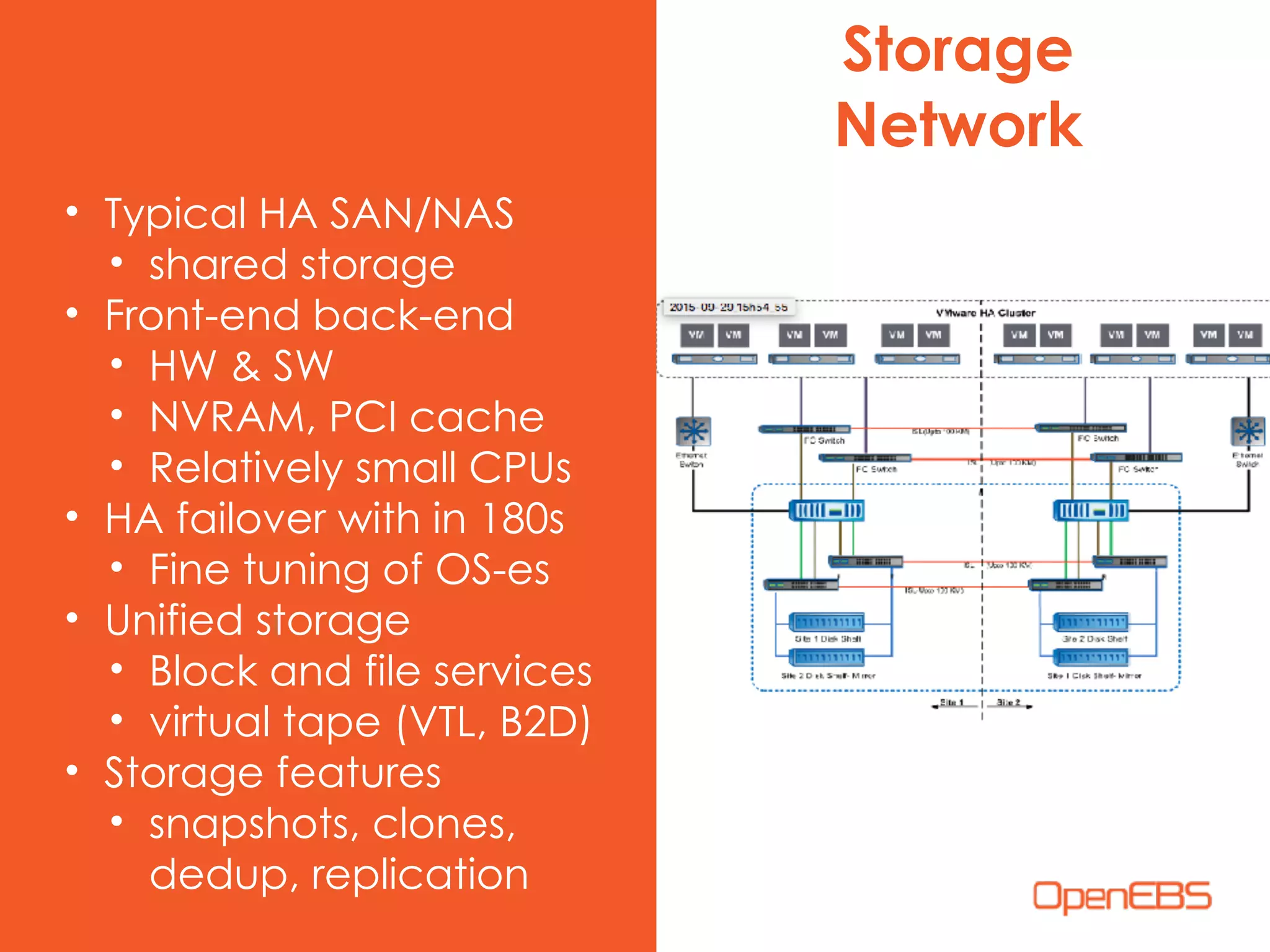
• Typical HA SAN/NAS
• shared storage
• Front-end back-end
• HW & SW
• NVRAM, PCI cache
• Relatively small CPUs
• HA failover with in 180s
• Fine tuning of OS-es
• Unified storage
• Block and file services
• virtual tape (VTL, B2D)
• Storage features
• snapshots, clones,
dedup, replication
Storage
Network
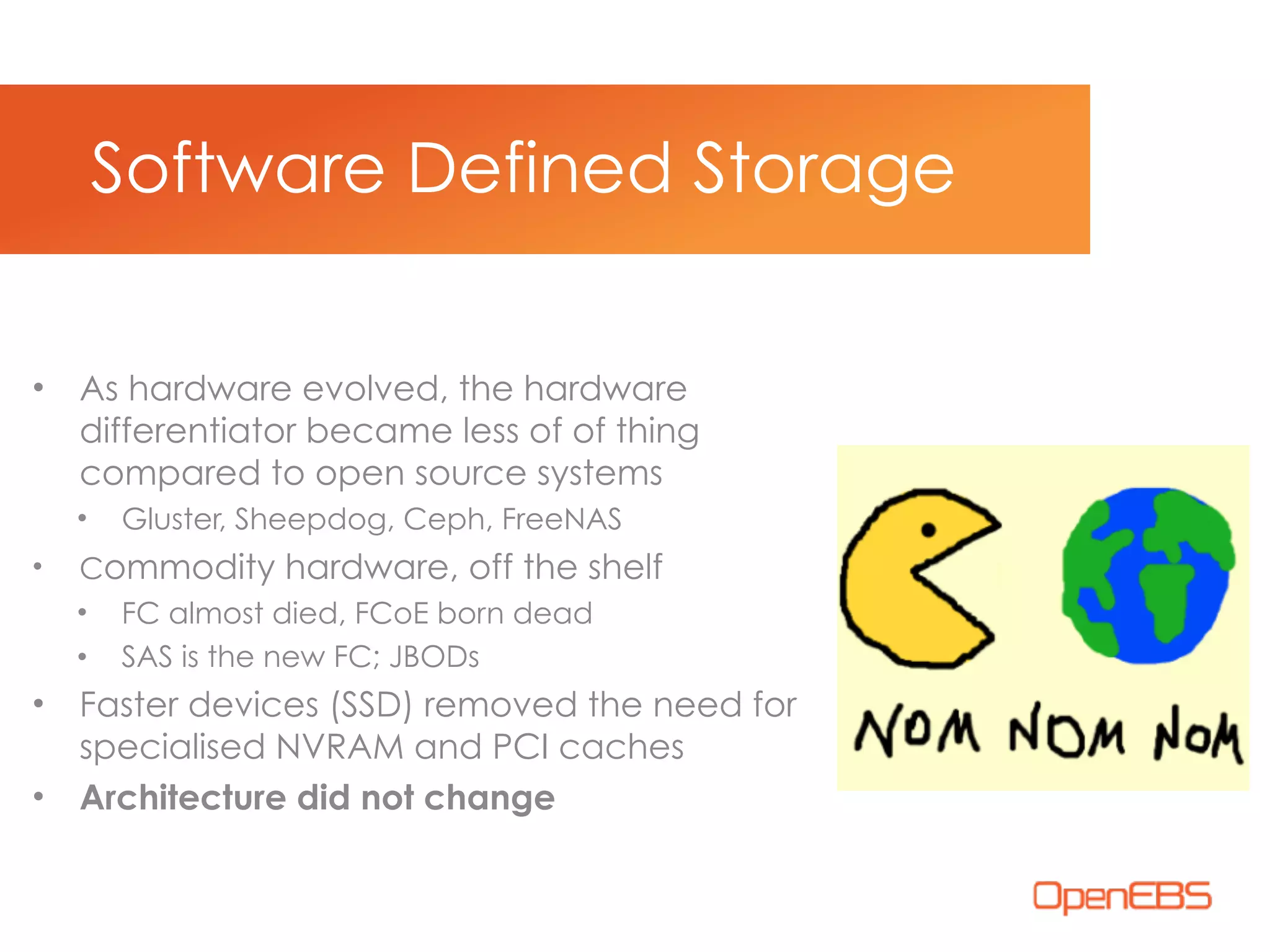
• As hardware evolved, the hardware
differentiator became less of of thing
compared to open source systems
• Gluster, Sheepdog, Ceph, FreeNAS
• Commodity hardware, off the shelf
• FC almost died, FCoE born dead
• SAS is the new FC; JBODs
• Faster devices (SSD) removed the need for
specialised NVRAM and PCI caches
• Architecture did not change
Software Defined Storage
• Apps have changed somebody forgot to tell storage
• Modern apps have native scalability features
– load balancers, database sharding, Paxos and RAFT
• Apps deployment; k8s scale up and down on demand
– K8s based on the google borg paper
– How to make that work across with storage?
• Apps are designed to fail across DC’s and even regions
– Data availability is not exclusively controlled at the storage layer
• Friction between teams
– Attempt to duck tape with ”volume plugins” as the arch is the same
– Typically does not allow for storage management capabilities
Then Containers (re)happend
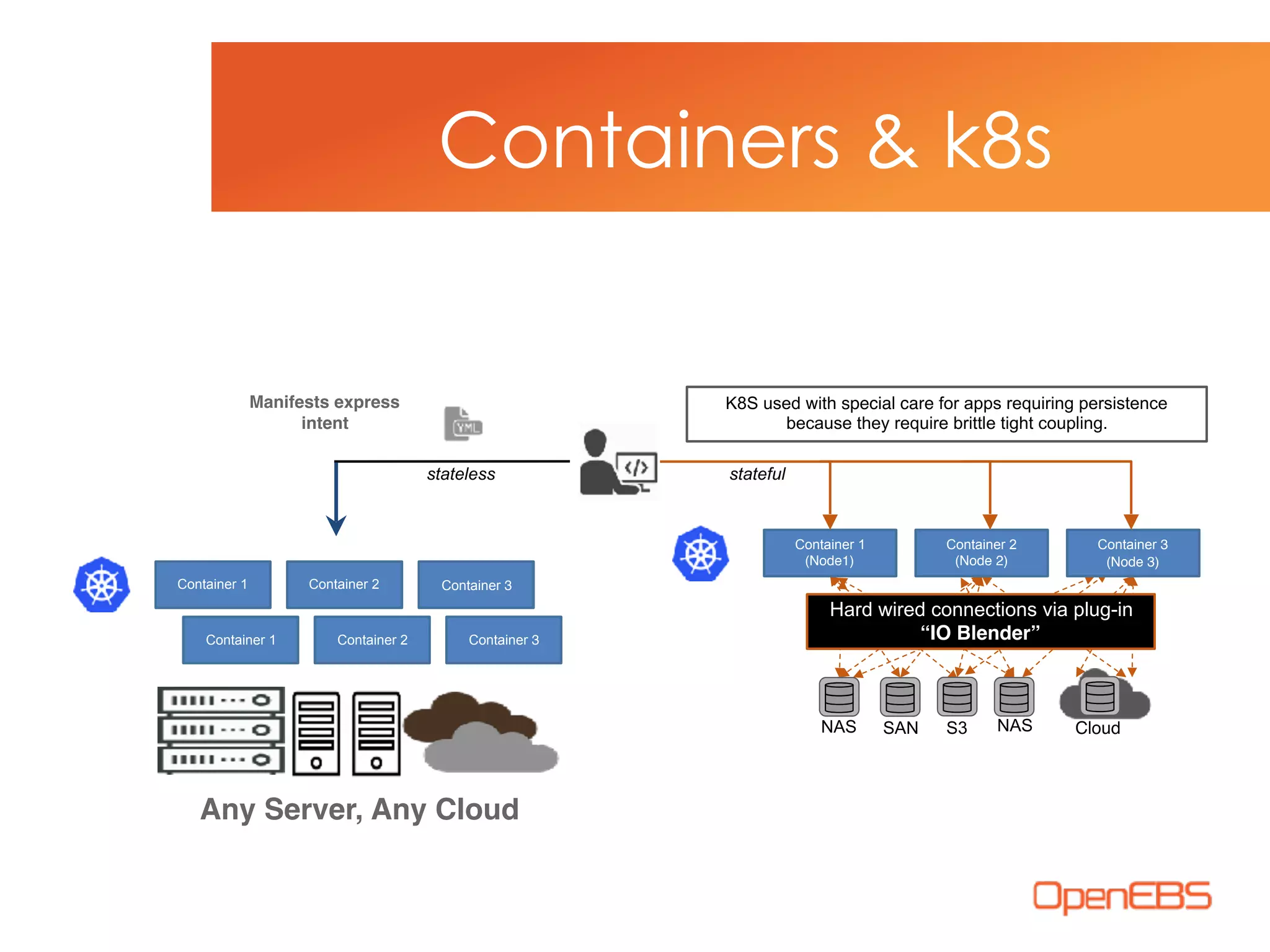
Containers & k8s
Manifests express
intent
K8S used with special care for apps requiring persistence
because they require brittle tight coupling.
Hard wired connections via plug-in
“IO Blender”
Container 1
(Node1)
Container 2
(Node 2)
Container 3
(Node 3)
stateless stateful
Container 1 Container 2 Container 3
NAS SAN S3 NAS Cloud
Any Server, Any Cloud
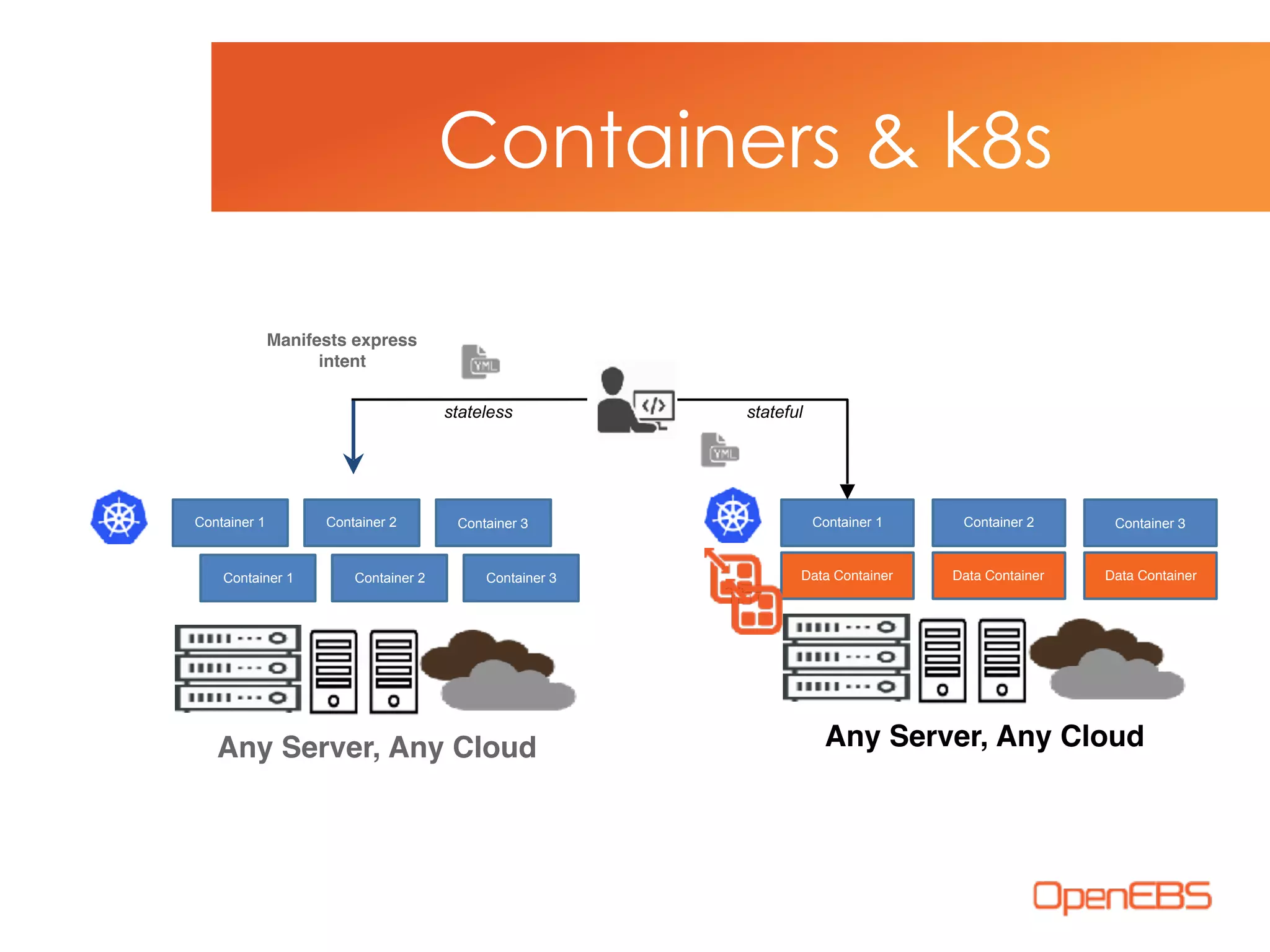
Containers & k8s
Manifests express
intent
stateless
Container 1 Container 2 Container 3
stateful
Data Container Data Container Data Container
Any Server, Any Cloud Any Server, Any Cloud
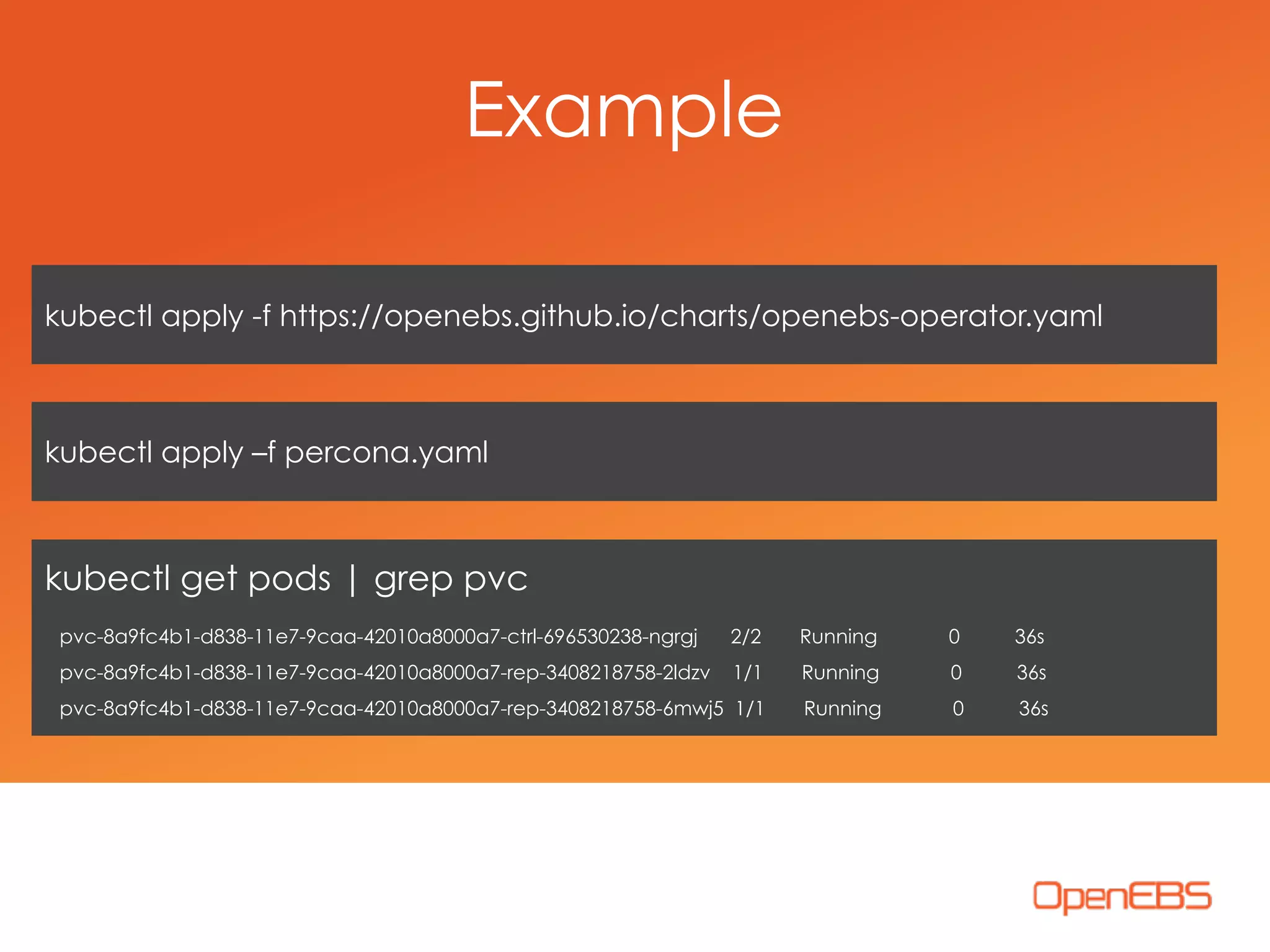
kubectl apply -f https://openebs.github.io/charts/openebs-operator.yaml
kubectl apply –f percona.yaml
kubectl get pods | grep pvc
pvc-8a9fc4b1-d838-11e7-9caa-42010a8000a7-ctrl-696530238-ngrgj 2/2 Running 0 36s

pvc-8a9fc4b1-d838-11e7-9caa-42010a8000a7-rep-3408218758-2ldzv 1/1 Running 0 36s

pvc-8a9fc4b1-d838-11e7-9caa-42010a8000a7-rep-3408218758-6mwj5 1/1 Running 0 36s
Example
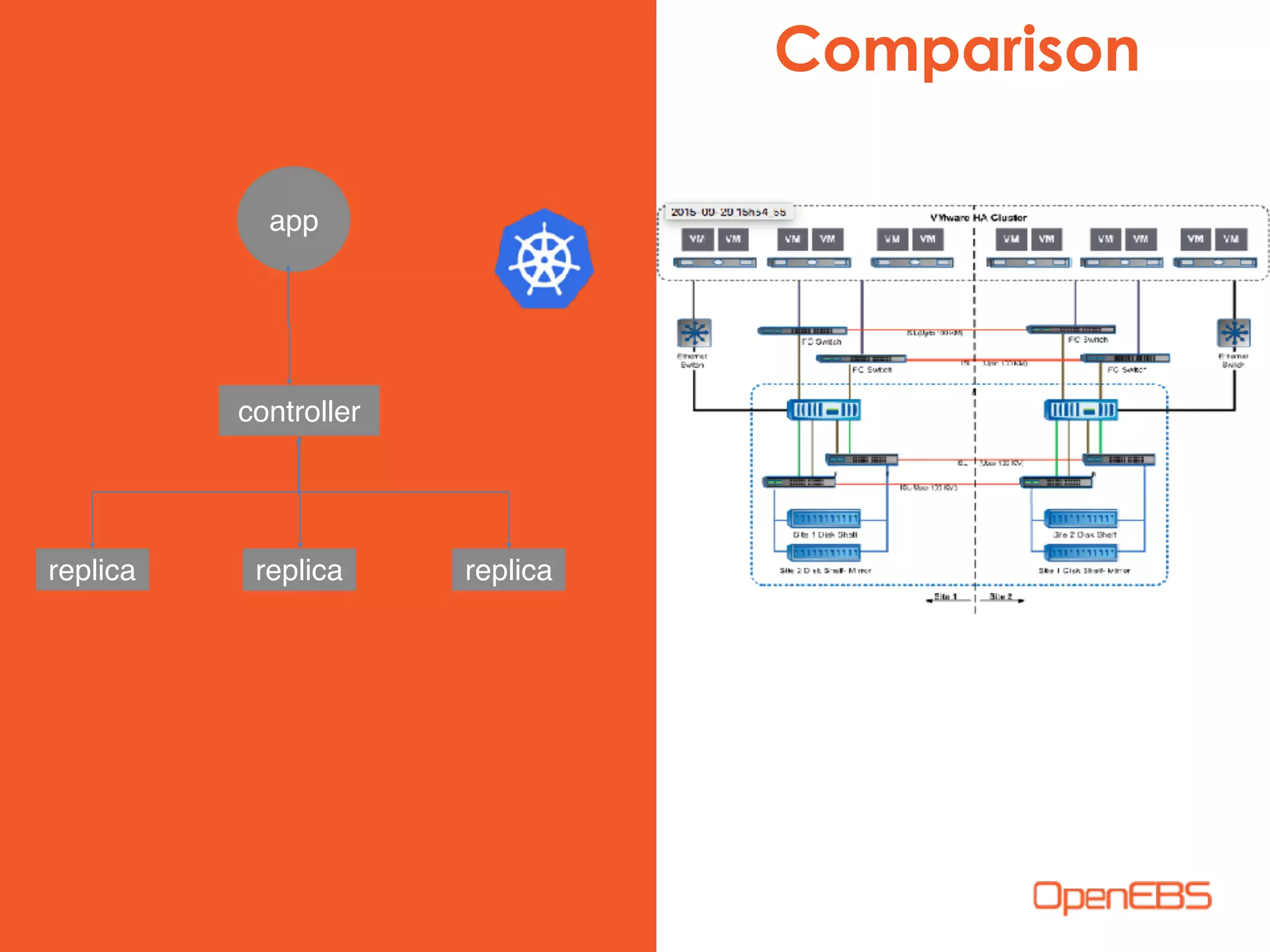
Comparison
controller
replica replica replica
app
Storage just fades away as a concern
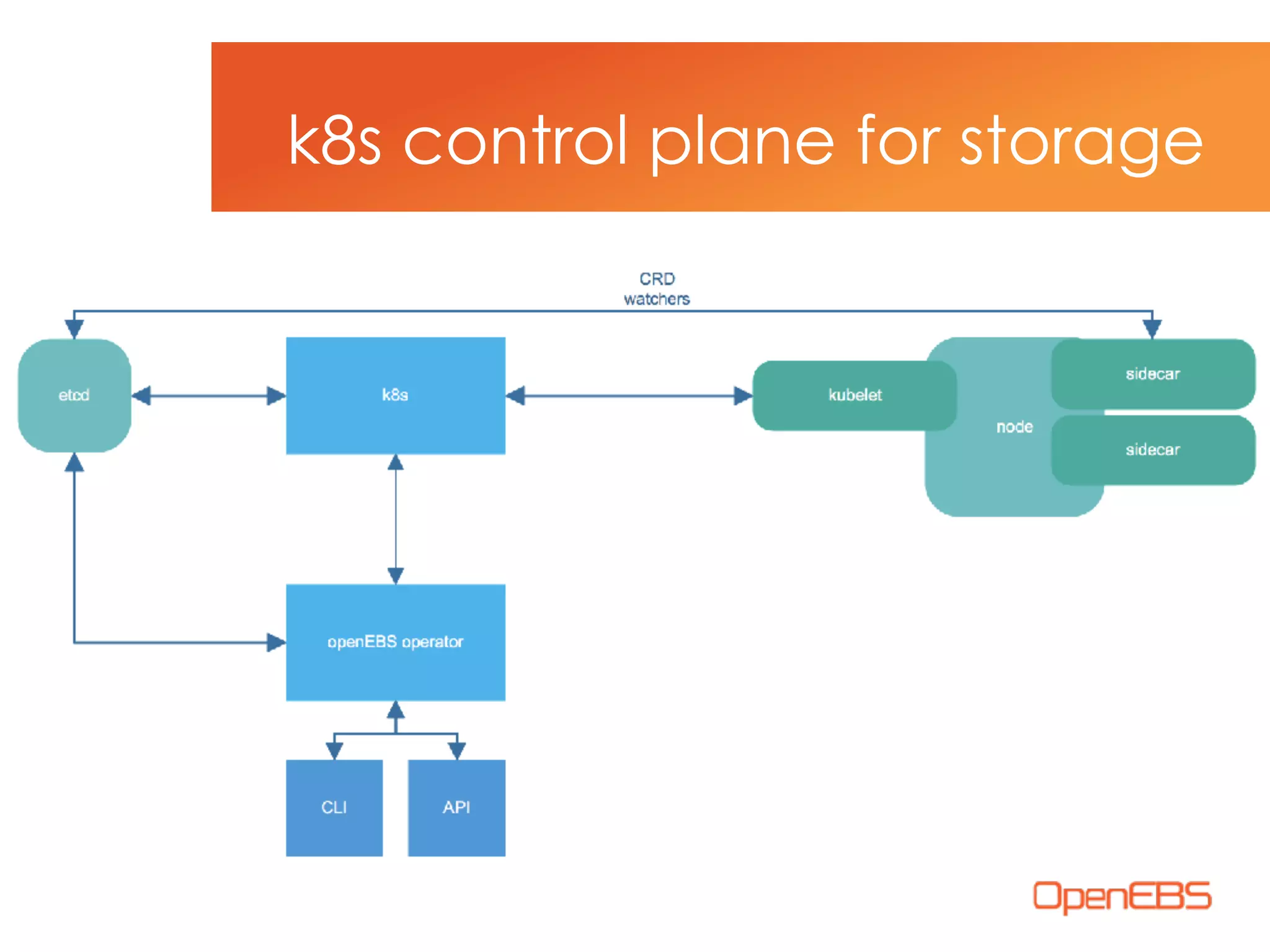
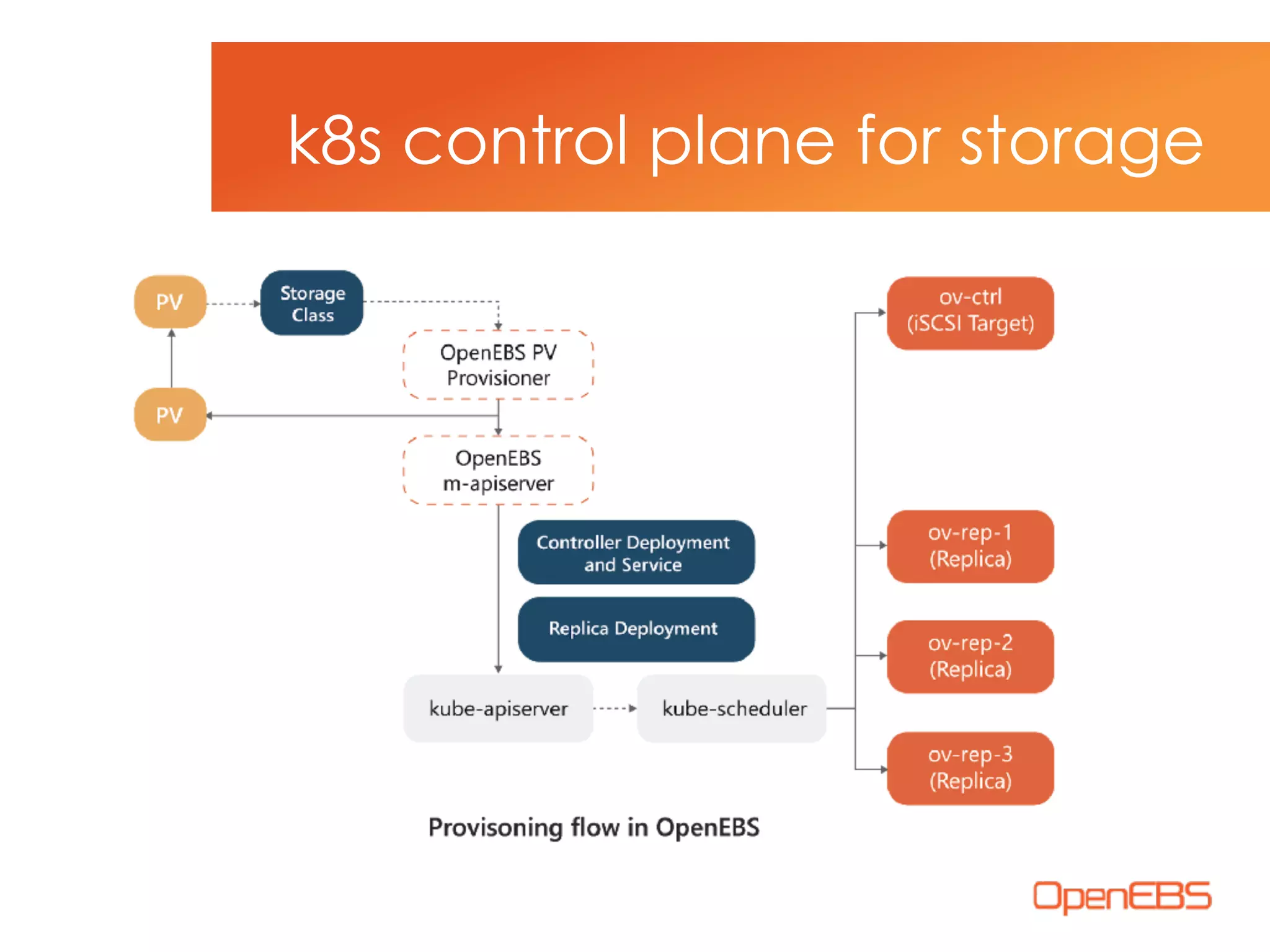
k8s control plane for storage
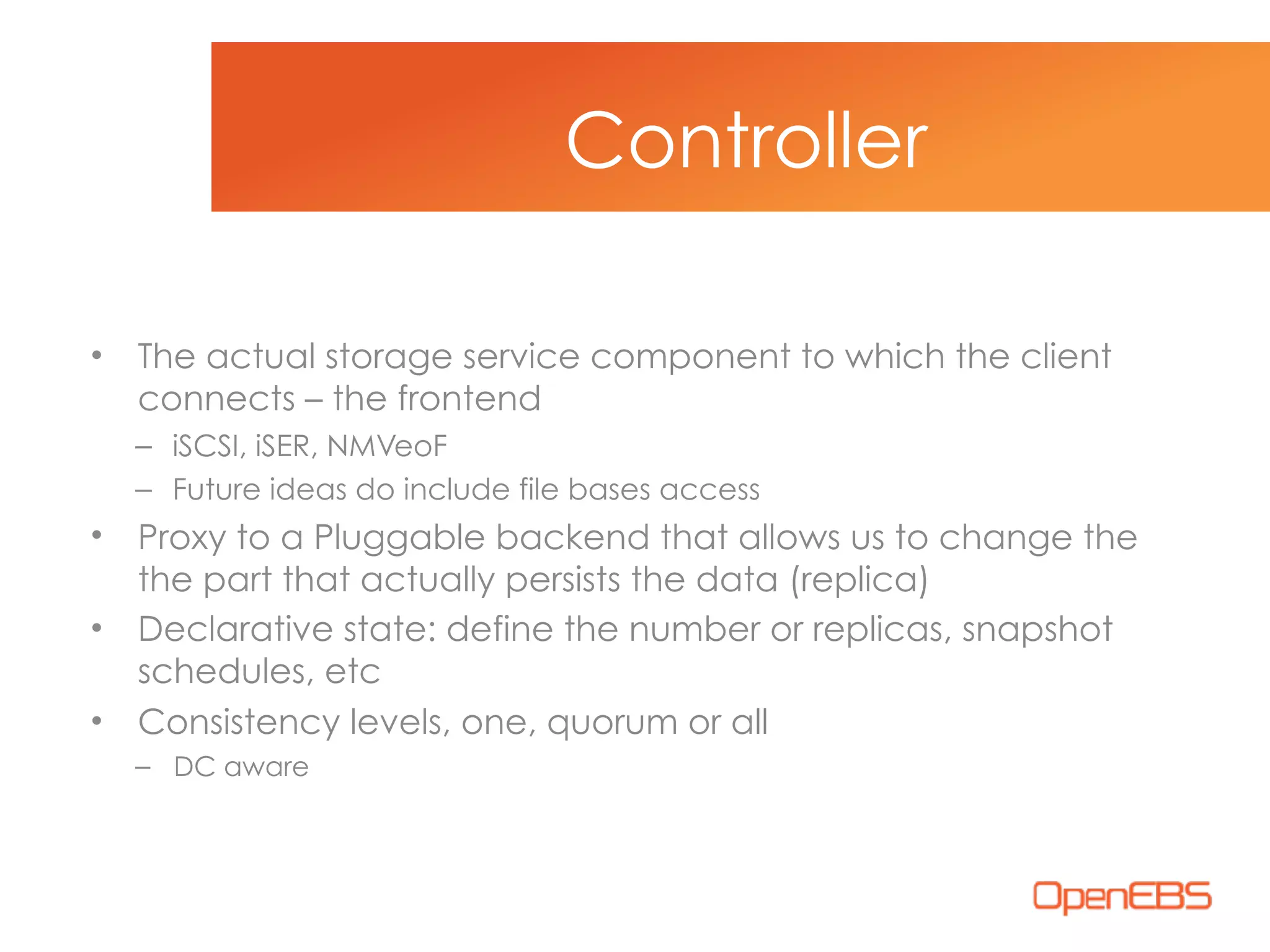
• The actual storage service component to which the client
connects – the frontend
– iSCSI, iSER, NMVeoF
– Future ideas do include file bases access
• Proxy to a Pluggable backend that allows us to change the
the part that actually persists the data (replica)
• Declarative state: define the number or replicas, snapshot
schedules, etc
• Consistency levels, one, quorum or all
– DC aware
Controller
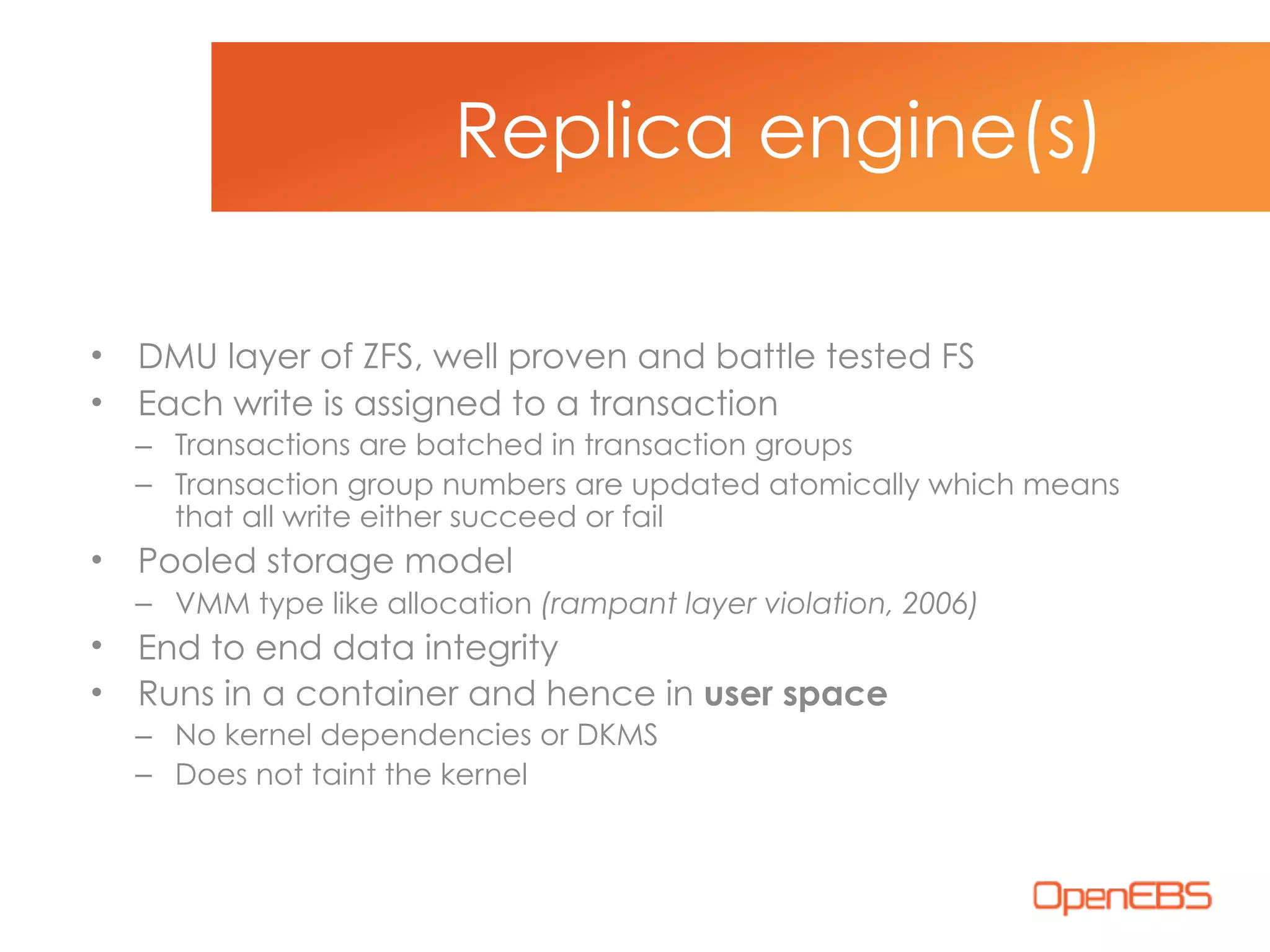
• DMU layer of ZFS, well proven and battle tested FS
• Each write is assigned to a transaction
– Transactions are batched in transaction groups
– Transaction group numbers are updated atomically which means
that all write either succeed or fail
• Pooled storage model
– VMM type like allocation (rampant layer violation, 2006)
• End to end data integrity
• Runs in a container and hence in user space
– No kernel dependencies or DKMS
– Does not taint the kernel
Replica engine(s)
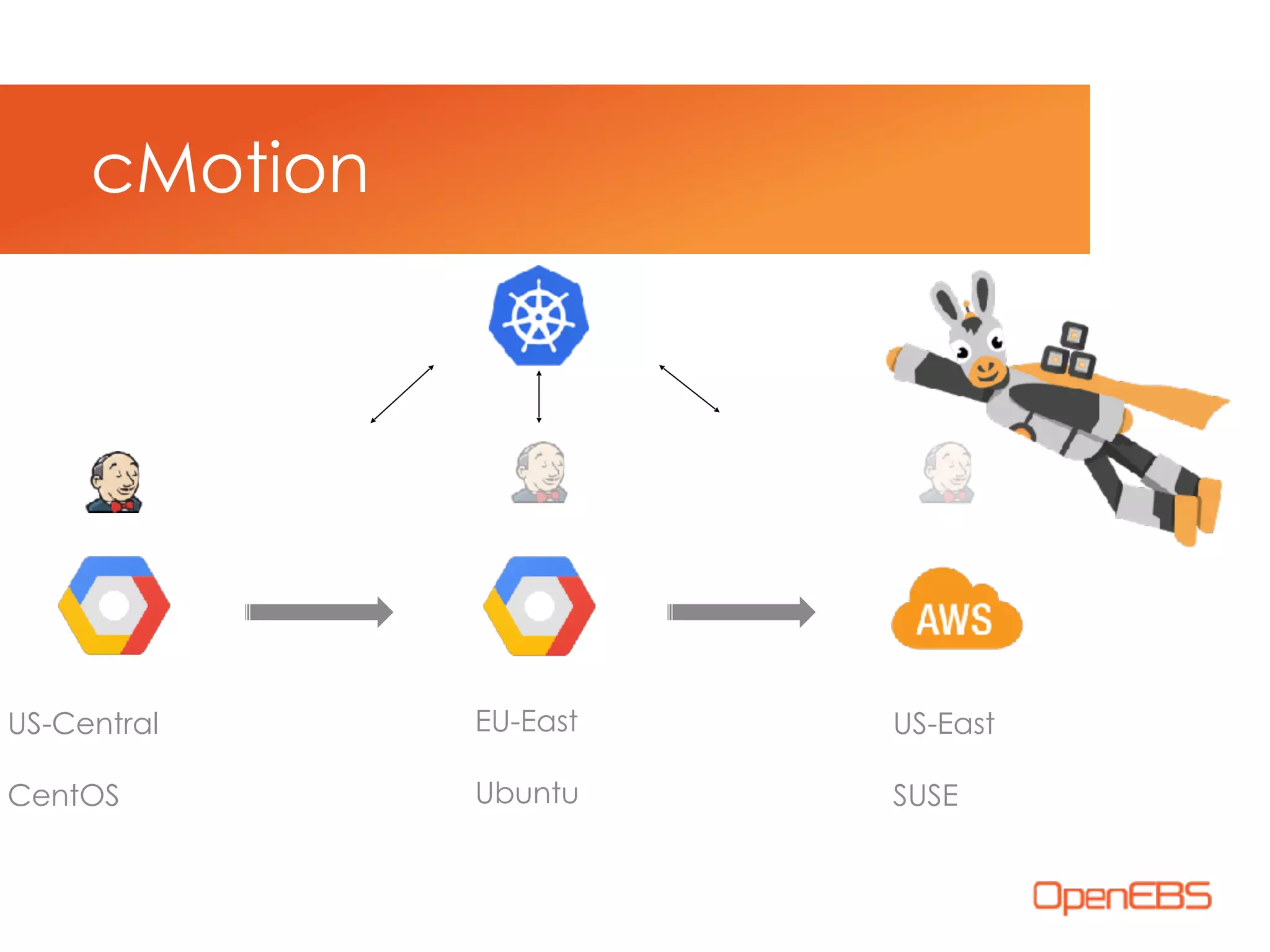
cMotion
US-Central
CentOS
EU-East
Ubuntu
US-East
SUSE
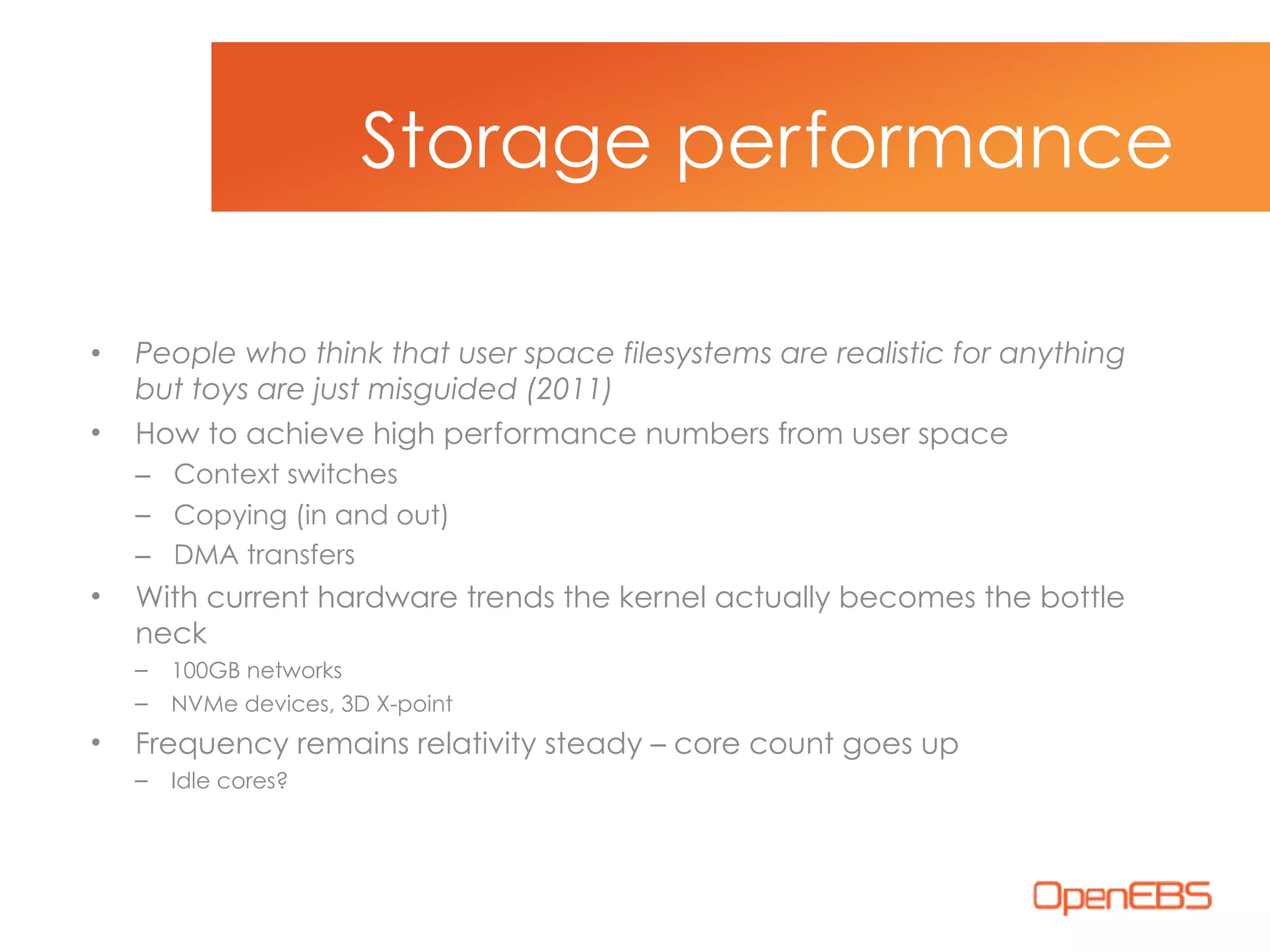
• People who think that user space filesystems are realistic for anything
but toys are just misguided (2011)
• How to achieve high performance numbers from user space
– Context switches
– Copying (in and out)
– DMA transfers
• With current hardware trends the kernel actually becomes the bottle
neck
– 100GB networks
– NVMe devices, 3D X-point
• Frequency remains relativity steady – core count goes up
– Idle cores?
Storage performance
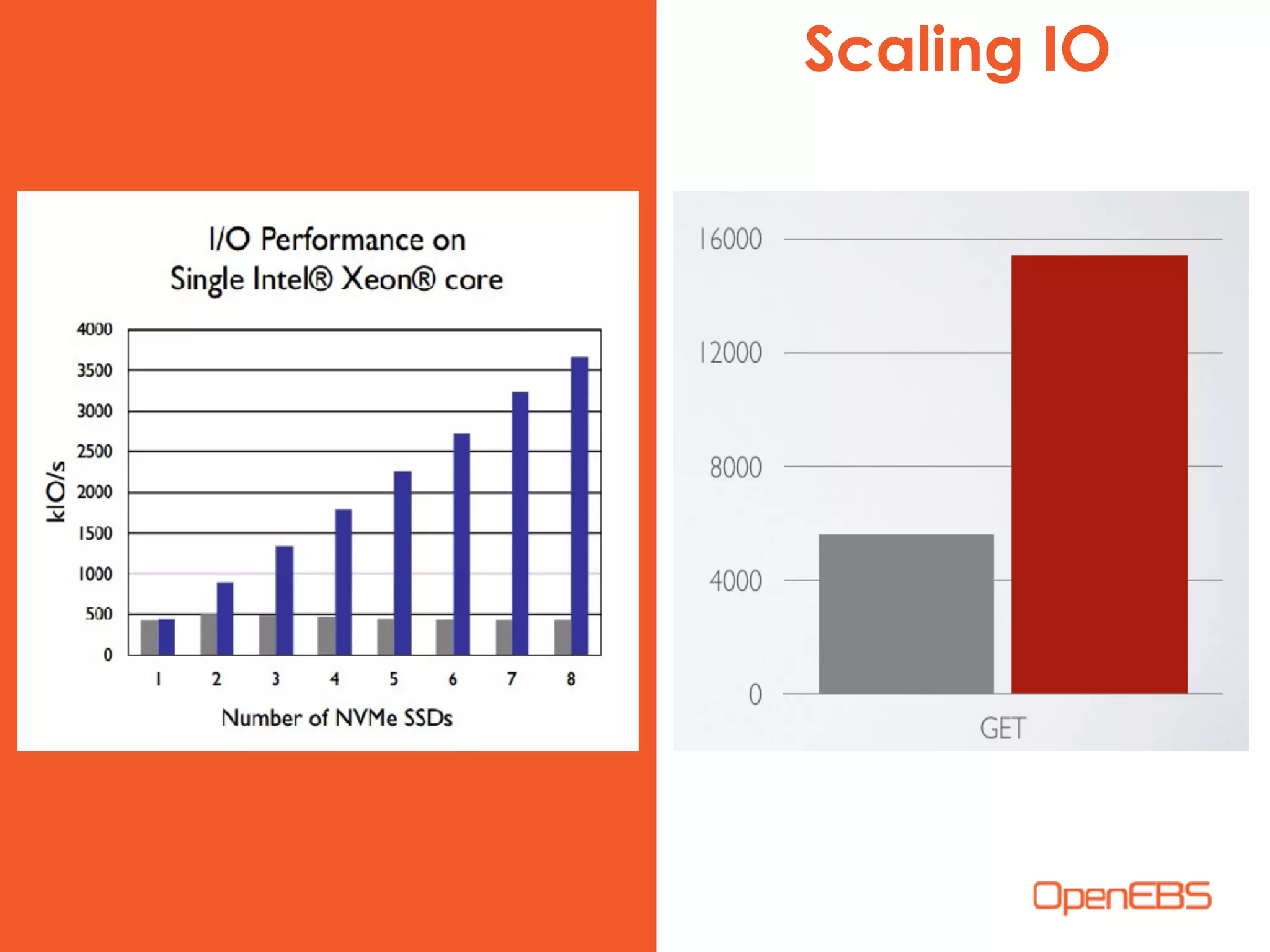
Scaling IO
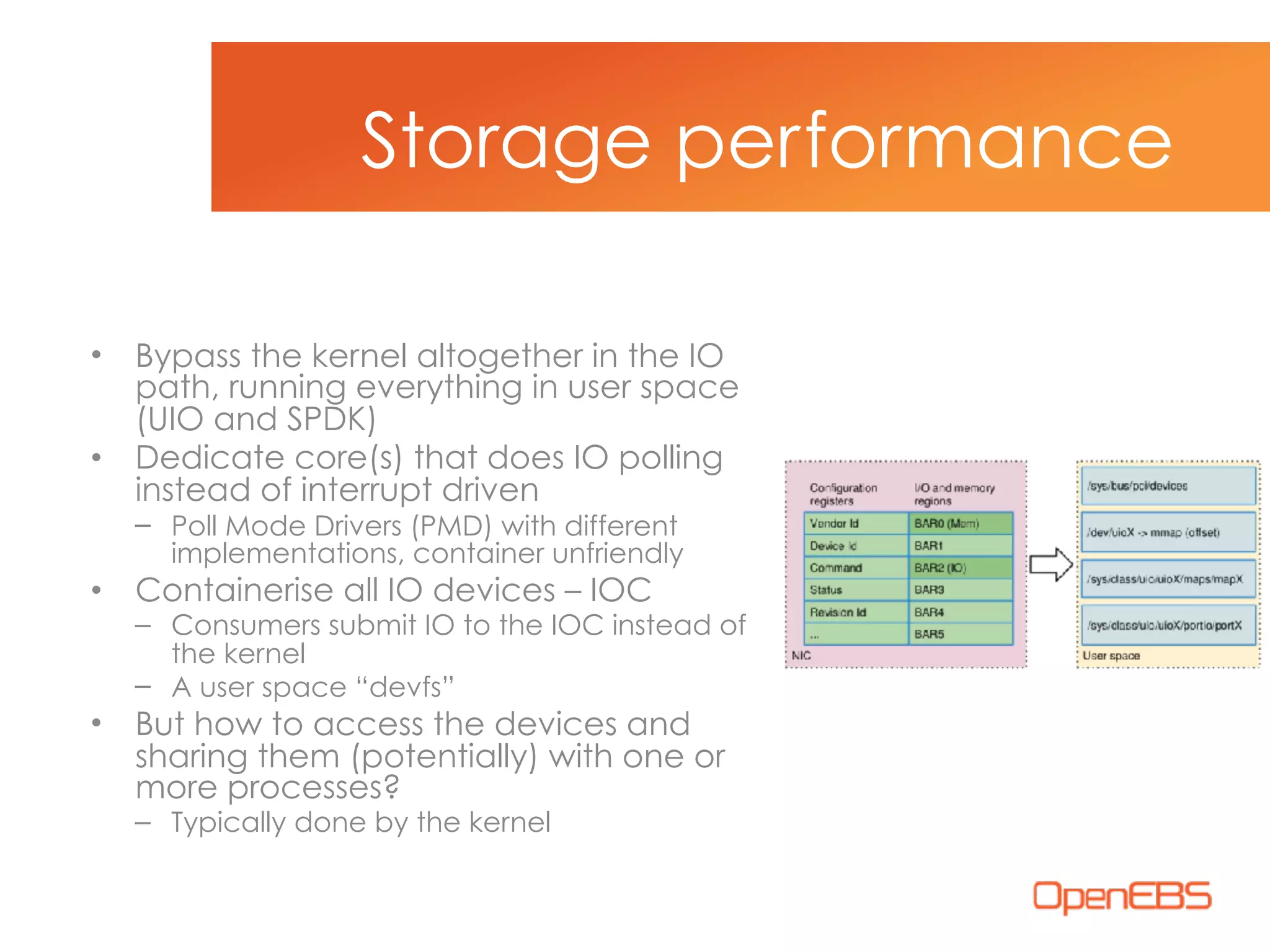
• Bypass the kernel altogether in the IO
path, running everything in user space
(UIO and SPDK)
• Dedicate core(s) that does IO polling
instead of interrupt driven
– Poll Mode Drivers (PMD) with different
implementations, container unfriendly
• Containerise all IO devices – IOC
– Consumers submit IO to the IOC instead of
the kernel
– A user space “devfs”
• But how to access the devices and
sharing them (potentially) with one or
more processes?
– Typically done by the kernel
Storage performance
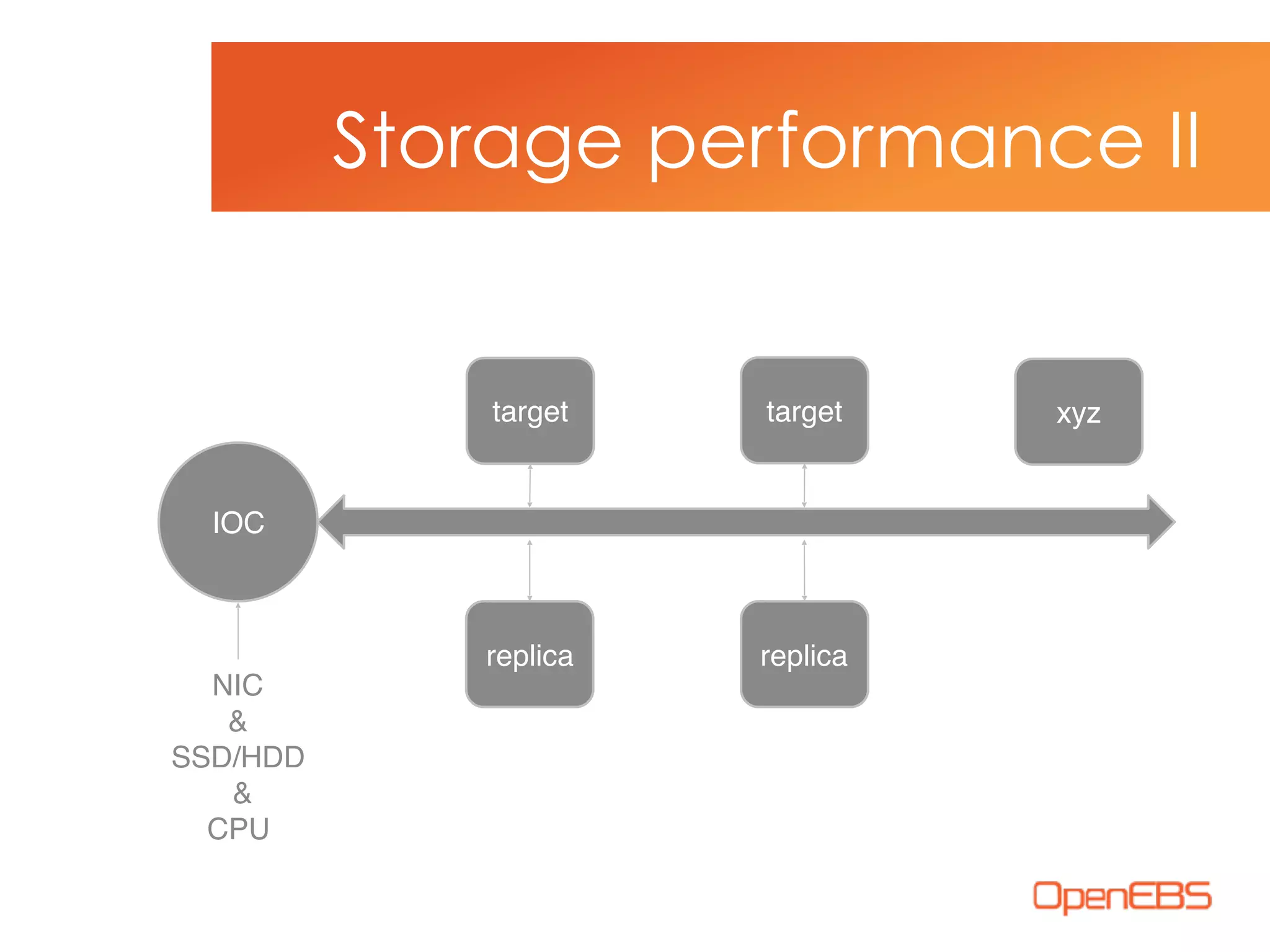
Storage performance II
IOC
replica
targettarget xyz
replica
NIC
&
SSD/HDD
&
CPU
• Reuse proven technology VHOST and virtio-{scsi,blk}
– In user space vhost-user (part of SPDK)
• IOC exposes VHOST interface to the “outside”
• Replica containers connect using virtio-scsi
– Replica exposes sockets to target for read/write
– Unfortunately, there is no virtio-scsi library (WIP)
• Allocate huge pages and pin them
– Suitable for DMA transfers
• Future work
– Explore further integration with FD.IO
– VPP-VCL in particular
Storage performance III
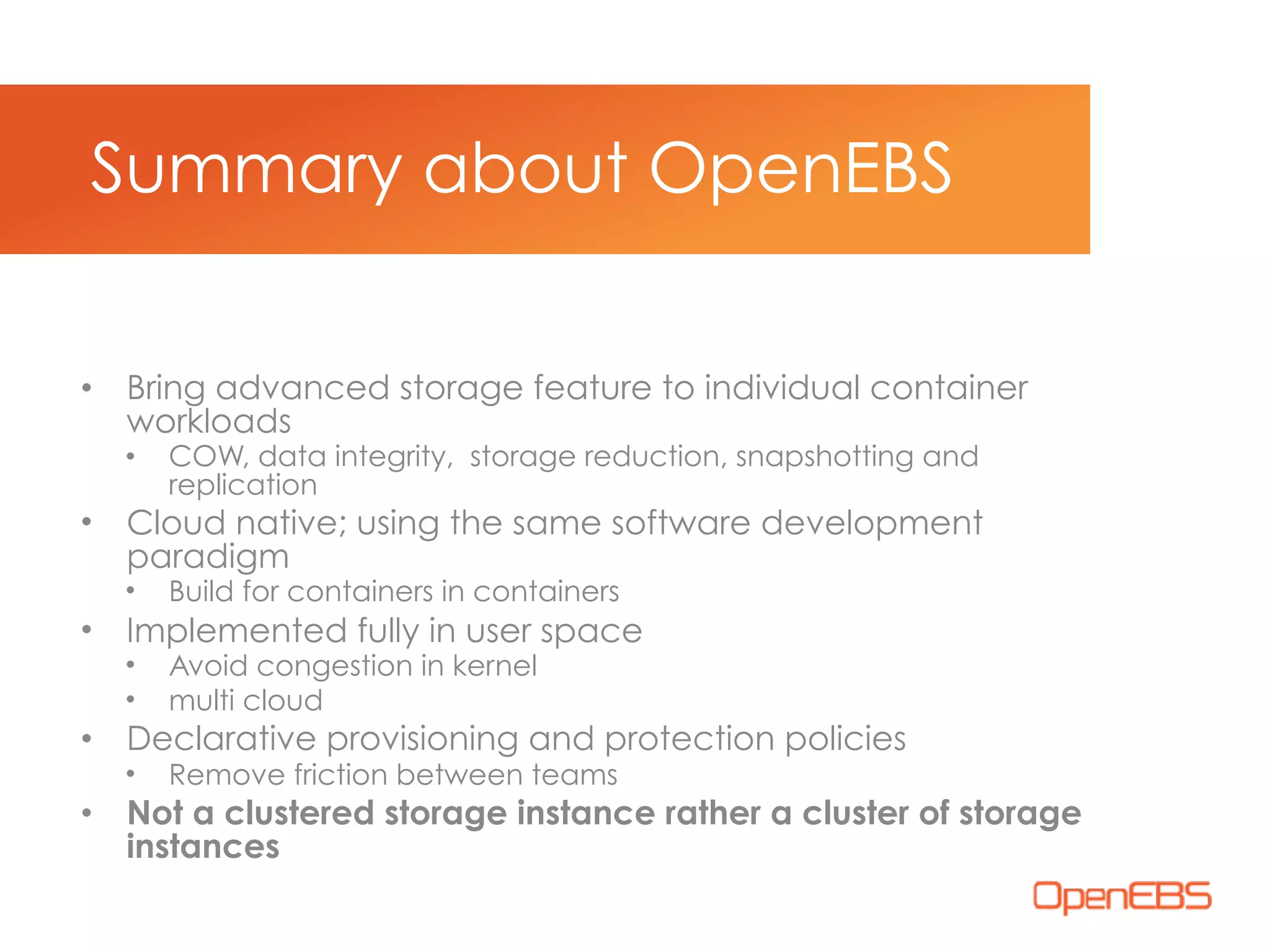
• Bring advanced storage feature to individual container
workloads
• COW, data integrity, storage reduction, snapshotting and
replication
• Cloud native; using the same software development
paradigm
• Build for containers in containers
• Implemented fully in user space
• Avoid congestion in kernel
• multi cloud
• Declarative provisioning and protection policies
• Remove friction between teams
• Not a clustered storage instance rather a cluster of storage
instances
Summary about OpenEBS
QUESTIONS?
www.openebs.io

Container Attached Storage (CAS) with OpenEBS - Berlin Kubernetes Meetup - May 2018

  • 1.
    Containerised Storage forContainers @JeffryMolanus @openEBS www.openebs.io K8s meetup, Berlin, May 2018
  • 2.
    What if storagefor container native applications was itself container native?
  • 3.
    • Originally —storage consolidation was done for efficiency reasons in terms of performance and capacity – Easier data management • Originating in the LAN (Novell, 80s), – Special MS-DOS TSRs to “login in” to the network – Novell Application Launcher, IPX/SPX • Quickly became a dedicated network (00’s) – Specialised HW — appliances – Separate network (FC) switches and cross DC interconnects How Did We Get Here?
  • 4.
    • Typical HASAN/NAS • shared storage • Front-end back-end • HW & SW • NVRAM, PCI cache • Relatively small CPUs • HA failover with in 180s • Fine tuning of OS-es • Unified storage • Block and file services • virtual tape (VTL, B2D) • Storage features • snapshots, clones, dedup, replication Storage Network
  • 5.
    • As hardwareevolved, the hardware differentiator became less of of thing compared to open source systems • Gluster, Sheepdog, Ceph, FreeNAS • Commodity hardware, off the shelf • FC almost died, FCoE born dead • SAS is the new FC; JBODs • Faster devices (SSD) removed the need for specialised NVRAM and PCI caches • Architecture did not change Software Defined Storage
  • 6.
    • Apps havechanged somebody forgot to tell storage • Modern apps have native scalability features – load balancers, database sharding, Paxos and RAFT • Apps deployment; k8s scale up and down on demand – K8s based on the google borg paper – How to make that work across with storage? • Apps are designed to fail across DC’s and even regions – Data availability is not exclusively controlled at the storage layer • Friction between teams – Attempt to duck tape with ”volume plugins” as the arch is the same – Typically does not allow for storage management capabilities Then Containers (re)happend
  • 7.
    Containers & k8s Manifestsexpress intent K8S used with special care for apps requiring persistence because they require brittle tight coupling. Hard wired connections via plug-in “IO Blender” Container 1 (Node1) Container 2 (Node 2) Container 3 (Node 3) stateless stateful Container 1 Container 2 Container 3 Container 1 Container 2 Container 3 NAS SAN S3 NAS Cloud Any Server, Any Cloud
  • 8.
    Containers & k8s Manifestsexpress intent stateless Container 1 Container 2 Container 3 Container 1 Container 2 Container 3 Container 1 Container 2 Container 3 stateful Data Container Data Container Data Container Any Server, Any Cloud Any Server, Any Cloud
  • 9.
    kubectl apply -fhttps://openebs.github.io/charts/openebs-operator.yaml kubectl apply –f percona.yaml kubectl get pods | grep pvc pvc-8a9fc4b1-d838-11e7-9caa-42010a8000a7-ctrl-696530238-ngrgj 2/2 Running 0 36s
 pvc-8a9fc4b1-d838-11e7-9caa-42010a8000a7-rep-3408218758-2ldzv 1/1 Running 0 36s
 pvc-8a9fc4b1-d838-11e7-9caa-42010a8000a7-rep-3408218758-6mwj5 1/1 Running 0 36s Example
  • 10.
  • 11.
    Storage just fadesaway as a concern
  • 12.
    k8s control planefor storage
  • 13.
    k8s control planefor storage
  • 14.
    • The actualstorage service component to which the client connects – the frontend – iSCSI, iSER, NMVeoF – Future ideas do include file bases access • Proxy to a Pluggable backend that allows us to change the the part that actually persists the data (replica) • Declarative state: define the number or replicas, snapshot schedules, etc • Consistency levels, one, quorum or all – DC aware Controller
  • 15.
    • DMU layerof ZFS, well proven and battle tested FS • Each write is assigned to a transaction – Transactions are batched in transaction groups – Transaction group numbers are updated atomically which means that all write either succeed or fail • Pooled storage model – VMM type like allocation (rampant layer violation, 2006) • End to end data integrity • Runs in a container and hence in user space – No kernel dependencies or DKMS – Does not taint the kernel Replica engine(s)
  • 16.
  • 17.
    • People whothink that user space filesystems are realistic for anything but toys are just misguided (2011) • How to achieve high performance numbers from user space – Context switches – Copying (in and out) – DMA transfers • With current hardware trends the kernel actually becomes the bottle neck – 100GB networks – NVMe devices, 3D X-point • Frequency remains relativity steady – core count goes up – Idle cores? Storage performance
  • 18.
  • 19.
    • Bypass thekernel altogether in the IO path, running everything in user space (UIO and SPDK) • Dedicate core(s) that does IO polling instead of interrupt driven – Poll Mode Drivers (PMD) with different implementations, container unfriendly • Containerise all IO devices – IOC – Consumers submit IO to the IOC instead of the kernel – A user space “devfs” • But how to access the devices and sharing them (potentially) with one or more processes? – Typically done by the kernel Storage performance
  • 20.
    Storage performance II IOC replica targettargetxyz replica NIC & SSD/HDD & CPU
  • 21.
    • Reuse proventechnology VHOST and virtio-{scsi,blk} – In user space vhost-user (part of SPDK) • IOC exposes VHOST interface to the “outside” • Replica containers connect using virtio-scsi – Replica exposes sockets to target for read/write – Unfortunately, there is no virtio-scsi library (WIP) • Allocate huge pages and pin them – Suitable for DMA transfers • Future work – Explore further integration with FD.IO – VPP-VCL in particular Storage performance III
  • 22.
    • Bring advancedstorage feature to individual container workloads • COW, data integrity, storage reduction, snapshotting and replication • Cloud native; using the same software development paradigm • Build for containers in containers • Implemented fully in user space • Avoid congestion in kernel • multi cloud • Declarative provisioning and protection policies • Remove friction between teams • Not a clustered storage instance rather a cluster of storage instances Summary about OpenEBS
  • 23.