1
Tiering on Gluster
Dan Lambright
Joseph Elwin Fernandes
Red Hat
2
Tiering is...
● A logical volume composed of diverse storage units
● Fast / slow
● Secure / nonsecure
● Expired hold time / expired
● compressed / uncompressed,
● Cloud expensive elastic storage / cheap
● etc.
● A timely feature
● Storage customization tool / SDS
● New world of diverse storage (SSDs, HDD, etc)
● Recently added by Ceph, Isilon
3
Cache Tiering
● Fast storage as cache for slow storage
● Fa$t SSD, slow HDD
● Fast 2X replicated, slow erasure coded
● Attach / detach tiers dynamically
● What goes in the cache?
● Track usage patterns
● Migrate file between tiers per usage
● Difference from memory cache
● “slow moving”
● Large index
4
Optimizations
● Other implementations: Ceph, dm cache, btier
● Tiering options possible
● Bias migrating large files over small
● Sequential vs. random
● Access counters
● O_DIRECT for migration – no Linux cache pollution
● Migration frequency
● Break files into chunks – sharding
● Only migrate when SSD close to full
5
Implementation – metadata store
● API to datastore : libgfdb
● SQLite current back-end (used in Swift)
● Investigating others, e.g. levelDB
● Bloom filter or timing wheel/hash possible
● Optimizations being considered..
● Write back cache DB ops
● Sharding databases
● Schedule DB defrag (“vacuum”)
● Etc..
6
Implementation – metadata capture
● “changetimerecorder” translator
● Server side
● Captures external I/O times (per PID)
● Off by default (but in graph)
● Etc..
7
Integration - DHT
● Stacking changes
● readdir maintains state per graph rather than per DHT
● Hashed subvolume is fixed
● Sometimes unpopulated inodes ctx are ok
● Need to deal with …
● I/Os during migration (blocking lock + timeout ?)
● I/Os during graph switches
● Tier has different xattr namespace than DHT
● Don't clash (e.g. commit-hash)
● Migration vs. Rebalancing / global inode
● Leverage rebalance enhancements
8
Integration - glusterd
● Attach / detach tier dynamically
● Graph change
● Isomorphic to add/remove bricks
● Statistics
● Isomorphic to rebalance daemon
● Challenging to modify glusterd :)
9
Benchmarking
● Many benchmarks a poor fit for tiering
● Tiering needs stable workloads
● Data stays in hot tier for hours or longer
● e.g. a set of videos popular for several days
● e.g. hospital in-patient records
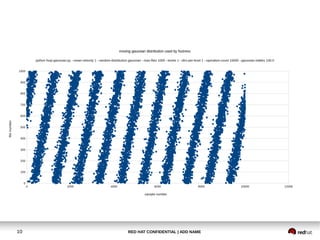
● New benchmarking tool
● FIO option for slow cache
● Can use with dm-cache, Ceph tiering, …
● DB results
● Scalability problems
RED HAT CONFIDENTIAL | ADD NAME10
Divider Slide
11
Next steps
● Read-only caching
● Time-based migration
● Allow volume expansion (add/remove bricks)
● Scale meta-data tracking
12
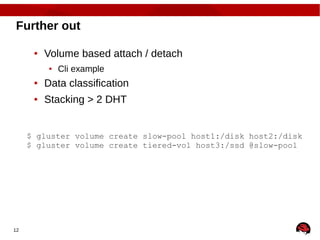
Further out
● Volume based attach / detach
● Cli example
● Data classification
● Stacking > 2 DHT
$ gluster volume create slow-pool host1:/disk host2:/disk
$ gluster volume create tiered-vol host3:/ssd @slow-pool

Gluster Data Tiering

  • 1.
    1 Tiering on Gluster DanLambright Joseph Elwin Fernandes Red Hat
  • 2.
    2 Tiering is... ● Alogical volume composed of diverse storage units ● Fast / slow ● Secure / nonsecure ● Expired hold time / expired ● compressed / uncompressed, ● Cloud expensive elastic storage / cheap ● etc. ● A timely feature ● Storage customization tool / SDS ● New world of diverse storage (SSDs, HDD, etc) ● Recently added by Ceph, Isilon
  • 3.
    3 Cache Tiering ● Faststorage as cache for slow storage ● Fa$t SSD, slow HDD ● Fast 2X replicated, slow erasure coded ● Attach / detach tiers dynamically ● What goes in the cache? ● Track usage patterns ● Migrate file between tiers per usage ● Difference from memory cache ● “slow moving” ● Large index
  • 4.
    4 Optimizations ● Other implementations:Ceph, dm cache, btier ● Tiering options possible ● Bias migrating large files over small ● Sequential vs. random ● Access counters ● O_DIRECT for migration – no Linux cache pollution ● Migration frequency ● Break files into chunks – sharding ● Only migrate when SSD close to full
  • 5.
    5 Implementation – metadatastore ● API to datastore : libgfdb ● SQLite current back-end (used in Swift) ● Investigating others, e.g. levelDB ● Bloom filter or timing wheel/hash possible ● Optimizations being considered.. ● Write back cache DB ops ● Sharding databases ● Schedule DB defrag (“vacuum”) ● Etc..
  • 6.
    6 Implementation – metadatacapture ● “changetimerecorder” translator ● Server side ● Captures external I/O times (per PID) ● Off by default (but in graph) ● Etc..
  • 7.
    7 Integration - DHT ●Stacking changes ● readdir maintains state per graph rather than per DHT ● Hashed subvolume is fixed ● Sometimes unpopulated inodes ctx are ok ● Need to deal with … ● I/Os during migration (blocking lock + timeout ?) ● I/Os during graph switches ● Tier has different xattr namespace than DHT ● Don't clash (e.g. commit-hash) ● Migration vs. Rebalancing / global inode ● Leverage rebalance enhancements
  • 8.
    8 Integration - glusterd ●Attach / detach tier dynamically ● Graph change ● Isomorphic to add/remove bricks ● Statistics ● Isomorphic to rebalance daemon ● Challenging to modify glusterd :)
  • 9.
    9 Benchmarking ● Many benchmarksa poor fit for tiering ● Tiering needs stable workloads ● Data stays in hot tier for hours or longer ● e.g. a set of videos popular for several days ● e.g. hospital in-patient records ● New benchmarking tool ● FIO option for slow cache ● Can use with dm-cache, Ceph tiering, … ● DB results ● Scalability problems
  • 10.
    RED HAT CONFIDENTIAL| ADD NAME10 Divider Slide
  • 11.
    11 Next steps ● Read-onlycaching ● Time-based migration ● Allow volume expansion (add/remove bricks) ● Scale meta-data tracking
  • 12.
    12 Further out ● Volumebased attach / detach ● Cli example ● Data classification ● Stacking > 2 DHT $ gluster volume create slow-pool host1:/disk host2:/disk $ gluster volume create tiered-vol host3:/ssd @slow-pool

Editor's Notes

  • #5 Apply tools to new environments My pov: systems software and educator
  • #6 Apply tools to new environments My pov: systems software and educator
  • #7 Apply tools to new environments My pov: systems software and educator
  • #8 Apply tools to new environments My pov: systems software and educator
  • #9 Apply tools to new environments My pov: systems software and educator
  • #10 Apply tools to new environments My pov: systems software and educator
  • #12 Apply tools to new environments My pov: systems software and educator
  • #13 Apply tools to new environments My pov: systems software and educator