CONTACT STRESSES
Between Two Surfaces Presses Together

Muhanned Mahdi
Instructor : Professor Satchi
Venkataraman
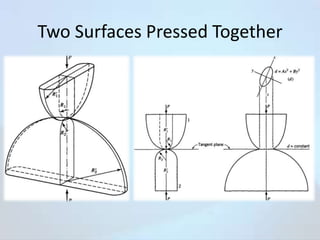
Two Surfaces Pressed Together
• The contact stresses created when surfaces of two bodies are pressed
together by external loads are the significant stresses; that is, the stresses on
Or somewhat beneath the surface of contact are the major causes of failure
of one or both of the bodies.
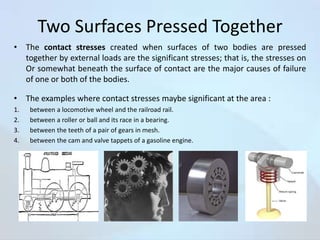
• The examples where contact stresses maybe significant at the area :
1.
2.
3.
4.

between a locomotive wheel and the railroad rail.
between a roller or ball and its race in a bearing.
between the teeth of a pair of gears in mesh.
between the cam and valve tappets of a gasoline engine.
Two Surfaces Pressed Together
•

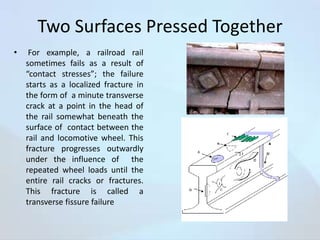
For example, a railroad rail
sometimes fails as a result of
“contact stresses”; the failure
starts as a localized fracture in
the form of a minute transverse
crack at a point in the head of
the rail somewhat beneath the
surface of contact between the
rail and locomotive wheel. This
fracture progresses outwardly
under the influence of the
repeated wheel loads until the
entire rail cracks or fractures.
This fracture is called a
transverse fissure failure
Two Surfaces Pressed Together
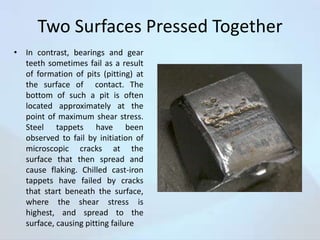
• In contrast, bearings and gear
teeth sometimes fail as a result
of formation of pits (pitting) at
the surface of contact. The
bottom of such a pit is often
located approximately at the
point of maximum shear stress.
Steel tappets have been
observed to fail by initiation of
microscopic cracks at the
surface that then spread and
cause flaking. Chilled cast-iron
tappets have failed by cracks
that start beneath the surface,
where the shear stress is
highest, and spread to the
surface, causing pitting failure
Assumptions
1. Load
•

It is assumed that there is no tendency for one body to slide with
respect to the other and, hence, no friction force is present.
There is no effect of a friction force.

2. Properties of Materials
•

The material of each body is homogeneous, isotropic, and elastic
in accordance with Hooke’s law, but the two bodies are not
necessarily made of the same material.

3. Shape of Surfaces near Point of Contact before Loading
•

If two bodies are in contact at a point, there is a common tangent
plane to the surfaces at The point of contact. In the solution for
contact stresses, an expression for the distance Between
corresponding points on the surfaces near the point of contact is
required.
Two Surfaces Pressed Together
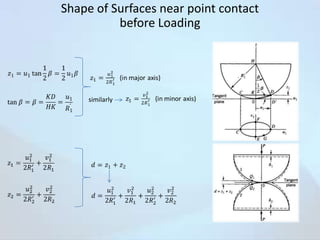
Shape of Surfaces near point contact
before Loading

similarly
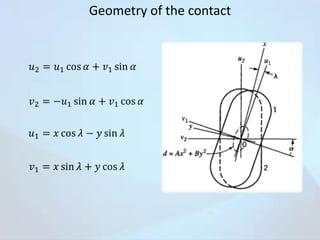
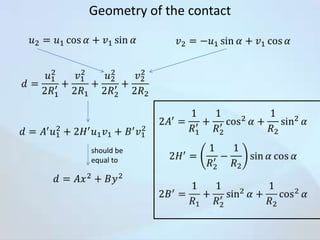
Geometry of the contact

should be
equal to
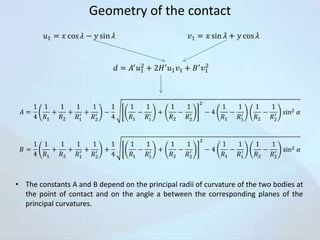
Geometry of the contact

• The constants A and B depend on the principal radii of curvature of the two bodies at
the point of contact and on the angle a between the corresponding planes of the
principal curvatures.
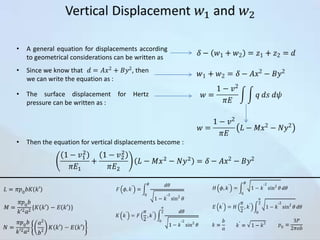
•

A general equation for displacements according
to geometrical considerations can be written as

•

Since we know that
we can write the equation as :

•

The surface displacement for Hertz
pressure can be written as :

•

Then the equation for vertical displacements become :

, then
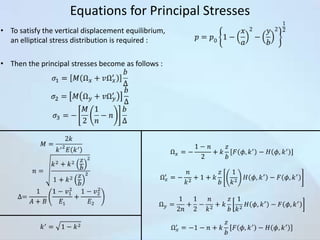
Equations for Principal Stresses
• To satisfy the vertical displacement equilibrium,
an elliptical stress distribution is required :
• Then the principal stresses become as follows :
Equations for Principal Stresses
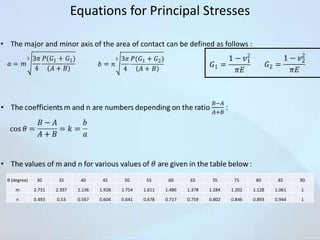
• The major and minor axis of the area of contact can be defined as follows :

θ (degree)

30

35

40

45

50

55

60

65

70

75

80

85

90

m

2.731

2.397

2.136

1.928

1.754

1.611

1.486

1.378

1.284

1.202

1.128

1.061

1

n

0.493

0.53

0.567

0.604

0.641

0.678

0.717

0.759

0.802

0.846

0.893

0.944

1
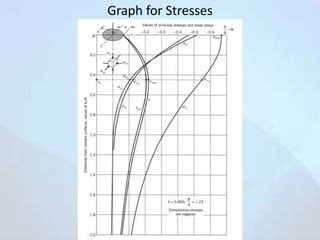
Graph for Stresses

Contact stresses

  • 1.
    CONTACT STRESSES Between TwoSurfaces Presses Together Muhanned Mahdi Instructor : Professor Satchi Venkataraman
  • 2.
    Two Surfaces PressedTogether • The contact stresses created when surfaces of two bodies are pressed together by external loads are the significant stresses; that is, the stresses on Or somewhat beneath the surface of contact are the major causes of failure of one or both of the bodies. • The examples where contact stresses maybe significant at the area : 1. 2. 3. 4. between a locomotive wheel and the railroad rail. between a roller or ball and its race in a bearing. between the teeth of a pair of gears in mesh. between the cam and valve tappets of a gasoline engine.
  • 3.
    Two Surfaces PressedTogether • For example, a railroad rail sometimes fails as a result of “contact stresses”; the failure starts as a localized fracture in the form of a minute transverse crack at a point in the head of the rail somewhat beneath the surface of contact between the rail and locomotive wheel. This fracture progresses outwardly under the influence of the repeated wheel loads until the entire rail cracks or fractures. This fracture is called a transverse fissure failure
  • 4.
    Two Surfaces PressedTogether • In contrast, bearings and gear teeth sometimes fail as a result of formation of pits (pitting) at the surface of contact. The bottom of such a pit is often located approximately at the point of maximum shear stress. Steel tappets have been observed to fail by initiation of microscopic cracks at the surface that then spread and cause flaking. Chilled cast-iron tappets have failed by cracks that start beneath the surface, where the shear stress is highest, and spread to the surface, causing pitting failure
  • 5.
    Assumptions 1. Load • It isassumed that there is no tendency for one body to slide with respect to the other and, hence, no friction force is present. There is no effect of a friction force. 2. Properties of Materials • The material of each body is homogeneous, isotropic, and elastic in accordance with Hooke’s law, but the two bodies are not necessarily made of the same material. 3. Shape of Surfaces near Point of Contact before Loading • If two bodies are in contact at a point, there is a common tangent plane to the surfaces at The point of contact. In the solution for contact stresses, an expression for the distance Between corresponding points on the surfaces near the point of contact is required.
  • 6.
  • 7.
    Shape of Surfacesnear point contact before Loading similarly
  • 8.
  • 9.
    Geometry of thecontact should be equal to
  • 10.
    Geometry of thecontact • The constants A and B depend on the principal radii of curvature of the two bodies at the point of contact and on the angle a between the corresponding planes of the principal curvatures.
  • 11.
    • A general equationfor displacements according to geometrical considerations can be written as • Since we know that we can write the equation as : • The surface displacement for Hertz pressure can be written as : • Then the equation for vertical displacements become : , then
  • 12.
    Equations for PrincipalStresses • To satisfy the vertical displacement equilibrium, an elliptical stress distribution is required : • Then the principal stresses become as follows :
  • 13.
    Equations for PrincipalStresses • The major and minor axis of the area of contact can be defined as follows : θ (degree) 30 35 40 45 50 55 60 65 70 75 80 85 90 m 2.731 2.397 2.136 1.928 1.754 1.611 1.486 1.378 1.284 1.202 1.128 1.061 1 n 0.493 0.53 0.567 0.604 0.641 0.678 0.717 0.759 0.802 0.846 0.893 0.944 1
  • 14.