The effects of roughness on the area of contact
and on the elastostatic friction
FEM simulation of micro-scale rough contact
and real world applications
PhD dissertation defense of Alessandro Rigazzi
Institute of Computational Science, University of Lugano
November 27th 2014
INTRODUCTION
Effects of roughness on the area of contact and on the elastostatic friction 2
The importance of rough contact
• All real surfaces are –at some scale– rough
– At macro-scale (10-3–10-2 m)
– At micro-scale (10-6 m)
– At nano-scale (10-9 m)
• As a consequence, every contact in the real
world involves rough surfaces
– Contact areas are not smooth and continuous
– They are collections of small fragmented contact
islands, spots, or points
3Effects of roughness on the area of contact and on the elastostatic friction
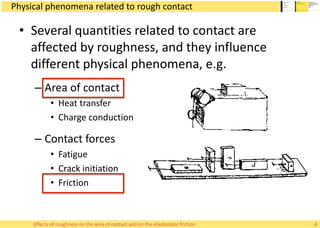
Physical phenomena related to rough contact
• Several quantities related to contact are
affected by roughness, and they influence
different physical phenomena, e.g.
– Area of contact
• Heat transfer
• Charge conduction
– Contact forces
• Fatigue
• Crack initiation
• Friction
4Effects of roughness on the area of contact and on the elastostatic friction
Rough contact: strategies
Homogenization
• Surfaces are smooth
• Quantities like friction
coefficient or heat
conduction are used in
averaged forms, as
parameters of the
simulations
• Lack of local variations
of results
Full scale resolution
• Realistic surfaces
• Physical laws imposed at
microscopic level, and
macroscopic quantities
are derived
• Need to consider several
orders of magnitude
• Two numerical approaches for rough contact
5Effects of roughness on the area of contact and on the elastostatic friction
The challenge
• We aim to discretize macroscopic bodies up to
microscopic scale and apply the Finite Element
Method
• The resulting system is huge
– Millions of unknowns only on the contact boundary
• Contact problems are highly non-smooth
• Solution of such systems is feasible only using
an efficient massively parallel contact solver
– Multigrid solver implemented in obslib++/UG
6Effects of roughness on the area of contact and on the elastostatic friction
The ultimate goal
• With the chosen method, we want to quantify
the influence of roughness on two relevant
features of rough contact
– Evolution of the real contact area
– Elastostatic friction force
• We want to derive the contribution of selected
roughness and parameters
7Effects of roughness on the area of contact and on the elastostatic friction
ROUGHNESS
CHARACTERIZATION
Effects of roughness on the area of contact and on the elastostatic friction 8
Roughness
• We need to formally define roughness
• Many measures exist covering different aspects of
roughness
– Root mean square roughness
– Mean profile depth
– …
• But we prefer a compact description based on the
Power Spectral Density (PSD) of the surfaces
– Geometric measures can be derived [Nayak 1971]
Effects of roughness on the area of contact and on the elastostatic friction 9
Mathematical representation of rough surfaces
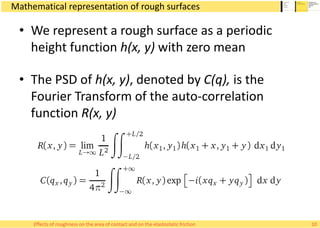
• We represent a rough surface as a periodic
height function h(x, y) with zero mean
• The PSD of h(x, y), denoted by C(q), is the
Fourier Transform of the auto-correlation
function R(x, y)
10Effects of roughness on the area of contact and on the elastostatic friction
Self-affine rough surfaces
• All natural surfaces show self-affinity
– Geometric features repeat themselves at different
length scales
– Similar to fractals, up to some limit scales
– Mostly isotropic
• All specimens of the same material have the
same statistical parameters, i.e. the same PSD
– They are different realization of the same random
process
11Effects of roughness on the area of contact and on the elastostatic friction
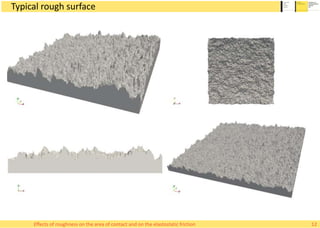
Typical rough surface
Effects of roughness on the area of contact and on the elastostatic friction 12
Geometry of our self-affine rough surfaces
• In all our experiments, we employ square surfaces
of side L (3 cm)
• h(x, y) is defined over a square lattice with
constant dO (0.1 mm)
• The full power spectrum is used to generate the
surfaces
• The surface is always considered as a rigid
corrugated half-space
13Effects of roughness on the area of contact and on the elastostatic friction
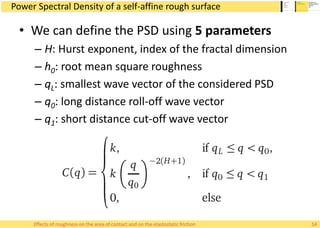
Power Spectral Density of a self-affine rough surface
• We can define the PSD using 5 parameters
– H: Hurst exponent, index of the fractal dimension
– h0: root mean square roughness
– qL: smallest wave vector of the considered PSD
– q0: long distance roll-off wave vector
– q1: short distance cut-off wave vector
14Effects of roughness on the area of contact and on the elastostatic friction
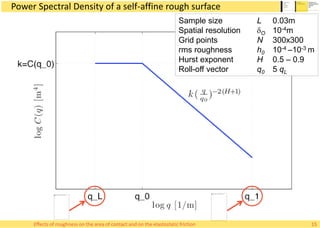
Power Spectral Density of a self-affine rough surface
Effects of roughness on the area of contact and on the elastostatic friction 15
Sample size L 0.03m
Spatial resolution dO 10-4m
Grid points N 300x300
rms roughness h0 10-4 –10-3 m
Hurst exponent H 0.5 – 0.9
Roll-off vector q0 5 qL
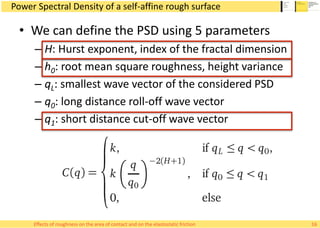
Power Spectral Density of a self-affine rough surface
• We can define the PSD using 5 parameters
– H: Hurst exponent, index of the fractal dimension
– h0: root mean square roughness, height variance
– qL: smallest wave vector of the considered PSD
– q0: long distance roll-off wave vector
– q1: short distance cut-off wave vector
16Effects of roughness on the area of contact and on the elastostatic friction
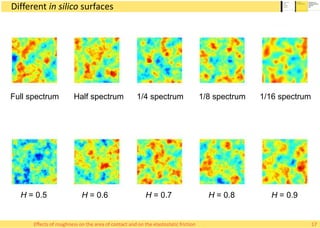
Different in silico surfaces
17Effects of roughness on the area of contact and on the elastostatic friction
Full spectrum Half spectrum 1/4 spectrum 1/8 spectrum 1/16 spectrum
H = 0.5 H = 0.6 H = 0.7 H = 0.8 H = 0.9
CONTACT PROBLEMS
IN ELASTICITY
Effects of roughness on the area of contact and on the elastostatic friction 18
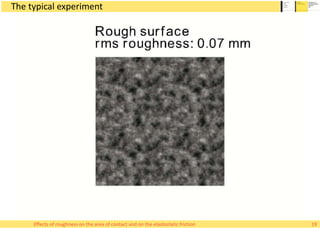
The typical experiment
19Effects of roughness on the area of contact and on the elastostatic friction
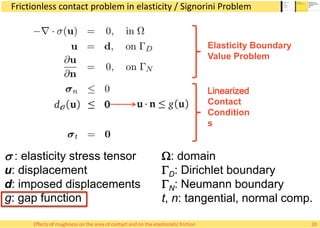
Frictionless contact problem in elasticity / Signorini Problem
Effects of roughness on the area of contact and on the elastostatic friction
Elasticity Boundary
Value Problem
Contact
Condition
s
s : elasticity stress tensor
u: displacement
d: imposed displacements
W: domain
GD: Dirichlet boundary
GN: Neumann boundary
t, n: tangential, normal comp.
20
g: gap function
Iterative Signorini problem
• The classic Signorini problem linearizes the
non-penetration condition, but this is not
suited for complex obstacles such as our rough
surfaces
• To overcome this problem, we solve a sequence
of Signorini problems, updating the gap
function
• Instead of using a pre-computed Signed
Distance Function, we compute distances on
the fly
21Effects of roughness on the area of contact and on the elastostatic friction
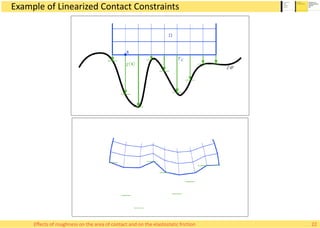
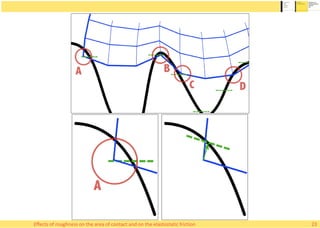
Example of Linearized Contact Constraints
22Effects of roughness on the area of contact and on the elastostatic friction
23Effects of roughness on the area of contact and on the elastostatic friction
NUMERICAL EXPERIMENTS
REAL AREA OF CONTACT
Effects of roughness on the area of contact and on the elastostatic friction 24
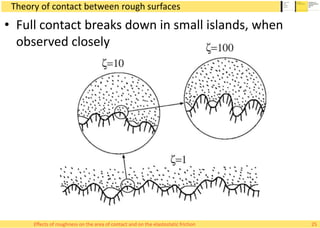
Theory of contact between rough surfaces
• Full contact breaks down in small islands, when
observed closely
Effects of roughness on the area of contact and on the elastostatic friction 25
Real area of contact
• The real area of contact is only a fraction of the
nominal area of contact between two bodies
• Its study is crucial to understand physical
phenomena
– Heat and charge conduction
– Force transfer across surfaces
• Experimental observations are difficult, when
not impossible
26Effects of roughness on the area of contact and on the elastostatic friction
Real area of contact, analytical models
• There exist two prominent theoretical models
for the relation of load and real area of contact
– Bush-Gibson-Thomas (BGT) model [1975]
– Persson’s model [2000]
• BGT model considers the surface asperities as
acting separately on the elastic body
– No merging of contact islands
• Persson’s model assumes that the stress
diffuses over the contact area uniformly
– No isolation of contact clusters
27Effects of roughness on the area of contact and on the elastostatic friction
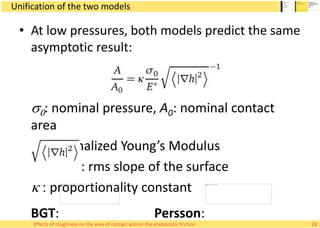
Unification of the two models
• At low pressures, both models predict the same
asymptotic result:
s0: nominal pressure, A0: nominal contact
area
E*: normalized Young’s Modulus
: rms slope of the surface
k : proportionality constant
BGT: Persson:
28Effects of roughness on the area of contact and on the elastostatic friction
Numerical setting
• To analyze the contact evolution, we push a
linear elastic cube onto the surface, with an
incremental normal force
• We impose a Poisson’s parameter of 0.45
(almost incompressible solid), Young Modulus
is unitary
• The cube is discretized with tetrahedra, we
employ two different mesh sizes on the contact
boundary: 50 mm and 25 mm
– 600x600 and 1200x1200 contact nodes respectively
29Effects of roughness on the area of contact and on the elastostatic friction
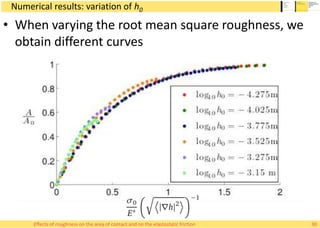
Numerical results: variation of h0
30Effects of roughness on the area of contact and on the elastostatic friction
• When varying the root mean square roughness, we
obtain different curves
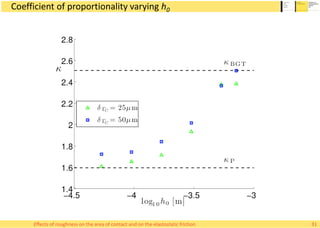
Coefficient of proportionality varying h0
31Effects of roughness on the area of contact and on the elastostatic friction
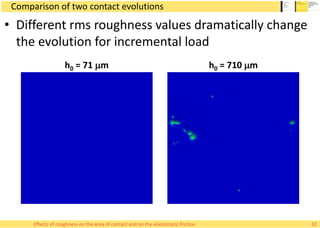
Comparison of two contact evolutions
h0 = 71 mm h0 = 710 mm
• Different rms roughness values dramatically change
the evolution for incremental load
32Effects of roughness on the area of contact and on the elastostatic friction
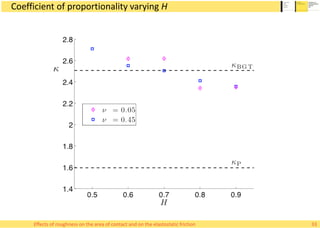
Coefficient of proportionality varying H
33Effects of roughness on the area of contact and on the elastostatic friction
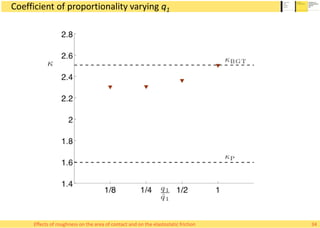
Coefficient of proportionality varying q1
34Effects of roughness on the area of contact and on the elastostatic friction
Area of contact at low, medium, and large loading
• Persson’s model is supposed to predict the
contact vs area relation at large loads
• There exists a recently developed model, by
Yastrebov, Anciaux, and Molinari, which states
that the contact evolution follows a power law
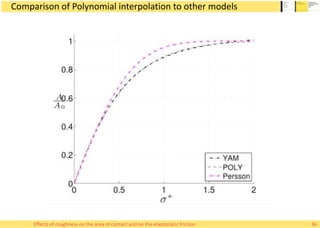
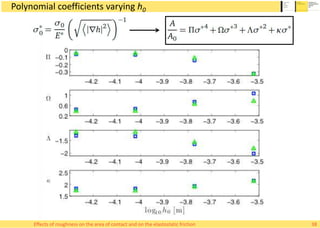
• Our experimental results are fitted better by a
polynomial of fourth order, for which we
studied the coefficients for different rough
surfaces
35Effects of roughness on the area of contact and on the elastostatic friction
Comparison of Polynomial interpolation to other models
36Effects of roughness on the area of contact and on the elastostatic friction
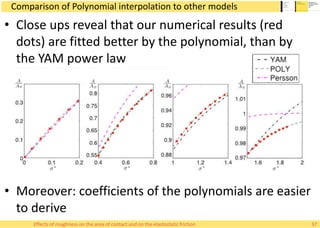
Comparison of Polynomial interpolation to other models
• Close ups reveal that our numerical results (red
dots) are fitted better by the polynomial, than by
the YAM power law
• Moreover: coefficients of the polynomials are easier
to derive
37Effects of roughness on the area of contact and on the elastostatic friction
Polynomial coefficients varying h0
38Effects of roughness on the area of contact and on the elastostatic friction
NUMERICAL EXPERIMENTS:
FRICTION
Effects of roughness on the area of contact and on the elastostatic friction 39
What is friction?
• Friction is a well-known, frequently observed,
never completely understood phenomenon
• Occurring in every contact, especially when
surfaces are rough
– But also when surfaces are very smooth
• Force opposed to sliding, transferred across
the contact surface
• Its study is crucial for many applications
Effects of roughness on the area of contact and on the elastostatic friction 40
Causes of friction
• Friction is a macroscopically perceived effect of
micro- and nano-scopic interactions
• We can distinguish between sources of friction
by the scale at which they act
– Microscopic scale – interaction with asperities
• Elasticity
• Plasticity
• Viscosity
– Nanoscopic scale
• Atomic interactions
• Chemical reactions
41Effects of roughness on the area of contact and on the elastostatic friction
Experimental setting
• To measure the friction coefficient, we proceed
with a natural extension of our previous
experiment
• After an initial phase of vertical loading, we
displace the top of the cube and let it relax
– We then measure the forces acting on the bottom
surface of the cube at equilibrium
– Friction coefficient is obtained as the ratio of
tangential to normal force
42Effects of roughness on the area of contact and on the elastostatic friction
Remarks on shear tests
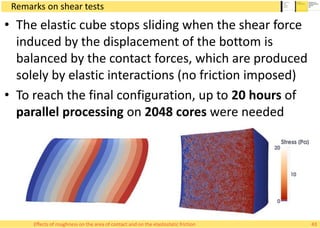
• The elastic cube stops sliding when the shear force
induced by the displacement of the bottom is
balanced by the contact forces, which are produced
solely by elastic interactions (no friction imposed)
• To reach the final configuration, up to 20 hours of
parallel processing on 2048 cores were needed
Effects of roughness on the area of contact and on the elastostatic friction 43
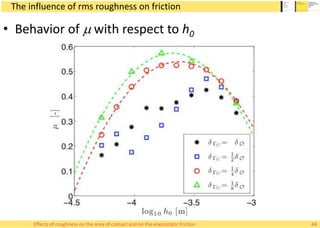
The influence of rms roughness on friction
Effects of roughness on the area of contact and on the elastostatic friction
• Behavior of m with respect to h0
44
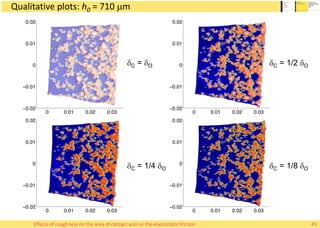
Qualitative plots: h0 = 710 mm
Effects of roughness on the area of contact and on the elastostatic friction
dC = dO
dC = 1/4 dO
dC = 1/2 dO
dC = 1/8 dO
45
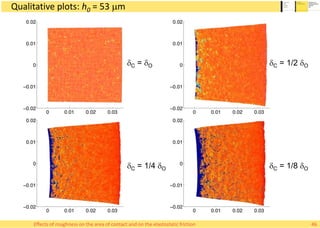
Qualitative plots: h0 = 53 mm
Effects of roughness on the area of contact and on the elastostatic friction
dC = dO
dC = 1/4 dO
dC = 1/2 dO
dC = 1/8 dO
46
VERIFICATION:
TYRE ROAD INTERACTION
Effects of roughness on the area of contact and on the elastostatic friction 47
Verification: wet tyre-road interactions
• To verify our prediction, we need data for an
experiment with
– A smooth elastic surface in contact with a hard
corrugated substrate
– No adhesive effects
– No plasticity effects
– No viscous effects
• We therefore rely on published experiments of
rubber sliding on wet asphalt
– Mildly wet asphalt: no real aquaplaning
– Studies performed by USA and UK governments
48Effects of roughness on the area of contact and on the elastostatic friction
Theory of wet tyre-road contact dynamics
• Persson et al. suggest that the loss of friction of
rubber on wet roads is due to the flooding of
the asphalt, which filters the high-frequency
details of the road texture
• The high-frequency details are responsible for
the hysteretic response of rubber: taking them
off, rubber is less stiff and braking is not
influenced by tangential velocity
• Water is confined in sealed pools, and acts as a
flat rigid obstacle, because of incompressibility
49Effects of roughness on the area of contact and on the elastostatic friction
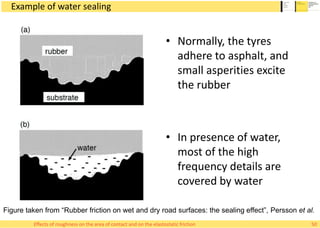
Example of water sealing
• Normally, the tyres
adhere to asphalt, and
small asperities excite
the rubber
• In presence of water,
most of the high
frequency details are
covered by water
50Effects of roughness on the area of contact and on the elastostatic friction
Figure taken from “Rubber friction on wet and dry road surfaces: the sealing effect”, Persson et al.
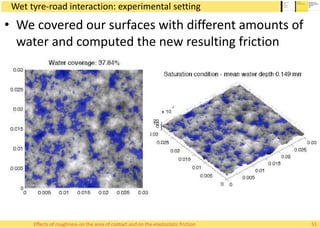
Wet tyre-road interaction: experimental setting
• We covered our surfaces with different amounts of
water and computed the new resulting friction
51Effects of roughness on the area of contact and on the elastostatic friction
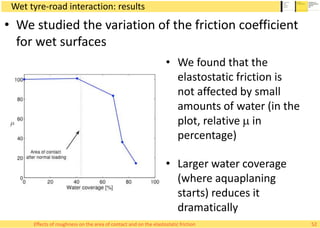
Wet tyre-road interaction: results
• We found that the
elastostatic friction is
not affected by small
amounts of water (in the
plot, relative m in
percentage)
• Larger water coverage
(where aquaplaning
starts) reduces it
dramatically
• We studied the variation of the friction coefficient
for wet surfaces
52Effects of roughness on the area of contact and on the elastostatic friction
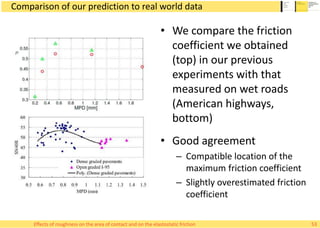
Comparison of our prediction to real world data
• We compare the friction
coefficient we obtained
(top) in our previous
experiments with that
measured on wet roads
(American highways,
bottom)
• Good agreement
– Compatible location of the
maximum friction coefficient
– Slightly overestimated friction
coefficient
53Effects of roughness on the area of contact and on the elastostatic friction
CONCLUSIONS
Effects of roughness on the area of contact and on the elastostatic friction 54
Goals achieved by this work
• We successfully applied the FEM to a rough
contact at micro-scale, by employing a massively
parallel MG-based contact solver
– To the best of our knowledge, nobody did it before us
• We validated the results against theoretical
models, and we were able to empirically bridge
two different theories
• We performed a broad parameter study
– area of contact depends on all roughness parameters
55Effects of roughness on the area of contact and on the elastostatic friction
Goals achieved by this work (II)
• We computed elastostatic friction
– Never negligible, even for almost smooth surfaces
• We found heuristic bounds on the needed
mesh size, and showed that the wrong mesh
size can result in misleading results
– HPC is a mandatory requirement for future
development
56Effects of roughness on the area of contact and on the elastostatic friction
Goals achieved by this work (III)
• We compared our results to measurements
realized in a compatible framework, wet tyre-
road interactions
– With the assumption that viscosity becomes
negligible, our results are in good agreement with
measured data
• We identified a possible explanation of the
aquaplaning regime, based on the water
coverage
57Effects of roughness on the area of contact and on the elastostatic friction
Future work
• Now that we have performed a broad
parameter study, we can use more
sophisticated models, targeting a narrower
parameter range to include
– Viscous and plastic effects
– Adhesive forces
– …
• More accurate experiments, with a better
description of the rough surfaces will have to
be used to verify future studies
58Effects of roughness on the area of contact and on the elastostatic friction
The effects of roughness on the area of contact
and on the elastostatic friction
FEM simulation of micro-scale rough contact
and real world applications
PhD dissertation defense of Alessandro Rigazzi
Institute of Computational Science, University of Lugano
November 27th 2014
Algorithm of Iterative Signorini Problem
60Effects of roughness on the area of contact and on the elastostatic friction
Validation and verification
• In computational science two steps are usually
required to prove the reliability of a method
– Validation against known theory
– Verification against experimental results
• Validation: we performed validation against
classic benchmarks (e.g. Hertzian contact), and
compared our results to BGT and Persson’s
model.
• Verification: need of experimental data for
friction
61Effects of roughness on the area of contact and on the elastostatic friction
The need for experimental data
• Finding good, large, detailed datasets for this
kind of phenomena is hard
– Commercial interests protecting corporate
experiments
– Laboratory equipments expensive
• Our experiments have a limited range of
validity (because of the elastic model, and of
the roughness parameters we employed)
62Effects of roughness on the area of contact and on the elastostatic friction
Advantages of our method
• With respect to analytical theories, which
assume that the PSD is uniform over the whole
surface, we can also simulate contact with
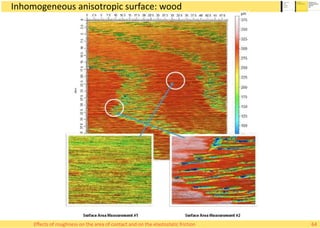
anisotropic or inhomogeneous surfaces
• Object do not need to have flat surfaces
• We can identify boundary effects (like the
footprint detachment in the shear tests)
63Effects of roughness on the area of contact and on the elastostatic friction
Inhomogeneous anisotropic surface: wood
64Effects of roughness on the area of contact and on the elastostatic friction
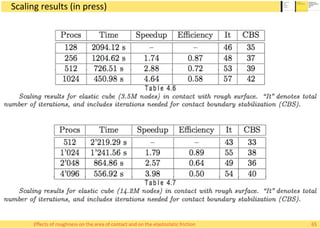
Scaling results (in press)
65Effects of roughness on the area of contact and on the elastostatic friction

rigazzi_phd_defense

  • 1.
    The effects ofroughness on the area of contact and on the elastostatic friction FEM simulation of micro-scale rough contact and real world applications PhD dissertation defense of Alessandro Rigazzi Institute of Computational Science, University of Lugano November 27th 2014
  • 2.
    INTRODUCTION Effects of roughnesson the area of contact and on the elastostatic friction 2
  • 3.
    The importance ofrough contact • All real surfaces are –at some scale– rough – At macro-scale (10-3–10-2 m) – At micro-scale (10-6 m) – At nano-scale (10-9 m) • As a consequence, every contact in the real world involves rough surfaces – Contact areas are not smooth and continuous – They are collections of small fragmented contact islands, spots, or points 3Effects of roughness on the area of contact and on the elastostatic friction
  • 4.
    Physical phenomena relatedto rough contact • Several quantities related to contact are affected by roughness, and they influence different physical phenomena, e.g. – Area of contact • Heat transfer • Charge conduction – Contact forces • Fatigue • Crack initiation • Friction 4Effects of roughness on the area of contact and on the elastostatic friction
  • 5.
    Rough contact: strategies Homogenization •Surfaces are smooth • Quantities like friction coefficient or heat conduction are used in averaged forms, as parameters of the simulations • Lack of local variations of results Full scale resolution • Realistic surfaces • Physical laws imposed at microscopic level, and macroscopic quantities are derived • Need to consider several orders of magnitude • Two numerical approaches for rough contact 5Effects of roughness on the area of contact and on the elastostatic friction
  • 6.
    The challenge • Weaim to discretize macroscopic bodies up to microscopic scale and apply the Finite Element Method • The resulting system is huge – Millions of unknowns only on the contact boundary • Contact problems are highly non-smooth • Solution of such systems is feasible only using an efficient massively parallel contact solver – Multigrid solver implemented in obslib++/UG 6Effects of roughness on the area of contact and on the elastostatic friction
  • 7.
    The ultimate goal •With the chosen method, we want to quantify the influence of roughness on two relevant features of rough contact – Evolution of the real contact area – Elastostatic friction force • We want to derive the contribution of selected roughness and parameters 7Effects of roughness on the area of contact and on the elastostatic friction
  • 8.
    ROUGHNESS CHARACTERIZATION Effects of roughnesson the area of contact and on the elastostatic friction 8
  • 9.
    Roughness • We needto formally define roughness • Many measures exist covering different aspects of roughness – Root mean square roughness – Mean profile depth – … • But we prefer a compact description based on the Power Spectral Density (PSD) of the surfaces – Geometric measures can be derived [Nayak 1971] Effects of roughness on the area of contact and on the elastostatic friction 9
  • 10.
    Mathematical representation ofrough surfaces • We represent a rough surface as a periodic height function h(x, y) with zero mean • The PSD of h(x, y), denoted by C(q), is the Fourier Transform of the auto-correlation function R(x, y) 10Effects of roughness on the area of contact and on the elastostatic friction
  • 11.
    Self-affine rough surfaces •All natural surfaces show self-affinity – Geometric features repeat themselves at different length scales – Similar to fractals, up to some limit scales – Mostly isotropic • All specimens of the same material have the same statistical parameters, i.e. the same PSD – They are different realization of the same random process 11Effects of roughness on the area of contact and on the elastostatic friction
  • 12.
    Typical rough surface Effectsof roughness on the area of contact and on the elastostatic friction 12
  • 13.
    Geometry of ourself-affine rough surfaces • In all our experiments, we employ square surfaces of side L (3 cm) • h(x, y) is defined over a square lattice with constant dO (0.1 mm) • The full power spectrum is used to generate the surfaces • The surface is always considered as a rigid corrugated half-space 13Effects of roughness on the area of contact and on the elastostatic friction
  • 14.
    Power Spectral Densityof a self-affine rough surface • We can define the PSD using 5 parameters – H: Hurst exponent, index of the fractal dimension – h0: root mean square roughness – qL: smallest wave vector of the considered PSD – q0: long distance roll-off wave vector – q1: short distance cut-off wave vector 14Effects of roughness on the area of contact and on the elastostatic friction
  • 15.
    Power Spectral Densityof a self-affine rough surface Effects of roughness on the area of contact and on the elastostatic friction 15 Sample size L 0.03m Spatial resolution dO 10-4m Grid points N 300x300 rms roughness h0 10-4 –10-3 m Hurst exponent H 0.5 – 0.9 Roll-off vector q0 5 qL
  • 16.
    Power Spectral Densityof a self-affine rough surface • We can define the PSD using 5 parameters – H: Hurst exponent, index of the fractal dimension – h0: root mean square roughness, height variance – qL: smallest wave vector of the considered PSD – q0: long distance roll-off wave vector – q1: short distance cut-off wave vector 16Effects of roughness on the area of contact and on the elastostatic friction
  • 17.
    Different in silicosurfaces 17Effects of roughness on the area of contact and on the elastostatic friction Full spectrum Half spectrum 1/4 spectrum 1/8 spectrum 1/16 spectrum H = 0.5 H = 0.6 H = 0.7 H = 0.8 H = 0.9
  • 18.
    CONTACT PROBLEMS IN ELASTICITY Effectsof roughness on the area of contact and on the elastostatic friction 18
  • 19.
    The typical experiment 19Effectsof roughness on the area of contact and on the elastostatic friction
  • 20.
    Frictionless contact problemin elasticity / Signorini Problem Effects of roughness on the area of contact and on the elastostatic friction Elasticity Boundary Value Problem Contact Condition s s : elasticity stress tensor u: displacement d: imposed displacements W: domain GD: Dirichlet boundary GN: Neumann boundary t, n: tangential, normal comp. 20 g: gap function
  • 21.
    Iterative Signorini problem •The classic Signorini problem linearizes the non-penetration condition, but this is not suited for complex obstacles such as our rough surfaces • To overcome this problem, we solve a sequence of Signorini problems, updating the gap function • Instead of using a pre-computed Signed Distance Function, we compute distances on the fly 21Effects of roughness on the area of contact and on the elastostatic friction
  • 22.
    Example of LinearizedContact Constraints 22Effects of roughness on the area of contact and on the elastostatic friction
  • 23.
    23Effects of roughnesson the area of contact and on the elastostatic friction
  • 24.
    NUMERICAL EXPERIMENTS REAL AREAOF CONTACT Effects of roughness on the area of contact and on the elastostatic friction 24
  • 25.
    Theory of contactbetween rough surfaces • Full contact breaks down in small islands, when observed closely Effects of roughness on the area of contact and on the elastostatic friction 25
  • 26.
    Real area ofcontact • The real area of contact is only a fraction of the nominal area of contact between two bodies • Its study is crucial to understand physical phenomena – Heat and charge conduction – Force transfer across surfaces • Experimental observations are difficult, when not impossible 26Effects of roughness on the area of contact and on the elastostatic friction
  • 27.
    Real area ofcontact, analytical models • There exist two prominent theoretical models for the relation of load and real area of contact – Bush-Gibson-Thomas (BGT) model [1975] – Persson’s model [2000] • BGT model considers the surface asperities as acting separately on the elastic body – No merging of contact islands • Persson’s model assumes that the stress diffuses over the contact area uniformly – No isolation of contact clusters 27Effects of roughness on the area of contact and on the elastostatic friction
  • 28.
    Unification of thetwo models • At low pressures, both models predict the same asymptotic result: s0: nominal pressure, A0: nominal contact area E*: normalized Young’s Modulus : rms slope of the surface k : proportionality constant BGT: Persson: 28Effects of roughness on the area of contact and on the elastostatic friction
  • 29.
    Numerical setting • Toanalyze the contact evolution, we push a linear elastic cube onto the surface, with an incremental normal force • We impose a Poisson’s parameter of 0.45 (almost incompressible solid), Young Modulus is unitary • The cube is discretized with tetrahedra, we employ two different mesh sizes on the contact boundary: 50 mm and 25 mm – 600x600 and 1200x1200 contact nodes respectively 29Effects of roughness on the area of contact and on the elastostatic friction
  • 30.
    Numerical results: variationof h0 30Effects of roughness on the area of contact and on the elastostatic friction • When varying the root mean square roughness, we obtain different curves
  • 31.
    Coefficient of proportionalityvarying h0 31Effects of roughness on the area of contact and on the elastostatic friction
  • 32.
    Comparison of twocontact evolutions h0 = 71 mm h0 = 710 mm • Different rms roughness values dramatically change the evolution for incremental load 32Effects of roughness on the area of contact and on the elastostatic friction
  • 33.
    Coefficient of proportionalityvarying H 33Effects of roughness on the area of contact and on the elastostatic friction
  • 34.
    Coefficient of proportionalityvarying q1 34Effects of roughness on the area of contact and on the elastostatic friction
  • 35.
    Area of contactat low, medium, and large loading • Persson’s model is supposed to predict the contact vs area relation at large loads • There exists a recently developed model, by Yastrebov, Anciaux, and Molinari, which states that the contact evolution follows a power law • Our experimental results are fitted better by a polynomial of fourth order, for which we studied the coefficients for different rough surfaces 35Effects of roughness on the area of contact and on the elastostatic friction
  • 36.
    Comparison of Polynomialinterpolation to other models 36Effects of roughness on the area of contact and on the elastostatic friction
  • 37.
    Comparison of Polynomialinterpolation to other models • Close ups reveal that our numerical results (red dots) are fitted better by the polynomial, than by the YAM power law • Moreover: coefficients of the polynomials are easier to derive 37Effects of roughness on the area of contact and on the elastostatic friction
  • 38.
    Polynomial coefficients varyingh0 38Effects of roughness on the area of contact and on the elastostatic friction
  • 39.
    NUMERICAL EXPERIMENTS: FRICTION Effects ofroughness on the area of contact and on the elastostatic friction 39
  • 40.
    What is friction? •Friction is a well-known, frequently observed, never completely understood phenomenon • Occurring in every contact, especially when surfaces are rough – But also when surfaces are very smooth • Force opposed to sliding, transferred across the contact surface • Its study is crucial for many applications Effects of roughness on the area of contact and on the elastostatic friction 40
  • 41.
    Causes of friction •Friction is a macroscopically perceived effect of micro- and nano-scopic interactions • We can distinguish between sources of friction by the scale at which they act – Microscopic scale – interaction with asperities • Elasticity • Plasticity • Viscosity – Nanoscopic scale • Atomic interactions • Chemical reactions 41Effects of roughness on the area of contact and on the elastostatic friction
  • 42.
    Experimental setting • Tomeasure the friction coefficient, we proceed with a natural extension of our previous experiment • After an initial phase of vertical loading, we displace the top of the cube and let it relax – We then measure the forces acting on the bottom surface of the cube at equilibrium – Friction coefficient is obtained as the ratio of tangential to normal force 42Effects of roughness on the area of contact and on the elastostatic friction
  • 43.
    Remarks on sheartests • The elastic cube stops sliding when the shear force induced by the displacement of the bottom is balanced by the contact forces, which are produced solely by elastic interactions (no friction imposed) • To reach the final configuration, up to 20 hours of parallel processing on 2048 cores were needed Effects of roughness on the area of contact and on the elastostatic friction 43
  • 44.
    The influence ofrms roughness on friction Effects of roughness on the area of contact and on the elastostatic friction • Behavior of m with respect to h0 44
  • 45.
    Qualitative plots: h0= 710 mm Effects of roughness on the area of contact and on the elastostatic friction dC = dO dC = 1/4 dO dC = 1/2 dO dC = 1/8 dO 45
  • 46.
    Qualitative plots: h0= 53 mm Effects of roughness on the area of contact and on the elastostatic friction dC = dO dC = 1/4 dO dC = 1/2 dO dC = 1/8 dO 46
  • 47.
    VERIFICATION: TYRE ROAD INTERACTION Effectsof roughness on the area of contact and on the elastostatic friction 47
  • 48.
    Verification: wet tyre-roadinteractions • To verify our prediction, we need data for an experiment with – A smooth elastic surface in contact with a hard corrugated substrate – No adhesive effects – No plasticity effects – No viscous effects • We therefore rely on published experiments of rubber sliding on wet asphalt – Mildly wet asphalt: no real aquaplaning – Studies performed by USA and UK governments 48Effects of roughness on the area of contact and on the elastostatic friction
  • 49.
    Theory of wettyre-road contact dynamics • Persson et al. suggest that the loss of friction of rubber on wet roads is due to the flooding of the asphalt, which filters the high-frequency details of the road texture • The high-frequency details are responsible for the hysteretic response of rubber: taking them off, rubber is less stiff and braking is not influenced by tangential velocity • Water is confined in sealed pools, and acts as a flat rigid obstacle, because of incompressibility 49Effects of roughness on the area of contact and on the elastostatic friction
  • 50.
    Example of watersealing • Normally, the tyres adhere to asphalt, and small asperities excite the rubber • In presence of water, most of the high frequency details are covered by water 50Effects of roughness on the area of contact and on the elastostatic friction Figure taken from “Rubber friction on wet and dry road surfaces: the sealing effect”, Persson et al.
  • 51.
    Wet tyre-road interaction:experimental setting • We covered our surfaces with different amounts of water and computed the new resulting friction 51Effects of roughness on the area of contact and on the elastostatic friction
  • 52.
    Wet tyre-road interaction:results • We found that the elastostatic friction is not affected by small amounts of water (in the plot, relative m in percentage) • Larger water coverage (where aquaplaning starts) reduces it dramatically • We studied the variation of the friction coefficient for wet surfaces 52Effects of roughness on the area of contact and on the elastostatic friction
  • 53.
    Comparison of ourprediction to real world data • We compare the friction coefficient we obtained (top) in our previous experiments with that measured on wet roads (American highways, bottom) • Good agreement – Compatible location of the maximum friction coefficient – Slightly overestimated friction coefficient 53Effects of roughness on the area of contact and on the elastostatic friction
  • 54.
    CONCLUSIONS Effects of roughnesson the area of contact and on the elastostatic friction 54
  • 55.
    Goals achieved bythis work • We successfully applied the FEM to a rough contact at micro-scale, by employing a massively parallel MG-based contact solver – To the best of our knowledge, nobody did it before us • We validated the results against theoretical models, and we were able to empirically bridge two different theories • We performed a broad parameter study – area of contact depends on all roughness parameters 55Effects of roughness on the area of contact and on the elastostatic friction
  • 56.
    Goals achieved bythis work (II) • We computed elastostatic friction – Never negligible, even for almost smooth surfaces • We found heuristic bounds on the needed mesh size, and showed that the wrong mesh size can result in misleading results – HPC is a mandatory requirement for future development 56Effects of roughness on the area of contact and on the elastostatic friction
  • 57.
    Goals achieved bythis work (III) • We compared our results to measurements realized in a compatible framework, wet tyre- road interactions – With the assumption that viscosity becomes negligible, our results are in good agreement with measured data • We identified a possible explanation of the aquaplaning regime, based on the water coverage 57Effects of roughness on the area of contact and on the elastostatic friction
  • 58.
    Future work • Nowthat we have performed a broad parameter study, we can use more sophisticated models, targeting a narrower parameter range to include – Viscous and plastic effects – Adhesive forces – … • More accurate experiments, with a better description of the rough surfaces will have to be used to verify future studies 58Effects of roughness on the area of contact and on the elastostatic friction
  • 59.
    The effects ofroughness on the area of contact and on the elastostatic friction FEM simulation of micro-scale rough contact and real world applications PhD dissertation defense of Alessandro Rigazzi Institute of Computational Science, University of Lugano November 27th 2014
  • 60.
    Algorithm of IterativeSignorini Problem 60Effects of roughness on the area of contact and on the elastostatic friction
  • 61.
    Validation and verification •In computational science two steps are usually required to prove the reliability of a method – Validation against known theory – Verification against experimental results • Validation: we performed validation against classic benchmarks (e.g. Hertzian contact), and compared our results to BGT and Persson’s model. • Verification: need of experimental data for friction 61Effects of roughness on the area of contact and on the elastostatic friction
  • 62.
    The need forexperimental data • Finding good, large, detailed datasets for this kind of phenomena is hard – Commercial interests protecting corporate experiments – Laboratory equipments expensive • Our experiments have a limited range of validity (because of the elastic model, and of the roughness parameters we employed) 62Effects of roughness on the area of contact and on the elastostatic friction
  • 63.
    Advantages of ourmethod • With respect to analytical theories, which assume that the PSD is uniform over the whole surface, we can also simulate contact with anisotropic or inhomogeneous surfaces • Object do not need to have flat surfaces • We can identify boundary effects (like the footprint detachment in the shear tests) 63Effects of roughness on the area of contact and on the elastostatic friction
  • 64.
    Inhomogeneous anisotropic surface:wood 64Effects of roughness on the area of contact and on the elastostatic friction
  • 65.
    Scaling results (inpress) 65Effects of roughness on the area of contact and on the elastostatic friction