Consumption Function
By
Dr. K. Murugan
Assistant Professor
Department of Economics
Guru Nanak College
Chennai
Consumption Function
Consumption is the use of goods/ services by
households.
The purchase of goods/services by use of
households is called consumption expenditure.
The consumption function is the association
between consumption and income. Before
1930s most economist stressed the relationship
between consumption and the interest rate.
• Keynes postulated the consumption depends
mainly on income. IN regard to the relationship,
he argued that consumption increases as income
increases but by a amount less than the increases
in income.
• This Law consists propositions
• When aggregate income increases consumption
extend also increases but by a somewhat smaller
amount. The reason is that as income increases
more and more of our wants get satisfied and
therefore, lesser and lesser amounts are spent out
of subsequent increase income.
• The second proposition is that when income
increase, the increment of income will be
divided in certain proportions between
consumption spending and saving. This
follows from the first proportion because what
is not spent is saved.
• The third proposition if that as some income
increases both consumption spending and
saving will go up.
• Assumption of the Law
• Keynes, Psychological law of consumption is
based on the following assumptions.
• It is assumed that habits of people regarding
spending do not change of that the propensity
to consume remains the same.
• The second assumption is that the condition
are normal in the economic system.
• The third assumption is that of the existences
of a capitalists lesser fair economy.
• Explain of the Law
• Consumption(C) is therefore according to
Keynes analysis a function of income (Y) .
The relationship is expresses as C= f (Y)
• Where C stands for consumption, f stands for
function and Y stands for income.
• Keynes has made use of four concepts in
analyzing consumption income relationship.
• These are
• Average Propensity to Consume
• Marginal Propensity to Consume
• Average Propensity to Save and
• Marginal Propensity to Save
• 1. Average Propensity to Consume
• It is the ratio of total consumption to total income.
• APC = C/Y C refers aggregate consumption
• Y refers aggregate income
• 2. Marginal Propensity to Consume
• The marginal propensity to consume the ratio of
the change in total consumption to the change in
total income
• MPC = Δ C/ Δ Y Where Δ C is the change in
consumption
• ΔY is the change in income
• 3. Average and Marginal Propensity to Save
• APS is the ratio of total saving to total
income.
• APS = S/ y
• APC + APS = 1 or
• Since income is either consumed or saved.
• C+ S = Y
• C/Y + S/Y = X/Y = 1
• APC + APS = 1 and MPC + MPS =1
• We know that Y = C+ S or
• Δ Y = Δ C + Δ S
• ΔY/ ΔY = ΔC/ ΔY + Δ S/ Δ Y
• 1- MPC + MPS
• 1- MPC = MPS
• Determinants of Consumption and Investment
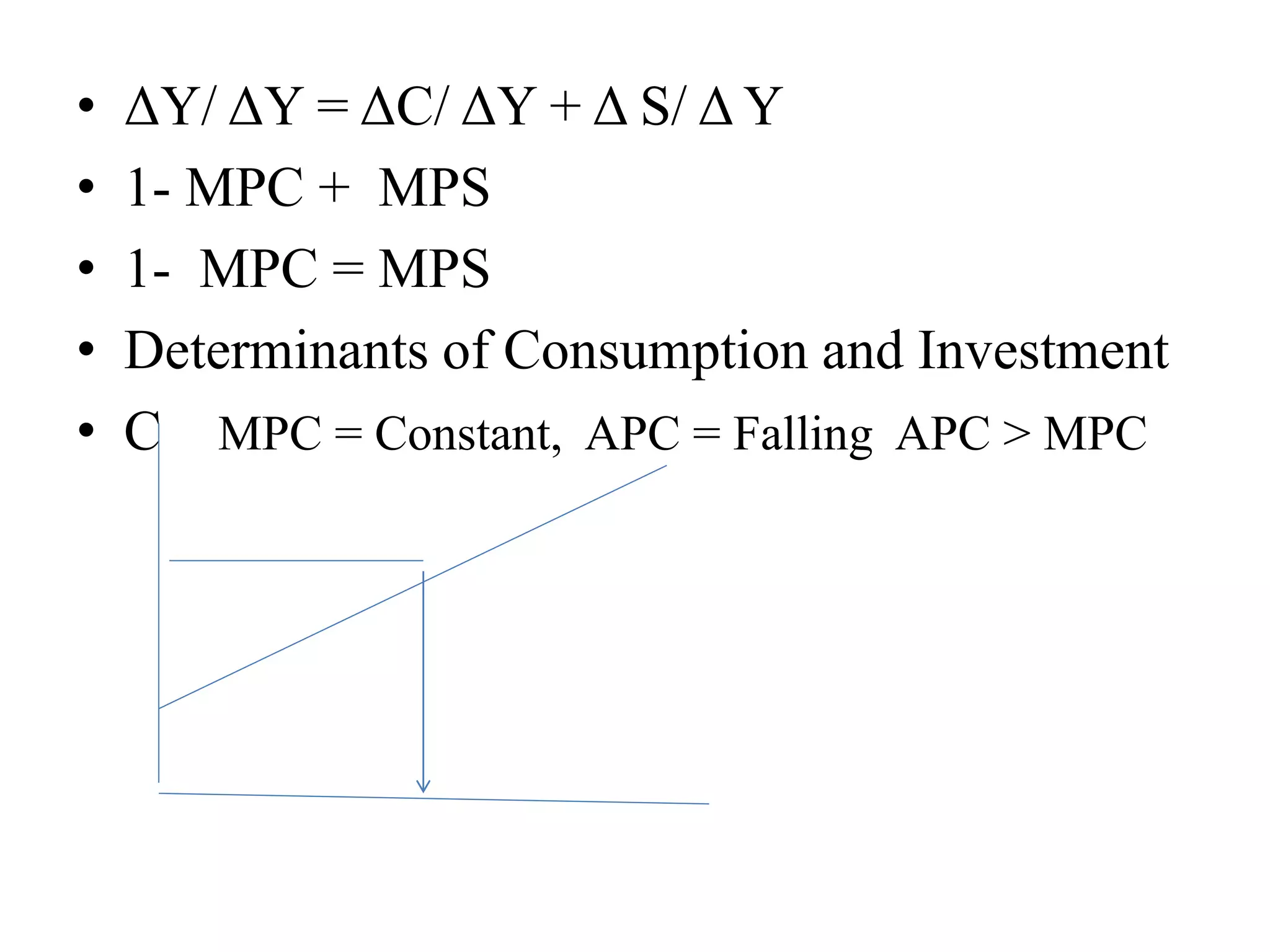
• C MPC = Constant, APC = Falling APC > MPC
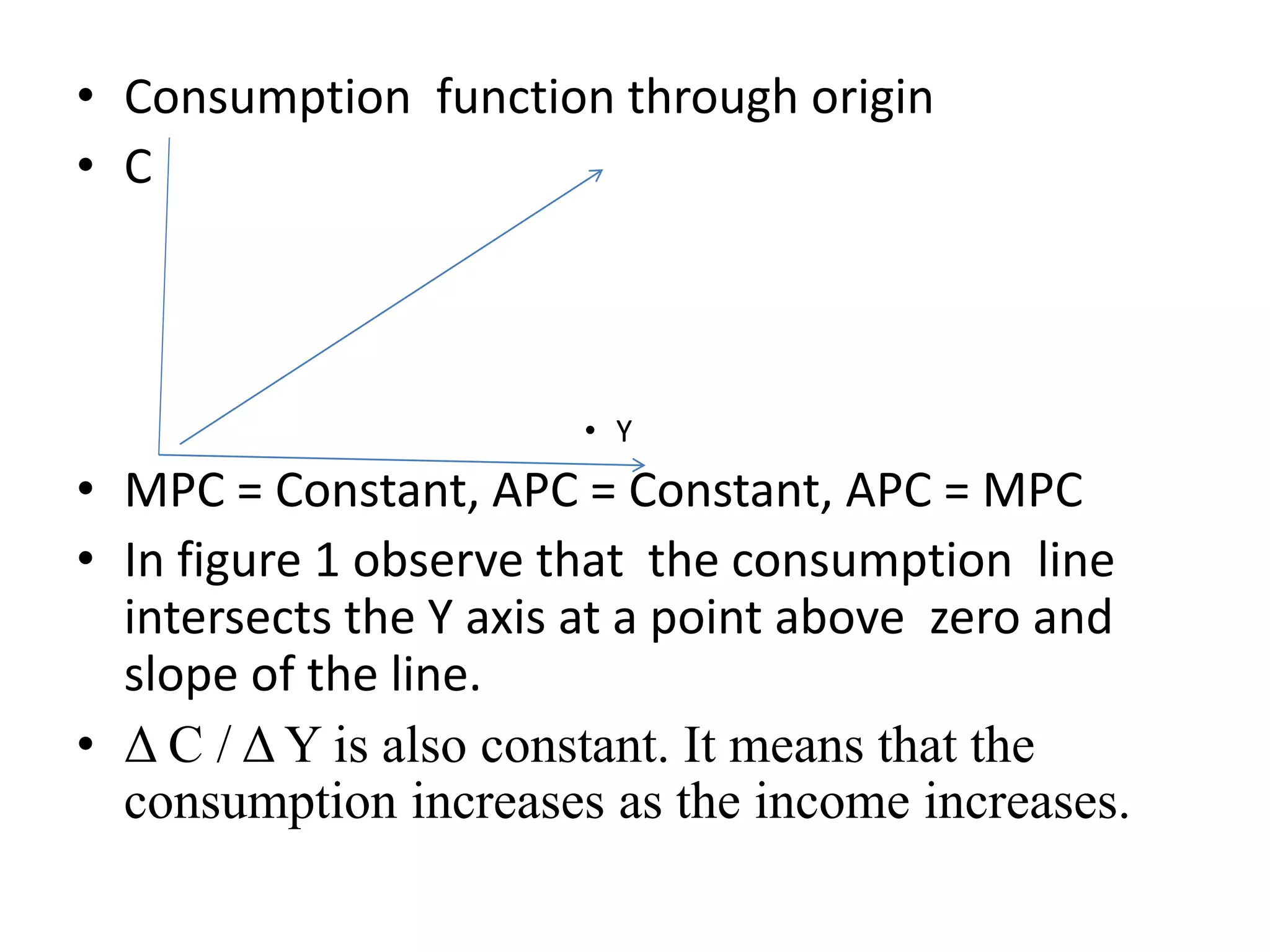
• Consumption function through origin
• C
• Y
• MPC = Constant, APC = Constant, APC = MPC
• In figure 1 observe that the consumption line
intersects the Y axis at a point above zero and
slope of the line.
• Δ C / Δ Y is also constant. It means that the
consumption increases as the income increases.
• The APC ( C / Y) consumption income ratio
declines as the level of income increases
while the MPC = Δ C / Δ Y
• The ratio of change in consumption to change
in income is constant. This type of
consumption function shows a non-
proportional income –consumption
relationship.

Consumption Function

  • 1.
    Consumption Function By Dr. K.Murugan Assistant Professor Department of Economics Guru Nanak College Chennai
  • 2.
    Consumption Function Consumption isthe use of goods/ services by households. The purchase of goods/services by use of households is called consumption expenditure. The consumption function is the association between consumption and income. Before 1930s most economist stressed the relationship between consumption and the interest rate.
  • 3.
    • Keynes postulatedthe consumption depends mainly on income. IN regard to the relationship, he argued that consumption increases as income increases but by a amount less than the increases in income. • This Law consists propositions • When aggregate income increases consumption extend also increases but by a somewhat smaller amount. The reason is that as income increases more and more of our wants get satisfied and therefore, lesser and lesser amounts are spent out of subsequent increase income.
  • 4.
    • The secondproposition is that when income increase, the increment of income will be divided in certain proportions between consumption spending and saving. This follows from the first proportion because what is not spent is saved. • The third proposition if that as some income increases both consumption spending and saving will go up. • Assumption of the Law • Keynes, Psychological law of consumption is based on the following assumptions.
  • 5.
    • It isassumed that habits of people regarding spending do not change of that the propensity to consume remains the same. • The second assumption is that the condition are normal in the economic system. • The third assumption is that of the existences of a capitalists lesser fair economy. • Explain of the Law • Consumption(C) is therefore according to Keynes analysis a function of income (Y) . The relationship is expresses as C= f (Y)
  • 6.
    • Where Cstands for consumption, f stands for function and Y stands for income. • Keynes has made use of four concepts in analyzing consumption income relationship. • These are • Average Propensity to Consume • Marginal Propensity to Consume • Average Propensity to Save and • Marginal Propensity to Save
  • 7.
    • 1. AveragePropensity to Consume • It is the ratio of total consumption to total income. • APC = C/Y C refers aggregate consumption • Y refers aggregate income • 2. Marginal Propensity to Consume • The marginal propensity to consume the ratio of the change in total consumption to the change in total income • MPC = Δ C/ Δ Y Where Δ C is the change in consumption • ΔY is the change in income
  • 8.
    • 3. Averageand Marginal Propensity to Save • APS is the ratio of total saving to total income. • APS = S/ y • APC + APS = 1 or • Since income is either consumed or saved. • C+ S = Y • C/Y + S/Y = X/Y = 1 • APC + APS = 1 and MPC + MPS =1 • We know that Y = C+ S or • Δ Y = Δ C + Δ S
  • 9.
    • ΔY/ ΔY= ΔC/ ΔY + Δ S/ Δ Y • 1- MPC + MPS • 1- MPC = MPS • Determinants of Consumption and Investment • C MPC = Constant, APC = Falling APC > MPC
  • 10.
    • Consumption functionthrough origin • C • Y • MPC = Constant, APC = Constant, APC = MPC • In figure 1 observe that the consumption line intersects the Y axis at a point above zero and slope of the line. • Δ C / Δ Y is also constant. It means that the consumption increases as the income increases.
  • 11.
    • The APC( C / Y) consumption income ratio declines as the level of income increases while the MPC = Δ C / Δ Y • The ratio of change in consumption to change in income is constant. This type of consumption function shows a non- proportional income –consumption relationship.