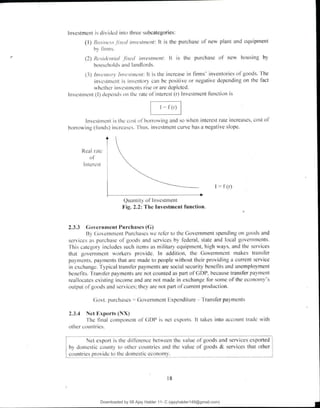
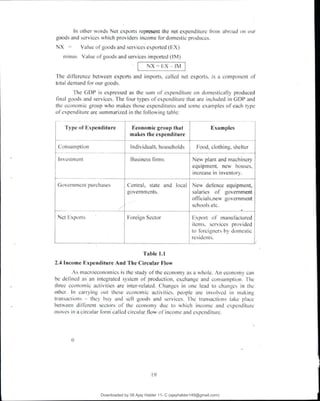
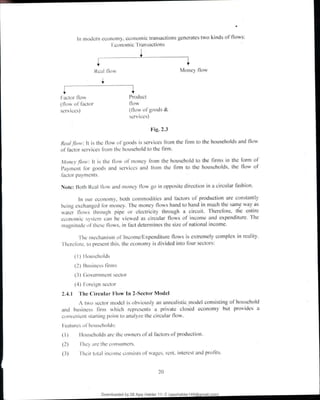
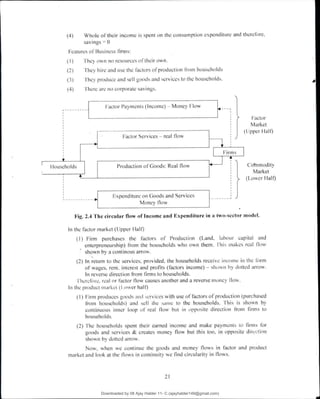
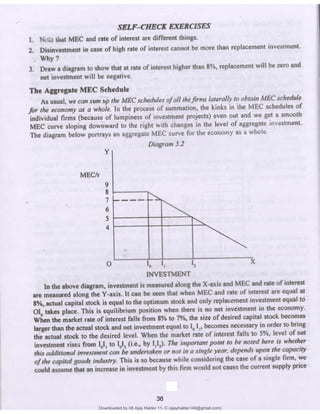
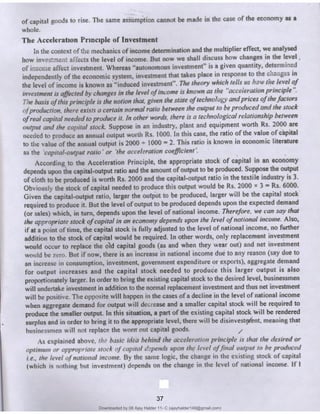
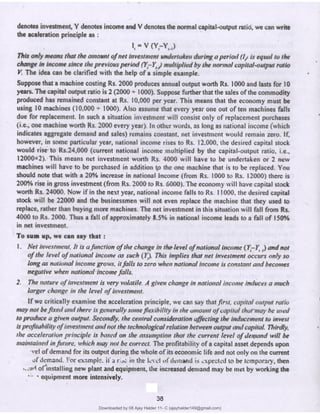
Studocu is not sponsored or endorsed by any college or university
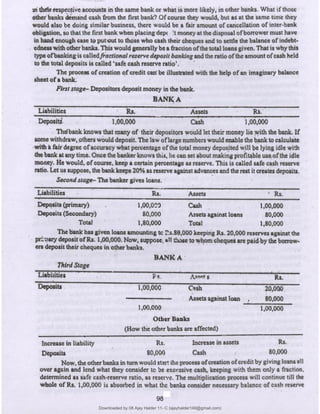
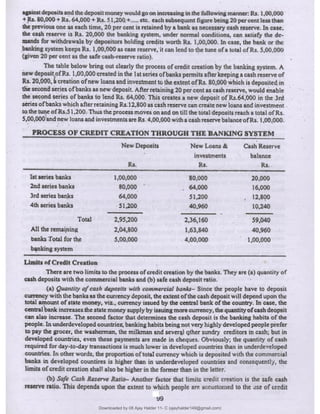
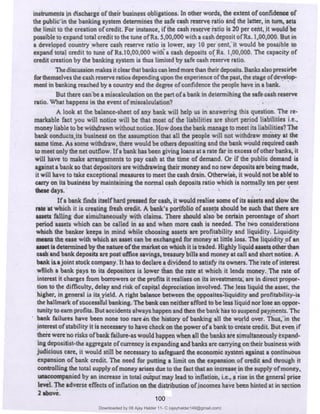
Unit 1-5 - Principles of Macroeconomics
b.com programe (University of Delhi)
Studocu is not sponsored or endorsed by any college or university
Unit 1-5 - Principles of Macroeconomics
b.com programe (University of Delhi)
Downloaded by 08 Ajay Halder 11- C (ajayhalder149@gmail.com)
lOMoARcPSD|24060133
GENERIC ELECTIVE (GE)
Principles of Macroeconomics
Study Material : Unit 1-5
Department of Economics
Semester-VI
B.Com./B.A.(Programme) GE - Economics
SCHOOL OF OPEN LEARNING
University of Delhi
Downloaded by 08 Ajay Halder 11- C (ajayhalder149@gmail.com)
lOMoARcPSD|24060133
Unit
Unit National Income Accounting
Unit : 3. Determination of GDP
- Consumption and Saving Function
- Investment Function - Determinants of Investment
- Equilibrium GDP (Income) - Two and Three Sector Model
- Concept of Multiplier
Unit : 4. Open Economy
Unit : 5. Money and Credit Creation
Downloaded by 08 Ajay Halder 11- C (ajayhalder149@gmail.com)
lOMoARcPSD|24060133
3
Downloaded by 08 Ajay Halder 11- C (ajayhalder149@gmail.com)
lOMoARcPSD|24060133
Downloaded by 08 Ajay Halder 11- C (ajayhalder149@gmail.com)
lOMoARcPSD|24060133
Downloaded by 08 Ajay Halder 11- C (ajayhalder149@gmail.com)
lOMoARcPSD|24060133
Downloaded by 08 Ajay Halder 11- C (ajayhalder149@gmail.com)
lOMoARcPSD|24060133
Downloaded by 08 Ajay Halder 11- C (ajayhalder149@gmail.com)
lOMoARcPSD|24060133
Downloaded by 08 Ajay Halder 11- C (ajayhalder149@gmail.com)
lOMoARcPSD|24060133
Downloaded by 08 Ajay Halder 11- C (ajayhalder149@gmail.com)
lOMoARcPSD|24060133
Downloaded by 08 Ajay Halder 11- C (ajayhalder149@gmail.com)
lOMoARcPSD|24060133
Downloaded by 08 Ajay Halder 11- C (ajayhalder149@gmail.com)
lOMoARcPSD|24060133
NATIONAL INCOME ACCOUNTING
Downloaded by 08 Ajay Halder 11- C (ajayhalder149@gmail.com)
lOMoARcPSD|24060133
Downloaded by 08 Ajay Halder 11- C (ajayhalder149@gmail.com)
lOMoARcPSD|24060133
Downloaded by 08 Ajay Halder 11- C (ajayhalder149@gmail.com)
lOMoARcPSD|24060133
Downloaded by 08 Ajay Halder 11- C (ajayhalder149@gmail.com)
lOMoARcPSD|24060133
Downloaded by 08 Ajay Halder 11- C (ajayhalder149@gmail.com)
lOMoARcPSD|24060133
Downloaded by 08 Ajay Halder 11- C (ajayhalder149@gmail.com)
lOMoARcPSD|24060133
Downloaded by 08 Ajay Halder 11- C (ajayhalder149@gmail.com)
lOMoARcPSD|24060133
Downloaded by 08 Ajay Halder 11- C (ajayhalder149@gmail.com)
lOMoARcPSD|24060133
Downloaded by 08 Ajay Halder 11- C (ajayhalder149@gmail.com)
lOMoARcPSD|24060133
Downloaded by 08 Ajay Halder 11- C (ajayhalder149@gmail.com)
lOMoARcPSD|24060133
Downloaded by 08 Ajay Halder 11- C (ajayhalder149@gmail.com)
lOMoARcPSD|24060133
Downloaded by 08 Ajay Halder 11- C (ajayhalder149@gmail.com)
lOMoARcPSD|24060133
Downloaded by 08 Ajay Halder 11- C (ajayhalder149@gmail.com)
lOMoARcPSD|24060133
Lesson-1
Consumption and Saving Function
APC, MPC, APS and MPS
Unit-3
DETERMINATION OF GDP
25
Downloaded by 08 Ajay Halder 11- C (ajayhalder149@gmail.com)
lOMoARcPSD|24060133
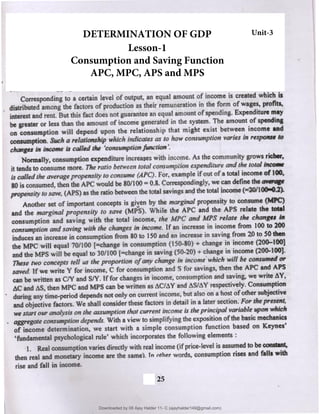
2. As inc.:,me increases, C0111UJ11plon also in,:-eres, llut by less1liao tbr irt:rnae ;,,. ii¥ ••
part of the additional income being saved. This means that AY s N:, + AS (•+ a � f t1
AC AS ' · ·
cotne, C consui;_nption, s saving and A de�s change) and AY+wa I It is Claar �
C AY (MPC) is positive, but less than I.
3. Conswnptioo e&11not fall below a cac.ia 11:iain111m level evu if i;)COQle falb to uro'lhis
, the bare subsiswnce level of consu111pli°'. Tllis put of cor.s11.W1pti!)11 is auto11011to� or
•�t ofthe level ofiacoaae. 'Ille equation C .. Ca + c.Y sum111arises such a consumption
IIICtioll. In tllisequatio11, C studs for aggregate con�umption,, Ca stands for auto110111ous part of
and c is the increase in income which is consumed or marginal propensity to coesuae AC/AY.
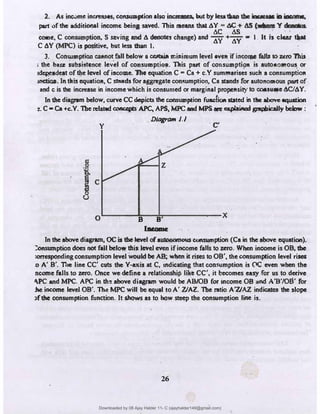
In the dias,am below, curve CC depicts the consumption fuac{i011 stated in the mo'f' equation
:.C •Ca +c.Y.The related ooncq,IS -".PC, APS, MPC and MPS- explained gnipiically bdow:
y
DiagrOM J.J
C'
.
•
·.:,
C.
J C
0 B B' X
(Nome
In the above diag,mn, OC is the level ofautonomous consumption (Ca in the above equation).
::0-ption does not fall below lhis: level even if income falls to zero. When income is OB, the
:orrespooding consumption level would be AB; when it rises to OB', the C011$Umption level ri­
:o A' B'. nie line CC' cuts the Y-axis at C, indicating that consumpfi!;>n is 0C even when the
ncome falls to zero. Once we define a relationship like CC', it becomes easy for us to derive
"-PC and MPC. APC in th� above diagram would be AB/OB for income OB and A'B'/08' for
:he income level OB'.� MPC will be equal to A' VAZ. The ratio A'ZJAZ. indicates the slope
,fdie consumption fum:tion. It shows as to how steep the consumption line is.
26
Downloaded by 08 Ajay Halder 11- C (ajayhalder149@gmail.com)
lOMoARcPSD|24060133
Diagram 1.2
y S'
Ot--r.--�3�8�',-----X
s Income (311'11)
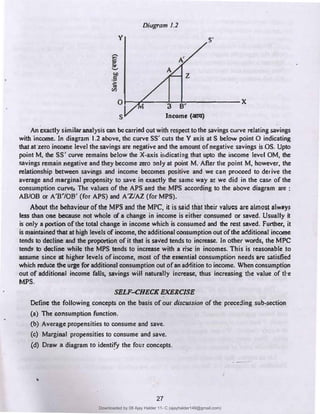
An exactly similar analysis can becarried out with respect to the savings curve relating savings
with income. In diagram 1.2 above, the curve SS' cuts the Y axis at S below point O indicating
that at zero income level the savings are negative and the amount ofnegative savings is OS. Upto
point M, the SS' curve remains �low the X-axis ir.dicating that upto !he income level OM, the
�vings remain negative and they become zero only at point M.-After the point M, however, the
relationship between savings and income becomes positive and we can. pr,oceed to derive the
average and marginal propensity to save in exactiy the same way a! we did in the casi, of the
consumption curve, The values of the APS an� the MPS according to the above diagram are
AB/OB or A'B'/08' (for APS) and A'VAZ (for MPS).
About the behaviourofthe MPS and the MPC, it is said that their values are almost alwitys
less than one because not whole of a change in income is either consumed or save.d. Usually it
is only a portiOC oftbe'total change in income which is consumed and the rest saved. Further, it
is ll)aintained that at high levels ofincome, the additional consumption out of ttre additional income
tends to decline and the proportion. of it that is saved tends to increase. In other words, the MPC
tend� to decline while the MPS tends to inc,ease with a rise in incomes. This is reasonable to
assume since at higher levels of income, most of the essential consumption needs are satisfied
which redu¢e the urge for additional consumption out ofan adtlition to income. When consumption
out ofadditional income falls, savings will nat1Jrally increase, thus increasing the value of tl:e
MPS.
SELF-CHECKEXERCISE
Deli� the following concepts on the basis ofour discussion of !he preceding sub-section
(a) The consumption function.
(b) Average propensities to consume a.nd save.
(c) Marginal propensities to consume and save.
(d) Draw a diagram to identify the four concepts.
•
•
27
Downloaded by 08 Ajay Halder 11- C (ajayhalder149@gmail.com)
lOMoARcPSD|24060133
LESSON 2
DETERMINANT OF CONSUMPI'ION
As already sbted, income creation at any stage is determined by the level of expenditure,
ari-d hence aggregate demand, in the earlier period. The two main expenditure items are
consumption and invesiment. For the time being, we take investment to be autonomou3,.r.111aning
thereby that it is independent ofall thefactor within the economic system and Is determined outside
the systenL It is, so to say, a given quantity which does not change with change in income,
consumption etc. With th is, we leave investment here and proceed to discuss the other item of
aggregate demand, namely, consumption.
The most important determinant ofconsumption is the level ofincome. This is as 'lilidi true
for an individual as it is for the .society as a whole. However, there are different .ypotheses
regarding the ways in which income influences consumption. Theae are • Ab�ol te income
hypothesis, Relative income hypothesis, Permanent income hypolbc1i1 and th, Life-cycle
hypothesis. Ei!ch of these hypotheses assigns a different role l!l inc� in the determination of
consumption. ·
The absolute Income Hypotbes�s
This hypothesis is associated with Keynes's theory o.f consumption and is based on his
Fundamental Psychological law. According to this law :
·
(I) Level ofconsumption is determined by.the absolute level of income. Higher the level of
"income, higher will tend to be the level of consumption.
(2) At very'low levels of income, consumption exceeds income and savi�g is negative.
Consumption is financed either by dissaving or borrowing.
(3) At a certain level of income, consumption equals income �nd saving becomes zero. lJ,is ·
may be called the break even point.
·
(4) Beyond this point, as income rises, consumption also rises; but by less than the increase
in income. This means that change in income 6Y is equal to t:.C+AS (i.e., change in consumption
and.change in savin gs). Evidently iiC/AY is less than I, and t:.C/AY (i.e. MPC} + 6S/t:.Y
(i.e. MPS)m I
(5)' Further A C/6 Y i.e., the marginal propensity to consume (MPC) declines with increasing
levels of income.
The Relative Income Hypothesis
Dueseribtt·ry was ihe author Of this hypothesis according to which a family's consumpt/011
depends on the level ofits income relative to /he incomes of other families with which it identifies,
rather than on the absolute level ofits'own Income. An example amply clarifies this hypothesis.
Suppose your neighbours grow richer while your income remains unchanged. Your consumption
will increase simply because your relative income posiJion has deteriorated vis-a-vjs your
neighbours whom you tend to imitate..As you must have observed, low income people typically
imitate the superior �onsumption patterns of the people in higher income groups. Duesenberry
26
28
Downloaded by 08 Ajay Halder 11- C (ajayhalder149@gmail.com)
lOMoARcPSD|24060133
29
Downloaded by 08 Ajay Halder 11- C (ajayhalder149@gmail.com)
lOMoARcPSD|24060133
•
• •
•
Otller Facton Aff«tln& Couumptioa
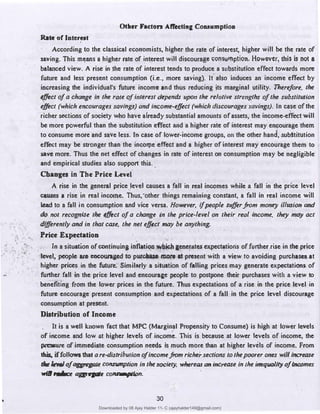
Rate of Interest
According to the ·classical economists, higher the rate of interest; higher will be the rate of
saving. This m,;ans a higher rate of interest will discourag� 0011sumplion. However, this is not a
balanced view. A rise in the rate of interest tends to produce a substitution effect towards more
future and less present consumption (i.e., more saving). It. also induces an income effect by
increasing the individual's future income and thus reducing its marginal utility. Therefore, the
effect of a change in the role ofinterest depends upon the relative strengths of the substitution
effect (which encourages savings) and income-effect (which discourages savings). In case ofihe
richer sections of society who have afreac!y substantial amounts of assets, the income-eff
ect will
be more powerful than the substitution .effect and a higher raie of interest may encourage them
to consume more and save less. In case of lower-income groups, 011 the other hand� .subttitution
eff
ect may be stronger than the inco'lle effect and a higher of interest may encourage them to
sav� more. Thus the net effect of changes in rate of interest on consumption may be negligible·
and empirical studies also support this. .
Changes in The Price Levei
A rise in the general price_level causes a ,fall in real incomes while a fall in the price level
causes a rise in real income. Thus,·other things remaining constant, a fall in real income will
lead to a fall in consumption and vice versa. However, if
people sufferfrom money illusion and
do no/ recognise the effect of a change in the price-level on their real income, they may act
differently and in that case, the net effect 111ay be anything.
Price Expectation
Tn a situation of continuing inflation 1!(bichaenenltes expectations of further rise in the price
level, people are encouraaed to p11rd111e IIIOte Ill present with a view to avoiding purchases at
higher prices in the future. Similarly a situation of falling prices may generate expectations of
further fall in the price level and encourage people to postpone their purchases with a view to.
benefiting from the lower prices in the future. Thus expectations of a rise in the price level in
future encourage present consumption and expectations of a fall in the price level discourage
consumption at present.
Distribution of Income
It is a well known fact that MPC (Muginal Propensity to Consume) is high at lower levels
of income. and low at higher levels of income. This is because at lower levels of income, the
pressure of immediate consumption needs is much more than at higher levels of income. From
lllil, iffollowsthat a re-distribution of incomefrom richer sections to thepoorer ones will inaease
t./ndof aa,epe COIISlllnption in thesociety, whereas an increase in the i�qua//ty of incomes
willrace "4>--�.:o�.'
30
Downloaded by 08 Ajay Halder 11- C (ajayhalder149@gmail.com)
lOMoARcPSD|24060133
Ownenhlip of Flnandal Assets
,•
Families with larger accumulation of financial assets feel richer and are inclined to spend
mon;-on oonsumption compared to the families who own less of financial assets.· This is /n,e
even when the disposable income in IWO cases is the same. A similar kind of effect is produced
by windfall gains and losses..
Consumer Credit
Availability and easier terms of consumer creditstimulate consumer expenditure on durable
goods. You must be aware of the various hire purchase schemes available these days.
Besidc:3 the above factors, changes in the size and composition of population, pent up demand
. . .
on account of ,r etc. and institutional changes popularising lo�g-term savings may also affect
the level of C.:......_!lmption and savings.
SELF-CHECK EXERCISES
(I) Identify the emphasis that each hypothesis lays on the influence of changes in income on
consumption.
(2) Each of the influences-absolute income, relative income position, consideration for future
income prospects-bas a role in the determination of consumption.
31
Downloaded by 08 Ajay Halder 11- C (ajayhalder149@gmail.com)
lOMoARcPSD|24060133
Introduction
LESSON 3
DETERMINANTS OF INVESTMENT
As you already know, according to Keynes, the level of income in a capitalist economy
depends upon the level of aggregate demand. Aggregate demand originates from private
consumption expenditure, business investment expenditure, government expenditure and ellp(llt"
demand. Y01t have also seen that a change in any of the above items of expenditure results in a
much larger change in income through the multiplier effect. Out of these items of expenditure,
we have so far assumed investment as an autonomous quantity, dete.rmined independently and
outside the system. But now we relax that assumption and see how level•ofinwstment is determined
In the economic system. In this context, we discuss basically two theories of investment, the first
being the Keynesian concept of the Marginal Efficiency of Capital (MEC) and the second is the
Acceleration Principle.
Discounting Future Values
Before explaining the concept of MEC, we discuss first the principle of discounting in the
context of capital goods. Capital goods a:re durable-use goods.which aid production over a number
ofyears. Returns from these capital goods are spread overthe whole of their useful lives. Therefore,
investment in capital goods necessitates estimation of their prospective yields. Prospective yield
from a capital good is MPP x MR minus all variable costs (except interest and depreciation), where
MPP. is·margiral physical product and MR is marginal re�enue. While yields obtainablefrom the
use ofa-capital good arefaJure ,quantities, the cos/ ofa capital asset is payable al present. So
long as we have a positive rate ofinterest, amounts available infuture are worth less at present.
Therefore, we cannot comparefuture quan1l1ies (prospective yields) with present cost. We have
t9 calculate the present value of the sernes of prospective yields to make them comparable with
the cost of the capital good in question. For example, if.the present market rate of interest is I0%
p.a., Rs. I000 lent out today would grow to Rs. 1210 in 2 years [(IOOO (110/100)1] and to Rs.
13.31 in 3 years [IOOOx(t.l)']. Thus at the currP�• market rate of interest of 10¾, the present
value of Rs. 1331 obtainable after 3 years is Rs. IWO [That is 1331 x (1001110)'�I000] and the
present value of Rs. 1210 obtainable after + years is also Rs. I000 [that is 121 0•(I001110)']. We
call this "disco,mling" thefaJure values, the process through which a fat11re quantify shrinks
when converted into present value. This discounting process is Si{Tlply the reverse of/he process
through which any present quantity grows at a compound rote when carried intofuture. We can
similarly calculate the present vaJue of a wlole series of prospective yields available at different
points of time in future.
The general formula for finding the present value of any future income-stream is :
C
= R1 • + R2 + R, +-------+ R.
(1+1)
1
(l+i)' (l+i)
3
(l+i)"
In this equati�n, V is the present discounted value, R,, R,, •···R, are prospective -returns
32
Downloaded by 08 Ajay Halder 11- C (ajayhalder149@gmail.com)
lOMoARcPSD|24060133
�pected to accrue in different years of the productive life.of the capital good (say, a machine)
111d I is the rate of discount. Let us take a simple example to explain the proceu of finding the
p1c:se!lt value of the s�ries ofprospective yields of a machine expected to 1M:Crue during different
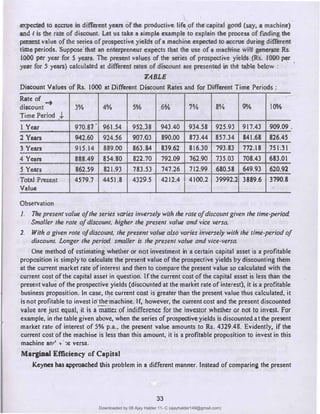
time periods. Suppose·that an enterpreneur expects that the use of a machine will �nerate Rs.
1000 per year for 5 years. Toe present values of the series of prospective yields (Rs. 1000 per
year for 5 years) calculattd at different rates of discount are presen�d in the table below :
TABLE
Discount Values of Rs. 1000 at Different Discount Rates and for Different Time Periods:
Rate of ➔
discount 3% 4% 5% .6¾ 7% 8% 9% 10%
Time Period J
I Year 970.87.- 961.S4 9S2.38 943.40 934.S8 92S.93 917.43 909.09 .
2 Yeen 942.60 924.56 907.03 890.00 873.44 8S7.34 841.68 826.45
3 Years 915.14 889.00 863.84 839.62 816.30 793.83 772.18 751.31
4 Years 888.49 8S4.80 822.70 792.09 162.90 735.03 708.43 683.01
S Years 862.59 821.93 783.S3 747.26 712.99 680.58 649.93 620.92
Total Present 4579.7 44S1.8 4329.S 4212.4 4100.2 39992.2 3889.6 3790.8
Value
Observation
I. The presentvalue ofthe series varies inversely with the rate ofdiscount given the time-period.
Smaller the rate ofdiscount. higher the present value and vice versa.
2. With a given r.ote ofdiscount, the present value also varies inversely with the time-period of
discount. Longer the period. smaller is the present vofue and vice-versa.
One method of estimating whether or not investment in a certain capital asset is a,profitable
proposition is simply to calculate the present value of the prospective yields by discounting them
at the current market rate ofinterest and then to compare the present value so calculated with the
current cost of the capital asset in question. If the current cost of the capital asset is less than the
present value of the prospective yields (discou'nted at the market rate of interest), it is a profitable
business proposition. In case, the current cost is greater than the present value thus calculated, it
is not profitable to invest in'the machine. lf, however, the current cost and the present discounted
value are just equal, it is a mailer of indifference for the investor whether or not to invest. For
example, in the table given above, when the series of prospective yields is discounted at the present
market rate of interest of 5% p.a., the present value amounts to Rs. 4329.48. Evidently, if the
current cost of the machine is less than this amount, it is a profitable proposition to invest in this
machine ant' • -:e versa.
Marpaal Effitiency of Capital
Keynes hasapproached this problem in a different manner. Instead of comparina the present
33
Downloaded by 08 Ajay Halder 11- C (ajayhalder149@gmail.com)
lOMoARcPSD|24060133
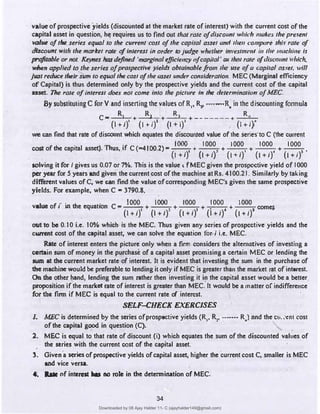
value·of prospective yields (discounted at the market rate of interest) with the current cost of the
capital asset in question, h� requires us to find out that rote ofdiscount which makes the presenr
value ofthe series equol to the cu"ent cost ofthe copi!al asset and then ,·ompt1re th_l.t rate of
dl.scount with the market rate ofinterest in order toJudge whether im•estm<'nl i11 the machi11e is
profitable or not. Keynes hasdefined 'marginal eificie11cy ofcapital· at thnt rate oftlis1:011nt ·which.
wben applied tq the series ofprospective yields obtainablefr.om the use ofa capitol as.,et. will
ju:sl reduce their sum to equal the cost ofthe asset under consideration.MEC(Marginal efficiency
ofCapital) is thus determined only by the prospective yields and the current cost of the capital
asset. The role ofinterest does not come into the picture In the determination ofMEC.
By substitutingC fo�V and in:sening the values ofR,, R,, ....=•R� in the discounting fonnula
C• R, ·+ R, +
R
, +-------+ R
(1+1)' (l+i)' (l+i)' (1+1)"
we can find that rate of discount which equates the discowued value of the series·toC(the current
cost of the capital asset). Thus, if C(-4T00.2)s
iOOO + 1000
, +
IOOO
+
1000
+
1000
•
(1+1)
1
{l+IY (1+1)' (l+i)' (l+i)'
solving it for I gives us 0.07 or 7%. This is the value t fMEC given the prospc,ctive yield of 1000
per year for 5 years and given the current cost of the mac·hine at
Rs. 4100.21. Similarly by taking
diffe�nt values ofC, we can find the value of correspondingMEC's given the same prospective
yields. For example, whenCs 3790.8,
.. . . I000 I000 I000 1000 l000
value of, m the equation C m ....;..;..;.;...+ , + , + • • + • comes
(1+1)
1
(1+I)' (l+i) (1+1) (l+i) .
out to be 0.10 i.e. 10% which is theM�C. Thus given any series of prospective yields and the
cwnent cost of the capital asset, we can solve the equation for./ i.e.MEC.
Rate of interest enters the picture only when a firm considers the ahematives of investing a
cenain sum of money in the purchase of a capital asset promising a certain MEC or lending the
aun at the current market rate of interest. It is evident that investing the sum in the purchase of
the machine would be preferable to lending ii only ifMEC is greater than the market rat of interesL
On the other hand, lending the sum rather then investing it in the capital asset would be a better
proposition if the markd rate of i'nterest is greater thanMEC.'It would be a matter ofindifference·
for the finn ifMEC is equal to the current rate of interest.
SELF-CHECK EXERCISES
J, MEC is determined by the series of prospective yields(R,, R,, --····R.) and the Ch. ,-ent cost
of the capital good in question(C),
. '
2. MEC is equal to that rate of discount (i) which equates the sum of the discounted values of
the series with the current cost of the capital asset.
3. Given'a � of prospective yields of capital asset, higher the'current costC, smaller isMEC
and vice versa.
41. a. nf intemt Im no role in the detennii,ation ofMEC.
34
Downloaded by 08 Ajay Halder 11- C (ajayhalder149@gmail.com)
lOMoARcPSD|24060133
MEC Schedule of a Firm
MECof a capital usset depends upon ifsprospective yield, (net of all cosis excep<depreciation
and interest) and c11rre111 supply price of the as.rel. For a single firm, the current supply cost of
the capital assets can be assumed as given since acquisition ofmore machines by a single firm
is not likely to exert much pressure on the cap·ital good industry. Prospective yields depend upo11
costs ofproduction t1.<sociored wilh lhe ou1purm1d morkel price of the product. When the firm
acquires and uses in production more units oflhe same capital asset, costs of production per unit
of output arc likely to increase because of the U-shnpe of the cost curve, Secondly, when the
firm supplies a larger output, market price is likely to fall. Therefore, pro.vper:tive yiclctrand hence
MECdecli11e asmore 1111il.r ofcapitalare 11sed. Because of the operation ofthese two factors, the
MEC of additional capital assets, diminishes as the firm increases its investment in machines.
Therefore, MEC schedule of the firm will slope downwards with increase in investment in
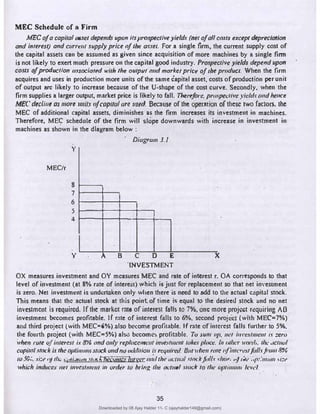
machines as shown in the diagram below :
. · Diagram 3.J
y
MEC/r
8 I----,
7 I----+--,
6 ,_
_
__.,____.,___
5 t----<>----<>----,1----,
ii t----<>----<>----'1---1----,
y A B C D E X
'INVESTMENT
OX measures .investment and OY measures MEC and rate ofin�rest r. OA corresponds to that
level of investment (at 8¾ rate of interest) ,.:t,ich is-just for replacement so that net in'eslment
is zero. Net investment is undertaken only when there is need to add to the actual capital stock.
This means that the actual stock at this point of time is-equal to the desired stock and no net
investment is required. Ifthe market rntt ofiiltercst falls to 7%, one more project r�quiring AO
investment becomes profitable. It rate of interest falls to 6¾, second proje<:l (with ME0=7¾)
and third project (with MEC=6¾).also become profitable. Ifrate of interest falls further to 5%.
the fourth project (with MEC=5¾) als.:, become� profitable. Tu sum up. 11,-1 h11·es/111e111 is zero
i,•hen rule ufinterest i.< 8% and 011/y replaccmr111 inve.,1111eJ11 lake., place. T,1 11/l1t•r 11Y>rd,. the ,1c111al
capital.<lock is the opti11111111.ttock and not«ldi1io11 �t f'f!quired BIilwhen r(//C <!/illlcrr!,<1fi,11.rji·om 8"/4
to 5%. si:.<' ,!fth;: ,;1,1i:.Hllt11 s1,1c:A °he('tJllfCS /w·ger111ulth� ac:wal .,·l(,t·kJi-,//.,,t(/u,r, rij,;,e .:pt.'111um .,i=t>
which indu<·cs net inve.r/nwul in order lo bring the aclllaf .rtor:k ro //,11 "JJti11111111 lt'•·cl.
35
Downloaded by 08 Ajay Halder 11- C (ajayhalder149@gmail.com)
lOMoARcPSD|24060133
36
Downloaded by 08 Ajay Halder 11- C (ajayhalder149@gmail.com)
lOMoARcPSD|24060133
37
Downloaded by 08 Ajay Halder 11- C (ajayhalder149@gmail.com)
lOMoARcPSD|24060133
38
Downloaded by 08 Ajay Halder 11- C (ajayhalder149@gmail.com)
lOMoARcPSD|24060133
39
Downloaded by 08 Ajay Halder 11- C (ajayhalder149@gmail.com)
lOMoARcPSD|24060133
2
LESSON 3
EQUILIBRIUM DETERMINATION AND MULTIPLIER
STRUCTURE
3.1 Objective
3.2 Introduction
3.3 Equilibrium in Two and Three Sector Economy
3.4 Concept of Multiplier
3.5 Automatic Stabilizers
3.6 Summary
3.7 Self Assessment Questions
3.8 Suggested Readings
3.1 OBJECTIVE
After reading this lesson, you should be able to
a) Explain different types of Economy – Open and Closed
b) Understand the concept of Equilibrium using AD– AS and S– I Approach
c) Differentiate between different types of multipliers.
d) Analyze Automatic Stabilizers
e) Explain and analyze the changes in Equilibrium
3.2 INTRODUCTION
Economics has two diverse fields – Micro and Macro. While Micro is concerned with analysis of
a particular unit, macro economics is concerned with the aggregate or the total. In macro
economics, the economies can be classified as Open and closed economy, a closed economy is
one where there is no interaction with the external economies having no export and import. An
open economy on the other hand is one where the economies are interlinked because of export
and import of goods and services. Further there can be two sector, three sector or four sector
economies. In two sector there are Households and Firms. In three sector along with the above
two there is also Government. Four sector comprises of external sector too along with export and
import in addition to above three sectors.
Household: A sector that makes the expenditure for own consumption. The entire expenditure by
this sector can be clubbed under the consumption function which is explained as follows:
C = Ĉ + cY (Linear Consumption function)
Where Ĉ = Autonomous Consumption that is the level of consumption which is fixed
irrespective of the level of income. It is there even at zero level of income. This is the
40
Downloaded by 08 Ajay Halder 11- C (ajayhalder149@gmail.com)
lOMoARcPSD|24060133
consumption that households derive out of past savings. It thus determines the intercept of
consumption function.
c = Slope of consumption function which shows change in consumption because of change in
income. It is shown by MPC (marginal propensity to consume) = ∆C/∆Y. In a linear
consumption function MPC is constant that is the slope is same everywhere on the consumption
curve. In non linear consumption function however the marginal propensity to consume
decreases with increase in income. For simplicity we assume that the consumption function is
linear with constant MPC.
Y = Real Income or total output of the economy.
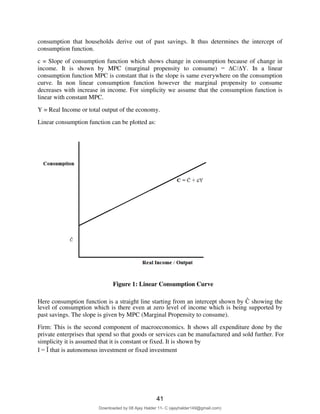
Linear consumption function can be plotted as:
Figure 1: Linear Consumption Curve
Here consumption function is a straight line starting from an intercept shown by Ĉ showing the
level of consumption which is there even at zero level of income which is being supported by
past savings. The slope is given by MPC (Marginal Propensity to consume).
Firm: This is the second component of macroeconomics. It shows all expenditure done by the
private enterprises that spend so that goods or services can be manufactured and sold further. For
simplicity it is assumed that it is constant or fixed. It is shown by
I = Ȋ that is autonomous investment or fixed investment
3
41
Downloaded by 08 Ajay Halder 11- C (ajayhalder149@gmail.com)
lOMoARcPSD|24060133
4
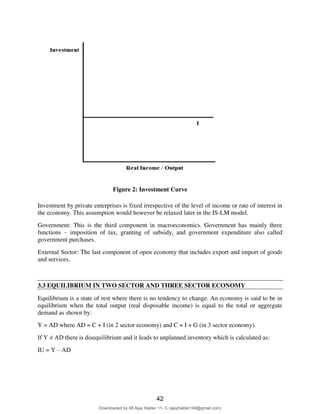
Figure 2: Investment Curve
Investment by private enterprises is fixed irrespective of the level of income or rate of interest in
the economy. This assumption would however be relaxed later in the IS-LM model.
Government: This is the third component in macroeconomics. Government has mainly three
functions – imposition of tax, granting of subsidy, and government expenditure also called
government purchases.
External Sector: The last component of open economy that includes export and import of goods
and services.
3.3 EQUILIBRIUM IN TWO SECTOR AND THREE SECTOR ECONOMY
Equilibrium is a state of rest where there is no tendency to change. An economy is said to be in
equilibrium when the total output (real disposable income) is equal to the total or aggregate
demand as shown by:
Y = AD where AD = C + I (in 2 sector economy) and C + I + G (in 3 sector economy).
If Y ≠ AD there is disequilibrium and it leads to unplanned inventory which is calculated as:
IU = Y – AD
42
Downloaded by 08 Ajay Halder 11- C (ajayhalder149@gmail.com)
lOMoARcPSD|24060133
5
If Y > AD, there is accumulation of inventory as total output being produced is more than the
total demand in the economy leading to increase in the unplanned stock and IU > 0 whereas
If Y < AD, there is depletion of inventory as total output being produced in the economy is less
than the total demand and hence the excess demand is met out of the stock that reduces the
existing stock and IU < 0.
Equilibrium in Two Sector Economy
A two sector economy is one where there is presence of households and private firms and there
is neither government nor the external sector. It can also be called a closed economy as there is
no interaction with the outside world in the form of exports and imports. A two sector economy
would be in equilibrium when the total output is equal to aggregate demand by the households
and firms as shown below:
Y = AD, Y = C + I, Y = Ĉ + cY + Ȋ, Y = Ᾱ + cY
Where Ᾱ = Ĉ + Ȋ its autonomous spending
Y – cY = Ᾱ, Y(1-c) = Ᾱ, Y = Ᾱ/(1– c). Thus the equilibrium condition is
Y = Ᾱ / (1-c)
Equilibrium is thus dependent on autonomous spending and marginal propensity to consume. If
any or both of them changes there is change in the equilibrium level of output.
Equilibrium can also be attained using an alternative approach as shown below:
Y = C + S (As households can either consume the income or save it). Thus total income is spent
on either the consumption or saving.
S = Y – C, S = Y – (Ĉ + cY), S = – Ĉ + (1– c) Y,
In equilibrium Y = AD (C +I). So from above two equations we get
C + S = C + I, S = I.
Here savings are the leakages from the economy and investment is the injection in the economy.
Thus according to this approach equilibrium is where leakages and injections are equal.
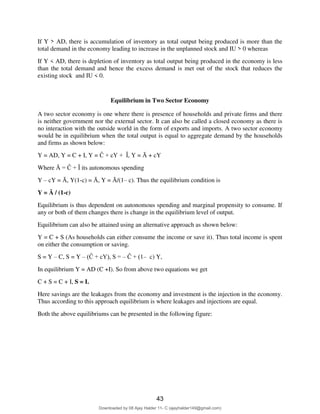
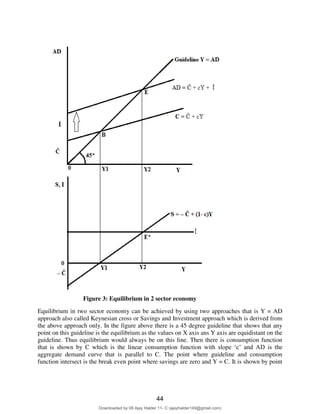
Both the above equilibriums can be presented in the following figure:
43
Downloaded by 08 Ajay Halder 11- C (ajayhalder149@gmail.com)
lOMoARcPSD|24060133
6
Figure 3: Equilibrium in 2 sector economy
Equilibrium in two sector economy can be achieved by using two approaches that is Y = AD
approach also called Keynesian cross or Savings and Investment approach which is derived from
the above approach only. In the figure above there is a 45 degree guideline that shows that any
point on this guideline is the equilibrium as the values on X axis ans Y axis are equidistant on the
guideline. Thus equilibrium would always be on this line. Then there is consumption function
that is shown by C which is the linear consumption function with slope ‘c’ and AD is the
aggregate demand curve that is parallel to C. The point where guideline and consumption
function intersect is the break even point where savings are zero and Y = C. It is shown by point
44
Downloaded by 08 Ajay Halder 11- C (ajayhalder149@gmail.com)
lOMoARcPSD|24060133
7
B at Y1 level of income. Equilibrium is where guideline and AD intersect which is at point E in
the Keynesian cross and E* in the panel below and equilibrium level of output is Y2.
Equilibrium in Three Sector Economy
A three sector economy is one where there is presence of government in addition to the
households and firms. Households spend on consumption, Firms spend on Investment and
Government performs three functions – Government expenditure called government purchases
which is assumed to be autonomous, collect taxes (it can be fixed or proportionate tax) and
provides transfer payments which is also assumed to be constant. The equilibrium thus can be
attained in two ways:
When there are Fixed Taxes
Equilibrium condition is
Y = AD,
Now here aggregate demand comprises of consumption which is dependent on disposable
income and not only income as was in two sector income as income and disposable income are
different because of presence of taxes and transfer payments in case of three sector economy
whereas in two sector economy the disposable income and income were one and the same.
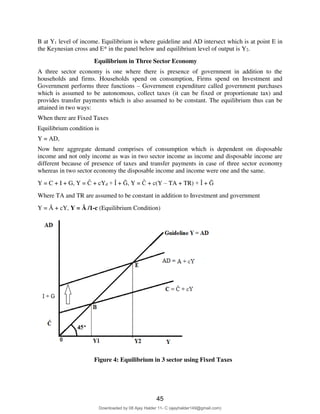
Y = C + I + G, Y = Ĉ + cYd + Ȋ + Ḡ, Y = Ĉ + c(Y – TA + TR) + Ȋ + Ḡ
Where TA and TR are assumed to be constant in addition to Investment and government
Y = Ᾱ + cY, Y = Ᾱ /1-c (Equilibrium Condition)
Figure 4: Equilibrium in 3 sector using Fixed Taxes
45
Downloaded by 08 Ajay Halder 11- C (ajayhalder149@gmail.com)
lOMoARcPSD|24060133
8
When there are proportionate taxes
Y = AD, Y = C + I + G, Y = Ĉ + cYd + Ȋ + Ḡ, Y = Ĉ + c(Y – tY + TR) + Ȋ + Ḡ
Where TR is assumed to be constant in addition to Investment and government purchases and tax
rate is fixed as a proportion of Y.
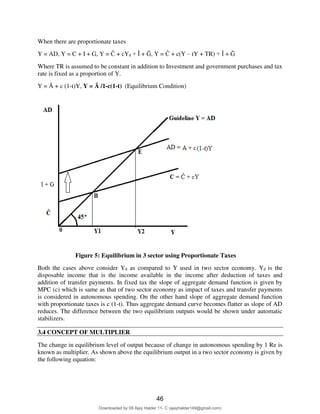
Y = Ᾱ + c (1-t)Y, Y = Ᾱ /1-c(1-t) (Equilibrium Condition)
Figure 5: Equilibrium in 3 sector using Proportionate Taxes
Both the cases above consider Yd as compared to Y used in two sector economy. Yd is the
disposable income that is the income available in the income after deduction of taxes and
addition of transfer payments. In fixed tax the slope of aggregate demand function is given by
MPC (c) which is same as that of two sector economy as impact of taxes and transfer payments
is considered in autonomous spending. On the other hand slope of aggregate demand function
with proportionate taxes is c (1-t). Thus aggregate demand curve becomes flatter as slope of AD
reduces. The difference between the two equilibrium outputs would be shown under automatic
stabilizers.
3.4 CONCEPT OF MULTIPLIER
The change in equilibrium level of output because of change in autonomous spending by 1 Re is
known as multiplier. As shown above the equilibrium output in a two sector economy is given by
the following equation:
46
Downloaded by 08 Ajay Halder 11- C (ajayhalder149@gmail.com)
lOMoARcPSD|24060133
Y = Ᾱ / (1– c) where Ᾱ = Autonomous spending that includes fixed consumption by the
households and autonomous investment by private firms.
c = Marginal Propensity to consume (MPC).
From the above equation the value of multiplier can be obtained as:
∆Y = ∆Ᾱ / (1-c), ∆Y = 1 / (1-c). ∆Ᾱ
Thus the change in equilibrium level of output is more than the change in autonomous spending
because of presence of multiplier shown by the 1 / (1– c).
Example 1: Let Autonomous spending increases by Re 1 and MPC is 0.8 then value of
multiplier would be: 1 / (1– 0.8) = 5 times that is change in equilibrium level of output is more
than change in autonomous spending.
The value of multiplier depends on the value of ‘c’ and as ‘c’ varies from 0 to 1 so the value of
multiplier also varies from 1 to infinity as shown below:
Example 2: Calculate value of multiplier in the following cases: a) MPC = 0 b) MPC = 1, c)
MPC = 0.2 d) MPC = 0.8
Solution: a) 1 / (1-0) = 1 times so no multiplier effect. ∆Y = ∆Ᾱ
b) 1 / (1-1) = Infinity
c) 1 / (1-0.2) = 1.25 times ∆Y > ∆Ᾱ
d) 1 / (1-0.8) = 5 times, ∆Y > ∆Ᾱ
Thus it shows that multiplier has a direct relation with MPC, the greater is MPC the higher is the
value of multiplier.
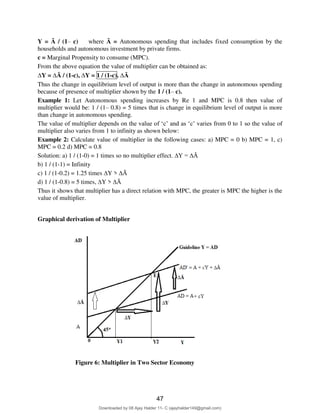
Graphical derivation of Multiplier
Figure 6: Multiplier in Two Sector Economy
47
Downloaded by 08 Ajay Halder 11- C (ajayhalder149@gmail.com)
lOMoARcPSD|24060133
The figure above shows original Aggregate demand curve with an intercept equal to autonomous
spending and slope equal to MPC. Equilibrium is where the AD intersects the guideline shown
by Y1 level of output. If there is an increase in autonomous spending by ∆Ᾱ, the aggregate
demand curve shifts parallel up by the same amount as slope is still the same (c). The new
equilibrium is at Y2 level of output. The increase in output from Y1 to Y2 is the change in
equilibrium level of output shown by the horizontal and vertical arrows whereas the distance
between the two aggregate demand curves is ∆Ᾱ. Thus graphically also it shows that ∆Y > ∆Ᾱ
because of multiplier.
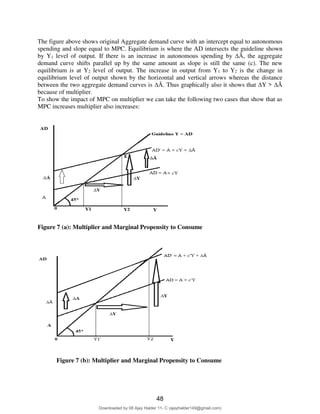
To show the impact of MPC on multiplier we can take the following two cases that show that as
MPC increases multiplier also increases:
Figure 7 (a): Multiplier and Marginal Propensity to Consume
Figure 7 (b): Multiplier and Marginal Propensity to Consume
48
Downloaded by 08 Ajay Halder 11- C (ajayhalder149@gmail.com)
lOMoARcPSD|24060133
11
Figure in panel (a) shows aggregate demand curve corresponding to a MPC of ‘c’ which is less
than MPC (c’) exhibited by panel (b). Thus the slope of aggregate demand curve of panel (a) is
less than that of panel (b). The intercept in both the cases is shown by autonomous spending an
increase with initial equilibrium at Y1 level of output in panel (a) and Y1’ in panel (b). With an
increase in autonomous spending by ∆Ᾱ in both the cases the equilibrium is at Y2 in panel (a)
and Y2’ in panel (b). the change in output is greater in case of higher MPC shoeing that there is a
direct relation between MPC and multiplier which is because of the fact that aggregate demand
curve is steeper in the second case as compared to the first one.
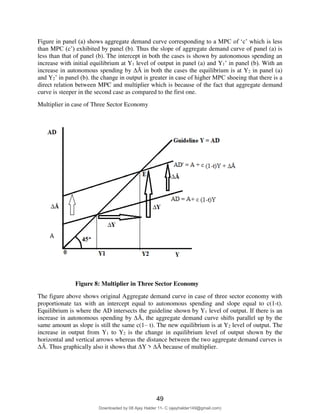
Multiplier in case of Three Sector Economy
Figure 8: Multiplier in Three Sector Economy
The figure above shows original Aggregate demand curve in case of three sector economy with
proportionate tax with an intercept equal to autonomous spending and slope equal to c(1-t).
Equilibrium is where the AD intersects the guideline shown by Y1 level of output. If there is an
increase in autonomous spending by ∆Ᾱ, the aggregate demand curve shifts parallel up by the
same amount as slope is still the same c(1– t). The new equilibrium is at Y2 level of output. The
increase in output from Y1 to Y2 is the change in equilibrium level of output shown by the
horizontal and vertical arrows whereas the distance between the two aggregate demand curves is
∆Ᾱ. Thus graphically also it shows that ∆Y > ∆Ᾱ because of multiplier.
49
Downloaded by 08 Ajay Halder 11- C (ajayhalder149@gmail.com)
lOMoARcPSD|24060133
12
The above discussion thus shows that the economy moves to a new level of equilibrium output
when there is change in the autonomous spending, the quantum of change depends on the
marginal propensity to consume and also on the taxation system being applicable in the economy
(fixed or proportionate tax). However ever economy tries not to deviate too much from the initial
equilibrium and there are certain forces imbibed in the economy itself that prevents a drastic
change which are known as the automatic stabilizers. It is being taken up in the next heading:
3.5 CONCEPT OF AUTOMATIC STABILIZER
Automatic stabilizers offset fluctuations in economic activity without direct intervention by
policymakers. When incomes are high, tax liabilities rise and eligibility for government benefits
falls, without any change in the tax code or other legislation. Conversely, when incomes slip, tax
liabilities drop and more families become eligible for government transfer programs, such as
food stamps and unemployment insurance that help buttress their income.
Two examples of Automatic stabilizers are:
Proportionate Tax – The presence of proportionate tax reduces the multiplier effect thereby
bringing a lesser diversion in the equilibrium income as compared to fixed tax. This is because in
case of proportionate taxes whatever is the change in income because of change in the
autonomous spending a part of it goes to the government in form of taxation and hence
disposable income is less as compared to fixed taxes. This can be illustrated using the following
example and figure:
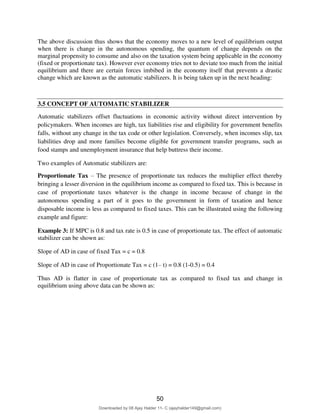
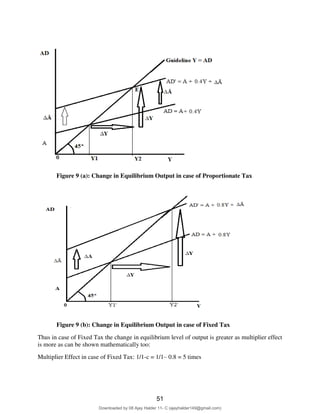
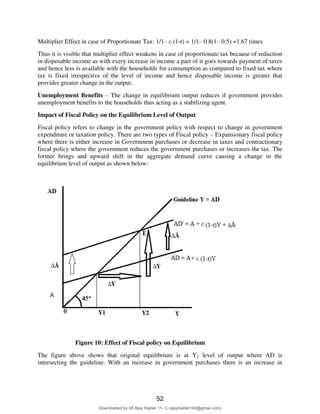
Example 3: If MPC is 0.8 and tax rate is 0.5 in case of proportionate tax. The effect of automatic
stabilizer can be shown as:
Slope of AD in case of fixed Tax = c = 0.8
Slope of AD in case of Proportionate Tax = c (1– t) = 0.8 (1-0.5) = 0.4
Thus AD is flatter in case of proportionate tax as compared to fixed tax and change in
equilibrium using above data can be shown as:
50
Downloaded by 08 Ajay Halder 11- C (ajayhalder149@gmail.com)
lOMoARcPSD|24060133
13
Figure 9 (a): Change in Equilibrium Output in case of Proportionate Tax
Figure 9 (b): Change in Equilibrium Output in case of Fixed Tax
Thus in case of Fixed Tax the change in equilibrium level of output is greater as multiplier effect
is more as can be shown mathematically too:
Multiplier Effect in case of Fixed Tax: 1/1-c = 1/1– 0.8 = 5 times
51
Downloaded by 08 Ajay Halder 11- C (ajayhalder149@gmail.com)
lOMoARcPSD|24060133
14
Multiplier Effect in case of Proportionate Tax: 1/1– c (1-t) = 1/1– 0.8(1– 0.5) =1.67 times
Thus it is visible that multiplier effect weakens in case of proportionate tax because of reduction
in disposable income as with every increase in income a part of it goes towards payment of taxes
and hence less is available with the households for consumption as compared to fixed tax where
tax is fixed irrespective of the level of income and hence disposable income is greater that
provides greater change in the output.
Unemployment Benefits – The change in equilibrium output reduces if government provides
unemployment benefits to the households thus acting as a stabilizing agent.
Impact of Fiscal Policy on the Equilibrium Level of Output
Fiscal policy refers to change in the government policy with respect to change in government
expenditure or taxation policy. There are two types of Fiscal policy – Expansionary fiscal policy
where there is either increase in Government purchases or decrease in taxes and contractionary
fiscal policy where the government reduces the government purchases or increases the tax. The
former brings and upward shift in the aggregate demand curve causing a change in the
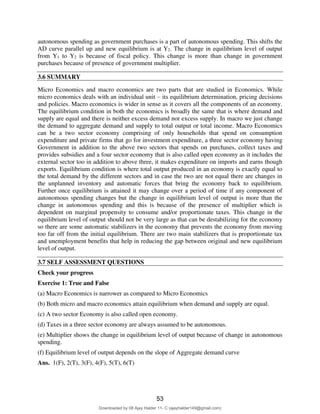
equilibrium level of output as shown below:
Figure 10: Effect of Fiscal policy on Equilibrium
The figure above shows that original equilibrium is at Y1 level of output where AD is
intersecting the guideline. With an increase in government purchases there is an increase in
52
Downloaded by 08 Ajay Halder 11- C (ajayhalder149@gmail.com)
lOMoARcPSD|24060133
autonomous spending as government purchases is a part of autonomous spending. This shifts the
AD curve parallel up and new equilibrium is at Y2. The change in equilibrium level of output
from Y1 to Y2 is because of fiscal policy. This change is more than change in government
purchases because of presence of government multiplier.
3.6 SUMMARY
Micro Economics and macro economics are two parts that are studied in Economics. While
micro economics deals with an individual unit – its equilibrium determination, pricing decisions
and policies. Macro economics is wider in sense as it covers all the components of an economy.
The equilibrium condition in both the economics is broadly the same that is where demand and
supply are equal and there is neither excess demand nor excess supply. In macro we just change
the demand to aggregate demand and supply to total output or total income. Macro Economics
can be a two sector economy comprising of only households that spend on consumption
expenditure and private firms that go for investment expenditure, a three sector economy having
Government in addition to the above two sectors that spends on purchases, collect taxes and
provides subsidies and a four sector economy that is also called open economy as it includes the
external sector too in addition to above three, it makes expenditure on imports and earns though
exports. Equilibrium condition is where total output produced in an economy is exactly equal to
the total demand by the different sectors and in case the two are not equal there are changes in
the unplanned inventory and automatic forces that bring the economy back to equilibrium.
Further once equilibrium is attained it may change over a period of time if any component of
autonomous spending changes but the change in equilibrium level of output is more than the
change in autonomous spending and this is because of the presence of multiplier which is
dependent on marginal propensity to consume and/or proportionate taxes. This change in the
equilibrium level of output should not be very large as that can be destabilizing for the economy
so there are some automatic stabilizers in the economy that prevents the economy from moving
too far off from the initial equilibrium. There are two main stabilizers that is proportionate tax
and unemployment benefits that help in reducing the gap between original and new equilibrium
level of output.
3.7 SELF ASSESSMENT QUESTIONS
Check your progress
Exercise 1: True and False
(a) Macro Economics is narrower as compared to Micro Economics
(b) Both micro and macro economics attain equilibrium when demand and supply are equal.
(c) A two sector Economy is also called open economy.
(d) Taxes in a three sector economy are always assumed to be autonomous.
(e) Multiplier shows the change in equilibrium level of output because of change in autonomous
spending.
(f) Equilibrium level of output depends on the slope of Aggregate demand curve
Ans. 1(F), 2(T), 3(F), 4(F), 5(T), 6(T)
53
Downloaded by 08 Ajay Halder 11- C (ajayhalder149@gmail.com)
lOMoARcPSD|24060133
Exercise 2: Fill in the Blanks
(a) A three sector economy has three components namely _ _ _ _ _ _ _ _ _ .
(b) If MPC is 1 then value of multiplier is _ _ _ _ _ _ _ _ _ .
(c) The two automatic stabilizers are _ _ _ _ _ _ _ _ _ .and _ _ _ _ _ _ _ _ _.
(d) An open economy is one where there is _ _ _ _ _ _ _ in addition to households, firms and
government purchases.
Ans 1. Households, Firms and Government 2. Infinity 3. Proportional Tax and Unemployment
Benefits 4. External Sector.
Exercise 3: Questions
1. Explain the equilibrium in case of two sector Economy.
_ _ _ _ _ _ _ _ _ _ _ _ _ _ _ _ _ _ _ _ _ _ _ _ _ _ _ _ _ _ _ _ _ _ _ _ _ _ _ _ _ _
_ _ _ _ _ _ _ _ _ _ _ _ _ _ _ _ _ _ _ _ _ _ _ _ _ _ _ _ _ _ _ _ _ _ _ _ _ _ _ _ _ _
2. Why the change in equilibrium level of output is greater than change in autonomous
spending.
_ _ _ _ _ _ _ _ _ _ _ _ _ _ _ _ _ _ _ _ _ _ _ _ _ _ _ _ _ _ _ _ _ _ _ _ _ _ _ _ _ _
_ _ _ _ _ _ _ _ _ _ _ _ _ _ _ _ _ _ _ _ _ _ _ _ _ _ _ _ _ _ _ _ _ _ _ _ _ _ _ _ _ _
3. How is equilibrium attained in case of three sector economy with proportionate tax.
_ _ _ _ _ _ _ _ _ _ _ _ _ _ _ _ _ _ _ _ _ _ _ _ _ _ _ _ _ _ _ _ _ _ _ _ _ _ _ _ _ _
_ _ _ _ _ _ _ _ _ _ _ _ _ _ _ _ _ _ _ _ _ _ _ _ _ _ _ _ _ _ _ _ _ _ _ _ _ _ _ _ _ _
4. Explain the concept of automatic stabilizers by giving suitable example.
_ _ _ _ _ _ _ _ _ _ _ _ _ _ _ _ _ _ _ _ _ _ _ _ _ _ _ _ _ _ _ _ _ _ _ _ _ _ _ _ _ _
_ _ _ _ _ _ _ _ _ _ _ _ _ _ _ _ _ _ _ _ _ _ _ _ _ _ _ _ _ _ _ _ _ _ _ _ _ _ _ _ _ _
5. Explain how fixed taxes bring more change in equilibrium as compared to proportionate
tax.
_ _ _ _ _ _ _ _ _ _ _ _ _ _ _ _ _ _ _ _ _ _ _ _ _ _ _ _ _ _ _ _ _ _ _ _ _ _ _ _ _ _
_ _ _ _ _ _ _ _ _ _ _ _ _ _ _ _ _ _ _ _ _ _ _ _ _ _ _ _ _ _ _ _ _ _ _ _ _ _ _ _ _ _
6. Explain the concept of multiplier in a two sector economy.
_ _ _ _ _ _ _ _ _ _ _ _ _ _ _ _ _ _ _ _ _ _ _ _ _ _ _ _ _ _ _ _ _ _ _ _ _ _ _ _ _ _
_ _ _ _ _ _ _ _ _ _ _ _ _ _ _ _ _ _ _ _ _ _ _ _ _ _ _ _ _ _ _ _ _ _ _ _ _ _ _ _ _ _
7. What is the effect of expansionary fiscal policy on the equilibrium level of output.
_ _ _ _ _ _ _ _ _ _ _ _ _ _ _ _ _ _ _ _ _ _ _ _ _ _ _ _ _ _ _ _ _ _ _ _ _ _ _ _ _ _
_ _ _ _ _ _ _ _ _ _ _ _ _ _ _ _ _ _ _ _ _ _ _ _ _ _ _ _ _ _ _ _ _ _ _ _ _ _ _ _ _ _
8. What is the role of government in a three sector economy.
_ _ _ _ _ _ _ _ _ _ _ _ _ _ _ _ _ _ _ _ _ _ _ _ _ _ _ _ _ _ _ _ _ _ _ _ _ _ _ _ _ _
_ _ _ _ _ _ _ _ _ _ _ _ _ _ _ _ _ _ _ _ _ _ _ _ _ _ _ _ _ _ _ _ _ _ _ _ _ _ _ _ _ _ _ _ _ _ _
3.8 SUGGESTED READINGS
Mankiw, N. Gregory, Macro Economics, Macmillan Worth Publishers New York, Hampshire
U.K..
Dornbusch, Rudiger and Stanley, Fischer, Macro Economics Theory, McGraw-Hill
Barro Robert J., Macroeconomics Theory and Applications, MIT Press.
54
Downloaded by 08 Ajay Halder 11- C (ajayhalder149@gmail.com)
lOMoARcPSD|24060133
UNIT IV
OPEN ECONOMY
55
Downloaded by 08 Ajay Halder 11- C (ajayhalder149@gmail.com)
lOMoARcPSD|24060133
Downloaded by 08 Ajay Halder 11- C (ajayhalder149@gmail.com)
lOMoARcPSD|24060133
65
LESSON 1
OPEN ECONOMY – LARGE AND SMALL
3. STRUCTURE
3.1 Objective
3.2 Introduction
3.3 Small Open Economy and Large Open Economy
3.4 Effect of Policies on small and large open economy
3.5 Exchange rate determination
3.6 Summary
3.7 Self Assessment Questions
3.8 Suggested Readings
3.1 OBJECTIVE
After reading this lesson, you should be able to:
a) Explain the concept of small and large open economy.
b) Effect of policies on small and large open economy and how they differ.
c) Determination of exchange rate using fixed exchange rate and flexible exchange rate
regime.
d) Analyze the impact of exchange rate variation on the small and open economy
e) Examine the relation between exchange rate and equilibrium output
3.2 INTRODUCTION
Unit two discussed derivation of IS-LM curves in a closed economy but there is no economy in
the world today that can be called a closed economy, hence to make the model more realistic this
unit would talk about IS-LM model in an open economy system. There are basically two types of
open economies – small and large open economy that would be discussed in the chapter and how
different policies have different impact on the output depending upon the fact whether it is an
open economy or a closed economy. In the IS-LM determination the model being closed one
there was no discussion about the exchange rate impact on the various variables but that is an
important component of this unit as it talks about open economy where exchange rate is an
important variable. IS-LM model showed relation between different levels of real rate of interest
and equilibrium level of output whereas open economy IS-LM model also known as Mundell-
Fleming model shows relation between exchange rate and equilibrium level of output which is
derived from the IS-LM model itself. This is because of the fact in an open economy exchange
rate is one such important variable that has an impact on all the policies and the equilibrium
output.
57
Downloaded by 08 Ajay Halder 11- C (ajayhalder149@gmail.com)
lOMoARcPSD|24060133
66
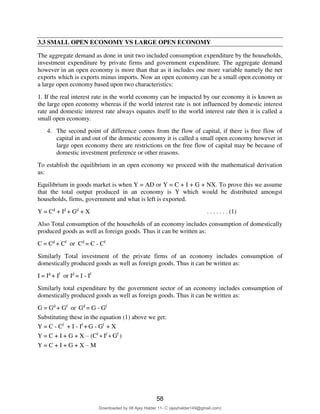
3.3 SMALL OPEN ECONOMY VS LARGE OPEN ECONOMY
The aggregate demand as done in unit two included consumption expenditure by the households,
investment expenditure by private firms and government expenditure. The aggregate demand
however in an open economy is more than that as it includes one more variable namely the net
exports which is exports minus imports. Now an open economy can be a small open economy or
a large open economy based upon two characteristics:
1. If the real interest rate in the world economy can be impacted by our economy it is known as
the large open economy whereas if the world interest rate is not influenced by domestic interest
rate and domestic interest rate always equates itself to the world interest rate then it is called a
small open economy.
4. The second point of difference comes from the flow of capital, if there is free flow of
capital in and out of the domestic economy it is called a small open economy however in
large open economy there are restrictions on the free flow of capital may be because of
domestic investment preference or other reasons.
To establish the equilibrium in an open economy we proceed with the mathematical derivation
as:
Equilibrium in goods market is when Y = AD or Y = C + I + G + NX. To prove this we assume
that the total output produced in an economy is Y which would be distributed amongst
households, firms, government and what is left is exported.
Y = Cd
+ Id
+ Gd
+ X . . . . . . . (1)
Also Total consumption of the households of an economy includes consumption of domestically
produced goods as well as foreign goods. Thus it can be written as:
C = Cd
+ Cf
or Cd
= C - Cf
Similarly Total investment of the private firms of an economy includes consumption of
domestically produced goods as well as foreign goods. Thus it can be written as:
I = Id
+ If
or Id
= I - If
Similarly total expenditure by the government sector of an economy includes consumption of
domestically produced goods as well as foreign goods. Thus it can be written as:
G = Gd
+ Gf
or Gd
= G - Gf
Substituting these in the equation (1) above we get:
Y = C - Cf
+ I - If
+ G - Gf
+ X
Y = C + I + G + X – (Cf
+ If
+ Gf
)
Y = C + I + G + X – M
58
Downloaded by 08 Ajay Halder 11- C (ajayhalder149@gmail.com)
lOMoARcPSD|24060133
67
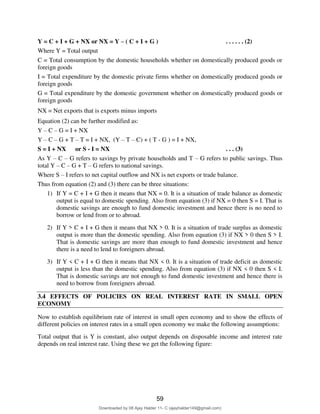
Y = C + I + G + NX or NX = Y – ( C + I + G ) . . . . . . (2)
Where Y = Total output
C = Total consumption by the domestic households whether on domestically produced goods or
foreign goods
I = Total expenditure by the domestic private firms whether on domestically produced goods or
foreign goods
G = Total expenditure by the domestic government whether on domestically produced goods or
foreign goods
NX = Net exports that is exports minus imports
Equation (2) can be further modified as:
Y – C – G = I + NX
Y – C – G + T – T = I + NX, (Y – T – C) + ( T - G ) = I + NX,
S = I + NX or S - I = NX . . . (3)
As Y – C – G refers to savings by private households and T – G refers to public savings. Thus
total Y – C – G + T – G refers to national savings.
Where S – I refers to net capital outflow and NX is net exports or trade balance.
Thus from equation (2) and (3) there can be three situations:
1) If Y = C + I + G then it means that NX = 0. It is a situation of trade balance as domestic
output is equal to domestic spending. Also from equation (3) if NX = 0 then S = I. That is
domestic savings are enough to fund domestic investment and hence there is no need to
borrow or lend from or to abroad.
2) If Y > C + I + G then it means that NX > 0. It is a situation of trade surplus as domestic
output is more than the domestic spending. Also from equation (3) if NX > 0 then S > I.
That is domestic savings are more than enough to fund domestic investment and hence
there is a need to lend to foreigners abroad.
3) If Y < C + I + G then it means that NX < 0. It is a situation of trade deficit as domestic
output is less than the domestic spending. Also from equation (3) if NX < 0 then S < I.
That is domestic savings are not enough to fund domestic investment and hence there is
need to borrow from foreigners abroad.
3.4 EFFECTS OF POLICIES ON REAL INTEREST RATE IN SMALL OPEN
ECONOMY
Now to establish equilibrium rate of interest in small open economy and to show the effects of
different policies on interest rates in a small open economy we make the following assumptions:
Total output that is Y is constant, also output depends on disposable income and interest rate
depends on real interest rate. Using these we get the following figure:
59
Downloaded by 08 Ajay Halder 11- C (ajayhalder149@gmail.com)
lOMoARcPSD|24060133
68
Figure 1: Equilibrium rate of interest in small open economy
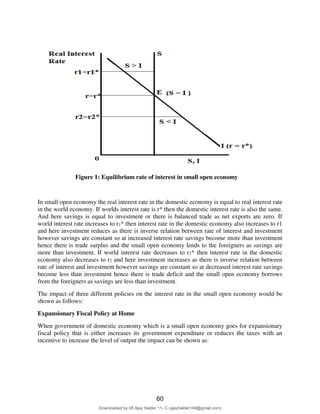
In small open economy the real interest rate in the domestic economy is equal to real interest rate
in the world economy. If worlds interest rate is r* then the domestic interest rate is also the same.
And here savings is equal to investment or there is balanced trade as net exports are zero. If
world interest rate increases to r1* then interest rate in the domestic economy also increases to r1
and here investment reduces as there is inverse relation between rate of interest and investment
however savings are constant so at increased interest rate savings become more than investment
hence there is trade surplus and the small open economy lends to the foreigners as savings are
more than investment. If world interest rate decreases to r2* then interest rate in the domestic
economy also decreases to r2 and here investment increases as there is inverse relation between
rate of interest and investment however savings are constant so at decreased interest rate savings
become less than investment hence there is trade deficit and the small open economy borrows
from the foreigners as savings are less than investment.
The impact of three different policies on the interest rate in the small open economy would be
shown as follows:
Expansionary Fiscal Policy at Home
When government of domestic economy which is a small open economy goes for expansionary
fiscal policy that is either increases its government expenditure or reduces the taxes with an
incentive to increase the level of output the impact can be shown as:
60
Downloaded by 08 Ajay Halder 11- C (ajayhalder149@gmail.com)
lOMoARcPSD|24060133
69
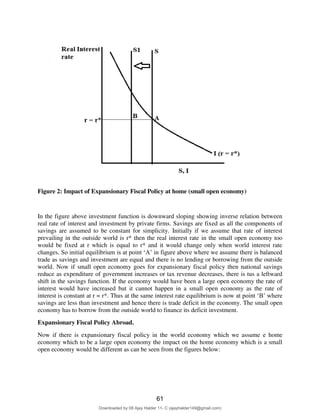
Figure 2: Impact of Expansionary Fiscal Policy at home (small open economy)
In the figure above investment function is downward sloping showing inverse relation between
real rate of interest and investment by private firms. Savings are fixed as all the components of
savings are assumed to be constant for simplicity. Initially if we assume that rate of interest
prevailing in the outside world is r* then the real interest rate in the small open economy too
would be fixed at r which is equal to r* and it would change only when world interest rate
changes. So initial equilibrium is at point ‘A’ in figure above where we assume there is balanced
trade as savings and investment are equal and there is no lending or borrowing from the outside
world. Now if small open economy goes for expansionary fiscal policy then national savings
reduce as expenditure of government increases or tax revenue decreases, there is tus a leftward
shift in the savings function. If the economy would have been a large open economy the rate of
interest would have increased but it cannot happen in a small open economy as the rate of
interest is constant at r = r*. Thus at the same interest rate equilibrium is now at point ‘B’ where
savings are less than investment and hence there is trade deficit in the economy. The small open
economy has to borrow from the outside world to finance its deficit investment.
Expansionary Fiscal Policy Abroad.
Now if there is expansionary fiscal policy in the world economy which we assume e home
economy which to be a large open economy the impact on the home economy which is a small
open economy would be different as can be seen from the figures below:
61
Downloaded by 08 Ajay Halder 11- C (ajayhalder149@gmail.com)
lOMoARcPSD|24060133
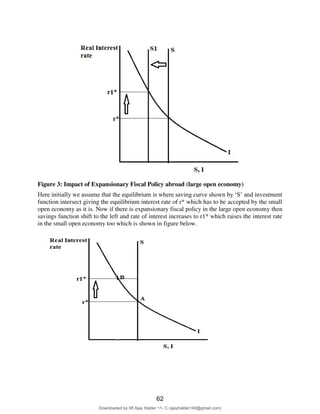
Figure 3: Impact of Expansionary Fiscal Policy abroad (large open economy)
Here initially we assume that the equilibrium is where saving curve shown by ‘S’ and investment
function intersect giving the equilibrium interest rate of r* which has to be accepted by the small
open economy as it is. Now if there is expansionary fiscal policy in the large open economy then
savings function shift to the left and rate of interest increases to r1* which raises the interest rate
in the small open economy too which is shown in figure below.
62
Downloaded by 08 Ajay Halder 11- C (ajayhalder149@gmail.com)
lOMoARcPSD|24060133
71
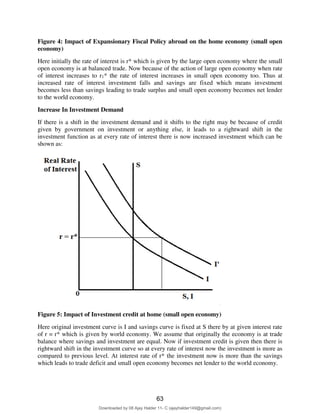
Figure 4: Impact of Expansionary Fiscal Policy abroad on the home economy (small open
economy)
Here initially the rate of interest is r* which is given by the large open economy where the small
open economy is at balanced trade. Now because of the action of large open economy when rate
of interest increases to r1* the rate of interest increases in small open economy too. Thus at
increased rate of interest investment falls and savings are fixed which means investment
becomes less than savings leading to trade surplus and small open economy becomes net lender
to the world economy.
Increase In Investment Demand
If there is a shift in the investment demand and it shifts to the right may be because of credit
given by government on investment or anything else, it leads to a rightward shift in the
investment function as at every rate of interest there is now increased investment which can be
shown as:
Figure 5: Impact of Investment credit at home (small open economy)
Here original investment curve is I and savings curve is fixed at S there by at given interest rate
of r = r* which is given by world economy. We assume that originally the economy is at trade
balance where savings and investment are equal. Now if investment credit is given then there is
rightward shift in the investment curve so at every rate of interest now the investment is more as
compared to previous level. At interest rate of r* the investment now is more than the savings
which leads to trade deficit and small open economy becomes net lender to the world economy.
63
Downloaded by 08 Ajay Halder 11- C (ajayhalder149@gmail.com)
lOMoARcPSD|24060133
Figure above shows a vertical line showing the savings and investment difference or the net
capital outflow. It is a vertical line as neither the savings nor the investment is a function of real
exchange rate. Net exports is a downward sloping curve showing inverse relation between net
exports and real exchange rate. Equilibrium is when both these curves intersect and there is trade
balance in the economy. This is the real exchange rate that would prevail in the economy.
3.6 SUMMARY
All the economies in the world can be divided into two types that is closed economy which does
not have any interaction with the rest of the world and open economy which is integrated with
the other economies of the world. Though there is no such economy which can be called purely a
closed economy. Further there can be two types of open economy – small open economy and
large open economy. The small open economy is one where there is no restriction on capital
movement and the world interest rate determines the real interest rate prevalent in the small open
economy. In the latter that is large open economy there are certain restrictions on the capital
movement in and out of the economy which can be because of investors’ preference for domestic
investment or government restrictions on free mobility. Also the world interest rate can be
influenced by the real interest rates prevailing in the large open economy. An important concept
that is needed in the open economy which was not there in the closed economy is the concept of
exchange rate as the capital movements, the movement of goods and services in and out of an
economy to a great extent depends on the exchange rate of the two countries. The impacts of
various policies are seen not only on the interest rates but also on the exchange rates in an open
economy.
3.7 SELF ASSESSMENT QUESTIONS
Check your progress
Exercise 1: True and False
(a) Large open economy can influence the world interest rate.
(b) When savings are more than the investment it means we are lending funds to the foreigners.
(c) A two sector Economy is also called open economy.
(d) Fiscal policy in the home country which is a small open economy has no impact on the
interest rates.
(e) Small open economy has unrestricted capital flows in and out of the economy.
(f) Equilibrium level of output depends on the slope of Aggregate demand curve
Ans. 1(T), 2(T), 3(F), 4(T), 5(T), 6(T)
64
Downloaded by 08 Ajay Halder 11- C (ajayhalder149@gmail.com)
lOMoARcPSD|24060133
Exercise 2: Fill in the Blanks
(a) An economy with households, firms, government and external sector is termed as _ _ _ _ _ _
_ _ _ .
(b) If there is expansionary fiscal policy in rest of the world it _ _ _ _ _ _ _ _ _ the interest rate in
the small open economy.
(c) Exchange rate is the rate at which currency of one country is exchanged for currency of _ _ _
_ _ _ _ _ country .
(d) Fisher effect shows relation between _ _ _ _ _ _ and _ _ _ _ _ _ .
Ans 1. Open economy 2. Increases 3. Another 4. Inflation and Interest Rate
Exercise 3: Questions
1. Differentiate between small open and large open economy.
_ _ _ _ _ _ _ _ _ _ _ _ _ _ _ _ _ _ _ _ _ _ _ _ _ _ _ _ _ _ _ _ _ _ _ _ _ _ _ _ _ _
_ _ _ _ _ _ _ _ _ _ _ _ _ _ _ _ _ _ _ _ _ _ _ _ _ _ _ _ _ _ _ _ _ _ _ _ _ _ _ _ _ _
2. What is the impact of contractionary fiscal policy in the small open economy on the
equilibrium?
_ _ _ _ _ _ _ _ _ _ _ _ _ _ _ _ _ _ _ _ _ _ _ _ _ _ _ _ _ _ _ _ _ _ _ _ _ _ _ _ _ _
_ _ _ _ _ _ _ _ _ _ _ _ _ _ _ _ _ _ _ _ _ _ _ _ _ _ _ _ _ _ _ _ _ _ _ _ _ _ _ _ _ _
3. Explain the concept of exchange rate.
_ _ _ _ _ _ _ _ _ _ _ _ _ _ _ _ _ _ _ _ _ _ _ _ _ _ _ _ _ _ _ _ _ _ _ _ _ _ _ _ _ _
_ _ _ _ _ _ _ _ _ _ _ _ _ _ _ _ _ _ _ _ _ _ _ _ _ _ _ _ _ _ _ _ _ _ _ _ _ _ _ _ _ _
4. Differentiate between nominal and real exchange rate.
_ _ _ _ _ _ _ _ _ _ _ _ _ _ _ _ _ _ _ _ _ _ _ _ _ _ _ _ _ _ _ _ _ _ _ _ _ _ _ _ _ _
_ _ _ _ _ _ _ _ _ _ _ _ _ _ _ _ _ _ _ _ _ _ _ _ _ _ _ _ _ _ _ _ _ _ _ _ _ _ _ _ _ _
5. Net foreign investment always equals the trade balance in a small open economy. Elaborate
_ _ _ _ _ _ _ _ _ _ _ _ _ _ _ _ _ _ _ _ _ _ _ _ _ _ _ _ _ _ _ _ _ _ _ _ _ _ _ _ _ _
_ _ _ _ _ _ _ _ _ _ _ _ _ _ _ _ _ _ _ _ _ _ _ _ _ _ _ _ _ _ _ _ _ _ _ _ _ _ _ _ _ _
6. Explain the concept of Natural rate of Unemployment.
_ _ _ _ _ _ _ _ _ _ _ _ _ _ _ _ _ _ _ _ _ _ _ _ _ _ _ _ _ _ _ _ _ _ _ _ _ _ _ _ _ _
_ _ _ _ _ _ _ _ _ _ _ _ _ _ _ _ _ _ _ _ _ _ _ _ _ _ _ _ _ _ _ _ _ _ _ _ _ _ _ _ _ _
7. What is the difference between investment credit and fiscal policy on the equilibrium in a
small open economy.
_ _ _ _ _ _ _ _ _ _ _ _ _ _ _ _ _ _ _ _ _ _ _ _ _ _ _ _ _ _ _ _ _ _ _ _ _ _ _ _ _ _
_ _ _ _ _ _ _ _ _ _ _ _ _ _ _ _ _ _ _ _ _ _ _ _ _ _ _ _ _ _ _ _ _ _ _ _ _ _ _ _ _ _
8. Why is world interest rate equal to interest rate in the small open economy.
_ _ _ _ _ _ _ _ _ _ _ _ _ _ _ _ _ _ _ _ _ _ _ _ _ _ _ _ _ _ _ _ _ _ _ _ _ _ _ _ _ _
_ _ _ _ _ _ _ _ _ _ _ _ _ _ _ _ _ _ _ _ _ _ _ _ _ _ _ _ _ _ _ _ _ _ _ _ _ _ _ _ _ _ _ _ _ _ _
65
Downloaded by 08 Ajay Halder 11- C (ajayhalder149@gmail.com)
lOMoARcPSD|24060133
3.8 SUGGESTED READINGS
Mankiw, N. Gregory, Macro Economics, Macmillan Worth Publishers New York, Hampshire
U.K..
Dornbusch, Rudiger and Stanley, Fischer, Macro Economics Theory, McGraw-Hill
Barro Robert J., Macroeconomics Theory and Applications, MIT Press.
66
Downloaded by 08 Ajay Halder 11- C (ajayhalder149@gmail.com)
lOMoARcPSD|24060133
77
LESSON 2
OPEN ECONOMY- MUNDELL FLEMING MODEL
2. STRUCTURE
2.1 Objective
2.2 Introduction
2.3 Equilibrium in Large open economy
2.4 Mundell – Fleming Model
2.5 Impact of policies on equilibrium
2.6 Summary
2.7 Self Assessment Questions
2.8 Suggested Readings
2.1 OBJECTIVE
After reading this lesson, you should be able to:
a) Differentiate between small and large open economy.
b) Effect of policies on large open economy and how they differ.
c) Determination of IS-LM Mundell Fleming model
d) Analyze the impact of exchange rate variation on the small and open economy
e) Examine the relation between various policy changes and equilibrium
2.2 INTRODUCTION
The earlier chapter talked about small open economy where there is no restriction on the
capital flows in and out of the economy, this chapter would focus on large open economy
and the impact of various policies on the equilibrium in large open economy. The chapter
would also discuss the IS-LM model applicable in case of a small open economy. The IS-
LM model that was discussed in unit two was operative in a closed economy where there
was no external sector and no imports or exports. A large open economy has capital
movements in and out of the economy but there is not an absolute free movements as
investors prefer domestic investment rather than outside investment. This fact is reflected
in the difference in the real interest rates that prevail in the domestic economy and world
economy.
67
Downloaded by 08 Ajay Halder 11- C (ajayhalder149@gmail.com)
lOMoARcPSD|24060133
78
2.3 EQUILIBRIUM IN LARGE OPEN ECONOMY
A large open economy has the following two features:
1. Real interest rate in the domestic large open economy is not equal to the world real
interest rate
2. There are restrictions on the capital movements in and out of the large open economy
as investors have preference for the local economy rather than the rest of the world.
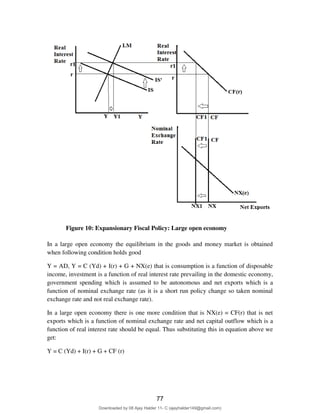
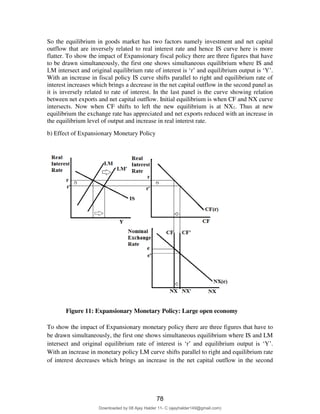
To attain the equilibrium in a large open economy two markets are to be studied
simultaneously that is market for loanable funds where the real interest rates are
determined and then the market for foreign exchange where the equilibrium exchange
rate is determined. It can be shown using the following diagrams:
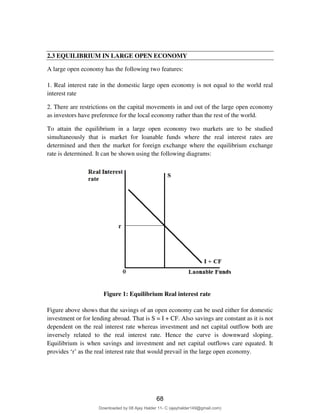
Figure 1: Equilibrium Real interest rate
Figure above shows that the savings of an open economy can be used either for domestic
investment or for lending abroad. That is S = I + CF. Also savings are constant as it is not
dependent on the real interest rate whereas investment and net capital outflow both are
inversely related to the real interest rate. Hence the curve is downward sloping.
Equilibrium is when savings and investment and net capital outflows care equated. It
provides ‘r’ as the real interest rate that would prevail in the large open economy.
68
Downloaded by 08 Ajay Halder 11- C (ajayhalder149@gmail.com)
lOMoARcPSD|24060133
79
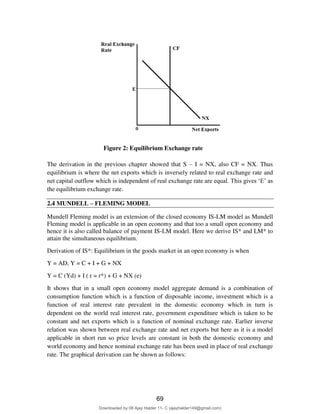
Figure 2: Equilibrium Exchange rate
The derivation in the previous chapter showed that S – I = NX, also CF = NX. Thus
equilibrium is where the net exports which is inversely related to real exchange rate and
net capital outflow which is independent of real exchange rate are equal. This gives ‘E’ as
the equilibrium exchange rate.
2.4 MUNDELL – FLEMING MODEL
Mundell Fleming model is an extension of the closed economy IS-LM model as Mundell
Fleming model is applicable in an open economy and that too a small open economy and
hence it is also called balance of payment IS-LM model. Here we derive IS* and LM* to
attain the simultaneous equilibrium.
Derivation of IS*: Equilibrium in the goods market in an open economy is when
Y = AD, Y = C + I + G + NX
Y = C (Yd) + I ( r = r*) + G + NX (e)
It shows that in a small open economy model aggregate demand is a combination of
consumption function which is a function of disposable income, investment which is a
function of real interest rate prevalent in the domestic economy which in turn is
dependent on the world real interest rate, government expenditure which is taken to be
constant and net exports which is a function of nominal exchange rate. Earlier inverse
relation was shown between real exchange rate and net exports but here as it is a model
applicable in short run so price levels are constant in both the domestic economy and
world economy and hence nominal exchange rate has been used in place of real exchange
rate. The graphical derivation can be shown as follows:
69
Downloaded by 08 Ajay Halder 11- C (ajayhalder149@gmail.com)
lOMoARcPSD|24060133
80
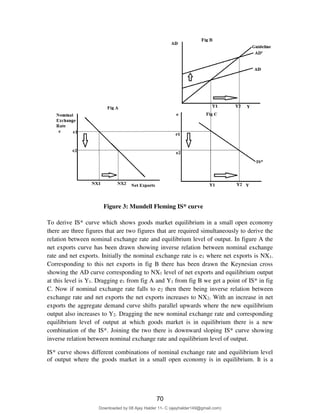
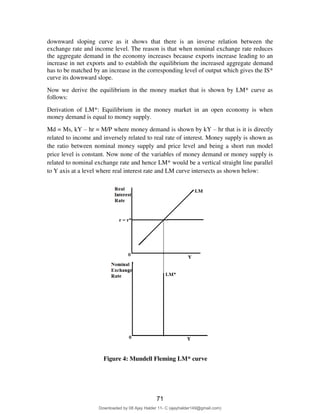
Figure 3: Mundell Fleming IS* curve
To derive IS* curve which shows goods market equilibrium in a small open economy
there are three figures that are two figures that are required simultaneously to derive the
relation between nominal exchange rate and equilibrium level of output. In figure A the
net exports curve has been drawn showing inverse relation between nominal exchange
rate and net exports. Initially the nominal exchange rate is e1 where net exports is NX1.
Corresponding to this net exports in fig B there has been drawn the Keynesian cross
showing the AD curve corresponding to NX1 level of net exports and equilibrium output
at this level is Y1. Dragging e1 from fig A and Y1 from fig B we get a point of IS* in fig
C. Now if nominal exchange rate falls to e2 then there being inverse relation between
exchange rate and net exports the net exports increases to NX2. With an increase in net
exports the aggregate demand curve shifts parallel upwards where the new equilibrium
output also increases to Y2. Dragging the new nominal exchange rate and corresponding
equilibrium level of output at which goods market is in equilibrium there is a new
combination of the IS*. Joining the two there is downward sloping IS* curve showing
inverse relation between nominal exchange rate and equilibrium level of output.
IS* curve shows different combinations of nominal exchange rate and equilibrium level
of output where the goods market in a small open economy is in equilibrium. It is a
70
Downloaded by 08 Ajay Halder 11- C (ajayhalder149@gmail.com)
lOMoARcPSD|24060133
downward sloping curve as it shows that there is an inverse relation between the
exchange rate and income level. The reason is that when nominal exchange rate reduces
the aggregate demand in the economy increases because exports increase leading to an
increase in net exports and to establish the equilibrium the increased aggregate demand
has to be matched by an increase in the corresponding level of output which gives the IS*
curve its downward slope.
Now we derive the equilibrium in the money market that is shown by LM* curve as
follows:
Derivation of LM*: Equilibrium in the money market in an open economy is when
money demand is equal to money supply.
Md = Ms, kY – hr = M/P where money demand is shown by kY – hr that is it is directly
related to income and inversely related to real rate of interest. Money supply is shown as
the ratio between nominal money supply and price level and being a short run model
price level is constant. Now none of the variables of money demand or money supply is
related to nominal exchange rate and hence LM* would be a vertical straight line parallel
to Y axis at a level where real interest rate and LM curve intersects as shown below:
Figure 4: Mundell Fleming LM* curve
71
Downloaded by 08 Ajay Halder 11- C (ajayhalder149@gmail.com)
lOMoARcPSD|24060133
82
To derive the LM* curve there are two panels required, in the above part there is LM
curve of a closed economy showing relation between real interest rate and equilibrium
level of output. Assuming the world real interest rate to be r* the domestic interest rate
would be equal to that such that the LM curve intersects the r* line which is dragged
below to get the LM* curve of an open economy. It is a vertical straight line showing that
there is no specific relation between nominal exchange rate and equilibrium level of
output. If there is any change in the world interest rate then there is a corresponding shift
of the LM curve and hence the LM* curve.
Simultaneous equilibrium in small open economy from IS* and LM* curve can be shown
as follows:
Figure 5: Simultaneous equilibrium in small open economy
Any point on the IS* curve shows equilibrium in the goods market of a small open
economy while any point on the LM* curve shows equilibrium in the money market in
the small open economy. For an economy to be in simultaneous equilibrium the point
should be on both the IS* and LM* curve which occurs at ‘E’ in the figure above
showing that the equilibrium nominal exchange rate is e* and equilibrium level of output
is Y*.
72
Downloaded by 08 Ajay Halder 11- C (ajayhalder149@gmail.com)
lOMoARcPSD|24060133
2.5 IMPACT OF DIFFERENT POLICIES ON SMALL AND LARGE
OPEN ECONOMY
Case 1: Impact of Expansionary Fiscal and monetary policy on Mundell Fleming
Equilibrium under Fixed and Floating Exchange rate: Floating exchange rate means
exchange rate that can change depending upon the market conditions whereas fixed
exchange rate is one where central bank fixes and exchange rate and it might be more or
less than the equilibrium exchange rate that market forces determine. But the arbitrageurs
make sure that their buying and selling action keeps the exchange rate as that fixed by the
central bank. Thus in fixed exchange rate the exchange rate is fixed at the central banks’
rate and exchange rate is not allowed to fluctuate.
a) Expansionary Fiscal Policy in case of floating Exchange Rate
Figure 6: Expansionary Fiscal Policy: Floating Exchange Rate
Here IS* is the original goods market curve and LM* is the original money market
curve. The original equilibrium exchange rate is e1. Now if there is expansionary
fiscal policy in the small open economy then IS* shifts parallel to right to IS’*. The
73
Downloaded by 08 Ajay Halder 11- C (ajayhalder149@gmail.com)
lOMoARcPSD|24060133
new equilibrium exchange rate is e2 that is there is appreciation of domestic currency
because of which net exports falls and hence the equilibrium output is at same level
because the increase in aggregate demand because of increase in government
expenditure is offset by decrease in net exports. Hence the new equilibrium is at
higher exchange rate but at same level of equilibrium level of output.
b) Expansionary Monetary Policy in case of floating Exchange Rate
Figure 7: Expansionary Monetary Policy: Floating Exchange Rate
Here IS* is the original goods market curve and LM* is the original money market
curve. The original equilibrium exchange rate is e1. Now if there is expansionary
monetary policy in the small open economy then LM* shifts parallel to right to LM’*.
The new equilibrium exchange rate is e2 that is there is depreciation of domestic
currency because of which net exports rises and hence the equilibrium output is at
increased level. Hence the new equilibrium is at lower exchange rate and at increased
level of equilibrium level of output.
74
Downloaded by 08 Ajay Halder 11- C (ajayhalder149@gmail.com)
lOMoARcPSD|24060133
c) Expansionary Fiscal Policy in case of fixed Exchange Rate
Figure 8: Expansionary Fiscal Policy: Fixed Exchange Rate
This is the case of a fixed exchange rate regime where the central bank has fixed the
exchange rate at e1, now if the government of the small open economy goes for an
expansionary fiscal policy then the IS* curve shifts to right to IS’*, now if the
exchange rate would have been floating then exchange rate would have appreciated to
e2. But it being a fixed exchange rate scenario, the moment exchange rate in the
foreign exchange market increases to e2, arbitragers come into force and increase the
money supply of domestic currency till the exchange rate in the foreign exchange
market also comes down to the rate fixed by central bank.. Hence LM* also shifts to
the right and at new equilibrium the exchange rate is same but equilibrium output has
increased unlike fixed exchange rate policy where there was a change in exchange
rate and no change in equilibrium output.
d) Expansionary Monetary Policy in case of fixed Exchange Rate
75
Downloaded by 08 Ajay Halder 11- C (ajayhalder149@gmail.com)
lOMoARcPSD|24060133
Figure 9: Expansionary Monetary Policy: Fixed Exchange Rate
This is the case of a fixed exchange rate regime where the central bank has fixed the
exchange rate at e2, now if the government of the small open economy goes for an
expansionary monetary policy then the LM* curve shifts to right to LM’*, now if the
exchange rate would have been floating then exchange rate would have depreciated to
e1. But it being a fixed exchange rate scenario, the moment exchange rate in the
foreign exchange market decreases to e1, arbitragers come into force and decrease the
money supply of domestic currency till the exchange rate in the foreign exchange
market also comes to the rate fixed by central bank. Hence LM* also shifts to the left
and at new equilibrium the exchange rate as well as output is same.
Case 2: Impact of Expansionary Fiscal and Monetary policy on Large open
economy.
a) Effect of Expansionary Fiscal Policy
76
Downloaded by 08 Ajay Halder 11- C (ajayhalder149@gmail.com)
lOMoARcPSD|24060133
87
Figure 10: Expansionary Fiscal Policy: Large open economy
In a large open economy the equilibrium in the goods and money market is obtained
when following condition holds good
Y = AD, Y = C (Yd) + I(r) + G + NX(e) that is consumption is a function of disposable
income, investment is a function of real interest rate prevailing in the domestic economy,
government spending which is assumed to be autonomous and net exports which is a
function of nominal exchange rate (as it is a short run policy change so taken nominal
exchange rate and not real exchange rate).
In a large open economy there is one more condition that is NX(e) = CF(r) that is net
exports which is a function of nominal exchange rate and net capital outflow which is a
function of real interest rate should be equal. Thus substituting this in equation above we
get:
Y = C (Yd) + I(r) + G + CF (r)
77
Downloaded by 08 Ajay Halder 11- C (ajayhalder149@gmail.com)
lOMoARcPSD|24060133
88
So the equilibrium in goods market has two factors namely investment and net capital
outflow that are inversely related to real interest rate and hence IS curve here is more
flatter. To show the impact of Expansionary fiscal policy there are three figures that have
to be drawn simultaneously, the first one shows simultaneous equilibrium where IS and
LM intersect and original equilibrium rate of interest is ‘r’ and equilibrium output is ‘Y’.
With an increase in fiscal policy IS curve shifts parallel to right and equilibrium rate of
interest increases which brings a decrease in the net capital outflow in the second panel as
it is inversely related to rate of interest. In the last panel is the curve showing relation
between net exports and net capital outflow. Initial equilibrium is when CF and NX curve
intersects. Now when CF shifts to left the new equilibrium is at NX1. Thus at new
equilibrium the exchange rate has appreciated and net exports reduced with an increase in
the equilibrium level of output and increase in real interest rate.
b) Effect of Expansionary Monetary Policy
Figure 11: Expansionary Monetary Policy: Large open economy
To show the impact of Expansionary monetary policy there are three figures that have to
be drawn simultaneously, the first one shows simultaneous equilibrium where IS and LM
intersect and original equilibrium rate of interest is ‘r’ and equilibrium output is ‘Y’.
With an increase in monetary policy LM curve shifts parallel to right and equilibrium rate
of interest decreases which brings an increase in the net capital outflow in the second
78
Downloaded by 08 Ajay Halder 11- C (ajayhalder149@gmail.com)
lOMoARcPSD|24060133
panel as it is inversely related to rate of interest. In the last panel is the curve showing
relation between net exports and net capital outflow. Initial equilibrium is when CF and
NX curve intersects. Now when CF shifts to right the new equilibrium is at NX’. Thus at
new equilibrium the exchange rate has depreciated and net exports increased with an
increase in the equilibrium level of output and decrease in real interest rate.
1.6 SUMMARY
In an open economy with the presence of external sector there can be either a small open
economy or a large open economy with the basic difference lying in the fact as to how
free is the capital movement in and outside the economy and how the interest rates in the
domestic economy are being impacted by the rest of the world. While in a small open
economy there are no restrictions on the capital movements but the interest rates ie n the
small open economy is determined by the world interest rate and the changes in the
interest rate in the small open economy have no impact on the world interest rate. A large
open economy on the other hand has certain restrictions on the capital movements as
investors here prefer domestic investments rather than outside investment. IS-LM model
as studied in unit 2 was about goods and market equilibrium in a closed economy with
just households, firms and government. Mundell and Fleming gave an extension of the
goods and market equilibrium by extending it to the open economy. It is known as IS*-
LM* model that studies relationship between nominal exchange rate and equilibrium
level of output where both the goods and money market are in equilibrium in an open
economy. It also showed how various policies have an impact on the large and small
open economy in the presence of fixed and floating exchange rate.
1.7 SELF ASSESSMENT QUESTIONS
Check your progress
Exercise 1: True and False
(a) Small open economy can influence the world interest rate.
(b) Mundell Fleming is a short run model.
(c) A four sector Economy is also called open economy.
(d) Fiscal policy in the home country which is a small open economy has no impact on
the interest rates.
(e) In fixed exchange rate policy monetary policy has no impact on the equilibrium in
small open economy.
(f) Equilibrium level of output depends on the slope of Aggregate demand curve.
79
Downloaded by 08 Ajay Halder 11- C (ajayhalder149@gmail.com)
lOMoARcPSD|24060133
Ans. 1(F), 2(T), 3(T), 4(T), 5(T), 6(T)
Exercise 2: Fill in the Blanks
(a) An economy with households, firms, government and external sector is termed as _ _
_ _ _ _ _ _ _ .
(b) If there is expansionary fiscal policy in a small open economy with fixed exchange
rate it brings an _ _ _ _ _ _ _ in the output.
(c) Exchange rate is the rate at which currency of one country is exchanged for currency
of _ _ _ _ _ _ _ _ country .
(d) Expansionary Fiscal Policy leads to _ _ _ _ _ _ in net exports.
Ans 1. Open economy 2. Increases 3. Another 4. Decrease
Exercise 3: Questions
1. Differentiate between small open and large open economy.
_ _ _ _ _ _ _ _ _ _ _ _ _ _ _ _ _ _ _ _ _ _ _ _ _ _ _ _ _ _ _ _ _ _ _ _ _ _ _ _ _ _
_ _ _ _ _ _ _ _ _ _ _ _ _ _ _ _ _ _ _ _ _ _ _ _ _ _ _ _ _ _ _ _ _ _ _ _ _ _ _ _ _ _
2. What is the impact of expansionary fiscal policy in the small open economy on the
equilibrium?
_ _ _ _ _ _ _ _ _ _ _ _ _ _ _ _ _ _ _ _ _ _ _ _ _ _ _ _ _ _ _ _ _ _ _ _ _ _ _ _ _ _
_ _ _ _ _ _ _ _ _ _ _ _ _ _ _ _ _ _ _ _ _ _ _ _ _ _ _ _ _ _ _ _ _ _ _ _ _ _ _ _ _ _
3. Explain the equilibrium in large open economy.
_ _ _ _ _ _ _ _ _ _ _ _ _ _ _ _ _ _ _ _ _ _ _ _ _ _ _ _ _ _ _ _ _ _ _ _ _ _ _ _ _ _
_ _ _ _ _ _ _ _ _ _ _ _ _ _ _ _ _ _ _ _ _ _ _ _ _ _ _ _ _ _ _ _ _ _ _ _ _ _ _ _ _ _
4. How does fixed exchange system operate when equilibrium exchange rate is more
than the fixed exchange rate..
_ _ _ _ _ _ _ _ _ _ _ _ _ _ _ _ _ _ _ _ _ _ _ _ _ _ _ _ _ _ _ _ _ _ _ _ _ _ _ _ _ _
_ _ _ _ _ _ _ _ _ _ _ _ _ _ _ _ _ _ _ _ _ _ _ _ _ _ _ _ _ _ _ _ _ _ _ _ _ _ _ _ _ _
5. Net foreign investment always equals the trade balance in a small open economy.
Elaborate
_ _ _ _ _ _ _ _ _ _ _ _ _ _ _ _ _ _ _ _ _ _ _ _ _ _ _ _ _ _ _ _ _ _ _ _ _ _ _ _ _ _
_ _ _ _ _ _ _ _ _ _ _ _ _ _ _ _ _ _ _ _ _ _ _ _ _ _ _ _ _ _ _ _ _ _ _ _ _ _ _ _ _ _
80
Downloaded by 08 Ajay Halder 11- C (ajayhalder149@gmail.com)
lOMoARcPSD|24060133
6. Explain the concept of floating and fixed rate system
_ _ _ _ _ _ _ _ _ _ _ _ _ _ _ _ _ _ _ _ _ _ _ _ _ _ _ _ _ _ _ _ _ _ _ _ _ _ _ _ _ _
_ _ _ _ _ _ _ _ _ _ _ _ _ _ _ _ _ _ _ _ _ _ _ _ _ _ _ _ _ _ _ _ _ _ _ _ _ _ _ _ _ _
7. How Is* and LM* are derived using mundell fleming model.
_ _ _ _ _ _ _ _ _ _ _ _ _ _ _ _ _ _ _ _ _ _ _ _ _ _ _ _ _ _ _ _ _ _ _ _ _ _ _ _ _ _
_ _ _ _ _ _ _ _ _ _ _ _ _ _ _ _ _ _ _ _ _ _ _ _ _ _ _ _ _ _ _ _ _ _ _ _ _ _ _ _ _ _
8. Derive aggregate demand curve in a small open economy.
_ _ _ _ _ _ _ _ _ _ _ _ _ _ _ _ _ _ _ _ _ _ _ _ _ _ _ _ _ _ _ _ _ _ _ _ _ _ _ _ _ _
_ _ _ _ _ _ _ _ _ _ _ _ _ _ _ _ _ _ _ _ _ _ _ _ _ _ _ _ _ _ _ _ _ _ _ _ _ _ _ _ _ _ _ _ _ _ _
1.8 SUGGESTED READINGS
Mankiw, N. Gregory, Macro Economics, Macmillan Worth Publishers New York,
Hampshire U.K..
Dornbusch, Rudiger and Stanley, Fischer, Macro Economics Theory, McGraw-Hill
Barro Robert J., Macroeconomics Theory and Applications, MIT Press.
81
Downloaded by 08 Ajay Halder 11- C (ajayhalder149@gmail.com)
lOMoARcPSD|24060133
82
Unit-3
MONEY AND CREDIT CREATION
Downloaded by 08 Ajay Halder 11- C (ajayhalder149@gmail.com)
lOMoARcPSD|24060133
83
Downloaded by 08 Ajay Halder 11- C (ajayhalder149@gmail.com)
lOMoARcPSD|24060133
84
Downloaded by 08 Ajay Halder 11- C (ajayhalder149@gmail.com)
lOMoARcPSD|24060133
85
Downloaded by 08 Ajay Halder 11- C (ajayhalder149@gmail.com)
lOMoARcPSD|24060133
86
Downloaded by 08 Ajay Halder 11- C (ajayhalder149@gmail.com)
lOMoARcPSD|24060133
87
Downloaded by 08 Ajay Halder 11- C (ajayhalder149@gmail.com)
lOMoARcPSD|24060133
88
Downloaded by 08 Ajay Halder 11- C (ajayhalder149@gmail.com)
lOMoARcPSD|24060133
89
Downloaded by 08 Ajay Halder 11- C (ajayhalder149@gmail.com)
lOMoARcPSD|24060133
90
Downloaded by 08 Ajay Halder 11- C (ajayhalder149@gmail.com)
lOMoARcPSD|24060133
91
Downloaded by 08 Ajay Halder 11- C (ajayhalder149@gmail.com)
lOMoARcPSD|24060133
92
Downloaded by 08 Ajay Halder 11- C (ajayhalder149@gmail.com)
lOMoARcPSD|24060133
93
Downloaded by 08 Ajay Halder 11- C (ajayhalder149@gmail.com)
lOMoARcPSD|24060133
94
Downloaded by 08 Ajay Halder 11- C (ajayhalder149@gmail.com)
lOMoARcPSD|24060133
95
Downloaded by 08 Ajay Halder 11- C (ajayhalder149@gmail.com)
lOMoARcPSD|24060133
96
Downloaded by 08 Ajay Halder 11- C (ajayhalder149@gmail.com)
lOMoARcPSD|24060133
97
Downloaded by 08 Ajay Halder 11- C (ajayhalder149@gmail.com)
lOMoARcPSD|24060133
98
Downloaded by 08 Ajay Halder 11- C (ajayhalder149@gmail.com)
lOMoARcPSD|24060133
99
Downloaded by 08 Ajay Halder 11- C (ajayhalder149@gmail.com)
lOMoARcPSD|24060133
100
Downloaded by 08 Ajay Halder 11- C (ajayhalder149@gmail.com)
lOMoARcPSD|24060133

unit-1-5-principles-of-macroeconomics.pdf

  • 1.
    Studocu is notsponsored or endorsed by any college or university Unit 1-5 - Principles of Macroeconomics b.com programe (University of Delhi) Studocu is not sponsored or endorsed by any college or university Unit 1-5 - Principles of Macroeconomics b.com programe (University of Delhi) Downloaded by 08 Ajay Halder 11- C (ajayhalder149@gmail.com) lOMoARcPSD|24060133
  • 2.
    GENERIC ELECTIVE (GE) Principlesof Macroeconomics Study Material : Unit 1-5 Department of Economics Semester-VI B.Com./B.A.(Programme) GE - Economics SCHOOL OF OPEN LEARNING University of Delhi Downloaded by 08 Ajay Halder 11- C (ajayhalder149@gmail.com) lOMoARcPSD|24060133
  • 3.
    Unit Unit National IncomeAccounting Unit : 3. Determination of GDP - Consumption and Saving Function - Investment Function - Determinants of Investment - Equilibrium GDP (Income) - Two and Three Sector Model - Concept of Multiplier Unit : 4. Open Economy Unit : 5. Money and Credit Creation Downloaded by 08 Ajay Halder 11- C (ajayhalder149@gmail.com) lOMoARcPSD|24060133
  • 4.
    3 Downloaded by 08Ajay Halder 11- C (ajayhalder149@gmail.com) lOMoARcPSD|24060133
  • 5.
    Downloaded by 08Ajay Halder 11- C (ajayhalder149@gmail.com) lOMoARcPSD|24060133
  • 6.
    Downloaded by 08Ajay Halder 11- C (ajayhalder149@gmail.com) lOMoARcPSD|24060133
  • 7.
    Downloaded by 08Ajay Halder 11- C (ajayhalder149@gmail.com) lOMoARcPSD|24060133
  • 8.
    Downloaded by 08Ajay Halder 11- C (ajayhalder149@gmail.com) lOMoARcPSD|24060133
  • 9.
    Downloaded by 08Ajay Halder 11- C (ajayhalder149@gmail.com) lOMoARcPSD|24060133
  • 10.
    Downloaded by 08Ajay Halder 11- C (ajayhalder149@gmail.com) lOMoARcPSD|24060133
  • 11.
    Downloaded by 08Ajay Halder 11- C (ajayhalder149@gmail.com) lOMoARcPSD|24060133
  • 12.
    Downloaded by 08Ajay Halder 11- C (ajayhalder149@gmail.com) lOMoARcPSD|24060133
  • 13.
    NATIONAL INCOME ACCOUNTING Downloadedby 08 Ajay Halder 11- C (ajayhalder149@gmail.com) lOMoARcPSD|24060133
  • 14.
    Downloaded by 08Ajay Halder 11- C (ajayhalder149@gmail.com) lOMoARcPSD|24060133
  • 15.
    Downloaded by 08Ajay Halder 11- C (ajayhalder149@gmail.com) lOMoARcPSD|24060133
  • 16.
    Downloaded by 08Ajay Halder 11- C (ajayhalder149@gmail.com) lOMoARcPSD|24060133
  • 17.
    Downloaded by 08Ajay Halder 11- C (ajayhalder149@gmail.com) lOMoARcPSD|24060133
  • 18.
    Downloaded by 08Ajay Halder 11- C (ajayhalder149@gmail.com) lOMoARcPSD|24060133
  • 19.
    Downloaded by 08Ajay Halder 11- C (ajayhalder149@gmail.com) lOMoARcPSD|24060133
  • 20.
    Downloaded by 08Ajay Halder 11- C (ajayhalder149@gmail.com) lOMoARcPSD|24060133
  • 21.
    Downloaded by 08Ajay Halder 11- C (ajayhalder149@gmail.com) lOMoARcPSD|24060133
  • 22.
    Downloaded by 08Ajay Halder 11- C (ajayhalder149@gmail.com) lOMoARcPSD|24060133
  • 23.
    Downloaded by 08Ajay Halder 11- C (ajayhalder149@gmail.com) lOMoARcPSD|24060133
  • 24.
    Downloaded by 08Ajay Halder 11- C (ajayhalder149@gmail.com) lOMoARcPSD|24060133
  • 25.
    Downloaded by 08Ajay Halder 11- C (ajayhalder149@gmail.com) lOMoARcPSD|24060133
  • 26.
    Lesson-1 Consumption and SavingFunction APC, MPC, APS and MPS Unit-3 DETERMINATION OF GDP 25 Downloaded by 08 Ajay Halder 11- C (ajayhalder149@gmail.com) lOMoARcPSD|24060133
  • 27.
    2. As inc.:,meincreases, C0111UJ11plon also in,:-eres, llut by less1liao tbr irt:rnae ;,,. ii¥ •• part of the additional income being saved. This means that AY s N:, + AS (•+ a � f t1 AC AS ' · · cotne, C consui;_nption, s saving and A de�s change) and AY+wa I It is Claar � C AY (MPC) is positive, but less than I. 3. Conswnptioo e&11not fall below a cac.ia 11:iain111m level evu if i;)COQle falb to uro'lhis , the bare subsiswnce level of consu111pli°'. Tllis put of cor.s11.W1pti!)11 is auto11011to� or •�t ofthe level ofiacoaae. 'Ille equation C .. Ca + c.Y sum111arises such a consumption IIICtioll. In tllisequatio11, C studs for aggregate con�umption,, Ca stands for auto110111ous part of and c is the increase in income which is consumed or marginal propensity to coesuae AC/AY. In the dias,am below, curve CC depicts the consumption fuac{i011 stated in the mo'f' equation :.C •Ca +c.Y.The related ooncq,IS -".PC, APS, MPC and MPS- explained gnipiically bdow: y DiagrOM J.J C' . • ·.:, C. J C 0 B B' X (Nome In the above diag,mn, OC is the level ofautonomous consumption (Ca in the above equation). ::0-ption does not fall below lhis: level even if income falls to zero. When income is OB, the :orrespooding consumption level would be AB; when it rises to OB', the C011$Umption level ri­ :o A' B'. nie line CC' cuts the Y-axis at C, indicating that consumpfi!;>n is 0C even when the ncome falls to zero. Once we define a relationship like CC', it becomes easy for us to derive "-PC and MPC. APC in th� above diagram would be AB/OB for income OB and A'B'/08' for :he income level OB'.� MPC will be equal to A' VAZ. The ratio A'ZJAZ. indicates the slope ,fdie consumption fum:tion. It shows as to how steep the consumption line is. 26 Downloaded by 08 Ajay Halder 11- C (ajayhalder149@gmail.com) lOMoARcPSD|24060133
  • 28.
    Diagram 1.2 y S' Ot--r.--�3�8�',-----X sIncome (311'11) An exactly similar analysis can becarried out with respect to the savings curve relating savings with income. In diagram 1.2 above, the curve SS' cuts the Y axis at S below point O indicating that at zero income level the savings are negative and the amount ofnegative savings is OS. Upto point M, the SS' curve remains �low the X-axis ir.dicating that upto !he income level OM, the �vings remain negative and they become zero only at point M.-After the point M, however, the relationship between savings and income becomes positive and we can. pr,oceed to derive the average and marginal propensity to save in exactiy the same way a! we did in the casi, of the consumption curve, The values of the APS an� the MPS according to the above diagram are AB/OB or A'B'/08' (for APS) and A'VAZ (for MPS). About the behaviourofthe MPS and the MPC, it is said that their values are almost alwitys less than one because not whole of a change in income is either consumed or save.d. Usually it is only a portiOC oftbe'total change in income which is consumed and the rest saved. Further, it is ll)aintained that at high levels ofincome, the additional consumption out of ttre additional income tends to decline and the proportion. of it that is saved tends to increase. In other words, the MPC tend� to decline while the MPS tends to inc,ease with a rise in incomes. This is reasonable to assume since at higher levels of income, most of the essential consumption needs are satisfied which redu¢e the urge for additional consumption out ofan adtlition to income. When consumption out ofadditional income falls, savings will nat1Jrally increase, thus increasing the value of tl:e MPS. SELF-CHECKEXERCISE Deli� the following concepts on the basis ofour discussion of !he preceding sub-section (a) The consumption function. (b) Average propensities to consume a.nd save. (c) Marginal propensities to consume and save. (d) Draw a diagram to identify the four concepts. • • 27 Downloaded by 08 Ajay Halder 11- C (ajayhalder149@gmail.com) lOMoARcPSD|24060133
  • 29.
    LESSON 2 DETERMINANT OFCONSUMPI'ION As already sbted, income creation at any stage is determined by the level of expenditure, ari-d hence aggregate demand, in the earlier period. The two main expenditure items are consumption and invesiment. For the time being, we take investment to be autonomou3,.r.111aning thereby that it is independent ofall thefactor within the economic system and Is determined outside the systenL It is, so to say, a given quantity which does not change with change in income, consumption etc. With th is, we leave investment here and proceed to discuss the other item of aggregate demand, namely, consumption. The most important determinant ofconsumption is the level ofincome. This is as 'lilidi true for an individual as it is for the .society as a whole. However, there are different .ypotheses regarding the ways in which income influences consumption. Theae are • Ab�ol te income hypothesis, Relative income hypothesis, Permanent income hypolbc1i1 and th, Life-cycle hypothesis. Ei!ch of these hypotheses assigns a different role l!l inc� in the determination of consumption. · The absolute Income Hypotbes�s This hypothesis is associated with Keynes's theory o.f consumption and is based on his Fundamental Psychological law. According to this law : · (I) Level ofconsumption is determined by.the absolute level of income. Higher the level of "income, higher will tend to be the level of consumption. (2) At very'low levels of income, consumption exceeds income and savi�g is negative. Consumption is financed either by dissaving or borrowing. (3) At a certain level of income, consumption equals income �nd saving becomes zero. lJ,is · may be called the break even point. · (4) Beyond this point, as income rises, consumption also rises; but by less than the increase in income. This means that change in income 6Y is equal to t:.C+AS (i.e., change in consumption and.change in savin gs). Evidently iiC/AY is less than I, and t:.C/AY (i.e. MPC} + 6S/t:.Y (i.e. MPS)m I (5)' Further A C/6 Y i.e., the marginal propensity to consume (MPC) declines with increasing levels of income. The Relative Income Hypothesis Dueseribtt·ry was ihe author Of this hypothesis according to which a family's consumpt/011 depends on the level ofits income relative to /he incomes of other families with which it identifies, rather than on the absolute level ofits'own Income. An example amply clarifies this hypothesis. Suppose your neighbours grow richer while your income remains unchanged. Your consumption will increase simply because your relative income posiJion has deteriorated vis-a-vjs your neighbours whom you tend to imitate..As you must have observed, low income people typically imitate the superior �onsumption patterns of the people in higher income groups. Duesenberry 26 28 Downloaded by 08 Ajay Halder 11- C (ajayhalder149@gmail.com) lOMoARcPSD|24060133
  • 30.
    29 Downloaded by 08Ajay Halder 11- C (ajayhalder149@gmail.com) lOMoARcPSD|24060133
  • 31.
    • • • • Otller FactonAff«tln& Couumptioa Rate of Interest According to the ·classical economists, higher the rate of interest; higher will be the rate of saving. This m,;ans a higher rate of interest will discourag� 0011sumplion. However, this is not a balanced view. A rise in the rate of interest tends to produce a substitution effect towards more future and less present consumption (i.e., more saving). It. also induces an income effect by increasing the individual's future income and thus reducing its marginal utility. Therefore, the effect of a change in the role ofinterest depends upon the relative strengths of the substitution effect (which encourages savings) and income-effect (which discourages savings). In case ofihe richer sections of society who have afreac!y substantial amounts of assets, the income-eff ect will be more powerful than the substitution .effect and a higher raie of interest may encourage them to consume more and save less. In case of lower-income groups, 011 the other hand� .subttitution eff ect may be stronger than the inco'lle effect and a higher of interest may encourage them to sav� more. Thus the net effect of changes in rate of interest on consumption may be negligible· and empirical studies also support this. . Changes in The Price Levei A rise in the general price_level causes a ,fall in real incomes while a fall in the price level causes a rise in real income. Thus,·other things remaining constant, a fall in real income will lead to a fall in consumption and vice versa. However, if people sufferfrom money illusion and do no/ recognise the effect of a change in the price-level on their real income, they may act differently and in that case, the net effect 111ay be anything. Price Expectation Tn a situation of continuing inflation 1!(bichaenenltes expectations of further rise in the price level, people are encouraaed to p11rd111e IIIOte Ill present with a view to avoiding purchases at higher prices in the future. Similarly a situation of falling prices may generate expectations of further fall in the price level and encourage people to postpone their purchases with a view to. benefiting from the lower prices in the future. Thus expectations of a rise in the price level in future encourage present consumption and expectations of a fall in the price level discourage consumption at present. Distribution of Income It is a well known fact that MPC (Muginal Propensity to Consume) is high at lower levels of income. and low at higher levels of income. This is because at lower levels of income, the pressure of immediate consumption needs is much more than at higher levels of income. From lllil, iffollowsthat a re-distribution of incomefrom richer sections to thepoorer ones will inaease t./ndof aa,epe COIISlllnption in thesociety, whereas an increase in the i�qua//ty of incomes willrace "4>--�.:o�.' 30 Downloaded by 08 Ajay Halder 11- C (ajayhalder149@gmail.com) lOMoARcPSD|24060133
  • 32.
    Ownenhlip of FlnandalAssets ,• Families with larger accumulation of financial assets feel richer and are inclined to spend mon;-on oonsumption compared to the families who own less of financial assets.· This is /n,e even when the disposable income in IWO cases is the same. A similar kind of effect is produced by windfall gains and losses.. Consumer Credit Availability and easier terms of consumer creditstimulate consumer expenditure on durable goods. You must be aware of the various hire purchase schemes available these days. Besidc:3 the above factors, changes in the size and composition of population, pent up demand . . . on account of ,r etc. and institutional changes popularising lo�g-term savings may also affect the level of C.:......_!lmption and savings. SELF-CHECK EXERCISES (I) Identify the emphasis that each hypothesis lays on the influence of changes in income on consumption. (2) Each of the influences-absolute income, relative income position, consideration for future income prospects-bas a role in the determination of consumption. 31 Downloaded by 08 Ajay Halder 11- C (ajayhalder149@gmail.com) lOMoARcPSD|24060133
  • 33.
    Introduction LESSON 3 DETERMINANTS OFINVESTMENT As you already know, according to Keynes, the level of income in a capitalist economy depends upon the level of aggregate demand. Aggregate demand originates from private consumption expenditure, business investment expenditure, government expenditure and ellp(llt" demand. Y01t have also seen that a change in any of the above items of expenditure results in a much larger change in income through the multiplier effect. Out of these items of expenditure, we have so far assumed investment as an autonomous quantity, dete.rmined independently and outside the system. But now we relax that assumption and see how level•ofinwstment is determined In the economic system. In this context, we discuss basically two theories of investment, the first being the Keynesian concept of the Marginal Efficiency of Capital (MEC) and the second is the Acceleration Principle. Discounting Future Values Before explaining the concept of MEC, we discuss first the principle of discounting in the context of capital goods. Capital goods a:re durable-use goods.which aid production over a number ofyears. Returns from these capital goods are spread overthe whole of their useful lives. Therefore, investment in capital goods necessitates estimation of their prospective yields. Prospective yield from a capital good is MPP x MR minus all variable costs (except interest and depreciation), where MPP. is·margiral physical product and MR is marginal re�enue. While yields obtainablefrom the use ofa-capital good arefaJure ,quantities, the cos/ ofa capital asset is payable al present. So long as we have a positive rate ofinterest, amounts available infuture are worth less at present. Therefore, we cannot comparefuture quan1l1ies (prospective yields) with present cost. We have t9 calculate the present value of the sernes of prospective yields to make them comparable with the cost of the capital good in question. For example, if.the present market rate of interest is I0% p.a., Rs. I000 lent out today would grow to Rs. 1210 in 2 years [(IOOO (110/100)1] and to Rs. 13.31 in 3 years [IOOOx(t.l)']. Thus at the currP�• market rate of interest of 10¾, the present value of Rs. 1331 obtainable after 3 years is Rs. IWO [That is 1331 x (1001110)'�I000] and the present value of Rs. 1210 obtainable after + years is also Rs. I000 [that is 121 0•(I001110)']. We call this "disco,mling" thefaJure values, the process through which a fat11re quantify shrinks when converted into present value. This discounting process is Si{Tlply the reverse of/he process through which any present quantity grows at a compound rote when carried intofuture. We can similarly calculate the present vaJue of a wlole series of prospective yields available at different points of time in future. The general formula for finding the present value of any future income-stream is : C = R1 • + R2 + R, +-------+ R. (1+1) 1 (l+i)' (l+i) 3 (l+i)" In this equati�n, V is the present discounted value, R,, R,, •···R, are prospective -returns 32 Downloaded by 08 Ajay Halder 11- C (ajayhalder149@gmail.com) lOMoARcPSD|24060133
  • 34.
    �pected to accruein different years of the productive life.of the capital good (say, a machine) 111d I is the rate of discount. Let us take a simple example to explain the proceu of finding the p1c:se!lt value of the s�ries ofprospective yields of a machine expected to 1M:Crue during different time periods. Suppose·that an enterpreneur expects that the use of a machine will �nerate Rs. 1000 per year for 5 years. Toe present values of the series of prospective yields (Rs. 1000 per year for 5 years) calculattd at different rates of discount are presen�d in the table below : TABLE Discount Values of Rs. 1000 at Different Discount Rates and for Different Time Periods: Rate of ➔ discount 3% 4% 5% .6¾ 7% 8% 9% 10% Time Period J I Year 970.87.- 961.S4 9S2.38 943.40 934.S8 92S.93 917.43 909.09 . 2 Yeen 942.60 924.56 907.03 890.00 873.44 8S7.34 841.68 826.45 3 Years 915.14 889.00 863.84 839.62 816.30 793.83 772.18 751.31 4 Years 888.49 8S4.80 822.70 792.09 162.90 735.03 708.43 683.01 S Years 862.59 821.93 783.S3 747.26 712.99 680.58 649.93 620.92 Total Present 4579.7 44S1.8 4329.S 4212.4 4100.2 39992.2 3889.6 3790.8 Value Observation I. The presentvalue ofthe series varies inversely with the rate ofdiscount given the time-period. Smaller the rate ofdiscount. higher the present value and vice versa. 2. With a given r.ote ofdiscount, the present value also varies inversely with the time-period of discount. Longer the period. smaller is the present vofue and vice-versa. One method of estimating whether or not investment in a certain capital asset is a,profitable proposition is simply to calculate the present value of the prospective yields by discounting them at the current market rate ofinterest and then to compare the present value so calculated with the current cost of the capital asset in question. If the current cost of the capital asset is less than the present value of the prospective yields (discou'nted at the market rate of interest), it is a profitable business proposition. In case, the current cost is greater than the present value thus calculated, it is not profitable to invest in'the machine. lf, however, the current cost and the present discounted value are just equal, it is a mailer of indifference for the investor whether or not to invest. For example, in the table given above, when the series of prospective yields is discounted at the present market rate of interest of 5% p.a., the present value amounts to Rs. 4329.48. Evidently, if the current cost of the machine is less than this amount, it is a profitable proposition to invest in this machine ant' • -:e versa. Marpaal Effitiency of Capital Keynes hasapproached this problem in a different manner. Instead of comparina the present 33 Downloaded by 08 Ajay Halder 11- C (ajayhalder149@gmail.com) lOMoARcPSD|24060133
  • 35.
    value·of prospective yields(discounted at the market rate of interest) with the current cost of the capital asset in question, h� requires us to find out that rote ofdiscount which makes the presenr value ofthe series equol to the cu"ent cost ofthe copi!al asset and then ,·ompt1re th_l.t rate of dl.scount with the market rate ofinterest in order toJudge whether im•estm<'nl i11 the machi11e is profitable or not. Keynes hasdefined 'marginal eificie11cy ofcapital· at thnt rate oftlis1:011nt ·which. wben applied tq the series ofprospective yields obtainablefr.om the use ofa capitol as.,et. will ju:sl reduce their sum to equal the cost ofthe asset under consideration.MEC(Marginal efficiency ofCapital) is thus determined only by the prospective yields and the current cost of the capital asset. The role ofinterest does not come into the picture In the determination ofMEC. By substitutingC fo�V and in:sening the values ofR,, R,, ....=•R� in the discounting fonnula C• R, ·+ R, + R , +-------+ R (1+1)' (l+i)' (l+i)' (1+1)" we can find that rate of discount which equates the discowued value of the series·toC(the current cost of the capital asset). Thus, if C(-4T00.2)s iOOO + 1000 , + IOOO + 1000 + 1000 • (1+1) 1 {l+IY (1+1)' (l+i)' (l+i)' solving it for I gives us 0.07 or 7%. This is the value t fMEC given the prospc,ctive yield of 1000 per year for 5 years and given the current cost of the mac·hine at Rs. 4100.21. Similarly by taking diffe�nt values ofC, we can find the value of correspondingMEC's given the same prospective yields. For example, whenCs 3790.8, .. . . I000 I000 I000 1000 l000 value of, m the equation C m ....;..;..;.;...+ , + , + • • + • comes (1+1) 1 (1+I)' (l+i) (1+1) (l+i) . out to be 0.10 i.e. 10% which is theM�C. Thus given any series of prospective yields and the cwnent cost of the capital asset, we can solve the equation for./ i.e.MEC. Rate of interest enters the picture only when a firm considers the ahematives of investing a cenain sum of money in the purchase of a capital asset promising a certain MEC or lending the aun at the current market rate of interest. It is evident that investing the sum in the purchase of the machine would be preferable to lending ii only ifMEC is greater than the market rat of interesL On the other hand, lending the sum rather then investing it in the capital asset would be a better proposition if the markd rate of i'nterest is greater thanMEC.'It would be a matter ofindifference· for the finn ifMEC is equal to the current rate of interest. SELF-CHECK EXERCISES J, MEC is determined by the series of prospective yields(R,, R,, --····R.) and the Ch. ,-ent cost of the capital good in question(C), . ' 2. MEC is equal to that rate of discount (i) which equates the sum of the discounted values of the series with the current cost of the capital asset. 3. Given'a � of prospective yields of capital asset, higher the'current costC, smaller isMEC and vice versa. 41. a. nf intemt Im no role in the detennii,ation ofMEC. 34 Downloaded by 08 Ajay Halder 11- C (ajayhalder149@gmail.com) lOMoARcPSD|24060133
  • 36.
    MEC Schedule ofa Firm MECof a capital usset depends upon ifsprospective yield, (net of all cosis excep<depreciation and interest) and c11rre111 supply price of the as.rel. For a single firm, the current supply cost of the capital assets can be assumed as given since acquisition ofmore machines by a single firm is not likely to exert much pressure on the cap·ital good industry. Prospective yields depend upo11 costs ofproduction t1.<sociored wilh lhe ou1purm1d morkel price of the product. When the firm acquires and uses in production more units oflhe same capital asset, costs of production per unit of output arc likely to increase because of the U-shnpe of the cost curve, Secondly, when the firm supplies a larger output, market price is likely to fall. Therefore, pro.vper:tive yiclctrand hence MECdecli11e asmore 1111il.r ofcapitalare 11sed. Because of the operation ofthese two factors, the MEC of additional capital assets, diminishes as the firm increases its investment in machines. Therefore, MEC schedule of the firm will slope downwards with increase in investment in machines as shown in the diagram below : . · Diagram 3.J y MEC/r 8 I----, 7 I----+--, 6 ,_ _ __.,____.,___ 5 t----<>----<>----,1----, ii t----<>----<>----'1---1----, y A B C D E X 'INVESTMENT OX measures .investment and OY measures MEC and rate ofin�rest r. OA corresponds to that level of investment (at 8¾ rate of interest) ,.:t,ich is-just for replacement so that net in'eslment is zero. Net investment is undertaken only when there is need to add to the actual capital stock. This means that the actual stock at this point of time is-equal to the desired stock and no net investment is required. Ifthe market rntt ofiiltercst falls to 7%, one more project r�quiring AO investment becomes profitable. It rate of interest falls to 6¾, second proje<:l (with ME0=7¾) and third project (with MEC=6¾).also become profitable. Ifrate of interest falls further to 5%. the fourth project (with MEC=5¾) als.:, become� profitable. Tu sum up. 11,-1 h11·es/111e111 is zero i,•hen rule ufinterest i.< 8% and 011/y replaccmr111 inve.,1111eJ11 lake., place. T,1 11/l1t•r 11Y>rd,. the ,1c111al capital.<lock is the opti11111111.ttock and not«ldi1io11 �t f'f!quired BIilwhen r(//C <!/illlcrr!,<1fi,11.rji·om 8"/4 to 5%. si:.<' ,!fth;: ,;1,1i:.Hllt11 s1,1c:A °he('tJllfCS /w·ger111ulth� ac:wal .,·l(,t·kJi-,//.,,t(/u,r, rij,;,e .:pt.'111um .,i=t> which indu<·cs net inve.r/nwul in order lo bring the aclllaf .rtor:k ro //,11 "JJti11111111 lt'•·cl. 35 Downloaded by 08 Ajay Halder 11- C (ajayhalder149@gmail.com) lOMoARcPSD|24060133
  • 37.
    36 Downloaded by 08Ajay Halder 11- C (ajayhalder149@gmail.com) lOMoARcPSD|24060133
  • 38.
    37 Downloaded by 08Ajay Halder 11- C (ajayhalder149@gmail.com) lOMoARcPSD|24060133
  • 39.
    38 Downloaded by 08Ajay Halder 11- C (ajayhalder149@gmail.com) lOMoARcPSD|24060133
  • 40.
    39 Downloaded by 08Ajay Halder 11- C (ajayhalder149@gmail.com) lOMoARcPSD|24060133
  • 41.
    2 LESSON 3 EQUILIBRIUM DETERMINATIONAND MULTIPLIER STRUCTURE 3.1 Objective 3.2 Introduction 3.3 Equilibrium in Two and Three Sector Economy 3.4 Concept of Multiplier 3.5 Automatic Stabilizers 3.6 Summary 3.7 Self Assessment Questions 3.8 Suggested Readings 3.1 OBJECTIVE After reading this lesson, you should be able to a) Explain different types of Economy – Open and Closed b) Understand the concept of Equilibrium using AD– AS and S– I Approach c) Differentiate between different types of multipliers. d) Analyze Automatic Stabilizers e) Explain and analyze the changes in Equilibrium 3.2 INTRODUCTION Economics has two diverse fields – Micro and Macro. While Micro is concerned with analysis of a particular unit, macro economics is concerned with the aggregate or the total. In macro economics, the economies can be classified as Open and closed economy, a closed economy is one where there is no interaction with the external economies having no export and import. An open economy on the other hand is one where the economies are interlinked because of export and import of goods and services. Further there can be two sector, three sector or four sector economies. In two sector there are Households and Firms. In three sector along with the above two there is also Government. Four sector comprises of external sector too along with export and import in addition to above three sectors. Household: A sector that makes the expenditure for own consumption. The entire expenditure by this sector can be clubbed under the consumption function which is explained as follows: C = Ĉ + cY (Linear Consumption function) Where Ĉ = Autonomous Consumption that is the level of consumption which is fixed irrespective of the level of income. It is there even at zero level of income. This is the 40 Downloaded by 08 Ajay Halder 11- C (ajayhalder149@gmail.com) lOMoARcPSD|24060133
  • 42.
    consumption that householdsderive out of past savings. It thus determines the intercept of consumption function. c = Slope of consumption function which shows change in consumption because of change in income. It is shown by MPC (marginal propensity to consume) = ∆C/∆Y. In a linear consumption function MPC is constant that is the slope is same everywhere on the consumption curve. In non linear consumption function however the marginal propensity to consume decreases with increase in income. For simplicity we assume that the consumption function is linear with constant MPC. Y = Real Income or total output of the economy. Linear consumption function can be plotted as: Figure 1: Linear Consumption Curve Here consumption function is a straight line starting from an intercept shown by Ĉ showing the level of consumption which is there even at zero level of income which is being supported by past savings. The slope is given by MPC (Marginal Propensity to consume). Firm: This is the second component of macroeconomics. It shows all expenditure done by the private enterprises that spend so that goods or services can be manufactured and sold further. For simplicity it is assumed that it is constant or fixed. It is shown by I = Ȋ that is autonomous investment or fixed investment 3 41 Downloaded by 08 Ajay Halder 11- C (ajayhalder149@gmail.com) lOMoARcPSD|24060133
  • 43.
    4 Figure 2: InvestmentCurve Investment by private enterprises is fixed irrespective of the level of income or rate of interest in the economy. This assumption would however be relaxed later in the IS-LM model. Government: This is the third component in macroeconomics. Government has mainly three functions – imposition of tax, granting of subsidy, and government expenditure also called government purchases. External Sector: The last component of open economy that includes export and import of goods and services. 3.3 EQUILIBRIUM IN TWO SECTOR AND THREE SECTOR ECONOMY Equilibrium is a state of rest where there is no tendency to change. An economy is said to be in equilibrium when the total output (real disposable income) is equal to the total or aggregate demand as shown by: Y = AD where AD = C + I (in 2 sector economy) and C + I + G (in 3 sector economy). If Y ≠ AD there is disequilibrium and it leads to unplanned inventory which is calculated as: IU = Y – AD 42 Downloaded by 08 Ajay Halder 11- C (ajayhalder149@gmail.com) lOMoARcPSD|24060133
  • 44.
    5 If Y >AD, there is accumulation of inventory as total output being produced is more than the total demand in the economy leading to increase in the unplanned stock and IU > 0 whereas If Y < AD, there is depletion of inventory as total output being produced in the economy is less than the total demand and hence the excess demand is met out of the stock that reduces the existing stock and IU < 0. Equilibrium in Two Sector Economy A two sector economy is one where there is presence of households and private firms and there is neither government nor the external sector. It can also be called a closed economy as there is no interaction with the outside world in the form of exports and imports. A two sector economy would be in equilibrium when the total output is equal to aggregate demand by the households and firms as shown below: Y = AD, Y = C + I, Y = Ĉ + cY + Ȋ, Y = Ᾱ + cY Where Ᾱ = Ĉ + Ȋ its autonomous spending Y – cY = Ᾱ, Y(1-c) = Ᾱ, Y = Ᾱ/(1– c). Thus the equilibrium condition is Y = Ᾱ / (1-c) Equilibrium is thus dependent on autonomous spending and marginal propensity to consume. If any or both of them changes there is change in the equilibrium level of output. Equilibrium can also be attained using an alternative approach as shown below: Y = C + S (As households can either consume the income or save it). Thus total income is spent on either the consumption or saving. S = Y – C, S = Y – (Ĉ + cY), S = – Ĉ + (1– c) Y, In equilibrium Y = AD (C +I). So from above two equations we get C + S = C + I, S = I. Here savings are the leakages from the economy and investment is the injection in the economy. Thus according to this approach equilibrium is where leakages and injections are equal. Both the above equilibriums can be presented in the following figure: 43 Downloaded by 08 Ajay Halder 11- C (ajayhalder149@gmail.com) lOMoARcPSD|24060133
  • 45.
    6 Figure 3: Equilibriumin 2 sector economy Equilibrium in two sector economy can be achieved by using two approaches that is Y = AD approach also called Keynesian cross or Savings and Investment approach which is derived from the above approach only. In the figure above there is a 45 degree guideline that shows that any point on this guideline is the equilibrium as the values on X axis ans Y axis are equidistant on the guideline. Thus equilibrium would always be on this line. Then there is consumption function that is shown by C which is the linear consumption function with slope ‘c’ and AD is the aggregate demand curve that is parallel to C. The point where guideline and consumption function intersect is the break even point where savings are zero and Y = C. It is shown by point 44 Downloaded by 08 Ajay Halder 11- C (ajayhalder149@gmail.com) lOMoARcPSD|24060133
  • 46.
    7 B at Y1level of income. Equilibrium is where guideline and AD intersect which is at point E in the Keynesian cross and E* in the panel below and equilibrium level of output is Y2. Equilibrium in Three Sector Economy A three sector economy is one where there is presence of government in addition to the households and firms. Households spend on consumption, Firms spend on Investment and Government performs three functions – Government expenditure called government purchases which is assumed to be autonomous, collect taxes (it can be fixed or proportionate tax) and provides transfer payments which is also assumed to be constant. The equilibrium thus can be attained in two ways: When there are Fixed Taxes Equilibrium condition is Y = AD, Now here aggregate demand comprises of consumption which is dependent on disposable income and not only income as was in two sector income as income and disposable income are different because of presence of taxes and transfer payments in case of three sector economy whereas in two sector economy the disposable income and income were one and the same. Y = C + I + G, Y = Ĉ + cYd + Ȋ + Ḡ, Y = Ĉ + c(Y – TA + TR) + Ȋ + Ḡ Where TA and TR are assumed to be constant in addition to Investment and government Y = Ᾱ + cY, Y = Ᾱ /1-c (Equilibrium Condition) Figure 4: Equilibrium in 3 sector using Fixed Taxes 45 Downloaded by 08 Ajay Halder 11- C (ajayhalder149@gmail.com) lOMoARcPSD|24060133
  • 47.
    8 When there areproportionate taxes Y = AD, Y = C + I + G, Y = Ĉ + cYd + Ȋ + Ḡ, Y = Ĉ + c(Y – tY + TR) + Ȋ + Ḡ Where TR is assumed to be constant in addition to Investment and government purchases and tax rate is fixed as a proportion of Y. Y = Ᾱ + c (1-t)Y, Y = Ᾱ /1-c(1-t) (Equilibrium Condition) Figure 5: Equilibrium in 3 sector using Proportionate Taxes Both the cases above consider Yd as compared to Y used in two sector economy. Yd is the disposable income that is the income available in the income after deduction of taxes and addition of transfer payments. In fixed tax the slope of aggregate demand function is given by MPC (c) which is same as that of two sector economy as impact of taxes and transfer payments is considered in autonomous spending. On the other hand slope of aggregate demand function with proportionate taxes is c (1-t). Thus aggregate demand curve becomes flatter as slope of AD reduces. The difference between the two equilibrium outputs would be shown under automatic stabilizers. 3.4 CONCEPT OF MULTIPLIER The change in equilibrium level of output because of change in autonomous spending by 1 Re is known as multiplier. As shown above the equilibrium output in a two sector economy is given by the following equation: 46 Downloaded by 08 Ajay Halder 11- C (ajayhalder149@gmail.com) lOMoARcPSD|24060133
  • 48.
    Y = Ᾱ/ (1– c) where Ᾱ = Autonomous spending that includes fixed consumption by the households and autonomous investment by private firms. c = Marginal Propensity to consume (MPC). From the above equation the value of multiplier can be obtained as: ∆Y = ∆Ᾱ / (1-c), ∆Y = 1 / (1-c). ∆Ᾱ Thus the change in equilibrium level of output is more than the change in autonomous spending because of presence of multiplier shown by the 1 / (1– c). Example 1: Let Autonomous spending increases by Re 1 and MPC is 0.8 then value of multiplier would be: 1 / (1– 0.8) = 5 times that is change in equilibrium level of output is more than change in autonomous spending. The value of multiplier depends on the value of ‘c’ and as ‘c’ varies from 0 to 1 so the value of multiplier also varies from 1 to infinity as shown below: Example 2: Calculate value of multiplier in the following cases: a) MPC = 0 b) MPC = 1, c) MPC = 0.2 d) MPC = 0.8 Solution: a) 1 / (1-0) = 1 times so no multiplier effect. ∆Y = ∆Ᾱ b) 1 / (1-1) = Infinity c) 1 / (1-0.2) = 1.25 times ∆Y > ∆Ᾱ d) 1 / (1-0.8) = 5 times, ∆Y > ∆Ᾱ Thus it shows that multiplier has a direct relation with MPC, the greater is MPC the higher is the value of multiplier. Graphical derivation of Multiplier Figure 6: Multiplier in Two Sector Economy 47 Downloaded by 08 Ajay Halder 11- C (ajayhalder149@gmail.com) lOMoARcPSD|24060133
  • 49.
    The figure aboveshows original Aggregate demand curve with an intercept equal to autonomous spending and slope equal to MPC. Equilibrium is where the AD intersects the guideline shown by Y1 level of output. If there is an increase in autonomous spending by ∆Ᾱ, the aggregate demand curve shifts parallel up by the same amount as slope is still the same (c). The new equilibrium is at Y2 level of output. The increase in output from Y1 to Y2 is the change in equilibrium level of output shown by the horizontal and vertical arrows whereas the distance between the two aggregate demand curves is ∆Ᾱ. Thus graphically also it shows that ∆Y > ∆Ᾱ because of multiplier. To show the impact of MPC on multiplier we can take the following two cases that show that as MPC increases multiplier also increases: Figure 7 (a): Multiplier and Marginal Propensity to Consume Figure 7 (b): Multiplier and Marginal Propensity to Consume 48 Downloaded by 08 Ajay Halder 11- C (ajayhalder149@gmail.com) lOMoARcPSD|24060133
  • 50.
    11 Figure in panel(a) shows aggregate demand curve corresponding to a MPC of ‘c’ which is less than MPC (c’) exhibited by panel (b). Thus the slope of aggregate demand curve of panel (a) is less than that of panel (b). The intercept in both the cases is shown by autonomous spending an increase with initial equilibrium at Y1 level of output in panel (a) and Y1’ in panel (b). With an increase in autonomous spending by ∆Ᾱ in both the cases the equilibrium is at Y2 in panel (a) and Y2’ in panel (b). the change in output is greater in case of higher MPC shoeing that there is a direct relation between MPC and multiplier which is because of the fact that aggregate demand curve is steeper in the second case as compared to the first one. Multiplier in case of Three Sector Economy Figure 8: Multiplier in Three Sector Economy The figure above shows original Aggregate demand curve in case of three sector economy with proportionate tax with an intercept equal to autonomous spending and slope equal to c(1-t). Equilibrium is where the AD intersects the guideline shown by Y1 level of output. If there is an increase in autonomous spending by ∆Ᾱ, the aggregate demand curve shifts parallel up by the same amount as slope is still the same c(1– t). The new equilibrium is at Y2 level of output. The increase in output from Y1 to Y2 is the change in equilibrium level of output shown by the horizontal and vertical arrows whereas the distance between the two aggregate demand curves is ∆Ᾱ. Thus graphically also it shows that ∆Y > ∆Ᾱ because of multiplier. 49 Downloaded by 08 Ajay Halder 11- C (ajayhalder149@gmail.com) lOMoARcPSD|24060133
  • 51.
    12 The above discussionthus shows that the economy moves to a new level of equilibrium output when there is change in the autonomous spending, the quantum of change depends on the marginal propensity to consume and also on the taxation system being applicable in the economy (fixed or proportionate tax). However ever economy tries not to deviate too much from the initial equilibrium and there are certain forces imbibed in the economy itself that prevents a drastic change which are known as the automatic stabilizers. It is being taken up in the next heading: 3.5 CONCEPT OF AUTOMATIC STABILIZER Automatic stabilizers offset fluctuations in economic activity without direct intervention by policymakers. When incomes are high, tax liabilities rise and eligibility for government benefits falls, without any change in the tax code or other legislation. Conversely, when incomes slip, tax liabilities drop and more families become eligible for government transfer programs, such as food stamps and unemployment insurance that help buttress their income. Two examples of Automatic stabilizers are: Proportionate Tax – The presence of proportionate tax reduces the multiplier effect thereby bringing a lesser diversion in the equilibrium income as compared to fixed tax. This is because in case of proportionate taxes whatever is the change in income because of change in the autonomous spending a part of it goes to the government in form of taxation and hence disposable income is less as compared to fixed taxes. This can be illustrated using the following example and figure: Example 3: If MPC is 0.8 and tax rate is 0.5 in case of proportionate tax. The effect of automatic stabilizer can be shown as: Slope of AD in case of fixed Tax = c = 0.8 Slope of AD in case of Proportionate Tax = c (1– t) = 0.8 (1-0.5) = 0.4 Thus AD is flatter in case of proportionate tax as compared to fixed tax and change in equilibrium using above data can be shown as: 50 Downloaded by 08 Ajay Halder 11- C (ajayhalder149@gmail.com) lOMoARcPSD|24060133
  • 52.
    13 Figure 9 (a):Change in Equilibrium Output in case of Proportionate Tax Figure 9 (b): Change in Equilibrium Output in case of Fixed Tax Thus in case of Fixed Tax the change in equilibrium level of output is greater as multiplier effect is more as can be shown mathematically too: Multiplier Effect in case of Fixed Tax: 1/1-c = 1/1– 0.8 = 5 times 51 Downloaded by 08 Ajay Halder 11- C (ajayhalder149@gmail.com) lOMoARcPSD|24060133
  • 53.
    14 Multiplier Effect incase of Proportionate Tax: 1/1– c (1-t) = 1/1– 0.8(1– 0.5) =1.67 times Thus it is visible that multiplier effect weakens in case of proportionate tax because of reduction in disposable income as with every increase in income a part of it goes towards payment of taxes and hence less is available with the households for consumption as compared to fixed tax where tax is fixed irrespective of the level of income and hence disposable income is greater that provides greater change in the output. Unemployment Benefits – The change in equilibrium output reduces if government provides unemployment benefits to the households thus acting as a stabilizing agent. Impact of Fiscal Policy on the Equilibrium Level of Output Fiscal policy refers to change in the government policy with respect to change in government expenditure or taxation policy. There are two types of Fiscal policy – Expansionary fiscal policy where there is either increase in Government purchases or decrease in taxes and contractionary fiscal policy where the government reduces the government purchases or increases the tax. The former brings and upward shift in the aggregate demand curve causing a change in the equilibrium level of output as shown below: Figure 10: Effect of Fiscal policy on Equilibrium The figure above shows that original equilibrium is at Y1 level of output where AD is intersecting the guideline. With an increase in government purchases there is an increase in 52 Downloaded by 08 Ajay Halder 11- C (ajayhalder149@gmail.com) lOMoARcPSD|24060133
  • 54.
    autonomous spending asgovernment purchases is a part of autonomous spending. This shifts the AD curve parallel up and new equilibrium is at Y2. The change in equilibrium level of output from Y1 to Y2 is because of fiscal policy. This change is more than change in government purchases because of presence of government multiplier. 3.6 SUMMARY Micro Economics and macro economics are two parts that are studied in Economics. While micro economics deals with an individual unit – its equilibrium determination, pricing decisions and policies. Macro economics is wider in sense as it covers all the components of an economy. The equilibrium condition in both the economics is broadly the same that is where demand and supply are equal and there is neither excess demand nor excess supply. In macro we just change the demand to aggregate demand and supply to total output or total income. Macro Economics can be a two sector economy comprising of only households that spend on consumption expenditure and private firms that go for investment expenditure, a three sector economy having Government in addition to the above two sectors that spends on purchases, collect taxes and provides subsidies and a four sector economy that is also called open economy as it includes the external sector too in addition to above three, it makes expenditure on imports and earns though exports. Equilibrium condition is where total output produced in an economy is exactly equal to the total demand by the different sectors and in case the two are not equal there are changes in the unplanned inventory and automatic forces that bring the economy back to equilibrium. Further once equilibrium is attained it may change over a period of time if any component of autonomous spending changes but the change in equilibrium level of output is more than the change in autonomous spending and this is because of the presence of multiplier which is dependent on marginal propensity to consume and/or proportionate taxes. This change in the equilibrium level of output should not be very large as that can be destabilizing for the economy so there are some automatic stabilizers in the economy that prevents the economy from moving too far off from the initial equilibrium. There are two main stabilizers that is proportionate tax and unemployment benefits that help in reducing the gap between original and new equilibrium level of output. 3.7 SELF ASSESSMENT QUESTIONS Check your progress Exercise 1: True and False (a) Macro Economics is narrower as compared to Micro Economics (b) Both micro and macro economics attain equilibrium when demand and supply are equal. (c) A two sector Economy is also called open economy. (d) Taxes in a three sector economy are always assumed to be autonomous. (e) Multiplier shows the change in equilibrium level of output because of change in autonomous spending. (f) Equilibrium level of output depends on the slope of Aggregate demand curve Ans. 1(F), 2(T), 3(F), 4(F), 5(T), 6(T) 53 Downloaded by 08 Ajay Halder 11- C (ajayhalder149@gmail.com) lOMoARcPSD|24060133
  • 55.
    Exercise 2: Fillin the Blanks (a) A three sector economy has three components namely _ _ _ _ _ _ _ _ _ . (b) If MPC is 1 then value of multiplier is _ _ _ _ _ _ _ _ _ . (c) The two automatic stabilizers are _ _ _ _ _ _ _ _ _ .and _ _ _ _ _ _ _ _ _. (d) An open economy is one where there is _ _ _ _ _ _ _ in addition to households, firms and government purchases. Ans 1. Households, Firms and Government 2. Infinity 3. Proportional Tax and Unemployment Benefits 4. External Sector. Exercise 3: Questions 1. Explain the equilibrium in case of two sector Economy. _ _ _ _ _ _ _ _ _ _ _ _ _ _ _ _ _ _ _ _ _ _ _ _ _ _ _ _ _ _ _ _ _ _ _ _ _ _ _ _ _ _ _ _ _ _ _ _ _ _ _ _ _ _ _ _ _ _ _ _ _ _ _ _ _ _ _ _ _ _ _ _ _ _ _ _ _ _ _ _ _ _ _ _ 2. Why the change in equilibrium level of output is greater than change in autonomous spending. _ _ _ _ _ _ _ _ _ _ _ _ _ _ _ _ _ _ _ _ _ _ _ _ _ _ _ _ _ _ _ _ _ _ _ _ _ _ _ _ _ _ _ _ _ _ _ _ _ _ _ _ _ _ _ _ _ _ _ _ _ _ _ _ _ _ _ _ _ _ _ _ _ _ _ _ _ _ _ _ _ _ _ _ 3. How is equilibrium attained in case of three sector economy with proportionate tax. _ _ _ _ _ _ _ _ _ _ _ _ _ _ _ _ _ _ _ _ _ _ _ _ _ _ _ _ _ _ _ _ _ _ _ _ _ _ _ _ _ _ _ _ _ _ _ _ _ _ _ _ _ _ _ _ _ _ _ _ _ _ _ _ _ _ _ _ _ _ _ _ _ _ _ _ _ _ _ _ _ _ _ _ 4. Explain the concept of automatic stabilizers by giving suitable example. _ _ _ _ _ _ _ _ _ _ _ _ _ _ _ _ _ _ _ _ _ _ _ _ _ _ _ _ _ _ _ _ _ _ _ _ _ _ _ _ _ _ _ _ _ _ _ _ _ _ _ _ _ _ _ _ _ _ _ _ _ _ _ _ _ _ _ _ _ _ _ _ _ _ _ _ _ _ _ _ _ _ _ _ 5. Explain how fixed taxes bring more change in equilibrium as compared to proportionate tax. _ _ _ _ _ _ _ _ _ _ _ _ _ _ _ _ _ _ _ _ _ _ _ _ _ _ _ _ _ _ _ _ _ _ _ _ _ _ _ _ _ _ _ _ _ _ _ _ _ _ _ _ _ _ _ _ _ _ _ _ _ _ _ _ _ _ _ _ _ _ _ _ _ _ _ _ _ _ _ _ _ _ _ _ 6. Explain the concept of multiplier in a two sector economy. _ _ _ _ _ _ _ _ _ _ _ _ _ _ _ _ _ _ _ _ _ _ _ _ _ _ _ _ _ _ _ _ _ _ _ _ _ _ _ _ _ _ _ _ _ _ _ _ _ _ _ _ _ _ _ _ _ _ _ _ _ _ _ _ _ _ _ _ _ _ _ _ _ _ _ _ _ _ _ _ _ _ _ _ 7. What is the effect of expansionary fiscal policy on the equilibrium level of output. _ _ _ _ _ _ _ _ _ _ _ _ _ _ _ _ _ _ _ _ _ _ _ _ _ _ _ _ _ _ _ _ _ _ _ _ _ _ _ _ _ _ _ _ _ _ _ _ _ _ _ _ _ _ _ _ _ _ _ _ _ _ _ _ _ _ _ _ _ _ _ _ _ _ _ _ _ _ _ _ _ _ _ _ 8. What is the role of government in a three sector economy. _ _ _ _ _ _ _ _ _ _ _ _ _ _ _ _ _ _ _ _ _ _ _ _ _ _ _ _ _ _ _ _ _ _ _ _ _ _ _ _ _ _ _ _ _ _ _ _ _ _ _ _ _ _ _ _ _ _ _ _ _ _ _ _ _ _ _ _ _ _ _ _ _ _ _ _ _ _ _ _ _ _ _ _ _ _ _ _ _ 3.8 SUGGESTED READINGS Mankiw, N. Gregory, Macro Economics, Macmillan Worth Publishers New York, Hampshire U.K.. Dornbusch, Rudiger and Stanley, Fischer, Macro Economics Theory, McGraw-Hill Barro Robert J., Macroeconomics Theory and Applications, MIT Press. 54 Downloaded by 08 Ajay Halder 11- C (ajayhalder149@gmail.com) lOMoARcPSD|24060133
  • 56.
    UNIT IV OPEN ECONOMY 55 Downloadedby 08 Ajay Halder 11- C (ajayhalder149@gmail.com) lOMoARcPSD|24060133
  • 57.
    Downloaded by 08Ajay Halder 11- C (ajayhalder149@gmail.com) lOMoARcPSD|24060133
  • 58.
    65 LESSON 1 OPEN ECONOMY– LARGE AND SMALL 3. STRUCTURE 3.1 Objective 3.2 Introduction 3.3 Small Open Economy and Large Open Economy 3.4 Effect of Policies on small and large open economy 3.5 Exchange rate determination 3.6 Summary 3.7 Self Assessment Questions 3.8 Suggested Readings 3.1 OBJECTIVE After reading this lesson, you should be able to: a) Explain the concept of small and large open economy. b) Effect of policies on small and large open economy and how they differ. c) Determination of exchange rate using fixed exchange rate and flexible exchange rate regime. d) Analyze the impact of exchange rate variation on the small and open economy e) Examine the relation between exchange rate and equilibrium output 3.2 INTRODUCTION Unit two discussed derivation of IS-LM curves in a closed economy but there is no economy in the world today that can be called a closed economy, hence to make the model more realistic this unit would talk about IS-LM model in an open economy system. There are basically two types of open economies – small and large open economy that would be discussed in the chapter and how different policies have different impact on the output depending upon the fact whether it is an open economy or a closed economy. In the IS-LM determination the model being closed one there was no discussion about the exchange rate impact on the various variables but that is an important component of this unit as it talks about open economy where exchange rate is an important variable. IS-LM model showed relation between different levels of real rate of interest and equilibrium level of output whereas open economy IS-LM model also known as Mundell- Fleming model shows relation between exchange rate and equilibrium level of output which is derived from the IS-LM model itself. This is because of the fact in an open economy exchange rate is one such important variable that has an impact on all the policies and the equilibrium output. 57 Downloaded by 08 Ajay Halder 11- C (ajayhalder149@gmail.com) lOMoARcPSD|24060133
  • 59.
    66 3.3 SMALL OPENECONOMY VS LARGE OPEN ECONOMY The aggregate demand as done in unit two included consumption expenditure by the households, investment expenditure by private firms and government expenditure. The aggregate demand however in an open economy is more than that as it includes one more variable namely the net exports which is exports minus imports. Now an open economy can be a small open economy or a large open economy based upon two characteristics: 1. If the real interest rate in the world economy can be impacted by our economy it is known as the large open economy whereas if the world interest rate is not influenced by domestic interest rate and domestic interest rate always equates itself to the world interest rate then it is called a small open economy. 4. The second point of difference comes from the flow of capital, if there is free flow of capital in and out of the domestic economy it is called a small open economy however in large open economy there are restrictions on the free flow of capital may be because of domestic investment preference or other reasons. To establish the equilibrium in an open economy we proceed with the mathematical derivation as: Equilibrium in goods market is when Y = AD or Y = C + I + G + NX. To prove this we assume that the total output produced in an economy is Y which would be distributed amongst households, firms, government and what is left is exported. Y = Cd + Id + Gd + X . . . . . . . (1) Also Total consumption of the households of an economy includes consumption of domestically produced goods as well as foreign goods. Thus it can be written as: C = Cd + Cf or Cd = C - Cf Similarly Total investment of the private firms of an economy includes consumption of domestically produced goods as well as foreign goods. Thus it can be written as: I = Id + If or Id = I - If Similarly total expenditure by the government sector of an economy includes consumption of domestically produced goods as well as foreign goods. Thus it can be written as: G = Gd + Gf or Gd = G - Gf Substituting these in the equation (1) above we get: Y = C - Cf + I - If + G - Gf + X Y = C + I + G + X – (Cf + If + Gf ) Y = C + I + G + X – M 58 Downloaded by 08 Ajay Halder 11- C (ajayhalder149@gmail.com) lOMoARcPSD|24060133
  • 60.
    67 Y = C+ I + G + NX or NX = Y – ( C + I + G ) . . . . . . (2) Where Y = Total output C = Total consumption by the domestic households whether on domestically produced goods or foreign goods I = Total expenditure by the domestic private firms whether on domestically produced goods or foreign goods G = Total expenditure by the domestic government whether on domestically produced goods or foreign goods NX = Net exports that is exports minus imports Equation (2) can be further modified as: Y – C – G = I + NX Y – C – G + T – T = I + NX, (Y – T – C) + ( T - G ) = I + NX, S = I + NX or S - I = NX . . . (3) As Y – C – G refers to savings by private households and T – G refers to public savings. Thus total Y – C – G + T – G refers to national savings. Where S – I refers to net capital outflow and NX is net exports or trade balance. Thus from equation (2) and (3) there can be three situations: 1) If Y = C + I + G then it means that NX = 0. It is a situation of trade balance as domestic output is equal to domestic spending. Also from equation (3) if NX = 0 then S = I. That is domestic savings are enough to fund domestic investment and hence there is no need to borrow or lend from or to abroad. 2) If Y > C + I + G then it means that NX > 0. It is a situation of trade surplus as domestic output is more than the domestic spending. Also from equation (3) if NX > 0 then S > I. That is domestic savings are more than enough to fund domestic investment and hence there is a need to lend to foreigners abroad. 3) If Y < C + I + G then it means that NX < 0. It is a situation of trade deficit as domestic output is less than the domestic spending. Also from equation (3) if NX < 0 then S < I. That is domestic savings are not enough to fund domestic investment and hence there is need to borrow from foreigners abroad. 3.4 EFFECTS OF POLICIES ON REAL INTEREST RATE IN SMALL OPEN ECONOMY Now to establish equilibrium rate of interest in small open economy and to show the effects of different policies on interest rates in a small open economy we make the following assumptions: Total output that is Y is constant, also output depends on disposable income and interest rate depends on real interest rate. Using these we get the following figure: 59 Downloaded by 08 Ajay Halder 11- C (ajayhalder149@gmail.com) lOMoARcPSD|24060133
  • 61.
    68 Figure 1: Equilibriumrate of interest in small open economy In small open economy the real interest rate in the domestic economy is equal to real interest rate in the world economy. If worlds interest rate is r* then the domestic interest rate is also the same. And here savings is equal to investment or there is balanced trade as net exports are zero. If world interest rate increases to r1* then interest rate in the domestic economy also increases to r1 and here investment reduces as there is inverse relation between rate of interest and investment however savings are constant so at increased interest rate savings become more than investment hence there is trade surplus and the small open economy lends to the foreigners as savings are more than investment. If world interest rate decreases to r2* then interest rate in the domestic economy also decreases to r2 and here investment increases as there is inverse relation between rate of interest and investment however savings are constant so at decreased interest rate savings become less than investment hence there is trade deficit and the small open economy borrows from the foreigners as savings are less than investment. The impact of three different policies on the interest rate in the small open economy would be shown as follows: Expansionary Fiscal Policy at Home When government of domestic economy which is a small open economy goes for expansionary fiscal policy that is either increases its government expenditure or reduces the taxes with an incentive to increase the level of output the impact can be shown as: 60 Downloaded by 08 Ajay Halder 11- C (ajayhalder149@gmail.com) lOMoARcPSD|24060133
  • 62.
    69 Figure 2: Impactof Expansionary Fiscal Policy at home (small open economy) In the figure above investment function is downward sloping showing inverse relation between real rate of interest and investment by private firms. Savings are fixed as all the components of savings are assumed to be constant for simplicity. Initially if we assume that rate of interest prevailing in the outside world is r* then the real interest rate in the small open economy too would be fixed at r which is equal to r* and it would change only when world interest rate changes. So initial equilibrium is at point ‘A’ in figure above where we assume there is balanced trade as savings and investment are equal and there is no lending or borrowing from the outside world. Now if small open economy goes for expansionary fiscal policy then national savings reduce as expenditure of government increases or tax revenue decreases, there is tus a leftward shift in the savings function. If the economy would have been a large open economy the rate of interest would have increased but it cannot happen in a small open economy as the rate of interest is constant at r = r*. Thus at the same interest rate equilibrium is now at point ‘B’ where savings are less than investment and hence there is trade deficit in the economy. The small open economy has to borrow from the outside world to finance its deficit investment. Expansionary Fiscal Policy Abroad. Now if there is expansionary fiscal policy in the world economy which we assume e home economy which to be a large open economy the impact on the home economy which is a small open economy would be different as can be seen from the figures below: 61 Downloaded by 08 Ajay Halder 11- C (ajayhalder149@gmail.com) lOMoARcPSD|24060133
  • 63.
    Figure 3: Impactof Expansionary Fiscal Policy abroad (large open economy) Here initially we assume that the equilibrium is where saving curve shown by ‘S’ and investment function intersect giving the equilibrium interest rate of r* which has to be accepted by the small open economy as it is. Now if there is expansionary fiscal policy in the large open economy then savings function shift to the left and rate of interest increases to r1* which raises the interest rate in the small open economy too which is shown in figure below. 62 Downloaded by 08 Ajay Halder 11- C (ajayhalder149@gmail.com) lOMoARcPSD|24060133
  • 64.
    71 Figure 4: Impactof Expansionary Fiscal Policy abroad on the home economy (small open economy) Here initially the rate of interest is r* which is given by the large open economy where the small open economy is at balanced trade. Now because of the action of large open economy when rate of interest increases to r1* the rate of interest increases in small open economy too. Thus at increased rate of interest investment falls and savings are fixed which means investment becomes less than savings leading to trade surplus and small open economy becomes net lender to the world economy. Increase In Investment Demand If there is a shift in the investment demand and it shifts to the right may be because of credit given by government on investment or anything else, it leads to a rightward shift in the investment function as at every rate of interest there is now increased investment which can be shown as: Figure 5: Impact of Investment credit at home (small open economy) Here original investment curve is I and savings curve is fixed at S there by at given interest rate of r = r* which is given by world economy. We assume that originally the economy is at trade balance where savings and investment are equal. Now if investment credit is given then there is rightward shift in the investment curve so at every rate of interest now the investment is more as compared to previous level. At interest rate of r* the investment now is more than the savings which leads to trade deficit and small open economy becomes net lender to the world economy. 63 Downloaded by 08 Ajay Halder 11- C (ajayhalder149@gmail.com) lOMoARcPSD|24060133
  • 65.
    Figure above showsa vertical line showing the savings and investment difference or the net capital outflow. It is a vertical line as neither the savings nor the investment is a function of real exchange rate. Net exports is a downward sloping curve showing inverse relation between net exports and real exchange rate. Equilibrium is when both these curves intersect and there is trade balance in the economy. This is the real exchange rate that would prevail in the economy. 3.6 SUMMARY All the economies in the world can be divided into two types that is closed economy which does not have any interaction with the rest of the world and open economy which is integrated with the other economies of the world. Though there is no such economy which can be called purely a closed economy. Further there can be two types of open economy – small open economy and large open economy. The small open economy is one where there is no restriction on capital movement and the world interest rate determines the real interest rate prevalent in the small open economy. In the latter that is large open economy there are certain restrictions on the capital movement in and out of the economy which can be because of investors’ preference for domestic investment or government restrictions on free mobility. Also the world interest rate can be influenced by the real interest rates prevailing in the large open economy. An important concept that is needed in the open economy which was not there in the closed economy is the concept of exchange rate as the capital movements, the movement of goods and services in and out of an economy to a great extent depends on the exchange rate of the two countries. The impacts of various policies are seen not only on the interest rates but also on the exchange rates in an open economy. 3.7 SELF ASSESSMENT QUESTIONS Check your progress Exercise 1: True and False (a) Large open economy can influence the world interest rate. (b) When savings are more than the investment it means we are lending funds to the foreigners. (c) A two sector Economy is also called open economy. (d) Fiscal policy in the home country which is a small open economy has no impact on the interest rates. (e) Small open economy has unrestricted capital flows in and out of the economy. (f) Equilibrium level of output depends on the slope of Aggregate demand curve Ans. 1(T), 2(T), 3(F), 4(T), 5(T), 6(T) 64 Downloaded by 08 Ajay Halder 11- C (ajayhalder149@gmail.com) lOMoARcPSD|24060133
  • 66.
    Exercise 2: Fillin the Blanks (a) An economy with households, firms, government and external sector is termed as _ _ _ _ _ _ _ _ _ . (b) If there is expansionary fiscal policy in rest of the world it _ _ _ _ _ _ _ _ _ the interest rate in the small open economy. (c) Exchange rate is the rate at which currency of one country is exchanged for currency of _ _ _ _ _ _ _ _ country . (d) Fisher effect shows relation between _ _ _ _ _ _ and _ _ _ _ _ _ . Ans 1. Open economy 2. Increases 3. Another 4. Inflation and Interest Rate Exercise 3: Questions 1. Differentiate between small open and large open economy. _ _ _ _ _ _ _ _ _ _ _ _ _ _ _ _ _ _ _ _ _ _ _ _ _ _ _ _ _ _ _ _ _ _ _ _ _ _ _ _ _ _ _ _ _ _ _ _ _ _ _ _ _ _ _ _ _ _ _ _ _ _ _ _ _ _ _ _ _ _ _ _ _ _ _ _ _ _ _ _ _ _ _ _ 2. What is the impact of contractionary fiscal policy in the small open economy on the equilibrium? _ _ _ _ _ _ _ _ _ _ _ _ _ _ _ _ _ _ _ _ _ _ _ _ _ _ _ _ _ _ _ _ _ _ _ _ _ _ _ _ _ _ _ _ _ _ _ _ _ _ _ _ _ _ _ _ _ _ _ _ _ _ _ _ _ _ _ _ _ _ _ _ _ _ _ _ _ _ _ _ _ _ _ _ 3. Explain the concept of exchange rate. _ _ _ _ _ _ _ _ _ _ _ _ _ _ _ _ _ _ _ _ _ _ _ _ _ _ _ _ _ _ _ _ _ _ _ _ _ _ _ _ _ _ _ _ _ _ _ _ _ _ _ _ _ _ _ _ _ _ _ _ _ _ _ _ _ _ _ _ _ _ _ _ _ _ _ _ _ _ _ _ _ _ _ _ 4. Differentiate between nominal and real exchange rate. _ _ _ _ _ _ _ _ _ _ _ _ _ _ _ _ _ _ _ _ _ _ _ _ _ _ _ _ _ _ _ _ _ _ _ _ _ _ _ _ _ _ _ _ _ _ _ _ _ _ _ _ _ _ _ _ _ _ _ _ _ _ _ _ _ _ _ _ _ _ _ _ _ _ _ _ _ _ _ _ _ _ _ _ 5. Net foreign investment always equals the trade balance in a small open economy. Elaborate _ _ _ _ _ _ _ _ _ _ _ _ _ _ _ _ _ _ _ _ _ _ _ _ _ _ _ _ _ _ _ _ _ _ _ _ _ _ _ _ _ _ _ _ _ _ _ _ _ _ _ _ _ _ _ _ _ _ _ _ _ _ _ _ _ _ _ _ _ _ _ _ _ _ _ _ _ _ _ _ _ _ _ _ 6. Explain the concept of Natural rate of Unemployment. _ _ _ _ _ _ _ _ _ _ _ _ _ _ _ _ _ _ _ _ _ _ _ _ _ _ _ _ _ _ _ _ _ _ _ _ _ _ _ _ _ _ _ _ _ _ _ _ _ _ _ _ _ _ _ _ _ _ _ _ _ _ _ _ _ _ _ _ _ _ _ _ _ _ _ _ _ _ _ _ _ _ _ _ 7. What is the difference between investment credit and fiscal policy on the equilibrium in a small open economy. _ _ _ _ _ _ _ _ _ _ _ _ _ _ _ _ _ _ _ _ _ _ _ _ _ _ _ _ _ _ _ _ _ _ _ _ _ _ _ _ _ _ _ _ _ _ _ _ _ _ _ _ _ _ _ _ _ _ _ _ _ _ _ _ _ _ _ _ _ _ _ _ _ _ _ _ _ _ _ _ _ _ _ _ 8. Why is world interest rate equal to interest rate in the small open economy. _ _ _ _ _ _ _ _ _ _ _ _ _ _ _ _ _ _ _ _ _ _ _ _ _ _ _ _ _ _ _ _ _ _ _ _ _ _ _ _ _ _ _ _ _ _ _ _ _ _ _ _ _ _ _ _ _ _ _ _ _ _ _ _ _ _ _ _ _ _ _ _ _ _ _ _ _ _ _ _ _ _ _ _ _ _ _ _ _ 65 Downloaded by 08 Ajay Halder 11- C (ajayhalder149@gmail.com) lOMoARcPSD|24060133
  • 67.
    3.8 SUGGESTED READINGS Mankiw,N. Gregory, Macro Economics, Macmillan Worth Publishers New York, Hampshire U.K.. Dornbusch, Rudiger and Stanley, Fischer, Macro Economics Theory, McGraw-Hill Barro Robert J., Macroeconomics Theory and Applications, MIT Press. 66 Downloaded by 08 Ajay Halder 11- C (ajayhalder149@gmail.com) lOMoARcPSD|24060133
  • 68.
    77 LESSON 2 OPEN ECONOMY-MUNDELL FLEMING MODEL 2. STRUCTURE 2.1 Objective 2.2 Introduction 2.3 Equilibrium in Large open economy 2.4 Mundell – Fleming Model 2.5 Impact of policies on equilibrium 2.6 Summary 2.7 Self Assessment Questions 2.8 Suggested Readings 2.1 OBJECTIVE After reading this lesson, you should be able to: a) Differentiate between small and large open economy. b) Effect of policies on large open economy and how they differ. c) Determination of IS-LM Mundell Fleming model d) Analyze the impact of exchange rate variation on the small and open economy e) Examine the relation between various policy changes and equilibrium 2.2 INTRODUCTION The earlier chapter talked about small open economy where there is no restriction on the capital flows in and out of the economy, this chapter would focus on large open economy and the impact of various policies on the equilibrium in large open economy. The chapter would also discuss the IS-LM model applicable in case of a small open economy. The IS- LM model that was discussed in unit two was operative in a closed economy where there was no external sector and no imports or exports. A large open economy has capital movements in and out of the economy but there is not an absolute free movements as investors prefer domestic investment rather than outside investment. This fact is reflected in the difference in the real interest rates that prevail in the domestic economy and world economy. 67 Downloaded by 08 Ajay Halder 11- C (ajayhalder149@gmail.com) lOMoARcPSD|24060133
  • 69.
    78 2.3 EQUILIBRIUM INLARGE OPEN ECONOMY A large open economy has the following two features: 1. Real interest rate in the domestic large open economy is not equal to the world real interest rate 2. There are restrictions on the capital movements in and out of the large open economy as investors have preference for the local economy rather than the rest of the world. To attain the equilibrium in a large open economy two markets are to be studied simultaneously that is market for loanable funds where the real interest rates are determined and then the market for foreign exchange where the equilibrium exchange rate is determined. It can be shown using the following diagrams: Figure 1: Equilibrium Real interest rate Figure above shows that the savings of an open economy can be used either for domestic investment or for lending abroad. That is S = I + CF. Also savings are constant as it is not dependent on the real interest rate whereas investment and net capital outflow both are inversely related to the real interest rate. Hence the curve is downward sloping. Equilibrium is when savings and investment and net capital outflows care equated. It provides ‘r’ as the real interest rate that would prevail in the large open economy. 68 Downloaded by 08 Ajay Halder 11- C (ajayhalder149@gmail.com) lOMoARcPSD|24060133
  • 70.
    79 Figure 2: EquilibriumExchange rate The derivation in the previous chapter showed that S – I = NX, also CF = NX. Thus equilibrium is where the net exports which is inversely related to real exchange rate and net capital outflow which is independent of real exchange rate are equal. This gives ‘E’ as the equilibrium exchange rate. 2.4 MUNDELL – FLEMING MODEL Mundell Fleming model is an extension of the closed economy IS-LM model as Mundell Fleming model is applicable in an open economy and that too a small open economy and hence it is also called balance of payment IS-LM model. Here we derive IS* and LM* to attain the simultaneous equilibrium. Derivation of IS*: Equilibrium in the goods market in an open economy is when Y = AD, Y = C + I + G + NX Y = C (Yd) + I ( r = r*) + G + NX (e) It shows that in a small open economy model aggregate demand is a combination of consumption function which is a function of disposable income, investment which is a function of real interest rate prevalent in the domestic economy which in turn is dependent on the world real interest rate, government expenditure which is taken to be constant and net exports which is a function of nominal exchange rate. Earlier inverse relation was shown between real exchange rate and net exports but here as it is a model applicable in short run so price levels are constant in both the domestic economy and world economy and hence nominal exchange rate has been used in place of real exchange rate. The graphical derivation can be shown as follows: 69 Downloaded by 08 Ajay Halder 11- C (ajayhalder149@gmail.com) lOMoARcPSD|24060133
  • 71.
    80 Figure 3: MundellFleming IS* curve To derive IS* curve which shows goods market equilibrium in a small open economy there are three figures that are two figures that are required simultaneously to derive the relation between nominal exchange rate and equilibrium level of output. In figure A the net exports curve has been drawn showing inverse relation between nominal exchange rate and net exports. Initially the nominal exchange rate is e1 where net exports is NX1. Corresponding to this net exports in fig B there has been drawn the Keynesian cross showing the AD curve corresponding to NX1 level of net exports and equilibrium output at this level is Y1. Dragging e1 from fig A and Y1 from fig B we get a point of IS* in fig C. Now if nominal exchange rate falls to e2 then there being inverse relation between exchange rate and net exports the net exports increases to NX2. With an increase in net exports the aggregate demand curve shifts parallel upwards where the new equilibrium output also increases to Y2. Dragging the new nominal exchange rate and corresponding equilibrium level of output at which goods market is in equilibrium there is a new combination of the IS*. Joining the two there is downward sloping IS* curve showing inverse relation between nominal exchange rate and equilibrium level of output. IS* curve shows different combinations of nominal exchange rate and equilibrium level of output where the goods market in a small open economy is in equilibrium. It is a 70 Downloaded by 08 Ajay Halder 11- C (ajayhalder149@gmail.com) lOMoARcPSD|24060133
  • 72.
    downward sloping curveas it shows that there is an inverse relation between the exchange rate and income level. The reason is that when nominal exchange rate reduces the aggregate demand in the economy increases because exports increase leading to an increase in net exports and to establish the equilibrium the increased aggregate demand has to be matched by an increase in the corresponding level of output which gives the IS* curve its downward slope. Now we derive the equilibrium in the money market that is shown by LM* curve as follows: Derivation of LM*: Equilibrium in the money market in an open economy is when money demand is equal to money supply. Md = Ms, kY – hr = M/P where money demand is shown by kY – hr that is it is directly related to income and inversely related to real rate of interest. Money supply is shown as the ratio between nominal money supply and price level and being a short run model price level is constant. Now none of the variables of money demand or money supply is related to nominal exchange rate and hence LM* would be a vertical straight line parallel to Y axis at a level where real interest rate and LM curve intersects as shown below: Figure 4: Mundell Fleming LM* curve 71 Downloaded by 08 Ajay Halder 11- C (ajayhalder149@gmail.com) lOMoARcPSD|24060133
  • 73.
    82 To derive theLM* curve there are two panels required, in the above part there is LM curve of a closed economy showing relation between real interest rate and equilibrium level of output. Assuming the world real interest rate to be r* the domestic interest rate would be equal to that such that the LM curve intersects the r* line which is dragged below to get the LM* curve of an open economy. It is a vertical straight line showing that there is no specific relation between nominal exchange rate and equilibrium level of output. If there is any change in the world interest rate then there is a corresponding shift of the LM curve and hence the LM* curve. Simultaneous equilibrium in small open economy from IS* and LM* curve can be shown as follows: Figure 5: Simultaneous equilibrium in small open economy Any point on the IS* curve shows equilibrium in the goods market of a small open economy while any point on the LM* curve shows equilibrium in the money market in the small open economy. For an economy to be in simultaneous equilibrium the point should be on both the IS* and LM* curve which occurs at ‘E’ in the figure above showing that the equilibrium nominal exchange rate is e* and equilibrium level of output is Y*. 72 Downloaded by 08 Ajay Halder 11- C (ajayhalder149@gmail.com) lOMoARcPSD|24060133
  • 74.
    2.5 IMPACT OFDIFFERENT POLICIES ON SMALL AND LARGE OPEN ECONOMY Case 1: Impact of Expansionary Fiscal and monetary policy on Mundell Fleming Equilibrium under Fixed and Floating Exchange rate: Floating exchange rate means exchange rate that can change depending upon the market conditions whereas fixed exchange rate is one where central bank fixes and exchange rate and it might be more or less than the equilibrium exchange rate that market forces determine. But the arbitrageurs make sure that their buying and selling action keeps the exchange rate as that fixed by the central bank. Thus in fixed exchange rate the exchange rate is fixed at the central banks’ rate and exchange rate is not allowed to fluctuate. a) Expansionary Fiscal Policy in case of floating Exchange Rate Figure 6: Expansionary Fiscal Policy: Floating Exchange Rate Here IS* is the original goods market curve and LM* is the original money market curve. The original equilibrium exchange rate is e1. Now if there is expansionary fiscal policy in the small open economy then IS* shifts parallel to right to IS’*. The 73 Downloaded by 08 Ajay Halder 11- C (ajayhalder149@gmail.com) lOMoARcPSD|24060133
  • 75.
    new equilibrium exchangerate is e2 that is there is appreciation of domestic currency because of which net exports falls and hence the equilibrium output is at same level because the increase in aggregate demand because of increase in government expenditure is offset by decrease in net exports. Hence the new equilibrium is at higher exchange rate but at same level of equilibrium level of output. b) Expansionary Monetary Policy in case of floating Exchange Rate Figure 7: Expansionary Monetary Policy: Floating Exchange Rate Here IS* is the original goods market curve and LM* is the original money market curve. The original equilibrium exchange rate is e1. Now if there is expansionary monetary policy in the small open economy then LM* shifts parallel to right to LM’*. The new equilibrium exchange rate is e2 that is there is depreciation of domestic currency because of which net exports rises and hence the equilibrium output is at increased level. Hence the new equilibrium is at lower exchange rate and at increased level of equilibrium level of output. 74 Downloaded by 08 Ajay Halder 11- C (ajayhalder149@gmail.com) lOMoARcPSD|24060133
  • 76.
    c) Expansionary FiscalPolicy in case of fixed Exchange Rate Figure 8: Expansionary Fiscal Policy: Fixed Exchange Rate This is the case of a fixed exchange rate regime where the central bank has fixed the exchange rate at e1, now if the government of the small open economy goes for an expansionary fiscal policy then the IS* curve shifts to right to IS’*, now if the exchange rate would have been floating then exchange rate would have appreciated to e2. But it being a fixed exchange rate scenario, the moment exchange rate in the foreign exchange market increases to e2, arbitragers come into force and increase the money supply of domestic currency till the exchange rate in the foreign exchange market also comes down to the rate fixed by central bank.. Hence LM* also shifts to the right and at new equilibrium the exchange rate is same but equilibrium output has increased unlike fixed exchange rate policy where there was a change in exchange rate and no change in equilibrium output. d) Expansionary Monetary Policy in case of fixed Exchange Rate 75 Downloaded by 08 Ajay Halder 11- C (ajayhalder149@gmail.com) lOMoARcPSD|24060133
  • 77.
    Figure 9: ExpansionaryMonetary Policy: Fixed Exchange Rate This is the case of a fixed exchange rate regime where the central bank has fixed the exchange rate at e2, now if the government of the small open economy goes for an expansionary monetary policy then the LM* curve shifts to right to LM’*, now if the exchange rate would have been floating then exchange rate would have depreciated to e1. But it being a fixed exchange rate scenario, the moment exchange rate in the foreign exchange market decreases to e1, arbitragers come into force and decrease the money supply of domestic currency till the exchange rate in the foreign exchange market also comes to the rate fixed by central bank. Hence LM* also shifts to the left and at new equilibrium the exchange rate as well as output is same. Case 2: Impact of Expansionary Fiscal and Monetary policy on Large open economy. a) Effect of Expansionary Fiscal Policy 76 Downloaded by 08 Ajay Halder 11- C (ajayhalder149@gmail.com) lOMoARcPSD|24060133
  • 78.
    87 Figure 10: ExpansionaryFiscal Policy: Large open economy In a large open economy the equilibrium in the goods and money market is obtained when following condition holds good Y = AD, Y = C (Yd) + I(r) + G + NX(e) that is consumption is a function of disposable income, investment is a function of real interest rate prevailing in the domestic economy, government spending which is assumed to be autonomous and net exports which is a function of nominal exchange rate (as it is a short run policy change so taken nominal exchange rate and not real exchange rate). In a large open economy there is one more condition that is NX(e) = CF(r) that is net exports which is a function of nominal exchange rate and net capital outflow which is a function of real interest rate should be equal. Thus substituting this in equation above we get: Y = C (Yd) + I(r) + G + CF (r) 77 Downloaded by 08 Ajay Halder 11- C (ajayhalder149@gmail.com) lOMoARcPSD|24060133
  • 79.
    88 So the equilibriumin goods market has two factors namely investment and net capital outflow that are inversely related to real interest rate and hence IS curve here is more flatter. To show the impact of Expansionary fiscal policy there are three figures that have to be drawn simultaneously, the first one shows simultaneous equilibrium where IS and LM intersect and original equilibrium rate of interest is ‘r’ and equilibrium output is ‘Y’. With an increase in fiscal policy IS curve shifts parallel to right and equilibrium rate of interest increases which brings a decrease in the net capital outflow in the second panel as it is inversely related to rate of interest. In the last panel is the curve showing relation between net exports and net capital outflow. Initial equilibrium is when CF and NX curve intersects. Now when CF shifts to left the new equilibrium is at NX1. Thus at new equilibrium the exchange rate has appreciated and net exports reduced with an increase in the equilibrium level of output and increase in real interest rate. b) Effect of Expansionary Monetary Policy Figure 11: Expansionary Monetary Policy: Large open economy To show the impact of Expansionary monetary policy there are three figures that have to be drawn simultaneously, the first one shows simultaneous equilibrium where IS and LM intersect and original equilibrium rate of interest is ‘r’ and equilibrium output is ‘Y’. With an increase in monetary policy LM curve shifts parallel to right and equilibrium rate of interest decreases which brings an increase in the net capital outflow in the second 78 Downloaded by 08 Ajay Halder 11- C (ajayhalder149@gmail.com) lOMoARcPSD|24060133
  • 80.
    panel as itis inversely related to rate of interest. In the last panel is the curve showing relation between net exports and net capital outflow. Initial equilibrium is when CF and NX curve intersects. Now when CF shifts to right the new equilibrium is at NX’. Thus at new equilibrium the exchange rate has depreciated and net exports increased with an increase in the equilibrium level of output and decrease in real interest rate. 1.6 SUMMARY In an open economy with the presence of external sector there can be either a small open economy or a large open economy with the basic difference lying in the fact as to how free is the capital movement in and outside the economy and how the interest rates in the domestic economy are being impacted by the rest of the world. While in a small open economy there are no restrictions on the capital movements but the interest rates ie n the small open economy is determined by the world interest rate and the changes in the interest rate in the small open economy have no impact on the world interest rate. A large open economy on the other hand has certain restrictions on the capital movements as investors here prefer domestic investments rather than outside investment. IS-LM model as studied in unit 2 was about goods and market equilibrium in a closed economy with just households, firms and government. Mundell and Fleming gave an extension of the goods and market equilibrium by extending it to the open economy. It is known as IS*- LM* model that studies relationship between nominal exchange rate and equilibrium level of output where both the goods and money market are in equilibrium in an open economy. It also showed how various policies have an impact on the large and small open economy in the presence of fixed and floating exchange rate. 1.7 SELF ASSESSMENT QUESTIONS Check your progress Exercise 1: True and False (a) Small open economy can influence the world interest rate. (b) Mundell Fleming is a short run model. (c) A four sector Economy is also called open economy. (d) Fiscal policy in the home country which is a small open economy has no impact on the interest rates. (e) In fixed exchange rate policy monetary policy has no impact on the equilibrium in small open economy. (f) Equilibrium level of output depends on the slope of Aggregate demand curve. 79 Downloaded by 08 Ajay Halder 11- C (ajayhalder149@gmail.com) lOMoARcPSD|24060133
  • 81.
    Ans. 1(F), 2(T),3(T), 4(T), 5(T), 6(T) Exercise 2: Fill in the Blanks (a) An economy with households, firms, government and external sector is termed as _ _ _ _ _ _ _ _ _ . (b) If there is expansionary fiscal policy in a small open economy with fixed exchange rate it brings an _ _ _ _ _ _ _ in the output. (c) Exchange rate is the rate at which currency of one country is exchanged for currency of _ _ _ _ _ _ _ _ country . (d) Expansionary Fiscal Policy leads to _ _ _ _ _ _ in net exports. Ans 1. Open economy 2. Increases 3. Another 4. Decrease Exercise 3: Questions 1. Differentiate between small open and large open economy. _ _ _ _ _ _ _ _ _ _ _ _ _ _ _ _ _ _ _ _ _ _ _ _ _ _ _ _ _ _ _ _ _ _ _ _ _ _ _ _ _ _ _ _ _ _ _ _ _ _ _ _ _ _ _ _ _ _ _ _ _ _ _ _ _ _ _ _ _ _ _ _ _ _ _ _ _ _ _ _ _ _ _ _ 2. What is the impact of expansionary fiscal policy in the small open economy on the equilibrium? _ _ _ _ _ _ _ _ _ _ _ _ _ _ _ _ _ _ _ _ _ _ _ _ _ _ _ _ _ _ _ _ _ _ _ _ _ _ _ _ _ _ _ _ _ _ _ _ _ _ _ _ _ _ _ _ _ _ _ _ _ _ _ _ _ _ _ _ _ _ _ _ _ _ _ _ _ _ _ _ _ _ _ _ 3. Explain the equilibrium in large open economy. _ _ _ _ _ _ _ _ _ _ _ _ _ _ _ _ _ _ _ _ _ _ _ _ _ _ _ _ _ _ _ _ _ _ _ _ _ _ _ _ _ _ _ _ _ _ _ _ _ _ _ _ _ _ _ _ _ _ _ _ _ _ _ _ _ _ _ _ _ _ _ _ _ _ _ _ _ _ _ _ _ _ _ _ 4. How does fixed exchange system operate when equilibrium exchange rate is more than the fixed exchange rate.. _ _ _ _ _ _ _ _ _ _ _ _ _ _ _ _ _ _ _ _ _ _ _ _ _ _ _ _ _ _ _ _ _ _ _ _ _ _ _ _ _ _ _ _ _ _ _ _ _ _ _ _ _ _ _ _ _ _ _ _ _ _ _ _ _ _ _ _ _ _ _ _ _ _ _ _ _ _ _ _ _ _ _ _ 5. Net foreign investment always equals the trade balance in a small open economy. Elaborate _ _ _ _ _ _ _ _ _ _ _ _ _ _ _ _ _ _ _ _ _ _ _ _ _ _ _ _ _ _ _ _ _ _ _ _ _ _ _ _ _ _ _ _ _ _ _ _ _ _ _ _ _ _ _ _ _ _ _ _ _ _ _ _ _ _ _ _ _ _ _ _ _ _ _ _ _ _ _ _ _ _ _ _ 80 Downloaded by 08 Ajay Halder 11- C (ajayhalder149@gmail.com) lOMoARcPSD|24060133
  • 82.
    6. Explain theconcept of floating and fixed rate system _ _ _ _ _ _ _ _ _ _ _ _ _ _ _ _ _ _ _ _ _ _ _ _ _ _ _ _ _ _ _ _ _ _ _ _ _ _ _ _ _ _ _ _ _ _ _ _ _ _ _ _ _ _ _ _ _ _ _ _ _ _ _ _ _ _ _ _ _ _ _ _ _ _ _ _ _ _ _ _ _ _ _ _ 7. How Is* and LM* are derived using mundell fleming model. _ _ _ _ _ _ _ _ _ _ _ _ _ _ _ _ _ _ _ _ _ _ _ _ _ _ _ _ _ _ _ _ _ _ _ _ _ _ _ _ _ _ _ _ _ _ _ _ _ _ _ _ _ _ _ _ _ _ _ _ _ _ _ _ _ _ _ _ _ _ _ _ _ _ _ _ _ _ _ _ _ _ _ _ 8. Derive aggregate demand curve in a small open economy. _ _ _ _ _ _ _ _ _ _ _ _ _ _ _ _ _ _ _ _ _ _ _ _ _ _ _ _ _ _ _ _ _ _ _ _ _ _ _ _ _ _ _ _ _ _ _ _ _ _ _ _ _ _ _ _ _ _ _ _ _ _ _ _ _ _ _ _ _ _ _ _ _ _ _ _ _ _ _ _ _ _ _ _ _ _ _ _ _ 1.8 SUGGESTED READINGS Mankiw, N. Gregory, Macro Economics, Macmillan Worth Publishers New York, Hampshire U.K.. Dornbusch, Rudiger and Stanley, Fischer, Macro Economics Theory, McGraw-Hill Barro Robert J., Macroeconomics Theory and Applications, MIT Press. 81 Downloaded by 08 Ajay Halder 11- C (ajayhalder149@gmail.com) lOMoARcPSD|24060133
  • 83.
    82 Unit-3 MONEY AND CREDITCREATION Downloaded by 08 Ajay Halder 11- C (ajayhalder149@gmail.com) lOMoARcPSD|24060133
  • 84.
    83 Downloaded by 08Ajay Halder 11- C (ajayhalder149@gmail.com) lOMoARcPSD|24060133
  • 85.
    84 Downloaded by 08Ajay Halder 11- C (ajayhalder149@gmail.com) lOMoARcPSD|24060133
  • 86.
    85 Downloaded by 08Ajay Halder 11- C (ajayhalder149@gmail.com) lOMoARcPSD|24060133
  • 87.
    86 Downloaded by 08Ajay Halder 11- C (ajayhalder149@gmail.com) lOMoARcPSD|24060133
  • 88.
    87 Downloaded by 08Ajay Halder 11- C (ajayhalder149@gmail.com) lOMoARcPSD|24060133
  • 89.
    88 Downloaded by 08Ajay Halder 11- C (ajayhalder149@gmail.com) lOMoARcPSD|24060133
  • 90.
    89 Downloaded by 08Ajay Halder 11- C (ajayhalder149@gmail.com) lOMoARcPSD|24060133
  • 91.
    90 Downloaded by 08Ajay Halder 11- C (ajayhalder149@gmail.com) lOMoARcPSD|24060133
  • 92.
    91 Downloaded by 08Ajay Halder 11- C (ajayhalder149@gmail.com) lOMoARcPSD|24060133
  • 93.
    92 Downloaded by 08Ajay Halder 11- C (ajayhalder149@gmail.com) lOMoARcPSD|24060133
  • 94.
    93 Downloaded by 08Ajay Halder 11- C (ajayhalder149@gmail.com) lOMoARcPSD|24060133
  • 95.
    94 Downloaded by 08Ajay Halder 11- C (ajayhalder149@gmail.com) lOMoARcPSD|24060133
  • 96.
    95 Downloaded by 08Ajay Halder 11- C (ajayhalder149@gmail.com) lOMoARcPSD|24060133
  • 97.
    96 Downloaded by 08Ajay Halder 11- C (ajayhalder149@gmail.com) lOMoARcPSD|24060133
  • 98.
    97 Downloaded by 08Ajay Halder 11- C (ajayhalder149@gmail.com) lOMoARcPSD|24060133
  • 99.
    98 Downloaded by 08Ajay Halder 11- C (ajayhalder149@gmail.com) lOMoARcPSD|24060133
  • 100.
    99 Downloaded by 08Ajay Halder 11- C (ajayhalder149@gmail.com) lOMoARcPSD|24060133
  • 101.
    100 Downloaded by 08Ajay Halder 11- C (ajayhalder149@gmail.com) lOMoARcPSD|24060133