INTRODUCTION TO
CONSUPTION
FUNCTION,MULTIPLIER,
ACCELRATOR
Hello!
Presented by-
 Debasish Ghadei
 Rahul
2
INTRODUCTION
TO CONSUPTION
FUNCTION
1
3
Introduction
▪ It is a functional relationship between two aggregates i.e.,
total consumption and National Income. Consumption is an
increasing function of income
▪ Symbolically C= f (Y)
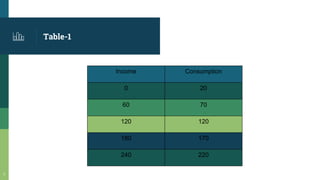
Consumption Schedule
▪ It is the tabular representation of various amounts of
consumption expenditure corresponding to different levels
of income.
4
Table-1
5
Income Consumption
0 20
60 70
120 120
180 170
240 220
Properties of the
Consumption Function
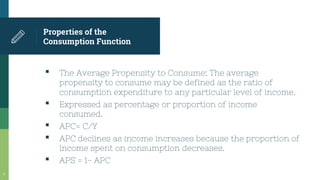
▪ The Average Propensity to Consume: The average
propensity to consume may be defined as the ratio of
consumption expenditure to any particular level of income.
▪ Expressed as percentage or proportion of income
consumed.
▪ APC= C/Y
▪ APC declines as income increases because the proportion of
income spent on consumption decreases.
▪ APS = 1- APC
6
Marginal Propensity to
Consume
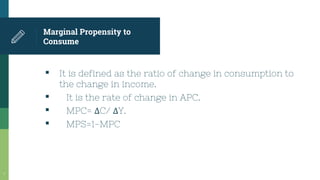
▪ It is defined as the ratio of change in consumption to
the change in income.
▪ It is the rate of change in APC.
▪ MPC= ΔC/ ΔY.
▪ MPS=1-MPC
7
Significance of MPC
▪ Over the long run APC and MPC are equal and
approximate 0.9.
▪ MPC is assumed to be positive and less than unity which
means that consumption is an increasing function of
income and it increases by less than the increase of income.
▪ Economic significance of the MPC lies in filling the gap
between income and consumption through planned
investment to maintain the desired level of income.
8
Keynes’s Psychological law
of Consumption
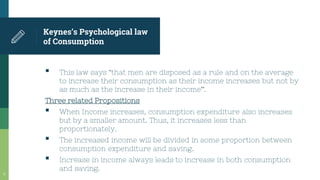
▪ This law says “that men are disposed as a rule and on the average
to increase their consumption as their income increases but not by
as much as the increase in their income”.
Three related Propositions
▪ When Income increases, consumption expenditure also increases
but by a smaller amount. Thus, it increases less than
proportionately.
▪ The increased income will be divided in some proportion between
consumption expenditure and saving.
▪ Increase in income always leads to increase in both consumption
and saving.
9
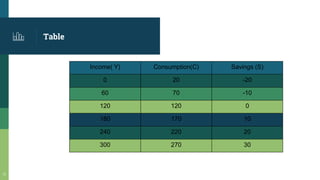
Table
10
Income( Y) Consumption(C) Savings (S)
0 20 -20
60 70 -10
120 120 0
180 170 10
240 220 20
300 270 30
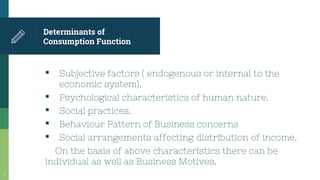
Determinants of
Consumption Function
▪ Subjective factors ( endogenous or internal to the
economic system).
▪ Psychological characteristics of human nature.
▪ Social practices.
▪ Behaviour Pattern of Business concerns
▪ Social arrangements affecting distribution of income.
On the basis of above characteristics there can be
individual as well as Business Motives.
11
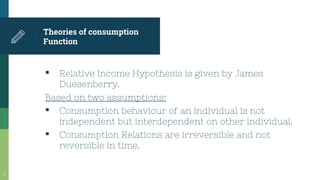
Theories of consumption
Function
▪ Relative Income Hypothesis is given by James
Duesenberry.
Based on two assumptions:
▪ Consumption behaviour of an individual is not
independent but interdependent on other individual.
▪ Consumption Relations are irreversible and not
reversible in time.
12
▪ According to Duesenberry human beings not only try
to keep up with joneses but try to surpass the joneses
which shows that consumers’ preferences are
interdependent. Rich people will have a lower APC and
poor people will have higher APC but in long run APC
will remain constant.
▪ According to Duesenberry it is harder for a family to
reduce its expenditure from a higher level than for a
family to refrain from making high expenditures in
the first place.13
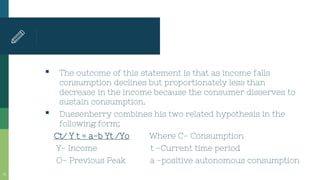
▪ The outcome of this statement is that as income falls
consumption declines but proportionately less than
decrease in the income because the consumer disserves to
sustain consumption.
▪ Duesenberry combines his two related hypothesis in the
following form;
Ct/ Y t = a-b Yt /Yo Where C- Consumption
Y- Income t -Current time period
O- Previous Peak a -positive autonomous consumption
14
▪ In this equation, the consumption income ratio in the
current period is regarded as function of ratio of
current income to the previous peak income.
▪ Ratchet effect is a peculiar phenomenon observed in
this case. The short run consumption function ratchet
upwards when income increases in the long run but it
does not shift down to earlier level when income
declines.
15
MULTIPLIER
16
2
Introduction of Multiplier
▪ The concept of Multiplier was first developed by R.F.
Kahn in early 1930` s. He traced the effect of an
increase in investment on employment.
▪ Then J.M. Keynes used it for income analysis.
Keynes believe that an increase in investment causes
a much bigger increase in national income.
17
Definition of Multiplier
▪ An initial change in aggregate demand will
lead to greater increase in the final level of
equilibrium National Income.
18
Investment Multiplier
▪ Multiplier shows that how an initial change
in investment brings a multiple change in
income.
OR
▪ Multiplier is the ratio of change in the
National Income to a change investment.
19
Example:
▪ The government decides to build new roads
across the Afghanistan. They pay a
contractor $300m to do this.
▪ This creates a $300 million increase in
spending in the Afghan economy.
20
▪ This will create a chain reaction of increases in
expenditures.
▪ The firm who gets the contract to build the roads will spend
this $300m on materials, equipment, wages & profits. This
will create additional incomes for other firms and
households
▪ If they spend approx 60% of that additional income, then
$180m will be added to the incomes of others.
▪ At this point, total income has grown by ($300m + (0.6 x
$300m).
21
▪ The sum will continue to increase as the producers of
the additional goods and services gain an increase in
their incomes, of which they in turn spend 60% on
even more goods and services.
▪ The increase in total income will then be ($300m + (0.6
x $300m) + (0.6 x $180m).
▪ The process can continue indefinitely. But each time,
the additional rise in spending and income is a
fraction of the previous addition to the circular flow.
22
Size of Investment
Multiplier...??
▪ The final increase in national income (Y) will
be greater than the initial injection.
▪ The size of the multiplier depends on how
much of an increase in income is spent in
Afghanistan economy.
23
Size of Multiplier……
cont`d
▪ Marginal Propensity to Consume determine the size
of multiplier.
▪ MPC = change in consumption
change in income
▪ For example if the MPC is 0.8 it means 80% of the
increase in income is spent.
24
Size of Multiplier……
cont`d
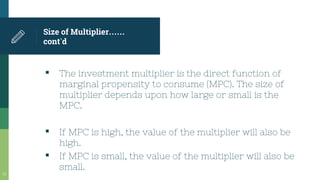
▪ The investment multiplier is the direct function of
marginal propensity to consume (MPC). The size of
multiplier depends upon how large or small is the
MPC.
▪ If MPC is high, the value of the multiplier will also be
high.
▪ If MPC is small, the value of the multiplier will also be
small.
25
Size of Multiplier……
cont`d
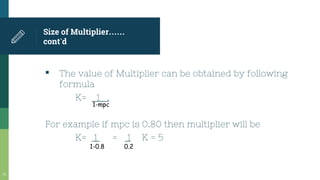
▪ The value of Multiplier can be obtained by following
formula
K= 1 .
For example if mpc is 0.80 then multiplier will be
K= 1 = 1 K = 5
26
0.21-0.8
1-mpc
Numerical Example for
Multiplier Action
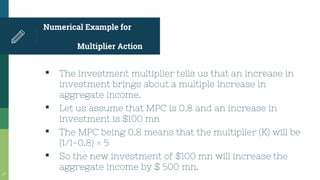
▪ The investment multiplier tells us that an increase in
investment brings about a multiple increase in
aggregate income.
▪ Let us assume that MPC is 0.8 and an increase in
investment is $100 mn
▪ The MPC being 0.8 means that the multiplier (K) will be
(1/1-0.8) = 5
▪ So the new investment of $100 mn will increase the
aggregate income by $ 500 mn.
27
Graphical presentation of
multiplier effect
C+I
C+S
0 x
Y
National income
E
.
B
2000
C+I+ ΔI
2500
500
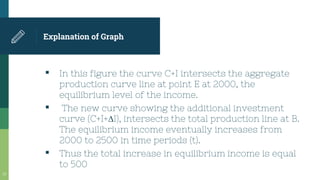
Explanation of Graph
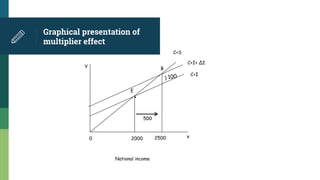
▪ In this figure the curve C+I intersects the aggregate
production curve line at point E at 2000, the
equilibrium level of the income.
▪ The new curve showing the additional investment
curve (C+I+∆I), intersects the total production line at B.
The equilibrium income eventually increases from
2000 to 2500 in time periods (t).
▪ Thus the total increase in equilibrium income is equal
to 500
29
ACCELRATOR
30
3
ACCELRATOR
▪ The principle of acceleration
The principle of acceleration is based on
the fact that demand for capital goods is
derived from the demand for Consumer
goods, it means that if there is demand of
consumer goods in market, investment will
take place and demand for capital goods will
increase.31
Acceleration (cont.…)
▪ Acceleration principle explains the process by which
an increase or (decrease) in demand for consumption
goods leads to an increase or decrease in investment
or capital goods
▪ In words of Kurihara “ acceleration coefficient is the
ratio between induced investment and initial change
in consumption expenditure.
32
Acceleration (cont.…)
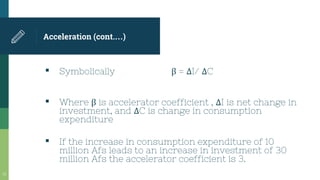
▪ Symbolically β = ΔI/ ΔC
▪ Where β is accelerator coefficient , ΔI is net change in
investment, and ΔC is change in consumption
expenditure
▪ If the increase in consumption expenditure of 10
million Afs leads to an increase in investment of 30
million Afs the accelerator coefficient is 3.
33
Acceleration (cont.…)
▪ This means that when the income of a
community rises the purchasing power of
the people increases. They begin to buy more
commodities. The higher the demand for
consumer goods leads to greater
investment. The rise in investment is
proportionately more than the rise in
demand for consumption.
34
35
THANK YOU

Introduction to consuption function,multiplier,accelrator

  • 1.
  • 2.
  • 3.
  • 4.
    Introduction ▪ It isa functional relationship between two aggregates i.e., total consumption and National Income. Consumption is an increasing function of income ▪ Symbolically C= f (Y) Consumption Schedule ▪ It is the tabular representation of various amounts of consumption expenditure corresponding to different levels of income. 4
  • 5.
    Table-1 5 Income Consumption 0 20 6070 120 120 180 170 240 220
  • 6.
    Properties of the ConsumptionFunction ▪ The Average Propensity to Consume: The average propensity to consume may be defined as the ratio of consumption expenditure to any particular level of income. ▪ Expressed as percentage or proportion of income consumed. ▪ APC= C/Y ▪ APC declines as income increases because the proportion of income spent on consumption decreases. ▪ APS = 1- APC 6
  • 7.
    Marginal Propensity to Consume ▪It is defined as the ratio of change in consumption to the change in income. ▪ It is the rate of change in APC. ▪ MPC= ΔC/ ΔY. ▪ MPS=1-MPC 7
  • 8.
    Significance of MPC ▪Over the long run APC and MPC are equal and approximate 0.9. ▪ MPC is assumed to be positive and less than unity which means that consumption is an increasing function of income and it increases by less than the increase of income. ▪ Economic significance of the MPC lies in filling the gap between income and consumption through planned investment to maintain the desired level of income. 8
  • 9.
    Keynes’s Psychological law ofConsumption ▪ This law says “that men are disposed as a rule and on the average to increase their consumption as their income increases but not by as much as the increase in their income”. Three related Propositions ▪ When Income increases, consumption expenditure also increases but by a smaller amount. Thus, it increases less than proportionately. ▪ The increased income will be divided in some proportion between consumption expenditure and saving. ▪ Increase in income always leads to increase in both consumption and saving. 9
  • 10.
    Table 10 Income( Y) Consumption(C)Savings (S) 0 20 -20 60 70 -10 120 120 0 180 170 10 240 220 20 300 270 30
  • 11.
    Determinants of Consumption Function ▪Subjective factors ( endogenous or internal to the economic system). ▪ Psychological characteristics of human nature. ▪ Social practices. ▪ Behaviour Pattern of Business concerns ▪ Social arrangements affecting distribution of income. On the basis of above characteristics there can be individual as well as Business Motives. 11
  • 12.
    Theories of consumption Function ▪Relative Income Hypothesis is given by James Duesenberry. Based on two assumptions: ▪ Consumption behaviour of an individual is not independent but interdependent on other individual. ▪ Consumption Relations are irreversible and not reversible in time. 12
  • 13.
    ▪ According toDuesenberry human beings not only try to keep up with joneses but try to surpass the joneses which shows that consumers’ preferences are interdependent. Rich people will have a lower APC and poor people will have higher APC but in long run APC will remain constant. ▪ According to Duesenberry it is harder for a family to reduce its expenditure from a higher level than for a family to refrain from making high expenditures in the first place.13
  • 14.
    ▪ The outcomeof this statement is that as income falls consumption declines but proportionately less than decrease in the income because the consumer disserves to sustain consumption. ▪ Duesenberry combines his two related hypothesis in the following form; Ct/ Y t = a-b Yt /Yo Where C- Consumption Y- Income t -Current time period O- Previous Peak a -positive autonomous consumption 14
  • 15.
    ▪ In thisequation, the consumption income ratio in the current period is regarded as function of ratio of current income to the previous peak income. ▪ Ratchet effect is a peculiar phenomenon observed in this case. The short run consumption function ratchet upwards when income increases in the long run but it does not shift down to earlier level when income declines. 15
  • 16.
  • 17.
    Introduction of Multiplier ▪The concept of Multiplier was first developed by R.F. Kahn in early 1930` s. He traced the effect of an increase in investment on employment. ▪ Then J.M. Keynes used it for income analysis. Keynes believe that an increase in investment causes a much bigger increase in national income. 17
  • 18.
    Definition of Multiplier ▪An initial change in aggregate demand will lead to greater increase in the final level of equilibrium National Income. 18
  • 19.
    Investment Multiplier ▪ Multipliershows that how an initial change in investment brings a multiple change in income. OR ▪ Multiplier is the ratio of change in the National Income to a change investment. 19
  • 20.
    Example: ▪ The governmentdecides to build new roads across the Afghanistan. They pay a contractor $300m to do this. ▪ This creates a $300 million increase in spending in the Afghan economy. 20
  • 21.
    ▪ This willcreate a chain reaction of increases in expenditures. ▪ The firm who gets the contract to build the roads will spend this $300m on materials, equipment, wages & profits. This will create additional incomes for other firms and households ▪ If they spend approx 60% of that additional income, then $180m will be added to the incomes of others. ▪ At this point, total income has grown by ($300m + (0.6 x $300m). 21
  • 22.
    ▪ The sumwill continue to increase as the producers of the additional goods and services gain an increase in their incomes, of which they in turn spend 60% on even more goods and services. ▪ The increase in total income will then be ($300m + (0.6 x $300m) + (0.6 x $180m). ▪ The process can continue indefinitely. But each time, the additional rise in spending and income is a fraction of the previous addition to the circular flow. 22
  • 23.
    Size of Investment Multiplier...?? ▪The final increase in national income (Y) will be greater than the initial injection. ▪ The size of the multiplier depends on how much of an increase in income is spent in Afghanistan economy. 23
  • 24.
    Size of Multiplier…… cont`d ▪Marginal Propensity to Consume determine the size of multiplier. ▪ MPC = change in consumption change in income ▪ For example if the MPC is 0.8 it means 80% of the increase in income is spent. 24
  • 25.
    Size of Multiplier…… cont`d ▪The investment multiplier is the direct function of marginal propensity to consume (MPC). The size of multiplier depends upon how large or small is the MPC. ▪ If MPC is high, the value of the multiplier will also be high. ▪ If MPC is small, the value of the multiplier will also be small. 25
  • 26.
    Size of Multiplier…… cont`d ▪The value of Multiplier can be obtained by following formula K= 1 . For example if mpc is 0.80 then multiplier will be K= 1 = 1 K = 5 26 0.21-0.8 1-mpc
  • 27.
    Numerical Example for MultiplierAction ▪ The investment multiplier tells us that an increase in investment brings about a multiple increase in aggregate income. ▪ Let us assume that MPC is 0.8 and an increase in investment is $100 mn ▪ The MPC being 0.8 means that the multiplier (K) will be (1/1-0.8) = 5 ▪ So the new investment of $100 mn will increase the aggregate income by $ 500 mn. 27
  • 28.
    Graphical presentation of multipliereffect C+I C+S 0 x Y National income E . B 2000 C+I+ ΔI 2500 500
  • 29.
    Explanation of Graph ▪In this figure the curve C+I intersects the aggregate production curve line at point E at 2000, the equilibrium level of the income. ▪ The new curve showing the additional investment curve (C+I+∆I), intersects the total production line at B. The equilibrium income eventually increases from 2000 to 2500 in time periods (t). ▪ Thus the total increase in equilibrium income is equal to 500 29
  • 30.
  • 31.
    ACCELRATOR ▪ The principleof acceleration The principle of acceleration is based on the fact that demand for capital goods is derived from the demand for Consumer goods, it means that if there is demand of consumer goods in market, investment will take place and demand for capital goods will increase.31
  • 32.
    Acceleration (cont.…) ▪ Accelerationprinciple explains the process by which an increase or (decrease) in demand for consumption goods leads to an increase or decrease in investment or capital goods ▪ In words of Kurihara “ acceleration coefficient is the ratio between induced investment and initial change in consumption expenditure. 32
  • 33.
    Acceleration (cont.…) ▪ Symbolicallyβ = ΔI/ ΔC ▪ Where β is accelerator coefficient , ΔI is net change in investment, and ΔC is change in consumption expenditure ▪ If the increase in consumption expenditure of 10 million Afs leads to an increase in investment of 30 million Afs the accelerator coefficient is 3. 33
  • 34.
    Acceleration (cont.…) ▪ Thismeans that when the income of a community rises the purchasing power of the people increases. They begin to buy more commodities. The higher the demand for consumer goods leads to greater investment. The rise in investment is proportionately more than the rise in demand for consumption. 34
  • 35.