CONSUMPTION FUNCTION,
AGGREGATE EXPENDITURE,
AND EQUILIBRIUM OUTPUT
JOJET B.ANDRINO, LPT, MBA (Occ.)
Instructor
LESSON 5
OBJECTIVES
 Define the theory of consumption
 Compute the Consumption function and the savings function
 Describe the determinants of consumption
 Examine the aggregate expenditure model
 Calculate Equilibrium Output
The Theory of Consumption
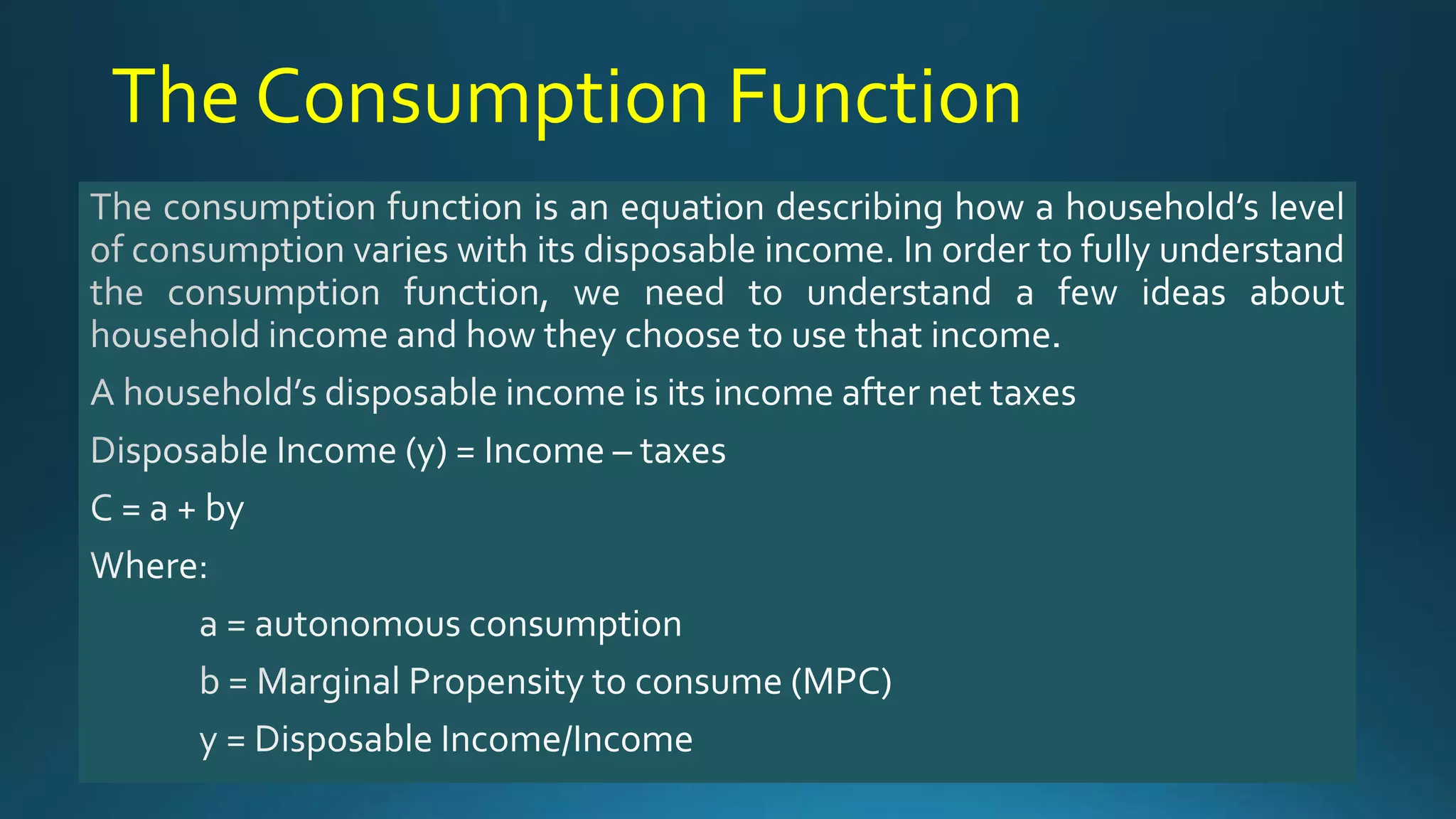
Consumption is the act of using resources to satisfy current
needs and wants
Consumption theories began with John Maynard Keynes in 1936
and were developed by economists such as Friedman, Dusenbery,
and Modigliani. The relationship between consumption and
income was a crucial concept in macroeconomic analysis for a
long time.
The consumption function shows how changes in income affect
consumption, with higher income leading to higher consumption,
and vice versa.
Keynes’s Psychological Law of
Consumption
Three related Propositions
1.When Income increases, consumption
expenditure also
increases but by a smaller amount.Thus, it
increases less than
proportionately.
2.The increased income will be divided in
some proportion
between consumption expenditure and saving.
3. Increased income always leads to increased
consumption and saving.
The Consumption Function
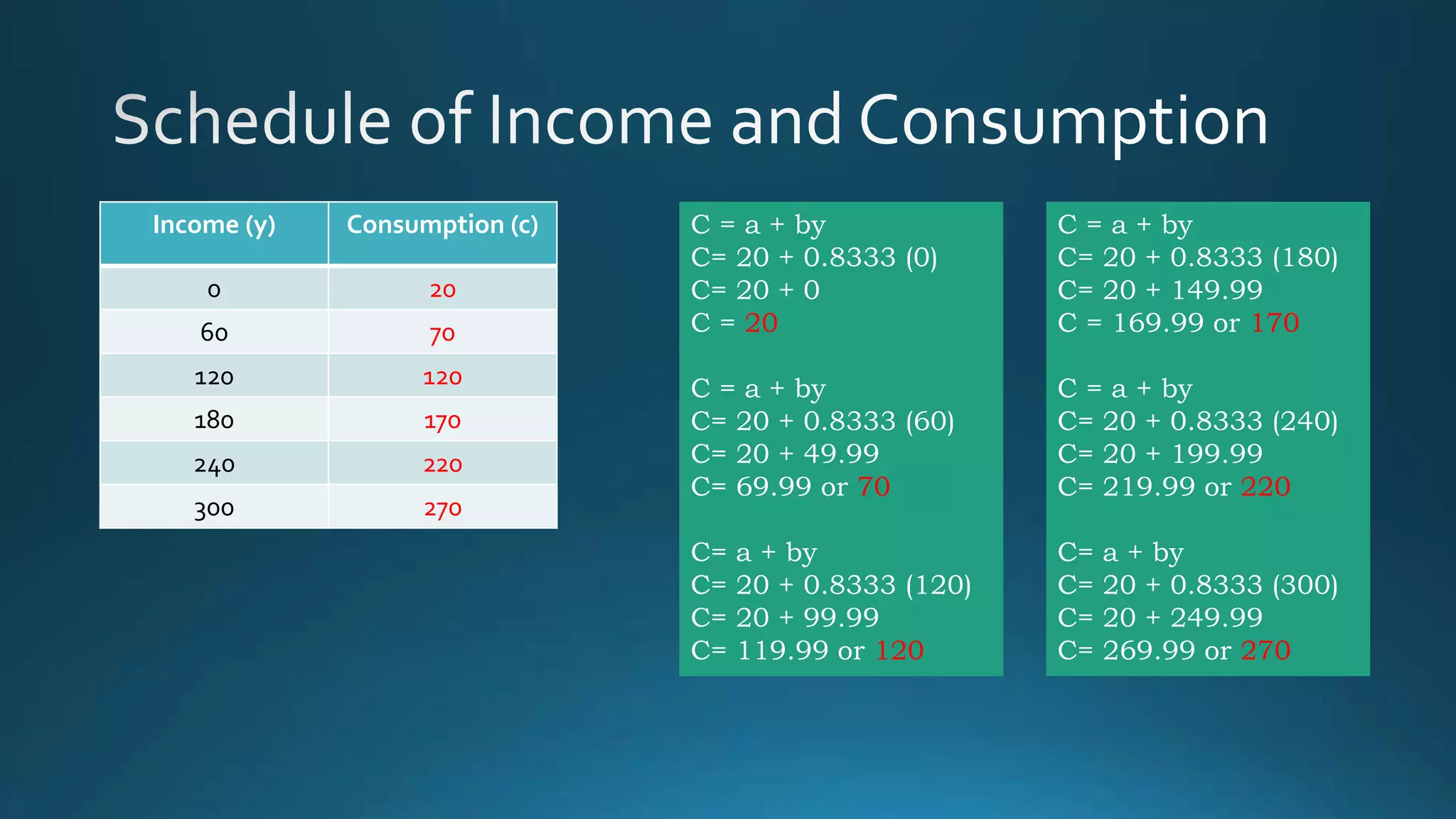
Income (y) Consumption (c)
0 20
60 70
120 120
180 170
240 220
300 270
C = a + by
C= 20 + 0.8333 (0)
C= 20 + 0
C = 20
C = a + by
C= 20 + 0.8333 (60)
C= 20 + 49.99
C= 69.99 or 70
C= a + by
C= 20 + 0.8333 (120)
C= 20 + 99.99
C= 119.99 or 120
C = a + by
C= 20 + 0.8333 (180)
C= 20 + 149.99
C = 169.99 or 170
C = a + by
C= 20 + 0.8333 (240)
C= 20 + 199.99
C= 219.99 or 220
C= a + by
C= 20 + 0.8333 (300)
C= 20 + 249.99
C= 269.99 or 270
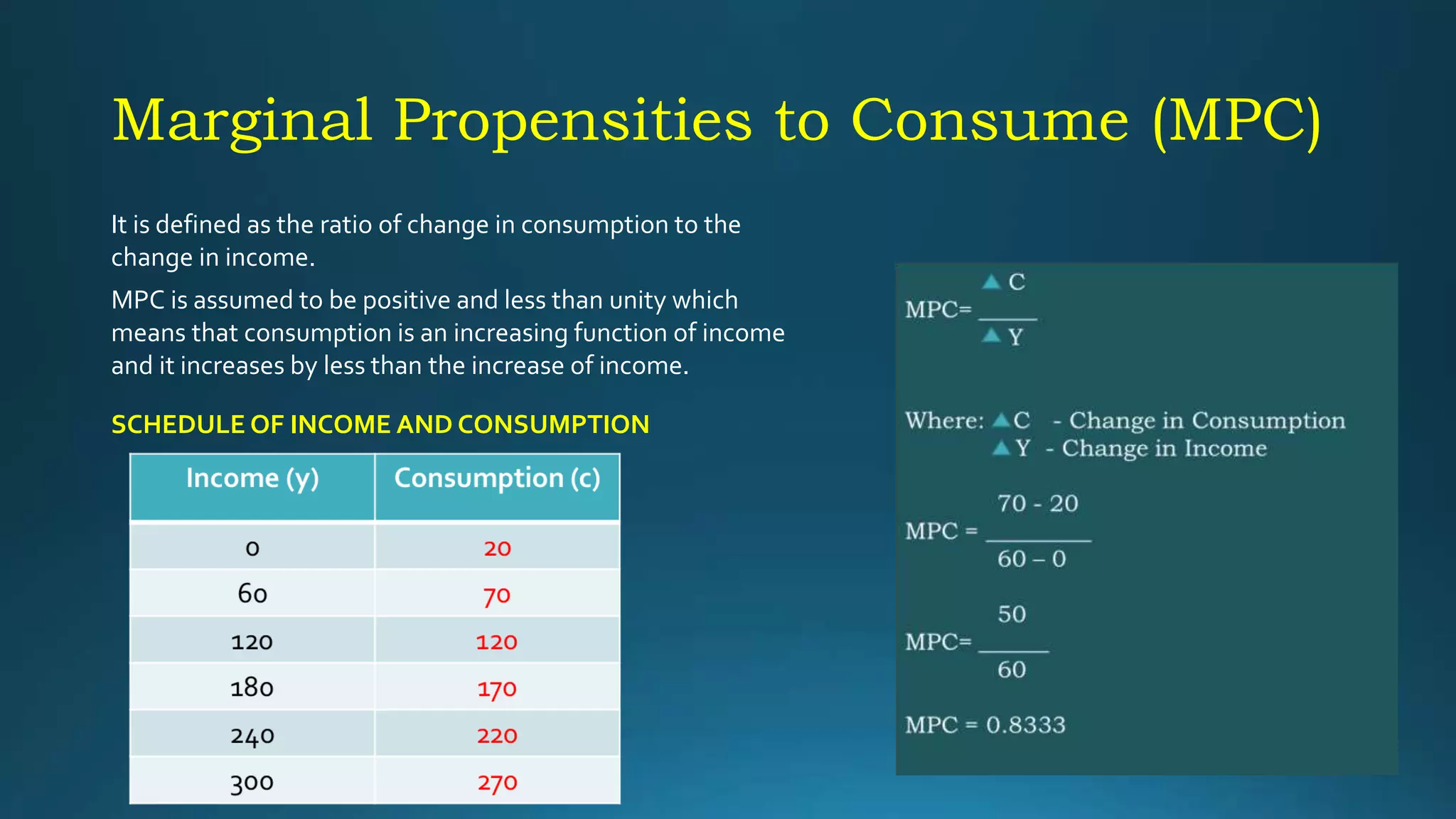
Marginal Propensities to Consume (MPC)
It is defined as the ratio of change in consumption to the
change in income.
MPC is assumed to be positive and less than unity which
means that consumption is an increasing function of income
and it increases by less than the increase of income.
SCHEDULE OF INCOME AND CONSUMPTION
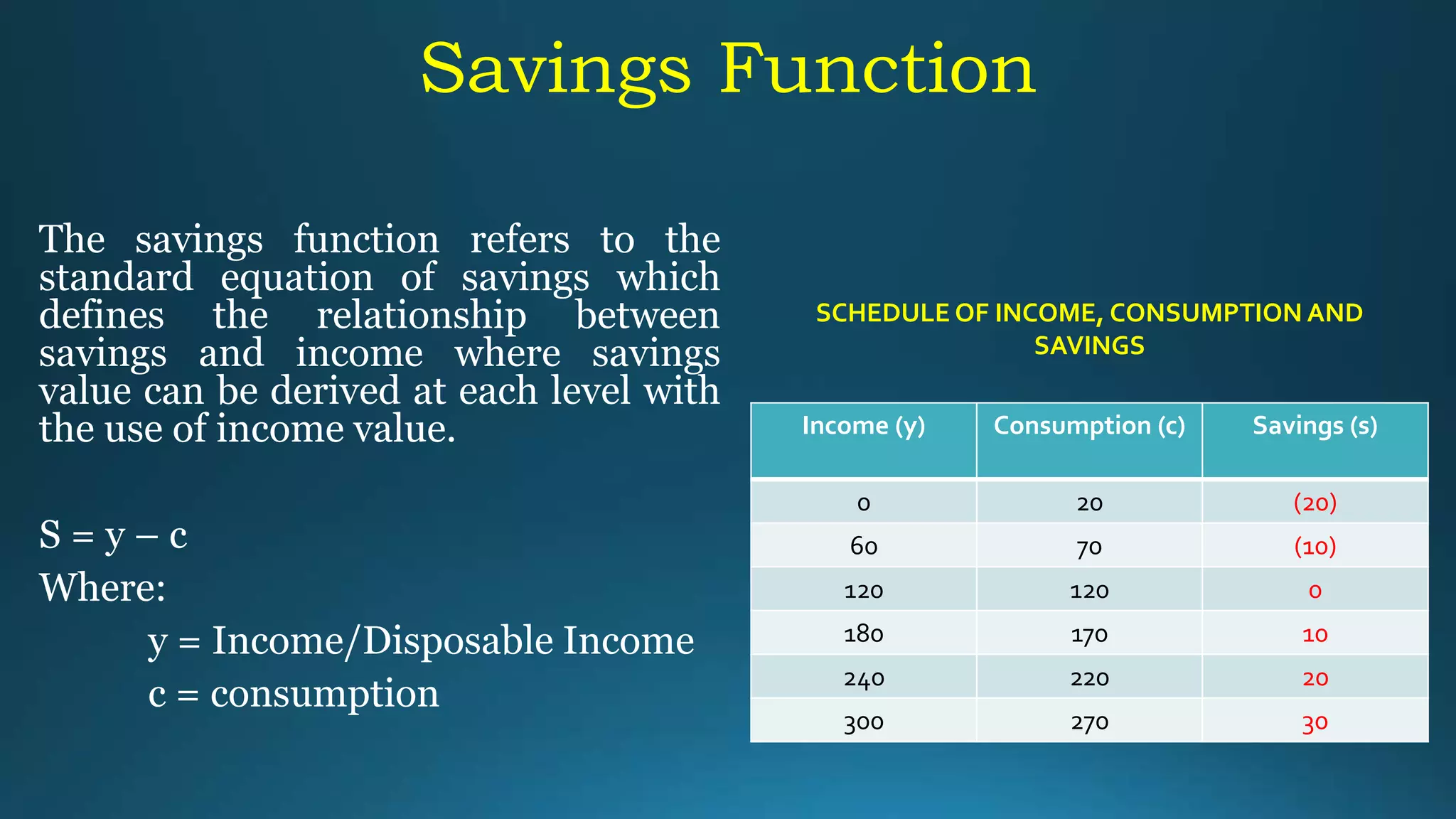
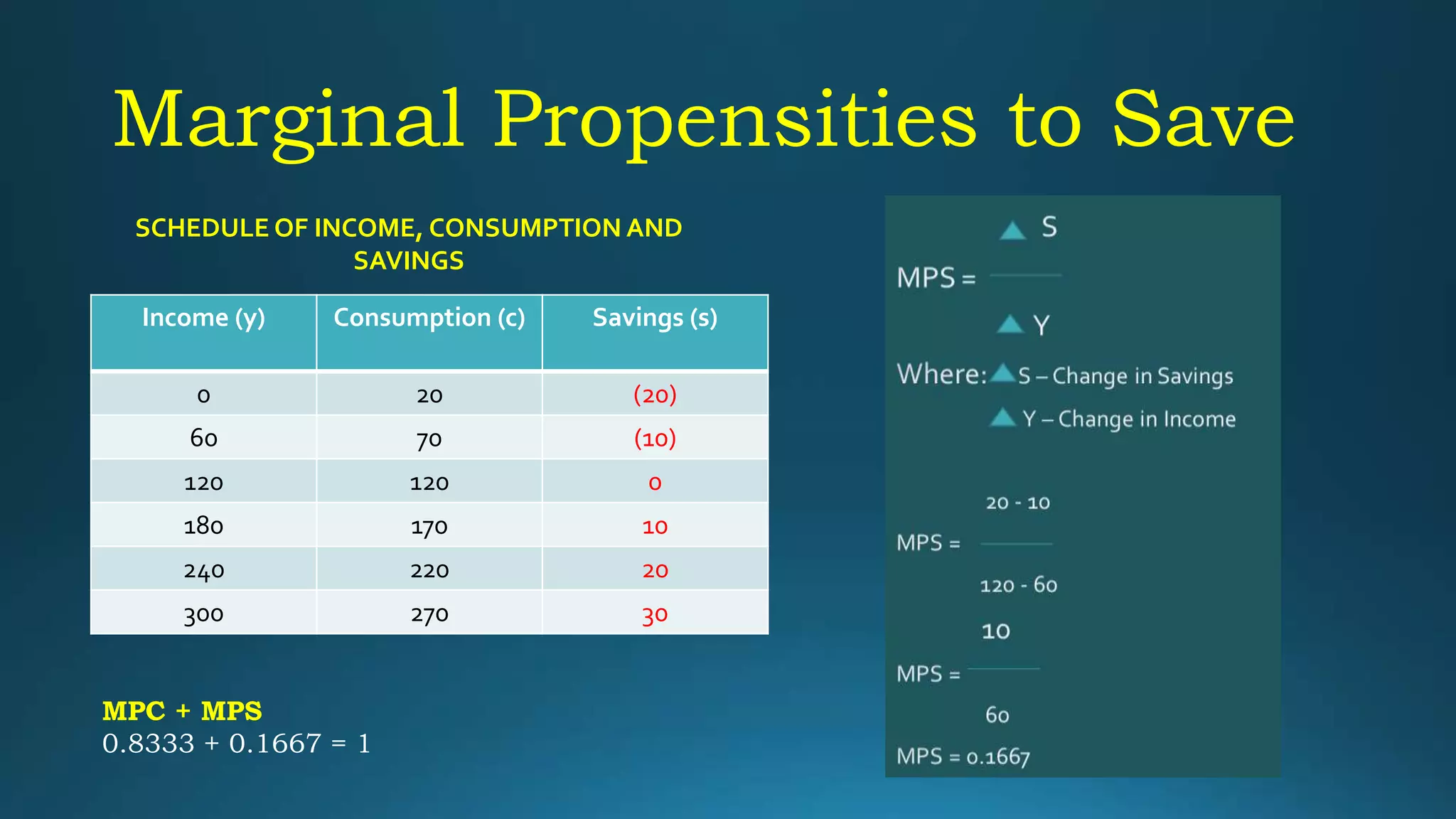
Savings Function
The savings function refers to the
standard equation of savings which
defines the relationship between
savings and income where savings
value can be derived at each level with
the use of income value.
S = y – c
Where:
y = Income/Disposable Income
c = consumption
Income (y) Consumption (c) Savings (s)
0 20 (20)
60 70 (10)
120 120 0
180 170 10
240 220 20
300 270 30
SCHEDULE OF INCOME, CONSUMPTION AND
SAVINGS
Marginal Propensities to Save
Income (y) Consumption (c) Savings (s)
0 20 (20)
60 70 (10)
120 120 0
180 170 10
240 220 20
300 270 30
SCHEDULE OF INCOME, CONSUMPTION AND
SAVINGS
MPC + MPS
0.8333 + 0.1667 = 1
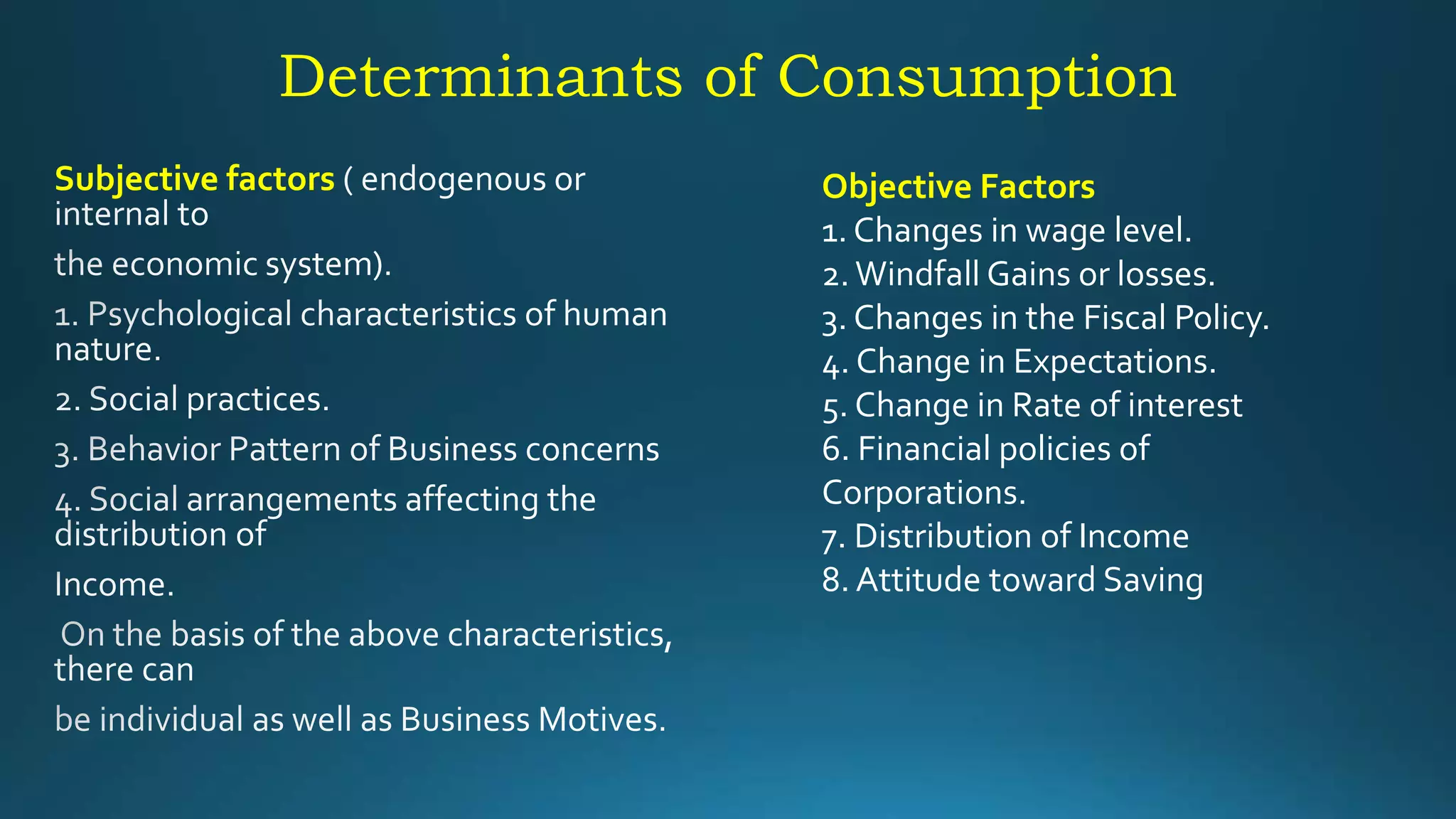
Determinants of Consumption
Subjective factors Objective Factors
1. Changes in wage level.
2.Windfall Gains or losses.
3. Changes in the Fiscal Policy.
4. Change in Expectations.
5. Change in Rate of interest
6. Financial policies of
Corporations.
7. Distribution of Income
8. Attitude toward Saving
The Aggregate Expenditure Model
The aggregate expenditure model
relates the components of spending
(consumption, investment,
government purchases, and net
exports) to the level of economic
activity. In the short run, taking the
price level as fixed, the level of
spending predicted by the
aggregate expenditure model
determines the level of economic
activity in an economy.
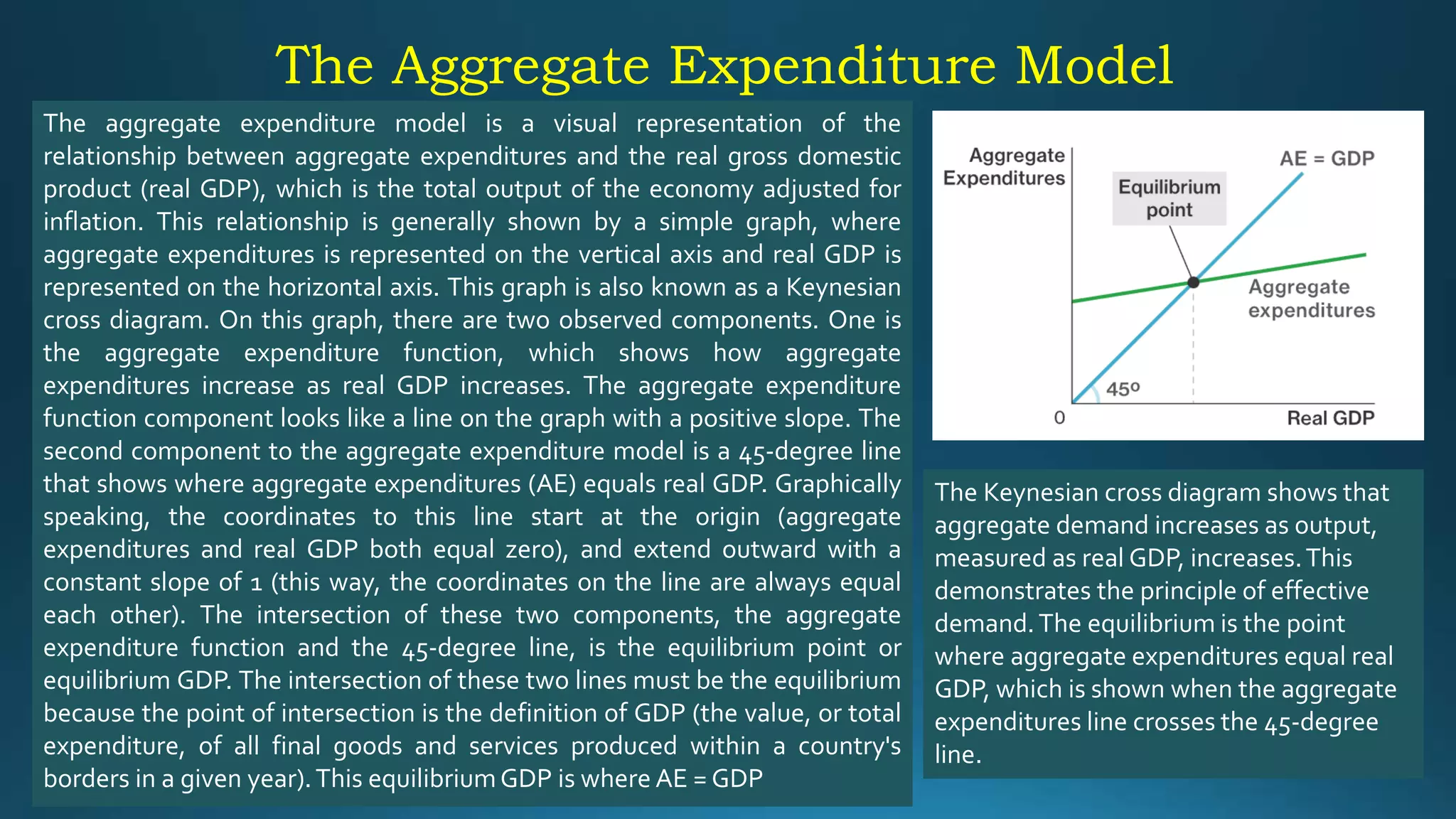
Figure 16.11
We illustrate this in Figure 16.11 "Planned
Spending in the Aggregate Expenditure
Model" where we suppose for simplicity
that there is a linear relationship between
spending and GDP.
The Aggregate Expenditure Model
The aggregate expenditure model is a visual representation of the
relationship between aggregate expenditures and the real gross domestic
product (real GDP), which is the total output of the economy adjusted for
inflation. This relationship is generally shown by a simple graph, where
aggregate expenditures is represented on the vertical axis and real GDP is
represented on the horizontal axis. This graph is also known as a Keynesian
cross diagram. On this graph, there are two observed components. One is
the aggregate expenditure function, which shows how aggregate
expenditures increase as real GDP increases. The aggregate expenditure
function component looks like a line on the graph with a positive slope. The
second component to the aggregate expenditure model is a 45-degree line
that shows where aggregate expenditures (AE) equals real GDP. Graphically
speaking, the coordinates to this line start at the origin (aggregate
expenditures and real GDP both equal zero), and extend outward with a
constant slope of 1 (this way, the coordinates on the line are always equal
each other). The intersection of these two components, the aggregate
expenditure function and the 45-degree line, is the equilibrium point or
equilibrium GDP. The intersection of these two lines must be the equilibrium
because the point of intersection is the definition of GDP (the value, or total
expenditure, of all final goods and services produced within a country's
borders in a given year).This equilibriumGDP is where AE = GDP
The Keynesian cross diagram shows that
aggregate demand increases as output,
measured as real GDP, increases.This
demonstrates the principle of effective
demand.The equilibrium is the point
where aggregate expenditures equal real
GDP, which is shown when the aggregate
expenditures line crosses the 45-degree
line.
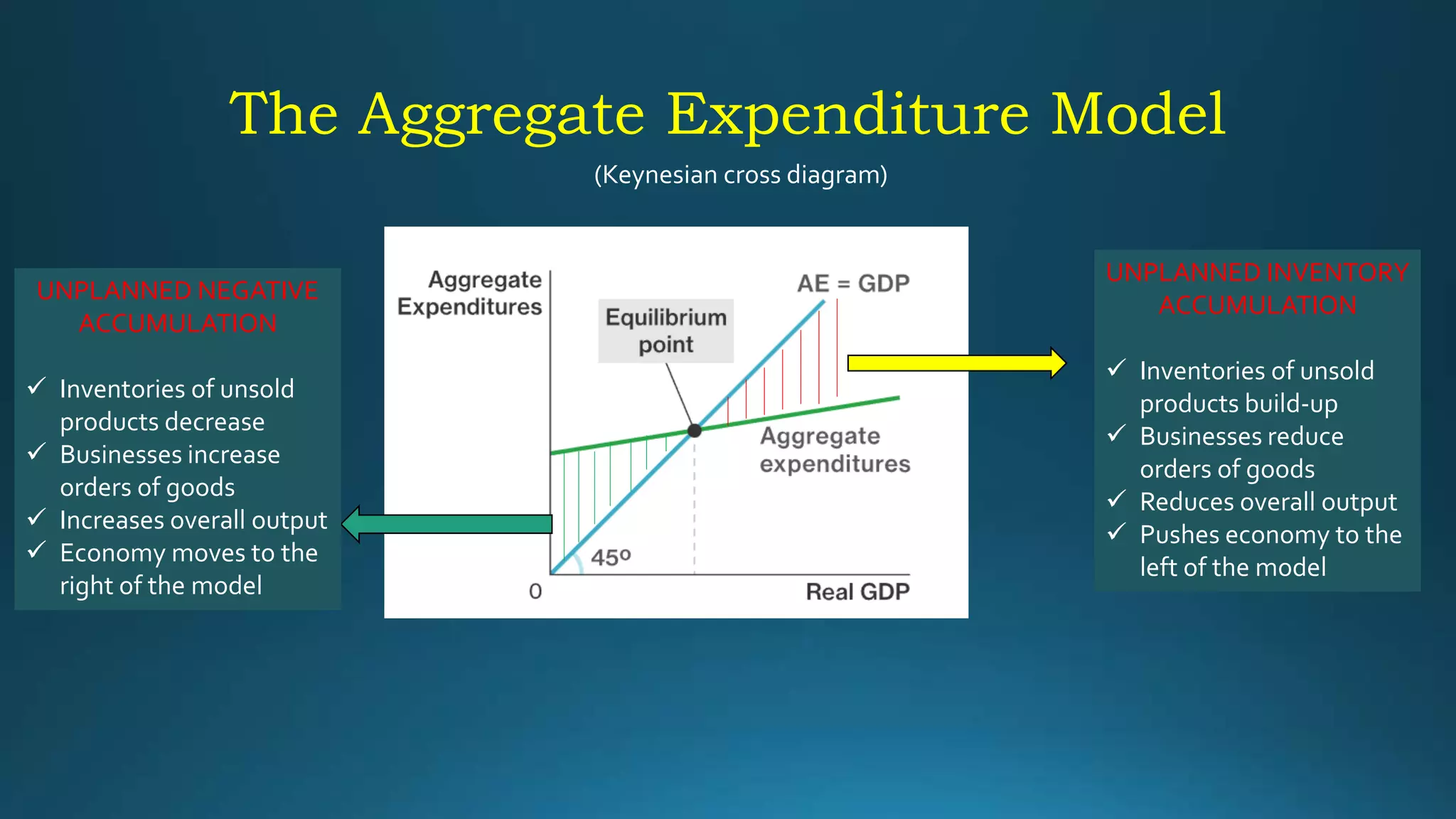
The Aggregate Expenditure Model
UNPLANNED INVENTORY
ACCUMULATION
 Inventories of unsold
products build-up
 Businesses reduce
orders of goods
 Reduces overall output
 Pushes economy to the
left of the model
UNPLANNED NEGATIVE
ACCUMULATION
 Inventories of unsold
products decrease
 Businesses increase
orders of goods
 Increases overall output
 Economy moves to the
right of the model
(Keynesian cross diagram)
Determination of Equilibrium Output
C = a + by (consumption function equation)
Let C =Y
Therefore, the new formula would be:
Y = a + by (use this formula in determining
Equilibrium Point/Output or Break-even Point
Y = a + by
Y = 20 + 0.8333y
Y – 0.8333y = 20 (Transposed)
0.1667 y = 20
0.1667
Y = 20_
0.1667
Y = 199.98 or 120
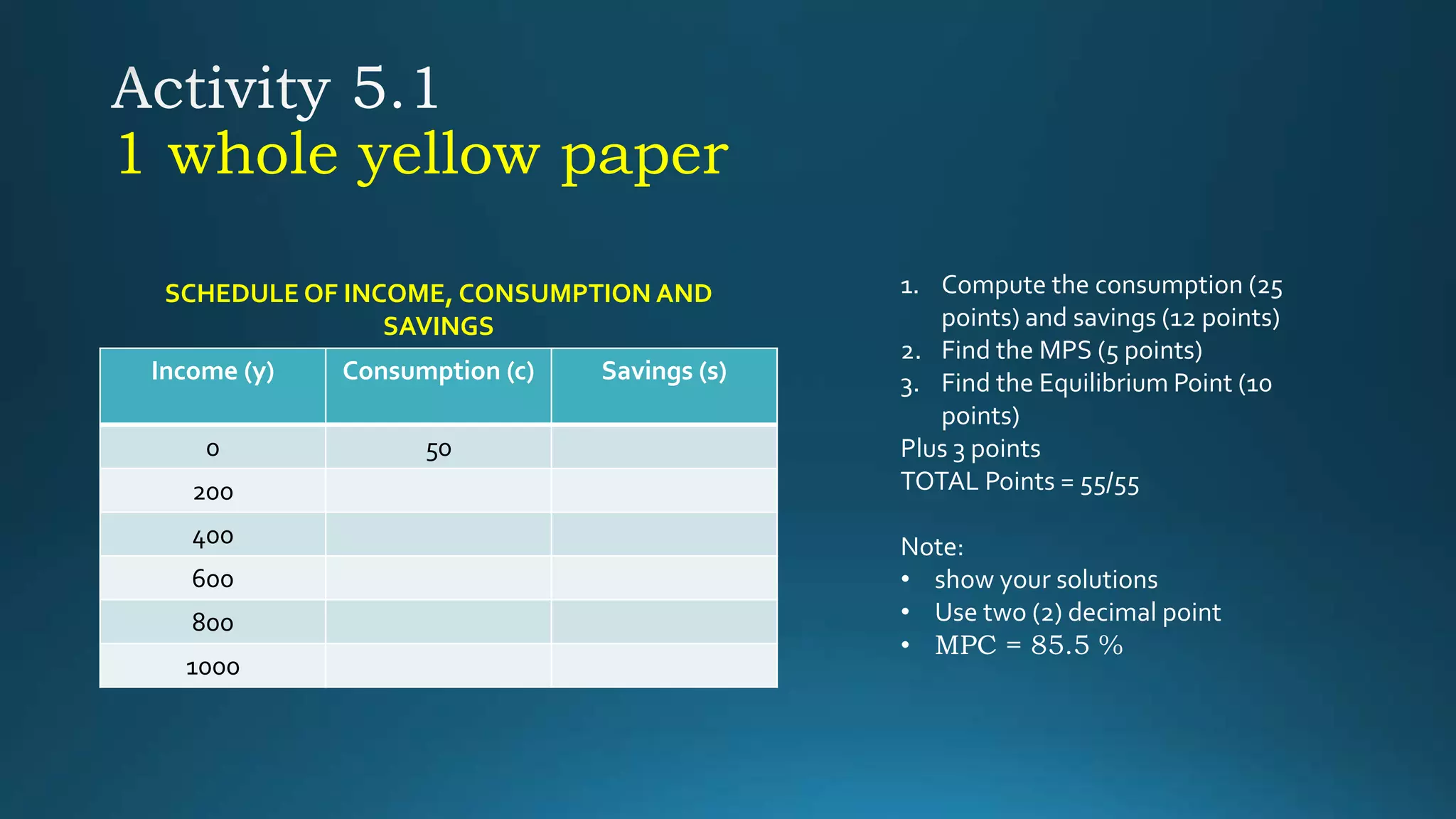
1 whole yellow paper
Income (y) Consumption (c) Savings (s)
0 50
200
400
600
800
1000
SCHEDULE OF INCOME, CONSUMPTION AND
SAVINGS
1. Compute the consumption (25
points) and savings (12 points)
2. Find the MPS (5 points)
3. Find the Equilibrium Point (10
points)
Plus 3 points
TOTAL Points = 55/55
Note:
• show your solutions
• Use two (2) decimal point
• MPC = 85.5 %
LESSON-5-CONSUMPTION-FUNCTION-AGGREGATE-EXPENDITURE-AND-EQUILIBRIUM.pptx

LESSON-5-CONSUMPTION-FUNCTION-AGGREGATE-EXPENDITURE-AND-EQUILIBRIUM.pptx

  • 1.
    CONSUMPTION FUNCTION, AGGREGATE EXPENDITURE, ANDEQUILIBRIUM OUTPUT JOJET B.ANDRINO, LPT, MBA (Occ.) Instructor LESSON 5
  • 2.
    OBJECTIVES  Define thetheory of consumption  Compute the Consumption function and the savings function  Describe the determinants of consumption  Examine the aggregate expenditure model  Calculate Equilibrium Output
  • 3.
    The Theory ofConsumption Consumption is the act of using resources to satisfy current needs and wants Consumption theories began with John Maynard Keynes in 1936 and were developed by economists such as Friedman, Dusenbery, and Modigliani. The relationship between consumption and income was a crucial concept in macroeconomic analysis for a long time. The consumption function shows how changes in income affect consumption, with higher income leading to higher consumption, and vice versa.
  • 4.
    Keynes’s Psychological Lawof Consumption Three related Propositions 1.When Income increases, consumption expenditure also increases but by a smaller amount.Thus, it increases less than proportionately. 2.The increased income will be divided in some proportion between consumption expenditure and saving. 3. Increased income always leads to increased consumption and saving.
  • 5.
  • 6.
    Income (y) Consumption(c) 0 20 60 70 120 120 180 170 240 220 300 270 C = a + by C= 20 + 0.8333 (0) C= 20 + 0 C = 20 C = a + by C= 20 + 0.8333 (60) C= 20 + 49.99 C= 69.99 or 70 C= a + by C= 20 + 0.8333 (120) C= 20 + 99.99 C= 119.99 or 120 C = a + by C= 20 + 0.8333 (180) C= 20 + 149.99 C = 169.99 or 170 C = a + by C= 20 + 0.8333 (240) C= 20 + 199.99 C= 219.99 or 220 C= a + by C= 20 + 0.8333 (300) C= 20 + 249.99 C= 269.99 or 270
  • 7.
    Marginal Propensities toConsume (MPC) It is defined as the ratio of change in consumption to the change in income. MPC is assumed to be positive and less than unity which means that consumption is an increasing function of income and it increases by less than the increase of income. SCHEDULE OF INCOME AND CONSUMPTION
  • 8.
    Savings Function The savingsfunction refers to the standard equation of savings which defines the relationship between savings and income where savings value can be derived at each level with the use of income value. S = y – c Where: y = Income/Disposable Income c = consumption Income (y) Consumption (c) Savings (s) 0 20 (20) 60 70 (10) 120 120 0 180 170 10 240 220 20 300 270 30 SCHEDULE OF INCOME, CONSUMPTION AND SAVINGS
  • 9.
    Marginal Propensities toSave Income (y) Consumption (c) Savings (s) 0 20 (20) 60 70 (10) 120 120 0 180 170 10 240 220 20 300 270 30 SCHEDULE OF INCOME, CONSUMPTION AND SAVINGS MPC + MPS 0.8333 + 0.1667 = 1
  • 10.
    Determinants of Consumption Subjectivefactors Objective Factors 1. Changes in wage level. 2.Windfall Gains or losses. 3. Changes in the Fiscal Policy. 4. Change in Expectations. 5. Change in Rate of interest 6. Financial policies of Corporations. 7. Distribution of Income 8. Attitude toward Saving
  • 11.
    The Aggregate ExpenditureModel The aggregate expenditure model relates the components of spending (consumption, investment, government purchases, and net exports) to the level of economic activity. In the short run, taking the price level as fixed, the level of spending predicted by the aggregate expenditure model determines the level of economic activity in an economy. Figure 16.11 We illustrate this in Figure 16.11 "Planned Spending in the Aggregate Expenditure Model" where we suppose for simplicity that there is a linear relationship between spending and GDP.
  • 12.
    The Aggregate ExpenditureModel The aggregate expenditure model is a visual representation of the relationship between aggregate expenditures and the real gross domestic product (real GDP), which is the total output of the economy adjusted for inflation. This relationship is generally shown by a simple graph, where aggregate expenditures is represented on the vertical axis and real GDP is represented on the horizontal axis. This graph is also known as a Keynesian cross diagram. On this graph, there are two observed components. One is the aggregate expenditure function, which shows how aggregate expenditures increase as real GDP increases. The aggregate expenditure function component looks like a line on the graph with a positive slope. The second component to the aggregate expenditure model is a 45-degree line that shows where aggregate expenditures (AE) equals real GDP. Graphically speaking, the coordinates to this line start at the origin (aggregate expenditures and real GDP both equal zero), and extend outward with a constant slope of 1 (this way, the coordinates on the line are always equal each other). The intersection of these two components, the aggregate expenditure function and the 45-degree line, is the equilibrium point or equilibrium GDP. The intersection of these two lines must be the equilibrium because the point of intersection is the definition of GDP (the value, or total expenditure, of all final goods and services produced within a country's borders in a given year).This equilibriumGDP is where AE = GDP The Keynesian cross diagram shows that aggregate demand increases as output, measured as real GDP, increases.This demonstrates the principle of effective demand.The equilibrium is the point where aggregate expenditures equal real GDP, which is shown when the aggregate expenditures line crosses the 45-degree line.
  • 13.
    The Aggregate ExpenditureModel UNPLANNED INVENTORY ACCUMULATION  Inventories of unsold products build-up  Businesses reduce orders of goods  Reduces overall output  Pushes economy to the left of the model UNPLANNED NEGATIVE ACCUMULATION  Inventories of unsold products decrease  Businesses increase orders of goods  Increases overall output  Economy moves to the right of the model (Keynesian cross diagram)
  • 14.
    Determination of EquilibriumOutput C = a + by (consumption function equation) Let C =Y Therefore, the new formula would be: Y = a + by (use this formula in determining Equilibrium Point/Output or Break-even Point Y = a + by Y = 20 + 0.8333y Y – 0.8333y = 20 (Transposed) 0.1667 y = 20 0.1667 Y = 20_ 0.1667 Y = 199.98 or 120
  • 15.
    1 whole yellowpaper Income (y) Consumption (c) Savings (s) 0 50 200 400 600 800 1000 SCHEDULE OF INCOME, CONSUMPTION AND SAVINGS 1. Compute the consumption (25 points) and savings (12 points) 2. Find the MPS (5 points) 3. Find the Equilibrium Point (10 points) Plus 3 points TOTAL Points = 55/55 Note: • show your solutions • Use two (2) decimal point • MPC = 85.5 %