Consumer Motivation

Pradyumna Kumar Atri
JU07332
Motivation is …………………
• a reason for behaviour
• A need or desire that causes a person to act, to have or
take inintiative
• An inner force that reflects goal directed arousal.
The most fundamental Question
behind motivation is……
• What is in it for me?
• What will I gain from it?
• Does it meet any of my motives or needs?
Motive………..
• A felt need or desire
• Can be related to
– Basic needs
– Status quo
– Peer recognition
or any other physiological or psychological need
Maslow’s Hierarchy of needs…
• Based on 4 premises:
– All humans acquire similar set of motives through genetic
endowment and social interaction
– Some motives are more basic than others
– The more basic motives should be satisfied to a minimum level
before other motives are activated
– As the basic motives are satisfied, more advanced motives
come into play

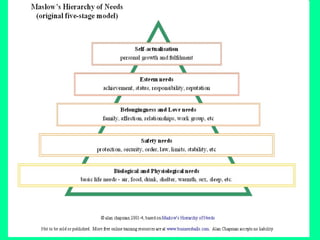
• Maslow set up a hierarchy of 5 levels of basic needs
Maslow’s heirarchy…….(contd.)
•
•
•
•

•
•

Physiological: food, water, sleep, etc. are our physiological needs
Safety: seeking physical safety and security, financial security and
stability and so forth
Belongingness (social): reflected in desire for love, friendship and
affiliation, and group acceptance
Esteem: desire for status, superiority, self respect, and prestige etc.
these needs relate to the individual’s feelings of usefulness and
accomplishment.
Self actualization: desire for self fulfillment
The first four layers of the pyramid are what Maslow called
"deficiency needs" or "D-needs": if they are not met, the body gives
no indication of it physically, but the individual feels anxious and
tense
Case study
•

In 1992, the state of Georgia developed a special ad campaign in
conjunction with its tax amnesty program. The campaign’s goal was
to convince business and individual consumers to pay their sales,
income and other taxes. The ad informed consumers that a brief tax
amnesty period was in effect, during which back taxes could be paid
without penalty. At the end of this program the delinquent taxpayers
could have their business closed down, fined upto $5000 or 3 years
in jail. The state received $51.3 mn in overdue and unreported taxes
during Georgia’s Tax Amnesty.

•

The ad showed a gate being locked with chains and a lock, and a
statement in bolds : “try explaining this to your customers”
Factors for the success of this ad campaign

• Tax offenders were highly motivated to process the
information in this ad. The information was relevant to
their
– needs (security),
– social values (be a good citizen)
– goal (stay out of trouble)
Factors for the success of this ad campaign

• Tax offenders were highly motivated to process the
information in this ad. The information was relevant to
their
– needs (security),
– social values (be a good citizen)
– goal (stay out of trouble)

Consumer motivation

  • 1.
  • 2.
    Motivation is ………………… •a reason for behaviour • A need or desire that causes a person to act, to have or take inintiative • An inner force that reflects goal directed arousal.
  • 3.
    The most fundamentalQuestion behind motivation is…… • What is in it for me? • What will I gain from it? • Does it meet any of my motives or needs?
  • 4.
    Motive……….. • A feltneed or desire • Can be related to – Basic needs – Status quo – Peer recognition or any other physiological or psychological need
  • 5.
    Maslow’s Hierarchy ofneeds… • Based on 4 premises: – All humans acquire similar set of motives through genetic endowment and social interaction – Some motives are more basic than others – The more basic motives should be satisfied to a minimum level before other motives are activated – As the basic motives are satisfied, more advanced motives come into play • Maslow set up a hierarchy of 5 levels of basic needs
  • 7.
    Maslow’s heirarchy…….(contd.) • • • • • • Physiological: food,water, sleep, etc. are our physiological needs Safety: seeking physical safety and security, financial security and stability and so forth Belongingness (social): reflected in desire for love, friendship and affiliation, and group acceptance Esteem: desire for status, superiority, self respect, and prestige etc. these needs relate to the individual’s feelings of usefulness and accomplishment. Self actualization: desire for self fulfillment The first four layers of the pyramid are what Maslow called "deficiency needs" or "D-needs": if they are not met, the body gives no indication of it physically, but the individual feels anxious and tense
  • 8.
    Case study • In 1992,the state of Georgia developed a special ad campaign in conjunction with its tax amnesty program. The campaign’s goal was to convince business and individual consumers to pay their sales, income and other taxes. The ad informed consumers that a brief tax amnesty period was in effect, during which back taxes could be paid without penalty. At the end of this program the delinquent taxpayers could have their business closed down, fined upto $5000 or 3 years in jail. The state received $51.3 mn in overdue and unreported taxes during Georgia’s Tax Amnesty. • The ad showed a gate being locked with chains and a lock, and a statement in bolds : “try explaining this to your customers”
  • 9.
    Factors for thesuccess of this ad campaign • Tax offenders were highly motivated to process the information in this ad. The information was relevant to their – needs (security), – social values (be a good citizen) – goal (stay out of trouble)
  • 10.
    Factors for thesuccess of this ad campaign • Tax offenders were highly motivated to process the information in this ad. The information was relevant to their – needs (security), – social values (be a good citizen) – goal (stay out of trouble)