Slide © 2010 by Lovelock & Wirtz Services Marketing 7/e Chapter 2 – Page 1
Chapter 2:
Consumer Behavior
in a Services Context
Services Marketing 7e, Global Edition
Slide © 2010 by Lovelock & Wirtz Services Marketing 7/e Chapter 2 – Page 2
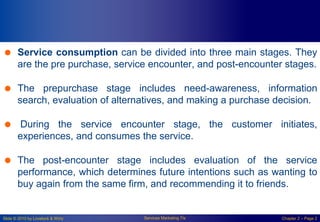
 Service consumption can be divided into three main stages. They
are the pre purchase, service encounter, and post-encounter stages.
 The prepurchase stage includes need-awareness, information
search, evaluation of alternatives, and making a purchase decision.
 During the service encounter stage, the customer initiates,
experiences, and consumes the service.
 The post-encounter stage includes evaluation of the service
performance, which determines future intentions such as wanting to
buy again from the same firm, and recommending it to friends.
Slide © 2010 by Lovelock & Wirtz Services Marketing 7/e Chapter 2 – Page 3
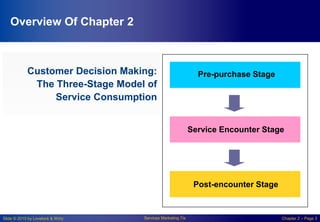
Overview Of Chapter 2
Pre-purchase Stage
Service Encounter Stage
Post-encounter Stage
Customer Decision Making:
The Three-Stage Model of
Service Consumption
Slide © 2010 by Lovelock & Wirtz Services Marketing 7/e Chapter 2 – Page 4
Pre-purchase Stage
Slide © 2010 by Lovelock & Wirtz Services Marketing 7/e Chapter 2 – Page 5
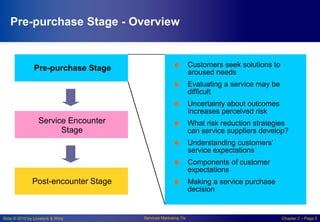
Pre-purchase Stage - Overview
 Customers seek solutions to
aroused needs
 Evaluating a service may be
difficult
 Uncertainty about outcomes
Increases perceived risk
 What risk reduction strategies
can service suppliers develop?
 Understanding customers’
service expectations
 Components of customer
expectations
 Making a service purchase
decision
Pre-purchase Stage
Service Encounter
Stage
Post-encounter Stage
Slide © 2010 by Lovelock & Wirtz Services Marketing 7/e Chapter 2 – Page 6
Need Arousal
 Decision to buy or use a service is triggered by need
arousal
 Triggers of need:
 Unconscious minds (e.g., personal identity and aspirations)
 Physical conditions (e.g., hunger )
 External sources (e.g., a service firm’s marketing activities)
 Consumers are then motivated to find a solution for their
need
Courtesy of Masterfile Corporation
Slide © 2010 by Lovelock & Wirtz Services Marketing 7/e Chapter 2 – Page 7
Information Search
 Need arousal leads to attempts to find a solution
 Several alternatives may come to mind and these form the
evoked set.
 Evoked set – a set of products and brands that a consumer
considers during the decision-making process – that is
derived from past experiences or external sources
 Alternatives then need to be evaluated before a final
decision is made
Slide © 2010 by Lovelock & Wirtz Services Marketing 7/e Chapter 2 – Page 8
Evaluating Alternatives –
Service Attributes
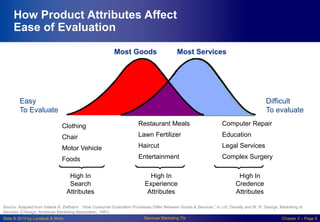
 Search attributes help customers evaluate a product before
purchase
 E.g., type of food, location, type of restaurant and price
 Experience attributes cannot be evaluated before purchase
 The consumer will not know how much s/he will enjoy the food, the
service, and the atmosphere until the actual experience
 Eg.. Vacations, sporting events, medical procedures
 Credence attributes are those that customers find impossible to
evaluate confidently even after purchase and consumption
 E.g., hygiene conditions of the kitchen and the healthiness of the
cooking ingredients , quality of repair and maintenance work
Slide © 2010 by Lovelock & Wirtz Services Marketing 7/e Chapter 2 – Page 9
How Product Attributes Affect
Ease of Evaluation
Most Goods
Difficult
To evaluate
Easy
To Evaluate
Most Services
Clothing
Chair
Motor Vehicle
Foods
High In
Search
Attributes
Restaurant Meals
Lawn Fertilizer
Haircut
Entertainment
High In
Experience
Attributes
Computer Repair
Education
Legal Services
Complex Surgery
High In
Credence
Attributes
Source: Adapted from Valarie A. Zeithaml , “How Consumer Evaluation Processes Differ Between Goods & Services,” in J.H. Donelly and W. R. George, Marketing of
Services (Chicago: American Marketing Association, 1981)
Slide © 2010 by Lovelock & Wirtz Services Marketing 7/e Chapter 2 – Page 10
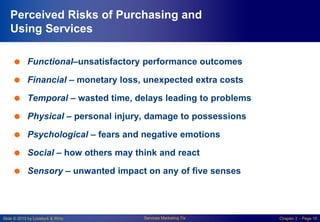
Perceived Risks of Purchasing and
Using Services
 Functional–unsatisfactory performance outcomes
 Financial – monetary loss, unexpected extra costs
 Temporal – wasted time, delays leading to problems
 Physical – personal injury, damage to possessions
 Psychological – fears and negative emotions
 Social – how others may think and react
 Sensory – unwanted impact on any of five senses
Slide © 2010 by Lovelock & Wirtz Services Marketing 7/e Chapter 2 – Page 11
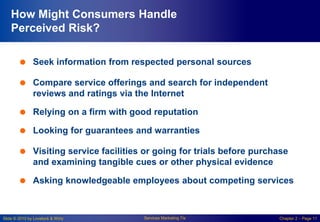
How Might Consumers Handle
Perceived Risk?
 Seek information from respected personal sources
 Compare service offerings and search for independent
reviews and ratings via the Internet
 Relying on a firm with good reputation
 Looking for guarantees and warranties
 Visiting service facilities or going for trials before purchase
and examining tangible cues or other physical evidence
 Asking knowledgeable employees about competing services
Slide © 2010 by Lovelock & Wirtz Services Marketing 7/e Chapter 2 – Page 12
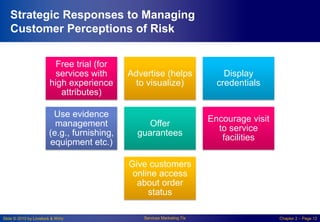
Strategic Responses to Managing
Customer Perceptions of Risk
Free trial (for
services with
high experience
attributes)
Advertise (helps
to visualize)
Display
credentials
Use evidence
management
(e.g., furnishing,
equipment etc.)
Offer
guarantees
Encourage visit
to service
facilities
Give customers
online access
about order
status
Slide © 2010 by Lovelock & Wirtz Services Marketing 7/e Chapter 2 – Page 13
Understanding Customers’
Service Expectations
 Customers evaluate service quality by comparing what they
expect against what they perceive
 Situational and personal factors also considered
 Expectations of good service vary from one business to
another, and differently positioned service providers in
same industry
 Expectations change over time
Slide © 2010 by Lovelock & Wirtz Services Marketing 7/e Chapter 2 – Page 14
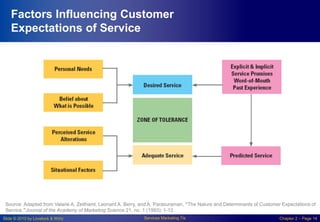
Factors Influencing Customer
Expectations of Service
Source: Adapted from Valarie A. Zeithaml, Leonard A. Berry, and A. Parasuraman, “The Nature and Determinants of Customer Expectations of
Service,”Journal of the Academy of Marketing Science 21, no. 1 (1993): 1-12
Slide © 2010 by Lovelock & Wirtz Services Marketing 7/e Chapter 2 – Page 15
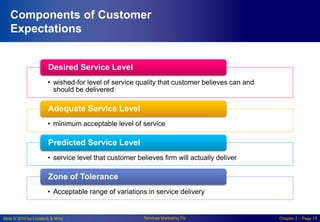
Components of Customer
Expectations
• wished-for level of service quality that customer believes can and
should be delivered
Desired Service Level
• minimum acceptable level of service
Adequate Service Level
• service level that customer believes firm will actually deliver
Predicted Service Level
• Acceptable range of variations in service delivery
Zone of Tolerance
Slide © 2010 by Lovelock & Wirtz Services Marketing 7/e Chapter 2 – Page 16
Purchase Decision
 Purchase Decision: Possible alternatives are compared and
evaluated, whereby the best option is selected
 Simple if perceived risks are low and alternatives are clear
 Complex when trade-offs increase
 Trade-offs are often involved. The more complex the
decision, the more trade- offs need to be made.
 Price is often a key factor in the purchase decision.
 After making a decision, the consumer moves into the
service encounter stage
Slide © 2010 by Lovelock & Wirtz Services Marketing 7/e Chapter 2 – Page 17
Service Encounter Stage
Slide © 2010 by Lovelock & Wirtz Services Marketing 7/e Chapter 2 – Page 18
 After making a purchase decision, customers move on to the core of the service
experience. The service encounter stage is when the customer interacts directly with the
service firm. We use a number of models and frameworks to better understand the
consumers’ behavior and experience during the service encounter.
 First, the “moments of truth” metaphor shows the importance of effectively managing
service touch points.
 A second framework, the high- or low-contact service model, helps us to better
understand the extent and nature of points of contact.
 A third concept, the servuction model, focuses on the various types of interactions that
together create the customer’s service experience.
 Finally, the theater metaphor together with the script, role, and perceived control
theories communicate effectively how one can look at “staging” service performances to
create the experience customers desire.
Slide © 2010 by Lovelock & Wirtz Services Marketing 7/e Chapter 2 – Page 19
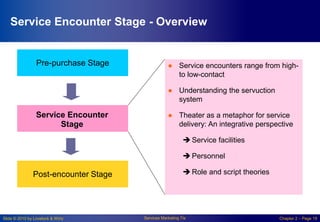
Service Encounter Stage - Overview
Pre-purchase Stage
Service Encounter
Stage
Post-encounter Stage
● Service encounters range from high-
to low-contact
● Understanding the servuction
system
● Theater as a metaphor for service
delivery: An integrative perspective
 Service facilities
 Personnel
 Role and script theories
Slide © 2010 by Lovelock & Wirtz Services Marketing 7/e Chapter 2 – Page 20
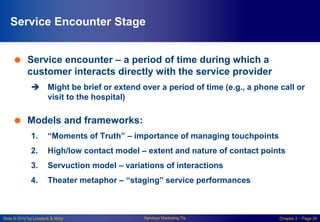
Service Encounter Stage
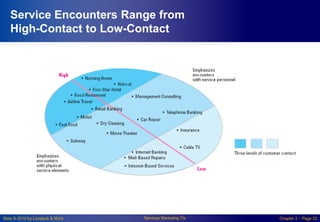
 Service encounter – a period of time during which a
customer interacts directly with the service provider
 Might be brief or extend over a period of time (e.g., a phone call or
visit to the hospital)
 Models and frameworks:
1. “Moments of Truth” – importance of managing touchpoints
2. High/low contact model – extent and nature of contact points
3. Servuction model – variations of interactions
4. Theater metaphor – “staging” service performances
Slide © 2010 by Lovelock & Wirtz Services Marketing 7/e Chapter 2 – Page 21
Moments of Truth
 The moment of truth…..
 A service business’s performance is made up of the sum of
its countless interaction with its clients.
 A Moments of Truth is when an interaction occurs between
a customer and service provider that can leave a lasting
positive or negative impression on customer.
Slide © 2010 by Lovelock & Wirtz Services Marketing 7/e Chapter 2 – Page 22
Service Encounters Range from
High-Contact to Low-Contact
Slide © 2010 by Lovelock & Wirtz Services Marketing 7/e Chapter 2 – Page 23
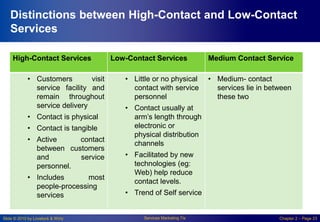
Distinctions between High-Contact and Low-Contact
Services
High-Contact Services Low-Contact Services Medium Contact Service
• Customers visit
service facility and
remain throughout
service delivery
• Contact is physical
• Contact is tangible
• Active contact
between customers
and service
personnel.
• Includes most
people-processing
services
• Little or no physical
contact with service
personnel
• Contact usually at
arm’s length through
electronic or
physical distribution
channels
• Facilitated by new
technologies (eg:
Web) help reduce
contact levels.
• Trend of Self service
• Medium- contact
services lie in between
these two
Slide © 2010 by Lovelock & Wirtz Services Marketing 7/e Chapter 2 – Page 24
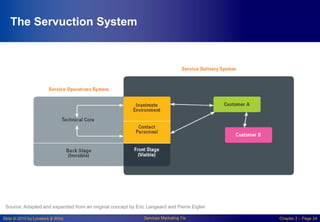
The Servuction System
Source: Adapted and expanded from an original concept by Eric Langeard and Pierre Eiglier
Slide © 2010 by Lovelock & Wirtz Services Marketing 7/e Chapter 2 – Page 25
The Servuction System:
Service Production and Delivery
Servuction System: visible front stage and invisible backstage
 Service Operations( front stage and back stage)
 Technical core where inputs are processed and service elements created
 Include facilities, equipment and personnel
 Service Delivery (front stage)
 Where “final assembly” of service elements takes place and service is
delivered
 Includes customer interactions with operations and other customers
 Service Marketing ( front Stage)
- Includes service delivery (as above ) and all other contacts between service
firm and customers.
Slide © 2010 by Lovelock & Wirtz Services Marketing 7/e Chapter 2 – Page 26
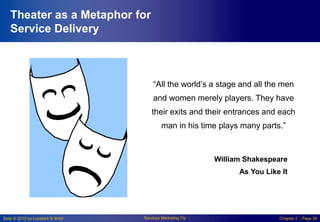
Theater as a Metaphor for
Service Delivery
“All the world’s a stage and all the men
and women merely players. They have
their exits and their entrances and each
man in his time plays many parts.”
William Shakespeare
As You Like It
Slide © 2010 by Lovelock & Wirtz Services Marketing 7/e Chapter 2 – Page 27
Theatrical Metaphor:
an Integrative Perspective
Good metaphor as service delivery is a series of events that
customers experience as a performance
Service facilities
• Stage on which drama
unfolds
• This may change from
one act to another
Personnel
• Front stage personnel are
like members of a cast
• Backstage personnel are
support production team
Roles
• Like actors, employees
have roles to play and
behave in specific ways
Scripts
• Specifies the sequences
of behavior for customers
and employees
Slide © 2010 by Lovelock & Wirtz Services Marketing 7/e Chapter 2 – Page 28
Implications of Customer
Participation in Service Delivery
 Greater need for information/training
 Help customers to perform well, get desired results
 Customers should be given a realistic service preview in
advance of service delivery
 This allows them to have a clear idea of their expected role and
their script in this whole experience
 Manages expectations and emotions
Slide © 2010 by Lovelock & Wirtz Services Marketing 7/e Chapter 2 – Page 29
Post-Encounter Stage
Slide © 2010 by Lovelock & Wirtz Services Marketing 7/e Chapter 2 – Page 30
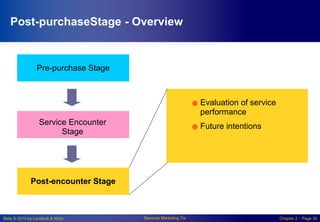
Post-purchaseStage - Overview
Pre-purchase Stage
Service Encounter
Stage
Post-encounter Stage
●Evaluation of service
performance
●Future intentions
Slide © 2010 by Lovelock & Wirtz Services Marketing 7/e Chapter 2 – Page 31
Customer Satisfaction with
Service Experience
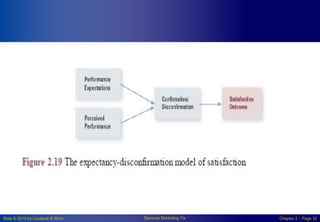
 Satisfaction: attitude-like judgment following a service
purchase or series of service interactions
 Whereby customers have expectations prior to consumption,
observe service performance, compare it to expectations
 Satisfaction judgments are based on this comparison
 Positive disconfirmation if better than expected
 Confirmation if same as expected
 Negative disconfirmation if worse than expected
Slide © 2010 by Lovelock & Wirtz Services Marketing 7/e Chapter 2 – Page 32
Slide © 2010 by Lovelock & Wirtz Services Marketing 7/e Chapter 2 – Page 33
Customer Delight:
Going Beyond Satisfaction
 Research shows that delight is a function of three components
 Unexpectedly high levels of performance
 Arousal (e.g., surprise, excitement)
 Positive affect (e.g., pleasure, joy, or happiness)
 Once customers are delighted, their expectations are raised.
 If service levels return to previous levels, this may lead to dissatisfaction and it
will be more difficult to “delight” customer in future.
 Strategic links exist between customer satisfaction and corporate performance
 By creating more value for customers (increased satisfaction), the firm
creates more value for the owners
Slide © 2010 by Lovelock & Wirtz Services Marketing 7/e Chapter 2 – Page 34
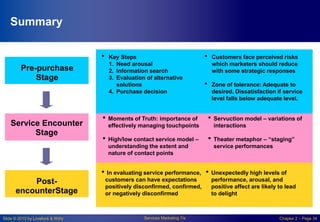
Summary
Pre-purchase
Stage
Service Encounter
Stage
Post-
encounterStage
• In evaluating service performance,
customers can have expectations
positively disconfirmed, confirmed,
or negatively disconfirmed
• Unexpectedly high levels of
performance, arousal, and
positive affect are likely to lead
to delight
• Moments of Truth: importance of
effectively managing touchpoints
• High/low contact service model –
understanding the extent and
nature of contact points
• Servuction model – variations of
interactions
• Theater metaphor – “staging”
service performances
• Key Steps
1. Need arousal
2. Information search
3. Evaluation of alternative
solutions
4. Purchase decision
• Customers face perceived risks
which marketers should reduce
with some strategic responses
• Zone of tolerance: Adequate to
desired. Dissatisfaction if service
level falls below adequate level.

chapter2.pdf processof marketing including the memory

  • 1.
    Slide © 2010by Lovelock & Wirtz Services Marketing 7/e Chapter 2 – Page 1 Chapter 2: Consumer Behavior in a Services Context Services Marketing 7e, Global Edition
  • 2.
    Slide © 2010by Lovelock & Wirtz Services Marketing 7/e Chapter 2 – Page 2  Service consumption can be divided into three main stages. They are the pre purchase, service encounter, and post-encounter stages.  The prepurchase stage includes need-awareness, information search, evaluation of alternatives, and making a purchase decision.  During the service encounter stage, the customer initiates, experiences, and consumes the service.  The post-encounter stage includes evaluation of the service performance, which determines future intentions such as wanting to buy again from the same firm, and recommending it to friends.
  • 3.
    Slide © 2010by Lovelock & Wirtz Services Marketing 7/e Chapter 2 – Page 3 Overview Of Chapter 2 Pre-purchase Stage Service Encounter Stage Post-encounter Stage Customer Decision Making: The Three-Stage Model of Service Consumption
  • 4.
    Slide © 2010by Lovelock & Wirtz Services Marketing 7/e Chapter 2 – Page 4 Pre-purchase Stage
  • 5.
    Slide © 2010by Lovelock & Wirtz Services Marketing 7/e Chapter 2 – Page 5 Pre-purchase Stage - Overview  Customers seek solutions to aroused needs  Evaluating a service may be difficult  Uncertainty about outcomes Increases perceived risk  What risk reduction strategies can service suppliers develop?  Understanding customers’ service expectations  Components of customer expectations  Making a service purchase decision Pre-purchase Stage Service Encounter Stage Post-encounter Stage
  • 6.
    Slide © 2010by Lovelock & Wirtz Services Marketing 7/e Chapter 2 – Page 6 Need Arousal  Decision to buy or use a service is triggered by need arousal  Triggers of need:  Unconscious minds (e.g., personal identity and aspirations)  Physical conditions (e.g., hunger )  External sources (e.g., a service firm’s marketing activities)  Consumers are then motivated to find a solution for their need Courtesy of Masterfile Corporation
  • 7.
    Slide © 2010by Lovelock & Wirtz Services Marketing 7/e Chapter 2 – Page 7 Information Search  Need arousal leads to attempts to find a solution  Several alternatives may come to mind and these form the evoked set.  Evoked set – a set of products and brands that a consumer considers during the decision-making process – that is derived from past experiences or external sources  Alternatives then need to be evaluated before a final decision is made
  • 8.
    Slide © 2010by Lovelock & Wirtz Services Marketing 7/e Chapter 2 – Page 8 Evaluating Alternatives – Service Attributes  Search attributes help customers evaluate a product before purchase  E.g., type of food, location, type of restaurant and price  Experience attributes cannot be evaluated before purchase  The consumer will not know how much s/he will enjoy the food, the service, and the atmosphere until the actual experience  Eg.. Vacations, sporting events, medical procedures  Credence attributes are those that customers find impossible to evaluate confidently even after purchase and consumption  E.g., hygiene conditions of the kitchen and the healthiness of the cooking ingredients , quality of repair and maintenance work
  • 9.
    Slide © 2010by Lovelock & Wirtz Services Marketing 7/e Chapter 2 – Page 9 How Product Attributes Affect Ease of Evaluation Most Goods Difficult To evaluate Easy To Evaluate Most Services Clothing Chair Motor Vehicle Foods High In Search Attributes Restaurant Meals Lawn Fertilizer Haircut Entertainment High In Experience Attributes Computer Repair Education Legal Services Complex Surgery High In Credence Attributes Source: Adapted from Valarie A. Zeithaml , “How Consumer Evaluation Processes Differ Between Goods & Services,” in J.H. Donelly and W. R. George, Marketing of Services (Chicago: American Marketing Association, 1981)
  • 10.
    Slide © 2010by Lovelock & Wirtz Services Marketing 7/e Chapter 2 – Page 10 Perceived Risks of Purchasing and Using Services  Functional–unsatisfactory performance outcomes  Financial – monetary loss, unexpected extra costs  Temporal – wasted time, delays leading to problems  Physical – personal injury, damage to possessions  Psychological – fears and negative emotions  Social – how others may think and react  Sensory – unwanted impact on any of five senses
  • 11.
    Slide © 2010by Lovelock & Wirtz Services Marketing 7/e Chapter 2 – Page 11 How Might Consumers Handle Perceived Risk?  Seek information from respected personal sources  Compare service offerings and search for independent reviews and ratings via the Internet  Relying on a firm with good reputation  Looking for guarantees and warranties  Visiting service facilities or going for trials before purchase and examining tangible cues or other physical evidence  Asking knowledgeable employees about competing services
  • 12.
    Slide © 2010by Lovelock & Wirtz Services Marketing 7/e Chapter 2 – Page 12 Strategic Responses to Managing Customer Perceptions of Risk Free trial (for services with high experience attributes) Advertise (helps to visualize) Display credentials Use evidence management (e.g., furnishing, equipment etc.) Offer guarantees Encourage visit to service facilities Give customers online access about order status
  • 13.
    Slide © 2010by Lovelock & Wirtz Services Marketing 7/e Chapter 2 – Page 13 Understanding Customers’ Service Expectations  Customers evaluate service quality by comparing what they expect against what they perceive  Situational and personal factors also considered  Expectations of good service vary from one business to another, and differently positioned service providers in same industry  Expectations change over time
  • 14.
    Slide © 2010by Lovelock & Wirtz Services Marketing 7/e Chapter 2 – Page 14 Factors Influencing Customer Expectations of Service Source: Adapted from Valarie A. Zeithaml, Leonard A. Berry, and A. Parasuraman, “The Nature and Determinants of Customer Expectations of Service,”Journal of the Academy of Marketing Science 21, no. 1 (1993): 1-12
  • 15.
    Slide © 2010by Lovelock & Wirtz Services Marketing 7/e Chapter 2 – Page 15 Components of Customer Expectations • wished-for level of service quality that customer believes can and should be delivered Desired Service Level • minimum acceptable level of service Adequate Service Level • service level that customer believes firm will actually deliver Predicted Service Level • Acceptable range of variations in service delivery Zone of Tolerance
  • 16.
    Slide © 2010by Lovelock & Wirtz Services Marketing 7/e Chapter 2 – Page 16 Purchase Decision  Purchase Decision: Possible alternatives are compared and evaluated, whereby the best option is selected  Simple if perceived risks are low and alternatives are clear  Complex when trade-offs increase  Trade-offs are often involved. The more complex the decision, the more trade- offs need to be made.  Price is often a key factor in the purchase decision.  After making a decision, the consumer moves into the service encounter stage
  • 17.
    Slide © 2010by Lovelock & Wirtz Services Marketing 7/e Chapter 2 – Page 17 Service Encounter Stage
  • 18.
    Slide © 2010by Lovelock & Wirtz Services Marketing 7/e Chapter 2 – Page 18  After making a purchase decision, customers move on to the core of the service experience. The service encounter stage is when the customer interacts directly with the service firm. We use a number of models and frameworks to better understand the consumers’ behavior and experience during the service encounter.  First, the “moments of truth” metaphor shows the importance of effectively managing service touch points.  A second framework, the high- or low-contact service model, helps us to better understand the extent and nature of points of contact.  A third concept, the servuction model, focuses on the various types of interactions that together create the customer’s service experience.  Finally, the theater metaphor together with the script, role, and perceived control theories communicate effectively how one can look at “staging” service performances to create the experience customers desire.
  • 19.
    Slide © 2010by Lovelock & Wirtz Services Marketing 7/e Chapter 2 – Page 19 Service Encounter Stage - Overview Pre-purchase Stage Service Encounter Stage Post-encounter Stage ● Service encounters range from high- to low-contact ● Understanding the servuction system ● Theater as a metaphor for service delivery: An integrative perspective  Service facilities  Personnel  Role and script theories
  • 20.
    Slide © 2010by Lovelock & Wirtz Services Marketing 7/e Chapter 2 – Page 20 Service Encounter Stage  Service encounter – a period of time during which a customer interacts directly with the service provider  Might be brief or extend over a period of time (e.g., a phone call or visit to the hospital)  Models and frameworks: 1. “Moments of Truth” – importance of managing touchpoints 2. High/low contact model – extent and nature of contact points 3. Servuction model – variations of interactions 4. Theater metaphor – “staging” service performances
  • 21.
    Slide © 2010by Lovelock & Wirtz Services Marketing 7/e Chapter 2 – Page 21 Moments of Truth  The moment of truth…..  A service business’s performance is made up of the sum of its countless interaction with its clients.  A Moments of Truth is when an interaction occurs between a customer and service provider that can leave a lasting positive or negative impression on customer.
  • 22.
    Slide © 2010by Lovelock & Wirtz Services Marketing 7/e Chapter 2 – Page 22 Service Encounters Range from High-Contact to Low-Contact
  • 23.
    Slide © 2010by Lovelock & Wirtz Services Marketing 7/e Chapter 2 – Page 23 Distinctions between High-Contact and Low-Contact Services High-Contact Services Low-Contact Services Medium Contact Service • Customers visit service facility and remain throughout service delivery • Contact is physical • Contact is tangible • Active contact between customers and service personnel. • Includes most people-processing services • Little or no physical contact with service personnel • Contact usually at arm’s length through electronic or physical distribution channels • Facilitated by new technologies (eg: Web) help reduce contact levels. • Trend of Self service • Medium- contact services lie in between these two
  • 24.
    Slide © 2010by Lovelock & Wirtz Services Marketing 7/e Chapter 2 – Page 24 The Servuction System Source: Adapted and expanded from an original concept by Eric Langeard and Pierre Eiglier
  • 25.
    Slide © 2010by Lovelock & Wirtz Services Marketing 7/e Chapter 2 – Page 25 The Servuction System: Service Production and Delivery Servuction System: visible front stage and invisible backstage  Service Operations( front stage and back stage)  Technical core where inputs are processed and service elements created  Include facilities, equipment and personnel  Service Delivery (front stage)  Where “final assembly” of service elements takes place and service is delivered  Includes customer interactions with operations and other customers  Service Marketing ( front Stage) - Includes service delivery (as above ) and all other contacts between service firm and customers.
  • 26.
    Slide © 2010by Lovelock & Wirtz Services Marketing 7/e Chapter 2 – Page 26 Theater as a Metaphor for Service Delivery “All the world’s a stage and all the men and women merely players. They have their exits and their entrances and each man in his time plays many parts.” William Shakespeare As You Like It
  • 27.
    Slide © 2010by Lovelock & Wirtz Services Marketing 7/e Chapter 2 – Page 27 Theatrical Metaphor: an Integrative Perspective Good metaphor as service delivery is a series of events that customers experience as a performance Service facilities • Stage on which drama unfolds • This may change from one act to another Personnel • Front stage personnel are like members of a cast • Backstage personnel are support production team Roles • Like actors, employees have roles to play and behave in specific ways Scripts • Specifies the sequences of behavior for customers and employees
  • 28.
    Slide © 2010by Lovelock & Wirtz Services Marketing 7/e Chapter 2 – Page 28 Implications of Customer Participation in Service Delivery  Greater need for information/training  Help customers to perform well, get desired results  Customers should be given a realistic service preview in advance of service delivery  This allows them to have a clear idea of their expected role and their script in this whole experience  Manages expectations and emotions
  • 29.
    Slide © 2010by Lovelock & Wirtz Services Marketing 7/e Chapter 2 – Page 29 Post-Encounter Stage
  • 30.
    Slide © 2010by Lovelock & Wirtz Services Marketing 7/e Chapter 2 – Page 30 Post-purchaseStage - Overview Pre-purchase Stage Service Encounter Stage Post-encounter Stage ●Evaluation of service performance ●Future intentions
  • 31.
    Slide © 2010by Lovelock & Wirtz Services Marketing 7/e Chapter 2 – Page 31 Customer Satisfaction with Service Experience  Satisfaction: attitude-like judgment following a service purchase or series of service interactions  Whereby customers have expectations prior to consumption, observe service performance, compare it to expectations  Satisfaction judgments are based on this comparison  Positive disconfirmation if better than expected  Confirmation if same as expected  Negative disconfirmation if worse than expected
  • 32.
    Slide © 2010by Lovelock & Wirtz Services Marketing 7/e Chapter 2 – Page 32
  • 33.
    Slide © 2010by Lovelock & Wirtz Services Marketing 7/e Chapter 2 – Page 33 Customer Delight: Going Beyond Satisfaction  Research shows that delight is a function of three components  Unexpectedly high levels of performance  Arousal (e.g., surprise, excitement)  Positive affect (e.g., pleasure, joy, or happiness)  Once customers are delighted, their expectations are raised.  If service levels return to previous levels, this may lead to dissatisfaction and it will be more difficult to “delight” customer in future.  Strategic links exist between customer satisfaction and corporate performance  By creating more value for customers (increased satisfaction), the firm creates more value for the owners
  • 34.
    Slide © 2010by Lovelock & Wirtz Services Marketing 7/e Chapter 2 – Page 34 Summary Pre-purchase Stage Service Encounter Stage Post- encounterStage • In evaluating service performance, customers can have expectations positively disconfirmed, confirmed, or negatively disconfirmed • Unexpectedly high levels of performance, arousal, and positive affect are likely to lead to delight • Moments of Truth: importance of effectively managing touchpoints • High/low contact service model – understanding the extent and nature of contact points • Servuction model – variations of interactions • Theater metaphor – “staging” service performances • Key Steps 1. Need arousal 2. Information search 3. Evaluation of alternative solutions 4. Purchase decision • Customers face perceived risks which marketers should reduce with some strategic responses • Zone of tolerance: Adequate to desired. Dissatisfaction if service level falls below adequate level.