What Data to Give Back & How

Learning from Idiopathic Disease Sequencing
                Case Studies


           Cinnamon S. Bloss, Ph.D.
         Director of Social Sciences & Bioethics
         Scripps Translational Science Institute
                    @CinnamonBloss


         Future of Genomic Medicine VI
Main Points of Interest


1. Who are the patients (and physicians)?
  Unique, not representative of all who may benefit.


2. What are their attitudes and expectations?
  Expect access to data beyond the presenting condition.


3. How well do physicians return results?
  Physicians, as a group, may need help with this.
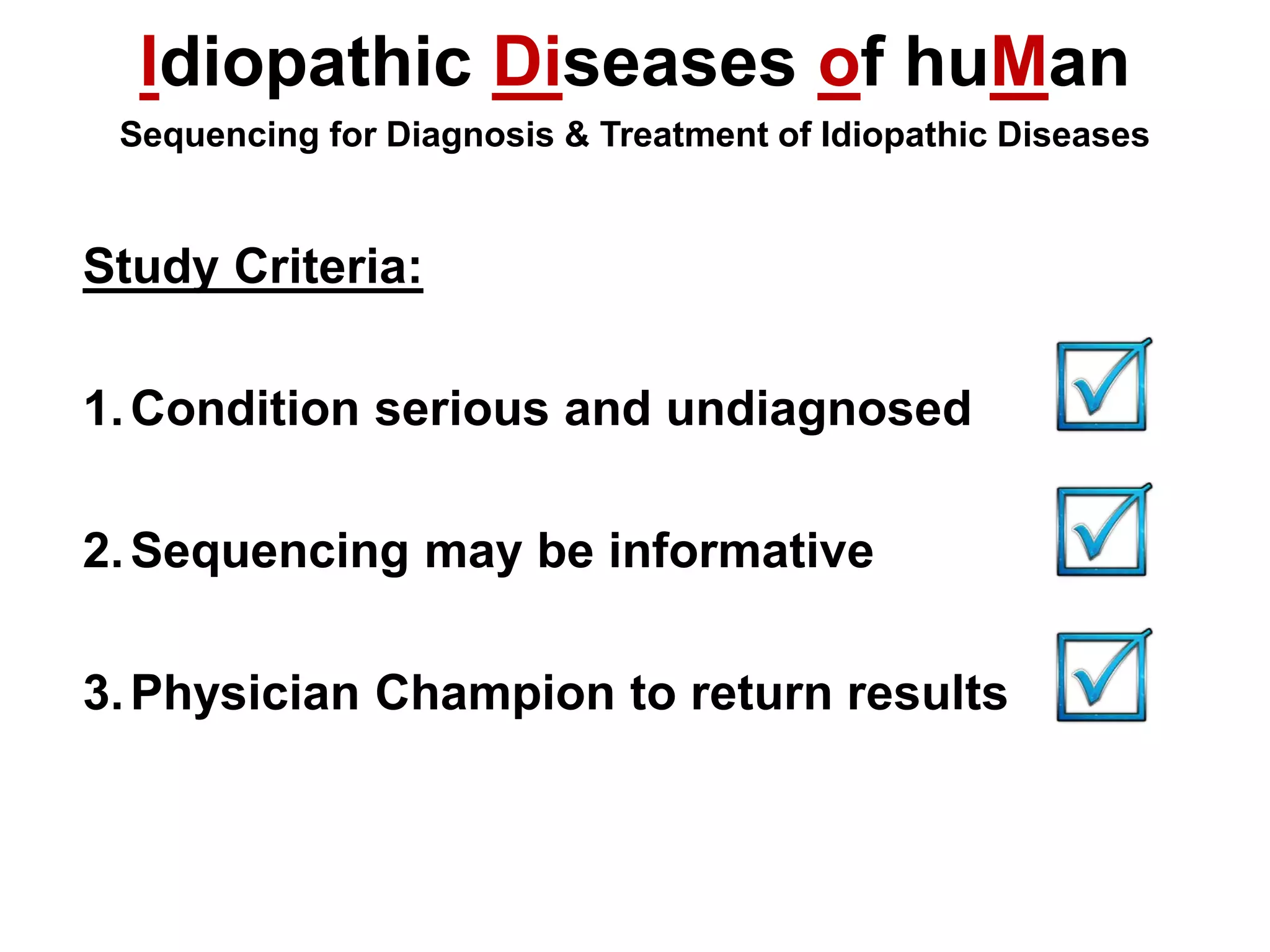
Idiopathic Diseases of huMan
 Sequencing for Diagnosis & Treatment of Idiopathic Diseases


Study Criteria:

1. Condition serious and undiagnosed

2. Sequencing may be informative

3. Physician Champion to return results
IDIOM Procedures
      Fall 2011
7th Patient Enrolled             Screening
N=5 Data Available
                       Clinician-Scientist Panel Review

                                 Enrollment

                            Psychosocial / Ethics

                           Seq, Analysis & Report

                       Return 1° Results to Phy Champ

                        Phy Champ Returns to Patient

                            Psychosocial / Ethics
IDIOM Scientist-Clinician Review Panel


                         Quarterly Evening Meetings
Neurology, Rheumatology, Internal Medicine, Allergy/Immunology, Cardiology, Medical
         Oncology/Hematology, Gastroenterology, Hepatology, Psychology,
             Bioinformatics/Genetics, Medical/Bioethics, Nursing, IRB
Psychosocial / Ethics

           Domain                       Instrument
                                       Quality of Life
                                        WHOQOL Grp (1998)
    Patient Characteristics          Genetic Knowledge
                                       Calsbeek et al. (2007)

   Physician Characteristics      Diffusion of Innovations
                                       Armstrong et al. (2003)
                               Whole Genome Sequencing Ques
                                        Ormond et al. (2012)
      Attitudes Towards             Secondary Findings
         Sequencing                      Mayer et al. (2011)
                                Personal Involvement Inventory
                                        Zaichkowsky (1994)
                                  Medical Communication
   Physician Communication             Competence
                                        Cegala et al. (1998)
                                    Decision Regret Scale
                                        Brehaut et al. (2003)
    Impact of Sequencing
                                    Impact of Events Scale
                                       Horowitz et al. (1979)


Pre- and Post-Seq Structured Patient Interviews
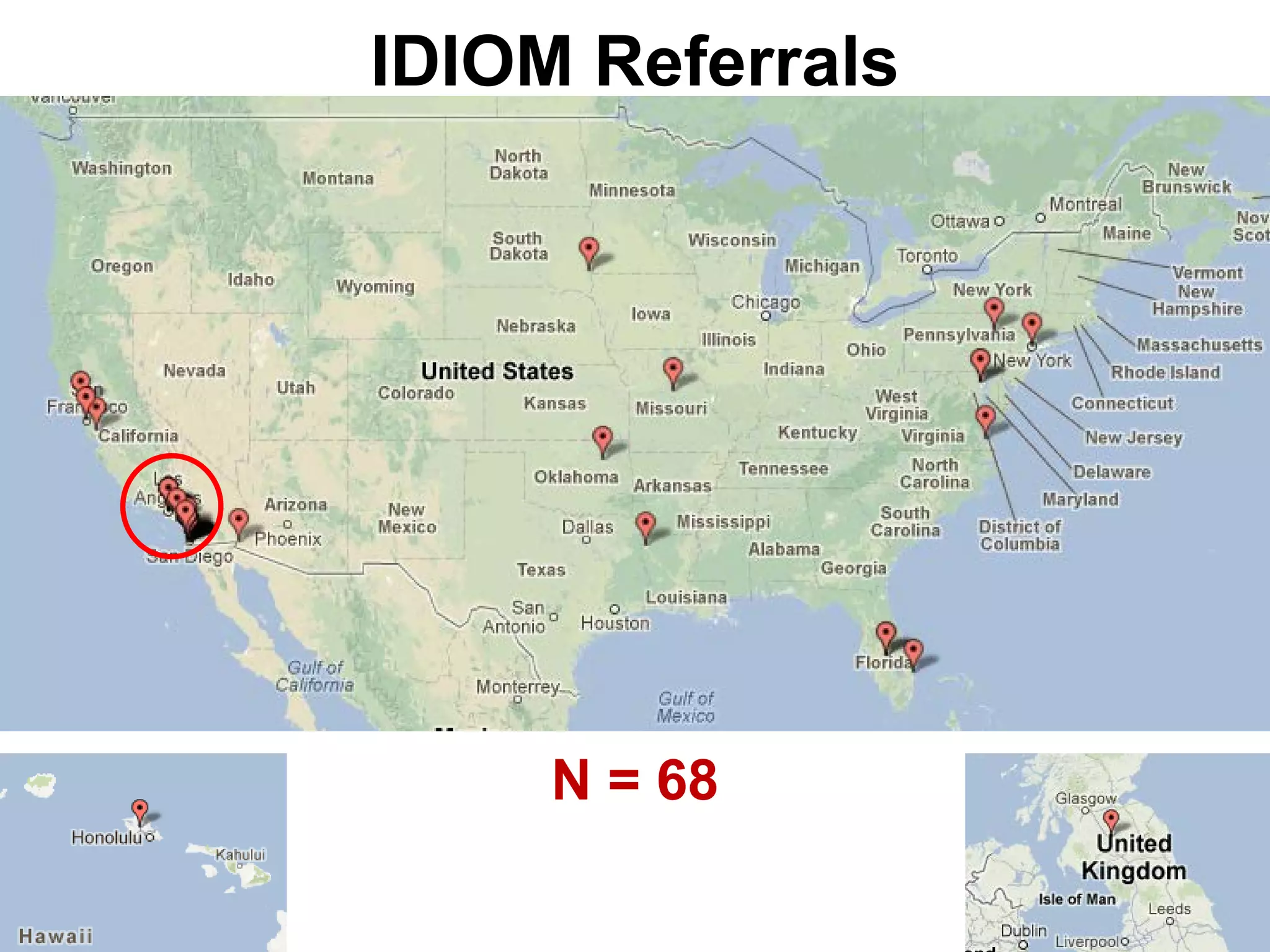
IDIOM Referrals


     N = 68
Panel Review

                       Ineligible    Panel Reviewed    p

        N                 47            21 (31%)        -
   Age (years)            47               26         <.001
Physician Referral       36%              71%          .04
                       Cardiology     Allergy/Immun
      Top 3
                      Internal Med       Oncology     .046
Medical Specialties
                       Neurology       Neurology


     Enrolled 10% of Referred Cases
Enrolled
Case Studies
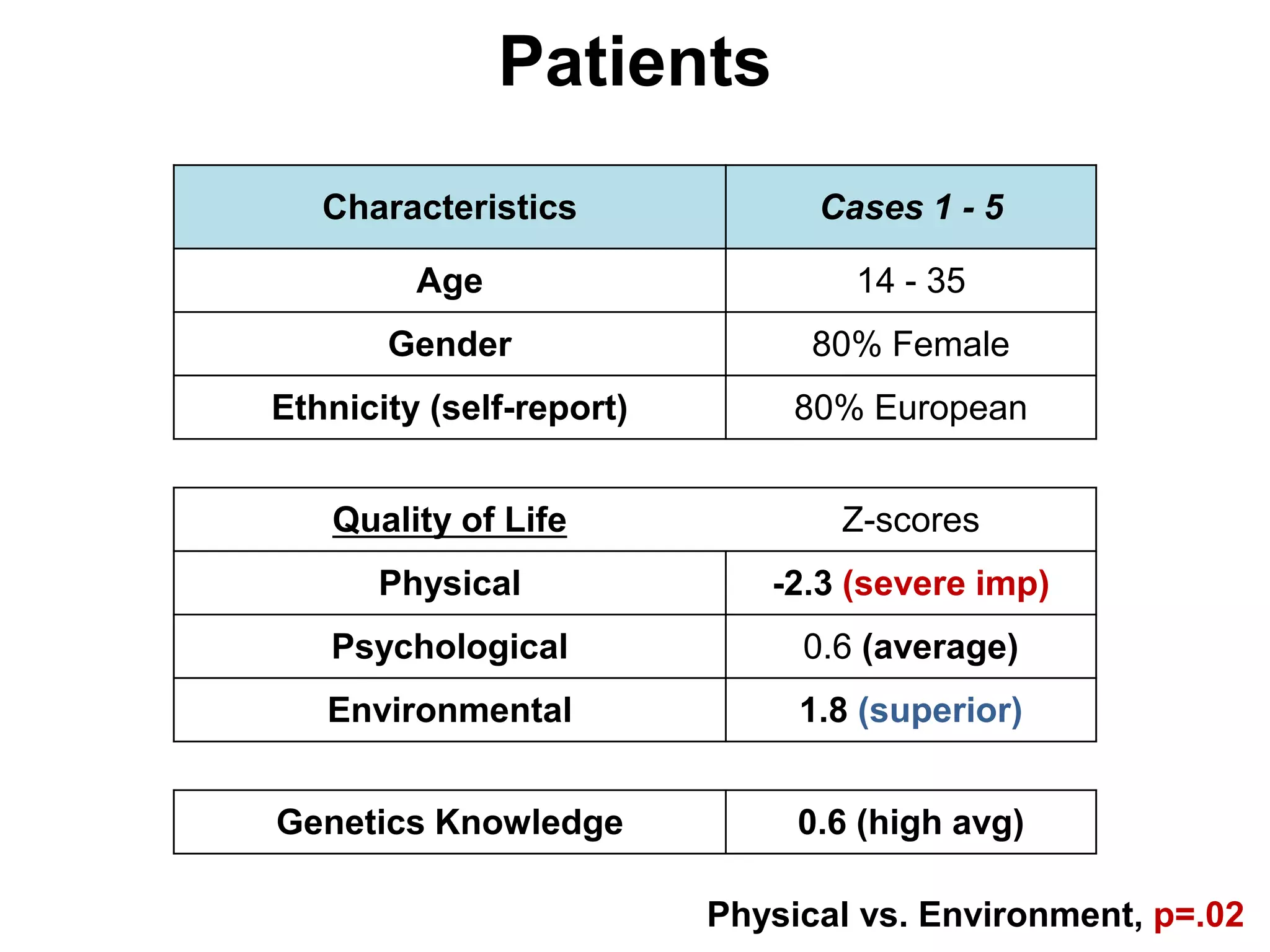
Patients
   Characteristics              Cases 1 - 5

         Age                      14 - 35
       Gender                   80% Female
Ethnicity (self-report)        80% European


   Quality of Life               Z-scores
      Physical               -2.3 (severe imp)
   Psychological               0.6 (average)
   Environmental               1.8 (superior)


Genetics Knowledge             0.6 (high avg)

                          Physical vs. Environment, p=.02
Physicians
    Characteristics          Cases 1 - 5

   Graduation Year           1991 - 2007

                               Neurology
                             Hem/Oncology
      Specialties
                           Gastroenterology
                          Allergy/Immunology
                                 7 – 90
Time Caring for Patient
                                Months

Personal Innovativeness      12 (average)
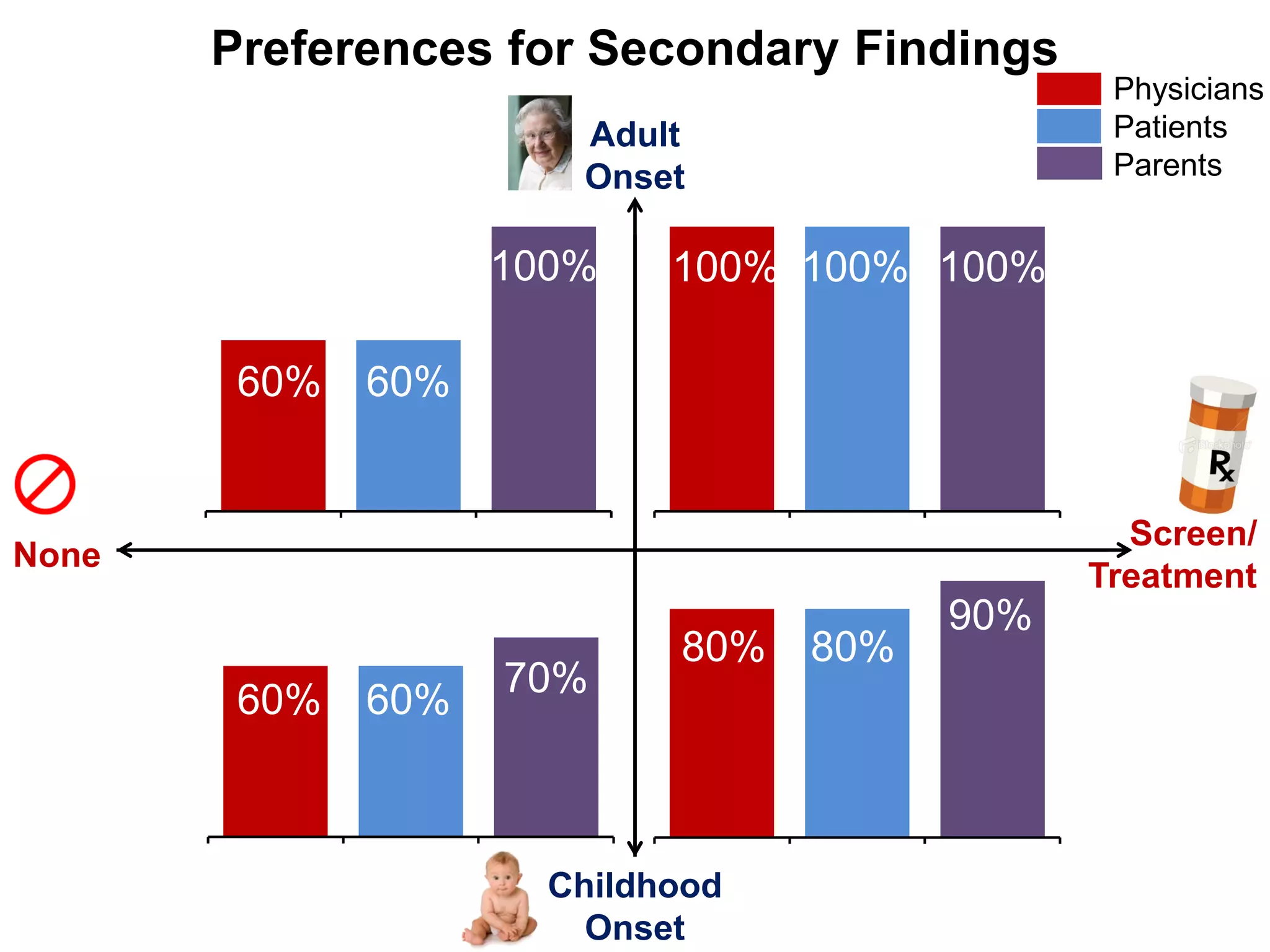
Preferences for Secondary Findings
                                               Physicians
                       Adult                   Patients
                       Onset                   Parents


                    100%    100% 100% 100%

        60%   60%


                                                Screen/
None
                                              Treatment
                                        90%
                            80%   80%
                    70%
        60%   60%


                      Childhood
                        Onset
How would you grade your physician?
    Communication


   Knowledge      A
  Explanations    B
  Solicits Ques   B-
  Spends Time     C
  Repeats Info    B
     Overall      B-
Physician “Self-Grading”
                                      Pre-seq Patient Grades Physician
                                      Post-seq Patient Grades Physician
                                      Post-seq Physician Grades Self
    60
A+
    50

A 40                                               Patient-Physician
                                                     Discrepancy
    30                                                   p=.04
B
    20


B-10


     0
F
    -10


    -20


    -30
          Case 1   Case 2   Case 3       Case 4

                               Medical Communication Competence Scale
Return of Results Discrepancy
                                                                                  Mother
Strongly                                                                          Father
   Agree 3                                                                        Physician

   Agree 2


 Slightly
  Agree 1


 Neither 0


 Slightly
Disagree
          -1


Disagree -2


Strongly
         -3
Disagree
               Knowledge Knowledge Explained    Reviewed Ensured Encouraged Spent Adequately
                 about     about    what the   or repeated patient   patient to enough explained
                genetics   WGS      results     important understood    ask       time     WGS
                                     were      information           questions explaining results
                                                                                          overall
Miscommunication = Mistakes, Misunderstandings
                & Frustration
Post-Sequencing
"We took several hours post-[testing to discuss results]
which is not feasible in general practice.” - Physician Case 1


"Make it faster so it's more relevant.” - Patient Case 2


"Do not depend on [a] child's doctor to…transfer such
important information.” - Father Case 3


• Mild to no sequencing-related distress, little to no regret

• 75% physicians & 50% patients suggest added clinician
Barriers


Cost Efficiency, Privacy Concerns / EMR, Turn-around
Time, Few Genetic Counselors, Secondary Findings,
        Return of Results, Physician Training
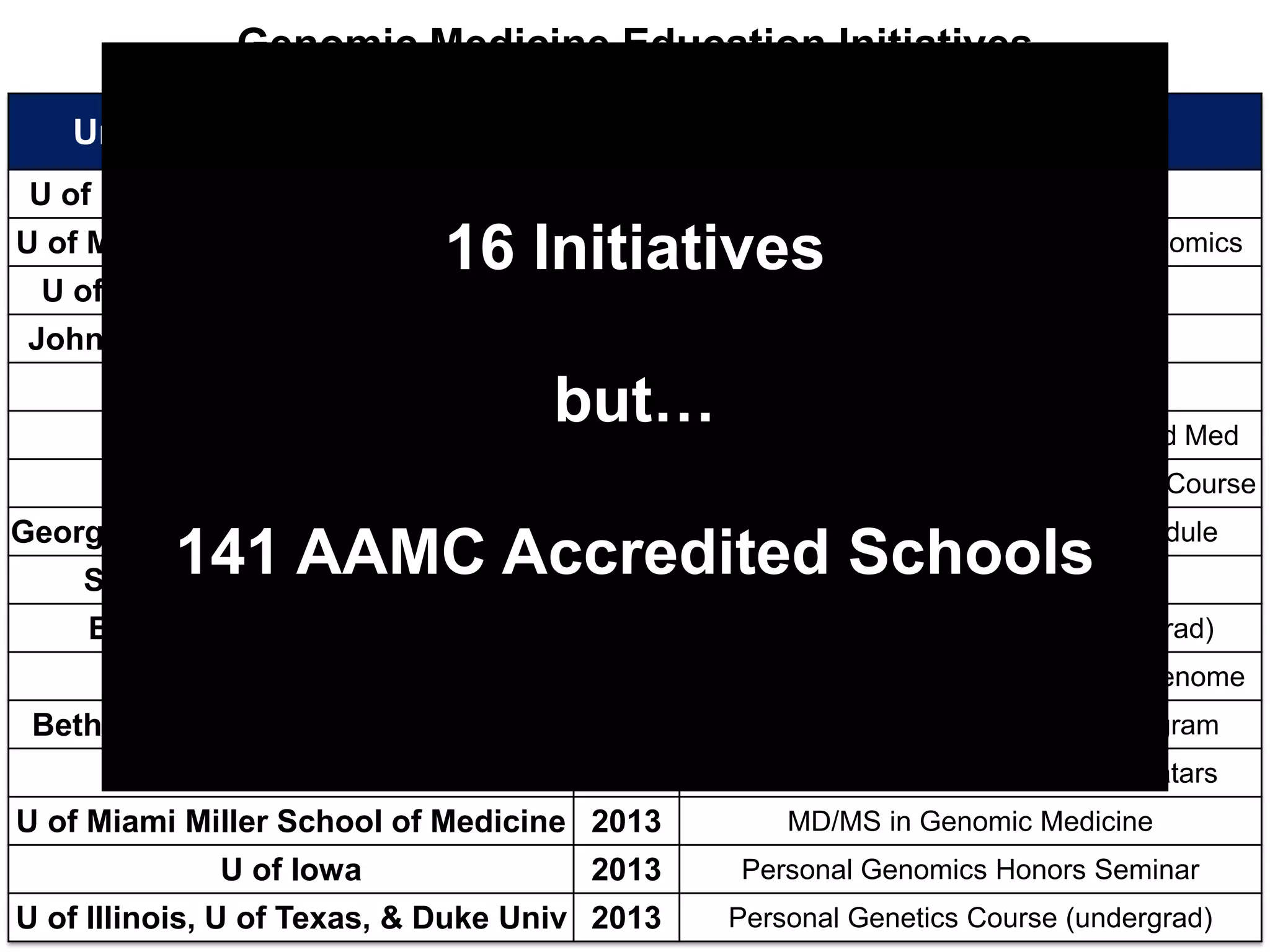
Genomic Medicine Education Initiatives

   University/Medical School          Year           Program Description
 U of Rochester School of Medicine    1999             Double Helix Curriculum
U of Miami Miller School of Medicine 2005     Pathway in Human Genetics and Genomics
 U of Pennsylvania School of Med      2008          Personalized Medicine Course
 Johns Hopkins School of Medicine     2009           Genes to Society Curriculum
          Tufts University            2009           Personal Genomics Course
       Ohio State University          2010    P4 Scholar’s Program in Personalized Med
        Stanford University           2010 Genomics and Personalized Medicine Course
Georgetown Univ School of Medicine 2010         Molecular and Human Genetics Module
    SUNY Upstate Medical Univ         2010          Personalized Medicine Elective
    Baylor College of Medicine        2011      Genetics Track Curriculum (undergrad)
        New York University           2012    Practical Analysis of Your Personal Genome
 Beth Israel Deaconess Medical Ctr    2012     Pathologist Genomics Training Program
            U of Florida              2012      Genetics Training Program with Avatars
U of Miami Miller School of Medicine 2013            MD/MS in Genomic Medicine
             U of Iowa                2013       Personal Genomics Honors Seminar
U of Illinois, U of Texas, & Duke Univ 2013     Personal Genetics Course (undergrad)
Genomic Medicine Education Initiatives

   University/Medical School           Year          Program Description
 U of Rochester School of Medicine     1999            Double Helix Curriculum

                              16 Initiativesin Human Genetics and Genomics
U of Miami Miller School of Medicine 2005
                                        Pathway
 U of Pennsylvania School of Med       2008  Personalized Medicine Course
 Johns Hopkins School of Medicine      2009          Genes to Society Curriculum
          Tufts University            2009
       Ohio State University
                                     but… Scholar’s Program in Personalized Med
                                      2010 P4
                                              Personal Genomics Course


        Stanford University            2010 Genomics and Personalized Medicine Course
Georgetown Univ School of Medicine 2010         Molecular and Human Genetics Module
          141 AAMC Accredited Schools
    SUNY Upstate Medical Univ
                     2010   Personalized Medicine Elective
    Baylor College of Medicine         2011     Genetics Track Curriculum (undergrad)
        New York University            2012   Practical Analysis of Your Personal Genome
 Beth Israel Deaconess Medical Ctr     2012    Pathologist Genomics Training Program
            U of Florida               2012     Genetics Training Program with Avatars
U of Miami Miller School of Medicine 2013            MD/MS in Genomic Medicine
             U of Iowa                 2013      Personal Genomics Honors Seminar
U of Illinois, U of Texas, & Duke Univ 2013     Personal Genetics Course (undergrad)
Exomes for Primary Care Physicians


56 Physicians / 78% Family Medicine / Median Year Graduation 1995
Observations
                  Main Points Revisited


1. Physicians, as a group, may need help with
   genetics (and in some cases might not know it)

2. Patients, families & physicians, would often
   choose to receive some secondary findings

3. Patients in early studies do not represent all
   who may benefit – need to ensure access
Acknowledgements
                                                          Andrew Carson, PhD
                     Sarah Topol, RN, BSN                 Guangfa Zhang, PhD
                     Burcu Darst                          Philip Pham
                     Sharon Haaser, RN                    Erick Scott, MD
Ali Torkamani, PhD   Philip Pham                          Glenn Oliveira
Nicholas Schork, PhD Bill Shipman, MS
                                                          Lauren Ariniello
Eric Topol, MD       Galina Erikson, MS                   Janel Lee
                                                          Nikki Villarasa
IDIOM Families & Physicians                               Sam Levy, PhD
With Special Thanks to “IDIOM #1”
                                                          Ashley Van Zeeland, PhD
Lilly, Gay and Steve Grossman
                                                          Mike Alcorn, MBA
Jennifer Friedman, M.D.
                                                          Scripps IRB
Clinician Review Panel Members                            Barbara Bigby, MA, CIP
Ron Simon, MD, Brad Patay, MD, Kelly Bethel, MD, Paul Pockros, MD, Gary Williams, MD,
James Mason, MD, Christy Jackson, MD, Michael Kayser, MD, Raj Belani, MD, Joel Diamant,
MD, Nelson Hwynn, MD, Erick Scott, MD

Funders
NIH/NCRR flagship CTSA grant (Eric Topol, MD)
Scripps Genomic Medicine Division of Scripps Health
Schaeffer Family Foundation / Warren Foundation / Zarrow Foundation
                                                                          Reproduced with permission

Fo gm vi-cinnamonbloss_idiom_7march2013_fina_lpost

  • 1.
    What Data toGive Back & How Learning from Idiopathic Disease Sequencing Case Studies Cinnamon S. Bloss, Ph.D. Director of Social Sciences & Bioethics Scripps Translational Science Institute @CinnamonBloss Future of Genomic Medicine VI
  • 2.
    Main Points ofInterest 1. Who are the patients (and physicians)? Unique, not representative of all who may benefit. 2. What are their attitudes and expectations? Expect access to data beyond the presenting condition. 3. How well do physicians return results? Physicians, as a group, may need help with this.
  • 3.
    Idiopathic Diseases ofhuMan Sequencing for Diagnosis & Treatment of Idiopathic Diseases Study Criteria: 1. Condition serious and undiagnosed 2. Sequencing may be informative 3. Physician Champion to return results
  • 4.
    IDIOM Procedures Fall 2011 7th Patient Enrolled Screening N=5 Data Available Clinician-Scientist Panel Review Enrollment Psychosocial / Ethics Seq, Analysis & Report Return 1° Results to Phy Champ Phy Champ Returns to Patient Psychosocial / Ethics
  • 5.
    IDIOM Scientist-Clinician ReviewPanel Quarterly Evening Meetings Neurology, Rheumatology, Internal Medicine, Allergy/Immunology, Cardiology, Medical Oncology/Hematology, Gastroenterology, Hepatology, Psychology, Bioinformatics/Genetics, Medical/Bioethics, Nursing, IRB
  • 6.
    Psychosocial / Ethics Domain Instrument Quality of Life WHOQOL Grp (1998) Patient Characteristics Genetic Knowledge Calsbeek et al. (2007) Physician Characteristics Diffusion of Innovations Armstrong et al. (2003) Whole Genome Sequencing Ques Ormond et al. (2012) Attitudes Towards Secondary Findings Sequencing Mayer et al. (2011) Personal Involvement Inventory Zaichkowsky (1994) Medical Communication Physician Communication Competence Cegala et al. (1998) Decision Regret Scale Brehaut et al. (2003) Impact of Sequencing Impact of Events Scale Horowitz et al. (1979) Pre- and Post-Seq Structured Patient Interviews
  • 7.
  • 8.
    Panel Review Ineligible Panel Reviewed p N 47 21 (31%) - Age (years) 47 26 <.001 Physician Referral 36% 71% .04 Cardiology Allergy/Immun Top 3 Internal Med Oncology .046 Medical Specialties Neurology Neurology Enrolled 10% of Referred Cases
  • 9.
  • 10.
    Patients Characteristics Cases 1 - 5 Age 14 - 35 Gender 80% Female Ethnicity (self-report) 80% European Quality of Life Z-scores Physical -2.3 (severe imp) Psychological 0.6 (average) Environmental 1.8 (superior) Genetics Knowledge 0.6 (high avg) Physical vs. Environment, p=.02
  • 11.
    Physicians Characteristics Cases 1 - 5 Graduation Year 1991 - 2007 Neurology Hem/Oncology Specialties Gastroenterology Allergy/Immunology 7 – 90 Time Caring for Patient Months Personal Innovativeness 12 (average)
  • 12.
    Preferences for SecondaryFindings Physicians Adult Patients Onset Parents 100% 100% 100% 100% 60% 60% Screen/ None Treatment 90% 80% 80% 70% 60% 60% Childhood Onset
  • 13.
    How would yougrade your physician? Communication Knowledge A Explanations B Solicits Ques B- Spends Time C Repeats Info B Overall B-
  • 14.
    Physician “Self-Grading” Pre-seq Patient Grades Physician Post-seq Patient Grades Physician Post-seq Physician Grades Self 60 A+ 50 A 40 Patient-Physician Discrepancy 30 p=.04 B 20 B-10 0 F -10 -20 -30 Case 1 Case 2 Case 3 Case 4 Medical Communication Competence Scale
  • 15.
    Return of ResultsDiscrepancy Mother Strongly Father Agree 3 Physician Agree 2 Slightly Agree 1 Neither 0 Slightly Disagree -1 Disagree -2 Strongly -3 Disagree Knowledge Knowledge Explained Reviewed Ensured Encouraged Spent Adequately about about what the or repeated patient patient to enough explained genetics WGS results important understood ask time WGS were information questions explaining results overall
  • 16.
    Miscommunication = Mistakes,Misunderstandings & Frustration
  • 17.
    Post-Sequencing "We took severalhours post-[testing to discuss results] which is not feasible in general practice.” - Physician Case 1 "Make it faster so it's more relevant.” - Patient Case 2 "Do not depend on [a] child's doctor to…transfer such important information.” - Father Case 3 • Mild to no sequencing-related distress, little to no regret • 75% physicians & 50% patients suggest added clinician
  • 18.
    Barriers Cost Efficiency, PrivacyConcerns / EMR, Turn-around Time, Few Genetic Counselors, Secondary Findings, Return of Results, Physician Training
  • 19.
    Genomic Medicine EducationInitiatives University/Medical School Year Program Description U of Rochester School of Medicine 1999 Double Helix Curriculum U of Miami Miller School of Medicine 2005 Pathway in Human Genetics and Genomics U of Pennsylvania School of Med 2008 Personalized Medicine Course Johns Hopkins School of Medicine 2009 Genes to Society Curriculum Tufts University 2009 Personal Genomics Course Ohio State University 2010 P4 Scholar’s Program in Personalized Med Stanford University 2010 Genomics and Personalized Medicine Course Georgetown Univ School of Medicine 2010 Molecular and Human Genetics Module SUNY Upstate Medical Univ 2010 Personalized Medicine Elective Baylor College of Medicine 2011 Genetics Track Curriculum (undergrad) New York University 2012 Practical Analysis of Your Personal Genome Beth Israel Deaconess Medical Ctr 2012 Pathologist Genomics Training Program U of Florida 2012 Genetics Training Program with Avatars U of Miami Miller School of Medicine 2013 MD/MS in Genomic Medicine U of Iowa 2013 Personal Genomics Honors Seminar U of Illinois, U of Texas, & Duke Univ 2013 Personal Genetics Course (undergrad)
  • 20.
    Genomic Medicine EducationInitiatives University/Medical School Year Program Description U of Rochester School of Medicine 1999 Double Helix Curriculum 16 Initiativesin Human Genetics and Genomics U of Miami Miller School of Medicine 2005 Pathway U of Pennsylvania School of Med 2008 Personalized Medicine Course Johns Hopkins School of Medicine 2009 Genes to Society Curriculum Tufts University 2009 Ohio State University but… Scholar’s Program in Personalized Med 2010 P4 Personal Genomics Course Stanford University 2010 Genomics and Personalized Medicine Course Georgetown Univ School of Medicine 2010 Molecular and Human Genetics Module 141 AAMC Accredited Schools SUNY Upstate Medical Univ 2010 Personalized Medicine Elective Baylor College of Medicine 2011 Genetics Track Curriculum (undergrad) New York University 2012 Practical Analysis of Your Personal Genome Beth Israel Deaconess Medical Ctr 2012 Pathologist Genomics Training Program U of Florida 2012 Genetics Training Program with Avatars U of Miami Miller School of Medicine 2013 MD/MS in Genomic Medicine U of Iowa 2013 Personal Genomics Honors Seminar U of Illinois, U of Texas, & Duke Univ 2013 Personal Genetics Course (undergrad)
  • 21.
    Exomes for PrimaryCare Physicians 56 Physicians / 78% Family Medicine / Median Year Graduation 1995
  • 22.
    Observations Main Points Revisited 1. Physicians, as a group, may need help with genetics (and in some cases might not know it) 2. Patients, families & physicians, would often choose to receive some secondary findings 3. Patients in early studies do not represent all who may benefit – need to ensure access
  • 23.
    Acknowledgements Andrew Carson, PhD Sarah Topol, RN, BSN Guangfa Zhang, PhD Burcu Darst Philip Pham Sharon Haaser, RN Erick Scott, MD Ali Torkamani, PhD Philip Pham Glenn Oliveira Nicholas Schork, PhD Bill Shipman, MS Lauren Ariniello Eric Topol, MD Galina Erikson, MS Janel Lee Nikki Villarasa IDIOM Families & Physicians Sam Levy, PhD With Special Thanks to “IDIOM #1” Ashley Van Zeeland, PhD Lilly, Gay and Steve Grossman Mike Alcorn, MBA Jennifer Friedman, M.D. Scripps IRB Clinician Review Panel Members Barbara Bigby, MA, CIP Ron Simon, MD, Brad Patay, MD, Kelly Bethel, MD, Paul Pockros, MD, Gary Williams, MD, James Mason, MD, Christy Jackson, MD, Michael Kayser, MD, Raj Belani, MD, Joel Diamant, MD, Nelson Hwynn, MD, Erick Scott, MD Funders NIH/NCRR flagship CTSA grant (Eric Topol, MD) Scripps Genomic Medicine Division of Scripps Health Schaeffer Family Foundation / Warren Foundation / Zarrow Foundation Reproduced with permission