
SUBMITTED TO:

PROF. S. SAPRE














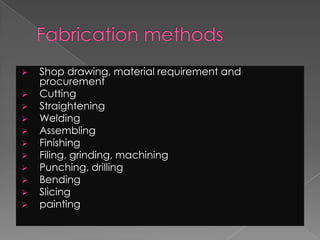
Shop drawing, material requirement and
procurement
Cutting
Straightening
Welding
Assembling
Finishing
Filing, grinding, machining
Punching, drilling
Bending
Slicing
painting
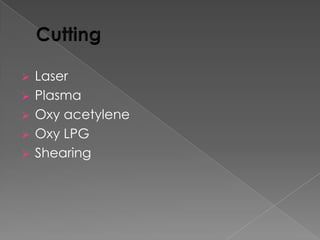
Laser
 Plasma
 Oxy acetylene
 Oxy LPG
 Shearing



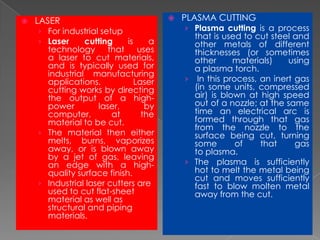
LASER

› For industrial setup
› Laser
cutting
is

a
technology that uses
a laser to cut materials,
and is typically used for
industrial manufacturing
applications.
Laser
cutting works by directing
the output of a highpower
laser,
by
computer,
at
the
material to be cut.
› The material then either
melts, burns, vaporizes
away, or is blown away
by a jet of gas, leaving
an edge with a highquality surface finish.
› Industrial laser cutters are
used to cut flat-sheet
material as well as
structural and piping
materials.



PLASMA CUTTING

› Plasma cutting is a process

that is used to cut steel and
other metals of different
thicknesses (or sometimes
other
materials)
using
a plasma torch.
› In this process, an inert gas
(in some units, compressed
air) is blown at high speed
out of a nozzle; at the same
time an electrical arc is
formed through that gas
from the nozzle to the
surface being cut, turning
some
of
that
gas
to plasma.
› The plasma is sufficiently
hot to melt the metal being
cut and moves sufficiently
fast to blow molten metal
away from the cut.




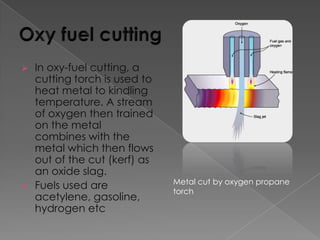
In oxy-fuel cutting, a
cutting torch is used to
heat metal to kindling
temperature. A stream
of oxygen then trained
on the metal
combines with the
metal which then flows
out of the cut (kerf) as
an oxide slag.
Fuels used are
acetylene, gasoline,
hydrogen etc

Metal cut by oxygen propane
torch
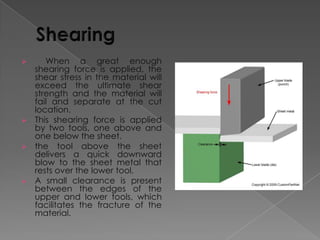
When a great enough
shearing force is applied, the
shear stress in the material will
exceed the ultimate shear
strength and the material will
fail and separate at the cut
location.
 This shearing force is applied
by two tools, one above and
one below the sheet.
 the tool above the sheet
delivers a quick downward
blow to the sheet metal that
rests over the lower tool.
 A small clearance is present
between the edges of the
upper and lower tools, which
facilitates the fracture of the
material.



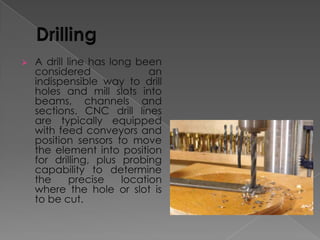
A drill line has long been
considered
an
indispensible way to drill
holes and mill slots into
beams, channels and
sections. CNC drill lines
are typically equipped
with feed conveyors and
position sensors to move
the element into position
for drilling, plus probing
capability to determine
the
precise
location
where the hole or slot is
to be cut.


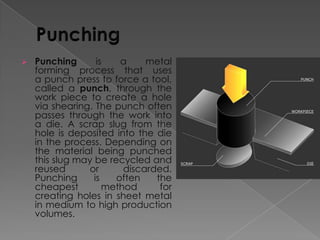
Punching
is
a
metal
forming process that uses
a punch press to force a tool,
called a punch, through the
work piece to create a hole
via shearing. The punch often
passes through the work into
a die. A scrap slug from the
hole is deposited into the die
in the process. Depending on
the material being punched
this slug may be recycled and
reused
or
discarded.
Punching
is
often
the
cheapest
method
for
creating holes in sheet metal
in medium to high production
volumes.


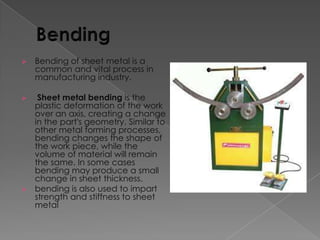
Bending of sheet metal is a
common and vital process in
manufacturing industry.

Sheet metal bending is the
plastic deformation of the work
over an axis, creating a change
in the part's geometry. Similar to
other metal forming processes,
bending changes the shape of
the work piece, while the
volume of material will remain
the same. In some cases
bending may produce a small
change in sheet thickness.
 bending is also used to impart
strength and stiffness to sheet
metal

It forms a protective layer over section
hence enhances the life of element
 It is done due to time lapse between
manufacturing and usage of the element
 MILL SCALE – thin film of rust is formed over
the section which changes the color of
element from metallic to rust
 Two stages of painting are


1. Surface preparation
2. painting



Emery paper
Wire brushing
 Manual

 Machine brushing



Acid pickling
Sand blasting / metal blasting


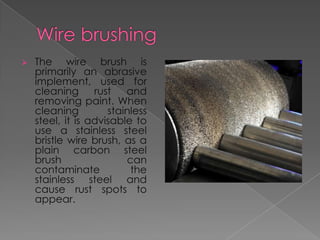
The wire brush is
primarily an abrasive
implement, used for
cleaning
rust
and
removing paint. When
cleaning
stainless
steel, it is advisable to
use a stainless steel
bristle wire brush, as a
plain carbon steel
brush
can
contaminate
the
stainless steel and
cause rust spots to
appear.








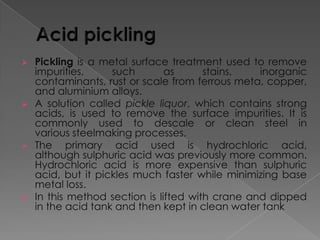
Pickling is a metal surface treatment used to remove
impurities,
such
as
stains,
inorganic
contaminants, rust or scale from ferrous meta, copper,
and aluminium alloys.
A solution called pickle liquor, which contains strong
acids, is used to remove the surface impurities. It is
commonly used to descale or clean steel in
various steelmaking processes.
The primary acid used is hydrochloric acid,
although sulphuric acid was previously more common.
Hydrochloric acid is more expensive than sulphuric
acid, but it pickles much faster while minimizing base
metal loss.
In this method section is lifted with crane and dipped
in the acid tank and then kept in clean water tank
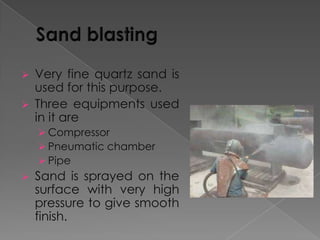
Very fine quartz sand is
used for this purpose.
 Three equipments used
in it are


 Compressor
 Pneumatic chamber
 Pipe


Sand is sprayed on the
surface with very high
pressure to give smooth
finish.









Roller
Brushing
Spraying
Metalizing
Hot dip galvanizing
two layers are applied on surface base
layer and finishing layer
Alcometer is a digital instrument measuring
the paint thickness in microns



Derrick pole
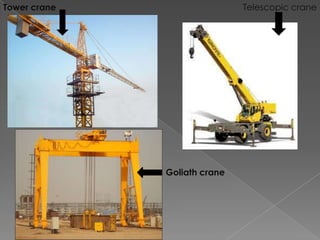
Cranes
 Telescopic

 Towers
 Goliath


Tools
 Pulley
 winches
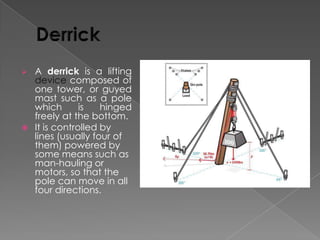
A derrick is a lifting
device composed of
one tower, or guyed
mast such as a pole
which
is
hinged
freely at the bottom.
 It is controlled by
lines (usually four of
them) powered by
some means such as
man-hauling or
motors, so that the
pole can move in all
four directions.

Telescopic crane

Tower crane

Goliath crane



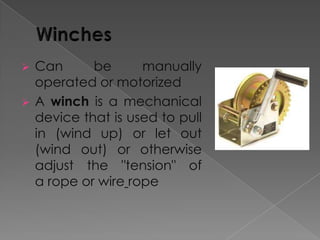
Can
be
manually
operated or motorized
A winch is a mechanical
device that is used to pull
in (wind up) or let out
(wind out) or otherwise
adjust the "tension" of
a rope or wire rope


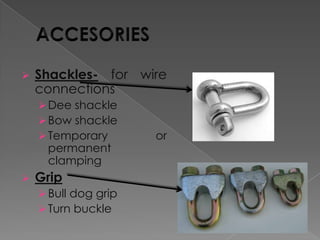
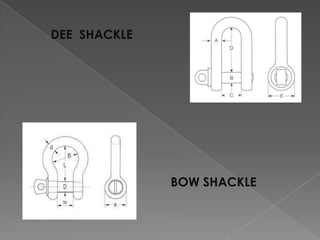
Shackles- for wire
connections
 Dee shackle
 Bow shackle
 Temporary

permanent
clamping



Grip
 Bull dog grip
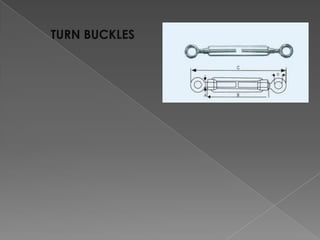
 Turn buckle

or
DEE SHACKLE

BOW SHACKLE
TURN BUCKLES
It is a thin membrane element.
 It has a thin slab.
 Better in corrosive environment.
 Gives better cooling.
 Better fire resistance.

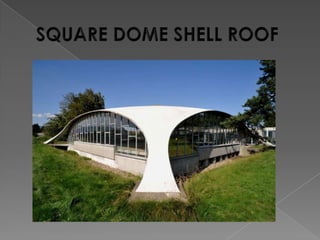
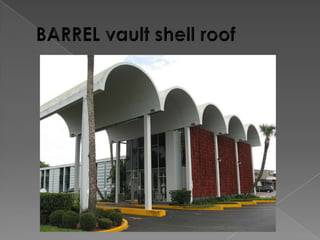
Cylindrical shell
 Trapezoidal shell
 ‘V’ shell
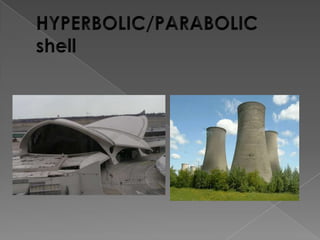
 Hyperbole shell
 Parabolic shell
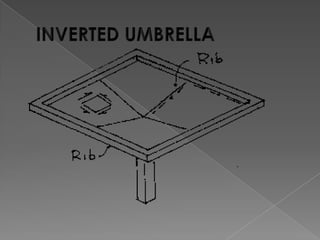
 Hyper/umbrella shell
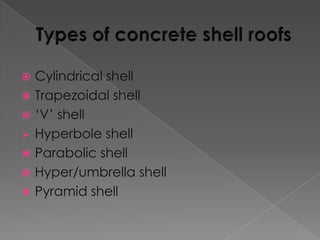
 Pyramid shell

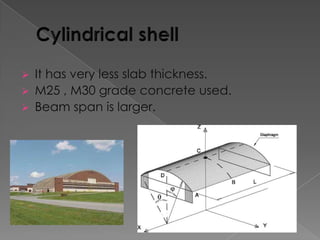
It has very less slab thickness.
 M25 , M30 grade concrete used.
 Beam span is larger.

Construction technology 3

Construction technology 3

  • 1.
  • 2.
               Shop drawing, materialrequirement and procurement Cutting Straightening Welding Assembling Finishing Filing, grinding, machining Punching, drilling Bending Slicing painting
  • 3.
    Laser  Plasma  Oxyacetylene  Oxy LPG  Shearing 
  • 4.
     LASER › For industrialsetup › Laser cutting is a technology that uses a laser to cut materials, and is typically used for industrial manufacturing applications. Laser cutting works by directing the output of a highpower laser, by computer, at the material to be cut. › The material then either melts, burns, vaporizes away, or is blown away by a jet of gas, leaving an edge with a highquality surface finish. › Industrial laser cutters are used to cut flat-sheet material as well as structural and piping materials.  PLASMA CUTTING › Plasma cutting is a process that is used to cut steel and other metals of different thicknesses (or sometimes other materials) using a plasma torch. › In this process, an inert gas (in some units, compressed air) is blown at high speed out of a nozzle; at the same time an electrical arc is formed through that gas from the nozzle to the surface being cut, turning some of that gas to plasma. › The plasma is sufficiently hot to melt the metal being cut and moves sufficiently fast to blow molten metal away from the cut.
  • 5.
      In oxy-fuel cutting,a cutting torch is used to heat metal to kindling temperature. A stream of oxygen then trained on the metal combines with the metal which then flows out of the cut (kerf) as an oxide slag. Fuels used are acetylene, gasoline, hydrogen etc Metal cut by oxygen propane torch
  • 6.
    When a greatenough shearing force is applied, the shear stress in the material will exceed the ultimate shear strength and the material will fail and separate at the cut location.  This shearing force is applied by two tools, one above and one below the sheet.  the tool above the sheet delivers a quick downward blow to the sheet metal that rests over the lower tool.  A small clearance is present between the edges of the upper and lower tools, which facilitates the fracture of the material. 
  • 7.
     A drill linehas long been considered an indispensible way to drill holes and mill slots into beams, channels and sections. CNC drill lines are typically equipped with feed conveyors and position sensors to move the element into position for drilling, plus probing capability to determine the precise location where the hole or slot is to be cut.
  • 8.
     Punching is a metal forming process thatuses a punch press to force a tool, called a punch, through the work piece to create a hole via shearing. The punch often passes through the work into a die. A scrap slug from the hole is deposited into the die in the process. Depending on the material being punched this slug may be recycled and reused or discarded. Punching is often the cheapest method for creating holes in sheet metal in medium to high production volumes.
  • 9.
     Bending of sheetmetal is a common and vital process in manufacturing industry. Sheet metal bending is the plastic deformation of the work over an axis, creating a change in the part's geometry. Similar to other metal forming processes, bending changes the shape of the work piece, while the volume of material will remain the same. In some cases bending may produce a small change in sheet thickness.  bending is also used to impart strength and stiffness to sheet metal 
  • 10.
    It forms aprotective layer over section hence enhances the life of element  It is done due to time lapse between manufacturing and usage of the element  MILL SCALE – thin film of rust is formed over the section which changes the color of element from metallic to rust  Two stages of painting are  1. Surface preparation 2. painting
  • 11.
      Emery paper Wire brushing Manual  Machine brushing   Acid pickling Sand blasting / metal blasting
  • 12.
     The wire brushis primarily an abrasive implement, used for cleaning rust and removing paint. When cleaning stainless steel, it is advisable to use a stainless steel bristle wire brush, as a plain carbon steel brush can contaminate the stainless steel and cause rust spots to appear.
  • 13.
        Pickling is ametal surface treatment used to remove impurities, such as stains, inorganic contaminants, rust or scale from ferrous meta, copper, and aluminium alloys. A solution called pickle liquor, which contains strong acids, is used to remove the surface impurities. It is commonly used to descale or clean steel in various steelmaking processes. The primary acid used is hydrochloric acid, although sulphuric acid was previously more common. Hydrochloric acid is more expensive than sulphuric acid, but it pickles much faster while minimizing base metal loss. In this method section is lifted with crane and dipped in the acid tank and then kept in clean water tank
  • 14.
    Very fine quartzsand is used for this purpose.  Three equipments used in it are   Compressor  Pneumatic chamber  Pipe  Sand is sprayed on the surface with very high pressure to give smooth finish.
  • 15.
           Roller Brushing Spraying Metalizing Hot dip galvanizing twolayers are applied on surface base layer and finishing layer Alcometer is a digital instrument measuring the paint thickness in microns
  • 16.
      Derrick pole Cranes  Telescopic Towers  Goliath  Tools  Pulley  winches
  • 17.
    A derrick isa lifting device composed of one tower, or guyed mast such as a pole which is hinged freely at the bottom.  It is controlled by lines (usually four of them) powered by some means such as man-hauling or motors, so that the pole can move in all four directions. 
  • 18.
  • 19.
      Can be manually operated or motorized Awinch is a mechanical device that is used to pull in (wind up) or let out (wind out) or otherwise adjust the "tension" of a rope or wire rope
  • 20.
     Shackles- for wire connections Dee shackle  Bow shackle  Temporary permanent clamping  Grip  Bull dog grip  Turn buckle or
  • 21.
  • 22.
  • 24.
    It is athin membrane element.  It has a thin slab.  Better in corrosive environment.  Gives better cooling.  Better fire resistance. 
  • 25.
    Cylindrical shell  Trapezoidalshell  ‘V’ shell  Hyperbole shell  Parabolic shell  Hyper/umbrella shell  Pyramid shell 
  • 26.
    It has veryless slab thickness.  M25 , M30 grade concrete used.  Beam span is larger. 