Construction of a Quadcopter
B.Tech
Aerospace Engineering
Semester (5)
Practical Evaluation-1
Faculty Guide:
Mr. Sarath Raj
Quadcopter Technology
By:
Michael Bseliss
Index
• Introduction
• Components of a Quadcopter
• Quadcopter Flight Control
• Applications of Quadcopters
• Advantages & Disadvantages
• Conclusion
Introduction
What is Quadcopter ?!
A quadcopter or a quadrotor helicopter is a multirotor copter that is
lifted and propelled by four rotors.
A quadcopter uses 2 sets of identical fixed pitched propellers; 2
clockwise (CW) or in one direction and 2 counter-clockwise (CCW)
or opposite direction
What is Quadcopter ?!
Quadrotor’s all four rotors work together to produce upward thrust
and only 1/4 of the weight is lifted by each rotor. So less powerful
motors are used, making it cost efficient.
What is Quadcopter ?!
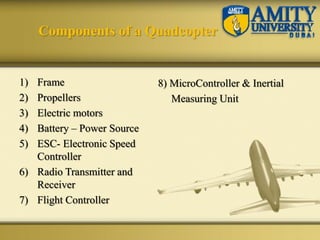
1) Frame
2) Propellers
3) Electric motors
4) Battery – Power Source
5) ESC- Electronic Speed
Controller
6) Radio Transmitter and
Receiver
7) Flight Controller
Components of a Quadcopter
8) MicroController & Inertial
Measuring Unit
Components of a Quadcopter
The Frame
Components of a Quadcopter
The structure that holds or houses all the components together. They
are designed to be strong and lightweight.
Weight
Size
Materials used
The Frame
It consists of 3 parts :
• The center plate where the electronics are mounted
• Four arms mounted to the center plate
• Four motor brackets connecting the motors to the end of the arms
Components of a Quadcopter
The Frame
Components of a Quadcopter
The Frame
Frames are usually made of:
• Carbon Fiber.
• Aluminum.
• Wood/ Plywood /MDF (Medium-density fiberboard)
4 propellers, 2 “normal” CCW , 2 “pusher” CW
Components of a Quadcopter
The Propellers
They are a bit similar to normal DC motors in the way that coils and
magnets are used to drive the shaft
Components of a Quadcopter
Electric Motors
LiPo (Lithium Polymer) batteries are used because it is light. NiMH
(Nickel Metal Hydride) is also possible. Cheaper but heavier.
Components of a Quadcopter
Battery – Power Source
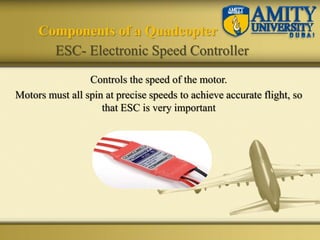
Controls the speed of the motor.
Motors must all spin at precise speeds to achieve accurate flight, so
that ESC is very important
Components of a Quadcopter
ESC- Electronic Speed Controller
Four channels for a basic quadcopter is required
Components of a Quadcopter
Radio Transmitter and Receiver
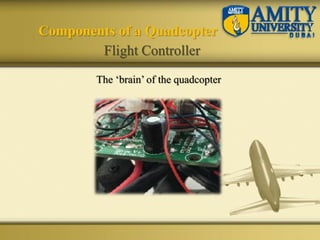
The ‘brain’ of the quadcopter
Components of a Quadcopter
Flight Controller
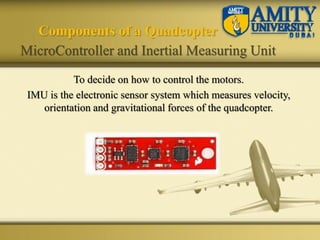
To decide on how to control the motors.
IMU is the electronic sensor system which measures velocity,
orientation and gravitational forces of the quadcopter.
Components of a Quadcopter
MicroController and Inertial Measuring Unit
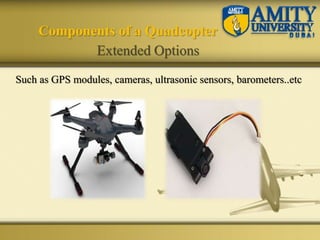
Such as GPS modules, cameras, ultrasonic sensors, barometers..etc
Components of a Quadcopter
Extended Options
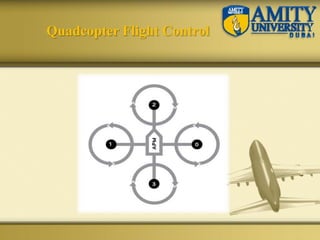
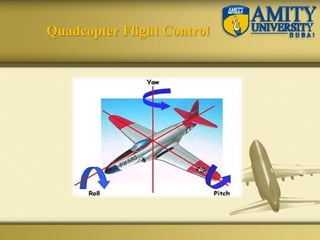
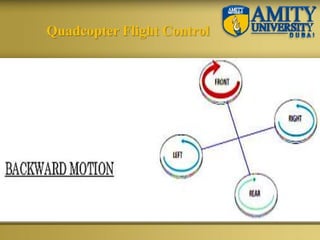
Quadcopter Flight Control
Applications of Quadcopters
3-D Mapping
Search and Rescue
Farming & Monitoring
Environmental Conditions
Capturing photos for events
(sport match)
Inspection of Building &
Monitoring Construction
Projects
Advantages of Quadcopters
 Four small rotors have smaller
diameter than one large
helicopter rotor.
 Takes less damage to rotors.
 No need for a tail rotor which
generates no lift.
 Easier to build four small blades
compared to large one.
 They can traverse through
difficult terrains because of
their small size and there is less
risk of damage too.
 They are significantly cheaper
and the cost in fuel and
maintenance is way lower than
regular airplanes.
Disadvantages of Quadcopters
 Drones also contain limitations.
For instance, they cannot
communicate with civilians for
more detailed intelligence.
 According to civilians drones
are viewed as an invasion force.
 Battery power may be restricted
and may require frequent
charging.
 The worst scenario is when
drones or a fleet of drones have
been commandeered or taken
control by the enemy.
Conclusion
Q & A
Thank You !!

Construction of Quadcopter

  • 1.
    Construction of aQuadcopter B.Tech Aerospace Engineering Semester (5) Practical Evaluation-1 Faculty Guide: Mr. Sarath Raj Quadcopter Technology By: Michael Bseliss
  • 2.
    Index • Introduction • Componentsof a Quadcopter • Quadcopter Flight Control • Applications of Quadcopters • Advantages & Disadvantages • Conclusion
  • 3.
  • 4.
    What is Quadcopter?! A quadcopter or a quadrotor helicopter is a multirotor copter that is lifted and propelled by four rotors.
  • 5.
    A quadcopter uses2 sets of identical fixed pitched propellers; 2 clockwise (CW) or in one direction and 2 counter-clockwise (CCW) or opposite direction What is Quadcopter ?!
  • 6.
    Quadrotor’s all fourrotors work together to produce upward thrust and only 1/4 of the weight is lifted by each rotor. So less powerful motors are used, making it cost efficient. What is Quadcopter ?!
  • 7.
    1) Frame 2) Propellers 3)Electric motors 4) Battery – Power Source 5) ESC- Electronic Speed Controller 6) Radio Transmitter and Receiver 7) Flight Controller Components of a Quadcopter 8) MicroController & Inertial Measuring Unit
  • 8.
    Components of aQuadcopter The Frame
  • 9.
    Components of aQuadcopter The structure that holds or houses all the components together. They are designed to be strong and lightweight. Weight Size Materials used The Frame
  • 10.
    It consists of3 parts : • The center plate where the electronics are mounted • Four arms mounted to the center plate • Four motor brackets connecting the motors to the end of the arms Components of a Quadcopter The Frame
  • 11.
    Components of aQuadcopter The Frame Frames are usually made of: • Carbon Fiber. • Aluminum. • Wood/ Plywood /MDF (Medium-density fiberboard)
  • 12.
    4 propellers, 2“normal” CCW , 2 “pusher” CW Components of a Quadcopter The Propellers
  • 13.
    They are abit similar to normal DC motors in the way that coils and magnets are used to drive the shaft Components of a Quadcopter Electric Motors
  • 14.
    LiPo (Lithium Polymer)batteries are used because it is light. NiMH (Nickel Metal Hydride) is also possible. Cheaper but heavier. Components of a Quadcopter Battery – Power Source
  • 15.
    Controls the speedof the motor. Motors must all spin at precise speeds to achieve accurate flight, so that ESC is very important Components of a Quadcopter ESC- Electronic Speed Controller
  • 16.
    Four channels fora basic quadcopter is required Components of a Quadcopter Radio Transmitter and Receiver
  • 17.
    The ‘brain’ ofthe quadcopter Components of a Quadcopter Flight Controller
  • 18.
    To decide onhow to control the motors. IMU is the electronic sensor system which measures velocity, orientation and gravitational forces of the quadcopter. Components of a Quadcopter MicroController and Inertial Measuring Unit
  • 19.
    Such as GPSmodules, cameras, ultrasonic sensors, barometers..etc Components of a Quadcopter Extended Options
  • 20.
  • 21.
  • 22.
  • 23.
  • 24.
  • 25.
  • 26.
  • 27.
  • 28.
    Applications of Quadcopters 3-DMapping Search and Rescue Farming & Monitoring Environmental Conditions Capturing photos for events (sport match) Inspection of Building & Monitoring Construction Projects
  • 29.
    Advantages of Quadcopters Four small rotors have smaller diameter than one large helicopter rotor.  Takes less damage to rotors.  No need for a tail rotor which generates no lift.  Easier to build four small blades compared to large one.  They can traverse through difficult terrains because of their small size and there is less risk of damage too.  They are significantly cheaper and the cost in fuel and maintenance is way lower than regular airplanes.
  • 30.
    Disadvantages of Quadcopters Drones also contain limitations. For instance, they cannot communicate with civilians for more detailed intelligence.  According to civilians drones are viewed as an invasion force.  Battery power may be restricted and may require frequent charging.  The worst scenario is when drones or a fleet of drones have been commandeered or taken control by the enemy.
  • 31.
  • 32.
  • 33.