W. K. Amila Gayan B.Sc.(Hons) in QS, A.I.Q.S.SL, MACostE
Introduction
Literature Review
Omissions in FIDIC Types of Contracts
Breach of Contract & Remedies
Case Review
Civil law jurisdictions
Conclusion
Q & A
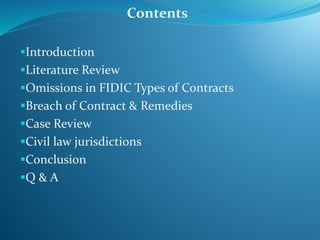
Contents
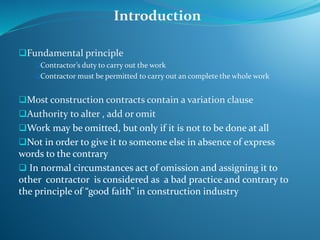
Fundamental principle
Contractor’s duty to carry out the work
Contractor must be permitted to carry out an complete the whole work
Most construction contracts contain a variation clause
Authority to alter , add or omit
Work may be omitted, but only if it is not to be done at all
Not in order to give it to someone else in absence of express
words to the contrary
 In normal circumstances act of omission and assigning it to
other contractor is considered as a bad practice and contrary to
the principle of “good faith” in construction industry
Introduction
Literature Review
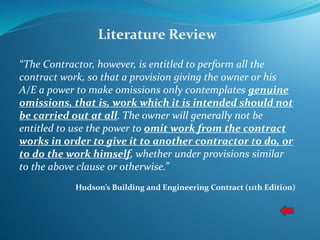
“The Contractor, however, is entitled to perform all the
contract work, so that a provision giving the owner or his
A/E a power to make omissions only contemplates genuine
omissions, that is, work which it is intended should not
be carried out at all. The owner will generally not be
entitled to use the power to omit work from the contract
works in order to give it to another contractor to do, or
to do the work himself, whether under provisions similar
to the above clause or otherwise.”
Hudson’s Building and Engineering Contract (11th Edition)
“The Contract usually gives the Employer or the Architect
power to order part of the work to be omitted with the
consequent adjustment of the contract price. There is little
English authority dealing with the exercise of such a power.
On the construction of the Contract it may not extend to
the ordering of variations, and it may not give the
Employer the right to omit part of the work from the
Contract with the object of giving it or similar work in
substitution to another Contractor.”
Keating on Building Contracts
Literature Review
“Under normal circumstances, and in the absence of
express words to the contrary, the employer cannot
omit work from the contract specifically to give it to
another contractor. If it did so it would be in breach of
contract and the contractor would be entitled to
recover its loss of profit on the omitted work as part of
its action of breach”. (D. Brayan Mogan,2005)
Literature Review
Clause 51, FIDIC Conditions of Contract for Works of
Civil Engineering Construction, Fourth Edition, 1987
“The Engineer shall make any variation of the form, quality or quantity of the
Works or any part thereof that may, in his opinion, be necessary and for that
purpose, or if for any other reason it shall, in his opinion, be appropriate, he
shall have the authority to instruct the Contractor to do and the Contractor
shall do any of the following:
(b)omit any such work (but not if the omitted work is to be carried out by
the Employer or by another contractor),”
Clause 51, Oman Standard Document for Building and
Civil Engineering Works, Third Edition, 1981 & Fourth
Edition, 1999 (unofficial copy)
“The Engineer shall make any variation of the form, quality or quantity of the
Works or any part thereof that may have been approved by the Employer and
he shall have power to order the Contractor to do and the contractor shall do
any of the following;
b)omit any such work,”
Omission in FIDIC Types of Contracts
Clause 13, FIDIC Conditions of Contract for Construction, First
Edition, 1999
“Variations may be initiated by the Engineer at any time prior to issuing
the Taking-Over Certificate for the Works, either by an instruction or
by a request for the Contractor to submit a proposal.
The Contractor shall execute and be bound by each Variation, unless
the Contractor promptly gives notice to the Engineer stating (with
supporting particulars) that the Contractor cannot readily obtain the
Goods required for the Variation. Upon receiving this notice, the
Engineer shall cancel, confirm or vary the instruction.
Each Variation may include:
(d) omission of any work unless it is to be carried out by others,”
Omission in FIDIC Types of Contracts
Omani Conditions (1981)
Absence of specific provision leaves ambiguities
FIDIC third edition to fourth edition
The Engineer’s authority to instruct the Contractor to omit
works expressly excluded to work to be carried out by the
Employer or by another contractor
Clause 31 – Opportunities for other contractors
“The Contractor shall in accordance with the requirements of the
Engineer, afford all reasonable opportunities for carrying out their work to
any other contractors employed by the Employer and their workmen and
to the workmen of the Employer and of any other duly constituted
authorities who may be employed in the execution on or near the Site of
any work not included in the Contract or of any contract which the
Employer may enter into in connection with or ancillary to the work.”
Omission in FIDIC Types of Contracts
Breach of Contract
Actual Breach –fails to perform obligation
Anticipatory Breach – announce in advance intended non-
performance
Breach does not automatically discharge the contract
Damages and equitable remedies are the basic remedies
Object of damages is usually to put injured party in to
same financial position he would have been had the
contract been properly performed
Remoteness Hadley v Baxendale
Loss flows naturally from the breach
Contemplation of loss by parties at the time the contract was
made as a probable results of the breach
Breach of Contract & Remedies
Measure of Damages
Expectation Damages
business; loss of profit
Reliance Damage
put the innocent party into the position he would have been in had
the contract never been made
Restitution
Mitigation
Liquidated Damages
Genuine pre-estimate of the anticipated loss
Equitable Remedies
Specific Performances
decree by the court to compel a party to perform his contractual
obligations
Injunction
damages would not be an adequate remedy to compensate
Injunctions are court orders compelling or restraining a specific act
Breach of Contract & Remedies
Carr v JA Berriman Pty Limited (1953) 89 CLR 327;
The contract gave the Architect the following power:
"The Architect may in his absolute discretion and from time to time
issue written instructions or written directions in regard to the
omission of any work. The Builder shall forthwith comply with all
Architect's Instructions".
In relation to that clause, the High Court of Australia held
Architect to hand over at will any part of the contractor to another
contractor is not intended by the meaning of the clause
Such power is most unreasonable
Required very clear word to confer
The judge made the reference that if work is omitted from the
contract and given to other then the contractor will be entitled to
claim loss of profit
Case Review
Gallagher v. Hirsch NY App Division 467 (1899)
Additional excavation to support foundation
Contractor submitted estimate
Employer accept other contractor’s estimate
In carrying out additional work it was necessary to carry out a part of
original works
A variation clause was available with power to omit a work
 The question put before the jury
“The employer had no right to take away any part of contractor’s contract
and give it to another with out consent of contractor”
Held
Omission did not mean omitted from plaintiff’s contract
It is omission from the work
Definitely not allowed to take 2/3 of the work and compel to
complete the rest
It is the correct interpretation of the clause in question
Case Review
Amec Building Ltd v Cadmus Investments Co Ltd (1996)
Amec was awarded to construct a shopping centre
Part of food court was under provisional sum
Amec claimed for loss of profit for a provisional sum omitted and
given to other contractor
Amec referred the matter to arbitration
The arbitrator found in favour of Amec and the matter was then
referred to the court by Cadmus
In finding in favour of Amec the judge stated:
“It seems to me that the arbitrator was perfectly correct in deciding that
such an arbitrary withdrawal of work from the provisional sums and the
giving of it to the third party was something for which Amec were
entitled to be compensated and the compensation that he arrived at
namely the loss of the profit having accepted figures put forward to him
in evidence is one which is not open to be impugned on appeal as a
matter of law”.
Case Review
Abbey Developments Ltd v PP Brickwork Ltd (2003) TCC
Construction of number of housing units
Provision of the contract
Abbey’s right to vary the number of housing units
Abbey’s right to re-negotitate rates or suspend the contract
Re-tender the works
Variation clause allowing additions and omissions
Terminate on 7 days notice if failed to comply with contract
Abbey wrote to PP complaining performance
PP disagreed with the complains
PP’s work was limited to current construction
Subsequently terminated the contract
Employed a third party
PP refer the matter to adjudication calling it as repudiatory breach
Adjudicator found in its favor
Abbey disagreed with decision and refer the matter to court
Case Review
Abbey Developments Ltd v PP Brickwork Ltd (2003) TCC contd…
Verdict
The court decided that variation clause in itself was not sufficient to
confer upon Abbey the right to take away work from PP in order to
carried out by other contractor even if Abbey had a bona fide
dissatisfaction with PP’s performance
Abbey’s right to omit work was limited to the omission of work that
was no longer required for the project
Judge made the reference to Hudson on Building Contracts (11th
edition)
Abbey did not rely upon provision of suspension and re-tender works
Attempted to terminate the contract before notice period expires
Express wording can be drafted to permit effectively omit the work
and give it to others
Great care must be taken to rely on such provision and not to abuse it
Case Review
Multiplex Construction (UK) Limited v Cleveland Bridge UK
Limited and Cleveland Bridge Dorman Long Engineering Limited
[2008] TCC.
Multiplex are the main contractor who constructed the new National
Stadium at Wembley.
CB were the steelwork sub-contactor.
A substantial portion of work was omitted from CB and given to other
contractor.
It was held that “A variation clause entitles the employer to omit work
which he no longer requires. Absent specific provision to that effect, a
variation clause does not entitle the employer to omit work for the
purpose of giving it to another contractor”.
Case Review
Some countries have specified loss of profits claim in
their legislation
Direct claim
French Civil Code
“Damages due to a creditor are, as a rule, for loss which
he has suffered and the profit which he has been
deprived of….”
“Even in the case where the non-performance of the
agreement is due to the debtor’s intentional breach,
damages may include, with respect to the loss suffered
by the creditor and the profit which he has been
deprived , only what is an immediate and direct
consequences of non-performance of agreement”
If omission of work is legitimate claim
Contractor is clearly able to recover loss of profit as a
part of his overall damage for claim
Civil Law Jurisdictions
The contractor should have opportunity to perform the
whole of the contracted work subject to authorized
variations of the Employer/Engineer.
 Generally, a work in a contract cannot be omitted for the
purpose of assigned it to another contractor unless
otherwise expressed provisions are written in the contract
to the contrary.
If such omission and assigning authority is not clearly
mentioned in the Contract, the Contractor may have a valid
claim for loss of profit.
Parties are free to agree a term by which work can be
omitted from contractually agreed scope and then give it to
other contractor.
Such clause should be drafted in clear words and it may
contain the entitlement of loss profit to the contractor.
Conclusion
Q & A
Thank You!

Can a work in a contract be omitted

  • 1.
    W. K. AmilaGayan B.Sc.(Hons) in QS, A.I.Q.S.SL, MACostE
  • 2.
    Introduction Literature Review Omissions inFIDIC Types of Contracts Breach of Contract & Remedies Case Review Civil law jurisdictions Conclusion Q & A Contents
  • 3.
    Fundamental principle Contractor’s dutyto carry out the work Contractor must be permitted to carry out an complete the whole work Most construction contracts contain a variation clause Authority to alter , add or omit Work may be omitted, but only if it is not to be done at all Not in order to give it to someone else in absence of express words to the contrary  In normal circumstances act of omission and assigning it to other contractor is considered as a bad practice and contrary to the principle of “good faith” in construction industry Introduction
  • 4.
    Literature Review “The Contractor,however, is entitled to perform all the contract work, so that a provision giving the owner or his A/E a power to make omissions only contemplates genuine omissions, that is, work which it is intended should not be carried out at all. The owner will generally not be entitled to use the power to omit work from the contract works in order to give it to another contractor to do, or to do the work himself, whether under provisions similar to the above clause or otherwise.” Hudson’s Building and Engineering Contract (11th Edition)
  • 5.
    “The Contract usuallygives the Employer or the Architect power to order part of the work to be omitted with the consequent adjustment of the contract price. There is little English authority dealing with the exercise of such a power. On the construction of the Contract it may not extend to the ordering of variations, and it may not give the Employer the right to omit part of the work from the Contract with the object of giving it or similar work in substitution to another Contractor.” Keating on Building Contracts Literature Review
  • 6.
    “Under normal circumstances,and in the absence of express words to the contrary, the employer cannot omit work from the contract specifically to give it to another contractor. If it did so it would be in breach of contract and the contractor would be entitled to recover its loss of profit on the omitted work as part of its action of breach”. (D. Brayan Mogan,2005) Literature Review
  • 7.
    Clause 51, FIDICConditions of Contract for Works of Civil Engineering Construction, Fourth Edition, 1987 “The Engineer shall make any variation of the form, quality or quantity of the Works or any part thereof that may, in his opinion, be necessary and for that purpose, or if for any other reason it shall, in his opinion, be appropriate, he shall have the authority to instruct the Contractor to do and the Contractor shall do any of the following: (b)omit any such work (but not if the omitted work is to be carried out by the Employer or by another contractor),” Clause 51, Oman Standard Document for Building and Civil Engineering Works, Third Edition, 1981 & Fourth Edition, 1999 (unofficial copy) “The Engineer shall make any variation of the form, quality or quantity of the Works or any part thereof that may have been approved by the Employer and he shall have power to order the Contractor to do and the contractor shall do any of the following; b)omit any such work,” Omission in FIDIC Types of Contracts
  • 8.
    Clause 13, FIDICConditions of Contract for Construction, First Edition, 1999 “Variations may be initiated by the Engineer at any time prior to issuing the Taking-Over Certificate for the Works, either by an instruction or by a request for the Contractor to submit a proposal. The Contractor shall execute and be bound by each Variation, unless the Contractor promptly gives notice to the Engineer stating (with supporting particulars) that the Contractor cannot readily obtain the Goods required for the Variation. Upon receiving this notice, the Engineer shall cancel, confirm or vary the instruction. Each Variation may include: (d) omission of any work unless it is to be carried out by others,” Omission in FIDIC Types of Contracts
  • 9.
    Omani Conditions (1981) Absenceof specific provision leaves ambiguities FIDIC third edition to fourth edition The Engineer’s authority to instruct the Contractor to omit works expressly excluded to work to be carried out by the Employer or by another contractor Clause 31 – Opportunities for other contractors “The Contractor shall in accordance with the requirements of the Engineer, afford all reasonable opportunities for carrying out their work to any other contractors employed by the Employer and their workmen and to the workmen of the Employer and of any other duly constituted authorities who may be employed in the execution on or near the Site of any work not included in the Contract or of any contract which the Employer may enter into in connection with or ancillary to the work.” Omission in FIDIC Types of Contracts
  • 10.
    Breach of Contract ActualBreach –fails to perform obligation Anticipatory Breach – announce in advance intended non- performance Breach does not automatically discharge the contract Damages and equitable remedies are the basic remedies Object of damages is usually to put injured party in to same financial position he would have been had the contract been properly performed Remoteness Hadley v Baxendale Loss flows naturally from the breach Contemplation of loss by parties at the time the contract was made as a probable results of the breach Breach of Contract & Remedies
  • 11.
    Measure of Damages ExpectationDamages business; loss of profit Reliance Damage put the innocent party into the position he would have been in had the contract never been made Restitution Mitigation Liquidated Damages Genuine pre-estimate of the anticipated loss Equitable Remedies Specific Performances decree by the court to compel a party to perform his contractual obligations Injunction damages would not be an adequate remedy to compensate Injunctions are court orders compelling or restraining a specific act Breach of Contract & Remedies
  • 12.
    Carr v JABerriman Pty Limited (1953) 89 CLR 327; The contract gave the Architect the following power: "The Architect may in his absolute discretion and from time to time issue written instructions or written directions in regard to the omission of any work. The Builder shall forthwith comply with all Architect's Instructions". In relation to that clause, the High Court of Australia held Architect to hand over at will any part of the contractor to another contractor is not intended by the meaning of the clause Such power is most unreasonable Required very clear word to confer The judge made the reference that if work is omitted from the contract and given to other then the contractor will be entitled to claim loss of profit Case Review
  • 13.
    Gallagher v. HirschNY App Division 467 (1899) Additional excavation to support foundation Contractor submitted estimate Employer accept other contractor’s estimate In carrying out additional work it was necessary to carry out a part of original works A variation clause was available with power to omit a work  The question put before the jury “The employer had no right to take away any part of contractor’s contract and give it to another with out consent of contractor” Held Omission did not mean omitted from plaintiff’s contract It is omission from the work Definitely not allowed to take 2/3 of the work and compel to complete the rest It is the correct interpretation of the clause in question Case Review
  • 14.
    Amec Building Ltdv Cadmus Investments Co Ltd (1996) Amec was awarded to construct a shopping centre Part of food court was under provisional sum Amec claimed for loss of profit for a provisional sum omitted and given to other contractor Amec referred the matter to arbitration The arbitrator found in favour of Amec and the matter was then referred to the court by Cadmus In finding in favour of Amec the judge stated: “It seems to me that the arbitrator was perfectly correct in deciding that such an arbitrary withdrawal of work from the provisional sums and the giving of it to the third party was something for which Amec were entitled to be compensated and the compensation that he arrived at namely the loss of the profit having accepted figures put forward to him in evidence is one which is not open to be impugned on appeal as a matter of law”. Case Review
  • 15.
    Abbey Developments Ltdv PP Brickwork Ltd (2003) TCC Construction of number of housing units Provision of the contract Abbey’s right to vary the number of housing units Abbey’s right to re-negotitate rates or suspend the contract Re-tender the works Variation clause allowing additions and omissions Terminate on 7 days notice if failed to comply with contract Abbey wrote to PP complaining performance PP disagreed with the complains PP’s work was limited to current construction Subsequently terminated the contract Employed a third party PP refer the matter to adjudication calling it as repudiatory breach Adjudicator found in its favor Abbey disagreed with decision and refer the matter to court Case Review
  • 16.
    Abbey Developments Ltdv PP Brickwork Ltd (2003) TCC contd… Verdict The court decided that variation clause in itself was not sufficient to confer upon Abbey the right to take away work from PP in order to carried out by other contractor even if Abbey had a bona fide dissatisfaction with PP’s performance Abbey’s right to omit work was limited to the omission of work that was no longer required for the project Judge made the reference to Hudson on Building Contracts (11th edition) Abbey did not rely upon provision of suspension and re-tender works Attempted to terminate the contract before notice period expires Express wording can be drafted to permit effectively omit the work and give it to others Great care must be taken to rely on such provision and not to abuse it Case Review
  • 17.
    Multiplex Construction (UK)Limited v Cleveland Bridge UK Limited and Cleveland Bridge Dorman Long Engineering Limited [2008] TCC. Multiplex are the main contractor who constructed the new National Stadium at Wembley. CB were the steelwork sub-contactor. A substantial portion of work was omitted from CB and given to other contractor. It was held that “A variation clause entitles the employer to omit work which he no longer requires. Absent specific provision to that effect, a variation clause does not entitle the employer to omit work for the purpose of giving it to another contractor”. Case Review
  • 18.
    Some countries havespecified loss of profits claim in their legislation Direct claim French Civil Code “Damages due to a creditor are, as a rule, for loss which he has suffered and the profit which he has been deprived of….” “Even in the case where the non-performance of the agreement is due to the debtor’s intentional breach, damages may include, with respect to the loss suffered by the creditor and the profit which he has been deprived , only what is an immediate and direct consequences of non-performance of agreement” If omission of work is legitimate claim Contractor is clearly able to recover loss of profit as a part of his overall damage for claim Civil Law Jurisdictions
  • 19.
    The contractor shouldhave opportunity to perform the whole of the contracted work subject to authorized variations of the Employer/Engineer.  Generally, a work in a contract cannot be omitted for the purpose of assigned it to another contractor unless otherwise expressed provisions are written in the contract to the contrary. If such omission and assigning authority is not clearly mentioned in the Contract, the Contractor may have a valid claim for loss of profit. Parties are free to agree a term by which work can be omitted from contractually agreed scope and then give it to other contractor. Such clause should be drafted in clear words and it may contain the entitlement of loss profit to the contractor. Conclusion
  • 20.
  • 21.