CONSTRUCTION OCCUPATIONAL
SAFETY AND HEALTH
TOPICS
1) Importance of Construction Safety and Health
2) What are Unsafe Acts and Unsafe Condition
1) Accident
2) Hazards
3) System Control
4) Job-Hazard Analysis
5) Construction Safety & Health Program
IMPORTANCE OF
CONSTRUCTION
SAFETY AND HEALTH
International Labour Organization
Report
 270 Million accidents reported
 350,000 of which are fatal
 160 Million work-related illnesses /
diseases reported
At least 60,000 fatalities occur at
construction sites, around the world,
every year
1 fatal accident occurs every 10 minutes
Around 17% of all fatalities at work (1 in
every 6) are construction fatalities

2,000,000 workers DIE every year

More than 100,000 work fatalities occur
every month

more than 5,000 everyday

4 every minute

Each year, 22,000 children are killed by work
accidents!
98% - preventable
88% - unsafe / unhealthy
ACTS
10% - unsafe/unhealthy
CONDITIONS
2% - non-preventable
With a highly mobile population of
workers and different contractors
working on dangerous construction
sites at the same time,
CONSTRUCTION continues to be a
major cause of death and
disabilities.
Type of Worker
Month of
Occurrence
Time of
Accident
I
C
E
B
E
R
G
Direct
Costs
Indirect
Costs
T
H
E
O
R
Y
Direct Cost of Accidents
• Medical Expenses
• Equipment Damage
• Wasted Raw Materials
• Insurance Premiums
• Litigation Expenses
1 Injured Workers
 Lesser productivity due to interruption on day of injury
 Loss in efficiency
 Loss of income
2 Other Employees
 loss productivity due to:
 work stoppage out of curiosity
 when assisting injured worker
 due to inspection
 Loss in efficiency out of sympathy to the injured
 Additional cost due to completion of added work
3. Supervisors
 lost productivity :
 when assisting the injured
 due to accident investigation
 in preparing reports
 during inspection
4. Replacement worker
 hiring or training
5. Equipment
 downtime
Indirect Cost of Accidents
UNSAFE ACTS –
UNSAFE CONDITIONS
WHAT IS AN ACCIDENT?

damage

injury

loss or
death
An occurrence or
event
that is:
- unexpected,
- unforeseen,
- unplanned and
- unwanted
8
Hazard + Exposure = Accident or Illness
HAZARDSSafety hazards
Health hazards
Direct contact -
injury
Exposure
- illness
SOURCE
We can
eliminate/avoid
/minimized
accident
Using this
formula
Environmental Hazards
in Construction
Chemical
Physical
Biological Social
Ergonomics
9
Noise
Illumination
Vibration
Pressure
Temperature
Ventilation
Virus
Bacteria
Fungi
Enzymes
Lost of income
Unproductive
Discouraged
Inferiority
isolation
Organic Solvent
Heavy metals
Gases
Acids
Dusts
Improper positioning
Improper lifting
Repeated Motion
Awkward position
(Fit the task to the worker)
Factors Contributing to Unsafe Acts
• Improper Attitude
• Physical Limitations
• Lack of Knowledge
or Skills
10
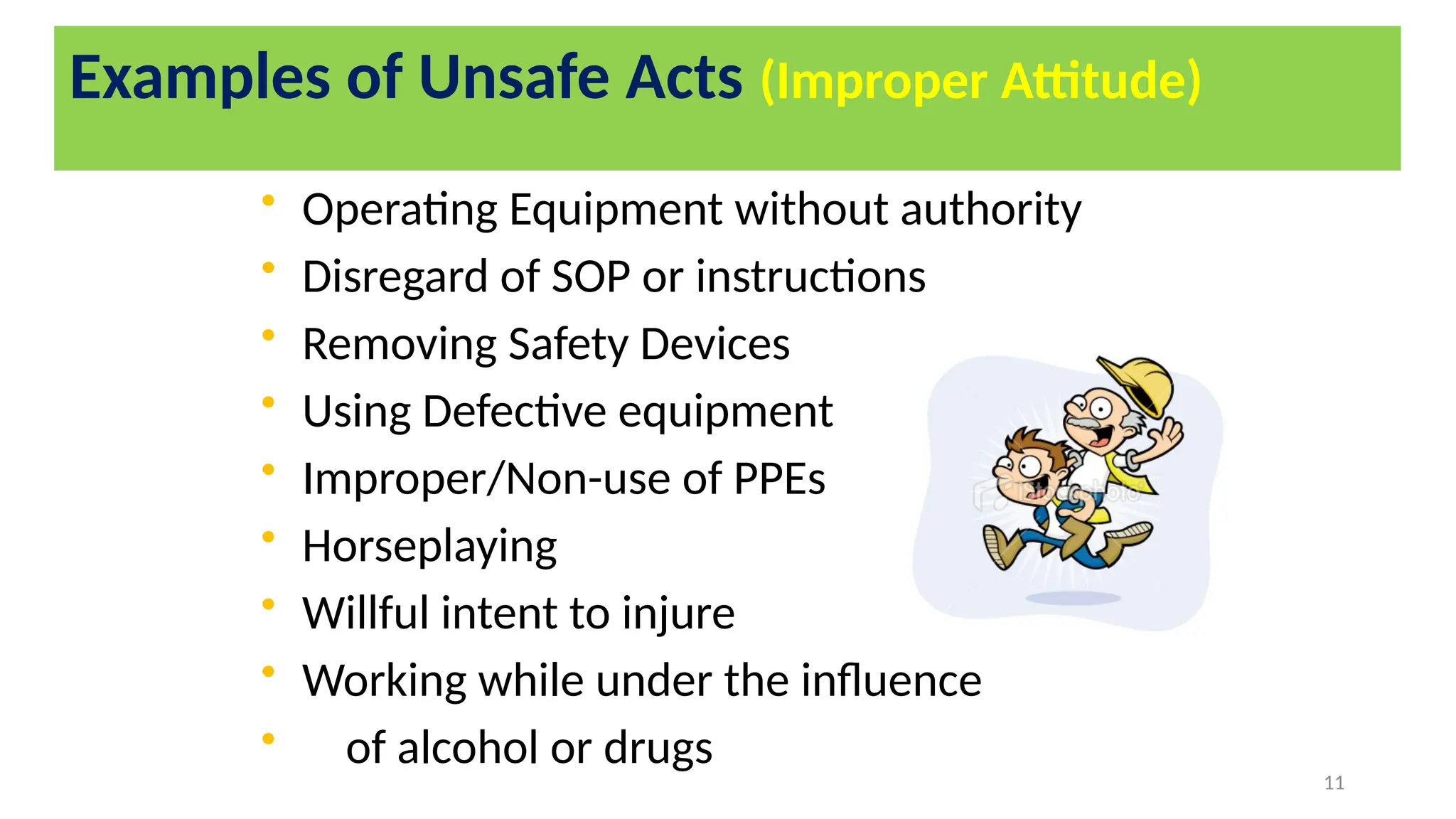
• Operating Equipment without authority
• Disregard of SOP or instructions
• Removing Safety Devices
• Using Defective equipment
• Improper/Non-use of PPEs
• Horseplaying
• Willful intent to injure
• Working while under the influence
• of alcohol or drugs
Examples of Unsafe Acts (Improper Attitude)
11
Physical Limitations
• Defective eyesight
• Muscular weakness due to fatigue
• Impaired hearing
• Short in Height
• Too tall in height
• Slow reactions
Slide 12
Lack of Knowledge or Skill
• Failure to understand instruction
• Unaware of safe practices
• Unconvinced of safe practices
• Unskilled or unpracticed
Slide 13
Examples of Unsafe Conditions
• Inadequate guards/protection
• Defective tools, equipment
• Congestion
• Inadequate warning systems
• Fire and explosion hazards
• Slippery floors
• Hazardous atmospheric condition
• Excessive noise
• Radiation exposure
• Inadequate illumination/ ventilation
14
System of Controls
Slide 15
• Point of contact:
• Personal Protective
Equipment
receiver
• Administrative Control :
• Exposure time limitations,
Safe work practices
• Signs and signage, Training
and Education
• Exposure time limitations,
Safe work practices
• Signs and signage, Training
and Education
path
• PRE-CONTACT
• Engineering Control:
• Elimination
• Minimization
• Enclosure of the Hazard
source
DIMENSION
S  L^2/2000
Where:
S & L= expressed in
the same unit of
measurement
S = Area of Safety
Sign
L = Distance of
Observation
ADMINISTRATIVE CONTROLS
3-Panel
SIGNBOARDS
 Signal Word
 Message
 Symbol
COLOR CODE
SAFETY RED
SAFETY GREEN
SAFETY WHITE
SAFETY YELLOW
SAFETY ORANGE
SAFETY BLUE
SAFETY PURPLE
CAUTION
RADIATION
PRECAUTION
ALERT
TRAFFIC
SAFETY
DANGER
TOOLBOX Meeting
Good Housekeeping
ENGINEERING CONTROLS
Shoring
requirement to
above 1m depth
excavation
Adherence to
construction
methodology
standards
Use of guardrails
of 1m & a toe
board of 0.15m.
Appropriateness of
tools and
equipment used.
Use of tubular or H-
frame as scaffolds
for above 6m height.
Use of fall arrest
system for above
10m height
 Cut the slope at a safe angle (H:V)
Prevention of Soil Collapse
v
h
• Type B - 1:1 or 45°
• Type C - 1½ :1 or 34°
• Type A - 3/4:1 or 53°
19
Ingress and Egress
(Ladder)
v
h
50 feet (max)
20
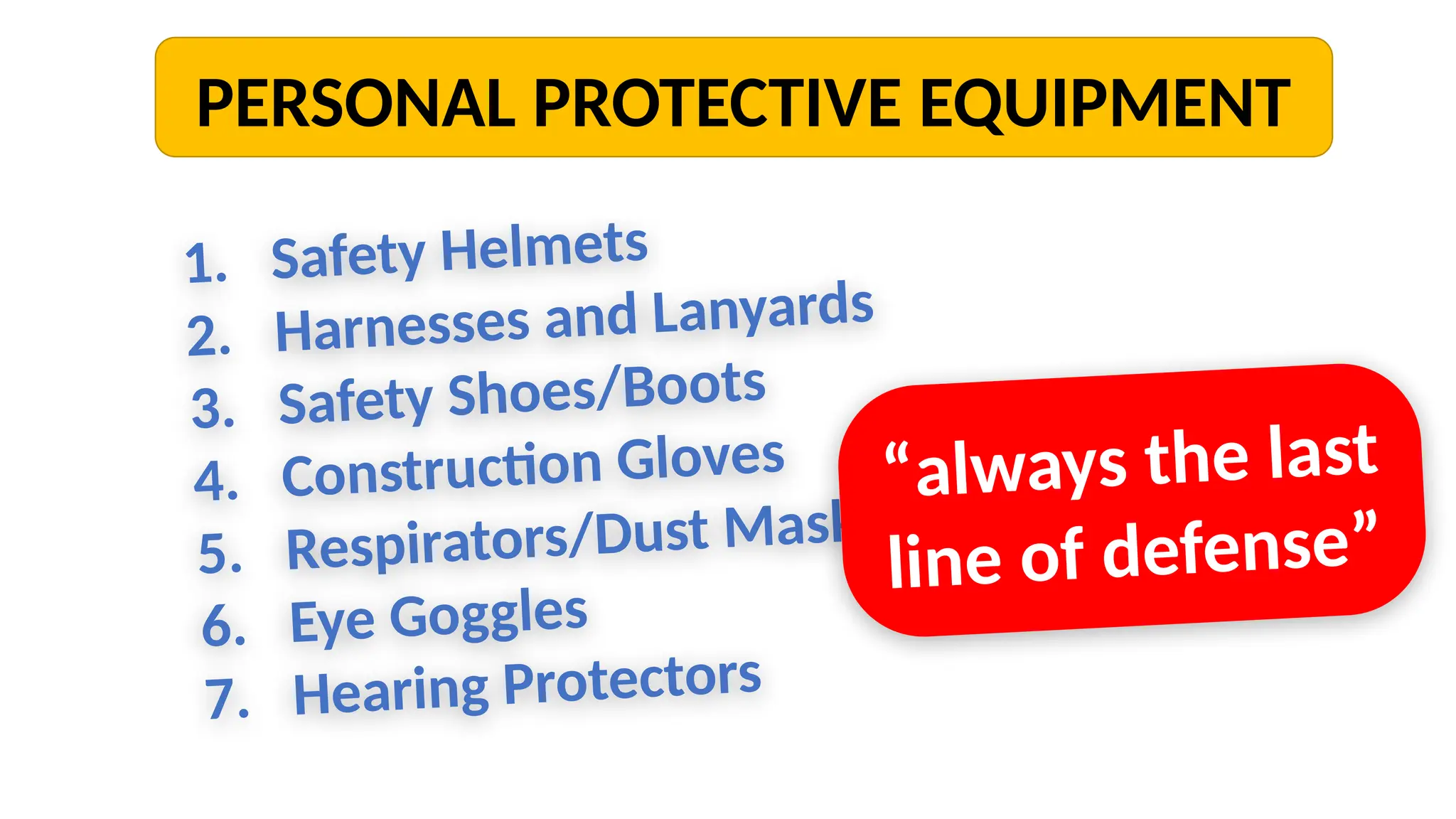
PERSONAL PROTECTIVE EQUIPMENT
1. Safety Helmets
2. Harnesses and Lanyards
3. Safety Shoes/Boots
4. Construction Gloves
5. Respirators/Dust Mask
6. Eye Goggles
7. Hearing Protectors
“always the last
line of defense”
Scope Specific Task Potential hazard Corrective measures
1. Site works - Excavation for footing Open pit - Falling Barricade & warning signs installation
2. Reinforcing Bar
Fabrication &
Installation
- Bar cutting/bending Steel bars - Cut &
bruise
Wearing of leather gloves, good
housekeeping, safety helmet, and caution
signs
3. Concrete Works - Concrete mixing Cement, aggregate -
Dust exposure
Wearing of dust-mask, safety gloves &
construction boots
4. Formworks &
Scaffoldings
- Installation of forms Tools, lumber - Cut
& bruise, bump
Conditioned tools, wearing of leather gloves
& safety helmet.
5. Masonry Works - Placing of CHB Handling –
Ergonomic
Caution sign installation & proper
posture/handling, wearing of construction
gloves, mask & helmet
6. Roofing Works - GI Sheet covering Elevated
-Falling/sliding,
bruise/cut
Wearing of Full Body Harness, safety gloves,
safety shoes.
JOB-HAZARD ANALYSIS (sample)
Construction Safety & Health Program
1. Statement of Commitment to Comply with
OSH Requirements
2. Safety Policy
3. Project Details
4. Construction Safety Committee & Duties
5. Emergency Occupational Health Personnel
and Facilities
6. Safety & Health Promotion & Education.
7. Toolbox Meeting
8. Accident/Incident/Illness Investigation &
Reporting
9. Personal Protective Equipment
10. Protection of the General Public
11. Safety Signage
12. Construction Workers Skills Certification
13. Testing & Inspection of Construction Heavy
Equipment
14. Control Measures on Construction Activities
15. First-Aid, health Care medicines and
Equipment Facilities
16. Workers Welfare Facilities
17. Medical Surveillance
18. Working Hour & Break Time
19. Construction Waste Disposal
20. Emergency Preparedness
21. Penalties/Sanctions
22. Attachments
CSHP
Safety
tips
• Your safety is your personal responsibility.
• Always follow the correct procedures.
• Never take shortcuts.
• Take responsibility and clean up if you made a mess.
• Clean and organize your workspace.
• Ensure a clear and easy route to emergency exits and equipment.
• Be alert and awake on the job.
• Be attentive at all times to your work surroundings.
• When in doubt, contact your supervisor or manager for instruction, guidance, or training.
• Never take risks when it comes to safety.
• Obey safety signs, stickers, and tags.
• Take short breaks when you keep up a repetitive motion for a long period of time, and sit,
stand, or walk with good posture.
• Report serious injuries immediately to a supervisor and get emergency assistance.
• Keep things in perspective. Hazards may be limitless, so focus on the most likely risks first.
THANK YOU!!!
“What is not
written cannot
be done”
If we FAIL to plan,we plan to
fail”

Construction Safety power point presentation

  • 1.
  • 2.
    TOPICS 1) Importance ofConstruction Safety and Health 2) What are Unsafe Acts and Unsafe Condition 1) Accident 2) Hazards 3) System Control 4) Job-Hazard Analysis 5) Construction Safety & Health Program
  • 3.
  • 4.
    International Labour Organization Report 270 Million accidents reported  350,000 of which are fatal  160 Million work-related illnesses / diseases reported At least 60,000 fatalities occur at construction sites, around the world, every year 1 fatal accident occurs every 10 minutes Around 17% of all fatalities at work (1 in every 6) are construction fatalities  2,000,000 workers DIE every year  More than 100,000 work fatalities occur every month  more than 5,000 everyday  4 every minute  Each year, 22,000 children are killed by work accidents! 98% - preventable 88% - unsafe / unhealthy ACTS 10% - unsafe/unhealthy CONDITIONS 2% - non-preventable With a highly mobile population of workers and different contractors working on dangerous construction sites at the same time, CONSTRUCTION continues to be a major cause of death and disabilities.
  • 5.
    Type of Worker Monthof Occurrence Time of Accident
  • 6.
    I C E B E R G Direct Costs Indirect Costs T H E O R Y Direct Cost ofAccidents • Medical Expenses • Equipment Damage • Wasted Raw Materials • Insurance Premiums • Litigation Expenses 1 Injured Workers  Lesser productivity due to interruption on day of injury  Loss in efficiency  Loss of income 2 Other Employees  loss productivity due to:  work stoppage out of curiosity  when assisting injured worker  due to inspection  Loss in efficiency out of sympathy to the injured  Additional cost due to completion of added work 3. Supervisors  lost productivity :  when assisting the injured  due to accident investigation  in preparing reports  during inspection 4. Replacement worker  hiring or training 5. Equipment  downtime Indirect Cost of Accidents
  • 7.
  • 8.
    WHAT IS ANACCIDENT?  damage  injury  loss or death An occurrence or event that is: - unexpected, - unforeseen, - unplanned and - unwanted 8 Hazard + Exposure = Accident or Illness HAZARDSSafety hazards Health hazards Direct contact - injury Exposure - illness SOURCE We can eliminate/avoid /minimized accident Using this formula
  • 9.
    Environmental Hazards in Construction Chemical Physical BiologicalSocial Ergonomics 9 Noise Illumination Vibration Pressure Temperature Ventilation Virus Bacteria Fungi Enzymes Lost of income Unproductive Discouraged Inferiority isolation Organic Solvent Heavy metals Gases Acids Dusts Improper positioning Improper lifting Repeated Motion Awkward position (Fit the task to the worker)
  • 10.
    Factors Contributing toUnsafe Acts • Improper Attitude • Physical Limitations • Lack of Knowledge or Skills 10
  • 11.
    • Operating Equipmentwithout authority • Disregard of SOP or instructions • Removing Safety Devices • Using Defective equipment • Improper/Non-use of PPEs • Horseplaying • Willful intent to injure • Working while under the influence • of alcohol or drugs Examples of Unsafe Acts (Improper Attitude) 11
  • 12.
    Physical Limitations • Defectiveeyesight • Muscular weakness due to fatigue • Impaired hearing • Short in Height • Too tall in height • Slow reactions Slide 12
  • 13.
    Lack of Knowledgeor Skill • Failure to understand instruction • Unaware of safe practices • Unconvinced of safe practices • Unskilled or unpracticed Slide 13
  • 14.
    Examples of UnsafeConditions • Inadequate guards/protection • Defective tools, equipment • Congestion • Inadequate warning systems • Fire and explosion hazards • Slippery floors • Hazardous atmospheric condition • Excessive noise • Radiation exposure • Inadequate illumination/ ventilation 14
  • 15.
    System of Controls Slide15 • Point of contact: • Personal Protective Equipment receiver • Administrative Control : • Exposure time limitations, Safe work practices • Signs and signage, Training and Education • Exposure time limitations, Safe work practices • Signs and signage, Training and Education path • PRE-CONTACT • Engineering Control: • Elimination • Minimization • Enclosure of the Hazard source
  • 16.
    DIMENSION S  L^2/2000 Where: S& L= expressed in the same unit of measurement S = Area of Safety Sign L = Distance of Observation ADMINISTRATIVE CONTROLS 3-Panel SIGNBOARDS  Signal Word  Message  Symbol COLOR CODE SAFETY RED SAFETY GREEN SAFETY WHITE SAFETY YELLOW SAFETY ORANGE SAFETY BLUE SAFETY PURPLE CAUTION RADIATION PRECAUTION ALERT TRAFFIC SAFETY DANGER TOOLBOX Meeting Good Housekeeping
  • 18.
    ENGINEERING CONTROLS Shoring requirement to above1m depth excavation Adherence to construction methodology standards Use of guardrails of 1m & a toe board of 0.15m. Appropriateness of tools and equipment used. Use of tubular or H- frame as scaffolds for above 6m height. Use of fall arrest system for above 10m height
  • 19.
     Cut theslope at a safe angle (H:V) Prevention of Soil Collapse v h • Type B - 1:1 or 45° • Type C - 1½ :1 or 34° • Type A - 3/4:1 or 53° 19
  • 20.
  • 21.
    PERSONAL PROTECTIVE EQUIPMENT 1.Safety Helmets 2. Harnesses and Lanyards 3. Safety Shoes/Boots 4. Construction Gloves 5. Respirators/Dust Mask 6. Eye Goggles 7. Hearing Protectors “always the last line of defense”
  • 22.
    Scope Specific TaskPotential hazard Corrective measures 1. Site works - Excavation for footing Open pit - Falling Barricade & warning signs installation 2. Reinforcing Bar Fabrication & Installation - Bar cutting/bending Steel bars - Cut & bruise Wearing of leather gloves, good housekeeping, safety helmet, and caution signs 3. Concrete Works - Concrete mixing Cement, aggregate - Dust exposure Wearing of dust-mask, safety gloves & construction boots 4. Formworks & Scaffoldings - Installation of forms Tools, lumber - Cut & bruise, bump Conditioned tools, wearing of leather gloves & safety helmet. 5. Masonry Works - Placing of CHB Handling – Ergonomic Caution sign installation & proper posture/handling, wearing of construction gloves, mask & helmet 6. Roofing Works - GI Sheet covering Elevated -Falling/sliding, bruise/cut Wearing of Full Body Harness, safety gloves, safety shoes. JOB-HAZARD ANALYSIS (sample)
  • 23.
    Construction Safety &Health Program 1. Statement of Commitment to Comply with OSH Requirements 2. Safety Policy 3. Project Details 4. Construction Safety Committee & Duties 5. Emergency Occupational Health Personnel and Facilities 6. Safety & Health Promotion & Education. 7. Toolbox Meeting 8. Accident/Incident/Illness Investigation & Reporting 9. Personal Protective Equipment 10. Protection of the General Public 11. Safety Signage 12. Construction Workers Skills Certification 13. Testing & Inspection of Construction Heavy Equipment 14. Control Measures on Construction Activities 15. First-Aid, health Care medicines and Equipment Facilities 16. Workers Welfare Facilities 17. Medical Surveillance 18. Working Hour & Break Time 19. Construction Waste Disposal 20. Emergency Preparedness 21. Penalties/Sanctions 22. Attachments CSHP
  • 24.
    Safety tips • Your safetyis your personal responsibility. • Always follow the correct procedures. • Never take shortcuts. • Take responsibility and clean up if you made a mess. • Clean and organize your workspace. • Ensure a clear and easy route to emergency exits and equipment. • Be alert and awake on the job. • Be attentive at all times to your work surroundings. • When in doubt, contact your supervisor or manager for instruction, guidance, or training. • Never take risks when it comes to safety. • Obey safety signs, stickers, and tags. • Take short breaks when you keep up a repetitive motion for a long period of time, and sit, stand, or walk with good posture. • Report serious injuries immediately to a supervisor and get emergency assistance. • Keep things in perspective. Hazards may be limitless, so focus on the most likely risks first.
  • 25.
    THANK YOU!!! “What isnot written cannot be done” If we FAIL to plan,we plan to fail”