CONSTELLATIONS
Constellations
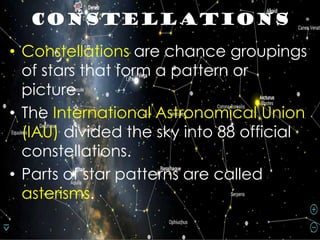
• Constellations are chance groupings
of stars that form a pattern or
picture.
• The International Astronomical Union
(IAU) divided the sky into 88 official
constellations.
• Parts of star patterns are called
asterisms.
Constellations
• Polaris is known as the North Star.
• Constellations that are found around
the North Pole are called
circumpolar constellations.
circumpolar
constellations
• Constellations that are found around
the North Pole are called
circumpolar constellations.
• There are five major circumpolar
constellations: Ursa Major, Ursa Minor,
Cassiopeia, Cepheus, and Draco.
Ursa Major
• Ursa Major also
called the Big
Bear.
• one of the most
famous
constellations and
is the third largest
of all
Ursa Major
• The tail and the
body of the bear
makes up the Big
Dipper.
Ursa MINor
• also called the
Little Bear, is made
up of relatively
faint stars.
• Its tail is called the
Little Dipper, which
is easily seen
because its end is
near the Polaris.
CASSIOPEIA
• Depending on
the time of the
year, Cassiopeia
looks like a letter
W or a letter M,
representing its
throne.
CASSIOPEIA
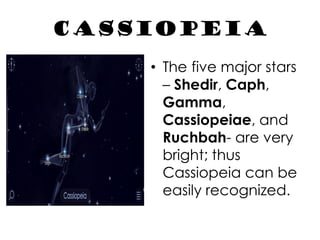
• The five major stars
– Shedir, Caph,
Gamma,
Cassiopeiae, and
Ruchbah- are very
bright; thus
Cassiopeia can be
easily recognized.
CEPHEUS
• The constellation
Cepheus is the 27th
largest constellation,
it was named after
Cassiopeia’s
husband.
CEPHEUS
• It is a little dimmer
than Cassiopeia.
• Some of the stars of
the Cepheus
include Alderamin,
Alfirk, Alrai, and
Garnet.
DRACO
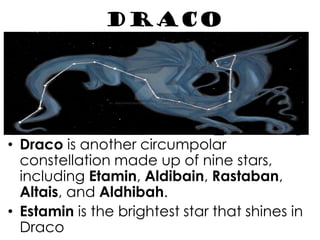
• Draco is another circumpolar
constellation made up of nine stars,
including Etamin, Aldibain, Rastaban,
Altais, and Aldhibah.
• Estamin is the brightest star that shines in
Draco
NON-circumpolar
constellations
• The second type of constellations,
called the noncircumpolar
constellations, is found lower in the
sky.
circumpolar
constellations
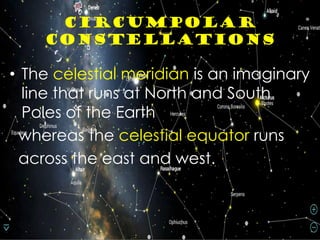
• The celestial meridian is an imaginary
line that runs at North and South
Poles of the Earth
whereas the celestial equator runs
across the east and west.
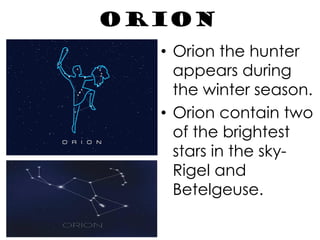
ORION
• Orion the hunter
appears during
the winter season.
• Orion contain two
of the brightest
stars in the sky-
Rigel and
Betelgeuse.
CANIS MAJOR
• Canis Major is a
constellation that
represents a
bigger dog
following Orion.
• It is home to the
brightest star in
the sky, Sirius.
CANIS MINOR
• Canis Minor
represents
another dog
following Orion,
but its name
describes it as the
smaller dog or
the lesser dog.
CANIS MINOR
• Canis Minor
holds the eighth
brightest star in
the sky-Procyon.
SCORPIUS
• The constellation
Scorpius is one of
the oldest
constellations
identified by
human
civilization.
• The brightest in
Scorpius is
Antares.

Constellations

  • 1.
  • 2.
    Constellations • Constellations arechance groupings of stars that form a pattern or picture. • The International Astronomical Union (IAU) divided the sky into 88 official constellations. • Parts of star patterns are called asterisms.
  • 3.
    Constellations • Polaris isknown as the North Star. • Constellations that are found around the North Pole are called circumpolar constellations.
  • 4.
    circumpolar constellations • Constellations thatare found around the North Pole are called circumpolar constellations. • There are five major circumpolar constellations: Ursa Major, Ursa Minor, Cassiopeia, Cepheus, and Draco.
  • 5.
    Ursa Major • UrsaMajor also called the Big Bear. • one of the most famous constellations and is the third largest of all
  • 6.
    Ursa Major • Thetail and the body of the bear makes up the Big Dipper.
  • 7.
    Ursa MINor • alsocalled the Little Bear, is made up of relatively faint stars. • Its tail is called the Little Dipper, which is easily seen because its end is near the Polaris.
  • 8.
    CASSIOPEIA • Depending on thetime of the year, Cassiopeia looks like a letter W or a letter M, representing its throne.
  • 9.
    CASSIOPEIA • The fivemajor stars – Shedir, Caph, Gamma, Cassiopeiae, and Ruchbah- are very bright; thus Cassiopeia can be easily recognized.
  • 10.
    CEPHEUS • The constellation Cepheusis the 27th largest constellation, it was named after Cassiopeia’s husband.
  • 11.
    CEPHEUS • It isa little dimmer than Cassiopeia. • Some of the stars of the Cepheus include Alderamin, Alfirk, Alrai, and Garnet.
  • 12.
    DRACO • Draco isanother circumpolar constellation made up of nine stars, including Etamin, Aldibain, Rastaban, Altais, and Aldhibah. • Estamin is the brightest star that shines in Draco
  • 13.
    NON-circumpolar constellations • The secondtype of constellations, called the noncircumpolar constellations, is found lower in the sky.
  • 14.
    circumpolar constellations • The celestialmeridian is an imaginary line that runs at North and South Poles of the Earth whereas the celestial equator runs across the east and west.
  • 15.
    ORION • Orion thehunter appears during the winter season. • Orion contain two of the brightest stars in the sky- Rigel and Betelgeuse.
  • 16.
    CANIS MAJOR • CanisMajor is a constellation that represents a bigger dog following Orion. • It is home to the brightest star in the sky, Sirius.
  • 17.
    CANIS MINOR • CanisMinor represents another dog following Orion, but its name describes it as the smaller dog or the lesser dog.
  • 18.
    CANIS MINOR • CanisMinor holds the eighth brightest star in the sky-Procyon.
  • 19.
    SCORPIUS • The constellation Scorpiusis one of the oldest constellations identified by human civilization. • The brightest in Scorpius is Antares.