Advances in Physics Theories and Applications                                                                              www.iiste.org
ISSN 2224-719X (Paper) ISSN 2225-0638 (Online)
Vol 6, 2012


    Einstein Field Equations And Heisenberg’s Principle Of
   Uncertainly The Consummation Of GTR And Uncertainty
                           Principle
                        *1
                          Dr K N Prasanna Kumar, 2Prof B S Kiranagi And 3Prof C S Bagewadi

           *1
             Dr K N Prasanna Kumar, Post doctoral researcher, Dr KNP Kumar has three PhD’s, one each in Mathematics,
       Economics and Political science and a D.Litt. in Political Science, Department of studies in Mathematics, Kuvempu
                  University, Shimoga, Karnataka, India Correspondence Mail id : drknpkumar@gmail.com


       2
       Prof B S Kiranagi, UGC Emeritus Professor (Department of studies in Mathematics), Manasagangotri, University
                                                     of Mysore, Karnataka, India

            3
                Prof C S Bagewadi, Chairman , Department of studies in Mathematics and Computer science, Jnanasahyadri
                                Kuvempu university, Shankarghatta, Shimoga district, Karnataka, India


Abstract
The Einstein field equations (EFE) or Einstein's equations are a set of 10 equations in Albert
Einstein's general theory of relativity, which describe the fundamental interaction (e&eb) of gravitation as
a result of spacetime being curved by matter and energy. First published by Einstein in 1915 as a tensor
equation, the EFE equate spacetime curvature (expressed by the Einstein tensor) with (=) the energy
and momentum tensor within that spacetime (expressed by the stress–energy tensor).Both space time
curvature tensor and energy and momentum tensor is classified in to various groups based on which
objects they are attributed to. It is to be noted that the total amount of energy and mass in the Universe is
zero. But as is said in different context, it is like the Bank Credits and Debits, with the individual debits
and Credits being conserved, holistically, the conservation and preservation of Debits and Credits occur,
and manifest in the form of General Ledger. Transformations of energy also take place individually in the
same form and if all such transformations are classified and written as a Transfer Scroll, it should tally
with the total, universalistic transformation. This is a very important factor to be borne in mind. Like
accounts are classifiable based on rate of interest, balance standing or the age, we can classify the factors
and parameters in the Universe, be it age, interaction ability, mass, energy content. Even virtual particles
could be classified based on the effects it produces. These aspects are of paramount importance in the
study. When we write A+b+5, it means that we are adding A to B or B to A until we reach 5.
Similarly, if we write A-B=0, it means we are taking away B from A and there may be time lag until
we reach zero. There may also be cases in which instantaneous results are reached, which however do not
affect the classification. By means of such a classification we obtain the values of Einstein Tensor and
Momentum Energy Tensor, which are in fact the solutions to the Einstein’s Field Equation. Terms “e” and
“eb” are used for better comprehension of the lay reader. It has no other attribution or ascription
whatsoever in the context of the paper. For the sake of simplicity, we shall take the equality case of
Heisenberg’s Principle Of Uncertainty for easy consolidation and consubstantiation process. The
“greater than” case can be attended to in a similar manner, with the symbolof”greater than”
incorporated in the paper series.


Introduction
Similar to the way that electromagnetic fields are determined (eb) using charges and currents via
 Maxwell's equations, the EFE are used to determine the spacetime geometry resulting from the presence
of mass-energy and linear momentum, that is, they (eb) determine the metric of spacetime for a given
arrangement of stress–energy in the spacetime. The relationship between the metric tensor and the
Einstein tensor allows the EFE to be written as a set of non-linear partial differential equations when used
in this way. The solutions of the EFE are the components of the metric tensor. The inertial trajectories of
particles and radiation (geodesics) in the resulting geometry are then calculated using the geodesic

                                                                     54
Advances in Physics Theories and Applications                                                              www.iiste.org
ISSN 2224-719X (Paper) ISSN 2225-0638 (Online)
Vol 6, 2012

equation. As well as obeying local energy-momentum conservation, the EFE reduce to Newton's law of
gravitation where the gravitational field is weak and velocities are much less than the speed of light.
Solution techniques for the EFE include simplifying assumptions such as symmetry. Special classes
of exact solutions are most often studied as they model many gravitational phenomena, such as rotating
black holes and the expanding universe. Further simplification is achieved in approximating the actual
spacetime as flat spacetime with a small deviation, leading to the linearised EFE. These equations are
used to study phenomena such as gravitational waves.

Mathematical form

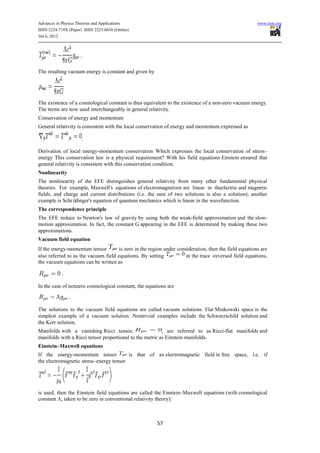
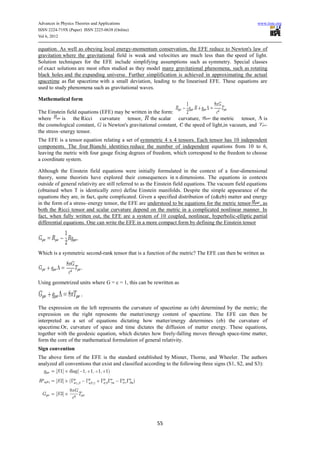
The Einstein field equations (EFE) may be written in the form:
where       is the Ricci curvature tensor,         the scalar curvature,    the metric tensor,                is
the cosmological constant, is Newton's gravitational constant, the speed of light,in vacuum, and
the stress–energy tensor.
The EFE is a tensor equation relating a set of symmetric 4 x 4 tensors. Each tensor has 10 independent
components. The four Bianchi identities reduce the number of independent equations from 10 to 6,
leaving the metric with four gauge fixing degrees of freedom, which correspond to the freedom to choose
a coordinate system.

Although the Einstein field equations were initially formulated in the context of a four-dimensional
theory, some theorists have explored their consequences in n dimensions. The equations in contexts
outside of general relativity are still referred to as the Einstein field equations. The vacuum field equations
(obtained when T is identically zero) define Einstein manifolds. Despite the simple appearance of the
equations they are, in fact, quite complicated. Given a specified distribution of (e&eb) matter and energy
in the form of a stress–energy tensor, the EFE are understood to be equations for the metric tensor         , as
both the Ricci tensor and scalar curvature depend on the metric in a complicated nonlinear manner. In
fact, when fully written out, the EFE are a system of 10 coupled, nonlinear, hyperbolic-elliptic partial
differential equations. One can write the EFE in a more compact form by defining the Einstein tensor


Which is a symmetric second-rank tensor that is a function of the metric? The EFE can then be written as


Using geometrized units where G = c = 1, this can be rewritten as


The expression on the left represents the curvature of spacetime as (eb) determined by the metric; the
expression on the right represents the matter/energy content of spacetime. The EFE can then be
interpreted as a set of equations dictating how matter/energy determines (eb) the curvature of
spacetime.Or, curvature of space and time dictates the diffusion of matter energy. These equations,
together with the geodesic equation, which dictates how freely-falling moves through space-time matter,
form the core of the mathematical formulation of general relativity.
Sign convention
The above form of the EFE is the standard established by Misner, Thorne, and Wheeler. The authors
analyzed all conventions that exist and classified according to the following three signs (S1, S2, and S3):


                                                          55
Advances in Physics Theories and Applications                                                            www.iiste.org
ISSN 2224-719X (Paper) ISSN 2225-0638 (Online)
Vol 6, 2012


The third sign above is related to the choice of convention for the Ricci tensor:

With these definitions Misner, Thorne, and Wheeler classify themselves as         , whereas Weinberg
(1972) is          , Peebles (1980) and Efstathiou (1990) are           while Peacock (1994), Rindler
(1977), Atwater (1974), Collins Martin & Squires (1989) are        .

Authors including Einstein have used a different sign in their definition for the Ricci tensor which results
in the sign of the constant on the right side being negative


The sign of the (very small) cosmological term would change in both these versions, if the +−−−
metric sign convention is used rather than the MTW −+++ metric sign convention adopted here.
Equivalent formulations
Taking the trace of both sides of the EFE one gets


Which simplifies to


If one adds             times this to the EFE, one gets the following equivalent "trace-reversed" form


Reversing the trace again would restore the original EFE. The trace-reversed form may be more
convenient in some cases (for example, when one is interested in weak-field limit and can replace in
the expression on the right with the Minkowski metric without significant loss of accuracy).
The cosmological constant
Einstein modified his original field equations to include a cosmological term proportional to the metric It
is to be noted that even constants like gravitational field, cosmological constant, depend upon the objects
for which they are taken in to consideration and total of these can be classified based on the
parameterization of objects.


The constant      is the cosmological constant. Since         is constant, the energy conservation law is
unaffected.
The cosmological constant term was originally introduced by Einstein to allow for a static universe (i.e.,
one that is not expanding or contracting). This effort was unsuccessful for two reasons: the static universe
described by this theory was unstable, and observations of distant galaxies by Hubble a decade later
confirmed that our universe is, in fact, not static but expanding. So was abandoned, with Einstein
calling it the "biggest blunder [he] ever made". For many years the cosmological constant was almost
universally considered to be 0.Despite Einstein's misguided motivation for introducing the cosmological
constant term, there is nothing inconsistent with the presence of such a term in the equations. Indeed,
recent improved astronomical techniques have found that a positive value of is needed to explain
the accelerating universe Einstein thought of the cosmological constant as an independent parameter, but
its term in the field equation can also be moved algebraically to the other side, written as part of the
stress–energy tensor:

                                                         56
Advances in Physics Theories and Applications                                                           www.iiste.org
ISSN 2224-719X (Paper) ISSN 2225-0638 (Online)
Vol 6, 2012


The resulting vacuum energy is constant and given by


The existence of a cosmological constant is thus equivalent to the existence of a non-zero vacuum energy.
The terms are now used interchangeably in general relativity.
Conservation of energy and momentum
General relativity is consistent with the local conservation of energy and momentum expressed as

                      .

Derivation of local energy-momentum conservation Which expresses the local conservation of stress–
energy This conservation law is a physical requirement? With his field equations Einstein ensured that
general relativity is consistent with this conservation condition.
Nonlinearity
The nonlinearity of the EFE distinguishes general relativity from many other fundamental physical
theories. For example, Maxwell's equations of electromagnetism are linear in theelectric and magnetic
fields, and charge and current distributions (i.e. the sum of two solutions is also a solution); another
example is Schrö dinger's equation of quantum mechanics which is linear in the wavefunction.
The correspondence principle
The EFE reduce to Newton's law of gravity by using both the weak-field approximation and the slow-
motion approximation. In fact, the constant G appearing in the EFE is determined by making these two
approximations.
Vacuum field equation
If the energy-momentum tensor         is zero in the region under consideration, then the field equations are
also referred to as the vacuum field equations. By setting            in the trace -reversed field equations,
the vacuum equations can be written as


In the case of nonzero cosmological constant, the equations are


The solutions to the vacuum field equations are called vacuum solutions. Flat Minkowski space is the
simplest example of a vacuum solution. Nontrivial examples include the Schwarzschild solution and
the Kerr solution.
Manifolds with a vanishing Ricci tensor,                  , are referred to as Ricci-flat manifolds and
manifolds with a Ricci tensor proportional to the metric as Einstein manifolds.
Einstein–Maxwell equations
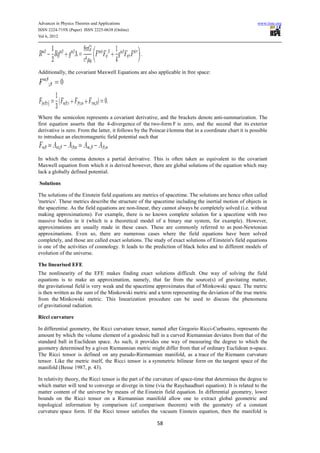
If the energy-momentum tensor            is that of an electromagnetic field in free space, i.e. if
the electromagnetic stress–energy tensor


is used, then the Einstein field equations are called the Einstein–Maxwell equations (with cosmological
constant Λ, taken to be zero in conventional relativity theory):


                                                        57
Advances in Physics Theories and Applications                                                             www.iiste.org
ISSN 2224-719X (Paper) ISSN 2225-0638 (Online)
Vol 6, 2012


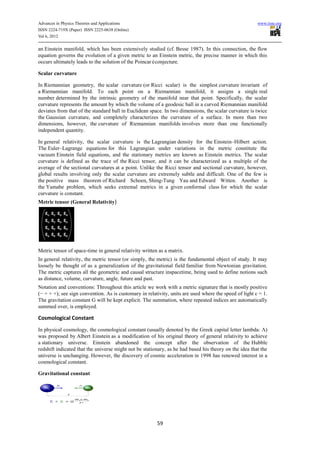
Additionally, the covariant Maxwell Equations are also applicable in free space:


Where the semicolon represents a covariant derivative, and the brackets denote anti-summarization. The
first equation asserts that the 4-divergence of the two-form F is zero, and the second that its exterior
derivative is zero. From the latter, it follows by the Poincarélemma that in a coordinate chart it is possible
to introduce an electromagnetic field potential such that


In which the comma denotes a partial derivative. This is often taken as equivalent to the covariant
Maxwell equation from which it is derived however, there are global solutions of the equation which may
lack a globally defined potential.

Solutions

The solutions of the Einstein field equations are metrics of spacetime. The solutions are hence often called
'metrics'. These metrics describe the structure of the spacetime including the inertial motion of objects in
the spacetime. As the field equations are non-linear, they cannot always be completely solved (i.e. without
making approximations). For example, there is no known complete solution for a spacetime with two
massive bodies in it (which is a theoretical model of a binary star system, for example). However,
approximations are usually made in these cases. These are commonly referred to as post-Newtonian
approximations. Even so, there are numerous cases where the field equations have been solved
completely, and those are called exact solutions. The study of exact solutions of Einstein's field equations
is one of the activities of cosmology. It leads to the prediction of black holes and to different models of
evolution of the universe.

The linearised EFE
The nonlinearity of the EFE makes finding exact solutions difficult. One way of solving the field
equations is to make an approximation, namely, that far from the source(s) of gravitating matter,
the gravitational field is very weak and the spacetime approximates that of Minkowski space. The metric
is then written as the sum of the Minkowski metric and a term representing the deviation of the true metric
from the Minkowski metric. This linearization procedure can be used to discuss the phenomena
of gravitational radiation.

Ricci curvature

In differential geometry, the Ricci curvature tensor, named after Gregorio Ricci-Curbastro, represents the
amount by which the volume element of a geodesic ball in a curved Riemannian deviates from that of the
standard ball in Euclidean space. As such, it provides one way of measuring the degree to which the
geometry determined by a given Riemannian metric might differ from that of ordinary Euclidean n-space.
The Ricci tensor is defined on any pseudo-Riemannian manifold, as a trace of the Riemann curvature
tensor. Like the metric itself, the Ricci tensor is a symmetric bilinear form on the tangent space of the
manifold (Besse 1987, p. 43).

In relativity theory, the Ricci tensor is the part of the curvature of space-time that determines the degree to
which matter will tend to converge or diverge in time (via the Raychaudhuri equation). It is related to the
matter content of the universe by means of the Einstein field equation. In differential geometry, lower
bounds on the Ricci tensor on a Riemannian manifold allow one to extract global geometric and
topological information by comparison (cf. comparison theorem) with the geometry of a constant
curvature space form. If the Ricci tensor satisfies the vacuum Einstein equation, then the manifold is

                                                         58
Advances in Physics Theories and Applications                                                           www.iiste.org
ISSN 2224-719X (Paper) ISSN 2225-0638 (Online)
Vol 6, 2012

an Einstein manifold, which has been extensively studied (cf. Besse 1987). In this connection, the flow
equation governs the evolution of a given metric to an Einstein metric, the precise manner in which this
occurs ultimately leads to the solution of the Poincaréconjecture.

Scalar curvature

In Riemannian geometry, the scalar curvature (or Ricci scalar) is the simplest curvature invariant of
a Riemannian manifold. To each point on a Riemannian manifold, it assigns a single real
number determined by the intrinsic geometry of the manifold near that point. Specifically, the scalar
curvature represents the amount by which the volume of a geodesic ball in a curved Riemannian manifold
deviates from that of the standard ball in Euclidean space. In two dimensions, the scalar curvature is twice
the Gaussian curvature, and completely characterizes the curvature of a surface. In more than two
dimensions, however, the curvature of Riemannian manifolds involves more than one functionally
independent quantity.

In general relativity, the scalar curvature is the Lagrangian density for the Einstein–Hilbert action.
The Euler–Lagrange equations for this Lagrangian under variations in the metric constitute the
vacuum Einstein field equations, and the stationary metrics are known as Einstein metrics. The scalar
curvature is defined as the trace of the Ricci tensor, and it can be characterized as a multiple of the
average of the sectional curvatures at a point. Unlike the Ricci tensor and sectional curvature, however,
global results involving only the scalar curvature are extremely subtle and difficult. One of the few is
the positive mass theorem of Richard Schoen, Shing-Tung Yau and Edward Witten. Another is
the Yamabe problem, which seeks extremal metrics in a given conformal class for which the scalar
curvature is constant.
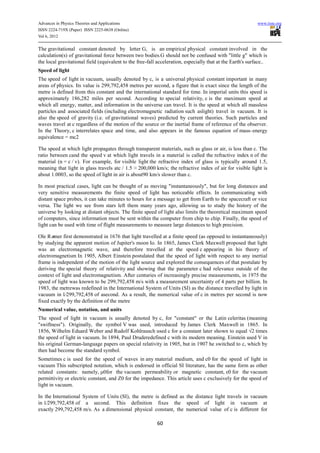
Metric tensor (General Relativity)


Metric tensor of space-time in general relativity written as a matrix.
In general relativity, the metric tensor (or simply, the metric) is the fundamental object of study. It may
loosely be thought of as a generalization of the gravitational field familiar from Newtonian gravitation.
The metric captures all the geometric and causal structure inspacetime, being used to define notions such
as distance, volume, curvature, angle, future and past.
Notation and conventions: Throughout this article we work with a metric signature that is mostly positive
(− + + +); see sign convention. As is customary in relativity, units are used where the speed of light c = 1.
The gravitation constant G will be kept explicit. The summation, where repeated indices are automatically
summed over, is employed.

Cosmological Constant
In physical cosmology, the cosmological constant (usually denoted by the Greek capital letter lambda: Λ)
was proposed by Albert Einstein as a modification of his original theory of general relativity to achieve
a stationary universe. Einstein abandoned the concept after the observation of the Hubble
redshift indicated that the universe might not be stationary, as he had based his theory on the idea that the
universe is unchanging. However, the discovery of cosmic acceleration in 1998 has renewed interest in a
cosmological constant.

Gravitational constant


                                                         59
Advances in Physics Theories and Applications                                                               www.iiste.org
ISSN 2224-719X (Paper) ISSN 2225-0638 (Online)
Vol 6, 2012

The gravitational constant denoted by letter G, is an empirical physical constant involved in the
calculation(s) of gravitational force between two bodies.G should not be confused with "little g" which is
the local gravitational field (equivalent to the free-fall acceleration, especially that at the Earth's surface..
Speed of light
The speed of light in vacuum, usually denoted by c, is a universal physical constant important in many
areas of physics. Its value is 299,792,458 metres per second, a figure that is exact since the length of the
metre is defined from this constant and the international standard for time. In imperial units this speed is
approximately 186,282 miles per second. According to special relativity, c is the maximum speed at
which all energy, matter, and information in the universe can travel. It is the speed at which all massless
particles and associated fields (including electromagnetic radiation such aslight) travel in vacuum. It is
also the speed of gravity (i.e. of gravitational waves) predicted by current theories. Such particles and
waves travel at c regardless of the motion of the source or the inertial frame of reference of the observer.
In the Theory, c interrelates space and time, and also appears in the famous equation of mass–energy
equivalence = mc2

The speed at which light propagates through transparent materials, such as glass or air, is less than c. The
ratio between cand the speed v at which light travels in a material is called the refractive index n of the
material (n = c / v). For example, for visible light the refractive index of glass is typically around 1.5,
meaning that light in glass travels atc / 1.5 ≈ 200,000 km/s; the refractive index of air for visible light is
about 1.0003, so the speed of light in air is about90 km/s slower than c.

In most practical cases, light can be thought of as moving "instantaneously", but for long distances and
very sensitive measurements the finite speed of light has noticeable effects. In communicating with
distant space probes, it can take minutes to hours for a message to get from Earth to the spacecraft or vice
versa. The light we see from stars left them many years ago, allowing us to study the history of the
universe by looking at distant objects. The finite speed of light also limits the theoretical maximum speed
of computers, since information must be sent within the computer from chip to chip. Finally, the speed of
light can be used with time of flight measurements to measure large distances to high precision.

Ole Rø mer first demonstrated in 1676 that light travelled at a finite speed (as opposed to instantaneously)
by studying the apparent motion of Jupiter's moon Io. In 1865, James Clerk Maxwell proposed that light
was an electromagnetic wave, and therefore travelled at the speed c appearing in his theory of
electromagnetism In 1905, Albert Einstein postulated that the speed of light with respect to any inertial
frame is independent of the motion of the light source and explored the consequences of that postulate by
deriving the special theory of relativity and showing that the parameter c had relevance outside of the
context of light and electromagnetism. After centuries of increasingly precise measurements, in 1975 the
speed of light was known to be 299,792,458 m/s with a measurement uncertainty of 4 parts per billion. In
1983, the metrewas redefined in the International System of Units (SI) as the distance travelled by light in
vacuum in 1⁄299,792,458 of asecond. As a result, the numerical value of c in metres per second is now
fixed exactly by the definition of the metre
Numerical value, notation, and units
The speed of light in vacuum is usually denoted by c, for "constant" or the Latin celeritas (meaning
"swiftness"). Originally, the symbol V was used, introduced by James Clerk Maxwell in 1865. In
1856, Wilhelm Eduard Weber and Rudolf Kohlrausch used c for a constant later shown to equal √2 times
the speed of light in vacuum. In 1894, Paul Druderedefined c with its modern meaning. Einstein used V in
his original German-language papers on special relativity in 1905, but in 1907 he switched to c, which by
then had become the standard symbol.
Sometimes c is used for the speed of waves in any material medium, and c0 for the speed of light in
vacuum This subscripted notation, which is endorsed in official SI literature, has the same form as other
related constants: namely, μ0for the vacuum permeability or magnetic constant, ε0 for the vacuum
permittivity or electric constant, and Z0 for the impedance. This article uses c exclusively for the speed of
light in vacuum.

In the International System of Units (SI), the metre is defined as the distance light travels in vacuum
in 1⁄299,792,458 of a second. This definition fixes the speed of light in vacuum at
exactly 299,792,458 m/s. As a dimensional physical constant, the numerical value of c is different for

                                                          60
Advances in Physics Theories and Applications                                                               www.iiste.org
ISSN 2224-719X (Paper) ISSN 2225-0638 (Online)
Vol 6, 2012

different unit systems. In branches of physics in which cappears often, such as in relativity, it is common
to use systems of natural units of measurement in which c = 1 Using these units, c does not appear
explicitly because multiplication or division by 1 does not affect the result.
Fundamental role in physics
Speed at which light waves propagate in vacuum is independent both of the motion of the wave source
and of the inertial frame of reference of the observer This invariance of the speed of light was postulated
by Einstein in 1905 after being motivated by Maxwell's theory of electromagnetism and the lack of
evidence for the luminiferous aether; it has since been consistently confirmed by many experiments. It is
only possible to verify experimentally that the two-way speed of light (for example, from a source to a
mirror and back again) is frame-independent, because it is impossible to measure the one-way speed of
light (for example, from a source to a distant detector) without some convention as to how clocks at the
source and at the detector should be synchronized. However, by adopting Einstein synchronization for the
clocks, the one-way speed of light becomes equal to the two-way speed of light by definition. The special
theory of relativity explores the consequences of this invariance of c with the assumption that the laws of
physics are the same in all inertial frames of reference. One consequence is that c is the speed at which
all massless particles and waves, including light, must travel in vacuum.


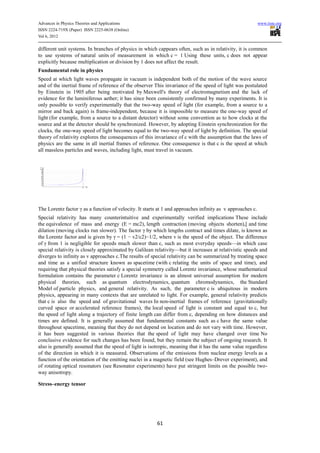
The Lorentz factor γ as a function of velocity. It starts at 1 and approaches infinity as v approaches c.
Special relativity has many counterintuitive and experimentally verified implications These include
the equivalence of mass and energy (E = mc2), length contraction (moving objects shorten),[ and time
dilation (moving clocks run slower). The factor γ by which lengths contract and times dilate, is known as
the Lorentz factor and is given by γ = (1 − v2/c2)−1/2, where v is the speed of the object. The difference
of γ from 1 is negligible for speeds much slower than c, such as most everyday speeds—in which case
special relativity is closely approximated by Galilean relativity—but it increases at relativistic speeds and
diverges to infinity as v approaches c.The results of special relativity can be summarized by treating space
and time as a unified structure known as spacetime (with c relating the units of space and time), and
requiring that physical theories satisfy a special symmetry called Lorentz invariance, whose mathematical
formulation contains the parameter c Lorentz invariance is an almost universal assumption for modern
physical theories, such as quantum electrodynamics, quantum chromodynamics, the Standard
Model of particle physics, and general relativity. As such, the parameter c is ubiquitous in modern
physics, appearing in many contexts that are unrelated to light. For example, general relativity predicts
that c is also the speed and of gravitational waves In non-inertial frames of reference (gravitationally
curved space or accelerated reference frames), the local speed of light is constant and equal to c, but
the speed of light along a trajectory of finite length can differ from c, depending on how distances and
times are defined. It is generally assumed that fundamental constants such as c have the same value
throughout spacetime, meaning that they do not depend on location and do not vary with time. However,
it has been suggested in various theories that the speed of light may have changed over time No
conclusive evidence for such changes has been found, but they remain the subject of ongoing research. It
also is generally assumed that the speed of light is isotropic, meaning that it has the same value regardless
of the direction in which it is measured. Observations of the emissions from nuclear energy levels as a
function of the orientation of the emitting nuclei in a magnetic field (see Hughes–Drever experiment), and
of rotating optical resonators (see Resonator experiments) have put stringent limits on the possible two-
way anisotropy.

Stress–energy tensor


                                                         61
Advances in Physics Theories and Applications                                                           www.iiste.org
ISSN 2224-719X (Paper) ISSN 2225-0638 (Online)
Vol 6, 2012


The components of the stress-energy tensor
The stress–energy tensor (sometimes stress–energy–momentum tensor) is a tensor quantity in physics that
describes the density and flux of energy and momentum in spacetime, generalizing the stress tensor of
Newtonian physics. It is an attribute of matter, radiation, and non-gravitational force fields. The stress-
energy tensor is the source of the gravitational field in the Einstein field equations of general relativity,
just as mass is the source of such a field in Newtonian gravity.

The stress–energy tensor involves the use of superscripted variables which are not exponents (see Einstein
summation notation). The components of the position four-vector are given by: x0 = t (time in
seconds), x1 = x (in meters), x2 = y (in meters), and x3 = z(in meters).

The stress–energy tensor is defined as the tensor of rank two that gives the flux of the αth component
of the momentum vector across a surface with constant xβ coordinate. In the theory of relativity, this
momentum vector is taken as the four-momentum. In general relativity, the stress-energy tensor is
symmetric


In some alternative theories like Einstein–Cartan theory, the stress–energy tensor may not be perfectly
symmetric because of a nonzero spin tensor, which geometrically corresponds to a nonzero torsion tensor.

Identifying the components of the tensor

In the following i and k range from 1 through 3.
The time–time component is the density of relativistic mass, i.e. the energy density divided by the speed
of light squared It is of special interest because it has a simple physical interpretation. In the case of a
perfect fluid this component is             And for an electromagnetic field in otherwise empty space this
component is


Where      and    are the electric and magnetic fields respectively
The flux of relativistic mass across the xi surface is equivalent to the density of the ith component of
linear momentum,


The components      Represent flux of ith component of linear momentum across the xk surface. In
particular, (Not summed) represents normal stress which is called pressure when it is independent of
direction. Whereas

Represents shear stress (compare with the stress tensor).

 In solid state physics and fluid mechanics, the stress tensor is defined to be the spatial components of the
stress–energy tensor in the comoving frame of reference. In other words, the stress energy tensor
in engineering differs from the stress energy tensor here by a momentum convective term.

Governing Equations


                                                         62
Advances in Physics Theories and Applications                                                                                         www.iiste.org
ISSN 2224-719X (Paper) ISSN 2225-0638 (Online)
Vol 6, 2012

First Term

        (    )(       )
                              (        )(       )                                                                                             1

        (    )(   )
                          (           )(        )                                                                                             2

        (    )(       )
                              (        )(       )                                                                                             3

Second Term

       (    )(    )
                          (           )(    )                                                                                                 4

       (    )(    )
                          (           )(    )                                                                                                 5

       (    )(    )
                          (           )(    )                                                                                                 6

Third Term

        (    )(   )
                          (           )(        )                                                                                             7

        (    )(   )
                          (           )(        )                                                                                             8

        (    )(   )
                          (           )(        )                                                                                             9

Fourth Term

       (    )(    )
                          (           )(    )                                                                                                 10


       (    )(    )
                          (           )(    )                                                                                                 11

       (    )(    )
                          (           )(    )                                                                                                 12

Governing Equations Of Dual Concatenated Systems Holistic System: Einstein Field Equation With
All The Four Terms:

First Term

        (    )(   )
                          [(           )(           )
                                                        (       )( ) (         ) ]                                                            13


        (    )(   )
                          [(           )(           )
                                                        (       )( ) (         ) ]                                                            14


        (    )(   )
                          [(           )(           )
                                                        (       )( ) (         ) ]                                                            15


Where ( )( ) (                    )             (           )( ) (       )         (   )( ) (   ) are first augmentation coefficients for
category 1, 2 and 3

Second Term

       (    )(    )
                          [(           )(       )
                                                        (      )( ) (        ) ]                                                              16


       (    )(    )
                          [(           )(       )
                                                        (      )( ) (        ) ]                                                              17


       (    )(    )
                          [(           )(       )
                                                        (      )( ) (        ) ]                                                              18


                                                                                        63
Advances in Physics Theories and Applications                                                                                                                                   www.iiste.org
ISSN 2224-719X (Paper) ISSN 2225-0638 (Online)
Vol 6, 2012


Where (           )( ) (    )           (           )( ) (            )        (               )( ) (                ) are first detrition coefficients for category 1,
2 and 3

Third Term

        (    )(   )
                           [(         )(        )
                                                        (       )( ) (                 ) ]                                                                                              19


        (    )(   )
                           [(         )(        )
                                                        (       )( ) (                 ) ]                                                                                              20


        (    )(   )
                           [(         )(        )
                                                        (       )( ) (                 ) ]                                                                                              21


Where ( )( ) (                  )           (            )( ) (            )               (           )( ) (                        ) are first augmentation coefficients for
category 1, 2 and 3

Fourth Term

       (     )(   )
                           [(       )(      )
                                                    (          )( ) (              ) ]                                                                                                  22


       (     )(   )
                           [(       )(      )
                                                    (          )( ) (              ) ]                                                                                                  23


       (     )(   )
                           [(       )(      )
                                                    (          )( ) (              ) ]                                                                                                  24


Where ( )( ) (                  ) ,          (              )( ) (         )                   (           )( ) (                     ) are first detritions coefficients for
category 1, 2 and 3

Governing Equations Of Concatenated System Of Two Concatenated Dual Systems

First Term

        (    )(   )
                           [(         )(        )
                                                        (       )( ) (                 )           (            )(           )
                                                                                                                                 (       ) ]                                            25


        (    )(   )
                           [(         )(        )
                                                        (       )( ) (                 )           (            )(           )
                                                                                                                                 (       ) ]                                            26


        (    )(   )
                           [(         )(        )
                                                        (       )( ) (                 )           (            )(           )
                                                                                                                                 (       ) ]                                            27


Where (     )( ) (          )       (            )( ) (               )    (               )( ) (                    ) are first augmentation coefficients for
category 1, 2 and 3

  ( )( ) (        )     (               )(          )
                                                        (            ) ,       (            )(         )
                                                                                                           (                 ) are second augmentation coefficients
for category 1, 2 and 3

Second Term

       (     )(   )
                           [(       )(      )
                                                    (          )( ) (          )            (          )(        )
                                                                                                                     (                 ) ]                                              28


       (     )(   )
                           [(       )(      )
                                                    (          )( ) (          )               (           )(        )
                                                                                                                         (             ) ]                                              29


       (     )(   )
                           [(       )(      )
                                                    (          )( ) (          )            (          )(        )
                                                                                                                     (                 ) ]                                              30


Where     ( )( ) ( )                    (           )( ) (            )            (           )( ) (                ) are first detrition coefficients for category
1, 2 and 3
   ( )( ) (       ) , (                     )(       )
                                                         (            ) , (                 )(         )
                                                                                                           (                 ) are second augmentation coefficients for

                                                                                                           64
Advances in Physics Theories and Applications                                                                                                                            www.iiste.org
ISSN 2224-719X (Paper) ISSN 2225-0638 (Online)
Vol 6, 2012

category 1, 2 and 3

Third Term

        (      )(   )
                            [(        )(        )
                                                        (        )( ) (              )            (           )(        )
                                                                                                                            (          ) ]                                       31


        (      )(   )
                            [(        )(        )
                                                        (        )( ) (              )            (           )(        )
                                                                                                                            (          ) ]                                       32

                                                                                                                                                                                 33
           (    )(      )
                             [(            )(       )
                                                            (     )( ) (              )           (            )(           )
                                                                                                                                (          ) ]

Where     ( )( ) (      )                   (               )( ) (           )            (           )( ) (                        ) are first augmentation coefficients
for category 1, 2 and 3

   ( )( ) (       )               (         )(          )
                                                            (        ) ,         (        )(          )
                                                                                                          (                 ) are second detrition coefficients for
category 1, 2 and 3

Fourth Term

       (       )(   )
                            [(        )(    )
                                                        (       )( ) (            )           (           )(        )
                                                                                                                        (            ) ]                                         34


       (       )(   )
                            [(        )(    )
                                                        (       )( ) (            )           (           )(        )
                                                                                                                        (            ) ]                                         35


       (       )(   )
                            [(        )(    )
                                                        (       )( ) (            )           (           )(        )
                                                                                                                        (            ) ]                                         36


Where     ( )( ) (    ) , ( )( ) (                                           )            (            )( ) (                        ) are first detrition coefficients for
category 1, 2 and 3
   ( )( ) ( ) , ( )( ) ( ) ,                                             (       )(       )
                                                                                              (           ) are second detrition coefficients for category
1, 2 and 3
Uncertainty principle
In quantum mechanics, the uncertainty principle is any of a variety of mathematical inequalities asserting
a fundamental lower bound on the precision with which certain pairs of physical properties of a particle,
such as position x and momentum p, can be simultaneously known. The more precisely the position of
some particle is determined, the less precisely its momentum can be known, and vice versa The original
heuristic argument that such a limit should exist was given by Werner Heisenberg in 1927. A more formal
inequality relating the standard deviation of position σx and the standard deviation of momentum σp was
derived by Kennard later that year (and independently by Weyl in 1928),


Where ħ is the reduced Planck constant.
Historically, the uncertainty principle has been confused with a somewhat similar effect in physics, called
the observer effect which notes that measurements of certain systems cannot be made without affecting
the systems. Heisenberg himself offered such an observer effect at the quantum level (see below) as a
physical "explanation" of quantum uncertainty. However, it has since become clear that quantum
uncertainty is inherent in the properties of all wave-like systems, and that it arises in quantum mechanics
simply due to the matter wavenature of all quantum objects. Thus, the uncertainty principle actually states
a fundamental property of quantum systems, and is not a statement about the observational success of
current technology

Mathematically, the uncertainty relation between position and momentum arises because the expressions
of the wavefunction in the two corresponding bases are Fourier transforms of one another (i.e., position
and momentum are conjugate variables). A similar tradeoff between the variances of Fourier conjugates
arises wherever Fourier analysis is needed, for example in sound waves. A pure tone is a sharp spike at a

                                                                                                      65
Advances in Physics Theories and Applications                                                             www.iiste.org
ISSN 2224-719X (Paper) ISSN 2225-0638 (Online)
Vol 6, 2012

single frequency. Its Fourier transform gives the shape of the sound wave in the time domain, which is a
completely delocalized sine wave. In quantum mechanics, the two key points are that the position of the
particle takes the form of a matter wave, and momentum is its Fourier conjugate, assured by the de
Broglie relation        , where is the wave number.

In the mathematical formulation of quantum mechanics, any pair of non-commuting self-adjoint
operators representing observables are subject to similar uncertainty limits. An eigenstate of an observable
represents the state of the wavefunction for a certain measurement value (the eigenvalue). For example, if
a measurement of an observable is taken then the system is in a particular eigenstate of that
observable. The particular eigenstate of the observable        may not be an eigenstate of another observable
   . If this is so, then it does not have a single associated measurement as the system is not in an eigenstate
of the observable
The Uncertainty Principle
The uncertainty principle can be interpreted in either the wave mechanics or matrix mechanics formalisms
of quantum mechanics. Although the principle is more visually intuitive in the wave mechanics
formalism, it was first derived and is more easily generalized in the matrix mechanics formalism. We will
attempt to motivate the principle in the two frameworks.
Wave mechanics interpretation


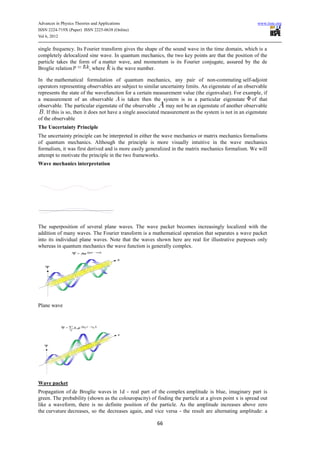
The superposition of several plane waves. The wave packet becomes increasingly localized with the
addition of many waves. The Fourier transform is a mathematical operation that separates a wave packet
into its individual plane waves. Note that the waves shown here are real for illustrative purposes only
whereas in quantum mechanics the wave function is generally complex.


Plane wave


Wave packet
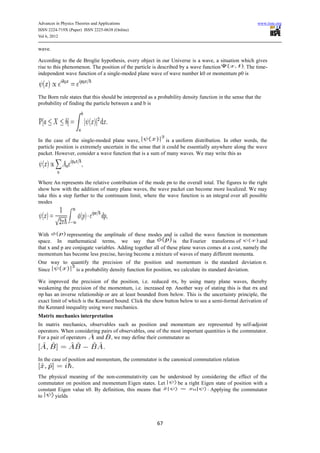
Propagation of de Broglie waves in 1d - real part of the complex amplitude is blue, imaginary part is
green. The probability (shown as the colouropacity) of finding the particle at a given point x is spread out
like a waveform, there is no definite position of the particle. As the amplitude increases above zero
the curvature decreases, so the decreases again, and vice versa - the result are alternating amplitude: a

                                                         66
Advances in Physics Theories and Applications                                                             www.iiste.org
ISSN 2224-719X (Paper) ISSN 2225-0638 (Online)
Vol 6, 2012

wave.

According to the de Broglie hypothesis, every object in our Universe is a wave, a situation which gives
rise to this phenomenon. The position of the particle is described by a wave function        . The time-
independent wave function of a single-moded plane wave of wave number k0 or momentum p0 is


The Born rule states that this should be interpreted as a probability density function in the sense that the
probability of finding the particle between a and b is


In the case of the single-moded plane wave,                  is a uniform distribution. In other words, the
particle position is extremely uncertain in the sense that it could be essentially anywhere along the wave
packet. However, consider a wave function that is a sum of many waves. We may write this as


Where An represents the relative contribution of the mode pn to the overall total. The figures to the right
show how with the addition of many plane waves, the wave packet can become more localized. We may
take this a step further to the continuum limit, where the wave function is an integral over all possible
modes


With          representing the amplitude of these modes and is called the wave function in momentum
space. In mathematical terms, we say that                       is the Fourier transforms of          and
that x and p are conjugate variables. Adding together all of these plane waves comes at a cost, namely the
momentum has become less precise, having become a mixture of waves of many different momenta.
One way to quantify the precision of the position and momentum is the standard deviation σ.
Since        is a probability density function for position, we calculate its standard deviation.

We improved the precision of the position, i.e. reduced σx, by using many plane waves, thereby
weakening the precision of the momentum, i.e. increased σp. Another way of stating this is that σx and
σp has an inverse relationship or are at least bounded from below. This is the uncertainty principle, the
exact limit of which is the Kennard bound. Click the show button below to see a semi-formal derivation of
the Kennard inequality using wave mechanics.
Matrix mechanics interpretation
In matrix mechanics, observables such as position and momentum are represented by self-adjoint
operators. When considering pairs of observables, one of the most important quantities is the commutator.
For a pair of operators   and , we may define their commutator as


In the case of position and momentum, the commutator is the canonical commutation relation


The physical meaning of the non-commutativity can be understood by considering the effect of the
commutator on position and momentum Eigen states. Let    be a right Eigen state of position with a
constant Eigen value x0. By definition, this means that                 Applying the commutator
to     yields


                                                         67
Advances in Physics Theories and Applications                                                           www.iiste.org
ISSN 2224-719X (Paper) ISSN 2225-0638 (Online)
Vol 6, 2012


Where is simply the identity operator. Suppose for the sake of proof by contradiction that       is also a
right Eigen state of momentum, with constant Eigen value p0. If this were true, then we could write


On the other hand, the canonical commutation relation requires that


This implies that no quantum state can be simultaneously both a position and a momentum Eigen state.
When a state is measured, it is projected onto an Eigen state in the basis of the observable. For example, if
a particle's position is measured, then the state exists at least momentarily in a position Eigen state.
However, this means that the state is not in a momentum Eigen state but rather exists as a sum of multiple
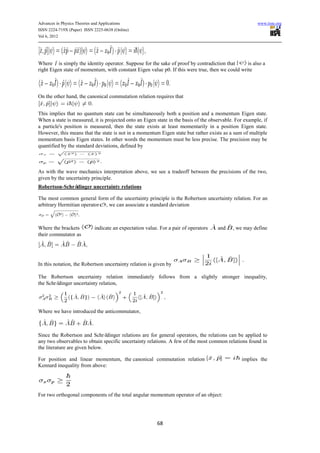
momentum basis Eigen states. In other words the momentum must be less precise. The precision may be
quantified by the standard deviations, defined by


As with the wave mechanics interpretation above, we see a tradeoff between the precisions of the two,
given by the uncertainty principle.
Robertson-Schrödinger uncertainty relations

The most common general form of the uncertainty principle is the Robertson uncertainty relation. For an
arbitrary Hermitian operator , we can associate a standard deviation


Where the brackets          indicate an expectation value. For a pair of operators   and    , we may define
their commutator as


In this notation, the Robertson uncertainty relation is given by

The Robertson uncertainty relation immediately follows from a slightly stronger inequality,
the Schrödinger uncertainty relation,


Where we have introduced the anticommutator,


Since the Robertson and Schrö   dinger relations are for general operators, the relations can be applied to
any two observables to obtain specific uncertainty relations. A few of the most common relations found in
the literature are given below.

For position and linear momentum, the canonical commutation relation                            implies the
Kennard inequality from above:


For two orthogonal components of the total angular momentum operator of an object:


                                                         68
Advances in Physics Theories and Applications                                                           www.iiste.org
ISSN 2224-719X (Paper) ISSN 2225-0638 (Online)
Vol 6, 2012


where i, j, k are distinct and Ji denotes angular momentum along the xi axis. This relation implies that
only a single component of a system's angular momentum can be defined with arbitrary precision,
normally the component parallel to an external (magnetic or electric) field. Moreover,
for                              , a choice                                , in angular momentum
multiplets, ψ = |j, m 〉, bounds the Casimir invariant (angular momentum squared,                          )
from below and thus yields useful constraints such as j (j+1) ≥ m (m + 1), and hence j ≥ m, among others.

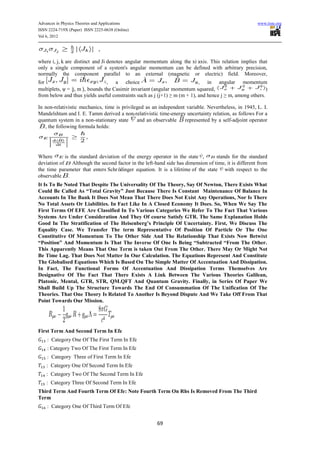
In non-relativistic mechanics, time is privileged as an independent variable. Nevertheless, in 1945, L. I.
Mandelshtam and I. E. Tamm derived a non-relativistic time-energy uncertainty relation, as follows For a
quantum system in a non-stationary state      and an observable    represented by a self-adjoint operator
   , the following formula holds:


Where        is the standard deviation of the energy operator in the state ,        stands for the standard
deviation of     Although the second factor in the left-hand side has dimension of time, it is different from
the time parameter that enters Schrö  dinger equation. It is a lifetime of the state with respect to the
observable .
It Is To Be Noted That Despite The Universality Of The Theory, Say Of Newton, There Exists What
Could Be Called As “Total Gravity” Just Because There Is Constant Maintenance Of Balance In
Accounts In The Bank It Does Not Mean That There Does Not Exist Any Operations, Nor Is There
No Total Assets Or Liabilities. In Fact Like In A Closed Economy It Does. So, When We Say The
First Terms Of EFE Are Classified In To Various Categories We Refer To The Fact That Various
Systems Are Under Consideration And They Of course Satisfy GTR. The Same Explanation Holds
Good In The Stratification of The Heisenberg’s Principle Of Uncertainty. First, We Discuss The
Equality Case. We Transfer The term Representative Of Position Of Particle Or The One
Constitutive Of Momentum To The Other Side And The Relationship That Exists Now Betwixt
“Position” And Momentum Is That The Inverse Of One Is Being “Subtracted “From The Other.
This Apparently Means That One Term is taken Out From The Other. There May Or Might Not
Be Time Lag. That Does Not Matter In Our Calculation. The Equations Represent And Constitute
The Globalised Equations Which Is Based On The Simple Matter Of Accentuation And Dissipation.
In Fact, The Functional Forms Of Accentuation And Dissipation Terms Themselves Are
Designative Of The Fact That There Exists A Link Between The Various Theories Galilean,
Platonic, Mental, GTR, STR, QM.QFT And Quantum Gravity. Finally, in Series Of Paper We
Shall Build Up The Structure Towards The End Of Consummation Of The Unification Of The
Theories. That One Theory Is Related To Another Is Beyond Dispute And We Take Off From That
Point Towards Our Mission.


First Term And Second Term In Efe
    : Category One Of The First Term In Efe
    : Category Two Of The First Term In Efe
    : Category Three of First Term In Efe
    : Category One Of Second Term In Efe
    : Category Two Of The Second Term In Efe
    : Category Three Of Second Term In Efe
Third Term And Fourth Term Of Efe: Note Fourth Term On Rhs Is Removed From The Third
Term
    : Category One Of Third Term Of Efe


                                                        69
Advances in Physics Theories and Applications                                                                                           www.iiste.org
ISSN 2224-719X (Paper) ISSN 2225-0638 (Online)
Vol 6, 2012

        : Category Two Of Third Term Of Efe
        : Category Three Of Third Term Of Efe
        : Category One Of Fourth Term Of Efe
        : Category Two Of Fourth Term Of Efe
        : Category Three Of Fourth Term Of Efe


Heisenberg’s Uncertainty Principle(Hup)
Note The First Term Is Inversely Proportional To The Second Term. Take The Equality Case. This
Leads To Subtraction Of The Second Term On The Rhs From The First Term This we Shall Model
And Annex With Efe. Despite Hup Holding Good For All The Systems, We Can Classify The
Systems Studied And Note The Registrations In Each System. As Said Earlier The First Term
Value Of Some System, The Second Term Value Of Some Other Differentiation Carried Out Based
On Parametricization
        : Category One Of First Term On Hup
        : Category Two Of First Term Of Hup
        : Category Three Of First Term Of Hup
        : Category One Of Second Term Of Hup
        : Category Two Of Second Term Of Hup
        : Category Three Of Second Term Of Hup
Accentuation Coefficients Of Holistic System Efe-Hup System
(       )(    )
                  (        )(   )
                                    (     )( ) (             )(   )
                                                                      (      )(     )
                                                                                        (     )( ) ( )( ) ( )( ) ( )( )
(       )(    )
                  (        )(   )
                                    (     )( ) : (           )(   )
                                                                      (      )(     )
                                                                                        (     )( ) ( )( ) ( )( ) ( )(               )

Dissipation Coefficients Of Holistic System Efe-Hup System
(       )(    )
                  (        )(   )
                                    (     )( ) (             )(   )
                                                                      (      )( ) (           )( ) (     )( ) (   )( ) (   )(   )

(       )(    )
                  (        )(   )
                                    (     )( ) (             )(   )
                                                                      (      )( ) (            )( ) (    )( ) (   )( ) (   )(   )

First Term Of Efe- Second Term Of Efe: Governing Equations:
The differential system of this model is now
              (       )(    )
                                          [(    )(       )
                                                                  (        )( ) (            )]                                                   1

              (       )(    )
                                          [(    )(       )
                                                                  (        )( ) (            )]                                                   2

              (       )(    )
                                          [(    )(       )
                                                                  (        )( ) (            )]                                                   3

             (        )(   )
                                         [(    )(    )
                                                              (           )( ) (        )]                                                        4

             (        )(   )
                                         [(    )(    )
                                                              (           )( ) (        )]                                                        5

             (        )(   )
                                         [(    )(    )
                                                              (           )( ) (        )]                                                        6

    (        )( ) (             )        First augmentation factor                                                                                7

    (     )( ) (            )           First detritions factor                                                                                   8

Governing Equations: Third Term Of Efe And Fourth Term Of Efe:
The differential system of this model is now
              (       )(    )
                                          [(    )(       )
                                                                  (        )( ) (            )]                                                   9

              (       )(    )
                                          [(    )(       )
                                                                  (        )( ) (            )]                                                  10


                                                                                                    70
Advances in Physics Theories and Applications                                                                                                               www.iiste.org
ISSN 2224-719X (Paper) ISSN 2225-0638 (Online)
Vol 6, 2012


           (       )(       )
                                          [(           )(       )
                                                                    (        )( ) (           )]                                                                     11

           (       )(       )
                                      [(           )(       )
                                                                    (       )( ) ((       ) )]                                                                       12

           (       )(       )
                                      [(           )(       )
                                                                    (       )( ) ((       ) )]                                                                       13

           (       )(       )
                                      [(           )(       )
                                                                    (       )( ) ((       ) )]                                                                       14

  (       )( ) (                )     First augmentation factor                                                                                                      15

  (       )( ) ((               ) )            First detritions factor                                                                                               16

Governing Equations: Of The First Term And Second Term Of Hup: Note That Second Term
(Inverse Thereof) Is Subtracted From The First Term, Which Means The Amount Is Removed For
Infinite Systems In The World. Law Of course Holds For All The Systems By This Methodology We
Get The Value Of The First Term As Well As The Second Term


The differential system of this model is now

           (       )(       )
                                          [(           )(       )
                                                                    (        )( ) (           )]                                                                     17

           (       )(       )
                                          [(           )(       )
                                                                    (        )( ) (           )]                                                                     18

           (       )(       )
                                          [(           )(       )
                                                                    (        )( ) (           )]                                                                     19

           (       )(       )
                                      [(           )(       )
                                                                    (       )( ) (            )]                                                                     20

           (       )(       )
                                      [(           )(       )
                                                                    (       )( ) (            )]                                                                     21

           (       )(       )
                                      [(           )(       )
                                                                    (       )( ) (            )]                                                                     22

  (       )( ) (                )     First augmentation factor                                                                                                      23

  (       )( ) (                )         First detritions factor                                                                                                    24

GOVERNING EQUATIONS OF THE HOLISTIC SYSTEM FOUR TERMS OF EFE AND TWO TERMS OF HUP:

                                                                                                                                                                     25

                                                                                                                                                                     26


           (       )(       )
                                          [(           )(       )
                                                                    (       )( ) (            )     (       )(     )
                                                                                                                       (    )    (   )(   )
                                                                                                                                              (   ) ]                27

           (       )(       )
                                          [(           )(       )
                                                                    (       )( ) (            )     (       )(     )
                                                                                                                       (    )    (   )(   )
                                                                                                                                              (   ) ]                28

           (       )(       )
                                          [(           )(       )
                                                                    (       )( ) (            )     (       )(     )
                                                                                                                       (    )    (   )(   )
                                                                                                                                              (   ) ]                29

Where (             )( ) (                )        (            )( ) (         )      (       )( ) (            ) are first augmentation coefficients for            30

category 1, 2 and 3

      (    )(       )
                        (           ) ,        (            )(      )
                                                                        (       ) ,       (        )(   )
                                                                                                            (          ) are second augmentation coefficient for     31

category 1, 2 and 3


                                                                                                        71
Advances in Physics Theories and Applications                                                                                                                                                                                                                   www.iiste.org
ISSN 2224-719X (Paper) ISSN 2225-0638 (Online)
Vol 6, 2012


   (      )(           )
                           (               )             (            )(                  )
                                                                                              (                   )               (           )(            )
                                                                                                                                                                (                    ) are third augmentation coefficient for
category 1, 2 and 3

        (          )(          )
                                                   [(           )(    )
                                                                                  (                   )( ) (                  )               (         )(               )
                                                                                                                                                                             (                )           (           )(        )
                                                                                                                                                                                                                                    (               ) ]                  32

        (          )(          )
                                                   [(           )(    )
                                                                                  (                   )( ) (                  )               (         )(               )
                                                                                                                                                                             (                )           (           )(        )
                                                                                                                                                                                                                                    (               ) ]                  33

        (          )(          )
                                                   [(           )(    )
                                                                                  (                   )( ) (                  )               (         )(               )
                                                                                                                                                                             (                )           (           )(        )
                                                                                                                                                                                                                                    (               ) ]                  34

Where          (               )( ) (               )            (                )( ) (                          )           (               )( ) (                 ) are first detrition coefficients for category 1,                                                  35

2 and 3

  (     )(         )
                       (                   )            (            )(               )
                                                                                          (                       )           (               )(        )
                                                                                                                                                            (                        ) are second detrition coefficients for

category 1, 2 and 3

  (     )(         )
                       (                   )             (           )(               )
                                                                                          (                       )            (              )(            )
                                                                                                                                                                (                    ) are third detrition coefficients for

category 1, 2 and 3

        (          )(          )
                                                   [(            )(       )
                                                                                      (                   )( ) (                      )            (            )(               )
                                                                                                                                                                                     (            )           (            )(           )
                                                                                                                                                                                                                                            (         ) ]                36

        (          )(          )
                                                   [(            )(       )
                                                                                      (                   )( ) (                      )            (            )(               )
                                                                                                                                                                                     (            )           (            )(           )
                                                                                                                                                                                                                                            (         ) ]                37

        (          )(          )
                                                   [(            )(       )
                                                                                      (                   )( ) (                      )            (            )(               )
                                                                                                                                                                                     (            )           (            )(           )
                                                                                                                                                                                                                                            (         ) ]                38

Where          (               )( ) (                   )             (                   )( ) (                          )               (            )( ) (                            ) are first augmentation coefficients for                                       39

category 1, 2 and 3

And       (        )(              )
                                       (                ) ,           (               )(                  )
                                                                                                              (               ) ,             (             )(               )
                                                                                                                                                                                 (            ) are second augmentation coefficient

for category 1, 2 and 3                                                                                                                                                                                                                                                  40
  (     )(             )
                           (               )                (         )(                      )
                                                                                                  (                   )               (            )(                )
                                                                                                                                                                         (                   ) are third augmentation coefficient for
category 1, 2 and 3

        (          )(          )
                                                   [(           )(    )
                                                                                  (                   )( ) (                      )                (            )(               )
                                                                                                                                                                                     (        )           (           )(            )
                                                                                                                                                                                                                                        (            ) ]                 41

        (          )(          )
                                                   [(           )(    )
                                                                                  (                   )( ) (                      )                (            )(               )
                                                                                                                                                                                     (        )           (           )(            )
                                                                                                                                                                                                                                        (            ) ]                 42

        (          )(          )
                                                   [(           )(    )
                                                                                  (                   )( ) (                      )                (            )(               )
                                                                                                                                                                                     (        )           (           )(            )
                                                                                                                                                                                                                                        (            ) ]                 43

               (               )( ) (                    ) ,                  (                   )( ) (                      ) ,                  (            )( ) (                        ) are first detrition coefficients for                                     44

category 1, 2 and 3

  (     )(         )
                       (           )                (           )(            )
                                                                                  (                ) ,                (           )(           )
                                                                                                                                                   (            ) are second detrition coefficients for category                                                         45

1,2 and 3

  (     )(             )
                           (                   )             (            )(                      )
                                                                                                      (                   )               (            )(                )
                                                                                                                                                                             (                ) are third detrition coefficients for
category 1,2 and 3

        (          )(          )
                                                   [(            )(       )
                                                                                      (                   )( ) (                      )            (                )(               )
                                                                                                                                                                                         (            )           (         )(              )
                                                                                                                                                                                                                                                (         ) ]            46

        (          )(          )
                                                   [(            )(       )
                                                                                      (                   )( ) (                      )            (                )(               )
                                                                                                                                                                                         (            )           (         )(              )
                                                                                                                                                                                                                                                (         ) ]            47


                                                                                                                                                            72
Advances in Physics Theories and Applications                                                                                                                                                                                                    www.iiste.org
ISSN 2224-719X (Paper) ISSN 2225-0638 (Online)
Vol 6, 2012


                 (           )(      )
                                                           [(               )(       )
                                                                                                 (            )( ) (                          )         (        )(                   )
                                                                                                                                                                                          (           )   (     )(      )
                                                                                                                                                                                                                            (        ) ]                  48

    (            )( ) (                       ),           (               )( ) (                        ),                  (            )( ) (                 ) are first augmentation coefficients for                                                49

category 1, 2 and 3

    (            )(          )
                                 (                    )               (          )(                  )
                                                                                                         (                   ) ,              (         )(           )
                                                                                                                                                                         (                    ) are second augmentation coefficients                      50

for category 1, 2 and 3

    (            )(           )
                                  (                   )               (             )(               )
                                                                                                         (                       )            (         )(               )
                                                                                                                                                                             (                ) are third augmentation coefficients
for category 1, 2 and 3

                 (        )(         )
                                                          [(               )(    )
                                                                                             (               )( ) (                           )         (        )(               )
                                                                                                                                                                                      (           )       (     )(      )
                                                                                                                                                                                                                            (    ) ]                      51

                 (        )(         )
                                                          [(               )(    )
                                                                                             (               )( ) (                           )         (        )(               )
                                                                                                                                                                                      (           )       (     )(      )
                                                                                                                                                                                                                            (    ) ]                      52

                 (        )(         )
                                                          [(               )(    )
                                                                                             (               )( ) (                           )         (        )(               )
                                                                                                                                                                                      (           )       (     )(      )
                                                                                                                                                                                                                            (    ) ]                      53

    (            )( ) (                       )               (            )( ) (                            )                   (            )( ) (                 ) are first detrition coefficients for category                                      54

1, 2 and 3

    (            )(          )
                                 (                    ) ,             (          )(                  )
                                                                                                         (                    ) ,             (         )(           )
                                                                                                                                                                         (                    ) are second detrition coefficients for
category 1, 2 and 3

    (            )(          )
                                 (                )               (            )(                )
                                                                                                     (               ) ,              (           )(         )
                                                                                                                                                                 (               ) are third detrition coefficients for category                          55
1,2 and 3
Where we suppose                                                                                                                                                                                                                                          56

(A)                   ( )(            )
                                          ( )(                )
                                                                   (           )(        )
                                                                                             ( )(                )
                                                                                                                         ( )(             )
                                                                                                                                              (        )(    )                                                                                            57


(B)                   The functions (                                      )(       )
                                                                                         (           )( ) are positive continuous increasing and bounded.
Definition of ( )(                                    )
                                                              ( )( ) :
                                                                                                                                                                                                                                                          58
        (        )( ) (                       )           ( )(             )
                                                                                         ( ̂             )(          )

                                                                                                                                                                                                                                                          59
    (           )( ) (                )               ( )(             )
                                                                                 ( )(                )
                                                                                                                     ( ̂              )(      )


(C)                                           (           )( ) (                             )           ( )(                )                                                                                                                            60

                         (           )( ) (                   )                ( )(              )


Definition of ( ̂                                     )(      )
                                                                  ( ̂               )( ) :                                                                                                                                                                61
                  Where ( ̂                               )( )
                                                                       ( ̂               )   ( )
                                                                                                         ( )         ( )
                                                                                                                                     ( )      ( )
                                                                                                                                                        are positive constants

                      and
They satisfy Lipschitz condition:
                                                                                                                                                                                               )( )
    (           )( ) (                    )           (           )( ) (                         )               (̂                  )(   )                                       ( ̂
                                                                                                                                                                                                                                                          62
                                                                                                                                                                                 )( )
(           ( )
            )        (            )           (           )   ( )
                                                                      (          )                   (̂                  )   ( )                                 ( ̂
                                                                                                                                                                                                                                                          63

With              the             Lipschitz                            condition,                                we                  place              a        restriction                      on      the        behavior        of      functions    64
(       )( ) (                    ) and(                          )( ) (                         ) (                             ) and              (                )           are           points         belonging         to     the    interval


                                                                                                                                                             73
Advances in Physics Theories and Applications                                                                                                                                                                             www.iiste.org
ISSN 2224-719X (Paper) ISSN 2225-0638 (Online)
Vol 6, 2012


[( ̂          )(   )
                        ( ̂              )( ) ] . It is to be noted that (                                                       )( ) (                         ) is uniformly continuous. In the eventuality of
the fact, that if ( ̂                                        )(          )
                                                                                           then the function (                                                )( ) (           ) , the first augmentation coefficient
WOULD BE absolutely continuous.
Definition of ( ̂                                )(      )
                                                                 (̂                )( ) :
(D)                ( ̂          )(       )
                                                 (̂              )(          )
                                                                                   are positive constants                                                                                                                             65
          (    )( )           (          )( )
        ( ̂        )( )     ( ̂              )( )

    Definition of ( ̂ )(                                     )
                                                                 ( ̂                   )( ) :                                                                                                                                         66
(E)                There exists two constants ( ̂ )                                                               ( )
                                                                                                                           and ( ̂                        )   ( )
                                                                                                                                                                    which together with
( ̂        )(      )
                       (̂            )(      )
                                                     ( ̂ )(                   )
                                                                                               ( ̂           )(   )
                                                                                                                       and the constants
                                                                                                                                                                                                                                      67
        ( )               ( )                    ( )                         ( )               ( )                    ( )
( )             ( )              ( )                     ( )                           ( )                   ( )
        satisfy the inequalities
                                                                                                                                                                                                                                      68
                       ( )(      )
                                             ( )(                 )
                                                                                   ( ̂              )(   )
                                                                                                                      ( ̂ )( ) ( ̂                             )(    )
( ̂      )( )

                       ( )(         )
                                                 ( )(                )
                                                                                   (̂               )(    )
                                                                                                                      ( ̂            )(       )
                                                                                                                                                   (̂               )(   )
( ̂      )( )
                                                                                                                                                                                                                                      69

Where we suppose

(F)                ( )(         )
                                        ( )(             )
                                                                 (            )(       )
                                                                                           ( )(          )
                                                                                                              ( )(          )
                                                                                                                                 (            )(      )                                                                               70

(G)                The functions (                                           )(    )
                                                                                       (           )( ) are positive continuous increasing and bounded.                                                                               71

Definition of ( )(                               )
                                                         ( )( ) :                                                                                                                                                                     72
                                                                                                   ( )
(       )( ) (              )            ( )(                )
                                                                             ( ̂               )                                                                                                                                      73

    (     )( ) (                    )                ( )(                )
                                                                                   ( )(             )
                                                                                                              ( ̂           )(   )                                                                                                    74

(H)                                      (           )( ) (                            )            ( )(          )                                                                                                                   75

                   (      )( ) ((                     ) )                          ( )(             )                                                                                                                                 76

Definition of ( ̂                                )(      )
                                                                 ( ̂               )( ) :                                                                                                                                             77

Where ( ̂                   )(       )
                                          ( ̂                )(          )
                                                                              ( )(             )
                                                                                                        ( )( ) are positive constants and
They satisfy Lipschitz condition:                                                                                                                                                                                                     78

                                                                                                                                                                             )( )
(        )( ) (                 )            (         )( ) (                              )            (̂            )(   )                                         ( ̂                                                              79

                                                                                                                                                                                          )( )
(        )( ) ((            )            )           (            )( ) ((                      ) )                    (̂         )(       )       (            )         (    )     ( ̂                                               80

With the Lipschitz condition, we place a restriction on the behavior of functions (                                                                                                                             )( ) (            )   81
and(           )( ) (                    ) .(                            ) and (                             ) are points belonging to the interval [( ̂                                         )(   )
                                                                                                                                                                                                          ( ̂    )( ) ] . It is
to be noted that (                               )( ) (                            ) is uniformly continuous. In the eventuality of the fact, that if ( ̂                                                                )(   )


      then the function                                   (              )( ) (                         ) , the Second augmentation coefficient attributable to would be
absolutely continuous.
    Definition of ( ̂                                )(      )
                                                                     (̂                )( ) :                                                                                                                                         82

(I)                ( ̂          )(       )
                                                 (̂              )(          )
                                                                                   are positive constants                                                                                                                             83


                                                                                                                                                      74
Advances in Physics Theories and Applications                                                                                                                                                                                         www.iiste.org
ISSN 2224-719X (Paper) ISSN 2225-0638 (Online)
Vol 6, 2012

        ( )( )                    ( )( )
      ( ̂ )( )                  ( ̂ )( )

Definition of ( ̂ )(                                         )
                                                                     ( ̂                 )( ) :                                                                                                                                                   84
There exists two constants ( ̂ )( ) and ( ̂                                                                                                            )( ) which together
with ( ̂                   )(   )
                                        (̂                  )(       )
                                                                         ( ̂ )(                      )
                                                                                                                             ( ̂           )(      )
                                                                                                                                                        and the constants
( )(          )
                   ( )(         )
                                    ( )(                 )
                                                                 ( )(                )
                                                                                             ( )(                )
                                                                                                                             ( )(          )


 satisfy the inequalities
                       ( )(         )
                                                    ( )(             )
                                                                                         (̂              )(              )
                                                                                                                                   ( ̂ )( ) ( ̂                       )(   )                                                                      85
(̂        )( )

                        ( )(            )
                                                    ( )(                 )
                                                                                         (̂                  )(          )
                                                                                                                                       ( ̂             )(   )
                                                                                                                                                                 (̂    )(      )                                                                  86
( ̂       )( )

Where we suppose                                                                                                                                                                                                                                  87

(J)                 ( )(            )
                                            ( )(             )
                                                                     (           )(          )
                                                                                                  ( )(                   )
                                                                                                                              ( )(             )
                                                                                                                                                   (        )(   )                                                                                88


(K)                 The functions (                                           )(         )
                                                                                              (          )( ) are positive continuous increasing and bounded.
Definition of ( )(                                  )
                                                             ( )( ) :
      (           )( ) (                    )            ( )(                )
                                                                                             ( ̂                 )(          )


      (       )( ) (                        )                ( )(             )
                                                                                              ( )(                   )
                                                                                                                                  ( ̂              )(   )


(L)                                         (               )( ) (                               )           ( )(                 )                                                                                                               89

                         (      )( ) (                               )                   ( )(                )
                                                                                                                                                                                                                                                  90
Definition of ( ̂                                       )   ( )
                                                                     ( ̂                     )   ( )
                                                                                                         :                                                                                                                                        91
                  Where ( ̂                              )   ( )
                                                                         (̂                  )   ( )
                                                                                                             ( )             ( )
                                                                                                                                        ( )         ( )
                                                                                                                                                            are positive constants and
They satisfy Lipschitz condition:                                                                                                                                                                                                                 93
                                                                                                                                                                                    )( )
(         )( ) (                    )           (            )( ) (                              )                   (̂               )(       )                           ( ̂
                                                                                                                                                                                                                                                  94
                                                                                                                                                                                           )( )
(         )( )
                   (                )               (            )   ( )
                                                                             (                       )                   (̂            )   ( )                                     ( ̂


With the Lipschitz condition, we place a restriction on the behavior of functions (                                                                                                                                         )( ) (            )   95
and(              )( ) (                    ) .(                              ) And (                                        ) are points belonging to the interval [( ̂                                     )(   )
                                                                                                                                                                                                                      ( ̂     )( ) ] . It is
to be noted that (                                      )( ) (                           ) is uniformly continuous. In the eventuality of the fact, that if ( ̂                                                                      )(   )


      then the function                                              (           )( ) (                              ) , the THIRD augmentation coefficient                                                 would be absolutely
continuous.
Definition of ( ̂                                       )(       )
                                                                     (̂                  )( ) :                                                                                                                                                   96
(M)                 ( ̂             )(          )
                                                    (̂                   )(      )
                                                                                             are positive constants
        (         )( )            (         )( )
      ( ̂           )( )        ( ̂             )( )

There exists two constants There exists two constants ( ̂                                                                                                              )( ) and ( ̂               )( ) which together with                        97
( ̂           )(    )
                         (̂             )(          )
                                                        ( ̂ )(                    )
                                                                                                     ( ̂                     )(    )
                                                                                                                                        and the constants
          ( )                ( )                    ( )                       ( )                        ( )                          ( )
( )                ( )              ( )                          ( )                         ( )                             ( )
satisfy the inequalities
                                                                                                                                                                                                                                                  98


                                                                                                                                                                 75
Advances in Physics Theories and Applications                                                                                                                                                                      www.iiste.org
ISSN 2224-719X (Paper) ISSN 2225-0638 (Online)
Vol 6, 2012


              ( )(        )
                                   ( )(        )
                                                           ( ̂                 )(    )
                                                                                              ( ̂        )( ) ( ̂                  )(   )                                                                                   99
( ̂    )( )

                  ( )(       )
                                   ( )(        )
                                                           (̂                  )(    )
                                                                                              ( ̂         )(          )
                                                                                                                          (̂           )(   )
( ̂    )( )

Theorem 1: if the conditions above are fulfilled, there exists a solution satisfying the conditions                                                                                                                        100
Definition of                    ( )      ( ):
                              ( ) ( ̂      )( )
      ( )         ( ̂ )                                    ,                      ( )
                                 ) ( ̂     )( )
  ( )         ( ̂        )(                                    ,                    ( )

Definition of                    ( )      ( )                                                                                                                                                                              101
                                 ) ( ̂     )( )
      ( )         ( ̂ )(                                   ,                   ( )                                                                                                                                         102
                          ( ) ( ̂          )( )
  ( )         ( ̂        )                                     ,                  ( )                                                                                                                                      103

                                 ) ( ̂     )( )
      ( )         ( ̂    )(                                ,                   ( )                                                                                                                                         104
                                 ) ( ̂     )( )
  ( )         ( ̂        )(                                    ,                  ( )                                                                                                                                      105

Proof:                                                                                                                                                                                                                     106
                                         ( )
Consider operator                                      defined on the space of sextuples of continuous functions
which satisfy
  ( )                        ( )                                       ( ̂ )(             )
                                                                                                          ( ̂                 )(   )                                                                                       107

                                                       ) ( ̂               )( )
            ( )                   ( ̂ )(                                                                                                                                                                                   109

                                                       ) ( ̂               )( )
            ( )                   ( ̂      )(                                                                                                                                                                              110

By                                                                                                                                                                                                                         111
 ̅ ( )                           ∫ [(      )(          )
                                                                   (       (      ))          ((         )(       )
                                                                                                                                   )( ) (       (   (    ))           (     ) ))        (   (   ) )]       (   )

  ̅ ( )                          ∫ [(      )(          )
                                                                   (       (      ))      ((         )(       )
                                                                                                                          (        )( ) (       (   (        ))       (      ) ))       (   (   ) )]       (   )
                                                                                                                                                                                                                           112

 ̅ ( )                        ∫ [(         )(          )
                                                                   (       (    ))        ((        )(        )
                                                                                                                          (        )( ) (       (   (        ))       (     ) ))        (   (   ) )]       (   )
                                                                                                                                                                                                                           113

̅ ( )                        ∫ [(         )(       )
                                                           (           (       ))        ((         )(    )
                                                                                                                          (        )( ) ( (     (       ))        (       ) ))      (   (   ) )]       (   )
                                                                                                                                                                                                                           114

̅ ( )                        ∫ [(         )(       )
                                                           (           (       ))        ((         )(    )
                                                                                                                          (        )( ) ( (     (       ))        (       ) ))      (   (   ) )]       (   )
                                                                                                                                                                                                                           115

̅ ()                         ∫ [(         )(       )
                                                           (       (           ))        ((         )(    )
                                                                                                                          (        )( ) ( (     (       ))        (       ) ))      (   (   ) )]       (   )
                                                                                                                                                                                                                           116

Where         (    )    is the integrand that is integrated over an interval (                                                                           )
Proof:                                                                                                                                                                                                                     117
                                         ( )
Consider operator                                      defined on the space of sextuples of continuous functions
which satisfy

  ( )                        ( )                                       ( ̂ )(             )
                                                                                                          ( ̂                 )(   )                                                                                       118

                                                       ) ( ̂               )( )
            ( )                   ( ̂ )(                                                                                                                                                                                   119

                                                       ) ( ̂               )( )
            ( )                   ( ̂      )(                                                                                                                                                                              120

By                                                                                                                                                                                                                         121


                                                                                                                              76
Advances in Physics Theories and Applications                                                                                                                                                                                                  www.iiste.org
ISSN 2224-719X (Paper) ISSN 2225-0638 (Online)
Vol 6, 2012


    ̅ ( )                   ∫ [(             )(      )
                                                                  (       (        ))           ((    )(           )
                                                                                                                                   )( ) (          (       (       ))        (       ) ))        (       (       ) )]          (       )

    ̅ ( )                  ∫ [(             )(       )
                                                               (          (       ))        ((       )(    )
                                                                                                                       (           )( ) (          (       (       ))        (       ) ))        (       (       ) )]          (       )
                                                                                                                                                                                                                                                       122

    ̅ ( )                  ∫ [(             )(       )
                                                               (          (       ))        ((       )(    )
                                                                                                                       (           )( ) (          (       (       ))        (       ) ))        (       (       ) )]          (       )
                                                                                                                                                                                                                                                       123

̅ ( )                      ∫ [(            )(    )
                                                              (    (              ))        ((       )(    )
                                                                                                                       (           )( ) ( (        (           ))       (        ) ))        (   (           ) )]          (       )
                                                                                                                                                                                                                                                       124

̅ ( )                      ∫ [(            )(    )
                                                              (    (              ))        ((       )(    )
                                                                                                                       (           )( ) ( (        (           ))       (        ) ))        (   (           ) )]          (       )
                                                                                                                                                                                                                                                       125

̅ ( )                      ∫ [(            )(    )
                                                              (    (              ))        ((       )(    )
                                                                                                                       (           )( ) ( (        (           ))       (        ) ))        (   (           ) )]          (       )
                                                                                                                                                                                                                                                       126

Where         (   )   is the integrand that is integrated over an interval (                                                                       )

Proof:                                                                                                                                                                                                                                                 127
                                          ( )
Consider operator                                    defined on the space of sextuples of continuous functions
which satisfy
    ( )                    ( )                                        ( ̂              )(   )
                                                                                                           ( ̂             )(      )                                                                                                                   128

                                                     ) ( ̂                )( )
            ( )                  ( ̂        )(                                                                                                                                                                                                         129

                                                     ) ( ̂                )( )
          ( )                   ( ̂         )(                                                                                                                                                                                                         130

By                                                                                                                                                                                                                                                     131
    ̅ ( )                   ∫ [(                )(   )
                                                                  (           (    ))           ((        )(       )
                                                                                                                                   )( ) (          (       (        ))       (       ) ))        (       (       ) )]          (       )

    ̅ ( )                   ∫ [(                )(       )
                                                                  (           (    ))           ((    )(       )
                                                                                                                       (               )( ) (          (       (    ))           (    ) ))           (       (      ) )]           (       )
                                                                                                                                                                                                                                                       132

    ̅ ( )                  ∫ [(             )(       )
                                                                  (       (        ))       ((        )(       )
                                                                                                                       (           )( ) (          (       (        ))       (       ) ))        (       (       ) )]          (       )
                                                                                                                                                                                                                                                       133

̅ ( )                      ∫ [(            )(    )
                                                              (       (           ))        ((       )(    )
                                                                                                                       (           )( ) ( (            (       ))        (       ) ))        (   (           ) )]          (       )
                                                                                                                                                                                                                                                       134

̅ ( )                      ∫ [(            )(    )
                                                              (       (           ))        ((       )(    )
                                                                                                                       (           )( ) ( (            (       ))        (       ) ))        (   (           ) )]          (       )
                                                                                                                                                                                                                                                       135

̅ ()                       ∫ [(            )(    )
                                                              (       (           ))        ((       )(    )
                                                                                                                       (           )( ) ( (         (          ))        (       ) ))        (   (           ) )]          (       )
                                                                                                                                                                                                                                                       136

Where         (   )   is the integrand that is integrated over an interval (                                                                       )
                                            ( )                                                                                                                                                                                                        137
(a)           The operator                           maps the space of functions satisfying into itself .Indeed it is obvious that
                                                                                                 ) ( ̂         )( ) (
      ( )                   ∫ [(             )( ) (                               ( ̂ )(                                       )   )]        (     )

                                                         (     )( ) ( ̂ )( )                               )( )
          (       (        )(   )
                                      )                                      ( (̂                                                  )
                                                              ( ̂ )( )

From which it follows that                                                                                                                                                                                                                             138
                                                                                                                                        (̂       )( )
                                                              (  )( )                                                              (                                )
                                ( ̂       )( )                                              ̂ )(
(      ( )             )                                              [((                             )
                                                                                                                           )                                                 ( ̂ )( ) ]
                                                             ( ̂ )( )


(     ) is as defined in the statement of theorem 1
Analogous inequalities hold also for
                                            ( )
(b)           The operator                           maps the space of functions satisfying into itself .Indeed it is obvious that

                                                                                                 ) ( ̂         )( ) (
      ( )                   ∫ [(             )( ) (                               ( ̂ )(                                       )   )]        (     )
                                                                                                                                                                                                                                                       139


                                                                                                                           77
Advances in Physics Theories and Applications                                                                                                                                                                                     www.iiste.org
ISSN 2224-719X (Paper) ISSN 2225-0638 (Online)
Vol 6, 2012

                                                                           (          )( ) ( ̂ )( )                                )( )
              (              (            )(    )
                                                        )                                           ( (̂                                                     )
                                                                                     ( ̂ )( )

From which it follows that                                                                                                                                                                                                                140
                                                                                                                                                                      (̂       )( )
                                                                                 (        )( )                                                               (                               )
                                               ( ̂           )( )                                     ̂ )(
(         ( )                     )                                                             ) [((
                                                                                                                               )
                                                                                                                                                 )                                                  ( ̂ )( ) ]
                                                                                ( ̂        )(


Analogous inequalities hold also for
                                                                     ( )                                                                                                                                                                  141
(a)                     The operator                                       maps the space of functions satisfying into itself .Indeed it is obvious that
                                                                                                                    ) ( ̂           )( )
       ( )                                    ∫ [(                   )( ) (                     ( ̂            )(                                (       )   )]            (       )

                                                                            (         )( ) ( ̂ )( )                     ( ̂        )( )
              (              (            )(        )
                                                        )                                                       (                                            )
                                                                                     ( ̂ )( )

From which it follows that                                                                                                                                                                                                                142
                                                                                                                                                                      (̂       )( )
                                                                                 (        )( )                                                               (                               )
                                                ( ̂          )( )                                      ̂
(         ( )                         )                                                          ) [((                   )(    )
                                                                                                                                                     )                                              ( ̂       )( ) ]
                                                                                ( ̂        )(


Analogous inequalities hold also for                                                                                                                                                                                                      143

                                                                           ( )( )                 ( )( )                                                                                                                                  144
It is now sufficient to take                                                                                                       and to choose
                                                                         ( ̂ )( )               ( ̂ )( )

( ̂ )(              )
                                  (̂                    )(   )
                                                                 large to have
                                                                                                           (̂           )( )                                                                                                              145
                                                                                                       (                            )
 ( )( )
         [( ̂                     ( )
                                  )                     (( ̂ )             ( )
                                                                                            )                                           ]            ( ̂ )(                    )
( ̂ )( )


                                                                                 (̂       )( )                                                                                                                                            146
                                                                            (                              )
 ( )( )
         [((                 ̂        )       ( )
                                                                     )                                                  ( ̂        )   ( )
                                                                                                                                             ]               ( ̂           )   ( )
( ̂ )( )


                                                                           ( )                                                                                                                                                            147
In order that the operator                                                       transforms the space of sextuples of functions                                                                                     into itself
                                          ( )                                                                                                                                                                                             148
The operator                                        is a contraction with respect to the metric
              ( )        ( )                    ( )              ( )
    ((                            )(                                     ))
                                 ( )
                                          ( )                  ( )
                                                                         ( )|         (̂        )( )                            ( )
                                                                                                                                       ( )                       ( )
                                                                                                                                                                       ( )|             (̂   )( )
                         |                                                                                                |

Indeed if we denote                                                                                                                                                                                                                       148
Definition of ̃ ̃ :                                            ( ̃ ̃)                           ( )
                                                                                                      (             )
It results
     ( )            ̃ ( )|                                                      ( )              ( )            (̂            )( ) (             (̂                  )( ) (
|̃                                            ∫(               )( ) |                                  |                                    )                                      )
                                                                                                                                                                                         (   )

                                  ( )                    ( )              (̂         )( ) (                 (̂          )( ) (
∫ (               )( ) |                                         |                               )                                     )
                                                                                                                                                                                                                                          149
              ( )        ( )                                 ( )                ( )           (̂           )( ) (              (̂           )( ) (
(         )         (                     (     ) )|                                  |                                   )                                      )


    ( )                                   ( )                                                         ( )                                  (̂            )( ) (                    (̂    )( ) (
           (            )( ) (                          (      ))          (          )( ) (                        (     ))
                                                                                                                                                                           )                        )
                                                                                                                                                                                                          (     )

Where               (     )      represents integrand that is integrated over the interval
From the hypotheses it follows
     ( )                ( )               (̂            )( )                                                                                                                                                                              150
|                             |


                                                                                                                                                 78
Advances in Physics Theories and Applications                                                                                                                                               www.iiste.org
ISSN 2224-719X (Paper) ISSN 2225-0638 (Online)
Vol 6, 2012


             ((          )(    )
                                      (         )(   )
                                                               ( ̂ )(        )
                                                                                   ( ̂ )( ) ( ̂ )( ) ) ((                              ( )        ( )       ( )      ( )
                                                                                                                                                                           ))
(̂      )( )

And analogous inequalities for                                                   . Taking into account the hypothesis the result follows
Remark 1: The fact that we supposed (                                              )(     )
                                                                                                        (        )(    )
                                                                                                                           depending also on can be considered as not                               151
conformal with the reality, however we have put this hypothesis ,in order that we can postulate condition
                                                                                                                                                 ) (̂       )( )                     ) (̂   )( )
necessary to prove the uniqueness of the solution bounded by ( ̂ )(                                                                                                         ( ̂ )(
respectively of
If instead of proving the existence of the solution on                                                               , we have to prove it only on a compact then it
                                                                 ( )                   ( )
suffices to consider that (                                  )               (     )                                         depend only on                            and respectively on
    (                              ) and hypothesis can replaced by a usual Lipschitz condition.
Remark 2: There does not exist any                                           where                ( )                            ( )                                                                152
From Global Equations it results
                         [ ∫ {(       )( ) (         )( ) (          ( (    )) (   ) )}            )]
     ( )                                                                                      (
                                                                                                                                                                                                    153
     ( )                 ( (       )( ) )
                                                         for
Definition of (( ̂ )( ) ) (( ̂ )( ) )                                                     (( ̂ )( ) ) :                                                                                             154

Remark 3: if                        is bounded, the same property have also                                                                       . indeed if

             ( ̂ )( ) it follows                                     (( ̂ )( ) )                  (         )(   )
                                                                                                                            and by integrating

             (( ̂ )( ) )                                     (         )( ) (( ̂ )( ) ) (                        )(    )


In the same way , one can obtain
             (( ̂ )( ) )                                     (         )( ) (( ̂ )( ) ) (                         )(   )


If                            is bounded, the same property follows for                                                            and                             respectively.
Remark 4: If                                bounded, from below, the same property holds for                                                                                    The proof is        155
analogous with the preceding one. An analogous property is true if                                                                               is bounded from below.
                                                                                                                           ( )
Remark 5: If                          is bounded from below and                                              ((        )         ( ( ) ))               (          )( ) then                        156
Definition of ( )(                     )
                                                         :
Indeed let               be so that for
(       )(   )
                     (     )( ) ( ( ) )                                    ( )     ( )(           )


Then                      (         )( ) ( )(        )
                                                                           which leads to                                                                                                           157

                 (   )( ) ( )( )
             (                        )(                         )                        If we take                   such that                              it results

                 (   )( ) ( )( )
             (                        )                                By taking now                             sufficiently small one sees that                               is unbounded.

The same property holds for                                       if               (         )( ) ( ( ) )                    (         )(    )


We now state a more precise theorem about the behaviors at infinity of the solutions
                                                    ( )( )                   ( )( )                                                                                                                 158
It is now sufficient to take                                                                          and to choose
                                                  ( ̂ )( )                 ( ̂ )( )

( ̂ )(           )
                          ( ̂         )(    )
                                                large to have


                                                                                                             79
Advances in Physics Theories and Applications                                                                                                                                                                                   www.iiste.org
ISSN 2224-719X (Paper) ISSN 2225-0638 (Online)
Vol 6, 2012

                                                                                                   (̂        )( )
                                                                                               (                               )
 ( )( )
         [( ̂                  )(   )
                                               (( ̂ )(               )
                                                                                      )                                             ]          ( ̂ )(                 )
( ̂ )( )


                                                                         (̂        )( )                                                                                                                                                 159
                                                                 (                                 )
 ( )( )
         [((              ̂         )   ( )
                                                           )                                                 ( ̂              )   ( )
                                                                                                                                          ]         ( ̂           )   ( )
( ̂ )( )


                                                                 ( )                                                                                                                                                                    160
In order that the operator                                               transforms the space of sextuples of functions                                                                                   into itself
                                    ( )                                                                                                                                                                                                 162
The operator                                  is a contraction with respect to the metric

    (((             )(    )
                               (         )( ) ) ((                )(      )
                                                                                  (       )( ) ))
                              ( )
                                    ( )            ( )
                                                               ( )|           (̂        )( )                               ( )
                                                                                                                                  ( )                ( )
                                                                                                                                                                ( )|           (̂   )( )
                      |                                                                                            |

Indeed if we denote                                                                                                                                                                                                                     163
Definition of ̃ ̃ :                                            ( ̃ ̃)                                   ( )
                                                                                                               (                          )
It results                                                                                                                                                                                                                              164
     ( )            ̃ ( )|                                           ( )                ( )             (̂             )( )                   (̂         )( )
|̃                                      ∫(         )( ) |                                      |                                (         )                       (       )
                                                                                                                                                                                (   )

                               ( )               ( )            (̂        )( ) (                    (̂         )( ) (
∫ (             )( ) |                                 |                                  )                                       )


                         ( )                       ( )                ( )             (̂           )( ) (                  (̂           )( ) (
(         )( ) (                    (     ) )|                                |                                    )                                 )


    ( )                             ( )                                                       ( )                                     (̂           )( ) (                 (̂    )( ) (
           (         )( ) (                    (   ))            (            )( ) (                     (         ))
                                                                                                                                                                 )                         )
                                                                                                                                                                                                 (    )

Where           (        )    represents integrand that is integrated over the interval                                                                                                                                                 165
From the hypotheses it follows
                                                                 (̂               )( )
|(             )(    )
                                (              )( ) |                                                                       ((                      )(      )
                                                                                                                                                                          (         )(     )
                                                                                                                                                                                                ( ̂ )(          )                       166
                                                                                                       (̂              )( )

( ̂ )( ) ( ̂ )( ) ) (((                                                       )(      )
                                                                                          (             )(         )
                                                                                                                           (                  )(    )
                                                                                                                                                            (             )( ) ))
And analogous inequalities for                                                                     . Taking into account the hypothesis the result follows                                                                              167

Remark 1: The fact that we supposed (                                                                    )(        )
                                                                                                                                      (        )(       )
                                                                                                                                                            depending also on can be considered as not                                  168
conformal with the reality, however we have put this hypothesis ,in order that we can postulate condition
                                                                                                                                                                                    ) (̂       )( )                      ) (̂   )( )
necessary to prove the uniqueness of the solution bounded by ( ̂ )(                                                                                                                                           (̂    )(
respectively of
If instead of proving the existence of the solution on                                                                                             , we have to prove it only on a compact then it
                                                                          ( )                                ( )
suffices to consider that (                                              )                     (        )                                                       depend only on                             and respectively on
(         )(                                   ) and hypothesis can replaced by a usual Lipschitz condition.
Remark 2: There does not exist any                                                            where                        ()                                    ()                                                                     169
From GLOBAL EQUTIONS it results
                              [ ∫ {(          )( ) (            )( ) (            ( (     )) (          ) )}               )]
     ()                                                                                                                (


     ()                       ( (       )( ) )
                                                                 for
Definition of (( ̂ )( ) ) (( ̂ )( ) )                                                                          (( ̂ )( ) ) :                                                                                                            170


                                                                                                                                              80
Advances in Physics Theories and Applications                                                                                                                                                                     www.iiste.org
ISSN 2224-719X (Paper) ISSN 2225-0638 (Online)
Vol 6, 2012

Remark 3: if                              is bounded, the same property have also                                                                                                  . indeed if

            ( ̂ )( ) it follows                                                     (( ̂ )( ) )                            (               )(   )
                                                                                                                                                           and by integrating

            (( ̂ )( ) )                                                    (            )( ) (( ̂ )( ) ) (                                      )(    )


In the same way , one can obtain                                                                                                                                                                                          171
            (( ̂ )( ) )                                                    (            )   ( )
                                                                                                  (( ̂ )( ) ) (                                 )   ( )


If                                is bounded, the same property follows for                                                                                          and                     respectively.
Remark 4: If                                       bounded, from below, the same property holds for                                                                                                        The proof is   172
analogous with the preceding one. An analogous property is true if                                                                                                                is bounded from below.
                                                                                                                                                          ( )
Remark 5: If                                 is bounded from below and                                                                     ((         )         ((            )( ) ))       (    )( ) then                173
Definition of ( )(                            )
                                                                       :
Indeed let                    be so that for
(      )(   )
                         (        )( ) ((              )( ) )                                          ()             ( )(           )


Then                           (          )( ) ( ) (               )
                                                                                             which leads to                                                                                                               174

                (         )( ) ( )( )
            (                                 )(                                )                                 If we take                        such that                              it results

                (         )( ) ( )( )                                                                                                                                                                                     175
            (                                )                                          By taking now                                        sufficiently small one sees that                             is unbounded.

The same property holds for                                                        if                       (         )( ) ((                   )( ) )                   (        )(   )


We now state a more precise theorem about the behaviors at infinity of the solutions
                                                                 ( )( )                       ( )( )                                                                                                                      176
It is now sufficient to take                                                                                                 and to choose
                                                               ( ̂ )( )                     ( ̂ )( )

( ̂ )(          )
                               (̂             )( ) large to have
                                                                                                       (̂        )( )                                                                                                     177
                                                                                                   (                           )
 ( )( )
         [( ̂                 )( )
                                              (( ̂             )( )
                                                                                        )                                          ]            ( ̂        )   ( )
( ̂ )( )


                                                                           (̂        )( )                                                                                                                                 178
                                                                   (                                   )
 (   )( )
           [((            ̂        )   ( )
                                                           )                                                    ( ̂          ) ( )
                                                                                                                                         ]          ( ̂         )   ( )
(̂    )( )


                                                                   ( )                                                                                                                                                    179
In order that the operator                                                  transforms the space of sextuples of functions                                                                       into itself
                                    ( )                                                                                                                                                                                   180
The operator                                 is a contraction with respect to the metric

    (((             )(    )
                              (         )( ) ) ((                      )(      )
                                                                                    (         )( ) ))
                              ( )
                                    ( )            ( )
                                                               ( )|             (̂          )( )                           ( )
                                                                                                                                 ( )                 ( )
                                                                                                                                                           ( )|              (̂    )( )
                      |                                                                                               |


Indeed if we denote                                                                                                                                                                                                       181
Definition of ̃ ̃ :( (̃) ( ) )
                         ̃                                                                                      ( )
                                                                                                                      ((             )(             ))

It results                                                                                                                                                                                                                182
     ( )            ̃ ( )|                                             ( )                  ( )             (̂        )( )                   (̂       )( )
|̃                                  ∫(             )( ) |                                          |                           (       )                        (    )
                                                                                                                                                                              (    )

                               ( )               ( )            (̂          )( ) (                     (̂        )( ) (
∫ (             )( ) |                                 |                                     )                                   )


                                                                                                                                             81
Advances in Physics Theories and Applications                                                                                                                                                            www.iiste.org
ISSN 2224-719X (Paper) ISSN 2225-0638 (Online)
Vol 6, 2012

                    ( )                          ( )          ( )              (̂        )( ) (              (̂     )( ) (
(      )( ) (                 (        ) )|                            |                             )                             )


                        ( )                             ( )                                                   ( )                               (̂    )( ) (        (̂   )( ) (
                                  (          )( ) (                (       ))        (        )( ) (                     (    ))
                                                                                                                                                                )                  )
                                                                                                                                                                                        (     )

Where           (   )   represents integrand that is integrated over the interval
From the hypotheses it follows
     ( )             ( )                (̂         )( )                                                                                                                                                          183
|                             |

            ((                    )(     )
                                                   (              )(       )
                                                                                    (̂          )(       )
(̂     )( )

( ̂ )( ) ( ̂ )( ) ) (((                                                )(       )
                                                                                    (         )(         )
                                                                                                              (              )(    )
                                                                                                                                           (      )( ) ))
And analogous inequalities for                                                              . Taking into account the hypothesis the result follows
Remark 1: The fact that we supposed (                                                         )(     )
                                                                                                                   (          )(   )
                                                                                                                                           depending also on can be considered as not                            184
conformal with the reality, however we have put this hypothesis ,in order that we can postulate condition
                                                                                                                                                           ) (̂      )( )                         ) (̂   )( )
necessary to prove the uniqueness of the solution bounded by ( ̂ )(                                                                                                                 ( ̂ )(
respectively of
If instead of proving the existence of the solution on                                                                            , we have to prove it only on a compact then it
suffices to consider that (                                       )(       )
                                                                                        (     )(     )
                                                                                                                                               depend only on                   and respectively on
(      )(                                    ) and hypothesis can replaced by a usual Lipschitz condition.
Remark 2: There does not exist any                                                   where                   ( )                                ( )                                                              185
From 19 to 24 it results
                        [ ∫ {(               )( ) (       )( ) (           ( (      )) (      ) )}            )]
     ( )                                                                                                 (


     ( )                ( (           )( ) )
                                                           for
Definition of (( ̂ )                             ( )
                                                       ) (( ̂ )( ) )                                 (( ̂ )( ) ) :                                                                                               186

Remark 3: if                            is bounded, the same property have also                                                                                . indeed if

            ( ̂ )( ) it follows                                            (( ̂ )( ) )                       (         )(     )
                                                                                                                                           and by integrating

            (( ̂ )( ) )                                           (            )( ) (( ̂ )( ) ) (                             )(       )


In the same way , one can obtain
            (( ̂ )( ) )                                           (            )( ) (( ̂ )( ) ) (                             )(       )


If                            is bounded, the same property follows for                                                                              and                    respectively.
Remark 4: If                                     bounded, from below, the same property holds for                                                                                           The proof is         187
analogous with the preceding one. An analogous property is true if                                                                                         is bounded from below.
Remark 5: If                             is bounded from below and                                                       ((            )( ) ((          )( ) ))             (     )( ) then                      188

Definition of ( )(                           )
                                                              :
Indeed let                be so that for
                                                                                                                                                                                                                 189
        ( )                       ( )                                                                              ( )
(      )            (      )            ((         )( ) )                                   ( )          ( )

Then                      (             )( ) ( ) (        )
                                                                                    which leads to                                                                                                               190

                (    )( ) ( )( )
            (                             )(                           )                             If we take                    such that                             it results


                                                                                                                         82
Advances in Physics Theories and Applications                                                                                                                                                                                                                                     www.iiste.org
ISSN 2224-719X (Paper) ISSN 2225-0638 (Online)
Vol 6, 2012

                      (           )( ) ( )( )
                  (                                        )                                                      By taking now                                                 sufficiently small one sees that                                                    is unbounded.

The same property holds for                                                                               if                              (           )( ) ((                       )( ) )                    (           )(      )


We now state a more precise theorem about the behaviors at infinity of the solutions of equations 37 to
42
Behavior of the solutions                                                                                                                                                                                                                                                                 191
Theorem 2: If we denote and define
Definition of ( )(                                             )
                                                                           ( )(              )
                                                                                                      ( )(               )
                                                                                                                                     ( )( ) :
(a)                           )(       )
                                                  ( )(                 )
                                                                            ( )(                 )
                                                                                                          ( )(               )
                                                                                                                                         four constants satisfying
    ( )(            )
                                       (               )(      )
                                                                               (             )(       )
                                                                                                                  (                  )( ) (                    )            (           )( ) (                    )                   ( )(      )


        ( )(          )
                                          (            )(          )
                                                                                (            )(          )
                                                                                                                     (               )( ) (               )            (            )( ) (                )            ( )(             )


                                                                                                                                                                                                                                                                                          192
Definition of ( )(                                             )
                                                                       ( )(              )
                                                                                                 (           )(      )
                                                                                                                             (           )(   )        ( )             ( )
                                                                                                                                                                                :
                                                           ( )                                           ( )
(b)                       By                  ( )                                        ( )                                             and respectively (                                         )(    )
                                                                                                                                                                                                                              (       )(    )
                                                                                                                                                                                                                                                        the roots of               the

equations (                                   )( ) (           ( )
                                                                           )             ( )(                    ) ( )
                                                                                                                                          (            )(      )
                                                                                                                                                                                and (                     )( ) (          ( )
                                                                                                                                                                                                                                  )         ( )(        ) ( )
                                                                                                                                                                                                                                                                     (   )(   )


Definition of ( ̅ )(                                           )
                                                                           ( ̅ )(            )
                                                                                                     ( ̅ )(              )
                                                                                                                             ( ̅ )( ) :                                                                                                                                                   193
    By ( ̅ )(                     )
                                                     ( ̅ )(                 )
                                                                                                     and respectively ( ̅ )(                                                        )
                                                                                                                                                                                                      ( ̅ )(          )
                                                                                                                                                                                                                                        the roots of the equations

(        )( ) (               ( )
                                      )              ( )(                   ) ( )
                                                                                                      (              )(          )
                                                                                                                                                      and (                  )( ) (             ( )
                                                                                                                                                                                                      )           ( )(                ) ( )
                                                                                                                                                                                                                                                    (     )(    )


Definition of (                                        )(          )
                                                                           (            )(       )
                                                                                                          ( )(               )
                                                                                                                                         ( )(         )
                                                                                                                                                          ( )( ) :-                                                                                                                       194
                                                                                    ( )                              ( )                      ( )                      ( )
(c)                       If we define (                                        )                (               )                   ( )                  ( )                       by
         (         )(         )
                                          ( )(                 )
                                                                       (            )(       )
                                                                                                             ( )(                )
                                                                                                                                                ( )(               )
                                                                                                                                                                             ( )(               )


         (            )(      )
                                              ( )(                 )
                                                                       (                )(       )
                                                                                                              ( ̅ )(                 )
                                                                                                                                                  ( )(             )
                                                                                                                                                                             ( )(               )
                                                                                                                                                                                                          ( ̅ )(          )


         and ( )(                             )


    (             )(      )
                                       ( )(                )
                                                                   (            )(       )
                                                                                                         ( )(                )
                                                                                                                                              ( ̅ )(           )
                                                                                                                                                                            ( )(            )


and analogously                                                                                                                                                                                                                                                                           195
                        ( )                            ( )                          ( )                                  ( )                                  ( )                       ( )
         ( )                              (          )                 ( )                                (          )                        (           )                  ( )
         ( )(                 )
                                          (          )(        )
                                                                       ( )(              )
                                                                                                         ( ̅ )(              )
                                                                                                                                              (        )(      )
                                                                                                                                                                            (        )(     )
                                                                                                                                                                                                         ( ̅ )(        )
                                                                                                                                                                                                                                                                                          196
        and (                     )(      )


    (          )(         )
                                      (           )(     )
                                                               ( )(                 )
                                                                                                     (           )(      )
                                                                                                                                         ( ̅ )(           )
                                                                                                                                                                       (        )(      )
                                                                                                                                                                                            where (                   )(          )
                                                                                                                                                                                                                                      ( ̅ )(    )


are defined
Then the solution satisfies the inequalities                                                                                                                                                                                                                                              197
             ((         )( ) (                    )( ) )                                                                         (       )( )
                                                                                        ( )

where ( )( ) is defined
                                                                                    (        )( )

             ((       )( ) (                      )( ) )                                                                                          (    )( )
                                                                                        ( )
                                                                                                             (        )( )

                              (           )( )                                                        ((         )( ) (                   )( ) )                        (       )( )                               (          )( )                                                        198
(                                                                                      [                                                                                                    ]                                                       ( )
    (        )( ) ((          )( ) (                   )( ) (                   )( ) )


                                                                                                                                                                            83
Advances in Physics Theories and Applications                                                                                                                                                                                                   www.iiste.org
ISSN 2224-719X (Paper) ISSN 2225-0638 (Online)
Vol 6, 2012

           (             )( )                                           (       )( )                               (               )( )                                      (           )( )
                                                                                                                                                                                                    )
(       )( ) ((          )( ) (                 )( ) )

           (         )( )                                                                    ((              )( ) (                    )( ) )                                                                                                           199
                                                   ( )
                             (        )( )                                                                                              ((          )( ) (            )( ) )                                                                            200
                                                                        ( )
(     )( )                                                                                       (           )( )

             (           )( )                                           (       )( )                               (           )( )                                      (           )( )                                                               201
                                                      [                                                                                      ]                                                                ( )
(     )( ) ((            )( ) (                )( ) )

                         (   )( )                                                                ((           )( ) (                    )( ) )                       (       )( )                                (   )( )
                                                                               [                                                                                                          ]
(     )( ) ((            )( ) ( )( ) (                                  )( ) )


Definition of ( )(                                      )
                                                                ( )(                 )
                                                                                             (               )(     )
                                                                                                                           (               )( ) :-                                                                                                      202
Where ( )(                         )
                                                (               )( ) (                       )(          )
                                                                                                                    (                  )(       )


                     ( )(              )
                                                   (                )(      )
                                                                                         (                    )(       )


                         (       )(        )
                                                       (                )( ) (                   )(          )
                                                                                                                           (               )(       )


                     (           )(    )
                                                    (               )(      )
                                                                                             (                )(       )


Behavior of the solutions                                                                                                                                                                                                                               203
If we denote and define
Definition of (                                    )(       )
                                                                    (               )(       )
                                                                                                      ( )(                 )
                                                                                                                                       ( )( ) :                                                                                                         204
(d)                           )(       )
                                               (        )(          )
                                                                            ( )(                     )
                                                                                                             ( )(                  )
                                                                                                                                            four constants satisfying
    (      )(        )
                                       (            )(      )
                                                                            (                )(          )
                                                                                                                    (                  )( ) (                     )              (            )( ) (                 )         (   )(   )               205

    ( )(             )
                                      (            )(       )
                                                                            (            )(              )
                                                                                                                   (                   )( ) ((                  ) )                  (            )( ) ((            ) )           ( )(     )           206

Definition of ( )(                                          )
                                                                    ( )(                 )
                                                                                                 (            )(       )
                                                                                                                               (           )( ) :                                                                                                       207

By ( )(                      )
                                                   ( )(                 )
                                                                                             and respectively (                                                  )(      )
                                                                                                                                                                                              (         )(   )
                                                                                                                                                                                                                         the roots                      208

(e)                      of        the equations (                                                       )( ) (                ( )
                                                                                                                                        )               (        )(      ) ( )
                                                                                                                                                                                               (         )(      )                                      209

and (                    )( ) (            ( )
                                                   )                ( )(                 ) ( )
                                                                                                                        (               )(       )
                                                                                                                                                                 and                                                                                    210

Definition of ( ̅ )(                                        )
                                                                    ( ̅ )(                   )
                                                                                                     ( ̅ )(                )
                                                                                                                               ( ̅ )( ) :                                                                                                               211

By ( ̅ )(                )
                                               ( ̅ )(               )
                                                                                         and respectively ( ̅ )(                                                         )
                                                                                                                                                                                              ( ̅ )(         )
                                                                                                                                                                                                                         the                            212

roots of the equations (                                                        )( ) (                       ( )
                                                                                                                   )                   (         )(     ) ( )
                                                                                                                                                                             (               )(     )                                                   213

and (                    )( ) (            ( )
                                                   )                ( )(                 ) ( )
                                                                                                                        (               )(       )                                                                                                      214

Definition of (                                     )(          )
                                                                        (            )(          )
                                                                                                             ( )(                  )
                                                                                                                                        ( )( ) :-                                                                                                       215

(f)                      If we define (                                     )(           )
                                                                                                 (                )(       )
                                                                                                                                       ( )(             )
                                                                                                                                                                ( )(         )
                                                                                                                                                                                         by                                                             216

(        )(      )
                              ( )(             )
                                                    (               )(          )
                                                                                             ( )(                   )
                                                                                                                                           ( )(             )
                                                                                                                                                                      ( )(               )                                                              217

(        )(      )
                              ( )(             )
                                                    (               )(      )
                                                                                             ( ̅ )(                )
                                                                                                                                        ( )(                )
                                                                                                                                                                     ( )(             )
                                                                                                                                                                                                    ( ̅ )(       )                                      218

        and ( )(                           )


    (            )(      )
                                      ( )(              )
                                                                (           )(           )
                                                                                                         ( )(                  )
                                                                                                                                                 ( ̅ )(          )
                                                                                                                                                                             ( )(               )                                                       219

and analogously                                                                                                                                                                                                                                         220


                                                                                                                                                                                 84
Advances in Physics Theories and Applications                                                                                                                                                                                                                   www.iiste.org
ISSN 2224-719X (Paper) ISSN 2225-0638 (Online)
Vol 6, 2012


(           )(    )
                              (          )(       )
                                                       ( )(                    )
                                                                                                (           )(      )
                                                                                                                                        (        )(       )
                                                                                                                                                                    (               )(       )


( )(                 )
                                (        )(       )
                                                          ( )(                 )
                                                                                                ( ̅ )(                )
                                                                                                                                        (            )(   )
                                                                                                                                                                        (           )(       )
                                                                                                                                                                                                         ( ̅ )(     )


and (                    )(     )


(            )(      )
                                ( )(              )
                                                          ( )(                 )
                                                                                                (           )(       )
                                                                                                                                        ( ̅ )(            )
                                                                                                                                                                        (               )(    )                                                                         221

Then the solution satisfies the inequalities                                                                                                                                                                                                                            222
                  ((         )( ) (               )( ) )                                    ( )                                     (       )( )


( )( ) is defined                                                                                                                                                                                                                                                       223

                                         ((       )( ) (                       )( ) )                                                                                               (        )( )                                                                       224
                                                                                                                         ( )
        (        )( )                                                                                                                        (           )( )

                               (         )( )                                                               ((        )( ) (                     )( ) )                         (        )( )                            (   )( )                                       225
(                                                                                         [                                                                                                          ]                                         ( )
    (         )( ) ((           )( ) (                    )( ) (                   )( ) )

                 (           )( )                                          (           )( )                          (              )( )                                        (            )( )
                                                                                                                                                                                                      )
(           )( ) ((          )( ) (                   )( ) )

              (          )( )                                                                   ((          )( ) (                      )( ) )                                                                                                                          226
                                                       ( )
                              (      )( )                                                                                               ((           )( ) (             )( ) )                                                                                          227
                                                                           ( )
(       )( )                                                                                        (        )( )

                 (           )( )                                          (           )( )                          (              )( )                                    (               )( )                                                                        228
                                                         [                                                                                   ]                                                                     ( )
(       )( ) ((              )( ) (               )( ) )

                          (         )( )                                                            ((           )( ) (                  )( ) )                         (           )( )                            (    )( )
                                                                                  [                                                                                                              ]
(       )( ) ((              )( ) (               )( ) (                   )( ) )
                                                                                                                                                                                                                                                                        229

Definition of ( )(                                            )
                                                                   ( )(                     )
                                                                                                (               )(      )
                                                                                                                              (             )( ) :-                                                                                                                     230

Where ( )(                           )
                                                      (            )( ) (                       )(          )
                                                                                                                        (               )(       )                                                                                                                      231
                         ( )(            )
                                                       (               )(          )
                                                                                                (               )(        )


                          (         )(        )
                                                           (               )( ) ( )(                            )
                                                                                                                              (             )(       )                                                                                                                  232
                         (          )(    )
                                                          (            )(          )
                                                                                                    (            )(       )


Behavior of the solutions                                                                                                                                                                                                                                               233
If we denote and define
Definition of ( )(                                                )
                                                                           ( )(                     )
                                                                                                            ( )(                )
                                                                                                                                        ( )( ) :
(a)                             )(       )
                                                  ( )(                 )
                                                                               ( )(                     )
                                                                                                              ( )(                  )
                                                                                                                                            four constants satisfying
                  ( )                                         ( )                                       ( )                                 ( )
    ( )                                  (                )                    (                )                       (               )            (              )                   (            )( ) (              )          ( )(   )


        ( )(             )
                                         (                )(       )
                                                                               (                    )(      )
                                                                                                                          (             )( ) (                  )           (                )( ) ((               ) )              ( )(   )


Definition of ( )(                                             )
                                                                       ( )(                 )
                                                                                                    (            )(       )
                                                                                                                                (           )( ) :                                                                                                                      234
                                                              ( )                                           ( )                                                                                            ( )                      ( )
(b)                       By                  ( )                                           ( )                                          and respectively (                                               )                  (      )            the roots of    the

equations (                                   )( ) (               ( )
                                                                           )                    ( )(                 ) ( )
                                                                                                                                             (                )(    )


and (                        )( ) (           ( )
                                                      )                ( )(                     ) ( )
                                                                                                                            (            )(       )
                                                                                                                                                                    and
             By ( ̅ )(                   )
                                                                  ( ̅ )(                )
                                                                                                             and respectively ( ̅ )(                                                         )
                                                                                                                                                                                                              ( ̅ )(     )
                                                                                                                                                                                                                                    the

            roots of the equations (                                                                )( ) (                ( )
                                                                                                                                    )             ( )(              ) ( )
                                                                                                                                                                                                 (        )(   )


                                                                                                                                                                                        85
Advances in Physics Theories and Applications                                                                                                                                                                                                                www.iiste.org
ISSN 2224-719X (Paper) ISSN 2225-0638 (Online)
Vol 6, 2012


            and (                   )( ) (              ( )
                                                                )                 ( )(              ) ( )
                                                                                                                              (                )(       )


Definition of (                                         )(      )
                                                                         (             )(      )
                                                                                                        ( )(              )
                                                                                                                                      ( )( ) :-                                                                                                                      235
(c)                       If we define (                                      )(       )
                                                                                               (             )(       )
                                                                                                                              ( )(                  )
                                                                                                                                                        ( )(              )
                                                                                                                                                                                   by
            (          )(       )
                                          ( )(                  )
                                                                    (             )(       )
                                                                                                         ( )(                 )
                                                                                                                                                   ( )(         )
                                                                                                                                                                              ( )(            )


             (            )(    )
                                              ( )(              )
                                                                        (          )(       )
                                                                                                            ( ̅ )(                )
                                                                                                                                                   ( )(         )
                                                                                                                                                                              ( )(            )
                                                                                                                                                                                                   ( ̅ )(      )


            and ( )(                          )


    (              )(       )
                                         ( )(               )
                                                                (             )(       )
                                                                                                    ( )(                  )
                                                                                                                                               ( ̅ )(       )
                                                                                                                                                                          ( )(            )


and analogously                                                                                                                                                                                                                                                      236
    ( )(              )
                                    (         )(    )
                                                            ( )(              )
                                                                                            (           )(     )
                                                                                                                                      (            )(   )
                                                                                                                                                                    ( )(            )


    ( )(              )
                                    (         )(    )
                                                         ( )(                 )
                                                                                            ( ̅ )(             )
                                                                                                                                      (        )(       )
                                                                                                                                                                (             )(    )
                                                                                                                                                                                              ( ̅ )(   )
                                                                                                                                                                                                                   and (        )(   )


(             )(      )
                                (             )(    )
                                                         ( )(                 )
                                                                                           (            )(     )
                                                                                                                                      ( ̅ )(            )
                                                                                                                                                                 (            )(    )


Then the solution satisfies the inequalities                                                                                                                                                                                                                         237
                 ((       )( ) (                  )( ) )                                                                      (        )( )
                                                                                       ( )
( )( ) is defined
                                         ((        )( ) (                    )( ) )                                                                                       (        )( )                                                                              238
                                                                                                                  ( )
        (        )( )                                                                                                                      (        )( )

                                (   )( )                                                            ((       )( ) (                        )( ) )                     (       )( )                         (       )( )                                              239
(                                                                                    [                                                                                                    ]                                          ( )
    (           )( ) ((         )( ) (   )( ) (                               )( ) )

               (           )( )                                          (        )( )                        (           )( )                                          (          )( )
                                                                                                                                                                                              )
(           )( ) ((        )( ) (                  )( ) )

                   (          )( )                                                                 ((       )( ) (                     )( ) )                                                                                                                        240
                                                             ( )
                                (        )( )                                                                                         ((       )( ) (               )( ) )                                                                                           241
                                                                         ( )
(       )( )                                                                                   (        )( )

             (             )( )                                         (        )( )                         (           )( )                                      (          )( )                                                                                  242
                                                          [                                                                                ]                                                        ( )
(       )( ) ((            )( ) (                  )( ) )

                           (   )( )                                                         ((           )( ) (                       )( ) )                    (         )( )                         (   )( )
                                                                                [                                                                                                   ]
(       )( ) ((            )( ) ( )( ) (                                 )( ) )

Definition of ( )(                                          )
                                                                    ( )(            )
                                                                                           (            )(    )
                                                                                                                      (               )( ) :-                                                                                                                        243
                                    ( )                                 ( )                    ( )                                    ( )
Where ( )                                          (                )         (            )                   (                  )
                       ( )(               )
                                                    (               )(        )
                                                                                           (             )(       )


                          (         )(        )
                                                        (               )( ) (                 )(       )
                                                                                                                   (                  )(       )


                       (            )(    )
                                                        (               )(    )
                                                                                            (            )(       )


FROM GLOBAL EQUATIONS WE OBTAIN:                                                                                                                                                                                                                                     244
    ( )
                      (             )(        )
                                                        ((                  )(     )
                                                                                                (            )(       )
                                                                                                                                       (            )( ) (                     ))             (     )( ) (                )   ( )
                                                                                                                                                                                                                                     (     )(   ) ( )


                                              ( )                                  ( )
Definition of                                           :-

It follows
                                                                                                                                                                ( )
        ((                )( ) (          ( )
                                                   )                ( )(                ) ( )
                                                                                                               (                  )( ) )                                                ((        )( ) (   ( )
                                                                                                                                                                                                                   )          ( )(   ) ( )
                                                                                                                                                                                                                                                (       )( ) )


                                                                                                                                                                            86
Advances in Physics Theories and Applications                                                                                                                                                                www.iiste.org
ISSN 2224-719X (Paper) ISSN 2225-0638 (Online)
Vol 6, 2012

From which one obtains
Definition of ( ̅ )(                      )
                                               ( )( ) :-

(a)                  For                ( )(              )
                                                                                  ( )(        )
                                                                                                       ( ̅ )(           )


                                                                        [ (            )( ) ((     )( ) (             )( ) ) ]
          ( )                 (     )( ) ( )( ) (                  )( )                                                                                             (        )( ) (      )( )
                    ( )                                                 )( ) ((         )( ) (         )( ) ) ]
                                                                                                                                       ,      ( )(      )
                                                      [ (                                                                                                           (        )( ) (      )( )
                                               ( )( )

                                                                                                       ( )(            )          ( )
                                                                                                                                           ( )         ( )(         )
                                                                                                                                                                                                                       245

In the same manner , we get                                                                                                                                                                                            246
                                                   [ (                           )( )((̅ )( ) (̅ )( ) ) ]
                          (̅ )( ) ( ̅ )( ) (̅ )( )                                                                                                          (̅ )( ) (             )( )
    ( )
          ( )                                                       )( )((̅ )( ) (̅ )( ) ) ]
                                                                                                                                  , ( ̅ )(         )
                                                 [ (                                                                                                        (       )( ) (̅ )( )
                                        ( ̅ )( )

    From which we deduce ( )(                                           )              ( )
                                                                                             ( )           ( ̅ )(           )


(b)                  If             ( )(           )
                                                              ( )(          )
                                                                                                   ( ̅ )(         )
                                                                                                                       we find like in the previous case,                                                              247

                                                                      [ (              )( ) ((     )( ) (             )( ) ) ]
                              (     )( ) ( )( ) (                )( )
       ( )(           )
                                                     [ (                )( ) ((         )( ) (         )( ) ) ]
                                                                                                                                            ( )
                                                                                                                                                  ( )
                                              ( )( )

                                     [ (                             )( )((̅ )( ) (̅ )( ) ) ]
            (̅ )( ) ( ̅ )( ) (̅ )( )
                                       [ (                )( )((̅ )( ) (̅ )( ) ) ]
                                                                                                                       ( ̅ )(      )
                              ( ̅ )( )

                                                                                                                                                                                                                       248
(c)                  If             ( )(           )
                                                              ( ̅ )(        )
                                                                                       ( )(        )
                                                                                                                            , we obtain

                                                                            [ (                            )( ) ((̅ )( ) (̅ )( )) ]
                                                   (̅ )( ) ( ̅ )( ) (̅ )( )
    ( )(        )            ( )
                                   ( )                                       [ (             )( ) ((̅ )( ) (̅ )( )) ]
                                                                                                                                                        ( )(            )
                                                                    ( ̅ )( )

And so with the notation of the first part of condition (c) , we have
                                   ( )
Definition of                            ( ) :-
                                                                                                            ( )
(      )(       )           ( )
                                   ( )            (           )( ) ,             ( )
                                                                                       ( )
                                                                                                            ( )

In a completely analogous way, we obtain
                                   ( )
Definition of                            ( ) :-
                                                                                                       ( )
(     )(    )               ( )
                                  ( )         ( )( ) ,                          ( )
                                                                                      ( )
                                                                                                       ( )

Now, using this result and replacing it in GLOBAL EQUATIONS we get easily the result stated in the
theorem.
Particular case :
If (            )(    )
                              (          )(   )
                                                                   ( )(          )
                                                                                         ( )(          )
                                                                                                            and in this case ( )(                               )
                                                                                                                                                                             ( ̅ )(    )
                                                                                                                                                                                           if in addition ( )(   )


( )(        )
                    then          ( )
                                        ( )            ( )(         )
                                                                        and as a consequence                                       ( )             ( )(         )
                                                                                                                                                                             ( ) this also defines ( )(      )
                                                                                                                                                                                                                 for
the special case
Analogously if (                              )(      )
                                                               (        )(       )
                                                                                                 ( )(        )
                                                                                                                           ( )( ) and then
(      )(       )
                           ( ̅ )( ) if in addition (                                    )(    )
                                                                                                       ( )(             )
                                                                                                                                then             ( )        (           )(    )
                                                                                                                                                                                      ( ) This is an important
                                                                                              ( )                           ( )                                                   ( )
consequence of the relation between ( )                                                                and ( ̅ )                  and definition of (                             )
From GLOBAL EQUATIONS we obtain                                                                                                                                                                                        249


                                                                                                                                 87
Advances in Physics Theories and Applications                                                                                                                                                                            www.iiste.org
ISSN 2224-719X (Paper) ISSN 2225-0638 (Online)
Vol 6, 2012

    ( )
                (          )(       )
                                              ((           )(     )
                                                                         (          )(      )
                                                                                                      (         )( ) (               ))            (         )( ) (              )   ( )
                                                                                                                                                                                                (      )(   ) ( )


                                    ( )                           ( )                                                                                                                                                            250
Definition of                                 :-

It follows                                                                                                                                                                                                                       251
                                                                                                                              ( )
      ((         )( ) (             ( )
                                          )            (        )(    ) ( )
                                                                                        (            )( ) )                                   ((        )( ) (        ( )
                                                                                                                                                                            )        ( )(           ) ( )
                                                                                                                                                                                                             (      )( ) )

From which one obtains                                                                                                                                                                                                           252
Definition of ( ̅ )(                           )
                                                   ( )( ) :-

(d)                  For                  ( )(             )
                                                                                  ( )(           )
                                                                                                           ( ̅ )(         )


                                                                           [ (           )( ) ((          )( ) (          )( ) ) ]
          ( )                   (        )( ) ( )( ) (                )( )                                                                                            (       )( ) (       )( )
                ( )                                                          )( ) ((         )( ) (         )( ) ) ]
                                                                                                                                          ,        ( )(       )
                                                          [ (                                                                                                         (       )( ) (       )( )
                                                   ( )( )

                          ( )(           )             ( )
                                                               ( )        ( )(           )


    In the same manner , we get                                                                                                                                                                                                  253
                                                   [ (                             )( ) ((̅ )( ) (̅ )( ) ) ]
                          (̅ )( ) ( ̅ )( ) (̅ )( )                                                                                                                (̅ )( ) (   )( )
    ( )
          ( )                                                          )( ) ((̅ )( ) (̅ )( ) ) ]
                                                                                                                                     , ( ̅ )(           )
                                                      [ (                                                                                                         (   )( ) (̅ )( )
                                             ( ̅ )( )

    From which we deduce ( )(                                             )              ( )
                                                                                                ( )             ( ̅ )(         )                                                                                                 254

(e)                  If                 ( )(           )
                                                                 ( )(         )
                                                                                                          ( ̅ )(      )
                                                                                                                           we find like in the previous case,                                                                    255

                                                                           [ (           )( ) ((          )( ) (      )( ) ) ]
                 ( )            (       )( ) ( )( ) (                 )( )                                                                     ( )
       ( )                                                                   )( ) ((
                                                                                                                                                       ( )
                                                          [ (                                )( ) (        )( ) ) ]
                                                   ( )( )

                                     [ (                                )( ) ((̅ )( ) (̅ )( ) ) ]
            (̅ )( ) ( ̅ )( ) (̅ )( )
                                         [ (                   )( ) ((̅ )( ) (̅ )( ) ) ]
                                                                                                                           ( ̅ )(     )
                                ( ̅ )( )


(f)                  If                 ( )(           )
                                                                 ( ̅ )(       )
                                                                                        ( )(           )
                                                                                                                              , we obtain                                                                                        256


                                                                                [ (                          )( )((̅ )( ) (̅ )( ) ) ]
           ( )               ( )                       (̅ )( ) ( ̅ )( ) (̅ )( )
    ( )                                 ( )                                     [ (              )( )((̅ )( ) (̅ )( ) ) ]
                                                                                                                                                              ( )(        )
                                                                       ( ̅ )( )

And so with the notation of the first part of condition (c) , we have
                                        ( )
Definition of                                 ( ) :-                                                                                                                                                                             257
                                                                                                                ( )
(      )(   )               ( )
                                     ( )               (        )( ) ,             ( )
                                                                                         ( )
                                                                                                                ( )

In a completely analogous way, we obtain                                                                                                                                                                                         258
                                        ( )
Definition of                                 ( ) :-
                                                                                                            ( )
(     )(    )               ( )
                                    ( )            ( )( ) ,                       ( )
                                                                                        ( )
                                                                                                            ( )                                                                                                                  259

Now, using this result and replacing it in CONCATENATED GLOBAL EQUATIONS we get easily the
result stated in the theorem.
Particular case :                                                                                                                                                                                                                260
If (            )(    )
                                (            )(    )
                                                                      ( )(         )
                                                                                             (        )(    )
                                                                                                                  and in this case ( )(                               )
                                                                                                                                                                                ( ̅ )(     )
                                                                                                                                                                                               if in addition ( )(           )


                                                                                                                                     88
Advances in Physics Theories and Applications                                                                                                                                                                                           www.iiste.org
ISSN 2224-719X (Paper) ISSN 2225-0638 (Online)
Vol 6, 2012


( )( ) then                    ( )
                                        ( )                ( )( ) and as a consequence                                                            ( )             ( )(        )
                                                                                                                                                                                       ( )
Analogously if (                                  )(       )
                                                                     (       )(      )
                                                                                                           ( )(           )
                                                                                                                                       ( )( ) and then
(      )(   )
                          ( ̅ )( ) if in addition (                                               )(      )
                                                                                                                    ( )(              )
                                                                                                                                              then               ( )          (       )(    )
                                                                                                                                                                                                     ( ) This is an important
consequence of the relation between ( )( ) and ( ̅ )(                                                                                         )


FROM GLOBAL EQUATIONS WE OBTAIN:                                                                                                                                                                                                                261
    ( )
                (         )(       )
                                             ((                )(    )
                                                                            (            )(       )
                                                                                                              (        )( ) (                     ))             (       )( ) (                 )    ( )
                                                                                                                                                                                                                  (   )(   ) ( )


Definition of                      ( )
                                             :-                      ( )                                                                                                                                                                        262

It follows
                                                                                                                                      ( )
      ((            )( ) (     ( )
                                        )              ( )(              ) ( )
                                                                                          (               )( ) )                                           ((          )( ) (     ( )
                                                                                                                                                                                        )            ( )(         ) ( )
                                                                                                                                                                                                                           (       )( ) )

From which one obtains                                                                                                                                                                                                                          263

(a)                 For                  ( )(              )
                                                                                     ( )(             )
                                                                                                                   ( ̅ )(         )


                                                                              [ (             )( ) ((             )( ) (          )( ) ) ]
          ( )                  (        )( ) ( )( ) (                    )( )                                                                                                     (        )( ) (          )( )
                ( )                                                             )( ) ((           )( ) (            )( ) ) ]
                                                                                                                                                       ,         ( )(     )
                                                          [ (                                                                                                                     (        )( ) (          )( )
                                                   ( )( )

                         ( )(           )              ( )
                                                               ( )           ( )(             )


In the same manner , we get                                                                                                                                                                                                                     264
                                                  [ (                                )( )((̅ )( ) (̅ )( ) ) ]
                         (̅ )( ) ( ̅ )( ) (̅ )( )                                                                                                                             (̅ )( ) (             )( )
    ( )
          ( )                                                             )( )((̅ )( ) (̅ )( ) ) ]
                                                                                                                                                  , ( ̅ )(           )
                                                     [ (                                                                                                                      (   )( ) (̅ )( )
                                            ( ̅ )( )

Definition of ( ̅ )( ) :-
    From which we deduce ( )(                                                )             ( )
                                                                                                      ( )             ( ̅ )(              )


(b)                 If                 ( )(            )
                                                                    ( )(         )
                                                                                                               ( ̅ )(         )
                                                                                                                                  we find like in the previous case,                                                                            265


                                                                         [ (              )( ) ((             )( ) (          )( ) ) ]
                           (       )( ) ( )( ) (                    )( )
    ( )(            )
                                                     [ (                    )( ) ((        )( ) (                 )( ) ) ]
                                                                                                                                                           ( )
                                                                                                                                                                 ( )
                                              ( )( )                                                                                                                                                                                            266
                                     [ (    )( )((̅ )( ) (̅ )( ) ) ]
            (̅ )( ) ( ̅ )( ) (̅ )( )
                               [ (   )( )((̅ )( ) (̅ )( ) ) ]
                                                                                                                                      ( ̅ )(       )
                     ( ̅ )( )


(c)                 If                 ( )(            )
                                                                    ( ̅ )(      )
                                                                                          ( )(                )
                                                                                                                                   , we obtain                                                                                                  267

                                                                                [ (                                  )( ) ((̅ )( ) (̅ )( )) ]
                                                       (̅ )( ) ( ̅ )( ) (̅ )( )
    ( )(        )           ( )
                                       ( )                                         [ (                 )( ) ((̅ )( ) (̅ )( )) ]
                                                                                                                                                                         ( )(         )
                                                                          ( ̅ )( )

And so with the notation of the first part of condition (c) , we have
                                       ( )
Definition of                                ( ) :-
                                                                                                                      ( )
(      )(   )              ( )
                                   ( )             (            )( ) ,               ( )
                                                                                           ( )
                                                                                                                      ( )

In a completely analogous way, we obtain
                                       ( )
Definition of                                ( ) :-
                                                                                                                    ( )
(     )(    )              ( )
                                   ( )            ( )( ) ,                          ( )
                                                                                          ( )
                                                                                                                    ( )


                                                                                                                                               89
Advances in Physics Theories and Applications                                                                                                                                                               www.iiste.org
ISSN 2224-719X (Paper) ISSN 2225-0638 (Online)
Vol 6, 2012

    Now, using this result and replacing it in GLOBAL EQUATIONS we get easily the result stated in the
theorem.
Particular case :
If (         )(         )
                                     (        )(    )
                                                                           ( )(       )
                                                                                                ( )(        )
                                                                                                                  and in this case ( )(                     )
                                                                                                                                                                         ( ̅ )(     )
                                                                                                                                                                                        if in addition ( )(   )


( )( ) then                           ( )
                                             ( )            ( )( ) and as a consequence                                              ( )       ( )(    )
                                                                                                                                                                        ( )
                                                       ( )                       ( )                            ( )                 ( )
Analogously if (                                   )                   (     )                           ( )               ( )              and then
(      )(   )
                             ( ̅ )( ) if in addition (                                      )(       )
                                                                                                            ( )(       )
                                                                                                                                then           ( )     (            )(   )
                                                                                                                                                                                  ( ) This is an important
                                                                                                     ( )                    ( )
consequence of the relation between ( )                                                                    and ( ̅ )
We can prove the following                                                                                                                                                                                          268
                                                   ( )                        ( )
Theorem 3: If (                                )                       (     )            are independent on , and the conditions
(      )( ) (                    )(      )
                                               (               )( ) (        )(    )


(      )( ) (                    )(      )
                                               (               )( ) (        )(    )
                                                                                            (            )( ) (        )(      )
                                                                                                                                     (        )( ) (       )(       )
                                                                                                                                                                             (      )( ) (         )(   )


(      )( ) (                    )(      )
                                              (             )( ) (          )(    )
                                                                                                 ,
(      )( ) (                    )(      )
                                              (             )( ) (          )(    )
                                                                                            (            )( ) (       )(   )
                                                                                                                                    (        )( ) (    )(   )
                                                                                                                                                                         (        )( ) (      )(   )


            (               )(    )
                                         (     )( ) as defined by equation 25 are satisfied , then the system
If (        )(      )
                                      (       )( ) are independent on , and the conditions                                                                                                                          269

(      )( ) (                    )(      )
                                               (               )( ) (        )(    )                                                                                                                                270

(      )( ) (                    )(      )
                                               (               )( ) (        )(    )
                                                                                            (            )( ) (        )(      )
                                                                                                                                     (        )( ) (       )(       )
                                                                                                                                                                             (      )( ) (         )(   )           271

(      )( ) (                    )(      )
                                              (             )( ) (          )(    )
                                                                                                 ,                                                                                                                  272

(      )( ) (                    )(      )
                                              (             )( ) (          )(    )
                                                                                            (            )( ) (       )(   )
                                                                                                                                    (        )( ) (    )(   )
                                                                                                                                                                         (        )( ) (      )(   )                273
            (               )(    )
                                         (     )( ) as defined are satisfied , then the system
If (        )(          )
                                         (     )( ) are independent on , and the conditions                                                                                                                         274
           ( )                       ( )                        ( )              ( )
(      )            (            )             (               )       (     )
(      )( ) (                    )(      )
                                               (               )( ) (        )(    )
                                                                                            (             )( ) (       )(       )
                                                                                                                                        (     )( ) (        )(      )
                                                                                                                                                                              (      )( ) (        )(   )


(      )( ) (                    )(      )
                                              (             )( ) (           )(    )
                                                                                                 ,
        ( )                       ( )                           ( )              ( )
(      )            (            )            (             )         (      )              (            )( ) (       )(    )
                                                                                                                                     (       )( ) (    )(       )
                                                                                                                                                                         (        )( ) (      )(    )


            (               )(    )
                                         (     )(      )
                                                            as defined are satisfied , then the system
(      )(       )
                                      [(          )(       )
                                                                   (        )( ) (              )]                                                                                                                  275

(      )(       )
                                      [(          )(       )
                                                                   (        )( ) (              )]                                                                                                                  276

(      )(       )
                                      [(          )(       )
                                                                   (        )( ) (              )]                                                                                                                  277

(      )(    )
                                         (     )(       )
                                                                   (        )( ) ( )                                                                                                                                278

(      )(    )
                                         (     )(       )
                                                                   (        )( ) ( )                                                                                                                                279

(      )(    )
                                         (     )(       )
                                                                   (        )( ) ( )                                                                                                                                280

has a unique positive solution , which is an equilibrium solution for the system

(      )(       )
                                      [(          )(       )
                                                                   (        )( ) (              )]                                                                                                                  281


                                                                                                                                    90
Advances in Physics Theories and Applications                                                                                                                                                                     www.iiste.org
ISSN 2224-719X (Paper) ISSN 2225-0638 (Online)
Vol 6, 2012


(       )(      )
                                  [(         )(       )
                                                                   (           )( ) (            )]                                                                                                                       282

(       )(      )
                                  [(         )(       )
                                                                   (           )( ) (            )]                                                                                                                       283

(       )(      )
                                  (          )(    )
                                                                (              )( ) (            )                                                                                                                        284

(       )(      )
                                  (          )(    )
                                                                (              )( ) (            )                                                                                                                        285

(       )(      )
                                  (          )(    )
                                                                (              )( ) (            )                                                                                                                        286

has a unique positive solution , which is an equilibrium solution for

(       )(      )
                                  [(          )(       )
                                                                   (            )( ) (           )]                                                                                                                       287

(       )(      )
                                  [(          )(       )
                                                                   (            )( ) (           )]                                                                                                                       288

(       )(      )
                                  [(          )(       )
                                                                   (            )( ) (           )]                                                                                                                       289

(       )(      )
                                  (          )(    )
                                                                (              )( ) (            )                                                                                                                        290

(       )(      )
                                  (          )(    )
                                                                (              )( ) (            )                                                                                                                        291

(       )(      )
                                  (          )(    )
                                                                (              )( ) (            )                                                                                                                        292

has a unique positive solution , which is an equilibrium solution for

Proof:                                                                                                                                                                                                                    293
(a) Indeed the first two equations have a nontrivial solution                                                                                                  if
    ( )             (        )( ) (            )(          )
                                                                       (            )( ) (           )(   )
                                                                                                                   (       )( ) (           )( ) (         )        (        )( ) (        )( ) (         )
            ( )                             ( )
(       )           (        )(         )         (            )
(a)                  Indeed the first two equations have a nontrivial solution                                                                                              if                                            294
                                  ( )                     ( )                          ( )                ( )                 ( )                ( )                             ( )            ( )
    (       )           (        )      (          )                       (         )       (        )                (    )       (        )         (       )        (        )     (    )         (       )
(       )( ) (               )(         )( ) (                 )
(a) Indeed the first two equations have a nontrivial solution                                                                                                  if                                                         295
    (       )           (         )( ) (               )(      )
                                                                           (          )( ) (              )(   )
                                                                                                                       (     )( ) (           )( ) (           )        (        )( ) (      )( ) (           )
            ( )                             ( )
(       )           (        )(         )         (             )
Definition and uniqueness of                                                             :-                                                                                                                               296
After hypothesis                             ( )                               ( )                   and the functions (                              )( ) (        ) being increasing, it follows that
there exists a unique                                                          for which                   (           )      . With this value , we obtain from the three first
equations
                             (    )( )                                                                              (    )( )
                                                                               ,
                [(          )( ) (     )( ) (                  )]                                         [(       )( ) (     )( ) (          )]

Definition and uniqueness of                                                             :-                                                                                                                               297
After hypothesis                             ( )                               ( )                   and the functions (                              )( ) (        ) being increasing, it follows that
there exists a unique                                                          for which                   (           )      . With this value , we obtain from the three first
equations
                             (        )( )                                                                             (    )( )                                                                                          298
                                                                                ,
                [(          )( ) (           )( ) (             )]                                        [(       )( ) (          )( ) (        )]

Definition and uniqueness of                                                             :-                                                                                                                               299


                                                                                                                                   91
Advances in Physics Theories and Applications                                                                                                                                                     www.iiste.org
ISSN 2224-719X (Paper) ISSN 2225-0638 (Online)
Vol 6, 2012


After hypothesis                       ( )                       ( )                       and the functions (                                        )( ) (       ) being increasing, it follows that
there exists a unique                                                for which                       (               )              . With this value , we obtain from the three first
equations
                      (        )( )                                                                              (           )( )
                                                                     ,
           [(        )( ) (           )( ) (        )]                                          [(           )( ) (                 )( ) (      )]

(b)             By the same argument, the equations (SOLUTIONAL) admit solutions                                                                                                    if                    300
 ( )         (        )( ) (             )(    )
                                                         (               )( ) (            )(    )


[(    )( ) (          )( ) ( )                 (         )( ) (                   )( ) ( )] (                            )( ) ( )(                   )( ) ( )
Where in                  (                             )                           must be replaced by their values. It is easy to see that                                                      is a
decreasing function in                                   taking into account the hypothesis                                                               ( )           ( )       it follows that there
exists a unique                        such that (                            )
(c)             By the same argument, the equations (SOLUTIONAL) admit solutions                                                                                                     if                   301
 (     )         (            )( ) (          )(    )
                                                             (               )( ) (             )(   )


[(    )( ) (          )( ) (             )         (         )( ) (                )( ) (                    )] (                   )( ) (           )(     )( ) (      )
Where in (                    )(                             )                              must be replaced by their values. It is easy to see that                                              is a    302
decreasing function in                                   taking into account the hypothesis                                                               ( )           ( )       it follows that there
exists a unique                        such that ((                               ))
(d)             By the same argument, the equations(SOLUTIONAL) admit solutions                                                                                                     if                    303
 (     )         (            )( ) (          )(    )
                                                             (               )( ) (             )(       )


[(    )( ) (          )( ) (             )          (            )( ) (             )( ) (                   )] (                   )( ) (           )(        )( ) (   )
Where in                  (                             )                           must be replaced by their values from 96. It is easy to see that                                               is a
decreasing function in                                   taking into account the hypothesis                                                               ( )           ( )       it follows that there
exists a unique                        such that ((                               ))
Finally we obtain the unique solution                                                                                                                                                                     304
                              (      )             ,                                        (                )                and
                  (           )( )                                                                (              )( )
                                                             ,
        [(       )( ) (              )( ) (        )]                                 [(         )( ) (                  )( ) (         )]

                  (   )( )                                                                       (   )( )
                                                             ,
       [(        )( ) (    )( ) (              )]                                   [(          )( ) (    )( )(                       )]

Obviously, these values represent an equilibrium solution
Finally we obtain the unique solution

                              ((         ))                  ,                                           (               )             and                                                                305

                   (   )( )                                                                        (   )( )                                                                                               306
                                                             ,
        [(       )( ) (     )( ) (                 )]                                 [(         )( ) (     )( ) (                         )]

                    (   )( )                                                                                    (   )( )                                                                                  307
                                                                         ,
       [(        )( ) (    )( ) ((                  ) )]                                    [(               )( ) (    )( ) ((                  ) )]

Obviously, these values represent an equilibrium solution

Finally we obtain the unique solution                                                                                                                                                                     308
                               ((        ))                      ,                                            (              )             and


                                                                                                                                     92
Advances in Physics Theories and Applications                                                                                                                                         www.iiste.org
ISSN 2224-719X (Paper) ISSN 2225-0638 (Online)
Vol 6, 2012

                         (    )( )                                                              (    )( )
                                                               ,
              [(        )( ) (     )( ) (                 )]                         [(        )( ) (     )( ) (                   )]

                          (    )( )                                                                  (    )( )
                                                                   ,
              [(        )( ) (     )( ) (                 )]                          [(           )( ) (     )( ) (                    )]

Obviously, these values represent an equilibrium solution
ASYMPTOTIC STABILITY ANALYSIS                                                                                                                                                                 309
Theorem 4:                                   If the conditions of the previous theorem are satisfied and if the functions
(       )(    )
                            (        )(      )
                                                  Belong to             ( )
                                                                              (               ) then the above equilibrium point is asymptotically stable.
Proof: Denote
Definition of                                    :-
                                                                        ,
                                (        )( )                                                      (           )( )
                                                  (       )        (        )(    )
                                                                                          ,                           (       )

Then taking into account equations (GLOBAL)and neglecting the terms of power 2, we obtain

                       ((       )(       )
                                                  (        )( ) )                     (            )(          )
                                                                                                                              (         )(   )                                                310

                       ((       )(       )
                                                  (       )( ) )                  (            )(          )
                                                                                                                          (        )(    )                                                    311

                       ((       )(       )
                                                  (       )( ) )                  (            )(          )
                                                                                                                          (        )(    )                                                    312

                       ((       )(   )
                                                 (        )( ) )                 (            )(       )
                                                                                                                          ∑         (    (       )( )   )                                     313

                       ((       )(   )
                                                 (        )( ) )                 (            )(       )
                                                                                                                          ∑         (    (       )( )   )                                     314

                       ((       )(   )
                                                 (        )( ) )                 (            )(       )
                                                                                                                          ∑         (    (       )( )   )                                     315

If the conditions of the previous theorem are satisfied and if the functions (                                                                              )(   )
                                                                                                                                                                     (   )(   )
                                                                                                                                                                                  Belong to
    ( )
          (        ) then the above equilibrium point is asymptotically stable
Denote                                                                                                                                                                                        316
Definition of                                    :-
                                             ,                                                                                                                                                317

    (     )( )                                                 (       )( )                                                                                                                   318
                   (        )        (           )(   )
                                                           ,                  ((              ) )

taking into account equations(GLOBAL) and neglecting the terms of power 2, we obtain

                       ((       )(    )
                                                  (       )( ) )                  (            )(          )
                                                                                                                          (        )(    )                                                    319

                       ((       )(    )
                                                  (       )( ) )                  (            )(          )
                                                                                                                          (        )(    )                                                    320

                       ((       )(    )
                                                  (       )( ) )                  (            )(          )
                                                                                                                          (        )(    )                                                    321

                       ((       )(   )
                                                 (        )( ) )                 (            )(    )
                                                                                                                          ∑         (    (       )( )   )                                     322

                       ((       )(   )
                                                 (        )( ) )                 (            )(    )
                                                                                                                          ∑         (    (       )( )   )                                     323

                       ((       )(   )
                                                 (        )( ) )                 (            )(    )
                                                                                                                          ∑         (    (       )( )   )                                     324

If the conditions of the previous theorem are satisfied and if the functions (                                                                              )(   )
                                                                                                                                                                     (   )(   )
                                                                                                                                                                                  Belong to   325
    ( )
          (        ) then the above equilibrium point is asymptotically stable

                                                                                                                                  93
Advances in Physics Theories and Applications                                                                                                                                                                            www.iiste.org
ISSN 2224-719X (Paper) ISSN 2225-0638 (Online)
Vol 6, 2012

Denote
Definition of                                      :-                                                                                                                                                                            326
                                                                                  ,
                            (         )( )                                                                   (        )( )
                                                   (            )        (            )(    )
                                                                                                    ,                              ((                     ) )

Then taking into account equations (GLOBAL AND CONCATENATED) and neglecting the terms of
power 2, we obtain

                    ((           )(    )
                                                       (            )( ) )                          (            )(       )
                                                                                                                                                   (            )(   )                                                           327

                    ((           )(    )
                                                       (            )( ) )                          (            )(       )
                                                                                                                                                   (            )(   )                                                           328

                    ((           )(    )
                                                       (            )( ) )                          (            )(       )
                                                                                                                                                   (            )(   )                                                           329

                    ((           )(    )
                                                       (            )( ) )                      (            )(       )
                                                                                                                                                  ∑             (    (        )( )               )                               330

                    ((           )(    )
                                                       (            )( ) )                      (            )(       )
                                                                                                                                                  ∑             (    (        )( )               )                               331

                    ((           )(    )
                                                       (            )( ) )                      (            )(       )
                                                                                                                                                  ∑             (    (        )( )               )                               332

The characteristic equation of this system is                                                                                                                                                                                    333
(( )(   )
                    (           )(    )
                                                   (            )( ) ) (( )(                    )
                                                                                                             (            )(          )
                                                                                                                                                  (            )( ) )

[((( )(         )
                         (            )(       )
                                                            (           )( ) )(                 )(       )
                                                                                                                                  (            )( ) (                )(      )
                                                                                                                                                                                          )]

((( )(      )
                        (        )(        )
                                                        (           )( ) )    (            )(        )                    (               )(      )
                                                                                                                                                          (     )(       )            )

    ((( )(          )
                             (            )(       )
                                                                (        )( ) )(                    )(       )
                                                                                                                                      (            )( ) (                )(       )
                                                                                                                                                                                           )

((( )(      )
                        (        )(        )
                                                        (           )( ) )    (            )(        )                    (               )(          )
                                                                                                                                                           (    )(        )           )

((( )( ) )                   ((                )(       )
                                                                    (        )(       )
                                                                                                (                )(   )
                                                                                                                                      (            )( ) ) ( ) ( ) )

((( )( ) )                   ((                )(       )
                                                                    (        )(       )
                                                                                                (            )(       )
                                                                                                                                  (               )( ) ) ( ) ( ) )

    ((( )( ) )                    ((                   )(       )
                                                                         (            )(    )
                                                                                                         (            )(      )
                                                                                                                                              (            )( ) ) ( ) ( ) ) (                     )(    )


    (( )(       )
                            (         )(       )
                                                            (           )( ) ) ((                       )( ) (                    )(      )
                                                                                                                                                                (         )( ) (               )( ) (       )(   )
                                                                                                                                                                                                                     )

((( )(      )
                        (        )(        )
                                                        (           )( ) )    (            )(        )                    (               )(      )
                                                                                                                                                          (     )(       )            )

+
(( )(   )
                    (           )(    )
                                                   (            )( ) ) (( )(                    )
                                                                                                             (            )(          )
                                                                                                                                                  (            )( ) )

[((( )(         )
                         (            )(       )
                                                            (           )( ) )(                 )(       )
                                                                                                                                  (            )( ) (                )(       )
                                                                                                                                                                                          )]

((( )(      )
                        (        )(        )
                                                        (           )( ) )    (            )(        )                    (               )(      )
                                                                                                                                                          (     )(       )            )

    ((( )(          )
                             (            )(       )
                                                                (        )( ) )(                    )(       )
                                                                                                                                      (            )( ) (                )(       )
                                                                                                                                                                                           )

((( )(      )
                        (        )(        )
                                                        (           )( ) )    (            )(        )                     (              )(          )
                                                                                                                                                           (    )(        )           )

((( )( ) )                   ((                )(       )
                                                                    (        )(       )
                                                                                                (                )(   )
                                                                                                                                      (            )( ) ) ( ) ( ) )

    ((( )( ) )                   ((                    )(       )
                                                                        (         )(       )
                                                                                                        (         )(          )
                                                                                                                                          (               )( ) ) ( )( ) )


                                                                                                                                                              94
Advances in Physics Theories and Applications                                                                                                                                                                          www.iiste.org
ISSN 2224-719X (Paper) ISSN 2225-0638 (Online)
Vol 6, 2012


    ((( )( ) )                   ((                   )(      )
                                                                      (        )(       )
                                                                                                     (            )(      )
                                                                                                                                      (            )( ) ) ( ) ( ) ) (                           )(    )


    (( )(       )
                            (        )(       )
                                                          (           )( ) ) ((                  )( ) (                   )(      )
                                                                                                                                                           (          )( ) (                 )( ) (       )(   )
                                                                                                                                                                                                                   )

((( )(      )
                        (        )(      )
                                                      (           )( ) )   (           )(       )                     (           )(      )
                                                                                                                                               (           )(        )           )

+
(( )(   )
                    (           )(   )
                                                  (           )( ) ) (( )(                  )
                                                                                                         (            )(      )
                                                                                                                                          (                )( ) )

[((( )(         )
                        (            )(      )
                                                          (           )( ) )(               )(       )
                                                                                                                          (               )( ) (                 )(      )
                                                                                                                                                                                     )]

((( )(      )
                        (        )(      )
                                                      (           )( ) )   (           )(        )                    (           )(       )
                                                                                                                                                   (        )(       )           )

    ((( )(          )
                            (            )(       )
                                                              (        )( ) )(                  )(       )
                                                                                                                              (               )( ) (                 )(      )
                                                                                                                                                                                         )

((( )(      )
                        (        )(       )
                                                       (          )( ) )       (       )(        )                        (           )(       )
                                                                                                                                                       (        )(       )           )

((( )( ) )                  ((               )(       )
                                                                  (       )(       )
                                                                                            (                )(   )
                                                                                                                              (            )( ) ) ( )( ) )

((( )( ) )                  ((               )(       )
                                                                  (       )(   )
                                                                                            (            )(       )
                                                                                                                              (           )( ) ) ( )( ) )

    ((( )( ) )                   ((                   )(      )
                                                                      (        )(       )
                                                                                                     (            )(      )
                                                                                                                                      (            )( ) ) ( )( ) ) (                            )(    )


    (( )(       )
                            (        )(       )
                                                          (           )( ) ) ((                  )( ) (                   )(      )
                                                                                                                                                            (            )( ) (              )( ) (       )(   )
                                                                                                                                                                                                                   )

((( )(      )
                        (        )(      )
                                                      (           )( ) )   (           )(        )                    (           )(       )
                                                                                                                                                   (        )(       )           )

And as one sees, all the coefficients are positive. It follows that all the roots have negative real part, and
this proves the theorem.
Acknowledgments

The introduction is a collection of information from various articles, Books, News Paper reports,
Home Pages Of authors, Journal Reviews, the internet including Wikipedia. We acknowledge all
authors who have contributed to the same. In the eventuality of the fact that there has been any act
of omission on the part of the authors, We regret with great deal of compunction, contrition, and
remorse. As Newton said, it is only because erudite and eminent people allowed one to piggy ride on
their backs; probably an attempt has been made to look slightly further. Once again, it is stated
that the references are only illustrative and not comprehensive

References

[1] A Haimovici: “On the growth of a two species ecological system divided on age groups”. Tensor, Vol
37 (1982),Commemoration volume dedicated to Professor Akitsugu Kawaguchi on his 80 th birthday
[2] Fritjof Capra: “The web of life” Flamingo, Harper Collins See "Dissipative structures” pages 172-188

[3] Heylighen F. (2001): "The Science of Self-organization and Adaptivity", in L. D. Kiel, (ed) .
Knowledge          Management, Organizational Intelligence and Learning, and Complexity, in: The
Encyclopedia of Life Support Systems ((EOLSS), (Eolss Publishers, Oxford) [http://www.eolss.net
[4] Matsui, T, H. Masunaga, S. M. Kreidenweis, R. A. Pielke Sr., W.-K. Tao, M. Chin, and Y. J
Kaufman (2006), “Satellite-based assessment of marine low cloud variability associated with aerosol,
atmospheric    stability,   and     the   diurnal    cycle”, J.   Geophys.       Res., 111, D17204,
doi:10.1029/2005JD006097
[5] Stevens, B, G. Feingold, W.R. Cotton and R.L. Walko, “Elements of the microphysical structure of
numerically simulated nonprecipitating stratocumulus” J. Atmos. Sci., 53, 980-1006
[6] Feingold, G, Koren, I; Wang, HL; Xue, HW; Brewer, WA (2010), “Precipitation-generated
oscillations in open cellular cloud fields” Nature, 466 (7308) 849-852, doi: 10.1038/nature09314,


                                                                                                                                                   95
Advances in Physics Theories and Applications                                                        www.iiste.org
ISSN 2224-719X (Paper) ISSN 2225-0638 (Online)
Vol 6, 2012

Published 12-Aug 2010
[7] R Wood “The rate of loss of cloud droplets by coalescence in warm clouds” J.Geophys. Res., 111,
doi: 10.1029/2006JD007553, 2006
[8] H. Rund, “The Differential Geometry of Finsler Spaces”, Grund. Math. Wiss. Springer-Verlag,
Berlin, 1959
[9] A. Dold, “Lectures on Algebraic Topology”, 1972, Springer-Verlag

[10] S Levin “Some Mathematical questions in Biology vii ,Lectures on Mathematics in life sciences, vol
8” The American Mathematical society, Providence , Rhode island 1976
[11] Einstein, Albert (1916). "The Foundation of the General Theory of Relativity" (PDF). Annalen der
hysik. Bibcode 1916AnP...354...769E. DOI:10.1002/andp.19163540702.
[12] Carroll, Sean (2004). Space-time and Geometry - An Introduction to General Relativity. pp. 151–15
[13] Weinberg, Steven (1993). Dreams of a Final Theory: the search for the fundamental laws of nature.
Vintage Press. p. 107, 233.
[14] Gamow, George (April 28, 1970). My World Line : An Informal Autobiography. Viking
Adult. ISBN 0-670-50376-2. Retrieved 2007-03-14.
[15] Wahl, Nicolle (2005-11-22). "Was Einstein's 'biggest blunder' a stellar success?". Archived from the
original on 2007-03-07. Retrieved 2007-03-14.
[16] Turner, Michael S. (May, 2001). "Making Sense of the New Cosmology". Int.J.Mod.Phys.
A17S1 17: 180–196. ArXiv:astro-ph/0202008.  Bibcode 2002IJMPA. .17S.180T. DOI:10.1142/
S0217751X02013113.
[17] Brown, Harvey (2005). Physical Relativity. Oxford University Press. p. 164.
[18] Trautman, Andrzej (1977). "Solutions of the Maxwell and Yang-Mills equations associated with
hopf fibrings". International Journal of Theoretical Physics 16 (9): 561–565.
[19] Stephani, Hans; D. Kramer, M. MacCallum, C. Hoenselaers and E. Herlt (2003). Exact Solutions of
Einstein's Field Equations. Cambridge University Press.
[20] Beckner, W. (1975), "Inequalities in Fourier analysis", Annals of Mathematics 102 (6): 159–
182, DOI:10.2307/1970980, JSTOR 1970980.
[21] Bialynicki-Birula, I.; Mycielski, J. (1975), "Uncertainty Relations for Information Entropy in Wave
Mechanics", Communications in Mathematical Physics 44 (2): 129, Bibcode1975CMaPh. .44. 129
B, DOI:10.1007/BF01608825
[22] Erhart, Jacqueline; Stephan Sponar, Georg Sulyok, Gerald Badurek, Masanao Ozawa, Yuji Hasegawa
(2012), "Experimental demonstration of a universally valid error-disturbance uncertainty relation in spin-
measurements", Nature Physics 8: 185–189,DOI:10.1038/nphys2194
[23] American Physical Society online exhibit on the Uncertainty Principle
[24] Bohr, Niels (1958), Atomic Physics and Human Knowledge, New York: Wiley, p. 38
[25] Tipler, Paul A.; Llewellyn, Ralph A. (1999), "5-5", Modern Physics (3rd ed.), W. H. Freeman and
Co., ISBN 1-57259-164-1
[26] Feynman lectures on Physics, vol 3, 2-2
[27] Gamow, G., The great physicists from Galileo to Einstein
[28] Dr K N Prasanna Kumar, Prof B S Kiranagi, Prof C S Bagewadi - Measurement Disturbs
Explanation Of Quantum Mechanical States-A Hidden Variable Theory - published at: "International
Journal of Scientific and Research Publications, www.ijsrp.org ,Volume 2, Issue 5, May 2012 Edition".
[29] Dr K N Prasanna Kumar, Prof B S Kiranagi And Prof C S Bagewadi -Classic 2 Flavour Color
Superconductivity And Ordinary Nuclear Matter-A New Paradigm Statement - Published At:
"International Journal Of Scientific And Research Publications, www.ijsrp.org, Volume 2, Issue 5, May
2012 Edition".
[30] Dr K N Prasanna Kumar, Prof B S Kiranagi And Prof C S Bagewadi -Space And Time, Mass And
Energy Accentuation Dissipation Models - Published At: "International Journal Of Scientific And


                                                       96
Advances in Physics Theories and Applications                                                        www.iiste.org
ISSN 2224-719X (Paper) ISSN 2225-0638 (Online)
Vol 6, 2012

Research Publications, www.ijsrp.org, Volume 2, Issue 6, June 2012 Edition".
[31] Dr K N Prasanna Kumar, Prof B S Kiranagi And Prof C S Bagewadi - Dark Energy (DE) And
Expanding Universe (EU) An Augmentation -Detrition Model - Published At: "International Journal
Of Scientific And Research Publications, www.ijsrp.org,Volume 2, Issue 6, June 2012 Edition".
[32] Dr K N Prasanna Kumar, Prof B S Kiranagi And Prof C S Bagewadi -Quantum Chromodynamics
And Quark Gluon Plasma Sea-A Abstraction And Attrition Model - Published At: "International
Journal Of Scientific And Research Publications, www.ijsrp.org, Volume 2, Issue 6, June 2012 Edition".
[33] Dr K N Prasanna Kumar, Prof B S Kiranagi And Prof C S Bagewadi - A General Theory Of Food
Web Cycle - Part One - Published At: "International Journal Of Scientific And Research Publications,
www.ijsrp.org, Volume 2, Issue 6, June 2012 Edition".
[34] Dr K N Prasanna Kumar, Prof B S Kiranagi And Prof C S Bagewadi -Mass And Energy-A Bank
General Assets And Liabilities Approach –The General Theory Of ‘Mass, Energy ,Space And
Time’-Part 2 Published At: "Mathematical Theory and Modeling , http://www.iiste.org/ Journals/
index.php/MTM www.iiste.org, ISSN 2224-5804 (Paper) ISSN 2225-0522 (Online) Vol.2, No.5, 2012"
[35] Dr K N Prasanna Kumar, Prof B S Kiranagi And Prof C S Bagewadi -Uncertainty Of Position Of A
Photon And Concomitant And Consummating Manifestation Of Wave Effects - Published At:
"Mathematical Theory and Modeling , http://www.iiste.org/Journals/index.php/MTM, www.iiste.org,
ISSN 2224-5804 (Paper) ISSN 2225-0522 (Online) Vol.2, No.5, 2012"


First Author: 1Mr. K. N.Prasanna Kumar has three doctorates one each in Mathematics, Economics, Political
Science. Thesis was based on Mathematical Modeling. He was recently awarded D.litt., for his work on
‘Mathematical Models in Political Science’--- Department of studies in Mathematics, Kuvempu University,
Shimoga, Karnataka, India Corresponding Author:drknpkumar@gmail.com

Second Author: 2Prof. B.S Kiranagi is the Former Chairman of the Department of Studies in Mathematics,
Manasa Gangotri and present Professor Emeritus of UGC in the Department. Professor Kiranagi has guided over
25 students and he has received many encomiums and laurels for his contribution to Co homology Groups and
Mathematical Sciences. Known for his prolific writing, and one of the senior most Professors of the country, he
has over 150 publications to his credit. A prolific writer and a prodigious thinker, he has to his credit several
books on Lie Groups, Co Homology Groups, and other mathematical application topics, and excellent
publication history.-- UGC Emeritus Professor (Department of studies in Mathematics), Manasagangotri,
University of Mysore, Karnataka, India

Third Author: 3Prof. C.S. Bagewadi is the present Chairman of Department of Mathematics and Department
of Studies in Computer Science and has guided over 25 students. He has published articles in both national and
international journals. Professor Bagewadi specializes in Differential Geometry and its wide-ranging
ramifications. He has to his credit more than 159 research papers. Several Books on Differential Geometry,
Differential Equations are coauthored by him--- Chairman, Department of studies in Mathematics and Computer
science, Jnanasahyadri Kuvempu university, Shankarghatta, Shimoga district, Karnataka, India


                                                       97
This academic article was published by The International Institute for Science,
Technology and Education (IISTE). The IISTE is a pioneer in the Open Access
Publishing service based in the U.S. and Europe. The aim of the institute is
Accelerating Global Knowledge Sharing.

More information about the publisher can be found in the IISTE’s homepage:
http://www.iiste.org


The IISTE is currently hosting more than 30 peer-reviewed academic journals and
collaborating with academic institutions around the world. Prospective authors of
IISTE journals can find the submission instruction on the following page:
http://www.iiste.org/Journals/

The IISTE editorial team promises to the review and publish all the qualified
submissions in a fast manner. All the journals articles are available online to the
readers all over the world without financial, legal, or technical barriers other than
those inseparable from gaining access to the internet itself. Printed version of the
journals is also available upon request of readers and authors.

IISTE Knowledge Sharing Partners

EBSCO, Index Copernicus, Ulrich's Periodicals Directory, JournalTOCS, PKP Open
Archives Harvester, Bielefeld Academic Search Engine, Elektronische
Zeitschriftenbibliothek EZB, Open J-Gate, OCLC WorldCat, Universe Digtial
Library , NewJour, Google Scholar

Eienstein field equations

  • 1.
    Advances in PhysicsTheories and Applications www.iiste.org ISSN 2224-719X (Paper) ISSN 2225-0638 (Online) Vol 6, 2012 Einstein Field Equations And Heisenberg’s Principle Of Uncertainly The Consummation Of GTR And Uncertainty Principle *1 Dr K N Prasanna Kumar, 2Prof B S Kiranagi And 3Prof C S Bagewadi *1 Dr K N Prasanna Kumar, Post doctoral researcher, Dr KNP Kumar has three PhD’s, one each in Mathematics, Economics and Political science and a D.Litt. in Political Science, Department of studies in Mathematics, Kuvempu University, Shimoga, Karnataka, India Correspondence Mail id : drknpkumar@gmail.com 2 Prof B S Kiranagi, UGC Emeritus Professor (Department of studies in Mathematics), Manasagangotri, University of Mysore, Karnataka, India 3 Prof C S Bagewadi, Chairman , Department of studies in Mathematics and Computer science, Jnanasahyadri Kuvempu university, Shankarghatta, Shimoga district, Karnataka, India Abstract The Einstein field equations (EFE) or Einstein's equations are a set of 10 equations in Albert Einstein's general theory of relativity, which describe the fundamental interaction (e&eb) of gravitation as a result of spacetime being curved by matter and energy. First published by Einstein in 1915 as a tensor equation, the EFE equate spacetime curvature (expressed by the Einstein tensor) with (=) the energy and momentum tensor within that spacetime (expressed by the stress–energy tensor).Both space time curvature tensor and energy and momentum tensor is classified in to various groups based on which objects they are attributed to. It is to be noted that the total amount of energy and mass in the Universe is zero. But as is said in different context, it is like the Bank Credits and Debits, with the individual debits and Credits being conserved, holistically, the conservation and preservation of Debits and Credits occur, and manifest in the form of General Ledger. Transformations of energy also take place individually in the same form and if all such transformations are classified and written as a Transfer Scroll, it should tally with the total, universalistic transformation. This is a very important factor to be borne in mind. Like accounts are classifiable based on rate of interest, balance standing or the age, we can classify the factors and parameters in the Universe, be it age, interaction ability, mass, energy content. Even virtual particles could be classified based on the effects it produces. These aspects are of paramount importance in the study. When we write A+b+5, it means that we are adding A to B or B to A until we reach 5. Similarly, if we write A-B=0, it means we are taking away B from A and there may be time lag until we reach zero. There may also be cases in which instantaneous results are reached, which however do not affect the classification. By means of such a classification we obtain the values of Einstein Tensor and Momentum Energy Tensor, which are in fact the solutions to the Einstein’s Field Equation. Terms “e” and “eb” are used for better comprehension of the lay reader. It has no other attribution or ascription whatsoever in the context of the paper. For the sake of simplicity, we shall take the equality case of Heisenberg’s Principle Of Uncertainty for easy consolidation and consubstantiation process. The “greater than” case can be attended to in a similar manner, with the symbolof”greater than” incorporated in the paper series. Introduction Similar to the way that electromagnetic fields are determined (eb) using charges and currents via Maxwell's equations, the EFE are used to determine the spacetime geometry resulting from the presence of mass-energy and linear momentum, that is, they (eb) determine the metric of spacetime for a given arrangement of stress–energy in the spacetime. The relationship between the metric tensor and the Einstein tensor allows the EFE to be written as a set of non-linear partial differential equations when used in this way. The solutions of the EFE are the components of the metric tensor. The inertial trajectories of particles and radiation (geodesics) in the resulting geometry are then calculated using the geodesic 54
  • 2.
    Advances in PhysicsTheories and Applications www.iiste.org ISSN 2224-719X (Paper) ISSN 2225-0638 (Online) Vol 6, 2012 equation. As well as obeying local energy-momentum conservation, the EFE reduce to Newton's law of gravitation where the gravitational field is weak and velocities are much less than the speed of light. Solution techniques for the EFE include simplifying assumptions such as symmetry. Special classes of exact solutions are most often studied as they model many gravitational phenomena, such as rotating black holes and the expanding universe. Further simplification is achieved in approximating the actual spacetime as flat spacetime with a small deviation, leading to the linearised EFE. These equations are used to study phenomena such as gravitational waves. Mathematical form The Einstein field equations (EFE) may be written in the form: where is the Ricci curvature tensor, the scalar curvature, the metric tensor, is the cosmological constant, is Newton's gravitational constant, the speed of light,in vacuum, and the stress–energy tensor. The EFE is a tensor equation relating a set of symmetric 4 x 4 tensors. Each tensor has 10 independent components. The four Bianchi identities reduce the number of independent equations from 10 to 6, leaving the metric with four gauge fixing degrees of freedom, which correspond to the freedom to choose a coordinate system. Although the Einstein field equations were initially formulated in the context of a four-dimensional theory, some theorists have explored their consequences in n dimensions. The equations in contexts outside of general relativity are still referred to as the Einstein field equations. The vacuum field equations (obtained when T is identically zero) define Einstein manifolds. Despite the simple appearance of the equations they are, in fact, quite complicated. Given a specified distribution of (e&eb) matter and energy in the form of a stress–energy tensor, the EFE are understood to be equations for the metric tensor , as both the Ricci tensor and scalar curvature depend on the metric in a complicated nonlinear manner. In fact, when fully written out, the EFE are a system of 10 coupled, nonlinear, hyperbolic-elliptic partial differential equations. One can write the EFE in a more compact form by defining the Einstein tensor Which is a symmetric second-rank tensor that is a function of the metric? The EFE can then be written as Using geometrized units where G = c = 1, this can be rewritten as The expression on the left represents the curvature of spacetime as (eb) determined by the metric; the expression on the right represents the matter/energy content of spacetime. The EFE can then be interpreted as a set of equations dictating how matter/energy determines (eb) the curvature of spacetime.Or, curvature of space and time dictates the diffusion of matter energy. These equations, together with the geodesic equation, which dictates how freely-falling moves through space-time matter, form the core of the mathematical formulation of general relativity. Sign convention The above form of the EFE is the standard established by Misner, Thorne, and Wheeler. The authors analyzed all conventions that exist and classified according to the following three signs (S1, S2, and S3): 55
  • 3.
    Advances in PhysicsTheories and Applications www.iiste.org ISSN 2224-719X (Paper) ISSN 2225-0638 (Online) Vol 6, 2012 The third sign above is related to the choice of convention for the Ricci tensor: With these definitions Misner, Thorne, and Wheeler classify themselves as , whereas Weinberg (1972) is , Peebles (1980) and Efstathiou (1990) are while Peacock (1994), Rindler (1977), Atwater (1974), Collins Martin & Squires (1989) are . Authors including Einstein have used a different sign in their definition for the Ricci tensor which results in the sign of the constant on the right side being negative The sign of the (very small) cosmological term would change in both these versions, if the +−−− metric sign convention is used rather than the MTW −+++ metric sign convention adopted here. Equivalent formulations Taking the trace of both sides of the EFE one gets Which simplifies to If one adds times this to the EFE, one gets the following equivalent "trace-reversed" form Reversing the trace again would restore the original EFE. The trace-reversed form may be more convenient in some cases (for example, when one is interested in weak-field limit and can replace in the expression on the right with the Minkowski metric without significant loss of accuracy). The cosmological constant Einstein modified his original field equations to include a cosmological term proportional to the metric It is to be noted that even constants like gravitational field, cosmological constant, depend upon the objects for which they are taken in to consideration and total of these can be classified based on the parameterization of objects. The constant is the cosmological constant. Since is constant, the energy conservation law is unaffected. The cosmological constant term was originally introduced by Einstein to allow for a static universe (i.e., one that is not expanding or contracting). This effort was unsuccessful for two reasons: the static universe described by this theory was unstable, and observations of distant galaxies by Hubble a decade later confirmed that our universe is, in fact, not static but expanding. So was abandoned, with Einstein calling it the "biggest blunder [he] ever made". For many years the cosmological constant was almost universally considered to be 0.Despite Einstein's misguided motivation for introducing the cosmological constant term, there is nothing inconsistent with the presence of such a term in the equations. Indeed, recent improved astronomical techniques have found that a positive value of is needed to explain the accelerating universe Einstein thought of the cosmological constant as an independent parameter, but its term in the field equation can also be moved algebraically to the other side, written as part of the stress–energy tensor: 56
  • 4.
    Advances in PhysicsTheories and Applications www.iiste.org ISSN 2224-719X (Paper) ISSN 2225-0638 (Online) Vol 6, 2012 The resulting vacuum energy is constant and given by The existence of a cosmological constant is thus equivalent to the existence of a non-zero vacuum energy. The terms are now used interchangeably in general relativity. Conservation of energy and momentum General relativity is consistent with the local conservation of energy and momentum expressed as . Derivation of local energy-momentum conservation Which expresses the local conservation of stress– energy This conservation law is a physical requirement? With his field equations Einstein ensured that general relativity is consistent with this conservation condition. Nonlinearity The nonlinearity of the EFE distinguishes general relativity from many other fundamental physical theories. For example, Maxwell's equations of electromagnetism are linear in theelectric and magnetic fields, and charge and current distributions (i.e. the sum of two solutions is also a solution); another example is Schrö dinger's equation of quantum mechanics which is linear in the wavefunction. The correspondence principle The EFE reduce to Newton's law of gravity by using both the weak-field approximation and the slow- motion approximation. In fact, the constant G appearing in the EFE is determined by making these two approximations. Vacuum field equation If the energy-momentum tensor is zero in the region under consideration, then the field equations are also referred to as the vacuum field equations. By setting in the trace -reversed field equations, the vacuum equations can be written as In the case of nonzero cosmological constant, the equations are The solutions to the vacuum field equations are called vacuum solutions. Flat Minkowski space is the simplest example of a vacuum solution. Nontrivial examples include the Schwarzschild solution and the Kerr solution. Manifolds with a vanishing Ricci tensor, , are referred to as Ricci-flat manifolds and manifolds with a Ricci tensor proportional to the metric as Einstein manifolds. Einstein–Maxwell equations If the energy-momentum tensor is that of an electromagnetic field in free space, i.e. if the electromagnetic stress–energy tensor is used, then the Einstein field equations are called the Einstein–Maxwell equations (with cosmological constant Λ, taken to be zero in conventional relativity theory): 57
  • 5.
    Advances in PhysicsTheories and Applications www.iiste.org ISSN 2224-719X (Paper) ISSN 2225-0638 (Online) Vol 6, 2012 Additionally, the covariant Maxwell Equations are also applicable in free space: Where the semicolon represents a covariant derivative, and the brackets denote anti-summarization. The first equation asserts that the 4-divergence of the two-form F is zero, and the second that its exterior derivative is zero. From the latter, it follows by the Poincarélemma that in a coordinate chart it is possible to introduce an electromagnetic field potential such that In which the comma denotes a partial derivative. This is often taken as equivalent to the covariant Maxwell equation from which it is derived however, there are global solutions of the equation which may lack a globally defined potential. Solutions The solutions of the Einstein field equations are metrics of spacetime. The solutions are hence often called 'metrics'. These metrics describe the structure of the spacetime including the inertial motion of objects in the spacetime. As the field equations are non-linear, they cannot always be completely solved (i.e. without making approximations). For example, there is no known complete solution for a spacetime with two massive bodies in it (which is a theoretical model of a binary star system, for example). However, approximations are usually made in these cases. These are commonly referred to as post-Newtonian approximations. Even so, there are numerous cases where the field equations have been solved completely, and those are called exact solutions. The study of exact solutions of Einstein's field equations is one of the activities of cosmology. It leads to the prediction of black holes and to different models of evolution of the universe. The linearised EFE The nonlinearity of the EFE makes finding exact solutions difficult. One way of solving the field equations is to make an approximation, namely, that far from the source(s) of gravitating matter, the gravitational field is very weak and the spacetime approximates that of Minkowski space. The metric is then written as the sum of the Minkowski metric and a term representing the deviation of the true metric from the Minkowski metric. This linearization procedure can be used to discuss the phenomena of gravitational radiation. Ricci curvature In differential geometry, the Ricci curvature tensor, named after Gregorio Ricci-Curbastro, represents the amount by which the volume element of a geodesic ball in a curved Riemannian deviates from that of the standard ball in Euclidean space. As such, it provides one way of measuring the degree to which the geometry determined by a given Riemannian metric might differ from that of ordinary Euclidean n-space. The Ricci tensor is defined on any pseudo-Riemannian manifold, as a trace of the Riemann curvature tensor. Like the metric itself, the Ricci tensor is a symmetric bilinear form on the tangent space of the manifold (Besse 1987, p. 43). In relativity theory, the Ricci tensor is the part of the curvature of space-time that determines the degree to which matter will tend to converge or diverge in time (via the Raychaudhuri equation). It is related to the matter content of the universe by means of the Einstein field equation. In differential geometry, lower bounds on the Ricci tensor on a Riemannian manifold allow one to extract global geometric and topological information by comparison (cf. comparison theorem) with the geometry of a constant curvature space form. If the Ricci tensor satisfies the vacuum Einstein equation, then the manifold is 58
  • 6.
    Advances in PhysicsTheories and Applications www.iiste.org ISSN 2224-719X (Paper) ISSN 2225-0638 (Online) Vol 6, 2012 an Einstein manifold, which has been extensively studied (cf. Besse 1987). In this connection, the flow equation governs the evolution of a given metric to an Einstein metric, the precise manner in which this occurs ultimately leads to the solution of the Poincaréconjecture. Scalar curvature In Riemannian geometry, the scalar curvature (or Ricci scalar) is the simplest curvature invariant of a Riemannian manifold. To each point on a Riemannian manifold, it assigns a single real number determined by the intrinsic geometry of the manifold near that point. Specifically, the scalar curvature represents the amount by which the volume of a geodesic ball in a curved Riemannian manifold deviates from that of the standard ball in Euclidean space. In two dimensions, the scalar curvature is twice the Gaussian curvature, and completely characterizes the curvature of a surface. In more than two dimensions, however, the curvature of Riemannian manifolds involves more than one functionally independent quantity. In general relativity, the scalar curvature is the Lagrangian density for the Einstein–Hilbert action. The Euler–Lagrange equations for this Lagrangian under variations in the metric constitute the vacuum Einstein field equations, and the stationary metrics are known as Einstein metrics. The scalar curvature is defined as the trace of the Ricci tensor, and it can be characterized as a multiple of the average of the sectional curvatures at a point. Unlike the Ricci tensor and sectional curvature, however, global results involving only the scalar curvature are extremely subtle and difficult. One of the few is the positive mass theorem of Richard Schoen, Shing-Tung Yau and Edward Witten. Another is the Yamabe problem, which seeks extremal metrics in a given conformal class for which the scalar curvature is constant. Metric tensor (General Relativity) Metric tensor of space-time in general relativity written as a matrix. In general relativity, the metric tensor (or simply, the metric) is the fundamental object of study. It may loosely be thought of as a generalization of the gravitational field familiar from Newtonian gravitation. The metric captures all the geometric and causal structure inspacetime, being used to define notions such as distance, volume, curvature, angle, future and past. Notation and conventions: Throughout this article we work with a metric signature that is mostly positive (− + + +); see sign convention. As is customary in relativity, units are used where the speed of light c = 1. The gravitation constant G will be kept explicit. The summation, where repeated indices are automatically summed over, is employed. Cosmological Constant In physical cosmology, the cosmological constant (usually denoted by the Greek capital letter lambda: Λ) was proposed by Albert Einstein as a modification of his original theory of general relativity to achieve a stationary universe. Einstein abandoned the concept after the observation of the Hubble redshift indicated that the universe might not be stationary, as he had based his theory on the idea that the universe is unchanging. However, the discovery of cosmic acceleration in 1998 has renewed interest in a cosmological constant. Gravitational constant 59
  • 7.
    Advances in PhysicsTheories and Applications www.iiste.org ISSN 2224-719X (Paper) ISSN 2225-0638 (Online) Vol 6, 2012 The gravitational constant denoted by letter G, is an empirical physical constant involved in the calculation(s) of gravitational force between two bodies.G should not be confused with "little g" which is the local gravitational field (equivalent to the free-fall acceleration, especially that at the Earth's surface.. Speed of light The speed of light in vacuum, usually denoted by c, is a universal physical constant important in many areas of physics. Its value is 299,792,458 metres per second, a figure that is exact since the length of the metre is defined from this constant and the international standard for time. In imperial units this speed is approximately 186,282 miles per second. According to special relativity, c is the maximum speed at which all energy, matter, and information in the universe can travel. It is the speed at which all massless particles and associated fields (including electromagnetic radiation such aslight) travel in vacuum. It is also the speed of gravity (i.e. of gravitational waves) predicted by current theories. Such particles and waves travel at c regardless of the motion of the source or the inertial frame of reference of the observer. In the Theory, c interrelates space and time, and also appears in the famous equation of mass–energy equivalence = mc2 The speed at which light propagates through transparent materials, such as glass or air, is less than c. The ratio between cand the speed v at which light travels in a material is called the refractive index n of the material (n = c / v). For example, for visible light the refractive index of glass is typically around 1.5, meaning that light in glass travels atc / 1.5 ≈ 200,000 km/s; the refractive index of air for visible light is about 1.0003, so the speed of light in air is about90 km/s slower than c. In most practical cases, light can be thought of as moving "instantaneously", but for long distances and very sensitive measurements the finite speed of light has noticeable effects. In communicating with distant space probes, it can take minutes to hours for a message to get from Earth to the spacecraft or vice versa. The light we see from stars left them many years ago, allowing us to study the history of the universe by looking at distant objects. The finite speed of light also limits the theoretical maximum speed of computers, since information must be sent within the computer from chip to chip. Finally, the speed of light can be used with time of flight measurements to measure large distances to high precision. Ole Rø mer first demonstrated in 1676 that light travelled at a finite speed (as opposed to instantaneously) by studying the apparent motion of Jupiter's moon Io. In 1865, James Clerk Maxwell proposed that light was an electromagnetic wave, and therefore travelled at the speed c appearing in his theory of electromagnetism In 1905, Albert Einstein postulated that the speed of light with respect to any inertial frame is independent of the motion of the light source and explored the consequences of that postulate by deriving the special theory of relativity and showing that the parameter c had relevance outside of the context of light and electromagnetism. After centuries of increasingly precise measurements, in 1975 the speed of light was known to be 299,792,458 m/s with a measurement uncertainty of 4 parts per billion. In 1983, the metrewas redefined in the International System of Units (SI) as the distance travelled by light in vacuum in 1⁄299,792,458 of asecond. As a result, the numerical value of c in metres per second is now fixed exactly by the definition of the metre Numerical value, notation, and units The speed of light in vacuum is usually denoted by c, for "constant" or the Latin celeritas (meaning "swiftness"). Originally, the symbol V was used, introduced by James Clerk Maxwell in 1865. In 1856, Wilhelm Eduard Weber and Rudolf Kohlrausch used c for a constant later shown to equal √2 times the speed of light in vacuum. In 1894, Paul Druderedefined c with its modern meaning. Einstein used V in his original German-language papers on special relativity in 1905, but in 1907 he switched to c, which by then had become the standard symbol. Sometimes c is used for the speed of waves in any material medium, and c0 for the speed of light in vacuum This subscripted notation, which is endorsed in official SI literature, has the same form as other related constants: namely, μ0for the vacuum permeability or magnetic constant, ε0 for the vacuum permittivity or electric constant, and Z0 for the impedance. This article uses c exclusively for the speed of light in vacuum. In the International System of Units (SI), the metre is defined as the distance light travels in vacuum in 1⁄299,792,458 of a second. This definition fixes the speed of light in vacuum at exactly 299,792,458 m/s. As a dimensional physical constant, the numerical value of c is different for 60
  • 8.
    Advances in PhysicsTheories and Applications www.iiste.org ISSN 2224-719X (Paper) ISSN 2225-0638 (Online) Vol 6, 2012 different unit systems. In branches of physics in which cappears often, such as in relativity, it is common to use systems of natural units of measurement in which c = 1 Using these units, c does not appear explicitly because multiplication or division by 1 does not affect the result. Fundamental role in physics Speed at which light waves propagate in vacuum is independent both of the motion of the wave source and of the inertial frame of reference of the observer This invariance of the speed of light was postulated by Einstein in 1905 after being motivated by Maxwell's theory of electromagnetism and the lack of evidence for the luminiferous aether; it has since been consistently confirmed by many experiments. It is only possible to verify experimentally that the two-way speed of light (for example, from a source to a mirror and back again) is frame-independent, because it is impossible to measure the one-way speed of light (for example, from a source to a distant detector) without some convention as to how clocks at the source and at the detector should be synchronized. However, by adopting Einstein synchronization for the clocks, the one-way speed of light becomes equal to the two-way speed of light by definition. The special theory of relativity explores the consequences of this invariance of c with the assumption that the laws of physics are the same in all inertial frames of reference. One consequence is that c is the speed at which all massless particles and waves, including light, must travel in vacuum. The Lorentz factor γ as a function of velocity. It starts at 1 and approaches infinity as v approaches c. Special relativity has many counterintuitive and experimentally verified implications These include the equivalence of mass and energy (E = mc2), length contraction (moving objects shorten),[ and time dilation (moving clocks run slower). The factor γ by which lengths contract and times dilate, is known as the Lorentz factor and is given by γ = (1 − v2/c2)−1/2, where v is the speed of the object. The difference of γ from 1 is negligible for speeds much slower than c, such as most everyday speeds—in which case special relativity is closely approximated by Galilean relativity—but it increases at relativistic speeds and diverges to infinity as v approaches c.The results of special relativity can be summarized by treating space and time as a unified structure known as spacetime (with c relating the units of space and time), and requiring that physical theories satisfy a special symmetry called Lorentz invariance, whose mathematical formulation contains the parameter c Lorentz invariance is an almost universal assumption for modern physical theories, such as quantum electrodynamics, quantum chromodynamics, the Standard Model of particle physics, and general relativity. As such, the parameter c is ubiquitous in modern physics, appearing in many contexts that are unrelated to light. For example, general relativity predicts that c is also the speed and of gravitational waves In non-inertial frames of reference (gravitationally curved space or accelerated reference frames), the local speed of light is constant and equal to c, but the speed of light along a trajectory of finite length can differ from c, depending on how distances and times are defined. It is generally assumed that fundamental constants such as c have the same value throughout spacetime, meaning that they do not depend on location and do not vary with time. However, it has been suggested in various theories that the speed of light may have changed over time No conclusive evidence for such changes has been found, but they remain the subject of ongoing research. It also is generally assumed that the speed of light is isotropic, meaning that it has the same value regardless of the direction in which it is measured. Observations of the emissions from nuclear energy levels as a function of the orientation of the emitting nuclei in a magnetic field (see Hughes–Drever experiment), and of rotating optical resonators (see Resonator experiments) have put stringent limits on the possible two- way anisotropy. Stress–energy tensor 61
  • 9.
    Advances in PhysicsTheories and Applications www.iiste.org ISSN 2224-719X (Paper) ISSN 2225-0638 (Online) Vol 6, 2012 The components of the stress-energy tensor The stress–energy tensor (sometimes stress–energy–momentum tensor) is a tensor quantity in physics that describes the density and flux of energy and momentum in spacetime, generalizing the stress tensor of Newtonian physics. It is an attribute of matter, radiation, and non-gravitational force fields. The stress- energy tensor is the source of the gravitational field in the Einstein field equations of general relativity, just as mass is the source of such a field in Newtonian gravity. The stress–energy tensor involves the use of superscripted variables which are not exponents (see Einstein summation notation). The components of the position four-vector are given by: x0 = t (time in seconds), x1 = x (in meters), x2 = y (in meters), and x3 = z(in meters). The stress–energy tensor is defined as the tensor of rank two that gives the flux of the αth component of the momentum vector across a surface with constant xβ coordinate. In the theory of relativity, this momentum vector is taken as the four-momentum. In general relativity, the stress-energy tensor is symmetric In some alternative theories like Einstein–Cartan theory, the stress–energy tensor may not be perfectly symmetric because of a nonzero spin tensor, which geometrically corresponds to a nonzero torsion tensor. Identifying the components of the tensor In the following i and k range from 1 through 3. The time–time component is the density of relativistic mass, i.e. the energy density divided by the speed of light squared It is of special interest because it has a simple physical interpretation. In the case of a perfect fluid this component is And for an electromagnetic field in otherwise empty space this component is Where and are the electric and magnetic fields respectively The flux of relativistic mass across the xi surface is equivalent to the density of the ith component of linear momentum, The components Represent flux of ith component of linear momentum across the xk surface. In particular, (Not summed) represents normal stress which is called pressure when it is independent of direction. Whereas Represents shear stress (compare with the stress tensor). In solid state physics and fluid mechanics, the stress tensor is defined to be the spatial components of the stress–energy tensor in the comoving frame of reference. In other words, the stress energy tensor in engineering differs from the stress energy tensor here by a momentum convective term. Governing Equations 62
  • 10.
    Advances in PhysicsTheories and Applications www.iiste.org ISSN 2224-719X (Paper) ISSN 2225-0638 (Online) Vol 6, 2012 First Term ( )( ) ( )( ) 1 ( )( ) ( )( ) 2 ( )( ) ( )( ) 3 Second Term ( )( ) ( )( ) 4 ( )( ) ( )( ) 5 ( )( ) ( )( ) 6 Third Term ( )( ) ( )( ) 7 ( )( ) ( )( ) 8 ( )( ) ( )( ) 9 Fourth Term ( )( ) ( )( ) 10 ( )( ) ( )( ) 11 ( )( ) ( )( ) 12 Governing Equations Of Dual Concatenated Systems Holistic System: Einstein Field Equation With All The Four Terms: First Term ( )( ) [( )( ) ( )( ) ( ) ] 13 ( )( ) [( )( ) ( )( ) ( ) ] 14 ( )( ) [( )( ) ( )( ) ( ) ] 15 Where ( )( ) ( ) ( )( ) ( ) ( )( ) ( ) are first augmentation coefficients for category 1, 2 and 3 Second Term ( )( ) [( )( ) ( )( ) ( ) ] 16 ( )( ) [( )( ) ( )( ) ( ) ] 17 ( )( ) [( )( ) ( )( ) ( ) ] 18 63
  • 11.
    Advances in PhysicsTheories and Applications www.iiste.org ISSN 2224-719X (Paper) ISSN 2225-0638 (Online) Vol 6, 2012 Where ( )( ) ( ) ( )( ) ( ) ( )( ) ( ) are first detrition coefficients for category 1, 2 and 3 Third Term ( )( ) [( )( ) ( )( ) ( ) ] 19 ( )( ) [( )( ) ( )( ) ( ) ] 20 ( )( ) [( )( ) ( )( ) ( ) ] 21 Where ( )( ) ( ) ( )( ) ( ) ( )( ) ( ) are first augmentation coefficients for category 1, 2 and 3 Fourth Term ( )( ) [( )( ) ( )( ) ( ) ] 22 ( )( ) [( )( ) ( )( ) ( ) ] 23 ( )( ) [( )( ) ( )( ) ( ) ] 24 Where ( )( ) ( ) , ( )( ) ( ) ( )( ) ( ) are first detritions coefficients for category 1, 2 and 3 Governing Equations Of Concatenated System Of Two Concatenated Dual Systems First Term ( )( ) [( )( ) ( )( ) ( ) ( )( ) ( ) ] 25 ( )( ) [( )( ) ( )( ) ( ) ( )( ) ( ) ] 26 ( )( ) [( )( ) ( )( ) ( ) ( )( ) ( ) ] 27 Where ( )( ) ( ) ( )( ) ( ) ( )( ) ( ) are first augmentation coefficients for category 1, 2 and 3 ( )( ) ( ) ( )( ) ( ) , ( )( ) ( ) are second augmentation coefficients for category 1, 2 and 3 Second Term ( )( ) [( )( ) ( )( ) ( ) ( )( ) ( ) ] 28 ( )( ) [( )( ) ( )( ) ( ) ( )( ) ( ) ] 29 ( )( ) [( )( ) ( )( ) ( ) ( )( ) ( ) ] 30 Where ( )( ) ( ) ( )( ) ( ) ( )( ) ( ) are first detrition coefficients for category 1, 2 and 3 ( )( ) ( ) , ( )( ) ( ) , ( )( ) ( ) are second augmentation coefficients for 64
  • 12.
    Advances in PhysicsTheories and Applications www.iiste.org ISSN 2224-719X (Paper) ISSN 2225-0638 (Online) Vol 6, 2012 category 1, 2 and 3 Third Term ( )( ) [( )( ) ( )( ) ( ) ( )( ) ( ) ] 31 ( )( ) [( )( ) ( )( ) ( ) ( )( ) ( ) ] 32 33 ( )( ) [( )( ) ( )( ) ( ) ( )( ) ( ) ] Where ( )( ) ( ) ( )( ) ( ) ( )( ) ( ) are first augmentation coefficients for category 1, 2 and 3 ( )( ) ( ) ( )( ) ( ) , ( )( ) ( ) are second detrition coefficients for category 1, 2 and 3 Fourth Term ( )( ) [( )( ) ( )( ) ( ) ( )( ) ( ) ] 34 ( )( ) [( )( ) ( )( ) ( ) ( )( ) ( ) ] 35 ( )( ) [( )( ) ( )( ) ( ) ( )( ) ( ) ] 36 Where ( )( ) ( ) , ( )( ) ( ) ( )( ) ( ) are first detrition coefficients for category 1, 2 and 3 ( )( ) ( ) , ( )( ) ( ) , ( )( ) ( ) are second detrition coefficients for category 1, 2 and 3 Uncertainty principle In quantum mechanics, the uncertainty principle is any of a variety of mathematical inequalities asserting a fundamental lower bound on the precision with which certain pairs of physical properties of a particle, such as position x and momentum p, can be simultaneously known. The more precisely the position of some particle is determined, the less precisely its momentum can be known, and vice versa The original heuristic argument that such a limit should exist was given by Werner Heisenberg in 1927. A more formal inequality relating the standard deviation of position σx and the standard deviation of momentum σp was derived by Kennard later that year (and independently by Weyl in 1928), Where ħ is the reduced Planck constant. Historically, the uncertainty principle has been confused with a somewhat similar effect in physics, called the observer effect which notes that measurements of certain systems cannot be made without affecting the systems. Heisenberg himself offered such an observer effect at the quantum level (see below) as a physical "explanation" of quantum uncertainty. However, it has since become clear that quantum uncertainty is inherent in the properties of all wave-like systems, and that it arises in quantum mechanics simply due to the matter wavenature of all quantum objects. Thus, the uncertainty principle actually states a fundamental property of quantum systems, and is not a statement about the observational success of current technology Mathematically, the uncertainty relation between position and momentum arises because the expressions of the wavefunction in the two corresponding bases are Fourier transforms of one another (i.e., position and momentum are conjugate variables). A similar tradeoff between the variances of Fourier conjugates arises wherever Fourier analysis is needed, for example in sound waves. A pure tone is a sharp spike at a 65
  • 13.
    Advances in PhysicsTheories and Applications www.iiste.org ISSN 2224-719X (Paper) ISSN 2225-0638 (Online) Vol 6, 2012 single frequency. Its Fourier transform gives the shape of the sound wave in the time domain, which is a completely delocalized sine wave. In quantum mechanics, the two key points are that the position of the particle takes the form of a matter wave, and momentum is its Fourier conjugate, assured by the de Broglie relation , where is the wave number. In the mathematical formulation of quantum mechanics, any pair of non-commuting self-adjoint operators representing observables are subject to similar uncertainty limits. An eigenstate of an observable represents the state of the wavefunction for a certain measurement value (the eigenvalue). For example, if a measurement of an observable is taken then the system is in a particular eigenstate of that observable. The particular eigenstate of the observable may not be an eigenstate of another observable . If this is so, then it does not have a single associated measurement as the system is not in an eigenstate of the observable The Uncertainty Principle The uncertainty principle can be interpreted in either the wave mechanics or matrix mechanics formalisms of quantum mechanics. Although the principle is more visually intuitive in the wave mechanics formalism, it was first derived and is more easily generalized in the matrix mechanics formalism. We will attempt to motivate the principle in the two frameworks. Wave mechanics interpretation The superposition of several plane waves. The wave packet becomes increasingly localized with the addition of many waves. The Fourier transform is a mathematical operation that separates a wave packet into its individual plane waves. Note that the waves shown here are real for illustrative purposes only whereas in quantum mechanics the wave function is generally complex. Plane wave Wave packet Propagation of de Broglie waves in 1d - real part of the complex amplitude is blue, imaginary part is green. The probability (shown as the colouropacity) of finding the particle at a given point x is spread out like a waveform, there is no definite position of the particle. As the amplitude increases above zero the curvature decreases, so the decreases again, and vice versa - the result are alternating amplitude: a 66
  • 14.
    Advances in PhysicsTheories and Applications www.iiste.org ISSN 2224-719X (Paper) ISSN 2225-0638 (Online) Vol 6, 2012 wave. According to the de Broglie hypothesis, every object in our Universe is a wave, a situation which gives rise to this phenomenon. The position of the particle is described by a wave function . The time- independent wave function of a single-moded plane wave of wave number k0 or momentum p0 is The Born rule states that this should be interpreted as a probability density function in the sense that the probability of finding the particle between a and b is In the case of the single-moded plane wave, is a uniform distribution. In other words, the particle position is extremely uncertain in the sense that it could be essentially anywhere along the wave packet. However, consider a wave function that is a sum of many waves. We may write this as Where An represents the relative contribution of the mode pn to the overall total. The figures to the right show how with the addition of many plane waves, the wave packet can become more localized. We may take this a step further to the continuum limit, where the wave function is an integral over all possible modes With representing the amplitude of these modes and is called the wave function in momentum space. In mathematical terms, we say that is the Fourier transforms of and that x and p are conjugate variables. Adding together all of these plane waves comes at a cost, namely the momentum has become less precise, having become a mixture of waves of many different momenta. One way to quantify the precision of the position and momentum is the standard deviation σ. Since is a probability density function for position, we calculate its standard deviation. We improved the precision of the position, i.e. reduced σx, by using many plane waves, thereby weakening the precision of the momentum, i.e. increased σp. Another way of stating this is that σx and σp has an inverse relationship or are at least bounded from below. This is the uncertainty principle, the exact limit of which is the Kennard bound. Click the show button below to see a semi-formal derivation of the Kennard inequality using wave mechanics. Matrix mechanics interpretation In matrix mechanics, observables such as position and momentum are represented by self-adjoint operators. When considering pairs of observables, one of the most important quantities is the commutator. For a pair of operators and , we may define their commutator as In the case of position and momentum, the commutator is the canonical commutation relation The physical meaning of the non-commutativity can be understood by considering the effect of the commutator on position and momentum Eigen states. Let be a right Eigen state of position with a constant Eigen value x0. By definition, this means that Applying the commutator to yields 67
  • 15.
    Advances in PhysicsTheories and Applications www.iiste.org ISSN 2224-719X (Paper) ISSN 2225-0638 (Online) Vol 6, 2012 Where is simply the identity operator. Suppose for the sake of proof by contradiction that is also a right Eigen state of momentum, with constant Eigen value p0. If this were true, then we could write On the other hand, the canonical commutation relation requires that This implies that no quantum state can be simultaneously both a position and a momentum Eigen state. When a state is measured, it is projected onto an Eigen state in the basis of the observable. For example, if a particle's position is measured, then the state exists at least momentarily in a position Eigen state. However, this means that the state is not in a momentum Eigen state but rather exists as a sum of multiple momentum basis Eigen states. In other words the momentum must be less precise. The precision may be quantified by the standard deviations, defined by As with the wave mechanics interpretation above, we see a tradeoff between the precisions of the two, given by the uncertainty principle. Robertson-Schrödinger uncertainty relations The most common general form of the uncertainty principle is the Robertson uncertainty relation. For an arbitrary Hermitian operator , we can associate a standard deviation Where the brackets indicate an expectation value. For a pair of operators and , we may define their commutator as In this notation, the Robertson uncertainty relation is given by The Robertson uncertainty relation immediately follows from a slightly stronger inequality, the Schrödinger uncertainty relation, Where we have introduced the anticommutator, Since the Robertson and Schrö dinger relations are for general operators, the relations can be applied to any two observables to obtain specific uncertainty relations. A few of the most common relations found in the literature are given below. For position and linear momentum, the canonical commutation relation implies the Kennard inequality from above: For two orthogonal components of the total angular momentum operator of an object: 68
  • 16.
    Advances in PhysicsTheories and Applications www.iiste.org ISSN 2224-719X (Paper) ISSN 2225-0638 (Online) Vol 6, 2012 where i, j, k are distinct and Ji denotes angular momentum along the xi axis. This relation implies that only a single component of a system's angular momentum can be defined with arbitrary precision, normally the component parallel to an external (magnetic or electric) field. Moreover, for , a choice , in angular momentum multiplets, ψ = |j, m 〉, bounds the Casimir invariant (angular momentum squared, ) from below and thus yields useful constraints such as j (j+1) ≥ m (m + 1), and hence j ≥ m, among others. In non-relativistic mechanics, time is privileged as an independent variable. Nevertheless, in 1945, L. I. Mandelshtam and I. E. Tamm derived a non-relativistic time-energy uncertainty relation, as follows For a quantum system in a non-stationary state and an observable represented by a self-adjoint operator , the following formula holds: Where is the standard deviation of the energy operator in the state , stands for the standard deviation of Although the second factor in the left-hand side has dimension of time, it is different from the time parameter that enters Schrö dinger equation. It is a lifetime of the state with respect to the observable . It Is To Be Noted That Despite The Universality Of The Theory, Say Of Newton, There Exists What Could Be Called As “Total Gravity” Just Because There Is Constant Maintenance Of Balance In Accounts In The Bank It Does Not Mean That There Does Not Exist Any Operations, Nor Is There No Total Assets Or Liabilities. In Fact Like In A Closed Economy It Does. So, When We Say The First Terms Of EFE Are Classified In To Various Categories We Refer To The Fact That Various Systems Are Under Consideration And They Of course Satisfy GTR. The Same Explanation Holds Good In The Stratification of The Heisenberg’s Principle Of Uncertainty. First, We Discuss The Equality Case. We Transfer The term Representative Of Position Of Particle Or The One Constitutive Of Momentum To The Other Side And The Relationship That Exists Now Betwixt “Position” And Momentum Is That The Inverse Of One Is Being “Subtracted “From The Other. This Apparently Means That One Term is taken Out From The Other. There May Or Might Not Be Time Lag. That Does Not Matter In Our Calculation. The Equations Represent And Constitute The Globalised Equations Which Is Based On The Simple Matter Of Accentuation And Dissipation. In Fact, The Functional Forms Of Accentuation And Dissipation Terms Themselves Are Designative Of The Fact That There Exists A Link Between The Various Theories Galilean, Platonic, Mental, GTR, STR, QM.QFT And Quantum Gravity. Finally, in Series Of Paper We Shall Build Up The Structure Towards The End Of Consummation Of The Unification Of The Theories. That One Theory Is Related To Another Is Beyond Dispute And We Take Off From That Point Towards Our Mission. First Term And Second Term In Efe : Category One Of The First Term In Efe : Category Two Of The First Term In Efe : Category Three of First Term In Efe : Category One Of Second Term In Efe : Category Two Of The Second Term In Efe : Category Three Of Second Term In Efe Third Term And Fourth Term Of Efe: Note Fourth Term On Rhs Is Removed From The Third Term : Category One Of Third Term Of Efe 69
  • 17.
    Advances in PhysicsTheories and Applications www.iiste.org ISSN 2224-719X (Paper) ISSN 2225-0638 (Online) Vol 6, 2012 : Category Two Of Third Term Of Efe : Category Three Of Third Term Of Efe : Category One Of Fourth Term Of Efe : Category Two Of Fourth Term Of Efe : Category Three Of Fourth Term Of Efe Heisenberg’s Uncertainty Principle(Hup) Note The First Term Is Inversely Proportional To The Second Term. Take The Equality Case. This Leads To Subtraction Of The Second Term On The Rhs From The First Term This we Shall Model And Annex With Efe. Despite Hup Holding Good For All The Systems, We Can Classify The Systems Studied And Note The Registrations In Each System. As Said Earlier The First Term Value Of Some System, The Second Term Value Of Some Other Differentiation Carried Out Based On Parametricization : Category One Of First Term On Hup : Category Two Of First Term Of Hup : Category Three Of First Term Of Hup : Category One Of Second Term Of Hup : Category Two Of Second Term Of Hup : Category Three Of Second Term Of Hup Accentuation Coefficients Of Holistic System Efe-Hup System ( )( ) ( )( ) ( )( ) ( )( ) ( )( ) ( )( ) ( )( ) ( )( ) ( )( ) ( )( ) ( )( ) ( )( ) : ( )( ) ( )( ) ( )( ) ( )( ) ( )( ) ( )( ) Dissipation Coefficients Of Holistic System Efe-Hup System ( )( ) ( )( ) ( )( ) ( )( ) ( )( ) ( )( ) ( )( ) ( )( ) ( )( ) ( )( ) ( )( ) ( )( ) ( )( ) ( )( ) ( )( ) ( )( ) ( )( ) ( )( ) First Term Of Efe- Second Term Of Efe: Governing Equations: The differential system of this model is now ( )( ) [( )( ) ( )( ) ( )] 1 ( )( ) [( )( ) ( )( ) ( )] 2 ( )( ) [( )( ) ( )( ) ( )] 3 ( )( ) [( )( ) ( )( ) ( )] 4 ( )( ) [( )( ) ( )( ) ( )] 5 ( )( ) [( )( ) ( )( ) ( )] 6 ( )( ) ( ) First augmentation factor 7 ( )( ) ( ) First detritions factor 8 Governing Equations: Third Term Of Efe And Fourth Term Of Efe: The differential system of this model is now ( )( ) [( )( ) ( )( ) ( )] 9 ( )( ) [( )( ) ( )( ) ( )] 10 70
  • 18.
    Advances in PhysicsTheories and Applications www.iiste.org ISSN 2224-719X (Paper) ISSN 2225-0638 (Online) Vol 6, 2012 ( )( ) [( )( ) ( )( ) ( )] 11 ( )( ) [( )( ) ( )( ) (( ) )] 12 ( )( ) [( )( ) ( )( ) (( ) )] 13 ( )( ) [( )( ) ( )( ) (( ) )] 14 ( )( ) ( ) First augmentation factor 15 ( )( ) (( ) ) First detritions factor 16 Governing Equations: Of The First Term And Second Term Of Hup: Note That Second Term (Inverse Thereof) Is Subtracted From The First Term, Which Means The Amount Is Removed For Infinite Systems In The World. Law Of course Holds For All The Systems By This Methodology We Get The Value Of The First Term As Well As The Second Term The differential system of this model is now ( )( ) [( )( ) ( )( ) ( )] 17 ( )( ) [( )( ) ( )( ) ( )] 18 ( )( ) [( )( ) ( )( ) ( )] 19 ( )( ) [( )( ) ( )( ) ( )] 20 ( )( ) [( )( ) ( )( ) ( )] 21 ( )( ) [( )( ) ( )( ) ( )] 22 ( )( ) ( ) First augmentation factor 23 ( )( ) ( ) First detritions factor 24 GOVERNING EQUATIONS OF THE HOLISTIC SYSTEM FOUR TERMS OF EFE AND TWO TERMS OF HUP: 25 26 ( )( ) [( )( ) ( )( ) ( ) ( )( ) ( ) ( )( ) ( ) ] 27 ( )( ) [( )( ) ( )( ) ( ) ( )( ) ( ) ( )( ) ( ) ] 28 ( )( ) [( )( ) ( )( ) ( ) ( )( ) ( ) ( )( ) ( ) ] 29 Where ( )( ) ( ) ( )( ) ( ) ( )( ) ( ) are first augmentation coefficients for 30 category 1, 2 and 3 ( )( ) ( ) , ( )( ) ( ) , ( )( ) ( ) are second augmentation coefficient for 31 category 1, 2 and 3 71
  • 19.
    Advances in PhysicsTheories and Applications www.iiste.org ISSN 2224-719X (Paper) ISSN 2225-0638 (Online) Vol 6, 2012 ( )( ) ( ) ( )( ) ( ) ( )( ) ( ) are third augmentation coefficient for category 1, 2 and 3 ( )( ) [( )( ) ( )( ) ( ) ( )( ) ( ) ( )( ) ( ) ] 32 ( )( ) [( )( ) ( )( ) ( ) ( )( ) ( ) ( )( ) ( ) ] 33 ( )( ) [( )( ) ( )( ) ( ) ( )( ) ( ) ( )( ) ( ) ] 34 Where ( )( ) ( ) ( )( ) ( ) ( )( ) ( ) are first detrition coefficients for category 1, 35 2 and 3 ( )( ) ( ) ( )( ) ( ) ( )( ) ( ) are second detrition coefficients for category 1, 2 and 3 ( )( ) ( ) ( )( ) ( ) ( )( ) ( ) are third detrition coefficients for category 1, 2 and 3 ( )( ) [( )( ) ( )( ) ( ) ( )( ) ( ) ( )( ) ( ) ] 36 ( )( ) [( )( ) ( )( ) ( ) ( )( ) ( ) ( )( ) ( ) ] 37 ( )( ) [( )( ) ( )( ) ( ) ( )( ) ( ) ( )( ) ( ) ] 38 Where ( )( ) ( ) ( )( ) ( ) ( )( ) ( ) are first augmentation coefficients for 39 category 1, 2 and 3 And ( )( ) ( ) , ( )( ) ( ) , ( )( ) ( ) are second augmentation coefficient for category 1, 2 and 3 40 ( )( ) ( ) ( )( ) ( ) ( )( ) ( ) are third augmentation coefficient for category 1, 2 and 3 ( )( ) [( )( ) ( )( ) ( ) ( )( ) ( ) ( )( ) ( ) ] 41 ( )( ) [( )( ) ( )( ) ( ) ( )( ) ( ) ( )( ) ( ) ] 42 ( )( ) [( )( ) ( )( ) ( ) ( )( ) ( ) ( )( ) ( ) ] 43 ( )( ) ( ) , ( )( ) ( ) , ( )( ) ( ) are first detrition coefficients for 44 category 1, 2 and 3 ( )( ) ( ) ( )( ) ( ) , ( )( ) ( ) are second detrition coefficients for category 45 1,2 and 3 ( )( ) ( ) ( )( ) ( ) ( )( ) ( ) are third detrition coefficients for category 1,2 and 3 ( )( ) [( )( ) ( )( ) ( ) ( )( ) ( ) ( )( ) ( ) ] 46 ( )( ) [( )( ) ( )( ) ( ) ( )( ) ( ) ( )( ) ( ) ] 47 72
  • 20.
    Advances in PhysicsTheories and Applications www.iiste.org ISSN 2224-719X (Paper) ISSN 2225-0638 (Online) Vol 6, 2012 ( )( ) [( )( ) ( )( ) ( ) ( )( ) ( ) ( )( ) ( ) ] 48 ( )( ) ( ), ( )( ) ( ), ( )( ) ( ) are first augmentation coefficients for 49 category 1, 2 and 3 ( )( ) ( ) ( )( ) ( ) , ( )( ) ( ) are second augmentation coefficients 50 for category 1, 2 and 3 ( )( ) ( ) ( )( ) ( ) ( )( ) ( ) are third augmentation coefficients for category 1, 2 and 3 ( )( ) [( )( ) ( )( ) ( ) ( )( ) ( ) ( )( ) ( ) ] 51 ( )( ) [( )( ) ( )( ) ( ) ( )( ) ( ) ( )( ) ( ) ] 52 ( )( ) [( )( ) ( )( ) ( ) ( )( ) ( ) ( )( ) ( ) ] 53 ( )( ) ( ) ( )( ) ( ) ( )( ) ( ) are first detrition coefficients for category 54 1, 2 and 3 ( )( ) ( ) , ( )( ) ( ) , ( )( ) ( ) are second detrition coefficients for category 1, 2 and 3 ( )( ) ( ) ( )( ) ( ) , ( )( ) ( ) are third detrition coefficients for category 55 1,2 and 3 Where we suppose 56 (A) ( )( ) ( )( ) ( )( ) ( )( ) ( )( ) ( )( ) 57 (B) The functions ( )( ) ( )( ) are positive continuous increasing and bounded. Definition of ( )( ) ( )( ) : 58 ( )( ) ( ) ( )( ) ( ̂ )( ) 59 ( )( ) ( ) ( )( ) ( )( ) ( ̂ )( ) (C) ( )( ) ( ) ( )( ) 60 ( )( ) ( ) ( )( ) Definition of ( ̂ )( ) ( ̂ )( ) : 61 Where ( ̂ )( ) ( ̂ ) ( ) ( ) ( ) ( ) ( ) are positive constants and They satisfy Lipschitz condition: )( ) ( )( ) ( ) ( )( ) ( ) (̂ )( ) ( ̂ 62 )( ) ( ( ) ) ( ) ( ) ( ) ( ) (̂ ) ( ) ( ̂ 63 With the Lipschitz condition, we place a restriction on the behavior of functions 64 ( )( ) ( ) and( )( ) ( ) ( ) and ( ) are points belonging to the interval 73
  • 21.
    Advances in PhysicsTheories and Applications www.iiste.org ISSN 2224-719X (Paper) ISSN 2225-0638 (Online) Vol 6, 2012 [( ̂ )( ) ( ̂ )( ) ] . It is to be noted that ( )( ) ( ) is uniformly continuous. In the eventuality of the fact, that if ( ̂ )( ) then the function ( )( ) ( ) , the first augmentation coefficient WOULD BE absolutely continuous. Definition of ( ̂ )( ) (̂ )( ) : (D) ( ̂ )( ) (̂ )( ) are positive constants 65 ( )( ) ( )( ) ( ̂ )( ) ( ̂ )( ) Definition of ( ̂ )( ) ( ̂ )( ) : 66 (E) There exists two constants ( ̂ ) ( ) and ( ̂ ) ( ) which together with ( ̂ )( ) (̂ )( ) ( ̂ )( ) ( ̂ )( ) and the constants 67 ( ) ( ) ( ) ( ) ( ) ( ) ( ) ( ) ( ) ( ) ( ) ( ) satisfy the inequalities 68 ( )( ) ( )( ) ( ̂ )( ) ( ̂ )( ) ( ̂ )( ) ( ̂ )( ) ( )( ) ( )( ) (̂ )( ) ( ̂ )( ) (̂ )( ) ( ̂ )( ) 69 Where we suppose (F) ( )( ) ( )( ) ( )( ) ( )( ) ( )( ) ( )( ) 70 (G) The functions ( )( ) ( )( ) are positive continuous increasing and bounded. 71 Definition of ( )( ) ( )( ) : 72 ( ) ( )( ) ( ) ( )( ) ( ̂ ) 73 ( )( ) ( ) ( )( ) ( )( ) ( ̂ )( ) 74 (H) ( )( ) ( ) ( )( ) 75 ( )( ) (( ) ) ( )( ) 76 Definition of ( ̂ )( ) ( ̂ )( ) : 77 Where ( ̂ )( ) ( ̂ )( ) ( )( ) ( )( ) are positive constants and They satisfy Lipschitz condition: 78 )( ) ( )( ) ( ) ( )( ) ( ) (̂ )( ) ( ̂ 79 )( ) ( )( ) (( ) ) ( )( ) (( ) ) (̂ )( ) ( ) ( ) ( ̂ 80 With the Lipschitz condition, we place a restriction on the behavior of functions ( )( ) ( ) 81 and( )( ) ( ) .( ) and ( ) are points belonging to the interval [( ̂ )( ) ( ̂ )( ) ] . It is to be noted that ( )( ) ( ) is uniformly continuous. In the eventuality of the fact, that if ( ̂ )( ) then the function ( )( ) ( ) , the Second augmentation coefficient attributable to would be absolutely continuous. Definition of ( ̂ )( ) (̂ )( ) : 82 (I) ( ̂ )( ) (̂ )( ) are positive constants 83 74
  • 22.
    Advances in PhysicsTheories and Applications www.iiste.org ISSN 2224-719X (Paper) ISSN 2225-0638 (Online) Vol 6, 2012 ( )( ) ( )( ) ( ̂ )( ) ( ̂ )( ) Definition of ( ̂ )( ) ( ̂ )( ) : 84 There exists two constants ( ̂ )( ) and ( ̂ )( ) which together with ( ̂ )( ) (̂ )( ) ( ̂ )( ) ( ̂ )( ) and the constants ( )( ) ( )( ) ( )( ) ( )( ) ( )( ) ( )( ) satisfy the inequalities ( )( ) ( )( ) (̂ )( ) ( ̂ )( ) ( ̂ )( ) 85 (̂ )( ) ( )( ) ( )( ) (̂ )( ) ( ̂ )( ) (̂ )( ) 86 ( ̂ )( ) Where we suppose 87 (J) ( )( ) ( )( ) ( )( ) ( )( ) ( )( ) ( )( ) 88 (K) The functions ( )( ) ( )( ) are positive continuous increasing and bounded. Definition of ( )( ) ( )( ) : ( )( ) ( ) ( )( ) ( ̂ )( ) ( )( ) ( ) ( )( ) ( )( ) ( ̂ )( ) (L) ( )( ) ( ) ( )( ) 89 ( )( ) ( ) ( )( ) 90 Definition of ( ̂ ) ( ) ( ̂ ) ( ) : 91 Where ( ̂ ) ( ) (̂ ) ( ) ( ) ( ) ( ) ( ) are positive constants and They satisfy Lipschitz condition: 93 )( ) ( )( ) ( ) ( )( ) ( ) (̂ )( ) ( ̂ 94 )( ) ( )( ) ( ) ( ) ( ) ( ) (̂ ) ( ) ( ̂ With the Lipschitz condition, we place a restriction on the behavior of functions ( )( ) ( ) 95 and( )( ) ( ) .( ) And ( ) are points belonging to the interval [( ̂ )( ) ( ̂ )( ) ] . It is to be noted that ( )( ) ( ) is uniformly continuous. In the eventuality of the fact, that if ( ̂ )( ) then the function ( )( ) ( ) , the THIRD augmentation coefficient would be absolutely continuous. Definition of ( ̂ )( ) (̂ )( ) : 96 (M) ( ̂ )( ) (̂ )( ) are positive constants ( )( ) ( )( ) ( ̂ )( ) ( ̂ )( ) There exists two constants There exists two constants ( ̂ )( ) and ( ̂ )( ) which together with 97 ( ̂ )( ) (̂ )( ) ( ̂ )( ) ( ̂ )( ) and the constants ( ) ( ) ( ) ( ) ( ) ( ) ( ) ( ) ( ) ( ) ( ) ( ) satisfy the inequalities 98 75
  • 23.
    Advances in PhysicsTheories and Applications www.iiste.org ISSN 2224-719X (Paper) ISSN 2225-0638 (Online) Vol 6, 2012 ( )( ) ( )( ) ( ̂ )( ) ( ̂ )( ) ( ̂ )( ) 99 ( ̂ )( ) ( )( ) ( )( ) (̂ )( ) ( ̂ )( ) (̂ )( ) ( ̂ )( ) Theorem 1: if the conditions above are fulfilled, there exists a solution satisfying the conditions 100 Definition of ( ) ( ): ( ) ( ̂ )( ) ( ) ( ̂ ) , ( ) ) ( ̂ )( ) ( ) ( ̂ )( , ( ) Definition of ( ) ( ) 101 ) ( ̂ )( ) ( ) ( ̂ )( , ( ) 102 ( ) ( ̂ )( ) ( ) ( ̂ ) , ( ) 103 ) ( ̂ )( ) ( ) ( ̂ )( , ( ) 104 ) ( ̂ )( ) ( ) ( ̂ )( , ( ) 105 Proof: 106 ( ) Consider operator defined on the space of sextuples of continuous functions which satisfy ( ) ( ) ( ̂ )( ) ( ̂ )( ) 107 ) ( ̂ )( ) ( ) ( ̂ )( 109 ) ( ̂ )( ) ( ) ( ̂ )( 110 By 111 ̅ ( ) ∫ [( )( ) ( ( )) (( )( ) )( ) ( ( ( )) ( ) )) ( ( ) )] ( ) ̅ ( ) ∫ [( )( ) ( ( )) (( )( ) ( )( ) ( ( ( )) ( ) )) ( ( ) )] ( ) 112 ̅ ( ) ∫ [( )( ) ( ( )) (( )( ) ( )( ) ( ( ( )) ( ) )) ( ( ) )] ( ) 113 ̅ ( ) ∫ [( )( ) ( ( )) (( )( ) ( )( ) ( ( ( )) ( ) )) ( ( ) )] ( ) 114 ̅ ( ) ∫ [( )( ) ( ( )) (( )( ) ( )( ) ( ( ( )) ( ) )) ( ( ) )] ( ) 115 ̅ () ∫ [( )( ) ( ( )) (( )( ) ( )( ) ( ( ( )) ( ) )) ( ( ) )] ( ) 116 Where ( ) is the integrand that is integrated over an interval ( ) Proof: 117 ( ) Consider operator defined on the space of sextuples of continuous functions which satisfy ( ) ( ) ( ̂ )( ) ( ̂ )( ) 118 ) ( ̂ )( ) ( ) ( ̂ )( 119 ) ( ̂ )( ) ( ) ( ̂ )( 120 By 121 76
  • 24.
    Advances in PhysicsTheories and Applications www.iiste.org ISSN 2224-719X (Paper) ISSN 2225-0638 (Online) Vol 6, 2012 ̅ ( ) ∫ [( )( ) ( ( )) (( )( ) )( ) ( ( ( )) ( ) )) ( ( ) )] ( ) ̅ ( ) ∫ [( )( ) ( ( )) (( )( ) ( )( ) ( ( ( )) ( ) )) ( ( ) )] ( ) 122 ̅ ( ) ∫ [( )( ) ( ( )) (( )( ) ( )( ) ( ( ( )) ( ) )) ( ( ) )] ( ) 123 ̅ ( ) ∫ [( )( ) ( ( )) (( )( ) ( )( ) ( ( ( )) ( ) )) ( ( ) )] ( ) 124 ̅ ( ) ∫ [( )( ) ( ( )) (( )( ) ( )( ) ( ( ( )) ( ) )) ( ( ) )] ( ) 125 ̅ ( ) ∫ [( )( ) ( ( )) (( )( ) ( )( ) ( ( ( )) ( ) )) ( ( ) )] ( ) 126 Where ( ) is the integrand that is integrated over an interval ( ) Proof: 127 ( ) Consider operator defined on the space of sextuples of continuous functions which satisfy ( ) ( ) ( ̂ )( ) ( ̂ )( ) 128 ) ( ̂ )( ) ( ) ( ̂ )( 129 ) ( ̂ )( ) ( ) ( ̂ )( 130 By 131 ̅ ( ) ∫ [( )( ) ( ( )) (( )( ) )( ) ( ( ( )) ( ) )) ( ( ) )] ( ) ̅ ( ) ∫ [( )( ) ( ( )) (( )( ) ( )( ) ( ( ( )) ( ) )) ( ( ) )] ( ) 132 ̅ ( ) ∫ [( )( ) ( ( )) (( )( ) ( )( ) ( ( ( )) ( ) )) ( ( ) )] ( ) 133 ̅ ( ) ∫ [( )( ) ( ( )) (( )( ) ( )( ) ( ( ( )) ( ) )) ( ( ) )] ( ) 134 ̅ ( ) ∫ [( )( ) ( ( )) (( )( ) ( )( ) ( ( ( )) ( ) )) ( ( ) )] ( ) 135 ̅ () ∫ [( )( ) ( ( )) (( )( ) ( )( ) ( ( ( )) ( ) )) ( ( ) )] ( ) 136 Where ( ) is the integrand that is integrated over an interval ( ) ( ) 137 (a) The operator maps the space of functions satisfying into itself .Indeed it is obvious that ) ( ̂ )( ) ( ( ) ∫ [( )( ) ( ( ̂ )( ) )] ( ) ( )( ) ( ̂ )( ) )( ) ( ( )( ) ) ( (̂ ) ( ̂ )( ) From which it follows that 138 (̂ )( ) ( )( ) ( ) ( ̂ )( ) ̂ )( ( ( ) ) [(( ) ) ( ̂ )( ) ] ( ̂ )( ) ( ) is as defined in the statement of theorem 1 Analogous inequalities hold also for ( ) (b) The operator maps the space of functions satisfying into itself .Indeed it is obvious that ) ( ̂ )( ) ( ( ) ∫ [( )( ) ( ( ̂ )( ) )] ( ) 139 77
  • 25.
    Advances in PhysicsTheories and Applications www.iiste.org ISSN 2224-719X (Paper) ISSN 2225-0638 (Online) Vol 6, 2012 ( )( ) ( ̂ )( ) )( ) ( ( )( ) ) ( (̂ ) ( ̂ )( ) From which it follows that 140 (̂ )( ) ( )( ) ( ) ( ̂ )( ) ̂ )( ( ( ) ) ) [(( ) ) ( ̂ )( ) ] ( ̂ )( Analogous inequalities hold also for ( ) 141 (a) The operator maps the space of functions satisfying into itself .Indeed it is obvious that ) ( ̂ )( ) ( ) ∫ [( )( ) ( ( ̂ )( ( ) )] ( ) ( )( ) ( ̂ )( ) ( ̂ )( ) ( ( )( ) ) ( ) ( ̂ )( ) From which it follows that 142 (̂ )( ) ( )( ) ( ) ( ̂ )( ) ̂ ( ( ) ) ) [(( )( ) ) ( ̂ )( ) ] ( ̂ )( Analogous inequalities hold also for 143 ( )( ) ( )( ) 144 It is now sufficient to take and to choose ( ̂ )( ) ( ̂ )( ) ( ̂ )( ) (̂ )( ) large to have (̂ )( ) 145 ( ) ( )( ) [( ̂ ( ) ) (( ̂ ) ( ) ) ] ( ̂ )( ) ( ̂ )( ) (̂ )( ) 146 ( ) ( )( ) [(( ̂ ) ( ) ) ( ̂ ) ( ) ] ( ̂ ) ( ) ( ̂ )( ) ( ) 147 In order that the operator transforms the space of sextuples of functions into itself ( ) 148 The operator is a contraction with respect to the metric ( ) ( ) ( ) ( ) (( )( )) ( ) ( ) ( ) ( )| (̂ )( ) ( ) ( ) ( ) ( )| (̂ )( ) | | Indeed if we denote 148 Definition of ̃ ̃ : ( ̃ ̃) ( ) ( ) It results ( ) ̃ ( )| ( ) ( ) (̂ )( ) ( (̂ )( ) ( |̃ ∫( )( ) | | ) ) ( ) ( ) ( ) (̂ )( ) ( (̂ )( ) ( ∫ ( )( ) | | ) ) 149 ( ) ( ) ( ) ( ) (̂ )( ) ( (̂ )( ) ( ( ) ( ( ) )| | ) ) ( ) ( ) ( ) (̂ )( ) ( (̂ )( ) ( ( )( ) ( ( )) ( )( ) ( ( )) ) ) ( ) Where ( ) represents integrand that is integrated over the interval From the hypotheses it follows ( ) ( ) (̂ )( ) 150 | | 78
  • 26.
    Advances in PhysicsTheories and Applications www.iiste.org ISSN 2224-719X (Paper) ISSN 2225-0638 (Online) Vol 6, 2012 (( )( ) ( )( ) ( ̂ )( ) ( ̂ )( ) ( ̂ )( ) ) (( ( ) ( ) ( ) ( ) )) (̂ )( ) And analogous inequalities for . Taking into account the hypothesis the result follows Remark 1: The fact that we supposed ( )( ) ( )( ) depending also on can be considered as not 151 conformal with the reality, however we have put this hypothesis ,in order that we can postulate condition ) (̂ )( ) ) (̂ )( ) necessary to prove the uniqueness of the solution bounded by ( ̂ )( ( ̂ )( respectively of If instead of proving the existence of the solution on , we have to prove it only on a compact then it ( ) ( ) suffices to consider that ( ) ( ) depend only on and respectively on ( ) and hypothesis can replaced by a usual Lipschitz condition. Remark 2: There does not exist any where ( ) ( ) 152 From Global Equations it results [ ∫ {( )( ) ( )( ) ( ( ( )) ( ) )} )] ( ) ( 153 ( ) ( ( )( ) ) for Definition of (( ̂ )( ) ) (( ̂ )( ) ) (( ̂ )( ) ) : 154 Remark 3: if is bounded, the same property have also . indeed if ( ̂ )( ) it follows (( ̂ )( ) ) ( )( ) and by integrating (( ̂ )( ) ) ( )( ) (( ̂ )( ) ) ( )( ) In the same way , one can obtain (( ̂ )( ) ) ( )( ) (( ̂ )( ) ) ( )( ) If is bounded, the same property follows for and respectively. Remark 4: If bounded, from below, the same property holds for The proof is 155 analogous with the preceding one. An analogous property is true if is bounded from below. ( ) Remark 5: If is bounded from below and (( ) ( ( ) )) ( )( ) then 156 Definition of ( )( ) : Indeed let be so that for ( )( ) ( )( ) ( ( ) ) ( ) ( )( ) Then ( )( ) ( )( ) which leads to 157 ( )( ) ( )( ) ( )( ) If we take such that it results ( )( ) ( )( ) ( ) By taking now sufficiently small one sees that is unbounded. The same property holds for if ( )( ) ( ( ) ) ( )( ) We now state a more precise theorem about the behaviors at infinity of the solutions ( )( ) ( )( ) 158 It is now sufficient to take and to choose ( ̂ )( ) ( ̂ )( ) ( ̂ )( ) ( ̂ )( ) large to have 79
  • 27.
    Advances in PhysicsTheories and Applications www.iiste.org ISSN 2224-719X (Paper) ISSN 2225-0638 (Online) Vol 6, 2012 (̂ )( ) ( ) ( )( ) [( ̂ )( ) (( ̂ )( ) ) ] ( ̂ )( ) ( ̂ )( ) (̂ )( ) 159 ( ) ( )( ) [(( ̂ ) ( ) ) ( ̂ ) ( ) ] ( ̂ ) ( ) ( ̂ )( ) ( ) 160 In order that the operator transforms the space of sextuples of functions into itself ( ) 162 The operator is a contraction with respect to the metric ((( )( ) ( )( ) ) (( )( ) ( )( ) )) ( ) ( ) ( ) ( )| (̂ )( ) ( ) ( ) ( ) ( )| (̂ )( ) | | Indeed if we denote 163 Definition of ̃ ̃ : ( ̃ ̃) ( ) ( ) It results 164 ( ) ̃ ( )| ( ) ( ) (̂ )( ) (̂ )( ) |̃ ∫( )( ) | | ( ) ( ) ( ) ( ) ( ) (̂ )( ) ( (̂ )( ) ( ∫ ( )( ) | | ) ) ( ) ( ) ( ) (̂ )( ) ( (̂ )( ) ( ( )( ) ( ( ) )| | ) ) ( ) ( ) ( ) (̂ )( ) ( (̂ )( ) ( ( )( ) ( ( )) ( )( ) ( ( )) ) ) ( ) Where ( ) represents integrand that is integrated over the interval 165 From the hypotheses it follows (̂ )( ) |( )( ) ( )( ) | (( )( ) ( )( ) ( ̂ )( ) 166 (̂ )( ) ( ̂ )( ) ( ̂ )( ) ) ((( )( ) ( )( ) ( )( ) ( )( ) )) And analogous inequalities for . Taking into account the hypothesis the result follows 167 Remark 1: The fact that we supposed ( )( ) ( )( ) depending also on can be considered as not 168 conformal with the reality, however we have put this hypothesis ,in order that we can postulate condition ) (̂ )( ) ) (̂ )( ) necessary to prove the uniqueness of the solution bounded by ( ̂ )( (̂ )( respectively of If instead of proving the existence of the solution on , we have to prove it only on a compact then it ( ) ( ) suffices to consider that ( ) ( ) depend only on and respectively on ( )( ) and hypothesis can replaced by a usual Lipschitz condition. Remark 2: There does not exist any where () () 169 From GLOBAL EQUTIONS it results [ ∫ {( )( ) ( )( ) ( ( ( )) ( ) )} )] () ( () ( ( )( ) ) for Definition of (( ̂ )( ) ) (( ̂ )( ) ) (( ̂ )( ) ) : 170 80
  • 28.
    Advances in PhysicsTheories and Applications www.iiste.org ISSN 2224-719X (Paper) ISSN 2225-0638 (Online) Vol 6, 2012 Remark 3: if is bounded, the same property have also . indeed if ( ̂ )( ) it follows (( ̂ )( ) ) ( )( ) and by integrating (( ̂ )( ) ) ( )( ) (( ̂ )( ) ) ( )( ) In the same way , one can obtain 171 (( ̂ )( ) ) ( ) ( ) (( ̂ )( ) ) ( ) ( ) If is bounded, the same property follows for and respectively. Remark 4: If bounded, from below, the same property holds for The proof is 172 analogous with the preceding one. An analogous property is true if is bounded from below. ( ) Remark 5: If is bounded from below and (( ) (( )( ) )) ( )( ) then 173 Definition of ( )( ) : Indeed let be so that for ( )( ) ( )( ) (( )( ) ) () ( )( ) Then ( )( ) ( ) ( ) which leads to 174 ( )( ) ( )( ) ( )( ) If we take such that it results ( )( ) ( )( ) 175 ( ) By taking now sufficiently small one sees that is unbounded. The same property holds for if ( )( ) (( )( ) ) ( )( ) We now state a more precise theorem about the behaviors at infinity of the solutions ( )( ) ( )( ) 176 It is now sufficient to take and to choose ( ̂ )( ) ( ̂ )( ) ( ̂ )( ) (̂ )( ) large to have (̂ )( ) 177 ( ) ( )( ) [( ̂ )( ) (( ̂ )( ) ) ] ( ̂ ) ( ) ( ̂ )( ) (̂ )( ) 178 ( ) ( )( ) [(( ̂ ) ( ) ) ( ̂ ) ( ) ] ( ̂ ) ( ) (̂ )( ) ( ) 179 In order that the operator transforms the space of sextuples of functions into itself ( ) 180 The operator is a contraction with respect to the metric ((( )( ) ( )( ) ) (( )( ) ( )( ) )) ( ) ( ) ( ) ( )| (̂ )( ) ( ) ( ) ( ) ( )| (̂ )( ) | | Indeed if we denote 181 Definition of ̃ ̃ :( (̃) ( ) ) ̃ ( ) (( )( )) It results 182 ( ) ̃ ( )| ( ) ( ) (̂ )( ) (̂ )( ) |̃ ∫( )( ) | | ( ) ( ) ( ) ( ) ( ) (̂ )( ) ( (̂ )( ) ( ∫ ( )( ) | | ) ) 81
  • 29.
    Advances in PhysicsTheories and Applications www.iiste.org ISSN 2224-719X (Paper) ISSN 2225-0638 (Online) Vol 6, 2012 ( ) ( ) ( ) (̂ )( ) ( (̂ )( ) ( ( )( ) ( ( ) )| | ) ) ( ) ( ) ( ) (̂ )( ) ( (̂ )( ) ( ( )( ) ( ( )) ( )( ) ( ( )) ) ) ( ) Where ( ) represents integrand that is integrated over the interval From the hypotheses it follows ( ) ( ) (̂ )( ) 183 | | (( )( ) ( )( ) (̂ )( ) (̂ )( ) ( ̂ )( ) ( ̂ )( ) ) ((( )( ) ( )( ) ( )( ) ( )( ) )) And analogous inequalities for . Taking into account the hypothesis the result follows Remark 1: The fact that we supposed ( )( ) ( )( ) depending also on can be considered as not 184 conformal with the reality, however we have put this hypothesis ,in order that we can postulate condition ) (̂ )( ) ) (̂ )( ) necessary to prove the uniqueness of the solution bounded by ( ̂ )( ( ̂ )( respectively of If instead of proving the existence of the solution on , we have to prove it only on a compact then it suffices to consider that ( )( ) ( )( ) depend only on and respectively on ( )( ) and hypothesis can replaced by a usual Lipschitz condition. Remark 2: There does not exist any where ( ) ( ) 185 From 19 to 24 it results [ ∫ {( )( ) ( )( ) ( ( ( )) ( ) )} )] ( ) ( ( ) ( ( )( ) ) for Definition of (( ̂ ) ( ) ) (( ̂ )( ) ) (( ̂ )( ) ) : 186 Remark 3: if is bounded, the same property have also . indeed if ( ̂ )( ) it follows (( ̂ )( ) ) ( )( ) and by integrating (( ̂ )( ) ) ( )( ) (( ̂ )( ) ) ( )( ) In the same way , one can obtain (( ̂ )( ) ) ( )( ) (( ̂ )( ) ) ( )( ) If is bounded, the same property follows for and respectively. Remark 4: If bounded, from below, the same property holds for The proof is 187 analogous with the preceding one. An analogous property is true if is bounded from below. Remark 5: If is bounded from below and (( )( ) (( )( ) )) ( )( ) then 188 Definition of ( )( ) : Indeed let be so that for 189 ( ) ( ) ( ) ( ) ( ) (( )( ) ) ( ) ( ) Then ( )( ) ( ) ( ) which leads to 190 ( )( ) ( )( ) ( )( ) If we take such that it results 82
  • 30.
    Advances in PhysicsTheories and Applications www.iiste.org ISSN 2224-719X (Paper) ISSN 2225-0638 (Online) Vol 6, 2012 ( )( ) ( )( ) ( ) By taking now sufficiently small one sees that is unbounded. The same property holds for if ( )( ) (( )( ) ) ( )( ) We now state a more precise theorem about the behaviors at infinity of the solutions of equations 37 to 42 Behavior of the solutions 191 Theorem 2: If we denote and define Definition of ( )( ) ( )( ) ( )( ) ( )( ) : (a) )( ) ( )( ) ( )( ) ( )( ) four constants satisfying ( )( ) ( )( ) ( )( ) ( )( ) ( ) ( )( ) ( ) ( )( ) ( )( ) ( )( ) ( )( ) ( )( ) ( ) ( )( ) ( ) ( )( ) 192 Definition of ( )( ) ( )( ) ( )( ) ( )( ) ( ) ( ) : ( ) ( ) (b) By ( ) ( ) and respectively ( )( ) ( )( ) the roots of the equations ( )( ) ( ( ) ) ( )( ) ( ) ( )( ) and ( )( ) ( ( ) ) ( )( ) ( ) ( )( ) Definition of ( ̅ )( ) ( ̅ )( ) ( ̅ )( ) ( ̅ )( ) : 193 By ( ̅ )( ) ( ̅ )( ) and respectively ( ̅ )( ) ( ̅ )( ) the roots of the equations ( )( ) ( ( ) ) ( )( ) ( ) ( )( ) and ( )( ) ( ( ) ) ( )( ) ( ) ( )( ) Definition of ( )( ) ( )( ) ( )( ) ( )( ) ( )( ) :- 194 ( ) ( ) ( ) ( ) (c) If we define ( ) ( ) ( ) ( ) by ( )( ) ( )( ) ( )( ) ( )( ) ( )( ) ( )( ) ( )( ) ( )( ) ( )( ) ( ̅ )( ) ( )( ) ( )( ) ( ̅ )( ) and ( )( ) ( )( ) ( )( ) ( )( ) ( )( ) ( ̅ )( ) ( )( ) and analogously 195 ( ) ( ) ( ) ( ) ( ) ( ) ( ) ( ) ( ) ( ) ( ) ( ) ( )( ) ( )( ) ( )( ) ( ̅ )( ) ( )( ) ( )( ) ( ̅ )( ) 196 and ( )( ) ( )( ) ( )( ) ( )( ) ( )( ) ( ̅ )( ) ( )( ) where ( )( ) ( ̅ )( ) are defined Then the solution satisfies the inequalities 197 (( )( ) ( )( ) ) ( )( ) ( ) where ( )( ) is defined ( )( ) (( )( ) ( )( ) ) ( )( ) ( ) ( )( ) ( )( ) (( )( ) ( )( ) ) ( )( ) ( )( ) 198 ( [ ] ( ) ( )( ) (( )( ) ( )( ) ( )( ) ) 83
  • 31.
    Advances in PhysicsTheories and Applications www.iiste.org ISSN 2224-719X (Paper) ISSN 2225-0638 (Online) Vol 6, 2012 ( )( ) ( )( ) ( )( ) ( )( ) ) ( )( ) (( )( ) ( )( ) ) ( )( ) (( )( ) ( )( ) ) 199 ( ) ( )( ) (( )( ) ( )( ) ) 200 ( ) ( )( ) ( )( ) ( )( ) ( )( ) ( )( ) ( )( ) 201 [ ] ( ) ( )( ) (( )( ) ( )( ) ) ( )( ) (( )( ) ( )( ) ) ( )( ) ( )( ) [ ] ( )( ) (( )( ) ( )( ) ( )( ) ) Definition of ( )( ) ( )( ) ( )( ) ( )( ) :- 202 Where ( )( ) ( )( ) ( )( ) ( )( ) ( )( ) ( )( ) ( )( ) ( )( ) ( )( ) ( )( ) ( )( ) ( )( ) ( )( ) ( )( ) Behavior of the solutions 203 If we denote and define Definition of ( )( ) ( )( ) ( )( ) ( )( ) : 204 (d) )( ) ( )( ) ( )( ) ( )( ) four constants satisfying ( )( ) ( )( ) ( )( ) ( )( ) ( ) ( )( ) ( ) ( )( ) 205 ( )( ) ( )( ) ( )( ) ( )( ) (( ) ) ( )( ) (( ) ) ( )( ) 206 Definition of ( )( ) ( )( ) ( )( ) ( )( ) : 207 By ( )( ) ( )( ) and respectively ( )( ) ( )( ) the roots 208 (e) of the equations ( )( ) ( ( ) ) ( )( ) ( ) ( )( ) 209 and ( )( ) ( ( ) ) ( )( ) ( ) ( )( ) and 210 Definition of ( ̅ )( ) ( ̅ )( ) ( ̅ )( ) ( ̅ )( ) : 211 By ( ̅ )( ) ( ̅ )( ) and respectively ( ̅ )( ) ( ̅ )( ) the 212 roots of the equations ( )( ) ( ( ) ) ( )( ) ( ) ( )( ) 213 and ( )( ) ( ( ) ) ( )( ) ( ) ( )( ) 214 Definition of ( )( ) ( )( ) ( )( ) ( )( ) :- 215 (f) If we define ( )( ) ( )( ) ( )( ) ( )( ) by 216 ( )( ) ( )( ) ( )( ) ( )( ) ( )( ) ( )( ) 217 ( )( ) ( )( ) ( )( ) ( ̅ )( ) ( )( ) ( )( ) ( ̅ )( ) 218 and ( )( ) ( )( ) ( )( ) ( )( ) ( )( ) ( ̅ )( ) ( )( ) 219 and analogously 220 84
  • 32.
    Advances in PhysicsTheories and Applications www.iiste.org ISSN 2224-719X (Paper) ISSN 2225-0638 (Online) Vol 6, 2012 ( )( ) ( )( ) ( )( ) ( )( ) ( )( ) ( )( ) ( )( ) ( )( ) ( )( ) ( ̅ )( ) ( )( ) ( )( ) ( ̅ )( ) and ( )( ) ( )( ) ( )( ) ( )( ) ( )( ) ( ̅ )( ) ( )( ) 221 Then the solution satisfies the inequalities 222 (( )( ) ( )( ) ) ( ) ( )( ) ( )( ) is defined 223 (( )( ) ( )( ) ) ( )( ) 224 ( ) ( )( ) ( )( ) ( )( ) (( )( ) ( )( ) ) ( )( ) ( )( ) 225 ( [ ] ( ) ( )( ) (( )( ) ( )( ) ( )( ) ) ( )( ) ( )( ) ( )( ) ( )( ) ) ( )( ) (( )( ) ( )( ) ) ( )( ) (( )( ) ( )( ) ) 226 ( ) ( )( ) (( )( ) ( )( ) ) 227 ( ) ( )( ) ( )( ) ( )( ) ( )( ) ( )( ) ( )( ) 228 [ ] ( ) ( )( ) (( )( ) ( )( ) ) ( )( ) (( )( ) ( )( ) ) ( )( ) ( )( ) [ ] ( )( ) (( )( ) ( )( ) ( )( ) ) 229 Definition of ( )( ) ( )( ) ( )( ) ( )( ) :- 230 Where ( )( ) ( )( ) ( )( ) ( )( ) 231 ( )( ) ( )( ) ( )( ) ( )( ) ( )( ) ( )( ) ( )( ) 232 ( )( ) ( )( ) ( )( ) Behavior of the solutions 233 If we denote and define Definition of ( )( ) ( )( ) ( )( ) ( )( ) : (a) )( ) ( )( ) ( )( ) ( )( ) four constants satisfying ( ) ( ) ( ) ( ) ( ) ( ) ( ) ( ) ( ) ( )( ) ( ) ( )( ) ( )( ) ( )( ) ( )( ) ( )( ) ( ) ( )( ) (( ) ) ( )( ) Definition of ( )( ) ( )( ) ( )( ) ( )( ) : 234 ( ) ( ) ( ) ( ) (b) By ( ) ( ) and respectively ( ) ( ) the roots of the equations ( )( ) ( ( ) ) ( )( ) ( ) ( )( ) and ( )( ) ( ( ) ) ( )( ) ( ) ( )( ) and By ( ̅ )( ) ( ̅ )( ) and respectively ( ̅ )( ) ( ̅ )( ) the roots of the equations ( )( ) ( ( ) ) ( )( ) ( ) ( )( ) 85
  • 33.
    Advances in PhysicsTheories and Applications www.iiste.org ISSN 2224-719X (Paper) ISSN 2225-0638 (Online) Vol 6, 2012 and ( )( ) ( ( ) ) ( )( ) ( ) ( )( ) Definition of ( )( ) ( )( ) ( )( ) ( )( ) :- 235 (c) If we define ( )( ) ( )( ) ( )( ) ( )( ) by ( )( ) ( )( ) ( )( ) ( )( ) ( )( ) ( )( ) ( )( ) ( )( ) ( )( ) ( ̅ )( ) ( )( ) ( )( ) ( ̅ )( ) and ( )( ) ( )( ) ( )( ) ( )( ) ( )( ) ( ̅ )( ) ( )( ) and analogously 236 ( )( ) ( )( ) ( )( ) ( )( ) ( )( ) ( )( ) ( )( ) ( )( ) ( )( ) ( ̅ )( ) ( )( ) ( )( ) ( ̅ )( ) and ( )( ) ( )( ) ( )( ) ( )( ) ( )( ) ( ̅ )( ) ( )( ) Then the solution satisfies the inequalities 237 (( )( ) ( )( ) ) ( )( ) ( ) ( )( ) is defined (( )( ) ( )( ) ) ( )( ) 238 ( ) ( )( ) ( )( ) ( )( ) (( )( ) ( )( ) ) ( )( ) ( )( ) 239 ( [ ] ( ) ( )( ) (( )( ) ( )( ) ( )( ) ) ( )( ) ( )( ) ( )( ) ( )( ) ) ( )( ) (( )( ) ( )( ) ) ( )( ) (( )( ) ( )( ) ) 240 ( ) ( )( ) (( )( ) ( )( ) ) 241 ( ) ( )( ) ( )( ) ( )( ) ( )( ) ( )( ) ( )( ) 242 [ ] ( ) ( )( ) (( )( ) ( )( ) ) ( )( ) (( )( ) ( )( ) ) ( )( ) ( )( ) [ ] ( )( ) (( )( ) ( )( ) ( )( ) ) Definition of ( )( ) ( )( ) ( )( ) ( )( ) :- 243 ( ) ( ) ( ) ( ) Where ( ) ( ) ( ) ( ) ( )( ) ( )( ) ( )( ) ( )( ) ( )( ) ( )( ) ( )( ) ( )( ) ( )( ) ( )( ) FROM GLOBAL EQUATIONS WE OBTAIN: 244 ( ) ( )( ) (( )( ) ( )( ) ( )( ) ( )) ( )( ) ( ) ( ) ( )( ) ( ) ( ) ( ) Definition of :- It follows ( ) (( )( ) ( ( ) ) ( )( ) ( ) ( )( ) ) (( )( ) ( ( ) ) ( )( ) ( ) ( )( ) ) 86
  • 34.
    Advances in PhysicsTheories and Applications www.iiste.org ISSN 2224-719X (Paper) ISSN 2225-0638 (Online) Vol 6, 2012 From which one obtains Definition of ( ̅ )( ) ( )( ) :- (a) For ( )( ) ( )( ) ( ̅ )( ) [ ( )( ) (( )( ) ( )( ) ) ] ( ) ( )( ) ( )( ) ( )( ) ( )( ) ( )( ) ( ) )( ) (( )( ) ( )( ) ) ] , ( )( ) [ ( ( )( ) ( )( ) ( )( ) ( )( ) ( ) ( ) ( )( ) 245 In the same manner , we get 246 [ ( )( )((̅ )( ) (̅ )( ) ) ] (̅ )( ) ( ̅ )( ) (̅ )( ) (̅ )( ) ( )( ) ( ) ( ) )( )((̅ )( ) (̅ )( ) ) ] , ( ̅ )( ) [ ( ( )( ) (̅ )( ) ( ̅ )( ) From which we deduce ( )( ) ( ) ( ) ( ̅ )( ) (b) If ( )( ) ( )( ) ( ̅ )( ) we find like in the previous case, 247 [ ( )( ) (( )( ) ( )( ) ) ] ( )( ) ( )( ) ( )( ) ( )( ) [ ( )( ) (( )( ) ( )( ) ) ] ( ) ( ) ( )( ) [ ( )( )((̅ )( ) (̅ )( ) ) ] (̅ )( ) ( ̅ )( ) (̅ )( ) [ ( )( )((̅ )( ) (̅ )( ) ) ] ( ̅ )( ) ( ̅ )( ) 248 (c) If ( )( ) ( ̅ )( ) ( )( ) , we obtain [ ( )( ) ((̅ )( ) (̅ )( )) ] (̅ )( ) ( ̅ )( ) (̅ )( ) ( )( ) ( ) ( ) [ ( )( ) ((̅ )( ) (̅ )( )) ] ( )( ) ( ̅ )( ) And so with the notation of the first part of condition (c) , we have ( ) Definition of ( ) :- ( ) ( )( ) ( ) ( ) ( )( ) , ( ) ( ) ( ) In a completely analogous way, we obtain ( ) Definition of ( ) :- ( ) ( )( ) ( ) ( ) ( )( ) , ( ) ( ) ( ) Now, using this result and replacing it in GLOBAL EQUATIONS we get easily the result stated in the theorem. Particular case : If ( )( ) ( )( ) ( )( ) ( )( ) and in this case ( )( ) ( ̅ )( ) if in addition ( )( ) ( )( ) then ( ) ( ) ( )( ) and as a consequence ( ) ( )( ) ( ) this also defines ( )( ) for the special case Analogously if ( )( ) ( )( ) ( )( ) ( )( ) and then ( )( ) ( ̅ )( ) if in addition ( )( ) ( )( ) then ( ) ( )( ) ( ) This is an important ( ) ( ) ( ) consequence of the relation between ( ) and ( ̅ ) and definition of ( ) From GLOBAL EQUATIONS we obtain 249 87
  • 35.
    Advances in PhysicsTheories and Applications www.iiste.org ISSN 2224-719X (Paper) ISSN 2225-0638 (Online) Vol 6, 2012 ( ) ( )( ) (( )( ) ( )( ) ( )( ) ( )) ( )( ) ( ) ( ) ( )( ) ( ) ( ) ( ) 250 Definition of :- It follows 251 ( ) (( )( ) ( ( ) ) ( )( ) ( ) ( )( ) ) (( )( ) ( ( ) ) ( )( ) ( ) ( )( ) ) From which one obtains 252 Definition of ( ̅ )( ) ( )( ) :- (d) For ( )( ) ( )( ) ( ̅ )( ) [ ( )( ) (( )( ) ( )( ) ) ] ( ) ( )( ) ( )( ) ( )( ) ( )( ) ( )( ) ( ) )( ) (( )( ) ( )( ) ) ] , ( )( ) [ ( ( )( ) ( )( ) ( )( ) ( )( ) ( ) ( ) ( )( ) In the same manner , we get 253 [ ( )( ) ((̅ )( ) (̅ )( ) ) ] (̅ )( ) ( ̅ )( ) (̅ )( ) (̅ )( ) ( )( ) ( ) ( ) )( ) ((̅ )( ) (̅ )( ) ) ] , ( ̅ )( ) [ ( ( )( ) (̅ )( ) ( ̅ )( ) From which we deduce ( )( ) ( ) ( ) ( ̅ )( ) 254 (e) If ( )( ) ( )( ) ( ̅ )( ) we find like in the previous case, 255 [ ( )( ) (( )( ) ( )( ) ) ] ( ) ( )( ) ( )( ) ( )( ) ( ) ( ) )( ) (( ( ) [ ( )( ) ( )( ) ) ] ( )( ) [ ( )( ) ((̅ )( ) (̅ )( ) ) ] (̅ )( ) ( ̅ )( ) (̅ )( ) [ ( )( ) ((̅ )( ) (̅ )( ) ) ] ( ̅ )( ) ( ̅ )( ) (f) If ( )( ) ( ̅ )( ) ( )( ) , we obtain 256 [ ( )( )((̅ )( ) (̅ )( ) ) ] ( ) ( ) (̅ )( ) ( ̅ )( ) (̅ )( ) ( ) ( ) [ ( )( )((̅ )( ) (̅ )( ) ) ] ( )( ) ( ̅ )( ) And so with the notation of the first part of condition (c) , we have ( ) Definition of ( ) :- 257 ( ) ( )( ) ( ) ( ) ( )( ) , ( ) ( ) ( ) In a completely analogous way, we obtain 258 ( ) Definition of ( ) :- ( ) ( )( ) ( ) ( ) ( )( ) , ( ) ( ) ( ) 259 Now, using this result and replacing it in CONCATENATED GLOBAL EQUATIONS we get easily the result stated in the theorem. Particular case : 260 If ( )( ) ( )( ) ( )( ) ( )( ) and in this case ( )( ) ( ̅ )( ) if in addition ( )( ) 88
  • 36.
    Advances in PhysicsTheories and Applications www.iiste.org ISSN 2224-719X (Paper) ISSN 2225-0638 (Online) Vol 6, 2012 ( )( ) then ( ) ( ) ( )( ) and as a consequence ( ) ( )( ) ( ) Analogously if ( )( ) ( )( ) ( )( ) ( )( ) and then ( )( ) ( ̅ )( ) if in addition ( )( ) ( )( ) then ( ) ( )( ) ( ) This is an important consequence of the relation between ( )( ) and ( ̅ )( ) FROM GLOBAL EQUATIONS WE OBTAIN: 261 ( ) ( )( ) (( )( ) ( )( ) ( )( ) ( )) ( )( ) ( ) ( ) ( )( ) ( ) Definition of ( ) :- ( ) 262 It follows ( ) (( )( ) ( ( ) ) ( )( ) ( ) ( )( ) ) (( )( ) ( ( ) ) ( )( ) ( ) ( )( ) ) From which one obtains 263 (a) For ( )( ) ( )( ) ( ̅ )( ) [ ( )( ) (( )( ) ( )( ) ) ] ( ) ( )( ) ( )( ) ( )( ) ( )( ) ( )( ) ( ) )( ) (( )( ) ( )( ) ) ] , ( )( ) [ ( ( )( ) ( )( ) ( )( ) ( )( ) ( ) ( ) ( )( ) In the same manner , we get 264 [ ( )( )((̅ )( ) (̅ )( ) ) ] (̅ )( ) ( ̅ )( ) (̅ )( ) (̅ )( ) ( )( ) ( ) ( ) )( )((̅ )( ) (̅ )( ) ) ] , ( ̅ )( ) [ ( ( )( ) (̅ )( ) ( ̅ )( ) Definition of ( ̅ )( ) :- From which we deduce ( )( ) ( ) ( ) ( ̅ )( ) (b) If ( )( ) ( )( ) ( ̅ )( ) we find like in the previous case, 265 [ ( )( ) (( )( ) ( )( ) ) ] ( )( ) ( )( ) ( )( ) ( )( ) [ ( )( ) (( )( ) ( )( ) ) ] ( ) ( ) ( )( ) 266 [ ( )( )((̅ )( ) (̅ )( ) ) ] (̅ )( ) ( ̅ )( ) (̅ )( ) [ ( )( )((̅ )( ) (̅ )( ) ) ] ( ̅ )( ) ( ̅ )( ) (c) If ( )( ) ( ̅ )( ) ( )( ) , we obtain 267 [ ( )( ) ((̅ )( ) (̅ )( )) ] (̅ )( ) ( ̅ )( ) (̅ )( ) ( )( ) ( ) ( ) [ ( )( ) ((̅ )( ) (̅ )( )) ] ( )( ) ( ̅ )( ) And so with the notation of the first part of condition (c) , we have ( ) Definition of ( ) :- ( ) ( )( ) ( ) ( ) ( )( ) , ( ) ( ) ( ) In a completely analogous way, we obtain ( ) Definition of ( ) :- ( ) ( )( ) ( ) ( ) ( )( ) , ( ) ( ) ( ) 89
  • 37.
    Advances in PhysicsTheories and Applications www.iiste.org ISSN 2224-719X (Paper) ISSN 2225-0638 (Online) Vol 6, 2012 Now, using this result and replacing it in GLOBAL EQUATIONS we get easily the result stated in the theorem. Particular case : If ( )( ) ( )( ) ( )( ) ( )( ) and in this case ( )( ) ( ̅ )( ) if in addition ( )( ) ( )( ) then ( ) ( ) ( )( ) and as a consequence ( ) ( )( ) ( ) ( ) ( ) ( ) ( ) Analogously if ( ) ( ) ( ) ( ) and then ( )( ) ( ̅ )( ) if in addition ( )( ) ( )( ) then ( ) ( )( ) ( ) This is an important ( ) ( ) consequence of the relation between ( ) and ( ̅ ) We can prove the following 268 ( ) ( ) Theorem 3: If ( ) ( ) are independent on , and the conditions ( )( ) ( )( ) ( )( ) ( )( ) ( )( ) ( )( ) ( )( ) ( )( ) ( )( ) ( )( ) ( )( ) ( )( ) ( )( ) ( )( ) ( )( ) ( )( ) ( )( ) ( )( ) , ( )( ) ( )( ) ( )( ) ( )( ) ( )( ) ( )( ) ( )( ) ( )( ) ( )( ) ( )( ) ( )( ) ( )( ) as defined by equation 25 are satisfied , then the system If ( )( ) ( )( ) are independent on , and the conditions 269 ( )( ) ( )( ) ( )( ) ( )( ) 270 ( )( ) ( )( ) ( )( ) ( )( ) ( )( ) ( )( ) ( )( ) ( )( ) ( )( ) ( )( ) 271 ( )( ) ( )( ) ( )( ) ( )( ) , 272 ( )( ) ( )( ) ( )( ) ( )( ) ( )( ) ( )( ) ( )( ) ( )( ) ( )( ) ( )( ) 273 ( )( ) ( )( ) as defined are satisfied , then the system If ( )( ) ( )( ) are independent on , and the conditions 274 ( ) ( ) ( ) ( ) ( ) ( ) ( ) ( ) ( )( ) ( )( ) ( )( ) ( )( ) ( )( ) ( )( ) ( )( ) ( )( ) ( )( ) ( )( ) ( )( ) ( )( ) ( )( ) ( )( ) , ( ) ( ) ( ) ( ) ( ) ( ) ( ) ( ) ( )( ) ( )( ) ( )( ) ( )( ) ( )( ) ( )( ) ( )( ) ( )( ) as defined are satisfied , then the system ( )( ) [( )( ) ( )( ) ( )] 275 ( )( ) [( )( ) ( )( ) ( )] 276 ( )( ) [( )( ) ( )( ) ( )] 277 ( )( ) ( )( ) ( )( ) ( ) 278 ( )( ) ( )( ) ( )( ) ( ) 279 ( )( ) ( )( ) ( )( ) ( ) 280 has a unique positive solution , which is an equilibrium solution for the system ( )( ) [( )( ) ( )( ) ( )] 281 90
  • 38.
    Advances in PhysicsTheories and Applications www.iiste.org ISSN 2224-719X (Paper) ISSN 2225-0638 (Online) Vol 6, 2012 ( )( ) [( )( ) ( )( ) ( )] 282 ( )( ) [( )( ) ( )( ) ( )] 283 ( )( ) ( )( ) ( )( ) ( ) 284 ( )( ) ( )( ) ( )( ) ( ) 285 ( )( ) ( )( ) ( )( ) ( ) 286 has a unique positive solution , which is an equilibrium solution for ( )( ) [( )( ) ( )( ) ( )] 287 ( )( ) [( )( ) ( )( ) ( )] 288 ( )( ) [( )( ) ( )( ) ( )] 289 ( )( ) ( )( ) ( )( ) ( ) 290 ( )( ) ( )( ) ( )( ) ( ) 291 ( )( ) ( )( ) ( )( ) ( ) 292 has a unique positive solution , which is an equilibrium solution for Proof: 293 (a) Indeed the first two equations have a nontrivial solution if ( ) ( )( ) ( )( ) ( )( ) ( )( ) ( )( ) ( )( ) ( ) ( )( ) ( )( ) ( ) ( ) ( ) ( ) ( )( ) ( ) (a) Indeed the first two equations have a nontrivial solution if 294 ( ) ( ) ( ) ( ) ( ) ( ) ( ) ( ) ( ) ( ) ( ) ( ) ( ) ( ) ( ) ( ) ( ) ( ) ( ) ( )( ) ( )( )( ) ( ) (a) Indeed the first two equations have a nontrivial solution if 295 ( ) ( )( ) ( )( ) ( )( ) ( )( ) ( )( ) ( )( ) ( ) ( )( ) ( )( ) ( ) ( ) ( ) ( ) ( )( ) ( ) Definition and uniqueness of :- 296 After hypothesis ( ) ( ) and the functions ( )( ) ( ) being increasing, it follows that there exists a unique for which ( ) . With this value , we obtain from the three first equations ( )( ) ( )( ) , [( )( ) ( )( ) ( )] [( )( ) ( )( ) ( )] Definition and uniqueness of :- 297 After hypothesis ( ) ( ) and the functions ( )( ) ( ) being increasing, it follows that there exists a unique for which ( ) . With this value , we obtain from the three first equations ( )( ) ( )( ) 298 , [( )( ) ( )( ) ( )] [( )( ) ( )( ) ( )] Definition and uniqueness of :- 299 91
  • 39.
    Advances in PhysicsTheories and Applications www.iiste.org ISSN 2224-719X (Paper) ISSN 2225-0638 (Online) Vol 6, 2012 After hypothesis ( ) ( ) and the functions ( )( ) ( ) being increasing, it follows that there exists a unique for which ( ) . With this value , we obtain from the three first equations ( )( ) ( )( ) , [( )( ) ( )( ) ( )] [( )( ) ( )( ) ( )] (b) By the same argument, the equations (SOLUTIONAL) admit solutions if 300 ( ) ( )( ) ( )( ) ( )( ) ( )( ) [( )( ) ( )( ) ( ) ( )( ) ( )( ) ( )] ( )( ) ( )( )( ) ( ) Where in ( ) must be replaced by their values. It is easy to see that is a decreasing function in taking into account the hypothesis ( ) ( ) it follows that there exists a unique such that ( ) (c) By the same argument, the equations (SOLUTIONAL) admit solutions if 301 ( ) ( )( ) ( )( ) ( )( ) ( )( ) [( )( ) ( )( ) ( ) ( )( ) ( )( ) ( )] ( )( ) ( )( )( ) ( ) Where in ( )( ) must be replaced by their values. It is easy to see that is a 302 decreasing function in taking into account the hypothesis ( ) ( ) it follows that there exists a unique such that (( )) (d) By the same argument, the equations(SOLUTIONAL) admit solutions if 303 ( ) ( )( ) ( )( ) ( )( ) ( )( ) [( )( ) ( )( ) ( ) ( )( ) ( )( ) ( )] ( )( ) ( )( )( ) ( ) Where in ( ) must be replaced by their values from 96. It is easy to see that is a decreasing function in taking into account the hypothesis ( ) ( ) it follows that there exists a unique such that (( )) Finally we obtain the unique solution 304 ( ) , ( ) and ( )( ) ( )( ) , [( )( ) ( )( ) ( )] [( )( ) ( )( ) ( )] ( )( ) ( )( ) , [( )( ) ( )( ) ( )] [( )( ) ( )( )( )] Obviously, these values represent an equilibrium solution Finally we obtain the unique solution (( )) , ( ) and 305 ( )( ) ( )( ) 306 , [( )( ) ( )( ) ( )] [( )( ) ( )( ) ( )] ( )( ) ( )( ) 307 , [( )( ) ( )( ) (( ) )] [( )( ) ( )( ) (( ) )] Obviously, these values represent an equilibrium solution Finally we obtain the unique solution 308 (( )) , ( ) and 92
  • 40.
    Advances in PhysicsTheories and Applications www.iiste.org ISSN 2224-719X (Paper) ISSN 2225-0638 (Online) Vol 6, 2012 ( )( ) ( )( ) , [( )( ) ( )( ) ( )] [( )( ) ( )( ) ( )] ( )( ) ( )( ) , [( )( ) ( )( ) ( )] [( )( ) ( )( ) ( )] Obviously, these values represent an equilibrium solution ASYMPTOTIC STABILITY ANALYSIS 309 Theorem 4: If the conditions of the previous theorem are satisfied and if the functions ( )( ) ( )( ) Belong to ( ) ( ) then the above equilibrium point is asymptotically stable. Proof: Denote Definition of :- , ( )( ) ( )( ) ( ) ( )( ) , ( ) Then taking into account equations (GLOBAL)and neglecting the terms of power 2, we obtain (( )( ) ( )( ) ) ( )( ) ( )( ) 310 (( )( ) ( )( ) ) ( )( ) ( )( ) 311 (( )( ) ( )( ) ) ( )( ) ( )( ) 312 (( )( ) ( )( ) ) ( )( ) ∑ ( ( )( ) ) 313 (( )( ) ( )( ) ) ( )( ) ∑ ( ( )( ) ) 314 (( )( ) ( )( ) ) ( )( ) ∑ ( ( )( ) ) 315 If the conditions of the previous theorem are satisfied and if the functions ( )( ) ( )( ) Belong to ( ) ( ) then the above equilibrium point is asymptotically stable Denote 316 Definition of :- , 317 ( )( ) ( )( ) 318 ( ) ( )( ) , (( ) ) taking into account equations(GLOBAL) and neglecting the terms of power 2, we obtain (( )( ) ( )( ) ) ( )( ) ( )( ) 319 (( )( ) ( )( ) ) ( )( ) ( )( ) 320 (( )( ) ( )( ) ) ( )( ) ( )( ) 321 (( )( ) ( )( ) ) ( )( ) ∑ ( ( )( ) ) 322 (( )( ) ( )( ) ) ( )( ) ∑ ( ( )( ) ) 323 (( )( ) ( )( ) ) ( )( ) ∑ ( ( )( ) ) 324 If the conditions of the previous theorem are satisfied and if the functions ( )( ) ( )( ) Belong to 325 ( ) ( ) then the above equilibrium point is asymptotically stable 93
  • 41.
    Advances in PhysicsTheories and Applications www.iiste.org ISSN 2224-719X (Paper) ISSN 2225-0638 (Online) Vol 6, 2012 Denote Definition of :- 326 , ( )( ) ( )( ) ( ) ( )( ) , (( ) ) Then taking into account equations (GLOBAL AND CONCATENATED) and neglecting the terms of power 2, we obtain (( )( ) ( )( ) ) ( )( ) ( )( ) 327 (( )( ) ( )( ) ) ( )( ) ( )( ) 328 (( )( ) ( )( ) ) ( )( ) ( )( ) 329 (( )( ) ( )( ) ) ( )( ) ∑ ( ( )( ) ) 330 (( )( ) ( )( ) ) ( )( ) ∑ ( ( )( ) ) 331 (( )( ) ( )( ) ) ( )( ) ∑ ( ( )( ) ) 332 The characteristic equation of this system is 333 (( )( ) ( )( ) ( )( ) ) (( )( ) ( )( ) ( )( ) ) [((( )( ) ( )( ) ( )( ) )( )( ) ( )( ) ( )( ) )] ((( )( ) ( )( ) ( )( ) ) ( )( ) ( )( ) ( )( ) ) ((( )( ) ( )( ) ( )( ) )( )( ) ( )( ) ( )( ) ) ((( )( ) ( )( ) ( )( ) ) ( )( ) ( )( ) ( )( ) ) ((( )( ) ) (( )( ) ( )( ) ( )( ) ( )( ) ) ( ) ( ) ) ((( )( ) ) (( )( ) ( )( ) ( )( ) ( )( ) ) ( ) ( ) ) ((( )( ) ) (( )( ) ( )( ) ( )( ) ( )( ) ) ( ) ( ) ) ( )( ) (( )( ) ( )( ) ( )( ) ) (( )( ) ( )( ) ( )( ) ( )( ) ( )( ) ) ((( )( ) ( )( ) ( )( ) ) ( )( ) ( )( ) ( )( ) ) + (( )( ) ( )( ) ( )( ) ) (( )( ) ( )( ) ( )( ) ) [((( )( ) ( )( ) ( )( ) )( )( ) ( )( ) ( )( ) )] ((( )( ) ( )( ) ( )( ) ) ( )( ) ( )( ) ( )( ) ) ((( )( ) ( )( ) ( )( ) )( )( ) ( )( ) ( )( ) ) ((( )( ) ( )( ) ( )( ) ) ( )( ) ( )( ) ( )( ) ) ((( )( ) ) (( )( ) ( )( ) ( )( ) ( )( ) ) ( ) ( ) ) ((( )( ) ) (( )( ) ( )( ) ( )( ) ( )( ) ) ( )( ) ) 94
  • 42.
    Advances in PhysicsTheories and Applications www.iiste.org ISSN 2224-719X (Paper) ISSN 2225-0638 (Online) Vol 6, 2012 ((( )( ) ) (( )( ) ( )( ) ( )( ) ( )( ) ) ( ) ( ) ) ( )( ) (( )( ) ( )( ) ( )( ) ) (( )( ) ( )( ) ( )( ) ( )( ) ( )( ) ) ((( )( ) ( )( ) ( )( ) ) ( )( ) ( )( ) ( )( ) ) + (( )( ) ( )( ) ( )( ) ) (( )( ) ( )( ) ( )( ) ) [((( )( ) ( )( ) ( )( ) )( )( ) ( )( ) ( )( ) )] ((( )( ) ( )( ) ( )( ) ) ( )( ) ( )( ) ( )( ) ) ((( )( ) ( )( ) ( )( ) )( )( ) ( )( ) ( )( ) ) ((( )( ) ( )( ) ( )( ) ) ( )( ) ( )( ) ( )( ) ) ((( )( ) ) (( )( ) ( )( ) ( )( ) ( )( ) ) ( )( ) ) ((( )( ) ) (( )( ) ( )( ) ( )( ) ( )( ) ) ( )( ) ) ((( )( ) ) (( )( ) ( )( ) ( )( ) ( )( ) ) ( )( ) ) ( )( ) (( )( ) ( )( ) ( )( ) ) (( )( ) ( )( ) ( )( ) ( )( ) ( )( ) ) ((( )( ) ( )( ) ( )( ) ) ( )( ) ( )( ) ( )( ) ) And as one sees, all the coefficients are positive. It follows that all the roots have negative real part, and this proves the theorem. Acknowledgments The introduction is a collection of information from various articles, Books, News Paper reports, Home Pages Of authors, Journal Reviews, the internet including Wikipedia. We acknowledge all authors who have contributed to the same. In the eventuality of the fact that there has been any act of omission on the part of the authors, We regret with great deal of compunction, contrition, and remorse. As Newton said, it is only because erudite and eminent people allowed one to piggy ride on their backs; probably an attempt has been made to look slightly further. Once again, it is stated that the references are only illustrative and not comprehensive References [1] A Haimovici: “On the growth of a two species ecological system divided on age groups”. Tensor, Vol 37 (1982),Commemoration volume dedicated to Professor Akitsugu Kawaguchi on his 80 th birthday [2] Fritjof Capra: “The web of life” Flamingo, Harper Collins See "Dissipative structures” pages 172-188 [3] Heylighen F. (2001): "The Science of Self-organization and Adaptivity", in L. D. Kiel, (ed) . Knowledge Management, Organizational Intelligence and Learning, and Complexity, in: The Encyclopedia of Life Support Systems ((EOLSS), (Eolss Publishers, Oxford) [http://www.eolss.net [4] Matsui, T, H. Masunaga, S. M. Kreidenweis, R. A. Pielke Sr., W.-K. Tao, M. Chin, and Y. J Kaufman (2006), “Satellite-based assessment of marine low cloud variability associated with aerosol, atmospheric stability, and the diurnal cycle”, J. Geophys. Res., 111, D17204, doi:10.1029/2005JD006097 [5] Stevens, B, G. Feingold, W.R. Cotton and R.L. Walko, “Elements of the microphysical structure of numerically simulated nonprecipitating stratocumulus” J. Atmos. Sci., 53, 980-1006 [6] Feingold, G, Koren, I; Wang, HL; Xue, HW; Brewer, WA (2010), “Precipitation-generated oscillations in open cellular cloud fields” Nature, 466 (7308) 849-852, doi: 10.1038/nature09314, 95
  • 43.
    Advances in PhysicsTheories and Applications www.iiste.org ISSN 2224-719X (Paper) ISSN 2225-0638 (Online) Vol 6, 2012 Published 12-Aug 2010 [7] R Wood “The rate of loss of cloud droplets by coalescence in warm clouds” J.Geophys. Res., 111, doi: 10.1029/2006JD007553, 2006 [8] H. Rund, “The Differential Geometry of Finsler Spaces”, Grund. Math. Wiss. Springer-Verlag, Berlin, 1959 [9] A. Dold, “Lectures on Algebraic Topology”, 1972, Springer-Verlag [10] S Levin “Some Mathematical questions in Biology vii ,Lectures on Mathematics in life sciences, vol 8” The American Mathematical society, Providence , Rhode island 1976 [11] Einstein, Albert (1916). "The Foundation of the General Theory of Relativity" (PDF). Annalen der hysik. Bibcode 1916AnP...354...769E. DOI:10.1002/andp.19163540702. [12] Carroll, Sean (2004). Space-time and Geometry - An Introduction to General Relativity. pp. 151–15 [13] Weinberg, Steven (1993). Dreams of a Final Theory: the search for the fundamental laws of nature. Vintage Press. p. 107, 233. [14] Gamow, George (April 28, 1970). My World Line : An Informal Autobiography. Viking Adult. ISBN 0-670-50376-2. Retrieved 2007-03-14. [15] Wahl, Nicolle (2005-11-22). "Was Einstein's 'biggest blunder' a stellar success?". Archived from the original on 2007-03-07. Retrieved 2007-03-14. [16] Turner, Michael S. (May, 2001). "Making Sense of the New Cosmology". Int.J.Mod.Phys. A17S1 17: 180–196. ArXiv:astro-ph/0202008. Bibcode 2002IJMPA. .17S.180T. DOI:10.1142/ S0217751X02013113. [17] Brown, Harvey (2005). Physical Relativity. Oxford University Press. p. 164. [18] Trautman, Andrzej (1977). "Solutions of the Maxwell and Yang-Mills equations associated with hopf fibrings". International Journal of Theoretical Physics 16 (9): 561–565. [19] Stephani, Hans; D. Kramer, M. MacCallum, C. Hoenselaers and E. Herlt (2003). Exact Solutions of Einstein's Field Equations. Cambridge University Press. [20] Beckner, W. (1975), "Inequalities in Fourier analysis", Annals of Mathematics 102 (6): 159– 182, DOI:10.2307/1970980, JSTOR 1970980. [21] Bialynicki-Birula, I.; Mycielski, J. (1975), "Uncertainty Relations for Information Entropy in Wave Mechanics", Communications in Mathematical Physics 44 (2): 129, Bibcode1975CMaPh. .44. 129 B, DOI:10.1007/BF01608825 [22] Erhart, Jacqueline; Stephan Sponar, Georg Sulyok, Gerald Badurek, Masanao Ozawa, Yuji Hasegawa (2012), "Experimental demonstration of a universally valid error-disturbance uncertainty relation in spin- measurements", Nature Physics 8: 185–189,DOI:10.1038/nphys2194 [23] American Physical Society online exhibit on the Uncertainty Principle [24] Bohr, Niels (1958), Atomic Physics and Human Knowledge, New York: Wiley, p. 38 [25] Tipler, Paul A.; Llewellyn, Ralph A. (1999), "5-5", Modern Physics (3rd ed.), W. H. Freeman and Co., ISBN 1-57259-164-1 [26] Feynman lectures on Physics, vol 3, 2-2 [27] Gamow, G., The great physicists from Galileo to Einstein [28] Dr K N Prasanna Kumar, Prof B S Kiranagi, Prof C S Bagewadi - Measurement Disturbs Explanation Of Quantum Mechanical States-A Hidden Variable Theory - published at: "International Journal of Scientific and Research Publications, www.ijsrp.org ,Volume 2, Issue 5, May 2012 Edition". [29] Dr K N Prasanna Kumar, Prof B S Kiranagi And Prof C S Bagewadi -Classic 2 Flavour Color Superconductivity And Ordinary Nuclear Matter-A New Paradigm Statement - Published At: "International Journal Of Scientific And Research Publications, www.ijsrp.org, Volume 2, Issue 5, May 2012 Edition". [30] Dr K N Prasanna Kumar, Prof B S Kiranagi And Prof C S Bagewadi -Space And Time, Mass And Energy Accentuation Dissipation Models - Published At: "International Journal Of Scientific And 96
  • 44.
    Advances in PhysicsTheories and Applications www.iiste.org ISSN 2224-719X (Paper) ISSN 2225-0638 (Online) Vol 6, 2012 Research Publications, www.ijsrp.org, Volume 2, Issue 6, June 2012 Edition". [31] Dr K N Prasanna Kumar, Prof B S Kiranagi And Prof C S Bagewadi - Dark Energy (DE) And Expanding Universe (EU) An Augmentation -Detrition Model - Published At: "International Journal Of Scientific And Research Publications, www.ijsrp.org,Volume 2, Issue 6, June 2012 Edition". [32] Dr K N Prasanna Kumar, Prof B S Kiranagi And Prof C S Bagewadi -Quantum Chromodynamics And Quark Gluon Plasma Sea-A Abstraction And Attrition Model - Published At: "International Journal Of Scientific And Research Publications, www.ijsrp.org, Volume 2, Issue 6, June 2012 Edition". [33] Dr K N Prasanna Kumar, Prof B S Kiranagi And Prof C S Bagewadi - A General Theory Of Food Web Cycle - Part One - Published At: "International Journal Of Scientific And Research Publications, www.ijsrp.org, Volume 2, Issue 6, June 2012 Edition". [34] Dr K N Prasanna Kumar, Prof B S Kiranagi And Prof C S Bagewadi -Mass And Energy-A Bank General Assets And Liabilities Approach –The General Theory Of ‘Mass, Energy ,Space And Time’-Part 2 Published At: "Mathematical Theory and Modeling , http://www.iiste.org/ Journals/ index.php/MTM www.iiste.org, ISSN 2224-5804 (Paper) ISSN 2225-0522 (Online) Vol.2, No.5, 2012" [35] Dr K N Prasanna Kumar, Prof B S Kiranagi And Prof C S Bagewadi -Uncertainty Of Position Of A Photon And Concomitant And Consummating Manifestation Of Wave Effects - Published At: "Mathematical Theory and Modeling , http://www.iiste.org/Journals/index.php/MTM, www.iiste.org, ISSN 2224-5804 (Paper) ISSN 2225-0522 (Online) Vol.2, No.5, 2012" First Author: 1Mr. K. N.Prasanna Kumar has three doctorates one each in Mathematics, Economics, Political Science. Thesis was based on Mathematical Modeling. He was recently awarded D.litt., for his work on ‘Mathematical Models in Political Science’--- Department of studies in Mathematics, Kuvempu University, Shimoga, Karnataka, India Corresponding Author:drknpkumar@gmail.com Second Author: 2Prof. B.S Kiranagi is the Former Chairman of the Department of Studies in Mathematics, Manasa Gangotri and present Professor Emeritus of UGC in the Department. Professor Kiranagi has guided over 25 students and he has received many encomiums and laurels for his contribution to Co homology Groups and Mathematical Sciences. Known for his prolific writing, and one of the senior most Professors of the country, he has over 150 publications to his credit. A prolific writer and a prodigious thinker, he has to his credit several books on Lie Groups, Co Homology Groups, and other mathematical application topics, and excellent publication history.-- UGC Emeritus Professor (Department of studies in Mathematics), Manasagangotri, University of Mysore, Karnataka, India Third Author: 3Prof. C.S. Bagewadi is the present Chairman of Department of Mathematics and Department of Studies in Computer Science and has guided over 25 students. He has published articles in both national and international journals. Professor Bagewadi specializes in Differential Geometry and its wide-ranging ramifications. He has to his credit more than 159 research papers. Several Books on Differential Geometry, Differential Equations are coauthored by him--- Chairman, Department of studies in Mathematics and Computer science, Jnanasahyadri Kuvempu university, Shankarghatta, Shimoga district, Karnataka, India 97
  • 45.
    This academic articlewas published by The International Institute for Science, Technology and Education (IISTE). The IISTE is a pioneer in the Open Access Publishing service based in the U.S. and Europe. The aim of the institute is Accelerating Global Knowledge Sharing. More information about the publisher can be found in the IISTE’s homepage: http://www.iiste.org The IISTE is currently hosting more than 30 peer-reviewed academic journals and collaborating with academic institutions around the world. Prospective authors of IISTE journals can find the submission instruction on the following page: http://www.iiste.org/Journals/ The IISTE editorial team promises to the review and publish all the qualified submissions in a fast manner. All the journals articles are available online to the readers all over the world without financial, legal, or technical barriers other than those inseparable from gaining access to the internet itself. Printed version of the journals is also available upon request of readers and authors. IISTE Knowledge Sharing Partners EBSCO, Index Copernicus, Ulrich's Periodicals Directory, JournalTOCS, PKP Open Archives Harvester, Bielefeld Academic Search Engine, Elektronische Zeitschriftenbibliothek EZB, Open J-Gate, OCLC WorldCat, Universe Digtial Library , NewJour, Google Scholar