SIR JERICK YTAC
CONSTELLATIONS
Learning Objectives
At the end of the lesson, pupils should be able
to:
recognize
and name
major
constellation
s in the sky
classify
constellations
based on their
observable
characteristic
s
understand
the different
types of stars
within
constellations
Constellations
If you are going to observe the sky on a
cloudless night very keenly, you will notice
the patterns formed by groups of stars. The
groups of stars that form distinct patterns
in the sky are called constellations.
What are some examples
of constellations?
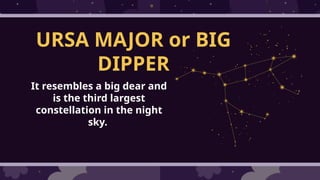
URSA MAJOR or BIG
DIPPER
It resembles a big dear and
is the third largest
constellation in the night
sky.
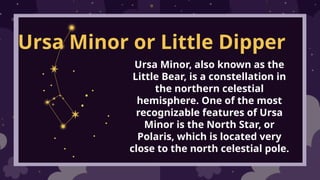
Ursa Minor or Little Dipper
Ursa Minor, also known as the
Little Bear, is a constellation in
the northern celestial
hemisphere. One of the most
recognizable features of Ursa
Minor is the North Star, or
Polaris, which is located very
close to the north celestial pole.
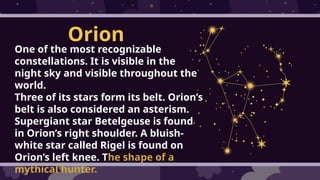
Orion
One of the most recognizable
constellations. It is visible in the
night sky and visible throughout the
world.
Three of its stars form its belt. Orion’s
belt is also considered an asterism.
Supergiant star Betelgeuse is found
in Orion’s right shoulder. A bluish-
white star called Rigel is found on
Orion’s left knee. The shape of a
mythical hunter.
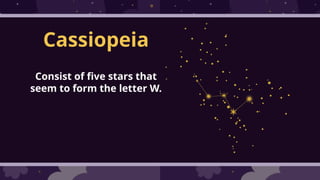
Cassiopeia
Consist of five stars that
seem to form the letter W.
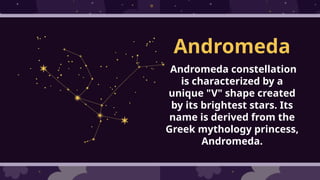
Andromeda
Andromeda constellation
is characterized by a
unique "V" shape created
by its brightest stars. Its
name is derived from the
Greek mythology princess,
Andromeda.
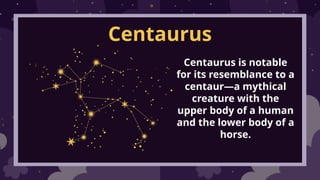
Centaurus
Centaurus is notable
for its resemblance to a
centaur—a mythical
creature with the
upper body of a human
and the lower body of a
horse.
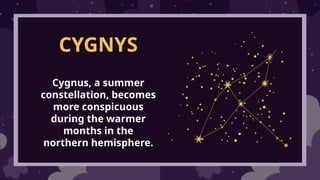
CYGNYS
Cygnus, a summer
constellation, becomes
more conspicuous
during the warmer
months in the
northern hemisphere.
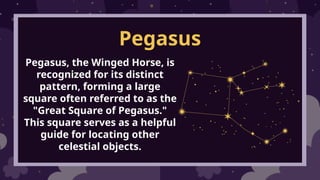
Pegasus
Pegasus, the Winged Horse, is
recognized for its distinct
pattern, forming a large
square often referred to as the
"Great Square of Pegasus."
This square serves as a helpful
guide for locating other
celestial objects.
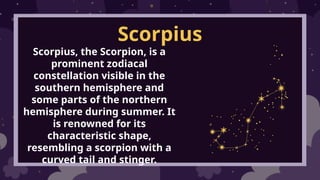
Scorpius
Scorpius, the Scorpion, is a
prominent zodiacal
constellation visible in the
southern hemisphere and
some parts of the northern
hemisphere during summer. It
is renowned for its
characteristic shape,
resembling a scorpion with a
curved tail and stinger.
CONSTELLATION IN THE
ZODIAZ
The people living in the Northern Hemisphere see constellations
different from those living in the Southern Hemisphere. Why do you
think so?
The stars appear to keep the same patterns in the sky, while the
much nearer sun, moon, and planets appear to move. However, the
sun and planets travel along a particular belt or path in the sky
called the Zodiac.
I hope you learn something new today!
THANK YOU!

constellation_Science-Grade 5 Level_Science Beyond.pptx

  • 1.
  • 2.
    Learning Objectives At theend of the lesson, pupils should be able to: recognize and name major constellation s in the sky classify constellations based on their observable characteristic s understand the different types of stars within constellations
  • 3.
    Constellations If you aregoing to observe the sky on a cloudless night very keenly, you will notice the patterns formed by groups of stars. The groups of stars that form distinct patterns in the sky are called constellations.
  • 4.
    What are someexamples of constellations?
  • 5.
    URSA MAJOR orBIG DIPPER It resembles a big dear and is the third largest constellation in the night sky.
  • 6.
    Ursa Minor orLittle Dipper Ursa Minor, also known as the Little Bear, is a constellation in the northern celestial hemisphere. One of the most recognizable features of Ursa Minor is the North Star, or Polaris, which is located very close to the north celestial pole.
  • 7.
    Orion One of themost recognizable constellations. It is visible in the night sky and visible throughout the world. Three of its stars form its belt. Orion’s belt is also considered an asterism. Supergiant star Betelgeuse is found in Orion’s right shoulder. A bluish- white star called Rigel is found on Orion’s left knee. The shape of a mythical hunter.
  • 8.
    Cassiopeia Consist of fivestars that seem to form the letter W.
  • 9.
    Andromeda Andromeda constellation is characterizedby a unique "V" shape created by its brightest stars. Its name is derived from the Greek mythology princess, Andromeda.
  • 10.
    Centaurus Centaurus is notable forits resemblance to a centaur—a mythical creature with the upper body of a human and the lower body of a horse.
  • 11.
    CYGNYS Cygnus, a summer constellation,becomes more conspicuous during the warmer months in the northern hemisphere.
  • 12.
    Pegasus Pegasus, the WingedHorse, is recognized for its distinct pattern, forming a large square often referred to as the "Great Square of Pegasus." This square serves as a helpful guide for locating other celestial objects.
  • 13.
    Scorpius Scorpius, the Scorpion,is a prominent zodiacal constellation visible in the southern hemisphere and some parts of the northern hemisphere during summer. It is renowned for its characteristic shape, resembling a scorpion with a curved tail and stinger.
  • 14.
    CONSTELLATION IN THE ZODIAZ Thepeople living in the Northern Hemisphere see constellations different from those living in the Southern Hemisphere. Why do you think so? The stars appear to keep the same patterns in the sky, while the much nearer sun, moon, and planets appear to move. However, the sun and planets travel along a particular belt or path in the sky called the Zodiac.
  • 15.
    I hope youlearn something new today! THANK YOU!