Conservation
Science
May Faulk
Extinctions, conservation
science and biodiversity
 There may be from 8-100 million species on Earth
actual amounts are still unknown only 1 percent of
plants have been investigated from 250,000 species.
 Extinction rates between 50-150 species per day
 Using an estimate of 10 million species about .2-.6
percent are lost each year
 When today’s high school students are grandparents
more than half of the species on earth may be gone
if we continue the extinction rate of species at its
present rate.
 Source Norman Myers author of article ‘What’s this
Biodiversity and What’s it Done for Us today?’
Conservation Science
 Developed throughout the 20th century
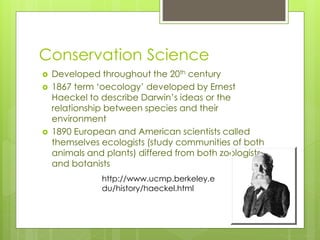
 1867 term ‘oecology’ developed by Ernest
Haeckel to describe Darwin’s ideas or the
relationship between species and their
environment
 1890 European and American scientists called
themselves ecologists (study communities of both
animals and plants) differed from both zoologists
and botanists
http://www.ucmp.berkeley.e
du/history/haeckel.html
Two opposing views
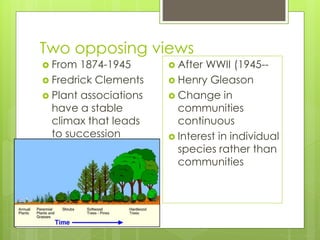
 From 1874-1945
 Fredrick Clements
 Plant associations
have a stable
climax that leads
to succession
 After WWII (1945--
 Henry Gleason
 Change in
communities
continuous
 Interest in individual
species rather than
communities
 After WWII a new environmental movement
changes American culture in regard to ecology
and science.
Environmental advocates did not trust scientists would
be a benefit to wilderness because…
By 1947 U.S produced ___________ lbs of DDT
 124,258,00
 198, 589,00
 637,666,00
True or False
In the town of Donora PA a deadly smog killed 20
people and 6000 people became sick?
.
From the 1940s -1960s Two
types of scientists existed
Ecologists
Aldo Leopold -forest
management
Rachel Carson -
marine biologist
Paul Ehrlick -
entomologist
E.O Wilson -
entomologist
Scientists who worked for
commercial industries
that produced
atomic bombs,
pesticides,
herbicides, medical
and biological
warfare
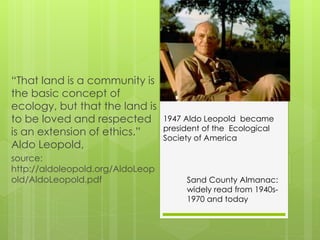
“That land is a community is
the basic concept of
ecology, but that the land is
to be loved and respected
is an extension of ethics.”
Aldo Leopold,
source:
http://aldoleopold.org/AldoLeop
old/AldoLeopold.pdf Sand County Almanac:
widely read from 1940s-
1970 and today
1947 Aldo Leopold became
president of the Ecological
Society of America
Educating the public
In the 1950s and early 1960s
 People wanted to remember a romantic past
 Ignore devastation of landscape by pesticides,
land pollution to include industrial air and water
pollution
 Celebrated the life of John Muir
The mid 1960s began the “age of ecology” (Lewis,
2007, p.207)
 Why did it take so long for the public to become
involved with environmental issues?
 Eventually the environmental movement began to
educate people on scientific and ecological
terms
 carrying capacity, invasive species, extinctions
and biodiversity because of these voices
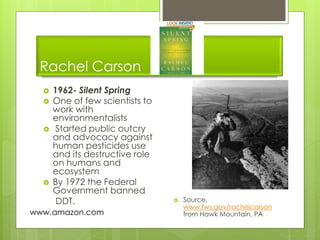
Rachel Carson
 1962- Silent Spring
 One of few scientists to
work with
environmentalists
 Started public outcry
and advocacy against
human pesticides use
and its destructive role
on humans and
ecosystem
 By 1972 the Federal
Government banned
DDT.  Source.
www.fws.gov/rachelcarson
from Hawk Mountain, PAwww.amazon.com
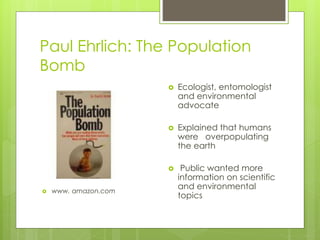
Paul Ehrlich: The Population
Bomb
 www. amazon.com
 Ecologist, entomologist
and environmental
advocate
 Explained that humans
were overpopulating
the earth
 Public wanted more
information on scientific
and environmental
topics
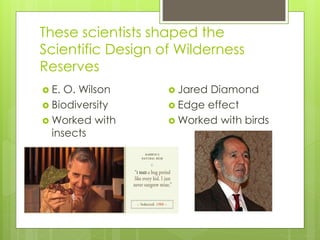
These scientists shaped the
Scientific Design of Wilderness
Reserves
 E. O. Wilson
 Biodiversity
 Worked with
insects
 Jared Diamond
 Edge effect
 Worked with birds
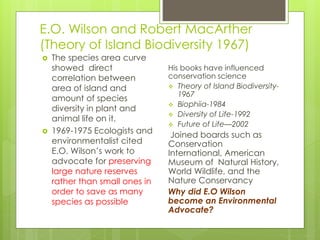
E.O. Wilson and Robert MacArther
(Theory of Island Biodiversity 1967)
 The species area curve
showed direct
correlation between
area of island and
amount of species
diversity in plant and
animal life on it.
 1969-1975 Ecologists and
environmentalist cited
E.O. Wilson’s work to
advocate for preserving
large nature reserves
rather than small ones in
order to save as many
species as possible
His books have influenced
conservation science
 Theory of Island Biodiversity-
1967
 Biophiia-1984
 Diversity of Life-1992
 Future of Life—2002
Joined boards such as
Conservation
International, American
Museum of Natural History,
World Wildlife, and the
Nature Conservancy
Why did E.O Wilson
become an Environmental
Advocate?
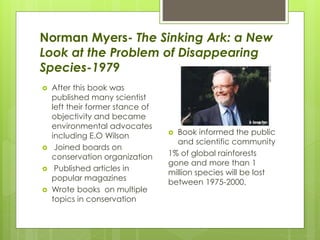
Norman Myers- The Sinking Ark: a New
Look at the Problem of Disappearing
Species-1979
 After this book was
published many scientist
left their former stance of
objectivity and became
environmental advocates
including E.O Wilson
 Joined boards on
conservation organization
 Published articles in
popular magazines
 Wrote books on multiple
topics in conservation
 Book informed the public
and scientific community
1% of global rainforests
gone and more than 1
million species will be lost
between 1975-2000.
Scientific Design of wilderness
areas: Keystone species or
umbrella species 1970-1980
 Minimum viable
population of species
for gene diversity
 Save wilderness for
large carnivores like
mountain lions and
bears
 Easy to gain support
with environmental
advocacy for wolves,
bears, tigers etc.
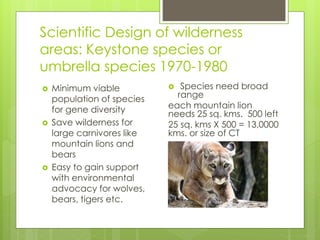
 Species need broad
range
each mountain lion
needs 25 sq. kms. 500 left
25 sq. kms X 500 = 13,0000
kms. or size of CT
Edge Effect and SLOSS
preservation
 Jared Diamond
stated ‘edge
effect’ different
species on edge of
forest verses other
species in the
interior for example
oven bird
 Single large or
several small
microhabitats ---
save as much
diversity as possible
Two types of Ecology
Conservation
Biology
1. Which category
would have the
Tijuana River Estuary?
3. Which category
would have Rocking
the Boat?
Hint: Bronx, NY
Restoration
Ecology
2. Which category
would study a wood
frog in a vernal pool?
4. Which category
would study a oven
bird in its natural
habitat?
Society for
Conservation
Biology
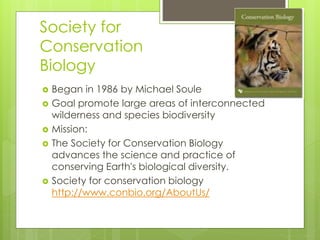
 Began in 1986 by Michael Soule
 Goal promote large areas of interconnected
wilderness and species biodiversity
 Mission:
 The Society for Conservation Biology
advances the science and practice of
conserving Earth's biological diversity.
 Society for conservation biology
http://www.conbio.org/AboutUs/
Society for Ecological
Restoration
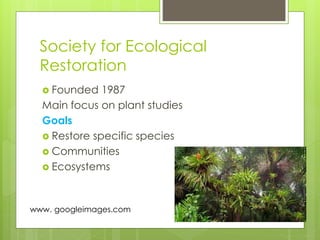
 Founded 1987
Main focus on plant studies
Goals
 Restore specific species
 Communities
 Ecosystems
www. googleimages.com
Match author to book
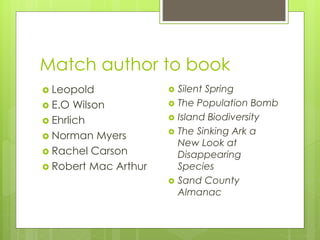
 Leopold
 E.O Wilson
 Ehrlich
 Norman Myers
 Rachel Carson
 Robert Mac Arthur
 Silent Spring
 The Population Bomb
 Island Biodiversity
 The Sinking Ark a
New Look at
Disappearing
Species
 Sand County
Almanac
Conservation and ecological
science
 Contributed knowledge to all Americans
 Americans used it to conserve wilderness
 Science has shaped attitudes about wilderness
 Direct affect on how Americans “understand, manage and
preserve wilderness” (Lewis, p. 207, 2007)
 Ecology study interactions among community of species
 Human influences on nature undesirable
 Preservation of large wilderness verses small wilderness
areas
 Humans depend on nature and biodiversity for survival yet
continue to threaten it and their own existence.
References
 Carson, R. U. S. Fish and Wildlife Service retrieved on October 31,
2011 from http://www.fws.gov/rachelcarson/#bio
 Clements, F. United States Department of History retrieved on Nov
1, 2011 from
http://www.history.ucsb.edu/projects/westcampus/clements/bio.ht
m
 Diamond, J. photo retrieved on Nov 1,2011 from www. wikipedia
 Hackel E. University of Berkley retrieved on Oct 31 from
http://www.ucmp.berkeley.edu/history/haeckel.html
 Erhlick, P. book picture retrieved on Nov 1, 2011 from
www.amozon.com
 Kline, B. (20i1). First along the river. Lanham; MD: Rowman and
Littlefield
 Leopold,A Aldo Leopold Foundation retrieved on Oct 27, 2011
from http://aldoleopold.org/AldoLeopold/leopold_bio.shtml
 Lewis, M. (2007). American wilderness A new history New York:
Oxford.
 Mountain lion photo retrieved on Nov 1, 2011 from
www.images.search yahoo.com
 Secession landscape retrieved on Nov 1, 2011
photohttp://www.physicalgeography.net/fundamentals/imag
es/succession.gif
 Society for conservation biology retrieved on October 27, 2011
from //www.conbio.org/AboutUs
 Wilson, E.O photo retrieved on October 27, from
http://www.eowilson.org
 Wilson, E. O. Biophilia Center at Nokuse Plantation retrieved on
October 27, 2011 from
http://eowilsoncenter.org/viewphotos.html
 Wilson, E. O. Academy of Achievement. Museum of Living
History. Washington D.C. E.O Wilson retrieved on October 27,
2011
http://www.achievement.org/autodoc/page/wil2gal-1

Conservation Science powerpoint

  • 1.
  • 2.
    Extinctions, conservation science andbiodiversity  There may be from 8-100 million species on Earth actual amounts are still unknown only 1 percent of plants have been investigated from 250,000 species.  Extinction rates between 50-150 species per day  Using an estimate of 10 million species about .2-.6 percent are lost each year  When today’s high school students are grandparents more than half of the species on earth may be gone if we continue the extinction rate of species at its present rate.  Source Norman Myers author of article ‘What’s this Biodiversity and What’s it Done for Us today?’
  • 3.
    Conservation Science  Developedthroughout the 20th century  1867 term ‘oecology’ developed by Ernest Haeckel to describe Darwin’s ideas or the relationship between species and their environment  1890 European and American scientists called themselves ecologists (study communities of both animals and plants) differed from both zoologists and botanists http://www.ucmp.berkeley.e du/history/haeckel.html
  • 4.
    Two opposing views From 1874-1945  Fredrick Clements  Plant associations have a stable climax that leads to succession  After WWII (1945--  Henry Gleason  Change in communities continuous  Interest in individual species rather than communities
  • 5.
     After WWIIa new environmental movement changes American culture in regard to ecology and science. Environmental advocates did not trust scientists would be a benefit to wilderness because… By 1947 U.S produced ___________ lbs of DDT  124,258,00  198, 589,00  637,666,00 True or False In the town of Donora PA a deadly smog killed 20 people and 6000 people became sick? .
  • 6.
    From the 1940s-1960s Two types of scientists existed Ecologists Aldo Leopold -forest management Rachel Carson - marine biologist Paul Ehrlick - entomologist E.O Wilson - entomologist Scientists who worked for commercial industries that produced atomic bombs, pesticides, herbicides, medical and biological warfare
  • 7.
    “That land isa community is the basic concept of ecology, but that the land is to be loved and respected is an extension of ethics.” Aldo Leopold, source: http://aldoleopold.org/AldoLeop old/AldoLeopold.pdf Sand County Almanac: widely read from 1940s- 1970 and today 1947 Aldo Leopold became president of the Ecological Society of America
  • 8.
    Educating the public Inthe 1950s and early 1960s  People wanted to remember a romantic past  Ignore devastation of landscape by pesticides, land pollution to include industrial air and water pollution  Celebrated the life of John Muir The mid 1960s began the “age of ecology” (Lewis, 2007, p.207)  Why did it take so long for the public to become involved with environmental issues?  Eventually the environmental movement began to educate people on scientific and ecological terms  carrying capacity, invasive species, extinctions and biodiversity because of these voices
  • 9.
    Rachel Carson  1962-Silent Spring  One of few scientists to work with environmentalists  Started public outcry and advocacy against human pesticides use and its destructive role on humans and ecosystem  By 1972 the Federal Government banned DDT.  Source. www.fws.gov/rachelcarson from Hawk Mountain, PAwww.amazon.com
  • 10.
    Paul Ehrlich: ThePopulation Bomb  www. amazon.com  Ecologist, entomologist and environmental advocate  Explained that humans were overpopulating the earth  Public wanted more information on scientific and environmental topics
  • 11.
    These scientists shapedthe Scientific Design of Wilderness Reserves  E. O. Wilson  Biodiversity  Worked with insects  Jared Diamond  Edge effect  Worked with birds
  • 12.
    E.O. Wilson andRobert MacArther (Theory of Island Biodiversity 1967)  The species area curve showed direct correlation between area of island and amount of species diversity in plant and animal life on it.  1969-1975 Ecologists and environmentalist cited E.O. Wilson’s work to advocate for preserving large nature reserves rather than small ones in order to save as many species as possible His books have influenced conservation science  Theory of Island Biodiversity- 1967  Biophiia-1984  Diversity of Life-1992  Future of Life—2002 Joined boards such as Conservation International, American Museum of Natural History, World Wildlife, and the Nature Conservancy Why did E.O Wilson become an Environmental Advocate?
  • 13.
    Norman Myers- TheSinking Ark: a New Look at the Problem of Disappearing Species-1979  After this book was published many scientist left their former stance of objectivity and became environmental advocates including E.O Wilson  Joined boards on conservation organization  Published articles in popular magazines  Wrote books on multiple topics in conservation  Book informed the public and scientific community 1% of global rainforests gone and more than 1 million species will be lost between 1975-2000.
  • 14.
    Scientific Design ofwilderness areas: Keystone species or umbrella species 1970-1980  Minimum viable population of species for gene diversity  Save wilderness for large carnivores like mountain lions and bears  Easy to gain support with environmental advocacy for wolves, bears, tigers etc.  Species need broad range each mountain lion needs 25 sq. kms. 500 left 25 sq. kms X 500 = 13,0000 kms. or size of CT
  • 15.
    Edge Effect andSLOSS preservation  Jared Diamond stated ‘edge effect’ different species on edge of forest verses other species in the interior for example oven bird  Single large or several small microhabitats --- save as much diversity as possible
  • 16.
    Two types ofEcology Conservation Biology 1. Which category would have the Tijuana River Estuary? 3. Which category would have Rocking the Boat? Hint: Bronx, NY Restoration Ecology 2. Which category would study a wood frog in a vernal pool? 4. Which category would study a oven bird in its natural habitat?
  • 17.
    Society for Conservation Biology  Beganin 1986 by Michael Soule  Goal promote large areas of interconnected wilderness and species biodiversity  Mission:  The Society for Conservation Biology advances the science and practice of conserving Earth's biological diversity.  Society for conservation biology http://www.conbio.org/AboutUs/
  • 18.
    Society for Ecological Restoration Founded 1987 Main focus on plant studies Goals  Restore specific species  Communities  Ecosystems www. googleimages.com
  • 19.
    Match author tobook  Leopold  E.O Wilson  Ehrlich  Norman Myers  Rachel Carson  Robert Mac Arthur  Silent Spring  The Population Bomb  Island Biodiversity  The Sinking Ark a New Look at Disappearing Species  Sand County Almanac
  • 20.
    Conservation and ecological science Contributed knowledge to all Americans  Americans used it to conserve wilderness  Science has shaped attitudes about wilderness  Direct affect on how Americans “understand, manage and preserve wilderness” (Lewis, p. 207, 2007)  Ecology study interactions among community of species  Human influences on nature undesirable  Preservation of large wilderness verses small wilderness areas  Humans depend on nature and biodiversity for survival yet continue to threaten it and their own existence.
  • 21.
    References  Carson, R.U. S. Fish and Wildlife Service retrieved on October 31, 2011 from http://www.fws.gov/rachelcarson/#bio  Clements, F. United States Department of History retrieved on Nov 1, 2011 from http://www.history.ucsb.edu/projects/westcampus/clements/bio.ht m  Diamond, J. photo retrieved on Nov 1,2011 from www. wikipedia  Hackel E. University of Berkley retrieved on Oct 31 from http://www.ucmp.berkeley.edu/history/haeckel.html  Erhlick, P. book picture retrieved on Nov 1, 2011 from www.amozon.com  Kline, B. (20i1). First along the river. Lanham; MD: Rowman and Littlefield  Leopold,A Aldo Leopold Foundation retrieved on Oct 27, 2011 from http://aldoleopold.org/AldoLeopold/leopold_bio.shtml  Lewis, M. (2007). American wilderness A new history New York: Oxford.  Mountain lion photo retrieved on Nov 1, 2011 from www.images.search yahoo.com
  • 22.
     Secession landscaperetrieved on Nov 1, 2011 photohttp://www.physicalgeography.net/fundamentals/imag es/succession.gif  Society for conservation biology retrieved on October 27, 2011 from //www.conbio.org/AboutUs  Wilson, E.O photo retrieved on October 27, from http://www.eowilson.org  Wilson, E. O. Biophilia Center at Nokuse Plantation retrieved on October 27, 2011 from http://eowilsoncenter.org/viewphotos.html  Wilson, E. O. Academy of Achievement. Museum of Living History. Washington D.C. E.O Wilson retrieved on October 27, 2011 http://www.achievement.org/autodoc/page/wil2gal-1