Topic:-Role of Government
in maintaining the heritage
of monuments by taking
special care
Role of Government in conservation
Introduction :-
Name :-Vishwajeet Kachawah
Role of Government after 1947
in constitution
A NITI AAYOG REPORT 5
The Constitution of India has divided the jurisdiction over these
monuments, cultural heritage, and archaeological sites as follows:
Union: Ancient and Historical Monuments and Archaeological sites
and remains, declared by Parliament, by law to be of national
importance.
State: Ancient and Historical Monuments other than those declared
by Parliament to be of national importance.
Concurrent: Besides the above, both the Union and States have
concurrent jurisdic- tion over archaeological sites and remains
other than those declared by law and Parliament to be of national
importance
Article 253 of the Constitution of India, enables Parliament to
legislate for the im- plementation of any treaty, agreement or
convention with any other country or countries, or any decision,
made at any international conference, association or other body.
Any such legislation can be enacted even if the subject matter of
the legislation is an item in the State List of the Constitution of
India.
6 IMPROVING HERITAGE MANAGEMENT IN INDIA
“We should be aware of the International Con- ventions
that are relevant to the protection and conservation of art
and cultural heritage and to which India is a signatory.”
-Convention on the Protection and Promotion of the Diver-
sity of Cultural Expressions. Paris, 20 October 2005
-Convention for the Safeguarding of the Intangible Cultur-
al Heritage. Paris, 17 October 2003.
-Convention concerning the Protection of the World Cul-
tural and Natural Heritage. Paris, 16 November 1972.
-Convention on the Means of Prohibiting and Preventing
the Illicit Import, Export and Transfer of Ownership of Cul-
tural Property. Paris, 14 November 1970.
-Protocol to the Convention for the Protection of Cultur- al
Property in the Event of Armed Conflict. The Hague, 14
May 1954.
-Convention for the Protection of Cultural Property in the
Event of Armed Conflict with Regulations for the Execu-
tion of the Convention. The Hague, 14 May 1954.
3.
A NITI AAYOG REPORT 7
Vision“Value, protect, conserve, interpret and foster
India’s unique and di- verse Archaeological and
Built Heritage as;
-a channel for continuing cross cultural linkages at
the international level
-a means for nation building and testimony to
India’s cultural identity at the national level and,
-a development tool for socio-economic upliftment
at the local level and sustainability for future
generations,
with an all-encompassing, inclusive, multisectoral
and multidisci- plinary approach involving the
entire gamut of heritage stakeholders from the
myriad custodians and range of heritage experts to
the visi- tors as well as citizens of India.”
Sanchi at the time of discovery
Sanchi after conservation
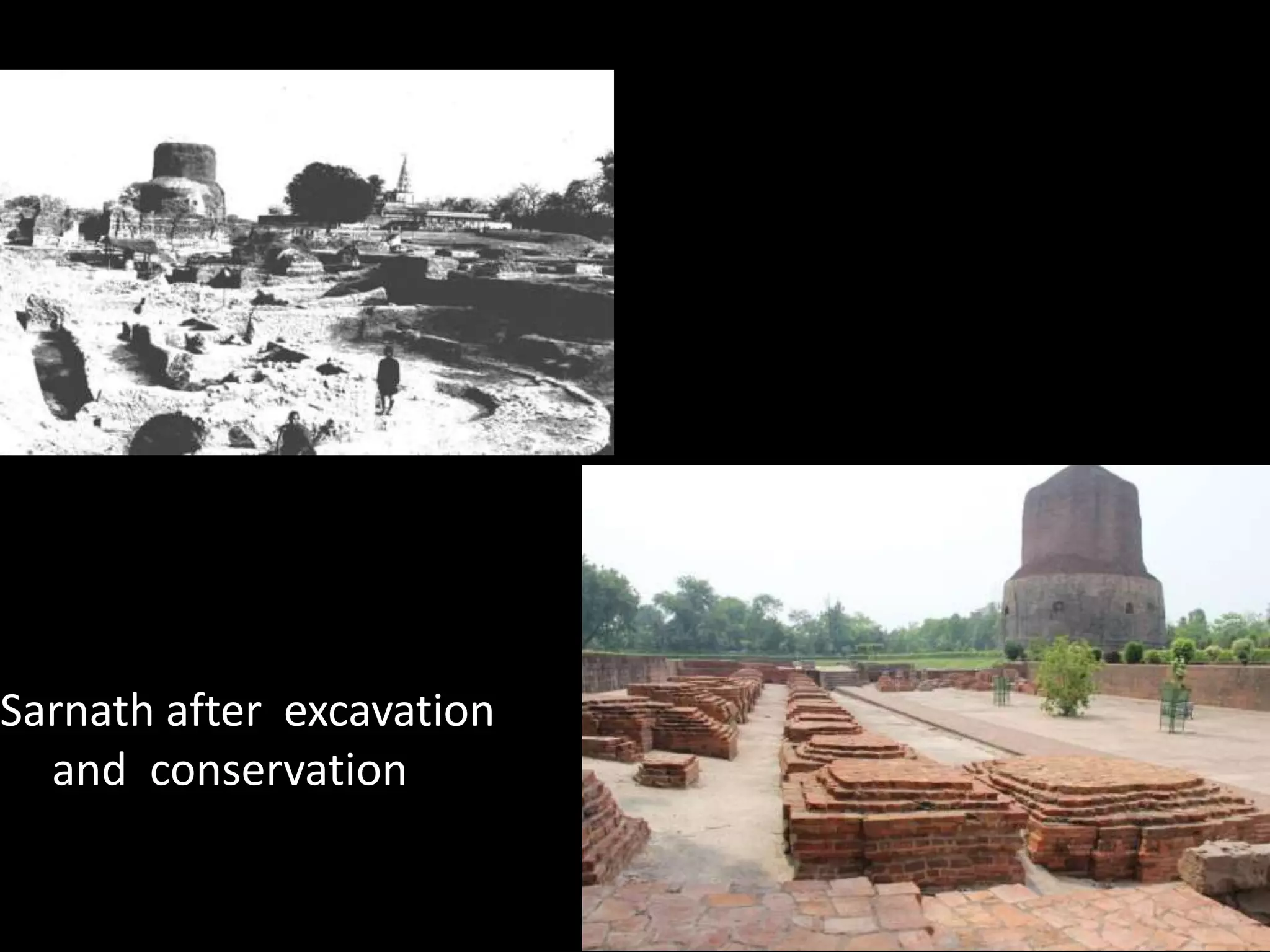
19th century ‘discovery’ of
‘monuments’ and beginnings
of legislation
Sarnath after excavation
and conservation
24 IMPROVING HERITAGE MANAGEMENT IN INDIA
India’s Built
Heritage
500,000+ heritage sites and
monuments
3691 ASI
Protected
Monuments
38 UNESCO
World Heritage
Sites
A NITI AAYOG REPORT 25
400,000 +
Religious Heritage
Sites
1800 +
Archaeological
Sites
50
historic cities
6000 + State
Archaeology
Protected
Monuments
134 IMPROVING HERITAGE MANAGEMENT ININDIA
Upgradation of the
Archaeological
Survey of India
Strengthening of old and introduction of new
verticals
Scale upgradation at par with UGC
A NITI AAYOG REPORT 135
NATIONAL DATABASE AND
DOCUMENTATION
Implementation of
comprehensive database and
documentation system
CONSERVATION
Implementation of National
Conservation Policy
EXCAVATION
Notification of Draft
Policy for excavation and
exploration
EPIGRAPHY
Sourcing of language
experts and training
programs
MANAGEMENT
Use of revenue from tickets
for conservation works
ANTIQUITIES
Strengthening of CAC
guidelines
HORTICULTURE AND
LANDSCAPE
Draft policy on hydrology and
re-creation of traditional water
systems
UNDERWATER
ARCHAEOLOGY
Revival of underwater
archaeology wing with NIO,
Goa
NGOs in Heritage Conservation and
Management in India
1. 1.Aga Khan Trust for Culture
2. Indian National Trust for Art and Cultural
Heritage
3. 3. International Council On Monuments and
sites
52 IMPROVING HERITAGE MANAGEMENT IN INDIA
90 IMPROVING HERITAGE MANAGEMENT IN INDIA
1. Excavation and
Exploration Policy to be
drafted and ad- opted
after public discussion
within 6
months period
3. Development of
laboratories for post-
excavation
analysis.
6. Re-exposing and
putting the excavat- ed
sites in public do-
main
4. Archaeology as a
separate cadre
5. Publication of
Excavation Reports
within 6 months
period
2. ASI Vision Plan to be
made for
exploration and
excavation.
Excavation and Exploration of Archaeological Sites
A NITI AAYOG REPORT 91
72 IMPROVING HERITAGE MANAGEMENT IN INDIA
Conservation of
National Heritage
A NITI AAYOG REPORT 73
1. National Policy on
Conservation needs to
be implemented
vigorously
2. Conservation Plan be
prepared for the
site before undertaking
any conservation
works
3. Provision for Work
Audit needs to be
incorporated
4. Region-wise em-
panelment of crafts
persons
5. National Level
awards to be given to
ASI Circles, State
Governments and
other heritage
custodians
Group of Monuments, Mahabalipuram
98 IMPROVING HERITAGE MANAGEMENT IN INDIA
1. Budget
2020-21 proposed five
archaeological sites to be
developed as iconic sites
with on-site Museums.
These should be completed
in next 3 years. Clear Action
Plan to be finalised.
2. Clear Action Plan to
be finalised for the
proposed mu- seums in
Rakhigarhi (HR),
Hastinapur (UP)
Shivsagar (Assam),
Dholavira (GJ) and
Adichanallur (TN).
4. An inter-
disciplinary team of
specialists,
archaeologists, curators,
exhibition designers
need to be engaged
5. Financially
sustainable and
revenue generation
models to be adopted
3. ASI should finalize
world class projects for
2 site museums Hampi
and Sarnath within next
3 months
Developing
Site Museums
A NITI AAYOG REPORT 99
100 IMPROVING HERITAGE MANAGEMENT ININDIA
16. Sarnath Museum
17. Vaishali Museum
18. Vikramshila Museum, Antichak
19. Cooch Bihar Palace Museum
20. Surya Pahar Museum, Goalpara
21. Chanderi Museum and Period Museum, Chanderi
22. Khajuraho Museum
23. Bodhgaya Museumm
24. Nalanda Museum
25. Hazarduari Palace Museum, Murshidabad
27. Archaeological Museum, Dholavira
28. Archaeological Museum, Lothal
29. Tamluk Museum
30. Ratnagiri Museum
31. Lalitgiri Site Museum
32. Konark Museum
33. Kondapur Museum
34. Bijapur Museum
35. Nagarjunakonda Museum
36. Amravati Museum
37. Badami Museum
38. Aihole Museum
39. Velha Goa Museum, Goa
40. Kamlapur Museum, Hampi
41. Halebidu Museum
42. Chandragiri Museum
43. Tipu Sultan Museum, Srirangapatana
26. Sanchi Museum and Sir John Marshall Memorial, Sanchi 44. Fort St George Museum, Chennai
45. Mattancherry Palace Museum 46.
47.
48.
49.
50.
Archaeological Site Museums in India;
Source - asi.nic.in
1. Burzahom Site Museum
2. Kangra Fort Museum
3. Ropar Museum
4. Sheikh Chili’s Tomb, Thanesar
5. Kalibangan Museum
6. Jageshwar Museum, Almora
7.Purana Qila Museum, Archaeological Museum (Red Fort), Indian War
Memorial Museum (Red Fort), Swatantra San- gram Sangrahalaya (Red
Fort), Swadhinata Senani Smarak Sangrahalaya (Salimgarh), and
Children’s Museum, Delhi
8. Deeg Palace Museum
9. Fatehpur Sikri Museum
10. Taj Museum, Agra
11. Piprahwa Site Museum
108 IMPROVING HERITAGE MANAGEMENT ININDIA
Heritage Tourism, Revenue
Generation and Marketing
A NITI AAYOG REPORT 109
7. Crowdfunding/
community
funding/ CSR
8.Tourism
Experience to
cater to all
segments of
Society
Action
Points
1. Adopt
Revenue
Generation Mod- el
through PPP
Schemes
2.Professional and
focused marketing
effort with
Information
Technology and
Promotion
3. Each ASI site
to be treated as
separate profit
centres
4. ASI
revenues to be
ploughed back
to the site5. National
Culture Fund –
To be made
autonomous
6.Processing of
the pending
MoUs under Adopt a
Heritage to be
accelerated
156 IMPROVING HERITAGE MANAGEMENT ININDIA
Taj mahal is becoming yellow by
pollution
Taj Mahal had again get its beauty
during lockdown
A NITI AAYOG REPORT 125
Thank you

conservation of heritage sites in India and role of government

  • 2.
    Topic:-Role of Government inmaintaining the heritage of monuments by taking special care Role of Government in conservation Introduction :- Name :-Vishwajeet Kachawah
  • 4.
    Role of Governmentafter 1947 in constitution
  • 5.
    A NITI AAYOGREPORT 5 The Constitution of India has divided the jurisdiction over these monuments, cultural heritage, and archaeological sites as follows: Union: Ancient and Historical Monuments and Archaeological sites and remains, declared by Parliament, by law to be of national importance. State: Ancient and Historical Monuments other than those declared by Parliament to be of national importance. Concurrent: Besides the above, both the Union and States have concurrent jurisdic- tion over archaeological sites and remains other than those declared by law and Parliament to be of national importance Article 253 of the Constitution of India, enables Parliament to legislate for the im- plementation of any treaty, agreement or convention with any other country or countries, or any decision, made at any international conference, association or other body. Any such legislation can be enacted even if the subject matter of the legislation is an item in the State List of the Constitution of India.
  • 6.
    6 IMPROVING HERITAGEMANAGEMENT IN INDIA “We should be aware of the International Con- ventions that are relevant to the protection and conservation of art and cultural heritage and to which India is a signatory.” -Convention on the Protection and Promotion of the Diver- sity of Cultural Expressions. Paris, 20 October 2005 -Convention for the Safeguarding of the Intangible Cultur- al Heritage. Paris, 17 October 2003. -Convention concerning the Protection of the World Cul- tural and Natural Heritage. Paris, 16 November 1972. -Convention on the Means of Prohibiting and Preventing the Illicit Import, Export and Transfer of Ownership of Cul- tural Property. Paris, 14 November 1970. -Protocol to the Convention for the Protection of Cultur- al Property in the Event of Armed Conflict. The Hague, 14 May 1954. -Convention for the Protection of Cultural Property in the Event of Armed Conflict with Regulations for the Execu- tion of the Convention. The Hague, 14 May 1954. 3.
  • 7.
    A NITI AAYOGREPORT 7 Vision“Value, protect, conserve, interpret and foster India’s unique and di- verse Archaeological and Built Heritage as; -a channel for continuing cross cultural linkages at the international level -a means for nation building and testimony to India’s cultural identity at the national level and, -a development tool for socio-economic upliftment at the local level and sustainability for future generations, with an all-encompassing, inclusive, multisectoral and multidisci- plinary approach involving the entire gamut of heritage stakeholders from the myriad custodians and range of heritage experts to the visi- tors as well as citizens of India.”
  • 8.
    Sanchi at thetime of discovery Sanchi after conservation 19th century ‘discovery’ of ‘monuments’ and beginnings of legislation
  • 9.
  • 10.
    24 IMPROVING HERITAGEMANAGEMENT IN INDIA India’s Built Heritage 500,000+ heritage sites and monuments 3691 ASI Protected Monuments 38 UNESCO World Heritage Sites
  • 11.
    A NITI AAYOGREPORT 25 400,000 + Religious Heritage Sites 1800 + Archaeological Sites 50 historic cities 6000 + State Archaeology Protected Monuments
  • 12.
    134 IMPROVING HERITAGEMANAGEMENT ININDIA Upgradation of the Archaeological Survey of India Strengthening of old and introduction of new verticals Scale upgradation at par with UGC
  • 13.
    A NITI AAYOGREPORT 135 NATIONAL DATABASE AND DOCUMENTATION Implementation of comprehensive database and documentation system CONSERVATION Implementation of National Conservation Policy EXCAVATION Notification of Draft Policy for excavation and exploration EPIGRAPHY Sourcing of language experts and training programs MANAGEMENT Use of revenue from tickets for conservation works ANTIQUITIES Strengthening of CAC guidelines HORTICULTURE AND LANDSCAPE Draft policy on hydrology and re-creation of traditional water systems UNDERWATER ARCHAEOLOGY Revival of underwater archaeology wing with NIO, Goa
  • 14.
    NGOs in HeritageConservation and Management in India 1. 1.Aga Khan Trust for Culture 2. Indian National Trust for Art and Cultural Heritage 3. 3. International Council On Monuments and sites 52 IMPROVING HERITAGE MANAGEMENT IN INDIA
  • 15.
    90 IMPROVING HERITAGEMANAGEMENT IN INDIA 1. Excavation and Exploration Policy to be drafted and ad- opted after public discussion within 6 months period 3. Development of laboratories for post- excavation analysis. 6. Re-exposing and putting the excavat- ed sites in public do- main 4. Archaeology as a separate cadre 5. Publication of Excavation Reports within 6 months period 2. ASI Vision Plan to be made for exploration and excavation. Excavation and Exploration of Archaeological Sites
  • 16.
    A NITI AAYOGREPORT 91
  • 17.
    72 IMPROVING HERITAGEMANAGEMENT IN INDIA Conservation of National Heritage
  • 18.
    A NITI AAYOGREPORT 73 1. National Policy on Conservation needs to be implemented vigorously 2. Conservation Plan be prepared for the site before undertaking any conservation works 3. Provision for Work Audit needs to be incorporated 4. Region-wise em- panelment of crafts persons 5. National Level awards to be given to ASI Circles, State Governments and other heritage custodians
  • 19.
    Group of Monuments,Mahabalipuram
  • 20.
    98 IMPROVING HERITAGEMANAGEMENT IN INDIA 1. Budget 2020-21 proposed five archaeological sites to be developed as iconic sites with on-site Museums. These should be completed in next 3 years. Clear Action Plan to be finalised. 2. Clear Action Plan to be finalised for the proposed mu- seums in Rakhigarhi (HR), Hastinapur (UP) Shivsagar (Assam), Dholavira (GJ) and Adichanallur (TN). 4. An inter- disciplinary team of specialists, archaeologists, curators, exhibition designers need to be engaged 5. Financially sustainable and revenue generation models to be adopted 3. ASI should finalize world class projects for 2 site museums Hampi and Sarnath within next 3 months Developing Site Museums
  • 21.
    A NITI AAYOGREPORT 99
  • 22.
    100 IMPROVING HERITAGEMANAGEMENT ININDIA 16. Sarnath Museum 17. Vaishali Museum 18. Vikramshila Museum, Antichak 19. Cooch Bihar Palace Museum 20. Surya Pahar Museum, Goalpara 21. Chanderi Museum and Period Museum, Chanderi 22. Khajuraho Museum 23. Bodhgaya Museumm 24. Nalanda Museum 25. Hazarduari Palace Museum, Murshidabad 27. Archaeological Museum, Dholavira 28. Archaeological Museum, Lothal 29. Tamluk Museum 30. Ratnagiri Museum 31. Lalitgiri Site Museum 32. Konark Museum 33. Kondapur Museum 34. Bijapur Museum 35. Nagarjunakonda Museum 36. Amravati Museum 37. Badami Museum 38. Aihole Museum 39. Velha Goa Museum, Goa 40. Kamlapur Museum, Hampi 41. Halebidu Museum 42. Chandragiri Museum 43. Tipu Sultan Museum, Srirangapatana 26. Sanchi Museum and Sir John Marshall Memorial, Sanchi 44. Fort St George Museum, Chennai 45. Mattancherry Palace Museum 46. 47. 48. 49. 50. Archaeological Site Museums in India; Source - asi.nic.in 1. Burzahom Site Museum 2. Kangra Fort Museum 3. Ropar Museum 4. Sheikh Chili’s Tomb, Thanesar 5. Kalibangan Museum 6. Jageshwar Museum, Almora 7.Purana Qila Museum, Archaeological Museum (Red Fort), Indian War Memorial Museum (Red Fort), Swatantra San- gram Sangrahalaya (Red Fort), Swadhinata Senani Smarak Sangrahalaya (Salimgarh), and Children’s Museum, Delhi 8. Deeg Palace Museum 9. Fatehpur Sikri Museum 10. Taj Museum, Agra 11. Piprahwa Site Museum
  • 23.
    108 IMPROVING HERITAGEMANAGEMENT ININDIA Heritage Tourism, Revenue Generation and Marketing
  • 24.
    A NITI AAYOGREPORT 109 7. Crowdfunding/ community funding/ CSR 8.Tourism Experience to cater to all segments of Society Action Points 1. Adopt Revenue Generation Mod- el through PPP Schemes 2.Professional and focused marketing effort with Information Technology and Promotion 3. Each ASI site to be treated as separate profit centres 4. ASI revenues to be ploughed back to the site5. National Culture Fund – To be made autonomous 6.Processing of the pending MoUs under Adopt a Heritage to be accelerated
  • 25.
    156 IMPROVING HERITAGEMANAGEMENT ININDIA
  • 26.
    Taj mahal isbecoming yellow by pollution
  • 27.
    Taj Mahal hadagain get its beauty during lockdown
  • 28.
    A NITI AAYOGREPORT 125
  • 29.