


Consequences of
Deinstitutionalization
MOHAMED ABDELBADIE
PSYCHIATRIST
Sharjah Medical Services
What do you think is the most
prevalent form of mental health
service?
Psychiatric hospitals-based service
VS
Community-based services
Which is better?
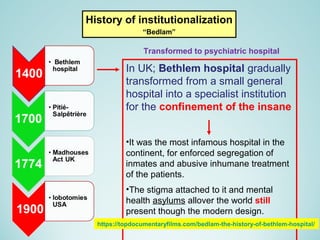
History of institutionalization
“Bedlam”
In UK; Bethlem hospital gradually
transformed from a small general
hospital into a specialist institution
for the confinement of the insane
•It was the most infamous hospital in the
continent, for enforced segregation of
inmates and abusive inhumane treatment
of the patients.
•The stigma attached to it and mental
health asylums allover the world still
present though the modern design.
https://topdocumentaryfilms.com/bedlam-the-history-of-bethlem-hospital/
Transformed to psychiatric hospital
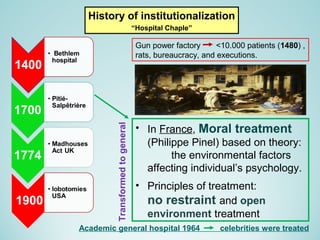
History of institutionalization
“Hospital Chaple”
• In France, Moral treatment
(Philippe Pinel) based on theory:
the environmental factors
affecting individual’s psychology.
• Principles of treatment:
no restraint and open
environment treatment
Gun power factory <10.000 patients (1480) ,
rats, bureaucracy, and executions.
Academic general hospital 1964 celebrities were treated
Transformedtogeneral
History of institutionalization
“mental health acts”
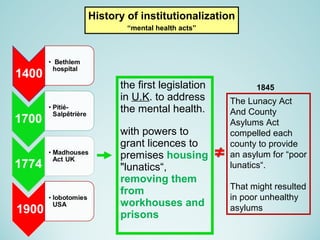
the first legislation
in U.K. to address
the mental health.
with powers to
grant licences to
premises housing
"lunatics“,
removing them
from
workhouses and
prisons
The Lunacy Act
And County
Asylums Act
compelled each
county to provide
an asylum for “poor
lunatics“.
That might resulted
in poor unhealthy
asylums
1845
History of institutionalization
“catastrophic treatments”
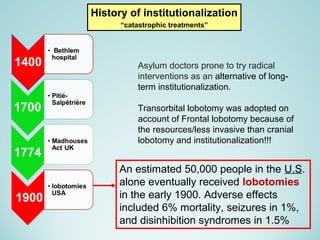
An estimated 50,000 people in the U.S.
alone eventually received lobotomies
in the early 1900. Adverse effects
included 6% mortality, seizures in 1%,
and disinhibition syndromes in 1.5%
Asylum doctors prone to try radical
interventions as an alternative of long-
term institutionalization.
Transorbital lobotomy was adopted on
account of Frontal lobotomy because of
the resources/less invasive than cranial
lobotomy and institutionalization!!!
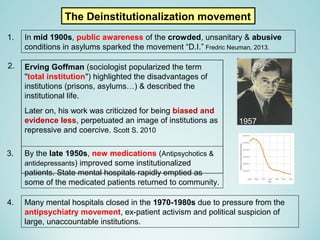
Erving Goffman (sociologist popularized the term
"total institution") highlighted the disadvantages of
institutions (prisons, asylums…) & described the
institutional life.
Later on, his work was criticized for being biased and
evidence less, perpetuated an image of institutions as
repressive and coercive. Scott S. 2010
The Deinstitutionalization movement
By the late 1950s, new medications (Antipsychotics &
antidepressants) improved some institutionalized
patients. State mental hospitals rapidly emptied as
some of the medicated patients returned to community.
In mid 1900s, public awareness of the crowded, unsanitary & abusive
conditions in asylums sparked the movement “D.I.” Fredric Neuman, 2013.
Many mental hospitals closed in the 1970-1980s due to pressure from the
antipsychiatry movement, ex-patient activism and political suspicion of
large, unaccountable institutions.
1.
4.
3.
2.
1957
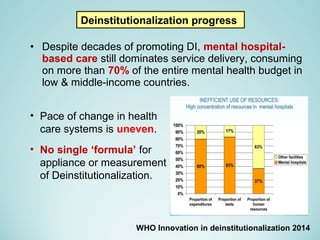
• Despite decades of promoting DI, mental hospital-
based care still dominates service delivery, consuming
on more than 70% of the entire mental health budget in
low & middle-income countries.
Deinstitutionalization progress
WHO Innovation in deinstitutionalization 2014
• Pace of change in health
care systems is uneven.
• No single ‘formula’ for
appliance or measurement
of Deinstitutionalization.
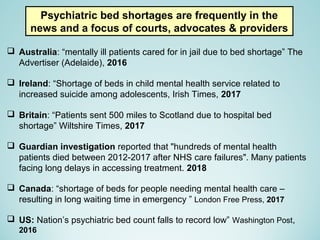
 Australia: “mentally ill patients cared for in jail due to bed shortage” The
Advertiser (Adelaide), 2016
 Ireland: “Shortage of beds in child mental health service related to
increased suicide among adolescents, Irish Times, 2017
 Britain: “Patients sent 500 miles to Scotland due to hospital bed
shortage” Wiltshire Times, 2017
 Guardian investigation reported that "hundreds of mental health
patients died between 2012-2017 after NHS care failures". Many patients
facing long delays in accessing treatment. 2018
 Canada: “shortage of beds for people needing mental health care –
resulting in long waiting time in emergency ” London Free Press, 2017
 US: Nation’s psychiatric bed count falls to record low” Washington Post,
2016
Psychiatric bed shortages are frequently in the
news and a focus of courts, advocates & providers
www.caglecartoons.com
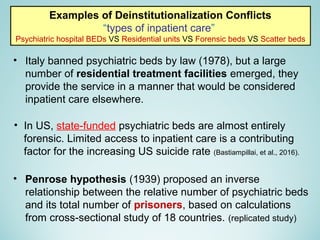
• Italy banned psychiatric beds by law (1978), but a large
number of residential treatment facilities emerged, they
provide the service in a manner that would be considered
inpatient care elsewhere.
Examples of Deinstitutionalization Conflicts
“types of inpatient care”
Psychiatric hospital BEDs VS Residential units VS Forensic beds VS Scatter beds
• Penrose hypothesis (1939) proposed an inverse
relationship between the relative number of psychiatric beds
and its total number of prisoners, based on calculations
from cross-sectional study of 18 countries. (replicated study)
• In US, state-funded psychiatric beds are almost entirely
forensic. Limited access to inpatient care is a contributing
factor for the increasing US suicide rate (Bastiampillai, et al., 2016).
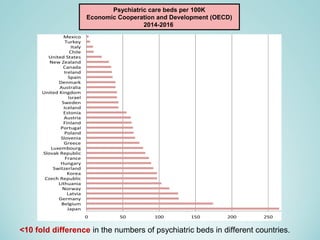
Psychiatric care beds per 100K
Economic Cooperation and Development (OECD)
2014-2016
<10 fold difference in the numbers of psychiatric beds in different countries.
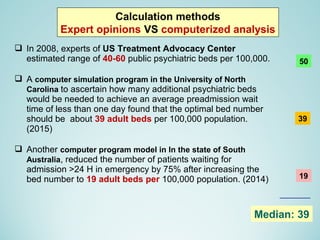
 In 2008, experts of US Treatment Advocacy Center
estimated range of 40-60 public psychiatric beds per 100,000.
 A computer simulation program in the University of North
Carolina to ascertain how many additional psychiatric beds
would be needed to achieve an average preadmission wait
time of less than one day found that the optimal bed number
should be about 39 adult beds per 100,000 population.
(2015)
 Another computer program model in In the state of South
Australia, reduced the number of patients waiting for
admission >24 H in emergency by 75% after increasing the
bed number to 19 adult beds per 100,000 population. (2014)
Calculation methods
Expert opinions VS computerized analysis
50
39
19
Median: 39
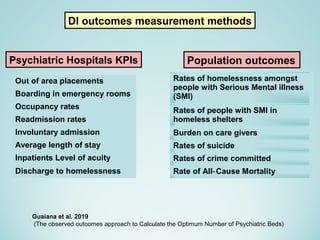
DI outcomes measurement methods
Guaiana et al. 2019
(The observed outcomes approach to Calculate the Optimum Number of Psychiatric Beds)
Psychiatric Hospitals KPIs Population outcomes
Out of area placements
Boarding in emergency rooms
Occupancy rates
Readmission rates
Involuntary admission
Average length of stay
Inpatients Level of acuity
Discharge to homelessness
Rates of homelessness amongst
people with Serious Mental illness
(SMI)
Rates of people with SMI in
homeless shelters
Burden on care givers
Rates of suicide
Rates of crime committed
Rate of All Cause Mortality‑
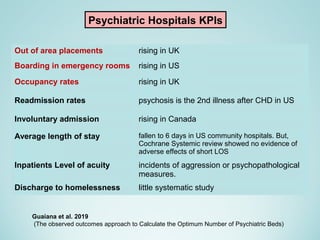
Psychiatric Hospitals KPIs
Out of area placements rising in UK
Boarding in emergency rooms rising in US
Occupancy rates rising in UK
Readmission rates psychosis is the 2nd illness after CHD in US
Involuntary admission rising in Canada
Average length of stay fallen to 6 days in US community hospitals. But,
Cochrane Systemic review showed no evidence of
adverse effects of short LOS
Inpatients Level of acuity incidents of aggression or psychopathological
measures.
Discharge to homelessness little systematic study
Guaiana et al. 2019
(The observed outcomes approach to Calculate the Optimum Number of Psychiatric Beds)
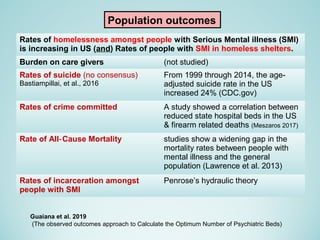
Population outcomes
Guaiana et al. 2019
(The observed outcomes approach to Calculate the Optimum Number of Psychiatric Beds)
Rates of homelessness amongst people with Serious Mental illness (SMI)
is increasing in US (and) Rates of people with SMI in homeless shelters.
Burden on care givers (not studied)
Rates of suicide (no consensus)
Bastiampillai, et al., 2016
From 1999 through 2014, the age-
adjusted suicide rate in the US
increased 24% (CDC.gov)
Rates of crime committed A study showed a correlation between
reduced state hospital beds in the US
& firearm related deaths (Meszaros 2017)
Rate of All Cause Mortality‑ studies show a widening gap in the
mortality rates between people with
mental illness and the general
population (Lawrence et al. 2013)
Rates of incarceration amongst
people with SMI
Penrose’s hydraulic theory
http://worldpopulationreview.com/countries/suicide-rate-by-country/ 2019
http://apps.who.int/gho/data/node.main.MHHR?lang=en/ 2104 – 2011*
http://apps.who.int/gho/data/node.main.MHBEDS?lang=en 2015
https://www.mapsofworld.com/answers/government/countries-beds-mental-health-patients/ 2014
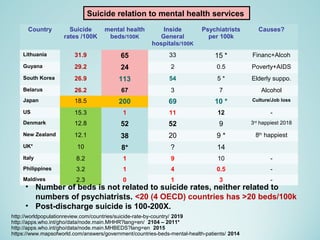
Suicide relation to mental health services
Country Suicide
rates /100K
mental health
beds/100K
Inside
General
hospitals/100K
Psychiatrists
per 100k
Causes?
Lithuania 31.9 65 33 15 * Financ+Alcoh
Guyana 29.2 24 2 0.5 Poverty+AIDS
South Korea 26.9 113 54 5 * Elderly suppo.
Belarus 26.2 67 3 7 Alcohol
Japan 18.5 200 69 10 * Culture/Job loss
US 15.3 1 11 12 -
Denmark 12.8 52 52 9 3rd
happiest 2018
New Zealand 12.1 38 20 9 * 8th
happiest
UK* 10 8* ? 14
Italy 8.2 1 9 10 -
Philippines 3.2 1 4 0.5 -
Maldives 2.3 0 1 3 -
• Number of beds is not related to suicide rates, neither related to
numbers of psychiatrists. <20 (4 OECD) countries has >20 beds/100k
• Post-discharge suicide is 100-200X.
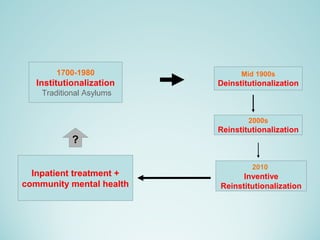
1700-1980
Institutionalization
Traditional Asylums
Mid 1900s
Deinstitutionalization
2000s
Reinstitutionalization
2010
Inventive
Reinstitutionalization
Inpatient treatment +
community mental health
?
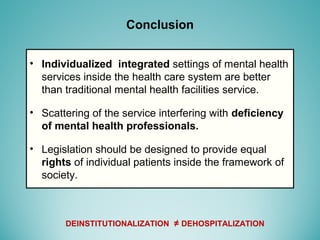
• Individualized integrated settings of mental health
services inside the health care system are better
than traditional mental health facilities service.
• Scattering of the service interfering with deficiency
of mental health professionals.
• Legislation should be designed to provide equal
rights of individual patients inside the framework of
society.
Conclusion
DEINSTITUTIONALIZATION ≠ DEHOSPITALIZATION
References
• Innovation in deinstitutionalization: a WHO expert survey. 2014
• Fredric Neuman. Psychiatric Hospitalization vs. Treatment at Home. Psychology
today 2013.
• Steven P Reidbord MD. A brief history of psychiatry 2014
• Anna k. Schliehe. re-discovering Goffman. 2016
• Scott, S. Revisiting the Total Institution: Reinventive Institution 2010.
• An overview of the mental health system in Italy, Antonio Lora 2009.
• Andrews, et al,. The History of Bethlem. London & New York: Routledge; 1997.
• Guaiana, G., O’Reilly, R., & Grassi, L. (2018). A Comparison of inpatient adult
psychiatric services in Italy and Canada.
• Oxford textbook of community mental health, 2011
• Bastiampillai, et al., (2016). Increase in US suicide rates and critical decline in
psychiatric beds. Journal of the American Medical Association.
• Guaiana et al. 2019 (The observed outcomes approach to Calculate the Optimum
Number of Psychiatric Beds)

consequences of deinstitutionalization

  • 1.
  • 2.
    What do youthink is the most prevalent form of mental health service? Psychiatric hospitals-based service VS Community-based services Which is better?
  • 4.
    History of institutionalization “Bedlam” InUK; Bethlem hospital gradually transformed from a small general hospital into a specialist institution for the confinement of the insane •It was the most infamous hospital in the continent, for enforced segregation of inmates and abusive inhumane treatment of the patients. •The stigma attached to it and mental health asylums allover the world still present though the modern design. https://topdocumentaryfilms.com/bedlam-the-history-of-bethlem-hospital/ Transformed to psychiatric hospital
  • 5.
    History of institutionalization “HospitalChaple” • In France, Moral treatment (Philippe Pinel) based on theory: the environmental factors affecting individual’s psychology. • Principles of treatment: no restraint and open environment treatment Gun power factory <10.000 patients (1480) , rats, bureaucracy, and executions. Academic general hospital 1964 celebrities were treated Transformedtogeneral
  • 6.
    History of institutionalization “mentalhealth acts” the first legislation in U.K. to address the mental health. with powers to grant licences to premises housing "lunatics“, removing them from workhouses and prisons The Lunacy Act And County Asylums Act compelled each county to provide an asylum for “poor lunatics“. That might resulted in poor unhealthy asylums 1845
  • 7.
    History of institutionalization “catastrophictreatments” An estimated 50,000 people in the U.S. alone eventually received lobotomies in the early 1900. Adverse effects included 6% mortality, seizures in 1%, and disinhibition syndromes in 1.5% Asylum doctors prone to try radical interventions as an alternative of long- term institutionalization. Transorbital lobotomy was adopted on account of Frontal lobotomy because of the resources/less invasive than cranial lobotomy and institutionalization!!!
  • 8.
    Erving Goffman (sociologistpopularized the term "total institution") highlighted the disadvantages of institutions (prisons, asylums…) & described the institutional life. Later on, his work was criticized for being biased and evidence less, perpetuated an image of institutions as repressive and coercive. Scott S. 2010 The Deinstitutionalization movement By the late 1950s, new medications (Antipsychotics & antidepressants) improved some institutionalized patients. State mental hospitals rapidly emptied as some of the medicated patients returned to community. In mid 1900s, public awareness of the crowded, unsanitary & abusive conditions in asylums sparked the movement “D.I.” Fredric Neuman, 2013. Many mental hospitals closed in the 1970-1980s due to pressure from the antipsychiatry movement, ex-patient activism and political suspicion of large, unaccountable institutions. 1. 4. 3. 2. 1957
  • 11.
    • Despite decadesof promoting DI, mental hospital- based care still dominates service delivery, consuming on more than 70% of the entire mental health budget in low & middle-income countries. Deinstitutionalization progress WHO Innovation in deinstitutionalization 2014 • Pace of change in health care systems is uneven. • No single ‘formula’ for appliance or measurement of Deinstitutionalization.
  • 12.
     Australia: “mentallyill patients cared for in jail due to bed shortage” The Advertiser (Adelaide), 2016  Ireland: “Shortage of beds in child mental health service related to increased suicide among adolescents, Irish Times, 2017  Britain: “Patients sent 500 miles to Scotland due to hospital bed shortage” Wiltshire Times, 2017  Guardian investigation reported that "hundreds of mental health patients died between 2012-2017 after NHS care failures". Many patients facing long delays in accessing treatment. 2018  Canada: “shortage of beds for people needing mental health care – resulting in long waiting time in emergency ” London Free Press, 2017  US: Nation’s psychiatric bed count falls to record low” Washington Post, 2016 Psychiatric bed shortages are frequently in the news and a focus of courts, advocates & providers
  • 13.
  • 14.
    • Italy bannedpsychiatric beds by law (1978), but a large number of residential treatment facilities emerged, they provide the service in a manner that would be considered inpatient care elsewhere. Examples of Deinstitutionalization Conflicts “types of inpatient care” Psychiatric hospital BEDs VS Residential units VS Forensic beds VS Scatter beds • Penrose hypothesis (1939) proposed an inverse relationship between the relative number of psychiatric beds and its total number of prisoners, based on calculations from cross-sectional study of 18 countries. (replicated study) • In US, state-funded psychiatric beds are almost entirely forensic. Limited access to inpatient care is a contributing factor for the increasing US suicide rate (Bastiampillai, et al., 2016).
  • 15.
    Psychiatric care bedsper 100K Economic Cooperation and Development (OECD) 2014-2016 <10 fold difference in the numbers of psychiatric beds in different countries.
  • 17.
     In 2008,experts of US Treatment Advocacy Center estimated range of 40-60 public psychiatric beds per 100,000.  A computer simulation program in the University of North Carolina to ascertain how many additional psychiatric beds would be needed to achieve an average preadmission wait time of less than one day found that the optimal bed number should be about 39 adult beds per 100,000 population. (2015)  Another computer program model in In the state of South Australia, reduced the number of patients waiting for admission >24 H in emergency by 75% after increasing the bed number to 19 adult beds per 100,000 population. (2014) Calculation methods Expert opinions VS computerized analysis 50 39 19 Median: 39
  • 18.
    DI outcomes measurementmethods Guaiana et al. 2019 (The observed outcomes approach to Calculate the Optimum Number of Psychiatric Beds) Psychiatric Hospitals KPIs Population outcomes Out of area placements Boarding in emergency rooms Occupancy rates Readmission rates Involuntary admission Average length of stay Inpatients Level of acuity Discharge to homelessness Rates of homelessness amongst people with Serious Mental illness (SMI) Rates of people with SMI in homeless shelters Burden on care givers Rates of suicide Rates of crime committed Rate of All Cause Mortality‑
  • 19.
    Psychiatric Hospitals KPIs Outof area placements rising in UK Boarding in emergency rooms rising in US Occupancy rates rising in UK Readmission rates psychosis is the 2nd illness after CHD in US Involuntary admission rising in Canada Average length of stay fallen to 6 days in US community hospitals. But, Cochrane Systemic review showed no evidence of adverse effects of short LOS Inpatients Level of acuity incidents of aggression or psychopathological measures. Discharge to homelessness little systematic study Guaiana et al. 2019 (The observed outcomes approach to Calculate the Optimum Number of Psychiatric Beds)
  • 20.
    Population outcomes Guaiana etal. 2019 (The observed outcomes approach to Calculate the Optimum Number of Psychiatric Beds) Rates of homelessness amongst people with Serious Mental illness (SMI) is increasing in US (and) Rates of people with SMI in homeless shelters. Burden on care givers (not studied) Rates of suicide (no consensus) Bastiampillai, et al., 2016 From 1999 through 2014, the age- adjusted suicide rate in the US increased 24% (CDC.gov) Rates of crime committed A study showed a correlation between reduced state hospital beds in the US & firearm related deaths (Meszaros 2017) Rate of All Cause Mortality‑ studies show a widening gap in the mortality rates between people with mental illness and the general population (Lawrence et al. 2013) Rates of incarceration amongst people with SMI Penrose’s hydraulic theory
  • 21.
    http://worldpopulationreview.com/countries/suicide-rate-by-country/ 2019 http://apps.who.int/gho/data/node.main.MHHR?lang=en/ 2104– 2011* http://apps.who.int/gho/data/node.main.MHBEDS?lang=en 2015 https://www.mapsofworld.com/answers/government/countries-beds-mental-health-patients/ 2014 Suicide relation to mental health services Country Suicide rates /100K mental health beds/100K Inside General hospitals/100K Psychiatrists per 100k Causes? Lithuania 31.9 65 33 15 * Financ+Alcoh Guyana 29.2 24 2 0.5 Poverty+AIDS South Korea 26.9 113 54 5 * Elderly suppo. Belarus 26.2 67 3 7 Alcohol Japan 18.5 200 69 10 * Culture/Job loss US 15.3 1 11 12 - Denmark 12.8 52 52 9 3rd happiest 2018 New Zealand 12.1 38 20 9 * 8th happiest UK* 10 8* ? 14 Italy 8.2 1 9 10 - Philippines 3.2 1 4 0.5 - Maldives 2.3 0 1 3 - • Number of beds is not related to suicide rates, neither related to numbers of psychiatrists. <20 (4 OECD) countries has >20 beds/100k • Post-discharge suicide is 100-200X.
  • 22.
  • 23.
    • Individualized integratedsettings of mental health services inside the health care system are better than traditional mental health facilities service. • Scattering of the service interfering with deficiency of mental health professionals. • Legislation should be designed to provide equal rights of individual patients inside the framework of society. Conclusion DEINSTITUTIONALIZATION ≠ DEHOSPITALIZATION
  • 24.
    References • Innovation indeinstitutionalization: a WHO expert survey. 2014 • Fredric Neuman. Psychiatric Hospitalization vs. Treatment at Home. Psychology today 2013. • Steven P Reidbord MD. A brief history of psychiatry 2014 • Anna k. Schliehe. re-discovering Goffman. 2016 • Scott, S. Revisiting the Total Institution: Reinventive Institution 2010. • An overview of the mental health system in Italy, Antonio Lora 2009. • Andrews, et al,. The History of Bethlem. London & New York: Routledge; 1997. • Guaiana, G., O’Reilly, R., & Grassi, L. (2018). A Comparison of inpatient adult psychiatric services in Italy and Canada. • Oxford textbook of community mental health, 2011 • Bastiampillai, et al., (2016). Increase in US suicide rates and critical decline in psychiatric beds. Journal of the American Medical Association. • Guaiana et al. 2019 (The observed outcomes approach to Calculate the Optimum Number of Psychiatric Beds)

Editor's Notes

  • #2 Community-based mental health and social care services is one of the WHO 4 keys objective plan from 2013-2020. On basis of this objective: --- to Provide guidance and evidence-based practices for deinstitutionalization. On the other hand, there are increasing numbers of suicide, homelessness and imprisonment of psychiatric patients. Deinstitutionalization described by some professionals as Disowning Responsibility to decrease the high costs and funds for mental Healthcare.
  • #4 What is the Importance of history? More evident
  • #9 500 years VS 100 years
  • #10 What are the Various Hurdles in Providing Community Mental Health Services? In spite of having community outreach services in various cities and states, still people do not prefer to visit these centers. There could be various reasons for not seeking help from these centers. It could be: Inadequate participation of community Lack of integration of mental health into general health care Lack of ideal model of mental health delivery Weak link between mental health and social development Nonavailability of services in certain areas No regular monitoring and evaluation.
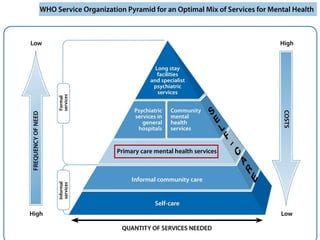
  • #11 1ry care mental health services is the main Formal service should be available And On top there should be few specialist psychiatric facilities In between there should be some scatter beds
  • #12 According to WHO surveys only 30% of the budget go to non mental hospital based care
  • #15 Deficiency in beds accused of being the cause of higher suicidal rates, imprisonment of patients and limiting the accessibility of care. The conflict between types of inpatient care
  • #17 What are the Various Hurdles in Providing Community Mental Health Services? In spite of having community outreach services in various cities and states, still people do not prefer to visit these centers. There could be various reasons for not seeking help from these centers. It could be: Inadequate participation of community Lack of integration of mental health into general health care Lack of ideal model of mental health delivery Weak link between mental health and social development Nonavailability of services in certain areas No regular monitoring and evaluation.
  • #20 establishment of various community-based services as imperative for successful deinstitutionalization. These included both mental health services, including access to evidence-based clinical care, and support for housing, employment, and community reintegration. Respondents made the point that long-term institutional residents need to be involved in decision-making concerning their discharge, and prepared and supported for reintegration into the community. Families and communities also require education and support when institutional residents return to the community. Ongoing communication and coordination are essential throughout the process, which should focus on outreach, proactive case management, and taking care not to lose people from care. Health workers (and their professional associations) need to be consulted widely and involved in the planning and implementation of deinstitutionalization and community-based care. Those employed currently in institutions deserve special attention. They usually have valuable views concerning discharge and care planning for institutional residents, and moreover, their involvement in the process helps mitigate any concerns they might have about losing employment, professional status, or familiar ways of working.
  • #22 Economic Cooperation and Development (OECD)