1
CONNECTIVE TISSUE
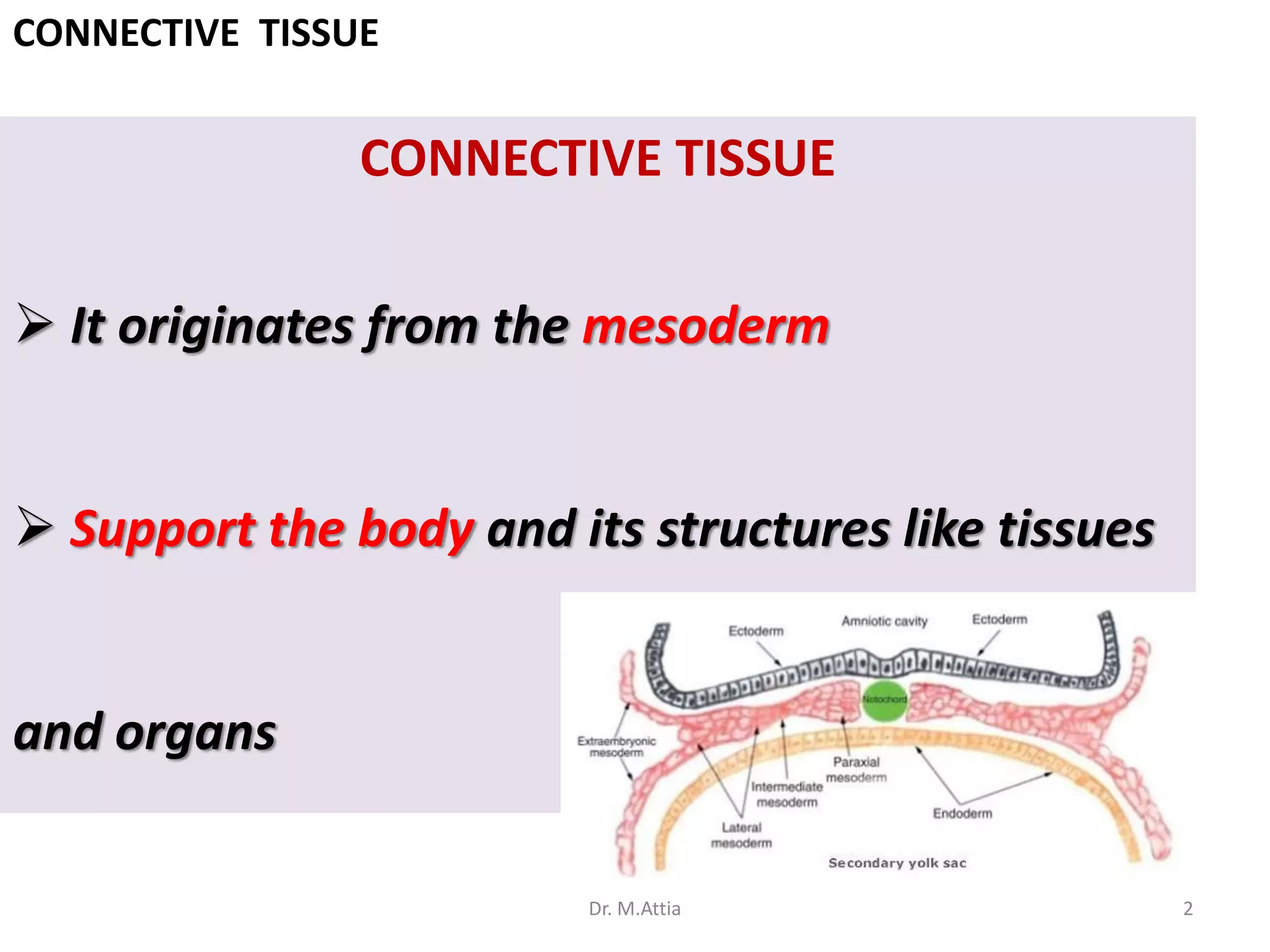
 It originates from the mesoderm
 Support the body and its structures like tissues
and organs
Dr. M.Attia 2
CONNECTIVE TISSUE
General characters
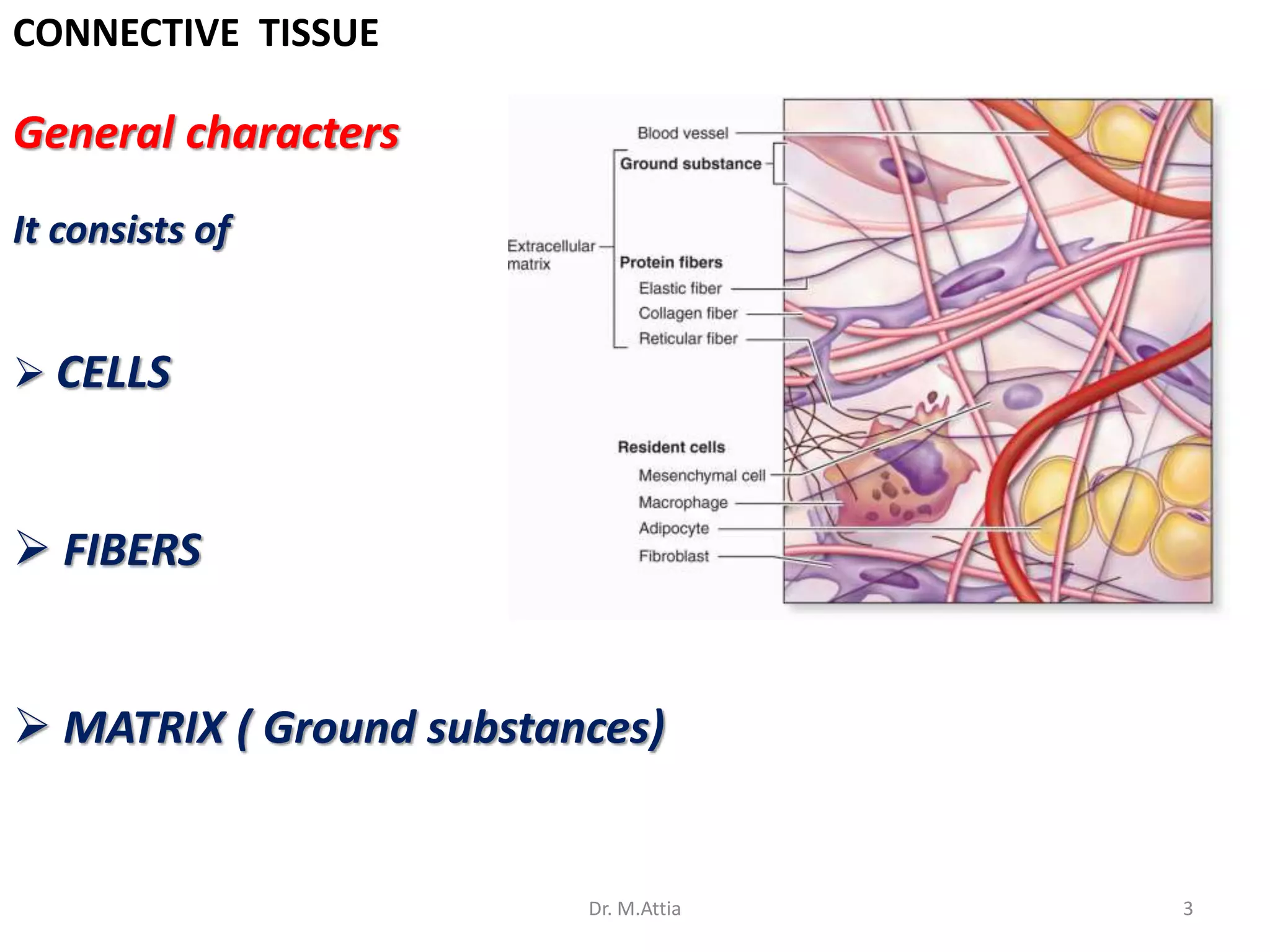
It consists of
 CELLS
 FIBERS
 MATRIX ( Ground substances)
CONNECTIVE TISSUE
Dr. M.Attia 3
CONNECTIVE TISSUE
Types:
1. Connective tissue proper
2. CT Special types Like ,
 Bone
 Cartilage
 Blood
Dr. M.Attia 4
CONNECTIVE TISSUE
Function
1- Structural support
2- Metabolic function
3- Defensive function
4- Tissue repair
5- Special function as energy storage in adipose tissue, blood cell
formation
Dr. M.Attia 5
CONNECTIVE TISSUE
CT Cells a- Fixed ,
b- Free
Dr. M.Attia 6
CONNECTIVE TISSUE
Fixed cells are relatively stable
Include: ( ME-RE-PER-END, 4F)
1. Mesenchymal cells
2. Fibroblasts
3. Fibrocytes
4. Reticular cells
5. Endothelial cells
6. Pericytes
7. Fat cells
8. Fixed macrophages Dr. M.Attia 7
CONNECTIVE TISSUE
Free cells
 Plasma cells
 Mast cells
 Pigment cells
Leucocytes
Dr. M.Attia 8
CONNECTIVE TISSUE
CT fibers
1.Collagen fibers
2.Reticular fibers
3.Elastic fibers
Dr. M.Attia 9
CONNECTIVE TISSUE
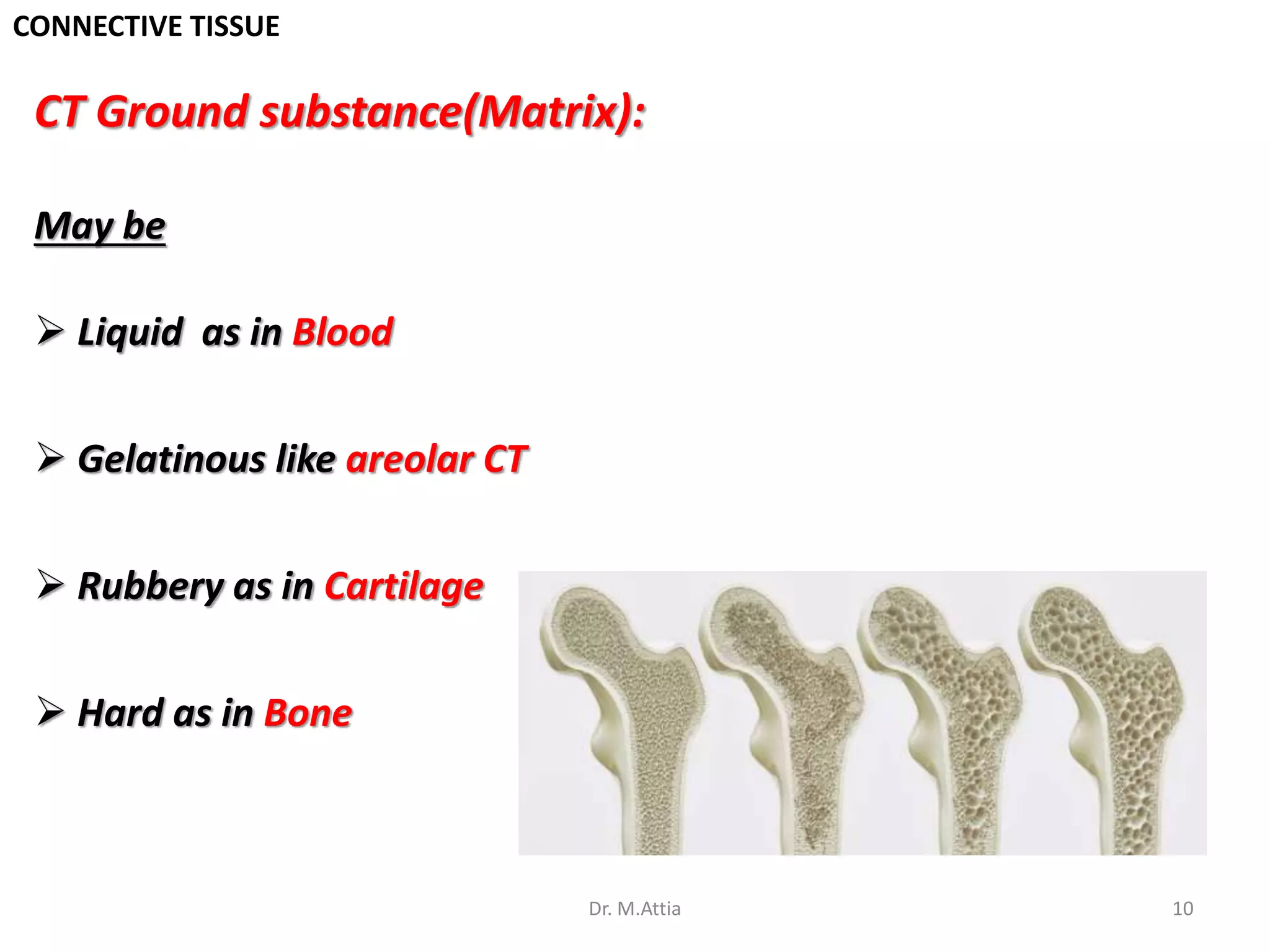
CT Ground substance(Matrix):
May be
 Liquid as in Blood
 Gelatinous like areolar CT
 Rubbery as in Cartilage
 Hard as in Bone
Dr. M.Attia 10
CONNECTIVE TISSUE
Fixed cells are relatively stable
Include: ( ME-RE-PER-END, 4F)
1. Mesenchymal cells
2. Fibroblasts
3. Fibrocytes
4. Reticular cells
5. Endothelial cells
6. Pericytes
7. Fat cells
8. Fixed macrophages Dr. M.Attia 11
CONNECTIVE TISSUE
Fixed cells are relatively stable
Include: ( ME-RE-PER-END, 4F)
1. Mesenchymal cells
It is called Embryonic stem cell, remains undifferentiated in
adult CT
 Light Microscopy (L/M) small cell with long cytoplasmic
processes, fainty basophilic cytoplasm
Dr. M.Attia 12
CONNECTIVE TISSUE
Fixed cells are relatively stable
Include: ( ME-RE-PER-END, 4F)
1. Mesenchymal cells
 Elecron Microscopy (E/M) (cell making protein)
Cytoplasm contains Golgi apparatus, rough endoplasmic reticulum,
mitochondria, ribosomes
Function: Stem cell for most of CT cells.
Dr. M.Attia 13
Dr. M.Attia 14
CONNECTIVE TISSUE
Fixed cells are relatively stable
Include: ( ME-RE-PER-END, 4F)
1. Mesenchymal cells
2. Fibroblasts
3. Fibrocytes
4. Reticular cells
5. Endothelial cells
6. Pericytes
7. Fat cells
8. Fixed macrophages Dr. M.Attia 15
CONNECTIVE TISSUE
Fixed cells are relatively stable
Include: ( ME-RE-PER-END, 4F)
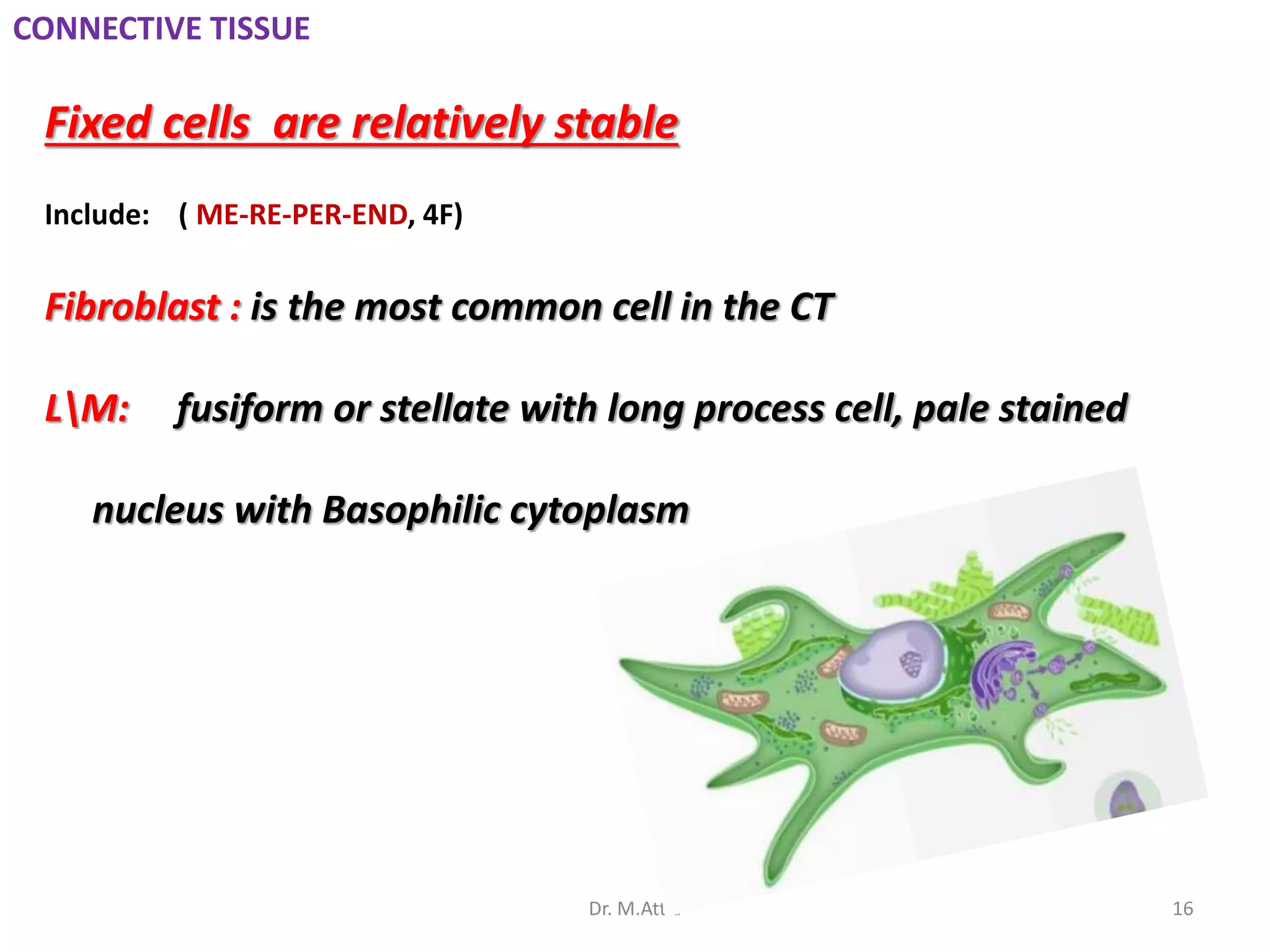
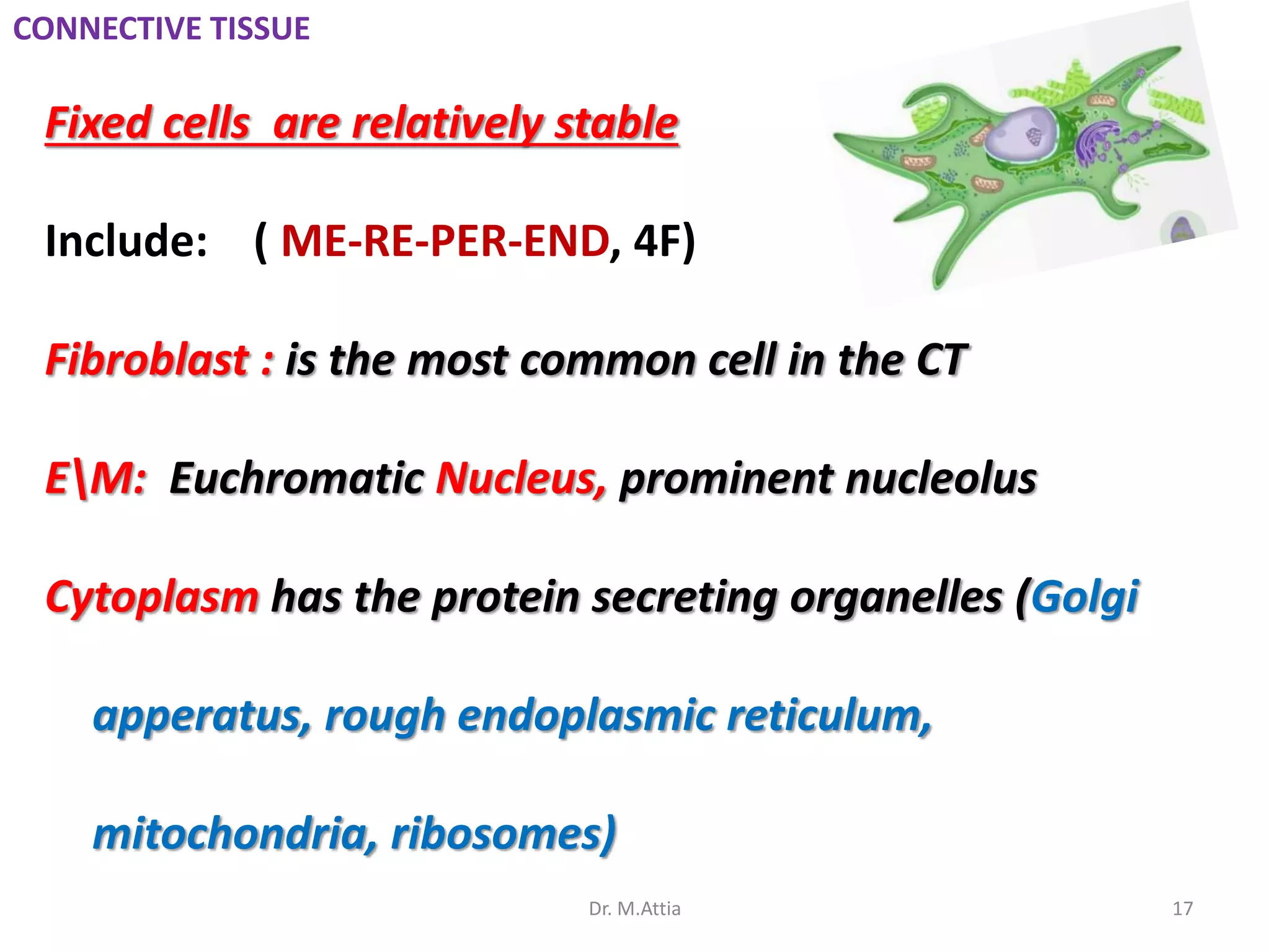
Fibroblast : is the most common cell in the CT
LM: fusiform or stellate with long process cell, pale stained
nucleus with Basophilic cytoplasm
Dr. M.Attia 16
CONNECTIVE TISSUE
Fixed cells are relatively stable
Include: ( ME-RE-PER-END, 4F)
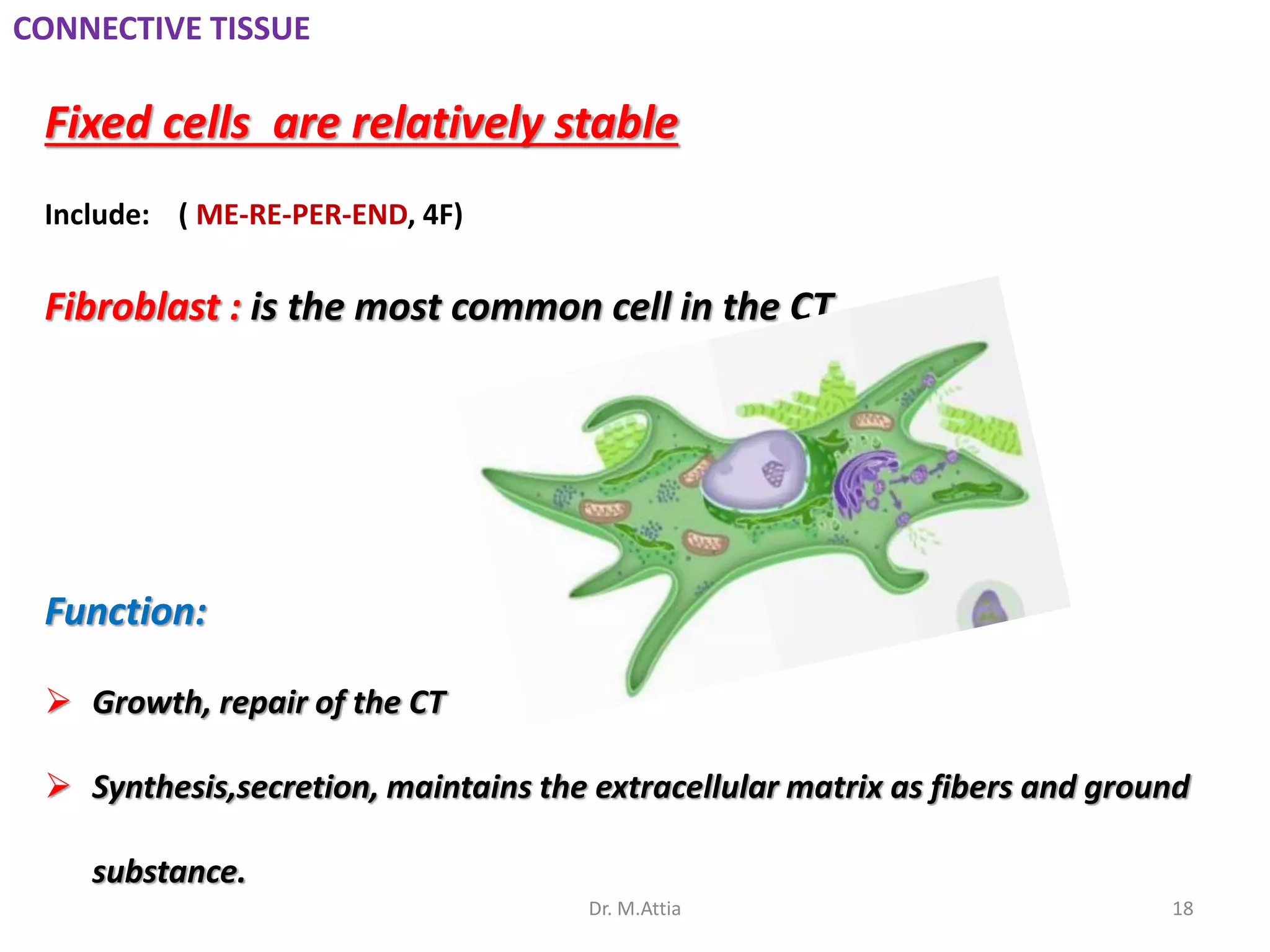
Fibroblast : is the most common cell in the CT
EM: Euchromatic Nucleus, prominent nucleolus
Cytoplasm has the protein secreting organelles (Golgi
apperatus, rough endoplasmic reticulum,
mitochondria, ribosomes)
Dr. M.Attia 17
CONNECTIVE TISSUE
Fixed cells are relatively stable
Include: ( ME-RE-PER-END, 4F)
Fibroblast : is the most common cell in the CT
Function:
 Growth, repair of the CT
 Synthesis,secretion, maintains the extracellular matrix as fibers and ground
substance.
Dr. M.Attia 18
CONNECTIVE TISSUE
Fixed cells are relatively stable
Include: ( ME-RE-PER-END, 4F)
1. Mesenchymal cells
2. Fibroblasts
3. Fibrocytes
4. Reticular cells
5. Endothelial cells
6. Pericytes
7. Fat cells
8. Fixed macrophages Dr. M.Attia 19
CONNECTIVE TISSUE
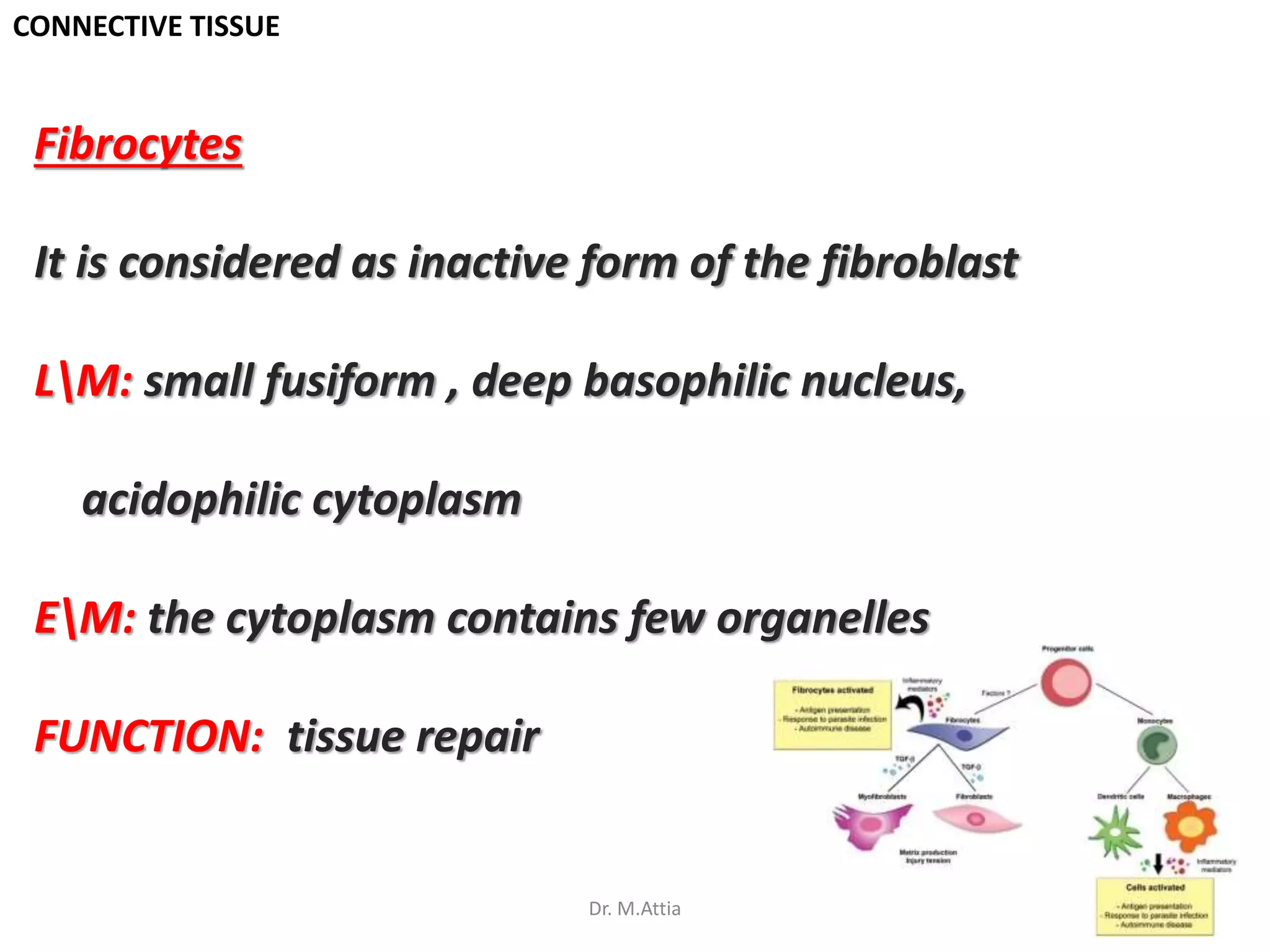
Fibrocytes
It is considered as inactive form of the fibroblast
LM: small fusiform , deep basophilic nucleus,
acidophilic cytoplasm
EM: the cytoplasm contains few organelles
FUNCTION: tissue repair
Dr. M.Attia 20
CONNECTIVE TISSUE
Fixed cells are relatively stable
Include: ( ME-RE-PER-END, 4F)
1. Mesenchymal cells
2. Fibroblasts
3. Fibrocytes
4. Reticular cells
5. Endothelial cells
6. Pericytes
7. Fat cells
8. Fixed macrophages Dr. M.Attia 21
CONNECTIVE TISSUE
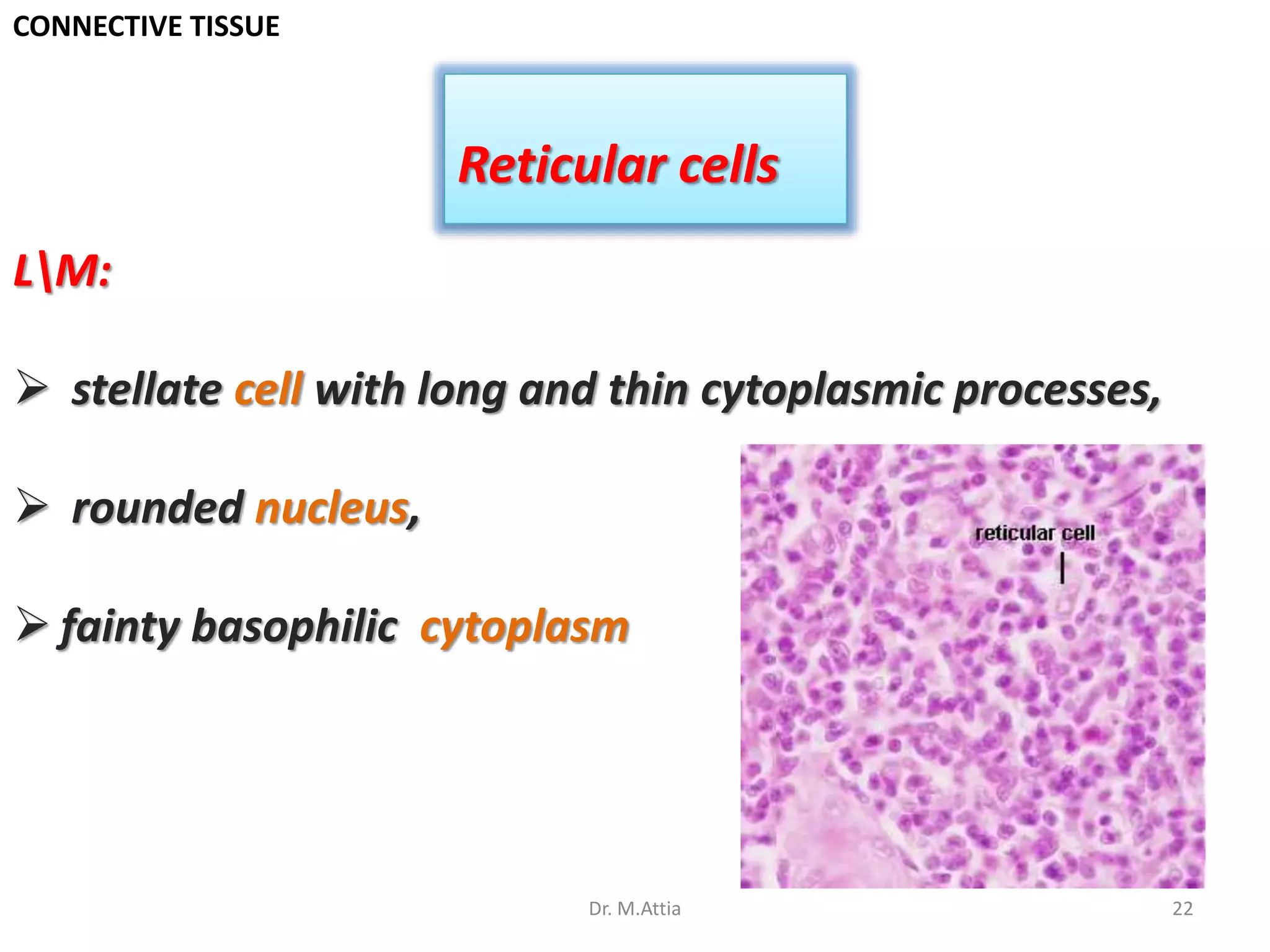
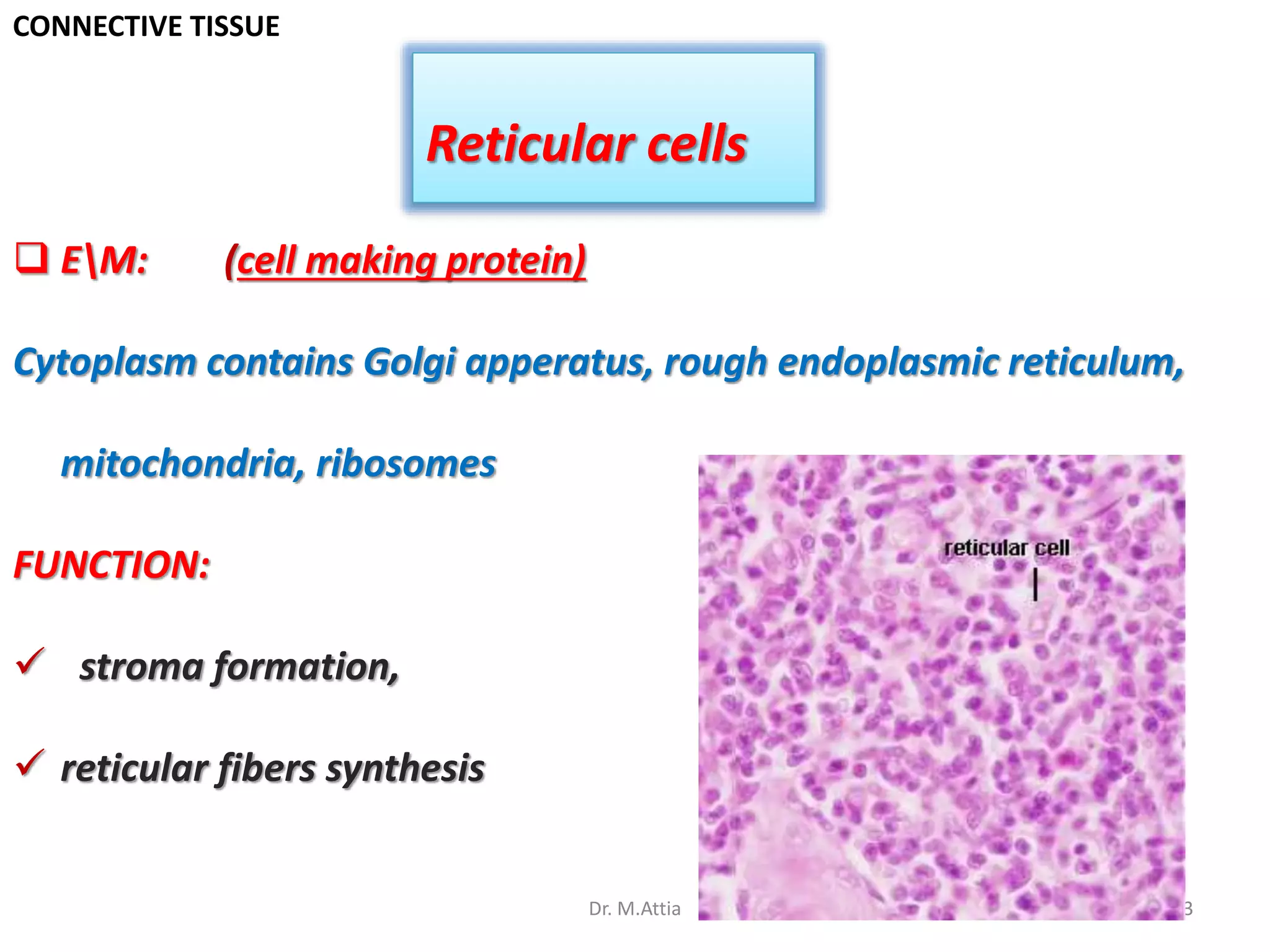
LM:
 stellate cell with long and thin cytoplasmic processes,
 rounded nucleus,
 fainty basophilic cytoplasm
Dr. M.Attia 22
Reticular cells
CONNECTIVE TISSUE
Reticular cells
 EM: (cell making protein)
Cytoplasm contains Golgi apperatus, rough endoplasmic reticulum,
mitochondria, ribosomes
FUNCTION:
 stroma formation,
 reticular fibers synthesis
Dr. M.Attia 23
CONNECTIVE TISSUE
Fixed cells are relatively stable
Include: ( ME-RE-PER-END, 4F)
1. Mesenchymal cells
2. Fibroblasts
3. Fibrocytes
4. Reticular cells
5. Endothelial cells
6. Pericytes
7. Fat cells
8. Fixed macrophages Dr. M.Attia 24
CONNECTIVE TISSUE
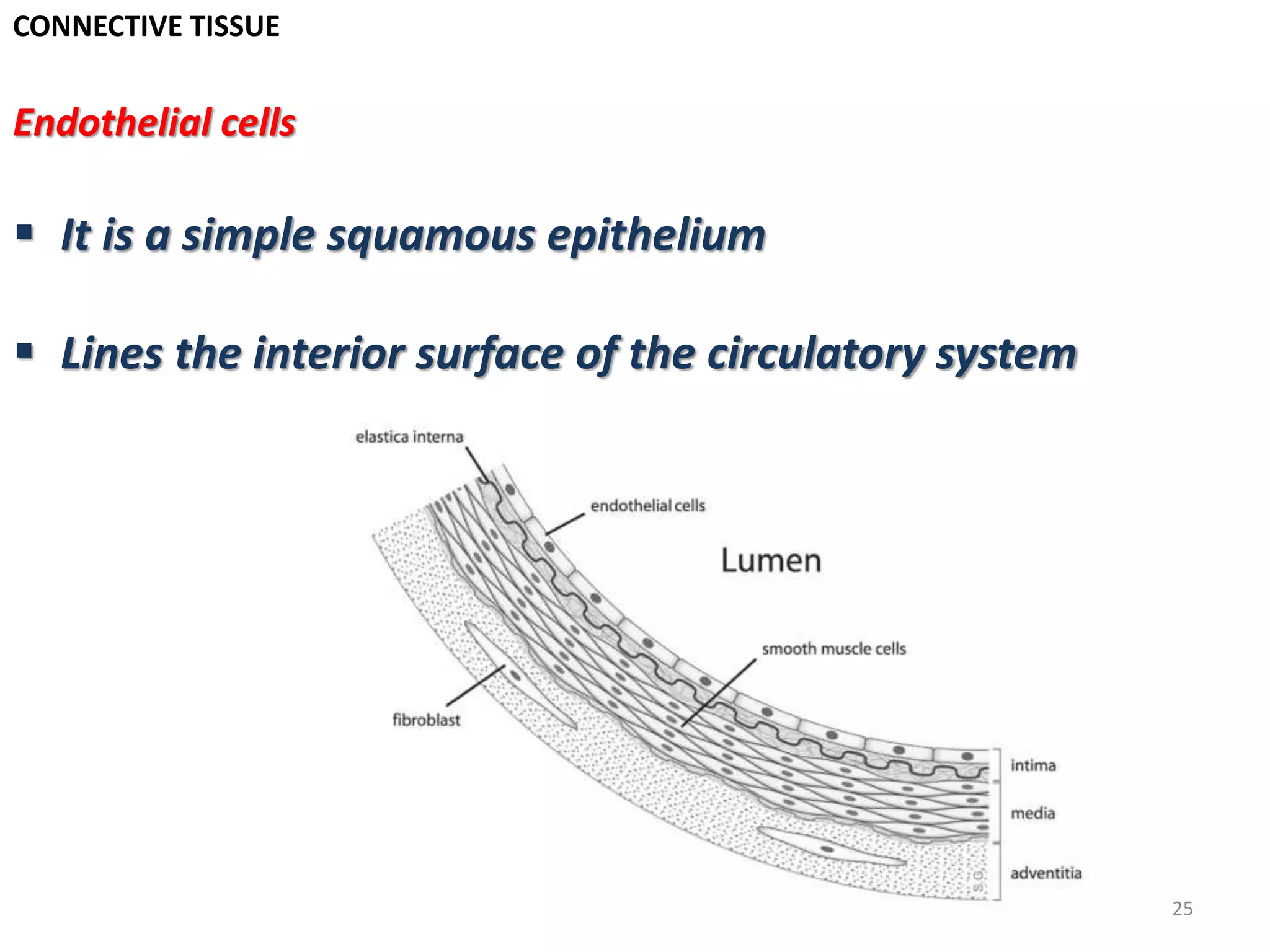
Endothelial cells
 It is a simple squamous epithelium
 Lines the interior surface of the circulatory system
Dr. M.Attia 25
CONNECTIVE TISSUE
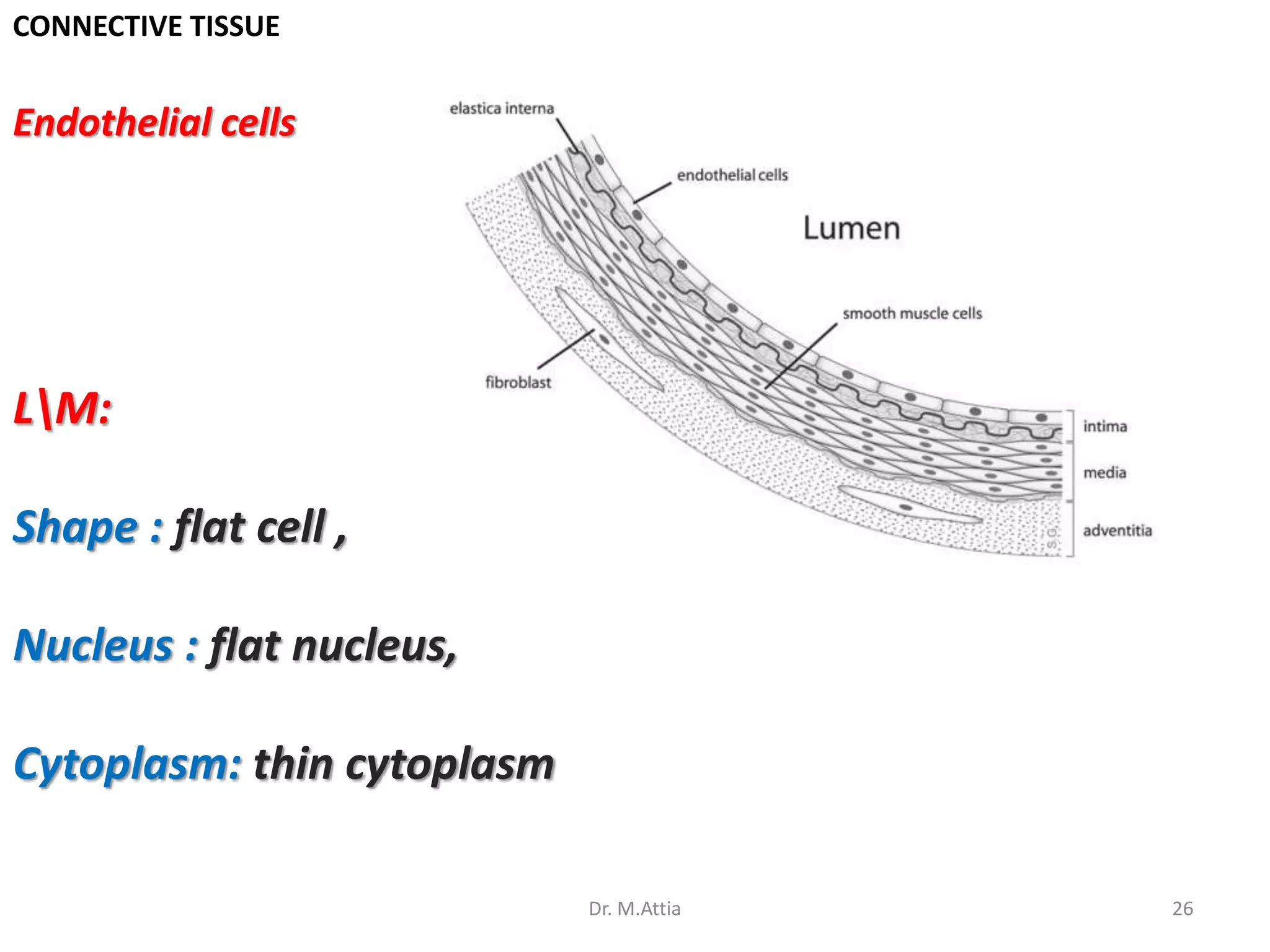
Endothelial cells
LM:
Shape : flat cell ,
Nucleus : flat nucleus,
Cytoplasm: thin cytoplasm
Dr. M.Attia 26
CONNECTIVE TISSUE
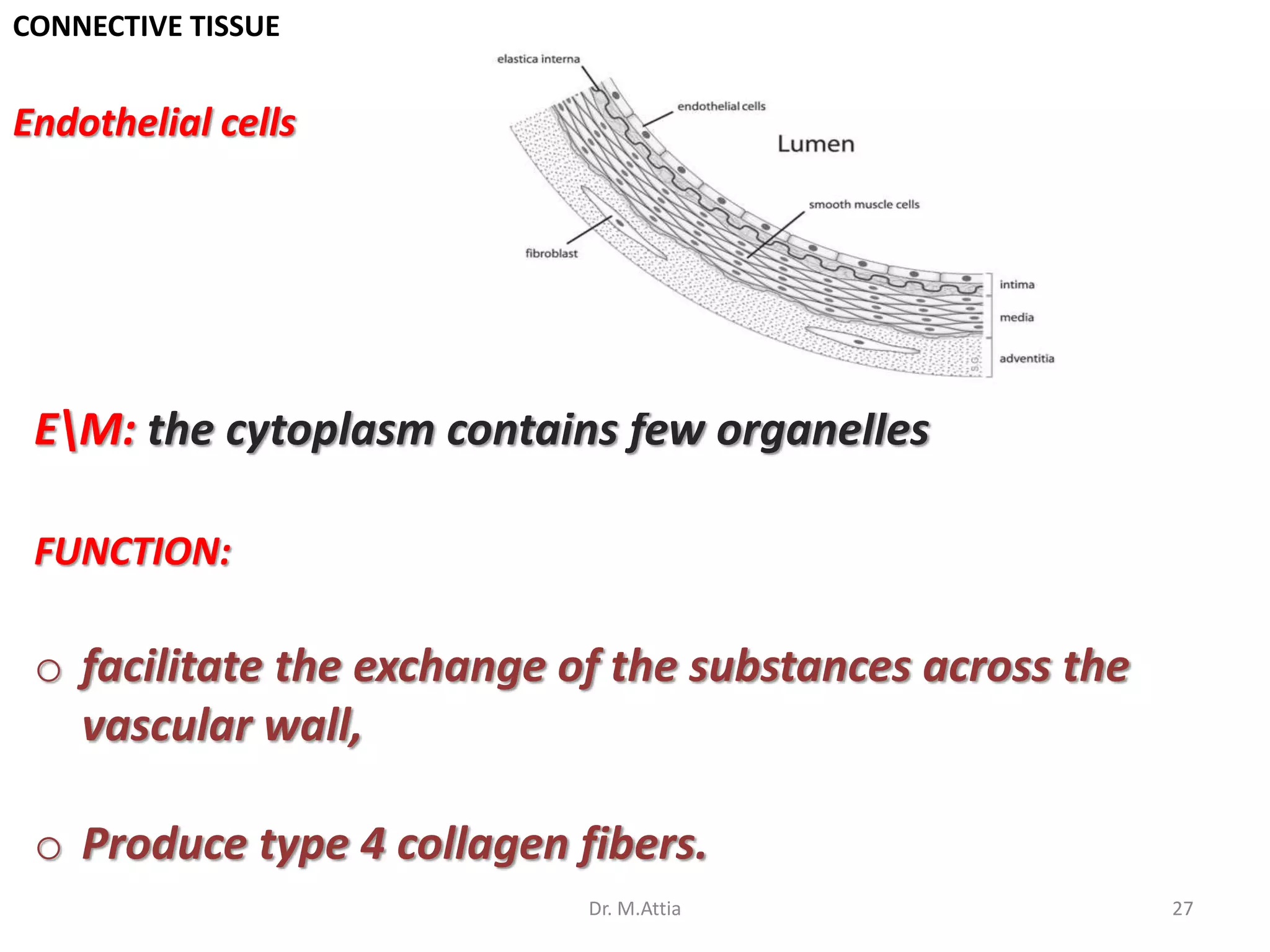
Endothelial cells
EM: the cytoplasm contains few organelles
FUNCTION:
o facilitate the exchange of the substances across the
vascular wall,
o Produce type 4 collagen fibers.
Dr. M.Attia 27
CONNECTIVE TISSUE
Fixed cells are relatively stable
Include: ( ME-RE-PER-END, 4F)
1. Mesenchymal cells
2. Fibroblasts
3. Fibrocytes
4. Reticular cells
5. Endothelial cells
6. Pericytes
7. Fat cells
8. Fixed macrophages Dr. M.Attia 28
CONNECTIVE TISSUE
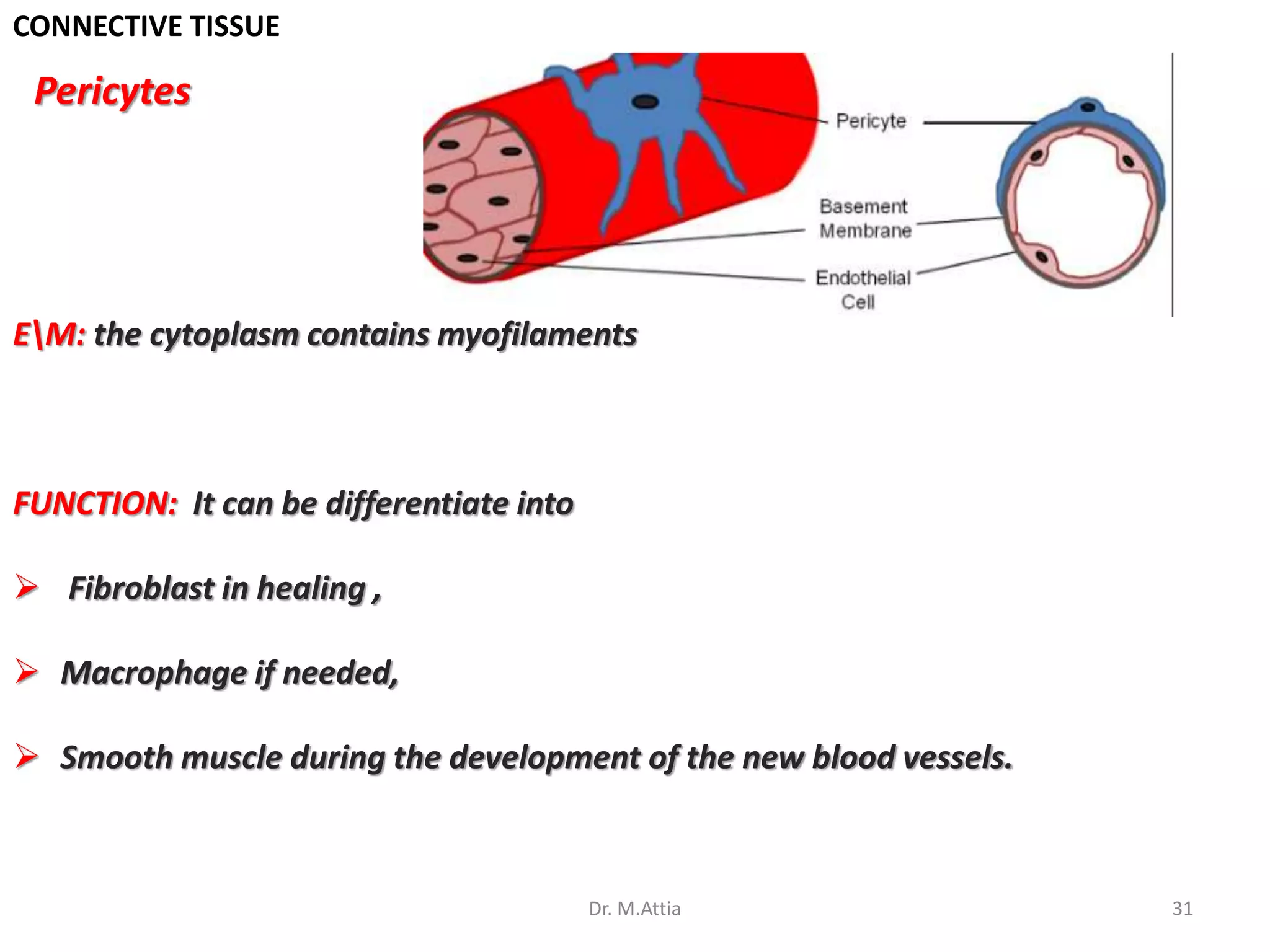
Pericytes
 It is partially surrounds the endothelial cells of capillaries and
small venules
 It is a perivascular cell with multifunctions .
Dr. M.Attia 29
CONNECTIVE TISSUE
Pericytes
LM:
Shape: has long processes and share in Gap junctions with
the endothelial cells
Nucleus: Flat
Cytoplasm: Thin
Dr. M.Attia 30
CONNECTIVE TISSUE
Pericytes
EM: the cytoplasm contains myofilaments
FUNCTION: It can be differentiate into
 Fibroblast in healing ,
 Macrophage if needed,
 Smooth muscle during the development of the new blood vessels.
Dr. M.Attia 31
CONNECTIVE TISSUE
Fixed cells are relatively stable
Include: ( ME-RE-PER-END, 4F)
1. Mesenchymal cells
2. Fibroblasts
3. Fibrocytes
4. Reticular cells
5. Endothelial cells
6. Pericytes
7. Fat cells
8. Fixed macrophages Dr. M.Attia 32
CONNECTIVE TISSUE
Adipose cell
There are two types
A.Unilocular adipose cell
B.Multilocular adipose cell
Function:
Storage and release of fat
Plays an important role in energy homeostasis
Dr. M.Attia 33
CONNECTIVE TISSUE
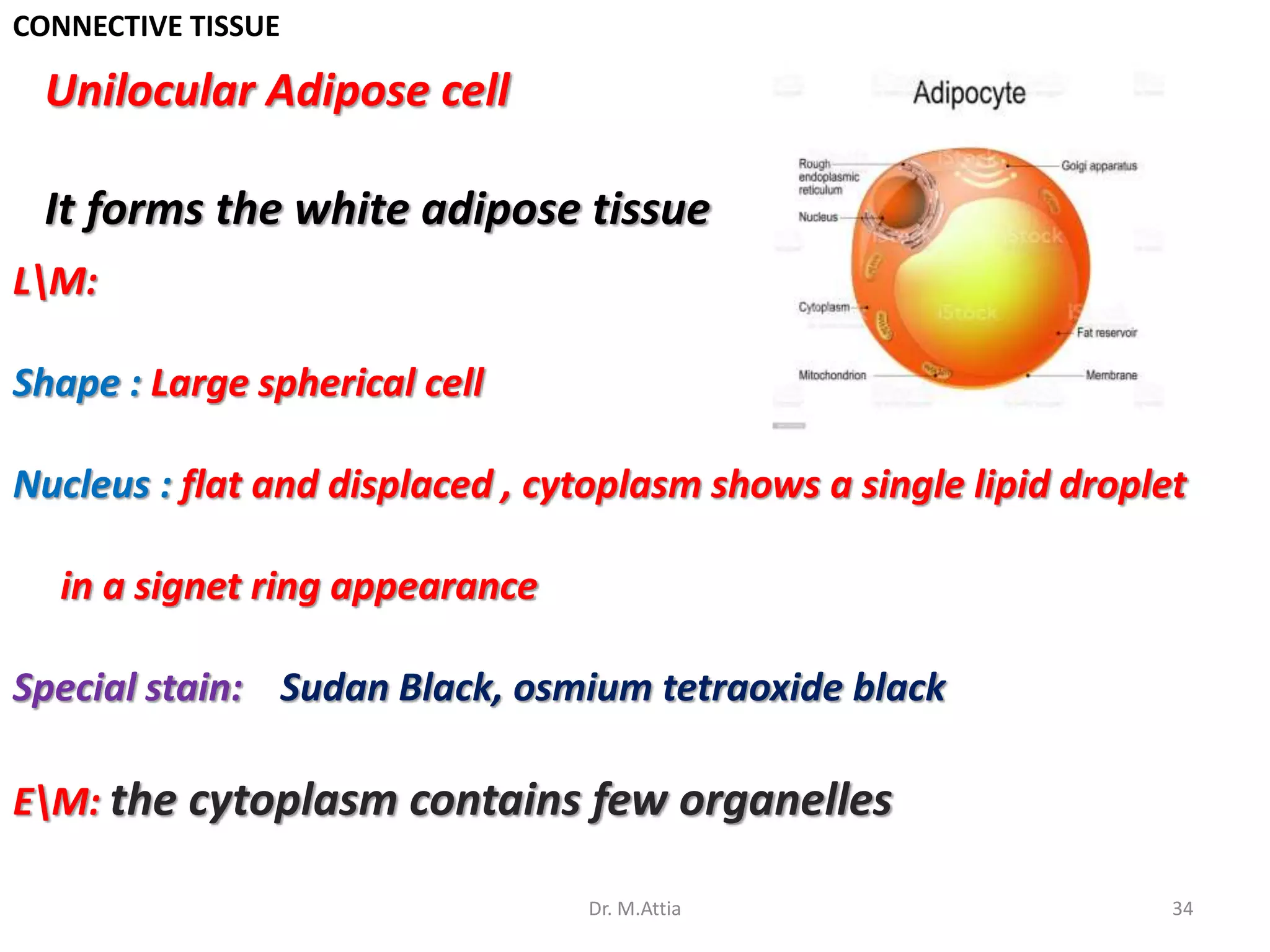
LM:
Shape : Large spherical cell
Nucleus : flat and displaced , cytoplasm shows a single lipid droplet
in a signet ring appearance
Special stain: Sudan Black, osmium tetraoxide black
EM: the cytoplasm contains few organelles
Unilocular Adipose cell
It forms the white adipose tissue
Dr. M.Attia 34
CONNECTIVE TISSUE
Multilocular adipose cell
It forms the brown adipose tissue
LM:
Shape : small polygonal cell
Nucleus : eccentric rounded nucleus
Cytoplasm: strongly acidophilic in H&E stain.
EM: the cytoplasm contains mitochondria, smooth endoplasmic
reticulum.
Dr. M.Attia 35
CONNECTIVE TISSUE
Fixed cells are relatively stable
Include: ( ME-RE-PER-END, 4F)
1. Mesenchymal cells
2. Fibroblasts
3. Fibrocytes
4. Reticular cells
5. Endothelial cells
6. Pericytes
7. Fat cells
8. Fixed macrophages Dr. M.Attia 36
CONNECTIVE TISSUE
Fixed macrophages
Originate from the blood monocytes
Types:
A. Fixed macrophages setteled in CT
B. Free macrophages travel between Ct and Blood
Macrophages are distributed in most organs and tissues and form
mononuclear phagocytic system
Dr. M.Attia 37
CONNECTIVE TISSUE
Dr. M.Attia 38
CONNECTIVE TISSUE
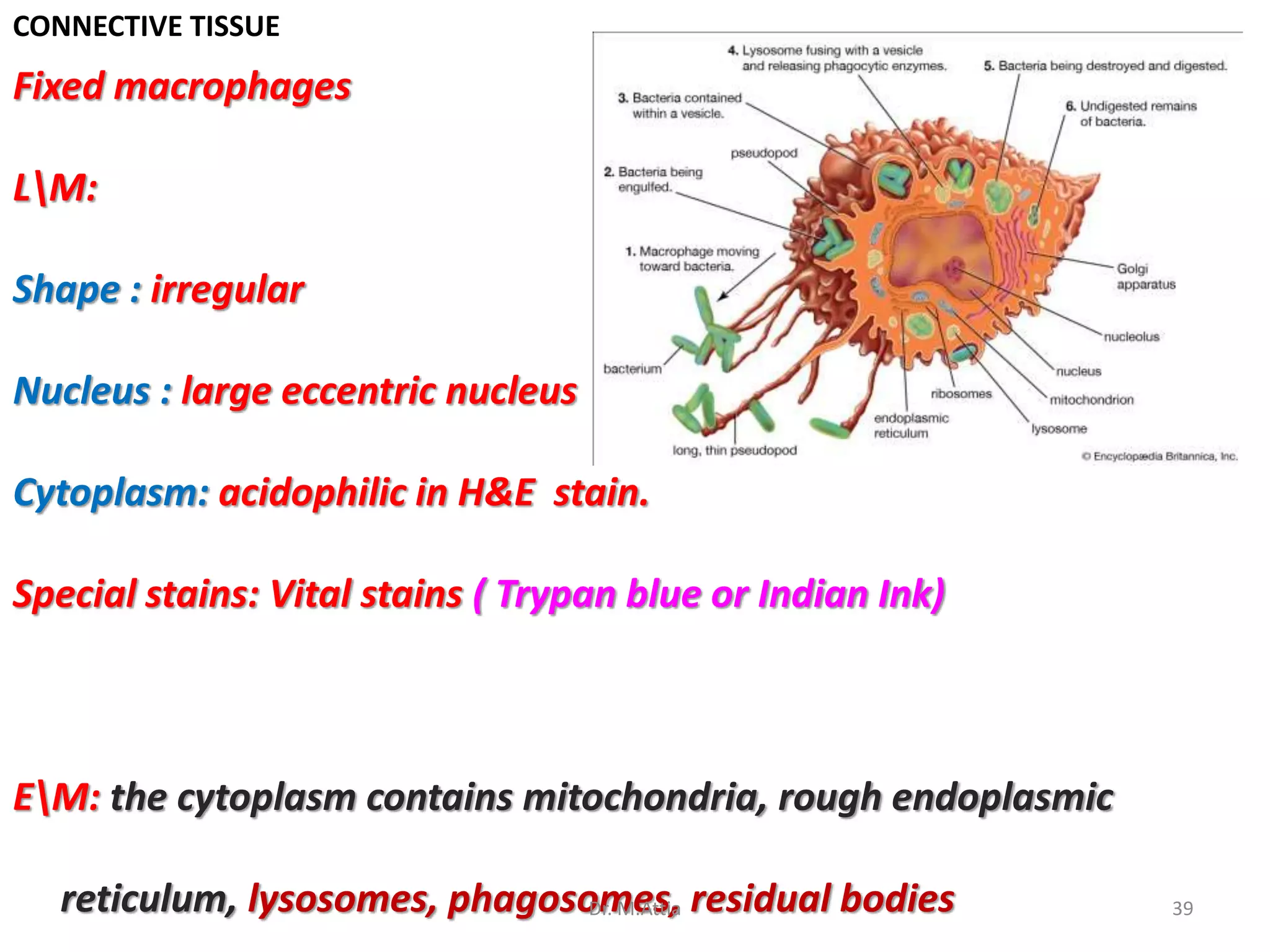
Fixed macrophages
LM:
Shape : irregular
Nucleus : large eccentric nucleus
Cytoplasm: acidophilic in H&E stain.
Special stains: Vital stains ( Trypan blue or Indian Ink)
EM: the cytoplasm contains mitochondria, rough endoplasmic
reticulum, lysosomes, phagosomes, residual bodiesDr. M.Attia 39
CONNECTIVE TISSUE
Fixed macrophages
Function
1- Tissue cleaning by removing debris, dead cells, foreign
substances.
2. Defensive function
3. Immunological function
Dr. M.Attia 40
Dr. M.Attia 41

Connective Tissue Fixed Cells Histology

  • 1.
  • 2.
    CONNECTIVE TISSUE  Itoriginates from the mesoderm  Support the body and its structures like tissues and organs Dr. M.Attia 2 CONNECTIVE TISSUE
  • 3.
    General characters It consistsof  CELLS  FIBERS  MATRIX ( Ground substances) CONNECTIVE TISSUE Dr. M.Attia 3
  • 4.
    CONNECTIVE TISSUE Types: 1. Connectivetissue proper 2. CT Special types Like ,  Bone  Cartilage  Blood Dr. M.Attia 4
  • 5.
    CONNECTIVE TISSUE Function 1- Structuralsupport 2- Metabolic function 3- Defensive function 4- Tissue repair 5- Special function as energy storage in adipose tissue, blood cell formation Dr. M.Attia 5
  • 6.
    CONNECTIVE TISSUE CT Cellsa- Fixed , b- Free Dr. M.Attia 6
  • 7.
    CONNECTIVE TISSUE Fixed cellsare relatively stable Include: ( ME-RE-PER-END, 4F) 1. Mesenchymal cells 2. Fibroblasts 3. Fibrocytes 4. Reticular cells 5. Endothelial cells 6. Pericytes 7. Fat cells 8. Fixed macrophages Dr. M.Attia 7
  • 8.
    CONNECTIVE TISSUE Free cells Plasma cells  Mast cells  Pigment cells Leucocytes Dr. M.Attia 8
  • 9.
    CONNECTIVE TISSUE CT fibers 1.Collagenfibers 2.Reticular fibers 3.Elastic fibers Dr. M.Attia 9
  • 10.
    CONNECTIVE TISSUE CT Groundsubstance(Matrix): May be  Liquid as in Blood  Gelatinous like areolar CT  Rubbery as in Cartilage  Hard as in Bone Dr. M.Attia 10
  • 11.
    CONNECTIVE TISSUE Fixed cellsare relatively stable Include: ( ME-RE-PER-END, 4F) 1. Mesenchymal cells 2. Fibroblasts 3. Fibrocytes 4. Reticular cells 5. Endothelial cells 6. Pericytes 7. Fat cells 8. Fixed macrophages Dr. M.Attia 11
  • 12.
    CONNECTIVE TISSUE Fixed cellsare relatively stable Include: ( ME-RE-PER-END, 4F) 1. Mesenchymal cells It is called Embryonic stem cell, remains undifferentiated in adult CT  Light Microscopy (L/M) small cell with long cytoplasmic processes, fainty basophilic cytoplasm Dr. M.Attia 12
  • 13.
    CONNECTIVE TISSUE Fixed cellsare relatively stable Include: ( ME-RE-PER-END, 4F) 1. Mesenchymal cells  Elecron Microscopy (E/M) (cell making protein) Cytoplasm contains Golgi apparatus, rough endoplasmic reticulum, mitochondria, ribosomes Function: Stem cell for most of CT cells. Dr. M.Attia 13
  • 14.
  • 15.
    CONNECTIVE TISSUE Fixed cellsare relatively stable Include: ( ME-RE-PER-END, 4F) 1. Mesenchymal cells 2. Fibroblasts 3. Fibrocytes 4. Reticular cells 5. Endothelial cells 6. Pericytes 7. Fat cells 8. Fixed macrophages Dr. M.Attia 15
  • 16.
    CONNECTIVE TISSUE Fixed cellsare relatively stable Include: ( ME-RE-PER-END, 4F) Fibroblast : is the most common cell in the CT LM: fusiform or stellate with long process cell, pale stained nucleus with Basophilic cytoplasm Dr. M.Attia 16
  • 17.
    CONNECTIVE TISSUE Fixed cellsare relatively stable Include: ( ME-RE-PER-END, 4F) Fibroblast : is the most common cell in the CT EM: Euchromatic Nucleus, prominent nucleolus Cytoplasm has the protein secreting organelles (Golgi apperatus, rough endoplasmic reticulum, mitochondria, ribosomes) Dr. M.Attia 17
  • 18.
    CONNECTIVE TISSUE Fixed cellsare relatively stable Include: ( ME-RE-PER-END, 4F) Fibroblast : is the most common cell in the CT Function:  Growth, repair of the CT  Synthesis,secretion, maintains the extracellular matrix as fibers and ground substance. Dr. M.Attia 18
  • 19.
    CONNECTIVE TISSUE Fixed cellsare relatively stable Include: ( ME-RE-PER-END, 4F) 1. Mesenchymal cells 2. Fibroblasts 3. Fibrocytes 4. Reticular cells 5. Endothelial cells 6. Pericytes 7. Fat cells 8. Fixed macrophages Dr. M.Attia 19
  • 20.
    CONNECTIVE TISSUE Fibrocytes It isconsidered as inactive form of the fibroblast LM: small fusiform , deep basophilic nucleus, acidophilic cytoplasm EM: the cytoplasm contains few organelles FUNCTION: tissue repair Dr. M.Attia 20
  • 21.
    CONNECTIVE TISSUE Fixed cellsare relatively stable Include: ( ME-RE-PER-END, 4F) 1. Mesenchymal cells 2. Fibroblasts 3. Fibrocytes 4. Reticular cells 5. Endothelial cells 6. Pericytes 7. Fat cells 8. Fixed macrophages Dr. M.Attia 21
  • 22.
    CONNECTIVE TISSUE LM:  stellatecell with long and thin cytoplasmic processes,  rounded nucleus,  fainty basophilic cytoplasm Dr. M.Attia 22 Reticular cells
  • 23.
    CONNECTIVE TISSUE Reticular cells EM: (cell making protein) Cytoplasm contains Golgi apperatus, rough endoplasmic reticulum, mitochondria, ribosomes FUNCTION:  stroma formation,  reticular fibers synthesis Dr. M.Attia 23
  • 24.
    CONNECTIVE TISSUE Fixed cellsare relatively stable Include: ( ME-RE-PER-END, 4F) 1. Mesenchymal cells 2. Fibroblasts 3. Fibrocytes 4. Reticular cells 5. Endothelial cells 6. Pericytes 7. Fat cells 8. Fixed macrophages Dr. M.Attia 24
  • 25.
    CONNECTIVE TISSUE Endothelial cells It is a simple squamous epithelium  Lines the interior surface of the circulatory system Dr. M.Attia 25
  • 26.
    CONNECTIVE TISSUE Endothelial cells LM: Shape: flat cell , Nucleus : flat nucleus, Cytoplasm: thin cytoplasm Dr. M.Attia 26
  • 27.
    CONNECTIVE TISSUE Endothelial cells EM:the cytoplasm contains few organelles FUNCTION: o facilitate the exchange of the substances across the vascular wall, o Produce type 4 collagen fibers. Dr. M.Attia 27
  • 28.
    CONNECTIVE TISSUE Fixed cellsare relatively stable Include: ( ME-RE-PER-END, 4F) 1. Mesenchymal cells 2. Fibroblasts 3. Fibrocytes 4. Reticular cells 5. Endothelial cells 6. Pericytes 7. Fat cells 8. Fixed macrophages Dr. M.Attia 28
  • 29.
    CONNECTIVE TISSUE Pericytes  Itis partially surrounds the endothelial cells of capillaries and small venules  It is a perivascular cell with multifunctions . Dr. M.Attia 29
  • 30.
    CONNECTIVE TISSUE Pericytes LM: Shape: haslong processes and share in Gap junctions with the endothelial cells Nucleus: Flat Cytoplasm: Thin Dr. M.Attia 30
  • 31.
    CONNECTIVE TISSUE Pericytes EM: thecytoplasm contains myofilaments FUNCTION: It can be differentiate into  Fibroblast in healing ,  Macrophage if needed,  Smooth muscle during the development of the new blood vessels. Dr. M.Attia 31
  • 32.
    CONNECTIVE TISSUE Fixed cellsare relatively stable Include: ( ME-RE-PER-END, 4F) 1. Mesenchymal cells 2. Fibroblasts 3. Fibrocytes 4. Reticular cells 5. Endothelial cells 6. Pericytes 7. Fat cells 8. Fixed macrophages Dr. M.Attia 32
  • 33.
    CONNECTIVE TISSUE Adipose cell Thereare two types A.Unilocular adipose cell B.Multilocular adipose cell Function: Storage and release of fat Plays an important role in energy homeostasis Dr. M.Attia 33
  • 34.
    CONNECTIVE TISSUE LM: Shape :Large spherical cell Nucleus : flat and displaced , cytoplasm shows a single lipid droplet in a signet ring appearance Special stain: Sudan Black, osmium tetraoxide black EM: the cytoplasm contains few organelles Unilocular Adipose cell It forms the white adipose tissue Dr. M.Attia 34
  • 35.
    CONNECTIVE TISSUE Multilocular adiposecell It forms the brown adipose tissue LM: Shape : small polygonal cell Nucleus : eccentric rounded nucleus Cytoplasm: strongly acidophilic in H&E stain. EM: the cytoplasm contains mitochondria, smooth endoplasmic reticulum. Dr. M.Attia 35
  • 36.
    CONNECTIVE TISSUE Fixed cellsare relatively stable Include: ( ME-RE-PER-END, 4F) 1. Mesenchymal cells 2. Fibroblasts 3. Fibrocytes 4. Reticular cells 5. Endothelial cells 6. Pericytes 7. Fat cells 8. Fixed macrophages Dr. M.Attia 36
  • 37.
    CONNECTIVE TISSUE Fixed macrophages Originatefrom the blood monocytes Types: A. Fixed macrophages setteled in CT B. Free macrophages travel between Ct and Blood Macrophages are distributed in most organs and tissues and form mononuclear phagocytic system Dr. M.Attia 37
  • 38.
  • 39.
    CONNECTIVE TISSUE Fixed macrophages LM: Shape: irregular Nucleus : large eccentric nucleus Cytoplasm: acidophilic in H&E stain. Special stains: Vital stains ( Trypan blue or Indian Ink) EM: the cytoplasm contains mitochondria, rough endoplasmic reticulum, lysosomes, phagosomes, residual bodiesDr. M.Attia 39
  • 40.
    CONNECTIVE TISSUE Fixed macrophages Function 1-Tissue cleaning by removing debris, dead cells, foreign substances. 2. Defensive function 3. Immunological function Dr. M.Attia 40
  • 41.