Below are my 5 connections starting with the
              most influential to the least:

1.   No Child Left Behind
2.   Differentiated Instruction
3.   Student-Centered Learning
4.   Literacy Coaching
5.   Youth Dropout Rate
   NCLB was implemented with the hopes to
    improve student achievement and hold all
    involved more accountable.

   An unsettling outcome of this act is high-stakes
    testing.
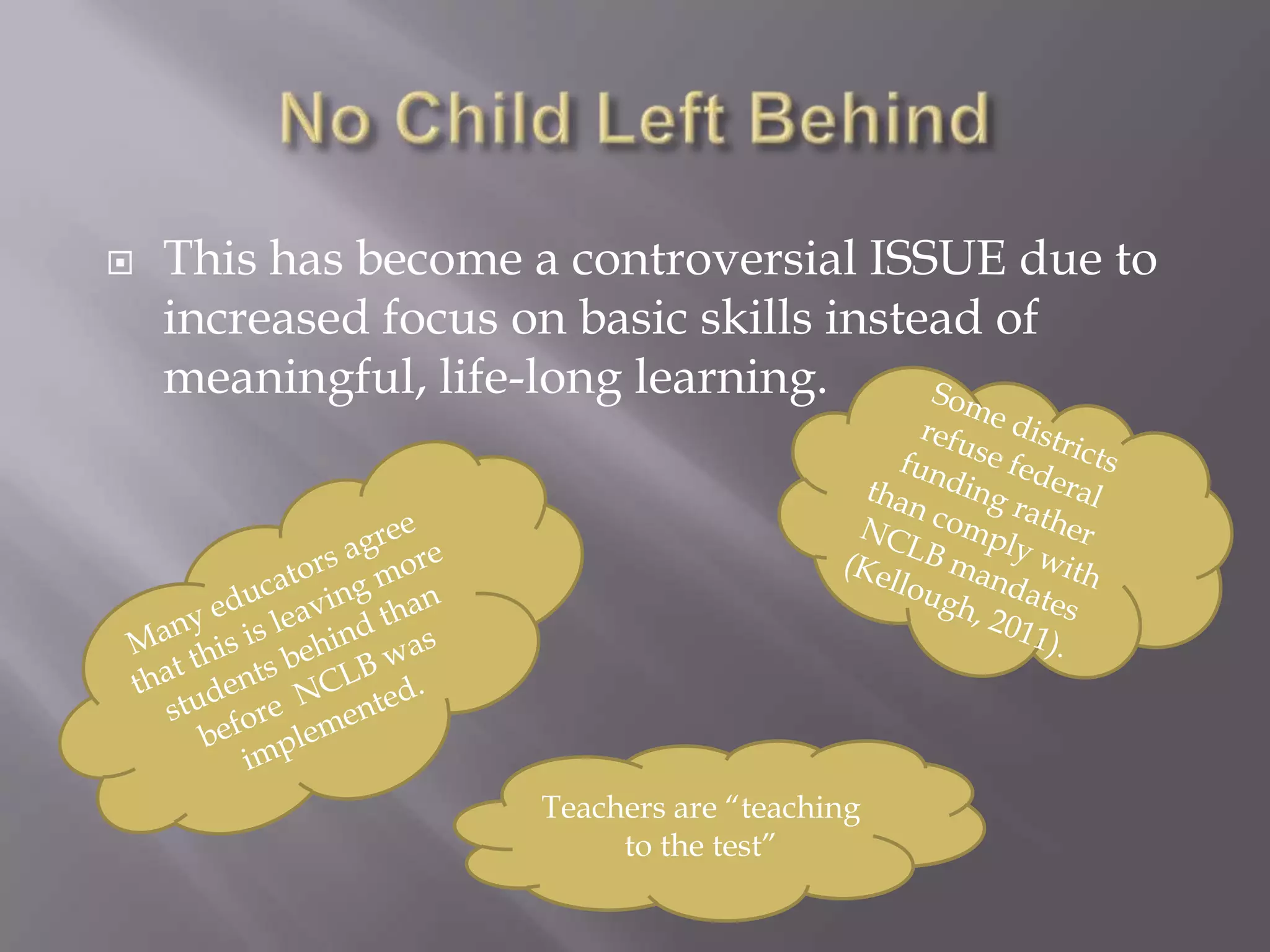
   This has become a controversial ISSUE due to
    increased focus on basic skills instead of
    meaningful, life-long learning.


                    Teachers are “teaching
                         to the test”
   NCLB is extremely influential to students
    because it affects the progress and future of
    each student (Duffy, 2008).

Ex. There is a female student at our school that does well in her
   high school classes. She made a 4 on her EOC. (Keep in
   mind that many teachers are teaching to the test for job
   security.) On the flip side, she failed all of her college classes
   she was enrolled in at the same time. She lacks the ability to
   be an active participant in her learning and it shows in her
   college classes.
   To promote a high quality education teachers must produce a
    learning environment in which students want to learn. This means
    differentiating instruction to meet everyone’s needs.
   Teachers must also allow students to participate in respectful
    work while maintaining a flexible working relationship
    (Logan, 2011).


                       A few ways to differentiate
                              instruction:
                   • Give students choices
                   • Create learning contracts
                   • Provide learning centers
                   • Provide a variety of
                     resources/reading material
                     about the topic
   This is a growing TREND because our
    classrooms are more diverse than ever and
    youth dropout rates are not decreasing.
   I ranked this as second most influential because
    differentiated instruction is the key to ensuring
    that you reach every child in that classroom.
I had a male student who came in my class
with little intention of learning. Teachers
previously had given up on him and it showed.
It took me about two months to establish a
good relationship with this young man and
learn about his interests. Everything we did I
somehow related it to sports and tweaked his
assignments to follow suit. We also agreed to
establish learning centers and he was in charge
of the students in his center. I am proud to say
that he succeeded in my class as well as on the
EOC.
   Student-centered learning is where students
    play an active role in their learning.
   This is a CHALLENGE because of many
    reasons:
      1.) student motivation (Pederson, 2003)
      2.) keeping students on task (Pederson, 2003)
      3.) how does one accurately assess this
          process (Pederson, 2003)
      4.) NCLB focusing on the basic skills
There was a student in my class who had
trouble with rote memorization. He had to
perform hands on activities, write his thoughts
in a learning log and then teach it to another
student in the class. He was key in choosing
these activities and he felt responsible not only
for himself but for the students he was
teaching.
   A current TREND that consists of someone
    providing professional development to
    teachers in efforts to help them improve their
    students’ abilities to read, write and succeed in
    that content area.
   Literacy coaches meet with teachers one-on-one
    to discuss current tactics and encourage new
    strategies to include reading, writing and more
    student oral participation (Gross, 2010)
   We have an awesome literacy coach but as I said
    earlier, it is difficult to correct a problem that has been
    ongoing in a short amount of time.
   There was a student this year that could not read or
    write sufficiently. We worked with him extensively
    and he did improve but he was still not on grade level
    by the end of the year.
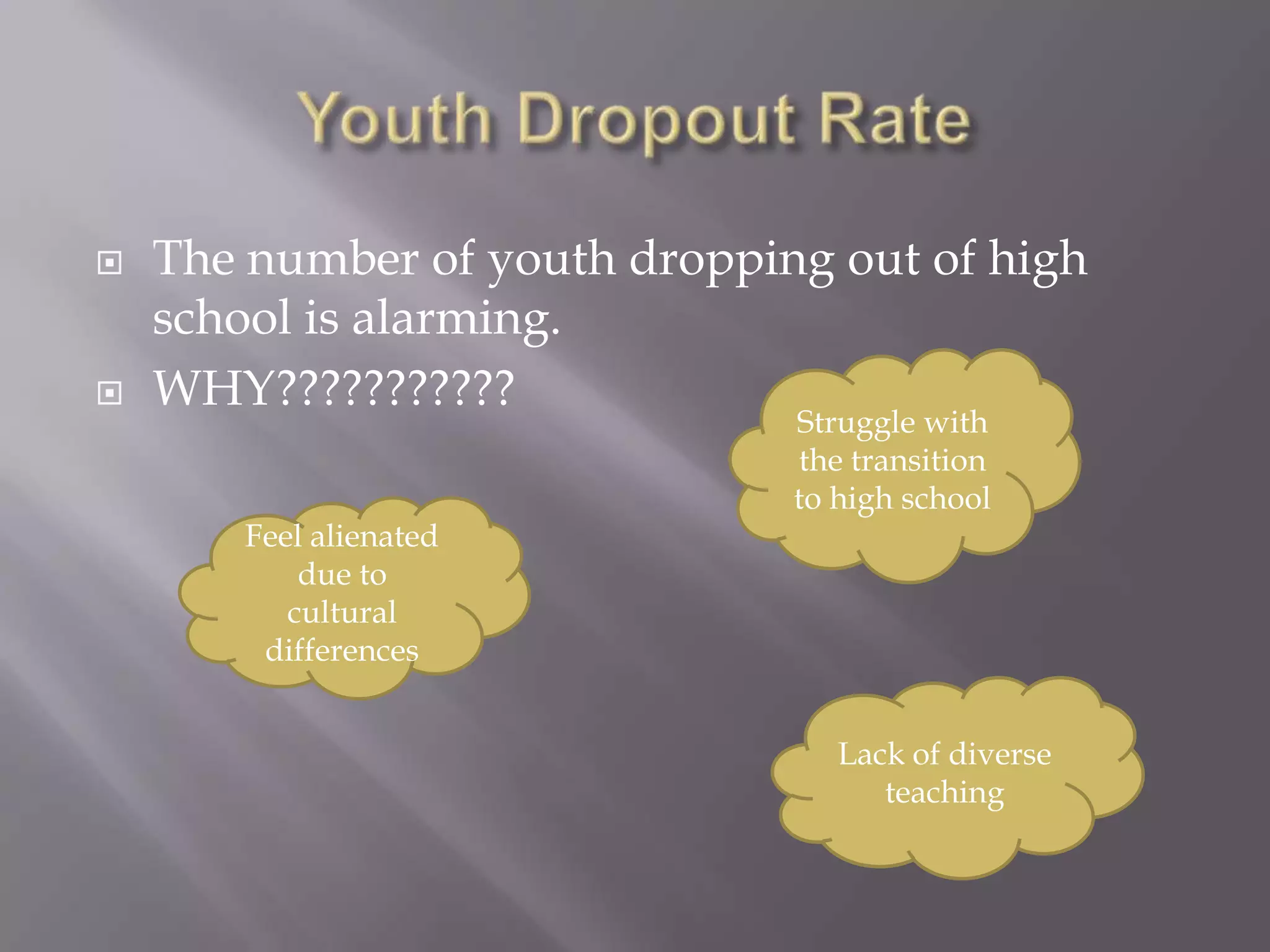
   The number of youth dropping out of high
    school is alarming.
   WHY???????????
                               Struggle with
                               the transition
                               to high school
       Feel alienated
           due to
          cultural
        differences


                                  Lack of diverse
                                     teaching
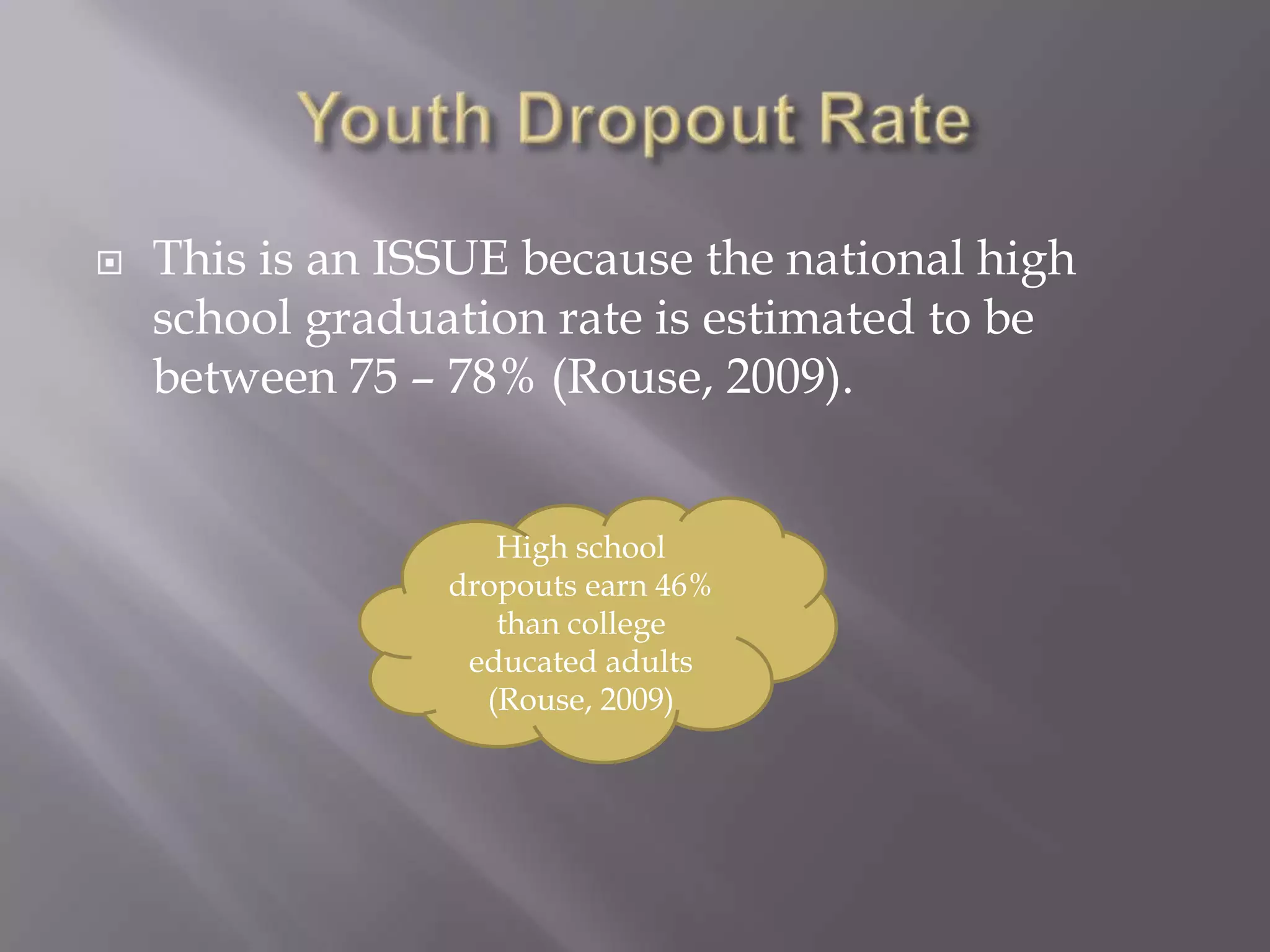
   This is an ISSUE because the national high
    school graduation rate is estimated to be
    between 75 – 78% (Rouse, 2009).


                    High school
                 dropouts earn 46%
                    than college
                  educated adults
                   (Rouse, 2009)
   I rated this last, not because I think it is any less
    influential than the others, but because if the
    previous topics are addressed then the dropout
    rate would decrease
Duffy, M., Giordano, V.A., Farrell, J.B., Paneque, O.M., & Crump, G.B. (2008). No Child Left

    Behind: Values and Research Issues in High-Stakes Assessments. Counseling & Values,

    53(1), 53-66.


Gross, P.A. (2010). Not Another Trend: Secondary-Level Literacy Coaching. The Clearing

    House, 83, 133-137. doi: 1080/00098651003774844


Kellough, R., & Kellough, N. (2011). Secondary School Teaching: A Guide to Methods and

    Resources. Retrieved from the University of Phoenix eBook Collection database.
Logan, B. (2011). Examining differentiated instruction: Teachers respond. Research In Higher

     Education Journal, 13, 1-14.


Pederson, S., & Liu, M. (2003). Teachers’ Beliefs about Issues in the Implementation of a

     Student-Centered Learning Environment. Educational Technology Research and

     Development, 51,(2), 57-76.


Rouse, C., & Kemple, J.J. (2009). Introducing the Issue. Future Of Children, 19(1), 3-15.

Connections: Current Trends, Challenges & Issues in Education

  • 2.
    Below are my5 connections starting with the most influential to the least: 1. No Child Left Behind 2. Differentiated Instruction 3. Student-Centered Learning 4. Literacy Coaching 5. Youth Dropout Rate
  • 3.
    NCLB was implemented with the hopes to improve student achievement and hold all involved more accountable.  An unsettling outcome of this act is high-stakes testing.
  • 4.
    This has become a controversial ISSUE due to increased focus on basic skills instead of meaningful, life-long learning. Teachers are “teaching to the test”
  • 5.
    NCLB is extremely influential to students because it affects the progress and future of each student (Duffy, 2008). Ex. There is a female student at our school that does well in her high school classes. She made a 4 on her EOC. (Keep in mind that many teachers are teaching to the test for job security.) On the flip side, she failed all of her college classes she was enrolled in at the same time. She lacks the ability to be an active participant in her learning and it shows in her college classes.
  • 6.
    To promote a high quality education teachers must produce a learning environment in which students want to learn. This means differentiating instruction to meet everyone’s needs.  Teachers must also allow students to participate in respectful work while maintaining a flexible working relationship (Logan, 2011). A few ways to differentiate instruction: • Give students choices • Create learning contracts • Provide learning centers • Provide a variety of resources/reading material about the topic
  • 7.
    This is a growing TREND because our classrooms are more diverse than ever and youth dropout rates are not decreasing.  I ranked this as second most influential because differentiated instruction is the key to ensuring that you reach every child in that classroom.
  • 8.
    I had amale student who came in my class with little intention of learning. Teachers previously had given up on him and it showed. It took me about two months to establish a good relationship with this young man and learn about his interests. Everything we did I somehow related it to sports and tweaked his assignments to follow suit. We also agreed to establish learning centers and he was in charge of the students in his center. I am proud to say that he succeeded in my class as well as on the EOC.
  • 9.
    Student-centered learning is where students play an active role in their learning.  This is a CHALLENGE because of many reasons: 1.) student motivation (Pederson, 2003) 2.) keeping students on task (Pederson, 2003) 3.) how does one accurately assess this process (Pederson, 2003) 4.) NCLB focusing on the basic skills
  • 10.
    There was astudent in my class who had trouble with rote memorization. He had to perform hands on activities, write his thoughts in a learning log and then teach it to another student in the class. He was key in choosing these activities and he felt responsible not only for himself but for the students he was teaching.
  • 11.
    A current TREND that consists of someone providing professional development to teachers in efforts to help them improve their students’ abilities to read, write and succeed in that content area.
  • 12.
    Literacy coaches meet with teachers one-on-one to discuss current tactics and encourage new strategies to include reading, writing and more student oral participation (Gross, 2010)
  • 13.
    We have an awesome literacy coach but as I said earlier, it is difficult to correct a problem that has been ongoing in a short amount of time.  There was a student this year that could not read or write sufficiently. We worked with him extensively and he did improve but he was still not on grade level by the end of the year.
  • 14.
    The number of youth dropping out of high school is alarming.  WHY??????????? Struggle with the transition to high school Feel alienated due to cultural differences Lack of diverse teaching
  • 15.
    This is an ISSUE because the national high school graduation rate is estimated to be between 75 – 78% (Rouse, 2009). High school dropouts earn 46% than college educated adults (Rouse, 2009)
  • 16.
    I rated this last, not because I think it is any less influential than the others, but because if the previous topics are addressed then the dropout rate would decrease
  • 17.
    Duffy, M., Giordano,V.A., Farrell, J.B., Paneque, O.M., & Crump, G.B. (2008). No Child Left Behind: Values and Research Issues in High-Stakes Assessments. Counseling & Values, 53(1), 53-66. Gross, P.A. (2010). Not Another Trend: Secondary-Level Literacy Coaching. The Clearing House, 83, 133-137. doi: 1080/00098651003774844 Kellough, R., & Kellough, N. (2011). Secondary School Teaching: A Guide to Methods and Resources. Retrieved from the University of Phoenix eBook Collection database.
  • 18.
    Logan, B. (2011).Examining differentiated instruction: Teachers respond. Research In Higher Education Journal, 13, 1-14. Pederson, S., & Liu, M. (2003). Teachers’ Beliefs about Issues in the Implementation of a Student-Centered Learning Environment. Educational Technology Research and Development, 51,(2), 57-76. Rouse, C., & Kemple, J.J. (2009). Introducing the Issue. Future Of Children, 19(1), 3-15.