adam@opened.io
Agenda
 What are some myths about the Common Core?
 How ready is California for the Common Core?
 What are the big remaining challenges?
 What are some technology solutions?
Myths About the Common Core
 It’s a federal government plot and a “national curriculum”
 The standards are too easy
 The standards are too hard
 It creates “cookie-cutter courses”
 It forces teachers to teach outside their expertise
It’s a Federal Government Plot
 The Common Core State standards were developed by the
National Governor’s Association
 But its tied to No Child Left Behind act right?
 But CCSS predates NCLB

 Oh well its Race to the Top then?
 Race to the Top provides incentives for adopting internationally
recognized standards of which CCSS is one

 But the federal government will take them over
 There are no such plans

 This is our federal tax dollars being misused.
 Initial work was funded by both the states and the Gates Foundation
and others. With no federal funding
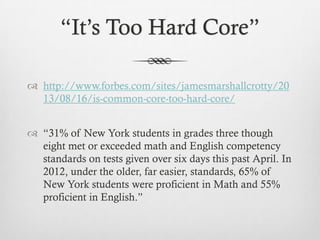
“It’s Too Hard Core”
 http://www.forbes.com/sites/jamesmarshallcrotty/20
13/08/16/is-common-core-too-hard-core/
 “31% of New York students in grades three though
eight met or exceeded math and English competency
standards on tests given over six days this past April. In
2012, under the older, far easier, standards, 65% of
New York students were proficient in Math and 55%
proficient in English.”
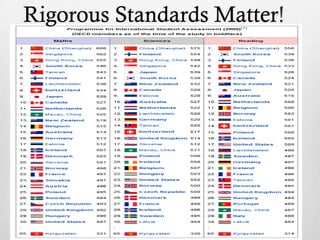
Rigorous Standards Matter!
Is It Really Too Hard?
 Yes there is a deeper conceptual base
 Word problems demonstrating full understanding are
important

 The CC standards build on each other
 Fractions -> Algebra
 Algebra -> Statistics

 And there are far fewer individual items than previous
efforts
 e.g. California State Standards
CC Forces Teachers to
Teach Outside Their Expertise
 No doubt due to the “Common Core Literacy
Standards”
 I have seen “English teachers will be forced to teach
Science and Social Studies”
 Not true

 Science and Social Studies teachers will be called upon
to teach reading and writing skills
 Presumably they were already but it is no longer enough
to be a “subject matter expert” there
CCSS
Implementation Survey
 https://www.documentcloud.org/documents/810000commcore-careadinesssurvey-countysupts102413.html
 Will be presented November 6th to State Board of Ed
 Prepared by CCSESA and Sacramento County

 Performed from mid-September to mid-October
 809 districts, 80% completion
 Nearly all have implementation plan
 Half approved by school boards
CCSS Sequencing
Implementation Plan
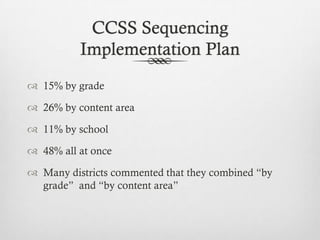
 15% by grade
 26% by content area
 11% by school
 48% all at once
 Many districts commented that they combined “by
grade” and “by content area”
CCSS Sequencing
Implementation Plan
 15% by grade
 26% by content area
 11% by school
 48% all at once
 Many districts commented that they combined “by
grade” and “by content area”
CCSS Sequencing
Math Implementation Plan
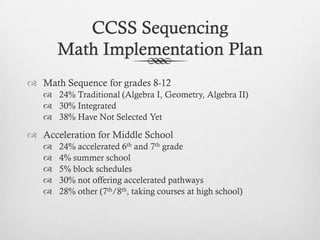
 Math Sequence for grades 8-12
 24% Traditional (Algebra I, Geometry, Algebra II)
 30% Integrated
 38% Have Not Selected Yet

 Acceleration for Middle School






24% accelerated 6th and 7th grade
4% summer school
5% block schedules
30% not offering accelerated pathways
28% other (7th/8th, taking courses at high school)
CCSS Communication Plan
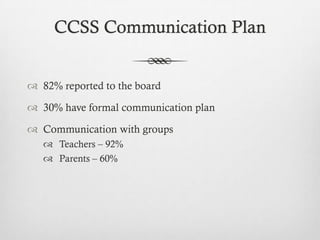
 82% reported to the board
 30% have formal communication plan
 Communication with groups
 Teachers – 92%
 Parents – 60%
CCSS Curriculum Review
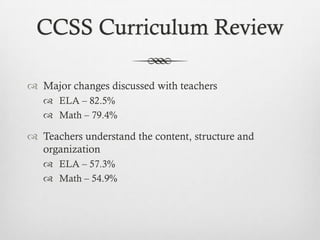
 Major changes discussed with teachers
 ELA – 82.5%
 Math – 79.4%

 Teachers understand the content, structure and
organization
 ELA – 57.3%
 Math – 54.9%
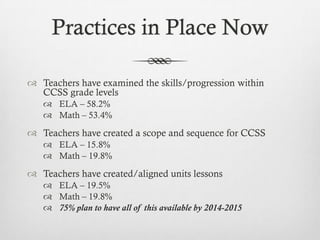
Practices in Place Now
 Teachers have examined the skills/progression within
CCSS grade levels
 ELA – 58.2%
 Math – 53.4%

 Teachers have created a scope and sequence for CCSS
 ELA – 15.8%
 Math – 19.8%

 Teachers have created/aligned units lessons
 ELA – 19.5%
 Math – 19.8%
 75% plan to have all of this available by 2014-2015
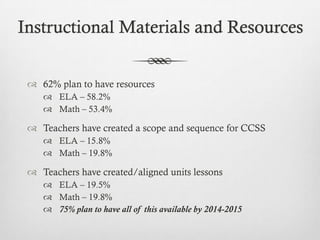
Instructional Materials and Resources
 62% plan to have resources
 ELA – 58.2%
 Math – 53.4%

 Teachers have created a scope and sequence for CCSS
 ELA – 15.8%
 Math – 19.8%

 Teachers have created/aligned units lessons
 ELA – 19.5%
 Math – 19.8%
 75% plan to have all of this available by 2014-2015
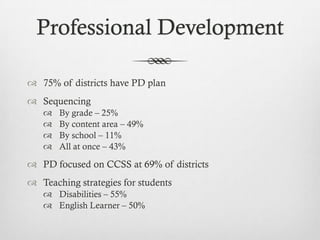
Professional Development
 75% of districts have PD plan
 Sequencing





By grade – 25%
By content area – 49%
By school – 11%
All at once – 43%

 PD focused on CCSS at 69% of districts
 Teaching strategies for students
 Disabilities – 55%
 English Learner – 50%
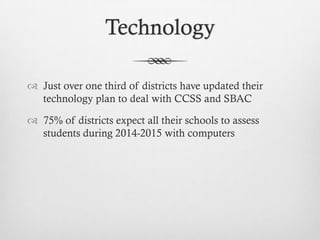
Technology
 Just over one third of districts have updated their
technology plan to deal with CCSS and SBAC
 75% of districts expect all their schools to assess
students during 2014-2015 with computers
Biggest Challenges in CCSS
Implementation
 Time (too much at once)
 Funding (materials, PD)
 Technology (bandwidth, internet, infrastructure)
 Instructional shifts (increased rigor and across subjects)
 Lack of curriculum (materials and assessments)
Challenges of the Common Core


Most teachers self-assess as not knowing all the mandated material for their
subjects



All students are expected to be exposed to their grade level standards



Especially in math, emphasizes conceptual understanding which can be more
challenging to teach



It is by definition more interdisciplinary



It can be difficult to engage students in the nonfiction language content



Contrary to some perceptions, CC is LESS prescriptive, putting the burden on
the teacher of “what to teach”
Technology Solutions
 Flipping your classroom with video lectures and games
can resolve an expertise problem
 Videos can make nonfiction language content more
engaging

 We still need more video content: needs tools to enable
easy content creation
 Automated quizzing and games can get all students to
basic standard mastery
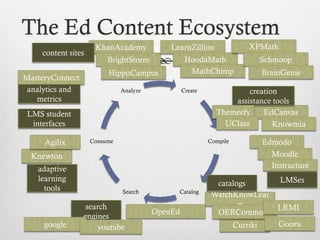
The Ed Content Ecosystem
content sites
MasteryConnect
analytics and
metrics

KhanAcademy

HoodaMath
MathChimp

BrightStorm

HippoCampus
Analyze

Create

LMS student
interfaces
Agilix

Consume

google

Schmoop
BrainGenie

creation
assistance tools
EdCanvas
Themeefy
UClass
Knowmia
Compile

Edmodo
Moodle
Instructure

Knewton
adaptive
learning
tools

XPMath

LearnZillion

Search

search
engines
youtube

Catalog

OpenEd

LMSes
catalogs
WatchKnowLear
n
LRMI
OERCommons
Gooru
Curriki
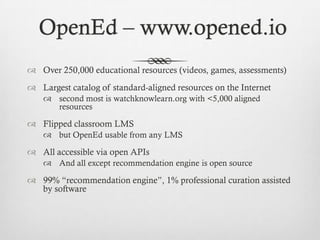
OpenEd – www.opened.io
 Over 250,000 educational resources (videos, games, assessments)

 Largest catalog of standard-aligned resources on the Internet
 second most is watchknowlearn.org with <5,000 aligned
resources

 Flipped classroom LMS
 but OpenEd usable from any LMS

 All accessible via open APIs
 And all except recommendation engine is open source

 99% “recommendation engine”, 1% professional curation assisted
by software
Some of the Interesting Remaining Problems

 Content from the ground up focused on standard
 Best ways to use class time when flipping (projects,
problems, teams, questions)
 How to find the best content for your topic and standard

 Mapping between standards, to leverage content internationally
 How to assess effectiveness of content in addressing standard
 How to deal with SBAC/PARCC without “teaching to the
test”
Questions for Teachers
 What is the content needed for your students?
 How do you find it?
 How will you organize it?
 How will your students get to it?
 How will you assess its effectiveness for your students?

Common Core State Standards: Myths, Readiness, Challenges and Solutions

  • 1.
  • 2.
    Agenda  What aresome myths about the Common Core?  How ready is California for the Common Core?  What are the big remaining challenges?  What are some technology solutions?
  • 3.
    Myths About theCommon Core  It’s a federal government plot and a “national curriculum”  The standards are too easy  The standards are too hard  It creates “cookie-cutter courses”  It forces teachers to teach outside their expertise
  • 4.
    It’s a FederalGovernment Plot  The Common Core State standards were developed by the National Governor’s Association  But its tied to No Child Left Behind act right?  But CCSS predates NCLB  Oh well its Race to the Top then?  Race to the Top provides incentives for adopting internationally recognized standards of which CCSS is one  But the federal government will take them over  There are no such plans  This is our federal tax dollars being misused.  Initial work was funded by both the states and the Gates Foundation and others. With no federal funding
  • 5.
    “It’s Too HardCore”  http://www.forbes.com/sites/jamesmarshallcrotty/20 13/08/16/is-common-core-too-hard-core/  “31% of New York students in grades three though eight met or exceeded math and English competency standards on tests given over six days this past April. In 2012, under the older, far easier, standards, 65% of New York students were proficient in Math and 55% proficient in English.”
  • 7.
  • 8.
    Is It ReallyToo Hard?  Yes there is a deeper conceptual base  Word problems demonstrating full understanding are important  The CC standards build on each other  Fractions -> Algebra  Algebra -> Statistics  And there are far fewer individual items than previous efforts  e.g. California State Standards
  • 9.
    CC Forces Teachersto Teach Outside Their Expertise  No doubt due to the “Common Core Literacy Standards”  I have seen “English teachers will be forced to teach Science and Social Studies”  Not true  Science and Social Studies teachers will be called upon to teach reading and writing skills  Presumably they were already but it is no longer enough to be a “subject matter expert” there
  • 10.
    CCSS Implementation Survey  https://www.documentcloud.org/documents/810000commcore-careadinesssurvey-countysupts102413.html Will be presented November 6th to State Board of Ed  Prepared by CCSESA and Sacramento County  Performed from mid-September to mid-October  809 districts, 80% completion  Nearly all have implementation plan  Half approved by school boards
  • 11.
    CCSS Sequencing Implementation Plan 15% by grade  26% by content area  11% by school  48% all at once  Many districts commented that they combined “by grade” and “by content area”
  • 12.
    CCSS Sequencing Implementation Plan 15% by grade  26% by content area  11% by school  48% all at once  Many districts commented that they combined “by grade” and “by content area”
  • 13.
    CCSS Sequencing Math ImplementationPlan  Math Sequence for grades 8-12  24% Traditional (Algebra I, Geometry, Algebra II)  30% Integrated  38% Have Not Selected Yet  Acceleration for Middle School      24% accelerated 6th and 7th grade 4% summer school 5% block schedules 30% not offering accelerated pathways 28% other (7th/8th, taking courses at high school)
  • 14.
    CCSS Communication Plan 82% reported to the board  30% have formal communication plan  Communication with groups  Teachers – 92%  Parents – 60%
  • 15.
    CCSS Curriculum Review Major changes discussed with teachers  ELA – 82.5%  Math – 79.4%  Teachers understand the content, structure and organization  ELA – 57.3%  Math – 54.9%
  • 16.
    Practices in PlaceNow  Teachers have examined the skills/progression within CCSS grade levels  ELA – 58.2%  Math – 53.4%  Teachers have created a scope and sequence for CCSS  ELA – 15.8%  Math – 19.8%  Teachers have created/aligned units lessons  ELA – 19.5%  Math – 19.8%  75% plan to have all of this available by 2014-2015
  • 17.
    Instructional Materials andResources  62% plan to have resources  ELA – 58.2%  Math – 53.4%  Teachers have created a scope and sequence for CCSS  ELA – 15.8%  Math – 19.8%  Teachers have created/aligned units lessons  ELA – 19.5%  Math – 19.8%  75% plan to have all of this available by 2014-2015
  • 18.
    Professional Development  75%of districts have PD plan  Sequencing     By grade – 25% By content area – 49% By school – 11% All at once – 43%  PD focused on CCSS at 69% of districts  Teaching strategies for students  Disabilities – 55%  English Learner – 50%
  • 19.
    Technology  Just overone third of districts have updated their technology plan to deal with CCSS and SBAC  75% of districts expect all their schools to assess students during 2014-2015 with computers
  • 20.
    Biggest Challenges inCCSS Implementation  Time (too much at once)  Funding (materials, PD)  Technology (bandwidth, internet, infrastructure)  Instructional shifts (increased rigor and across subjects)  Lack of curriculum (materials and assessments)
  • 21.
    Challenges of theCommon Core  Most teachers self-assess as not knowing all the mandated material for their subjects  All students are expected to be exposed to their grade level standards  Especially in math, emphasizes conceptual understanding which can be more challenging to teach  It is by definition more interdisciplinary  It can be difficult to engage students in the nonfiction language content  Contrary to some perceptions, CC is LESS prescriptive, putting the burden on the teacher of “what to teach”
  • 22.
    Technology Solutions  Flippingyour classroom with video lectures and games can resolve an expertise problem  Videos can make nonfiction language content more engaging  We still need more video content: needs tools to enable easy content creation  Automated quizzing and games can get all students to basic standard mastery
  • 23.
    The Ed ContentEcosystem content sites MasteryConnect analytics and metrics KhanAcademy HoodaMath MathChimp BrightStorm HippoCampus Analyze Create LMS student interfaces Agilix Consume google Schmoop BrainGenie creation assistance tools EdCanvas Themeefy UClass Knowmia Compile Edmodo Moodle Instructure Knewton adaptive learning tools XPMath LearnZillion Search search engines youtube Catalog OpenEd LMSes catalogs WatchKnowLear n LRMI OERCommons Gooru Curriki
  • 24.
    OpenEd – www.opened.io Over 250,000 educational resources (videos, games, assessments)  Largest catalog of standard-aligned resources on the Internet  second most is watchknowlearn.org with <5,000 aligned resources  Flipped classroom LMS  but OpenEd usable from any LMS  All accessible via open APIs  And all except recommendation engine is open source  99% “recommendation engine”, 1% professional curation assisted by software
  • 25.
    Some of theInteresting Remaining Problems  Content from the ground up focused on standard  Best ways to use class time when flipping (projects, problems, teams, questions)  How to find the best content for your topic and standard  Mapping between standards, to leverage content internationally  How to assess effectiveness of content in addressing standard  How to deal with SBAC/PARCC without “teaching to the test”
  • 26.
    Questions for Teachers What is the content needed for your students?  How do you find it?  How will you organize it?  How will your students get to it?  How will you assess its effectiveness for your students?

Editor's Notes

  • #26 OpenEd working on italicized bullets