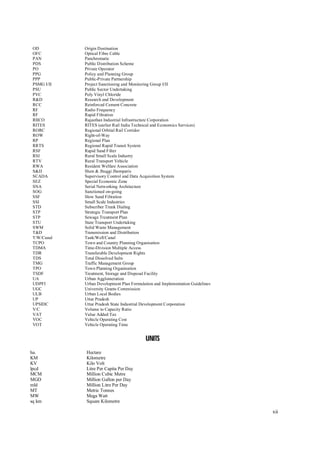
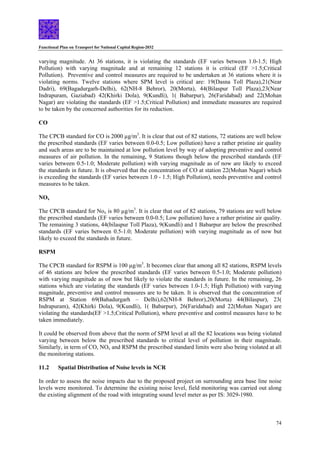
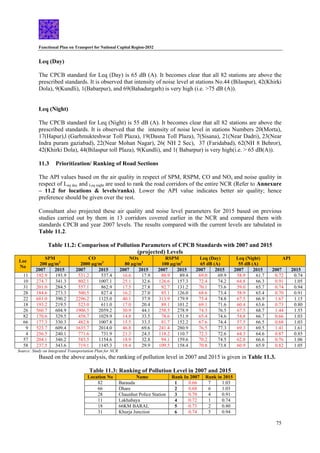
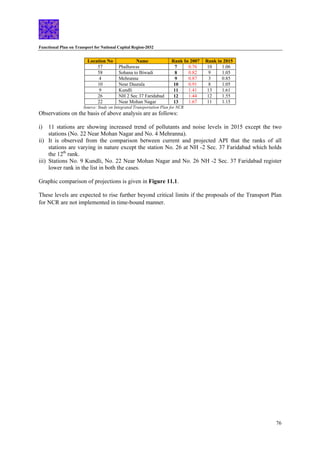
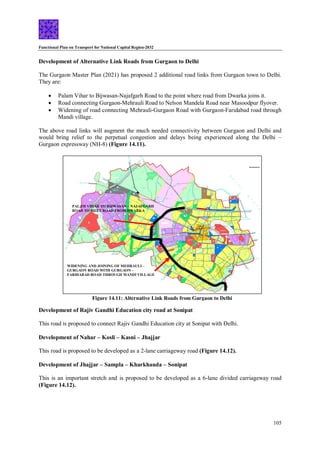
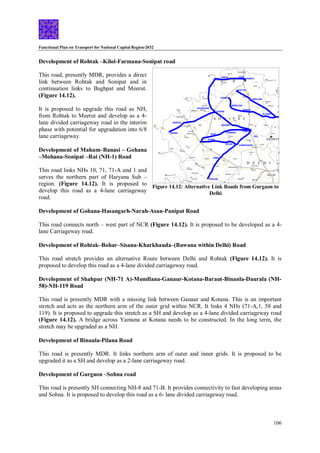
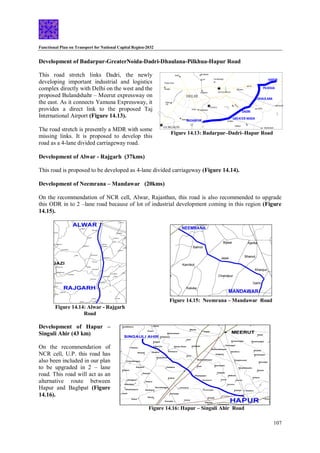
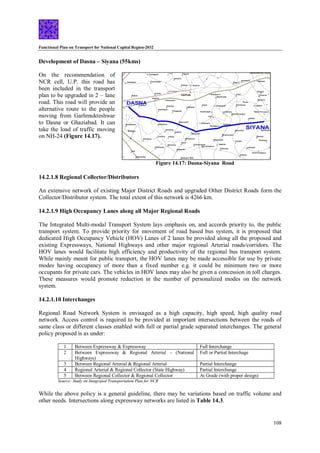
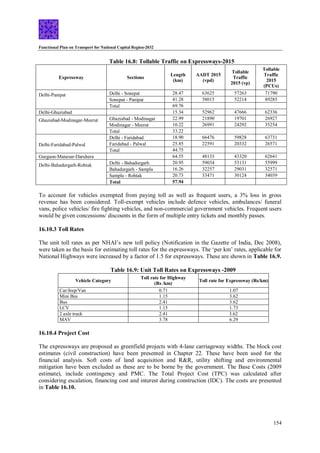
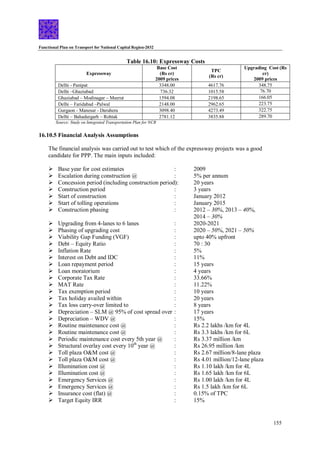
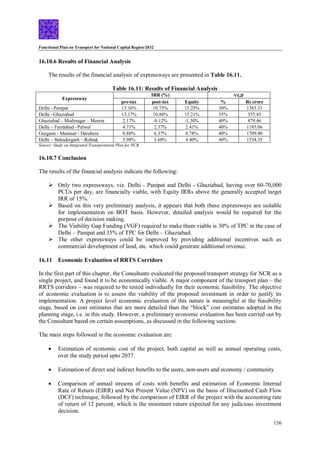
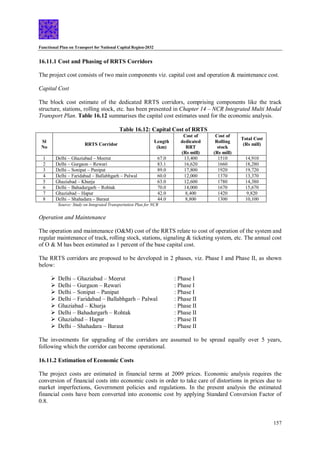
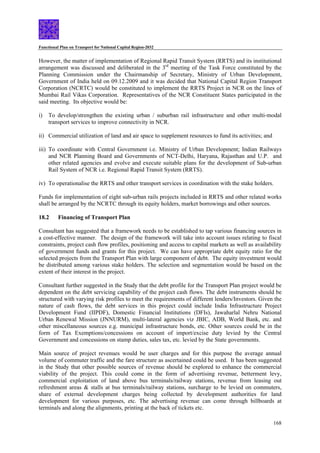
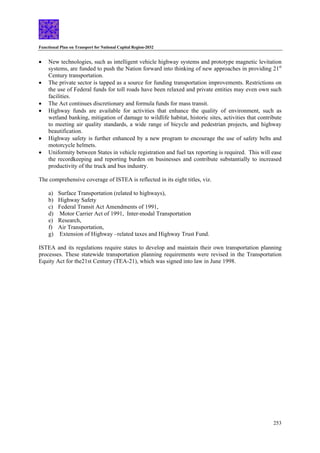
NATIONAL CAPITAL REGION PLANNING BOARD
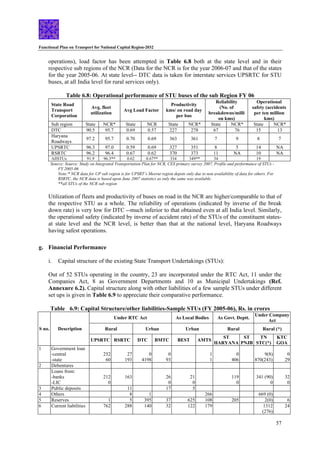
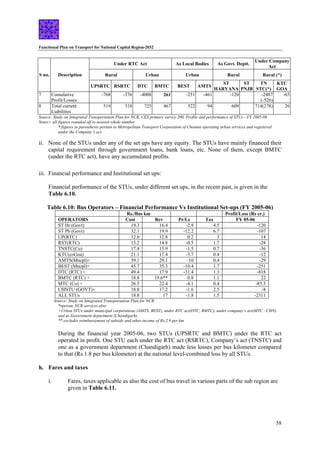
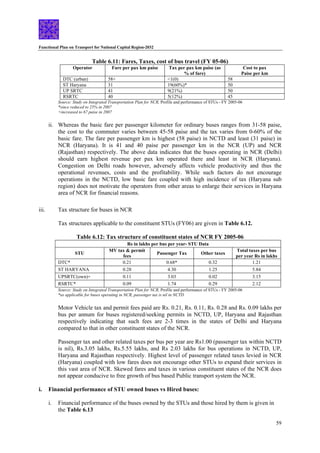
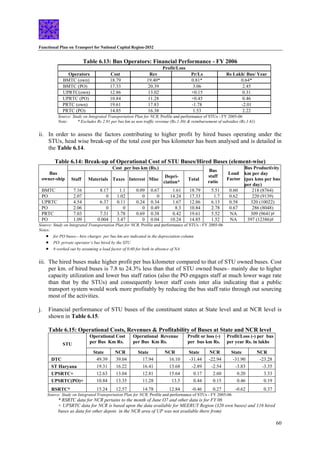
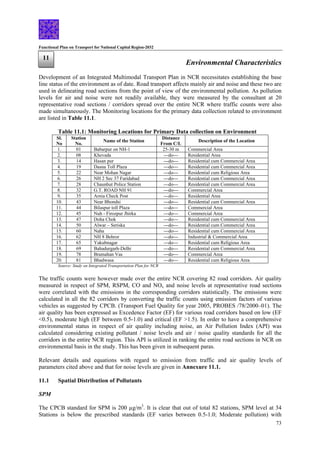
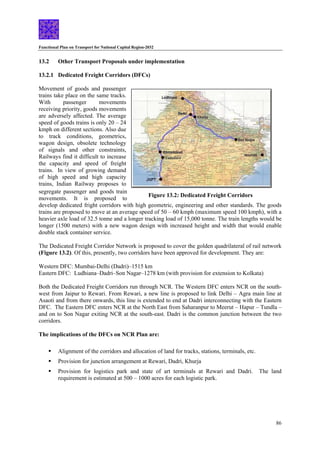
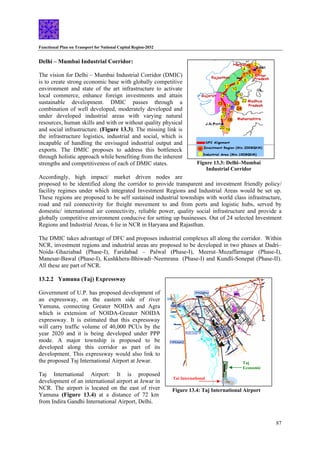
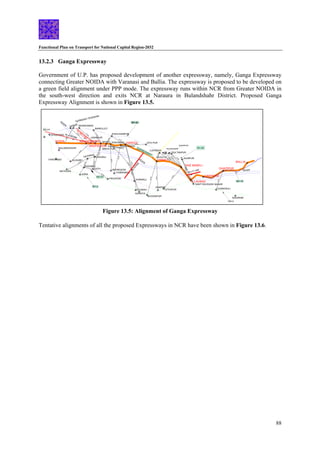
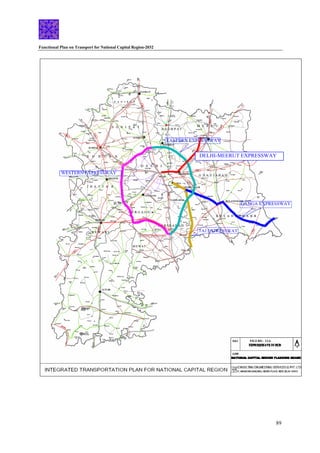
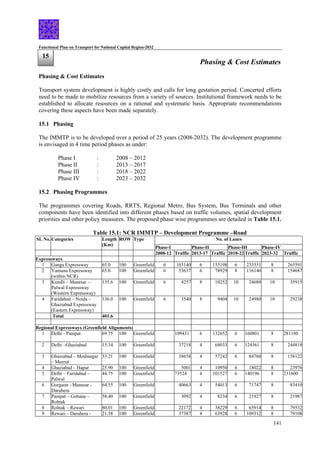
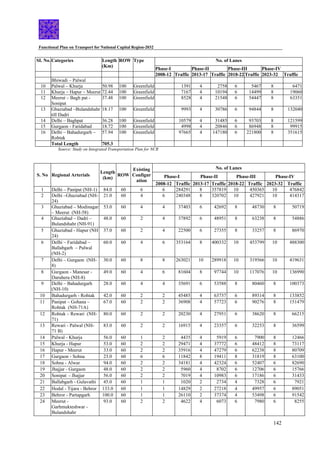
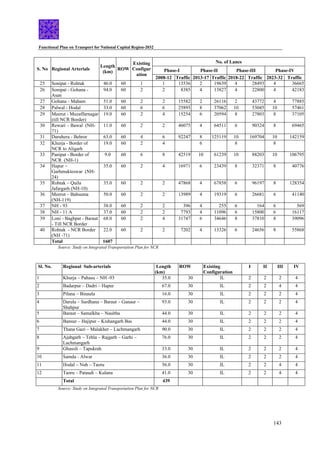
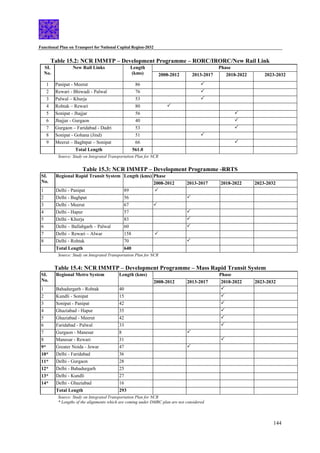
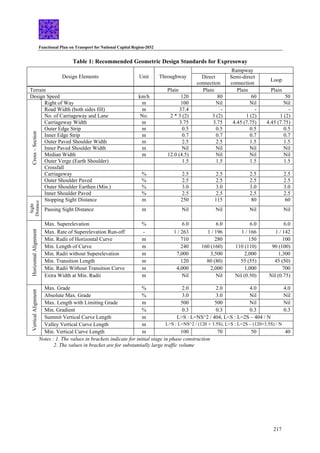
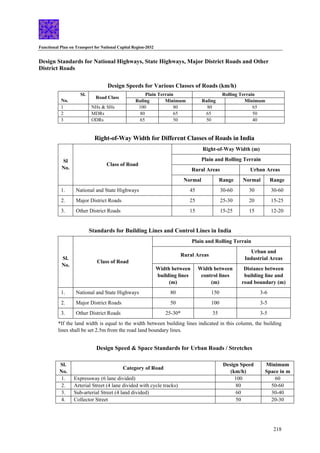
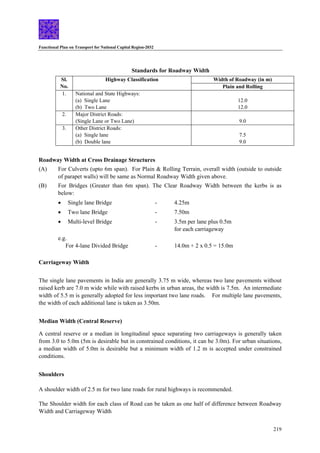
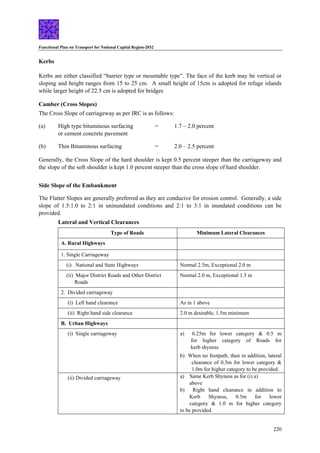
Ministry of Urban Development, Government of India
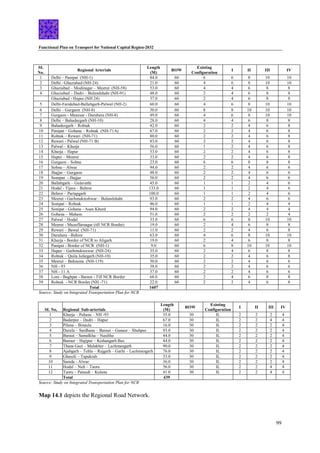
Functional Plan on Transport for National
Capital Region-2032
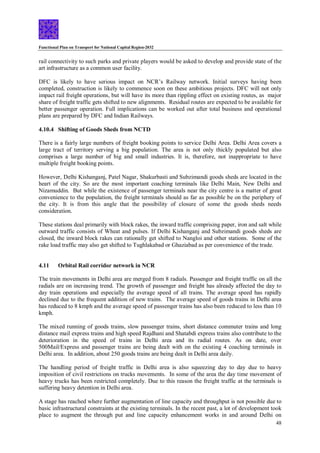
MEERUT
PANIPAT
FARIDABAD
GHAZIABAD
DELHI
GURGAON
REWARI
JHAJJAR
ALWAR
Babarpur
Asan
RS
Karsindhu
RS
Naultha
Narah
Manana
Samalkha
GOHANA
Ganaur
Bapauli
Khas
Pur
Juan
Mohana
Barauda
Butana
Siwana Mal
Murthal
Kotana
Farmana
Silana
Ratdhana
RS
Kharkhauda
Sisana
Narela
Bawana
Shakur Basti
Nangloi
RS
Loni
Daula
Farrukhnagar
Badli
Chuchajwas
Badli
Bupania
BAHADURGARH
Dujana
Dubaldhan
Jahazgarh
Kasnl
Matanhel
Najafgarh
Asauda
Chhara
Dighal
Sampla
Dhankot
Bohar
Sanghi
Banasi
MAHAM
Kharanti
RS
Samar
Gopalpur RS
Madina
Kharak
Kalanaur
Lahll
Kilol
Qilazafargarh
Mundlana
Jharli
Bahu
Nahar Kosli
Farrukhnagar
Patauda
Sultanpur
Bird
Sanctuary
Pataudi
RS Pataudi
Bahora
Manesar
Sohna
Badshahpur
Bhaundsi
Dhauj
Badarpur
Tuglakabad
GREATER NOIDA
Surajpur
Ajaibpur
Ballabgarh
Mahrauli
Okhla
Shahdara
Palam
RS
Muradnagar Faridnagar
Modinagar
Khokra
Gothra
RS
Kankarkhera
Bohla
Parichhatgarh
Sathla
Modi
Puram RS
MAWANA
Hastinapur
Phalavda
Lawar
Mulhaira
SARDHANA
Sakoti
RS
Jewar
Jhajhar
Khurja RS
Kakor
Bilaspur
KHURJA
Karora
Ahmadgarh
Pahasu
Arnia
Sikandarpur
Jahangirpur
RAJGARH
Malakher
Sariska
National
Park
Baleta
Sariska
Akbarpur
Mahwa
Maujpur
Buntoli
Garh
Lachhmangarh
Ramgarh
Milkapur
Bagar Meo
Jamwa
Ramgarh
Sanctuary
Partapgarh
Thana Gazi
Nangal
Bani
Baraud
Mandawar
Harsauli
Gunta
Tatarpur
Jindoli
Hajipur
Ghasoli
Mubarikpur
Bahadurpur
Kishangarh Bas
Shahbach
Bhindusi
Fatehabad
TIJARA
Kot Qasim
Tapukrah
Dharuhera
Taoru
Nuh
Malab
Bhadas
Nagina
Sakras Punahana
HODAL
PALWAL
Hathin
Ghasera Mandkaula
Manpur
Kot
Mohana
Asaoti
RS
RAI
Raoh
Firozpur
Jhirka
Nauganva
Jahangirabad
Anupshahr
Ahar
Saiyad
Saidpur
Siyana
Garhmukteshwar
Kuchesar
Road RS Baksar
Kuchesar
Kithaur
Kharkhauda
HAPUR
Pilkhua
Babugarh
Gulavthi
Khanpur
Sikandrabad
Daurala
Niwari
Munak
Kahnaur
Bari
Khas
Salahawas
Kanwali Jatusan
Nangal
Mundi RS
Danina
Zainabad
Kund
RS
Khori RS
Bharawas
BAWAL
BEHROR
Neemrana
Shahjahanpur
Khor
Madhan
Samda
Bansur
Indrara
Rampur
Narayanpur
Harsora
Bamanwas
Tehla
Khoh
Ajabgarh
Dhamrer
BASWA
Manoheri
Garhi
Baseth
Jaharu
Kathumar
Garu
Reni
Naranpura
RS
Biwal
Garhi
Harsaru
Patil
RS
Chhaensa
Dankaur
Rabupura
Shikarpur
Bahsuma
Binaula
Sarurpur
Chhaprauli
Kishanpur
Bavil
RS
Asimpur
Kheri RS
BAGHPAT
BULANDSHAHR
ROHTAK
Baldeogarh
Sherah
Dibai
Kasan
N
H
-8
NH-10
NH
-7
1
SONIPAT
NOIDA
NH
-1
NH-2
NH-9
1
NH-24
NH-5
8
NH-119
NH-71B
NH-7
1A
Bamnikhera
To Charkhi Dadri (SH-20)
J H A J J A R
G U R G A O N
F A R I D A B A D
R E W A R I
A L W A R
R O H T A K
S O N I P A T
D E L H I
G H A Z I A B A D
M E E R U T
B A G H P A T
B U L A N D S H A H R
GAUTAM BUDH NAGAR
M E W A T
Dasna
Rasulpur
Rohta
Davathwa
Suraj
Kund
Badhkhal Lake
Tankri
Gajraula
Dhaulana
Jarcha
Nagar
Govidgarh
Pinangwan
NH
-71
Simbhauli
Dankaur RS
Wair RS
Ajarka RS
Sujra
RS
Ailam
RS
N
R
Maripat
RS
Rundhi
RS
Kahrawar
RS
NH-58
NH-10
NH-8
N
H
-7
1
Asan
BHIWADI
To
Karnal
To Jind (SH-14)
To Muzaffarnagar (SH-16)
To Jind (SH-10)
T
o
J
in
d
(
N
H
-
7
1
)
To Hani (NH -10)
To Bhiwani (SH-16)
To Mahendragarh (SH-22)
To Narnaul (SH -25)
T
o
J
a
ip
u
r
(N
H
-8
)
To Jaipur (SH-13)
To
Jaipur
(SH-25)
To Mathura (SH-14)
T
o
M
at
hu
ra
(N
H
-2
)
T
o
A
lig
a
rh
(N
H
-9
1
)
T
o
A
li
g
a
r
h
To Moradabad
To Moradabad
To Moradabad (NH-24)
T
o
B
ij
n
o
r
(
N
H
-
1
1
9
)
T
o
M
uz
af
fa
rn
ag
ar
(N
H
-5
8)
To
Shamli
(SH-57)
NH-11A
Gotoli
KUNDLI
SH
-14
SH-
18
S
H
-8
2
SH-14
S
H
-8
2
N
H
-9
3
SH
-6
5
SH-
65
SH-65
SH-63
MDR - 50
MDR - 58
SH- 11
SH
-11
SH
-24
SH-26
S
H
-1
5
SH-26
Shahpur
S
H
-2
2
SH-20
SH
-20
SH
-22
S
H
-1
5
A
Khalilpur
Musepur
Bhojpur
DADRI
SH
-16 A
SH-15
A
SH
-10
SH
-20
SH-
11
SH-14
SH-16
Niwara
Hasangarh
Rindhana
SH-26
SH-
57
Pilana
Khekhada
Kulana
SH-13
Rithoj
DamDama
Lake
Hassanpur
Pipli
Chandhat
Ghori
Tigaon
Gharora
SH-18
TAJ EXPRESSWAY
Baraut
SH
-14
SH
-6
5
S
H
-2
2
GANGA EXPRESSWAY
EASTERN EXPRESSWAY
WESTERN EXPRESSWAY
TRANSPORT
i
C
CO
ON
NT
TE
EN
NT
TS
S
Page
List of Tables v-vi
List of Figures vii
List of Maps viii
List of Annexures ix
Abbreviations and Units x-xii
Conversions xiii
Executive Summary xiv-xxix
1. Introduction 1-3
1.1 Regional Plan-2021 for National Capital Region 1
1.2 Aims & Objectives of the Regional Plan-2021 1
1.3 Objectives of the Study on Transport Plan 1
1.4 Preparation of Functional Plan on Transport-2032 2
2. Road Network 4-9
2.1 Existing Road Network 4
2.2 Network Form and Spread 4
2.3 Road Network Inventory 7
2.4 Volume/Capacity Ratio 7
2.5 Pavement Condition 7
2.6 Road Network Analysis - Inferences and Recommendations 8
3. Traffic and Travel Characteristics 10-34
3.1 Traffic Surveys 10
3.1.1 Traffic Characteristics 10
3.1.1.1 Outer Cordon (OC) Traffic Characteristics 10
3.1.1.2 Traffic Characteristics at Urban Cordons 12
3.1.2 Speed Characteristics 15
3.2 Traffic Pattern Characteristics 17
3.2.1 Overall Traffic Patterns in NCR 17
3.2.1.1 Overall Traffic Pattern – Passenger Modes 17
3.2.1.2 Overall Traffic Pattern – Goods Modes 18
3.2.1.3 Inter-State Movement Pattern 19
3.2.2 Spatial Travel Pattern 19
3.2.2.1 Traffic Pattern at Outer Cordon (NCR) 19
3.2.2.2 Traffic Pattern at Middle Cordon (CNCR) 24
3.2.2.3 Traffic Pattern at Inner Cordon (NCTD) 28
3.2.3 Comparative Analysis and Issues 33
3.2.3.1 Comparative Analysis 33
3.2.3.2 Issues 34
4. Railway Network in NCR 35-49
4.1 Rail Radials around NCTD 35
4.2 Passenger Terminals in the Capital 35
4.3 Coaching and Freight Traffic in Delhi & NCR 37
4.4 Operational Complexities 37
4.5 Description of Radials in Delhi Area 37
4.6 Passenger Traffic Profile 39
4.7 Commuter Services in NCR 40
4.7.1 Fare Structure 41
4.8 Metro Rail in NCR 42
4.9 Freight movement for and beyond Delhi and NCR (Railway Network) 42
4.9.1 Movement of Freight Trains over alternate routes 44
4.9.2 More Intensive Utilisation of GAL/DAL 44
ii
4.9.3 Catering Light Engine Movements in Delhi Area 44
4.9.4 Container Operations in NCR 45
4.9.5 Entry of Private Container Companies 46
4.10 Dedicated Freight Corridor 46
4.10.1 Need for Dedicated Freight Corridor Project 46
4.10.2 The Eastern Corridor 47
4.10.3 The Western Corridor 47
4.10.4 Shifting of Goods Sheds from NCTD 48
4.11 Orbital Rail corridor network in NCR 48
5. Air Transport in NCR 50-51
5.1 Traffic Characteristics 50
5.2 O&D Pattern 51
6. Bus System in NCR 52-65
6.1 Existing Public Transport System in NCR and its Sub-Regions 52
6.1.1 Rail Services 52
6.1.2 Existing Bus Services-characteristics, performance and issues 52
6.1.2.1 Bus services 52
6.1.2.2 Operational Characteristics and Performance of the bus based Public
Transport System (BPTS) services
53
7. Bus Terminals 66
8. Commuter Characteristics 67-69
9. Stated Preference Survey 70
10. Intermediate Public Transport System Operator Survey 71-72
10.1 Personal Characteristics 71
10.2 Operating Characteristics 71
10.3 Suggestions by Operators 72
11. Environmental Characteristics 73-77
11.1 Spatial Distribution of Pollutants 73
11.2 Spatial Distribution of Noise levels in NCR 74
11.3 Prioritization/ Ranking of Road Sections 75
12. NCR Transport Modal 78-83
13. Regional Plan-2021and Other Transport Proposals under Implementation 84-89
13.1 Regional Plan-2021 Proposals under Implementation 84
13.1.1 Up-gradation of National Highway within NCR 84
13.1.2 Peripheral Expressways around Delhi 84
13.1.3 Up-gradation of Roads through NCR Financed Projects 84
13.1.4 Delhi-Meerut Expressway 85
13.1.5 New Rail Links 85
13.1.6 Extension of Delhi Metro to NCR Towns 85
13.2 Other Transport Proposals under implementation 86
13.2.1 Dedicated Freight Corridors (DFCs) 86
13.2.2 Yamuna (Taj) Expressway 87
13.2.3 Ganga Expressway 88
14. Integrated Multi Modal Transport Plan for NCR 90-140
14.1 Travel Demand 91
14.2 Integrated Multi Modal Transport Plan –Components 92
14.2.1 Road Network System 92
14.2.1.1 Hierarchy 93
14.2.1.2 Road Network Extent 93
14.2.1.3 Regional Expressways 93
14.2.1.4 Development of Regional Arterial Roads 97
14.2.1.5 Urban Expressways 101
14.2.1.6 Urban Bypasses 101
14.2.1.7 Regional Sub-Arterial Roads 101
iii
14.2.1.8 Regional Collector/Distributors 108
14.2.1.9 High Occupancy Lanes along all Major Regional Roads 108
14.2.1.10 Interchanges 108
14.2.1.11 Bypass System around All Major Urban Centers 109
14.2.1.12 Integrating and Interfacing Regional and Urban Road Network Systems 109
14.2.1.13 Toll Policy and Toll Plazas 110
14.2.1.14 Integrated Freight Complexes 110
14.2.1.15 Highway Facility Centres 110
14.2.1.16 NCR – Highways Facilities Centres Development Company 111
14.2.1.17 Road Traffic Safety Issues & Strategies 111
14.2.1.18 Road Safety Scenario of NCR States vis-à-vis India 113
14.2.1.19 Road Safety Strategies 114
14.2.1.20 NCR Transport Safety Authority/Cell 115
14.2.2 Bus System 115
14.2.2.1 Demand Forecast for Buses 115
14.2.2.2 Bus based Public Transport System Development 116
14.2.3 Bus Terminals 121
14.2.3.1 Main Functions of Bus Terminals 121
14.2.3.2 Standards and norms for Bus Terminals 122
14.2.3.3 Development of Bus Terminals: Recommendations 125
14.2.3.4 Public Private Partnership Options for Development of Bus Terminals and
Other Facilities-Concepts and their Evaluation
127
14.2.4 Rail System 127
14.2.4.1 Rail Network in NCR 127
14.2.4.2 Issues 128
14.2.4.3 Travel Demand and Loadings by Corridors 129
14.2.4.4 Prioritization of RRTS Corridors with Costing 130
14.2.4.5 NCR Transport Corporation 131
14.2.4.6 Regional Orbital Rail Corridor 131
14.2.4.7 Inner Regional Orbital Rail Corridor (Other New Rail Lines) 132
14.2.4.8 Cost Estimate 134
14.2.4.9 Logistics Hubs/Inland Container Depots/ Yards 134
14.2.5 Regional Mass Rapid Transit System (MRTS) 135
14.2.5.1 Delhi Metro Rail System 135
14.2.5.2 Mass Rapid Transit System in NCR 135
14.2.5.3 Travel Demand on Mass Rapid Transit System (MRTS) 138
14.2.5.4 Phasing of MRTS in NCR 138
14.2.5.5 Institution 138
14.2.6 Air Transport 138
14.2.6.1 International/Domestic Airports 138
14.2.6.2 Aerotropolis 139
14.2.6.3 Domestic Airport at Jhajjar 139
14.2.6.4 Smaller Airports 139
15. Phasing & Cost Estimates 141-146
15.1 Phasing 141
15.2 Phasing Programmes 141
15.3 Cost Estimates 145
15.4 NCR - IMMTP - Investment Cost 145
16. Economic and Financial Analyses 147-160
16.1 Economic Analysis 147
16.2 Transport Plan for NCR 147
16.3 Framework for Economic Analysis 148
16.4 Economic Modal Inputs 149
16.4.1 Traffic 149
iv
16.4.2 Unit Costs of VOC Inputs 150
16.4.3 Estimation of unit VOC 150
16.4.4 Value of Travel Time 150
16.4.5 Network Level Costs 151
16.4.6 MRT System 151
16.4.7 Regional Rapid Rail Transit 151
16.5 Project Benefits 152
16.6 Project Costs 152
16.6.1 Maintenance Costs 152
16.7 Economic Viability 152
16.8 Other Benefits 152
16.8.1 Environmental Benefit 152
16.8.2 Increase in Land Values 153
16.9 Conclusions 153
16.10Financial Analysis of Expressways in NCR 153
16.10.1 Introduction 153
16.10.2 Tollable Traffic 153
16.10.3 Toll Rates 154
16.10.4 Project Cost 154
16.10.5 Financial Analysis Assumptions 155
16.10.6 Results of Financial Analysis 156
16.10.7 Conclusion 156
16.11 Economic Evaluation of RRTS Corridors 156
16.11.1 Cost and Phasing of RRTS Corridors 157
16.11.2 Estimation of Economic Costs 157
16.11.3 Estimation of Economic Benefits 158
16.11.4Economic Appraisal 159
17. Social Impact Assessment 161-166
17.1 Impact Assessment of the Proposed Integrated Transport Plan 161
17.1.1 Awareness about the Integrated Transport Plan for NCR 161
17.1.2 Impact of Proposed Integrated Transport Plan for NCR 161
17.1.2.1 Impact on Economic Activities 161
17.1.2.2 Impact of Road Improvement 162
17.1.2.3 Impact of Rail Improvement 163
17.1.2.4 Major Land Use to be Affected in Case of Road Improvement 163
17.1.3 Efficacy of the Proposed Integrated Transport Plan 163
17.1.4 Composite Social Index 164
17.2 Suggestions and Recommendations 165
18. Institutional Arrangement and Financing 167-169
18.1 Institutional Arrangement 167
18.2 Financing of Transport Plan 168
v
L
LI
IS
ST
T O
OF
F T
TA
AB
BL
LE
ES
S
Page
2.1 Sub-Region Wise Road Density in NCR 4
2.2 Comparison of Road Density by NH, SH and MDRs 5
2.3 Distribution of Road Length by V/C Ratio 7
2.4 Distribution of Road Length by Type of Pavement Condition 8
3.1 Traffic Characteristics at Metro Centres/Regional Centres 13
3.2 Interstate Movement Pattern 19
3.3 Outer Cordon – ADT, Passenger Modes 20
3.4 Outer Cordon – ADT, Goods Modes 20
3.5 Outer Cordon – Movement Pattern, by Modes 21
3.6 Outer Cordon – Movement Pattern, of Modes 22
3.7 Outer Cordon – Spatial Pattern of Movement by Goods Modes 23
3.8 Outer Cordon – Spatial Pattern of Movement of Goods Modes by Type 23
3.9 Middle Cordon – ADT, Passenger Modes 24
3.10 Middle Cordon – ADT, Goods Modes 24
3.11 Inner Cordon – ADT, Passenger Modes 28
3.12 Inner Cordon – ADT, Goods Modes 29
4.1 Growth of Passenger Trains in Delhi Area (25 years) 40
4.2 Unreserved Passengers in NCR (Major Stations) 40
4.3 Commuter Services for Different Stations in NCR 41
4.4 Fare Structure of 2nd
Class Sub-Urban Traffic 41
4.5 Metro Sections to be Operational by 2010 42
4.6 Inward and Outward Freight Traffic at different Goods Terminal in NCR 42
5.1 Person Trips Observed at Delhi Airport 51
5.2 Classified Traffic Count Observed at Delhi Airport 51
5.3 Delhi Airport – Passenger Distribution by Spatial Units 51
6.1 Commuter perceived problems of inter-city travel - percentage of commuters 53
6.2 Passenger trips serviced and Bus supply by the STUs from depots in NCR (Aug- Oct.2007) 54
6.3 Buses per lakh population in NCR sub regions 2007 54
6.4 Country-wide share of passenger load and share of Buses to Total vehicles 55
6.5 Buses to total vehicles ratio in NCR 2007 55
6.6 Mode-Wise/Sub-Region wise Break- Up of Vehicle Trips 55
6.7 Combined Bus Passenger Trip Matrix — Base Year 2007 56
6.8 Operational performance of STU buses of the sub Region FY 06 57
6.9 Capital Structure/other liabilities-Sample STUs (FY 2005-06) 57
6.10 Bus Operators – Financial Performance Vs Institutional Set-ups (FY 2005-06) 58
6.11 Fares, Taxes, cost of bus travel (FY 05-06) 59
6.12 Tax structure of constituent states of NCR FY2005-06 59
6.13 Bus Operators: Financial Performance - FY 06 60
6.14 Break up of the operational cost of STU Buses/hired buses (element-wise) 60
6.15 Operational costs, revenues and profitability of buses at State and NCR level 60
6.16 Bus ownership and financing pattern of Private Operator’s buses in NCR (excluding NCTD) 61
6.17 Type, Capacity, Age, Fleet Utilization and Staffing of PO buses in NCR 61
6.18 Operational Performance Characteristics of PO buses (Standard 52 Seater) in NCR 62
6.19 Comparison of Operational performance characteristics of Private and STU buses in NCR 62
6.20 Profit / Loss(-) per bus per year (Standard buses) - Private operators' and STU buses 62
8.1 Connectivity by Public Transport 68
8.2 Type of Problems Faced by Commuters 68
10.1 Operating Costs of Auto-Rickshaws by Components 72
10.2 Operating Costs of Other Vehicles (RTVs) by Components 72
10.3 Distribution of IPT Operator’s Opinion by Suggestions 72
11.1 Monitoring locations for primary data collection 73
11.2 Comparison of Pollution Parameters of CPCB Standards with 2007 and 2015 (projected) Levels 75
11.3 Ranking of Pollution Level in 2007 and 2015 75
12.1 Internal Trips Forecast as per Mode Choice Modal (2032) 83
vi
12.2 Internal Trips Forecast as per Mode Choice Modal and Elasticity Modal (2032) 83
14.1 NCR Regional Road Network - Hierarchy and Extent 93
14.2 Road Network System Development Plan 98
14.3 Proposed Locations of Interchanges in NCR 109
14.4 Demand assessment of buses for Intra Region Bus Transport Services (excluding intra urban and
inter state) in NCR
116
14.5 Estimated Cost & Phasing of BPT System 117
14.6 Space Standards for Parking Facilities for Intra City Bus Terminals 123
14.7 Categorization of Bus Terminal based on Amenities and city size 124
14.8 Suggested Operational and other facilities required in Bus Terminal w.r.t. city size 124
14.9 Category wise number of terminals 126
14.10 Travel Demand & Average Trip Length on RRTS Corridors 130
14.11 Prioritisation & Cost of RRTS Corridors 130
14.12 Corridor –wise cost of Rolling Stock on RRTS 131
14.13 Regional Orbital Rail Corridor Passenger Demand 132
14.14 Cost of Development of Regional Orbital Rail Corridor 132
14.15 Passenger Travel Demand on IRORC 133
14.16 Cost of Development of IRORC 134
14.17 Estimated Cost of Development of RRTS, RORC & IRORC 134
15.1 NCR IMMTP – Development Programme –Road 141
15.2 NCR IMMTP – Development Programme – New Rail Link 144
15.3 NCR IMMTP – Development Programme -RRTS 144
15.4 NCR IMMTP – Development Programme – Mass Rapid Transit System 144
15.5 Block Unit Costs 145
15.6 NCR – IMMTP Investment Cost 146
16.1 Vehicle-km Performed per day by Road-based Modes on NCR Network 149
16.2 Travel Time for Road-based Modes on NCR Network 149
16.3 Passenger-km Performed by Rail-based Modes on NCR Network 149
16.4 Travel Time for Rail-based Modes on NCR Network 150
16.5 Value of Travel Time by Vehicle Type 150
16.6 Network Travel Cost (VOC) per Day 151
16.7 Network Travel Time Cost per Day 151
16.8 Tollable Traffic on Expressways-2015 154
16.9 Unit Toll Rates on Expressways -2009 154
16.10 Expressway Costs 155
16.11 Results of Financial Analysis 156
16.12 Capital Cost of RRTS 157
16.13 Results of Economic Analysis 159
17.1 Positive Impact of Road Improvement 162
17.2 Negative Impact of Road Improvement 163
17.3 Positive Impact of Road Improvement 163
17.4 Type of Abutting Land Use in Case of Widening of Road 163
17.5 Parameters and their Respective Weightages 164
17.6 Priority of the Sections 165
vii
L
LI
IS
ST
T O
OF
F F
FI
IG
GU
UR
RE
ES
S
Page
2.1 Accessibility Index (by employment) 5
2.2 Weighted Accessibility Index (by population) 6
2.3 Average Mobility Index for Traffic Zones 6
2.4 Existing Road Network of NCR 9
3.1 Traffic Survey Locations 11
3.2 Modal Composition at National Capital Region Outer Cordon 12
3.3 Temporal Variation of Traffic at NCR Outer Cordon 12
3.4 Modal Traffic Composition at Urban Cordons around Selected Metro Centre/Regional Centres in NCR 14
3.5 Inter-Spatial Movement Pattern of Passenger Modes in NCR Outer Cordon 21
3.6 Inter-spatial Movement Pattern of Goods Modes in NCR Outer Cordon 23
3.7 Inter-Spatial Movement Pattern of Passenger Modes in CNCR Middle Cordon 25
3.8 Inter-Spatial Movement Pattern of Goods Modes in CNCR Middle Cordon 27
3.9 Inter-Spatial Movement Pattern of Passenger Modes in NCTD Inner Cordon 31
3.10 Inter-Spatial Movement Pattern of Goods Modes in NCTD Inner Cordon 33
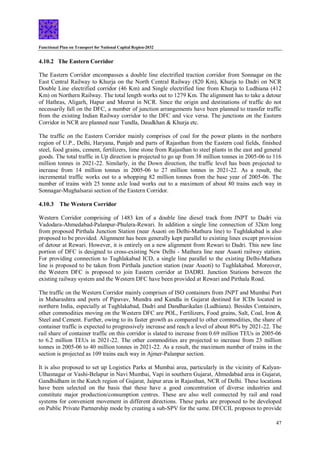
4.1 Dedicated Freight Corridor 46
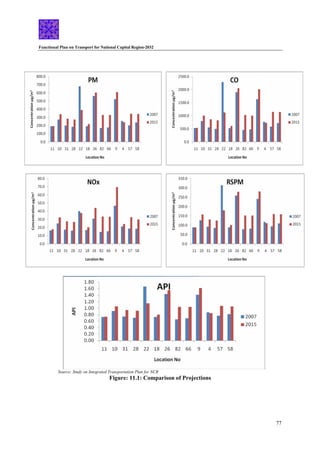
11.1 Comparison of Projections 77
13.1 KMP Global Corridor 85
13.2 Dedicated Freight Corridors 86
13.3 Delhi–Mumbai Industrial Corridor 87
13.4 Taj International 87
13.5 Alignment of Ganga Expressway 88
13.6 Expressways in NCR 89
14.1 Proposed Expressway Network in NCR 94
14.2 Gurgaon – Alwar Highway 101
14.3 Loni – Baraut Highway 101
14.4 Naultha (NH-71 A) – Samalkha – Baraut – Binaula – Sardhana – Daurala (NH-58) 102
14.5 Meerut - Bulandshahr Highway 102
14.6 Bulandshahr - Ahmedgarh & Khurja – Pahasu Road 102
14.7 Ballabgarh-Gulavathi Road 103
14.8 Jhajjar – Dhankot – Gurgaon Road 103
14.9 Roads to be developed in Alwar Region 104
14.10 Behror – Taoru and Alwar – Bhiwadi Road 104
14.11 Alternative Link Roads from Gurgaon to Delhi 105
14.12 Alternative Link Roads from Gurgaon to Delhi 106
14.13 Badarpur–Dadri–Hapur Road 107
14.14 Alwar - Rajgarh Road 107
14.15 Neemrana – Mandawar Road 107
14.16 Hapur – Singuli Ahir Road 107
14.17 Dasna-Siyana Road 107
14.18 Rail Network in Delhi area and Surroundings 128A
16.1 Framework for Economic Analysis 148
17.1 Awareness about the Transport Plan among the Respondents 161
17.2 Impact of Road Improvements on Economic Activities 162
17.3 Other Anticipated Benefits by the people 164
viii
L
LI
IS
ST
T O
OF
F M
MA
AP
PS
S
Page
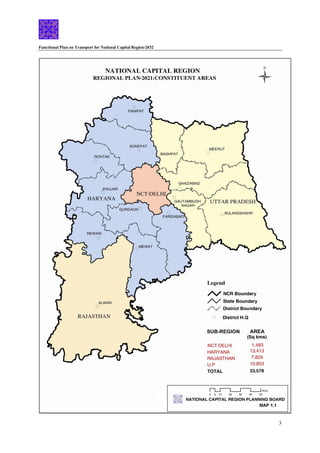
1.1 Constituent areas of NCR 3
2.1 Existing road network in NCR 9
3.1 Speed characteristics of the network for different speed ranges 16
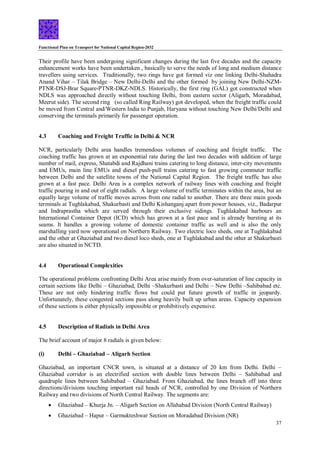
4.1 Existing rail network in NCR 36
14.1 Regional road network 100
14.2 Concept plan for a HFC 112
14.3 New rail lines and Logistic Hubs 136
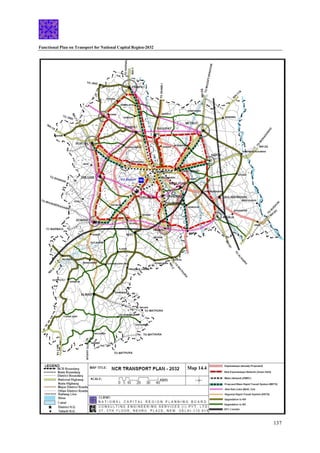
14.4 NCR Transport Plan -2032 137
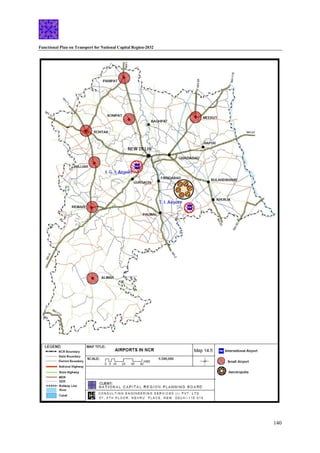
14.5 Airports in NCR 140
ix
LIST OF ANNEXURES
Page
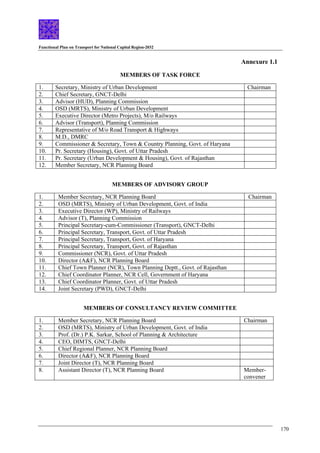
1.1 Members of Task Force, Advisory Group and Consultancy Review Committee 170
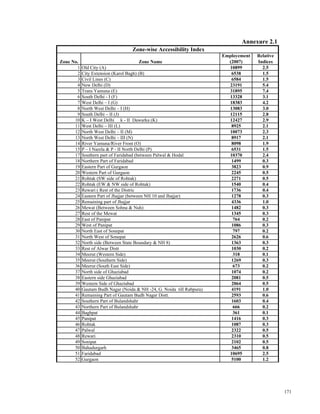
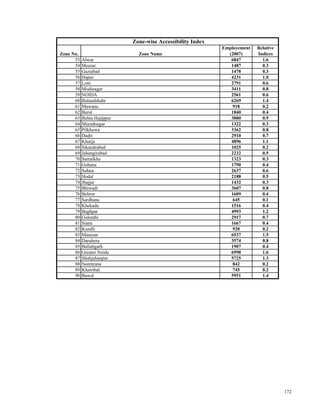
2.1 Accessibility Index Details 171-172
2.2 Mobility Index Details 173-174
2.3 Salient Characteristics of Major Roads 175-176
3.1 List of Survey Locations 177-178
4.1 to
4.12
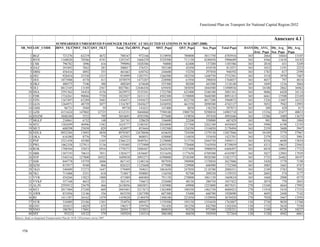
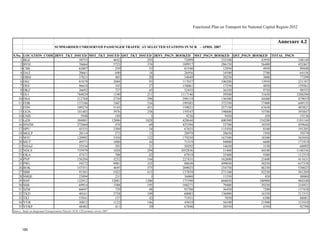
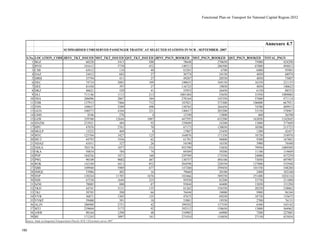
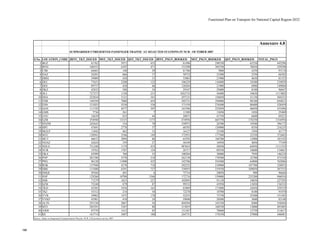
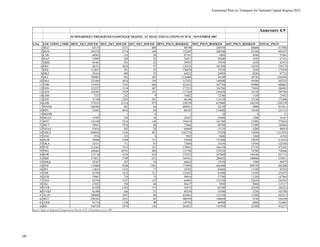
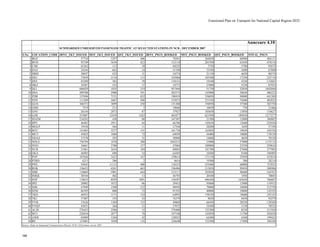
Sectional Details and Existing Volume of Originating Passenger Traffic in the Sections 179-190
6.1 Details of Services of other State Road Transport Corporations (SRTCs) operating in NCR 191
6.2 Members ASRTU 192
11.1 Relevant details and equations with regard to emission from traffic and air quality levels of
parameters cited above and that for noise levels
193-196
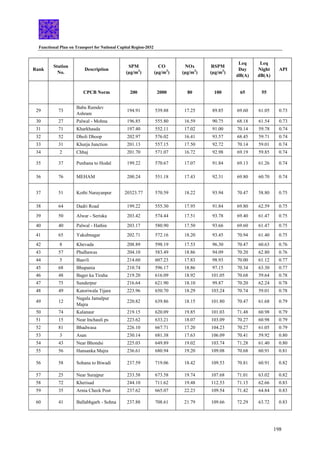
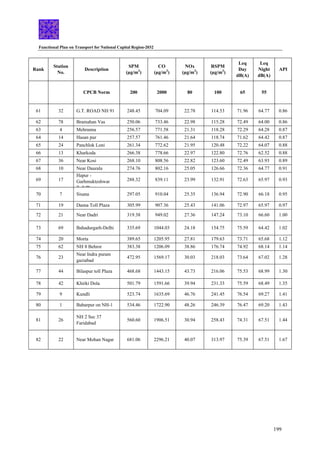
11.2 API Ranking of All Road Sections based on SPM, CO, NOx, RSPM and Leq (Day) & Leq
(Night)
197-199
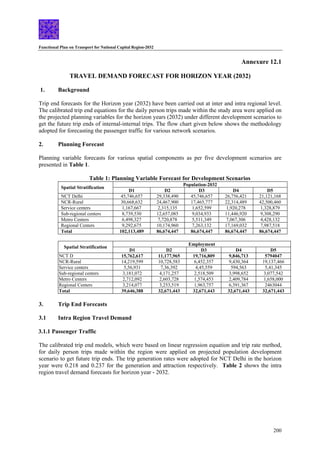
12.1 Travel Demand Forecast for Horizon Year (2032) 200-213
14.1 Design Standards for Road Network Development 214-223
14.2 City-wise categorization of terminals along with the estimates of area requirement 224
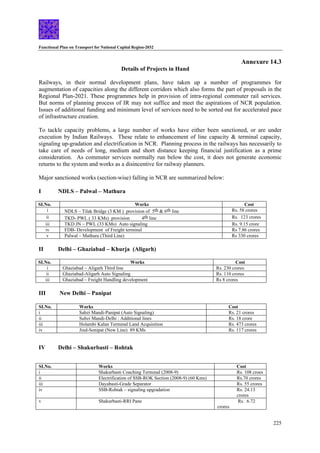
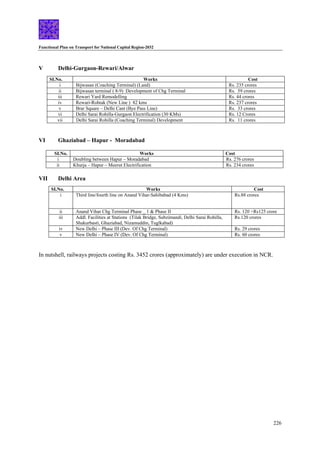
14.3 Details of projects already taken up by Indian Railways in the National Capital Region 225-226
14.4
(i-ix)
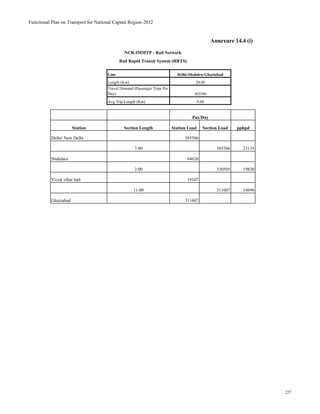
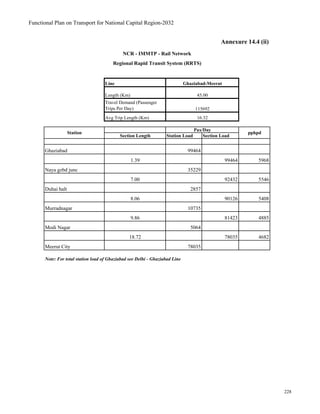
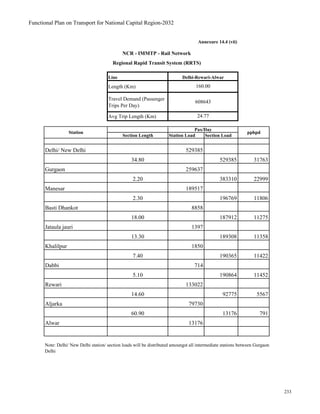
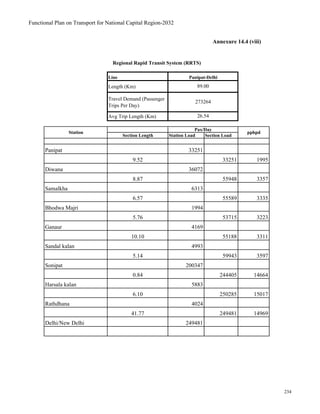
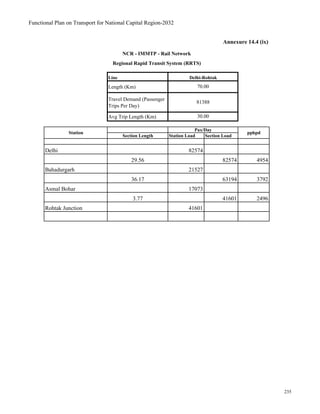
Section-wise Travel Demand for RRTS Corridors 227-235
14.5
(i-vi)
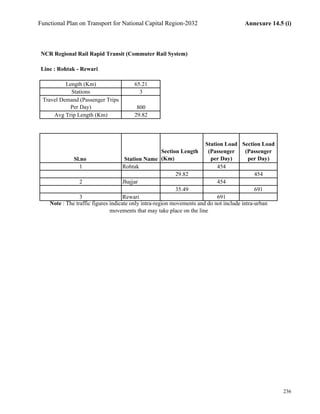
Corridor-wise Station and Section Loadings (RORC) 236-241
16.1 Look-up Tables of Speed vs Unit VOC per vehicle-km 242
16.2 Net Cash Flow Statement for the Project is presented 243
18.1 Review of Various Existing Acts in NCR States and Abroad 244-253
x
A
AB
BB
BR
RE
EV
VI
IA
AT
TI
IO
ON
NS
S
3G Network 3rd
Generation Network
AD Assistant Director
ADT Average Daily Traffic
AICTE All India Council of Technical Education
ASI Archeological Survey of India
AVVID Architecture for Voice, Video and Integrated Data Technology
BIS Bureau of Indian Standards
BOLT Build Operate Lease and Transfer
BOOT Build Operate Own and Transfer
BOT Build Operate and Transfer
BPT Bus based Public Transport
BSNL Bharat Sanchar Nigam Limited
CAA Constitutional Amendment Act
CBD Central Business District
CCA City Compensatory Allowance
CCP Chief Coordinator Planner
C-DOT Centre for Development of Telematics
CEA Central Electricity Authority
CEPT Centre for Environmental Planning and Technology
CETP Combined Effluent Treatment Plant
CEZ Common Economic Zone
CGHS Central Government Health Scheme
CGI Corrugated Galvanized Iron
CGO Central Government Office
CGWB Central Ground Water Board
CMA Counter Magnet Areas
CPCB Central Pollution Control Board
CNCR Central National Capital Region
CPHEEO Central Public Health and Environment Engineering Organisation
CPWD Central Public Works Department
CRISIL Credit Rating Information Services of India Limited
CRP Chief Regional Planner
CS Central Sector
CSIR Center for Science and Industrial Research
CSS Centrally Sponsored Schemes
CST Central Sales Tax
CT Census Town
DAL Delhi Avoiding Lines
DCE Delhi College of Engineering
DD Deputy Director
DDA Delhi Development Authority
DDMC District Disaster Management Committee
DEL Direct Extension Lines
DFC Delhi Finance Corporation
DMA Delhi Metropolitan Area
DMC Disaster Management Committee
DOT Department of Telecommunication
DSIDC Delhi State Industrial Development Corporation
DTA Delhi Territorial Area
DUEIIP Delhi Urban Environment and Infrastructure Improvement Project
EDC External Development Charges
EG Enforcement Group
EJC Eastern Jamuna Canal
EWS Economically Weaker Section
FAR Floor Area Ratio
FCC False Colour Composite
FDI Foreign Direct Investment
FIPB Foreign Investment Promotions Board
FIRR Financial Internal Rate of Return
GAL Goods Avoiding Lines
GDA Ghaziabad Development Authority
GDP Gross Domestic Product
GIS Geographical Information System
GMT Greenwich Mean Time
GNCTD Government of National Capital Territory of Delhi
GPRS General Packet Radio System
GPS Global Positioning System
xi
GSM Global System for Mobile Communications
HFC Highway Facility Centres
HQ Headquarters
HRA House Rent Allowance
HSIDC Haryana State Industrial Development Corporation
HSTS High Speed Transportation System
HUDA Haryana Urban Development Authority
HUDCO Housing and Urban Development Corporation
IC Installed Capacity
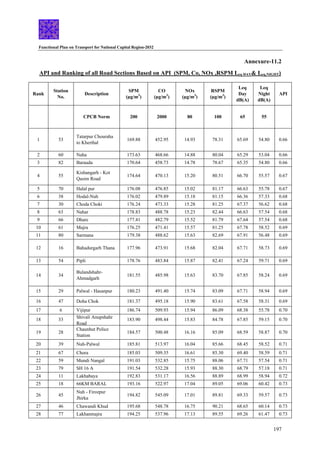
IEBR Internal Extra Budgetary Resource
IGP Interim General Plan
IIT Indian Institute of Technology
IMD Indian Meteorological Department
IMMTP Integrated Multi Modal Transport Plan
IPT Intermediate Public Transport
INTACH Indian National Trust for Arts and Cultural Heritage
IP Internet Protocol
IRBT Integrated Rail-cum-Bus Transit
IRORC Inner Regional Orbital Rail Corridor
IRS Indian Remote Sensing Satellite
ISDN International Subscriber Digital Network
ITC(HS) ITC (HS)-Classifications of Export and Import Items Book
ITI Industrial Training Institute
L&DO Land and Development Organisation
LAN Local Area Network
LCS Low Cost Sanitation
LISS Linear Image Self Scanner
LRT Light Rail Transport
LT/HT Low Tension/High Tension
M Municipality
M Corp. Municipal Corporation
MB Municipal Boundary
MC Municipal Committee
MC/RC Metro Centre/Regional Center
MCD Municipal Corporation of Delhi
MCl Municipal Council
MDA Meerut Development Authority
MDR Major District Road
MHRD Ministry of Human Resource Development
MIS Management Information System
MNC Multi-National Company
MOEF Ministry of Environment and Forests
MOU Memorandum of Understanding
MOUD&PA Ministry of Urban Development and Poverty Alleviation
MPD Master Plan for Delhi
MRTS Mass Rapid Transit System
MSK Scale Medvedev, Sponheuer and Karnik (MSK) Scale
MTNL Mahanagar Telephone Nigam Limited
NA Not Available
NBC National Building Code
NCBWW New Canal Based Water Works
NCR National Capital Region
NCRPB National Capital Region Planning Board
NCT National Capital Territory
NDMC New Delhi Municipal Corporation
NGO Non-Government Organisation
NH National Highway
NH/SH National Highway/State Highway
NHAI National Highway Authority of India
NHPC National Hydro Power Corporation
NIC National Informatics Centre
NOC No Objection Certificate
NOIDA New Okhla Industrial Development Authority
NP Nagar Palika
NPL National Physical Laboratory
NREB Northern Regional Electricity Board
NRI Non-Resident Indian
NRSA National Remote Sensing Agency
NTPC National Thermal Power Corporation
O&M Operation and Maintenance
xii
OD Origin Destination
OFC Optical Fibre Cable
PAN Panchromatic
PDS Public Distribution Scheme
PO Private Operator
PPG Policy and Planning Group
PPP Public-Private Partnership
PSMG I/II Project Sanctioning and Monitoring Group I/II
PSU Public Sector Undertaking
PVC Poly Vinyl Chloride
R&D Research and Development
RCC Reinforced Cement Concrete
RF Radio Frequency
RF Rapid Filtration
RIICO Rajasthan Industrial Infrastructure Corporation
RITES RITES (earlier Rail India Technical and Economics Services)
RORC Regional Orbital Rail Corridor
ROW Right-of-Way
RP Regional Plan
RRTS Regional Rapid Transit System
RSF Rapid Sand Filter
RSI Rural Small Scale Industry
RTV Rural Transport Vehicle
RWA Resident Welfare Association
S&JJ Slum & Jhuggi Jhomparis
SCADA Supervisory Control and Data Acquisition System
SEZ Special Economic Zone
SNA Serial Networking Architecture
SOG Sanctioned on-going
SSF Slow Sand Filtration
SSI Small Scale Industries
STD Subscriber Trunk Dialing
STP Strategic Transport Plan
STP Sewage Treatment Plan
STU State Transport Undertaking
SWM Solid Waste Management
T&D Transmission and Distribution
T/W/Canal Tank/Well/Canal
TCPO Town and Country Planning Organisation
TDMA Time-Division Multiple Access
TDR Transferable Development Rights
TDS Total Dissolved Salts
TMG Traffic Management Group
TPO Town Planning Organisation
TSDF Treatment, Storage and Disposal Facility
UA Urban Agglomeration
UDPFI Urban Development Plan Formulation and Implementation Guidelines
UGC University Grants Commission
ULB Urban Local Bodies
UP Uttar Pradesh
UPSIDC Uttar Pradesh State Industrial Development Corporation
V/C Volume to Capacity Ratio
VAT Value Added Tax
VOC Vehicle Operating Cost
VOT Vehicle Operating Time
U
UN
NI
IT
TS
S
ha. Hectare
KM Kilometre
KV Kilo Volt
lpcd Litre Per Capita Per Day
MCM Million Cubic Metre
MGD Million Gallon per Day
mld Million Litre Per Day
MT Metric Tonnes
MW Mega Watt
sq km Square Kilometre
xiii
C
CO
ON
NV
VE
ER
RS
SI
IO
ON
NS
S
Non-Metric to Metric
Linear
To convert Multiply by
Inches into millimetres 25.4
Inches into centimetres 2540
Inches into metres 2540 x 10
Feet into centimetres 30.48
Feet into metres 0.3048
Yards into metres 0.9144
Miles into metres 1609.344
Miles into kilometres 0.609344
Area
To convert Multiply by
Square inches into square centimetres 6.4516
Square feet into square centimetres 929.03
Square feet into square metre 0.092903
Square yards into square metres 0.8361
Square miles into square kilometres 2.58999
Square miles into hectares 258.999
Acres into square metres 4046.856
Acres into hectares 0.4069
Volume and capacity
To convert Multiply by
Cubic inches into cubic centimetres 16.3871
Cubic inches into litres 0.016387
Cubic feet into cubic metres 0.028317
Cubic yards into cubic metres 0.7646
Pints into litres 0.56826
Quarts into litres 1.13652
UK gallon into litres 4.54609
US gallon into litres 3.7854
Mass
To convert Multiply by
Ounces into grams 28.3495
Pounds into grams 453.6
Pounds into kilograms 0.4536
Ton into kilograms 1016.047
Tahils into grams 37.799
Kati into kilograms 0.60479
Grains into grams 0.648
Velocity
To convert Multiply by
Feet per second into centimetres per second 30.48
Feet per second into metres per second 0.3048
Miles per hour into kilometres per hour 1.609344
Power
To convert Multiply by
Horsepower into kilowatts 0.7457
Horsepower into metric horsepower 1.01387
Foot pounds force/Second into kilowatts 0.001356
Force
To convert Multiply by
Pounds force into newtons 4.44822
Pounds into newtons 0.138255
Degree Fahrenheit = 9/5 (◦
C+32)
Metric to Non-Metric
Linear
To convert Multiply by
Millimetres into inches 0.03937
Millimetres into feet 3.281x10
Centimetres into inches 0.3937
Metres into feet 3.281
Metres into yards 1.09361
Kilometres into yards 1093.61
Kilometres into miles 0.62137
Area
To convert Multiply by
Square millimetres into square inches 1.550x10
Square centimetres into square inches 0.1550
Square metres into square feet 10.7639
Square metres into square yards 1.19599
Square metres into acres 2.47105x10
Square kilometres into square miles 0.3861
Square kilometres into acres 247.105
Hectares into acres 2.47105
Volume & capacity
To convert Multiply by
Cubic centimetres into cubic inches 0.06102
Cubic metres into cubic feet 35.3147
Cubic metres into cubic yards 1.30795
Litres into cubic inches 61.03
Litres into pints 1.7598
Litres into quarts 0.8799
Litres into UK gallon 0.219976
Litres into US gallon 0.264178
Mass
To convert Multiply by
Grams into ounces 0.3527
Grams into grains 15.4324
Grams into tahils 0.02646
Kilograms into pounds 2.2046
Kilograms into tons 0.0009842
Kilograms into katis 1.553
Kilograms into stones 0.1575
Kilograms into hundredweights 0.01968
Velocity
To convert Multiply by
Centimetres per sec. into feet per second 0.03281
Metres per second into feet per second 3.281
Metres per second into feet per minute 196.9
Kilometre per hour into miles per hour 0.6214
Power
To convert Multiply by
Kilowatts into horsepower 1341
Metric horsepower into horsepower 0.98632
Metric house power into feet pounds force/second 542.48
Force
To convert Multiply by
Newtons into pounds force 0.2248
Newtons into pounds 7.2330
Degree Celsius = 9/5 (◦
F-32)
1 MCM per day = 1000 million litre per day (mld)
Functional Plan for Transportation in NCR-2032
ACKNOWLEDGEMENTS
The Functional Plan on Transportation for NCR, which is meant to detail out the policies of
the Regional Plan 2021 related to this sector, is the result of concerted efforts by many
people.
First and foremost, I am grateful to Dr. M. Ramachandran, Secretary, Urban Development,
Govt. of India, under whose able guidance and leadership the need for looking deeper into
this sector was conceived.
Dr. Noor Mohammad, Member Secretary, NCR Planning Board has been the driving force
behind the Functional Plan. I am grateful to him for his vision and constant encouragement,
without which this Plan would not have been completed.
I would like to special thank to Shri S.K. Lohia, OSD (MRTS), Ministry of Urban
Development and Prof. (Dr.) P.K. Sarkar, School of Planning and Architecture, who are the
active members of Consultancy Review Committee (CRC) and who contributed a lot from
the inception of the study on “Integrated Transportation Plan for NCR”.
It is my proud privilege to acknowledge the contribution of M/s Consultancy Engineering
Services (CES), the Consultant for Study on ‘Integrated Transportation for NCR”, without
which the Functional Plan could not have seen the light of the day. The key members from
M/s CES who contributed a lot for the study are Dr. B.C. Roy, Prof. N. Ranganathan, Prof.
Sanjay Gupta, Shri Satbir Singh Bal and Ms. Ekta Ahluwalia.
I am indebted to all the members of Consultancy Review Committee and Advisory Group for
the study on “Integrated Transportation Plan for NCR”.
I would also like to thank all officers from the NCR participating States, Railways, Planning
Commission who are our partners in progress, and without whose cooperation this Functional
Plan cannot be implemented. I would further appeal to them to continue their support for
successful implementation of the Plan.
Last but not the least, I would like to acknowledge the effort that has gone into making this
endeavour a success and has resulted in the publication of the Functional Plan for
Transportation for NCR. I thank the team in NCR Planning Board, particularly Shri Rajesh
Chandra Shukla, Joint Director (T) and Shri Syed Aqeel Ahmad, Assistant Director (T) who
have toiled to make this possible.
(Rajeev Malhotra)
Chief Regional Planner
NCR Planning Board
Functional Plan on Transport for National Capital Region-2032
1
Introduction
1.0 Background
1.1 Regional Plan 2021 for National Capital Region
National Capital Region Planning Board prepared the Regional Plan with the perspective year 2021
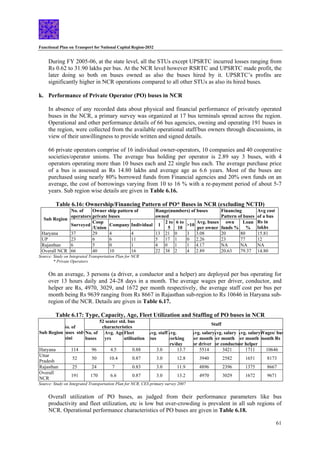
for the National Capital Region (NCR) as per the provisions of Section 10 of the NCR Planning Board
Act, 1985 for balanced and harmonized development of the National Capital Region which was
notified on 17th
September, 2005.
The Region covers an area of 33,578 square kilometres with 1,483 sq kms (about 4.41%) falling in the
National Capital Region Territory of Delhi; 13,413 sq kms (about 39.95%) falling in the Haryana
Sub-Region; 7,829 sq kms (about 23.32%) falling in the Rajasthan Sub-Region; and 10,853 sq kms
(about 32.32%) falling in the Uttar Pradesh Sub-Region. The administrative units of the NCR are:
a. Union Territory of Delhi;
b. Haryana Sub-Region comprises of the Faridabad, Palwal, Gurgaon, Mewat, Rohtak, Sonepat,
Rewari, Jhajjar and Panipat districts.
c. Rajasthan Sub-Region comprises of the Alwar district; &
d. Uttar Pradesh Sub-Region comprises of Meerut, Ghaziabad, Gautam Bhudha Nagar, Bulandshahr
and Baghpat districts.
A map showing the constituent areas of NCR is at Map 1.1.
In addition to above, Board has identified eight Counter-Magnet Areas to NCR as per Section 8(f) of
the NCR Planning Board Act, 1985, namely, Ambala and Hissar in Haryana, Bareilly and Kanpur
Nagar in Uttar Pradesh, Dehradun in Uttrakhand, Kota in Rajasthan, Patiala in Punjab and Gwalior in
Madhya Pradesh. These are as per modified Chapter 18 of the Regional Plan-2021.
1.2 Aims and Objectives of Regional Plan 2021
Regional Plan-2021 aims to promote the economic growth and balanced development of the National
Capital Region. It seeks to attain the above mentioned vital objective through an integrated strategy
involving:
a. Providing suitable economic base for future growth by identification and development of regional
settlements capable of absorbing the economic development impulse of Delhi;
b. Providing efficient and economic rail and road based transportation networks (including mass
transport systems) well integrated with the landuse patterns to support balanced regional
development in such identified settlements;
c. Minimising the adverse environmental impact that may occur in the process of development of
the National Capital Region;
d. Developing selected urban settlements with urban infrastructure facilities such as transport,
power, communication, drinking water, sewerage and drainage comparable with Delhi;
e. Providing a rational landuse pattern; &
f. Promoting sustainable development in the Region for improving the quality of life.
1.3 Objectives of the Study on Transport Plan
Regional Plan-2021 proposed development of road & rail network in the region in order to provide
efficient and economic rail/road based transportation networks (including mass transport systems)
1
Functional Plan on Transport for National Capital Region-2032
2
well integrated with the land-use patterns to support balanced regional development in the Region for
sustainable development along with development of Intra-City Urban Transport. It proposed a
hierarchical system of road network comprising of development/up-gradation of primary road
network which included expressways, national highways and some important state highways;
secondary road network which included major district roads and tertiary road network to provide
access to all villages, work places, employment centres, residential areas, etc. It also proposed
development of Regional Rapid Transit System (RRTS) to connect regional towns with Delhi and
with Sub-regional Centres; orbital rail and Mass Rapid Transit System (MRTS) for Delhi and CNCR
towns.
Transport affects our daily lives in its myriad forms. It influences economic development, population
distribution, the shape of cities, energy consumption, access to markets and quality of life. It
contributes substantially to gross domestic product, absorbs large investments and provides
employment for millions of people. NCR is a high intensity, multi-level and multi-modal travel
region. There is high intensity of intra-regional movement within NCR amongst Delhi and the
regional centres & sub-regional centres and amongst themselves. Therefore, the recommendations of
the Regional Plan-2021 were required to be elaborated on the basis of research studies on the
movement of traffic after conducting appropriate surveys to prepare the Integrated Transportation
Plan/Functional Plan of Transport for NCR as per the provisions of section 16 of the NCR Planning
Board Act, 1985.
In view of this, NCR Planning Board commissioned a study through a Consultant with the aim to
provide an adequate, accessible and affordable Integrated Multi Modal Transport System to the
people of this region to cater for the needs of the passengers, goods and services of NCR in an
equitable and sustainable manner. This, in turn, involves the study of traffic and travel characteristics
of passengers and goods which would govern the choice of transport system for movement of goods
and transport of commuters by different modes. The major objectives of the study were to:
a. Assess the level of utilization, potential and deficiencies in the present transport system
b. Assess the characteristics of the regional road and rail network for movement of passengers and
goods traffic
c. Construct Regional Transport Planning Modals appropriate to conditions and planning needs of
NCR so as to develop alternative transport strategies for short term, medium term and long term
up to the year 2032
d. Prepare an Integrated Multi-Modal Transportation System for NCR with phased program of its
implementation up to the year 2032.
e. Identify various project proposals, which are economically viable, socially acceptable,
environmentally sustainable and financially feasible
1.4 Preparation of Functional Plan on Transport-2032
The study was carried out by M/s Consulting Engineering Services (India) Private Limited, New
Delhi. It was guided by the Task Force for RRTS for NCR, Advisory Group to advise Consultancy
Review Committee (CRC) for the preparation of Transport Plan for NCR and CRC. The
recommendations of the Draft Final Report were presented by the Consultant in a Workshop held on
2nd
February 2009 at India Habitat Centre, New Delhi, wherein stakeholders, experts and members of
the Planning Committee, Task Force, Advisory Group and Consultancy Review Committee were
invited to interact and obtain their suggestions on the Plan. The Final Report presents the findings of
the surveys & studies, the policy framework and details of the Transport Plan for NCR. The Plan was
approved by the Board in its 31st
meeting held on 11th
November, 2009. List of Members of the Task
Force, Advisory Group and Consultancy Review Committee is at Annexure-1.1.
Functional Plan on Transport for National Capital Region-2032
3
Functional Plan on Transport for National Capital Region-2032
4
Road Network
2.1 Existing Road Network
The existing transport network in National Capital Region is ‘radial’ in nature. It comprises of
expressways, national highways, state highways, major district and other district roads. The road
network is being developed and maintained by NHAI, PWD, MCD, NDMC, Delhi Cantonment Board
and DDA. Five National Highways (NH-1, 2, 8, 10 & 24) converge on Ring Road of Delhi and one
National Highway (NH-58) meets NH-24 at Ghaziabad. In addition, NH-71, 71-A, 71-B, NH-91 and
NH-119 also pass through the region. Apart from these national highways, some state highways also
serve in strengthening the regional road network. Other than these highways, MDRs and ODRs also
act as important linkages among these highways.
Existing road transport network of the National Capital Region was examined for the existing
connectivity, mobility and accessibility in the study.
Mobility-based measurement and accessibility-based measurement are two significant approaches of
measuring the transportation system performances. Mobility refers to the movement of people or
goods while accessibility refers to the ability to reach “opportunities” like desired goods, services,
activities and destinations. Accordingly, Road Network Analysis has been carried out and elaborated
in subsequent paras.
2.2 Network form and spread
Network form and spread has been analysed in four parts in the Study as stated below:
a. Road Density
b. Accessibility
c. Mobility
d. Connectivity (Graph Theory)
a. Road Density
The region and sub-region wise road density1
in the NCR is presented in Table 2.1.
Table 2.1: Sub-Region Wise Road Density in NCR
Sub-region
NCR
Area
(Sq.
Kms)
Total
Length
(Km)
Km per
100 sq.
km of
area
Length of
NH
(Km)
Km per
100 sq.
km of
area
Length
of SH
(Km)
Km per
100 sq.
km of
area
Length of
MDR (Km)
Km Per
100 sq. km of
area
Haryana* 13413 7954 59.30 528 3.93 1448.2 10.79 580 4.32
UP* 10853 5504 50.71 321.4 2.96 805.6 7.42 432.66 3.98
Rajasthan* 7829 3976 50.79 35.3 0.45 1010.1 12.90 326.76 4.04
Total 32095 17434 54.32 884.70 2.76 3263.90 10.17 1339.42 4.14
Note: 1) Excludes NCTD 2) Does not includes ODRs & VRs.
Source: * Study on Integrated Transportation Plan for NCR, CES primary survey 2007
Road densities of NCR when compared with the national level shows that density of National
Highways (2.84) and State Highways (9.72) in NCR is higher than the density of National Highways
(1.99) and State Highways (4.19) in India. But in case of MDR, road density of NCR (3.95) is much
1
Road Density is given as length of roads per unit area of land. A high road density indicates that major share of the
population has some access to the road network.
2
Functional Plan on Transport for National Capital Region-2032
5
less as compared to that in India (14.23). Table 2.2 presents a comparative picture of the road
densities by category.
Table 2.2: Comparison of Road Density by NH, SH and MDRs
Road
Type
India Road Length
(kms)
Density
(Km per 100 sq. km)
NCR Road Length
(kms)
Density
(Km per 100 sq. km)
NH 66590 1.99 1221.7 * 3.64
SH 131899 4.19 3263.9 9.72
MDR 467763 14.23 1339.4 3.95
Total 671064 20.41 5825.0 17.32
* Includes the NH length in NCTD, Source: Study on Integrated Transportation Plan for NCR
b. Accessibility
Accessibility2
measure is unit-free and has no intrinsic meaning, it provides an indication of the level
of accessibility of employment / jobs for each zone; with jobs weighted more heavily the closer they
are (in terms of travel time) to the zone.
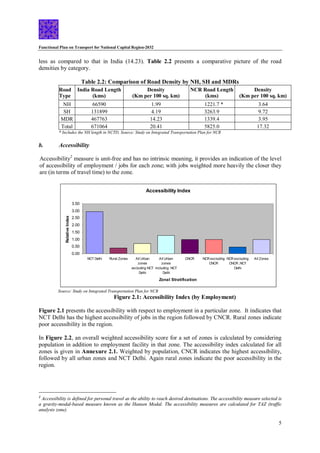
Accessibility Index
0.00
0.50
1.00
1.50
2.00
2.50
3.00
3.50
NCT Delhi Rural Zones All Urban
zones
excluding NCT
Delhi
All Urban
zones
including NCT
Delhi
CNCR NCR excluding
CNCR
NCR excluding
CNCR ,NCT
Delhi
All Zones
Zonal Stratification
Relative
Index
Source: Study on Integrated Transportation Plan for NCR
Figure 2.1: Accessibility Index (by Employment)
Figure 2.1 presents the accessibility with respect to employment in a particular zone. It indicates that
NCT Delhi has the highest accessibility of jobs in the region followed by CNCR. Rural zones indicate
poor accessibility in the region.
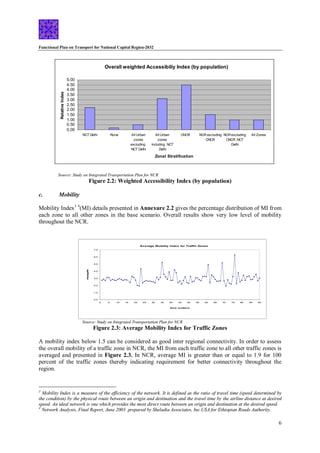
In Figure 2.2, an overall weighted accessibility score for a set of zones is calculated by considering
population in addition to employment facility in that zone. The accessibility index calculated for all
zones is given in Annexure 2.1. Weighted by population, CNCR indicates the highest accessibility,
followed by all urban zones and NCT Delhi. Again rural zones indicate the poor accessibility in the
region.
2
Accessibility is defined for personal travel as the ability to reach desired destinations. The accessibility measure selected is
a gravity-modal-based measure known as the Hansen Modal. The accessibility measures are calculated for TAZ (traffic
analysis zone).
Functional Plan on Transport for National Capital Region-2032
6
Overall weighted Accessibiliy Index (by population)
0.00
0.50
1.00
1.50
2.00
2.50
3.00
3.50
4.00
4.50
5.00
NCT Delhi Rural All Urban
zones
excluding
NCT Delhi
All Urban
zones
including NCT
Delhi
CNCR NCR excluding
CNCR
NCR excluding
CNCR ,NCT
Delhi
All Zones
Zonal Stratification
Relative
Index
Source: Study on Integrated Transportation Plan for NCR
Figure 2.2: Weighted Accessibility Index (by population)
c. Mobility
Mobility Index3 4
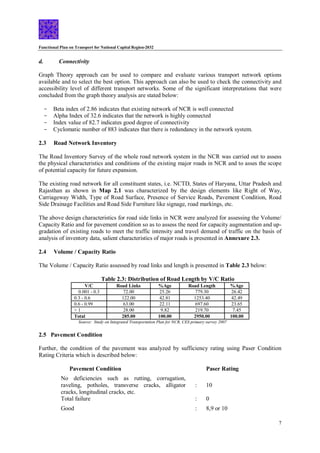
(MI) details presented in Annexure 2.2 gives the percentage distribution of MI from
each zone to all other zones in the base scenario. Overall results show very low level of mobility
throughout the NCR.
Average Mobility Index for Traffic Zones
0.0
1.0
2.0
3.0
4.0
5.0
6.0
7.0
0 5 10 15 20 25 30 35 40 45 50 55 60 65 70 75 80 85 90
Zone numbers
A
v
e
ra
g
e
M
I
Source: Study on Integrated Transportation Plan for NCR
Figure 2.3: Average Mobility Index for Traffic Zones
A mobility index below 1.5 can be considered as good inter regional connectivity. In order to assess
the overall mobility of a traffic zone in NCR, the MI from each traffic zone to all other traffic zones is
averaged and presented in Figure 2.3. In NCR, average MI is greater than or equal to 1.9 for 100
percent of the traffic zones thereby indicating requirement for better connectivity throughout the
region.
3
Mobility Index is a measure of the efficiency of the network. It is defined as the ratio of travel time (speed determined by
the condition) by the physical route between an origin and destination and the travel time by the airline distance at desired
speed. An ideal network is one which provides the most direct route between an origin and destination at the desired speed.
4
Network Analysis, Final Report, June 2003 prepared by Sheladia Associates, Inc.USA for Ethiopian Roads Authority.
Functional Plan on Transport for National Capital Region-2032
7
d. Connectivity
Graph Theory approach can be used to compare and evaluate various transport network options
available and to select the best option. This approach can also be used to check the connectivity and
accessibility level of different transport networks. Some of the significant interpretations that were
concluded from the graph theory analysis are stated below:
­ Beta index of 2.86 indicates that existing network of NCR is well connected
­ Alpha Index of 32.6 indicates that the network is highly connected
­ Index value of 82.7 indicates good degree of connectivity
­ Cyclomatic number of 883 indicates that there is redundancy in the network system.
2.3 Road Network Inventory
The Road Inventory Survey of the whole road network system in the NCR was carried out to assess
the physical characteristics and conditions of the existing major roads in NCR and to asses the scope
of potential capacity for future expansion.
The existing road network for all constituent states, i.e. NCTD, States of Haryana, Uttar Pradesh and
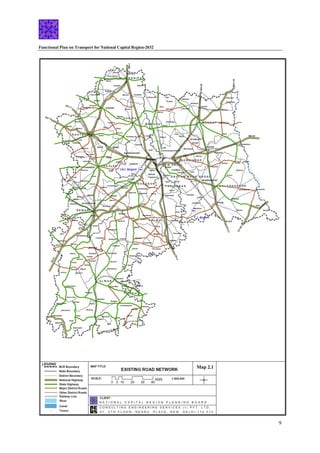
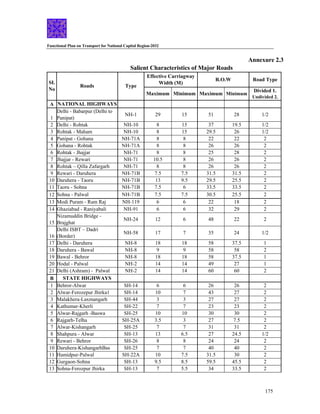
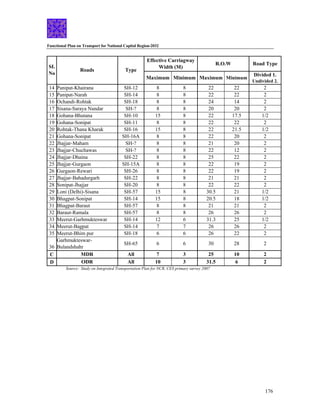
Rajasthan as shown in Map 2.1 was characterized by the design elements like Right of Way,
Carriageway Width, Type of Road Surface, Presence of Service Roads, Pavement Condition, Road
Side Drainage Facilities and Road Side Furniture like signage, road markings, etc.
The above design characteristics for road side links in NCR were analyzed for assessing the Volume/
Capacity Ratio and for pavement condition so as to assess the need for capacity augmentation and up-
gradation of existing roads to meet the traffic intensity and travel demand of traffic on the basis of
analysis of inventory data, salient characteristics of major roads is presented in Annexure 2.3.
2.4 Volume / Capacity Ratio
The Volume / Capacity Ratio assessed by road links and length is presented in Table 2.3 below:
Table 2.3: Distribution of Road Length by V/C Ratio
V/C Road Links %Age Road Length %Age
0.001 - 0.3 72.00 25.26 779.30 26.42
0.3 - 0.6 122.00 42.81 1253.40 42.49
0.6 - 0.99 63.00 22.11 697.60 23.65
> 1 28.00 9.82 219.70 7.45
Total 285.00 100.00 2950.00 100.00
Source: Study on Integrated Transportation Plan for NCR, CES primary survey 2007
2.5 Pavement Condition
Further, the condition of the pavement was analyzed by sufficiency rating using Paser Condition
Rating Criteria which is described below:
Pavement Condition Paser Rating
No deficiencies such as rutting, corrugation,
raveling, potholes, transverse cracks, alligator
cracks, longitudinal cracks, etc.
: 10
Total failure : 0
Good : 8,9 or 10
Functional Plan on Transport for National Capital Region-2032
8
Pavement Condition Paser Rating
Fair : 5,6 or 7
Poor : 1,2,3,4
Based on this Paser Rating, all links are classified for maintenance needs. If Paser Rating is good,
then it means routine maintenance would suffice, if the rating is fair, then the road needs preventive
maintenance and if the road rating is poor, then the road would need rehabilitation of existing
pavement. The distribution of road length by pavement condition for NCR sub-regions is presented in
Table 2.4 below:
Table 2.4: Distribution of Road Length by Type of Pavement Condition
Pavement
Condition
Road Length (Km) %Age Road Length
Rajasthan U.P. Haryana Total Rajasthan U.P. Haryana Total
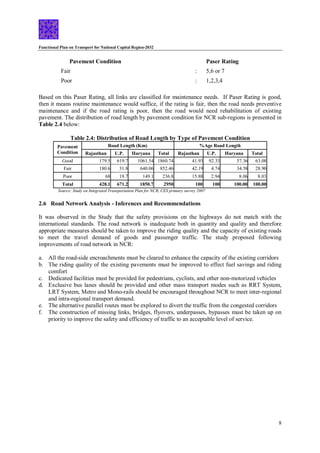
Good 179.5 619.7 1061.54 1860.74 41.93 92.33 57.36 63.08
Fair 180.6 31.8 640.06 852.46 42.19 4.74 34.58 28.90
Poor 68 19.7 149.1 236.8 15.88 2.94 8.06 8.03
Total 428.1 671.2 1850.7 2950 100 100 100.00 100.00
Source: Study on Integrated Transportation Plan for NCR, CES primary survey 2007
2.6 Road Network Analysis - Inferences and Recommendations
It was observed in the Study that the safety provisions on the highways do not match with the
international standards. The road network is inadequate both in quantity and quality and therefore
appropriate measures should be taken to improve the riding quality and the capacity of existing roads
to meet the travel demand of goods and passenger traffic. The study proposed following
improvements of road network in NCR:
a. All the road-side encroachments must be cleared to enhance the capacity of the existing corridors
b. The riding quality of the existing pavements must be improved to effect fuel savings and riding
comfort
c. Dedicated facilities must be provided for pedestrians, cyclists, and other non-motorized vehicles
d. Exclusive bus lanes should be provided and other mass transport modes such as RRT System,
LRT System, Metro and Mono-rails should be encouraged throughout NCR to meet inter-regional
and intra-regional transport demand.
e. The alternative parallel routes must be explored to divert the traffic from the congested corridors
f. The construction of missing links, bridges, flyovers, underpasses, bypasses must be taken up on
priority to improve the safety and efficiency of traffic to an acceptable level of service.
Functional Plan on Transport for National Capital Region-2032
9
Map 2.1
Functional Plan on Transport for National Capital Region-2032
10
Traffic and Travel Characteristics
3.1 Traffic Surveys
The characteristics of Regional Transport System were studied and assessed through conduct of
following major primary surveys:
 Road Inventory Surveys
 Traffic Volume Surveys
 Origin-Destination Surveys
 Speed and Delay Surveys
 Commuter Surveys
The characteristics of road network for NCR based on these surveys are described in the following
paragraphs:
3.1.1 Traffic Characteristics
The traffic characteristics on the basis of traffic volume survey, origin-destination survey and speed
and delay surveys are briefly described below.
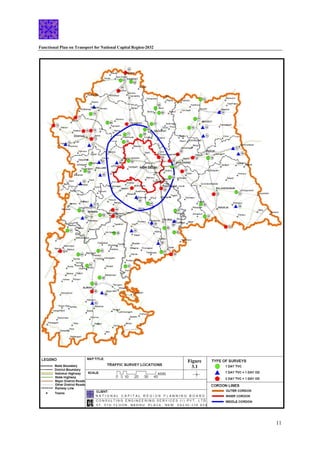
The traffic volume surveys were conducted at 82 count stations and origin-destination surveys at 44
locations on different categories of roads spread over the entire NCR network. The traffic survey
locations are presented in Figure 3.1. The list of survey locations are presented in Annexure 3.1.
The traffic characteristics such as ADT, directional distribution of traffic, traffic composition,
temporal variation, etc. at outer cordon & urban cordon and along road corridors are presented below:
3.1.1.1 Outer Cordon (OC) Traffic Characteristics
A large number of count stations fall along the outer cordon around the NCR. The traffic survey data
at these locations have been analysed to appreciate the development at the outer cordon of NCR.
Average Daily Traffic (ADT)
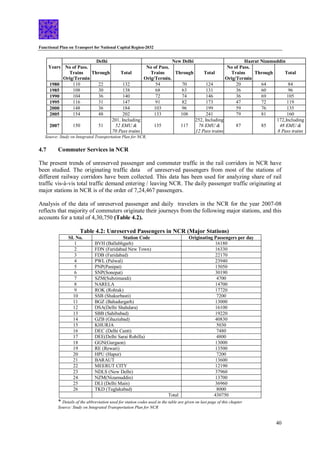
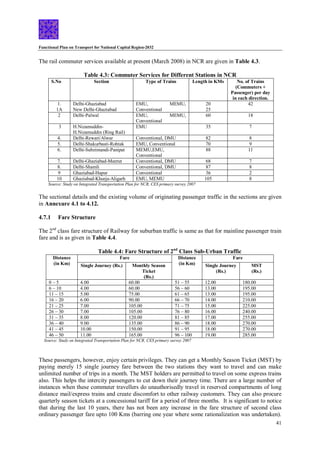
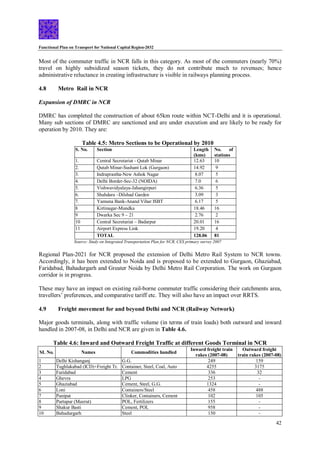
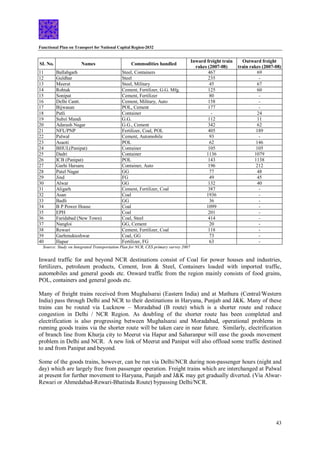
About 2,21,575 vehicles (3,50,694 PCUs) enter and exit NCR on an average day. Amongst the count
locations along the outer cordon, the highest ADT was 50,858 vehicles (90,853 PCUs) at Babarpur on
Karnal road (NH-1). The lowest traffic volume (ADT) of 2,407 vehicles (3,008 PCUs) were observed
at Gohana-Butana road. National Highways account for 74.57% (vehicles) of the total traffic entering
and exiting the NCR.
Directional Distribution
There is no major directional imbalance (in – 50.3%; out – 49.7%) at the different count stations along
the OC.
3
Functional Plan on Transport for National Capital Region-2032
11
Figure
3.1
Functional Plan on Transport for National Capital Region-2032
12
Composition
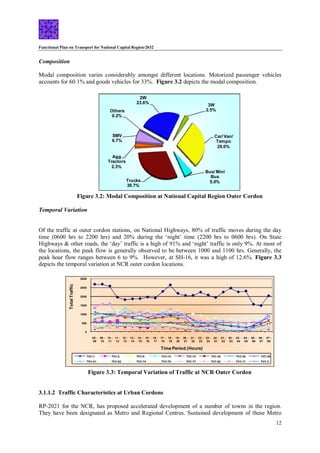
Modal composition varies considerably amongst different locations. Motorized passenger vehicles
accounts for 60.1% and goods vehicles for 33%. Figure 3.2 depicts the modal composition.
2W
23.6%
3W
2.5%
Car/ Van/
Tempo
29.0%
Bus/ Mini
Bus
5.0%
Trucks
30.7%
Agg
Tractors
2.3%
SMV
6.7%
Others
0.2%
Figure 3.2: Modal Composition at National Capital Region Outer Cordon
Temporal Variation
Of the traffic at outer cordon stations, on National Highways, 80% of traffic moves during the day
time (0600 hrs to 2200 hrs) and 20% during the ‘night’ time (2200 hrs to 0600 hrs). On State
Highways & other roads, the ‘day’ traffic is a high of 91% and ‘night’ traffic is only 9%. At most of
the locations, the peak flow is generally observed to be between 1000 and 1100 hrs. Generally, the
peak hour flow ranges between 6 to 9%. However, at SH-16, it was a high of 12.6%. Figure 3.3
depicts the temporal variation at NCR outer cordon locations.
0
500
1000
1500
2000
2500
3000
08 -
09
09 -
10
10 -
11
11 -
12
12 -
13
13 -
14
14 -
15
15 -
16
16 -
17
17 -
18
18 -
19
19 -
20
20 -
21
21 -
22
22 -
23
23 -
24
24 -
01
01 -
02
02 -
03
03 -
04
04 -
05
05 -
06
06 -
07
07 -
08
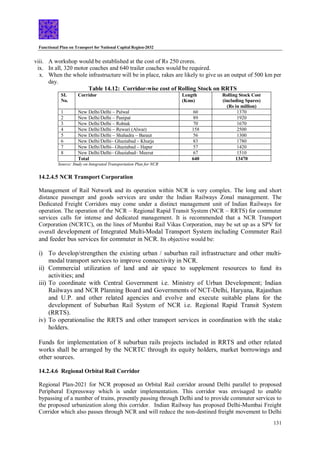
Total
Traffic
Time Period (Hours)
TVC-1 TVC-2 TVC-5 TVC-10 TVC-15 TVC-34 TVC-35 TVC-36
TVC-51 TVC-62 TVC-74 TVC-76 TVC-77 TVC-82 TVC-17 TVC-3
Figure 3.3: Temporal Variation of Traffic at NCR Outer Cordon
3.1.1.2 Traffic Characteristics at Urban Cordons
RP-2021 for the NCR, has proposed accelerated development of a number of towns in the region.
They have been designated as Metro and Regional Centres. Sustained development of these Metro
Functional Plan on Transport for National Capital Region-2032
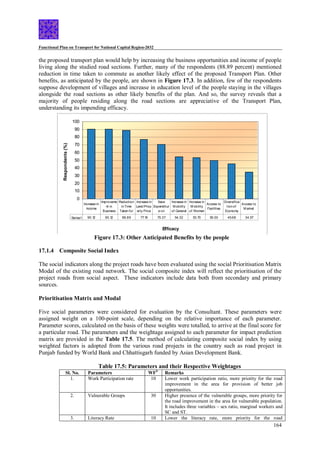
13
Centres and Regional Centres is key to the success of the Regional Plan-2021. Connectivity amongst
each and all of them and mobility within them are critical in their sustained development and
attractiveness to receive investments. Traffic to and from these towns reflect their relative level of
accessibility. Its appreciation will help in planning the regional road network system.
Urban Cordons (UC) are drawn around 10 selected Metro and Regional Centres. A number of TVC
stations lie on each of these UCs. This data has been compiled and analysed to appreciate the traffic
characteristics to and from the selected Metro and Regional Centres which is given in Table 3.1.
Table 3.1: Traffic Characteristics at Metro Centres/Regional Centres
Source: Study on Integrated Transportation Plan for NCR, CES primary survey 2007
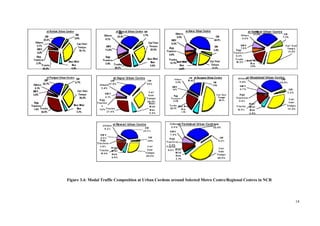
Traffic composition at Urban Cordons around the 10 selected Metro / Regional Centres is given in
Figure 3.4.
Name of
Metro
Centres/
Regional
Centres
Traffic Entering
& Exiting Per
Day
Share of
Passenger
mode
Share
of
Goods
mode
Share
of
NMVs
Share of
Night
Traffic
Peak
Hour
share
Remarks
Vehicles PCU (%) (%) (%) (%) (%)
Rohtak 41,328 60,303 68.3 27.5 4.2 14.38 -
19.41
6.2-6.8 Important town in the state of Haryana, an
administrative-cum-educational-cum trade
center
Meerut 83,681 1,15,060 64.0 22.4 13.4 9.3 - 18.4 7.0 - 9.2 Biggest Metro Centre, next only to Delhi,
major regional center serving its catchments
as well as a major activity center consuming
goods and services
Alwar 36,514 40,426 73.9 16.7 9.5 8.5 - 27.7 6.8 -
8.2
Headquarters of Alwar districts, the only
district of Rajasthan which is part of NCR.
Alwar is a heritage town and is important
tourist center
Sonipat 20,625 25,247 71.7 20.6 7.6 8.7 - 10.6 6.7 - 8.1 Important town in Haryana and falls within
CNCR
Panipat 86,604 1,36,609 60.9 35.8 3.2 7.84 -
33.39
5.3 - 7.8 Major industrial-cum-trade center on NH1
and suffers a large volume of traffic
Hapur 50,375 71,818 64.4 29.1 6.1 15 - 20 7.1 - 7.7 lies on NH-24 on the eastern part of NCR
suffering a large volume of traffic
Gurgaon 3,14,609 3,17,970 69.5 29.4 0.9 10.63 -
19.03
6.3 - 8.3 Experiencing phenomenal growth
Ghaziabad 1,71,217 1,92,399 79.0 14.3 6.7 14.0 -
20.9
5.9 - 7.1 Large share of through traffic due to National
Highways
Rewari 30,273 37,068 75.0 18.2 6.6 6.2 - 24.1 6.9 -
10.4
Lies at the intersection for NH-71 and NH-71
B
Faridabad 96,383 93,806 83.0 9.5 7.4 13.3 7.3 Major industrial town of Haryana which lies
within CNCR
14
Figure 3.4: Modal Traffic Composition at Urban Cordons around Selected Metro Centre/Regional Centres in NCR
Functional Plan on Transport for National Capital Region-2032
15
3.1.2 Speed Characteristics
Traffic speed is an important characteristic as it determines the efficiency of the road network and
helps in obtaining the level of service. The speed and delay survey was conducted using moving car
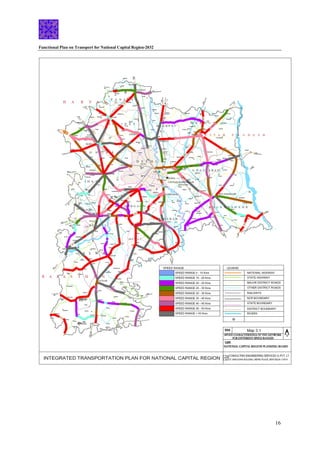
observer method. The special analysis of speed for the network of roads reveals that 18% of road
length has a speed of less than 20km per hour while the highest journey speed was observed to be
61.35 km / hour. The road network covered under speed and delay and the speed characteristics of the
network for different speed ranges are presented in Map 3.1.
The data on speed analysis reveals the following preferences for improvement of NCR network:
 Clearing of road side encroachments, obstructions and physical objects for improving
effective capacity of existing corridors
 Augmentation of capacity of different category of roads to meet the travel demand of today
and tomorrow at present and in the future
 Exercising controls on direct access to highways and arterial roads
 Providing sufficient parking facilities with effective management to enhance the capacity of
existing roads
 Provision of dedicated facilities for pedestrian and cycle movement along and across the
roads to enhance highway capacity as well as safety.
 Provision of dedicated routes / lanes for buses and other public transport means
 Provision of grade separators / interchanges, pedestrian subways, foot over bridges, etc. for
traffic segregation and safety.
The speed analysis also reveals that for a particular volume-capacity ratio, the speed on different
sections is different mainly due to roadside encroachments, on-street parking, and absence of
continuous footpaths and service lanes / roads in urban stretches, etc. It is, therefore, desirable to first
improve the efficiency of existing road network through adoption of following measures before
taking up capital intensive measures to minimize the operation losses:
 Clearing of encroachments within the right of way including physical objects and utilities
 Provision of dedicated pedestrian and cycle facilities along the road and at the intersections /
interchange locations
 Provision of continuous footpaths and service lanes in urban stretches
 Exploring intelligent technical solutions for eradication of traffic bottlenecks in the road
network
 Provision of grade separators / interchanges at major intersection locations
 Provision of pedestrian subways, FOBs, footpaths, etc. at urban settlement locations, growth
centres, business centres, schools, etc.
 Augmentation of capacity of major corridors through development of alternative parallel
routes links through traffic management techniques
 Lastly, augmentation of capacity of existing network to meet present and future traffic needs
by capital intensive measures such as construction of new expressways, highways, bypasses,
elevated corridors, etc.
Functional Plan on Transport for National Capital Region-2032
16
Functional Plan on Transport for National Capital Region-2032
17
3.2 Traffic Pattern Characteristics
The traffic pattern on the road network was established through conduct of extensive O-D surveys at 43
locations covering all types of roads within NCR in order to appreciate the intra-spatial pattern of
movements.
For O-D survey & data analysis, NCR was classified into following traffic analysis zones, spatial units
and cordon lines:
Traffic Analysis Zones: Traffic Analysis Zones (TAZs) were classified into 115 zones, comprising of 89
internal and 25 external zones for detailed analysis of data and modaling.
Spatial Units: Traffic movement pattern in NCR is complex in nature as it originates from all locations
and also destined to all locations. For better appreciation of movement pattern, the analysis was carried
out by dividing NCR into four spatial units:
 The National Capital Territory of Delhi (NCTD)
 The Central National Capital Region (CNCR)
 The rest of National Capital Region (RNCR)
 Areas Outside NCR (External)
Cordon Lines: To appreciate inter movement pattern by spatial units, the cordon lines around 3 spatial
units, viz. NCR, CNCR and NCTD were drawn to delineate the spatial units, as below:
o Outer Cordon – Around NCR
o Middle Cordon – Around CNCR
o Inner Cordon – Around NCTD
The pattern of movements by passenger and goods modes for four spatial units has been analyzed by 3
cordon lines, i.e. Inner Cordon, Middle Cordon and Outer Cordon.
The intra-settlements (urban and rural) movements are not covered under this study.
3.2.1 Overall Traffic Patterns in NCR
3.2.1.1 Overall Traffic Pattern – Passenger Modes
(i) Movement Pattern
Of the 7,59,508 passenger modes crossing the O-D count stations in a day,
 Internal-Internal (II) : 69.4% (both O & D within NCR)
 Internal-External (IE) : 15.5% (Origin within NCR)
 External-Internal (EI) : 14.0% (Destination within NCR)
 External-External (EE) : 1.2% (both O & D outside NCR)
By modes, the pattern is almost similar. Nearly 85% of 2-wheeler movements, 80% of auto movements
and 60% of car movements were II. Only 45% of bus movements were II, and 51% were IE / EI. While
EE movements were generally very low, about 4% of bus movements were EE.
Functional Plan on Transport for National Capital Region-2032
18
(ii) Trip Length - by modes
Trip lengths by modes indicate the intensity of usage of a mode and by implication its functional role. The
average trip length of 2-wheelers and 3-wheelers (Auto-rickshaws) were low at 13.99 km and 13.35 km.
Cars had a longer trip length of 125 km. Standard buses had the longest trip length of 191 km.
(iii) Trip Length frequency – by modes
Nearly 95% of 2-wheeler and 3-wheeler modes had a trip length of only upto 25 km. Car modes had fairly
distributed trip lengths. Nearly 42% of buses had trip lengths in the range 100 – 250 km. Almost 41% of
mini buses had trip lengths in the range 25-50 km and 30% in the range 50-100 km.
(iv) Average Occupancy - by modes
The occupancy of a mode, by number of people, indicates the intensity of use of the mode in terms of
movement of people. It also indicates the efficiency of usage of the mode. The average occupancy of 2-
wheeler was 1.68, of 3-wheeler was 3.55, cars 3.23 and buses 40.44. The occupancy is slightly higher
than in urban areas indicating the intensive utilization of modes in the region.
(v) Trip Purpose
Overall, ‘Work’ was the predominant purpose (19.1%) followed by ‘Business’ (17.2%), ‘Social’ (11.7%)
and ‘Return Home’ (14.0%). Interestingly ‘Religious/Tourism’ purpose showed a high share (10.5%) in
trips performed by car mode. The share of passengers travelling for ‘Education’ purpose was low.
3.2.1.2 Overall Traffic Pattern – Goods Modes
(i) Movement Pattern
Of the 2,81,698 goods modes movement in NCR in a day,
 Internal-Internal (II) : 39.9% (both O & D within NCR)
 Internal-External (IE) : 27.6% (Origin within NCR)
 External-Internal (EI) : 27.4% (Destination within NCR)
 External-External (EE) : 5.1% (both O & D outside NCR)
(ii) Trip Length
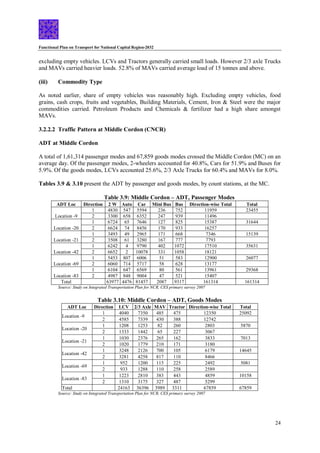
MAVs had a long trip length of 685 km, 2/3 Axle Trucks had 321 km, while LCV and Tractors had trip
lengths of 154 km and 51 kms respectively.
(iii) Trip Length Distribution
In case of MAVs, dominant distributions were in the frequency bands of 100-250 km and above. In case
of 2/3 Axle Trucks, the predominant distributions were in the bands of 500-750 km. LCV modes had
fairly distributed trip lengths. Tractors had a dominant distribution (44.64% in the band 0-25 km).
(iv) Load
Excluding empty vehicles, average load of MAVs was 11.7 tonnes and those of 2/3 trucks was 9.3 tonnes,
while for LCV and Tractor, these values were found to be 4.4 tonnes and 2.3 tonnes respectively.
Functional Plan on Transport for National Capital Region-2032
19
(v) Load Frequency Distribution
The load carried by a vehicle had been ascertained by enquiry. Empty vehicles accounted for a
considerable share ranging from 27-28% (2/3 Axle Trucks and MAV) and 46% (Tractors). LCVs and
Tractors generally carried small loads. However 2-3 axle Trucks and MAVs carried heavier loads. 31.0%
of 2/3 Axle Trucks carried a load of more than 10 tonnes. Nearly 33% of MAVs carried an average load
of 15 tonnes and above.
(vi) Commodity
The Commodity share indicates the multi-activity characteristics of NCR. 19 commodity types (excluding
empty vehicles) had been identified. The distribution of loaded vehicles, by mode revealed that Food
Grains, Fruits & Vegetables, Building Materials, Milk & Milk Products, Machinery, Petroleum Products,
Iron & Steel were the major commodities carried by the goods vehicles.
3.2.1.3 Inter-State Movement Pattern
The movement patterns between the states within and outside NCR are stated in Table 3.2.
Table 3.2: Interstate Movement Pattern
Movement Pattern Passenger Modes Goods Mode
Intra-NCR 70% 40%
Between Rest of Haryana and NCR 5% 10%
Between Rest of UP and NCR 7% 14%
Between Rest of Rajasthan and NCR 13% 11%
Between NCR and Other States 5% 20%
Through movements/non-destined traffic 5%
Note: Rest of Haryana, UP and Rajasthan implies part of the state excluding portion within NCR
The above pattern indicates the high intensity of intra-NCR movements, the close affinity between
NCR and the three constituent states of Haryana, UP and Rajasthan. The non-destined or through
movements, though only 5% by share, by quantum they would be substantial and demand attention
for their efficient movement.
3.2.2 Spatial Travel Pattern
3.2.2.1 Traffic Pattern at Outer Cordon (NCR)
ADT at Outer Cordon
A total of 94,659 passenger modes and 63,352 goods modes crossed the Outer Cordon (NCR, 12
locations) on an average per day. Of the passenger modes, 2-wheelers accounted for 35,173 (37.16%)
and cars for 47,048 (49.70%). Of the goods modes, LCVs accounted for 16,223 (25.61%) and 2 / 3
Axle trucks accounted for 38,264 (60.39%). The share size of MAVs was low at only 5072 (8.02%).
The pattern movements of the modes are analysed and presented below.
Tables 3.3 & Table 3.4 present the ADT, by passenger and goods modes, by count stations, at the
Outer Cordon.
Functional Plan on Transport for National Capital Region-2032
20
Table 3.3: Outer Cordon – ADT, Passenger Modes
ADT Loc Direction 2 W AUTO CAR MINI BUS BUS
Direction
Wise Total
Total
Location -1
1 3272 777 8332 42 941 13364 26931
2 3463 618 8419 72 995 13567
Location -15
1 2532 179 1595 22 313 4641 9068
2 2396 175 1499 23 334 4427
Location -17
1 2763 231 2524 21 506 6045 12183
2 2773 249 2498 27 591 6138
Location -34
1 878 1 470 11 105 1465 2929
2 835 9 480 13 127 1464
Location -35
1 848 1 1060 9 482 2400 4822
2 869 1 1111 7 434 2422
Location -36
1 1722 372 3187 39 267 5587 11470
2 1780 388 3413 36 266 5883
Location -51
1 1096 72 531 80 115 1894 4005
2 1181 34 659 79 158 2111
Location -62
1 1733 32 2643 151 453 5012 9223
2 1381 39 2167 138 486 4211
Location -74
1 910 111 1086 41 249 2397 4793
2 898 90 1125 39 244 2396
Location -76
1 676 59 1106 29 173 2043 4334
2 772 76 1244 32 167 2291
Location -77
1 675 53 791 26 80 1625 3220
2 665 64 772 18 76 1595
Location -82
1 473 121 186 0 15 795 1681
2 582 138 150 0 16 886
Total 35173 3890 47048 955 7593 94659 94659
Source: Study on Integrated Transportation Plan for NCR, CES primary survey 2007
Table 3.4: Outer Cordon – ADT, Goods Modes
ADT Loc Direction LCV 2/3 Axle MAV Tractor
Direction
Wise Total
Total
Location -1 1 3196 7825 656 118 11795 23251
2 3197 7278 859 122 11456
Location -15 1 317 279 11 153 760 1722
2 435 376 17 134 962
Location -17 1 1508 1561 54 144 3267 6547
2 1241 1815 70 154 3280
Location -34 1 240 122 3 25 390 813
2 223 150 16 34 423
Location -35 1 538 1434 49 81 2102 4082
2 468 1400 37 75 1980
Location -36 1 392 1519 140 386 2437 4895
2 459 1444 149 406 2458
Location -51 1 116 474 97 248 935 1985
2 75 663 71 241 1050
Location -62 1 1039 4080 1109 320 6548 12988
2 1042 4075 1093 230 6440
Location -74 1 294 1067 155 118 1634 3082
2 246 965 145 92 1448
Location -76 1 311 368 77 90 846 1745
2 338 373 78 110 899
Location -77 1 218 430 89 144 881 1868
2 246 461 95 185 987
Location -82 1 45 62 1 96 204 374
2 39 43 1 87 170
Total 16223 38264 5072 3793 63352 63352
Source: Study on Integrated Transportation Plan for NCR, CES primary survey 2007
Functional Plan on Transport for National Capital Region-2032
21
Movement pattern at Outer Cordon – Passenger Modes
Overall Pattern
Of the 94,659 passenger modes crossing the O-D count stations at the NCR outer cordon in a day,
 Internal-External (IE) : 47.4% (Origin within NCR)
 External-Internal (EI) : 49.4% (Destination within NCR)
 External-External (EE) : 3.2% (both O & D outside NCR)
Almost all the movements of 2-wheelers and autos were IE & EI. 5% of car movements and 10% of
bus movements were EE.
Inter Spatial Movement Pattern
Figure 3.5 depicts the inter-spatial movement pattern of all passenger modes (a total of 94,659
vehicles) at the Outer Cordon.
Figure 3.5: Inter-Spatial Movement Pattern of Passenger Modes
in NCR Outer Cordon
Inter-spatial Movement Pattern by Passenger Modes by Type
Inter-Spatial Movement Pattern, at Outer Cordon, by individual passenger modes, presents an
interesting picture. Tables 3.5 & 3.6 present the movement pattern amongst the ‘Outside NCR’ and
NCR spatial units, by modes and of modes.
Table 3.5: Outer Cordon – Movement Pattern, by Modes
Movement Pattern
Mode (%)
2 Wheeler Auto Car Mini Bus Bus Total
Outside NCR & NCTD 0.0 0.4 84.4 0.9 14.3 100.0
Outside NCR & CNCR 47.1 4.2 41.8 0.7 6.1 100.0
Outside NCR & Rest of NCR 54.3 6.0 33.9 1.0 4.8 100.0
Outside NCR & Outside NCR 0.0 0.0 75.4 3.4 21.3 100.0
Source: Study on Integrated Transportation Plan for NCR, CES primary survey 2007
26.7%
39.9 %
12.5%
3.2 %
57.6%
NCTD
CNCR
REST OF NCR
Functional Plan on Transport for National Capital Region-2032
22
Table 3.6: Outer Cordon – Movement Pattern, of Modes
Movement Pattern
Mode (%)
2 Wheeler Auto Car Mini Bus Bus Total
Outside NCR and NCTD 0 3 45 24 47 24
Outside NCR and CNCR 16 12 11 9 10 12
Outside NCR and Rest of NCR 84 85 39 56 34 59
Out side NCR and Out side NCR 0 0 5 11 9 5
Total 100 100 100 100 100 100
Source: Study on Integrated Transportation Plan for NCR, CES primary survey 2007
(i) Occupancy
The average occupancy, by modes, at the outer cordon, is almost similar to the overall occupancy
pattern in overall NCR. The average occupancy of two wheelers are 1.78, that of three wheelers are
3.49, cars/jeeps are 3.39, mini buses are 18.31 and that of buses are 40.72.
(ii) Trip Length
Cars had a long average trip length of nearly 160 km commensurate with their destination to NCTD.
Buses had a long trip length of 217 km indicating inter-state movements.
(iii) Trip Length Frequency
About 90% of 2-wheeler and 3-wheelers had a trip length in the range 0 – 25 km. Cars and Mini Bus
modes had a fairly distributed range of trip lengths. Buses had 50% of trips in the range 100 – 250
km.
(iv) Vehicle Trips by Purpose
‘Work’ and ‘Business’ trips were predominant trip purposes, overall and by modes. ‘Social’ trips
were reasonable by different modes. The share of ‘return home’ trips by different modes was also
significant.
Movement Pattern at Outer Cordon – Goods Modes
Overall Pattern
Of the 63,352 goods modes crossing the O-D count stations at the NCR outer cordon in a day,
 Internal-External (IE) : 44.6% (Origin within NCR)
 External-Internal (EI) : 46.3% (Destination within NCR)
 External-External (EE) : 9.1% (both O & D outside NCR)
Majority of the movements of LCV and HCV were IE & EI. 18% of MAV movements and 11.2 % of
Agricultural tractor movements were EE.
Inter-spatial Movement Pattern
Figure 3.6 depicts the Inter-Spatial Movement Pattern of Goods Modes (out of a total of 63,352
vehicles) in NCR Outer Cordon.
Functional Plan on Transport for National Capital Region-2032
23
Figure 3.6: Inter-spatial Movement Pattern of Goods Modes in NCR Outer Cordon
Inter-Spatial Movement Pattern of Goods Modes by Type
Tables 3.7 & 3.8 present the spatial pattern of movement by modes and of modes, at Outer Cordon.
Table 3.7: Outer Cordon – Spatial Pattern of Movement by Goods Modes
Movement Pattern
Mode (%)
LCV HCV MAV
Agr.
Tractors
Total
Outside NCR and NCTD 24.6 66.5 8.9 0.1 100.0
Outside NCR and CNCR 31.3 54.8 8.2 5.7 100.0
Outside NCR and Rest of NCR 26.6 56.8 5.3 11.4 100.0
Out side NCR and Outside NCR 15.8 60.8 15.7 7.7 100.0
Source: Study on Integrated Transportation Plan for NCR, CES primary survey 2007
Table 3.8: Outer Cordon – Spatial Pattern of Movement of Goods Modes by Type
Movement Pattern
Mode (%)
LCV HCV MAV Agr. Tractors Total
Outside NCR to NCTD 35 41 41 0 37
Outside NCR to CNCR 19 14 16 15 16
Outside NCR to Rest of NCR 40 36 25 73 38
Out side NCR to Out side NCR 6 9 18 12 9
Total 100 100 100 100 100
Source: Study on Integrated Transportation Plan for NCR, CES primary survey 2007
(i) Trip Length
Trip lengths of different modes ranged from less than 25 km to more than 1500 km. Trip lengths were
reasonably distributed over all frequency bands. The modal bands were: LCVs – 100-250 km; 2/3
Axle trucks – 100-250 km; and MAVs – 250-500 km. This indicated the generation potential of all
parts of NCR.
(ii) Load
Empty vehicles accounted for a good share ranging between 17.1% (2/3 Axle Trucks) and 40.6%
(Tractors). The average load ranged between 1.9 tonnes for tractors and 13.9 tonnes for MAVs
36.9%
39.9 %
16.0%
9.1%
38.1 %
NCTD
CNCR
REST OF NCR
Functional Plan on Transport for National Capital Region-2032
24
excluding empty vehicles. LCVs and Tractors generally carried small loads. However 2/3 axle Trucks
and MAVs carried heavier loads. 52.8% of MAVs carried average load of 15 tonnes and above.
(iii) Commodity Type
As noted earlier, share of empty vehicles was reasonably high. Excluding empty vehicles, food
grains, cash crops, fruits and vegetables, Building Materials, Cement, Iron & Steel were the major
commodities carried. Petroleum Products and Chemicals & fertilizer had a high share amongst
MAVs.
3.2.2.2 Traffic Pattern at Middle Cordon (CNCR)
ADT at Middle Cordon
A total of 1,61,314 passenger modes and 67,859 goods modes crossed the Middle Cordon (MC) on an
average day. Of the passenger modes, 2-wheelers accounted for 40.8%, Cars for 51.9% and Buses for
5.9%. Of the goods modes, LCVs accounted 25.6%, 2/3 Axle Trucks for 60.4% and MAVs for 8.0%.
Tables 3.9 & 3.10 present the ADT by passenger and goods modes, by count stations, at the MC.
Table 3.9: Middle Cordon – ADT, Passenger Modes
ADT Loc Direction 2 W Auto Car Mini Bus Bus Direction-wise Total Total
Location -9
1 4830 547 5594 236 752 11959 23455
2 3300 658 6352 247 939 11496
Location -20
1 6724 65 7646 127 825 15387 31644
2 6624 74 8456 170 933 16257
Location -21
1 3493 49 2965 171 668 7346 15139
2 3508 61 3280 167 777 7793
Location -42
1 6242 4 9790 402 1072 17510 35631
2 6652 2 10078 331 1058 18121
Location -69
1 5453 807 6006 51 583 12900 26077
2 6060 714 5717 58 628 13177
Location -83
1 6104 647 6569 80 561 13961 29368
2 4987 848 9004 47 521 15407
Total 63977 4476 81457 2087 9317 161314 161314
Source: Study on Integrated Transportation Plan for NCR, CES primary survey 2007
Table 3.10: Middle Cordon – ADT, Goods Modes
ADT Loc Direction LCV 2/3 Axle MAV Tractor Direction-wise Total Total
Location -9
1 4040 7350 485 475 12350 25092
2 4585 7339 430 388 12742
Location -20
1 1208 1253 82 260 2803 5870
2 1333 1442 65 227 3067
Location -21
1 1030 2376 265 162 3833 7013
2 1020 1779 210 171 3180
Location -42
1 3248 2126 700 105 6179 14645
2 3281 4258 817 110 8466
Location -69
1 952 1200 115 225 2492 5081
2 933 1288 110 258 2589
Location -83
1 1223 2810 383 443 4859 10158
2 1310 3175 327 487 5299
Total 24163 36396 3989 3311 67859 67859
Source: Study on Integrated Transportation Plan for NCR, CES primary survey 2007
Functional Plan on Transport for National Capital Region-2032
25
Movement Pattern at MC – Passenger Modes
Overall Pattern
Of the 1,56,838 passenger modes (excluding autos) crossing the O-D count stations in a day,
 Internal-Internal (II) : 27.3% (both O & D within CNCR)
 Internal-External (IE) : 35.8% (Origin within CNCR)
 External-Internal (EI) : 32.8% (Destination within CNCR)
 External-External (EE) : 4.1% (both O & D outside NCR)
In the analysis, Autos were not included.
Inter Spatial Units Movement Pattern
The inter-spatial units movement pattern of all passenger modes indicated that a good share (40.7%)
was performed between Outside CNCR and NCTD. 24.0% between CNCR and Rest of NCR; and
14.3% between CNCR and NCTD.
Inter Spatial Movement Pattern by Passenger Modes by Type
The distribution of Inter Spatial Movement Pattern by mode type shows that movements between
Outside CNCR and NCTD account for high share. Cars accounted for 47.5%, Buses for 59.5% and
even 2-wheelers for 26.6%. This indicated the high attraction of NCTD from Outside CNCR areas.
Interestingly movements between CNCR and NCTD were not very high, ranging between 9.1% (Bus)
and 16.6% (Cars). Intra CNCR movements was high amongst 2-wheelers (25.7%). Figure 3.7 depicts
the Inter-Spatial Movement Pattern of Passenger Modes in CNCR Middle Cordon.
Figure 3.7: Inter-Spatial Movement Pattern of Passenger Modes in
CNCR Middle Cordon
(i) Occupancy
Compared to occupancy at OC, Buses and Minibuses at MC, had higher occupancies of 42.67 and
22.41. Cars, 2 wheelers and 3 wheelers had occupancies of 1.76,3.85 and 3.38 respectively.
%
NCTD
17.6%
%
23.1%
4.8%
24.0%
14.3%
39.9%
CNCR
4.4%
Rest of NCR
11.8
%
Functional Plan on Transport for National Capital Region-2032
26
(ii) Trip Length
Cars had an average trip length of 151 km and buses a high of 229 km. This indicates the relatively
large vehicle-kms of travel in NCR.
(iii) Trip Length Frequency
Nearly 40% of Buses had a trip length in the band 100-250 km, and another 26.7% in the band 250-
500 km. A large share (98.4%) of Cars was in the bands upto 500 km. 2-wheeler (97.7%) and 3-
wheelers(99.7%) were mainly of short trip length in the band 0-25 km.
(iv) Vehicle Trips by Purpose
Overall, ‘Work’ and ‘Business’ purpose accounted for a share of 15.8% and 20.3% respectively. The
share of Education trips was low (2.4%). Social purpose trips were reasonably high at 13.3%. By
mode, share of 2-wheeler (21% for ‘work’ and 34% for ‘business’) and 3-wheeler trips (46% for
‘work’ and 26% for ‘business’) for ‘work’ and ‘business’ purpose were very high.
Movement Pattern at Middle Cordon – Goods Modes
Overall Pattern
Of the 67,859 goods modes crossing the counts stations at CNCR Middle Cordon in a day,
 Internal-External (IE) : 46.8% (Origin within CNCR)
 External-Internal (EI) : 41.8% (Destination within CNCR)
 External-External (EE) : 7.2% (both O & D outside CNCR)
 Internal-Internal (II) : 4.2% (both O & D inside CNCR)
The share of external trips indicated the potential need for a bypass/orbital road system around
CNCR. Surprisingly, Agricultural Tractors had a higher share 8.6% of EE movements. This might be
due to their movements in the peripheral areas as denoted by their average trip length, which was the
lowest amongst the goods modes.
Inter Spatial Movement Pattern
The inter spatial movement pattern indicated a very high share (62%) of movements between Outside
CNCR and NCTD. This indicated the high generation character of NCTD. Surprisingly the share of
movements between CNCR and NCTD was a low of 2.0%.
Inter-Spatial Movement Pattern of Goods Modes by Type
By each mode type, a high share of movement was observed between outside CNCR & NCTD
(Outside CNCR includes Rest of NCR and Outside NCR). The share ranged from 48.8% (Agr.
Tractors) to 65% (HCVs). There was a high degree of interaction between CNCR and Rest of NCR
and CNCR and Outside NCR. Figure 3.8 depicts the inter-spatial movement pattern of goods mode
(out of a total of 67,859 vehicles).
Functional Plan on Transport for National Capital Region-2032
27
Figure 3.8: Inter-Spatial Movement Pattern of Goods Modes in CNCR Middle
Cordon
(i) Trip Length
The average trip lengths of modes were reasonably high ranging from 54 km (Agri. Tractor) to 517
km (MAVs). This indicated the intense vehicular-kms within NCR.
Trip lengths were reasonably distributed amongst different frequency bands upto 750 km. MAVs had
longer trip lengths with a share of 10.13% in the band above 1500 km.
(ii) Load
Empty vehicles accounted for a share ranging between 23.2% (MAVs) and 40.9% (LCVs). This
indicated the imbalance in demand for goods vehicles and also perhaps the requirement of organized
hubs for collection and distribution of consignments and goods vehicles. Excluding the empty
vehicles, the average load of MAVs was 11.7 tonnes and that of 2/3 Axle Trucks was 7.5 tonnes.
By vehicle type, 33.0% of MAVs had a load of more than 15 tonnes and 16.8% of 2/3 Axle Trucks
had a load of more than 10 tonnes. LCVs and Agricultural tractors mainly carried loads up to 7.5
tonnes.
(iii) Commodity Type
Excluding empty vehicles, minerals, food grains, cash crops, fruits & vegetables, building materials,
cement, milk & milk products and petroleum products were the major commodities carried by
vehicles. Of the MAVs, 20.5% carried cement and 24.1% iron & steel. Amongst 2/3 axle trucks,
19.4% carried cash crops, 11.5% building materials and 10.6% petroleum products. Large share of
agricultural tractors carried food grains (20.5%), cash crops (17.4%), building materials (16.3%) and
cement (14.7%).
39.9 %
13.9 %
2.1 %
NCTD
CNCR
REST OF NCR
41.6%
7.2 %
12.8 %
2.1 %
20.4 %
Functional Plan on Transport for National Capital Region-2032
28
3.2.2.3 Traffic Pattern at Inner Cordon (NCTD)
ADT at Inner Cordon
NCTD is the focus of NCR. While its physical size is small as compared to other sub-regions, its
demographic size is huge and activities concentration intense. It is a major producer and attractor of
people, goods and other flows. The emphasis on planning the road network system enabling
movements to and from NCTD will continue. Added also is the need to divert non-destined traffic.
Appreciation of traffic pattern at the cordon around NCTD (Inner Cordon) is important to plan an
efficient and effective road network system in the NCR.
A total of 11,07,043 passenger modes and 1,03,853 goods modes crossed the Inner Cordon (IC) on an
average day. Of the passenger modes, cars accounted for a maximum share (60.7%) followed by 2-
wheelers (33.4%). Autos accounted for 3.6 % and Buses for 2.3%.
Of the goods modes, 2/3 Axle Truck had the maximum share (55%). LCVs were in good number
(38,717 /37.3%). MAVs (5158 / 5.0%) and tractors (2850/ 2.7%) accounted for a low share.
Table 3.11 & 3.12 presents the ADT, by Passenger and Goods mode, by count stations on NCTD
Inner Cordon.
Movement Pattern at Inner Cordon – Passenger Modes
Overall Pattern
Of the 11,07,043 passenger modes crossing the counts stations at NCTD Inner Cordon in a day,
 Internal-External (IE) : 36.7% (Origin within NCTD)
 External-Internal (EI) : 38.4% (Destination within NCTD)
 External-External (EE) : 22.9% (both O & D outside NCTD)
The high share of external movements called for a bypass orbital around NCTD and justified the
proposed Eastern and Western Peripheral Expressways. The share of internal movements within the
inner cordon is negligible (2%) and has hence been excluded in further analysis.
Table 3.11: Inner Cordon – ADT, Passenger Modes
LOC No. ADT Loc Dir 2 W Auto
Car,
Jeep***
Mini Bus Bus
Direction
Wise Total
Total
1 *
Delhi-Gurgaon section on
NH-8
1 23050 35 120404 187 1609 145285 288978
2 17917 53 124361 186 1176 143693
2 *
Mehrauli -Gurgaon Rd
(Near Aya Nagar)
1 13861 129 27557 191 496 42234 86332
2 14838 83 28578 153 446 44098
3 **
Surajkund Rd (Near
Pulprahladpur)
1 6327 307 6487 62 117 13300 24690
2 5207 423 5553 60 147 11390
4 *
Delhi -Faridabad section
on NH-2/ Mathura Rd
1 12263 3047 17513 214 622 33659 68336
2 12798 2824 17991 257 807 34677
5 *
Noida-Saritavihar/ Road
No. 13A (Kalindi Kunj
Rd)
1 21727 1305 23278 134 964 47408 93035
2 20709 1272 22496 106 1044 45627
6 *
Delhi-Noida Rd/ Noida
Link Rd
1 11023 703 27978 71 205 39980 85794
2 12352 771 32356 67 268 45814
7 ** New Ashok Nagar Rd 1 1563 27 1539 6 8 3143 6254
Functional Plan on Transport for National Capital Region-2032
29
LOC No. ADT Loc Dir 2 W Auto
Car,
Jeep***
Mini Bus Bus
Direction
Wise Total
Total
2 1433 31 1636 7 4 3111
8 ** Vasundhara Enclave
1 5932 765 4920 40 90 11747 24297
2 6244 978 5136 44 148 12550
9 **
Har Shingar Marg (Near
DDA Sports Complex)
1 4723 895 4662 44 370 10694 22021
2 5493 740 4745 11 338 11327
10 *
Ghaziabad-Delhi section
on NH-24 / NH-24 near
Gazipur Border
1 18766 2729 22955 224 386 45060 92721
2 20317 2675 23859 132 678 47661
11 **
Koushambi Border (Near
Anand Vihar ISBT)
1 13233 1026 14650 101 301 29311 59467
2 13967 1652 13929 199 409 30156
12 **
Dr. Bhabha Marg (Near
Ramprastha)
1 4309 236 4012 36 42 8635 17326
2 4508 195 3892 44 52 8691
13 *
Ghaziabad-Mohan Nagar
on NH 58/ Apsara Border
(G.T. Rd)
1 21767 5196 17136 227 1689 46015 94773
2 22871 5583 18164 252 1888 48758
14 **
Mangal Pandey Marg
(Bhopura Border)
1 7075 800 5674 77 330 13956 28387
2 7876 1128 5028 73 326 14431
15 *
Loni-Bagpat section on
SH-57/ Loni Border
(Saharanpur Rd)
1 1817 950 1998 8 226 4999 9421
2 1556 886 1826 6 148 4422
16 *
Haryana-Delhi Section on
NH-1 near Singhu Border
1 3822 52 12561 77 1118 17630 36192
2 3622 42 13786 90 1022 18562
17 *
Bawana -Sahadpur
Chowki/ Auchandi-
Bawana Rd
1 715 0 1185 29 79 2008 4146
2 870 0 1124 44 100 2138
18 *
Bahadurgarh-Delhi
Section on NH/ Rohtak
Rd (Tikri Border)
1 4432 660 5608 63 678 11441 22809
2 4295 698 5557 81 737 11368
19 ** Dhansa Border
1 839 5 436 82 83 1445 2927
2 964 4 339 84 91 1482
20 *
Haryana-Delhi
(Kapashera) on old NH /
Old Gurgaon Rd (Near
Kapasheda Border)
1 6691 596 11124 468 598 19477 39137
2 7558 580 10324 510 688 19660
Total 369330 40081 672357 4747 20528 1107043 1107043
Source: * Source: Study on Integrated Transportation Plan for NCR, CES primary survey 2007 ** RITES – Primary Survey 2007-08
Note : ***- RITES data covers vans along with cars and jeeps, but CES data does not include vans
Table 3.12: Inner Cordon – ADT, Goods Modes
LOC No. Name of Location Dir LCV
Trucks/
2-3 Axle
MAV Tractors
Direction
Wise Total
Total
1 *
Delhi-Gurgaon section on
NH-8
1 2406 4318 684 100 7508 14846
2 2362 4536 334 106 7338
2 *
Mehrauli -Gurgaon Rd (Near
Aya Nagar)
1 758 1305 42 104 2209 3607
2 560 807 10 21 1398
3 **
Surajkund Rd (Near
Pulprahladpur)
1 912 1040 132 *** 2084 4282
2 1041 1033 124 *** 2198
4 *
Delhi -Faridabad section on
NH-2/ Mathura Rd
1 2415 2803 193 65 5476 10837
2 2376 2727 131 127 5361
5 *
Noida-Saritavihar/ Road No.
13A (Kalindi Kunj Rd)
1 1063 4928 674 112 6777 12121
2 776 4234 296 38 5344
6 *
Delhi-Noida Rd/ Noida Link
Rd
1 148 216 8 19 391 865
2 191 246 12 25 474
7 ** New Ashok Nagar Rd 1 26 6 0 *** 32 50
Functional Plan on Transport for National Capital Region-2032
30
LOC No. Name of Location Dir LCV
Trucks/
2-3 Axle
MAV Tractors
Direction
Wise Total
Total
2 17 1 0 *** 18
8 ** Vasundhara Enclave
1 763 25 1 *** 789 1318
2 493 36 0 *** 529
9 **
Har Shingar Marg (Near DDA
Sports Complex)
1 675 27 10 *** 712 1326
2 501 106 7 *** 614
10 *
Ghaziabad-Delhi section on
NH-24 / NH-24 near Gazipur
Border
1 874 1803 184 17 2878 6132
2 815 2205 164 70 3254
11 **
Koushambi Border (Near
Anand Vihar ISBT)
1 544 259 0 *** 803 2211
2 671 585 152 *** 1408
12 **
Dr. Bhabha Marg (Near
Ramprastha)
1 196 489 3 *** 688 1038
2 164 186 0 *** 350
13 *
Ghaziabad-Mohan Nagar on
NH 58/ Apsara Border (G.T.
Rd)
1 1676 1874 186 201 3937 8185
2 1897 1885 208 258 4248
14 **
Mangal Pandey Marg
(Bhopura Border)
1 1878 1246 386 *** 3510 6384
2 1407 1276 191 *** 2874
15 *
Loni-Bagpat section on SH-
57/ Loni Border (Saharanpur
Rd)
1 151 1592 201 252 2196 4909
2 194 1881 235 403 2713
16 *
Haryana-Delhi Section on
NH-1 near Singhu Border
1 1967 3802 11 92 5872 11276
2 2068 3256 25 55 5404
17 *
Bawana -Sahadpur Chowki/
Auchandi-Bawana Rd
1 332 416 14 190 952 1870
2 202 479 10 227 918
18 *
Bahadurgarh-Delhi Section on
NH/ Rohtak Rd (Tikri Border)
1 1066 1299 259 186 2810 5457
2 1063 1275 168 141 2647
19 ** Dhansa Border
1 231 209 0 *** 440 871
2 190 240 1 *** 431
20 *
Haryana-Delhi (Kapashera)
on old NH / Old Gurgaon Rd
(Near Kapasheda Border)
1 1782 1147 92 21 3042 6268
2 1866 1330 10 20 3226
Total 38717 57128 5158 2850 103853 103853
Source: * Source: Study on Integrated Transportation Plan for NCR, CES primary survey 2007, ** RITES – Primary Survey 2007-08
Note : ***- RITES data does not include tractors separately
Inter Spatial Movement pattern by Passenger Modes
Interestingly share of movements between NCTD and Rest of NCR (36.21%) were almost equal to
that between NCTD and CNCR (36.20%). Figure 3.9 depicts the inter-spatial movement pattern of
passenger mode (out of a total of 11,07,043 vehicles).
There were intense interactions amongst all spatial units. The highest share in all modes was between
NCTD and Rest of NCR. This indicated the increasing location of activities in Rest of NCR. However
the share of passenger movement observed between NCTD and outside NCR was very low (4.18%).
The share of movements between outside NCTD and outside NCTD was high at 23.40%.
Functional Plan on Transport for National Capital Region-2032
31
Figure 3.9: Inter-Spatial Movement Pattern of Passenger Modes in NCTD Inner
Cordon
(i) Occupancy
There were variations in occupancy of modes observed at IC as compared to OC & MC. Buses
showed a lower occupancy level 39.77 as compared to 42.67 at MC. Similarly mini buses also
showed a much lower occupancy level 11.18 as compared to 22.41 at MC. The average occupancy of
2 wheelers, 3 wheelers, and Car/Jeep were 1.59, 2.93 and 2.79 respectively which were lower than the
corresponding values observed at OC and MC.
(ii) Trip Length
Buses had the longest trip length (121.86) as compared to other modes. Trip lengths were much
shorter as compared to those at OC and MC.
(iii) Trip Length Frequency
Nearly 84% of the total trips were less than 50 km in length. 87% of 2-wheelers were in the band 0-25
km while 89% of 3-wheelers had distributed trip lengths upto 100 km. Buses had fairly distributed
trip lengths upto 250 km while cars,3 wheelers and mini buses had fairly distributed trip lengths upto
100 km.
(iv) Vehicle Trip Purpose
‘Work’ and ‘Business’ were the major purposes accounting for 32% and 23% of the total trips
respectively. Social trips were also high at 13.0%. Education trips were low (2.3%). By mode, share
of 2 wheelers, 3 wheelers, cars and mini buses for ‘work’ and business’ purpose were reasonably
high.
4.18 %
36.20 % NCTD
CNCR
REST OF NCR
23.40 %
36.21%
Functional Plan on Transport for National Capital Region-2032
32
Movement Pattern at Inner Cordon – Goods Modes
Overall Pattern
Of the 1,03,853 goods modes crossing the counts stations at NCTD Inner Cordon in a day,
 Internal-External (IE) : 30.5% (Origin within NCTD)
 External-Internal (EI) : 38.6% (Destination within NCTD)
 External-External (EE) : 29.9% (both O & D outside NCTD)
The significant share of EE movements stressed the need for a bypass orbital road system around
NCTD. The share of internal movements within the inner cordon is negligible (1%) and has hence
been excluded in further analysis.
Inter Spatial Movement Pattern by Goods Mode
The movement between NCTD and rest of NCR accounted for the highest share (34.49%) followed
by that between NCTD and CNCR(20.85%). The share of goods movement between NCTD and
outside NCR was nearly 15% which indicated the intense interaction between NCTD and different
states of the country. As already noted, share of movements between outside NCTD and Outside
NCTD was high at 30.19%.
Figure 3.10 depicts the inter-spatial movement pattern of goods mode (out of a total of 1,03,853
vehicles).
(i) Trip Length
Generally at the inner cordon, trip lengths were found to be shorter than that at OC or MC. MAVs had
the longest trip length of 163 km followed by 2/3 Axle Trucks at 139 km. The trip length for LCV
and Tractor was 96 km and 84 km respectively.
A high share of movements of different modes was in the band 0-25 km. Trip lengths of all modes are
reasonably distributed amongst bands from 0-25 km to 250 –500 km.
(ii) Load
A high share of modes by type, (ranging from around 30-33% in MAVs and 2/3 axle trucks to around
40% in Tractors and LCVs) were empty. Excluding empty vehicles, the average load of MAVs was
10.3 tonnes and 2/3 Axle Trucks was 7.8 tonnes. As it was ascertained by enquiry, there might be a
possibility of understatement. About 27.2% of the MAVs were found to carry loads greater than 15
tonnes. Agricultural tractors were generally found to carry loads upto 5 tonnes.
Functional Plan on Transport for National Capital Region-2032
33
Figure 3.10: Inter-Spatial Movement Pattern of Goods Modes in NCTD Inner
Cordon
(iii) Commodity
Excluding empty vehicles, Fruits & Vegetables and Building Materials were the major commodities
carried by the different types of goods modes. A high share of MAVs carried Petroleum Products
(12.8%) and Manufacturing products (11.2%). A high proportion of Tractors carried Petroleum
products (15.0%) and Milk, Poultry, Livestock (12.6%).
3.2.3 Comparative Analysis and Issues
3.2.3.1 Comparative Analysis
i) On the whole NCR, around 10,40,000 vehicles criss-crossed the 43 O-D count stations a day
of which passenger modes were about 7,60,000 and goods modes were about 2,80,000.
ii) At NCR level, Internal-Internal movements predominated with 69% for passenger modes
and 40% for goods modes.
iii) At the NCR level, External-External movements were found to be low in the order of 1.2%
for passenger modes and 5.1% for goods modes.
iv) The total movements from outer cordon were found to be 95,000 for passenger modes
catering for 5,60,000 passenger modes per day on an average day while total goods modes
were found to be 63,500 transporting 3,95,000 tonnes of goods per day.
v) At the outer cordon, External-External movements were catering for 3.2% of the passenger
modes and 9.1% of the goods modes while at the inner Cordon, External-External
movements were catering for 22.9 % in passenger modes and 29.9 % in goods modes.
vi) Amongst goods modes at the outer cordon, the share of empty vehicles was high,
constituting 17% of 2 / 3 axle trucks,22% MAVs and 40% of tractors.
vii) NCTD of Delhi is the focus of NCR from traffic considerations as the intensity of traffic
crossing IC was high. A total of around 11,07,043 passenger modes and 1,03,853 goods
modes crossed the IC on an average day.
viii) At the inner cordon, trip lengths of passenger modes as well as goods modes were found to
be much shorter than that at OC and MC.
14.47 %
20.85 %
NCTD
CNCR
REST OF NCR
30.19 %
34.49 %
Functional Plan on Transport for National Capital Region-2032
34
3.2.3.2 Issues
The appreciation of traffic pattern characteristics has brought out the following important issues:
i) There is high intensity of traffic at all spatial levels
ii) The complex pattern of movements criss-crossing all over the NCR
iii) There is increase in share of External-External traffic as one moves from OC to IC and hence
it highlights the need for screening at all spatial levels
iv) Passenger modes necessitate higher levels of service in terms of capacity and speed from the
network
v) The size of goods traffic calls for appropriate logistic facilities spread over the NCR
vi) The share of buses in traffic is moderate and hence concerted efforts are required to
strengthen the bus system and rationalize the routes and operation
Functional Plan on Transport for National Capital Region-2032
35
Railway Network in NCR
The railway network in NCR consists of complex rail radials and hubs which have got developed over
the last hundred years. It serves the National capital – New Delhi and strives to meet transportation
needs of India’s populations, people visiting it for business and social requirements. Unlike other
major metros of the country, rail network in the capital also operates as a transit point for passengers
and freight volumes moving between Punjab, Haryana, Himachal, J&K, Rajasthan on one side and
rest of the country on the other.
4.1 Rail Radials around NCT-Delhi
NCT-Delhi is served by the following 8 rail radials:
5 Major Radials
i. New Delhi – Faridabad – Palwal (to and from Central India)
ii. New Delhi – Sonipat – Panipat (to and from Northern States)
iii. New Delhi – Rohtak (to and from parts of Haryana & Punjab)
iv. New Delhi – Gurgaon – Rewari – Alwar (to and from Western India)
v. New Delhi – Shahdara – Shamli (to and from Western UP)
3 Radials converging at Ghaziabad
i. Delhi – Ghaziabad – Khurja – Aligarh (to and from Eastern India)
ii. Delhi – Ghaziabad – Hapur – Garhmukteswhwar (to and from UP and Utrakhand
iii. Delhi – Ghaziabad – Meerut (to and from Western UP)
The following sub sections complete the rail network in NCR and around NCT:
i. Delhi – New Delhi – Nizamuddin – Patel Nagar – Delhi Kishanganj – New Delhi/DLI (GAL)
ii. Delhi – Shahdara/Sahibabad – Anand Vihar- New Delhi/Delhi (DAL)
iii. Khurja – Hapur – Meerut (connecting DLI-Howarh route with DLI-Meerut- Saharanpur
and Delhi-Moradabad links)
iv. Panipat – Rohtak (Branch line)
v. Sub sections of Rohtak – Jind, Rewari – Bhiwani, Rewari – Mahendragarh and Rewari –
Narnaul sections
The rail network in NCR is shown in Map 4.1.
4.2 Passenger Terminals in the Capital
The four passenger handling terminals in the capital are:
(i) New Delhi
(ii) Delhi
(iii) H. Nizamuddin
(iv) Delhi Sarai Rohilla
4
Functional Plan on Transport for National Capital Region-2032
36
Functional Plan on Transport for National Capital Region-2032
37
Their profile have been undergoing significant changes during the last five decades and the capacity
enhancement works have been undertaken , basically to serve the needs of long and medium distance
travellers using services. Traditionally, two rings have got formed viz one linking Delhi-Shahadra
Anand Vihar – Tilak Bridge – New Delhi-Delhi and the other formed by joining New Delhi-NZM-
PTNR-DSJ-Brar Square-PTNR-DKZ-NDLS. Historically, the first ring (GAL) got constructed when
NDLS was approached directly without touching Delhi, from eastern sector (Aligarh, Moradabad,
Meerut side). The second ring (so called Ring Railway) got developed, when the freight traffic could
be moved from Central and/Western India to Punjab, Haryana without touching New Delhi/Delhi and
conserving the terminals primarily for passenger operation.
4.3 Coaching and Freight Traffic in Delhi & NCR
NCR, particularly Delhi area handles tremendous volumes of coaching and freight traffic. The
coaching traffic has grown at an exponential rate during the last two decades with addition of large
number of mail, express, Shatabdi and Rajdhani trains catering to long distance, inter-city movements
and EMUs, main line EMUs and diesel push-pull trains catering to fast growing commuter traffic
between Delhi and the satellite towns of the National Capital Region. The freight traffic has also
grown at a fast pace. Delhi Area is a complex network of railway lines with coaching and freight
traffic pouring in and out of eight radials. A large volume of traffic terminates within the area, but an
equally large volume of traffic moves across from one radial to another. There are three main goods
terminals at Tughlakabad, Shakurbasti and Delhi Kishanganj apart from power houses, viz., Badarpur
and Indraprastha which are served through their exclusive sidings. Tughlakabad harbours an
International Container Depot (ICD) which has grown at a fast pace and is already bursting at its
seams. It handles a growing volume of domestic container traffic as well and is also the only
marshalling yard now operational on Northern Railway. Two electric loco sheds, one at Tughlakabad
and the other at Ghaziabad and two diesel loco sheds, one at Tughlakabad and the other at Shakurbasti
are also situated in NCTD.
4.4 Operational Complexities
The operational problems confronting Delhi Area arise mainly from over-saturation of line capacity in
certain sections like Delhi – Ghaziabad, Delhi –Shakurbasti and Delhi – New Delhi –Sahibabad etc.
These are not only hindering traffic flows but could put future growth of traffic in jeopardy.
Unfortunately, these congested sections pass along heavily built up urban areas. Capacity expansion
of these sections is either physically impossible or prohibitively expensive.
4.5 Description of Radials in Delhi Area
The brief account of major 8 radials is given below:
(i) Delhi – Ghaziabad – Aligarh Section
Ghaziabad, an important CNCR town, is situated at a distance of 20 km from Delhi. Delhi –
Ghaziabad corridor is an electrified section with double lines between Delhi – Sahibabad and
quadruple lines between Sahibabad – Ghaziabad. From Ghaziabad, the lines branch off into three
directions/divisions touching important rail heads of NCR, controlled by one Division of Northern
Railway and two divisions of North Central Railway. The segments are:
 Ghaziabad – Khurja Jn. – Aligarh Section on Allahabad Division (North Central Railway)
 Ghaziabad – Hapur – Garmukteshwar Section on Moradabad Division (NR)
Functional Plan on Transport for National Capital Region-2032
38
 Ghaziabad – Meerut Section on Delhi Division (NR).
The NCR limit on Ghaziabad-Aligarh rail corridor extends upto Somna station at a distance of 104
km from Delhi. The section beyond Ghaziabad and up to Aligarh is presently a double line electrified
route under the administrative control of Allahabad Division of North-Central Railway. It handles
long distance mail / express trains, passenger shuttles and long distance freight trains on electric
traction.
On the critical sub section (viz Sahibabad- Ghaziabad) of this radial, 120 trains each way is the
installed sectional capacity whereas LC utilization is already above 130%. 116 passenger carrying
trains and over 40 freight trains each way are operational on the critical sub-section.
Major contribution of unreserved passenger traffic is made by Ghaziabad, Delhi Shahdara, Sahibabad,
Dankaur, Khurja, Dadri and Aligarh Jn. stations etc.
(ii) Ghaziabad – Hapur – Garmukteshwar –Section
The NCR limit on this rail corridor extends upto Garmukteshwar station at a distance of 87 km from
Delhi. Hapur station is situated at a distance of 37 km from Ghaziabad. The section between
Ghaziabad and Hapur is a double, non-electrified line route and is under the administrative control of
Moradabad Division of Northern Railway. It handles 25 long distance mail / express trains, passenger
shuttles and 3 freight trains each way on diesel traction. With doubling completed upto Hapur, LC
utilization on the sub-section between Hapur-Ghaziabad is eased and utilization is over 60%. Being a
non-electrified section, inter-radial EMU operation for commuter traffic on this sub section, is at
present, not feasible. Hapur and Pilkhuwa generate significant commuter traffic.
(iii) Ghaziabad – Meerut
The NCR limit on this rail corridor extends upto Khatauli station at a distance of 101 km from Delhi.
Meerut City station is situated at a distance of 69 km from Delhi and 48 km from Ghaziabad. The
section between Ghaziabad and Meerut is double line non-electrified. The section handles 19 long
distance mail / express, passenger shuttles and 8 freight trains each way on diesel traction system. The
section is under the administrative control of Delhi Division of Northern Railway. Present utilization
of Ghaziabad-Meerut sub section is comparatively lower (in the range of 50%). To make it commuter
friendly, non-electrified territory may come in the way in the long run. Modinagar, Muradnagar,
Meerut City and Meerut Cantt. generate substantial commuter traffic.
(iv) Delhi – Shahdara – Shamli section
The NCR limit on this rail corridor extends upto a distance of around 75 Km from Delhi. This is a
single line non-electrified section operated by Diesel traction. This is relatively lightly loaded section
with predominantly passenger traffic and very low goods traffic. The section is under the control of
Delhi Division of Northern Railway. Line capacity, at present on the sub section (Delhi Shahdara-
Shamli) is not a constraint. However, beyond Delhi Shahdara towards Delhi Jn, LC does pose a
problem for operation. Loni, Khekra, Bagpat Road, Baraut, Shamli have a big share in commuter
traffic.
(v) Delhi – Faridabad – Palwal Section
The NCR limit on this rail corridor extends upto Chhata station at a distance of 114 km from Delhi.
This is a double line electrified section utilised for running of long distance, inter-city mail / express
trains, ordinary passenger trains EMU trains and freight trains. On this section, jurisdiction of
Northern Railway extends upto Palwal station (inclusive) and thereafter the section is under the
Functional Plan on Transport for National Capital Region-2032
39
control of Agra Division of North-Central Railway. This is a major artery, which carries heavy mixed
traffic from Central and Western India. 65 passenger carrying trains and over 50 freight trains each
way are operated daily on this vital sub section of Indian Railway with 150% line capacity utilization.
Introduction of any new passenger/freight train on this sub section becomes a major issue. Palwal,
Faridabad, Ballabgarh, Kosi Kalan and Tuglakabad are the major contributors of commuter traffic.
(vi) Delhi – Gurgaon – Rewari – Alwar Section
The NCR limit on this rail corridor extends upto Alwar station is at a distance of 158 km from Delhi.
Gurgaon (CNCR town) is situated at a distance of 32 km from Delhi. The entire section is non-
electrified running on diesel traction system and catering to inter-city mail / express, trains, ordinary
passenger and freight trains. The section upto Rewari (excluding) falls under the administrative
control of Delhi Division of Northern Railway. Beyond that, it is under Jaipur Division of North-
Western Railway. With complete gauge conversion of double line upto Rewari, the section is
operating 20 passenger trains and 6 freight trains each way. Rewari, Pataudi road, Gurgaon, Palam
and Delhi Cantt. contribute a major share in unreserved passenger stream.
(vii) Delhi – Shakurbasti – Rohtak Section
The NCR limit on this rail corridor extends slightly beyond Rohtak which station is at a distance of 70
km from Delhi. Bahadurgarh (CNCR town) is situated at a distance of 30 km from Delhi. This is a
non-electrified double line section operating on diesel traction system which is utilised for running of
mail / express, trains, ordinary passenger and freight trains to and from Haryana, Punjab and
Rajasthan. Being a diesel section, seamless operation from and to other vital sections is a challenge
for commuter operation. Rohtak, Bahadurgarh, Sampla, Nangloi and Shakurbasti are the major
contributors to commuter traffic.
(viii) Delhi – Subzimandi – Sonipat – Panipat Section
The NCR limit on this rail corridor extends upto Panipat station at a distance of 89 km from Delhi.
The section is an electrified double line rail corridor which is extensively utilised for running of inter-
city mail / express trains, ordinary passenger carrying trains as well as freight trains to and from
Haryana, Punjab, Himachal Pradesh and Jammu & Kashmir. In operational priority, this sub section
falls at third position in NCR, after New Delhi – Aligarh Jn and New Delhi – Palwal sections. With
electrified territory it moves around 70 trains each way, including 38 passenger carrying trains each
way. Line capacity is saturated with 135% utilization. Panipat, Sonipat, Narela, Naya Azadpur,
Ganaur, Samalkha and Sabzimandi contribute a major share in commuter/unreserved traffic.
4.6 Passenger Traffic Profile
4.6.1 NCR, particularly NCT, has been witnessing a stupendous growth in passenger train handling.
Till early, 60s, Old Delhi Station was the only (BG) coaching terminal. In the last 40 years,
New Delhi and Nizamuddin have assumed much greater importance. In terms of passenger
trains, the three terminals have seen remarkable growth. A sample of growth over the last 25
years may be seen as under:
Table 4.1: Growth of Passenger Trains in Delhi Area (25 years)
Functional Plan on Transport for National Capital Region-2032
40
Source: Study on Integrated Transportation Plan for NCR,
4.7 Commuter Services in NCR
The present trends of unreserved passenger and commuter traffic in the rail corridors in NCR have
been studied. The originating traffic data of unreserved passengers from most of the stations of
different railway corridors have been collected. This data has been used for analyzing share of rail
traffic vis-à-vis total traffic demand entering / leaving NCR. The daily passenger traffic originating at
major stations in NCR is of the order of 7,24,467 passengers.
Analysis of the data of unreserved passenger and daily travelers in the NCR for the year 2007-08
reflects that majority of commuters originate their journeys from the following major stations, and this
accounts for a total of 4,30,750 (Table 4.2).
Table 4.2: Unreserved Passengers in NCR (Major Stations)
SI. No. Station Code Originating Passengers per day
1 BVH (Ballabhgarh) 16180
2 FDN (Faridabad New Town) 16330
3 FDB (Faridabad) 22170
4 PWL (Palwal) 23940
5 PNP(Panipat) 15050
6 SNP(Sonepat) 30190
7 SZM(Subzimandi) 4700
8 NARELA 14700
9 ROK (Rohtak) 17720
10 SSB (Shakurbasti) 7200
11 BGZ (Bahadurgarh) 13000
12 DSA(Delhi Shahdara) 16100
13 SBB (Sahibabad) 19220
14 GZB (Ghaziabad) 40830
15 KHURJA 5030
16 DEC (Delhi Cantt) 7480
17 DEE(Delhi Sarai Rohilla) 4800
18 GGN(Gurgaon) 13000
19 RE (Rewari) 13500
20 HPU (Hapur) 7200
21 BARAUT 13600
22 MEERUT CITY 12190
23 NDLS (New Delhi) 37960
24 NZM(Nizamuddin) 13700
25 DLI (Delhi Main) 36960
26 TKD (Tuglakabad) 8000
Total 430750
* Details of the abbreviation used for station codes used in the table are given on last page of this chapter
Source: Study on Integrated Transportation Plan for NCR
Years
Delhi New Delhi Hazrat Nizamuddin
No of Pass.
Trains
Orig/Termin
Through Total
No of Pass.
Trains
Orig/Termin.
Through Total
No of Pass.
Trains
Orig/Termin
Through Total
1980 110 22 132 54 70 124 20 64 84
1985 108 30 138 68 63 131 36 60 96
1990 104 36 140 72 74 146 36 69 105
1995 116 31 147 91 82 173 47 72 119
2000 148 36 184 103 96 199 59 76 135
2005 154 48 202 133 108 241 79 81 160
2007 150 51
201, Including
52 EMU &
70 Pass trains
135 117
252, Including
76 EMU &
12 Pass trains
87 85
172,Including
48 EMU &
8 Pass trains
Functional Plan on Transport for National Capital Region-2032
41
The rail commuter services available at present (March 2008) in NCR are given in Table 4.3.
Table 4.3: Commuter Services for Different Stations in NCR
S.No Section Type of Trains Length in KMs No. of Trains
(Commuters +
Passenger) per day
in each direction.
1.
1A
Delhi-Ghaziabad
New Delhi-Ghaziabad
EMU, MEMU,
Conventional
20
25
42
2 Delhi-Palwal EMU, MEMU,
Conventional
60 18
3 H.Nizamuddin-
H.Nizamuddin (Ring Rail)
EMU 35 7
4. Delhi-Rewari/Alwar Conventional, DMU 82 8
5. Delhi-Shakurbasti-Rohtak EMU, Conventional 70 9
6. Delhi-Subzimandi-Panipat MEMU,EMU,
Conventional
88 11
7. Delhi-Ghaziabad-Meerut Conventional, DMU 68 7
8. Delhi-Shamli Conventional, DMU 87 8
9 Ghaziabad-Hapur Conventional 36 2
10 Ghaziabad-Khurja-Aligarh EMU, MEMU 105 8
Source: Study on Integrated Transportation Plan for NCR, CES primary survey 2007
The sectional details and the existing volume of originating passenger traffic in the sections are given
in Annexure 4.1 to 4.12.
4.7.1 Fare Structure
The 2nd
class fare structure of Railway for suburban traffic is same as that for mainline passenger train
fare and is as given in Table 4.4.
Table 4.4: Fare Structure of 2nd
Class Sub-Urban Traffic
Distance
(in Km)
Fare Distance
(in Km)
Fare
Single Journey (Rs.) Monthly Season
Ticket
(Rs.)
Single Journey
(Rs.)
MST
(Rs.)
0 – 5 4.00 60.00 51 – 55 12.00 180.00
6 – 10 4.00 60.00 56 – 60 13.00 195.00
11 – 15 5.00 75.00 61 – 65 13.00 195.00
16 – 20 6.00 90.00 66 – 70 14.00 210.00
21 – 25 7.00 105.00 71 – 75 15.00 225.00
26 – 30 7.00 105.00 76 – 80 16.00 240.00
31 – 35 8.00 120.00 81 – 85 17.00 255.00
36 – 40 9.00 135.00 86 – 90 18.00 270.00
41 – 45 10.00 150.00 91 – 95 18.00 270.00
46 – 50 11.00 165.00 96 – 100 19.00 285.00
Source: Study on Integrated Transportation Plan for NCR, CES primary survey 2007
These passengers, however, enjoy certain privileges. They can get a Monthly Season Ticket (MST) by
paying merely 15 single journey fare between the two stations they want to travel and can make
unlimited number of trips in a month. The MST holders are permitted to travel on some express trains
also. This helps the intercity passengers to cut down their journey time. There are a large number of
instances when these commuter travellers do unauthorisedly travel in reserved compartments of long
distance mail/express trains and create discomfort to other railway customers. They can also procure
quarterly season tickets at a concessional tariff for a period of three months. It is significant to notice
that during the last 10 years, there has not been any increase in the fare structure of second class
ordinary passenger fare upto 100 Kms (barring one year where some rationalization was undertaken).
Functional Plan on Transport for National Capital Region-2032
42
Most of the commuter traffic in NCR falls in this category. As most of the commuters (nearly 70%)
travel on highly subsidized season tickets, they do not contribute much to revenues; hence
administrative reluctance in creating infrastructure is visible in railways planning process.
4.8 Metro Rail in NCR
Expansion of DMRC in NCR
DMRC has completed the construction of about 65km route within NCT-Delhi and it is operational.
Many sub sections of DMRC are sanctioned and are under execution and are likely to be ready for
operation by 2010. They are:
Table 4.5: Metro Sections to be Operational by 2010
S. No. Section Length
(kms)
No. of
stations
1. Central Secretariat - Qutab Minar 12.63 10
2. Qutab Minar-Sushant Lok (Gurgaon) 14.92 9
3. Indraprastha-New Ashok Nagar 8.07 5
4. Delhi Border-Sec-32 (NOIDA) 7.0 6
5. Vishwavidyalaya-Jahangirpuri 6.36 5
6. Shahdara –Dilshad Garden 3.09 3
7. Yamuna Bank-Anand Vihar ISBT 6.17 5
8 Kirtinagar-Mundka 18.46 16
9 Dwarka Sec 9 – 21 2.76 2
10 Central Secretariat – Badarpur 20.01 16
11 Airport Express Link 19.20 4
TOTAL 128.06 81
Source: Study on Integrated Transportation Plan for NCR, CES primary survey 2007
Regional Plan-2021 for NCR proposed the extension of Delhi Metro Rail System to NCR towns.
Accordingly, it has been extended to Noida and is proposed to be extended to Gurgaon, Ghaziabad,
Faridabad, Bahadurgarh and Greater Noida by Delhi Metro Rail Corporation. The work on Gurgaon
corridor is in progress.
These may have an impact on existing rail-borne commuter traffic considering their catchments area,
travellers’ preferences, and comparative tariff etc. They will also have an impact over RRTS.
4.9 Freight movement for and beyond Delhi and NCR (Railway Network)
Major goods terminals, along with traffic volume (in terms of train loads) both outward and inward
handled in 2007-08, in Delhi and NCR are given in Table 4.6.
Table 4.6: Inward and Outward Freight Traffic at different Goods Terminal in NCR
SI. No. Names Commodities handled
Inward freight train
rakes (2007-08)
Outward freight
train rakes (2007-08)
1 Delhi Kishanganj G.G. 249 159
2 Tughlakabad (ICD)+Freight Tr. Container, Steel, Coal, Auto 4255 3175
3 Faridabad Cement 336 32
4 Ghevra LPG 253 -
5 Ghaziabad Cement, Steel, G.G. 1324 -
6 Loni Containers/Steel 458 488
7 Panipat Clinker, Containers, Cement 102 105
8 Partapur (Meerut) POL, Fertilizers 155 -
9 Shakur Basti Cement, POL 958 -
10 Bahadurgarh Steel 150 -
Functional Plan on Transport for National Capital Region-2032
43
SI. No. Names Commodities handled
Inward freight train
rakes (2007-08)
Outward freight
train rakes (2007-08)
11 Ballabgarh Steel, Containers 467 69
12 Guldhar Steel 235 -
13 Meerut Steel, Military 45 67
14 Rohtak Cement, Fertilizer, G.G. Mfg. 125 60
15 Sonipat Cement, Fertilizer 80 -
16 Delhi Cantt. Cement, Military, Auto 158 -
17 Bijwasan POL, Cement 177 -
18 Patli Container - 24
19 Subzi Mandi G.G. 112 11
20 Adarash Nagar G.G., Cement 342 62
21 NFL/PNP Fertilizer, Coal, POL 405 189
22 Palwal Cement, Automobile 93 -
23 Asaoti POL 62 146
24 BHUL(Panipat) Container 105 105
25 Dadri Container 1136 1079
26 ICB (Panipat) POL 143 1138
27 Garhi Harsaru Container, Auto 196 212
28 Patel Nagar GG 77 48
29 Jind FG 49 45
30 Alwar GG 132 40
31 Aligarh Cement, Fertilizer, Coal 387 -
32 Asan Coal 1936 -
33 Badli GG 36 -
34 B P Power House Coal 1099 -
35 EPH Coal 201 -
36 Faridabad (New Town) Coal, Steel 414 -
37 Nangloi GG, Cement 20 -
38 Rewari Cement, Fertilizer, Coal 118 -
39 Garhmukteshwar Coal, GG 73 -
40 Hapur Fertilizer, FG 63 -
Source: Study on Integrated Transportation Plan for NCR, CES primary survey 2007
Inward traffic for and beyond NCR destinations consist of Coal for power houses and industries,
fertilizers, petroleum products, Cement, Iron & Steel, Containers loaded with imported traffic,
automobiles and general goods etc. Onward traffic from the region mainly consists of food grains,
POL, containers and general goods etc.
Many of freight trains received from Mughalsarai (Eastern India) and at Mathura (Central/Western
India) pass through Delhi and NCR to their destinations in Haryana, Punjab and J&K. Many of these
trains can be routed via Lucknow – Moradabad (B route) which is a shorter route and reduce
congestion in Delhi / NCR Region. As doubling of the shorter route has been completed and
electrification is also progressing between Mughalsarai and Moradabad, operational problems in
running goods trains via the shorter route will be taken care in near future. Similarly, electrification
of branch line from Khurja city to Meerut via Hapur and Saharanpur will ease the goods movement
problem in Delhi and NCR. A new link of Meerut and Panipat will also offload some traffic destined
to and from Panipat and beyond.
Some of the goods trains, however, can be run via Delhi/NCR during non-passenger hours (night and
day) which are largely free from passenger operation. Freight trains which are interchanged at Palwal
at present for further movement to Haryana, Punjab and J&K may get gradually diverted. (Via Alwar-
Rewari or Ahmedabad-Rewari-Bhatinda Route) bypassing Delhi/NCR.
Functional Plan on Transport for National Capital Region-2032
44
4.9.1 Movement of Freight Trains over alternate routes
With the coming up of route from Mathura to Alwar, an alternative route is already available for
traffic from CR/WCR/WR for destinations on Rewari – Bhiwani – Hisar –Bhatinda and via routes and
the return traffic from these areas for CR/WCR/WR. In fact, the investment made in the link should
have given relief to the congested Delhi Area as well as the SPR (Southern Punjab – DLI-BTI
Section) route. Though, the Mathura-Alwar-Bhatinda route is slightly longer than the Mathura-
Tughlakabad – SPR route, the difference is not much. While the Mathura –Alwar – Bhatinda route is
497 km, the route via Tughlakabad-SPR is 453 kms – a difference of 44 Kms only. Moreover,
stabling lines and diesel fuelling arrangements are already available at Mathura to facilitate traction
change from electric to diesel. The Mathura – Alwar – Bhatinda line does require some upgradation of
infrastructure enroute, particularly strengthening of track and signalling arrangements between
Mathura-Alwar and Rewari-Bhatinda. This may involve marginal investment but will enable optimal
utilization of the line.
The potential of this need to be explored fully. On a sample analysis of freight trains received from
WCR/WR at Palwal shows that on an average at least 7 trains per day could be diverted over the
Mathura-Alwar-Bathinda route including trains for destinations via Bhiwani-Hisar-Bhatinda.
Similarly, in the return direction, Northern Railway can route all its freight trains from Punjab,
including POL empties for BAD.
4.9.2 More Intensive Utilisation of GAL/DAL
Goods Avoiding Line (GAL) and Delhi Avoiding Line (DAL) were provided to give relief to the
heavily congested Delhi Main route. The avowed intention was that all freight trains running across
Delhi Area, viz., from SPR and DUK to via Ghaziabad and Tughlakabad and vice versa will run via
GAL/DAL and Delhi Main route will cater more or less exclusively to passenger and other coaching
trains and coaching yard movements with which it was already over-burdened. This was indeed the
pattern of movement for a long time, and it yielded tremendous relief to the Delhi Main route.
Delhi Main and New Delhi have a very heavy schedule of coaching and yard shunting movements.
It is, easy to , visualize that movement of freight trains through Delhi Main and New Delhi would be
seriously affecting the fluidity of these shunting movements with repercussions on passenger train
operation.
It is sometime argued that it will be advantageous to run at least a few trains via Delhi Main/NDLS
strictly during non-peak periods on pre-determined economical paths, provided these do not involve
detention at Naya Azadpur or Shakurbasti or Ghaziabad or Okhla. Even with a strict regime the
advantage of this policy may prove illusory, as it does not take into account the possible repercussion
on shunting movements at Delhi Main / New Delhi and on passenger train operation.
It is suggested that the discipline and routing freight trains via GAL/DAL only should be maintained,
with the Delhi Main/ New Delhi route being used only in emergencies.
4.9.3 Catering Light Engine Movements in Delhi Area
It has been calculated that over 250 light engine movements take place everyday in Delhi Area, eating
as much as 30% of the line capacity in some of the sections. A substantial number of these
movements are inescapable. The coaching engine links require working a train up to Delhi and
picking up another train from New Delhi/Nizamuddin or vice versa or a freight train gets dropped at a
terminal (like Shakurbasti or BTPP) but does not get a return load or a loco has to go to shed for
normal maintenance schedule and return after getting the necessary attention. However, with closer
Functional Plan on Transport for National Capital Region-2032
45
scrutiny and better links light engine movement in Delhi Area needs to be brought down to lead to
significant reduction in the over-congestion in Delhi Area.
4.9.4 Container Operations in NCR
The container traffic in India has grown at a CAGR of 15% since 1991, 2.5 times the average GDP in
the same period. With the growth of external trade being faster than GDP, the similar trends are
expected to continue in future as well. Similarly the possibilities of growth in container traffic in the
Domestic sector are immense with continued strong trends in growth of GDP and the need of the
industry for value added services. Logistics ports, large cargo hubs will be the requirement of the
industry in very near future, as large retail chains generate the demand for professional managed cargo
delivery systems
More emphasis will be required on providing total logistics and transport solutions to its customers in
all the segments of the transport value chain in the Exim as well as Domestic segment. Possibilities
are visible for strategic alliances, both for optimal utilization of infrastructure as well as expansion
into other segments of the value chain.
The emergence of number of new ports viz. Mundra, Pipavav, Vizag, Tuticorin, Vallarpadam & some
minor ports in Gujarat like Porbandar, Okha, Maroli etc. will have a large effect on the hinterland
movement of containers in the country. Further, the hinterland penetration levels of the container
traffic, which are very low at present, are also bound to see a many fold increase.
Business trends are now changing towards more and more door-to-door clearances. This need to
provide single window clearance facilities to its customer’s. Introduction of movement of Double
Stack Container Trains between Kankakpura (Jaipur) & Pipavav and Kankakpura & Mundra is a
milestone. Due to the presence of OHE wires and other fixed structures on P-way, double stack trains
cannot be run elsewhere. These trains will provide cost-effective transportation between these ports
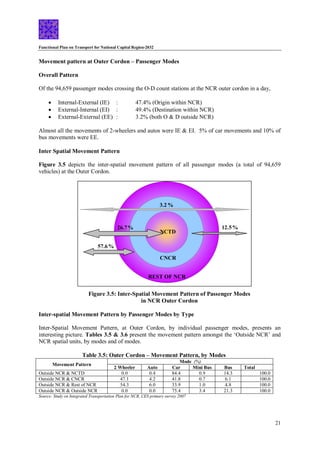
and ICDs in Northern India.
For domestic business, given that consumption centres are vast distances away from production
points, there will always be a big demand for transport. The setting up of high capacity consumer
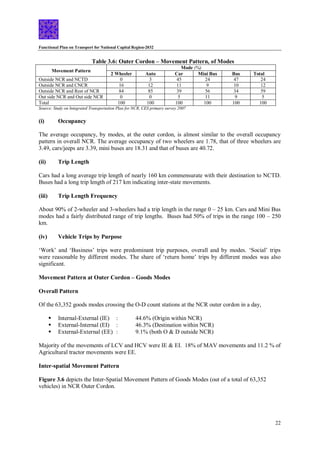
goods industries also indicates that the growth of non-bulk traffic is expected to be faster then that of
bulk traffic, with the shares of both becoming decidedly better than the current 35-65 ratio.
Significantly most of this non-bulk traffic is containerisable, and represents a huge market potential
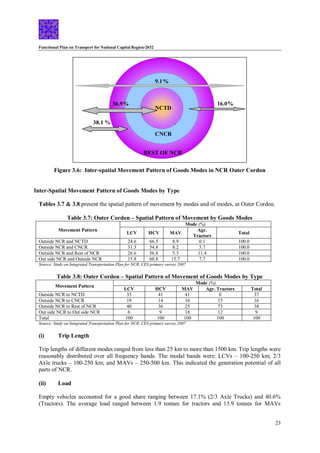
for container companies in the domestic sector.
The biggest ICD (Internal Container Depot) of CONCOR, catering to the export and import traffic of
the country in containers, is located at Tughlakabad. CONCOR also has a facility to cater to the
Domestic Container Traffic. In fact, container traffic has expanded at an explosive rate. In advanced
countries, nearly 75% of the export/import cargo is containerized. In India, we are far below that
level. Therefore, the projected growth in exports/imports coupled with the growing popularity of
containers promise that the container traffic can continue to grow in geometric proportions. The ICD
at Tughlakabad was initially designed for handling about 8000 TEUs per month, both inward and
outward, with stacking capacity of 8,500 TEUs. To meet the growing needs of traffic, CONCOR has
set up another ICD at Dadri in Greater Noida.
CONCOR’s Rail served ICDs in NCR are, Ballabhgarh (without CFS), Dadri (Greater Noida),
Rewari, Sonipat (without CFS), Tughlakabad (Delhi).
Functional Plan on Transport for National Capital Region-2032
46
4.9.5 Entry of Private Container Companies
With larger participation of private sector in railways business, and infrastructure getting opened for
their partnership, 15 container handling companies have been given licenses to operate international
and domestic containers on Indian Railways. Most of them have applied for opening ICDs in NCR,
putting infrastructure under newly created pressure. Preferred locations are Patli, Garhi Harsaru,
Bijwasan (on Rewari-Delhi cantt. section), around Sonipat, Panipat (Panipat-Subzimandi section) and
on Palwal - Tughlakabad section. Puncturing of vital routes will need to be tackled efficiently. This
operation is likely to have its impact on regional commuter traffic and creation of infrastructure for it.
With 20% to 25% annual growth in international container, and most of it being centralized around
the national capital, along with emerging demands of logistic parks and railside warehouses,
operational pressure in NCR is got to mount up.
4.10 Dedicated Freight Corridor
Economic liberalization policies of 1991 followed by information technology explosion have taken
India to a new growth scenario. Indian Economy is poised to grow even further at an average of 8 to
10% in the next few years. Transport requirement in the country, being primarily a derived demand, is
slated to increase with elasticity of 1.25 with GDP growth by 10 to 12% in the medium and long term
range. Riding on the waves of economic success, Indian Railways has witnessed a dramatic turn
around and unprecedented financial turnover in the last few years. The railway freight traffic has
grown by 8 to 11%, which is projected to cross 1100 million tonnes by the end of XIth
Five Year Plan.
4.10.1 Need for Dedicated Freight Corridor Project
The Indian Railways’ quadrilateral linking the four metropolitan cities of Delhi, Mumbai, Chennai
and Howrah, commonly known as the Golden Quadrilateral; and its two diagonals (Delhi-Chennai
and Mumbai-Howrah), adding up to a total route length of 10,122 km carries more than 55% of
revenue earning freight traffic of IR. The existing trunk routes of Howrah-Delhi on the Eastern
Corridor and Mumbai-Delhi on the Western Corridor are highly saturated, line capacity utilization
varying between 115% & 150%. The surging power needs requiring heavy coal movement, booming
infrastructure construction and growing international trade has led to the conception of the Dedicated
Freight Corridors along the Eastern and Western Routes. The DFC alignment is shown in Figure 4.1.
Figure 4.1: Dedicated Freight Corridor
Functional Plan on Transport for National Capital Region-2032
47
4.10.2 The Eastern Corridor
The Eastern Corridor encompasses a double line electrified traction corridor from Sonnagar on the
East Central Railway to Khurja on the North Central Railway (820 Km), Khurja to Dadri on NCR
Double Line electrified corridor (46 Km) and Single electrified line from Khurja to Ludhiana (412
Km) on Northern Railway. The total length works out to 1279 Km. The alignment has to take a detour
of Hathras, Aligarh, Hapur and Meerut in NCR. Since the origin and destinations of traffic do not
necessarily fall on the DFC, a number of junction arrangements have been planned to transfer traffic
from the existing Indian Railway corridor to the DFC and vice versa. The junctions on the Eastern
Corridor in NCR are planned near Tundla, Daudkhan & Khurja etc.
The traffic on the Eastern Corridor mainly comprises of coal for the power plants in the northern
region of U.P., Delhi, Haryana, Punjab and parts of Rajasthan from the Eastern coal fields, finished
steel, food grains, cement, fertilizers, lime stone from Rajasthan to steel plants in the east and general
goods. The total traffic in Up direction is projected to go up from 38 million tonnes in 2005-06 to 116
million tonnes in 2021-22. Similarly, in the Down direction, the traffic level has been projected to
increase from 14 million tonnes in 2005-06 to 27 million tonnes in 2021-22. As a result, the
incremental traffic works out to a whopping 82 million tonnes from the base year of 2005-06. The
number of trains with 25 tonne axle load works out to a maximum of about 80 trains each way in
Sonnagar-Mughalsarai section of the Eastern Corridor.
4.10.3 The Western Corridor
Western Corridor comprising of 1483 km of a double line diesel track from JNPT to Dadri via
Vadodara-Ahmedabad-Palanpur-Phulera-Rewari. In addition a single line connection of 32km long
from proposed Pirthala Junction Station (near Asaoti on Delhi-Mathura line) to Tughlakabad is also
proposed to be provided. Alignment has been generally kept parallel to existing lines except provision
of detour at Rewari. However, it is entirely on a new alignment from Rewari to Dadri. This new line
portion of DFC is designed to cross-existing New Delhi - Mathura line near Asaoti railway station.
For providing connection to Tughlakabad ICD, a single line parallel to the existing Delhi-Mathura
line is proposed to be taken from Pirthala junction station (near Asaoti) to Tughlakabad. Moreover,
the Western DFC is proposed to join Eastern corridor at DADRI. Junction Stations between the
existing railway system and the Western DFC have been provided at Rewari and Pirthala Road.
The traffic on the Western Corridor mainly comprises of ISO containers from JNPT and Mumbai Port
in Maharashtra and ports of Pipavav, Mundra and Kandla in Gujarat destined for ICDs located in
northern India, especially at Tughlakabad, Dadri and Dandharikalan (Ludhiana). Besides Containers,
other commodities moving on the Western DFC are POL, Fertilizers, Food grains, Salt, Coal, Iron &
Steel and Cement. Further, owing to its faster growth as compared to other commodities, the share of
container traffic is expected to progressively increase and reach a level of about 80% by 2021-22. The
rail share of container traffic on this corridor is slated to increase from 0.69 million TEUs in 2005-06
to 6.2 million TEUs in 2021-22. The other commodities are projected to increase from 23 million
tonnes in 2005-06 to 40 million tonnes in 2021-22. As a result, the maximum number of trains in the
section is projected as 109 trains each way in Ajmer-Palanpur section.
It is also proposed to set up Logistics Parks at Mumbai area, particularly in the vicinity of Kalyan-
Ulhasnagar or Vashi-Belapur in Navi Mumbai, Vapi in southern Gujarat, Ahmedabad area in Gujarat,
Gandhidham in the Kutch region of Gujarat, Jaipur area in Rajasthan, NCR of Delhi. These locations
have been selected on the basis that these have a good concentration of diverse industries and
constitute major production/consumption centres. These are also well connected by rail and road
systems for convenient movement in different directions. These parks are proposed to be developed
on Public Private Partnership mode by creating a sub-SPV for the same. DFCCIL proposes to provide
Functional Plan on Transport for National Capital Region-2032
48
rail connectivity to such parks and private players would be asked to develop and provide state of the
art infrastructure as a common user facility.
DFC is likely to have serious impact on NCR’s Railway network. Initial surveys having been
completed, construction is likely to commence soon on these ambitious projects. DFC will not only
impact rail freight operations, but will have its more than rippling effect on existing routes, as major
share of freight traffic gets shifted to new alignments. Residual routes are expected to be available for
better passenger operation. Full implications can be worked out after total business and operational
plans are prepared by DFC and Indian Railways.
4.10.4 Shifting of Goods Sheds from NCTD
There is a fairly large numbers of freight booking points to service Delhi Area. Delhi Area covers a
large tract of territory serving a big population. The area is not only thickly populated but also
comprises a large number of big and small industries. It is, therefore, not inappropriate to have
multiple freight booking points.
However, Delhi Kishanganj, Patel Nagar, Shakurbasti and Subzimandi goods sheds are located in the
heart of the city. So are the most important coaching terminals like Delhi Main, New Delhi and
Nizamuddin. But while the existence of passenger terminals near the city centre is a matter of great
convenience to the population, the freight terminals should as far as possible be on the periphery of
the city. It is from this angle that the possibility of closure of some the goods sheds needs
consideration.
These stations deal primarily with block rakes, the inward traffic comprising paper, iron and salt while
outward traffic consists of Wheat and pulses. If Delhi Kishanganj and Subzimandi goods sheds are
closed, the inward block rakes can rationally get shifted to Nangloi and other stations. Some of the
rake load traffic may also get shifted to Tughlakabad or Ghaziabad as per convenience of the trade.
4.11 Orbital Rail corridor network in NCR
The train movements in Delhi area are merged from 8 radials. Passenger and freight traffic on all the
radials are on increasing trend. The growth of passenger and freight has already affected the day to
day train operations and especially the average speed of all trains. The average speed has rapidly
declined due to the frequent addition of new trains. The average speed of goods trains in Delhi area
has reduced to 8 kmph and the average speed of passenger trains has also been reduced to less than 10
kmph.
The mixed running of goods trains, slow passenger trains, short distance commuter trains and long
distance mail express trains and high speed Rajdhani and Shatabdi express trains also contribute to the
deterioration in the speed of trains in Delhi area and its radial routes. As on date, over
500Mail/Express and passenger trains are being dealt with on the existing 4 coaching terminals in
Delhi area. In addition, about 250 goods trains are being dealt in Delhi area daily.
The handling period of freight traffic in Delhi area is also squeezing day to day due to heavy
imposition of civil restrictions on trucks movements. In some of the area the day time movement of
heavy trucks has been restricted completely. Due to this reason the freight traffic at the terminals is
suffering heavy detention in Delhi area.
A stage has reached where further augmentation of line capacity and throughput is not possible due to
basic infrastructural constraints at the existing terminals. In the recent past, a lot of development took
place to augment the through put and line capacity enhancement works in and around Delhi on
Functional Plan on Transport for National Capital Region-2032
49
Northern Railway net work, in addition to introduction of DMRC network. But all these
developments have not been able to meet the requisite passenger and freight demands. During the last
five year plan period it was envisaged that capacity/infrastructure should be developed ahead of the
expected demand. But despite heavy capital investment, there has not been significant increase in the
speed of trains in Delhi area.
Regional Plan-2021 has proposed an Orbital Rail Corridor along the Western and Eastern Peripheral
expressways. This was intended to divert through goods trains to avoid Delhi Area.
Functional Plan on Transport for National Capital Region-2032
50
5
Air Transport and its Growth in NCR
Indira Gandhi International Airport (IGI Airport), Delhi, is the second busiest airport in India. It
handled around 20.44 Million Passengers and 385,000 Tons of Cargo (2006- 07). Currently it has two
operational runways. There are three separate terminal areas, domestic passenger, international
passenger and cargo. The total area at IGI Airport is about 5060 acres of which about 1,907 acres is
currently in use. The Airport connects 60 destinations all over the globe through 51 international
airlines.
It needs to be highlighted that for the first half of calendar year 2006 (January’ 06 to June’ 06), World
Air Traffic growth recorded 6.4% and 2.0% in the international and domestic traffic respectively.
Indian Air Traffic grew at the rate of 12.15% and 31.58% in international and domestic traffic. As
compared to the world average, Indian air transportation market is growing 2 times higher in
international and 16 times higher in the domestic sector.
IGI Airport handled 3.12 million (18.23% growth compared to first half 2005) and 6.26 million
(40.19% growth compared to first half 2005) passengers in international and domestic traffic. It
handled 16.1 million passengers in 2005-06 and 20.44 million passengers in 2006-07, registering a
26.9 % growth rate in passenger traffic. It accounts for 30% of international and 23% of domestic
freight in the country
With more and more foreign airlines coming to the capital city, Delhi will become the country’s
busiest airport for international flights as well. In 2006-07, international passenger growth for Delhi
(6.44 million) was 15% as compared to 9.2% for Mumbai (7.35 million).
It is expected that by 2010, IGI Airport-New Delhi will overtake Mumbai Airport as India’s busiest
Airport. The gap between passengers using the two airports is closing, with more aircraft landing and
leaving Delhi than Mumbai for both domestic and international travel.
Projected Air traffic
Based on the growth rates observed at the Delhi airport and the projections made by Delhi
International Airport Ltd. (DIAL) the Consultant has suggested in the Study Report that the passenger
traffic (international and domestic) is expected to touch 50 million mark by 2015-16. Further, it is
expected to handle 82.7 million passengers by 2026 and will touch 100 million mark by 2036. Besides
this, it is expected to handle large quantity of cargo, which will be induced due to commissioning of
Delhi Mumbai Industrial Corridor. The international traffic at Delhi airport is about 45-50% of the
domestic traffic.
5.1 Traffic Characteristics
Delhi airport attracts a total of 80,000 person trips, including passengers, both domestic and
international and employees; and approximately 94,000 vehicles enter and leave the airport daily.
Table 5.1 shows the distribution of count of trips observed at the Airport. Table 5.2 shows the traffic
generated and attracted from Delhi Airport.
Functional Plan on Transport for National Capital Region-2032
51
Table 5.1: Person Trips Observed at Delhi Airport
Domestic International
Terminal 1A Terminal 1B Terminal 2 Terminal 2
Total
Departure Arrival Departure Arrival Departure
Passengers 6528 18297 16342 11802 10134 63103
Employees 3051 1972 4132 3554 4154 16863
Total 9579 20269 20474 15356 14288 79966
Source: Study on Integrated Transportation Plan for NCR, Primary survey Conducted for Airport Metro Link, DIAL
Table 5.2: Classified Traffic Count Observed at Delhi Airport
Domestic International
Terminal 1A Terminal 1B Terminal 2
Total
Total Vehicles 20278 48785 24945 94008
Source: Study on Integrated Transportation Plan for NCR, Primary survey Conducted for Airport Metro Link, DIAL
This high intensity affects the traffic scenario in the hinterland of Airport.
5.2 O&D Pattern
The OD pattern of air passengers indicate that 75.75% were from within NCTD itself 18.75% of
passenger generated from rest of NCR and 5.5% from area beyond NCR. Table 5.3 presents the
combined OD pattern.
Table 5.3: Delhi Airport – Passenger Distribution by Spatial Units
Passenger Distribution
REGION Passengers per day %
NCTD 48040 75.75
NCR 11891 18.75
BEYOND NCR 3488 5.50
TOTAL 63419 100.00
Source: Study on Integrated Transportation Plan for NCR, Primary survey Conducted for Airport Metro Link, DIAL
Functional Plan on Transport for National Capital Region-2032
52
6
Bus System in NCR
A fast, convenient and universally affordable mobility solution in the NCR with seamless transfers
acts as a catalyst for achieving its plan objectives of a balanced and harmonious development of the
Region and dispersal of economic activities. Development of an Integrated Multi-Modal Public
Transport System (IMMPTS) is one of the pre-requisites to facilitate accelerated achievement of the
plan objectives. An adequate, efficient, affordable and well coordinated Bus based Public transport
system with easy access and seamless transfer amongst all modes, would go a long way in effectively
meeting the mobility needs of the NCR.
6.1 Existing Public Transport System in NCR and its Sub-Regions
6.1.1 Rail Services
Eight Railway lines connecting Delhi and the NCR are collectively served by about 180 trains (85
mail/express, 34 passenger and 61 EMUs) between Delhi and the NCR Towns. A few railway lines
exist within NCR serving the NCR towns. However, poor accessibility to stations, inadequacy of
interchange facilities amongst different modes, lack of bus bays and parking facilities for public and
private vehicles, long waiting periods, longer travel time, overcrowding in local trains, etc., are some
of the problems faced by the commuters.
6.1.2 Existing Bus Services-characteristics, performance and issues
6.1.2.1 Bus services
i) Amongst the NCR towns, Delhi is served mainly (over 60% of total motorised passenger trips) by
buses as the same is accessible, flexible, convenient and cost effective. The bus system in Delhi
comprises of public (DTC) and privately owned vehicles. Some of these buses, although cost
effective, are heavily crowded during peak hours and their average operating speeds are low (12-
15 kilometers per hour) causing journey delays. Some others like contract carriage buses are
comparatively comfortable and faster (18-20 kmph) but charge higher fares. DTC, which is
responsible for providing efficient public transport services at affordable prices, operated 3467
buses (FY06)-- out of which 529 vehicles operated within NCR, 360 operated to other nearby
states through NCR and 2578 buses operated within NCTD.
ii) Intercity buses between Delhi and NCR/other states and within NCR are also operated by the
Uttar Pradesh SRTC (UPSRTC), Haryana Roadways (HR), PEPSU Road Transport
Corporation(PRTC), Punjab Roadways(PR), Himachal RTC(HRTC), J&K RTC (JKRTC),
Rajasthan State RTC (RSRTC), etc, besides some buses operated by private persons.
iii) Haryana Roadways provides bus services in the NCR and other areas mainly from 14 depots,
UPSRTC from 12 depots, DTC from 28 depots (27 located in NCTD and 1 in NOIDA) and
RSRTC from 3 depots located in the NCR besides those located else where in these states. Other
State Road Transport Corporations (SRTCs) operate services to/from/via Delhi/other towns of the
NCR from/to a number of locations in their respective states on reciprocal basis. Details are given
in Annexure 6.1.
iv) Except NCTD, the intra-urban PT Services in most of the urban metros, regional centers and other
towns of the NCR are mainly provided by mini buses, auto rickshaws and the Non Motorised
Transport Services (NMTS). The quality of these services however appear to be far from being
satisfactory.
Functional Plan on Transport for National Capital Region-2032
53
v) Bus depot/terminal locations in the NCR are focused more for state level operations than for
addressing NCR concerns of providing adequate transport facilities and seamless transfers to
commuters
vi) The bus services provided by various states, though cater to a sizeable lot of passenger trips, lack
unified planning, time table, fare structures, tax structures, etc. Services provided are not NCR
focused. Their route structuring and service level provisioning is more on the basis of the
individual operator (SRTC’s) assessments / convenience rather than a scientific demand
assessment and demand directed route structuring.
vii) Consequently, poor accessibility to public transport, indifferent quality of services, over-crowding
in buses, long wait and travel period, fare/tax disparities amongst various operators, etc are causes
of concern in providing effective, efficient and affordable PTS as can also be seen from the
commuter survey data (CES 2007) of over 5100 persons inter alia high-lighting passenger travel
characteristics/pattern/ service quality etc. (Table 6.1.)
Table 6.1: Commuter perceived problems of inter-city travel - percentage of commuters
S.
No.
Quality parameter
NCTD sub
region
Haryana
sub region
UP sub
region
Rajasthan
sub region
NCR
1 Inadequacy of buses 40.7 53.4 44.3 52.1 45.6
2 Unreliable services 35.9 48.0 34.4 47.9 39.5
3 Irregular frequency 24.3 14.0 22.0 28.1 20.8
4 poor route coverage 3.4 2.2 3.0 9.6 3.1
5 Excessive transfers between
routes
5.5 9.1 6.7 4.1 6.8
6 High fares 21.5 26.3 32.1 34.2 25.5
7 Poor quality of vehicles 12.4 6.3 7.7 9.6 9.5
8 Poor safety performance 11.0 15.3 8.4 33.6 12.4
9 Crew misbehavior 12.1 6.5 7.7 4.8 9.3
10 Unhealthy competition between
operators
7.5 6.5 6.1 12.3 7.0
11 others 23.1 19.0 19.3 9.6 20.7
Source: Study on Integrated Transportation Plan for NCR, CES primary survey 2007
Inadequacy of buses, poor reliability and irregularity of services besides high fares are the main
problems faced by the commuters in all the sub regions of the NCR. In Rajasthan sub region
commuters also perceive poor operational safety.
viii) Keeping in view the above concerns about BPTS and the overall NCR Plan aim of promoting
and supporting harmonious development of NCR, the Bus based Public Transport Plan for
providing accessibility to all the parts of the region and servicing a larger quantum of travel
demand is proposed.
6.1.2.2 Operational Characteristics and Performance of the Bus Based Public Transport
System (BPTS) services
i. Operational Characteristics and the Performance of the existing BPTS
a. Operational characteristics and the performance of the existing BPTS system were analysed w.r.t.
Growth of vehicles/buses in the NCR, physical and financial performance of the bus fleet,
demand serviced, passenger trips, average trip length, quality of service, institutional set up, tariff
structure, taxes and their structure, bus depots and bus terminals, their location, size, capacity,
facilities, fleet size, bus technology, bus capacity and other relevant information by the Consultant
and an appreciation of bus based public transport system characteristics was made addressing
major factors such as system and operational characteristics, their role and performance.
Functional Plan on Transport for National Capital Region-2032
54
Passenger Trips serviced and Bus supply by the STUs from out of depots located in the NCR is
given in Table 6.2.
Table 6.2: Passenger trips serviced and Bus supply by the STUs from depots in NCR (Aug-Oct 07)
Sub Region
No. of STU
depots in
NCR
No. of buses
in NCR
depots
Avg. no. of
passengers carried
daily/Bus on road
Avg. no. of passengers carried per
day
A B C D E=C*FU*D
NCTD 28* 351 931 297371
Haryana 14+ 1285 353 412781
Uttar Pradesh 12+ 1219 230 269155
Rajasthan 3+ 289 243 67418
Overall NCR 57 3144 360 1046724
Source: Study on Integrated Transportation Plan for NCR
Notes:
1) * These depots, though mainly serve the intra urban demand in NCTD, operate 351 buses in NCR. Additional 385 buses from 5 depots
of DTC operate inter city bus services from NCTD to areas beyond the NCR.
2) + The depots located in NCR sub regions of the States provide bus services within /out side NCR
3) Over and above these 3144 buses, another 2208 buses are operated across the NCR by 11STUs (including the above three) as per data
obtained from 3 ISBTs at Delhi. As nearly 18% bus trips are performed from locations outside NCTD, the above fleet of 2208 is increased
proportionately to 260 buses. Further UP operates 285 private buses to/from NCTD, Data of privately operated buses from other
constituent states not included due to non-availability of the same.
4) Above buses (6034) collectively service nearly 21.71 lakh passenger trips daily on an average (taking 360 passengers per bus per day-
the over all average of the STU buses in the sub region-- for 2890 buses and adding it to passengers carried by 3144 STU buses).
5) FU= Fleet Utilization
b. Densities of all vehicles and that of the buses per lakh population in the sub-regions of NCR and
that at the national level, are given in the Table 6.3.
Table 6.3: Buses per lakh population in NCR sub regions 2007
Population In Lakhs No. of buses registered
as stage carriage
State
State NCR
Total no. of
buses
registered in
NCR
STUs Total
No of buses per
lakh population
in NCR
Total no. of
vehicles lakhs
in NCR
No of vehicles
per lakh
population
NCTD 163.5 163.5 43639 3449 **9000 267 51.4 31437
Haryana 237.4 108.5 6964 1285 4030 64 15.4 14194
UP 1867.6 136.7 6234 1204 2421 46 9.3 6818
Rajasthan 634.1 34.8 1509 278 1509 43 2.5 7069
Total 2902.6 443.5 58346 6216 16960 132 78.6 17718
India 11285.2 @@0.11 @0.29
India 2004 10791.2 768000 71 727.2 6739
Source: Study on Integrated Transportation Plan for NCR
** estimated
@ Stage carriage buses in NCR as % of total buses in NCR
@@ Stage carriage STU buses in NCR as % of total buses in NCR.
Against an average of 71 buses per lakh persons country-wide, the NCR Sub regions of Uttar
Pradesh and Rajasthan have much lower densities at 46 and 43 buses respectively, the Haryana
sub region has 64. The other sub region of Delhi has significantly higher bus density of 267
compared to the national average but mainly serves the intra urban travel demand. On the other
hand population density of all type of vehicles in the NCR sub regions is comparable/much higher
than the national average. Out of a total of 58346 buses registered in the NCR, 6216 (29%) are
stage carriage buses. Only 11% of all the registered buses and 37% of the stage carriage buses are
owned by the STUs and the remaining 89% and 63% respectively owned privately.
Against an average annual growth of over 8% in bus population at national level, the growth of
bus fleets in NCR states have remained far behind at less than 4% -reflecting a dismal growth rate
for the Bus based public transport system in the constituent states as illustrated further by the
growth scenario of one of the constituent states (UP) of the NCR. In the state of UP, while total
Functional Plan on Transport for National Capital Region-2032
55
vehicular population has increased from about 22 lakhs (FY92) to 91 lakhs (FY07)-more than 4
fold increase during the last 15 years, the population of buses has remained static at about 25000
(25170 in FY92 and 25423 in FY07). The dismal growth of bus fleets appears to have led to a
very high growth of private vehicles (nearly 11% annual average growth of all motorized vehicles
in the NCR) at the cost of bus based public transport system. An accelerated growth of buses is
immediately required for obtaining a sustainable bus based transport system.
c. Modal split of passenger trips between public transport modes of rail and road, during the period
FY 1951 to FY 2005, and share of buses to total vehicles is given in Table 6.4.
Table 6.4: Country-wide share of passenger load and share of Buses to Total vehicles
Share of travel load
-Billion passenger kms (modal split) $
Share of buses (%) in
vehicular population
year
Rail Road All India
1950-51 66.5(84.5) 23.0(15.4) 11.1
1960-61 77.7(49.0) 80.9(51.0) 8.6
1970-71 118.1(36.0) 210.0(64.0) 5.0
1980-81 208.6(27.8) 541.8(72.2) 3.0
1990-91 295.6(27.8) 767.7(72.2) 1.5
2000-01 457.0(18.0) 2075.5(82.0) 1.2
2004-05 515.7(12.9) 3469.0(87.1) 1.1
Source: Study on Integrated Transportation Plan for NCR, Planning Commission - Working Group Report – Transport - 11th
Five
Year Plan
During the period 1950 to 2005 while the share of travel load between Road and Rail has
significantly increased in favour of buses i.e. from 15%(1950) to 87%(2005), the share of buses to
total number of vehicles has decreased from 11.1% to 1.1%-the buses still serving more than 50%
of the passenger Journeys. In the NCR sub region, the bus fleets constitute significantly less
proportion (0.74%) of total vehicular population compared to the national average (1.1%)
indicating poor growth of the Public Transport System (Table 6.5).
Table 6.5: Buses to total vehicles ratio in NCR 2007
State No. of buses Total no of vehicles in lakhs Buses as % of vehicles
NCTD 43639 51.4 0.85
Haryana 6964 15.4 0.45
UP 6234 9.3 0.67
Rajasthan 1509 2.5 0.61
Total NCR 58346 78.6 0.74
All India 2004 768000 727.2 1.06
Source: Study on Integrated Transportation Plan for NCR
d. The movement wise share of buses as percentage of all vehicles observed during surveys (CES
2007) is given in the Table 6.6 along with vehicle category wise breakup of the trips.
Table 6.6: Mode-Wise/Sub-Region wise Break- Up of Vehicle Trips
Source: Study on Integrated Transportation Plan for NCR, CES primary survey 2007
S.No. Movement Pattern 2 Wheeler
Auto
Rickshaw
Car
Mini
Bus
Std. Bus Total
1 NCTD-CNCR 8.33 0 10.73 0.13 1.16 20.35
2 NCTD-NCR rest 10.69 0 24.30 0.22 3.07 38.27
3 NCTD-NCR out side 5.18 0.01 14.49 0.13 1.32 21.23
4 CNCR-CNCR 2.14 0 0.62 0.05 0.10 2.91
5 CNCR-NCR rest 2.81 0 2.72 0.16 0.21 5.90
6 CNCR-NCR out side 0.82 0.07 1.75 0.06 0.18 2.88
7 NCR rest-NCR rest 0 0 0.34 0.01 0.09 0.44
8 NCR rest-NCR out side 4.28 0.44 2.93 0.08 0.44 8.12
9 Overall NCR 34.24 0.52 57.88 0.84 6.51 100
Functional Plan on Transport for National Capital Region-2032
56
Out of 100 passenger vehicle trips, only 7.35 trips are of buses. 86% of buses and 54% of mini
buses operate from/to/via NCTD. Over 92% of all passenger vehicle trips are made by private
vehicles--cars (58%) and two wheelers (34%).
e. Distribution of bus passenger trips amongst concerned states and amongst various movement
patterns, in the base year (2007), is given in Table 6.7.
Table 6.7: Combined Bus Passenger Trip Matrix - Base Year 2007
Distribution of Bus passenger Trips originating from A(AB) and
Those originating from B (BA) –region wise movement pattern wise
NCTD Haryana UP Rajasthan Punjab &
Chandigarh
Himachal J & K Uttarakhand Others Total
NCTD-CNCR AB 471364 471364
NCTD-CNCR BA 354692 122810 477502
NCTD-CNCR AB+BA 471364 354692 122810 948866
NCTD-NCR rest AB 397155 397155
NCTD-NCR rest BA 194202 172747 52875 419824
NCTD-NCR rest
AB+BA
397155 194202 172747 52875 817045
NCTD-NCR os AB 1042295 1042295
NCTD-NCR os BA 326177 211313 320690 22752 7897 5631 37596 30063 962119
NCTD-NCR os AB+BA 1042295 339768 220118 334052 23700 8226 5866 39162 31315 2004414
CNCR-CNCR 10566 24276 34841
CNCR-NCR rstAB 42320 36286 78606
CNCR-NCR rst BA 51669 49900 5429 106998
CNCR-NCR rst AB+BA 93989 86186 5429 185603
CNCR-NCR os AB 149806 10176 159982
CNCR-NCR os BA 85311 33475 6838 27983 0 89 2831 3495 160022
CNCR-NCR os AB+BA 235117 43651 6838 27983 0 89 2831 3495 320004
NCR rst-NCR rst 55652 67648 14946 138246
NCRrst-NCRos AB 122199 28266 137703 288168
NCRrst-NCRos BA 65234 93000 18705 1106 0 183 11006 12761 201995
NCRrst-NCRos AB+BA 187434 121266 156408 1106 0 183 11006 12761 490164
NCR os-NCR os 7399 23864 13368 3216 81 658 4006 8043 60635
NCRos-
os+NCRrstos+osrst
194833 145130 169776 4322 81 841 15012 20804 550799
TOTAL 1910814
Source: Study on Integrated Transportation Plan for NCR, CES primary survey 2007
For the NCR population of 443.5 lakhs, nearly 50 lakh bus passenger trips are performed daily.
This amounts to an overall average PCTR of 0.1127 for intra region and inter-state bus passenger
trips(excluding intra urban trips). For intra region (excluding intra urban) bus passenger travel, an
average PCTR of 0.0479 and weighted average passenger trip length of 51 kms is estimated. On
the basis of the above PCTR (0.0479), the average passenger trip length of 51 kms., and the bus
capacity of 11597 seat kms per day (52 seats per bus, 349 kms of daily operation per bus on road,
96.2% fleet utilization and average load factor of 0.69 as obtained in the NCR buses of constituent
states) the number of buses required for intra region travel (excluding intra urban) in NCR is
assessed as 9283 in the base year. As against the above requirement of 9283 buses, only 6034
buses are operated leaving a wide gap between supply and demand of buses for intra region travel.
f. Physical Performance
As most of the bus services in the NCR are provided by various State Road Transport
Corporations(SRTC), an analysis of their operational performance in respect of utilization of the
fleet and productivity of buses, reliability- in terms of breakdowns per million kilometers operated
(higher the break down rate lower is the reliability of operations), safety of operations- in terms of
accidents per ten million kilometers operated (higher the accident rate lower is the safety of
Functional Plan on Transport for National Capital Region-2032
57
operations), load factor has been attempted in Table 6.8 both at the state level and in their
respective sub regions of the NCR (Data for the NCR is for the year 2006-07 and that of the states
for the year 2005-06. At state level-- DTC data is taken for interstate services UPSRTC for STU
buses, at all India level for rural services only).
Table 6.8: Operational performance of STU buses of the sub Region FY 06
State Road
Transport
Corporation
Avg. fleet
utilization
Avg Load Factor
Productivity
kms/ on road day
per bus
Reliability
(No. of
breakdowns/milli
on kms)
Operational
safety (accidents
per ten million
kms)
Sub region State NCR* State NCR State NCR* State NCR* State NCR*
DTC 90.5 95.7 0.69 0.57 227 278 67 76 15 13
Haryana
Roadways
97.2 95.7 0.70 0.69 363 361 7 9 8 7
UPSRTC 96.3 97.0 0.59 0.69 327 351 8 5 14 NA
RSRTC 96.2 96.4 0.67 0.62 370 373 11 NA 10 NA
AllSTUs 91.9 96.3** 0.62 0.67** 334 349** 34 19
Source: Source: Study on Integrated Transportation Plan for NCR, CES primary survey 2007, Profile and performance of STUs -
FY 2005-06
Note:* NCR data for UP sub region is for UPSRT’s Meerut region depots only due to non availability of data for others. For
RSRTC, the NCR data is based upon June 2007 statistics as only the same was available.
**all STUs of the NCR sub region
Utilization of fleets and productivity of buses on road in the NCR are higher/comparable to that of
the respective STU as a whole. The reliability of operations (indicated by inverse of the break
down rate) is very low for DTC --much inferior to that obtained even at all India level. Similarly,
the operational safety (indicated by inverse of accident rate) of the STUs of the constituent states-
at state level and the NCR level, is better than that at the national level, Haryana Roadways
having safest operations.
g. Financial Performance
i. Capital structure of the existing State Transport Undertakings (STUs):
Out of 52 STUs operating in the country, 23 are incorporated under the RTC Act, 11 under the
Companies Act, 8 as Government Departments and 10 as Municipal Undertakings (Ref.
Annexure 6.2). Capital structure along with other liabilities of a few sample STUs under different
set ups is given in Table 6.9 to appreciate their comparative performance.
Table 6.9: Capital Structure/other liabilities-Sample STUs (FY 2005-06), Rs. in crores
Under RTC Act As Local Bodies As Govt. Deptt.
Under Company
Act
Rural Urban Urban Rural Rural (*)
S no. Description
UPSRTC RSRTC DTC BMTC BEST AMTS
ST
HARYANA
ST
PNJB
TN
STC(*)
KTC
GOA
1 Government loan
-central
-state
252
60
27
193
0
4198
0
93
1
1
0
406
9(8)
870(243)
0
29
2 Debentures
Loans from:
-banks
-LIC
212
0
163 26
0
21
0
119
0
341 (90)
0
32
0
3 Public deposits 11 17 5
4 Others 8 1 266 669 (0)
5 Reserves 1 5 395 37 625 108 205 2(0) 6
6 Current liabilities 762 288 140 32 122 179 1312
(276)
24
Functional Plan on Transport for National Capital Region-2032
58
Under RTC Act As Local Bodies As Govt. Deptt.
Under Company
Act
Rural Urban Urban Rural Rural (*)
S no. Description
UPSRTC RSRTC DTC BMTC BEST AMTS
ST
HARYANA
ST
PNJB
TN
STC(*)
KTC
GOA
7 Cumulative
Profit/Losses
-768 -376 -4008 261 -251 -461 -120 -2487
(-526)
-65
8 Total current
Liabilities
519 318 725 467 522 94 609 714(278) 26
Source: Study on Integrated Transportation Plan for NCR, CES primary survey 200, Profile and performance of STUs - FY 2005-06
Notes+ all figures rounded off to nearest whole number
* figures in parenthesis pertain to Metropolitan Transport Corporation of Chennai operating urban services and registered
under the Company’s act
ii. None of the STUs under any of the set ups have any equity. The STUs have mainly financed their
capital requirement through government loans, bank loans, etc. None of them, except BMTC
(under the RTC act), have any accumulated profits.
iii. Financial performance and Institutional set ups:
Financial performance of the STUs, under different set ups, in the recent past, is given in the
Table 6.10.
Table 6.10: Bus Operators – Financial Performance Vs Institutional Set-ups (FY 2005-06)
Rs./Bus km Profit/Loss (Rs cr.)
OPERATORS Cost Rev Pr/Ls Tax FY 05-06
ST Hr (Govt) 19.3 16.4 -2.9 4.5 -120
ST Pb (Govt) 32.1 19.9 -12.2 6.7 -107
UP(RTC) 12.6 12.8 0.2 3 14
RST(RTC) 15.2 14.8 -0.5 1.7 -28
TNSTC(Co) 17.4 15.9 -1.5 0.7 -36
KTC(coGoa) 21.1 17.4 -3.7 0.4 -12
AMTS(Mncpl)+ 39.1 29.1 -10 0.4 -29
BEST (Mncpl)+ 45.7 35.3 -10.4 1.7 -251
DTC (RTC) + 49.4 17.9 -31.4 1.3 -818
BMTC (RTC) + 18.8 19.6** 0.8 1.1 22
MTC (Co) + 26.5 22.4 -4.1 0.4 -85.5
CHNTU (GOVT)+ 18.8 17.2 -1.6 2.5 -8
ALL STUs 18.8 17 -1.8 1.5 -2311
Source: Study on Integrated Transportation Plan for NCR
*operate NCR services also
+Urban STUs under municipal corporations (AMTS, BEST), under RTC act(DTC, BMTC), under company’s act(MTC –CHN)
and as Government department (Chandigarh).
** excludes reimbursement of subsidy and other income of Rs.2.9 per km
During the financial year 2005-06, two STUs (UPSRTC and BMTC) under the RTC act
operated in profit. One STU each under the RTC act (RSRTC), Company’s act (TNSTC) and
one as a government department (Chandigarh) made less losses per bus kilometer compared
to that (Rs.1.8 per bus kilometer) at the national level-combined loss by all STUs.
h. Fares and taxes
i. Fares, taxes applicable as also the cost of bus travel in various parts of the sub region are
given in Table 6.11.
Functional Plan on Transport for National Capital Region-2032
59
Table 6.11: Fares, Taxes, cost of bus travel (FY 05-06)
Operator Fare per pax km paise Tax per pax km paise (as
% of fare)
Cost to pax
Paise per km
DTC (urban) 58+ <1(0) 58
ST Haryana 31 19(60%)* 50
UP SRTC 41 9(21%) 50
RSRTC 40 5(12%) 45
Source: Study on Integrated Transportation Plan for NCR, Profile and performance of STUs - FY 2005-06
*since reduced to 25% in 2007
+increased to 67 paise in 2007
ii. Whereas the basic fare per passenger kilometer for ordinary buses ranges from 31-58 paise,
the cost to the commuter varies between 45-58 paise and the tax varies from 0-60% of the
basic fare. The fare per passenger km is highest (58 paise) in NCTD and least (31 paise) in
NCR (Haryana). It is 41 and 40 paise per passenger km in the NCR (UP) and NCR
(Rajasthan) respectively. The above data indicates that the buses operating in NCR (Delhi)
should earn highest revenue per pax km operated there and least in NCR (Haryana).
Congestion on Delhi roads however, adversely affects vehicle productivity and thus the
operational revenues, costs and the profitability. While such factors do not encourage
operations in the NCTD, low basic fare coupled with high incidence of tax (Haryana sub
region) does not motivate the operators from other areas to enlarge their services in Haryana
area of NCR for financial reasons.
iii. Tax structure for buses in NCR
Tax structures applicable to the constituent STUs (FY06) are given in Table 6.12.
Table 6.12: Tax structure of constituent states of NCR FY 2005-06
Rs in lakhs per bus per year- STU Data
STU
MV tax & permit
fees
Passenger Tax Other taxes
Total taxes per bus
per year Rs in lakhs
DTC* 0.21 0.68* 0.32 1.21
ST HARYANA 0.28 4.30 1.25 5.84
UPSRTC(own)+ 0.11 3.03 0.02 3.15
RSRTC* 0.09 1.74 0.29 2.12
Source: Study on Integrated Transportation Plan for NCR, Profile and performance of STUs - FY 2005-06
*as applicable for buses operating in NCR, passenger tax is nil in NCTD
Motor Vehicle tax and permit fees paid are Rs. 0.21, Rs. 0.11, Rs. 0.28 and Rs. 0.09 lakhs per
bus per annum for buses registered/seeking permits in NCTD, UP, Haryana and Rajasthan
respectively indicating that such fees are 2-3 times in the states of Delhi and Haryana
compared to that in other constituent states of the NCR.
Passenger tax and other related taxes per bus per year are Rs1.00 (passenger tax within NCTD
is nil), Rs.3.05 lakhs, Rs.5.55 lakhs, and Rs 2.03 lakhs for bus operations in NCTD, UP,
Haryana and Rajasthan respectively. Highest level of passenger related taxes levied in NCR
(Haryana) coupled with low fares does not encourage other STUs to expand their services in
this vast area of NCR. Skewed fares and taxes in various constituent states of the NCR does
not appear conducive to free growth of bus based Public transport system the NCR.
i. Financial performance of STU owned buses vs Hired buses:
i. Financial performance of the buses owned by the STUs and those hired by them is given in
the Table 6.13
Functional Plan on Transport for National Capital Region-2032
60
Table 6.13: Bus Operators: Financial Performance - FY 2006
Profit/Loss
Operators Cost Rev Pr/Ls Rs Lakh/ Bus/ Year
BMTC (own) 18.79 19.40* 0.81* 0.64*
BMTC (PO) 17.33 20.39 3.06 2.45
UPRTC(own) 12.86 13.02 +0.15 0.31
UPRTC (PO) 10.84 11.28 +0.45 0.46
PRTC (own) 19.61 17.83 -1.78 -2.01
PRTC (PO) 14.85 16.38 1.53 2.22
Source: Study on Integrated Transportation Plan for NCR, Profile and performance of STUs - FY 2005-06
Note: * Excludes Rs 2.91 per bus km as non traffic revenue (Rs.1.30) & reimbursement of subsidies (Rs.1.61)
ii. In order to assess the factors contributing to higher profit by hired buses operating under the
STUs, head wise break-up of the total cost per bus kilometer has been analysed and is detailed in
the Table 6.14.
Table 6.14: Break-up of Operational Cost of STU Buses/Hired Buses (element-wise)
Cost per bus km (Rs.)
Bus
owner-ship Staff Materials Taxes Interest Misc
Depri-
ciation*
Total
Bus
staff
ratio
Load
Factor
Bus Productivity
km per day
(pax kms per bus
per day)
BMTC 7.16 8.17 1.1 0.09 0.67 1.61 18.79 5.51 0.60 218 (8764)
PO 2.07 0 1.02 0 0 14.24 17.33 1.7 0.62 220 (9139)
UPRTC 4.54 6.37 0.11 0.24 0.34 1.67 12.86 6.13 0.58 320 (10022)
PO 2.06 0 0 0 0.49 8.3 10.84 2.78 0.67 286 (8048)
PRTC 7.03 7.31 3.78 0.69 0.38 0.42 19.61 5.52 NA 309 (9641)#
PO 1.09 0.004 3.47 0 0.04 10.24 14.85 1.52 NA 397 (12386)#
Source: Study on Integrated Transportation Plan for NCR, Profile and performance of STUs - FY 2005-06
Notes:
• for PO buses-- hire charges per bus km are indicated in the depreciation column
A
• PO- private operator’s bus hired by the STU
• # worked out by assuming a load factor of 0.60 for both in absence of N
iii. The hired buses make higher profit per bus kilometer compared to that of STU owned buses. Cost
per km. of hired buses is 7.8 to 24.3% less than that of STU owned buses– mainly due to higher
capacity utilization and lower bus staff ratios (also the PO engages staff at much lower wage rate
than that by the STUs) and consequently lower staff costs inter alia indicating that a public
transport system would work more profitably by reducing the bus staff ratio through out sourcing
most of the activities.
j. Financial performance of STU buses of the constituent states at State level and at NCR level is
hown in Table 6.15.
s
Table 6.15: Operational Costs, Revenues & Profitability of Buses at State and NCR level
Operational Cost
per Bus Km Rs.
Operational Revenue
per Bus Km Rs.
Profit or loss (-)
per bus km Rs.
Profit/Loss (-) per bus
per year Rs. in lakhs
STU
State NCR State NCR State NCR State NCR
DTC 49.39 39.04 17.94 16.10 -31.44 -22.94 -31.90 -23.28
ST Haryana 19.31 16.22 16.41 13.68 -2.89 -2.54 -3.83 -3.35
UPSRTC+ 12.63 13.04 12.81 15.64 0.17 2.60 0.20 3.33
UPSRTC(PO)+ 10.84 13.35 11.28 13.5 0.44 0.15 0.46 0.19
RSRTC* 15.24 12.57 14.78 12.84 -0.46 0.27 -0.62 0.37
Source -06
: Study on Integrated Transportation Plan for NCR, Profile and performance of STUs - FY 2005
* RSRTC data for NCR pertains to the month of June O7 and other data is for FY 06
+ UPSRTC data for NCR is based upon the data available for MEERUT Region (320 own buses) and 116 hired
buses as data for other depots in the NCR area of UP was not available there from)
Functional Plan on Transport for National Capital Region-2032
61
During FY 2005-06, at the state level, all the STUs except UPSRTC incurred losses ranging from
Rs 0.62 to 31.90 lakhs per bus. At the NCR level however RSRTC and UPSRTC made profit, the
later doing so both on buses owned as also the buses hired by it. UPSRTC’s profits are
significantly higher in NCR operations compared to all other STUs as also its hired buses.
k. Performance of Private Operator (PO) buses in NCR
In absence of any recorded data about physical and financial performance of privately operated
buses in the NCR, a primary survey was organized at 17 bus terminals spread across the region.
Operational and other performance details of 66 bus agencies, owning and operating 191 buses in
the region, were collected from the available operational staff/bus owners through discussions, in
view of their unwillingness to provide written and signed details.
66 private operators comprise of 16 individual owner-operators, 10 companies and 40 cooperative
societies/operator unions. The average bus holding per operator is 2.89 say 3 buses, with 4
operators operating more than 10 buses each and 22 single bus each. The average purchase price
of a bus is assessed as Rs 14.80 lakhs and average age as 6.6 years. Most of the buses are
purchased using nearly 80% borrowed funds from Financial agencies and 20% own funds on an
average, the cost of borrowings varying from 10 to 16 % with a re-payment period of about 5-7
years. Sub region wise details are given in Table 6.16.
Table 6.16: Ownership/Financing Pattern of PO* Buses in NCR (excluding NCTD)
No. of
operators
Owner ship pattern of
private buses
Range(numbers) of buses
owned
Financing
Pattern of buses
Sub Region
Surveyed
Coop
/Union
Company Individual 1
2 to
5
6 to
10
>10
Avg. buses
per owner
own
funds %
Loan
%
Avg cost
of a bus
Rs in
lakhs
Haryana 37 29 4 4 13 21 0 3 3.08 20 80 15.81
UP 23 6 6 11 5 17 1 0 2.26 23 77 12
Rajasthan 6 5 0 1 4 0 1 1 4.17 NA NA NA
Overall NCR 66 40 10 16 22 38 2 4 2.89 20.63 79.37 14.80
Source: Study on Integrated Transportation Plan for NCR
* Private Operators
On an average, 3 persons (a driver, a conductor and a helper) are deployed per bus operating for
over 13 hours daily and 24-28 days in a month. The average wages per driver, conductor, and
helper are Rs, 4970, 3029, and 1672 per month respectively, the average staff cost per bus per
month being Rs 9639 ranging from Rs 8667 in Rajasthan sub-region to Rs 10646 in Haryana sub-
region of the NCR. Details are given in Table 6.17.
Table 6.17: Type, Capacity, Age, Fleet Utilization and Staffing of PO buses in NCR
52 seater std. bus
characteristics
Staff
Sub Region
No. of
buses std+
mini
No. of
buses
Avg. Age
yrs
Fleet
utilisation
Avg. staff
bus
Avg.
working
hrs/day
Avg. salary
per month
or driver
Avg. salary
per month
or conducto
Avg. salary
per month
or helper
Wages/ bus
month Rs
Haryana 114 96 4.5 0.88 3.0 13.7 5514 3421 1711 10646
Uttar
Pradesh
52 50 10.4 0.87 3.0 12.8 3940 2582 1651 8173
Rajasthan 25 24 7 0.83 3.0 11.9 4896 2396 1375 8667
Overall
NCR
191 170 6.6 0.87 3.0 13.2 4970 3029 1672 9671
Source: Study on Integrated Transportation Plan for NCR, CES primary survey 2007
Overall utilization of PO buses, as judged from their performance parameters like bus
productivity and fleet utilization, etc is low but over-crowding is prevalent in all sub regions of
NCR. Operational performance characteristics of PO buses are given in Table 6.18.
Functional Plan on Transport for National Capital Region-2032
62
Table 6.18: Operational Performance Characteristics of PO buses (Standard 52 Seater) in NCR
Sub Region
No. of
buses
Fleet
Utilisation
vehicle
(on road)
utilisation
kms/day
Avg.
load
factor
avg.no. of
pax carried
daily/
bus
avg.no. of
pax carried
per trip/bus
Avg. no.
of trips
/bus /day
average
bus trip
length
km
Haryana 96 0.88 247 0.89 323 46 6.96 35.7
Uttar Pradesh 50 0.87 185 0.87 199 45 4.40 42.1
Rajasthan 24 0.83 306 0.82 143 43 3.33 91.7
Overall NCR 170 0.87 237 0.88 260 46 5.69 41.8
Source: Study on Integrated Transportation Plan for NCR, CES primary survey 2007
Comparing the operational performance of private operators’ buses with that of the State
Transport Undertaking (STU) buses in the sub region (ref. Table 6.18 & 6.19), PO Buses have:
- lower fleet utilization by about 5%
- significantly (31%) lower vehicle utilization (kms operated per bus on road per day)
- over crowding [avg. load factor significantly (38%) higher]
- low journey speeds (buses operating on an average 237 kms/bus/day in 13.2 hours
perhaps by resorting to trip missing and over staying at bus stops vis a vis 342 kms by
STU buses)
- 4% less passenger kms served daily per bus.
Table 6.19: Comparison of Operational performance characteristics of Private and STU buses in NCR
Sub
Region
No. of buses Fleet Utilisation Avg. vehicle(on road)
utilisation kms/day
Avg. load factor Avg. no. of Pass.
carried daily/bus
Pvt STU
NCR
STU
State
Pvt. STU
NCR
STU
State
Pvt. STU
NCR
STU
State
Pvt. STU
NCR
STU
State
Pvt. STU
NCR
STU
State
Haryana 96 1285 3223 0.88 0.92 0.97 247 362 363 0.89 0.7 0.70 323 333
351
Uttar
Pradesh
50 1219 5976 0.87 0.92 0.96 185 321 334 0.87 0.57 0.67 199 214 156
Rajasthan 24 289 4373 0.83 0.97 0.96 306 337 370 0.82 0.62 0.67 143 240 146
Overall
NCR
170 2793 13572 0.87 0.93 0.96 237 342 352 0.88 0.63 0.68 260 271 199
Source: Study on Integrated Transportation Plan for NCR, Profile and performance of STUs - FY 2005-06
Table 6.20: Profit / Loss (-) per bus per year (Standard buses) - Private operators' and STU buses
No. of buses Total cost per bus per yr
Rs in lacs
Total rev. per bus per yr Rs
in lacs
Profit/Loss per bus per yr
Rs in lacs
Sub Region
Private STU
NCR
STU
State
Private STU
NCR
STU State Private STU
NCR
STU
State
Private STU
NCR
STU
State
Haryana 96 1285 3223 14.83 22.26 24.96 19.21 18.28 21.12 4.38 -3.98 -3.84
Uttar
Pradesh
50 1219 5976 11.55 14.47 18.66 14.71 16.75 15.86 3.16 2.28 -2.8
Rajasthan 24 289 4373 16.11 20.19 19.89 21 19.75 19.39 4.89 -0.44 -0.5
Overall
NCR
170 2793 13572 14.04 18.56 20.55 18.11 17.76 18.24 4.07 -0.8 -2.31
Study on Integrated Transportation Plan for NCR, Profile and performance of STUs - FY 2005-06
On the financial performance comparisons with STU buses (refer Table 6.20), the PO buses have:
• 27% higher cost per bus km on account of lower bus productivity
Functional Plan on Transport for National Capital Region-2032
63
• 0.72% less revenue per bus per year (passenger kms operated annually and the fare
structure being identical)
• 64% higher revenue per bus km due to the more revenue generated through over-loading and
then distributed on less kms operations
• 561% higher profitability of operations (a PO bus earns a profit of Rs.4.08 lacs /year as
against a loss of Rs.2.31lacs per bus per year by STU buses)
PO bus operation appears to be more profitable than that of STU buses but mainly at the cost of
passenger convenience (over loading, low journey speeds, selective operation of trips, longer stay
of buses on bus stops etc). Lower payment of taxes, exploitation of staff by way of poor wages,
non adherence to any of the labor related rules/regulations etc as also non provision of any of the
welfare/social security facilities and very long working hours without any compensation, appear
to be other factors contributing to higher profitability of these buses. STU buses on the other hand
rightly (following all applicable rules /regulations/acts etc) employ more than twice the staff
employed by the PO and incur significantly higher expenses on their wages and other statutory
/welfare schemes. Bus productivity, operational efficiency, punctuality (though at the cost of load
factor) etc, commuter convenience and comfort, etc of STU buses is much better than the PO
buses
Following above analysis, a judicious mix of the two systems on the concept of public private
partnership (PPP) is expected to go a long way to provide and sustain an adequate, efficient,
affordable, safe and environmentally compatible bus system in the NCR area and hence proposed
for the NCR.
l. Bus technology
Buses deployed in the NCR are mainly the conventional buses, about 10.5 meters long with high
floors (over 1100 mm floor height) with two doors, 2X2/3x2 seating layouts with conventional
seats, fitted with manual transmission and clutching, leaf spring suspension system, etc. These
buses are propelled by about 100-125 HP engines with low acceleration. Some mini buses also
operate in parts of the NCR. In the interiors, jeeps/MAVs/other locally developed vehicles
(Jugads) serve as passenger transport vehicles. Most of the buses do not have universal
accessibility and commuter friendly provisions such as accessibility for differently-abled persons,
properly illuminated route destination boards, time table etc.
The bus designs (except the buses currently being acquired by the DTC) have not undergone
scientific evaluations for their structural strengths and passenger safety in the event of
collisions/roll-over etc.
On considerations of economizing on investments/saving taxes (as against 16% excise duty
applicable to the chassis/bus manufacturer, no excise duty chargeable if bus body constructed in
the small scale sector) most of the private operators buy bare chassis and get their buses
constructed by the bus body builders in the small scale sector who are deficiently equipped to
ensure appropriate grade/quality of buses. Even the bus designs specified by individual private
bus owners are inefficient on similar considerations and lack of knowledge/skills with the se
owners.
Transport vehicles are required to undergo roadworthiness certification periodically. Almost all
transport vehicles including buses under go such certification after visual inspections/checking in
absence of appropriate facilities/skills available for scientific evaluation of roadworthiness by the
certification agencies. Even the repair and maintenance of buses is hardly done at the properly
equipped workshops(except the STU workshops) thereby telling upon the quality of buses in
operation and thus diminishing commuter preference for the bus based public transport system.
Functional Plan on Transport for National Capital Region-2032
64
Although the transport vehicles are required to undergo emission checks periodically, the quality
of checks appears to be wanting as qualitatively assessed from deteriorating air quality in most of
the towns of the NCR. The air quality is further affected severely by the 3 wheelers and other
transport vehicles phased out of the NCTD finding an easy business opportunity in the NCR in
spite of their dismal physical condition. These vehicles resort to use of adulterated fuels for
economizing on operational costs without any consideration for the environment.
At present, most of the DTC buses and a few each of Haryana Roadways and the UPSRTC,
operating in the NCR, are CNG fuelled, while all others are mainly diesel fuelled. All the buses
registered in the NCR meet the prescribed emission norms –currently applicable norms being
BSIII. Low sulphar (0.035%) diesel fuel necessary for meeting the BSIII emission norms is
available.
m. Institutional Setup of STUs in NCR
The STUs, (except Haryana Roadways--a Haryana Government department), operating in the
NCR are incorporated under the RTC Act 1950 for operation mainly in their respective States. As
per provisions of the RTC Act, the STUs operate in other states with the prior concurrence of /
agreement with the concerned state. However such operations have not been very smooth and
have frequently led to interstate disputes causing disruption of transport services.
The permits issued for operation in areas/states other than those in the jurisdiction of the
concerned transport authority need counter signature of the other authority leading to avoidable
delays and costs.
As the NCR operations of the STUs, generally have low profitability/are loss making, the STUs
hardly get motivated to expand their operations in spite of the growing travel demands in the
region. Although the RTC act provides for securing of buses by agreement etc with the private
bus owners/operators more economically, the permit conditions under the MV act/the MV rules
framed there-under, discourage such arrangements terming them as trading on permits. The
transport services by single bus owner private operators, under the stage carriage permits issued
by the STA NCTD, have not been reasonably successful in Delhi/Delhi-Noida in satisfying the
demand of public transport in a safe, comfortable and efficient manner. Similarly, the cooperative
societies formed to operate bus transport services in some parts of NCR (Haryana), are
understood to have dispensed with their buses to single owners defeating the purpose of operating
such services by the organized groups for better services and coordination. The existing
institutional set ups appear to have only marginally succeeded in providing a self sustaining
public transport system and fuelling its growth commensurate with the ever increasing demand.
n. Bus parking, repair/maintenance facilities
For an operational fleet of over 6000 inter city buses in the NCR, space for parking/repair and
maintenance of about 3200 buses of the STUs has been provided mainly by the STUs. Hardly any
planned spaces/repair and maintenance facilities have been developed for the privately owned/
operated buses. Consequently on-street parking of buses is a common sight in almost all parts of
the NCR. Similarly the repair and maintenance activities are carried out by unskilled technicians
at inadequately equipped workshops. While poorly maintained vehicles are potential reliability,
safety and environmental hazards, on-street parking causes avoidable congestion, reduced vehicle
productivity and longer journey time.
Functional Plan on Transport for National Capital Region-2032
65
o. Bus terminals and bus queue shelters
For over 6000 buses operating in the NCR, only a few terminal spaces have been provided. Even
amongst them except for some terminals like ISBT Kashmeri-gate in Delhi; Meerut, ILT-
Ghaziabad, etc in NCR (UP); Faridabad, Ballabgarh, Bahadurgarh, Sonipat, Panipat, etc, in
Haryana, Alwar in Rajasthan, others are partially/ poorly developed. Facilities for advance
reservation, passenger waiting spaces, and passenger amenities are hardly available. Similarly
inter-modal transfer facilities are available only at the few terminals mentioned above.
Other than the NCTD, bus terminals/stops are located beyond a walk-able distance from the
Railway stations consequently the luggage carrying commuters take inter modal transfers mainly
by the NMTs/IPTs not only entailing higher costs but also causing journey delays. Sufficient
number of spaces for parking of buses and for bus bays facilitating boarding/alighting of
passengers are hardly observed at most of the railway stations. Similar is situation for parking
spaces for private vehicles, IPTs, NMTs at these locations.
Availability of Bus Queue Shelters (BQS) along the national highways, state highways and the
other roads is rare in almost all areas of the NCR except the NCTD or a few places in the CNCR
causing avoidable inconveniences to the bus commuters particularly in harsh winter, summer and
the rainy seasons.
Functional Plan on Transport for National Capital Region-2032
66
Bus Terminals
7
Bus Terminals
An important factor influencing efficiency of bus transport system in any area including the National
Capital Region is adequate availability of mode / route interchange facilities in the form of bus
terminals/bus stations. In a vast region like NCR, passengers shift from one bus route to another, one
transport mode to another, public transport buses to private transport buses to complete their end-to-
end trips. Such inevitable shifts call for seamless transfer facilities in the form of bus terminals / bus
stations, etc. to avoid inconvenience to the passengers.
Physical Survey of terminal facilities at 17 locations across the region was carried out by the
Consultant during the Study and accordingly main issues related to bus terminals are listed below:
i) A comprehensive policy and a designated authority does not appear to exist for planning /
development / operation / maintenance of bus terminals in the NCR particularly for the Private
Operators’ buses – an essential requirement for promoting efficient bus operations and motivating
commuters for using such services.
ii) The passenger amenities at a number of existing bus terminals are bare minimum. Development
of commercial space if any not coupled with improvement of passenger amenities.
iii) Based on the qualitative observations, most of the bus terminals situated in the city centers are
already saturated. These bus terminals add to the congestion of the cities. There is a need to
decongest these terminals - as many of them have reached saturation levels and their capacities
cannot be increased, they may be shifted outside the cities.
iv) A number of bus terminals in NCR offer inadequate passenger accessibility, mode transfer and
other facilities.
v) Most of the private bus operators park their vehicles on the streets/roads, hindering smooth
movement of vehicles.
vi) No O & M workshops are developed by the private bus operators. Consequently most of their
buses are repaired at ill equipped road side workshops telling upon service quality rendered by
such buses.
vii) While STUs developed Depot and workshop facilities progressively, POs have not developed any
depots or workshops for their buses presumably on account of affordability and uneconomic fleet
sizes as most of the POs own fleet sizes ranging from 1-5.
viii) All the bus stops even in urban centers use road space for parking, boarding / alighting thus
reducing the effective carriageway width and causing delays to other traffic.
ix) There is untapped potential for commercial exploitation in the bus terminals.
x) User charges levied at some of the terminals for private buses are on an ad-hoc basis.
Functional Plan on Transport for National Capital Region-2032
67
Commuter Characteristics
Planning, development and operation of regional public transport system needs an appreciation of the
travel characteristics of the people of the region. To assess the adequacy of public transport system
and related transport infrastructure and to capture the inter-regional and intra-regional commuter
movement characteristics in NCR, commuter surveys were conducted by the Consultant at different
locations within and outside Delhi covering the entire NCR. Commuter Surveys were taken up with
the following objectives:
i) Appreciate the personal characteristics of commuters, trip & travel characteristics and correlation
between them
ii) Elicit the opinion of the commuters about the service provided by different public mass transport
modes, reasons for choosing a particular mode of public transport, willingness to shift &
willingness to pay for improved level of service
iii) Generate necessary input data for calibrating travel demand modal.
Appreciation of socio-economic and travel characteristics of the commuters in NCR along with their
opinion regarding alternative mode provides a good base for rational planning, development,
operation and management of the overall transport system of NCR. Findings/issues emerged in the
Study are:
i) Survey results reveal the mobility problem of females and elderly people.
ii) Overall level of income of the commuters is low to medium which indicates limited paying
capacity for any improved/new technology PMTS.
iii) General trend shows that commuter’s average monthly expenditure on travel increases with their
monthly income. Analysis was also performed to express expenditure on travel as a percentage of
monthly income and results showed that lower income group spend a higher share of their income
on travel.
iv) Commuters primarily comprise the student population which will affect the fare policy of any
new system.
v) More than half the commuters do not own private vehicle and avail the facility of PMTS. This
indicates a good size of captive passengers who needs to be retained in the proposed system.
vi) ‘Work’ and ‘Education’ accounts for more than 65% of the total trips and both these types
predominantly favour PMTS.
vii) At present, expenditure per trip (origin to destination) is reasonably high in all the sub-regions.
Commuters in Haryana and UP sub-regions pay higher cost per trip as compared to NCT Delhi
and Rajasthan.
viii) Overall picture shows that travel time taken by the commuters are generally high.
ix) Inadequacy and lack in reliability of service are the major problems perceived by the commuters
with the inter-city mode followed by problems like high fares, irregular frequency and
overcrowding condition.
x) A large share of commuters prefer commuter rail stating less fare and less travel time as the
primary reasons behind their preference.
xi) Commuters stating Metro as their preference for modal choice consider less travel time and riding
comfort behind their choice.
xii) Propensity of commuters for shift to ‘rail’ system is very high subject to provision of feeder
system between their origin/destination and railway stations.
xiii) Nearly 98.3% of the commuters were willing to shift to ‘rail’ mode if travel time was reduced by
50% while 67% of the total commuters were willing to shift to ‘rail’ mode if travel cost was
8
Functional Plan on Transport for National Capital Region-2032
68
reduced by 50%. This shows that commuters are more sensitive to reduction in travel time than
reduction in travel cost.
xiv)Almost 72% were willing to shift to ‘rail’ mode if only seating facility is available. This shows
that less travel time and less fare are more desirable to the commuters than the level of comfort.
xv) About 61.4% of the commuters were willing to pay 20% extra for high frequency and comfortable
seating and 49.9% were willing to pay 20% extra for AC facility. However 45.7% of the
commuters were not willing to pay extra for AC facility. This shows that frequent service and
comfortable seating are more desirable than AC facility.
xvi)Nearly 60% opinioned in favour of frequency of rail less than 15 minutes and 96% in favour of
frequency less than 30 minutes which is an important factor to be considered in planning the
proposed ‘commuter rail’ system operation.
xvii) A large share of commuters (83.1%) in the entire NCR do not like any transfers within a single
journey which is significant in the design of a multi-modal transport system.
To understand the structure of network of public transport from the perspective of people who are
staying in the villages, key issues were explored during the survey. The issues are:
(i) Bus is the most common mode of public transport (71.6 percent), subsequent modes being auto
(56.17 percent) and jeep (41.36 percent). Status of connectivity of the villages by the public
transport has also been studied during the survey. The connectivity is sorted into five categories –
very good, good average, poor and very poor. It is mentioned in Table 8.1. Majority of the road
sections have average connectivity.
Table 8.1: Connectivity by Public Transport
Sl.
No.
Connectivity Criteria for Grading the Connectivity % of
Respondents
1
Very Good Mode of communication available at a very frequent interval (less than 15
min)
11 %
2
Good Mode of communication available at a frequent interval (between 15 min to
30 min)
24%
3 Average Mode of communication available but at an interval of ½ hour to 1 hour 37%
4 Poor Mode of communication is available but after waiting for more than 1 hour 19%
5 Very Poor Hardly any mode of communication is available 9%
Source: Study on Integrated Transportation Plan for NCR
(ii) To establish an improved and responsive system and to ensure that benefits accruing to the people
in the project area are maximised, the present commuting problems were studied by the
Consultant. Table 8.2 shows that majority of the people face problem of crowded roads followed
by inadequate safety on roads.
Table 8.2: Type of Problems Faced by Commuters
Sl. No. Type of Problems Percentage of the Total Respondents
1 Unavailability of Public Transport 64.2
2 Traffic Congestion 60.49
3 Poor Road Condition 64.2
4 Lack of Safety on Rods 79.63
5 Lack of Option 39.51
6 Misbehaviour 43.21
7 Crowded 81.48
8 Any Other 5.56
Source: Study on Integrated Transportation Plan for NCR, CES primary survey 2007
(iii)Impact of Road Conditions on Economic Activities: More than 75 percent of the respondents
mentioned that there is a positive impact of the improvement in road condition on the economic
situation. The major types of positive impact are: diversification of economic activities including
Functional Plan on Transport for National Capital Region-2032
69
more job opportunities and credit facilities, increase in land price, easy accessibility to market,
and accessibility to information related to economic activities and market. About 30 percent of the
respondents mentioned that increase in the land price is the most common positive impact of the
road.
However, 22 percent of the total respondents mentioned that the bad road condition has adverse
impact on the economic condition. The major adverse impacts are problems faced in
transportation of crops and in commuting to workplace, increase in cost of living, lack of
diversification of the present activities, out-migration, and prone to accident.
Functional Plan on Transport for National Capital Region-2032
70
Stated Preference Survey
Consultant carried out the Stated Preference (SP) survey with the following objectives:
i) Appreciate the personal characteristics of private mode (car and 2 wheelers) users in terms of age,
level of education, monthly income pattern and average monthly expenditure on travel.
ii) Appreciate the trip and travel characteristics of private mode users in terms of trip travel time, trip
purpose, trip length, expenditure per trip and trip frequency.
iii) Elicit the perception of the trip maker about the existing public mass transport system.
iv) Elicit the willingness to shift to public transport modes including their preference for improved
service attributes such as reduced travel time, reduced travel cost, increased comfort level,
minimal walking distance to stop/station and minimal waiting time.
v) Generate necessary input data for calibrating travel demand modal.
vi) Derive value of time of the trip maker(private mode)
Some of the important findings/issues emerged from the study are as follows:
i) Level of income is medium to high
ii) Expenditure on travel as a percentage of monthly income showed a decreasing trend with the
increase in income group among all the user groups irrespective of the type of mode used.
iii) ‘Business’ and ‘work’ purpose were predominant among the respondents
iv) Long waiting time followed by absence of flexibility and lack of comfort were the main
reasons cited by the private transport users for not availing the public transport system
v) Savings in travel time and better comfort are more desirable to the users as compared to
savings in travel cost while considering shifting to public transport mode.
vi) Majority of the respondents, irrespective of type of mode used at present, preferred a minimal
walking distance upto 200m to the Stop/Station in order to avail the public transport system.
vii) Most of the car users stated their desired minimal waiting time upto 10 minutes while
considerable share of 2 wheeler users were willing to wait upto 15 minutes.
viii) Nearly a quarter of the existing private transport users wanted a savings in travel time by 15
minutes to shift to public transport system while more than three quarter of the users wanted a
savings in travel time by 30 minutes.
9
Functional Plan on Transport for National Capital Region-2032
71
10
Intermediate Public Transport System Operator Survey
The objective of the survey was to assess operational characteristics of the (Intermediate Public
Transport) IPT operators, identify problems, issues and suggest appropriate policies for rational
development of IPT system in the National Capital Region (NCR).
IPT operator survey was conducted at locations where maximum numbers of trips by IPT (Auto
Rickshaws, chakdas etc.,) originate and destine. A total of 198 operators (Auto rickshaws and other
rural transport vehicles) were interviewed and data collected from their responses was analysed by the
Consultant.
The survey provided information relating to personal characteristics of operators in terms of age,
education, professional experience, vehicle ownership and operational characteristics in terms of route
and duration of operation, vehicle utilisation, passengers carried, operating cost and revenue. As a part
of this survey, operators were requested to give their opinion on problems perceived by them during
IPT operation and recommendations on the same. Some of the important findings of the Study are as
follows:
10.1 Personal Characteristics
i) Nearly 96% of the operators are below 45 years of age. There is a high share (86%) of middle age
groups (25-44) among the operators.
ii) Literacy rate of a significant share (59%) of the operators are restricted below secondary level
followed by 29% in the secondary level. Only 3% of them are graduates.
iii) Most of the operators in the study area have an experience of less than 15 years. Operators having
experience less than 5 years and between 5 - 10 years have almost equal share.
iv) Distribution of vehicles by ownership shows that nearly 28% of the total sample operators run
self-owned vehicles while the remaining was hired.
10.2 Operating Characteristics
i) About 93% of operators operate between 10 to 15 hours/day.
ii) About 34.0% of the IPT operators operate between 100-150 km/day followed by 28.0 % who
operate between 50-100 km per day. On an average, Auto Rickshaws operate 103.4 km/day while
other vehicles(RTVs) operate 210.2 km/day.
iii) About 53.0 percent of IPT operators perform less than 5 trips/day. On an average Auto Rickshaws
operate 6 trips per day while other vehicles operate 3 trips per day.
iv) Auto Rickshaws carry 96 passengers per day on an average while other vehicles like RTVs carry
around 114 passengers per day on an average.
v) Auto Rickshaws operate empty (without passengers) for 11.5 km/day while other vehicles like
RTVs operate empty for 8.9 km/day on an average.
vi) Operating cost of auto-rickshaw by cost components is given in Table 10.1.
Functional Plan on Transport for National Capital Region-2032
72
Table 10.1: Operating Costs of Auto-Rickshaws by Components
Operation Cost Per Day (Rs.)
Average Rent Cost 197.37
Average Fuel Cost 170.75
Average Maintenance Cost 24.39
Source: Study on Integrated Transportation Plan for NCR
vii) Operating cost of other vehicles (RTVs) by cost components is given in Table 10.2.
Table 10.2: Operating Costs of Other Vehicles (RTVs) by Components
Operation Cost Per Day (Rs.)
Average Rent Cost 0.00
Average Fuel Cost 1290.00
Average Maintenance Cost 183.44
Source: Study on Integrated Transportation Plan for NCR
viii) Since all the RTVs in our sample of operators are self-owned ,there is no rent cost, the average
fuel cost and maintenance cost of RTV is quite high as compared to that of auto rickshaws.
ix) Revenue per day on an average for different types of IPT as obtained from our survey responses
reveals that other vehicles (RTVs) pay much higher amount (approx Rs. 1995) than the auto-
rickshaws.(approx Rs. 388)
x) Annual Cost comprises of taxes, permit, charges, fees etc. Survey results show that the average
annual cost for other vehicles like RTVs (approx Rs. 52831) is much higher than the auto-
rickshaws (R. 6159).
xi) Some of the problems highlighted by the operators during survey by the Consultant are lack of
defined terminal /waiting stands, high competition (over supply of auto) and harassment by
STA/police.
10.3 Suggestions by Operators
During survey various suggestions were given by the operators, they are listed below:
i) More than half of the respondents opined in favor of making soft loans available (54%) and
simplifying procedures for getting loans (53%).
ii) A significant share of operators (42.4%) also opined in favor of fare increase to be linked to
increase in input costs.
iii) Nearly one-third of the operator’s suggestion was to simplify the process of obtaining license and
provide parking space.
Table 10.3 provides percentage distribution of IPT operator’s opinion by their suggestions for
improvement.
Table 10.3: Distribution of IPT Operator’s Opinion by Suggestions
Suggestions (%)
Make soft
loans
available
Simplify
procedure for
getting loans
Simplify
process for
obtaining
license
Minimise
Undue
Harassment
Provide
parking
space
Fare increase to
be linked to
increase in input
costs
Provide assistance/
subsidy for
technology up-
gradation
Provide
training
facilities for
skills up-
gradation
Others
54.0 53.0 36.4 19.2 32.3 42.4 13.6 2.5 3.0
Source: Study on Integrated Transportation Plan for NCR
Functional Plan on Transport for National Capital Region-2032
73
Environmental Characteristics
11
Development of an Integrated Multimodal Transport Plan in NCR necessitates establishing the base
line status of the environment as of date. Road transport affects mainly air and noise and these two are
used in delineating road sections from the point of view of the environmental pollution. As pollution
levels for air and noise were not readily available, they were measured by the consultant at 20
representative road sections / corridors spread over the entire NCR where traffic counts were also
made simultaneously. The Monitoring locations for the primary data collection related to environment
are listed in Table 11.1.
Table 11.1: Monitoring Locations for Primary Data collection on Environment
Sl.
No
Station
No.
Name of the Station
Distance
From C/L
Description of the Location
1. 01 Babarpur on NH-1 25-30 m Commercial Area
2. 08 Khevada ---do--- Residential Area
3. 14 Hasan pur ---do--- Residential cum Commercial Area
4. 19 Dasna Toll Plaza ---do--- Residential cum Commercial Area
5. 22 Near Mohan Nagar ---do--- Residential cum Religious Area
6. 26 NH 2 Sec 37 Faridabad ---do--- Residential cum Commercial Area
7. 28 Chaunhut Police Station ---do--- Residential cum Commercial Area
8. 32 G.T. ROAD NH 91 ---do--- Commercial Area
9. 35 Arnia Check Post ---do--- Residential Area
10. 43 Near Bhondsi ---do--- Residential cum Commercial Area
11. 44 Bilaspur toll Plaza ---do--- Commercial Area
12. 45 Nuh - Firozpur Jhirka ---do--- Commercial Area
13. 47 Doha Chok ---do--- Residential cum Commercial Area
14. 50 Alwar – Seriska ---do--- Residential cum Commercial Area
15. 60 Naha ---do--- Residential cum Commercial Area
16. 62 NH 8 Behror ---do--- Industrial & Commercial Area
17. 65 Yakubnagar ---do--- Residential cum Religious Area
18. 69 Bahadurgarh-Delhi ---do--- Residential cum Commercial Area
19. 78 Bramahan Vas ---do--- Commercial Area
20. 81 Bhadwasa ---do--- Residential cum Religious Area
Source: Study on Integrated Transportation Plan for NCR
The traffic counts were however made over the entire NCR covering 82 road corridors. Air quality
measured in respect of SPM, RSPM, CO and NOx and noise levels at representative road sections
were correlated with the emissions in the corresponding corridors statistically. The emissions were
calculated in all the 82 corridors by converting the traffic counts using emission factors of various
vehicles as suggested by CPCB. (Transport Fuel Quality for year 2005, PROBES /78/2000–01). The
air quality has been expressed as Excedence Factor (EF) for various road corridors based on low (EF
<0.5), moderate high (EF between 0.5-1.0) and critical (EF >1.5). In order to have a comprehensive
environmental status in respect of air quality including noise, an Air Pollution Index (API) was
calculated considering existing pollutant / noise levels and air / noise quality standards for all the
corridors in the entire NCR region. This API is utilized in ranking the entire road sections in NCR on
environmental basis in the study. This has been given in subsequent paras.
Relevant details and equations with regard to emission from traffic and air quality levels of
parameters cited above and that for noise levels are given in Annexure 11.1.
11.1 Spatial Distribution of Pollutants
SPM
The CPCB standard for SPM is 200 µg/m3
. It is clear that out of total 82 stations, SPM level at 34
Stations is below the prescribed standards (EF varies between 0.5-1.0; Moderate pollution) with
Functional Plan on Transport for National Capital Region-2032
74
varying magnitude. At 36 stations, it is violating the standards (EF varies between 1.0-1.5; High
Pollution) with varying magnitude and at remaining 12 stations it is critical (EF >1.5;Critical
Pollution). Preventive and control measures are required to be undertaken at 36 stations where it is
violating norms. Twelve stations where SPM level is critical are: 19(Dasna Toll Plaza),21(Near
Dadri), 69(Bagadurgarh-Delhi), 62(NH-8 Behror), 20(Morta), 44(Bilaspur Toll Plaza),23(Near
Indrapuram, Gaziabad) 42(Khirki Dola), 9(Kundli), 1( Babarpur), 26(Faridabad) and 22(Mohan
Nagar) are violating the standards (EF >1.5;Critical Pollution) and immediate measures are required
to be taken by the concerned authorities for its reduction.
CO
The CPCB standard for CO is 2000 µg/m3
. It is clear that out of 82 stations, 72 stations are well below
the prescribed standards (EF varies between 0.0-0.5; Low pollution) have a rather pristine air quality
and such areas are to be maintained at low pollution level by way of adopting preventive and control
measures of air pollution. In the remaining, 9 Stations though below the prescribed standards (EF
varies between 0.5-1.0; Moderate pollution) with varying magnitude as of now are likely to exceed
the standards in future. It is observed that the concentration of CO at station 22(Mohan Nagar) which
is exceeding the standards (EF varies between 1.0 - 1.5; High Pollution), needs preventive and control
measures to be taken.
NOx
The CPCB standard for Nox is 80 µg/m3
. It is clear that out of 82 stations, 79 stations are well below
the prescribed standards (EF varies between 0.0-0.5; Low pollution) have a rather pristine air quality.
The remaining 3 stations, 44(bilaspur Toll Plaza), 9(Kundli) and 1 Babarpur are below the prescribed
standards (EF varies between 0.5-1.0; Moderate pollution) with varying magnitude as of now but
likely to exceed the standards in future.
RSPM
The CPCB standard for RSPM is 100 µg/m3
. It becomes clear that among all 82 stations, RSPM levels
of 46 stations are below the prescribed standards (EF varies between 0.5-1.0; Moderate pollution)
with varying magnitude as of now but likely to violate the standards in future. In the remaining, 26
stations which are violating the standards (EF varies between 1.0-1.5; High Pollution) with varying
magnitude, preventive and control measures are to be taken. It is observed that the concentration of
RSPM at Station 69(Bahadurgarh – Delhi),62(NH-8 Behror),20(Morta) 44(Bilaspur), 23(
Indrapuram), 42(Khirki Dola), 9(Kundli), 1( Babarpur), 26(Faridabad) and 22(Mohan Nagar) are
violating the standards(EF >1.5;Critical Pollution), where preventive and control measures have to be
taken immediately.
It could be observed from above that the norm of SPM level at all the 82 locations was being violated
varying between below the prescribed standards to critical level of pollution in their magnitude.
Similarly, in term of CO, NOx and RSPM the prescribed standard limits were also being violated at all
the monitoring stations.
11.2 Spatial Distribution of Noise levels in NCR
In order to assess the noise impacts due to the proposed project on surrounding area base line noise
levels were monitored. To determine the existing noise level, field monitoring was carried out along
the existing alignment of the road with integrating sound level meter as per IS: 3029-1980.
Functional Plan on Transport for National Capital Region-2032
75
Leq (Day)
The CPCB standard for Leq (Day) is 65 dB (A). It becomes clear that all 82 stations are above the
prescribed standards. It is observed that intensity of noise level at stations No.44 (Bilaspur), 42(Khirki
Dola), 9(Kundli), 1(Babarpur), and 69(Bahadurgarh) is very high (i.e. >75 dB (A)).
Leq (Night)
The CPCB standard for Leq (Night) is 55 dB (A). It becomes clear that all 82 stations are above the
prescribed standards. It is observed that the intensity of noise level in stations Numbers 20(Morta),
17(Hapur),l (Garhmukteshwar Toll Plaza), 19(Dasna Toll Plaza), 7(Sisana), 21(Near Dadri), 23(Near
Indra puram gaziabad), 22(Near Mohan Nagar), 26( NH 2 Sec), 37 (Faridabad), 62(NH 8 Behror),
42(Khirki Dola), 44(Bilaspur toll Plaza), 9(Kundli), and 1( Babarpur) is very high(i.e. > 65 dB(A)).
11.3 Prioritization/ Ranking of Road Sections
The API values based on the air quality in respect of SPM, RSPM, CO and NOx and noise quality in
respect of Leq day and Leq night are used to rank the road corridors of the entire NCR (Refer to Annexure
– 11.2 for locations & levels/ranks). Lower the API value indicates better air quality; hence
preference should be given over the rest.
Consultant also projected these air quality and noise level parameters for 2015 based on previous
studies carried out by them in 13 corridors covered earlier in the NCR and compared them with
standards CPCB and year 2007 levels. The results compared with the current levels are tabulated in
Table 11.2.
Table 11.2: Comparison of Pollution Parameters of CPCB Standards with 2007 and 2015
(projected) Levels
SPM
200 µg/m3
CO
2000 µg/m3
NOx
80 µg/m3
RSPM
100 µg/m3
Leq (Day)
65 dB (A)
Leq (Night)
55 dB (A)
API
Loc
No
2007 2015 2007 2015 2007 2015 2007 2015 2007 2015 2007 2015 2007 2015
11 192.9 193.9 531.2 537.4 16.6 17.9 88.9 89.4 69.0 69.9 58.9 61.7 0.72 0.74
10 274.7 341.3 802.1 1007.1 25.1 32.6 126.6 157.3 72.4 74.2 64.8 66.3 0.91 1.05
31 201.0 284.5 557.1 862.9 17.5 27.8 92.7 131.2 70.1 73.6 59.0 65.7 0.74 0.94
28 184.6 273.3 500.5 827.4 16.2 27.0 85.1 126.0 68.6 73.4 58.9 65.4 0.70 0.91
22 681.0 390.2 2296.2 1125.0 40.1 37.9 313.9 179.9 75.4 74.8 67.5 66.9 1.67 1.15
18 193.2 219.5 523.0 611.0 17.0 20.4 89.1 101.2 69.1 71.6 60.4 63.6 0.73 0.80
26 560.7 604.9 1906.5 2059.2 30.9 44.1 258.5 278.9 74.3 76.5 67.5 68.7 1.44 1.55
82 170.6 329.5 458.7 1029.9 14.8 33.5 78.6 151.9 65.4 74.6 54.8 66.7 0.66 1.03
66 177.3 330.3 482.8 1007.8 15.5 33.3 81.7 152.2 67.6 74.4 57.5 66.5 0.68 1.03
9 523.7 609.4 1635.7 2014.0 46.8 69.6 241.4 280.9 76.5 77.3 69.3 69.5 1.41 1.61
4 256.5 240.1 771.6 731.9 21.3 24.3 118.2 110.7 72.3 72.6 64.3 64.6 0.87 0.85
57 204.1 346.2 583.5 1154.6 18.9 32.8 94.1 159.6 70.2 74.5 62.8 66.6 0.76 1.06
58 237.5 343.6 719.1 1145.3 18.4 29.9 109.5 158.4 70.8 73.8 60.9 65.9 0.82 1.05
Source: Study on Integrated Transportation Plan for NCR
Based on the above analysis, the ranking of pollution level in 2007 and 2015 is given in Table 11.3.
Table 11.3: Ranking of Pollution Level in 2007 and 2015
Location No Name Rank In 2007 Rank in 2015
82 Barauda 1 0.66 7 1.03
66 Dhare 2 0.68 6 1.03
28 Chaunhut Police Station 3 0.70 4 0.91
11 Lakhabaya 4 0.72 1 0.74
18 66KM BARAL 5 0.73 2 0.80
31 Khurja Junction 6 0.74 5 0.94
Functional Plan on Transport for National Capital Region-2032
76
Location No Name Rank In 2007 Rank in 2015
57 Phalhawas 7 0.76 10 1.06
58 Sohana to Biwadi 8 0.82 9 1.05
4 Mehranna 9 0.87 3 0.85
10 Near Daurala 10 0.91 8 1.05
9 Kundli 11 1.41 13 1.61
26 NH 2 Sec 37 Faridabad 12 1.44 12 1.55
22 Near Mohan Nagar 13 1.67 11 1.15
Source: Study on Integrated Transportation Plan for NCR
Observations on the basis of above analysis are as follows:
i) 11 stations are showing increased trend of pollutants and noise levels in 2015 except the two
stations (No. 22 Near Mohan Nagar and No. 4 Mehranna).
ii) It is observed from the comparison between current and projected API that the ranks of all
stations are varying in nature except the station No. 26 at NH -2 Sec. 37 Faridabad which holds
the 12th
rank.
iii) Stations No. 9 Kundli, No. 22 Near Mohan Nagar and No. 26 NH -2 Sec. 37 Faridabad register
lower rank in the list in both the cases.
Graphic comparison of projections is given in Figure 11.1.
These levels are expected to rise further beyond critical limits if the proposals of the Transport Plan
for NCR are not implemented in time-bound manner.
Functional Plan on Transport for National Capital Region-2032
77
Source: Study on Integrated Transportation Plan for NCR
Figure: 11.1: Comparison of Projections
Functional Plan on Transport for National Capital Region-2032
78
NCR Transport Modal
NCR Transport Modal
A four stage Urban Transport Planning System (UTPS) Modal was constructed in the Study for
modalling internal-internal trips and an elasticity based growth rate modal for the other three
components of trips (IE, EI & EE). The transport network comprises the road network, public
transport (bus & rail) and metro network.
Nearly 5.9 million person trips are performed daily by road in the base year, of which 3.9 million trips
are I-I. In terms of freight traffic, nearly 1.8 million tonnes move daily in the study area.
Regression modals based on zonal population and employment, for passenger trip production and
attraction have been developed for intra-region trips, for various spatial components of NCR namely,
rural, urban, service centre, sub regional centres and metro centres & regional centres. For NCTD, trip
rate modal has been adopted.
The trip distribution is accomplished using gravity modal where the generalised cost used is the
composite impedance represented by a logsum variable. The modal is calibrated using CUBE
Voyager software wherein friction factor lookup table is generated. The validation was performed
using checks such as trip length frequency distribution, coincidence ratio and mean trip length.
A nested logit choice modal was developed for mode choice modalling based on Stated Preference
and Revealed Preference data. The modal was calibrated separately for five different spatial units:
NCT Delhi, NCR Urban Metro & Regional Centres, NCR Urban Sub Regional Centres, NCR Urban
Service Centres and NCR Rural areas. The attributes considered were travel time, travel cost and wait
time for transit modes and travel time and cost for private modes. The estimation of the choice modal
process comprised setting up of panel data, calibration of coefficients and modal bias from
disaggregate modal and validating the same at disaggregate level. Maximum likelihood method was
adopted to estimate the modal parameters. The modal was successfully validated by comparing the
observed and estimated trips by different modes across various spatial stratification in NCR. Modal
sensitivity tests were also carried out in terms of change in fare and time of bus and rail on their
respective ridership.
Trip assignment was carried out using Capacity Restraint Assignment Technique. The highway
assignment was carried out for the peak period, preloading the network with public transport and
commercial vehicle flows before loading the private vehicle flows. While the highway assignment
was carried out based on generalised cost (with vehicle operating cost and value of time as inputs), the
public transport assignment was based on generalised time (with in-vehicle travel time, waiting time
and fare in time units as inputs). The validation of the trip assignment was successfully done by
comparing the assigned with the observed screen line traffic counts.
Five alternate land use development scenarios were conceputalised based on alternate policies and
patterns of development. Planning variables in terms of population and employment were forecast for
various spatial stratifications of NCR for each development scenario. The calibrated trip end modals
in the base year for daily person trips within the region were applied along with trip rates for NCT
Delhi on projected population development scenario to get future trip ends. Daily intra-regional travel
demand in NCR for horizon year (2032) ranges from 10.0 million in D5 to 15.44 million in D1
scenario and daily goods generation varies from 1.79 million tonnes in D5 to 2.48 million tonnes in
D1 scenario.
12
Functional Plan on Transport for National Capital Region-2032
79
The inter-region traffic was forecast based on elasticity approach. Transport demand elasticity was
worked out based on time series information and projected in the horizon years along with projected
NSDP growth rates in the horizon years which provided the estimates of future inter-region traffic.
The horizon year trip end forecasts incorporating inter and intra-region trips ranges from 18.3 million
in D5 to 23.77 million in D1 scenario in 2032 for passenger traffic while it varies between 5.87
million tonnes in D5 to 6.57 million tonnes in D1 for goods traffic.
Development Scenarios
NCR - RP-2021 has estimated the population size of NCR, by 2021, to be 64.14 million. As the
Transport Plan is being envisaged for 2032, the population and employment data of NCR, extended
up to 2032, are estimated to be 86.67 million and 32.67 million, respectively.
5 scenarios of spatial distribution of population and employment by 3 policy zones of NCTD, CNCR
and Rest of NCR, have been conceptualized, including:
 Growth Trend Based Development (D-1)
 Regional Plan-2021 Policy Based Development (D-2)
 Dominant Delhi Based Development (D-3)
 Strong CNCR Based Development (D-4)
 Strong Rest of NCR Based Development (D-5)
Under ‘Growth Trend Based Development’ Scenario (D-1), the pattern of development and growth
will be in line with past trends, i.e. a growth rate prevailing in the decade 1991-2001. This scenario
presents a high growth rate with a high total population (102.11 million in the year 2032).
Under ‘Regional Plan-2021 Policy Based Development (D-2)’ Scenario, the spatial distribution of
population by policy zones as proposed in RP-2021 is extended to 2032. The population, by sub-
regions, in 2032, was estimated based on the proposed growth rate between 2001 and 2021. The total
population size of NCR, by 2032, at 86.67 million is kept the same in the other subsequent scenarios.
In ‘Dominant Delhi Based Development (D-3)’ Scenario, it presents a situation wherein the NCTD
will experience unabated increase in population size. This will be contrary to NCR RP Policies.
NCTD is estimated to grow at the same high decadal growth rate of 47.5% experienced during 1991-
2001. This indicates a population size of 45.75 million in NCTD as against 29.34 million in ‘Regional
Plan-2021 Policy Based Development (D-2)’ Scenario.
In ‘Strong CNCR Based Development (D-4)’ Scenario, the Central NCR (CNCR) zone is assumed to
experience a higher growth rate. A 10 percentage point increase over the decadal (1991-2001) growth
rate has been adopted and the CNCR zone population size is estimated to be 23.65 million by 2032 as
against 17.57 million in ‘Regional Plan-2021 Policy Based Development (D-2)’ Scenario.
In ‘Strong Rest of NCR Based Development (D-5)’ Scenario, it assumes highly restricted financial
and urban development policies in NCTD and CNCR zones and accelerated development, of both
infrastructure and economic activities, in the ‘Rest of NCR’ zone. As in ‘Strong CNCR Based
Development (D-4)’ Scenario, a 10 percentage point increase over the decadal (1991-2001) growth
rate has been adopted. The population of ‘Rest of NCR’, by 2032, is estimated to be 52.90 million as
against 39.76 million in ‘Regional Plan-2021 Policy Based Development (D-2)’ Scenario.
The distribution of employment size, by spatial zones, in different policy zones, has also been
estimated under similar policy basis.
Functional Plan on Transport for National Capital Region-2032
80
SCENARIO – 1
NCTD - 457.47 LAKH
CNCR – 158.62 LAKH
REST OF NCR – 405.05 LAKH
TOTAL NCR – 1021.13 LAKH
SCENARIO – 2
NCTD – 293.38 LAKH
CNCR – 175.73 LAKH
REST OF NCR – 397.63 LAKH
TOTAL NCR – 866.74 LAKH
SCENARIO – 3
NCTD – 457.47 LAKH
CNCR – 125.44 LAKH
REST OF NCR – 283.84 LAKH
TOTAL NCR – 866.74 LAKH
SCENARIO – 4
NCTD – 267.56 LAKH
CNCR – 236.54 LAKH
REST OF NCR – 362.64 LAKH
TOTAL NCR – 866.74 LAKH
SCENARIO – 5
NCTD – 211.21 LAKH
CNCR – 126.51 LAKH
REST OF NCR – 529.03 LAKH
TOTAL NCR – 866.74 LAKH
NCTD
CNCR
REST OF NCR
SCENARIO – 1
NCTD - 457.47 LAKH
CNCR – 158.62 LAKH
REST OF NCR – 405.05 LAKH
TOTAL NCR – 1021.13 LAKH
SCENARIO – 2
NCTD – 293.38 LAKH
CNCR – 175.73 LAKH
REST OF NCR – 397.63 LAKH
TOTAL NCR – 866.74 LAKH
SCENARIO – 3
NCTD – 457.47 LAKH
CNCR – 125.44 LAKH
REST OF NCR – 283.84 LAKH
TOTAL NCR – 866.74 LAKH
SCENARIO – 4
NCTD – 267.56 LAKH
CNCR – 236.54 LAKH
REST OF NCR – 362.64 LAKH
TOTAL NCR – 866.74 LAKH
SCENARIO – 5
NCTD – 211.21 LAKH
CNCR – 126.51 LAKH
REST OF NCR – 529.03 LAKH
TOTAL NCR – 866.74 LAKH
NCTD
CNCR
REST OF NCR
NCTD
CNCR
REST OF NCR
SCENARIO – 1
NCTD – 157.63 LAKH
CNCR – 58.82 LAKH
REST OF NCR – 180.02 LAKH
TOTAL NCR – 396.46 LAKH
SCENARIO – 2
NCTD – 111.78 LAKH
CNCR – 58.96 LAKH
REST OF NCR – 155.98 LAKH
TOTAL NCR – 326.71 LAKH
SCENARIO – 3
NCTD – 197.17 LAKH
CNCR – 35.53 LAKH
REST OF NCR – 94.01 LAKH
TOTAL NCR – 326.71 LAKH
SCENARIO – 4
NCTD – 98.47 LAKH
CNCR – 90.85 LAKH
REST OF NCR – 137.40 LAKH
TOTAL NCR – 326.71 LAKH
SCENARIO – 5
NCTD – 57.94 LAKH
CNCR – 30.56 LAKH
REST OF NCR – 238.21 LAKH
TOTAL NCR – 326.71 LAKH
NCTD
CNCR
REST OF NCR
SCENARIO – 1
NCTD – 157.63 LAKH
CNCR – 58.82 LAKH
REST OF NCR – 180.02 LAKH
TOTAL NCR – 396.46 LAKH
SCENARIO – 2
NCTD – 111.78 LAKH
CNCR – 58.96 LAKH
REST OF NCR – 155.98 LAKH
TOTAL NCR – 326.71 LAKH
SCENARIO – 3
NCTD – 197.17 LAKH
CNCR – 35.53 LAKH
REST OF NCR – 94.01 LAKH
TOTAL NCR – 326.71 LAKH
SCENARIO – 4
NCTD – 98.47 LAKH
CNCR – 90.85 LAKH
REST OF NCR – 137.40 LAKH
TOTAL NCR – 326.71 LAKH
SCENARIO – 5
NCTD – 57.94 LAKH
CNCR – 30.56 LAKH
REST OF NCR – 238.21 LAKH
TOTAL NCR – 326.71 LAKH
The comparative distribution of population and employment in policy zones, by 2032, are depicted in
the following figures:
Scenario-wise Employment Estimate
Transport Network Alternatives
In consonance with Development scenarios, 5 Alternate Transport Networks conceptualized, are:
N1. Do Nothing (Existing Network System)
In this alternative, existing BY network system is assumed to continue with minor improvements, up
to the HY (2032).This represents the ‘Do Nothing’ Scenario. The Network includes National
Highways, State Highways, Major District Roads, and Other Roads; commuter Rail service mixed
with long distance rail services; and one airport (Indira Gandhi International Airport at Delhi).
N2: RP-2021 Network Extended
The NCR RP-2021 planned the Transport and network systems as a part of the Regional Plan. The
proposed road Network includes, apart from the roads in the scenario N1, addition of 2 Expressways
and upgrading of a few National Highways to Expressway standards. Under Rail Network, the
proposals include, development of 15 corridors as Regional Rail Rapid Transit for commuter services,
extension of 3 lines to connect the sub-regional centers, development of an orbital rail corridor and
extension of Metro line to 5 regional towns as well as a 2nd
international Airport.
N3: Road Dominant Network System
In this scenario a dominant, extensive, high quality road system has been conceptualized. It includes
extensive expressways connecting regional towns with Delhi and amongst themselves, an extensive
DS – Comparative Patterns of Population Estimates
Functional Plan on Transport for National Capital Region-2032
81
National Highways network including upgrading of a number of State Highways, an extensive State
highways network including upgrading of a number of Major District Roads and other roads. The
Expressways are proposed to be developed as Greenfield Expressways. Under Rail Network,
development of commuter rail network and operation of commuter rail services are envisaged. No
metro rail extension into the region has been proposed. The 2nd
International Airport forms a part of
the Transport System under this scenario.
N4-Rail Dominant Network System
Under this scenario, the Road Network is envisaged to be the same as in N2. An extensive Rail
Network is envisaged which would include a number of new rail links, Regional Rapid Transit System
and an extensive extension of Metro Rail system to the major regional urban centers.
N5: Integrated Multimodal Transport System
An optimistic, high quality, transport system is conceptualized in this scenario. The road network
would be the one envisaged in the N3 scenario and the rail network would be the one in the N4
scenario. 2 International Airports are common with the other scenarios. The network would operate as
a highly integrated multimodal system, including extensive transfer stations and enabling fare policies
facilitating easy and convenient transfer amongst the sub-systems.
The Scenario Matrix
Combining the 5 Development Scenarios and the 5 Network Alternatives, a scenario matrix was
generated with 25 cells of different combinations, out of which, in consultation with NCRPB, 6
combinations were selected for evaluation and selection. The scenario matrix highlighting the selected
combinations (cells) is presented below.
Development Scenario
Network Alternatives
D – 1:
Do Nothing
D – 2:
NCR RP-2021
Extended
D – 3:
Delhi Dominant
D – 4: CNCR
Strong
D – 5:
Rest of NCR
Strong
N-1: Do Nothing (Existing
Network)
D1 – N1 D2 – N1 D3 – N1 D4 – N1 D5 – N1
N-2: NCR RP – 2021
Extended
D1 – N2 D2 – N2 D3 – N2 D4 – N2 D5 – N2
N-3: (Road Dominant
Network System)
D1 – N3 D2 – N3 D3 – N3 D4 – N3 D5 – N3
N-4: Rail Dominant
Network System
D1 – N4 D2 – N4 D3 – N4 D4 – N4 D5 – N4
N-5: Integrated Multi-
modal Transport System
D1 – N5 D2 – N5 D3 – N5 D4 – N5 D5 – N5
Source: Study on Integrated Transportation Plan for NCR
Evaluation
The probable scenarios was evaluated and ranked. Evaluation was carried out by 1) graphical indices
and 2) analytical quantitative indices
Graphical indices include:
 Accessibility Index
 Mobility Index
Functional Plan on Transport for National Capital Region-2032
82
 Degree of Connectivity
The order of merit of the alternate scenarios is:
1 D 5 N 5
2 D 2 N 5
3 D 2 N 2 & D 4 N 3
4 D 5 N 4
5 D 1 N 1
The analytical quantitative indices (outputs / impacts) include the following:
 Passenger vehicles-kilometers by modes (car, 2-wheeler, bus, rail and metro)
 Passenger vehicle-hours by modes
 Person kilometers by modes
 Person hours by modes
 Goods vehicle-kms
 Goods vehicle-hours
 Goods tonnage – kms
 Goods tonnage-hours
 Energy (fuel) consumption by modes (Car, 2-wheeler, Auto Rickshaw & Goods vehicles)
 Emissions (CO2) by modes
The order of merit by this method is:
1 D 5 N 5
2 D 2 N 5
3 D 5 N 4
4 D 4 N 3
5 D 2 N 2
6 D1 N1
Selection
Under both the techniques, the combination scenario ‘Strong Rest of NCR – Integrated Multi Modal
Transport System’ has emerged as the most optimal and the scenario ‘RP 2021 (extended) –
Integrated Multi Modal Transport System’ was the second best. This indicates the importance of the
‘Rest of NCR’ zone for future development to receive larger population and activities. The scenario
combination D 2 N 5 – ‘RP 2021 Extended – Integrated Multi Modal Transport System – has been
selected for detailing. It is noted that the conceptual transport network system is the same in both the
scenarios.
Trip Forecast
Using the NCR Transport Modal, travel demand in the HY, in each of the selected scenario has been
estimated. A total of 18.02 million to 23.46 million passenger trips are generated in HY under
different scenarios. The total trips forecast in NCR, by HY, by modes, are presented below:
Functional Plan on Transport for National Capital Region-2032
83
Table 12.1: Internal Trips Forecast as per Mode Choice Modal (2032)
Scenario
ID
Bus Commuter Rail Metro Auto Car Two Wheeler
% % % % % %
D1N1 11,249,347 72.8 734,183 4.8 - - 772,148 5.0 1,986,480 12.9 700,805 4.5
D2N2 5,630,173 42.5 2,004,313 15.1 804,282 6.1 661,687 5.0 2,458,647 18.6 1,674,635 12.7
D2N5 6,177,032 46.7 1,696,202 12.8 1,205,699 9.1 661,687 5.0 2,216,552 16.7 1,276,565 9.6
D4N3 7,086,007 53.6 1,189,989 9.0 - 0.0 660,634 5.0 2,577,472 19.5 1,698,587 12.9
D5N4 4,458,823 44.6 1,549,751 15.5 946,119 9.5 500,426 5.0 1,536,647 15.4 1,016,758 10.2
D5N5 4,529,312 45.3 1,544,677 15.4 917,331 9.2 500,426 5.0 1,545,511 15.4 971,266 9.7
Source: Study on Integrated Transportation Plan for NCR
Table 12.2: Total Trips Forecast as per Mode Choice Modal and Elasticity Modal (2032)
Scenario
ID
Bus Commuter Rail Metro Auto Car Two Wheeler
% % % % % %
D1N1 15,421,255 65.7 734,183 3.1 - 0.0 901,606 3.8 5,160,802 22.0 1,239,351 5.3
D2N2 9,802,081 46.1 2,004,313 9.4 804,282 3.8 791,145 3.7 5,632,969 26.5 2,213,181 10.4
D2N5 10,348,940 48.7 1,696,202 8.0 1,205,699 5.7 791,145 3.7 5,390,874 25.4 1,815,111 8.5
D4N3 11,257,915 53.0 1,188,631 5.6 - 0.0 790,092 3.7 5,751,794 27.1 2,237,133 10.5
D5N4 8,630,731 47.9 1,549,751 8.6 946,119 5.2 629,884 3.5 4,710,969 26.1 1,555,304 8.6
D5N5 8,701,220 48.3 1,544,677 8.6 917,331 5.1 629,884 3.5 4,719,833 26.2 1,509,812 8.4
Source: Study on Integrated Transportation Plan for NCR
Note:1) Above figures do not include EE trips
2) Does not include long distance passenger trips by Rail
Horizon year traffic assignment was carried out for public and private trips on respective networks.
Iterative process between public transport and private traffic assignment was carried out until there
was no appreciable change in the link loadings and link cost.
The details of intra-regional and inter-regional traffic forecast are provided at Annexure 12.1.
Functional Plan on Transport for National Capital Region-2032
84
Regional Plan-2021 and Other Transport Proposals under Implementation
13
Regional Plan-2021 proposals are being implemented and are at various stages of implementation by
the concerned Central Ministries and State Government on their proposals which are related to road
development or rail network development or development of new townships along transport corridor.
Apart from this, few proposals/projects are being planned/implemented by the concerned Central
Ministries and NCR Constituent States which form the part of their own proposals. Some of the major
projects are briefly presented hereunder.
13.1 Regional Plan-2021 Proposals under Implementation
13.1.1 Up-gradation of National Highway within NCR
Up-gradation of National Highways No. 1, 2, 8, 10, 24, 58, 71, 71A and 91 is being carried out or
proposed to be carried out by Ministry of Road Transport and Highways and are part of NHDP/other
programmes. Along NH-1, at Panipat, an elevated roadway for a length of 10 km has been constructed
and is under operation. Elevated road on NH-2 at Badarpur-Faridabad Stretch is under construction.
Up-gradation of NH-10 & 24 is also under progress.
13.1.2 Peripheral Expressways around Delhi
It consists of two parts, namely, Kundli-Manesar-Palwal (KMP) Expressway (Western Peripheral
Expressway) and Palwal-Ghaziabad-Kundli Expressway (Eastern Peripheral Expressway) and both
were proposed in the Regional Plan-2021. Length of each part of expressway is 135 kms. KMP
Expressway is under construction by Government of Haryana and about 48% work has been
completed (May 2010). Work on Eastern Peripheral Expressway (EPE) is being carried out by
Ministry of Road Transport and Highway through NHAI.
Government of Haryana has proposed development of townships along the KMP expressway corridor.
New townships are envisaged as functional theme towns covering education, knowledge, trade &
finance, medical health, biotech, entertainment, leisure, etc. About 62,000 hectares of land all along
the 135 km long KMP expressway is proposed to be developed. The proposed development would
accommodate a large size of population and activities.The functions of KMP expressway and Orbital
Rail Corridor would change from that of enabling bypass movements to one of intense development
and intra-corridor movement. Conceptual Plan is at Figure 13.1.
13.1.3 Up-gradation of Roads through NCR Financed Projects
NCR Planning Board is financing projects related to Transport sector which includes up-gradation of
roads, construction of bus terminus, truck terminals/transport nagar, railway over bridges, etc. in
NCR. About 58 projects have been sanctioned with an estimated cost of Rs.3131.1 crores up to
March, 2010. A loan amount of Rs.2466.4 crores was sanctioned and Rs.962.9 crores have been
released up to March, 2010 for transport project. This includes 27 on-going and 14 completed road
projects.
Functional Plan on Transport for National Capital Region-2032
85
1. Education City (2000 acres)
2. SAMPLA TOWNSHIP
3. Cyber City (475 acres)
4. Bio-Sciences City (1375 acres)
5. Medi City (625 acres.)
7. Fashion City (1360 acres)
6. Jahangirpur - Badli New
Township
8. Entertainment City (865 acres)
9. World Trade City (650 acres.)
10. Dry Port City (720 acres)
11. Leather City (500 acres)
12. Leisure City (1875 acres)
Figure 13.1: KMP Global Corridor
13.1.4 Delhi-Meerut Expressway
Ministry of Road Transport and Highways has included this proposal as part of NHDP programme
and initiated action to implement the same.
13.1.5 New Rail Links
Railway has sanctioned work on Rewari-Jhajjar-Rohtak, Sonepat-Gohana-Jind, Tuglakabad-Palwal 4th
Line and Sahibabad-Anand Vihar 3rd
& 4th
line. It has also sanctioned survey for Meerut-Panipat and
Rewari-Bhiwari-Palwal Khurja rail corridors.
13.1.6 Extension of Delhi Metro to NCR Towns
Metro Rail has been extended to Noida. It is also proposed to be extended to Gurgaon, Faridabad,
Ghaziabad and Bahadurgarh. The work on Gurgaon line is in progress. This would enhance the
accessibility of these towns and surrounding areas and accelerate their development. It would also
result in changed mode choice patterns promoting travel by public transport and reduction in
personalized modes.
Functional Plan on Transport for National Capital Region-2032
86
13.2 Other Transport Proposals under implementation
13.2.1 Dedicated Freight Corridors (DFCs)
Figure 13.2: Dedicated Freight Corridors
Movement of goods and passenger
trains take place on the same tracks.
With passenger movements
receiving priority, goods movements
are adversely affected. The average
speed of goods trains is only 20 – 24
kmph on different sections. Also due
to track conditions, geometrics,
wagon design, obsolete technology
of signals and other constraints,
Railways find it difficult to increase
the capacity and speed of freight
trains. In view of growing demand
of high speed and high capacity
trains, Indian Railway proposes to
segregate passenger and goods train
movements. It is proposed to
develop dedicated fright corridors with high geometric, engineering and other standards. The goods
trains are proposed to move at an average speed of 50 – 60 kmph (maximum speed 100 kmph), with a
heavier axle load of 32.5 tonne and a longer tracking load of 15,000 tonne. The train lengths would be
longer (1500 meters) with a new wagon design with increased height and width that would enable
double stack container service.
The Dedicated Freight Corridor Network is proposed to cover the golden quadrilateral of rail network
(Figure 13.2). Of this, presently, two corridors have been approved for development. They are:
Western DFC: Mumbai-Delhi (Dadri)–1515 km
Eastern DFC: Ludhiana–Dadri–Son Nagar–1278 km (with provision for extension to Kolkata)
Both the Dedicated Freight Corridors run through NCR. The Western DFC enters NCR on the south-
west from Jaipur to Rewari. From Rewari, a new line is proposed to link Delhi – Agra main line at
Asaoti and from there onwards, this line is extended to end at Dadri interconnecting with the Eastern
DFC. The Eastern DFC enters NCR at the North East from Saharanpur to Meerut – Hapur – Tundla –
and on to Son Nagar exiting NCR at the south-east. Dadri is the common junction between the two
corridors.
The implications of the DFCs on NCR Plan are:
ƒ Alignment of the corridors and allocation of land for tracks, stations, terminals, etc.
ƒ Provision for junction arrangement at Rewari, Dadri, Khurja
ƒ Provision for logistics park and state of art terminals at Rewari and Dadri. The land
requirement is estimated at 500 – 1000 acres for each logistic park.
Functional Plan on Transport for National Capital Region-2032
87
Delhi – Mumbai Industrial Corridor:
Taj International
Taj
Economic
Figure 13.4: Taj International Airport
The vision for Delhi – Mumbai Industrial Corridor (DMIC)
is to create strong economic base with globally competitive
environment and state of the art infrastructure to activate
local commerce, enhance foreign investments and attain
sustainable development. DMIC passes through a
combination of well developed, moderately developed and
under developed industrial areas with varying natural
resources, human skills and with or without quality physical
and social infrastructure. (Figure 13.3). The missing link is
the infrastructure logistics, industrial and social, which is
incapable of handling the envisaged industrial output and
exports. The DMIC proposes to address this bottleneck
through holistic approach while benefiting from the inherent
strengths and competitiveness of each of DMIC states.
Accordingly, high impact/ market driven nodes are
proposed to be identified along the corridor to provide transparent and investment friendly policy/
facility regimes under which integrated Investment Regions and Industrial Areas would be set up.
These regions are proposed to be self sustained industrial townships with world class infrastructure,
road and rail connectivity for freight movement to and from ports and logistic hubs, served by
domestic/ international air connectivity, reliable power, quality social infrastructure and provide a
globally competitive environment conducive for setting up businesses. Out of 24 selected Investment
Regions and Industrial Areas, 6 lie in NCR in Haryana and Rajasthan.
Figure 13.3: Delhi–Mumbai
Industrial Corridor
The DMIC takes advantage of DFC and proposes industrial complexes all along the corridor. Within
NCR, investment regions and industrial areas are proposed to be developed in two phases at Dadri–
Noida–Ghaziabad (Phase-I), Faridabad – Palwal (Phase-I), Meerut–Muzaffarnagar (Phase-I),
Manesar-Bawal (Phase-I), Kushkhera-Bhiwadi–Neemrana (Phase-I) and Kundli-Sonepat (Phase-II).
All these are part of NCR.
13.2.2 Yamuna (Taj) Expressway
Government of U.P. has proposed development of
an expressway, on the eastern side of river
Yamuna, connecting Greater NOIDA and Agra
which is extension of NOIDA-Greater NOIDA
expressway. It is estimated that this expressway
will carry traffic volume of 40,000 PCUs by the
year 2020 and it is being developed under PPP
mode. A major township is proposed to be
developed along this corridor as part of its
development. This expressway would also link to
the proposed Taj International Airport at Jewar.
Taj International Airport: It is proposed
development of an international airport at Jewar in
NCR. The airport is located on the east of river
Yamuna (Figure 13.4) at a distance of 72 km
from Indira Gandhi International Airport, Delhi.
Functional Plan on Transport for National Capital Region-2032
88
LUCKNOW
SITA PUR
SHAHJHANPUR
BAREILLEY
MURADABAD
GHAZIABAD
SULTANPUR
JAUNPUR
BULANDSHAHR
13.2.3 Ganga Expressway
Government of U.P. has proposed development of another expressway, namely, Ganga Expressway
connecting Greater NOIDA with Varanasi and Ballia. The expressway is proposed to be developed on
a green field alignment under PPP mode. The expressway runs within NCR from Greater NOIDA in
the south-west direction and exits NCR at Naraura in Bulandshahr District. Proposed Ganga
Expressway Alignment is shown in Figure 13.5.
VARANASI
ALIGARH
EATH
KANPUR
KANNAUJ
BHONGAON
DELHI
FARIDABAD
MATHURA
AGRA
FIROZPUR
ETAWAH
BHOGNIPUR
ALLAHBAD
HARDOI
UNNAO
RAE BARELI
NOIDA
HAPUR
SIKANDRABAD
EXPRESSWAY
RIVER
RIVER
RIVER
NH-2
BALLIA
GHAZIPUR
CHANDAULI
SASARAM
139 KM
KASGANJ
SADABAD
178
KM
HATHRAS
15
1
KM
184
KM
BITROI
1
1
9
K
M
SHAHABAD
AURAIYA
11
9
KM
1
2
5
K
M
89
KM
FATEHPUR
5
8
K
M
52
KM
ANUPSHAHR
M
5
3
K
M
80
K
86
KM
CHIBRAMAU
RAM GANGA
58
KM
48
KM
18
KM
HALDARGARH
48
KM
JAGDISHPUR
42
KM
HASANPUR
82
KM
1
0
0
K
M
5
KM
SANT RAVIDASS NAGAR
6
78
8
M
K
M
2
K
GURMUKH TESHWAR
45
KM
GANNAUR
9
1
K
M
7
1
.2
K
M
MIRZA PUR
4
0
K
M
64 KM
60
KM
M
63 KM
80
K
AL=105 KM
AL=60.3
KM
AL=71 KM
A
L
=
5
7
K
M
NH-24
NH-56
NH-2
EXPRESSWAY
NH-91
NH-19
Figure 13.5: Alignment of Ganga Expressway
Tentative alignments of all the proposed Expressways in NCR have been shown in Figure 13.6.
Functional Plan on Transport for National Capital Region-2032
89
DELHI-MEERUT EXPRESSWAY
FIGURE: 13.6
Functional Plan on Transport for National Capital Region-2032
90
Integrated Multi Modal Transport Plan for NCR
NCR is a highly dynamic region with fast increasing population and activity concentration. It is a
highly urbanized and urbanizing region. It is a region of intense movement of people, goods and
services. All types of movements – international, national, inter-regional, intra-regional and intra-
urban – take place within, to, from and through the region by a variety of modes – roads, railways,
bus, metro, IPTs, personal modes and NMVs. The movement size is intense and pattern complex. The
need is to plan, develop, operate and manage an integrated, multi-modal system to enable the different
movement needs to be performed efficiently, economically and safely.
Integrated Multimodal Transport Plan (IMMTP) has two conceptual components – integration and
multi-modality. Integration would need to be ensured at various levels.
 At the first level is the policy integration, Transport Policy needs to blend with the overall and
other sector policies of development of the region.
 The next important level is the integration between land use and transport. A region/city is a
centre of concentration of people and activities dispersed over a spatial frame, resulting in
interactions amongst people and activities interlinked and flows of people and goods enabled
by the transport system. This symbiotic relationship needs to be maintained at a high level of
efficiency to achieve the vision, goals and objectives of development on an efficient and
sustained basis.
 At the third level, it is the integration amongst the sub-systems of the transport system itself.
The sub-systems would include users, network, modes, technologies and the environment.
In the context of intense and diverse pattern of travel demand there is a need to have a spectrum of
mode choice to serve a particular trip in the most efficient, safe and economic manner. The entry of a
large number of modes to service travel demand, if left un-coordinated, results in confusion,
unhealthy competition, poor service, inefficiency and negative impacts. Multi-Modal planning and
operation envisages assigning a role and sphere of action for each mode, singly or in combination,
such that each mode is efficient and prospers, the user gets satisfactory service and the region/city
benefits.
In essence the multi-modal system enables a trip to be made using more than one mode with
advantages of cost, time, comfort, safety etc. as compared to performing the trip by only one mode.
This calls for building appropriate capacities and integration amongst the modes.
The Multi-Modal Transport System (MMTS) meets the needs of the system components. For the
user, it provides right capacity at right time and place and at right cost. It provides a dependable,
comfortable and safe transport service.
For the Operator, it lowers the cost of operation, and results in higher profits. It enables high
productivity of the vehicles and manpower. It prevents unhealthy competition amongst service
providers.
For the government/region/city, it enables optimization of scarce resources – capital, land, energy,
etc. It creates less pollution and leads to high sustainability. It promotes desirable urban form and
structure. It enables access to transport service and thereby to opportunities, to all the people of the
region/city on an equitable basis. In short, the MMTS meets the 5 E’s – Efficiency, Economy, Energy,
Environment and Equity.
14
Functional Plan on Transport for National Capital Region-2032
91
There is a wide difference between a Many Modal System and a Multi-Modal system. The critical
element in moving from a Many Modal System to a Multi-Modal System is ‘integration’.
System Integration would comprise:
 Physical integration
 Operational integration
 Financial integration and
 Institutional integration
The present Plan addresses the physical and institutional integration aspects. Operational integration
which would include the service patterns of the selected modes, the fare policy and management
needs to be taken care of while operating the component sub-systems.
In a multi-modal system the role, time and areas of operation of each mode needs to be assigned.
Roles include operating as a basic system servicing a trip from origin to destination; as a
complimentary system to another basic system feeding and extending the catchment area of the later;
and as a supplementary system meeting the capacity gap of the other basic system. Every mode needs
to perform all roles at some time and place or other. The essence is to allocate the right role and place
as best suits the mode’s inherent capacity and characteristics.
Planning of a Multi-Modal Transport System is an efficient combination of modes and roles to match
the varying needs of demand by time, place and cost. It calls for an institutional and legal framework.
The IMMTP-NCR endeavors to incorporate the principles and aspects of integration and multi-
modality in the planning of the transport system allocating capacities, roles and areas of operation for
the different modes and promoting appropriate institutions to manage the system supported by
enabling legal base.
For preparation of a long term, integrated, multi-modal transport system, extensive surveys and
studies have been carried out to appreciate the physical, demographic, economic, social, traffic, road
network, bus system, rail system, air transport, intermediate public transport and commuter
characteristics of the NCR. The studies have enabled to identify the issues, constraints and potentials
of the region and its transport system. Transport Modals have been constructed to enable forecast of
probable size of travel demand in the Horizon Year. Alternate development scenarios projecting the
population and employment size and distribution have been developed. Alternate Transport System
comprising combination of road network, rail network, commuter rail service, metro rail, bus system
(i/c IPT system) have been conceptualized. Wide options in combination of development scenario and
transport network alternatives are possible. The selected combinations have been studied based on
resultant travel patterns, evaluated based on relevant criteria and the most optimal alternative selected
for further detailing into plan, programmes and projects.
14.1 Travel Demand
Base Year
In 2001, NCR contained a population size of 37.1 million. The population in 2007 (BY) is estimated
to be 44.4 million. Urbanization was 56.3% (2001). Traffic surveys have indicated that a total of 8.7
million persons trips and 1.7 million tonnes of goods moved on the road network (2007). In addition
are the intense movement by the rail system. The above figures do not include intra-urban movements
that take place within the urban areas of the region.
Functional Plan on Transport for National Capital Region-2032
92
Horizon Year
The population size of NCR, by 2032, the Horizon Year, has been estimated to be 86.6 million.
Transport Modal for NCR has been constructed. It indicates that by 2032, the road based inter-region
trips (EE, IE, EI) will be of the order 21 million person trips – ‘Optimistic Scenario’ & 15 million
person trips – ‘Business as Usual scenario’. The road based intra-region trip production will be of the
order of 9 million person trips on an average day.
14.2 Integrated Multi Modal Transport Plan –Components
Based on the surveys and studies carried out, an Integrated Multi Modal Transport Plan (IMMTP) has
been identified. The IMMTP would help in improving accessibility of and connectivity to major
activity locations in NCR and also promote a balanced high capacity, high quality road and rail
network systems. The main proposals are presented hereunder.
The NCR – IMMTP includes
 Road System
 Bus System
 Bus Terminal System
 Rail System (Commuter)
 Mass Rapid Transit System
 Airport
The sub-sector systems are integrated with each other to provide for seamless transfer amongst each
other and extend the accessibility of every location within the region and enable mobility of the
people of the region.
14.2.1 Road Network System
Road system forms the most important component of the IMMTP in terms of its extent, spread and
access.
The analysis of existing road system of the region has indicated that the extent and spread is good but
the quality is lacking. The dimensions of the future travel demand are many and complex. The main
characteristics are:
 Large Volume
 Diverse Pattern
 Multi-Modal
 Multi-dimensional (international, inter-city, intra-region, intra-zonal, intra-urban, etc)
 Large size of non-destined traffic with reference to different spatial units – the NCR, the
Policy Zones (NCTD & CNCR), and the urban centres.
The proposed Road Network Plan provides for
 High capacity
 High mobility (speed)
 Rational movement pattern (segregation of different movement types at appropriate spatial
levels)
 Re-organisation from a predominantly radial pattern oriented to NCTD into a balanced radial-
cum-grid pattern for upgrading the accessibility and connectivity of the regional centres.
Functional Plan on Transport for National Capital Region-2032
93
14.2.1.1 Hierarchy
The Road Network Plan is envisaged in a hierarchical system comprising –
i) Regional Expressways (Inter-urban)
ii) Regional Arterials (which include National Highways)
iii) Regional Sub-arterials (which include State Highways)
iv) Regional Collector Roads (which include Major District Roads) and
v) Regional Access Roads (which include ODR & Village Roads)
14.2.1.2 Road Network Extent
The proposed NCR Road Network extends over 7402 km. This does not include a large extent of
ODRs and Village Roads and Urban Roads which are to be identified and planned as part of sub-
regional plans and urban Master Plans. The increase in the extent of the network may seem to be
small over that of 6157 km in 2007. However there is substantial increase in 1) capacity, from 11,929
lane-km in 2007 to 34,396 lane-km in 2032, and 2) quality and speeds with an extensive network of
expressways and upgraded arterials. Table 14.1 provides the details of the Regional Road Network in
NCR.
Table 14.1: NCR Regional Road Network-Hierarchy and Extent
Sl
No.
Classification Base Year (2007) Horizon Year (2032)
Length (kms) Lane-
kms
Length (kms) Lane-kms
1 Expressways 1107 9398
2 Regional Arteries 1102 4408 2046 14894
3 Regional Sub Arteries 1861 3722 786 3144
4 Regional Collectors/Distributor 3194 3799 3480 6960
a) MDR 1210 1815 841 1682
b) ODRs 1984 1984 2639 5278
Total 6157 11929 7402 34396
Source: Study on Integrated Transportation Plan for NCR
14.2.1.3 Regional Expressways
The Plan envisages development of an extensive Regional Expressways of 1107 km in length with
lane length of 9398 kms. The expressways are important to overcome the tyranny of distance between
activities and from people dispersed over the regional spatial frame, an avowed objective of the
Regional Plan.
The expressways are to be developed as Greenfield expressways with a ROW of 100 m, a design
speed of 120 kmph and full access control.
Exclusive High Occupancy Vehicle (HOV) lanes are proposed as part of the expressway cross-section
configuration.
The expressways may be developed under PPP mode. The recommended expressway network
includes:
 Delhi – Sonipat – Panipat
 Delhi – Bahadurgarh – Sampla - Rohtak
 Delhi – Gurgaon – Manesar – Rewari
 Gurgaon - Faridabad
 Delhi – Faridabad – Ballabgarh – Palwal
Functional Plan on Transport for National Capital Region-2032
94
Figure 14.1: Proposed Expressway Network in NCR
(may be developed along the western bund of river Yamuna as an extension of the NH-
Bypass from Kalindi Kunj in Delhi to Faridabad)
 Delhi – Ghaziabad – Hapur
 Dadri – Ghaziabad – Meerut
 Loni – Baghpat (with potential to extend to Baraut and beyond)
 Sonipat – Baghpat – Meerut
 The entire outer grid from Panipat – Gohana – Rohtak – Jhajjar – Rewari – Palwal – Jewar –
Bulandshahr – Hapur – Meerut
These are shown in (Figure 14.1) given below:
The proposed expressways are:
 Kundli-Manesar-Palwal Expressway (Western Peripheral Expressway) (135.6 km).
This Expressway is under construction and runs on the west of Delhi connecting Kundli,
Manesar and Palwal. This along with the Palwal-Ghaziabad-Kundli Expressway (Eastern
Peripheral Expressway) is envisaged as a bypass system for NCT-Delhi. This will open up
development in this part of Haryana Sub-region. However, any development proposed along
this corridor should not have direct access on expressway and should be preferably through
inter-changes and under-passes with appropriate access control.
Functional Plan on Transport for National Capital Region-2032
95
 Palwal-Ghaziabad-Loni-Kundli Expressway (Eastern Peripheral Expressway) (136.0
km)
This Expressway, linking Palwal with Ghaziabad and Kundli running on the eastern side of
Delhi, completes the ring system around Delhi. Its function is to enable bypass movements
avoiding Delhi. It connects to the proposed 2nd
International Airport at Jewar and crosses the
proposed Yamuna Expressway (Noida-Agra Expressway) near Hodal; and the proposed
Ganga Expressway at Dibai.
 Noida –Agra Expressway (Yamuna Expressway) (65.0 km)
Noida-Agra Expressway, renamed as Yamuna Expressway, is a venture of the Government of
Uttar Pradesh, under PPP mode. It is under construction and provides a high speed connection
between Delhi and other urban centres in the eastern part of CNCR to Agra, the famous
tourist place with the Taj Mahal.
 Greater Noida-Bulandshahr – Varanasi Expressway (Ganga Expressway) (65.0 km)
This is another venture of the Government of Uttar Pradesh to link Delhi with Varanasi with a
high speed & high quality road corridor and promote development of the western parts of the
state. It is also proposed to be developed under PPP mode.
 Delhi-Panipat Expressway (84.0 km)
Delhi-Panipat Expressway is proposed to be developed along the western bank of river
Yamuna as a Greenfield Expressway. In its stretch within NCR, it connects Delhi, Kundli,
Sonepat and Panipat with each other. In the long run it is envisaged to be extended to
Chandigarh via Karnal and Ambala.
 Delhi-Loni-Baghpat Expressway (31.0 km)
The Loni-Baghpat Expressway caters to the rich agricultural belt on the east of river Yamuna.
In the long run, it is proposed to be extended to Saharanpur and to Dehradun, the capital of
Uttarakhand. This route provides an alternate route to Dehradun from Delhi.
 Delhi-Ghaziabad-Meerut Expressway ( 74.0 km)
The Delhi-Ghaziabad-Meerut Expressway is on the anvil for a long time. It connects Meerut,
the second biggest urban centre in NCR and Delhi with a high speed road corridor. The
Expressway also caters to the highly urbanized and fast growing corridor. This has been
included in NHDP-VI for implementation by NHAI.
 Ghaziabad-Hapur Expressway (37.0 km)
The Ghaziabad-Hapur Expressway connects Hapur, the major foodgrains trading centre, with
Delhi and other parts of NCR. In the long run it has the potential to be extended to Bareilly
and Moradabad, the fast growing industrial towns of the state of Uttar Pradesh. The
Expressway connects to the proposed eastern arm of the Regional Outer Grid Expressway
system.
Functional Plan on Transport for National Capital Region-2032
96
 Ghaziabad-Bulandshahr-Khurja Expressway (67.0 km)
Ghaziabad-Khurja Expressway provides a direct link to Khurja where the proposed Eastern
Dedicated Freight Corridor (Rail) passes through. Khurja has great potential for development
as a major transportation hub for collection and distribution of goods.
 Delhi-Faridabad-Ballabgarh-Palwal Expressway (60.0 km)
Delhi-Faridabad-Palwal Expressway provides a high speed road system for the fast
urbanizing corridor. Faridabad-Ballabgarh complex, an important industrial town of NCR, is
re-emerging as a fast growing urban centre with metropolitan dimensions. Palwal, located on
the cross roads of transport corridors of NCR has great potential for growth. This
Expressway also connects Delhi with the proposed 2nd
International Airport at Jewar.
 Delhi-Gurgaon-Manesar-Dharuhera Expressway ( 79.0 km)
Delhi-Gurgaon Expressway has already been operationalised. The traffic volume has crossed
all expectations. Extension of this Expressway is proposed upto Manesar, a planned industrial
centre and to link with KMP Expressway and further on to Rewari, which is emerging as the
fast growing industrial complex of NCR alongwith Bhiwadi and Dharuhera. At Dharuhera,
the Expressway links with the proposed outer grid expressway. The DGMD Expressway also
provides a high degree of accessibility and connectivity to the proposed Haryana SEZ at
Jhajjar-Gurgaon districts.
 Delhi-Bahadurgarh-Rohtak Expressway (70.0 km)
Rohtak is an important educational and service town in the Haryana Sub Region of NCR. It
has the potential to develop as a major metropolitan centre. The Delhi-Rohtak Expressway
links with the KMP Expressway at Barahai and the proposed western grid Expressway at
Rohtak.
 Panipat-Rohtak-Rewari Expressway (148 km)
The Panipat-Rohtak-Rewari (PRR) Expressway is the western part of the proposed outer grid
expressway system. It is envisaged, apart from interlinking the urban centres along this part of
NCR, to enable non-destined traffic with reference to NCR, to divert and bypass at the
regional level. This Expressway provides an attractive, high level of service route to enable
the high intensity of road based freight and passenger traffic between north India states and
the western India states, particularly the western India ports oriented traffic. This Expressway
substitutes the function presently envisaged for KMP Expressway. Considering the projected
size of the NCR non-destined traffic, which is estimated to increase from 18,348 vehicle trip
in 2007 to 75,234 vehicle trips in 2032, a 4 fold increase, the PRR Expressway corridor
assumes great relevance and high importance.
 Rewari-Palwal-Khurja Expressway ( 139 km)
The Rewari-Palwal-Khurja Expressway forms the southern portion of the outer grid
Expressway system. This provides connectivity to the proposed 2nd
International Airport at
Jewar.
Functional Plan on Transport for National Capital Region-2032
97
 Khurja-Hapur-Meerut Expressway ( 86.0 km)
The Khurja-Hapur-Meerut Expressway forms the eastern portion of the outer grid
Expressway system.
 Meerut-Baghpat-Sonipat Expressway ( 68.0 km)
Meerut-Baghpat-Sonipat Expressway connects the eastern parts of NCR with the western
part, on the northern half, of NCR. This forms part of the proposed inner CNCR grid to
enable diversion of non-destined traffic with reference to CNCR and NCTD zones.
 Gurgaon-Faridabad Expressway ( 34.0 km)
Gurgaon and Faridabad are two major urban centres in CNCR zone. There would be intense
interactions between them resulting in flows. Presently they are constrained to move mostly
through NCTD. The Gurgaon –Faridabad Expressway provides a direct, fast and quality link
between the two important centres.
Expressways beyond NCR
The NCR Cell, Uttar Pradesh has suggested expressway from NCR to other parts of the state. They
are:
1) Upper Yamuna Expressway from Ponta Sahib to Baghpat
2) Upper Ganga Canal Road from Roorkee to Muradnagar
3) Extension of Ganga Expressway from Narora to Haridwar
As the above expressways run in areas outside NCR, the present study has not considered them as part
of NCR expressway network. It is appreciated that some of the expressways of NCR require to be
extended beyond NCR to connect important cities outside NCR and form part of the national
expressway system. It is recommended that separate studies at the participating state levels be carried
out to identify the state expressway network system. It is noted that the National Road Development
Plan envisages development of a national expressways of about 15,000 km in length.
14.2.1.4 Development of Regional Arterial Roads
A number of National Highways traverse through the NCR, mostly converging into Delhi. The traffic
volume on these road stretches is high and is increasing. The traffic is mixed comprising inter-region,
intra-region and intra-urban movements. This mix, apart from heterogeneous modal mix, is causing
problems of congestion, delays, accidents and pollution. In addition, continuous urban development is
taking place along these highways. NCR Regional Plan-2021 policy also envisages intense planned
development along the highways on either side for 500 meter depth, identified as Highway Policy
Zone. There is a need to reorganize the road network system to rationalize movement pattern. Some
National Highway stretches and some State Highway stretches within NCR are proposed to be
developed as Regional Arterials primarily catering the needs of intra regional centres and intra-
regional trips.
Amongst the radial highways converging on to Delhi, Delhi-Panipat (NH-1) is part of NHDP North-
South Corridor. Delhi-Palwal (NH-2) and Delhi-Gurgaon- Dharuhera-Behror (NH-8) are part of
NHDP Golden Quadrilateral. They have already been taken up for widening to 6-lanes as proposed in
the Regional Plan-2021.
Functional Plan on Transport for National Capital Region-2032
98
Ghaziabad-Bulandshahr-Aligarh (NH-91) has been proposed to be developed as 4 lane highway under
NHDP.
The other National Highways stretches within the region are proposed to be developed as regional
arterials of appropriate capacity. Panipat-Gohana-Rohtak-Rewari-Palwal-Khurja-Hapur-Meerut (NHs,
MDRs & SHs) will form part of the Regional Arterial system and will enable rerouting of inter-
regional movements till the expressway network is developed.
The State Highways linking Sonipat-Sampla-Jhajjar, Jhajjar-Gurgaon and Ballabgarh-Dankepur-
Gulaothi are proposed to be upgraded as National Highways and widened. They along with some of
the expressway links would form the CNCR Grid system.
Alwar is an important regional centre. Its growth has suffered due to poor levels of accessibility
compared to other centres. The State Highway stretch between Gurgaon and Alwar is proposed to be
upgraded as National Highway and strengthened.
A number of other State Highway stretches are proposed to be upgraded as National Highways and
strengthened. They interconnect National Highways (Regional Arterials) and interlink a number of
sub-regional urban centres promoting their faster growth.
A number of other State Highway stretches are proposed to be widened to improve sub-regional
accessibility and function as regional sub-arterials.
A few of Major District Roads are proposed to be upgraded as State Highways to balance the network
hierarchy. Other MDRs are proposed to be widened to function as the Regional Collector/Distributor
Road System.
The ODRs/VRs, which will function as Access Roads need to be taken up for strengthening as part of
sub-regional plans. Table 14.2 details the Road Network System Development Plan.
Table 14.2: Road Network System Development Plan
Categories
Length
(Km)
ROW Type
Phase
2008-2012 2013-2017 2018-2022 2023-2032
Expressways I II III IV
1 Ganga Expressway 65.0 100 Greenfield 6 6 6 8
2 Yamuna Expressway (within NCR) 65.0 100 Greenfield 6 6 8 8
3
Kundli – Manesar – Palwal Expressway
(Western Expressway)
135.6 100 Greenfield 6 8 10 10
4
Kundli – Ghaziabad - Palwal
Expressway (Eastern Expressway)
136.0 100 Greenfield 6 8 10 10
Total 401.6
Regional Expressways
1 Delhi – Panipat 69.75 100 Greenfield 4 6 8
2 Delhi –Ghaziabad 15.34 100 Greenfield 4 6 8
3 Ghaziabad – Modinagar – Meerut 33.21 100 Greenfield 4 6 8
4 Ghaziabad – Hapur 25.90 100 Greenfield 4 6 8
5 Delhi – Faridabad –Palwal 44.75 100 Greenfield 4 6 8
6 Gurgaon - Manesar – Daruhera 64.55 100 Greenfield 4 6 8
7 Panipat – Gohana – Rohtak 58.40 100 Greenfield 4 6 8
8 Rohtak – Rewari 80.01 100 Greenfield 4 6 8
9 Rewari – Daruhera - Bhiwadi – Palwal 21.38 100 Greenfield 4 6 8
10 Palwal – Khurja 50.98 100 Greenfield 4 6 8
11 Khurja – Hapur – Meerut 72.44 100 Greenfield 4 6 8
12 Meerut – Baghpat – Sonipat 37.48 100 Greenfield 4 6 8
13 Ghaziabad –Bulandshahr till Dadri 18.17 100 Greenfield 4 6 8
14 Delhi – Baghpat 36.28 100 Greenfield 4 6 8
15 Gurgaon – Faridabad 18.72 100 Greenfield 4 6 8
16 Delhi – Bahadurgarh – Rohtak 57.94 100 Greenfield 4 6 8
Total Length 705.3
Source: Study on Integrated Transportation Plan for NCR
Functional Plan on Transport for National Capital Region-2032
99
SI.
No.
Regional Arterials
Length
(M)
ROW
Existing
Configuration
I II III IV
1 Delhi – Panipat (NH-1) 84.0 60 6 6 8 10 10
2 Delhi –Ghaziabad (NH-24) 21.0 60 4 6 8 10 10
3 Ghaziabad – Modinagar – Meerut (NH-58) 53.0 60 4 4 6 8 8
4 Ghaziabad – Dadri – Bulandshahr (NH-91) 48.0 60 2 4 6 8 8
Ghaziabad - Hapur (NH 24) 37.0 60 2 4 6 8 8
5 Delhi-Faridabad-Ballabgarh-Palwal (NH-2) 60.0 60 4 6 8 10 10
6 Delhi – Gurgaon (NH-8) 30.0 60 8 8 10 10 10
7 Gurgaon - Manesar - Daruhera (NH-8) 49.0 60 4 6 8 10 10
8 Delhi – Bahadurgarh (NH-10) 28.0 60 4 4 6 8 8
9 Bahadurgarh – Rohtak 42.0 60 2 2 4 6 8
10 Panipat – Gohana – Rohtak (NH-71A) 67.0 60 2 2 4 6 8
11 Rohtak – Rewari (NH-71) 80.0 60 2 2 4 6 8
12 Rewari - Palwal (NH-71 B) 83.0 60 2 2 4 6 8
13 Palwal – Khurja 56.0 60 1 2 4 6 8
14 Khurja – Hapur 53.0 60 2 2 4 6 8
15 Hapur – Meerut 33.0 60 2 2 4 6 8
16 Gurgaon – Sohna 23.0 60 6 6 8 8 8
17 Sohna – Alwar 94.0 60 2 2 4 6 6
18 Jhajjar – Gurgaon 48.0 60 2 2 4 6 6
19 Sonepat - Jhajjar 56.0 60 2 2 4 6 6
20 Ballabgarh – Gulavathi 45.0 60 1 1 2 4 6
21 Hodal - Tijara – Behror 133.0 60 1 1 2 4 6
22 Behror – Partapgarh 100.0 60 1 1 2 4 6
23 Meerut - Garhmukteshwar – Bulandshahr 93.0 60 2 2 4 6 6
24 Sonipat – Rohtak 46.0 60 1 1 2 4 4
25 Sonipat - Gohana - Asan Khurd 94.0 60 2 2 4 4 4
26 Gohana – Maham 51.0 60 2 2 2 2 4
27 Palwal – Hodal 33.0 60 6 6 8 10 10
28 Meerut - Muzaffarnagar (till NCR Border) 19.0 60 2 4 6 8 8
29 Rewari – Bawal (NH-71) 11.0 60 2 2 4 6 8
30 Daruhera - Behror 63.0 60 4 6 8 10 10
31 Khurja - Border of NCR to Aligarh 19.0 60 2 4 6 8 8
32 Panipat - Border of NCR (NH-1) 9.0 60 6 8 10 10 10
33 Hapur – Garhmukteswar (NH-24) 35.0 60 2 4 6 8 8
34 Rohtak – Quila Jafargarh (NH-10) 35.0 60 2 2 4 6 8
35 Meerut – Bahsuma (NH-119) 50.0 60 2 2 4 6 6
36 NH - 93 38.0 60 2 2 4 6 6
37 NH - 11 A 37.0 60 2 2 4 6 6
38 Loni - Baghpat - Baraut - Till NCR Border 68.0 60 2 4 6 8 8
39 Rohtak - NCR Border (NH -71) 22.0 60 2 2 4 6 8
Total 1607
Source: Study on Integrated Transportation Plan for NCR
SI. No, Regional Sub-arterials
Length
(M)
ROW
Existing
Configuration
I II III IV
1 Khurja – Pahasu – NH -93 35.0 30 IL 2 2 2 4
2 Badarpur – Dadri – Hapur 67.0 30 IL 2 2 4 4
3 Pilana – Binaula 16.0 30 IL 2 2 2 4
4 Darula – Sardhana – Baraut – Ganaur – Shahpur 93.0 30 IL 2 2 2 4
5 Baraut – Samalkha – Naultha 44.0 30 IL 2 2 2 4
6 Bansur – Hajipur – Kishangarh Bas 44.0 30 IL 2 2 2 4
7 Thana Gazi – Malakher – Lachmangarh 90.0 30 IL 2 2 2 4
8 Ajabgarh – Tehla – Rajgarh – Garhi – Lachmangarh 76.0 30 IL 2 2 2 4
9 Ghasoli – Tapukrah 33.0 30 IL 2 2 2 4
10 Samda - Alwar 36.0 30 IL 2 2 2 4
11 Hodal – Nuh – Taoru 56.0 30 IL 2 2 4 4
12 Taoru – Pataudi – Kulana 41.0 30 IL 2 2 4 4
Total 439
Source: Study on Integrated Transportation Plan for NCR
Map 14.1 depicts the Regional Road Network.
Functional Plan on Transport for National Capital Region-2032
100
Functional Plan on Transport for National Capital Region-2032
101
GURGAON
REWARI
ALWAR
Kasnl
Dhankot
Jharli
Bahu
Nahar Kosli
Farrukhnagar
Patauda
Sultanpur
Bird
Sanctuary
Pataudi
RS
Pataudi
Bahora
Manesar
Sohna
Badshahpur
Bhaundsi
Mahrauli
Akbarpur
Mahwa
Ramgarh
Milkapur
Bagar Meo
Baraud
Mandawar
Harsauli
Gunta
Tatarpur
Jindoli
Hajipur
Ghasoli
Mubarikpur
Bahadurpur
KishangarhBas
Shahbach
Bhindusi
Fatehabad TIJARA
Kot Qasim
Tapukrah
Dharuhera
Taoru
Nuh
Malab
Bhadas
Nagina
Sakras Punahana
Ghasera Mandkaula
Raoh
Firozpur
Jhirka
Nauganva
Salahawas
Kanwali Jatusan
Nangal
Mundi RS
Danina
Zainabad
Kund
RS
Khori RS
Bharawas
BAWAL
BEHROR
Neemrana
Shahjahanpur
Khor
Madhan
Samda
Bansur
Indrara
Rampur
Narayanpur
Harsora
Garhi
Harsaru
Patil
RS
Kasan
N
H
-8
NH-71B
J H A J J A R
G U R G A O N
R E W A R I
A L W A R
M E W A T
Tankri
Govidgarh
Pinangwan
NH
-71
Ajarka RS
NH-8
BHIWADI
ToMahe
ndrag
arh
(S
H-22)
To Narnaul (SH
-25)
To
Ja
ip
ur
(N
H
-8
)
Gotoli
SH
-24
SH-26
SH
-1
5
SH
-26
SH
-2
2
SH
-1
5
A
Khalilpur
Musepur
SH
-26
Kulana
SH-13
Rithoj
DamDama
La
ke
Figure 14.2: Gurgaon-Alwar Highway
Figure 14.3: Loni – Baraut Highway
DELHI
Ganaur
Murthal
Kotana
BARAUT
Ratdhana
RS
Narela
Bawana
Shakur Basti
Nangloi
LONI
Daula
Farrukhnagar
Badli
Shahdara
Muradnagar
Khokra
Gothra
RS
RAI
Binaula
Sarurpur
Kishanpur
Bavil
RS
Asimpur
Kheri RS
BAGHPAT
SONIPAT
D E L H I
B A G H P A T
Sujra
RS
KUNDLI
SH- 11
Niwara
S
H
-
5
7
Pilana
Khekhada
EASTERN EXPRESSWAY
14.2.1.5 Urban Expressways
To provide continuity of network and traffic flow, it is important that a network of expressways
within each of the urban centres is planned and developed and integrated with the Regional
Expressway with interchange facilities. The intra-urban network of each major urban centre within
NCR should have a minimum of two axial and one circular expressway network system.
The Master Plan of all the regional urban centres needs to be reviewed and revised to bring them in
consonance with the Regional Transport Plan 2032.
14.2.1.6 Urban Bypasses
A number of regional urban centres have planned and developed bypasses to divert non-destined
traffic. However, there is a need to plan and develop new bypasses for each urban centre taking into
consideration its growth potential upto 2032 and in integration within the Regional Transport Plan.
The new bypasses should be elevated as far as possible to avoid becoming urban arterial road in
future.
These urban bypasses would need to be integrated with the
Regional Expressways and Regional Arterial Road
Systems.
14.2.1.7 Regional Sub-Arterial Roads
Development of the important Regional Sub-Arterial (State
Highways) and Regional Collectors/Distributors (MDRs)
are detailed below:
Development of Gurgaon – Alwar Highway
Gurgaon-Alwar highway was formerly part of NH-8. With
Alwar being developed as a major regional center, the
interaction between Alwar and Rajasthan Sub-region with
other urban centers and sub-regions would increase. It will
also improve the accessibility level of Alwar. It is proposed
that the above highway stretch is upgraded as a 6-lane
divided carriageway road in the first instance. (Figure 14.2)
Development of Loni-Baghpat-Baraut Highway
The Loni – Baghpat (Saharanpur) highway (SH-57) is an
important road in the western part of UP Sub-region. It
caters to the rich agricultural belt and provides an
alternative route from Delhi to Roorkee & Dehradun via
Saharanpur, an important town in U.P. It is proposed to
upgrade this road as a 6/8-lane divided carriageway
highway. It also merits to be classified as a National
Highway. (Figure 14.3)
Functional Plan on Transport for National Capital Region-2032
102
Development of Naultha (NH – 71 A) – Samalkha – Baraut – Binaula – Sardhana – Daurala
(NH – 58) – and extension upto NH-119
This road stretch presently comprises State Highways and Major District Roads and forms the
northern east-west link in U.P. sub-region (Meerut and Baghpat Districts) and serves the rich
agricultural belt. It also interconnects 4 National Highways (71-A, 1, 58 & 119). The road is proposed
to be upgraded as a State Highway and developed as a 4-lane road. (Figure 14.4).
Development of Meerut – Kithaur – Garhmukteswar –
Siana – Saiyad – Bulandshahr – NH-91 – Jewar (to meet
Palwal – Khurja road)
This road stretch is presently State Highway and serves the
eastern parts of U.P. sub-region and will promote its
development. It interconnects 3 National Highways (58, 24
& 91). It also links to the proposed Ganga Expressway and
the under development Yamuna Expressway. More
importantly, it provides connectivity to the proposed Taj
International Airport from the sub-region (Figure 14.5). It is
proposed to be developed as a 2-lane highway with
reservations for development as a 4 / 6 lane highway in the
long run.
Development of Bulandshahr – Shikarpur –
Ahmadgarh (NH – 93) Road
It is proposed to develop this road as a 2-lane highway
with reservations for further upgrading as a 4-lane
divided carriageway highway (Figure 14.6).
Development of Khurja – Karora – Pahasu – NH-93
Road
It would be a State Highway connecting Khurja to NH-
93 and would serve the southern part of U.P. sub-region. The road is proposed to be developed as a 2-
lane carriageway with reservation for upgrading into a 4-lane divided carriageway road (Figure 14.6).
NAULTHA
Manana
SAMALKHA
Ganaur
Khas
Pur
Juan
Mohana
Murthal
Kotana
BARAUT
Modi
Puram RS
Phalavda
Lawar
Mulhaira
SARDHANA
Sakoti
RS
Daurala
BINAULA
Sarurpur
Chhaprauli
Kishanpur
Bavil
RS
Asimpur
Kheri RS
N
H
-1
NH-119
NH-71A
M E E R U T
B A G H P A T
Rasulpur
Rohta
Davathwa
Ailam
RS
N
R
NH-58
T
o
M
u
za
ff
a
rn
a
g
a
r
(N
H
-5
8
)
To
Shamli
(SH-57)
S
H
-8
2
S
H
-8
2
Shahpur
Figure 14.4: Naultha (NH -71 A) – Samalkha – Baraut – Binaula – Sardhana – Daurala (NH – 58)
MEERUT
GREATER NOIDA
Ajaibpur
Faridnagar
Modinagar
Bohla
Parichhatgarh
Bilaspur Jahangirabad
SAIYAD
Saidpur
SIYANA
GARHMUKTESHWAR
Kuchesar
Road RS Baksar
Kuchesar
KITHAUR
Kharkhauda
HAPUR
Pilkhua
Babugarh
Gulavthi
Khanpur
Sikandrabad
Niwari
Dankaur
BULANDSHAHR
NH-9
1
NH-24
NH-58
G H A Z I A B A D
Dasna
Dhaulana
Jarcha
Dankaur RS
Wair RS
SH
-14
SH
-18
SH
-6
5
SH
-65
MDR - 58
Bhojpur
DADRI
SH-18
Figure 14.5: Meerut - Bulandshahr Highway
Jhajhar
Khurja RS
KHURJA
KARORA
AHMADGARH
PAHASU
Arnia
Sikandarpur
Jahangirabad
Anupshahr
Ahar
Saiyad
Sikandrabad
SHIKARPUR
BULANDSHAHR
Dibai
Dankaur RS
To
A
lig
ar
h
(N
H-
91
)
To Moradabad
N
H
-9
3
SH-65
SH-63
MDR - 58
Figure 14.6: Bulandshahr - Ahmedgarh &
Khurja – Pahasu Road
Functional Plan on Transport for National Capital Region-2032
103
Development of Ballabgarh (NH-2) – Tigaon – Gharora – Bilaspur – Sikandrabad (NH-91) –
Gulavthi (on Bulandshahr – Hapur SH)
This link will enable distribution of traffic destined to
Greater NOIDA, Hapur and other regional/sub-regional
centers in U.P. Sub-region. It also provides a route to
channelise non-destined traffic to NCTD and CNCR
towns. (Figure 14.7).The road is proposed to be
developed as a 4-lane divided carriageway.
Development of Jhajjar – Farrukhnagar
– Dhankot – Gurgaon – Faridabad road
This road stretch is presently part SH and
part MDR. It connects Faridabad (NH-2) –
Gurgaon (NH-8) with Jhajjar and enables
direct interaction amongst them. (Figure
14.8). The road is proposed to be developed
as 6-lane divided carriageway road.
Development of Behror (NH-8) – Mandawan – Harsauli – Kishangarh Bas – Tijara – Nagina –
Pinangwan – Punahana –Hodal – Hassanpur – Yamuna Expressway (outside NCR)
This road stretch is partly SH, partly MDR and partly ODR. There are some missing links also. This
stretch acts as the southern west-east road corridor serving Rajasthan and southern part of Haryana
sub-regions. It interconnects National Highways 8 and 2 and in its eastern end connects to Yamuna
expressway. It is an important road to promote development of the south-western parts of NCR.
It is proposed to develop this road as a 2-lane highway in the interim phase with potential for further
upgrading into 4/6 lane carriageway road. A major bridge across river Yamuna near Hassanpur needs
to be constructed.
Development of Ajabgarh (NH-11 A) – Khoh – Tehla – Rajgarh – Manohari – Garhi –
Lachmangarh Road
This road forms the southern most west-east link and serves the Rajasthan Sub-region. It provides
connectivity to Jamwa Ramgarh Sanctuary. It is proposed to develop this road stretch to 2-lane
carriageway (Figure 14.9).
Development of Thana Gazi – Sariska – Malakher – Maujpur – Lachmangarh –Kathumar
Road
This stretch primarily consists of SHs, is another west-east road serving the Rajasthan Sub-region. It
provides connectivity to Sariska National Park. (Figure 14.9). It is proposed to develop the above
road stretches as a 2-lane carriageway.
FARIDABAD
GHAZIABAD
DELHI
Loni Farrukhnagar
Badarpur
Tuglakabad
GREATER NOIDA
Surajpur
Ajaibpur
BALLABGARH
Mahrauli
Okhla
Shahdara
BILASPUR
HAPUR
Pilkhua
Babugarh
GULAVATHI
SIKANDRABAD
NOIDA
N
H-2
NH-91
NH-24
Dasna
Suraj
Kund
Badhkhal Lake
Dhaulana
Jarcha
Dankaur RS
Maripat
RS
DADRI
TIGAON GHRORA
SH-1
8
Figure 14.7: Ballabgarh-Gulavathi Road
FARIDABAD
DELHI
GURGAON
JHAJJAR
Badli
Bupania
Kasnl
Najafgarh
DHANKOT
FARRUKHNAGAR
Patauda
Sultanpur
Bird
Sanctuary
Badshahpur
Badarpur
Tuglakabad
Mahrauli
Okhla
Shahdara
Palam
RS
Harsaru
Patil
RS
N
H
-
8
N
H-2
Suraj
Kund
Badhkhal Lake
SH-20 SH-22
S
H
-1
5
A
SH-26
Kulana
Figure 14.8: Jhajjar – Dhankot – Gurgaon Road
Functional Plan on Transport for National Capital Region-2032
104
Development of Partapgarh – Thana Gazi – Narayanpur – Bansur – Gunta – Baraud –
Behror (NH-8) Road
This stretch acts as the western-most
South-North axial road corridor. It
connects NH-8 and NH-11 A (Figure
14.9). It is proposed to be developed
as a 4-lane divided carriageway road.
A bridge across river Sota is required
to be constructed.
Development of Bansur – Hajipur
– Jindoli – Kishangarh Bas Road
The road, presently a MDR is
proposed to be upgraded as a SH and
developed as a 2-lane carriageway.
Development of Samda (of
Pratapgarh – Behror road) –
Tatarpur – Jindoli – Alwar
This road provides a direct
connection from Alwar to NH-8 on
the west side of the region. (Figure
14.9). It is proposed to develop this road as a 2-lane carriageway road with a scope for expansion to
4/6 lane.
Development of Alwar – Ghasoli – Tijara –
Tapukrah – Bhiwadi
This road consists of partly SHs and partly
MDR. This links Alwar, a major regional centre
with the fast developing Bhiwadi Industrial
Complex (Figure 14.10). It is proposed to
develop the road as a SH with 2-lane
carriageway.
Development of Behror – Mandawar –
Harsauli – Fatehabad – Kot Qasim –
Tapukrah – Taoru
This road presently MDR provides an alternative
route to part length of NH-8. It also links the
area to the southern arm of the outer grid (NH-71
B) (Figure 14.10). It is proposed to upgrade this
road stretch as a SH and develop as 2-lane
carriageway road.
Development of Kulana – Pataudi –Bahora – Taoru – Nuh – Kot – Hodal Road
The road stretch, presently MDR, links NH-71, NH-71 B (outer grid) and NH-2. It is proposed to
upgrade this road stretch as 4-lane carriageway road as a part of SH.
REWARI
ALWAR
Ramgarh
Milkapur
Baraud
MANDAWAR
HARSAULI
Gunta
Tatarpur
Jindoli
Hajipur
GHASOLI
Mubarikpur
Bahadurpur
Kishangarh Bas
Shahbach
Bhindusi
FATEHABAD
TIJARA
KOT QASIM
TAPUKRAH
Dharuhera TAROU
Nagina
Raoh
Firozpur
Jhirka
Nauganva
Nangal
Mundi RS
Zainabad
Kund
RS
Khori RS
Bharawas
BAWAL
BEHROR
Neemrana
Shahjahanpur
Khor
Madhan
Samda
Bansur
Indrara
Rampur
Harsora
R E W A R I
Tankri
N
H-
71
Ajarka RS
NH-8
BHIWADI
To Narnaul (SH -25)
Gotoli
SH-24
SH-26
S
H
-1
5
SH-26
Khalilpur
Figure 14.10: Behror – Taoru and Alwar –
Bhiwadi Road
ALWAR
RAJGARH
MALAKHER
Sariska
National
Park
Baleta
Sariska
Akbarpur
Mahwa
Maujpur
Buntoli
Garh
LACHMANGARH
Ramgarh
Milkapur
Bagar Meo
Jamwa
Ramgarh
Sanctuary
PARTAPGARH
THANA GAZI
Nangal
Bani
BARAUD
Mandawar
Harsauli
GUNTA
TATARPUR
JINDOLI
HAJIPUR
Ghasoli
Mubarikpur
Bahadurpur
KISHANGARH BAS
Shahbach
Bhindusi
Fatehabad TIJARA
Bhadas
Nagina
Sakras Punahana
Raoh
Firozpur
Jhirka
Nauganva
BEHROR
Neemrana
SAMDA
BANSUR
Indrara
Rampur
NARAYANPUR
Harsora
Bamanwas
TEHLA
KHOH
AJABGARH
Dhamrer
BASWA
Manoheri
GARHI
Baseth
Jaharu
KATHUMAR
Garu
Reni
Naranpura
RS
Biwal
Baldeogarh
M E W A T
Nagar
Govidgarh
Pinangwan
Ajarka RS
NH-8
T
o
Ja
ip
u
r
(N
H
-8
)
To Jaipur (SH-13)
To
J
aipu
r
(SH
-25
)
To Mathura (SH-14)
NH-11A
Figure 14.9: Roads to be developed in Alwar Region
Functional Plan on Transport for National Capital Region-2032
105
PALAM VIHAR TO BIJWASAN – NAJAFGARH
ROAD TO MEET ROAD FROM DWARKA
WIDENING AND JOINING OF MEHRAULI –
GURGAON ROAD WITH GURGAON –
FARIDABAD ROAD THROUGH MANDI VILLAGE
Figure 14.11: Alternative Link Roads from Gurgaon to Delhi
Development of Alternative Link Roads from Gurgaon to Delhi
The Gurgaon Master Plan (2021) has proposed 2 additional road links from Gurgaon town to Delhi.
They are:
 Palam Vihar to Bijwasan-Najafgarh Road to the point where road from Dwarka joins it.
 Road connecting Gurgaon-Mehrauli Road to Nelson Mandela Road near Masoodpur flyover.
 Widening of road connecting Mehrauli-Gurgaon Road with Gurgaon-Faridabad road through
Mandi village.
The above road links will augment the much needed connectivity between Gurgaon and Delhi and
would bring relief to the perpetual congestion and delays being experienced along the Delhi –
Gurgaon expressway (NH-8) (Figure 14.11).
Development of Rajiv Gandhi Education city road at Sonipat
This road is proposed to connect Rajiv Gandhi Education city at Sonipat with Delhi.
Development of Nahar – Kosli – Kasni – Jhajjar
This road is proposed to be developed as a 2-lane carriageway road (Figure 14.12).
Development of Jhajjar – Sampla – Kharkhauda – Sonipat
This is an important stretch and is proposed to be developed as a 6-lane divided carriageway road
(Figure 14.12).
Functional Plan on Transport for National Capital Region-2032
106
Development of Rohtak –Kilol-Farmana-Sonipat road
This road, presently MDR, provides a direct
link between Rohtak and Sonipat and in
continuation links to Baghpat and Meerut.
(Figure 14.12).
It is proposed to upgrade this road as NH,
from Rohtak to Meerut and develop as a 4-
lane divided carriageway road in the interim
phase with potential for upgradation into 6/8
lane carriageway.
Development of Maham–Banasi – Gohana
–Mohana-Sonipat –Rai (NH-1) Road
This road links NHs 10, 71, 71-A and 1 and
serves the northern part of Haryana Sub –
region. (Figure 14.12). It is proposed to
develop this road as a 4-lane carriageway
road.
Development of Gohana-Hasangarh-Narah-Asan-Panipat Road
This road connects north – west part of NCR (Figure 14.12). It is proposed to be developed as a 4-
lane Carriageway road.
Development of Rohtak–Bohar–Sisana-Kharkhauda–(Bawana within Delhi) Road
This road stretch provides an alternative Route between Delhi and Rohtak (Figure 14.12). It is
proposed to develop this road as a 4-lane divided carriageway road.
Development of Shahpur (NH-71 A)-Mundlana-Ganaur-Kotana-Baraut-Binanla-Daurala (NH-
58)-NH-119 Road
This road is presently MDR with a missing link between Ganaur and Kotana. This is an important
stretch and acts as the northern arm of the outer grid within NCR. It links 4 NHs (71-A,1, 58 and
119). It is proposed to upgrade this stretch as a SH and develop as a 4-lane divided carriageway road
(Figure 14.12). A bridge across Yamuna at Kotana needs to be constructed. In the long term, the
stretch may be upgraded as a NH.
Development of Binaula-Pilana Road
This road is presently MDR. It links northern arm of outer and inner grids. It is proposed to be
upgraded it as a SH and develop as a 2-lane carriageway road.
Development of Gurgaon –Sohna road
This road is presently SH connecting NH-8 and 71-B. It provides connectivity to fast developing areas
and Sohna. It is proposed to develop this road as a 6- lane divided carriageway road.
PANIPAT
DELHI
JHAJJAR
Babarpur
Asan
RS
Karsindhu
RS
NAULTHA
NARAH
Manana
SAMALKHA
GOHANA
GANAUR
Bapauli
Khas
Pur
Juan
MOHANA
Barauda
Butana
Siwana Mal
Murthal
KOTANA
FARMANA
Silana
Ratdhana
RS
KHARKHAUDA
SISANA
Narela
Bawana
Shakur Basti
Nangloi
Loni
Badli
Chuchajwas
Bupania
BAHADURGARH
Dujana
Dubaldhan
Jahazgarh
Matanhel
Najafgarh
Asauda
Chhara
Dighal SAMPLA
BOHAR
Sanghi
BANASAI
MAHAM
Kharanti
RS
Samar
Gopalpur RS
Madina
Kharak
Kalanaur
Lahll
KILOL
Qilazafargarh
MUNDLANA
Palam
RS
RAI
Kahnaur
Bari
Khas
Sarurpur
Chhaprauli
Kishanpur
BAGHPAT
Sherah
NH-10
NH
-7
1
SONIPAT
NH
-1
NH-7
1A
To Charkhi Dadri (SH-20)
S O N I P A T
D E L H I
Sujra
RS
Kahrawar
RS
NH-10
N
H
-7
1
ASAN
To Jind (SH-14)
To Muzaffarnagar (SH-16)
To
Jind (SH-10)
T
o
J
in
d
(N
H
-7
1
)
To
Hani (NH-10)
To Bhiwani (SH-16)
To
Shamli
(SH-57)
KUNDLI
SH- 11
SH-11
SHAHPUR
SH-20
SH
-20
SH-22
SH
-16 A
SH-15
A
SH
-10
SH-20
SH-
11
SH-14
SH-16
Niwara
HASANGARH
Rindhana
S
H
-
57
Figure 14.12: Alternative Link Roads from Gurgaon to
Delhi
Functional Plan on Transport for National Capital Region-2032
107
Figure 14.15: Neemrana – Mandawar Road
Figure 14.16: Hapur – Singuli Ahir Road
Figure 14.14: Alwar - Rajgarh
Road
Development of Badarpur-GreaterNoida-Dadri-Dhaulana-Pilkhua-Hapur Road
This road stretch links Dadri, the newly
developing important industrial and logistics
complex directly with Delhi on the west and the
proposed Bulandshahr – Meerut expressway on
the east. As it connects Yamuna Expressway, it
provides a direct link to the proposed Taj
International Airport (Figure 14.13).
The road stretch is presently a MDR with some
missing links. It is proposed to develop this
road as a 4-lane divided carriageway road.
Development of Alwar - Rajgarh (37kms)
This road is proposed to be developed as 4-lane divided carriageway (Figure 14.14).
Development of Neemrana – Mandawar (20kms)
On the recommendation of NCR cell, Alwar, Rajasthan, this road is also recommended to upgrade
this ODR in to 2 –lane road because of lot of industrial development coming in this region (Figure
14.15).
Development of Hapur –
Singuli Ahir (43 km)
On the recommendation of
NCR cell, U.P. this road has
also been included in our plan
to be upgraded in 2 – lane
road. This road will act as an
alternative route between
Hapur and Baghpat (Figure
14.16).
GHAZIABAD
DELHI
GURGAON
Shakur Basti
Nangloi
Loni Farrukhnagar
Badli
BADARPUR
Tuglakabad
GREATER NOIDA
Surajpur
Ajaibpur
Mahrauli
Okhla
Shahdara
Palam
RS
HAPUR
PILKHUA
Gulavthi
Sikandrabad
NOIDA
NH-2
NH-91
NH-24
Dasna
Suraj
Kund
DHAULANA
Jarcha
Maripat
RS
DADRI
Khekhada
SH-1
8
Figure 14.13: Badarpur–Dadri–Hapur Road
Functional Plan on Transport for National Capital Region-2032
108
Figure 14.17: Dasna-Siyana Road
Development of Dasna – Siyana (55kms)
On the recommendation of
NCR cell, U.P. this road has
been included in the transport
plan to be upgraded in 2 – lane
road. This road will provide an
alternative route to the people
moving from Garhmukteshwar
to Dasna or Ghaziabad. It can
take the load of traffic moving
on NH-24 (Figure 14.17).
14.2.1.8 Regional Collector/Distributors
An extensive network of existing Major District Roads and upgraded Other District Roads form the
Collector/Distributor system. The total extent of this network is 4266 km.
14.2.1.9 High Occupancy Lanes along all Major Regional Roads
The Integrated Multi-modal Transport System lays emphasis on, and accords priority to, the public
transport system. To provide priority for movement of road based bus system, it is proposed that
dedicated High Occupancy Vehicle (HOV) Lanes of 2 lanes be provided along all the proposed and
existing Expressways, National Highways and other major regional Arterial roads/corridors. The
HOV lanes would facilitate high efficiency and productivity of the regional bus transport system.
While mainly meant for public transport, the HOV lanes may be made accessible for use by private
modes having occupancy of more than a fixed number e.g. it could be minimum two or more
occupants for private cars. The vehicles in HOV lanes may also be given a concession in toll charges.
These measures would promote reduction in the number of personalized modes on the network
system.
14.2.1.10 Interchanges
Regional Road Network System is envisaged as a high capacity, high speed, high quality road
network. Access control is required to be provided at important intersections between the roads of
same class or different classes enabled with full or partial grade separated interchanges. The general
policy proposed is as under:
1 Between Expressway & Expressway Full Interchange
2 Between Expressway & Regional Arterial – (National
Highways)
Full or Partial Interchage
3 Between Regional Arterial & Regional Arterial Partial Interchange
4 Regional Arterial & Regional Collector (State Highway) Partial Interchange
5 Between Regional Collector & Regional Collector At Grade (with proper design)
Source: Study on Integrated Transportation Plan for NCR
While the above policy is a general guideline, there may be variations based on traffic volume and
other needs. Intersections along expressway networks are listed in Table 14.3.
Functional Plan on Transport for National Capital Region-2032
109
Table 14.3: Proposed Locations of Interchanges in NCR
Sl.
No.
Location Between Type
1 Kundli KMP EW x Delhi Peripheral Expressway Full
2 Kundli KMP EW X Delhi Peripheral Regional Arterial (NH-1) Parital
3 Bahadurgarh KMP EW X Delhi-Rohtak EW Full
4 Bahadurgarh KMP EW x Delhi-Rohtak Regional Arterial (NH 10) Partial
5 Farrukhpur KMP EW X Jhajjar-Gurgaon CNCR Grid Arterial (NH) Full
6 Manesar KMP EW X Delhi-Gurgaon – Dharuhera EW Partial
7 Taoru KMP EW x Rewari-Taoru Expressway Full
8 Taoru KMP EW x Rewari – Palwal RA x Pataudi – Nuh RC/D Partial
9 Palwal KMP EW x Delhi – Peripheral EW Full
10 Ghori KMP EX x Palwal-Khurja EW Full
11 Gharora PGK EW x Ballabgarh-Sikandarabad RA Partial
12 Kondli PGK EW x Yanuna EW Full
13 Surajpur PGK EW x Ganga Expressway Full
14 Dadri PGK EW x Ghaziabad-Dadri EW x Faridabad-Dardri-Hapur RC/D Full
15 Dasna PGK EW X Ghaziabad-Hapur EW Full
16 Dasna PGK EW X Ghaziabad – Hapur RA Partial
17 Murdnagar PGK EW x Ghaziabad-Meerut EW Full
18 Muradnagar PGK EW x Ghaziabad-Meerut RA (NH-58) Partial
19 Baghpat PGK EW x Loni-Baghpat EW Full
20 Panipiat Delhi-Panipat EW x Panipat Bypass Full
21 Panipat Panipat-Rohtal EW x Panipat Byapss Full
22 Rohtak Rohtak Bypass x Rohtak Panipat EW Full
23 Rohtak Rohtak Bypass x Rohtak-Delhi EW Full
24 Rohtak Rohtak Bypass x Rohtak Jhajjar-Rewari EW Full
25 Rewari Rewari Bypass x Rewari – Rohtak EW Full
26 Rewari Rewari Bypass x Dharuhera-Taoru EW Full
27 Rewari Rewari Bypass x Dharuhera-Taoru EW Full
28 Gurgaon Delhi-Gurgaon-Dharuhera EW x Gurgaion –Faridabad EW Full
29 Faridabad Delhi-Faridabad-Palwal EW x Faridabad-Gurgaon EW Full
30 Jewar Yamuna EW x Palwal-Kheja EW Full
31 Bulandshahr Ganga EW x Khurja – Hapur-Meerut EW Full
32 Hapur Ghaziabad-Hapur EW x Khurja-Hapur-Meerut EW Full
33 Meerut Meerut Bypass x Meerut-Hapur EW Full
34 Meerut Meerut Bypass x Ghaziabad-Meerut EW Full
35 Meerut Meerut Bypass x Meerut – Baghpat EW Full
Source: Study on Integrated Transportation Plan for NCR
14.2.1.11 Bypass System around All Major Urban Centers
It is important that intra-regional and inter-regional traffic is segregated from intra-urban traffic. Most
of the master plans for regional centers have proposed some systems of bypass roads. However, in
the context of higher envisaged growth of the regional urban centers, it is proposed that necessary
provisions may be made in the master plans for new bypass systems around each of the urban centre
planned and developed with appropriate interchanges recommended in the transport plan. These
bypasses should be elevated as far as possible to avoid becoming urban arterial road in future.
14.2.1.12 Integrating and Interfacing Regional and Urban Road Network Systems
While the development of the regional roads would enable high capacity, high speed movement
between urban nodes, it is important to ensure that the advantage is not lost when they move within
the urban centre to reach their final destination.
It is proposed that each urban centre, as part of its road network master plan, identify an internal
network system comprising radial and orbital roads to be developed to expressway standards and
Functional Plan on Transport for National Capital Region-2032
110
integrate with the regional road system so that the destined traffic moves seamlessly to its destination
point within the urban center.
Another important aspect is the interfacing of the regional and urban network systems. The
intersections forming transition points need to be properly designed, preferably as grade separated
interchanges, with appropriate geometric standards.
14.2.1.13 Toll Policy and Toll Plazas
Development of Road Network in NCR needs to be supported by levy of toll on the users. Presently
the highway toll policy is to charge the user a part of the benefit he derives due to the improvement. It
is levied along a defined section (length) of the road. In the context of NCR the toll policy needs to be
formulated on a wider context of promoting equitable development of different spatial parts, ensuring
equilibrium flows along the network system and enabling non-destined flows to divert at the regional
level. This calls for a differential fare policy which would, for non-destined traffic, make it
economical to move along the Regional Bypass System rather than on the radial routes converging
onto Delhi.
Toll plaza location and design are important to ensure full collection and minimize traffic escaping
toll. Toll plaza location and number would depend on the policy concept of open-barrier toll system or
closed-barrier toll system. The closed-barrier toll system captures all toll facility users, captures the
entire revenue stream, provides better enforcement for toll collection and ensures users pay tolls that
are directly related to the distance traveled on system.
In selecting a system the cost of toll plaza development and maintenance needs to be balanced against
probable revenue loss. Under the closed barrier system toll collection could either be a closed-ticket
system or closed-cash system. Toll collection equipment is important in the efficiency of the toll
plaza. In the NCR it is recommended that fully automatic Electronic Toll Collection (ETC) system be
adopted.
14.2.1.14 Integrated Freight Complexes
A high intensity of goods movement by road and rail systems is envisaged. They include
consignments to a variety of destinations within and outside the region. The goods need to be
received, stored, sorted and redistributed. Historically, this function is being carried out within or at
the periphery of the city central area. Apart from sub-optimal utilization of valuable urban land space,
this practice has led to lower productivity of the goods vehicles, high congestion, high costs of
handling the goods, environmental degradation, accidents and a number of other issues.
The need is to develop Integrated Freight Complexes (IFCs) at the outer edge of the urban area at the
location of interfacing of the regional and urban network systems. Apart from the road system, the
IFCs need to be integrated with the regional rail system. IFCs at all the regional urban nodes
integrated with the Outer Grid Road/Expressway Systems are proposed. They are namely Sonipat,
Baghpat, Bahadurgarh, Ghaziabad, Jhajjar, Gurgaon, Bulandshahr, Palwal and other towns like
Alwar, Behror, Shahjahanpur or Neemrana. Master Plans need to be reviewed and revised to provide
for their land use allocating adequate extent of land and integrating the same with intra-urban
transport network system. The concerned city authorities may make necessary institutional
arrangement to set up IFC Co. to plan, develop, operate and manage the city IFCs.
14.2.1.15 Highway Facility Centres
The quality of the road network system is also affected by the user facilities provided along the road
stretches. Road side amenities are needed and expected. In the absence of planned provision these
Functional Plan on Transport for National Capital Region-2032
111
facilities will develop in an adhoc manner, encroaching on the road right of way and causing
bottlenecks and accidents.
The Highway Facility Centres (HFC) needs to be planned and developed on a comprehensive basis.
They need to include parking, fuelling, servicing and repairs, telephone and telecommunication,
restaurants and motels, medical, police, godown, weigh bridge, entertainment, banking (ATMs), and a
host of other needed services. These HFCs need to be developed along the highways, spread over
about 10 to 15 ha, at a spacing of 50-60 km. Map 14.2 presents a Concept Plan for a HFC.
14.2.1.16 NCR – Highways Facilities Centres Development Company
It is suggested that a ‘NCR – Highways Facilities Centres Development Company’ may be set up for
planning and developing the Facilities Centres on an integrated basis. The SPV would be responsible
for land assembly and integrated planning of the Facilities Centres. The individual components of the
Centres may be developed and operated by different entrepreneurs.
14.2.1.17 Road Traffic Safety Issues & Strategies
The main reasons for increase in road accidents are attributed to phenomenal increase in vehicle
population and introduction of new technology vehicles without making matching improvement in
road structure and lack of application of modern traffic control and management tools to tackle the
burgeoning traffic problems effectively and efficiently. In addition, India, especially NCR, is
undergoing a major change in the causes of mortality accompanied by a rapid motorization and
urbanization. A negative externality associated with expansion in road network, motorization and
urbanization in NCR has resulted in increase in road related accidents. Today, Road Traffic Injuries
(RTIs) are one of the leading causes of deaths, disabilities and hospitalization with severe socio-
economic costs and social implications. In fact, road accidents are being seen as an epidemic and
perennial disaster.
Functional Plan on Transport for National Capital Region-2032
112
Functional Plan on Transport for National Capital Region-2032
113
14.2.1.18 Road Safety Scenario of NCR States vis-à-vis India
The Road Safety Scenario of NCR vis-à-vis India (total 28 States and 7 Union Territories) in terms of
various parameters is was analyzed in a study in India and the findings of this study are summarized
below.
Among 35 States and Union Territories of India, the highest number of Road Accidents per lac
population was reported to be 245 for Goa and lowest 4 for Bihar against the national average of 40.
The status of Road Accidents per lac population for NCR States is reported as below:
(a) Delhi = 59.5
(b) Haryana = 40.4
(c) Rajasthan = 37.6
(d) Uttar Pradesh = 10.1
Thus, Delhi & Haryana are considered under High Risk Category as the fatality rate exceeds the
threshold value of 40, while Rajasthan & Uttar Pradesh are classified under Low Risk Category as
their fatality rate is less than the threshold value.
Similarly, the number of persons killed per lac population was 21.4, which was observed to be the
highest for Dadra & Nagar Haveli and this was lowest zero for Lakshadeep against the national
average of 8.6. The status of NCR States in this context is as follows:
(a) Delhi = 12.8
(b) Haryana = 14.7
(c) Rajasthan = 11.0
(d) Uttar Pradesh = 5.5
Among 35 States and Union Territories of India, the National Average of Road Accidents per 10000
vehicles was found to be 59. This Accident Rate was observed to be the highest for Kerala with 148
and lowest for Lakshadeep with 6. The status of NCR States in this context is as follows:
(a) Delhi = 21.4
(b) Haryana = 36.6
(c) Rajasthan = 60.6
(d) Uttar Pradesh = 28.6
Similarly, the number of persons killed per 10000 vehicles was observed to be the highest for
Arunachal Pradesh with 79 and lowest for Lakshadeep with zero against the national average of 12.7.
The status of NCR States in this context is as follows:
(a) Delhi = 4.5
(b) Haryana = 13.4
(c) Rajasthan = 16.9
(d) Uttar Pradesh = 15.4
Among 35 States and Union Territories of India, the severity of accidents related to deaths per 100
accidents was observed to be the highest for Uttarakhand with 66 and lowest with zero for
Lakshadeep against the national average of 22. The status of NCR States in this context is as follows:
(a) Delhi = 21.8
(b) Haryana = 36.3
(c) Rajasthan = 29.4
(d) Uttar Pradesh = 54.3
Functional Plan on Transport for National Capital Region-2032
114
14.2.1.19 Road Safety Strategies
The following Road Safety Strategies for Accident Prevention, Reduction and Mitigation are
proposed to be adopted:
(i) Proactive Measures (compatible with hazardous road locations i.e. junctions, non-junction
locations and accident prone routes). These proactive measures will comprise preventive and
corrective measures for accident prone spots / sites / routes / areas in form of geometric
improvement of curves, intersections, provision of additional turning lanes, grade separations,
pedestrian underpasses, realignments / bypasses, etc. based on problem diagnosis through safety
audit of existing roads supplemented by site investigations. These proactive measures will be
proposed on short-term and long-term basis, depending upon various factors such as cause of an
accident, implementation timeframe, resource requirements, etc.
(ii) Reactive Measures (junctions, non-junction locations, single cause accidents requiring mass
action, route action plan requiring corridor improvement, area action plan). These reactive
measures will comprise rectification of minor deficiencies such as kinks, presence of sharp curve /
broken back curves without adequate tangent length, inadequate sight distances at intersections
due to physical obstructions, absence of traffic guidance, control and regulatory signs, road
markings, guard posts, guard rails, delineators, pedestrian crossing facilities, etc. in form of traffic
guidance, control and management counter measures as required for safe guidance and movement
of traffic within the travel way. These counter measures are proposed to be taken on priority basis
to improve the safety scenario, e.g. use of retro-reflective tapes for vulnerable vehicles such as
bicycles, cycle rickshaws, and other non-motorized vehicles, use of flood lights on rear left hand
side of the motorized vehicles for lighting the shoulders, use of guard rails and guard posts at
vulnerable locations such as high embankment, sharp curves, structure approaches, etc.; provision
of overhead gantry signs for place identification, direction and distance guidance, etc. ;
compulsory delineation of the island ends with obstruction markers and delineators, provision of
pedestrian facilities at vulnerable locations, heavy punitive action against law offenders /
defaulters, especially for helmet use for two-wheelers, safety belt for front car passengers,
drunken drivers, speed violators, etc.
(iii)Mitigation Measures (organizational measures such as traffic aid posts, highway patrolling,
surveillance, communication system, ambulance services, trauma care and management etc.).
These measures will be aimed at reducing the severity of accidents by way of emergency help to
accident victims through efficient information system, accident reporting and timely treatment at
trauma care centers, hospitals, etc.
In order to minimize the number, frequency and severity of accidents in NCR, the following
recommendations are made:
i) Adoption of standard designs for Roads & Highways such as basic forms of intersections and
their choice, road alignment and vertical profile, visibility at intersections, radii of curves,
minimum design features, minimum turning radii, widths of carriageway at junctions, etc.
ii) Design of Expressways, Arterial Roads, Sub-arterial Roads & Collector Roads will specially be
based on premise that accidents are bound to take place even if all possible safety measures are
taken, i.e. all categories of Roads & Highways should be of forgiving nature and are provided
with gentle road-side slopes, safety barriers, guard rails, guard posts, delineators, object /
obstruction markers, besides adequate traffic signs with markings, etc.
iii) Adoption of standard designs for appropriate types of grade-separated interchanges for catering to
all traffic movements safely
iv) Adoption of sound construction and maintenance practices.
Functional Plan on Transport for National Capital Region-2032
115
v) Provision of adequate and effective traffic control and safety devices during construction and
maintenance activities as it has been observed that the accident rate is generally 1.5 times during
these activities as against normal traffic flow conditions
vi) Provision of road side amenities for pedestrians, cyclists and other special road users such as
rickshaws, vans, buses, trucks, etc.
vii) In addition, all possible engineering, educational, enforcement, environment management and
emergency measures (5 Es) for ensuring highway safety, including training as appropriate should
be adopted.
viii) The following initiatives should be taken to enhance road safety:
 Design & Specifications of new roads to be as per International Safety Practices
 Adequate Safety Measures during construction and maintenance of highways
 Adoption of both pro-active and reactive counter measures for enhancing safety of existing
highways based on diagnostic analysis.
ix) Adoption of Intelligent Transport Systems (ITS) for design of vehicles, road & road environment
and traffic guidance.
The geometric design standards for road network development are given in Annexure 14.1. The
geometric sections are shown in Figure 14.27.
14.2.1.20 NCR Transport Safety Authority/Cell
It is recommended that a Transport Safety Authority/Cell is proposed in each sub-region, independent
of functional departments and under the direct charge of the Principal Secretary of the concerned
Department in the State Government to be established to conduct Safety Audit of all transport plans,
designs and operations. It could be a multi-disciplinary team. Apart from safety audit, it should also
conduct detailed study and analysis of any accident that may take place within their respective sub-
regions, identify causal factors and recommend guidelines for improved safety. The vision is to move
towards zero fatal accidents in NCR.
14.2.2 Bus System
Considering the population growth and settlement pattern of the NCR, its current and projected travel
needs, following appreciation of the travel characteristics of the commuters in the NCR and the
evaluation of existing public transport services in respect of their Institutional set ups; adequacy of
services, their physical and financial performance including utilization of assets; operational
profitability, costs and revenues, fares and taxes; etc and analysis of causes of deficiencies, if any,
recommendations for operationalisation of providing an adequate, efficient, economical and
environmentally sustainable Bus based Public Transport (BPT) system has been made. It includes
modal split, buses required and their distribution amongst the sub regions, bus system and bus
technology, provisioning of bus depots, repair and maintenance workshops, bus terminals, Bus queue
shelters, etc. besides other fiscal reforms. Investments required for development of BPT system,
phasing of investments over the period spreading upto the horizon year is proposed. The Funds for
investment are expected to be through PPP modals. Investment of the order of Rs 37 per person per
year is proposed to be made by the government agencies.
14.2.2.1Demand Forecast for Buses
On the basis of the average intra region (excluding intra urban and inter-state trips) Per Capita Trip
Rate (PCTR) of 0.0479 by bus in base year and 0.07968 in horizon year (2032), the average passenger
trip length of 51 kms in the base year (as per survey estimates-CES 2007) and 68kms in horizon year;
the population projections for the horizon year 2032; and the carrying capacity of 11597 seat kms per
Functional Plan on Transport for National Capital Region-2032
116
bus per day in base year and 12370 in horizon year; the demand of buses is as estimated in Table
14.4.
Table 14.4: Demand assessment of buses for Intra Region Bus Transport Services
(excluding intra urban and inter state) in NCR
Demand Estimation Base yr 2007 Horizon year 2032
a NCR population lakhs 443.5 866.4
b Bus Pax daily trips 2124587 6900228
c Bus Pax PCTR 0.047905 0.07968
d Bus Pax avg trip lngth kms 51 68
e Total demand pax kms 108353924 466761044
Supply side *
e.Kms per bus on road/day 349 331.2
f.Avg no of seats in a bus 52 58
g.Avg load factor 0.67 0.7
h. Avg fleet utilisation 0.96 0.92
i. supply per bus held per day
=e*f*g*h 11673 12370
Buses required 9283 37734
The requirement of buses, for intra region transport services in NCR, is assessed as 9283 for the base
year and 37734 buses for the horizon year (refer table above) with the following assumptions:
 the average decadal growth in bus passenger trip length ( in the range of 12-13%) on account
of the increasing spread of settlements in the NCR,
 the average decadal decline of vehicular utilization of about 2% due to increasing road
congestion,
 seating capacity of vehicles increasing to 58 from 52 due to longer vehicles being
progressively available,
 optimum fleet utilization of 92% considered against the over utilization of more than 96% in
the base year
The above demand levels would significantly increase if inter state travel needs are considered. This
demand however has to be serviced both by the NCR as also by other states. In both cases however
intra urban travel requirement is excluded.
14.2.2.2 Bus based Public Transport System Development
Based on above analysis, various issues related to the Bus based Public Transport System has been
addressed and the recommendations are as follows:
i) Based on travel demand estimates for the bus system in the NCR, the number of buses required is
assessed and given in Table 14.4. Bus fleets, as per sub region wise requirements, be provided in
each of the constituent states of the NCR, mainly under the Public Private Partnership (PPP)
system. The supply of buses is proposed to be in equal proportions by the public and the private
bus operators.
Bus fleets levels in the NCR may be achieved progressively, in a phased manner, by distributing
the additional fleet induction till the horizon year on a near straight line basis over the time span
of 5 years each. The details of Estimated Cost and Phasing of BPT System are given in Table
14.5.
Functional Plan on Transport for National Capital Region-2032
117
Table 14.5: Estimated Cost & Phasing of BPT System
Phasing of bus fleets and other Facilities along with cost estimates
Sl.
No.
Description
Periods Total at the end
of the horizon
year
2008-
2012
2013-
2017
2018-
2022
2023-
2032
1 Bus Fleet level
1.1 at the end of terminal year 12000 18000 24000 37734 37734
1.2 at the beginning of the period 0 12000 18000 24000
1.3 addition during the period 12000 6000 6000 13734 37734
2 Distribution of Bus fleet bus provider wise
2.1 NCRTC Buses 6000 9000 12000 18867 18867
2.1.1 NCRTC Owned buses 3000 4500 6000 9434 9434
2.1.2 NCRTC hired buses 3000 4500 6000 9434 9434
2.2 Private Bus Providers' buses 6000 9000 12000 18867 18867
2.3
Cost of additionasl buses @ Rs 30 Lakhs per
bus on an average
360000 180000 180000 412020 1132020
2.4
cost of replacement of buses after every 8 yrs
of life Rs in Lakhs
0 216000 252000 581616 1049616
3
No. of Bus depots @1 depot per 100 buses
at the end of the period
120 180 240 377 377
3.1 no. of bus depots to be added during the perod 120 60 60 137 377
3.2 Land for depot @ 5 acre per depot 600 300 300 687 1887
3.3 Cost Estimates (Rs in Lakhs)
3.3.1 Land @ Rs100 lakhs per acre 60000 30000 30000 68670 188670
3.3.2
Building cost lumpsome @ Rs 400 lakhs per
depot
48000 24000 24000 54936 150936
3.3.3 Equipment @ Rs 100 Lakhs per depot 12000 6000 6000 13734 37734
3.3.4 Total cost of Bus depots Rs in lakhs 120000 60000 60000 137340 377340
4 Workshops
4.1
No. of Workshops @ 1 per 3000 buses
expandable to 6000 buses
2 3 4 6 6
4.2 Additional w/shops per period 2 1 1 2 6
4.3
Land required per workshop @ 15 acres per
w/shop
30 15 15 34 94
4.4 Cost Estimates (Rs in Lakhs)
4.4.1 Land for workshops @ Rs 100 lakhs per acre 3000 1500 1500 3434 9434
4.4.2
Buildings for workshops about 20000 sq mtr
@ Rs 10000 /sq mtr
4000 2000 2000 4578 12578
4.4.3 Equipments @ Rs 1000 lakhs per w/shop 2000 1000 1000 2289 6289
4.4.4 Total cost of w/shops Rs in Lakhs 9000 4500 4500 10301 28301
5
Total Investment required Rs in
Lakhs(2.3+2.4+3.3.4+4.4.4)
489000 460500 496500 1141277 2587277
Source: Study on Integrated Transportation Plan for NCR
Procurement of bus fleets, development of bus depots, workshops, etc. will require a total
investment of Rs 25873 crores spread over the period of 25 years is required. Investment in about
75% of the bus fleet additions, its periodic replacements and the corresponding bus depots and
workshops would be made by the private sector and through PPP modal. Only about 25% of the
investment amounting to nearly Rs 6468 crores is proposed to be made by the Government
agencies. This investment of Rs 6468 crores is expected to serve an average population of about
seven crores during the period of 25 years. Accordingly, investment requirement by the
government agencies will be about Rs. 37 lakhs per lakh population per year.
ii) Sub region-wise stage carriage bus permits be provided for the number of buses required in each
sub region. The permit conditions/fees etc for buses engaged by the bus corporation be identical
for all sub regions. Fiscal incentives such as sales tax holiday / concessional excise duty on
purchase of buses by private operators for operation under the bus corporation could bring about
enhanced participation of even the private sector’s corporate entities. Rationalisation of excise
Functional Plan on Transport for National Capital Region-2032
118
duty on buses, for the vehicle manufactures at par with that applicable to the small scale bus body
builders, would encourage acquisition of fully built buses from the vehicle manufactures directly.
These buses built by the vehicle manufacturers are expected to be of appropriate designs and
quality.
iii) As non-uniform tax and permit fee structures, amongst the constituent states of the sub regions,
does not financially motivate the bus operators towards growth of bus fleets and expansion of
operations in such areas, a uniform tax/permit fee structure be worked out and maintained
throughout the NCR. Losses if any, by any of the constituent states, on such rationalization of
taxes etc be suitably compensated through an agreed mechanism.
iv) Passenger fares, which constitute the main source of revenue for the bus operators, are
significantly different in the sub regions of the NCR. Lower fare levels in some regions coupled
with high incidence of taxes neither encourage bus operators to operate/expand their services in
that area nor do they motivate commuters to travel by bus based public transport. Bus fares should
be such as to cost the commuter less than the operational cost of a two wheelers for affordability
considerations and for increased patronization of the public transport system by the commuters.
The bus fares should be fixed at a level sufficient to cover all costs at optimum physical
performance of the operator and to generate surplus for growth etc. for financial sustainability of
the public transport operator. Considering the contradicting demands on the system, the fare be
worked out for the financial sustainability and growth objective. It could be suitably moderated by
the concerned government for affordability and other socio-political considerations. The gap
between the two be bridged under the viability gap funding scheme/any other scheme of the
government. The fare levels and the cost of travel to the commuter be uniform in the entire sub
region.
For the convenience of commuters and for encouraging seamless transfer amongst modes
possibility of a single ticket for the journey by all modes be explored. Smart card based ticketing
could serve the purpose.
v) Bus Rapid Transit System (BRTS), with adequate and efficient feeder network, using modern
buses for high density routes (corridor loads of more than 5000 pphpd) has been proposed based
on the route wise travel demand. Buses of varying capacities are recommended for other routes
depending upon travel intensities.
Normally 12 meter long ultra low floor buses (of floor height of up to 400 mm) with wide (1200
mm) entry/ exit gates, 2*2 seating layout, high acceleration capability, fitted with air suspension,
automatic transmission, etc are the preferred options for the main corridors of NCR, these buses
(and or single/double articulated ones) are recommended for the BRTS routes for operation on
dedicated road space as also for the NCTD-CNCR routes mainly on account of operational
considerations.
On other national /state highways, low floor (650 mm floor height) 12 meters long buses and or
standard buses (1150 mm floor height and up to 12 meter length) with wide (800-1200 mm)
entry/exit gates,3*2 seating layout, medium to high acceleration capability, etc., are proposed
depending upon the road conditions and travel demand intensity.
For the single lane roads, mostly for low level travel demands, smaller buses (mini and micro) be
the preferred option for operation on these routes.
CNG buses are proposed for environmental considerations which are as per Reciprocal Common
Transport Agreement signed by the NCR constituent states.
Functional Plan on Transport for National Capital Region-2032
119
Buses of all comfort categories viz ordinary, semi-deluxe and super deluxe in appropriate
proportions be selected depending upon travel characteristics of the route/area.
All buses be provided with electronic route-destination display system at three out side locations
namely front, rear and entry side of the bus besides one inside the bus on the driver partition
panel. These micro processor based systems are proposed to deliver audio- video
signals/messages about route number, its destination, next stop, etc for the convenience of the
commuters, including differently-abled commuters, at the bus shelter as also for those on board.
These systems could also be incorporated on public private participation basis.
All the Buses be equipped with Intelligent Transport Systems (ITS) comprising of GPS / GPRS /
related communication and other sub systems for on-line tracking of bus operations besides
feeding the Passenger Information System (PIS). The Bus Corporations would create a set of
control rooms suitably located in the NCR and adequately equipped with necessary hardware /
software for on-line monitoring of buses and providing necessary information to users through
IVRS / SMS, etc. Further web based information about operation schedules, seat availability, etc
be available for optimal journey planning by the users.
All buses are equipped with hand held Electronic Ticketing / ticket Verification Machines
(ETVMs). The ETVMs be GPS/ GPRS compatible for on-line identification of bus stops / fare
stages and communication of requisite data (the way bill details, revenue collection etc) to the
control rooms periodically. These machines are programmed to work out and pop up the number
of passengers on-board at any point of time. Such a data would not only facilitate bus choice
making for the passengers waiting enroute on the following bus stops but would also help in
checking ticket-less travel.
All buses need to meet the prescribed emission norms, all statutory requirements besides the
general bus specs as per AIS 052(or latest).
vi) One bus depot, of about five acre area, per 100 vehicles be planned, at suitable locations, for idle
parking, repair and maintenance etc. of buses. Adequately equipped workshops for major repair of
buses and reconditioning of bus aggregates are provided at suitable locations for every cluster of
up to 3000 buses. While space of about 15 acres be earmarked for each of these workshops, their
equipping and operations be undertaken on Public Private Partnership (PPP) basis. The NCR Bus
Corporation (NCRBC) could act as the administrative agency for the purpose. Alternatively all
vehicles be purchased with annual maintenance contracts with the vehicle manufacturers.
vii) Route structuring and the bus service frequencies on these routes be worked out on considerations
of corridor loads, etc.
viii) The operation, repair and maintenance of these buses would call for involvement of a large
labour force (generally at the rate of 5-7 persons per bus) duly qualified and trained for
undertaking multifarious tasks efficiently. Training institutes for imparting systematic training in
various skills particularly driving and repair and maintenance of buses are proposed to be
developed across the NCR.
For servicing the growing manpower needs of the bus transport system, possibility of developing
regular multi-skill/trade training courses, such as driver-mechanic trade, conductor-clerk-
accounting trade, bus electronic-microprocessor-software trade, etc be evolved at the national
level and regular certificate courses of 6 to 12 months duration, at par with those conducted by the
Industrial Training Institutes in various industrial skills, be explored for ready availability of
trained/qualified persons for deployment in the bus transport system.
Functional Plan on Transport for National Capital Region-2032
120
Driver is the key element for providing a safe bus system. Besides his training as above, he is
further trained ‘on the job’ for acquiring bus specific skills, before actually deploying him for bus
operation. His skills be evaluated using a human intervention free driving skill evaluation system
to the extent possible.
ix) Another important element for safe and reliable operation of the bus transport system is a well
maintained and fully roadworthy bus. For obtaining such buses in the system, on regular basis,
their periodic inspection and certification at the well equipped testing workshops preferably using
human intervention free inspection facilities is essential. Such facilities therefore need to be
designed and provided across the NCR at convenient locations.
x) Taxis and Auto-rickshaws are important mode of transport within the NCR and together they
cater to a significant share of the transport demand. They play a crucial role in containing the
levels of motorisation, particularly in respect of private vehicles. IPT modes therefore need to be
accorded due attention, and necessary programs be initiated to enhance their share of travel
demand. The existing fiscal and other policies, not being conducive to the free movement and
operation of the IPTs across the NCR, need to be reviewed for uniformity in fares, taxes and
permit fees/conditions, etc.
xi) Consultant has suggested to establish an institution at NCR level for formulation of policies,
planning for transport services; scheduling of operations; setting standards for facilities, vehicles
and the quality of services; facilitate provisioning / contracting of services; monitor and control
operational performance etc for developing an adequate, integrated and well coordinated;
affordable, safe, reliable; environment friendly and financially sustainable bus based public
transport system. They suggested to establish NCR Bus Corporation (NCRBC) at the Central
Government level instead of with all the constituent states, the representative of the Central
Government, the NCR Planning Board, etc as members amongst others. This corporation be
headed by a nominee of the Central Government. The operational jurisdiction of the NCRBC be
fixed as whole of the NCR for inter-city services in accordance with the existing provisions of the
act.
This suggestion of the Consultant was not agreed by the NCR Constituent States during
interaction in the Workshop, therefore, it is proposed to establish such NCR Bus Corporations at
Sub-regional levels by the NCR Constituent States to handle the bus based public transport
system in respective sub-regions. These Corporations could operate services in other areas/states
by mutual agreements. There could be an umbrella forum which includes representatives of the
NCR States and take decisions with consensus among all the NCR Constituent States which could
meet as & when required to facilitate efficient coordination. This forum/committee could be
chaired by Member Secretary, NCR Planning Board.
xii)The capital requirement of these corporations and land for the depots could be arranged by the
respective state governments and their development & operations may be undertaken on Public
Private Partnership (PPP) concept. As the operational profitability of the buses hired by the RTCs
is much better than that of their own buses, it would only be appropriate that the new corporation
out-sources the rolling stock from private sector on wet lease and or any other system. This would
not only contain the requirement of capital but would also reduce the staff cost of the new entity
as high staff costs appear to be the main factor for poor financial performance of the STU owned
buses. The corporation may also out-source all other services including bus fare revenue
collection from private sector. The corporation would undertake mainly the policy planning,
contracting / outsourcing of services, operations planning, setting standards, scheduling,
monitoring and controlling of the performance and the quality of the operations etc.
Functional Plan on Transport for National Capital Region-2032
121
14.2.3 Bus Terminals
Bus terminals constitute a most important component of the bus based road transport system for
providing seamless transfer from one mode to another and one route to another as also the necessary
passenger amenities and facilities. On the basis of bus fleet requirements; terminal norms and
standards; and the quantum of operations, a number of bus terminals are proposed for the NCR. The
size of each terminal is assessed on the basis of intensity of use. Facilities and amenities are provided
on the basis of quantum of operations / population size of the cities.
Requirement of bus terminals and other facilities in terms of their numbers, locations, capacities, sizes
etc could be accessed through scientifically undertaken travel demand studies and their analysis using
various modalling techniques on one hand and the level of passenger amenities to be provided on the
other hand.
Normally all intercity, intra-city, intra region and long distance service buses should operate between
well developed bus terminals, providing not only necessary amenities to the commuters but also
promoting seamless inter-modal transfer.
The function of bus terminal primarily includes processing of vehicles, passengers, etc. with provision
of necessary facilities for their smooth flow. The terminal serves as a point and unit where necessary
information to user is made available for processing his journey.
14.2.3.1 Main Functions of Bus Terminals
i) A passenger bus terminal broadly needs to perform the functions to meet requirements of the
following:
a. Passengers and vehicles
b. Passengers only
c. Vehicles only
d. Crew
e. Management
ii) The functions related to both passengers and vehicles include:
- Concentration
- Loading
- Dispersal
- Unloading
iii) Passenger only oriented functions of the terminal include provision of:
- Passenger platforms to board and alight
- Waiting lounges
- Rest houses / rooms
- Baggage storage facilities
- Basic shopping and commercial facilities
- Utilities, services and amenities
- Information system
- Ticketing facilities
- Shelter from weather
- Communication and postal facilities
- Eating places
iv) The components related to vehicles (bus) only include provision of:
- Bays for loading and unloading
- Idle bus parking spaces
Functional Plan on Transport for National Capital Region-2032
122
- Facilities related to maintenance
- Information system for movement within terminal
v) The terminal components to meet the needs of crew are:
- Rest rooms
- Information system
- Communication facilities
- Eating places
vi) The terminal facilities for the management in terms of:
- Demand management on account of concentration
- Incurring minimum expenditure
- Development of centralized information
- Ensuring better control
- Operations management-- planning, monitoring and control
- Contracting of services / service providers
14.2.3.2 Standards and norms for Bus Terminals
i) Design Criteria for bus terminals
The design criteria of terminal inter alia include determining the size of terminal and factors to be
taken into consideration in planning the facilities and activities. The size of the terminal is primarily
governed by the following factors:
- Traffic demand
- Traffic characteristics
- Functions of terminal
- Type, quantum and sophistication of facilities
The other factors to be considered in terminal design by appreciating activity and facility inter-
relationship are:
a. Segregation of Terminal and non-terminal traffic;
b. Segregation of Vehicular and pedestrians’ traffic and movement;
c. Segregation of Traffic by type, function, and direction;
d. Coordination of different activities in terms of functional and spatial inter-relationship;
e. Provision of good user and vehicular information;
f. Provision of necessary and identified facilities to meet requirement of all user groups;
g. Achieving minimum passenger and vehicular processing time;
h. Achieving overall functional and spatial efficiency;
i. Achieving smooth flow of all types of traffic to and from terminal
ii) Planning Norms and Space Standards for Bus Terminals
Planning norms and space standards further vary with type of bus operations catered by the terminals
viz. interstate, intra region, urban or rural as the requirements for them are different. While in an
interstate bus terminal the passengers and the crew requires facilities for overnight stay, in an intra
city terminal the quantum of passengers handled during peak hour would be much larger than that of
the interstate bus terminal. In rural areas on the other hand even provisioning of a few bus shelters
with chairs for waiting may serve the purpose.
Functional Plan on Transport for National Capital Region-2032
123
As per UDPFI guidelines, indicative norms for intra city bus terminals are as follows:
Description Norms
Capacity of an intra city bus terminal : 1.5 lakh passengers / day
Peak hour load : 10% of daily passenger load
Occupancy / Bus : 50 ideal
Time taken for loading : 6 min; 12 min max
Time taken for unloading : 3 min; 6 min max
Source: Study on Integrated Transportation Plan for NCR
Space standards for parking facilities for intra city bus terminals are given in Table 14.6.
Table 14.6: Space Standards for Parking Facilities for Intra City Bus Terminals
Description Area / Vehicle
sq. mtrs
Area in sq. meters including
circulation
a. Bus bays
Boarding /alighting of Pax 200
Idle Parking per bus 145 200
b. Parking of other Modes
Car 25 50
Two wheeler 4 12.5
Taxi 16 50
Auto-rickshaw 1.2 3
Cycle 1.2
Source: Study on Integrated Transportation Plan for NCR
The need for bus terminals arises for all types of operations undertaken by different passenger
transport service providers. The quantum and nature of facilities in different types of bus terminals
varies with the intensity of vehicles arrival / departures, density of commuters, quantum of
intermediate public transport vehicles, peak hour traffic loads, etc.
While the passengers’ needs at intra city bus terminals mainly consist of
boarding–alighting facilities, bus shelters, and enquiry / ticketing office, wash rooms, etc., the
passenger needs at interstate bus terminals would be far more than the intra city bus terminals. In
addition, the interstate bus terminals need to have facilities of rest rooms, advance reservation, book
stalls, telephone facilities, waiting halls, overnight staying facilities, snack bars, restaurants, and
overnight stay facilities for interstate bus crew, idle bus parking facilities besides others generally
required at any bus terminal. Intra region bus terminals would need to have facilities in between the
above two types of bus terminals.
Bus terminals in comparatively smaller towns and cities in the NCR have to have facilities tending
towards the urban bus terminals. The size of the bus terminals should be such as to provide all the
above facilities, adequate number of bus bays, adequate parking space for private vehicles, boarding
alighting bays for intermediate public transport modes, idle parking facilities for buses awaiting their
scheduled departure from bus terminals.
On an average, about one third each of the total area may be taken for terminal built-up space, idle
parking, landscaping respectively subject however to local norms.
On the basis of above requirements, the bus terminals in the National Capital Region based on the
facilities may be classified as given in the Table 14.7.
Functional Plan on Transport for National Capital Region-2032
124
Table 14.7: Categorization of Bus Terminal based on Amenities and city size
Sr.
no.
Amenities / Facilities Category of terminal / suitable
for class of city
1 Drinking water & Hand Pumps
Category ‘D’(1-6)
“Class V level towns”
2 Lighting & passenger sheds & station
3 Fans in passenger sheds
4 Benches & chairs
5 Display of time table and fare list
6 Toilets and urinals
7 Suggestions/complaint box
Category ‘C1’(1-15)
“ Block Level Facilities” or
“Class IV level cities”
8 Booking and enquiry counter
9 Canteen/book stalls/general merchant shops
10 Boarding platform
11 Stalls
12 PCO
13 Passenger lounge
14 Mini tube well and moulded tank
15 Idle parking
16 Public address systems
Category ‘C2’(1-18)
“Class III level cities”
17 Water cooler
18 In-out enquiry
19 Generator
Category ‘B’ (1-22)
“Class II level cities”
20 Administrative office
21 Driver/ conductors rest room
22 Private car, scooter rickshaw parking
23 Television
Category ‘A’(1-30)
“Class I level cities”
24 AC canteen
25 AC waiting room
26 Dormitory
27 Computerized arrival/ departure
28 Computerized booking/reservation
29 Tube well & RCC overhead tank
30 Cloak room
31 Tourist information centre
Category ‘A plus’(1-35)
“Metropolitan Cities”
32 Washing machine
33 Security room
34 Passenger Information system
35 Real Time Information System
Source: Study on Integrated Transportation Plan for NCR
Considering various operational and other requirements for development of bus terminals, the
terminals may be provided as under (Table 14.8).
Table 14.8: Suggested Operational and other facilities required in Bus Terminal w.r.t. city size
S.
No
Description
Population
Range
Type of Terminals Proposed
Size of
Terminals
(in acres)
for FY 2032
Terminal
classification
on the basis
of amenities /
facilities
Inter-
state
Intra-
region
Urban
Services
Other
Services
1 State capitals and Metropolitan Cities >1000000    X 15 A+
2 Major city centers >500000    X 10-15 A
3 Class I settlements >100000   x X 10-15 A
4 Class II settlements 50000-99999   X x 5-10 B
5 Class III settlements 20000-49999   X  5 C2
6 Class IV settlements 10000-19999 X  X  3 C1
7 Class V settlements 5000-9999 X X X  2 D
Source: Study on Integrated Transportation Plan for NCR
Functional Plan on Transport for National Capital Region-2032
125
14.2.3.3 Development of Bus Terminals: Recommendations
The development of bus terminals calls for large investments which may be obtained through Public-
Private-Participation. The public sector equity in development of bus terminals may be taken as the
land value of the bus terminals. The private sector may be required to bring in investments for
development of the bus terminals through any of the PPP Modals. The operations, management and
maintenance expenses for the bus terminals and other facilities are proposed to be met through user
charges etc.
Consultant has proposed a separate corporation for planning, designing, development, operations
management, monitoring and control of operations, etc of terminals to be established under the RTC
act 1950 for each sub-region.
i) Strategy for Development of bus Terminal and other Facilities
The strategy for bus terminal development in NCR comprises of – first, an assessment of space
for various levels of passenger terminals; second, a hierarchical system of developing terminals in
the study area which can cater to traffic in the entire State and third, outsourcing of funds and
operations management through PPP. Such terminals would facilitate as an optimal interface of
intra-region, intra-sub-region, intra-states and inter-state traffic.
At least one bus terminal with adequate provision for future growth is proposed in every class of
city. In class I and above cities, a number of bus terminals @ of one commuter terminal for
handling upto 1500 buses per day and peak hour load of 100 buses is suggested. Considering an
average alighting / boarding time of about 15 minutes for a bus-a provision of about 50 bus bays
at the terminal is proposed besides space for idle parking of buses, parking of private vehicles and
IPTs, in addition to the requisite space for public conveniences / passenger amenities etc.
Following above discussions an area of about 2-15 acres is proposed to be allocated for the
terminals. In class II/III cities, terminal space of up to 5-10 acres for each of the terminals to
handle a peak hour load of about 50/25 buses in the base year with adequate provision for future
expansion be provided.
ii) Category wise requirement and cost estimates of bus terminals
On the basis of above norms / standards and the class-wise distribution of cities in NCR, the
minimum number of bus terminals is 50 as per details given in Table 14.9. City-wise
categorization of terminals along with the estimates of area requirement is given in Annexure
14.2. Estimates of land required and that of the investments in acquisition of land and
development/construction of terminals are also given therein. Cost Estimates of Land and
construction / development is made on block cost basis.
An investment of Rs 3539 crores for development of bus terminals across the NCR is estimated
on PPP modal. The total investment may be made in phased manner generally depending upon the
induction of the bus fleet. Accordingly the investment be phased as 20%, 20%, 20% and 40%
during 2008-12, 2013-2017, 2018-2022, 2023-2032 respectively.
Functional Plan on Transport for National Capital Region-2032
126
Table 14.9: Category wise number of terminals
Source: Study on Integrated Transportation Plan for NCR
Note: *@ 1 per 15 lakhs population of a city (excludes Delhi )
** cost of land taken as Rs 100 Lakhs per acre on an average
# cost of buildup space taken @ Rs 500 lakhs per acre of terminal area as lump sum.
iii) Bus stations at Railway Stations
Bus bays @ of one Bus bay for peak hour load of upto 200 rail passengers (assuming that 50% of
rail commuters would travel by buses for access to/dispersal from the railway stations) be planned
at the Railway stations besides idle parking space for buses, parking area for IPTs, private
vehicles, etc. This provision is expected to facilitate seamless transfer of commuters between Rail
– road modes. A space of about 200 square meters be earmarked for every bus bay and the bus
circulation needs. Parking space for idle buses, IPTs and the NMTs be also provided at each of
the stations.
iv) Bus Stops and Bus Shelters
For convenience of commuters boarding buses en-route, suitable bus shelters are proposed at the
main bus stops as also at the route ends on PPP concept. The proposed NCRTC (Bus Terminals)
is expected to take up this activity as well. Alternatively the bus providers may be entrusted the
task of developing bus shelters in their respective areas allowing them the commercialization of
such shelters for revenue earning. Permission of land owning agencies in any case would be
required.
v) Operations Management and Maintenance (O & M) of Bus Terminals
Although the private investor brings in the investment for development of the bus terminal
facilities, he may not have adequate expertise and or significant interest in (O&M) of the bus
terminals in view of insignificant revenue potential there-from. (O&M) of bus terminals is
proposed through a third agency on PPP concept following a process of transparent and
competitive bidding. The Operations Management & Maintenance (O&M) agency would not only
carry out the day-to-day operations of the bus terminals, but would also maintain the facilities
available at the bus terminals. This O&M agency would be allowed to raise additional revenues
by way of:
- User charges from the bus providers / operators / all other users of bus terminals
- Parking charges from all types of vehicles
- Advertisement in the bus terminal area (except that reserved for the Real Estate Developer),
wherever permitted by applicable laws
Category
of
terminal
No.
of
cities
Terminals
No. Land in acres Cost of
Land Rs in
Lakhs**
Cost of
construction Rs in
Lakhs #
per terminal Total
A+ 6 10* 15 150 15000 75000
A 29 29 12.5 363 36300 185000
B 8 8 7.5 60 6000 30000
C2 1 1 5 5 500 2500
C1 2 2 3 6 600 3000
Total 50 584 58400 295500
Total investment required Rs in Lakhs 353900
D others As per requirement in smaller towns and at the railway stations
Functional Plan on Transport for National Capital Region-2032
127
- Renting out shops, offices, etc. in the bus terminal operational area allotted to the new
Corporation
14.2.3.4 Public Private Partnership Options for Development of Bus Terminals and Other
Facilities – Concepts and their Evaluation
Public Private Partnership or PPP is a mode of implementing government programmes / schemes in
partnership with the private sector. The term private in PPP encompasses all non-government
agencies such as the corporate sector, voluntary organizations, self-help groups, partnership firms,
individuals and community based organizations. PPP moreover, subsumes all the objectives of the
service being provided earlier by the government, and is not intended to compromise on them.
Essentially, the shift in emphasis is from delivering services directly, to service management and
coordination. The roles and responsibilities of the partners may vary from sector to sector. While in
some schemes/projects, the private partner may have significant involvement in regard to all aspects
of implementation; in others Private Operator may have only a minor role.
Development of bus terminals and other facilities for the mass passenger road transport system in the
NCR, under the PPP modal, involves the following main activities:
- Assessment of total requirement of bus terminals, their location, sizes and the quantum of
facilities/ amenities needed.
- Planning for phased development
- Preparation of detailed feasibility reports
- Preparation of detailed Designs of various facilities at different locations and their approvals
by the competent agency.
- Contracting Real Estate Developers for construction of all facilities and the build up area in
the terminals, its maintenance and commercialisation, etc.
- Detailed operations planning and management for terminal
- Out-sourcing operations and maintenance of terminals besides those of other assets
- Out-sourcing of commercial exploitation activities (e.g. renting of spaces, kiosks, parking
areas, etc) of the above assets through a competitive and transparent bidding process
- Coordinating activities of various service providers
- Over all management of terminals and other facilities
- Development and management of Passenger Information Systems through PPP concepts
- Developing Management Information Reports periodically
- Any other activity related to above tasks
The above activities are proposed to be performed by an independent agency under the overall control
of the Government to avoid any bias between public and private bus operators. Accordingly Bus
Terminal Corporations could be established by the NCR Constituent States for each sub-region.
14.2.4 Rail System
14.2.4.1Rail Network in NCR
NCR has a fairly developed rail network system. They are mainly radial lines converging into Delhi.
The rail system caters for long distance, destined and through, traffic both passenger and goods on
Functional Plan on Transport for National Capital Region-2032
128
mixed corridors. As far as intra – regional movements in NCR are concerned, the role of railways is
to cater to the large and increasing commuter travel demand. While presently, the commuter
movement is mainly between Delhi and regional towns, over a period of time, there would also be
very huge demand for such movements amongst the regional centers. Figure 14.18 shows the rail
network in Delhi area and surroundings.
Indian Railways, as the prominent carrier of goods and passengers, do face conflicting demands of
long distance/medium distance travelers’ vis-à-vis short distance and commuter traffic on one hand
and fast vis-à-vis stopping passenger trains on the other. Indian Railways strive to meet the aspirations
of upper class passengers of Shatabadi/Rajdhani as well as the basic needs of mobility of rural and
townships populace. On the same infrastructure, they try to fulfill the requirement of agriculture,
industry and other sectors of economy. With growing aspirations, trade is now demanding guaranteed
transit. Hence, in their planning process, Indian Railways have not been, broadly, able to concentrate
on Regional/local commuter traffic exclusively. The issues of punctuality, reliability of service,
comfort, seamless operation, reduction in waiting time , and physical transfer from one mode to
another, and above all affordability of tariff ( or economic viability for the railways) are equally vital
in determining the socially and individually preferred mode of travel. Absence of exclusive and
dedicated corridors for passenger/commuter or segregation of freight and passenger corridors has been
one of the main constraints to channelise resources exclusively on regional passenger traffic. Indian
Railways’ line capacity around Metro cities including Delhi has been predominantly saturated.
Signaling up-gradation and electrification of certain sections do take place at time and pace, which fits
into national priorities, considering over all availability of resources and relative importance of works.
This also applies to creation of infrastructure related to terminals and rolling stock.
Existence of surface crossings needing rail-over-rail flyovers, level crossings (manned/unmanned),
need of reversal of train direction, change of traction, speed differential between various types of
trains running on the same section, maintenance blocks and existence of junction stations are other
problems affecting provision of better commuter services in NCR. Line Capacity of Indian Railways,
especially around Metro Cities, has been under severe pressure and is over-saturated.
Railways, in their normal development plans, have taken up a number of programmes for
augmentation of capacities along the different corridors which also forms the part of proposals in the
Regional Plan-2021. Ongoing projects on existing corridors whether by way of additional tracks,
signaling, up gradation, augmentation of amenities on traffic facilities, etc. will help NCR commuters
in the interim period. However, the final remedy will be manifest only after additional dedicated
corridors are created, as travel demand is likely to rise tremendously. Offloading of goods traffic as a
result of creation of DFC, on certain segments will also go a long way to help NCR commuter
primarily on Delhi – Palwal, Delhi – Rewari and Delhi Junction -Khura sections. Phases and stages
of RRTS may not be identical for each corridor in the intervening periods; adjustments of services can
be made to maintain some satisfactory levels. But norms of planning process of IR may not suffice
and meet the aspirations of NCR population. Issues of additional funding and minimum level of
services would be their for accelerated pace of infrastructure creation. Details of projects already
taken up by Indian Railways in the National Capital Region are at Annexure 14.3.
14.2.4.2 Issues
i) Need for Integrated Planning: In view of rapidly increasing population, enhanced requirement
of mobility and resultant travel demand, there is a need of greater cohesion in planning and
execution of rail system in National Capital Region. It is the right time to review and reconsider
the movement pattern of suburban commuters, intercity passengers within NCR, long distance
passenger operation originating / terminating into National Capital and voluminous freight traffic.
During the last one decade, railways have already started thinking, de novo about configuration of
Functional Plan on Transport for National Capital Region-2032
129
network as well as segregation of freight and passenger. This has resulted into sanctioning of
Eastern and Western Dedicated Freight Corridor, directional coaching terminals (viz. Anand
Vihar, Holambi Kalan, Bijwasan and Shakurbasti, etc.). Augmentation of line capacity by way of
quadrupling of Palwal-Tughlakabad, Sahibabad-Anand Vihar, Ghaziabad-Aligarh sections as well
as 6 lines entering into Delhi and New Delhi Areas are also part of schemes. To cater to suburban
like passengers, EMU/MEMU operation may be extended to all the radials and EMU Car sheds
planned along with acquisition of rolling stock.
ii) Need for New Suburban Terminals: It is expected that some freight handling terminals viz.
Shakurbasti, Subzi Mandi and Delhi Kishan Ganj will undergo major changes and freight will get
shifted to outskirts of NCTD. Space thus created can be utilized for creating suburban terminal.
RITES report had recommended New Tilak Bridge as a NCR commuter hub. With DMRC
alignment coming in that area new suburban terminal will have to be found. Tuglkabad, Okhla,
Shakurbasti, Subzi Mandi, Delhi Kishan Ganj and Patel Nagar Junction can be explored to fill the
gap. Considering the maximum routes can have access to Shakurbasti, it may prove to be an ideal
location for suburban terminal. Other locations can be explored for mini suburban terminal.
iii) Need of dedicated regional corridors: Apart from the road and MRTS network, significant and
substantial demands for low cost fast train services within NCR need to be met by augmentation
of existing rail network. In this direction, all the 8 radials need to be electrified and provided with
automatic and modern signaling. All the radials need to have independent double line electrified
corridor for running of commuter trains by way of operation of EMUs. As seamless operation of
Metro and Indian Railways trains does not appear to be feasible now, a smooth and fast transfer of
passengers on the two networks is essential. Integrated ticketing need be experimented to save lot
of time and effort. This can be done along with adequate junction arrangements and planning
traveling facilities appropriately.
iv) Smooth Transfer of Passengers: With the establishment of Anand Vihar and sanctioning of
Bijwasan, Holambi Kalan and Shakurbasti coaching terminals (apart from the existing 4
passenger terminals at Delhi, New Delhi, Nizamuddin and Sarai Rohilla), and Delhi Metro
touching some of them , the conceptual plan of 70s and early 80s can get materialized in near
future.
v) Review of Freight & Coaching Complexes at same location: Though the Railways have plans
to have integrated freight terminals at Holambi Kalan and Bijwasan, they need to be reviewed
keeping the future needs of NCT as well as NCR. Segregation of the two streams is recommended
strongly.
vi) Exploring new ways of financing: NCR Rail Network Corporation need to be conceived to
develop infrastructure for an efficient safe and sustainable railway system in NCR to provide
comfortable and friendly service to the commuters on the lines of Mumbai Rail Vikas Nigam
(MRVC). The financial modal could be equity participation and sharing of cost among the
constituent States or any other financial modal which could be explored by the concerned
agency/corporation. Market borrowings could also be resorted to with the consent of all
participating agencies.
14.2.4.3 Travel Demand and Loadings by Corridors
An extensive Regional Rapid Transit System has been conceived along with the Regional Road
Network as an integrated network, for assignment of intra-region passenger traffic by public transport
(road & rail). The modal share of regional rail system has been estimated to be 12.8%. The passenger
demand by HY is 1.7million passenger trips per day. It is noted that this represents only the intra-
region passenger trips that may be considered as the daily commuter travel demand. The inter-region
Functional Plan on Transport for National Capital Region-2032
130
trips are not considered, but are estimated to be 3.5 lakhs in the region. They need to be inducted to
visualize the overall loading on the recommended RRTS. The estimated rail corridor commuter trip
loadings along each of eight corridors of the RRTS, by the HY(2032) is given in Table 14.10.
Section-wise travel demand for RRTS corridors is given Annexure 14.4 (i-ix).
Table 14.10: Travel Demand & Average Trip Length on RRTS Corridors
Source: Study on Integrated Transportation Plan for NCR
14.2.4.4 Prioritization of RRTS Corridors with Costing
While all the rail corridors of the RRTS are important to cater to the commuter needs of the region,
considering the constraints of money and stages of development, prioritization has been undertaken.
This is based on traffic demand, trend of population and activities distribution, important programmes
already on hand and other factors.
Table 14.11: Prioritisation & Cost of RRTS Corridors
Order of
Priority
Corridor Length
including
Delhi Urban
Area (km)
Approximate cost of dedicated RRT
infrastructure in NCR including
Delhi Urban Area without Rolling
Stock (in millions)
1 Delhi - Ghaziabad -Meerut 67.0 Rs 13400
2 Delhi - Gurgaon – Rewari - Alwar 158.0 Rs 31600
3 Delhi – Faridabad – Ballabgarh - Palwal 60.0 Rs 12000
4 Ghaziabad – Khurja 83.0 Rs 16600
5 Delhi – Sonipat - Panipat 89.0 Rs 17800
6 Delhi - Bahadurgarh - Rohtak 70.0 Rs 14000
7 Delhi - Ghaziabad-Hapur 57.0 Rs 11400
8 Delhi-Shahadra-Baraut 56.0 Rs 11200
Total 640.0 Rs128000
Source: Study on Integrated Transportation Plan for NCR
*Rs 200 million per km (for double line) has been broadly estimated
**Cost of length between Delhi – GZB has been taken once in GZB – Hapur line
The broad costs of rolling stock for RRTS have been worked out with the following assumptions:
i. The trains will run at 10 minutes frequency in the peak period and 20 minutes frequency in the
non-peak period.
ii. The peak period has been assumed to be between 6hrs and 10hrs and between 18 to 21 hrs. This
works out to 7 hrs in a day.
iii. The non-peak period is assumed to be 10 hrs to 18 hrs and 21 hrs to 24 hrs. It works to to 11 hrs
in a day.
iv. In all, approximately 160 rakes would be required.
v. Maximum speed of the trains has been taken as 100 kmph, while the average speed has been
taken as 50 kmph.
vi. The trains will run with 6 coach EMU rake including 2 motor coaches and 4 trailer coaches in
each rake. The cost of the motor coach has been worked out to Rs 2 crores each while the trailer
coach has been assumed to be Rs 50 lakhs.
vii. A spare 7.5% has been assumed.
S.No. Line Length
(kms)
Travel Demand in the year 2032
(Passenger Trips per Day)
Average Trip Length
(kms)
1a Delhi – Ghaziabad 20.0 385586 8.60
1b Ghaziabad – Meerut 47.0 115692 16.32
2 Delhi – Rewari – Alwar 158.0 608643 24.77
3 Delhi – Faridabad – Palwal 60.0 214123 20.81
4 Ghaziabad – Khurja 83.0 229134 12.67
5 Delhi – Sonipat – Panipat 89.0 273264 26.64
6 Delhi – Bahadurgarh– Rohtak 70.0 81388 30.00
7 Delhi – Ghaziabad – Hapur 57.0 114213 14.75
8 Shahadra – Baraut 56.0 48223 20.47
Functional Plan on Transport for National Capital Region-2032
131
viii. A workshop would be established at the cost of Rs 250 crores.
ix. In all, 320 motor coaches and 640 trailer coaches would be required.
x. When the whole infrastructure will be in place, rakes are likely to give us an output of 500 km per
day.
Table 14.12: Corridor-wise cost of Rolling Stock on RRTS
SI.
No.
Corridor Length
(Kms)
Rolling Stock Cost
(including Spares)
(Rs in million)
1 New Delhi/Delhi – Palwal 60 1370
2 New Delhi/Delhi – Panipat 89 1920
3 New Delhi/Delhi – Rohtak 70 1670
4 New Delhi/Delhi – Rewari (Alwar) 158 2500
5 New Delhi/Delhi – Shahadra – Baraut 56 1300
6 New Delhi/Delhi– Ghaziabad – Khurja 83 1780
7 New Delhi/Delhi– Ghaziabad – Hapur 57 1420
8 New Delhi/Delhi– Ghaziabad– Meerut 67 1510
Total 640 13470
Source: Study on Integrated Transportation Plan for NCR
14.2.4.5 NCR Transport Corporation
Management of Rail Network and its operation within NCR is very complex. The long and short
distance passenger and goods services are under the Indian Railways Zonal management. The
Dedicated Freight Corridors may come under a distinct management unit of Indian Railways for
operation. The operation of the NCR – Regional Rapid Transit System (NCR – RRTS) for commuter
services calls for intense and dedicated management. It is recommended that a NCR Transport
Corporation (NCRTC), on the lines of Mumbai Rail Vikas Corporation, may be set up as a SPV for
overall development of Integrated Multi-Modal Transport System including Commuter Rail
and feeder bus services for commuter in NCR. Its objective would be:
i) To develop/strengthen the existing urban / suburban rail infrastructure and other multi-
modal transport services to improve connectivity in NCR.
ii) Commercial utilization of land and air space to supplement resources to fund its
activities; and
iii) To coordinate with Central Government i.e. Ministry of Urban Development; Indian
Railways and NCR Planning Board and Governments of NCT-Delhi, Haryana, Rajasthan
and U.P. and other related agencies and evolve and execute suitable plans for the
development of Suburban Rail System of NCR i.e. Regional Rapid Transit System
(RRTS).
iv) To operationalise the RRTS and other transport services in coordination with the stake
holders.
Funds for implementation of 8 suburban rails projects included in RRTS and other related
works shall be arranged by the NCRTC through its equity holders, market borrowings and
other sources.
14.2.4.6 Regional Orbital Rail Corridor
Regional Plan-2021 for NCR proposed an Orbital Rail corridor around Delhi parallel to proposed
Peripheral Expressway which is under implementation. This corridor was envisaged to enable
bypassing of a number of trains, presently passing through Delhi and to provide commuter services to
the proposed urbanization along this corridor. Indian Railway has proposed Delhi-Mumbai Freight
Corridor which also passes through NCR and will reduce the non-destined freight movement to Delhi
Functional Plan on Transport for National Capital Region-2032
132
and part of NCR. In view of this, the Regional Orbital Rail Corridor (RORC) was reviewed and as an
alternative, Panipat-Gohana-Rohtak-Jhajjar-Rewari-Palwal-Khurja-Hapur-Meerut- Baraut-Panipat rail
corridor is proposed to serve as Regional Orbital Rail Corridor (RORC). In this RORC, rail link
between Panipat-Gohana-Rohtak and Khurja-Hapur-Meerut are existing rail links and rail link
Rohtak-Jhajjar-Rewari is under execution. Survey for Rewari-Palwal-Khurja rail link and Meerut-
Baraut-Panipat is in progress. This revised RORC would serve as a regional commuter service
corridor as it inter-connects metro, regional and sub-regional centres in NCR and also provides for
corridor for bypassing the freight traffic. This will increase the accessibility and potential for growth
in NCR.
It is proposed that Indian Railways may take up implementation of Rewari-Palwal-Khurja and
Meerut-Baraut-Panipat corridors to complete the outer orbital corridor and provide necessary
commuter rail services. Section-wise passenger demand is summarized below:
Table 14.13: Regional Orbital Rail Corridor Passenger Demand
SI
No.
Section Length
(km)
No. of
Stations
Passenger Trips
per day
1 Panipat – Gohana – Rohtak (existing) 75.0 3 40005
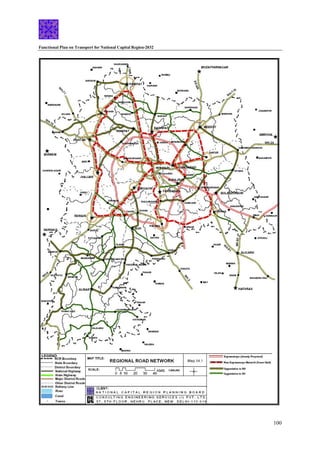
2 Rohtak – Jhajjar – Rewari (under execution) 80.2 3 16110
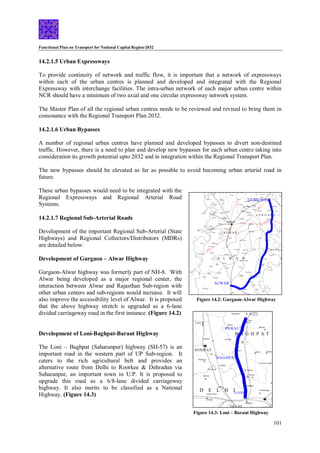
3 Rewari – Palwal – Khurja (new) 129.5 3 129284
4 Meerut – Hapur – Khurja (existing) 66.0 3 94330

5 Meerut – Panipat (new) 85.6 3 25505
Source: Study on Integrated Transportation Plan for NCR
The corridor-wise station and section loadings are given in Annexure 14.5 (i-vi).
It is proposed that the new lines on these corridors be initially single lines with electrification and
colour light signaling with a plan to expand. With Khurja-Hapur-Meerut and Shakurbasti-Rohtak
sections getting electrified, Rohtak-Panipat branch may also be sanctioned for electrification. Present
traffic density may not appear to justify it. However, to obviate the problems related to multi-tractions
and change of tractions in the region, it is suggested that all legs of RORC be electrified. They are
also proposed to be fit to run MEMU/ EMU progressively.
Table 14.14: Cost of Development of Regional Orbital Rail Corridor
S. No. Regional Orbital Corridor Length (kms) Cost excluding Rolling Stock (in millions)
1. Panipat - Meerut (new) 86 4708
2. Meerut - Khurja (existing) - -
3. Khurja - Palwal (new) 54 2943
4. Palwal - Bhiwadi - Rewari (new) 76 4180
5. Rewari - Rohtak (under construction) 80 4411
6. Rohtak - Gohana - Panipat - -
Total 296 16242
Source: Study on Integrated Transportation Plan for NCR
14.2.4.7 Inner Regional Orbital Rail Corridor/Other New Rail Lines
i) Inner Regional Orbital Rail Corridor
In addition to RORC, five other rail lines within NCR are proposed to strengthen the connectivity of
the rail system which will form Inner Regional Orbital Rail Corridor (IRORC). These rail lines could
also form the part of RRTS. They are:
Functional Plan on Transport for National Capital Region-2032
133
a) Sonipat-Kharkhauda-Sampla–Jhajjar (56 Kms)
It is proposed to link Sonipat with Jhajjar via Kharkhauda and Sampla. This line in continuation
with the other proposed lines would form a tangential rail corridor to the CNCR. This corridor
would be developed to operate both goods and passenger train services.
b) Jhajjar - Gurgaon (40 Kms)
A large SEZ has been proposed between Gurgaon and Jhajjar. It would generate intense
commuter and fright traffic. It is proposed to develop a rail link between Jhajjar and Gurgaon,
connecting the proposed Rohtak –Jhajjar Rewari rail line and the Delhi-Gurgaon–Jaipur–
Ahmedabad-Mumbai route. The rail line may skirt the proposed SEZ. The above line may be
developed under PPP mode.
c) Gurgaon - Faridabad - Dadri (53 Kms)
The Jhajjar-Gurgaon rail line is proposed to be extended upto Faridabad, connecting the two
major urban nodes and linking it with Delhi–Bhopal-Chennai rail line route from Faridabad. It is
proposed to be further extended to Dadri to link with Ghaziabad – Aligarh line and the proposed
DFC terminal at Dadri. The above two rail lines would also cater to the intense commuter
movement in this part of CNCR.
d) Meerut - Sonipat (66 Kms)
It is also proposed to connect Sonipat with Meerut.
e) Dadri – Ghaziabad - Meerut
The missing rail link in IRORC is between Dadri-Ghaziabad and Ghaziabad-Meerut which could
be used from the RRTS Corridors to complete the orbit.
Both these Orbital Rails i.e. RORC and IRORC will connect most of the metro and regional centres in
NCR.
ii) Other New Rail Lines
Sonipat - Gohana - (Jind) (51 km within NCR):
This line has been proposed to connect Jind, an important town in Haryana, with other NCR
towns. It is already sanctioned and is under execution.
The estimated commuter passenger travel demand, apart from freight traffic, along these
corridors/lines is given in Table 14.15 and cost of development of IRORC is given in Table
14.16.
Table 14.15: Passenger Travel Demand on IRORC
S. No. Corridor Passengers per day
1. Sonipat – Gohana 10282
2. Sonipat – Meerut 22727
3. Sonipat –Jhajjar 203750
4. Jhajjar - Gurgaon 12420
5. Gurgaon – Faridabad – Dadri 187981
Source: Study on Integrated Transportation Plan for NCR
Functional Plan on Transport for National Capital Region-2032
134
Table 14.16: Cost of Development of IRORC
S. No.
Corridor
Length
(kms)
Cost excluding Rolling Stock
(in millions)
1 Sonipat - Jhajjar 56 3091
2 Jhajjar - Gurgaon 40 2189
3 Gurgaon - Faridabad 28 1557
4 Faridabad - Dadri 25 1359
5 Meerut - Baghpat - Sonipat 65 3614
6 Sonipat – Gohana - Jind 51 2825
Total 265 14635
Source: Study on Integrated Transportation Plan for NCR
14.2.4.8 Cost Estimate
Total estimated cost for development of the proposed Regional Rapid Transit System (RRTS),
Regional Orbital Rail Corridor (RORC) and Inner Regional Orbital Rail Corridor (IRORC) is Rs.
1,72,347 millions (cost of rolling stock is included while calculating cost for RRTS but excluded in
other lines). Details are given in Table 14.17.
Table 14.17: Estimated Cost of Development of RRTS, RORC & IRORC
S.No. Scheme Estimated Cost
(Rs. Millions)
i) Regional Rapid Transit System (including rolling stock cost) 1,41,470
ii) Regional Orbital Rail Corridor 16,242
iii) Inner Orbital Rail Corridor & New lines 14,635
Total Cost 1,72,347
Source: Study on Integrated Transportation Plan for NCR
14.2.4.9 Logistics Hubs/Inland Container Depots/ Yards
NCR is a high intense goods movement region. A large volume of goods, of all types move into/out of
the region for consumption, storage and distribution. Import/export traffic from the northern region
moves into the region for modal transfer. The NCR also produces goods of various types which need
to move within and to other regions. Intensity of goods movement will get further intensified with the
development of the two Dedicated Freight Corridors which traverse through the region and meet at
Dadri. An extensive rail yard is being developed at Dadri. Presently there are a number of Inland
Container Depots (ICDs) along existing rail network at
 Loni
 Dadri
 Tuglakabad
 Faridabad
 Patli
 Garhi Harsaru
In addition, an extensive Logistics Hub/Container Yard also needs to be developed at Dadri. Such
yards and hubs need to be developed also at other locations within the region.
Logistics Park is proposed at Dadri where Western and Eastern Dedicated Freight Corridors are
proposed to interest each other. However, considering the development prospects of CNCR of which
Dadri is a part, major constraints may arise for receipt and evacuation of goods from Dadri to
different originating & destination points by road system. Also, availability of land for various related
needs may prove to be difficult and costly. It is suggested interlinking the two DFCs at Khurja and
development of Logistics Park and other related facilities may be planned and developed at this
location too. With the proposed Regional Expressway and Rail Systems in NCR, it will be more
efficient to receive and distribute the goods traffic to & from Khurja. However, the final locations
could be finalized after detailed survey to be carried out by the implementing agencies in consultation
Functional Plan on Transport for National Capital Region-2032
135
with the concerned State Authorities. The proposed tentative location of Logistic hubs, Orbital Rail
Corridor and proposed DFC are shown in Map 14.3 . Proposed tentative locations of distribution
centres are as follows:
 Greater Noida
 Asaoti/ Pirthala
 Daruhera
 Rewari (along western DFC)
 Khurja (along eastern DFC)
 Rohtak (along ORC)
 Panipat (along ORC)
 Meerut (along ORC)
 Hapur (along ORC)
14.2.5 Regional Mass Rapid Transit System (MRTS)
14.2.5.1 Delhi Metro Rail System
Regional Plan-2021 for NCR proposed the extension of Delhi Metro Rail System to NCR towns.
Accordingly, it has been extended to Noida and is proposed to be extended to Gurgaon, Ghaziabad,
Faridabad, Bahadurgarh and Greater Noida by Delhi Metro Rail Corporation. The work on Gurgaon
corridor is in progress.
14.2.5.2 Mass Rapid Transit System in NCR
Regional Plan-2021 for NCR proposed Mass Transport System for commuters and also recommended
high density location and development of population and activities, upto a depth of 500 m on either
side of the regional highways designated as Highway Policy Zone. Delhi-Mumbai Industrial Corridor
which passes through NCR also proposes to develop industrial areas on both the sides of dedicated
Freight Corridor proposed by Indian Railway. All these developments would result in high intensity
urban/industrial corridors with intense movement of people. These movements will be alike to intra
urban movements – high volume, predominantly for work and education purpose, short trip length
and highly oriented to public mass transport. It is proposed to provide MRTS in the Regional Centres
& Sub-regional Centres along the proposed Regional Arterial road corridor to accelerate the process
of development. The corridors proposed are as follows:
 Noida–Greater Noida–Jewar (65.0 km)
 (Badli) Sonipat-Panipat ( 42.0 km)
 Ghaziabad-Meerut ( 42.0 km)
 Ghaziabad-Hapur ( 35.0 km)
 Faridabad-Palwal ( 33.0 km)
 Gurgaon-Rewari ( 39.0 km)
 Bahadurgarh – Rohtak ( 40.0 km)
The Transport Plan for NCR 2032 showing all study proposal w.r.t. Road, Rail, MRTS, RRTS are
shown in Map 14.4.
Functional Plan on Transport for National Capital Region-2032
136
Functional Plan on Transport for National Capital Region-2032
137
Map 14.4
Functional Plan on Transport for National Capital Region-2032
138
14.2.5.3 Travel Demand on Mass Rapid Transit System (MRTS)
The travel demand on the MRTS for NCR is estimated to be 1.2 million passengers per day. This
estimate does not include commuters travelling within the city. MRTS is proposed as an elevated
system along the Regional Arterial corridors. It may be noted that Faridabad, Gurgaon – Manesar,
Ghaziabad, Noida, Sonipat, Greater Noida and Meerut are likely to cross 2 million to 4 million mark
in population by 2032. In case, MRTS as an option is ruled out for any reason, regional road arteries
will have to take the burden and personalized mode of transport will be preferred by the users,
creating imbalance.
14.2.5.4 Phasing of MRTS in NCR
The development of MRTS in NCR is proposed to be implemented in four phases as under:
Phase I (2010-2013) : Surveys, preparation of DFRs and resource mobilization
Phase II (2013-2017) :  (Badli-Delhi) – Sonipat
 (Shastri Park, Delhi) – Loni
 (Dilshad Garden, Delhi) – Ghaziabad (Bus Adda)
 Noida City Centre – Greater Noida
 (Badarpur, Delhi) – Faridabad
 Rajiv Chowk, Gurgaon – Manesar
 (Dwarka, Sector 21, Delhi) – Rajiv Chowk
(Gurgaon)
 (Mundka, Delhi) – Bahadurgarh
Phase III (2018-2022) :  Sonipat-Panipat
 Ghaziabad-Meerut
 Faridabad-Palwal-Jewar (TIA)
 Manesar-Rewari
 Bahadurgarh-Rohtak
Phase IV (2023-2032) :  Loni-Baghpat
 Ghaziabad Bus Adda – Hapur
 Ghaziabad-Bulandshahr-Khurja
14.2.5.5 Institution
Appropriate Institutional arrangement will have to be made to develop and operate the NCR MRTS.
The options could be DMRC or NCRTC or any other suitable institution.
14.2.6 Air Transport
14.2.6.1 International/Domestic Airports
Presently Indira Gandhi International Airport is the only airport providing air service in the NCR and
is being upgraded by DIAL. It was handling 20 million passengers in 2007. As per DIAL’s
projections given in Study Report, it is expected to touch 50 million mark by 2015-16, 82.7 million
passengers by 2026 and will touch 100 million mark by 2036. Accordingly, the IGI Airport will be
upgraded by DIAL. As per OD pattern of air passengers, 75.75% passengers originate from Delhi,
18.75% from rest of NCR and 5.5% from beyond NCR.
Functional Plan on Transport for National Capital Region-2032
139
The air traffic growth and air transport development has been facilitated by the Open Air Sky Policy
adopted by the Government of India and the facilitating Civil Aviation Policy (CAP), the mission of
which is ‘to maintain a competitive civil aviation environment which ensures safety and security in
accordance with international standards, promotes efficient, cost-effective and orderly growth of air
transport and contributes to social and economic development of the country’. The CAP envisages
promotion and growth of air transport through a number of measures which include setting up of
Facilitation Committees, establishing a regulatory framework in the form of a statutory autonomous
Civil Aviation Authority (CAA), encouraging private sector participation in various aspects of air
transport system development, ensuring world class airport infrastructure capacity, permitting
development of Greenfield airports permitting foreign equity participation, promoting development of
small airports, permitting single engine aircraft of seating capacity upto 10 seats for passenger and
cargo flights, and a host of other facilitating measures.
Government of Uttar Pradesh has proposed an International Airport at Greater Noida (Jewar) as a
greenfield airport which is under consideration by the GoI. It is proposed to handle traffic of 40
million passengers per annum. There are at present some constraints like restriction of a second
airport within an aerial distance of 150 km from existing one and the contractual terms with DIAL,
the private sector agency who have been awarded the development, operation and management of
Delhi International Airport. As per OD pattern of air passengers about 24% passengers coming from
rest of NCR & beyond NCR area. Some part of these passengers could get the benefit of this Airport.
Apart from this, a part of Delhi-Mumbai Freight Corridor and Delhi-Mumbai Industrial Corridor
(DMIC) will also be near this Airport area which could also take the benefit if this Airport is
developed.
14.2.6.2 Aerotropolis
There is a great scope for development of an aerotropolis complex near the Greater Noida Airport at
Jewar. A number of air transport related functional complexes could be located in this area and a New
Town of reasonable size could be planned and developed.
14.2.6.3 Domestic Airport at Jhajjar
Government of Haryana is considering a Domestic Airport at Jhajjar. This forms part of the mega
Haryana SEZ at Jhajjar-Gurgaon. This location is very close to IGIA and will need detailed
examination of operational and legal aspects apart from its viability.
14.2.6.4 Smaller Airports
NCR being a high activity area, there is a scope for developing smaller airports in some of the major
urban centres within it. These would facilitate movement of business executive in smaller private
aircrafts avoiding delays along the road system. The potential centres are Meerut, Rewari, Alwar,
Rohtak, Sonipat and Panipat. However, their consideration will need detailed examination.
Map 14.5 depicts the proposed airports in NCR.
Functional Plan on Transport for National Capital Region-2032
140
Functional Plan on Transport for National Capital Region-2032
141
Phasing & Cost Estimates
Transport system development is highly costly and calls for long gestation period. Concerted efforts
need to be made to mobilize resources from a variety of sources. Institutional framework needs to be
established to allocate resources on a rational and systematic basis. Appropriate recommendations
covering these aspects have been made separately.
15.1 Phasing
The IMMTP is to be developed over a period of 25 years (2008-2032). The development programme
is envisaged in 4 time period phases as under:
Phase I : 2008 – 2012
Phase II : 2013 – 2017
Phase III : 2018 – 2022
Phase IV : 2023 – 2032
15.2 Phasing Programmes
The programmes covering Roads, RRTS, Regional Metro, Bus System, Bus Terminals and other
components have been identified into different phases based on traffic volumes, spatial development
priorities and other policy measures. The proposed phase wise programmes are detailed in Table 15.1.
Table 15.1: NCR IMMTP – Development Programme –Road
No. of Lanes
SI. No. Categories Length
(Km)
ROW Type
Phase-I Phase-II Phase-III Phase-IV
2008-12 Traffic 2013-17 Traffic 2018-22 Traffic 2023-32 Traffic
Expressways
1 Ganga Expressway 65.0 100 Greenfield 6 103140 6 155198 6 233531 8 265591
2 Yamuna Expressway
(within NCR)
65.0 100 Greenfield 6 53637 6 78929 8 116146 8 154687
3 Kundli – Manesar –
Palwal Expressway
(Western Expressway)
135.6 100 Greenfield 6 4257 8 10252 10 24689 10 35915
4 Faridabad – Noida –
Ghaziabad Expressway
(Eastern Expressway)
136.0 100 Greenfield 6 3540 8 9404 10 24980 10 29238
Total 401.6
Regional Expressways (Greenfield Alignments)
1 Delhi - Panipat 69.75 100 Greenfield 109431 6 132652 6 160801 8 281180
2 Delhi –Ghaziabad 15.34 100 Greenfield 37218 4 68033 6 124361 8 244818
3 Ghaziabad – Modinagar
– Meerut
33.21 100 Greenfield 38658 4 57242 6 84760 8 158122
4 Ghaziabad – Hapur 25.90 100 Greenfield 5001 4 10950 6 18022 8 23976
5 Delhi – Faridabad –
Palwal
44.75 100 Greenfield 73524 4 101527 6 140196 8 231600
6 Gurgaon - Manesar -
Daruhera
64.55 100 Greenfield 40663 4 54013 6 71747 8 83410
7 Panipat – Gohana –
Rohtak
58.40 100 Greenfield 3092 4 8234 6 21927 8 21987
8 Rohtak – Rewari 80.01 100 Greenfield 22172 4 38229 6 65914 8 79532
9 Rewari – Daruhera - 21.38 100 Greenfield 37387 4 63928 6 109312 8 79108
15
Functional Plan on Transport for National Capital Region-2032
142
No. of Lanes
SI. No. Categories Length
(Km)
ROW Type
Phase-I Phase-II Phase-III Phase-IV
2008-12 Traffic 2013-17 Traffic 2018-22 Traffic 2023-32 Traffic
Bhiwadi – Palwal
10 Palwal – Khurja 50.98 100 Greenfield 1391 4 2758 6 5467 8 6471
11 Khurja – Hapur – Meerut 72.44 100 Greenfield 7167 4 10194 6 14499 8 19060
12 Meerut – Bagh pat -
Sonipat
37.48 100 Greenfield 8528 4 21548 6 54447 8 63351
13 Ghaziabad –Bulandshahr
till Dadri
18.17 100 Greenfield 9993 4 30786 6 94844 8 132040
14 Delhi – Baghpat 36.28 100 Greenfield 10579 4 31485 6 93703 8 121599
15 Gurgaon - Faridabad 18.72 100 Greenfield 4998 4 20846 6 86948 8 99915
16 Delhi – Bahadurgarh –
Rohtak
57.94 100 Greenfield 97665 4 147180 6 221800 8 351615
Total Length 705.3
Source: Study on Integrated Transportation Plan for NCR
No. of Lanes
Phase-I Phase-II Phase-III Phase-IV
S. No Regional Arterials
Length
(km)
ROW
Existing
Configur
ation
2008-12 Traffic 2013-17 Traffic 2018-22 Traffic 2023-32 Traffic
1 Delhi – Panipat (NH-1) 84.0 60 6 6 284291 8 357819 10 450365 10 476842
2 Delhi –Ghaziabad (NH-
24)
21.0 60 4 6 240348 8 320702 10 427921 10 414317
3 Ghaziabad – Modinagar
– Meerut (NH-58)
53.0 60 4 4 37403 6 42692 8 48730 8 50719
4 Ghaziabad – Dadri –
Bulandshahr (NH-91)
48.0 60 2 4 37892 6 48951 8 63238 8 54886
5 Ghaziabad - Hapur (NH
24)
37.0 60 2 4 22500 6 27355 8 33257 8 86970
6 Delhi – Faridabad –
Ballabgarh – Palwal
(NH-2)
60.0 60 4 6 353164 8 400332 10 453799 10 488300
7 Delhi – Gurgaon (NH-
8)
30.0 60 8 8 263021 10 289918 10 319566 10 419631
8 Gurgaon - Manesar -
Daruhera (NH-8)
49.0 60 4 6 81604 8 97744 10 117076 10 136990
9 Delhi – Bahadurgarh
(NH-10)
28.0 60 4 4 35691 6 53588 8 80460 8 100373
10 Bahadurgarh - Rohtak 42.0 60 2 2 45485 4 63737 6 89314 8 133852
11 Panipat – Gohana –
Rohtak (NH-71A)
67.0 60 2 2 36908 4 57723 6 90276 8 151479
12 Rohtak – Rewari (NH-
71)
80.0 60 2 2 20230 4 27951 6 38620 8 66215
13 Rewari - Palwal (NH-
71 B)
83.0 60 2 2 16915 4 23357 6 32253 8 36599
14 Palwal - Khurja 56.0 60 1 2 4435 4 5919 6 7900 8 12466
15 Khurja - Hapur 53.0 60 2 2 29471 4 37772 6 48412 8 73117
16 Hapur - Meerut 33.0 60 2 2 35916 4 47279 6 62238 8 80709
17 Gurgaon - Sohna 23.0 60 6 6 11842 8 19411 8 31819 8 63100
18 Sohna - Alwar 94.0 60 2 2 34181 4 42324 6 52407 6 82690
19 Jhajjar - Gurgaon 48.0 60 2 2 5960 4 8702 6 12706 6 15766
20 Sonipat - Jhajjar 56.0 60 2 2 7019 4 10983 6 17186 6 31433
21 Ballabgarh - Gulavathi 45.0 60 1 1 1020 2 2734 4 7328 6 7921
22 Hodal - Tijara - Behror 133.0 60 1 1 14829 2 27218 4 49957 6 89051
23 Behror - Partapgarh 100.0 60 1 1 26110 2 37374 4 53498 6 91542
24 Meerut -
Garhmukteshwar -
Bulandshahr
93.0 60 2 2 4622 4 6073 6 7980 6 8255
Functional Plan on Transport for National Capital Region-2032
143
No. of Lanes
Phase-I Phase-II Phase-III Phase-IV
S. No Regional Arterials
Length
(km)
ROW
Existing
Configur
ation
2008-12 Traffic 2013-17 Traffic 2018-22 Traffic 2023-32 Traffic
25 Sonipat - Rohtak 46.0 60 1 1 13536 2 19639 4 28493 4 36665
26 Sonipat - Gohana -
Asan
94.0 60 2 2 8385 4 13827 4 22800 4 42183
27 Gohana - Maham 51.0 60 2 2 15582 2 26116 2 43772 4 77885
28 Palwal - Hodal 33.0 60 6 6 25895 8 37062 10 53045 10 57461
29 Meerut - Muzaffarnagar
(till NCR Border)
19.0 60 2 4 15254 6 20594 8 27803 8 37105
30 Rewari – Bawal (NH-
71)
11.0 60 2 2 46075 4 64511 6 90324 8 69465
31 Daruhera - Behror 63.0 60 4 6 92247 8 125119 10 169704 10 142159
32 Khurja - Border of
NCR to Aligarh
19.0 60 2 4 6 8 8
33 Panipat - Border of
NCR (NH-1)
9.0 60 6 8 42519 10 61239 10 88203 10 106795
34 Hapur –
Garhmukteswar (NH-
24)
35.0 60 2 4 16971 6 23439 8 32371 8 40776
35 Rohtak – Quila
Jafargarh (NH-10)
35.0 60 2 2 47868 4 67858 6 96197 8 128354
36 Meerut – Bahsuma
(NH-119)
50.0 60 2 2 13989 4 19319 6 26681 6 41140
37 NH - 93 38.0 60 2 2 396 4 255 6 164 6 569
38 NH - 11 A 37.0 60 2 2 7793 4 11096 6 15800 6 16117
39 Loni - Baghpat - Baraut
- Till NCR Border
68.0 60 2 4 31747 6 34646 8 37810 8 39096
40 Rohtak - NCR Border
(NH -71)
22.0 60 2 2 7202 4 13326 6 24656 8 55868
Total 1607
Source: Study on Integrated Transportation Plan for NCR
Sl. No. Regional Sub-arterials Length
(km)
ROW Existing
Configuration
I II III IV
1 Khurja – Pahasu – NH -93 35.0 30 IL 2 2 2 4
2 Badarpur – Dadri – Hapur 67.0 30 IL 2 2 4 4
3 Pilana – Binaula 16.0 30 IL 2 2 2 4
4 Darula – Sardhana – Baraut – Ganaur –
Shahpur
93.0 30 IL 2 2 2 4
5 Baraut – Samalkha – Naultha 44.0 30 IL 2 2 2 4
6 Bansur – Hajipur – Kishangarh Bas 44.0 30 IL 2 2 2 4
7 Thana Gazi – Malakher – Lachmangarh 90.0 30 IL 2 2 2 4
8 Ajabgarh – Tehla – Rajgarh – Garhi –
Lachmangarh
76.0 30 IL 2 2 2 4
9 Ghasoli – Tapukrah 33.0 30 IL 2 2 2 4
10 Samda - Alwar 36.0 30 IL 2 2 2 4
11 Hodal – Nuh – Taoru 56.0 30 IL 2 2 4 4
12 Taoru – Pataudi – Kulana 41.0 30 IL 2 2 4 4
Total 439
Source: Study on Integrated Transportation Plan for NCR
Functional Plan on Transport for National Capital Region-2032
144
Table 15.2: NCR IMMTP – Development Programme – RORC/IRORC/New Rail Link
Phase
SI.
No.
New Rail Links Length
(kms) 2008-2012 2013-2017 2018-2022 2023-2032
1 Panipat - Meerut 86 3
2 Rewari - Bhiwadi - Palwal 76 3
3 Palwal – Khurja 53 3
4 Rohtak – Rewari 80 3
5 Sonipat - Jhajjar 56 3
6 Jhajjar - Gurgaon 40 3
7 Gurgaon – Faridabad - Dadri 53 3
8 Sonipat - Gohana (Jind) 51 3
9 Meerut – Baghtpat – Sonipat 66 3
Total Length 561.0
Source: Study on Integrated Transportation Plan for NCR
Table 15.3: NCR IMMTP – Development Programme -RRTS
Phase
SI.
No.
Regional Rapid Transit System Length (kms)
2008-2012 2013-2017 2018-2022 2023-2032
1 Delhi - Panipat 89 3
2 Delhi - Baghpat 56 3
3 Delhi - Meerut 67 3
4 Delhi - Hapur 57 3
5 Delhi - Khurja 83 3
6 Delhi – Ballabgarh – Palwal 60 3
7 Delhi – Rewari – Alwar 158 3
8 Delhi - Rohtak 70 3
Total Length 640
Source: Study on Integrated Transportation Plan for NCR
Table 15.4: NCR IMMTP – Development Programme – Mass Rapid Transit System
Phase
SI.
No.
Regional Metro System Length (kms)
2008-2012 2013-2017 2018-2022 2023-2032
1 Bahadurgarh - Rohtak 40 3
2 Kundli - Sonipat 15 3
3 Sonipat - Panipat 42 3
4 Ghaziabad - Hapur 35 3
5 Ghaziabad - Meerut 42 3
6 Faridabad - Palwal 33 3
7 Gurgaon - Manesar 8 3
8 Manesar - Rewari 31 3
9* Greater Noida - Jewar 47 3
10* Delhi - Faridabad 36
11* Delhi - Gurgaon 28
12* Delhi - Bahadurgarh 25
13* Delhi - Kundli 27
14* Delhi - Ghaziabad 16
Total Length 293
Source: Study on Integrated Transportation Plan for NCR
* Lengths of the alignments which are coming under DMRC plan are not considered
Functional Plan on Transport for National Capital Region-2032
145
15.3 Cost Estimates
The estimates of total investment cost have been made based on unit block cost collected from
different sources. They are detailed in Table 15.5.
Table 15.5: Block Unit Costs
SI. No Categories Unit Cost per Km (in
million)
Road Development Cost
Expressways (Greenfield)
1 4L Expressway 120.0
2 6L 150.0
3 8L 180.0
Adding additional lane to existing
1 Expressway 2.50
2 NH/SH 1.50
3 MDR/ODR 1.00
Widening Cost for NH/SH
1 SL to 2L 20
2 IL to 2L 10
3 2L - 4L 80
4 4L - 6L (with shoulders) 120
5 4L - 6L (without shoulders) 80
Widening Cost for MDR/ ODR
1 SL to 2L 1.40
2 IL to 2L 0.70
3 2L - 4L 5.60
4 4L - 6L (with shoulders) 8.40
5 4L - 6L (without shoulders) 5.60
Rail Development Cost
1 Additional lane to the existing corridor (flat terrain) 55.0
2 New Line 55.0
Metro Cost
1. Elevated Structure 1250
2 Underground 2400
Logistic Hub
Area of around 10 ha 1000
Inland Container Depot
Area of around 100 ha 2400
Bus Terminal Cost
1 Area of around 5 acres 100
Wayside Amenities
1 Area of around 10 acres 100
2 Area of around 5 acres 50
Source: Study on Integrated Transportation Plan for NCR
15.4 NCR - IMMTP - Investment Cost
The total investment of the proposed IMMTP over the 25 years period, is estimated at Rs 17,63,545
million with RRTS extending in Delhi. It does not include land cost. This represents the total
Functional Plan on Transport for National Capital Region-2032
146
investment to be made. The resources may come from any sector, public or private resources may
come from any sector, public or private resources. Table 15.6 presents the phase-wise investment cost
by components.
Table 15.6: NCR – IMMTP Investment Cost
Phase wise Costs
(in Rs Million)
Category
I II III IV
Total
Cost(in Rs
Million)
Road
1 Expressways 45910 469124 52095 38515 605643
2 National Highway 13680 54990 55170 24330 148170
3 State Highways 11004 0 31584 56448 99036
4 Other Roads 0 4872 9744 9744 24360
Sub Total (Roads) 70594 528985 148593 129036 877208
Bus System
1 Bus Fleet & Infrastructure 48900 46050 49650 114127 258727
2 Bus Terminals 7388 7388 7388 7388 29552
Sub Total (Bus System) 56288 53438 57038 121515 288279
Rail System
1 Rail Line (New) 0 19069 8195 3614 30878
2 RRTS* 62800 65200 0 0 128000
3 Rolling Stock 5930 7540 0 0 13470
Sub Total (Rail System) 68730 91809 8195 3614 172348
MRTS 0 68750 297500 0 366250
Airports 0 5000 5000 7500 17500
Others
1 Logistic Hubs 1800 2700 2250 2250 9000
2 Integrated Freight Complex 2880 4320 3600 3600 14400
3 Highway Facilities Centres 0 220 440 440 1100
Sub Total (Others) 4680 7240 6290 6290 24500
Surveys, Investigation, DPRs’, Tender
Documents etc. (@ 1% of total investment
costs) 2003 7552 5226 2680 17461
Grand Total 202295 762774 527842 270635 1763545
Source: Study on Integrated Transportation Plan for NCR
Note - Land cost is not included
* RRTS alignment for Delhi – Meerut, Delhi – Hapur and Delhi – Aligarh sections have common alignment till Ghaziabad.
Functional Plan on Transport for National Capital Region-2032
147
Economic and Financial Analyses
16.1 Economic Analysis
The objective of economic evaluation is to enable Government authorities to determine whether the
project is an economically worthwhile investment proposal and whether it should be taken up for
implementation. Economic evaluation is based on an analysis of economic costs and benefits over a
fixed analysis period, ‘with’ and ‘without’ the project. The predominant cost is the cost of
construction, followed by maintenance and operation costs. All costs and benefits were valued in
monetary terms and expressed in economic prices to reflect the true resource cost to the economy. The
results have been expressed in terms of Economic Internal Rate of Return (EIRR) and Net Present
Value (NPV) @ 12 percent discount rate. These were calculated using discounted cash flow methods
since costs are incurred, and benefits accrue, at different dates. The feasibility of the project was
determined by comparing the EIRR with the current accounting rate of 12%. This represents the
opportunity cost of capital.
16.2 Transport Plan for NCR
The regional transportation system of NCR is a complex one. The NCR Transport Modal (based on
CUBE Voyager software) was used to evaluate different development scenarios and network
alternatives. Strategy D2N5 (RP 2021 Extended – Integrated Multi-Modal Transport System),
emerged as the most optimal after analysing the practical aspects and operational efficiency issues,
and was thus recommended.
The transport plan comprises a number of components, viz.
 expressways,
 regional arterials,
 sub-arterials and collector roads,
 urban bypasses,
 interchanges,
 regional Rail Rapid Transit,
 regional Metro Rail,
 bus system,
 terminals,
 integrated freight complexes,
 transport hubs, and
 facility centres.
Some of the projects already exist, while others are proposed as part of the transport strategy to
improve the efficiency of the transport network and system of the NCR. In order to assess the
economic justification of the transportation system as a whole, a network approach was adopted, for
quantifying the tangible costs and benefits due to the proposed improvements or enhancements in the
existing network/systems and/or induction of new projects for meeting the assessed future travel
demand. The complexities associated with the transportation system of NCR made assessment of the
different indicators, and the subsequent economic analysis equally complex. The outputs of the
Transport Modal, as required and developed exclusively for economic analysis, formed the inputs to
the economic analysis. A generalized cost approach was adopted for estimating the operating costs
and the travel time costs of the different modes of transport.
16
Functional Plan on Transport for National Capital Region-2032
148
2007 2012 2022 2032
1 Total Estimates of Travel Cost across all modes for the selected transport strategy and do minimum scenarios for 2007, 2012, 2022, 2032.
2 Total Estimates of Travel Time Cost across all modes for selected transport strategy and do minimum scenarios for 2007, 2012, 2022, 2032.
For each scenario
Road Based
Vehicular Traffic
Metro Rail Urban / Suburban
Rail
Vehicle km
by mode
Travel time
by mode
Passenger km
by mode
Travel Time
by mode
Total Travel Cost Total Travel Time Cost Total Travel Cost Total Travel Time Cost
D2N5 D1N1
Savings in VOC in
2007, 2012, 2022, 2032
Capital
Cost
Savings in VOT in
2007, 2012, 2022, 2032
Conversion
Factor for
Economic
Pricing
EIRR and NPV for D2N5, D1N1
NCR TRANSPORT PLAN FOR
2007, 2012, 2022, 2032
Transport Strategy
D2N5
Do Minimum
D1N1
Unit
VOT
Estimates
by Mode
D2N5 D1N1 D2N5 D1N1 D2N5 D1N1
2007 2012 2022 2032
2007 2012 2022 2032
2007 2012 2022 2032
D2N5 D1N1 D2N5 D1N1 D2N5 D1N1
Unit VOC
Estimates
by Mode
16.3 Framework for Economic Analysis
The proposed transport strategy, D2N5, is expected to result in improving the operational efficiency
of the system. The benefits that are likely to accrue would be mainly savings in vehicle operating cost
and travel time cost for the road-based vehicles and savings in operating cost for metro and rail.
Benefits were calculated by comparing the ‘with’ and ‘without’ project scenarios. The ‘with project’
case for the analysis was D2N5, which represents the development scenario considered in the
Regional Plan 2021 (extended to 2032), and the integrated multi-modal network. The ‘without
project’ situation is the base case option or the “do-minimum” case, where the existing network (N1)
and existing development scenario (D1) have been considered. The analysis period is 25 years, from
2007 to 2032. The approach for economic analysis is presented in the form of a flow-diagram (Figure
16.1). The economic analysis was done using a spreadsheet modal.
Figure 16.1: Framework for Economic Analysis
Functional Plan on Transport for National Capital Region-2032
149
16.4 Economic Modal Inputs
16.4.1 Traffic
The road-based vehicle types considered include two-wheeler, autorickshaw, car, bus, light
commercial vehicle (LCV), 2-axle truck, 3-axle truck and multi-axle vehicle (MAV). Rail-based
modes included metro and commuter rail.
The transport modal (CUBE) was used to undertake traffic assignments for 4 cardinal years, viz. 2007
(base year), 2012, 2022 and 2032. The same assignments were used to generate inputs for economic
analysis, viz.:
 Vehicle-kilometres performed by each road-based mode;
 Travel time in person-hours by each road-based mode;
 Passenger-kilometres performed by rail-based modes - metro and rail
 Travel time in person-hours by rail-based modes – metro and rail
These are presented in Tables 16.1 to 16.4.
Table 16.1: Vehicle-km Performed/day by Road-based Modes on NCR Network (million)
Year Car 2 Wheeler Auto Bus LCV HCV MAV
Base Case - D1N1
2007 36.93 14.54 3.32 1.66 8.68 15.52 2.10
2012 73.88 33.18 4.43 10.94 10.38 18.56 2.52
2022 130.71 45.73 8.14 33.57 16.82 30.07 4.08
2032 170.34 54.56 12.85 74.28 28.41 50.80 6.89
With Project – D2N5
2007 36.93 14.54 3.32 1.66 8.68 15.52 2.10
2012 67.44 17.11 4.78 2.24 7.36 13.15 1.78
2022 127.94 28.41 8.05 8.14 12.46 22.27 3.02
2032 175.80 39.01 13.10 25.96 22.69 40.56 5.50
Source: Study on Integrated Transportation Plan for NCR
Table 16.2: Travel Time for Road-based Modes on NCR Network (million person-hours/day)
Year Car 2 Wheeler Auto Bus LCV HCV MAV
Base Case - D1N1
2007 1.29 0.50 0.09 0.01 0.30 0.54 0.07
2012 3.48 1.59 0.19 0.21 0.52 0.94 0.13
2022 14.47 4.93 0.72 0.70 2.05 3.66 0.50
2032 30.18 9.69 1.79 1.92 5.73 10.24 1.39
With Project – D2N5
2007 1.29 0.50 0.09 0.01 0.30 0.54 0.07
2012 1.43 0.31 0.08 0.03 0.17 0.30 0.04
2022 3.14 0.51 0.12 0.10 0.30 0.54 0.07
2032 9.72 1.63 0.26 0.21 1.12 2.00 0.27
Source: Study on Integrated Transportation Plan for NCR
Table 16.3: Passenger-km Performed by Rail-based Modes on NCR Network (million)
Year Metro Rail
Base Case - D1N1
2007 - 44.68
2012 - 24.43
2022 - 41.82
2032 - 70.39
With Project – D2N5
2007 - 44.68
2012 - 51.32
2022 4.53 31.90
2032 12.57 44.30
Source: Study on Integrated Transportation Plan for NCR
Functional Plan on Transport for National Capital Region-2032
150
Table 16.4: Travel Time for Rail-based Modes on NCR Network (in million pax-hrs/day)
Year Metro Rail
Base Case - D1N1
2007 - 0.74
2012 - 0.70
2022 - 1.19
2032 - 2.01
With Project – D2N5
2007 - 0.74
2012 - 0.86
2022 0.14 0.53
2032 0.39 0.74
Source: Study on Integrated Transportation Plan for NCR
16.4.2 Unit Costs of VOC Inputs
Vehicle operating cost (VOC) inputs for the road-based vehicles included prices of vehicle, tyres, fuel
and lubricants, spare parts, labour costs, fixed costs, crew wages, etc. The unit costs of inputs for
VOC estimation were collected from markets in Delhi, along with taxes and duties applicable on
them. This was used for calculating economic prices from the financial prices.
16.4.3 Estimation of unit VOC
Till date no VOC equations have been developed for roads with carriageway width of more than 4-
lanes with paved shoulders. While unit VOCs were basically calculated from the VOC equations
developed for regional roads1
, some assumptions and modifications were necessary to cater to the
entire network, which also includes 6-lane roads and expressways. This was done by deriving the unit
VOCs for fixed speeds. Speeds on different links of the network were obtained from CUBE. Speed
thus served as a proxy for the type of road and carriageway width. Annexure 16.1 presents the look-
up tables of speed vs unit VOC per vehicle-km.
16.4.4 Value of Travel Time
Estimation of the value of time (VOT) for passengers was based on the wage rate approach and
discussed in detail in Chapter 16 The VOT for goods vehicles was based on the ‘holding cost’
concept, which takes into account average payload, average value of cargo per tonne, interest rate and
working days in a year. Table 16.5 shows the VOT values adopted in the economic analysis.
Table 16.5: Value of Travel Time by Vehicle Type
Vehicle Type Value of Time (Rs/hour)
Financial prices Economic prices
Car 69 62
Two-wheeler 32 29
Autorickshaw 32 29
Bus 15 13
Commuter Rail 14 13
Metro 51 46
LCV 3 2
2/3 axle truck 6 6
MAV 10 9
Source: Study on Integrated Transportation Plan for NCR
1
Updation of Road User Cost Data, Final Report, July 2001(MORTH) was used to derive unit VOCs. These equations take
into account congestion effects of traffic.
Functional Plan on Transport for National Capital Region-2032
151
16.4.5 Network Level Costs
Estimates of travel cost and travel time cost were obtained by using unit VOC and unit VOT as inputs
to the CUBE modal.
 Network travel cost (VOC) by each road-based mode;
 Network travel time cost by each road-based mode;
The total operating costs on the network are presented in Tables 16.6 and 16.7.
Table 16.6: Network Travel Cost (VOC) per Day (in Rs million)
Year Car 2 Wheeler Auto Bus LCV HCV MAV
Base Case - D1N1
2007 123.53 23.52 7.45 21.00 61.96 110.77 15.02
2012 266.07 62.19 12.55 138.73 70.53 126.10 17.10
2022 685.00 122.61 33.31 425.63 116.99 209.17 28.36
2032 929.46 172.16 61.71 941.84 197.00 352.21 47.76
With Project – D2N5
2007 23.52 7.45 21.00 61.96 110.77 15.02 23.52
2012 46.65 9.71 20.55 54.61 97.63 13.24 46.65
2022 79.26 16.41 74.68 92.31 165.03 22.38 79.26
2032 146.82 31.48 238.31 156.60 279.98 37.96 146.82
Source: Study on Integrated Transportation Plan for NCR
Table 16.7: Network Travel Time Cost per Day (in Rs million)
Year Car 2 Wheeler Auto Bus LCV HCV MAV
Base Case - D1N1
2007 3.30 0.77 0.14 4.28 0.03 0.05 0.01
2012 8.19 2.19 0.30 90.61 0.04 0.06 0.01
2022 29.94 6.95 1.17 309.03 0.06 0.11 0.01
2032 50.68 13.82 2.90 847.30 0.10 0.19 0.03
With Project – D2N5
2007 3.30 0.77 0.14 4.28 0.03 0.05 0.01
2012 4.10 0.47 0.12 12.94 0.02 0.04 0.01
2022 8.85 0.80 0.18 44.29 0.04 0.07 0.01
2032 22.52 2.44 0.41 92.93 0.06 0.10 0.01
Source: Study on Integrated Transportation Plan for NCR
16.4.6 MRT System
For estimation of operating cost of the MRT system, few cases exist that count as experience in India.
The studies undertaken by DMRC for Delhi Metro formed the basis for this study. The unit O&M
cost in the case of Delhi Metro was Rs 1.12 per passenger-km at 2007 prices, and found to be
declining over the years as optimal utilization neared. For the purpose of economic analysis, a
financial value of Rs 1.12 per pkm was assumed, which is equivalent to Rs 1.0 per pkm in economic
terms.
16.4.7 Regional Rapid Rail Transit
The O & M costs adopted for the rapid rail transit have been based on the Mumbai suburban rail
system, where the unit O&M cost is estimated as Rs 0.10 per passenger-km. This was converted into
economic price and formed an input to the analysis.
Functional Plan on Transport for National Capital Region-2032
152
16.5 Project Benefits
The project benefits have been estimated by taking the difference in the total operating costs in the
‘Base Case’ and the ‘With Project Case’. The benefits have been estimated for 3 time periods – 2012,
2022 and 2032. Similar benefits have been estimated for the travel time as well. The benefits in the
intermediate years were obtained through interpolation.
16.6 Project Costs
The total investment for the NCR Transport Plan over the analysis period, ie upto the year 2032, has
been estimated as Rs. 1,733,650 million. The project cost components include the following:
 Cost of improvement/new proposals for road projects – both capital and maintenance cost;
 Bus system and terminals;
 Civil cost of upgrading of RRTS and cost of its rolling stock;
 Cost of new railway lines;
 Cost of metro rail system as planned;
 Airports, logistic hubs, Integrated Freight Stations and wayside amenities.
For the purpose of analysis, the costs have been phased out equally over each of the phases of
implementation. The assumption here is that as individual projects are implemented they will be
opened for use by traffic.
16.6.1 Maintenance Costs
The maintenance cost of the systems has been estimated @ 0.5% of the construction cost per year. All
costs have been converted into economic costs by applying the standard conversion factor of 0.8.
16.7 Economic Viability
The economic analysis of the proposed transport strategy for NCR was undertaken as a single project.
The annual cost and benefit streams were analysed in Excel spreadsheet to derive the net cash flow for
the project. The EIRR and NPV @ 12% discount rate were determined using the discounted cash-flow
technique.
The EIRR of the project worked out to 43.26%, while the NPV @ 12% was Rs 807,786 million.
The rate of return considered desirable for transport infrastructure projects is 12 percent as the
opportunity cost of capital is 12%. The results indicate that the project is economically viable, as the
EIRRs are far higher than 12 percent. The net cash flow statement for the project is presented in
Annexure 16.2.
16.8 Other Benefits
Besides the benefits quantified for economic analysis, some intangible benefits would also accrue as a
result of the proposed transport strategy. These are discussed below.
16.8.1 Environmental Benefit
Traffic congestion and low speeds result in high levels of air pollution. A more efficient transport
system, viz. metro rail system, would result in lowering congestion on the roads, improving speeds of
road-based vehicles, and consequently lowering air pollution. The emission reduction of the proposed
transport plan has been detailed out in the chapter on Initial Environmental Examination.
Functional Plan on Transport for National Capital Region-2032
153
16.8.2 Increase in Land Values
Improvement in the transportation system would foster economic development and hence result in
considerable increase in land values in the NCR. The greenfield projects, in particular, are likely to
have a major impact on the value of land. However, this benefit has not been considered for economic
analysis.
16.9 Conclusions
The economic analysis shows that the proposed transport strategy for NCR is economically viable.
With the implementation of the transport plan, the society will benefit immensely. However, in view
of the huge investment involved, the level of implementation would depend on the availability of
resources.
16.10 Financial Analysis of Expressways in NCR
16.10.1 Introduction
Financial analysis of a project is carried out to ascertain the viability of implementing the project with
private sector participation on BOT basis. Generally, financial viability is assessed after some
preliminary design and cost estimates are available. However, it was too premature to carry out this
exercise as part of the overall Transport Plan for NCR. After discussions with NCRPB, it was agreed
by the Consultant to carry out a preliminary financial analysis of selected expressways being proposed
in the NCR. Expressways likely to carry sizeable commercial and car traffic formed the basis of the
selection. The following six expressways were selected for evaluation:
 Delhi – Panipat Expressway 69.76 km
 Delhi – Ghaziabad Expressway 15.34 km
 Ghaziabad – Modinagar – Meerut Expressway 33.22 km
 Delhi – Faridabad - Palwal Expressway 44.75 km
 Gurgaon – Manesar – Daruhera Expressway 64.55 km
 Delhi – Bahadurgarh - Rohtak Expressway 57.94 km
16.10.2 Tollable Traffic
For the purpose of evaluation, all expressways are taken to be operational by 2015. The projected
traffic on the expressways was obtained from the NCR Transport Modal outputs for the cardinal
years, 2015, 2022 and 2032. Some traffic leakage has been assumed, viz. 10% for all vehicle types.
The tollable traffic was estimated after deducting the traffic leakage. The tollable traffic categories
include:
 Car/Jeep/Taxi, etc.
 Bus – standard and mini
 Light Commercial Vehicle (LCV)
 Truck – 2 axles
 Multi axle vehicle (MAV)
The tollable traffic thus estimated for the expressways are given in Table 16.8.
Functional Plan on Transport for National Capital Region-2032
154
Table 16.8: Tollable Traffic on Expressways-2015
Expressway Sections
Length
(km)
AADT 2015
(vpd)
Tollable
Traffic
2015 (vp)
Tollable
Traffic
2015
(PCUs)
Delhi-Panipat Delhi - Sonepat 28.47 63625 57263 71790
Sonepat - Panipat 41.28 58015 52214 89285
Total 69.76
Delhi-Ghaziabad 15.34 52962 47666 62336
Ghaziabad-Modinagar-Meerut Ghaziabad - Modinagar 22.99 21890 19701 26927
Modinagar - Meerut 10.22 26991 24292 35254
Total 33.22
Delhi-Faridabad-Palwal
Delhi - Faridabad 18.90 66476 59828 63731
Faridabad - Palwal 25.85 22591 20332 26571
Total 44.75
Gurgaon-Manesar-Daruhera 64.55 48133 43320 62641
Delhi-Bahadurgarh-Rohtak Delhi - Bahadurgarh 20.95 59034 53131 55999
Bahadurgarh - Sampla 16.26 32257 29031 32571
Sampla - Rohtak 20.73 33471 30124 34039
Total 57.94
To account for vehicles exempted from paying toll as well as frequent users, a 3% loss in gross
revenue has been considered. Toll-exempt vehicles include defence vehicles, ambulances/ funeral
vans, police vehicles/ fire fighting vehicles, and non-commercial government vehicles. Frequent users
would be given concessions/ discounts in the form of multiple entry tickets and monthly passes.
16.10.3 Toll Rates
The unit toll rates as per NHAI’s new toll policy (Notification in the Gazette of India, Dec 2008),
were taken as the basis for estimating toll rates for the expressways. The ‘per km’ rates, applicable for
National Highways were increased by a factor of 1.5 for expressways. These are shown in Table 16.9.
Table 16.9: Unit Toll Rates on Expressways -2009
Vehicle Category
Toll rate for Highway
(Rs /km)
Toll rate for Expressway (Rs/km)
Car/Jeep/Van 0.71 1.07
Mini Bus 1.15 3.62
Bus 2.41 3.62
LCV 1.15 1.73
2 axle truck 2.41 3.62
MAV 3.78 6.29
16.10.4 Project Cost
The expressways are proposed as greenfield projects with 4-lane carriageway widths. The block cost
estimates (civil construction) have been presented in Chapter 22. These have been used for the
financial analysis. Soft costs of land acquisition and R&R, utility shifting and environmental
mitigation have been excluded as these are to be borne by the government. The Base Costs (2009
estimate), include contingency and PMC. The Total Project Cost (TPC) was calculated after
considering escalation, financing cost and interest during construction (IDC). The costs are presented
in Table 16.10.
Functional Plan on Transport for National Capital Region-2032
155
Table 16.10: Expressway Costs
Expressway
Base Cost
(Rs cr)
2009 prices
TPC
(Rs cr)
Upgrading Cost (Rs
cr)
2009 prices
Delhi - Panipat 3348.00 4617.76 348.75
Delhi –Ghaziabad 736.32 1015.58 76.70
Ghaziabad – Modinagar – Meerut 1594.08 2198.65 166.05
Delhi – Faridabad –Palwal 2148.00 2962.65 223.75
Gurgaon - Manesar - Daruhera 3098.40 4273.49 322.75
Delhi – Bahadurgarh – Rohtak 2781.12 3835.88 289.70
Source: Study on Integrated Transportation Plan for NCR
16.10.5 Financial Analysis Assumptions
The financial analysis was carried out to test which of the expressway projects was a good
candidate for PPP. The main inputs included:
 Base year for cost estimates : 2009
 Escalation during construction @ : 5% per annum
 Concession period (including construction period): 20 years
 Construction period : 3 years
 Start of construction : January 2012
 Start of tolling operations : January 2015
 Construction phasing : 2012 – 30%, 2013 – 40%,
2014 – 30%
 Upgrading from 4-lanes to 6 lanes : 2020-2021
 Phasing of upgrading cost : 2020 – 50%, 2021 – 50%
 Viability Gap Funding (VGF) : upto 40% upfront
 Debt – Equity Ratio : 70 : 30
 Inflation Rate : 5%
 Interest on Debt and IDC : 11%
 Loan repayment period : 15 years
 Loan moratorium : 4 years
 Corporate Tax Rate : 33.66%
 MAT Rate : 11.22%
 Tax exemption period : 10 years
 Tax holiday availed within : 20 years
 Tax loss carry-over limited to : 8 years
 Depreciation – SLM @ 95% of cost spread over : 17 years
 Depreciation – WDV @ : 15%
 Routine maintenance cost @ : Rs 2.2 lakhs /km for 4L
 Routine maintenance cost @ : Rs 3.3 lakhs /km for 6L
 Periodic maintenance cost every 5th year @ : Rs 3.37 million /km
 Structural overlay cost every 10th
year @ : Rs 26.95 million /km
 Toll plaza O&M cost @ : Rs 2.67 million/8-lane plaza
 Toll plaza O&M cost @ : Rs 4.01 million/12-lane plaza
 Illumination cost @ : Rs 1.10 lakh /km for 4L
 Illumination cost @ : Rs 1.65 lakh /km for 6L
 Emergency Services @ : Rs 1.00 lakh /km for 4L
 Emergency Services @ : Rs 1.5 lakh /km for 6L
 Insurance cost (flat) @ : 0.15% of TPC
 Target Equity IRR : 15%
Functional Plan on Transport for National Capital Region-2032
156
16.10.6 Results of Financial Analysis
The results of the financial analysis of expressways are presented in Table 16.11.
Table 16.11: Results of Financial Analysis
Expressway
IRR (%) VGF
pre-tax post-tax Equity % Rs crore
Delhi - Panipat 13.16% 10.73% 15.25% 30% 1385.33
Delhi –Ghaziabad 13.17% 10.84% 15.21% 35% 355.45
Ghaziabad – Modinagar – Meerut 2.17% -0.12% -1.30% 40% 879.46
Delhi – Faridabad –Palwal 4.71% 2.37% 2.41% 40% 1185.06
Gurgaon - Manesar - Daruhera 8.88% 6.37% 8.78% 40% 1709.40
Delhi – Bahadurgarh – Rohtak 5.98% 3.68% 4.40% 40% 1534.35
Source: Study on Integrated Transportation Plan for NCR
16.10.7 Conclusion
The results of the financial analysis indicate the following:
 Only two expressways, viz. Delhi - Panipat and Delhi - Ghaziabad, having over 60-70,000
PCUs per day, are financially viable, with Equity IRRs above the generally accepted target
IRR of 15%.
 Based on this very preliminary analysis, it appears that both these expressways are suitable
for implementation on BOT basis. However, detailed analysis would be required for the
purpose of decision making.
 The Viability Gap Funding (VGF) required to make them viable is 30% of TPC in the case of
Delhi – Panipat and 35% of TPC for Delhi – Ghaziabad.
 The other expressways could be improved by providing additional incentives such as
commercial development of land, etc. which could generate additional revenue.
16.11 Economic Evaluation of RRTS Corridors
In the first part of this chapter, the Consultants evaluated the proposed transport strategy for NCR as a
single project, and found it to be economically viable. A major component of the transport plan – the
RRTS corridors – was required to be tested individually for their economic feasibility. The objective
of economic evaluation is to assess the viability of the proposed investment in order to justify its
implementation. A project level economic evaluation of this nature is meaningful at the feasibility
stage, based on cost estimates that are more detailed than the “block” cost estimates adopted in the
planning stage, i.e. in this study. However, a preliminary economic evaluation has been carried out by
the Consultant based on certain assumptions, as discussed in the following sections.
The main steps followed in the economic evaluation are:
 Estimation of economic cost of the project, both capital as well as annual operating costs,
over the study period upto 2037.
 Estimation of direct and indirect benefits to the users, non-users and economy / community
 Comparison of annual streams of costs with benefits and estimation of Economic Internal
Rate of Return (EIRR) and Net Present Value (NPV) on the basis of Discounted Cash Flow
(DCF) technique, followed by the comparison of EIRR of the project with the accounting rate
of return of 12 percent, which is the minimum return expected for any judicious investment
decision.
Functional Plan on Transport for National Capital Region-2032
157
16.11.1 Cost and Phasing of RRTS Corridors
The project cost consists of two main components viz. capital cost and operation & maintenance cost.
Capital Cost
The block cost estimate of the dedicated RRTS corridors, comprising components like the track
structure, stations, rolling stock, etc. has been presented in Chapter 14 – NCR Integrated Multi Modal
Transport Plan. Table 16.12 summarises the capital cost estimates used for the economic analysis.
Table 16.12: Capital Cost of RRTS
Sl
No
RRTS Corridor
Length
(km)
Cost of
dedicated
RRT
(Rs mill)
Cost of
Rolling
stock
(Rs mill)
Total Cost
(Rs mill)
1 Delhi – Ghaziabad – Meerut 67.0 13,400 1510 14,910
2 Delhi – Gurgaon – Rewari 83.1 16,620 1660 18,280
3 Delhi – Sonipat – Panipat 89.0 17,800 1920 19,720
4 Delhi – Faridabad – Ballabhgarh – Palwal 60.0 12,000 1370 13,370
5 Ghaziabad – Khurja 63.0 12,600 1780 14,380
6 Delhi – Bahadurgarh – Rohtak 70.0 14,000 1670 15,670
7 Ghaziabad – Hapur 42.0 8,400 1420 9,820
8 Delhi – Shahadara – Baraut 44.0 8,800 1300 10,100
Source: Study on Integrated Transportation Plan for NCR
Operation and Maintenance
The operation and maintenance (O&M) cost of the RRTS relate to cost of operation of the system and
regular maintenance of track, rolling stock, stations, signaling & ticketing system, etc. The annual cost
of O & M has been estimated as 1 percent of the base capital cost.
The RRTS corridors are proposed to be developed in 2 phases, viz. Phase I and Phase II, as shown
below:
 Delhi – Ghaziabad – Meerut : Phase I
 Delhi – Gurgaon – Rewari : Phase I
 Delhi – Sonipat – Panipat : Phase I
 Delhi – Faridabad – Ballabhgarh – Palwal : Phase II
 Ghaziabad – Khurja : Phase II
 Delhi – Bahadurgarh – Rohtak : Phase II
 Ghaziabad – Hapur : Phase II
 Delhi – Shahadara – Baraut : Phase II
The investments for upgrading of the corridors are assumed to be spread equally over 5 years,
following which the corridor can become operational.
16.11.2 Estimation of Economic Costs
The project costs are estimated in financial terms at 2009 prices. Economic analysis requires the
conversion of financial costs into economic costs in order to take care of distortions in prices due to
market imperfections, Government policies and regulations. In the present analysis the estimated
financial costs have been converted into economic cost by applying Standard Conversion Factor of
0.8.
Functional Plan on Transport for National Capital Region-2032
158
16.11.3 Estimation of Economic Benefits
The benefits arising from the implementation of the RRTS need to be identified and quantified.
Construction of the dedicated and speedier RRTS will result in diversion of a sizeable proportion of
current bus passenger traffic from road to RRTS. These changes are obtained from the outputs of the
CUBE modal for the cardinal years, viz. 2007, 2012, 2022 and 2032. Benefits are estimated as the
savings in cost incurred in “without” and “with” project situations. The direct and indirect benefits of
each RRTS corridor have been quantified in monetary terms. The assumptions for estimating various
benefits are discussed below.
Time Cost Savings to Bus Passengers shifting to RRTS
With the improvement/upgrading of the RRTS, passengers presently using bus transport will shift to
RRTS, as they would benefit from the higher speed of the RRTS vis-à-vis the bus speed in congested
conditions. The saving in travel time is translated into time cost saving using the corresponding values
of time (VOT) (refer Table 16.5):
 VOT of bus passenger = Rs 15 per hour
 VOT of rail passenger = Rs 14 per hour
Time Cost Savings to Users of Road based Transportation
The shift of passengers from bus to RRTS would lead to a reduction in the number of buses on the
roads in the “with” project case. This will reduce congestion and release capacity on the roads parallel
to the RRTS corridor (mainly national highways and expressways), resulting in higher speeds on these
roads. Thus, all road traffic, viz. car, bus, two-wheeler, autorickshaw, LCV, HCV and MAV, would
also benefit indirectly in terms of travel time savings. The VOT values of different vehicle types are
reproduced below:
 VOT – car passenger = Rs 69 per hour
 VOT – two-wheeler / autorickshaw passenger = Rs 32 per hour
 VOT – LCV = Rs 3 per hour per tonne of cargo
 VOT – HCV = Rs 6 per hour per tonne of cargo
 VOT – MAV = Rs 12 per hour per tonne of cargo
Savings in Investment for Alternative Public Transport System and Supporting Infrastructure
The RRTS would drastically reduce the requirement for alternative public transport modes viz. buses.
This would result in considerable saving to the economy in terms of reduced investment in bus fleet,
bus maintenance, and supporting infrastructure such as bus depots and workshops.
The number of buses required, based on travel demand modal, was estimated for cardinal years under
“without” and “with” project situations. The corresponding investment in bus fleet, O&M, depots and
workshops was estimated on the following assumptions:
 Average life of a bus : 8 years
 Average cost of a bus on regional network
(mix of standard and low-floor buses) : Rs. 3 million
 Average utilisation of a bus on regional network : 275 km per day
 Average O&M cost of a bus : Rs. 21 per km
 Scrap Value of a bus : 10% of cost
 Cost of a depot with capacity for 100 buses : Rs. 50 million
 Cost of a workshop with capacity for 3000 buses : Rs. 500 million
Functional Plan on Transport for National Capital Region-2032
159
Reduction in Environmental Pollution
RRTS would help in bringing down pollution levels in the NCR because of the reduction in the
number of buses on the roads. The changes in bus vehicle-km per day for “with” and “without”
project strategies were analysed to estimate the savings in air pollution cost caused by buses.
The Central Pollution Control Board (CPCB) provides the norms for emission coefficients for the
different vehicle types and for the different Euro-specifications for fuel and engine design. The
application of these norms to daily bus vehicle-km travelled yields the emission loads of various air
pollutants such as CO, HC, NOX and PM10. Literature on the cost of vehicular emissions is quite
limited. Estimates provided in the “Bangalore Metro Bus Feasibility Study – SIDA (1999)” have been
adopted after correction for inflation to 2010 prices. The cost of pollutants for a diesel bus is
estimated as Rs 17.42 per vehicle-km. The annual pollution cost by buses is calculated for “with” and
“without” project scenarios and savings derived.
Saving in Fuel Consumption
There will be savings in fuel consumption because of fewer buses on the road after passengers shift
from bus to RRTS. Fuel saved due to reduction in buses is estimated from the number of buses
reduced, the annual vehicle utilisation and fuel consumption norms of a bus. The average
consumption of CNG by a bus is based on data published in the Operational Statistics (May 2009) of
the Delhi Transport Corporation. A mix of standard and low floor buses has been assumed for the
NCR regional network.
 Fuel consumption norm per bus = 3.01 km /kg of CNG
 Average utilization of bus = 275 km per day
 Fuel consumed per bus per day = 91.36 kg of CNG
 Cost of CNG (June 2010 prices) = Rs 30.60 per kg
The fuel savings are valued at 2010 prices by comparing fuel consumption costs of buses in the
“without” and “with” project situations.
16.11.4 Economic Appraisal
The annual streams of economic costs and benefits have been computed over the analysis period. The
project’s economic viability is assessed in terms of Economic Internal Rate of Return (EIRR) and Net
Present Value (NPV) by applying the Discounted Cash Flow (DCF) technique to the annual stream of
the net benefits of the project. The NPV of the stream of net benefits has been computed using
prevailing discount rate of 12%.
The results of the economic analysis are presented in Table 16.13.
Table 16.13: Results of Economic Analysis
Sl No.
RRTS Corridor Phase
EIRR
(%)
NPV @ 12%
(Rs. million)
1 Delhi – Ghaziabad – Meerut I 34.77 25682.69
2 Ghaziabad – Hapur II 29.03 8233.31
3 Delhi – Faridabad – Ballabhgarh – Palwal II 25.99 8222.81
4 Delhi – Sonipat – Panipat I 20.99 11143.69
5 Ghaziabad – Khurja II 20.42 4279.03
6 Delhi – Gurgaon – Rewari I 17.73 5400.38
7 Delhi – Bahadurgarh – Rohtak II 13.98 1047.60
8 Delhi – Shahadara – Baraut II 6.93 (-) 1272.11
Source: Study on Integrated Transportation Plan for NCR
Functional Plan on Transport for National Capital Region-2032
160
The results of the preliminary economic evaluation indicate that out of 8 corridors, the 7 corridors are
economically viable, with EIRRs above the minimum cut-off level of 12%. Of these, 3 corridors are
proposed to be developed in Phase I and rest in Phase-II.
It is recommended that after 5 years a review of the developments in NCR and the subsequent traffic
potential of the RRTS be carried out.
Functional Plan on Transport for National Capital Region-2032
161
Social Impact Assessment
Social Impact Assessment (SIA) was undertaken by the Consultant while carrying out the Study to
ensure that the benefits of the proposed transport development are equally distributed and no segment
of the population is adversely affected. It is a framework for incorporating social analysis and
participatory processes into project design and implementation. SIA helps in appreciating and catering
to social differences and assessing impacts on different groups. Such analysis helps to clarify the
social behavioural mechanism in development processes and can help in mobilising social assets and
capacities to attain the objectives of development.
17.1 Impact Assessment of the Proposed Integrated Transport Plan
The impact assessment of the proposed integrated transport plan has been analysed in two categories:
i) Perception of the people regarding the possible impact of the proposed transport plan through
primary survey. The indicators are:
a) awareness about the integrated transport plan for NCR
b) impact of proposed transport plan on (impact economic activities, impact of road and rail
improvement and land use which will be affected in case of road improvement) and efficacy of
the proposed transport plan.
ii) Analysis of the social composite index of the proposed transport network.
17.1.1 Awareness about the Integrated
Transport Plan for NCR
97 percent of the respondents of the people
were aware about the Transport Plan for
National Capital Region. Only 3 percent of
the respondents were either not aware or could
not say anything about the Plan. Figure 17.1
presents the percentage distribution of
awareness about the transport plan among the
respondents.
17.1.2 Impact of Proposed Integrated Transport Plan for NCR
17.1.2.1 Impact on Economic Activities
92 percent of the respondents had mentioned that the economic benefits of the proposed Transport
Plan would lead to increase in income and increase in business opportunity. Other major benefits of
the Transport Plan according to the respondents are as follows:
 Reduction in time taken to commute
 Save money on transport
 Diversification of economy
 Increase in land price/property price
 Increase in mobility
 Access to market
 Access to facilities
17
Figure 17.1: Awareness about the Transport Plan
among the Respondents
AWARENESS ABOUT THE TRANSPORT PL AN
AM ONG THE RESPONDENT S
Y es
9 7%
N o
2 %
C an't Say
1%
Functional Plan on Transport for National Capital Region-2032
162
Figure 17.2 shows a graphical representation of the impact of road improvements on economic
activities.
Figure 17.2: Impact of Road Improvement on Economic Activities
17.1.2.2 Impact of Road Improvement
People living in the villages along the studied road sections anticipated many probable positive
outcomes which are illustrated in table given below. 35.9 percent of the respondents reckon that the
road improvement would make travel easy and cheap. 10.9 percent of the respondents predicted
increase in employment opportunities as another significant outcome. Other positive impacts of road
improvement as anticipated by the respondents are presented in Table 17.1.
Table 17.1: Positive Impact of Road Improvement
Sl. No. Positive Impact of Road Improvement % of Respondents
1. Reduction in Accident 4.6%
2. Agriculture Development 4.1%
3. Business Development 3.8%
4. Education Opportunity will Increase 5.3%
5. Travel will be Easy and Cheap 35.9%
6. Employment (opportunity) will increase 10.9%
7. Income (resources) will increase 5.1%
8. Land/Property price will increase 6.9%
9. Mobility will increase 4.6%
10. Standard of Life will be high 7.1%
11. Vehicle life will long/ fuel saving 6.6%
12. Crime decrease 1.3%
13. Other 0.8%
14. No Response 3.1%
A few of the respondents could envisage the likely adverse affect of the road improvement (36 percent
of the total respondents). The negative impacts of the road improvement under the proposed plan as
foreseen by the people of the villages surveyed are mentioned in Table 17.2. The most common
adverse impact of the road improvement according to the respondents are on business and increases in
road accident (23 percent of the total respondents).
Impact of Road on Economic Activities
1
44
11
4
1
46 1
46
74
1
25
88
56
81
2
0
20
40
60
80
100
120
140
160
Type of Impact
No.
Of
Respondents
Figure 17.2: Impact of Road Improvements on Economic Activities
Functional Plan on Transport for National Capital Region-2032
163
Table 17.2: Negative Impact of Road Improvement
Sl. No. Likely Adverse Impacts % of Respondents
1 Affect on Business 23%
2 Increase in accident 23%
3 Loss of agriculture land 14%
4 Loss of House 9%
5 More expense on Vehicle 9%
6 Crossing of road will be difficult 5%
7 Increase in pollution 3%
8 Increase in traffic jam 9%
9 Others 5%
17.1.2.3 Impact of Rail Improvement
Likewise, people of the villages surveyed also enumerated various possible influences that the rail
improvement would have on the present transport structure and so on their lives. About 45 percent of
the total respondents did not give any response to the likely impact of rail improvement. Most of the
people thought that the proposed rail improvement will help in reduction of the transport cost (52
percent of the respondents) and time saving (27 percent). The other positive impacts of rail are given
in the Table 17.3.
Table 17.3: Positive Impact of Road Improvement
Sl. No. Positive Impact of Rail Total
1 Reduction in Transport Cost 52%
2 Reduction in Travel Time 27%
3 Safe and Comfort 8%
4 Decrease in Pollution 4%
5 Increase in Mobility 3%
6 Increase in Employment 3%
7 Increase in Business Opportunity 2%
8 Less Traffic on Road 1%
Major share of the respondents favoured improvement of the rail network. However, 5 percent of the
total respondents cited likely adverse affect of the rail improvement. The most common adverse
impacts of the rail improvement according to them were increase in travel time and loss of land.
17.1.2.4 Major Land Use to be Affected in Case of Road Improvement
During the survey, it has been noticed that the land used for agricultural, residential, industrial,
commercial and institutional purposes are likely to be affected in case of road widening on certain
sections; details of which is provided in Table 17.4. Most of these abutting land uses are agricultural,
followed by those which are residential. However, there is also abutting institutional and industrial
land use along some of the road sections.
Table 17.4: Type of Abutting Land Use in Case of Widening of Road
Sl. No. Type of Land Use Points in the Various Sections
1 Agriculture 231
2 Residential 72
3 Commercial 31
4 Mix Land use 27
5 Institutional 25
6 Industrial 16
17.1.3 Efficacy of the Proposed Integrated Transport Plan
In all the road sections surveyed, out of all the respondents, 97 percent are of the opinion that the
Transport Plan proposed for the NCR will be useful to them. Majority of the respondents viewed that
Functional Plan on Transport for National Capital Region-2032
164
the proposed transport plan would help by increasing the business opportunities and income of people
living along the studied road sections. Further, many of the respondents (88.89 percent) mentioned
reduction in time taken to commute as another likely effect of the proposed Transport Plan. Other
benefits, as anticipated by the people, are shown in Figure 17.3. In addition, few of the respondents
suppose development of villages and increase in education level of the people staying in the villages
alongside the road sections as other likely benefits of the plan. And so, the survey reveals that a
majority of people residing along the road sections are appreciative of the Transport Plan,
understanding its impending efficacy.
Figure 17.3: Efficiency of Proposed Integrated Transport Plan
17.1.4 Composite Social Index
The social indicators along the project roads have been evaluated using the social Prioritisation Matrix
Modal of the existing road network. The social composite index will reflect the prioritisation of the
project roads from social aspect. These indicators include data both from secondary and primary
sources.
Prioritisation Matrix and Modal
Five social parameters were considered for evaluation by the Consultant. These parameters were
assigned weight on a 100-point scale, depending on the relative importance of each parameter.
Parameter scores, calculated on the basis of these weights were totalled, to arrive at the final score for
a particular road. The parameters and the weightage assigned to each parameter for impact prediction
matrix are provided in the Table 17.5. The method of calculating composite social index by using
weighted factors is adopted from the various road projects in the country such as road project in
Punjab funded by World Bank and Chhattisgarh funded by Asian Development Bank.
Table 17.5: Parameters and their Respective Weightages
Sl. No. Parameters WF#
Remarks
1. Work Participation rate 10 Lower work participation ratio, more priority for the road
improvement in the area for provision of better job
opportunities.
2. Vulnerable Groups 30 Higher presence of the vulnerable groups, more priority for
the road improvement in the area for vulnerable population.
It includes three variables – sex ratio, marginal workers and
SC and ST.
3. Literacy Rate 10 Lower the literacy rate, more priority for the road
0
10
20
30
40
50
60
70
80
90
100
Efficacy
Respondents
(%)
Series1 90.1
2 90.1
2 88.89 77.16 70.37 54.32 53.70 50.00 45.68 34.57
Increase in
Income
Improveme
nt in
Business
Reduction
inTime
Taken for
Increase in
Land/Prop
erty Price
Save
Expenditur
e on
Increase in
Mobility
of General
Increase in
Mobility
of Women
Access to
Facilities
Diversifica
tionof
Economy
Access to
Market
Figure 17.3: Other Anticipated Benefits by the people
Functional Plan on Transport for National Capital Region-2032
165
Sl. No. Parameters WF#
Remarks
improvement in the area for better access to the facilities.
4. Abutting land use 25 The more abutting land use, lower priority and land
acquisition on those roads should be avoided.
5. Encroachment 25 The more encroachment, lower priority and land acquisition
on those roads should be avoided. These sections are also
having congested areas.
100
# Weightage Factor
Social Index Evaluation
The impact evaluation technique can be expressed by the following formula:
M
WF
n
i


 
1
where:  = Total Impact Score
n = Number of parameters
WF = Weightage factor for individual parameters
M = Value of the individual parameters
The score is multiplied by the weightage factor of the respective parameters to achieve the final score.
The higher the score for a particular road, higher will be the priority for road improvement in the
sections. The section with Rank 1 will have the least priority for the road development. Higher the
composite social index of a section, higher priority for the road improvement. Most of the sections are
in high priority for road improvement. Lowest priority sections are minimum number of sections
(refer Table 17.6).
Behror-Jaipur Road has the highest priority with a total score of 77 while Behror-Madhan-Rewari
Road has the lowest priority with a total score of 55.
Table 17.6: Priority of the Sections
Sl. No. Score Priority No. of Sections
1. <60 Very Low 2
2. 60-65 Low 11
3. 65-70 Average 18
4. 70-75 High 45
5. >75 Very High 6
From the existing social index of the road network, the proposed network have been also been tested.
The proposed networks are usually in high social priority for road improvement which implies that
they have low work participation rate; presence of vulnerable groups; low literacy; and low abutting
land use and encroachment. The proposed network comprises 66 percent of high priority sections, 20
percent as medium priority sections and 14 percent as low priority sections. Out of a total of 45
sections which have been in high priority (from social aspect), 73 percent of them have been
considered. Thus, the proposed network will bring in social mobility which will further lead to
economic development within NCR.
17.2 Suggestions and Recommendations
In areas where the transport needs of local communities are not addressed pertinently, a shift from
communities as passive recipients to active participants could provide the catalyst for sustainable
transport solutions. Community participation of stakeholders in planning, implementation,
maintenance and evaluation of transport intervention ensure a response appropriate to local mobility
Functional Plan on Transport for National Capital Region-2032
166
needs. Thus, solutions are to be prepared which are applicable to local needs and better acceptability
of Transport Plan by the people. This can be done by utilizing local knowledge and involving their
suggestions.
Survey had a focus on various social attributes viz., perception, attitude, and experiences of the local
people. The survey brought about viewpoint of the users/ beneficiaries of the proposed Transport Plan
to understand their current and future transport needs. Various provisions have been enumerated by
the people living along the villages in the studied road sections viz.
 Improve Road Safety
 Increase the Frequency of Public Transport
 Widening of Road
 Provision for New Links
 New Bus Services
 Improvement/ Strengthening of the Existing Roads
 Provisions for alternative Modes of Communication
91.98 percent of the respondents were of the opinion that provisions for improving the road safety
needs to be included. Further, necessity for increasing the frequency of public transport (85.80
percent), widening of roads (83.33 percent) and need for new links (83.33 percent) were other most
commonly listed provisions to be included in the Transport Plan.
Alternative modes of communication thus suggested by the local people in various road sections are
metro rail, bypass road, provision of frequent roadways bus, under pass/over bridge on certain roads,
etc. Roads that have higher social composite index should be given higher priority for improvement of
roads. The likely adverse social impacts of road and rail improvement should be minimized.
Appropriate considerations have been made while preparing the integrated transport plan for the
region.
Apart from that, the land acquisition and sensitive structures as far as possible should be avoided.
Land acquisition should be carried out within the provisions of Land Acquisition or other relevant
Acts only when it is unavoidable (especially during widening of road and construction of
expressways). Along with that, people whose land has been acquired compensation needs to be paid
as per the eligibility and provisions in various national and international policies. They should also be
given training for diversification of activities and efforts to be made if not to increase but at least the
income should be equivalent to the income prior to land acquisition. Priority should also be given to
the people whose land has been acquired in various developmental programmes of the state.
Entitlement matrix is to be prepared for the various project affected persons (PAP). Moreover, it
should be ensured that all sections of PAPs are addressed in the entitlement matrix. Before acquisition
of the land, detail census to be conducted for the project affected persons followed by consultations
with the various groups to know their expectations. There should also be effective information
dissemination about the road improvement programme and land acquisition.
Functional Plan on Transport for National Capital Region-2032
167
18
Institutional Arrangement and Financing
18.1 Institutional Arrangement
Institutions are important for successful implementation of policies and programs. They need to be
properly structured, adequately empowered and suitably supported with capacity and logistics to
effectively discharge their assigned functions. Presently, in NCR, as in other regions of the developing
world, the functions and responsibilities of urban transport are dispersed over a number of
organizations. There is a need to consolidate, integrate and coordinate.
The proposed institutional arrangement should promote:
• Seamless movement (including modal transfers) in NCR
• Dispute free operation
• Funding of system development
• Amicable sharing of revenues generated through transport operations
• Uniform tax structure or at least avoidance of double taxation
• Uniform fare policy (for services by public transport system)
Consultant studied and analyzed the following Acts related to NCR as well as Act related to Regional
Transport Sector in Spain and U.S:
i) The National Capital Region Planning Board Act, 1985
ii) Delhi Development Act, 1957
iii) The Motor Vehicles Act, 1988 and Rules thereunder
iv) The Carriers Act, 1865/The Carriage by Road Act, 2007
v) The Road Transport Corporation Act, 1950
vi) States Town & Country Planning Acts
vii) Uniform Law for Infrastructure Projects
viii) Act on Capital Status and Special Regime of Madrid (Spain)
ix) Regional Transportation Authority Act (of USA)
x) Intermodal Surface Transportation Efficiency Act of 1991 (of USA)
Detailed comments on the acts are at Annexure 18.1. After studying the said acts, Consultant has
proposed NCR – Transport Planning and Coordination Authority (NCR – TPCA) which shall be
responsible for NCR transport policy, planning, integration, funding, coordination and advocacy. Its
sphere of action would cover the NCR. The Authority needs to be properly structured in terms of
composition, functions, powers, responsibilities and procedures.
Consultant has further recommended another single authority, namely “Regional Transport Authority
for NCR” (NCR-RTA) under the M.V. Act, 1988 for discharging all relevant functions, within NCR.
In addition to the two institutions given above, a number of Special Purpose Vehicles(s) have been
suggested by the Consultant in the study report.
The aspect of institution arrangement was discussed in the workshop held on 02.02.2009 with the
stakeholders and the suggestions given by the Consultant were not agreed by the NCR constituent
States especially the suggestion of Regional Transport Authority for NCR (NCR-RTA) under the
M.V. Act, 1988 for the whole region. Therefore, this aspect will require further discussions among the
stake holders before deciding about the institutional framework.
Functional Plan on Transport for National Capital Region-2032
168
However, the matter of implementation of Regional Rapid Transit System (RRTS) and its institutional
arrangement was discussed and deliberated in the 3rd
meeting of the Task Force constituted by the
Planning Commission under the Chairmanship of Secretary, Ministry of Urban Development,
Government of India held on 09.12.2009 and it was decided that National Capital Region Transport
Corporation (NCRTC) would be constituted to implement the RRTS Project in NCR on the lines of
Mumbai Rail Vikas Corporation. Representatives of the NCR Constituent States participated in the
said meeting. Its objective would be:
i) To develop/strengthen the existing urban / suburban rail infrastructure and other multi-modal
transport services to improve connectivity in NCR.
ii) Commercial utilization of land and air space to supplement resources to fund its activities; and
iii) To coordinate with Central Government i.e. Ministry of Urban Development; Indian Railways
and NCR Planning Board and Governments of NCT-Delhi, Haryana, Rajasthan and U.P. and
other related agencies and evolve and execute suitable plans for the development of Sub-urban
Rail System of NCR i.e. Regional Rapid Transit System (RRTS).
iv) To operationalise the RRTS and other transport services in coordination with the stake holders.
Funds for implementation of eight sub-urban rails projects included in RRTS and other related works
shall be arranged by the NCRTC through its equity holders, market borrowings and other sources.
18.2 Financing of Transport Plan
Consultant has suggested that a framework needs to be established to tap various financing sources in
a cost-effective manner. The design of the framework will take into account issues relating to fiscal
constraints, project cash flow profiles, positioning and access to capital markets as well as availability
of government funds and grants for this project. We can have appropriate debt equity ratio for the
selected projects from the Transport Plan with large component of debt. The equity investment would
be distributed among various stake holders. The selection and segmentation would be based on the
extent of their interest in the project.
Consultant further suggested in the Study that the debt profile for the Transport Plan project would be
dependent on the debt servicing capability of the project cash flows. The debt instruments should be
structured with varying risk profiles to meet the requirements of different lenders/Investors. Given the
nature of cash flows, the debt services in this project could include India Infrastructure Project
Development Fund (IIPDF), Domestic Financial Institutions (DFIs), Jawaharlal Nehru National
Urban Renewal Mission (JNNURM), multi-lateral agencies viz JBIC, ADB, World Bank, etc. and
other miscellaneous sources e.g. municipal infrastructure bonds, etc. Other sources could be in the
form of Tax Exemptions/concessions on account of import/excise duty levied by the Central
Government and concessions on stamp duties, sales tax, etc. levied by the State governments.
Main source of project revenues would be user charges and for this purpose the average annual
volume of commuter traffic and the fare structure as ascertained could be used. It has been suggested
in the Study that other possible sources of revenue should be explored to enhance the commercial
viability of the project. This could come in the form of advertising revenue, betterment levy,
commercial exploitation of land above bus terminals/railway stations, revenue from leasing out
refreshment areas & stalls at bus terminals/railway stations, surcharge to be levied on commuters,
share of external development charges being collected by development authorities for land
development for various purposes, etc. The advertising revenue can come through billboards at
terminals and along the alignments, printing at the back of tickets etc.
Functional Plan on Transport for National Capital Region-2032
169
The financing of various Transport Plan projects will vary from project to project and further
elaboration of financing pattern and financing of the projects will be done while preparing the
Feasibility Report and Detailed Project Report after carrying out detailed appropriate service.
Institutional arrangement for implementation of such projects will also be decided at the same time.
Functional Plan for Transportation in NCR-2032
FOREWORD
The unprecedented growth of urbanization in the country has thrown serious challenges to the
Government as well as to the urban local bodies. The pace of this growth necessitates faster
development of urban infrastructure and more so in the National Capital Region. During the
last 10-15 years, there have been substantial changes in socio-economic profile of the NCR.
Consequently traffic and travel characteristics have undergone change over the years. The
interaction between Delhi and NCR States has increased manifold. These factors coupled
with many changes in land use, population and public transport availability in the NCR
needed to be studied in depth for a proper appreciation of traffic and transportation problems
in NCR.
National Capital Region has enormous network of transport of 36,305 km and accommodates
population of 371 lakhs (2001 census). Better connectivity and improved physical
infrastructure in the Region can only help to achieve the balanced and harmonized
development of the region. Efficient movement of the commuters from NCR to Delhi and
vice-versa will encourage the people to live outside Delhi and commute to Delhi for work
and other purposes and lead a good quality of life in NCR. This is possible only if the
connectivity in terms of road and rail is adequate, reliable, efficient and safe.
With a view to find a viable, efficient and sustainable solution of transport problems in NCR,
a study on preparation of ‘Integrated Transportation Plan for NCR’ with a horizon year of
2032 was initiated by the National Capital Region Planning Board. This study helped proper
appreciation of traffic & transportation problems and identification of the magnitude and
pattern of passenger/freight traffic movement within NCR. It made recommendations to
develop/improve the major transport demand corridors to and from Delhi as well as within
the NCR. The study includes estimation and projection of the regional travel demand to &
from Delhi as well as within and to & from NCR and to prepare an Integrated Multi-Modal
Transportation Plan for the NCR which can cater to growing transport demand at an
acceptable level of service. The traffic and travel characteristics, movement of goods,
regional land use, deficiencies and issues of existing transport network has been taken into
account in the study. The Consultant has recommended short-term, medium-term and long-
term measures for creating an efficient transportation network of the region. The Study will
ultimately help in developing Mass Commuter System for NCR, which will be helpful in
promoting & supporting the economic development of the Region and will ultimately help in
reducing migration to Delhi.
During the Study, Air Pollution and noise level surveys were carried out by the Consultant
within NCR and Air Pollution and Noise Modals were constructed. Spatial distribution of
SPM, CO, NOx, RSPM, Leq (Day) and Leq (Night) levels measured at 82 identified
…2..
Functional Plan for Transportation in NCR-2032
locations (2007) indicate that the norm of these parameters was being violated at all the 82
locations varying between moderate to critical level of pollution. Further, the NCR –
Transport Modal predicted intensity of traffic, by modes and their speeds, in the horizon year
and volume of exhaust gases due to this traffic was estimated using the modals and location-
wise Air Pollution Indices (API) was calculated which also exceeded the prescribed standards
at 70 out of 82 stations. Emission of Green House Gas (CO2) by modes, were estimated based
on vehicle kilometres, fuel consumption and CO2 emission factors. It was estimated that a
total of 15.52 Gg (15520 M Tons) of CO2 /day would be emitted at the 82 stations in NCR. It
indicates that Transport Plan for NCR is required to be implemented in phased manner as
proposed and if the rail based public transport system i.e. RRTS and Bus-based public
transport system i.e. BRT are not implemented in time-bound manner, it will have serious
impact on Climate Change apart from affecting the health of the people in the Region.
Hence, there is a dire need to construct/develop Integrated Multi-Modal Transport System in
NCR with major emphasis on RRTS, Regional Orbital Rail Corridor, Inner Regional Orbital
Rail Corridor and efficient bus services as public transport system.
With regard to Seamless travel in NCR, two Reciprocal Common Transport Agreements for
NCR have been signed - one for “Contract Carriage” vehicles on 14.10.2008 and the other for
“Stage Carriage” vehicles on 22.04.2010. All the Constituent States have notified the
“Contract Carriage” Agreement in their Gazettes; its implementation is in progress. The
process of Gazette Notification for “Stage Carriage” is under way. Thereafter, the agreement
will come in force. It is hoped that these agreements will make manifest contribution to a
seamless, integrated and reliable connectivity in NCR.
In order to disseminate proposals and recommendations of the Study, to interact with experts,
concerned agencies at Central, State and local levels, and to elicit the views of stakeholders, a
Workshop was organized on 02.02.09. After a full day of discussions, during which valuable
contributions were made, the outlines of Functional Plan for Transportation in NCR emerged.
The suggestions of the participants - including those of members of Consultancy Review
Committee, Advisory Group, representatives of the participating States, Planning
Commission & Railways - were incorporated and the Final Report has been prepared by the
Consultant, which is now being published as “Functional Plan on Transportation for NCR-
2032”. The Functional Plan was approved by NCR Planning Board on its 31st
meeting held
on 11th
November, 2009. The basic objective of this Plan, as per provisions contained in
Section 16 of NCRPB Act, 1985, is to provide proper guidance to the NCR States and the
concerned Ministries responsible for various aspects of transportation.
This Functional Plan on Transportation includes Demographic characteristics, Transport
System, Traffic and Travel characteristics, Transport Demand Modaling, development
Scenarios, Network Alternatives, Evaluation and Selection, Integrated Multimodal Transport
Plan and Institutional & Legal Framework. The block cost estimates have also been worked
out, which will serve as a guide to the NCR States in formulating detailed project reports.
The Functional Plan would have to be detailed out by the NCR States and their concerned
agencies, by formulation of district-wise Plan of Action, where required, for implementation,
detailing out shelf of projects for the sector and identification of sources of funding through
convergence with other governmental programmes. Similarly, the Central Ministries will
have to integrate this plan with their Development Plans.
…3..
Functional Plan for Transportation in NCR-2032
I congratulate NCR Planning Board for its efforts to prepare Functional Plan on
Transportation for NCR and thereby contribute to sustainable development of the region.
Thanks are due to the Members of the Consultancy Review Committee whose valuable inputs
have been helpful in shaping this “Integrated Transport Plan for NCR”. I am sure that, with
cooperation of the implementing agencies of the NCR States, Central Ministries and
enthusiastic support of the people, this Functional Plan would bring about a substantial
improvement in transportation facilities in NCR.
(Dr. Noor Mohammad)
Member Secretary
NCR Planning Board
Functional Plan for Transportation in NCR-2032
TEAM- NCR PLANNING BOARD
Dr. Noor Mohammad
Member Secretary
NCR Planning Board
S.K. Lohia
OSD (MRTS)
Ministry of Urban Development
Rajeev Malhotra
Chief Regional Planner
NCR Planning Board
Prof. (Dr.) P.K. Sarkar
School of Planning &
Architecture
R.K. Karna
Director (A&F)
NCR Planning Board
R. C. Shukla
Joint Director
NCR Planning Board
Syed Aqeel Ahmad
Assistant Director
NCR Planning Board
TEAM - CONSULTANT
Prof. N. Ranganathan
Team Leader
Prof. Sanjay Gupta
Transport Demand Modeller
Rajiv Sapra
Transportation Planner
K. Arunachalam
Highway Engineer
J. C. Gambhir
Regional/Urban Planner
Dr. M. R. Tagore
Transport Demand Modeller
S.P. Arora
Railway Expert
Prof. Salil Basu
Socio-Economic Expert
Prof. B. P. Murthy
Environmental Expert
S.C. Ghosh
GIS Expert
Mitali Chaudhuri
Transport Economist
J. K. Bhattacharya
Institutional Expert
Din Dayal
Legal Expert
Satbir Singh Bal
Transport Expert
Ekta Ahluwalia & Others
Transport Demand Modeller
Functional Plan on Transport for National Capital Region-2032
xiv
EXECUTIVE SUMMARY
Functional Plan on Transport for National Capital Region-2032
1. Introduction
National Capital Region Planning Board prepared the Regional Plan with the perspective year 2021 for
the National Capital Region as per the provisions of Section 10 of the NCR Planning Board Act, 1985 for
balanced and harmonized development of the National Capital Region which was notified on 17th
September, 2005.
The Region covers an area of 33,578 square kilometres with 1,483 sq kms (or about 4.41%) falling in the
National Capital Territory of Delhi; 13,413 sq kms (or about 39.95%) falling in the Haryana Sub-Region;
7,829 sq kms (or about 23.32%) falling in the Rajasthan Sub-Region; and 10,853 sq kms (or about
32.32%) falling in the Uttar Pradesh Sub-Region. It includes nine districts of Haryana, namely, Faridabad,
Palwal, Gurgaon, Mewat, Rohtak, Sonepat, Rewari, Jhajjar and Panipat; five districts of Uttar Pradesh,
namely, Meerut, Ghaziabad, Gautam Bhudha Nagar, Bulandshahr and Baghpat; and Alwar district of
Rajasthan apart from NCT-Delhi. In addition to above, there are eight Counter-magnet Areas, namely,
Ambala and Hissar in Haryana, Bareilly and Kanpur Nagar in Uttar Pradesh, Dehradun in Uttrakhand,
Kota in Rajasthan, Patiala in Punjab and Gwalior in Madhya Pradesh.
One of the objectives of the Regional Plan-2021 is to provide efficient and economic rail and road based
transportation system (including mass transport systems) well integrated with the landuse patterns for
balanced regional sustainable development.
National Capital Region Planning Board (NCRPB) initiated preparation of an Integrated Multi Modal
Transport Plan (IMMTP) for NCR to be in consonance and within the policy framework of the Regional
Plan. The study was carried out by M/s Consulting Engineering Services (India) Private Limited, New
Delhi. On submission of the Draft Final Report, a workshop was organized on 02 February 2009, at India
Habitat Centre, New Delhi, wherein stakeholders, experts and members of Planning Committee, Task
Force, Advisory Group and Consultancy Review Committee were invited to interact and obtain their
suggestions on the Plan. The Final Report presents the findings of the surveys & studies, the policy
framework and details the Integrated Multi Modal Transport Plan for NCR. The Functional Plan on
Transport-2032 for NCR has been prepared based on the findings and recommendations of this Study
Report and as per the provisions of section 16 of the NCR Planning Board Act, 1985.
2. NCR Transport System
NCR transport system includes an extensive road network system of about 36,305 km; a large bus fleet, a
good rail network of about 1000 km; and an International Airport at Delhi.
3. Surveys and Studies
A large number of extensive and in-depth surveys and studies were carried out to appreciate the
characteristics of NCR and identify issues, constraints and opportunities which includes Road Network
Inventory; Speed & Delay Survey of 2950 kms; Classified Traffic Volume Count Survey at 82 locations
(3- day Traffic Volume Count at 22 locations and 1-day Traffic Volume Count at 60 locations); Origin -
Destination Survey at 43 locations; Commuter Survey (5156 samples); Environmental Status Survey at 20
locations; Bus Terminal Survey at 20 terminals; Stated Preference Survey (748 samples); Freight Operator
Survey (100 samples); Social Impact Survey along major corridors and Intermediate Public Transport
Survey (198 samples).
Functional Plan on Transport for National Capital Region-2032
xv
4. Road Network
NCR has a good road network system. The road density is 108 km/100 Sq. km, which is higher than the
national road density. The accessibility levels are good with NCT-Delhi having the highest accessibility.
Connectivity is also good. Mobility index indicates the need for improving the quality of the road
network.
5. Traffic Volume
NCR is a high movement area and high intensity traffic of all types move on the road network. 2,21,575
vehicles (3,50,694 PCUs) enter and exit NCR (outer cordon – OC) on an average per day. National
Highways account for 74.75% (vehicles) of the total traffic volume. The traffic volume increases to
2,72,891 vehicles (3,87,565 PCUs) at the Middle Cordon – (MC) around the CNCR area; and reaches a
high of 12,10,896 vehicles (12,27,873 PCUs) at Inner Cordon – (IC) around NCTD.
6. Traffic and Travel Characteristics
The traffic pattern in the NCR presents interesting features. At the Outer Cordon, nearly 97% of passenger
modes movement was Internal – External and External – Internal. Only 3.2% was External – External
(non destined). The inter-spatial movement pattern of passenger modes showed a high share between
‘Rest of NCR’ and ‘Outside NCR’ areas. Of the goods modes movement at Outer Cordon, 9.1% was non-
destined.
At the Middle Cordon, Internal-External and External-Internal passenger mode movement accounted for
68.6%. The share of through movement was 4.1%. A high intensity of interaction between CNCR and
outside areas was observed. Internal-Internal passenger movement was 27.3% within CNCR. Of the goods
modes, 7.2% was non-destined.
At the Inner Cordon, of the passenger modes, the non-destined traffic was a high of 12.9%; and of goods
modes, 29.9%.
7. Rail System
NCR has a good rail network system with 5 Divisions of 3 Zonal Railways. Three rail corridors converge
at Ghaziabad and six rail corridors converge at Delhi. They are Ghaziabad – Khurja, Ghaziabad – Hapur –
Garmukteshwar & Ghaziabad – Meerut and Delhi – Ghaziabad, Delhi (Shahadara) – Shamli –
Saharanpur, Delhi – Faridabad – Palwal – Mathura, Delhi – Gurgaon – Rewari – Alwar, Delhi –
Shakurbasti – Rohtak and Delhi – Subzimandi – Sonipat – Panipat.
A large number of long distance passenger trains, commuter suburban trains and goods trains move into
and out of NCR. The commuter traffic in NCR is about 0.61 million per day.
8. Air Transport
Indira Gandhi International Airport (IGIA) is the major airport in NCR. In terms of traffic volumes, it is
second to Mumbai, and handles annually about 20.44 million passengers and 0.39 million tons of cargo
traffic (2006-07). Air traffic is increasing at a high rate and it is forecasted that Delhi airport would handle
82.7 million passengers by 2026 and would touch 100 million by 2036. Of the passenger traffic, 75.75%
was generated within NCTD, 18.75% in NCR (excluding NCTD) and 5.50% beyond NCR.
Functional Plan on Transport for National Capital Region-2032
xvi
9. Bus System
NCR is served by an extensive bus service operated by STUs of NCTD, Haryana, Uttar Pradesh,
Rajasthan, Uttaranchal, Punjab, Himachal Pradesh and Jammu and Kashmir; and a host of private
operators. The STUs operated about 3144 buses from NCR depots and carried 1.05 million passengers per
day. The overall NCR bus density (number of buses per lakh people) is much higher (132) compared to
national density (71) in the year 2004. The physical performance of the bus system (STUs) in NCR is
good. However the financial performance is poor, leading to a loss of Rs 22.94 per bus km.
The demand for buses in NCR would continue to increase at a high rate and it is estimated that by 2032,
more than 37,000 buses will be required to cater to the demand.
10. Intermediate Public Transport System (IPTS)
A large number of auto rickshaws and taxis operate within NCR providing the much needed capacity and
service. However this operation is mainly intra urban. The operation (driving) is mostly by hired vehicles
(72%). An auto rickshaw carries 96 passengers per day and other vehicles carry 114 passengers per day on
an average. The IPTS suffers from many constraints like lack of terminal facilities, technological
obsolescence, uneconomic fares, harassment, etc. There is a need to facilitate growth and operation of
IPTS within the NCR.
11. NCR Transport Modal, Development Scenario, Transport Network Alternatives,
Recommended Alternative for NCR and Trip Forecast
A four stage Urban Transport Planning System (UTPS) modal has been constructed for modalling
internal-internal trips and an elasticity based growth rate modal for the other three components of trips
(IE, EI & EE). The transport network comprises the road network, public transport (bus & rail) and metro
network.
Nearly 5.9 million person trips are performed daily by road in the base year, of which 3.9 million trips are
I-I. In terms of freight traffic, nearly 1.8 million tonnes move daily in the study area.
Regression modals based on zonal population and employment, for passenger trip production and
attraction have been developed for intra-region trips, for various spatial components of NCR namely,
rural, urban, service centre, sub regional centres and metro centres & regional centres. For NCTD, trip
rate modal has been adopted.
The trip distribution is accomplished using gravity modal where the generalised cost used is the composite
impedance represented by a logsum variable. The modal is calibrated using CUBE Voyager software
wherein friction factor lookup table is generated. The validation was performed using checks such as trip
length frequency distribution, coincidence ratio and mean trip length.
A nested logit choice modal was developed for mode choice modalling based on Stated Preference and
Revealed Preference data. The modal was calibrated separately for five different spatial units: NCT Delhi,
NCR Urban Service Centres, NCR Urban Sub Regional Centres, NCR Urban Metro and Regional Centres
and NCR Rural. The attributes considered were travel time, travel cost and wait time for transit modes and
travel time and cost for private modes. The estimation of the choice modal process comprised setting up
of panel data, calibration of coefficients and modal bias from disaggregate modal and validating the same
at disaggregate level. Maximum likelihood method was adopted to estimate the modal parameters. The
modal was successfully validated by comparing the observed and estimated trips by different modes
across various spatial stratification in NCR. Modal sensitivity tests were also carried out in terms of
change in fare and time of bus and rail on their respective riderships.
Functional Plan on Transport for National Capital Region-2032
xvii
Trip assignment was carried out using Capacity Restraint Assignment Technique. The highway
assignment was carried out for the peak period, preloading the network with public transport and
commercial vehicle flows before loading the private vehicle flows. While the highway assignment was
carried out based on generalised cost (with vehicle operating cost and value of time as inputs), the public
transport assignment was based on generalised time (with in-vehicle travel time, waiting time and fare in
time units as inputs). The validation of the trip assignment was done by comparing the assigned with the
observed screen line traffic counts.
Five alternate land use development scenarios were conceptualised based on alternate policies and
patterns of development. Planning variables in terms of population and employment were forecast for
various spatial stratifications of NCR for each development scenario. The calibrated trip end modals in the
base year for daily person trips within the region were applied along with trip rates for NCT Delhi on
projected population development scenario to get future trip ends.
The inter-region traffic was forecasted based on elasticity approach. Transport demand elasticities were
worked out based on time series information and projected in the horizon years along with projected
NSDP growth rates in the horizon years which provided the estimates of future inter-region traffic.
The horizon year trip end forecasts incorporating inter and intra-region trips ranges from 18.3 million to
23.77 million in different scenario in the Horizon Year 2032 for passenger traffic while it varies between
5.87 million tonnes to 6.57 million tonnes for goods traffic.
Regional Plan-2021 has estimated the population size of NCR, by 2021, to be 64.14 million. As the
Transport Plan is being envisaged for 2032, the population and employment data of NCR, extended up to
2032, are estimated to be 86.67 million and 32.67 million, respectively.
Five scenarios of spatial distribution of population and employment by three policy zones of NCTD,
CNCR and Rest of NCR, were conceptualized in the study which includes:
 Growth Trend Based Development
 NCR – RP-2021 Policy Based Development
 Dominant Delhi Based Development
 Strong CNCR Based Development
 Strong ‘Rest of NCR’ Based Development
Distribution of employment size, by spatial zones, in different policy zones, was estimated under similar
policy basis and comparative distribution of population & employment in policy zones, by 2032, were
depicted in the study. Five alternate Transport Networks were conceptualized in the study in consonance
with the Development scenarios. Combining the five Development Scenarios and five Network
Alternatives, a scenario matrix was generated with 25 cells of different combinations, out of which six
combinations were selected for evaluation and selection.
The probable scenario was evaluated and ranked in the Study which was carried out by i) graphical
indices and ii) analytical quantitative indices. Graphical indices include Accessibility Index, Mobility
Index and Degree of Connectivity. The analytical quantitative index (outputs / impacts) includes the
following:
 Passenger vehicles-kilometers by modes (car,
2-wheeler, bus, rail and metro)
 Passenger vehicle-hours by modes
 Goods tonnage – kms
 Goods tonnage-hours
 Energy (fuel) consumption by modes (Car,
Functional Plan on Transport for National Capital Region-2032
xviii
 Person kilometers by modes
 Person hours by modes
 Goods vehicle-kms
 Goods vehicle-hours
2-wheeler, Auto Rickshaw & Goods
vehicles)
 Emissions (CO2) by modes
Under both the techniques, the combination scenario ‘Strong Rest of NCR – Integrated Multi Modal
Transport System’ emerged as the most optimal and the scenario ‘RP 2021 (extended) – Integrated Multi
Modal Transport System’ was the second best. This indicates the importance of the ‘Rest of NCR’ zone
for future development to receive larger population and activities. However, the scenario combination RP
2021 Extended – Integrated Multi Modal Transport System – was selected for detailing. The conceptual
transport network system is the same in both the scenarios. Using the NCR Transport Modal, travel
demand in the Horizon Year was estimated in the Study. Horizon year traffic assignment was carried out
for public and private trips on respective networks. Iterative process between public transport and private
traffic assignment was carried out until there was no appreciable change in the link loadings and link cost.
12. NCR – Integrated Multi Modal Transport Plan
Based on the selected scenario, the Integrated Multi Modal Transport Plan (IMMTP) for NCR has been
prepared. The Plan emphasizes on two aspects, namely, Integration and Multi-Modality. The Network
Plan provides for physical integration. Operational integration needs to be ensured while detailing the
operational plan of the component systems.
The NCR – IMMTP includes:
 An extensive network of Regional Expressways (1376 kms)
 An extensive network of Regional Arterials (1801 kms)
(which are the strengthened National Highways and upgraded State Highways)
 An extensive network of Regional Sub-Arterials (631 kms)
(which are the strengthened State Highways and upgraded Major District Roads)
 An extensive network of Regional Collectors/Distributors
(which are the strengthened Major District Roads and upgraded Other District Roads)
 An extensive network of Sub-Regional Access Roads
(which are the Other District Roads and Village Roads to be detailed in Sub-Regional Plans)
 An extensive Bypass system around the regional urban centres
 A large number interchanges on the road network system
 A Network of Regional Rapid Rail System (RRTS) (640 kms) running on dedicated tracks and
providing rail service for commuters
 New Rail lines linking some of the regional centres and metro centres in the form of Regional Orbital
Rail Corridor (RORC) and Inner Regional Orbital Rail Corridor (IRORC) (561 kms)
 An extended network of Metro Rail System connecting the Regional Centres
 An extensive fleet of Bus System with supporting infrastructure (Depots, Workshops)
 A number of Bus Terminals and Rail Terminals enabling integration of and smooth transfer amongst
modes
 A number of Logistics Hubs
 A number of Highway Transport Facility Centers
 A number of Integrated Freight Complexes and Truck Terminals
Functional Plan on Transport for National Capital Region-2032
xix
 A second International Airport and a number of small airports in a few of the Regional Centres
The Map 0.1 presents the proposed NCR Transport Network System.
Road System
Road Network forms the main component of the IMMTP. A revised hierarchical classification comprising
Regional Expressways, Regional Arterials, Regional Sub-Arterials, Regional Collectors / Distributors and
Regional Access Roads is proposed. An extensive Regional Expressway Network extending over a length
of 1245 km is proposed. These expressways will enhance the quality of the road system.
High Occupancy Vehicle (HOV) lanes in Expressway and Regional Arterials need to be provided.
Regional bypass system (connecting Panipat, Rohtak, Rewari, Palwal, Khurja, Hapur, Meerut, Panipat) is
important to enable the high intensity inter region goods traffic to move at the regional level. The quality
of the Regional Bypass must be better than radial expressways to facilitate the process of diversion.
Differential fare policy, between radial & grid corridors and general & HOV lanes, needs to be adopted.
The Kundli-Manesar-Palwal and Palwal-Ghaziabad-Kundli expressways are important, but would tend to
become urban expressways due to intense urban development in CNCR.
At the second level, the existing radial NH corridors converging into Delhi are proposed to be developed
as Regional Arterials. NCR-RP 2021 has recommended high intensity development along major highway
corridors. Hence, these highways would almost become urban corridors with high intensity of traffic.
Along the NCR-Road Network, a number of support facilities are suggested. They include development of
Facilities Centers, Logistic Hubs and Integrated Freight Complexes.
Regional Rail System
NCR has a good rail network system. A variety of movements take place on it. Commuter service is
important for people within NCR. The rail commuter demand is estimated to be 1.7 million passengers
per day. An extensive commuter survey network designated as Regional Rapid Transit System is
proposed along dedicated tracks, with electrification and modern signal and communication systems to
enable safe, high speed, high frequency services.
The Regional Orbital Rail Corridor (RORC) connecting Panipat-Rohtak-Rewari-Palwal-Khurja-Hapur-
Meerut-Panipat enables re-routing of national rail goods movements at the regional level avoiding Delhi
Area. In this corridor Panipat-Meerut, Palwal-Khurja and Palwal-Bhiwadi-Rewari are new rail lines and
Rohtak-Rewari rail line is under construction. Meerut-Khurja and Rohtak-Gohana-Panipat Corridors are
existing corridors. RORC also interconnects the regional centers increasing their accessibility and
potential for growth.
Functional Plan on Transport for National Capital Region-2032
xx
Map 0.1
Functional Plan on Transport for National Capital Region-2032
xxi
In addition to RORC, five other rail lines, within NCR, are proposed to strengthen the connectivity of the
rail system which will form Inner Regional Orbital Rail Corridor (IRORC). They are Sonipat – Jhajjar,
Jhajjar – Gurgaon, Gurgaon – Faridabad, Faridabad – Dadri, Meerut - Baghpat – Sonipat and Sonipat –
Gohana – Jind. Sonipat – Gohana – Jind corridor is under execution. Dadri-Ghaziabad-Meerut
connectivity would be available through RRTS Corridors. This will connect most of the metro centres
and regional centres in NCR.
The proposed two Dedicated Freight Corridors (DFCs) run through the region and meet at Dadri. In
addition to the rail terminal at Dadri, a major logistics and container terminal is proposed to be developed
at Dadri. Further, such terminals would also be developed at Khurja, Palwal, Rewari, Rohtak, Panipat and
Meerut.
NCR Transport Corporation under the Ministry of Urban Development is being proposed to develop and
operate the RRTS.
Regional Mass Rapid Transit System (MRTS)
Regional Plan-2021 for NCR proposed the extension of Delhi Metro Rail System to CNCR towns and
Mass Transport System in NCR. Accordingly, it has been extended to Noida and is proposed to be
extended to Gurgaon, Ghaziabad, Faridabad, Bahadurgarh and Greater Noida by Delhi Metro Rail
Corporation. The work on Gurgaon corridor is in progress. It is proposed to provide MRTS in the
Regional Centres & Sub-regional Centres along the proposed Regional Arterial road corridor to accelerate
the process of development in a later phase. The Regional MRTS is estimated to cater to a share of 9.1%
of NCR internal-internal person trips with a demand size of 1.2 million passengers per day.
Bus System
A regional Bus based Public Transport System (BPTS) has been conceptualized for the NCR area
excluding intra-city transport needs of Delhi and other urban areas.
At present, more than 6200 buses, mainly from 57 depots of the STUs located in the NCR, and others
located outside, serve the intercity, inter and intra region transport needs of NCR. The bus system growth
in the region has not kept pace with growth in travel demand.
Against an average of 71 buses per lac persons country-wide, the NCR sub regions of Uttar Pradesh and
Rajasthan have much lower densities with 46 and 43 buses respectively; Haryana has 64 and Delhi, 267.
As per CES survey 2007, nearly 53% (50% by bus and 3% by mini bus) of all the motorised passenger
trips are served by buses constituting 7.35% of all the passenger vehicle trips observed. The average trip
length of intra region bus passengers is 51 kms, and the PCTR, 0.0479.
A number of recommendations in respect of fleet size, fleet ownership, institutional set-up, bus depots,
capacity building, bus terminals / BQS, rationalization of fares & taxes, bus technology, seamless
integration of travel trips, etc. have been made for bus based public transport in the Multi-modal
Integrated Transport System. On the basis of the current PCTR, the population of NCR and the bus
capacity of 11673 seat kms daily, a requirement of 9283 standard buses is assessed as base year demand
for intra region travel, the number increasing progressively to 37734 in the horizon year 2032. These
demand levels would increase significantly if interstate travel needs are considered. This demand however
Functional Plan on Transport for National Capital Region-2032
xxii
has to be served both by the NCR as also by other States. In both cases, intra urban travel requirement is
excluded.
The induction of bus fleets - both on addition and replacement accounts and creation of bus depots and
the Workshops, require a total investment of about Rs 25873 crores (at base year prices) spread over the
period of 25 years. The investment in about 75% of the bus fleet additions, its periodic replacements and
the corresponding bus depots and workshops would be made by the private sector through a PPP modal.
Only about 25% of the investment amounting to nearly Rs 6468 crores is proposed to be made by the
Government agencies. The above investment of Rs 6468 crores is expected to serve an average population
of about 7 crores during the period of 25 years. Investment requirement by the Government agencies
comes to Rs 37 lakhs per lakh population per year or Rs 37 per person per year. All buses are to be
provided with electronic route-destination display system.
All the buses are to be equipped with Intelligent Transport Systems (ITS) comprising of GPS / GPRS /
related communication and other sub systems for on-line tracking of bus operations besides feeding the
Passenger Information System (PIS). All buses are to be equipped with hand held Electronic Ticketing /
Ticket Verification Machines (ETVMs). The ETVMs need to be GPS/ GPRS compatible for on-line
identification of bus stops / fare stages and communication of requisite data (the way bill details, revenue
collection, etc.) to the control rooms periodically.
Bus Terminals
In a large region like NCR, passengers shift from one bus route to another, one transport mode to another,
public transport buses to private transport buses to complete their end-to-end trips call for seamless
transfer facilities in the form of bus terminals / bus stations, to avoid inconvenience to the passengers.
Mode / route interchange facilities in the form of bus terminals/bus stations is an important factor
influencing efficiency of bus transport system. For more than 6000 buses operating in the NCR, only a
few terminal spaces have been provided. Even amongst these, except for some terminals, the rest are
partially / poorly developed. A passenger bus terminal broadly needs to perform various functions to
meet requirements of passengers and vehicles; passengers only; vehicles only; crew and the management.
Considering the requirements, the facilities planned, and the population of the settlements, the bus
terminals is to be classified.
At least one bus terminal with adequate provision for future growth is proposed in every city. In Class I
cities and above, a number of bus terminals at the rate of one commuter terminal for handling up to 1500
buses per day is suggested. A requirement of 50 bus terminals (minimum) is assessed. Development of
bus terminals calls for large investments which are proposed to be obtained through Public-Private-
Partnership (PPP), the public sector equity coming mainly as the land value of the bus terminals. A total
investment of Rs 3539 crores for development of bus terminals across NCR is estimated. The investment
is proposed to be made on PPP basis in a phased manner generally at the rate of 20%, 20%, 20% and 40%
during the years 2008-12, 2013-2017, 2018-2022, 2023- 2032 respectively. Development of bus
terminals and other facilities under the PPP modal, involves a large variety of activities. These are
proposed to be performed by an independent agency under the over all control of the Government to avoid
any bias between public and private bus operators.
Functional Plan on Transport for National Capital Region-2032
xxiii
Airports
Indira Gandhi International Airport (IGIA), Delhi is the only commercial airport serving NCR. It is the
second biggest in the country, handling a passenger traffic on 20.44 million per annum and cargo traffic of
0.39 million tonnes per annum. Of the passenger traffic, 75.75% is generated within NCTD, 18.75% in
NCR excluding Delhi and 5.5% from outside NCR. IGIA development, operation and management has
been privatized. It is estimated that IGIA will need to handle a traffic of 100 million passengers by 2036.
The Government of Uttar Pradesh have proposed development of a 2nd
International Airport in Greater
Noida (Jewar) named as Taj International Airport. The proposal is under active consideration of the
Government of India. It is expected to handle about 40 million passengers per annum.
Considering the growing importance of air transport, facilitated by an enabling Civil Aviation Policy, the
demand for air connectivity to and from the regional centres in NCR would increase. The national and
business traffic generated by these centres would need quick access to and from the international airports.
A number of smaller airports in a few of the major regional centres are proposed.
13. Environmental Impact Assessment
Air Pollution and noise level surveys were carried out at a number of locations within NCR by the
Consultant and Air Pollution and Noise Modals constructed. Spatial distribution of SPM, CO, NOx,
RSPM, Leq (Day) and Leq (Night) levels measured at 82 identified locations by the Consultant in the
year 2007 have been detailed out following paras:
SPM
The CPCB standard for SPM is 200 µg/m3
. It is clear that out of total 82 stations, SPM level at 34 Stations
is below the prescribed standards (EF varies between 0.5-1.0; Moderate pollution) with varying
magnitude. At 36 stations, it is violating the standards (EF varies between 1.0-1.5; High Pollution) with
varying magnitude and at remaining 12 stations it is critical (EF >1.5;Critical Pollution). Preventive and
control measures are required to be undertaken at 36 stations where it is violating norms. Twelve stations
where SPM level is critical are: 19(Dasna Toll Plaza), 21(Near Dadri), 69(Bagadurgarh-Delhi), 62(NH-8
Behror), 20(Morta), 44(Bilaspur Toll Plaza), 23(Near Indrapuram, Ghaziabad), 42(Khirki Dola),
9(Kundli), 1(Babarpur), 26(Faridabad) and 22(Mohan Nagar) are violating the standards (EF >1.5;Critical
Pollution) and immediate measures are required to be taken by the concerned authorities for its reduction.
CO
The CPCB standard for CO is 2000 µg/m3
. It is clear that out of 82 stations, 72 stations are well below the
prescribed standards (EF varies between 0.0-0.5; Low pollution) have a rather pristine air quality and such
areas are to be maintained at low pollution level by way of adopting preventive and control measures of
air pollution. In the remaining, 9 Stations though below the prescribed standards (EF varies between 0.5-
1.0; Moderate pollution) with varying magnitude as of now are likely to exceed the standards in future. It
is observed that the concentration of CO at station 22(Mohan Nagar) which is exceeding the standards (EF
varies between 1.0 - 1.5; High Pollution), needs preventive and control measures to be taken.
NOx
The CPCB standard for Nox is 80 µg/m3
. It is clear that out of 82 stations, 79 stations are well below the
prescribed standards (EF varies between 0.0-0.5; Low pollution) have a rather pristine air quality. The
Functional Plan on Transport for National Capital Region-2032
xxiv
remaining 3 stations, 44(bilaspur Toll Plaza), 9(Kundli) and 1 Babarpur are below the prescribed
standards (EF varies between 0.5-1.0; Moderate pollution) with varying magnitude as of now but likely to
exceed the standards in future.
RSPM
The CPCB standard for RSPM is 100 µg/m3
. It becomes clear that among all 82 stations, RSPM levels of
46 stations are below the prescribed standards (EF varies between 0.5-1.0; Moderate pollution) with
varying magnitude as of now but likely to violate the standards in future. In the remaining, 26 stations
which are violating the standards (EF varies between 1.0-1.5; High Pollution) with varying magnitude,
preventive and control measures are to be taken. It is observed that the concentration of RSPM at Station
69(Bahadurgarh – Delhi),62(NH-8 Behror),20(Morta) 44(Bilaspur), 23( Indrapuram), 42(Khirki Dola),
9(Kundli), 1( Babarpur), 26(Faridabad) and 22(Mohan Nagar) are violating the standards(EF >1.5;Critical
Pollution), where preventive and control measures have to be taken immediately.
In order to assess the noise impacts due to the proposed project on surrounding area base line noise levels
were monitored. To determine the existing noise level, field monitoring was carried out along the existing
alignment of the road with integrating sound level meter as per IS: 3029-1980.
Leq (Day)
The CPCB standard for Leq (Day) is 65 dB (A). It becomes clear that all 82 stations are above the
prescribed standards. It is observed that intensity of noise level at stations No.44 (Bilaspur), 42(Khirki
Dola), 9(Kundli), 1(Babarpur), and 69(Bahadurgarh) is very high (i.e. >75 dB (A)).
Leq (Night)
The CPCB standard for Leq (Night) is 55 dB (A). It becomes clear that all 82 stations are above the
prescribed standards. It is observed that the intensity of noise level in stations Numbers 20(Morta),
17(Hapur),l (Garhmukteshwar Toll Plaza), 19(Dasna Toll Plaza), 7(Sisana), 21(Near Dadri), 23(Near
Indra puram gaziabad), 22(Near Mohan Nagar), 26( NH 2 Sec), 37 (Faridabad), 62(NH 8 Behror),
42(Khirki Dola), 44(Bilaspur toll Plaza), 9(Kundli), and 1( Babarpur) is very high(i.e. > 65 dB(A)).
It could be observed from above that the norm of SPM level at all the 82 locations was being violated
varying between moderate to critical level of pollution in their magnitude. Similarly, in term of CO, NOx
and RSPM the prescribed standard limits were also being violated at all the monitoring stations. These
levels are expected to rise further beyond critical limits if the proposals of the Transport Plan for NCR are
not implemented in time-bound manner.
The NCR – Transport Modal predicted intensity of traffic, by modes and their speeds, in the horizon year.
Volume of exhaust gases due to traffic was estimated using the modals and location-wise Air Pollution
Indices (API) were calculated. The locations were ranked on the basis of API ranging from a minimum
0.66 to maximum 1.67. Assessment indicates that the API in the horizon year will exceed the prescribed
standards at 70 out of 82 stations. Environmental Pollution due to traffic will be a serious problem in
NCR. Emission of Green House Gas (CO2) by modes, were estimated based on vehicle kilometres,
fuel consumption and CO2 emission factors. It was estimated that a total of 15.52 Gg (1Gg = 106
Kg
= 1000 M Tons) of CO2 /day would be emitted at the 82 stations in NCR. It indicates that if the rail
based public transport system i.e. RRTS and Bus-based public transport system i.e. BRT are not
implemented in time-bound manner, it will have serious impact on Climate Change apart from affecting
the health of the people in the Region.
Functional Plan on Transport for National Capital Region-2032
xxv
Hence, there is a dire need to construct/develop Integrated Multi-Modal Transport System in NCR with
major emphasis on RRTS, Regional Orbital Rail Corridor and Inner Regional Orbital Rail Corridor as
public transport system. However, a set of mitigation measures at pre-construction, during construction
and post-construction stages are also required to be taken simultaneously.
It is proposed that a NCR-Environmental Monitoring Cell may be set up in Central Pollution Control
Board to continuously monitor at various locations in NCR and map environmental pollution.
14. Social Impact Assessment (SIA)
The development scenario of NCR envisages large scale movement of people for work and other
purposes. A Social Impact Assessment was undertaken to ensure that the benefits of the proposed
transport development, are equally distributed, and no segment of the population is adversely affected.
The impact assessment of the proposed integrated transport plan was done with regard to the following
two categories: a) the perception of the people regarding impact through primary survey, and b) analysis
of the social composite index of the proposed transport network.
The common benefit of the implementation of the transport plan would be an increase in the income and
improvement in the business opportunity (92 percent of the respondents). The other anticipated benefits
are reduction in the time taken for commutation, saving money on transport, increase in income,
improvement in business opportunity, diversification of economy, increase in land price, increased
mobility, access to market facilities, etc.
Likewise, people in the villages surveyed enumerated various influences like rail improvement. Most of
the respondents think that the proposed rail improvement would help in reduction of transport cost (52
percent) and time saving (27 percent) and favoured improvement of the rail network. However, 5 percent
of the total respondents envisage a likely adverse effect of the rail improvement in terms of loss of land.
The social composite index reflects the prioritization of the project roads with regard to the social aspect.
Five social parameters were considered for evaluation (presence of vulnerable groups, work participation
rate, literacy rate, abutting land use and encroachment). Parameter scores, calculated on the basis of these
weights were totaled, to arrive at the final score for a particular road. The higher the score for a particular
road, higher will be its priority for road improvement. Most of the sections have high priority for road
improvement.
From the existing social index of the road network, the proposed network was also tested. The proposed
network is usually in the high social priority for road improvement. Out of the total of 45 sections in high
social priority, 73 percent of these sections have been considered. Thus, the proposed network will bring
in social mobility leading to economic development within NCR.
Community participation of stakeholders in planning, implementation, maintenance and evaluation of
transport intervention ensures a response appropriate to local mobility needs. The solutions which meet to
the local needs facilitate better acceptability of transport plan by the people. Suggestions made in this
regard by local people include improvement of road safety, increasing the frequency of public transport,
widening of road, provision for new links, bus services, improvement of existing roads and provisions for
alternative modes.
Functional Plan on Transport for National Capital Region-2032
xxvi
Roads with a higher social composite index should be given higher priority for improvement of roads. The
likely adverse social impacts of road and rail improvement should be minimized.
Land acquisition and adverse impacts in sensitive structures should be avoided as far as possible.
Wherever it is unavoidable, especially during widening of road and construction of expressways, land
acquisition should be done as per the Land Acquisition Act prevalent in the area, and compensation paid
as per eligibility and policy provisions. The Project Affected Persons (PAPs) should be trained for other
activities and efforts be made that at the least their income should be equivalent to the income prior to
land acquisition. Entitlement matrix has to be prepared for the various PAPs addressing all sections.
Before acquisition of the land, detailed census of and consultations with the project affected persons to be
conducted. There should also be effective information dissemination about the road improvement
programme and land acquisition.
15. Cost Estimates
The total estimated cost to implement the Functional Plan on Transport (Integrated Multi-modal Transport
Plan) for NCR with the perspective year 2032 is estimated on block cost basis and is Rs 1,763,545
millions. Component and phase-wise costs are given in Table 0.1.
Table 0.1: NCR – IMMTP Investment Cost
Sl. No. Category Phase wise Costs (in Rs Million) Total Cost (in Rs
Million)
I II III IV
I Road
1 Expressways 45910 469124 52095 38515 605643
2 National Highway 13680 54990 55170 24330 148170
3 State Highways 11004 0 31584 56448 99036
4 Other Roads 0 4872 9744 9744 24360
Sub Total (Roads) 70594 528985 148593 129036 877208
II Bus System
1 Bus Fleet & Infrastructure 48900 46050 49650 114127 258727
2 Bus Terminals 7388 7388 7388 7388 29552
Sub Total (Bus System) 56288 53438 57038 121515 288279
III Rail System
1 RRTS* 62800 65200 0 0 128000
2 RORC & IRORC – New Rail Line 0 19069 8195 3614 30878
3 Rolling Stock for RRTS 5930 7540 0 0 13470
Sub Total (Rail System) 68730 91809 8195 3614 172348
IV MRTS 0 68750 297500 0 366250
V Airports 0 5000 5000 7500 17500
IV Others
1 Logistic Hubs 1800 2700 2250 2250 9000
2 Integrated Freight Complex 2880 4320 3600 3600 14400
3 Highway Facilities Centres 0 220 440 440 1100
Sub Total (Others) 4680 7240 6290 6290 24500
VIII Surveys, Investigation, DPRs’,
Tender Documents etc. (@ 1% of
total investment costs) 2003 7552 5226 2680 17461
Grand Total 202295 762774 527842 270635 1763545
Source: Study on Integrated Transportation Plan for NCR
Note - Land cost is not included
* RRTS alignment for Delhi – Meerut, Delhi – Hapur and Delhi – Aligarh sections have common alignment till Ghaziabad.
Functional Plan on Transport for National Capital Region-2032
xxvii
16. Economic Evaluation & Financial Analysis
Economic Evaluation of Transport Plan of NCR
The economic analysis of the proposed transport strategy for NCR was undertaken as a single project in
the Study. The annual cost and benefit streams were analysed in Excel spreadsheet to derive the net cash
flow for the project. The EIRR and NPV @ 12% discount rate were determined using the discounted
cash-flow technique. The EIRR of the project worked out to 43.26%, while the NPV @ 12% was Rs
807,786 million. The rate of return considered desirable for transport infrastructure projects is 12 percent
as the opportunity cost of capital is 12%. The results indicate that the project is economically viable, as
the EIRRs are far higher than 12 percent.
Economic Evaluation of Expressways
A financial analysis of selected expressways proposed in the NCR was carried out in the Study by the
Consultant to ascertain the viability of implementation on BOT basis. The results of the financial analysis
indicate that Delhi - Panipat and Delhi - Ghaziabad, having over 60-70,000 PCUs per day, are financially
viable, with Equity IRRs above the target IRR of 15%. The Viability Gap Funding (VGF) required to
make them viable is 30% of TPC in the case of Delhi – Panipat and 35% of TPC for Delhi – Ghaziabad.
The other expressways would require additional incentives, such as revenue from commercial
development of land in order to be financially viable.
Economic Evaluation of RRTS Corridors
The Transport Plan identified 8 RRTS corridors to be developed in two phases and preliminary economic
evaluation of each corridor was carried out based on block cost estimates, comprising components like
tracks, stations, rolling stock, etc. The capital investments are assumed to be spread equally over 5 years,
following which the corridor can become operational. The annual streams of economic costs and benefits
have been computed over the analysis period. The project’s economic viability is assessed in terms of
Economic Internal Rate of Return (EIRR) and Net Present Value (NPV) by applying the Discounted Cash
Flow (DCF) technique to the annual stream of the net benefits of the project. The NPV of the stream of
net benefits has been computed using prevailing discount rate of 12%. The results of the economic
analysis are presented in the following Table:
Results of Economic Analysis
Sl No.
RRTS Corridor Phase
EIRR
(%)
NPV @ 12%
(Rs. million)
1 Delhi – Ghaziabad – Meerut I 34.77 25682.69
2 Ghaziabad – Hapur II 29.03 8233.31
3 Delhi – Faridabad – Ballabhgarh – Palwal II 25.99 8222.81
4 Delhi – Sonipat – Panipat I 20.99 11143.69
5 Ghaziabad – Khurja II 20.42 4279.03
6 Delhi – Gurgaon – Rewari I 17.73 5400.38
7 Delhi – Bahadurgarh – Rohtak II 13.98 1047.60
8 Delhi – Shahadara – Baraut II 6.93 (-) 1272.11
Source: Study on Integrated Transportation Plan for NCR
The results of the preliminary economic evaluation indicate that out of 8 corridors, the 7 corridors are
economically viable, with EIRRs above the minimum cut-off level of 12%. Of these, 3 corridors are
proposed to be developed in Phase I and rest in Phase-II.
Functional Plan on Transport for National Capital Region-2032
xxviii
17. Institutional Arrangement and Financing
Institutional Arrangement
Institutions are important for successful implementation of policies and programs. They need to be
properly structured, adequately empowered and suitably supported with capacity and logistics to
effectively discharge their assigned functions. Presently, in NCR, as in other regions of the developing
world, the functions and responsibilities of urban transport are dispersed over a number of organizations.
There is a need to consolidate, integrate and coordinate.
The proposed institutional arrangement should promote:
 Seamless movement (including modal transfers) in NCR
 Dispute free operation
 Funding of system development
 Amicable sharing of revenues generated through transport operations
 Uniform tax structure or at least avoidance of double taxation
 Uniform fare policy (for services by public transport system)
Consultant studied and analyzed the relevant Acts related to Transport, DDA, NCR, etc. as well as Acts
related to Regional Transport Sector in Spain and U.S. After studying the said acts, Consultant has
proposed NCR – Transport Planning and Coordination Authority (NCR – TPCA) which shall be
responsible for NCR transport policy, planning, integration, funding, coordination and advocacy. Its
sphere of action would cover the NCR. The Authority needs to be properly structured in terms of
composition, functions, powers, responsibilities and procedures. Consultant has further recommended
another single authority, namely “Regional Transport Authority for NCR” (NCR-RTA) under the M.V.
Act, 1988 for discharging all relevant functions, within NCR. In addition to the two institutions given
above, a number of Special Purpose Vehicles(s) have been suggested by the Consultant in the study
report. The aspect of institutional arrangement was discussed in a workshop held on 02.02.2009 with the
stakeholders and the suggestions given by the Consultant were not agreed by the NCR constituent States
especially the suggestion of Regional Transport Authority for NCR (NCR-RTA) under the M.V. Act,
1988 for the whole region. Therefore, this aspect will require further discussions among the stake holders
before deciding about the institutional framework.
However, the matter of implementation of Regional Rapid Transit System (RRTS) and its institutional
arrangement was discussed and deliberated in the 3rd
meeting of the Task Force constituted by the
Planning Commission under the Chairmanship of Secretary, Ministry of Urban Development,
Government of India held on 09.12.2009 and it was decided that National Capital Region Transport
Corporation (NCRTC) would be constituted to implement the RRTS Project in NCR on the lines of
Mumbai Rail Vikas Corporation. Representatives of the NCR Constituent States participated in the said
meeting. Its objective would be:
i) To develop/strengthen the existing urban / suburban rail infrastructure and other multi-modal
transport services to improve connectivity in NCR.
ii) Commercial utilization of land and air space to supplement resources to fund its activities; and
iii) To coordinate with Central Government i.e. Ministry of Urban Development; Indian Railways and
NCR Planning Board and Governments of NCT-Delhi, Haryana, Rajasthan and U.P. and other
Functional Plan on Transport for National Capital Region-2032
xxix
related agencies and evolve and execute suitable plans for the development of Sub-urban Rail System
of NCR i.e. Regional Rapid Transit System (RRTS).
iv) To operationalise the RRTS and other transport services in coordination with the stake holders.
Funds for implementation of eight sub-urban rails projects included in RRTS and other related works shall
be arranged by the NCRTC through its equity holders, market borrowings and other sources.
Financing of Transport Plan
The Consultant has suggested that a framework needs to be established to tap various financing sources in
a cost-effective manner. The design of the framework will take into account issues relating to fiscal
constraints, project cash flow profiles, positioning and access to capital markets as well as availability of
government funds and grants for this project. We can have appropriate debt equity ratio for the selected
projects from the Transport Plan with large component of debt. The equity investment would be
distributed among various stake holders. The selection and segmentation would be based on the extent of
their interest in the project.
The Consultant further suggested in the Study that the debt profile for the Transport Plan project would be
dependent on the debt servicing capability of the project cash flows. The debt instruments should be
structured with varying risk profiles to meet the requirements of different lenders/Investors. Given the
nature of cash flows, the debt services in this project could include India Infrastructure Project
Development Fund (IIPDF), Domestic Financial Institutions (DFIs), Jawaharlal Nehru National Urban
Renewal Mission (JNNURM), multi-lateral agencies viz JBIC, ADB, World Bank, etc. and other
miscellaneous sources e.g. municipal infrastructure bonds, etc. Other sources could be in the form of Tax
Exemptions/concessions on account of import/excise duty levied by the Central Government and
concessions on stamp duties, sales tax, etc. levied by the State governments.
Main source of project revenues would be user charges and for this purpose the average annual volume of
commuter traffic and the fare structure as ascertained could be used. It has been suggested in the Study
that other possible sources of revenue should be explored to enhance the commercial viability of the
project. This could come in the form of advertising revenue, betterment levy, commercial exploitation of
land above bus terminals/railway stations, revenue from leasing out refreshment areas & stalls at bus
terminals/railway stations, surcharge to be levied on commuters, share of external development charges
being collected by development authorities for land development for various purposes, etc. The
advertising revenue can come through billboards at terminals and along the alignments, printing at the
back of tickets etc.
The financing of various Transport Plan projects will vary from project to project and further elaboration
of financing pattern and financing of the projects will be done while preparing the Feasibility Report and
Detailed Project Report after carrying out detailed appropriate service. Institutional arrangement for
implementation of such projects will also be decided at the same time.
*****
Functional Plan on Transport for National Capital Region-2032
Annexure 1.1
MEMBERS OF TASK FORCE
1. Secretary, Ministry of Urban Development Chairman
2. Chief Secretary, GNCT-Delhi
3. Advisor (HUD), Planning Commission
4. OSD (MRTS), Ministry of Urban Development
5. Executive Director (Metro Projects), M/o Railways
6. Advisor (Transport), Planning Commission
7. Representative of M/o Road Transport & Highways
8. M.D., DMRC
9. Commissioner & Secretary, Town & Country Planning, Govt. of Haryana
10. Pr. Secretary (Housing), Govt. of Uttar Pradesh
11. Pr. Secretary (Urban Development & Housing), Govt. of Rajasthan
12. Member Secretary, NCR Planning Board
MEMBERS OF ADVISORY GROUP
1. Member Secretary, NCR Planning Board Chairman
2. OSD (MRTS), Ministry of Urban Development, Govt. of India
3. Executive Director (WP), Ministry of Railways
4. Advisor (T), Planning Commission
5. Principal Secretary-cum-Commissioner (Transport), GNCT-Delhi
6. Principal Secretary, Transport, Govt. of Uttar Pradesh
7. Principal Secretary, Transport, Govt. of Haryana
8. Principal Secretary, Transport, Govt. of Rajasthan
9. Commissioner (NCR), Govt. of Uttar Pradesh
10. Director (A&F), NCR Planning Board
11. Chief Town Planner (NCR), Town Planning Deptt., Govt. of Rajasthan
12. Chief Coordinator Planner, NCR Cell, Government of Haryana
13. Chief Coordinator Planner, Govt. of Uttar Pradesh
14. Joint Secretary (PWD), GNCT-Delhi
MEMBERS OF CONSULTANCY REVIEW COMMITTEE
1. Member Secretary, NCR Planning Board Chairman
2. OSD (MRTS), Ministry of Urban Development, Govt. of India
3. Prof. (Dr.) P.K. Sarkar, School of Planning & Architecture
4. CEO, DIMTS, GNCT-Delhi
5. Chief Regional Planner, NCR Planning Board
6. Director (A&F), NCR Planning Board
7. Joint Director (T), NCR Planning Board
8. Assistant Director (T), NCR Planning Board Member-
convener
170
Zone No. Zone Name
Employement
(2007)
Relative
Indices
1 Old City (A) 10899 2.5
2 City Extension (Karol Bagh) (B) 6538 1.5
3 Civil Lines (C) 6584 1.5
4 New Delhi (D) 23191 5.4
5 Trans Yamuna (E) 31895 7.4
6 South Delhi - I (F) 13328 3.1
7 West Delhi – I (G) 18383 4.2
8 North West Delhi – I (H) 13083 3.0
9 South Delhi – II (J) 12115 2.8
10 K – I West Delhi k - II Dawarka (K) 12427 2.9
11 West Delhi – III (L) 8925 2.1
12 North West Delhi – II (M) 10073 2.3
13 North West Delhi – III (N) 8917 2.1
14 River Yamuna/River Front (O) 8098 1.9
15 P – I Narela & P - II North Delhi (P) 6531 1.5
17 Southern part of Faridabad (between Palwal & Hodal 10370 2.4
18 Northern Part of Faridabad 1499 0.3
19 Eastern Part of Gurgaon 3823 0.9
20 Western Part of Gurgaon 2245 0.5
21 Rohtak (SW side of Rohtak) 2271 0.5
22 Rohtak (EW & NW side of Rohtak) 1540 0.4
23 Rewari ( Rest of the Distric 1736 0.4
24 Eastern Part of Jhajjar (between NH 10 and Jhajjar) 1278 0.3
25 Remaining part of Jhajjar 4336 1.0
26 Mewat (Between Sohna & Nuh) 1482 0.3
27 Rest of the Mewat 1345 0.3
28 East of Panipat 764 0.2
29 West of Panipat 1086 0.3
30 North East of Sonepat 797 0.2
31 North West of Sonepat 2626 0.6
32 North side (Between State Boundary & NH 8) 1363 0.3
33 Rest of Alwar Distt 1030 0.2
34 Meerut (Western Side) 318 0.1
35 Meerut (Southern Side) 1269 0.3
36 Meerut (South East Side) 673 0.2
37 North side of Ghaziabad 1074 0.2
38 Eastern side Ghaziabad 2081 0.5
39 Western Side of Ghaziabad 2064 0.5
40 Gautam Budh Nagar (Noida & NH -24, G. Noida till Rabpura) 4191 1.0
41 Remaining Part of Gautam Budh Nagar Distt. 2593 0.6
42 Southern Part of Bulandshahr 1603 0.4
43 Northern Part of Bulandshahr 666 0.2
44 Baghpat 361 0.1
45 Panipat 1416 0.3
46 Rohtak 1087 0.3
47 Palwal 2322 0.5
48 Rewari 2310 0.5
49 Sonipat 2102 0.5
50 Bahadurgarh 3465 0.8
51 Faridabad 10695 2.5
52 Gurgaon 5100 1.2
Zone-wise Accessibility Index
Annexure 2.1
171
Zone No. Zone Name
Employement
(2007)
Relative
Indices
Zone-wise Accessibility Index
53 Alwar 6847 1.6
54 Meerut 1487 0.3
55 Gaziabad 1478 0.3
56 Hapur 4231 1.0
57 Loni 2791 0.6
58 Modinagar 3411 0.8
59 NOIDA 2561 0.6
60 Bulandshahr 6269 1.4
61 Mawana 918 0.2
62 Barut 1840 0.4
63 Behta Hajippur 3880 0.9
64 Muradnagar 1322 0.3
65 Pilkhuwa 3362 0.8
66 Dadri 2910 0.7
67 Khurja 4896 1.1
68 Sikandrabad 1025 0.2
69 Jahangirabad 2232 0.5
70 Samalkha 1323 0.3
71 Gohana 1790 0.4
72 Sohna 2637 0.6
73 Hodal 2188 0.5
74 Jhajjar 1432 0.3
75 Bhiwadi 3607 0.8
76 Behror 1609 0.4
77 Sardhana 645 0.1
78 Khekada 1516 0.4
79 Baghpat 4993 1.2
80 Guloathi 2917 0.7
81 Siana 1667 0.4
82 Kundli 920 0.2
83 Manesar 6537 1.5
84 Daruhera 3574 0.8
85 Ballabgarh 1907 0.4
86 Greater Noida 6998 1.6
87 Shahjahanpur 5725 1.3
88 Neemrana 842 0.2
89 Khairthal 745 0.2
90 Bawal 5951 1.4
172
Functional Plan on Transport for National Capital Region-2032
<1.0 1.0-1.25 1.25-1.5 1.50-1.75 1.75-2.0 2.0-2.25 2.25-2.5 2.5-2.75 2.75-3.0 3.0-3.25 3.25-3.5 3.5-3.75 3.75-4.0 4.0-4.25 4.25-4.50 >4.5
1 15.91 2.27 1.14 7.95 4.55 3.41 9.09 7.95 9.09 5.68 7.95 4.55 5.68 2.27 0.00 12.50
2 15.91 0.00 1.14 0.00 2.27 1.14 7.95 12.50 17.05 6.82 9.09 5.68 4.55 4.55 2.27 9.09
3 15.91 0.00 0.00 1.14 1.14 9.09 13.64 10.23 11.36 11.36 7.95 4.55 3.41 1.14 1.14 7.95
4 15.91 0.00 0.00 0.00 0.00 3.41 4.55 5.68 17.05 13.64 7.95 3.41 7.95 2.27 5.68 12.50
5 15.91 0.00 0.00 0.00 0.00 2.27 5.68 4.55 15.91 17.05 5.68 6.82 3.41 4.55 4.55 13.64
6 15.91 0.00 0.00 0.00 2.27 11.36 6.82 6.82 19.32 14.77 5.68 3.41 2.27 1.14 2.27 7.95
7 15.91 0.00 0.00 0.00 0.00 7.95 12.50 7.95 12.50 10.23 7.95 4.55 4.55 3.41 2.27 10.23
8 15.91 0.00 0.00 0.00 0.00 7.95 14.77 7.95 14.77 13.64 6.82 2.27 3.41 2.27 2.27 7.95
9 15.91 0.00 0.00 1.14 0.00 7.95 14.77 10.23 14.77 11.36 5.68 3.41 3.41 1.14 2.27 7.95
10 15.91 0.00 0.00 0.00 0.00 7.95 12.50 3.41 15.91 13.64 5.68 4.55 5.68 2.27 3.41 9.09
11 15.91 0.00 0.00 0.00 0.00 6.82 14.77 2.27 13.64 7.95 7.95 6.82 5.68 3.41 1.14 13.64
12 15.91 0.00 0.00 0.00 1.14 4.55 7.95 13.64 13.64 10.23 10.23 6.82 2.27 1.14 2.27 10.23
13 15.91 0.00 0.00 1.14 2.27 6.82 14.77 9.09 11.36 12.50 10.23 2.27 3.41 1.14 1.14 7.95
14 15.91 0.00 0.00 0.00 0.00 9.09 13.64 4.55 13.64 12.50 9.09 4.55 3.41 3.41 1.14 9.09
15 15.91 0.00 0.00 0.00 1.14 9.09 11.36 5.68 12.50 14.77 10.23 2.27 5.68 1.14 2.27 7.95
17 1.14 0.00 1.14 10.23 13.64 14.77 21.59 7.95 10.23 14.77 0.00 2.27 1.14 0.00 0.00 1.14
18 2.27 0.00 1.14 4.55 5.68 7.95 11.36 14.77 11.36 9.09 2.27 1.14 4.55 1.14 2.27 20.45
19 1.14 1.14 0.00 4.55 7.95 6.82 18.18 9.09 6.82 9.09 9.09 2.27 2.27 4.55 4.55 12.50
20 2.27 0.00 1.14 11.36 12.50 7.95 12.50 11.36 7.95 9.09 4.55 6.82 3.41 4.55 0.00 4.55
21 0.00 1.14 9.09 23.86 17.05 28.41 11.36 4.55 0.00 1.14 2.27 0.00 0.00 0.00 1.14 0.00
22 2.27 3.41 11.36 22.73 29.55 17.05 5.68 2.27 1.14 0.00 0.00 2.27 1.14 1.14 0.00 0.00
23 1.14 0.00 0.00 0.00 0.00 0.00 0.00 0.00 1.14 14.77 14.77 12.50 7.95 5.68 7.95 34.09
24 0.00 0.00 2.27 10.23 17.05 17.05 26.14 12.50 6.82 1.14 1.14 0.00 4.55 0.00 0.00 1.14
25 1.14 2.27 13.64 6.82 4.55 13.64 13.64 12.50 11.36 3.41 6.82 2.27 1.14 0.00 1.14 5.68
26 1.14 0.00 1.14 5.68 7.95 14.77 13.64 19.32 9.09 4.55 6.82 7.95 4.55 1.14 1.14 1.14
27 1.14 0.00 1.14 6.82 7.95 12.50 19.32 17.05 5.68 7.95 13.64 3.41 1.14 1.14 0.00 1.14
28 0.00 0.00 1.14 9.09 9.09 18.18 32.95 11.36 6.82 1.14 0.00 1.14 1.14 0.00 0.00 7.95
29 0.00 0.00 1.14 5.68 6.82 21.59 21.59 14.77 17.05 3.41 1.14 2.27 0.00 1.14 0.00 3.41
30 1.14 1.14 6.82 11.36 4.55 14.77 21.59 10.23 4.55 2.27 5.68 7.95 3.41 1.14 1.14 2.27
31 2.27 0.00 3.41 6.82 14.77 23.86 14.77 20.45 4.55 1.14 0.00 1.14 1.14 1.14 0.00 4.55
32 0.00 0.00 0.00 0.00 1.14 2.27 7.95 30.68 15.91 17.05 10.23 6.82 2.27 2.27 1.14 2.27
33 0.00 0.00 0.00 0.00 0.00 3.41 23.86 32.95 12.50 15.91 9.09 0.00 1.14 0.00 0.00 1.14
34 1.14 0.00 0.00 0.00 6.82 11.36 7.95 12.50 18.18 18.18 5.68 7.95 3.41 0.00 3.41 3.41
35 3.41 0.00 0.00 0.00 0.00 0.00 0.00 0.00 0.00 0.00 1.14 5.68 10.23 6.82 7.95 64.77
36 0.00 0.00 0.00 1.14 0.00 1.14 2.27 14.77 17.05 10.23 9.09 7.95 23.86 4.55 1.14 6.82
37 1.14 0.00 2.27 0.00 1.14 2.27 7.95 22.73 18.18 13.64 3.41 1.14 12.50 4.55 4.55 4.55
38 1.14 0.00 1.14 2.27 1.14 7.95 13.64 22.73 13.64 17.05 6.82 6.82 1.14 0.00 1.14 3.41
39 1.14 1.14 0.00 1.14 1.14 1.14 5.68 4.55 14.77 11.36 6.82 7.95 5.68 5.68 6.82 25.00
40 3.41 0.00 2.27 2.27 10.23 14.77 17.05 10.23 4.55 13.64 10.23 3.41 0.00 2.27 0.00 5.68
41 2.27 0.00 0.00 3.41 13.64 9.09 11.36 13.64 11.36 4.55 20.45 4.55 2.27 0.00 1.14 2.27
42 1.14 0.00 0.00 0.00 0.00 1.14 0.00 2.27 2.27 10.23 12.50 7.95 9.09 11.36 4.55 37.50
43 1.14 0.00 0.00 0.00 0.00 0.00 0.00 1.14 10.23 19.32 13.64 11.36 4.55 17.05 7.95 13.64
44 2.27 0.00 1.14 13.64 11.36 15.91 20.45 12.50 6.82 7.95 4.55 0.00 1.14 0.00 0.00 2.27
45 0.00 0.00 1.14 4.55 4.55 12.50 30.68 17.05 14.77 7.95 0.00 2.27 1.14 0.00 0.00 3.41
Zone
Number
Percentage Distribution of Mobility Index from one zone to other zones
Annexure 2.2
173
Functional Plan on Transport for National Capital Region-2032
<1.0 1.0-1.25 1.25-1.5 1.50-1.75 1.75-2.0 2.0-2.25 2.25-2.5 2.5-2.75 2.75-3.0 3.0-3.25 3.25-3.5 3.5-3.75 3.75-4.0 4.0-4.25 4.25-4.50 >4.5
Zone
Number
Percentage Distribution of Mobility Index from one zone to other zones
46 0.00 2.27 2.27 20.45 14.77 20.45 15.91 13.64 4.55 1.14 1.14 2.27 0.00 0.00 0.00 1.14
47 0.00 0.00 2.27 7.95 11.36 9.09 18.18 13.64 5.68 4.55 14.77 6.82 1.14 1.14 1.14 2.27
48 0.00 0.00 0.00 0.00 0.00 1.14 6.82 26.14 17.05 22.73 4.55 7.95 5.68 2.27 1.14 4.55
49 1.14 1.14 10.23 6.82 3.41 21.59 19.32 7.95 6.82 9.09 4.55 3.41 1.14 1.14 0.00 2.27
50 0.00 3.41 2.27 10.23 25.00 20.45 12.50 10.23 6.82 2.27 1.14 0.00 4.55 0.00 0.00 1.14
51 2.27 0.00 1.14 3.41 2.27 12.50 9.09 14.77 11.36 9.09 4.55 0.00 2.27 5.68 2.27 19.32
52 0.00 0.00 2.27 6.82 21.59 17.05 6.82 18.18 10.23 4.55 5.68 2.27 0.00 2.27 0.00 2.27
53 1.14 0.00 0.00 0.00 0.00 20.45 38.64 12.50 13.64 5.68 3.41 2.27 0.00 0.00 0.00 2.27
54 3.41 0.00 0.00 1.14 0.00 2.27 9.09 17.05 17.05 11.36 9.09 5.68 5.68 13.64 2.27 2.27
55 0.00 0.00 0.00 3.41 10.23 5.68 11.36 18.18 10.23 12.50 5.68 0.00 11.36 0.00 2.27 9.09
56 1.14 0.00 2.27 1.14 4.55 5.68 20.45 22.73 22.73 3.41 6.82 1.14 2.27 2.27 1.14 2.27
57 0.00 0.00 2.27 6.82 9.09 10.23 26.14 9.09 17.05 3.41 3.41 2.27 1.14 1.14 3.41 4.55
58 1.14 0.00 0.00 0.00 0.00 7.95 7.95 17.05 19.32 10.23 5.68 4.55 3.41 13.64 2.27 6.82
59 1.14 1.14 0.00 2.27 1.14 3.41 9.09 14.77 9.09 17.05 4.55 6.82 12.50 3.41 1.14 12.50
60 0.00 0.00 0.00 1.14 0.00 2.27 14.77 18.18 18.18 9.09 3.41 15.91 5.68 0.00 2.27 9.09
61 3.41 0.00 0.00 0.00 0.00 0.00 0.00 0.00 0.00 0.00 5.68 10.23 7.95 9.09 3.41 60.23
62 1.14 1.14 3.41 11.36 9.09 22.73 26.14 6.82 9.09 1.14 0.00 1.14 2.27 1.14 0.00 3.41
63 0.00 0.00 0.00 0.00 0.00 0.00 5.68 13.64 19.32 18.18 5.68 5.68 2.27 14.77 3.41 11.36
64 1.14 1.14 0.00 1.14 1.14 2.27 10.23 18.18 17.05 14.77 6.82 1.14 1.14 3.41 12.50 7.95
65 0.00 2.27 0.00 1.14 3.41 6.82 21.59 23.86 18.18 4.55 3.41 6.82 1.14 1.14 2.27 3.41
66 1.14 0.00 3.41 1.14 14.77 12.50 20.45 20.45 6.82 6.82 4.55 1.14 0.00 2.27 1.14 3.41
67 0.00 0.00 2.27 3.41 14.77 14.77 13.64 12.50 15.91 12.50 2.27 1.14 3.41 0.00 1.14 2.27
68 0.00 0.00 0.00 0.00 12.50 19.32 26.14 20.45 10.23 1.14 1.14 1.14 1.14 2.27 0.00 4.55
69 0.00 0.00 0.00 0.00 0.00 0.00 0.00 1.14 0.00 4.55 2.27 6.82 10.23 10.23 6.82 57.95
70 0.00 0.00 0.00 3.41 5.68 14.77 30.68 13.64 14.77 7.95 2.27 0.00 1.14 1.14 0.00 4.55
71 2.27 2.27 13.64 18.18 21.59 27.27 6.82 2.27 1.14 1.14 1.14 1.14 1.14 0.00 0.00 0.00
72 0.00 1.14 0.00 5.68 6.82 7.95 11.36 17.05 17.05 4.55 17.05 2.27 2.27 3.41 0.00 3.41
73 1.14 0.00 3.41 11.36 14.77 23.86 13.64 9.09 17.05 1.14 2.27 1.14 0.00 0.00 0.00 1.14
74 0.00 1.14 4.55 27.27 19.32 15.91 11.36 5.68 4.55 4.55 3.41 0.00 0.00 0.00 0.00 2.27
75 1.14 0.00 0.00 0.00 0.00 1.14 25.00 13.64 14.77 4.55 11.36 6.82 4.55 6.82 4.55 5.68
76 0.00 0.00 0.00 0.00 0.00 0.00 0.00 0.00 0.00 0.00 0.00 1.14 0.00 2.27 9.09 87.50
77 4.55 0.00 0.00 7.95 13.64 11.36 31.82 19.32 5.68 1.14 4.55 0.00 0.00 0.00 0.00 0.00
78 0.00 0.00 0.00 0.00 0.00 0.00 3.41 13.64 10.23 19.32 11.36 1.14 9.09 3.41 4.55 23.86
79 1.14 1.14 1.14 9.09 12.50 17.05 17.05 7.95 15.91 5.68 2.27 0.00 3.41 2.27 1.14 2.27
80 0.00 0.00 2.27 2.27 5.68 11.36 19.32 22.73 18.18 4.55 6.82 0.00 2.27 1.14 0.00 3.41
81 0.00 0.00 0.00 0.00 1.14 4.55 5.68 14.77 6.82 10.23 13.64 9.09 14.77 5.68 4.55 9.09
82 0.00 1.14 3.41 6.82 6.82 10.23 11.36 19.32 13.64 4.55 10.23 1.14 5.68 1.14 1.14 3.41
83 0.00 0.00 0.00 2.27 5.68 7.95 12.50 15.91 11.36 7.95 9.09 2.27 2.27 5.68 3.41 13.64
84 1.14 0.00 0.00 0.00 1.14 2.27 13.64 26.14 5.68 12.50 4.55 5.68 5.68 12.50 0.00 9.09
85 2.27 1.14 1.14 6.82 7.95 11.36 15.91 15.91 9.09 3.41 2.27 2.27 0.00 1.14 11.36 7.95
86 1.14 1.14 3.41 5.68 5.68 15.91 12.50 10.23 5.68 3.41 14.77 6.82 1.14 5.68 1.14 5.68
87 0.00 0.00 0.00 0.00 0.00 0.00 2.27 28.41 20.45 19.32 5.68 11.36 6.82 0.00 3.41 2.27
88 0.00 0.00 0.00 0.00 0.00 0.00 0.00 2.27 14.77 21.59 15.91 17.05 12.50 5.68 4.55 5.68
89 1.14 0.00 0.00 0.00 1.14 15.91 32.95 22.73 15.91 3.41 2.27 1.14 1.14 0.00 0.00 2.27
90 0.00 1.14 0.00 0.00 0.00 1.14 3.41 32.95 17.05 14.77 15.91 6.82 4.55 1.14 0.00 1.14
174
Functional Plan on Transport for National Capital Region-2032
175
Annexure 2.3
Salient Characteristics of Major Roads
Effective Carriagway
Width (M)
R.O.W Road Type
SI.
No
Roads Type
Maximum Minimum Maximum Minimum
Divided 1.
Undivided 2.
A NATIONAL HIGHWAYS
1
Delhi - Babarpur (Delhi to
Panipat)
NH-1 29 15 51 28 1/2
2 Delhi - Rohtak NH-10 8 15 37 19.5 1/2
3 Rohtak - Maham NH-10 8 15 29.5 26 1/2
4 Panipat - Gohana NH-71A 8 8 22 22 2
5 Gohana - Rohtak NH-71A 8 8 26 26 2
6 Rohtak - Jhajjar NH-71 8 8 25 28 2
7 Jhajjar - Rewari NH-71 10.5 8 26 26 2
8 Rohtak – Qilla Zafargarh NH-71 8 8 26 26 2
9 Rewari - Daruhera NH-71B 7.5 7.5 31.5 31.5 2
10 Daruhera - Taoru NH-71B 13 9.5 29.5 25.5 2
11 Taoru - Sohna NH-71B 7.5 6 33.5 33.5 2
12 Sohna - Palwal NH-71B 7.5 7.5 30.5 25.5 2
13 Modi Puram - Ram Raj NH-119 6 6 22 18 2
14 Ghaziabad - Raniyabali NH-91 6 6 32 29 2
15
Nizamuddin Bridge -
Brajghat
NH-24 12 6 48 22 2
16
Delhi ISBT – Dadri
(Border)
NH-58 17 7 35 24 1/2
17 Delhi - Daruhera NH-8 18 18 58 37.5 1
18 Daruhera - Bawal NH-8 9 9 58 58 2
19 Bawal - Behror NH-8 18 18 58 37.5 1
20 Hodal - Palwal NH-2 14 14 49 27 1
21 Delhi (Ashram) - Palwal NH-2 14 14 60 60 2
B STATE HIGHWAYS
1 Behror-Alwar SH-14 6 6 26 26 2
2 Alwar-Ferozepur Jhirka1 SH-14 10 7 43 27 2
3 Malakhera-Laxmangarh SH-44 3 3 27 27 2
4 Kathumar-Kherli SH-22 7 7 23 23 2
5 Alwar-Rajgarh -Baswa SH-25 10 10 30 30 2
6 Rajgarh-Telha SH-25A 3.5 3 27 7.5 2
7 Alwar-Kishangarh SH-25 7 7 31 31 2
8 Shahpura - Alwar SH-13 13 6.5 27 24.5 1/2
9 Rewari - Behror SH-26 8 8 24 24 2
10 Daruhera-KishangarhBas SH-25 7 7 40 40 2
11 Hamidpur-Palwal SH-22A 10 7.5 31.5 30 2
12 Gurgaon-Sohna SH-13 9.5 8.5 59.5 45.5 2
13 Sohna-Ferozpur Jhirka SH-13 7 5.5 34 33.5 2
Functional Plan on Transport for National Capital Region-2032
176
Effective Carriagway
Width (M)
R.O.W Road Type
SI.
No
Roads Type
Maximum Minimum Maximum Minimum
Divided 1.
Undivided 2.
14 Panipat-Khairana SH-12 8 8 22 22 2
15 Panipat-Narah SH-14 8 8 22 22 2
16 Ochandi-Rohtak SH-18 8 8 24 14 2
17 Sisana-Saraya Nandar SH-? 8 8 20 20 2
18 Gohana-Bhutana SH-10 15 8 22 17.5 1/2
19 Gohana-Sonipat SH-11 8 8 22 22 2
20 Rohtak-Thana Kharak SH-16 15 8 22 21.5 1/2
21 Gohana-Sonipat SH-16A 8 8 22 20 2
22 Jhajjar-Maham SH-? 8 8 21 20 2
23 Jhajjar-Chuchawas SH-? 8 8 22 12 2
24 Jhajjar-Dhaina SH-22 8 8 25 22 2
25 Jhajjar-Gurgaon SH-15A 8 8 22 19 2
26 Gurgaon-Rewari SH-26 8 8 22 19 2
27 Jhajjar-Bahadurgarh SH-22 8 8 21 21 2
28 Sonipat-Jhajjar SH-20 8 8 22 22 2
29 Loni (Delhi)-Sisana SH-57 15 8 30.5 21 1/2
30 Bhagpat-Sonipat SH-14 15 8 20.5 18 1/2
31 Bhagpat-Baraut SH-57 8 8 21 21 2
32 Baraut-Ramala SH-57 8 8 26 26 2
33 Meerut-Garhmukteswar SH-14 12 6 31.3 25 1/2
34 Meerut-Bagpat SH-14 7 7 26 26 2
35 Meerut-Bhim pur SH-18 6 6 26 22 2
36
Garhmukteswar-
Bulandshahr
SH-65 6 6 30 28 2
C MDR All 7 3 25 10 2
D ODR All 10 3 31.5 6 2
Source: Study on Integrated Transportation Plan for NCR, CES primary survey 2007
Functional Plan on Transport for National Capital Region-2032
Annexure 3.1
TVC 1 Babarpur @ km 90 on NH 1
Panipat - Ambala Road (NH - 1)
(Panipat to Karnal)
3 TVC + 1 OD
TVC 2 SH-14 @km 11, Chaj
Panipat - Shamli Road
(Panipat to Muzaffarnagar)
TVC
TVC 3 SH-14 @ km 7, Asan
Panipat - Assand Road
(panipat - jind)
TVC
TVC 4 NH 71 A @ km 93,Mehrana Panipat - Gohana Road 3 TVC + 1 OD
TVC 5 SH-57 @km 63,Baavli Baraut - Shamli Road TVC
TVC 6 Vijipur Baraut - Sardhana Road TVC
TVC 7 SH-57 @km 42, Sisana Baghpat - Baraut Road TVC
TVC 8 SH-14 @km 102, Khevada Baghpat - Sonipat Road TVC
TVC 9 NH-1 @ km 36, Kundli Rai - Delhi Road (NH - 1) TVC
TVC 10 Daurala NH58 @ 87 km Meerut - MuzafarNagar Road (NH 58) TVC
TVC 11 Lakhsya MDR 34@ 10 km Meerut - Sardhana Road TVC
TVC 12 Nagala Jamalpur majra SH 14 @58 km Meerut - Baghpat Road TVC
TVC 13 Kharkhoda SH 18 @ 19 km Meerut - Hapur Road 1 TVC + 1 OD
TVC 14 Hasanpur SH 14 @ 34 km Meerut - Garhmukteshwar Road 1 TVC + 1 OD
TVC 15 Incholi NH 119 @ 18 km Meerut - Mawana Road 1 TVC + 1 OD
TVC 16 Bhadurgarh Thana @ 40 km on SH65 Garhmukteshwar - Bulandshahr Road 1 TVC + 1 OD
TVC 17 Toll Plaza @ 60 km on NH 24 Garhmukteshwar - Hapur Road (NH 24) 1 TVC + 1 OD
TVC 18 Baral @ 66 Km Hapur - Bulandshahr TVC
TVC 19 Toll Plaza @ 29 km on NH 24 Hapur - Gaziabad Road (NH 24) 3 TVC + 1 OD
TVC 20 Near Morta @ 25.4 km Gaziabad - Meerut Road ( NH 58) 3 TVC + 1 OD
TVC 21 Near Dadri @ 34.4 km Gaziabad - Dadri Road ( NH 91) 3 TVC + 1 OD
TVC 22 Mohan Nagar @ 16.5 km on NH-24 Gaziabad - Delhi Road ( NH 24) 3 TVC + 1 OD
TVC 23
Near Indrapuram , Ghaziabad
@ 12.5 km
Delhi - Hapur Road (NH - 24) before NH -91
crossing
1 OD
TVC 24 SH-57 @ 21.2 km,Loni Shahadra - Loni Road 3 TVC + 1 OD
TVC 25 Surajpur NOIDA - Dadri Road 1 OD
TVC 26 Sec 27 Faridabad @ km 22 on NH-2 Delhi - Faridabad Road (NH 2) 3 TVC + 1 OD
TVC 27 At Pelak between Palwal and Mohana Palwal - Mohna Road TVC
TVC 28 Chaunhut Police Station Palwal - Jewar Road 1 TVC + 1 OD
TVC 29 Palwal - Hassan pur Road TVC
TVC 30 Chola choki @14 km Bulandshahr - Kakor Road TVC
TVC 31 Khurja Junction @ 62 km Khurja - Jewar Road TVC
TVC 32
Thandi Payaoo
@ 71 Km NH91
Bulandshahr - Khurja Road 3 TVC + 1 OD
TVC 33 Shivali @14 km Bulandshahr - Anupshahr Road TVC
TVC 34
Salempur Thana
@ 85 on NH
Bulandshahr - Ahmadgarh Road 1 TVC + 1 OD
TVC 35
Arnia post @ 107 Km
NH91
Khurja - Aligarh Road (NH - 91) 3 TVC + 1 OD
TVC 36 @ km 105 on NH-2 near Hodal Palwal-Hodal Road (NH-2)
TVC 37 At Punahana Hodal - Punahana - Nagina Road TVC
TVC 38 At Malal on Hodal-Nuh Road Hodal - Nuh TVC + OD
TVC 39 At Mandakola between Palwal and Nuh Palwal - Nuh Road TVC + OD
TVC 40 At Tikari between Palwal and Hathin Palwal - Hathin Road TVC
TVC 41 @ km 16 on NH-71B near Hodal NH 71B- Dauj - Faridabad Road TVC
TVC 42 Khirki Dula, @km 43 on NH-8 Delhi - Gurgaon Road (NH 8) 3 TVC + 1 OD
TVC 43 @ km 14 on SH, Bhondsi Gurgaon - Sohna Road 1 TVC + 1 OD
TVC 44
Bilaspur toll Plaza
@62 on NH8
Daruhera - Gurgaon 3 TVC + 1 OD
TVC 45 At Mandi Kherea
Nuh - Mandi Kherea - Firozpur Jhirka Road
(SH )
1 TVC + 1 OD
TVC 46 Chawandi khud Tijara - Daruhera Road 1 TVC
TVC 47
Doha Chok
Bager Meo - Frozepur Zirka Road (SH)
(Ferozpur to Alwar)
1 TVC
TVC 48 Bager ka Tiraha
Alwar - Bager Meo Road (SH)
(Alwar to Delhi)
1 TVC + 1 OD
TVC 49 Katoriwala Tiwara Alwar - Kisahangarh Road (SH) 1 TVC
TVC 50 Akbarpur Alwar - Seriska Road (SH ) 3 TVC + 1 OD
TVC 51 Kothi Narayanpur Alwar - Malakher Road ( SH) 1 TVC + 1 OD
TVC 52 Dholi dhoop Alwar - Behror Road ( SH ) 1 TVC
TVC 53 Tarapur Kishangarh - Kairthal - Tatarpur Road 1 TVC
TVC 54 Pipli
Kishangarh - Mandawar - Behror Road
(Behror to Khairthal)
1 TVC
List of Traffic Survey Locations
Location
Code
Name & Chainage Road Survey Type
177
Functional Plan on Transport for National Capital Region-2032
Location
Code
Name & Chainage Road Survey Type
TVC 55 At Bhindusi between Kishangarh Bas and Kot Qasim
Kishangarh - Kot Qasim Road
(Rewari - Alwar)
1 TVC
TVC 56 Hansanka Majra Daruhera - Rewari Road (NH -71B) TVC
TVC 57 Palhawas Rewari - Jhajjar Road (NH 71) 1 TVC + 1 OD
TVC 58 Near Bhiwadi @km 26 on NH-71B Daruhera - Palwal Road (NH -71B) 3 TVC + 1 OD
TVC 59
Mundi Nangal ,SH-24
@ 11.2 KM
Rewari - Kanina Road (SH) TVC
TVC 60 Naha
Rewari - Shahjahanpur Road
(Rewari to Goglekota)
1 TVC + 1 OD
TVC 61 Majra @ 135 km Behror - Madhan - Rewari Road TVC
TVC 62 Behror @135 km Behror - Jaipur Road (NH - 8) 3 TVC + 1 OD
TVC 63 SH-22 @ km 60, Nahar
Kanina - Nahar - Salhawas Road
(Kanina - Roshni)
1 TVC + 1 OD
TVC 64 @ 8 km Dadri Road Jhajjar - Charkhi Dadri Road TVC
TVC 65 @ 26 km on SH-11, Yakub Nagar Jhajjar - Farrukhnagar Road 1 TVC + 1 OD
TVC 66 @ 6.5 km Dhare Road Jhajjar - Dujana Road TVC
TVC 67 @ 62 km Chora Jhajjar - Sampla Road 1 TVC + 1 OD
TVC 68
SH @ 17 km, Bhupania
Jhajjar - Bahadurgarh Road 1 TVC + 1 OD
TVC 69 @ 31 km Bahadurgarh Bahadurgarh - Delhi Road TVC
TVC 70 SH-18 @km 38, Halalpur Kharkhauda - Bawana - Delhi Road TVC
TVC 71 SH @ km 45, Kharkhoda Sonipat - Kharkhauda Road TVC
TVC 72
Kherisad @ 65 Km
on NH10
Rohtak - Bahadurgarh Road (NH 10) 3 TVC + 1 OD
TVC 73
Baba Ram Dev Ashram
@375 km on NH-71
Rohtak - Jhajjar Road (NH 71) 1 TVC + 1 OD
TVC 74 SH 16 @ km 112, Kalanaur Rohtak - Bhiwani Road 1 TVC + 1 OD
TVC 75 Sunderpur @350 km on NH-71 Rohtak - Jind Road (NH 71) 3 TVC + 1 OD
TVC 76
Meham Crossing
@105 km on NH-10
Rohtak - Hissar Road (NH 10) 3 TVC + 1 OD
TVC 77
Lakhan Majra'@ 320 km
NH-71
Rohtak - Jind Road (NH 71) 3 TVC + 1 OD
TVC 78 .@13 km on NH-71A near Brahamanwas Rohtak - Gohana Road (NH 71A) 3 TVC + 1 OD
TVC 79 SH 16 @ 5 Km Gohana - Bainsi Road TVC
TVC 80 SH @ km 23, Sarmana Gohana - Farmanah Road TVC
TVC 81 SH-11 @km 98, Bhadwesa Sonipat - Gohana Road 3 TVC + 1 OD
TVC 82 Barauda SH 14 @ 10 km Gohana - Butana Road 1 TVC + 1 OD
178
Functional Plan on Transport for National Capital Region-2032
SUMMARISED UNRESERVED PASSENGER TRAFFIC AT SELECTED STATIONS IN NCR (2007-2008)
SR_NO LOC_CODE JRNY_TKT MST_TKT QST_TKT Total_Tkt JRNY_Psgn MST_Psgn QST_Psgn Sea_Psgn Total Psgn DAYS Dly_AVG_
Jrny_Psgn
Dly_Avg_
Sea_Psgn
Dly_Avg_
Psgn
1 BGZ 721276 62219 4672 788167 972166 3110950 700800 3811750 4783916 365 2664 10444 13107
2 BVH 1168020 70586 4741 1243347 1666239 3529300 711150 4240450 5906689 365 4566 11618 16183
3 CSB 796782 1896 416 799094 1028386 94800 62400 157200 1185586 365 2818 431 3249
4 DAZ 291892 7842 283 300017 376521 392100 42450 434550 811071 365 1032 1191 2223
5 DBSI 456416 4892 355 461663 650742 244600 53250 297850 948592 365 1783 817 2599
6 DEC 928454 25330 1215 954999 1283751 1266500 182250 1448750 2732501 365 3518 3970 7487
7 DEE 1073988 4578 413 1078979 1473207 228900 61950 290850 1764057 365 4037 797 4834
8 DKZ 480575 7106 588 488269 674640 355300 88200 443500 1118140 365 1849 1216 3064
9 DLI 8812105 13189 2567 8827861 12446436 659450 385050 1044500 13490936 365 34100 2862 36962
10 DSA 2591362 34454 4156 2629972 3535241 1722700 623400 2346100 5881341 365 9686 6428 16114
11 FDB 1724261 90046 7720 1822027 2431113 4502300 1158000 5660300 8091413 365 6661 15508 22169
12 FDN 1367497 63289 5685 1436471 1943672 3164450 852750 4017200 5960872 365 5326 11007 16332
13 GGN 1264971 48739 3077 1316787 1843627 2436950 461550 2898500 4742127 365 5052 7942 12993
14 GMS 96731 2948 59 99738 141621 147400 8850 156250 297871 365 389 429 817
15 GZB 4151624 147802 12725 4312151 5604860 7390100 1908750 9298850 14903710 365 15356 25477 40833
16 HNZM 3048340 5552 799 3054691 4593596 277600 119850 397450 4991046 365 12586 1089 13675
17 MGLP 234861 6732 148 241741 328629 336600 22200 358800 687429 365 901 984 1884
18 MTC 1582699 40496 1582 1624777 2188345 2024800 237300 2262100 4450445 365 5996 6198 12193
19 MUT 600298 23850 829 624977 853644 1192500 124350 1316850 2170494 365 2339 3608 5947
20 NDLS 8952384 13093 4830 8970307 12478696 654650 724500 1379150 13857846 365 34189 3779 37967
21 OKA 616380 8776 779 625935 868051 438800 116850 555650 1423701 365 2379 1523 3901
22 PNP 2321438 42580 2105 2366123 3049761 2129000 315750 2444750 5494511 365 8356 6698 15054
23 PWL 1062358 127911 5136 1195405 1573909 6395550 770400 7165950 8739859 365 4313 19633 23945
24 ROK 1708504 52853 8916 1770273 2488447 2642650 1337400 3980050 6468497 365 6818 10905 17722
25 SBB 1307193 70633 7851 1385677 1834687 3531650 1177650 4709300 6543987 365 5027 12903 17929
26 SNP 1544316 127800 16922 1689038 2093273 6390000 2538300 8928300 11021573 365 5735 24462 30197
27 SSB 844778 19759 2606 867143 1248156 987950 390900 1378850 2627006 365 3420 3778 7198
28 SZM 815917 9540 866 826323 1125668 477000 129900 606900 1732568 365 3085 1663 4747
29 TKD 540489 37273 1647 579409 769651 1863650 247050 2110700 2880351 365 2109 5783 7892
30 TKJ 711068 2331 618 714017 950085 116550 92700 209250 1159335 365 2603 574 3177
31 VVB 454266 15823 1800 471889 608484 791150 270000 1061150 1669634 365 1668 2908 4575
32 VVKP 557168 4652 321 562141 756672 232600 48150 280750 1037422 365 2074 770 2843
33 ALJN 2593912 23678 466 2618056 3603851 1183900 69900 1253800 4857651 270 13348 4644 17992
34 MTJ 2017484 27248 669 2045401 3217673 1362400 100350 1462750 4680423 270 11918 5418 17335
35 AWR 831056 12146 356 843558 1267390 607300 53400 660700 1928090 270 4695 2448 7142
36 RE 1411387 26162 1479 1439028 2140470 1308100 221850 1529950 3670420 270 7928 5667 13595
37 NUR 310489 23186 1301 334976 409437 1159300 195150 1354450 1763887 150 2730 9030 11760
38 GNU 181013 14829 675 196517 259756 741450 101250 842700 1102456 150 1732 5618 7350
39 NNO 186781 17601 635 205017 253021 880050 95250 975300 1228321 120 2109 8128 10237
40 SPZ 95223 10122 579 105924 134314 506100 86850 592950 727264 120 1120 4942 6061
Annexure 4.1
Source: Study on Integrated Transportation Plan for NCR, CES primary survey 2007
179
Functional Plan on Transport for National Capital Region-2032
Annexure 4.2
SUMMARISED UNRESERVED PASSENGER TRAFFIC AT SELECTED STATIONS IN NCR - APRIL 2007
S.No. LOCATION_CODE JRNY_TKT_ISSUED MST_TKT_ISSUED QST_TKT_ISSUED JRNY_PSGN_BOOKED MST_PSGN_BOOKED QST_PSGN_BOOKED TOTAL_PSGN
1 BGZ 50755 4642 293 72099 232100 43950 348149
2 BVH 76664 5723 376 109917 286150 56400 452467
3 CSB 62887 259 33 81540 12950 4950 99440
4 DAZ 20661 690 18 26956 34500 2700 64156
5 DBSI 37021 405 20 54049 20250 3000 77299
6 DEC 81078 2004 93 117037 100200 13950 231187
7 DEE 96618 345 27 138061 17250 4050 159361
8 DKZ 36692 727 65 52455 36350 9750 98555
9 DLI 784829 1190 211 1117140 59500 31650 1208290
10 DSA 212768 2730 296 298119 136500 44400 479019
11 FDB 137186 7447 516 199385 372350 77400 649135
2 FDN 109274 5143 451 159021 257150 67650 483821
13 GGN 101483 3976 238 159347 198800 35700 393847
14 GMS 5948 189 3 9236 9450 450 19136
15 GZB 304001 12006 1028 428644 600300 154200 1183144
16 HNZM 272660 474 69 425594 23700 10350 459644
17 HPU 45333 2309 54 67655 115450 8100 191205
18 MGLP 20114 573 13 28979 28650 1950 59579
19 MTC 120992 3350 122 179250 167500 18300 365050
20 MUT 49571 1880 44 71319 94000 6600 171919
21 NDAZ 35534 293 21 50292 14650 3150 68092
22 NDLS 735979 1028 294 1052836 51400 44100 1148336
23 OKA 47471 708 62 67819 35400 9300 112519
24 PNP 156294 3252 144 227431 162600 21600 411631
25 PWL 59272 9981 335 88038 499050 50250 637338
26 ROK 147351 4695 575 209023 234750 86250 530023
27 SBB 93301 5422 615 137859 271100 92250 501209
28 SMQL 23894 231 3 36060 11550 450 48060
29 SNP 122912 12081 1206 175390 604050 180900 960340
30 SSB 69914 1588 195 108271 79400 29250 216921
31 SZM 66047 729 48 93788 36450 7200 137438
32 TKD 40161 2738 109 60083 136900 16350 213333
33 TKJ 53941 157 42 71931 7850 6300 86081
34 VVB 30812 1122 146 43010 56100 21900 121010
35 VVKP 48482 411 29 67898 20550 4350 92798
Source: Study on Integrated Transportation Plan for NCR, CES primary survey 2007
180
Functional Plan on Transport for National Capital Region-2032
SUMMARISED UNRESERVED PASSENGER TRAFFIC AT SELECTED STATIONS IN NCR - MAY 2007
LOCATION_CODE JRNY_TKT_ISSUED MST_TKT_ISSUED QST_TKT_ISSUED JRNY_PSGN_BOOKED MST_PSGN_BOOKED QST_PSGN_BOOKED TOTAL_PSGN
1 BGZ 54198 3866 204 74269 193300 30600 298169
2 BVH 82319 5901 284 120230 295050 42600 457880
3 CSB 66292 233 52 87337 11650 7800 106787
4 DAZ 25367 674 27 33493 33700 4050 71243
5 DBSI 36006 422 36 52187 21100 5400 78687
6 DEC 75199 2014 89 107856 100700 13350 221906
7 DEE 88698 363 32 126130 18150 4800 149080
8 DKZ 35458 714 52 50212 35700 7800 93712
9 DLI 779996 1165 204 1111115 58250 30600 1199965
10 DSA 213373 2827 318 298617 141350 47700 487667
11 FDB 135013 7504 532 192647 375200 79800 647647
12 FDN 110054 5232 391 159098 261600 58650 479348
13 GGN 97235 3903 212 141429 195150 31800 368379
14 GMS 7856 226 2 12095 11300 300 23695
15 GZB 325447 12622 916 455610 631100 137400 1224110
16 HNZM 259142 478 47 400937 23900 7050 431887
17 HPU 52053 2563 44 78434 128150 6600 213184
18 MGLP 20675 543 9 29105 27150 1350 57605
19 MTC 129490 3343 117 191663 167150 17550 376363
20 MUT 53602 2009 51 76924 100450 7650 185024
21 NDAZ 35844 282 25 50879 14100 3750 68729
22 NDLS 731911 1103 286 1058856 55150 42900 1156906
23 OKA 48025 754 32 68169 37700 4800 110669
24 PNP 176959 3709 142 240007 185450 21300 446757
25 PWL 67492 10572 256 101040 528600 38400 668040
26 ROK 146561 4915 557 212770 245750 83550 542070
27 SBB 98695 5662 566 143727 283100 84900 511727
28 SMQL 31634 259 9 48846 12950 1350 63146
29 SNP 128948 11974 1009 181273 598700 151350 931323
30 SSB 66261 1671 201 101422 83550 30150 215122
31 SZM 64413 738 32 90752 36900 4800 132452
32 TKD 44147 2946 122 64354 147300 18300 229954
33 TKJ 57316 163 35 77395 8150 5250 90795
34 VVB 36295 1173 147 50187 58650 22050 130887
35 VVKP 48213 387 26 66406 19350 3900 89656
Annexure 4.3
Source: Study on Integrated Transportation Plan for NCR, CES primary survey 2007
181
Functional Plan on Transport for National Capital Region-2032
SUMMARISED UNRESERVED PASSENGER TRAFFIC AT SELECTED STATIONS IN NCR - JUNE 2007
LOCATION_CODE JRNY_TKT_ISSUED MST_TKT_ISSUED QST_TKT_ISSUED JRNY_PSGN_BOOKED MST_PSGN_BOOKED QST_PSGN_BOOKED TOTAL_PSGN
1 BGZ 58619 3867 251 83905 193350 37650 314905
2 BVH 90066 5695 343 134622 284750 51450 470822
3 CSB 67838 219 38 90008 10950 5700 106658
4 DAZ 26007 645 25 33919 32250 3750 69919
5 DBSI 38737 394 35 56484 19700 5250 81434
6 DEC 76706 1957 76 111556 97850 11400 220806
7 DEE 99553 346 39 138388 17300 5850 161538
8 DKZ 38485 642 49 56045 32100 7350 95495
9 DLI 782098 1157 204 1135361 57850 30600 1223811
10 DSA 208068 2552 342 299013 127600 51300 477913
11 FDB 147040 7186 539 216772 359300 80850 656922
12 FDN 112917 5037 396 166038 251850 59400 477288
13 GGN 102463 3672 190 153220 183600 28500 365320
14 GMS 9293 264 0 14805 13200 0 28005
15 GZB 252427 8619 650 358805 430950 97500 887255
16 HNZM 274347 418 61 438131 20900 9150 468181
17 HPU 50491 2472 65 77479 123600 9750 210829
18 MGLP 22678 560 15 33018 28000 2250 63268
19 MTC 128843 3138 94 191778 156900 14100 362778
20 MUT 54582 1857 48 80280 92850 7200 180330
21 NDAZ 39536 278 34 56702 13900 5100 75702
22 NDLS 739512 1055 270 1074357 52750 40500 1167607
23 OKA 51037 688 47 72784 34400 7050 114234
24 PNP 212906 3534 171 291988 176700 25650 494338
25 PWL 90017 10566 310 139334 528300 46500 714134
26 ROK 143555 3980 391 222671 199000 58650 480321
27 SBB 105922 5359 562 155636 267950 84300 507886
28 SMQL 47974 305 6 75693 15250 900 91843
29 SNP 140946 10854 1042 204169 542700 156300 903169
30 SSB 71491 1557 215 112571 77850 32250 222671
31 SZM 67456 730 45 97908 36500 6750 141158
32 TKD 44069 2741 117 65107 137050 17550 219707
33 TKJ 58005 147 37 79872 7350 5550 92772
34 VVB 36534 1155 134 50835 57750 20100 128685
35 VVKP 51307 378 18 71253 18900 2700 92853
Annexure 4.4
Source: Study on Integrated Transportation Plan for NCR, CES primary survey 2007
182
Functional Plan on Transport for National Capital Region-2032
SUMMARISED UNRESERVED PASSENGER TRAFFIC AT SELECTED STATIONS IN NCR - JULY 2007
S.No LOCATION_CODE JRNY_TKT_ISSUED MST_TKT_ISSUED QST_TKT_ISSUED JRNY_PSGN_BOOKED MST_PSGN_BOOKED QST_PSGN_BOOKED TOTAL_PSGN
1 BGZ 60095 5800 416 80885 290000 62400 433285
2 BVH 93183 6406 440 133684 320300 66000 519984
3 CSB 73041 199 30 95058 9950 4500 109508
4 DAZ 24166 689 21 31643 34450 3150 69243
5 DBSI 38912 446 28 55067 22300 4200 81567
6 DEC 77499 2133 103 106124 106650 15450 228224
7 DEE 91975 385 38 126796 19250 5700 151746
8 DKZ 41107 610 51 56958 30500 7650 95108
9 DLI 771092 1154 219 1091632 57700 32850 1182182
10 DSA 206508 2970 324 287149 148500 48600 484249
11 FDB 146028 8150 655 205519 407500 98250 711269
12 FDN 112294 5741 501 157618 287050 75150 519818
13 GGN 108867 4033 262 160646 201650 39300 401596
14 GMS 8506 292 3 13530 14600 450 28580
15 GZB 355646 13256 1127 484339 662800 169050 1316189
16 HNZM 247061 501 49 370645 25050 7350 403045
17 HPU 53785 2851 73 79780 142550 10950 233280
18 MGLP 22951 647 18 31688 32350 2700 66738
19 MTC 127926 3542 145 183583 177100 21750 382433
20 MUT 52662 2080 64 72725 104000 9600 186325
21 NDAZ 39895 325 24 54378 16250 3600 74228
22 NDLS 755800 1213 349 1053229 60650 52350 1166229
23 OKA 55173 776 43 76930 38800 6450 122180
24 PNP 198368 3890 192 260925 194500 28800 484225
25 PWL 92184 10182 421 140781 509100 63150 713031
26 ROK 141791 4315 821 207174 215750 123150 546074
27 SBB 106515 6166 694 148669 308300 104100 561069
28 SMQL 53704 401 3 83117 20050 450 103617
29 SNP 135573 12405 1924 184959 620250 288600 1093809
30 SSB 71798 1652 222 105313 82600 33300 221213
31 SZM 67775 825 64 92757 41250 9600 143607
32 TKD 49349 3171 152 70819 158550 22800 252169
33 TKJ 63398 218 37 83269 10900 5550 99719
34 VVB 38602 1311 162 51156 65550 24300 141006
35 VVKP 46857 380 23 64368 19000 3450 86818
36 ALJN 294140 2706 43 424927 135300 6450 566677
37 MTJ 239652 2975 72 396604 148750 10800 556154
38 AWR 90494 1351 22 140839 67550 3300 211689
39 RE 148616 1016 93 232953 50800 13950 297703
Annexure 4.5
Source: Study on Integrated Transportation Plan for NCR, CES primary survey 2007
183
Functional Plan on Transport for National Capital Region-2032
SUMMARISED UNRESERVED PASSENGER TRAFFIC AT SELECTED STATIONS IN NCR - AUGUGST 2007
S.No. LOCATION_CODE JRNY_TKT_ISSUED MST_TKT_ISSUED QST_TKT_ISSUED JRNY_PSGN_BOOKED MST_PSGN_BOOKED QST_PSGN_BOOKED TOTAL_PSGN
1 BGZ 65689 5921 462 86243 296050 69300 451593
2 BVH 107026 6098 354 149247 304900 53100 507247
3 CSB 71613 170 41 90707 8500 6150 105357
4 DAZ 24711 689 29 32190 34450 4350 70990
5 DBSI 38105 421 36 53776 21050 5400 80226
6 DEC 80247 2172 107 107582 108600 16050 232232
7 DEE 85166 410 41 116406 20500 6150 143056
8 DKZ 41990 560 48 58142 28000 7200 93342
9 DLI 747925 1117 232 1052721 55850 34800 1143371
10 DSA 229269 2936 343 309339 146800 51450 507589
11 FDB 150382 7850 794 210328 392500 119100 721928
12 FDN 116322 5392 531 163947 269600 79650 513197
13 GGN 108243 4213 285 153492 210650 42750 406892
14 GMS 11000 269 3 17110 13450 450 31010
15 GZB 387323 12815 958 523389 640750 143700 1307839
16 HNZM 254472 503 71 378789 25150 10650 414589
17 HPU 51711 2491 51 74921 124550 7650 207121
18 MGLP 23103 609 8 31559 30450 1200 63209
19 MTC 160986 3565 122 219056 178250 18300 415606
20 MUT 65071 2190 74 89844 109500 11100 210444
21 NDAZ 41577 328 27 55142 16400 4050 75592
22 NDLS 748087 1179 522 1017230 58950 78300 1154480
23 OKA 55237 774 102 76052 38700 15300 130052
24 PNP 207133 3829 173 261417 191450 25950 478817
25 PWL 89395 9751 526 130412 487550 78900 696862
26 ROK 149536 4446 1157 215971 222300 173550 611821
27 SBB 123551 6110 675 170224 305500 101250 576974
28 SMQL 54192 371 12 83891 18550 1800 104241
29 SNP 151711 12310 1822 203508 615500 273300 1092308
30 SSB 69760 1592 219 101195 79600 32850 213645
31 SZM 71897 884 101 96957 44200 15150 156307
32 TKD 46764 3168 146 66228 158400 21900 246528
33 TKJ 65360 207 70 85161 10350 10500 106011
34 VVB 44915 1384 169 59148 69200 25350 153698
35 VVKP 43914 360 32 59506 18000 4800 82306
36 ALJN 287039 2680 52 392366 134000 7800 534166
37 MTJ 250991 3057 71 420883 152850 10650 584383
38 AWR 97378 1474 38 145271 73700 5700 224671
39 RE 177096 3232 270 265430 161600 40500 467530
Annexure 4.6
Source: Study on Integrated Transportation Plan for NCR, CES primary survey 2007
184
Functional Plan on Transport for National Capital Region-2032
SUMMARISED UNRESERVED PASSENGER TRAFFIC AT SELECTED STATIONS IN NCR - SEPTEMBER -2007
S.No. LOCATION_CODE JRNY_TKT_ISSUED MST_TKT_ISSUED QST_TKT_ISSUED JRNY_PSGN_BOOKED MST_PSGN_BOOKED QST_PSGN_BOOKED TOTAL_PSGN
1 BGZ 60228 5413 500 78648 270650 75000 424298
2 BVH 101612 5730 452 140513 286500 67800 494813
3 CSB 65612 134 40 83201 6700 6000 95901
4 DAZ 24412 683 27 30774 34150 4050 68974
5 DBSI 35794 411 27 49207 20550 4050 73807
6 DEC 74734 2083 109 100655 104150 16350 221155
7 DEE 81430 397 27 116723 19850 4050 140623
8 DKZ 40621 529 41 55953 26450 6150 88553
9 DLI 711146 1113 213 1001484 55650 31950 1089084
10 DSA 206096 2867 384 270164 143350 57600 471114
11 FDB 137913 7466 712 187821 373300 106800 667921
12 FDN 109637 5289 498 150765 264450 74700 489915
13 GGN 100573 4104 221 140617 205200 33150 378967
14 GMS 8346 276 4 12190 13800 600 26590
15 GZB 339760 12644 1087 447595 632200 163050 1242845
16 HNZM 233921 484 92 339609 24200 13800 377609
17 HPU 47076 2761 70 67173 138050 10500 215723
18 MGLP 13222 469 8 17807 23450 1200 42457
19 MTC 125704 3427 125 164876 171350 18750 354976
20 MUT 44793 1936 62 61701 96800 9300 167801
21 NDAZ 41011 327 26 54190 16350 3900 74440
22 NDLS 703176 1077 533 955709 53850 79950 1089509
23 OKA 50834 784 74 69309 39200 11100 119609
24 PNP 184236 3471 160 239709 173550 24000 437259
25 PWL 90109 9882 487 130757 494100 73050 697907
26 ROK 142169 4411 852 204598 220550 127800 552948
27 SBB 109940 5989 677 147280 299450 101550 548280
28 SMQL 53986 402 16 79660 20100 2400 102160
29 SNP 138244 11785 1676 183466 589250 251400 1024116
30 SSB 67538 1644 225 95930 82200 33750 211880
21 SZM 70085 888 87 93844 44400 13050 151294
32 TKD 44741 3131 135 61262 156550 20250 238062
33 TKJ 58705 200 66 76444 10000 9900 96344
34 VVB 36871 1385 125 47675 69250 18750 135675
35 VVKP 39400 391 18 53881 19550 2700 76131
36 ALJN 286988 2751 42 399292 137550 6300 543142
37 MTJ 239604 3173 92 392512 158650 13800 564962
38 AWR 98164 1298 48 154985 64900 7200 227085
39 RE 171245 3097 181 271034 154850 27150 453034
Annexure 4.7
Source: Study on Integrated Transportation Plan for NCR, CES primary survey 2007
185
Functional Plan on Transport for National Capital Region-2032
SUMMARISED UNRESERVED PASSENGER TRAFFIC AT SELECTED STATIONS IN NCR - OCTOBER 2007
S.No. LOCATION_CODE JRNY_TKT_ISSUED MST_TKT_ISSUED QST_TKT_ISSUED JRNY_PSGN_BOOKED MST_PSGN_BOOKED QST_PSGN_BOOKED TOTAL_PSGN
1 BGZ 61762 5971 435 81496 298550 65250 445296
2 BVH 106553 6107 471 153290 305350 70650 529290
3 CSB 64601 140 29 81760 7000 4350 93110
4 DAZ 24201 666 17 30732 33300 2550 66582
5 DBSI 39089 438 31 55003 21900 4650 81553
6 DEC 77651 2208 122 106229 110400 18300 234929
7 DEE 89757 438 46 120204 21900 6900 149004
8 DKZ 42832 588 54 59347 29400 8100 96847
9 DLI 727273 1128 231 1022752 56400 34650 1113802
10 DSA 222834 3121 341 297121 156050 51150 504321
11 FDB 144594 7880 654 202731 394000 98100 694831
12 FDN 121025 5530 536 171559 276500 80400 528459
13 GGN 111192 4477 307 163596 223850 46050 433496
14 GMS 7736 261 7 11309 13050 1050 25409
15 GNU 14639 835 44 20871 41750 6600 69221
16 GZB 354948 13315 1175 474956 665750 176250 1316956
17 HNZM 245643 534 70 358972 26700 10500 396172
18 HPU 47691 2778 57 68785 138900 8550 216235
19 MGLP 11842 462 13 16127 23100 1950 41177
20 MTC 128941 3546 149 172953 177300 22350 372603
21 MUT 46672 2094 86 65592 104700 12900 183192
22 NDAZ 42624 339 27 56549 16950 4050 77549
23 NDLS 721248 1179 433 987655 58950 64950 1111555
24 NUR 19762 1787 124 26717 89350 18600 134667
25 OKA 63999 760 53 100284 38000 7950 146234
26 PNP 201396 3570 218 262158 178500 32700 473358
27 PWL 96128 11090 432 142786 554500 64800 762086
28 ROK 137948 4378 718 202252 218900 107700 528852
29 SBB 115480 6391 727 158955 319550 109050 587555
30 SMQL 49368 401 6 75716 20050 900 96666
31 SNP 129260 10780 1568 172734 539000 235200 946934
32 SSB 71279 1823 227 102095 91150 34050 227295
33 SZM 73248 879 87 99532 43950 13050 156532
34 TKD 45585 3436 163 63069 171800 24450 259319
35 TKJ 55312 214 54 72270 10700 8100 91070
36 VVB 39962 1475 170 52255 73750 25500 151505
37 VVKP 43981 410 24 59040 20500 3600 83140
38 ALJN 291330 2867 56 404294 143350 8400 556044
39 MTJ 205291 3367 80 313055 168350 12000 493405
40 AWR 87578 1412 85 131267 70600 12750 214617
41 RE 161714 3487 180 244731 174350 27000 446081
Annexure 4.8
Source: Study on Integrated Transportation Plan for NCR, CES primary survey 2007
186
Functional Plan on Transport for National Capital Region-2032
SUMMARISED UNRESERVED PASSENGER TRAFFIC AT SELECTED STATIONS IN NCR - NOVEMBER 2007
S.No. LOCATION_CODE JRNY_TKT_ISSUED MST_TKT_ISSUED QST_TKT_ISSUED JRNY_PSGN_BOOKED MST_PSGN_BOOKED QST_PSGN_BOOKED TOTAL_PSGN
1 BGZ 65135 5371 404 88790 268550 60600 417940
2 BVH 105278 5774 349 152307 288700 52350 493357
3 CSB 66963 116 30 87541 5800 4500 97841
4 DAZ 27094 584 23 34531 29200 3450 67181
5 DBSI 41403 391 23 59935 19550 3450 82935
6 DEC 86321 2026 97 120324 101300 14550 236174
7 DEE 112837 391 35 150670 19550 5250 175470
8 DKZ 45434 499 55 64532 24950 8250 97732
9 DLI 789902 982 205 1126088 49100 30750 1205938
10 DSA 225494 2810 330 312525 140500 49500 502525
11 FDB 154433 7355 666 221012 367750 99900 688662
12 FDN 122237 5134 487 177235 256700 73050 506985
13 GGN 105485 3929 241 157160 196450 36150 389760
14 GMS 7232 242 9 10482 12100 1350 23932
15 GNU 31100 2283 101 46106 114150 15150 175406
16 GZB 379333 12316 975 520220 615800 146250 1282270
17 HNZM 268484 443 64 409261 22150 9600 441011
18 HPU 53505 2692 69 80185 134600 10350 225135
19 MDNR 1 1 0 1 50 0 51
20 MGLP 19585 530 10 28167 26500 1500 56167
21 MTC 141948 3234 146 194410 161700 21900 378010
22 MUT 50941 1934 88 75064 96700 13200 184964
23 NDAZ 43816 303 28 60669 15150 4200 80019
24 NDLS 846932 1105 487 1182776 55250 73050 1311076
25 NNO 2556 192 8 3965 9600 1200 14765
26 NUR 39606 2704 151 54560 135200 22650 212410
27 OKA 52551 711 93 73056 35550 13950 122556
28 PNP 212262 3323 181 278941 166150 27150 472241
29 PWL 100464 10591 498 151796 529550 74700 756046
30 ROK 152130 4156 934 219233 207800 140100 567133
31 SBB 119053 5789 672 169161 289450 100800 559411
32 SMQL 45307 387 10 68625 19350 1500 89475
33 SNP 131004 9248 1365 175058 462400 204750 842208
34 SPZ 12835 1252 77 18782 62600 11550 92932
35 SSB 81590 1632 211 122422 81600 31650 235672
36 SZM 70961 754 75 99014 37700 11250 147964
37 TKD 45794 3107 147 66943 155350 22050 244343
38 TKJ 67022 190 60 96617 9500 9000 115117
39 VVB 41920 1302 151 56573 65100 22650 144323
40 VVKP 61490 366 35 80238 18300 5250 103788
41 ALJN 300888 2507 90 424463 125350 13500 563313
42 MTJ 238362 2921 65 380394 146050 9750 536194
43 AWR 95710 1338 40 149705 66900 6000 222605
44 RE 168729 2919 150 263821 145950 22500 432271
Annexure 4.9
Source: Study on Integrated Transportation Plan for NCR, CES primary survey 2007
187
Functional Plan on Transport for National Capital Region-2032
SUMMARISED UNRESERVED PASSENGER TRAFFIC AT SELECTED STATIONS IN NCR - DECEMBER 2007
S.No. LOCATION_CODE JRNY_TKT_ISSUED MST_TKT_ISSUED QST_TKT_ISSUED JRNY_PSGN_BOOKED MST_PSGN_BOOKED QST_PSGN_BOOKED TOTAL_PSGN
1 BGZ 57754 5297 406 78381 264850 60900 404131
2 BVH 95749 5639 423 133118 281950 63450 478518
3 CSB 65362 115 38 84222 5750 5700 95672
4 DAZ 24244 662 24 31100 33100 3600 67800
5 DBSI 38047 423 31 54574 21150 4650 80374
6 DEC 75839 2110 115 102968 105500 17250 225718
7 DEE 83209 382 29 110151 19100 4350 133601
8 DKZ 39207 552 37 54773 27600 5550 87923
9 DLI 686029 1035 219 957444 51750 32850 1042044
10 DSA 209780 2900 391 282573 145000 58650 486223
11 FDB 137696 7121 632 190419 356050 94800 641269
12 FDN 111209 5067 496 155072 253350 74400 482822
13 GGN 106572 3899 250 151300 194950 37500 383750
14 GMS 7519 213 5 10066 10650 750 21466
15 GNU 26144 2073 87 37927 103650 13050 154627
16 GZB 353007 12439 1263 465877 621950 189450 1277277
17 HNZM 234202 430 80 347307 21500 12000 380807
18 HPU 46492 2913 84 66786 145650 12600 225036
19 MGLP 19556 564 11 27344 28200 1650 57194
20 MTC 121603 3277 131 161736 163850 19650 345236
21 MUT 45825 1888 72 64939 94400 10800 170139
22 NDAZ 37578 292 31 50900 14600 4650 70150
23 NDLS 756794 1078 380 1042215 53900 57000 1153115
24 NNO 34661 3780 157 47084 189000 23550 259634
25 NUR 51061 3634 184 68603 181700 27600 277903
26 OKA 46985 690 54 64305 34500 8100 106905
27 PNP 187046 3423 167 239614 171150 25050 435814
28 PTRD 6215 386 2 8614 19300 300 28214
29 PWL 95045 11112 400 138333 555600 60000 753933
30 ROK 136652 4261 663 196486 213050 99450 508986
31 SBB 110069 5901 644 153117 295050 96600 544767
32 SMQL 38544 402 13 56793 20100 1950 78843
33 SNP 118635 8929 1091 156587 446450 163650 766687
34 SPZ 20902 1872 86 29412 93600 12900 135912
35 SSB 67949 1580 232 98958 79000 34800 212758
36 SZM 66705 800 72 91522 40000 10800 142322
37 TKD 46933 3171 124 64993 158550 18600 242143
38 TKJ 57407 193 43 76379 9650 6450 92479
39 VVB 37626 1369 135 49869 68450 20250 138569
40 VVKP 43051 366 21 57072 18300 3150 78522
41 ALJN 276453 2506 55 378400 125300 8250 511950
42 MTJ 220434 2877 78 347108 143850 11700 502658
43 AWR 85009 1284 42 128925 64200 6300 199425
44 RE 153081 3050 116 226648 152500 17400 396548
Annexure 4.10
Source: Study on Integrated Transportation Plan for NCR, CES primary survey 2007
188
Functional Plan on Transport for National Capital Region-2032
SUMMARISED UNRESERVED PASSENGER TRAFFIC AT SELECTED STATIONS IN NCR - JANURY 2008
S.No. LOCATION_CODE JRNY_TKT_ISSUED MST_TKT_ISSUED QST_TKT_ISSUED JRNY_PSGN_BOOKED MST_PSGN_BOOKED QST_PSGN_BOOKED TOTAL_PSGN
1 BGZ 58806 5602 506 78367 280100 75900 434367
2 BVH 95451 5985 509 131810 299250 76350 507410
3 CSB 65499 107 26 82876 5350 3900 92126
4 DAZ 23238 692 27 29762 34600 4050 68412
5 DBSI 37042 396 39 52011 19800 5850 77661
6 DEC 69436 2279 112 92502 113950 16800 223252
7 DEE 70037 386 35 94030 19300 5250 118580
8 DKZ 36554 549 61 50236 27450 9150 86836
9 DLI 633240 1099 226 869237 54950 33900 958087
10 DSA 204433 3021 393 269750 151050 58950 479750
11 FDB 139135 7520 708 192432 376000 106200 674632
12 FDN 108810 5367 551 151240 268350 82650 502240
13 GGN 98791 4208 313 138373 210400 46950 395723
14 GMS 6986 235 11 8834 11750 1650 22234
15 GNU 34113 3249 169 47677 162450 25350 235477
16 GZB 347969 12927 1413 455857 646350 211950 1314157
17 HNZM 248373 445 62 367202 22250 9300 398752
18 HPU 43183 2913 62 61947 145650 9300 216897
19 MDNR 826 520 6 1229 26000 900 28129
20 MGLP 18369 543 21 25353 27150 3150 55653
21 MTC 121627 3423 163 159007 171150 24450 354607
22 MUT 42071 2036 74 59386 101800 11100 172286
23 NDAZ 34998 302 25 45968 15100 3750 64818
24 NDLS 715846 1050 463 982889 52500 69450 1104839
25 NNO 46279 4612 185 61475 230600 27750 319825
26 NUR 63161 5139 325 80529 256950 48750 386229
27 OKA 47227 733 81 63619 36650 12150 112419
28 PNP 179992 3596 204 227643 179800 30600 438043
29 PTRD 15065 1127 36 21592 56350 5400 83342
30 PWL 93240 11479 600 132435 573950 90000 796385
31 ROK 131040 4500 809 186553 225000 121350 532903
32 SBB 107007 6050 731 146256 302500 109650 558406
33 SMQL 39791 417 11 58650 20850 1650 81150
34 SNP 111964 9423 1460 144779 471150 219000 834929
35 SPZ 18107 2229 147 24998 111450 22050 158498
36 SSB 65113 1732 231 93184 86600 34650 214434
37 SZM 60807 807 106 81730 40350 15900 137980
38 TKD 42495 3308 165 58804 165400 24750 248954
39 TKJ 57331 217 58 75931 10850 8700 95481
40 VVB 35990 1410 167 47327 70500 25050 142877
41 VVKP 37973 429 32 50954 21450 4800 77204
42 ALJN 266769 2694 50 359200 134700 7500 501400
43 MTJ 188549 3047 82 281255 152350 12300 445905
44 AWR 82626 1326 35 122825 66300 5250 194375
45 RE 136821 3193 175 196020 159650 26250 381920
Annexure 4.11
Source: Study on Integrated Transportation Plan for NCR, CES primary survey 2007
189
Functional Plan on Transport for National Capital Region-2032
SUMMARISED UNRESERVED PASSENGER TRAFFIC AT SELECTED STATIONS IN NCR - FEBRUARY 2008
S.No. LOCATION_CODE JRNY_TKT_ISSUED MST_TKT_ISSUED QST_TKT_ISSUED JRNY_PSGN_BOOKED MST_PSGN_BOOKED QST_PSGN_BOOKED TOTAL_PSGN
1 BGZ 54856 4659 349 70736 232950 52350 356036
2 BTU 4865 124 6 7450 6200 900 14550
3 BVH 98285 5533 349 138997 276650 52350 467997
4 CSB 63105 111 25 80985 5550 3750 90285
5 DAZ 22596 559 25 29211 27950 3750 60911
6 DBSI 35739 363 19 50862 18150 2850 71862
7 DEC 70580 2105 101 96026 105250 15150 216426
8 DEE 79601 352 35 105091 17600 5250 127941
9 DKZ 36521 536 38 51128 26800 5700 83628
10 DLI 636984 1022 202 885258 51100 30300 966658
11 DSA 209028 2767 307 284842 138350 46050 469242
12 FDB 138283 7076 693 190865 353800 103950 648615
13 FDN 110792 5038 418 155213 251900 62700 469813
14 GGN 102031 4017 267 144217 200850 40050 385117
15 GMS 6996 194 8 9223 9700 1200 20123
16 GNU 32232 2627 113 45393 131350 16950 193693
17 GZB 358703 12019 957 469831 600950 143550 1214331
18 HNZM 241121 406 67 356026 20300 10050 386376
19 HPU 45024 2733 74 66937 136650 11100 214687
20 MDNR 1342 2578 34 2012 128900 5100 136012
21 MGLP 18535 578 10 25542 28900 1500 55942
22 MTC 125750 3126 137 168440 156300 20550 345290
23 MUT 45774 1895 89 65324 94750 13350 173424
24 NDAZ 35830 294 27 47802 14700 4050 66552
25 NDLS 688268 973 475 949055 48650 71250 1068955
26 NNO 46711 4305 126 62845 215250 18900 296995
27 NUR 63216 4541 260 81100 227050 39000 347150
28 OKA 47536 681 80 65056 34050 12000 111106
29 PNP 181463 3435 200 227138 171750 30000 428888
30 PTRD 21807 1821 57 31343 91050 8550 130943
31 PWL 89897 10664 480 131724 533200 72000 736924
32 ROK 118696 4208 831 170802 210400 124650 505852
33 SBB 104764 5841 619 145249 292050 92850 530149
34 SMQL 40989 328 9 61873 16400 1350 79623
35 SNP 106948 8601 1679 139713 430050 251850 821613
36 SPZ 18590 2202 114 25891 110100 17100 153091
37 SSB 63731 1584 216 91899 79200 32400 203499
38 SZM 62149 719 94 84573 35950 14100 134623
39 TKD 44177 3065 146 61923 153250 21900 237073
40 TKJ 57159 206 62 75003 10300 9300 94603
41 VVB 35546 1336 153 47706 66800 22950 137456
42 VVKP 41296 368 42 55493 18400 6300 80193
43 ALJN 281653 2391 42 390108 119550 6300 515958
44 MTJ 188851 2759 63 289925 137950 9450 437325
45 AWR 90475 1262 24 138198 63100 3600 204898
46 RE 138169 2961 173 204204 148050 25950 378204
Annexure 4.12
Source: Study on Integrated Transportation Plan for NCR, CES primary survey 2007
190
Functional Plan on Transport for National Capital Region-2032
191
Annexure 6.1
Details of Services of Other State Road Transport Corporations (SRTCs) to/from/via
Delhi/other towns of the NCR from/to a number of locations in their respective states on
reciprocal basis
Sr.No. Sub Region State Name of the depot No. of Buses
1 NCTD 28 depots partly housing NCR veh. 351
Panipat 116
Sonepat 207
Rohtak 159
Delhi 120
Jhajjar 127
Gurgaon 190
Faridabad (Ballabgarh, sub-depot
Palwal)
235
Rewari (Bahadurgarh sub-depot) 131
2 Haryana (NCR)
Total Haryana 1285
Gazhiabad (including Buland shahar) 499
Noida 150
Meerut 500
3 Uttar Pradesh(NCR)
Total Uttar Pradesh 1219
4 Rajasthan(NCR) Alawar, Tizara, Mastya Nagar 289
5 Total STU buses in NCR
depots excluding DTC
city buses
3144
6 Additional No. of buses
from 11 STUs and private
operators arriving at three
ISBTs (Sarai Kale Khan,
Kashmere Gate & Anand
Vihar)
2208
7 Others 682
Total 6034
Functional Plan on Transport for National Capital Region-2032
192
Annexure 6.2
MEMBERS OF ASRTU
Members of the Association of State Road Transport Undertakings = 52 + 3
CORPORATIONS GOVERNMENT
DEPARTMENTS
1 Andhra Pradesh SRTC 1 Andaman & Nicobar ST
2 Assam STC 2 Arunachal Pradesh ST
3 Bihar SRTC 3 Chandigarh TU
4 Calcutta STC 4 ST Haryana
5 Delhi TC 5 Mizoram ST
6 Gujarat SRTC 6 Nagaland ST
7 Himachal RTC 7 ST Punjab
8 Jammu & Kashmir SRTC 8 Sikkim NT
9 Karnataka SRTC
10 Kerala SRTC COMPANIES
11 Maharashtra SRTC
12 Manipur SRTC 1 Metropolitan TCL (CNI)
13 Meghalaya TC 2 State Express TCL (TN)
14 North Bengal STC 3 Tamil Nadu State TCL (CBE)
15 North West Karnataka RTC 4 Tamil Nadu State TCL (KUM)
16 North East Karnataka RTC 5 Tamil Nadu State TCL (MDU)
17 Orissa SRTC 6 Tamil Nadu State TCL (SLM)
18 Pepsu RTC 7 Tamil Nadu State TCL (VPM)
19 Rajasthan SRTC 8 Kadamba TCL
20 South Bengal STC 9 Calcutta Tram. Co. Ltd.
21 Tripura RTC 10 Pondicherry RTCL
22 Uttar Pradesh SRTC 11 West Bengal Surface TCL
23 Uttaranchal TC
MUNICIPAL UNDERTAKINGS ASSOCIATE MEMBERS
1 Ahmedabad MTS 1 Delhi Tourism DC
2 Bangalore Metropolitan TCL 2 Himachal Pra. TDCL
3 BEST Undertaking 3 The National TC, Mauritius
4 Kolhapur MTU
5 Navi Mumbai MT
6 Pimpri Chinchwad MT
7 Pune MT
8 Solapur MTU
9 Thane MTU
10 Kalayan Dombivli MTU
Functional Plan on Transport for National Capital Region-2032
193
Annexure 11.1
Relevant details and Equations with regard to Emission from Traffic and Air Quality
Levels of Parameters cited above and that for Noise Levels
1. Emissions from Traffic and Air Quality Levels
A detailed analysis has been carried out to arrive at the emission rate of different pollutants for different
road sections where the road traffic counts have been made. The average daily traffic data (ADT) for the
82 corridor sections in NCR was converted into pollutant emissions in respect of SPM, RSPM, CO and
NOX, utilizing the emission factors suggested by CPCB (Transport Fuel Quality for year 2005,
PROBES/78/2000 – 01).
This involves the following steps.
The ADT data has been classified in to six categories as Two Wheelers, Auto Rickshaws, Cars, Buses,
LCV and Trucks. By the following formula, the total emission of each pollutant for each vehicle category
has been calculated. Based on this, the total emission for a day of each pollutant was calculated by
summing up emissions from all the categories of vehicles.
Total Emission of each pollutant in g/min = Total Number of Vehicle/ Day * Emission Factor *
Coverage Distance *
(Coverage distance is the distance up to which the traffic would affect the monitoring station. As the
traffic is more or less a ground source coverage distance is taken as 50 m.)
A linear relationship between the monitored pollutant levels (at 20 Stations) and the emission strength for
the same 20 stations was developed by the method of least squares. The following are the equations
arrived at for different pollutants.
Y = a0 + a1X
Where, Y = Emission strength from the Traffic Volume Count data (g/min)
X = Monitored Pollutants level (µg/m3
) a0 and a1= Constants
a0= a1=
cc= r = , Where CC- Co-relation coefficient.
The Standard Deviation of air quality was also determined as
SD =
Functional Plan on Transport for National Capital Region-2032
194
Where, X = Individual air quality
= Average air quality
SPM: Y = - 0.06079 + 0.000384 X (CC = 0.711025, SD = 100.6553)
CO: Y = - 1.07721 + 0.002622 X (CC = 0.565154, SD = 355.022)
NOx: Y = - 1.88324 + 0.132585 X (CC = 0.494285, SD = 7.2915)
RSPM: Y = - 0.08114 + 0.001002 X (CC = 0.737516, SD = 46.40209)
(The ratio between the RSPM to SPM from the Monitored value came out to be 0.461. As there is no
emission factor, this relationship is used to calculate the RSPM concentration at 82 stations.)
Where, X = Pollutants Level in µg/m3
Y = Emission strength of Pollutants in g/min.
These equations are used to determine the various pollutants level at all the 82 stations.
The air quality is expressed as of low, moderate, high and critical for various road corridors based on the
Excedence Factor (CPCB has delineated the ratio of 24 hourly mean concentration of a pollutant with that
of a corresponding standard in to four categories).
2. Noise Level in NCR and Monitoring of Ambient Noise Levels
In order to assess the noise impacts due to the proposed project on surrounding area base line noise levels
were monitored. To determine the existing noise level, field monitoring was carried out along the existing
alignment of the road with integrating sound level meter as per IS: 3029-1980.
Ambient noise level or sound pressure levels (SPL) were measured by a portable sound level meter
having in built facilities to read noise level directly in dB (A). Noise measurements were made as
suggested by CPCB. Ambient noise level monitoring was carried out during the month of July and
August 2007. At each location, noise was monitored continuously over a period of twenty-four hours to
obtain Leq values at uniform time intervals of 1 Hour.
In each hourly time interval Leq values have been computed from SPL readings taken at uniform time
interval of 30secs.
Where, Leq = Hourly Equivalent Noise Level
n = No of equal time intervals (12)
SPLi = Sound Pressure Level Value of the ith
time interval.
For each location, day and night Time Leq values have been computed from the hourly Leq values.
Functional Plan on Transport for National Capital Region-2032
195
Where, Li = Value of the ith
hourly time interval.
Day = From 06:00 AM To 22:00 PM
Night = From 22:00 PM To 06:00 AM
Determination of Integrated/Generated Noise Levels by the Highway Noise Model
From the Traffic Volume Count (TVC) data at each location, three type of vehicle categorization (A –
Two and Three Wheelers, B – Cars and Vans, C – Buses, Tractors and Trucks) has been done. The
integrated/generated noise level Leq(hi)is obtained by calculating the Leq for all categories of vehicles
separately and adding them (logarithmic values only).
Source :( Hand Book of Transport and the Environment, David A Hensher and Kenneth T. Button)
Where, Leq (hi) = Hourly integrated noise level
Loei =Reference mean sound level for the ith
vehicle type
A. For Two and Three Wheelers -63 dBA
B. For Cars and Vans -65 dBA
C. For Buses, Trucks and Tractors -76 dBA
Ni = No. of class i vehicle passing at time T (1 Hr) in the particular road section.
Si = Average speed for the ith
vehicle class (Km/Hr) on the particular road section obtained from
survey results.
A. For Two and Three Wheelers -50 Km/Hr
B. For Cars and Vans -60 Km/Hr
C. For Buses, Trucks and Tractors -40 Km/Hr
T = duration for which Leq is desired and must correspond to Ni (T =1 Hour)
D = Perpendicular distance (m) from the centre line of the traffic lane to the location of the
observer. (15 m)
= The factor which relates to the adsorption characteristics of the ground cover between the
road way and the observer. (Taken as 0)
= Shielding factor provided by a noise barrier. (Taken as 0)
The combined effect of all the vehicle categories at the receptor has been determined by adding individual
values using the following equation:
(Source: Hand Book of Transport and the Environment, David A Hensher and Kenneth T. Button)
Functional Plan on Transport for National Capital Region-2032
196
By using this hourly Leq values, the day and night noise levels were determined in the same way as
mentioned in the previous section.
Co-relation between Ambient Noise Levels and Generated Noise Levels
A linear relationship between the monitored noise levels (at 20 Stations) and the noise levels (from ADT
data) for the same 20 stations was developed by the method of least squares. The following are the
equations arrived at for different pollutants
Y = - 32.2126 + 1.484435 X (CC = 0.925038, SD = 2.5958, Day Time)
Y = - 22.4091 + 1.423612 X (CC = 0.930429, SD = 3.6453, Night Time)
Where, X = Ambient Noise Levels in dB (A). Y = Generated Noise Levels in dB (A).
These linear equations are used to calculate the day and night time noise levels at all 82 stations in the
NCR region.
The Day- Night average Leq for the corrected noise level has been calculated from the following formula.
(Environmental Impact Assessment by Canter,1996).
Where, Ld = Leq for the day time
Ln = Leq for the night time.
Ldn = Day – Night Average sound level.
3. Air Pollution Index (API)
As there are a number of pollutants, it is difficult to comprehend the impacts of each and arrive at an
objective decision. Therefore a consolidated air pollution index (API) considering all of them is
developed for comparing and ranking the road sections. The air pollution index (API) is defined as,
Where, CSPM, CNOx, CRSPM, and CCO are the ambient concentrations of SPM, NOx, RSPM and CO
respectively, and SPMStd, COStd, NOxStd, RSPMStd are the respective standards laid down.The LeqDay and
LeqNight are the ambient noise levels and LeqDayStd and LeqNightStd are the respective standards. These
standards are for 24 hours averaging period, except COStd, which is for 1 h averaging period.
Functional Plan on Transport for National Capital Region-2032
197
Annexure-11.2
API and Ranking of all Road Sections Based on API (SPM, Co, NOx ,RSPM Leq DAY& Leq,NIGHT)
Rank
Station
No.
Description
SPM
(µg/m3
)
CO
(µg/m3
)
NOx
(µg/m3
)
RSPM
(µg/m3
)
Leq
Day
dB(A)
Leq
Night
dB(A)
API
CPCB Norm 200 2000 80 100 65 55
1 53
Tatarpur Chouraha
to Kherthal
169.88 452.95 14.93 78.31 65.69 54.80 0.66
2 60 Naha 173.63 468.66 14.88 80.04 65.29 53.04 0.66
3 82 Barauda 170.64 458.73 14.78 78.67 65.35 54.80 0.66
4 55
Kishangarh - Kot
Qasim Road
174.64 470.13 15.20 80.51 66.70 55.57 0.67
5 70 Halal pur 176.08 476.85 15.02 81.17 66.63 55.78 0.67
6 38 Hodal-Nuh 176.02 479.89 15.18 81.15 66.36 57.33 0.68
7 30 Choda Choki 176.24 473.33 15.28 81.25 67.37 56.62 0.68
8 63 Nahar 178.83 488.78 15.23 82.44 66.63 57.54 0.68
9 66 Dhare 177.41 482.79 15.52 81.79 67.64 57.54 0.68
10 61 Majra 176.25 471.41 15.57 81.25 67.78 58.52 0.69
11 80 Sarmana 179.38 488.62 15.63 82.69 67.91 56.48 0.69
12 16 Bahadurgarh Thana 177.96 473.91 15.68 82.04 67.71 58.73 0.69
13 54 Pipli 178.76 483.84 15.87 82.41 67.24 59.71 0.69
14 34
Bulandshahr-
Ahmadgarh
181.55 485.98 15.63 83.70 67.85 58.24 0.69
15 29 Palwal - Hasanpur 180.23 491.40 15.74 83.09 67.71 58.94 0.69
16 47 Doha Chok 181.37 495.18 15.90 83.61 67.58 58.31 0.69
17 6 Vijipur 186.74 509.93 15.94 86.09 68.38 55.78 0.70
18 33 Shivali Anupshahr
Road
183.90 498.44 15.83 84.78 67.85 59.15 0.70
19 28
Chaunhut Police
Station
184.57 500.48 16.16 85.09 68.59 58.87 0.70
20 39 Nuh-Palwal 185.81 513.97 16.04 85.66 68.45 58.52 0.71
21 67 Chora 185.03 509.35 16.61 85.30 69.40 58.59 0.71
22 59 Mundi Nangal 191.03 532.85 15.75 88.06 67.71 57.54 0.71
23 79 SH 16 A 191.54 532.28 15.93 88.30 68.79 57.18 0.71
24 11 Lakhabaya 192.83 531.17 16.56 88.89 68.99 58.94 0.72
25 18 66KM BARAL 193.16 522.97 17.04 89.05 69.06 60.42 0.73
26 45
Nuh - Firozpur
Jhirka
194.82 545.09 17.01 89.81 69.33 59.57 0.73
27 46 Chawandi Khud 195.68 548.78 16.75 90.21 68.65 60.14 0.73
28 77 Lakhanmajra 194.25 537.96 17.13 89.55 69.26 61.47 0.73
Functional Plan on Transport for National Capital Region-2032
198
Rank
Station
No.
Description
SPM
(µg/m3
)
CO
(µg/m3
)
NOx
(µg/m3
)
RSPM
(µg/m3
)
Leq
Day
dB(A)
Leq
Night
dB(A)
API
CPCB Norm 200 2000 80 100 65 55
29 73
Baba Ramdev
Ashram
194.91 539.88 17.25 89.85 69.60 61.05 0.73
30 27 Palwal - Mohna 196.85 555.80 16.59 90.75 68.18 61.54 0.73
31 71 Kharkhauda 197.40 552.11 17.02 91.00 70.14 59.78 0.74
32 52 Dholi Dhoop 202.97 576.02 16.41 93.57 68.45 59.71 0.74
33 31 Khurja Junction 201.13 557.15 17.50 92.72 70.14 59.01 0.74
34 2 Chhaj 201.70 571.07 16.72 92.98 69.19 59.85 0.74
35 37 Punhana to Hodal 199.22 570.67 17.07 91.84 69.13 61.26 0.74
36 76 MEHAM 200.24 551.18 17.43 92.31 69.80 60.70 0.74
37 51 Kothi Narayanpur 20323.77 570.59 18.22 93.94 70.47 58.80 0.75
38 64 Dadri Road 199.22 555.30 17.95 91.84 69.80 62.59 0.75
39 50 Alwar - Seriska 203.42 574.44 17.51 93.78 69.40 61.47 0.75
40 40 Palwal - Hathin 203.17 580.90 17.50 93.66 69.60 61.47 0.75
41 65 Yakubnagar 202.71 572.16 18.20 93.45 70.94 61.40 0.75
42 8 Khevada 208.89 598.19 17.53 96.30 70.47 60.63 0.76
43 57 Phalhawas 204.10 583.49 18.86 94.09 70.20 62.80 0.76
44 5 Baavli 214.60 607.23 17.83 98.93 70.00 61.12 0.77
45 68 Bhupania 210.74 596.17 18.86 97.15 70.34 63.30 0.77
46 48 Bager ka Tiraha 219.20 616.09 18.92 101.05 70.68 59.64 0.78
47 75 Sunderpur 216.64 621.90 18.10 99.87 70.20 62.24 0.78
48 49 Katoriwala Tijara 223.96 650.70 18.29 103.24 70.74 59.01 0.78
49 12
Nagala Jamalpur
Majra
220.82 639.86 18.15 101.80 70.47 61.68 0.79
50 74 Kalanaur 219.15 620.09 19.85 101.03 71.48 60.98 0.79
51 15 Near Inchauli ps 223.62 633.21 18.07 103.09 70.27 60.98 0.79
52 81 Bhadwasa 226.10 667.71 17.20 104.23 70.27 61.05 0.79
53 3 Asan 230.14 681.38 17.63 106.09 70.41 59.92 0.80
54 43 Near Bhondsi 225.03 649.89 19.02 103.74 71.28 61.40 0.80
55 56 Hansanka Majra 236.61 680.94 19.20 109.08 70.68 60.91 0.81
56 58 Sohana to Biwadi 237.59 719.06 18.42 109.53 70.81 60.91 0.82
57 25 Near Surajpur 233.58 673.58 19.74 107.68 71.01 63.02 0.82
58 72 Kherisad 244.10 711.62 19.48 112.53 71.15 62.66 0.83
59 35 Arnia Check Post 237.62 665.07 22.23 109.54 71.42 64.84 0.83
60 41 Ballabhgarh - Sohna 237.88 708.61 21.79 109.66 72.29 63.72 0.83
Functional Plan on Transport for National Capital Region-2032
199
Rank
Station
No.
Description
SPM
(µg/m3
)
CO
(µg/m3
)
NOx
(µg/m3
)
RSPM
(µg/m3
)
Leq
Day
dB(A)
Leq
Night
dB(A)
API
CPCB Norm 200 2000 80 100 65 55
61 32 G.T. ROAD NH 91 248.45 704.09 22.78 114.53 71.96 64.77 0.86
62 78 Bramahan Vas 250.06 733.46 22.98 115.28 72.49 64.00 0.86
63 4 Mehranna 256.57 771.58 21.31 118.28 72.29 64.28 0.87
64 14 Hasan pur 257.57 761.46 21.64 118.74 71.62 64.42 0.87
65 24 Panchlok Loni 261.34 772.62 21.95 120.48 72.22 64.07 0.88
66 13 Kharkoda 266.38 778.66 22.97 122.80 72.76 62.52 0.88
67 36 Near Kosi 268.10 808.56 22.82 123.60 72.49 63.93 0.89
68 10 Near Daurala 274.76 802.16 25.05 126.66 72.36 64.77 0.91
69 17
Hapur -
Garhmukteshwar
Toll Plaza
288.32 839.11 23.99 132.91 72.63 65.97 0.93
70 7 Sisana 297.05 910.04 25.35 136.94 72.90 66.18 0.95
71 19 Dasna Toll Plaza 305.99 907.36 25.43 141.06 72.97 65.97 0.97
72 21 Near Dadri 319.38 949.02 27.36 147.24 73.10 66.60 1.00
73 69 Bahadurgarh-Delhi 335.69 1044.03 24.18 154.75 75.59 64.42 1.02
74 20 Morta 389.65 1205.95 27.81 179.63 73.71 65.68 1.12
75 62 NH 8 Behror 383.38 1206.09 38.86 176.74 74.92 68.14 1.14
76 23
Near Indra puram
gaziabad
472.95 1569.17 30.03 218.03 73.64 67.02 1.28
77 44 Bilaspur toll Plaza 468.68 1443.15 43.73 216.06 75.53 68.99 1.30
78 42 Khirki Dola 501.79 1591.66 39.94 231.33 75.59 68.49 1.35
79 9 Kundli 523.74 1635.69 46.76 241.45 76.54 69.27 1.41
80 1 Babarpur on NH-1 534.46 1722.90 48.26 246.39 76.47 69.20 1.43
81 26
NH 2 Sec 37
Faridabad
560.60 1906.51 30.94 258.43 74.31 67.51 1.44
82 22 Near Mohan Nagar 681.06 2296.21 40.07 313.97 75.39 67.51 1.67
Functional Plan on Transport for National Capital Region-2032
200
Annexure 12.1
TRAVEL DEMAND FORECAST FOR HORIZON YEAR (2032)
1. Background
Trip end forecasts for the Horizon year (2032) have been carried out at inter and intra regional level.
The calibrated trip end equations for the daily person trips made within the study area were applied on
the projected planning variables for the horizon years (2032) under different development scenarios to
get the future trip ends of internal-internal trips. The flow chart given below shows the methodology
adopted for forecasting the passenger traffic for various network scenarios.
2. Planning Forecast
Planning variable forecasts for various spatial components as per five development scenarios are
presented in Table 1.
Table 1: Planning Variable Forecast for Development Scenarios
Population-2032
Spatial Stratification
D1 D2 D3 D4 D5
NCT Delhi 45,746,657 29,338,490 45,746,657 26,756,421 21,121,168
NCR-Rural 30,668,632 24,467,900 17,465,777 22,314,489 42,500,460
Service centers 1,167,667 2,315,135 1,652,599 1,920,278 1,328,879
Sub-regional centers 8,739,530 12,657,085 9,034,933 11,446,920 9,308,290
Metro Centers 6,498,327 7,720,878 5,511,349 7,067,306 4,428,132
Regional Centers 9,292,675 10,174,960 7,263,132 17,169,032 7,987,518
Total 102,113,489 86,674,447 86,674,447 86,674,447 86,674,447
Employment
Spatial Stratification
D1 D2 D3 D4 D5
NCT D 15,762,617 11,177,965 19,716,809 9,846,713 5794047
NCR-Rural 14,219,599 10,728,583 6,452,357 9,430,364 19,137,466
Service centers 5,56,931 7,36,392 4,45,559 594,563 5,41,345
Sub-regional centers 3,181,072 4,171,257 2,518,509 3,998,652 3,077,542
Metro Centers 2,712,092 2,603,728 1,574,453 2,409,784 1,658,000
Regional Centers 3,214,077 3,253,519 1,963,757 6,391,367 2463044
Total 39,646,388 32,671,443 32,671,443 32,671,443 32,671,443
3. Trip End Forecasts
3.1 Intra Region Travel Demand
3.1.1 Passenger Traffic
The calibrated trip end models, which were based on linear regression equation and trip rate method,
for daily person trips made within the region were applied on projected population development
scenario to get future trip ends. The trip generation rates were adopted for NCT Delhi in the horizon
year were 0.218 and 0.237 for the generation and attraction respectively. Table 2 shows the intra
region travel demand forecasts for horizon year - 2032.
Functional Plan on Transport for National Capital Region-2032
201
Apply trip-end equations and obtain future
year trip-ends of intra-city trips
Apply calibrated gravity model and obtain
O-D matrix for internal trips
Apply Nested Mode Choice Model and obtain
Bus, Rail, Metro, Car and Two-wheeler
O-D matrices of passenger internal trips
Assignment of PT passenger trips on to the
public transport network
Assignment of Private peak-period PCU trips
on road network taking peak-period PT & truck
PCU flows as preloads by sequential
equilibrium capacity restraint method
Public Transport and Private Traffic
Assignment Sub-Iterations to revise PT network
Road network data and PT network data
for the scenario under consideration
Link costs stable?
Final Link flows
PT Loadings (Bus, Commuter Rail, Metro)
Commuter Rail, Metro Boardings and Alightings
Final Congested PT and Highway Cost/Time skims
Yes
No
Seed Composite Impedance Skim
(byproduct of nested logit choice
model) for initial run using free flow
skims
Obtain truck
matrix and mode-
wise external O-D
matrices using
growth factors
Matrix of daily PT (Bus+ Commuter
Rail+ Metro) passenger trips and peak
period matrices of car, two-wheeler, auto
and truck trips in PCU
Regional peak
hour to daily flow
ratios Passenger -
PCU conversion
factors
Congested Composite
Impedance Skim
(byproduct of nested
logit choice model)
Congested
Impedance
Skims
Horizon Year Road and PT Network
Seed Free Flow Impedance Skims
(mode-wise) for initial run
Modal Split
Traffic Assignment
Flow Chart for Forecasting of Passenger Traffic
Trip Distribution
Projection of Planning Variables
Functional Plan on Transport for National Capital Region-2032
202
Table2: Daily Intra Regional Travel demand in NCR Region for Horizon Year - (2032)
Persons Trips –Production
Spatial Stratification
D1 D2 D3 D4 D5
NCT Delhi 9,988,783 6,406,059 9,988,783 5,842,264 4,611,807
NCR-Rural 7,70,883 6,55,614 4,98,057 6,07,159 1,063,036
Service centers 2,85,302 5,93,982 4,14,955 4,96,079 3,35,925
Sub-regional centers 1,982,974 2,853,649 2,005,005 2,610,701 2,078,910
Metro Centers 1,013,844 1,193,559 8,68,758 1,097,484 7,09,525
Regional Centers 1,401,177 1,530,873 1,102,834 2,559,002 1,209,319
All NCR 15,442,963 13,233,737 14,878,392 13,212,689 10,008,523
3.1.2 Goods Traffic
The goods tonnage trip rate adopted for NCT Delhi in the horizon year 2032 was 0.021 and 0.020 for
trip generation and attraction respectively.
The daily goods tonnage generation in the horizon year is shown in Table 3.
Table 3: Daily Goods Tonnage Generation in NCR Region for Horizon Year (2032)
Tonnage Production
Spatial Stratification D1 D2 D3 D4 D5
NCT D 972,940 623,971 972,940 569,056 449,205
NCR-Rural 141,271 117,082 78,977 105,519 189,649
Service centers 252,063 393,872 232,070 307,448 240,384
Sub-regional centers 445,130 577,169 346,245 558,577 427,766
Metro Centers 316,067 304,580 195,477 284,022 204,333
Regional Centers 357,843 362,024 225,309 694,636 278,234
Total 2,485,313 2,378,699 2,051,018 2,519,258 1,789,571
3.2 Inter-Regional Traffic
3.2.1 Approach
Inter-region traffic forecast is based on the elasticity approach. A long-term forecast of traffic is done
for a) originating outside NCR and passing through the region, b) originating outside and terminating
within the region and c) originating inside the NCR and terminating outside the region. Zonal
matrices of traffic growth rates, for these three categories of movement have been evolved using the
elasticity approach. It is based on the premise that vehicular growth rates are influenced by the area
economies of the traffic originating and destining states/regions. Under this methodology, a
quantitative relationship is established between time series vehicle registration data and socio-
economic indicators. This is done by fitting log-log regression equations with vehicle registration
data as the dependant variable and socio-economic indicators as the independent variable. Using the
vehicular growth rates, projections of vehicular traffic have been made over the analysis period. Based
on vehicular traffic, total daily trips & tonnage carried, vehicle wise, have been projected using
average occupancy and load carried, respectively.
3.2.1.1 Transport Demand Elasticities
Past traffic data at the external cordon points was available only for a few selected locations and this
was insufficient for estimation of elasticities. Thus, vehicular elasticities have been worked out using
time series vehicle registration data at the national level as the dependant variable and Net National
Product as the independent variable, over the period 1993-1994 to 2003-04 and are presented in Table
4.
Functional Plan on Transport for National Capital Region-2032
203
Table 4: Vehicular Elasticities (1993-94 to 2003-04)
Vehicle Type Elasticity R Square t-Stat
Trucks 1.4 0.99 25.67
Bus 1.1 0.97 15.19
Three wheelers (Passenger) 1.8 0.99 25.89
Two Wheelers 1.8 0.99 33.14
Car, Jeep, Taxi 1.7 0.98 21.53
Table 5 presents the data set used for the regression analysis.
Table 5: Data Set for the Regression Analysis
Number of Registered Vehicles
Year
NNP at
Factor Cost
(Rs crore)
MAV
(Truck)
LMV
(Goods)
Bus+ Omni
Bus
LMV
(Passenger)
Two
Wheelers
Car+
Jeep+ Taxi
Truck+ LCV
1993 1078761 1650105 418845 756797 18338480 3617050 1650105
1994 1154954 1793574 423383 897383 20831428 3840549 1793574
1995 1239019 1681309 349419 448415 1010344 23252287 4203644 2030728
1996 1340106 1805195 454857 488169 1165140 25693206 4661924 2260052
1998 1491870 1844628 709061 539819 1495200 31327607 5555923 2553689
1999 1585501 1891098 823907 562308 1583561 34117662 6142648 2715005
2000 1643998 2053942 894358 633900 1777130 38556026 7057724 2948300
2001 1739876 2002673 971067 635006 1878261 41581058 7613485 2973740
2002 1801430 2259752 1231885 720696 2113781 47519489 8599639 3491637
2003 1959599 2372702 1375782 767593 2167324 51921973 9451176 3748484
Elasticity values thus obtained are thereafter projected over the entire study duration (Table 6).
Values in the initial period are related to past values as obtained and are projected to decline on the
premise that transport demand elasticities for both freight and passenger traffic tend to go down over
time and approach unity and sometimes even below that as regional imbalances are corrected and
regions become self sufficient. Projected transport demand elasticities, vehicle-wise would be of the
following order.
Table 6: Projected Vehicular Elasticities
Vehicle Type Past 2007-2012 2012 - 2017 2017-2022 2022-2032
Trucks 1.3 1.10 1.00 1.00 0.90
Bus 1.1 1.10 1.00 1.00 0.90
Three-wheeler (Passenger) 1.8 1.40 1.20 1.10 1.00
Two Wheelers 1.8 1.50 1.40 1.30 1.10
Car 1.7 1.40 1.30 1.20 1.00
Vehicular elasticities take into account trends in vehicular growth, improvements in the road quality
and network, technological and market changes and socio-economic developments.
Vehicle registration data was used to establish vehicular elasticity, since past traffic data was available
only for a few locations at the external cordon points. Results of O-D survey carried out at different
locations indicate the influence of almost all states on traffic. Average vehicular elasticities based on
time series vehicle registration data at the state level & Net State Domestic Product of some of the
surrounding states from where traffic is originating & destining, were examined. Transport demand
elasticity estimated at the national level using time series vehicle registration data & time series Net
National Product were found to lie close to elasticities obtained from this state level analysis.
However, regression analysis carried out using National level vehicle registration data for estimation
of transport demand elasticities showed higher R squared values vis a vis state level data. In view of
the above and for long term traffic forecasting exercise, national level transport demand elasticities
were adopted for the analysis.
Functional Plan on Transport for National Capital Region-2032
204
Other studies carried out in the region were also consulted and traffic growth rates were looked into
while carrying out the forecasting exercise. RITES Traffic Survey Report - Transport Demand
Forecast Study and Development of an Integrated Road cum Multi-modal Public Transport Network
For NCT of Delhi–May 2008, showed that over the period 2001 to 2007, traffic growth ranging
between 7 and 12 percent were observed at various locations on the outer cordon of NCT Delhi such
as Ashram ROB, Wazirabad Bridge, Dhansa Border, Rohtak Road (Tikri Border), Auchandi Bawana
road ( Near Auchandi Border), NH-1 Singhu Border and Mathura Road ( Near Badarpur Border) and
higher growth rates over 15 percent were also observed at some locations. The Consultant’s own
Report: Integrated Transportation Plan for NCR, Traffic Characteristics Report, 2007 showed that on
NH-2 (km 86), a growth rate of 9 percent (over the period 2003-07) was observed for car and 6
percent for truck, while on NH-8 (km 112) a growth rate of 13 percent for car and 16 percent for truck
and on NH-1 (km 33) a growth rate of 3 percent for car and 13 percent for truck was observed over
the same period.
An analysis of Vehicle Registration data at the national level shows that goods vehicles have
witnessed an average annual growth rate of 8 percent, cars (including jeeps and taxis) 10.7 percent,
buses 7 percent over the period 1995 to 2003. The growth of the trucking sector is evident from the
increasing population of trucks over the years and increasing share of road transport vis a vis rail.
Commercial vehicle sales which have long grown at twice the GDP rate grew at a compound annual
growth rate of 25 percent for the last 4 years. In the trucks category, the higher tonnage trucks have
gained in the medium and heavy segment while in the LCV category, sales of the below 3.5 tonne
trucks far outstripped the 5 tonne and 7 tonne trucks. With road improvements, heavier trucks are
being used since the economies are much higher especially for long haul transportation. The heavier
trucks are now used for point- to- point deliveries from the factory to the main depot. The LCVs
takeover from then on. Tata and Volvo have stepped up sales in heavy trucks, the former with the
Daewoo range of Novus trucks in 2006. Also with a range of vehicles available in the category of
LCV, with carrying capacity less than 5 tonnes, this mode has a definite advantage for carrying small
consignments on short haul. Newer LCVs have emission-norms-compliant engines because of which,
apart from new purchase, there are replacement purchases.
In the bus category, the demand for luxury buses has grown two-fold in the last few years. Improved
highways, which can support these large luxury buses and the tourism boom impelling tour operators
to expand their bus fleet size to meet new demand, have attracted significant players including Ashok
Leyland, Volvo India, Swaraj Mazda and Eicher Motors to come into the market.
Personalised passenger modes, especially cars, have experienced high growth rates in the past.
Growing personal incomes, changes in lifestyle and higher ownership of cars have been responsible
for this trend. This mode is likely to demonstrate a higher growth rate in the near future given the
availability of affordable models and possible shift from autos/two wheeler.
3.2.1.2 Economic Perspective
An economic perspective has been developed for the traffic influencing states taking into account
their growth in the past and future growth prospects. Two scenarios of economic growth have been
developed. The first, optimistic scenario, assumes the growth rates based on the growth targets of the
11th
Five Year Plan to continue in the future till 2017 coinciding with termination of the 12th
Plan and
then decline. The second scenario, assumes that the targets set out by the government may not
materialize owing to external influences such as rising global oil prices, recessionary trends in the
international economy or restrictive domestic policies that could lead to deceleration in investment
growth and government spending. In this Business as Usual scenario, the economy is assumed to
Functional Plan on Transport for National Capital Region-2032
205
grow at the same rate as the past. The economic growth rates in the past are therefore presumed to
continue in the future till 2017 and then decline.
The Indian economy has displayed vigorous growth with strong macroeconomic fundamentals. The
Indian economy is now much more integrated with the world economy and has benefited from this
integration. During the Tenth Five Year Plan (2002-07), the economy has grown at a rate of over 7
percent against the targeted growth of 8 percent. Infact, GDP growth rates witnessed during the last
two years have been over 9.0 percent per annum. Both the services sector and Industry have witnessed
a growth of about 10 percent during these two years. The sharp rise in the rate of investment in the
economy has sustained the industrial performance and reinforces the outlook for growth. The growth
performance of the Indian economy and the states, during the period 2001-02 to 2004-05 and the 11th
Plan targets are presented in Table 7.
Table 7: Past Performance & 11th
Plan Targets: Growth Rate
States Growth Performance 10th Plan (2001-02
to 2004-05)
Growth Targets 11th Plan (2007-08
to 2011-12)
Andhra Pradesh 6.37 9.50
Arunachal Pradesh 4.63 6.40
Assam 5.37 6.50
Meghalaya 5.86 7.30
Manipur 4.09 5.90
Mizoram 5.28 7.10
Nagaland 10.32 9.30
Sikkim 7.79 6.70
Tripura 8.70 6.90
Bihar 5.67 7.60
Chandigarh 10.74 13.50
Chattisgarh 8.94 8.60
Delhi 8.69 11.20
Goa 8.39 12.10
Gujrat 9.17 11.20
Haryana 7.33 11.00
Himachal Pradesh 6.81 9.50
Jammu & Kashmir 5.25 6.40
Jharkhand 5.64 9.80
Karnataka 6.42 11.20
Kerala 9.29 9.50
Madhya Pradesh 4.01 6.70
Maharashtra 8.20 9.10
Orissa 8.11 8.80
Punjab 4.69 5.90
Rajasthan 5.68 7.40
Tamil Nadu 5.07 8.50
Uttar Pradesh 5.05 6.10
Uttaranchal 11.20 9.90
West Bengal 7.22 9.70
ALL INDIA 6.45 9.00
Source: Planning Commission
BRIC Report
According to the Goldman Sachs BRIC Report of 2004, India has the potential to grow higher than 5
percent over the next 30 years and close to 5 percent as late as 2050. The revised report (2007),
however, agues that India whose trade has been growing 25 percent annually since 2003, will grow at
8 percent a year through 2020, higher than the 5.7 percent predicted earlier, the key underlying
assumption being that growth supportive policies, will continue to be implemented.
Functional Plan on Transport for National Capital Region-2032
206
11th Five Year Plan
The 11th
Plan provides an opportunity to restructure policies to achieve a new vision of growth that
will be much more broad based and inclusive. The Approach paper to the 11th
Five Year Plan
emphasizes that “the economy can grow between 8 percent and 9 percent on a sustained basis
provided appropriate policies are put in place. With population growing at 1.5 percent per year this
would ensure that real income of an average Indian will double in 10 years.” In this optimistic
scenario the growth rates of the 11th
Plan have been assumed to continue even during the 12th
Plan
period. However, such high growth rates may not be sustainable over the very long run and hence
have been assumed to taper for the period, thereafter. The NCR which has witnessed very high growth
rate of 7.7 percent in the past is assumed to grow at the same rate as the national economy i.e. 9
percent per annum uptil the 12th
Five Year Plan and then decline to 8 percent, thereafter. In the
Business as Usual scenario, the NCR is assumed to grow at 7.7 percent per annum uptil the 12th
Plan
and then decline to 6.7 percent.
Table 8 and 9 present the perspective growth rates for the national and state economies during the
periods 2007-08 to 2011-2012; 2012-13 to 2016-17; 2017-2018 to 2021-22 and beyond 2022 until
2030 for the two scenarios, namely, optimistic and Business as Usual.
Table 8: Projected NSDP Growth Rate (State-wise)-Optimistic Scenario
States
Growth Targets
11th Plan (2007-08
to 2011-12)
Growth Targets
(2011-12 to 2016-17)
Growth Targets
(2016-17 to 2021-22)
Growth Targets
(2022-2032)
NCR 9.00 9.00 8.00 8.00
Andhra Pradesh 9.50 9.50 8.50 8.50
Bihar 7.60 7.60 6.60 6.60
Chattisgarh 8.60 8.60 7.60 7.60
Goa 12.10 12.10 11.10 11.10
Gujarat 11.20 11.20 10.20 10.20
Rest of Haryana 11.00 11.00 10.00 10.00
Himachal Pradesh 9.50 9.50 8.50 8.50
Jammu and Kashmir 6.40 6.40 5.40 5.40
Jharkhand 9.80 9.80 8.80 8.80
Karnataka 11.20 11.20 10.20 10.20
Kerala 9.50 9.50 8.50 8.50
Madhya Pradesh 6.70 6.70 5.70 5.70
Maharashtra 9.10 9.10 8.10 8.10
Orissa 8.80 8.80 7.80 7.80
Punjab 5.90 5.90 4.90 4.90
Rest of Rajasthan 7.40 7.40 6.40 6.40
Tamil Nadu 8.50 8.50 7.50 7.50
Rest of Uttar Pradesh 6.10 6.10 5.10 5.10
Uttranchal 9.90 9.90 8.90 8.90
West Bengal 9.70 9.70 8.70 8.70
North Eastern Region 7.01 7.01 6.01 6.01
Rest of India
(chandigarh)
13.50 13.50 12.50 12.50
International 0.00 0.00
West of Haryana
beyond NCR Boundary
11.00 11.00 10.00 10.00
North East of Uttar
Pradesh Beyond NCR
Boundary
6.10 6.10 5.10 5.10
Functional Plan on Transport for National Capital Region-2032
207
Table 9: Projected NSDP Growth Rate (State-wise): Business as Usual Scenario
STATES
Growth Targets
11th Plan (2007-08
to 2011-12)
Growth Targets
(2011-12 to 2016-17)
Growth Targets
(2016-17 to 2021-22)
Growth Targets
(2022-2032)
NCR 7.72 7.72 6.72 6.72
Andhra Pradesh 6.37 6.37 5.37 5.37
Bihar 5.67 5.67 4.67 4.67
Chattisgarh 8.94 8.94 7.94 7.94
Goa 8.39 8.39 7.39 7.39
Gujarat 9.17 9.17 8.17 8.17
Rest of Haryana 7.33 7.33 6.33 6.33
Himachal Pradesh 6.81 6.81 5.81 5.81
Jammu and Kashmir 5.25 5.25 4.25 4.25
Jharkhand 5.64 5.64 4.64 4.64
Karnataka 6.42 6.42 5.42 5.42
Kerala 9.29 9.29 8.29 8.29
Madhya Pradesh 4.01 4.01 3.01 3.01
Maharashtra 8.20 8.20 7.20 7.20
Orissa 8.11 8.11 7.11 7.11
Punjab 4.69 4.69 3.69 3.69
Rest of Rajasthan 5.68 5.68 4.68 4.68
Tamil Nadu 5.07 5.07 4.07 4.07
Rest of Uttar
Pradesh 5.05 5.05 4.05 4.05
Uttranchal 11.20 11.20 10.20 10.20
West Bengal 7.22 7.22 6.22 6.22
North Eastern
Region 6.51 6.51 5.51 5.51
Rest of India
(chandigarh) 10.74 10.74 9.74 9.74
International 0.00 0.00
West of Haryana
beyond NCR
Boundary
7.33 7.33 6.33 6.33
North East of Uttar
Pradesh Beyond
NCR Boundary
5.05 5.05 4.05 4.05
Realistic Growth Scenario
In light of the scenarios described above and the prevailing trends of growth in economy and transport
demand a more realistic growth scenario based on moderated growth rate of economy (Table 10)
from the optimistic scenario and a moderation in the transport demand elasticities in the horizon year
particularly for two wheelers and cars (Table 11) looks more appropriate and hence has been adopted
for transport demand forecasting in the horizon years.
Table 10: Projected NSDP Growth Rate (State-wise)-Realistic Scenario
Zone No STATES
Growth Targets
11th Plan (2007-08
to 2011-12)
Growth
Targets (2011-
12 to 2016-17)
Growth
Targets (2016-
17 to 2017-22)
Growth Targets
(2022 onwards)
1 to 90 NCR 8.00 7.50 7.00 6.50
91 Andhra Pradesh 8.50 8.00 7.50 7.00
92 Bihar 6.60 6.10 5.60 5.10
93 Chattisgarh 7.60 7.10 6.60 6.10
94 Goa 11.10 10.60 10.10 9.60
95 Gujarat 10.20 9.70 9.20 8.70
96 Rest of Haryana 10.00 9.50 9.00 8.50
97 Himachal Pradesh 8.50 8.00 7.50 7.00
Functional Plan on Transport for National Capital Region-2032
208
Zone No STATES
Growth Targets
11th Plan (2007-08
to 2011-12)
Growth
Targets (2011-
12 to 2016-17)
Growth
Targets (2016-
17 to 2017-22)
Growth Targets
(2022 onwards)
98 Jammu and Kashmir 5.40 4.90 4.40 3.90
99 Jharkhand 8.80 8.30 7.80 7.30
100 Karnataka 10.20 9.70 9.20 8.70
101 Kerala 8.50 8.00 7.50 7.00
102 Madhya Pradesh 5.70 5.20 4.70 4.20
103 Maharashtra 8.10 7.60 7.10 6.60
104 Orissa 7.80 7.30 6.80 6.30
105 Punjab 4.90 4.40 3.90 3.40
106 Rest of Rajasthan 6.40 5.90 5.40 4.90
107 Tamil Nadu 7.50 7.00 6.50 6.00
108 Rest of Uttar Pradesh 5.10 4.60 4.10 3.60
109 Uttranchal 8.90 8.40 7.90 7.40
110 West Bengal 8.70 8.20 7.70 7.20
111 North Eastern Region 6.01 5.51 5.01 4.51
112 Rest of India (chandigarh) 12.50 12.00 11.50 11.00
113 International
114
West of Haryana beyond
NCR Boundary
10.00 9.50 9.00 8.50
115
North East of Uttar Pradesh
Beyond NCR Boundary
5.10 4.60 4.10 3.60
Table 11: Transport Demand Elasticities- Realistic Scenario
Vehicle Type 2007-2012 2012 to 2017 2017-2022 2022 onwards
LCV/Trucks 1.10 1.00 1.00 0.90
Bus, Omni Bus 1.10 1.00 1.00 0.90
3 wheeler (Passenger) 1.40 1.20 1.10 1.00
Two Wheelers 1.50 1.30 1.10 1.10
Car, Jeep, Taxi 1.40 1.20 1.00 1.00
3.2.1.3 Traffic Forecast
Vehicular future traffic, for the three categories of traffic movement, namely EI (external to internal-
originating outside and terminating within the region), EE (external to external- originating outside
NCR and passing through the region) and IE (Internal to external- originating inside the NCR and
terminating outside the region) has been estimated for the three scenarios based on the derived zonal
growth rates is presented in Table 12 (a) & 12 (b).
Table 12 (a): Projected Number of Daily Vehicles (in Optimistic Scenario & BAU Scenario)
Optimistic Scenario Business as usual Scenario
Travel
Pattern
Vehicle
Types/
Year
2007 2012 2017 2022 2032 2007 2012 2017 2022 2032
Goods
LCV 15255 24010 36424 52904 74297 15255 22128 31114 41809 54663
2/3 Axle 37532 59164 89868 130674 183667 37532 54586 76942 103647 135822
MAV 5915 9394 14360 21006 29675 5915 8670 12309 16705 22038
Passenger
Bus 13673 21393 30680 41324 57720 13673 19884 28677 38581 50625
Car 106481 186804 297265 407821 590183 106481 169617 271333 373954 502621
Auto 4292 7615 11789 16422 24025 4292 6820 10688 14957 20045
EI
2 Wheeler 32623 59269 97449 137508 206177 32623 53228 87885 124456 170953
Goods
LCV 17431 27501 41808 60844 85587 17431 25393 35849 48375 63497
2/3 Axle 35518 55752 84347 122139 171018 35518 51493 72370 97204 127049
MAV 5454 8588 13024 18899 26503 5454 7938 11197 15096 19799
IE
Passenger
Functional Plan on Transport for National Capital Region-2032
209
Optimistic Scenario Business as usual Scenario
Travel
Pattern
Vehicle
Types/
Year
2007 2012 2017 2022 2032 2007 2012 2017 2022 2032
Bus 13499 21154 30393 41032 57454 13499 19666 28413 38310 50388
Car 108644 190086 301580 412498 595163 108644 172605 275320 378347 507166
Auto 2824 5131 8110 11511 17118 2824 4532 7264 10370 13988
2 Wheeler 28554 52202 86363 122558 184724 28554 46737 77651 110596 152317
Goods
LCV 1877 2917 4389 6343 8890 1877 2670 3702 4919 6387
2/3 Axle 6826 10747 16381 24007 34110 6826 9755 13577 18117 23611
MAV 2011 3224 4991 7417 10660 2011 2889 4036 5402 7054
Passenger
Bus 1499 2326 3325 4483 6293 1499 2142 3077 4137 5387
Car 5703 9709 15143 20558 29642 5703 8763 13708 18661 24719
Auto 87 149 226 311 454 87 130 199 275 356
EE
2 Wheeler 345 632 1060 1538 2382 345 562 943 1368 1907
Table 12 (b): Projected Number of Daily Vehicles (in Realistic)
Realistic Scenario
Travel
Pattern
Vehicle
Types/
Year 2007 2012 2017 2022 2032
Goods
LCV 15255 22828 32308 44792 59042
2/3 Axle 37532 56253 79715 110641 145962
MAV 5915 8932 12739 17789 23589
Passenger
Bus 13673 20338 28618 39440 51699
Car 106481 175410 263382 362751 489196
Auto 4292 7151 10860 15607 21291
EI
2 Wheeler 32623 55430 85836 121851 169136
Goods
LCV 17431 26149 37086 51518 68019
2/3 Axle 35518 53007 74810 103400 135883
MAV 5454 8165 11552 16000 21060
Passenger
Bus 13499 20112 28352 39162 51464
Car 108644 178486 267250 367090 493567
Auto 2824 4821 7474 10942 15176
IE
2 Wheeler 28554 48825 76049 108516 151427
Goods
LCV 1877 2773 3893 5370 7065
2/3 Axle 6826 10218 14532 20333 27125
MAV 2011 3066 4429 6285 8482
Passenger
Bus 1499 2211 3101 4279 5637
Car 5703 9113 13429 18310 24578
Auto 87 140 208 295 402
EE
2 Wheeler 345 591 933 1357 1945
Functional Plan on Transport for National Capital Region-2032
210
Projections of total daily trips, mode-wise & tonnage carried for the three categories of movement has
been estimated based on average occupancy and load carried. Table 13 presents the projected daily
passenger trips & tonnage carried for three categories of traffic movement, namely EI, IE and EE.
Table 13 Projected Number of Daily Persons Trips/ Tonnage carried (in Optimistic and BAU Scenario)
Optimistic Scenario Business as usual Scenario
Travel
Pattern
Vehicle
Types/
Year
2007 2012 2017 2022 2032 2007 2012 2017 2022 2032
Tonnage
LCV 67122 105643 160265 232779 326907 67122 97364 136902 183958 240517
2/3 Axle 349048 550226 835769 1215265 1708107 349048 507654 715561 963919 1263140
MAV 69206 109904 168009 245771 347200 69206 101438 144020 195445 257850
Persons Trips
Bus 552919 865119 1240686 1671127 2334207 552919 804097 1159689 1560199 2047267
Car 343934 603378 960167 1317261 1906290 343934 547862 876406 1207873 1623467
Auto 15237 27032 41852 58297 85289 15237 24211 37941 53098 71158
EI
2 Wheeler 54806 99572 163714 231014 346377 54806 89424 147646 209086 287201
Tonnage
LCV 76696 121007 183955 267712 376581 76696 111727 157735 212848 279386
2/3 Axle 330317 518497 784423 1135892 1590468 330317 478883 673040 903999 1181555
MAV 63812 100475 152379 221115 310088 63812 92874 131006 176622 231650
Persons Trips
Bus 545914 855462 1229092 1659329 2323444 545914 795310 1149010 1549267 2037683
Car 350919 613978 974103 1332367 1922375 350919 557514 889282 1222062 1638147
Auto 10026 18217 28791 40864 60770 10026 16088 25789 36813 49658
IE
2 Wheeler 47971 87700 145090 205897 310337 47971 78518 130453 185802 255892
Tonnage
LCV 8259 12836 19314 27909 39117 8259 11750 16287 21644 28104
2/3 Axle 63482 99948 152343 223262 317226 63482 90719 126263 168493 219580
MAV 23529 37726 58390 86780 124725 23529 33796 47218 63201 82527
Persons Trips
Bus 60635 94061 134453 181311 254481 60635 86641 124426 167286 217841
Car 18420 31359 48911 66403 95743 18420 28306 44278 60274 79844
Auto 308 528 801 1103 1611 308 462 707 977 1266
EE
2 Wheeler 579 1061 1781 2584 4002 579 944 1584 2298 3203
Table 14 shows the projected daily trips and tonnage carried in the Realistic Scenario.
Table 14: Projected Number of Daily Person Trips/Tonnages carried
Realistic Scenario
Travel
Pattern Vehicle Types/Year 2007 2012 2017 2022 2032
Tonnage
LCV 67122 100444 142155 197086 259785
2/3 Axle 349048 523152 741350 1028959 1357446
MAV 69206 104504 149051 208135 275991
Persons Trips
Bus 552919 822488 1157330 1594935 2090711
Car 343934 566576 850723 1171687 1580102
Auto 15237 25387 38554 55406 75582
EI
2 Wheeler 54806 93122 144205 204710 284149
Tonnage
LCV 76696 115053 163176 226677 299284
2/3 Axle 330317 492963 695734 961617 1263713
MAV 63812 95530 135158 187203 246400
Persons Trips
Bus 545914 813321 1146548 1583712 2081197
Car 350919 576508 863217 1185701 1594220
Auto 10026 17113 26531 38845 53876
IE
2 Wheeler 47971 82025 127762 182307 254397
Functional Plan on Transport for National Capital Region-2032
211
Realistic Scenario
Travel
Pattern Vehicle Types/Year 2007 2012 2017 2022 2032
Tonnage
LCV 8259 12203 17128 23627 31084
2/3 Axle 63482 95031 135150 189097 252258
MAV 23529 35877 51819 73534 99236
Persons Trips
Bus 60635 89420 125417 173049 227967
Car 18420 29436 43375 59141 79387
Auto 308 495 737 1049 1427
EE
2 Wheeler 579 993 1567 2280 3267
3.3 Horizon Year Total Trip Ends
3.3.1 Passenger Travel Forecast
The Passenger Trip Production forecast for horizon years is shown in Table 15.
Table 15: Daily Passenger Trip Production Forecast
Persons Trips-Production D1 D2 D3 D4 D5
Internal-Internal 15442963 13233737 14878392 13212689 10008523
External (IE,EI,EE)-
Realistic Scenario 8326282 8326282 8326282 8326282 8326282
All 23769245 21560019 23204674 21538971 18334805
3.3.2 Goods Traffic Forecast
The goods traffic forecast on terms of tonnage and vehicle trips is shown in Table 16.
Table 16: Daily Goods Traffic Forecast
Tonnage Production D1 D2 D3 D4 D5
Tonnage Trips
Internal 2485313 2378699 2051018 2519258 1789571
External 4085197 4085197 4085197 4085197 4085197
All 6570510 6463896 6136215 6604455 5874768
PCU Trips
Internal 873248.5 835788 720653 885175 628789
External 1435389 1435389 1435389 1435389 1435389
All 2308638 2271177 2156042 2320565 2064179
4. Horizon Year OD Matrices
The future year trip ends obtained in trip generation module were distributed by applying the
calibrated gravity distribution model using the composite skims. Friction factors for given impedance
are assumed not to change for horizon years. Composite skims, for the initial run, which was
generated from the modal choice module, was based on free flow skims. The composite skims used in
gravity distribution model and mode choice models were revised using the ones obtained by assigning
the public transport trips and highway trips on to their respective networks. Later as a result, the free
flow skims were replaced by the ‘congested’ and ‘perceived’ skims of the ‘stabalised’ model obtained
after subsequent iterations. Goods O-D matrix and mode-wise external trips were forecasted using
zonal growth factors.
5. Horizon Year Mode Choice Model
Modal Split for the horizon year for internal–internal movement as per Nested Logit under different
scenarios is presented in Table 17.
Functional Plan on Transport for National Capital Region-2032
212
Using the calibrated mode choice model , the O-D matrix of daily person trips thus obtained for the
future year under consideration was split into five O-D matrices - viz.
• bus matrix of daily passenger trips
• rail matrix of daily passenger trips
• metro matrix of daily passenger trips and
• two-wheeler matrix of daily passenger trips
• car matrix of daily passenger trips
For the horizon year the auto percentage share is assumed to remain static at 5% of the internal trip.
Modal Split for the horizon year for internal–internal movement as per Nested Logit under different
scenarios and Elasticity Model is presented in Table 18.
Table 17: Internal Daily Trips Forecast as per Mode Choice Model (2032)
Bus Commuter Rail Metro Auto Car Two Wheeler
Scenario ID
% % % % % %
Do-Nothing D1N1 11,249,347 72.8 734,183 4.8 - 0.0 772,148 5.0 1,986,480 12.9 700,805 4.5
Regional Plan 2021 D2N2 5,630,173 42.5 2,004,313 15.1 804,282 6.1 661,687 5.0 2,458,647 18.6 1,674,635 12.7
Integrated Multi Modal
Transport System
D2N5 6,177,032 46.7 1,696,202 12.8 1,205,699 9.1 661,687 5.0 2,216,552 16.7 1,276,565 9.6
Road Extensive D4N3 7,086,007 53.6 1,189,989 9.0 - 0.0 660,634 5.0 2,577,472 19.5 1,698,587 12.9
Rail Extensive D5N4 4,458,823 44.6 1,549,751 15.5 946,119 9.5 500,426 5.0 1,536,647 15.4 1,016,758 10.2
Integrated Multi Modal
Transport System
D5N5 4,529,312 45.3 1,544,677 15.4 917,331 9.2 500,426 5.0 1,545,511 15.4 971,266 9.7
Table 18: Total Daily Trips Forecast as per Mode Choice Model and Elasticity Model (2032)
Bus Commuter Rail Metro Auto Car Two Wheeler
Scenario ID
% % % % % %
Do-Nothing D1N1 15,421,255 65.7 734,183 3.1 - 0.0 901,606 3.8 5,160,802 22.0 1,239,351 5.3
Regional Plan 2021 D2N2 9,802,081 46.1 2,004,313 9.4 804,282 3.8 791,145 3.7 5,632,969 26.5 2,213,181 10.4
Integrated Multi Modal
Transport System
D2N5 10,348,940 48.7 1,696,202 8.0 1,205,699 5.7 791,145 3.7 5,390,874 25.4 1,815,111 8.5
Road Extensive D4N3 11,257,915 53.0 1,188,631 5.6 - 0.0 790,092 3.7 5,751,794 27.1 2,237,133 10.5
Rail Extensive D5N4 8,630,731 47.9 1,549,751 8.6 946,119 5.2 629,884 3.5 4,710,969 26.1 1,555,304 8.6
Integrated Multi Modal
Transport System
D5N5 8,701,220 48.3 1,544,677 8.6 917,331 5.1 629,884 3.5 4,719,833 26.2 1,509,812 8.4
Note: 1) above figures do not include EE trips
2) Does not include long distance passenger trips by Rail
6. Horizon Year Traffic Assignment
6.1 Public Transport Assignment
The daily O-D matrix of public transport passenger trips was assigned on to the public transport
network. The validated public transport assignment model of base year when employed on future
network provided the proportion of public transport trips on to bus, commuter rail and metro. The
public transport network consists of all the road links coded with appropriate characteristics like
length, speed, etc., regional rail links on which the trains move and the links of metro network for the
scenario considered. The bus routes were defined by specifying the links on which these routes
traverse. The regional rail routes and metro routes were defined by specifying the links on which they
run. The characteristics of these routes were coded accordingly. The public transport assignment was
done based on generalised time approach. For initial assignment (first iteration) the network with free
flow speeds was used. The bus passenger link loadings obtained after public transport assignment
were transferred on to the road network as peak hour PCU flows by employing appropriate passenger-
Functional Plan on Transport for National Capital Region-2032
213
PCU conversion factors and peak flow to daily flow ratios applicable to bus flows. Auto trips were
assigned on highway network.
6.2 Assignment of Private Trips
The daily truck matrix was also converted into peak hour PCU matrix. On similar lines the daily
matrices of car and two-wheeler person trips were converted into peak hour, O-D matrices in
passenger car units (PCU) by applying peak hour to daily flow ratios and passenger to PCU
conversion factors. First the network was pre-loaded with the goods PCU flows and bus PCU flows.
The car, two-wheeler and auto PCU peak hour PCU matrix were then loaded using incremental
capacity restraint assignment
6.3 Public Transport and Private Traffic Assignment Iterations
The public transport network was revised with the speeds obtained after assigning the private trips.
The assignment of public transport trips was performed on this revised network and the next iteration
of private traffic assignment was carried out by taking the bus, auto-rickshaw and truck flows as
preloads. This iterative process between PT and private traffic assignment was carried out until there
was no appreciable change in the link loadings and link costs. The public transport and road time/cost
skims were worked out based on these final link costs.
These cost/time skims were used to update the matrices by applying gravity distribution and mode
choice models. The whole process is then repeated till stable link costs are achieved. At this stage the
loadings on bus, auto, commuter rail and metro links are taken as final.
Functional Plan on Transport for National Capital Region-2032
214
Annexure 14.1
Geometric Design Standards for Road Network Development
The following geometric design standards for various categories of roads such as regional
expressways, regional arterials (which include NHs), regional sub-arterials (which include SHs),
regional collector roads (which include MDRs) and regional access roads (which normally comprise
ODR & Village Roads) are covered in the following paras:
Geometric Design Standards for Expressways
An expressway may be defined as an arterial highway for motor traffic with full control of access and
therefore the intersections are provided with grade separation. The guidelines on geometric design
standards for expressways are under preparation by Indian Roads Congress (IRC) and hence these
proposed design standards for expressways will be reviewed & modified as and when available for
design of expressway in NCR.
i) Design Speed = 100 – 120 km/h, where 100 km/h is the minimum design speed whereas 120
km/h is the ruling design speed. The minimum section length for design speed should not be
less than 5 km.
ii) Terrain Classification:
a) Plain Terrain – The cross slope of the country = 0 to 10%
b) Rolling Terrain – The cross slope of the country = 10 to 25%
iii) Cross-section elements:
a) Right of Way = 90m – 100 m
b) Overall width between the building lines in open areas = 130m
c) Overall width between control lines in open areas = 200m
d) Setback distance between building line and road boundary (ROW) in built-up
areas = 6m
e) Lane width: The width of the lane for expressway shall be 3.75m for Plain & Rolling
Terrain and hence 2-lane dual carriageway = 7.5m with provision for widening to 11m, and 3-
lane dual carriageway = 11.0 m with provision for widening to 14.5 m
f) Shoulder Width: The roadway will have an outer shoulder width of 3.0m and inner
shoulder width of 0.7m. The outer shoulder width will comprise 2.5m of paved shoulder and
0.5m of edge strip. The inner shoulder will be an edge strip only. A minimum median width
excluding edge strip will be 4.5m and with a concrete safety barrier
g) Cross slope: The cross slope for the carriageway and paved shoulders in case of flexible
pavement will be 2.5% (2% for carriageway in case of concrete pavements) and it is 3%
for earthen shoulders (verge)
h) Stopping Sight Distance (SSD): The minimum Stopping Sight Distance for
design speed of 120 km/h is 250m.
iv) Horizontal Alignment: The minimum radius of the curve will be calculated by following
equation:
R = V2
/ (127 * (emax + fmax))
Where, R = Minimum radius of curve (m)
Functional Plan on Transport for National Capital Region-2032
215
V = Design speed (120 km/hr)
emax = Maximum superelevation (0.06)
fmax = Maximum side friction factor (0.100 recommended in MOST
Guideline)
From the given conditions, the minimum radius of curve for 120 km/hr design speed is to
be 710m
A maximum super-elevation of 6.0% will be adopted in accordance with MOST Guidelines.
This value is considered reasonable since the vehicle types likely to dominate on the
expressways are trucks and multi-axle vehicles, and the operational speed will be expected to
fall well below the design speed in a high volume operation.
v) Vertical Alignment: The normal maximum grade for 120 km/hr design speed in plain terrain
should be 2% as per MOST Guidelines. The minimum grade for drainage should be 0.3% as
per MOST Guidelines. For cut sections, the minimum gradient for drainage may be kept
0.5% for lined side drains and 1% for un-lined side drains. To minimize the cost of
construction for structures, the absolute maximum grade and length are recommended to be
3.0% and 500m respectively for shortening the length of stretches for grade separation /
structure approaches. The vertical curves will be designed as square parabolas and minimum
length of vertical curves for different speeds is presented in
Table 1.
Geometric Design Standards for Interchange Ramps
(i) Design Speed of Ramps
There are two types of interchanging facilities; the junction (JCT) for joining an expressway to
another expressway, and the interchange (IC) with a function of joining an expressway to at-grade
arterial roads. The type of ramps applicable to junctions and interchanges are as follows:
-Junction :Direct connector, Semi-direct connector including outer connector
-Interchange : Semi-direct connector including outer connector and loop
The design speed of the above ramps when the design speed of the throughway is 120 km/hr will be
as follows in accordance with MOST Guidelines:
Direct Connector : 80 km/h
Semi-direct Connector : 60 km/h
Loop : 50 km/h
However, these values will be adopted only for the ramps from/to the expressway lanes, and the
interchange ramps from/to the at-grade arterial roads are to be as follows in accordance with IRC: 92-
1985 Guidelines for the Design of Interchanges in Urban Areas:
Semi-direct Connector : 40 km/h
Loop : 30 km/h
Functional Plan on Transport for National Capital Region-2032
216
(ii) Cross Section Elements
The lane configuration will be in two cases, which are a) one lane – one way operation with no
provision for passing a stalled vehicle on the lane, and b) two lane – two way operation. The lane
width for these cases will be as follows:
a) one lane – one way operation: 4.50 m for one lane
b) two lane – two way operation: 7.75 m for two lanes
A 2.0m wide outer shoulder and a 0.7m wide inner shoulder will be adopted. The outer shoulder will
consist of a 0.5m wide edge strip and a 1.5m wide paved shoulder. The inner shoulder will be an edge
strip only. These values will satisfy the requirement (0.6 to 1.2m) in MOST Guidelines. The edge
strip is the same width as the throughway.
Since there are no rules mentioned for median width on rampways in MOST Guidelines, a 1.0m wide
median with kerbstones is recommended for the following reasons:
- It can substitute for concrete barriers
- The stretch is relatively short where this median is provided
- This is a typical ramp median width by international standards
(iii) Horizontal Alignment
The minimum radius of curves for each design speed of ramps is as follows:
R = 280m for 80 km/h (f = 0.125)
R = 150m for 60 km/h (f = 0.140)
R = 100m for 50 km/h (f = 0.150)
R = 60m for 40 km/h (f = 0.150)
R = 30m for 30 km/h (f = 0.150)
The maximum superelevation is to be 6.0% as same as in the throughway design standard. Since the
relations between superelevation and radius of curves are not presented in MOST Guidelines, the
relation between e : superelevation and R : radius of curvature for each design speed is derived from
MOST Guidelines (AASHTO). The values for the design speed of 40 km/hr or less will be based on
MOST Guidelines.
(iv) Vertical Alignment
The maximum grade for direct connections and semi-direct connections at a junction applies to the
throughway standard, the absolute minimum value is recommended to be 3.0%. The maximum grade
for semi-direct connections and loops at an interchange is recommended to be 4.0% considering the
situation that the ramps will carry a number of heavy commercial vehicles.
The recommended summary on Geometric Design Standards for Expressways is presented in Table 1
below:
Functional Plan on Transport for National Capital Region-2032
217
Table 1: Recommended Geometric Design Standards for Expressway
Rampway
Design Elements Unit Throughway Direct
connection
Semi-direct
connection
Loop
Terrain Plain Plain Plain Plain
Design Speed km/h 120 80 60 50
Right of Way m 100 Nil Nil Nil
Road Width (both sides fill) m 37.4 - - -
No. of Carriageway and Lane No. 2 * 3 (2) 3 (2) 1 (2) 1 (2)
Carriageway Width m 3.75 3.75 4.45 (7.75) 4.45 (7.75)
Outer Edge Strip m 0.5 0.5 0.5 0.5
Inner Edge Strip m 0.7 0.7 0.7 0.7
Outer Paved Shoulder Width m 2.5 2.5 1.5 1.5
Inner Paved Shoulder Width m Nil Nil Nil Nil
Median Width m 12.0 (4.5) Nil Nil Nil
Outer Verge (Earth Shoulder) 1.5 1.5 1.5 1.5
Crossfall
Carriageway % 2.5 2.5 2.5 2.5
Outer Shoulder Paved % 2.5 2.5 2.5 2.5
Outer Shoulder Earthen (Min.) % 3.0 3.0 3.0 3.0
Cross
–
Section
Inner Shoulder Paved % 2.5 2.5 2.5 2.5
Stopping Sight Distance m 250 115 80 60
Sight
Distance
Passing Sight Distance m Nil Nil Nil Nil
Max. Superelevation % 6.0 6.0 6.0 6.0
Max. Rate of Superelevation Run-off - 1 / 263 1 / 196 1 / 166 1 / 142
Min. Radii of Horizontal Curve m 710 280 150 100
Min. Length of Curve m 240 160 (160) 110 (110) 90 (100)
Min. Radii without Superelevation m 7,000 3,500 2,000 1,300
Min. Transition Length m 120 80 (80) 55 (55) 45 (50)
Min. Radii Without Transition Curve m 4,000 2,000 1,000 700
Horizontal
Alignment
Extra Width at Min. Radii m Nil Nil Nil (0.50) Nil (0.75)
Max. Grade % 2.0 2.0 4.0 4.0
Absolute Max. Grade % 3.0 3.0 Nil Nil
Max. Length with Limiting Grade m 500 500 Nil Nil
Min. Gradient % 0.3 0.3 0.3 0.3
Summit Vertical Curve Length m L>S : L=NS^2 / 404, L<S : L=2S – 404 / N
Valley Vertical Curve Length m L>S : L=NS^2 / (120 + 3.5S), L<S : L=2S – (120+3.5S) / N
Vertical
Alignment
Min. Vertical Curve Length m 100 70 50 40
Notes : 1. The values in brackets indicate for initial stage in phase construction
2. The values in bracket are for substantially large traffic volume
Functional Plan on Transport for National Capital Region-2032
218
Design Standards for National Highways, State Highways, Major District Roads and Other
District Roads
Design Speeds for Various Classes of Roads (km/h)
Plain Terrain Rolling Terrain
Sl.
No.
Road Class
Ruling Minimum Ruling Minimum
1 NHs & SHs 100 80 80 65
2 MDRs 80 65 65 50
3 ODRs 65 50 50 40
Right-of-Way Width for Different Classes of Roads in India
Right-of-Way Width (m)
Plain and Rolling Terrain
Rural Areas Urban Areas
Sl
No.
Class of Road
Normal Range Normal Range
1. National and State Highways 45 30-60 30 30-60
2. Major District Roads 25 25-30 20 15-25
3. Other District Roads 15 15-25 15 12-20
Standards for Building Lines and Control Lines in India
Plain and Rolling Terrain
Rural Areas
Urban and
Industrial Areas
Sl.
No.
Class of Road
Width between
building lines
(m)
Width between
control lines
(m)
Distance between
building line and
road boundary (m)
1. National and State Highways 80 150 3-6
2. Major District Roads 50 100 3-5
3. Other District Roads 25-30* 35 3-5
*If the land width is equal to the width between building lines indicated in this column, the building
lines shall be set 2.5m from the road land boundary lines.
Design Speed & Space Standards for Urban Roads / Stretches
Sl.
No.
Category of Road
Design Speed
(km/h)
Minimum
Space in m
1. Expressway (6 lane divided) 100 60
2. Arterial Street (4 lane divided with cycle tracks) 80 50-60
3. Sub-arterial Street (4 land divided) 60 30-40
4. Collector Street 50 20-30
Functional Plan on Transport for National Capital Region-2032
219
Standards for Roadway Width
Width of Roadway (in m)
Sl.
No.
Highway Classification
Plain and Rolling
1. National and State Highways:
(a) Single Lane
(b) Two Lane
12.0
12.0
2. Major District Roads:
(Single Lane or Two Lane) 9.0
3. Other District Roads:
(a) Single lane
(b) Double lane
7.5
9.0
Roadway Width at Cross Drainage Structures
(A) For Culverts (upto 6m span). For Plain & Rolling Terrain, overall width (outside to outside
of parapet walls) will be same as Normal Roadway Width given above.
(B) For Bridges (Greater than 6m span). The Clear Roadway Width between the kerbs is as
below:
• Single lane Bridge - 4.25m
• Two lane Bridge - 7.50m
• Multi-level Bridge - 3.5m per lane plus 0.5m
for each carriageway
e.g.
For 4-lane Divided Bridge - 14.0m + 2 x 0.5 = 15.0m
Carriageway Width
The single lane pavements in India are generally 3.75 m wide, whereas two lane pavements without
raised kerb are 7.0 m wide while with raised kerbs in urban areas, the width is 7.5m. An intermediate
width of 5.5 m is generally adopted for less important two lane roads. For multiple lane pavements,
the width of each additional lane is taken as 3.50m.
Median Width (Central Reserve)
A central reserve or a median in longitudinal space separating two carriageways is generally taken
from 3.0 to 5.0m (5m is desirable but in constrained conditions, it can be 3.0m). For urban situations,
a median width of 5.0m is desirable but a minimum width of 1.2 m is accepted under constrained
conditions.
Shoulders
A shoulder width of 2.5 m for two lane roads for rural highways is recommended.
The Shoulder width for each class of Road can be taken as one half of difference between Roadway
Width and Carriageway Width
Functional Plan on Transport for National Capital Region-2032
220
Kerbs
Kerbs are either classified “barrier type or mountable type”. The face of the kerb may be vertical or
sloping and height ranges from 15 to 25 cm. A small height of 15cm is adopted for refuge islands
while larger height of 22.5 cm is adopted for bridges
Camber (Cross Slopes)
The Cross Slope of carriageway as per IRC is as follows:
(a) High type bituminous surfacing = 1.7 – 2.0 percent
or cement concrete pavement
(b) Thin Bituminous surfacing = 2.0 – 2.5 percent
Generally, the Cross Slope of the hard shoulder is kept 0.5 percent steeper than the carriageway and
the slope of the soft shoulder is kept 1.0 percent steeper than the cross slope of hard shoulder.
Side Slope of the Embankment
The Flatter Slopes are generally preferred as they are conducive for erosion control. Generally, a side
slope of 1.5:1.0 to 2:1 in uninundated conditions and 2:1 to 3:1 in inundated conditions can be
provided.
Lateral and Vertical Clearances
Type of Roads Minimum Lateral Clearances
A. Rural Highways
1. Single Carriageway
(i) National and State Highways Normal 2.5m, Exceptional 2.0 m
(ii) Major District Roads and Other District
Roads
Normal 2.0 m, Exceptional 1.5 m
2. Divided carriageway
(i) Left hand clearance As in 1 above
(ii) Right hand side clearance 2.0 m desirable, 1.5m minimum
B. Urban Highways
(i) Single carriageway a) 0.25m for lower category & 0.5 m
for higher category of Roads for
kerb shyness
b) When no footpath, then in addition, lateral
clearance of 0.5m for lower category &
1.0m for higher category to be provided.
(ii) Divided carriageway a) Same Kerb Shyness as for (i) a)
above
b) Right hand clearance in addition to
Kerb Shyness, 0.5m for lower
category & 1.0 m for higher category
to be provided.
Functional Plan on Transport for National Capital Region-2032
221
The Minimum Vertical Clearances are recommended as below:
(a) For Pedestrian Underpass or Box Culvert = 3.0 m
(b) For Vehicular Underpass or Box Culvert = 5.0 m
(c) For Urban Areas - Flyovers = 5.5 m
(d) For Railway Over Bridge (ROB) = 7.5 m
Sight Distance ♣
Driver should have enough visibility from a distance to react to different situations to avoid
Unwarranted Accidents. It is recommended that the driver should have enough distance to enable him
to overtake another vehicle safely on a 2-lane road and enough distance at any point on any road to
stop it safely whenever and wherever required. The Safe Stopping Sight Distance (SSD),
Intermediate Sight Distance (ISD) and Overtaking Sight Distance (ODS) for varying speeds are as
follows:
Speed (V) Safe SSD (m) ISD (m) OSD (m)
(km/h)
------------ ---------------- --------- ----------
40 45 90 165
50 60 120 235
65 90 180 340
80 120 240 470
100 180 360 640
Horizontal Alignment
To negotiate changes in direction of alignment, horizontal curves are introduced:
Radius of Horizontal Curve R = V2
/ (127 * (emax + fmax))
Where V = Vehicle Speed in km/h
e = Superdirection ratio
f = Coefficient of side friction between vehicle tyre & pavement
(taken as 0.15)
R = Radius in metres
♣
The criteria for Sight Distance measurement is as follows:
1.Safe Stopping Sight Distance (SSD) – Driver Eye Height = 1.2m; Object Height = 0.15m
2.Intermediate Sight Distance (ISD) - Driver Eye Height = 1.2m; Object Height = 1.2 m
3.Overtaking Sight Distance (ODS)- Driver Eye Height = 1.2m ; Object Height = 1.2m
Functional Plan on Transport for National Capital Region-2032
222
Minimum Radii of Horizontal Curves for Plain & Rolling Terrain is as follows:
Plain Terrain Rolling Terrain
Sl.
No.
Road Type Ruling
(Minimum)
Absolute
(Minimum)
Ruling
(Minimum)
Absolute
(Minimum)
1 NHs & SHs 360 230 230 155
2 MDRs 230 155 155 90
3 ODRs 155 90 90 60
Widening of Carriageway on Curves
Radius (m)
Upto
20
21 to 40 41 to 60 61 to 100 101 to 300 Above 300
Extra width(m)
(i) Two Lane 1.5 1.5 1.2 0.9 0.6 Nil
(ii) Single
Lane
0.9 0.6 0.6 Nil Nil Nil
Vertical Alignment
To negotiate changes in elevation in alignment, vertical curves and Gradients are introduced:
Minimum Length of Vertical Curves:
Design Speed Maximum Minimum Length
(km/h) Grade Change (%) of Vertical
not requiring Curve (m)
Vertical
Curve
--------------------- --------------------------- ----------------------
Upto 35 1.5 15
40 1.2 20
50 1.0 30
65 0.8 40
80 0.6 50
100 0.5 60
Plain & Ruling Limiting Exceptional
Rolling Terrain Gradient Gradient Gradient
-------------- --------------- ---------------
3.3% 5% 6.7%
(1 in 30 (1 in 20) (1 in 15)
Minimum Gradient for Drainage: To drain off storm water on kerbed roads:
• Desirable Gradient (Min) = 0.5% (if lined side drains)
• Desirable Gradient (Min) = 1.0% (if unlined side drains)
Functional Plan on Transport for National Capital Region-2032
223
Control of Access
The minimum spacing between points for different categories of roads is as follows:
Type of Street Suggested minimum
spacing
Expressways 1000 metres
Regional Arterial Roads 500 metres
Regional Sub-arterial Roads 300 metres
Regional Collector Roads 150 metres
Sub-Regional Access Roads Free Access
Bridge Design Standards
The following design guidelines and design standards as practiced in India will be adopted for
design of relevant structures:
A. Design Method : IS:456-1987 Code of Practice for Plain and Reinforced Concrete
B. Material Strength
B-1 Concrete Structure : IRC:21-1987 Standard Specifications and Code of Practice for Road
Bridges, Section III-Cement Concrete (Plain and Reinforced) (Second
Revision)
B-2 Pre-stressed Concrete : IRC:18-1985 Design Criteria for Prestressed Concrete Road Bridges
(Post-tensioned Concrete) (Second Revision)
C. Live Load : IRC:6-1966 Standard Specifications & Code of Practice for Road Bridges,
Section II – Loads and Stresses (Third Revision)
D. Horizontal Seismic Force : IRC:6-1966
E. Reference Standards : AASHTO Standards and Specifications
Functional Plan on Transport for National Capital Region-2032 Anneuxre 14.2
10 11 12 13 14
DS 1 DS 2 DS 3 DS 4 DS 5
Category as
per details at
Annexure ---
Area Code
Neemrana 8925.0551 100589 71803 91736 11197 C1 S4
Shahjahanpur 18242.159 207098 147832 188871 23052 C2 S3
Kundli 32606.53 76559 54650 63622 55116 B S3
Bawal 22800.795 61278 43742 55885 32244 C2 S3
Daruhera 78499.912 95329 68048 86939 50160 B S3
Behror 62434.811 545199 389176 497216 60685 B S3
Manesar 256706.4 322986 230555 109656 232522 A S2
Sohna 103696.48 125679 89713 114618 73202 B S3
Khairthal 87389.694 81465 58152 74295 84977 B S3
Samalkha 100040.43 121248 86550 110577 79298 B S3
Khekada 43775.623 56849 40580 51846 107094 A S2
Baghpat 64297.056 135348 96614 123436 96604 B S3
Siana 51868.483 82157 58646 74927 103547 A S2
Jhajjar 83911.756 101700 72596 92750 103555 A S2
Hodal 99052.096 120050 85695 109484 101715 A S2
Guloathi 53419.763 81601 58249 74419 113912 A S2
Sardhana 51827.104 64112 45765 58470 128279 A S2
Bhiwadi 378062.96 878574 627147 801251 89947 B S3
Jahangirabad 73509.136 121186 86506 110521 136457 A S2
Gohana 125243.87 151794 108354 138435 128858 A S2
Sikandrabad 75800.423 98296 70166 89645 185505 A S2
Pilkhuwa 92982.631 129687 92574 118274 177646 A S2
Dadri 177095.23 298395 213001 272133 152446 A S2
Mawana 96802.769 157661 112542 143785 183710 A S2
Barut 107290.05 318832 227590 290772 227565 A S2
Muradnagar 199309.25 335824 239719 527996 241764 A S2
Rewari 121320.78 508049 362657 463336 267328 A S2
Khurja 116148.75 213767 152592 194953 261821 A S2
Modinagar 120774.35 145967 104195 133121 300607 A S2
Behta Hajippur 202262.32 340800 243271 310806 250372 A S2
Palwal 389990.53 770348 549893 702550 267429 A S2
Bahadurgarh 1307084.1 425177 303502 939378 306091 A S2
Ballabgarh 239613.83 499204 356344 1334804 359384 A S2
Bulandshahr 266538.02 382455 273005 348795 468429 A S2
Loni 2704193.4 542283 387095 861195 390397 A S2
Gurgaon 856677.08 3935250 2809076 1629324 2833039 A+ S1
Hapur 367037 410891 293304 374729 562840 A S2
Sonipat 669966.67 1928533 1376633 1602650 1388376 A+ S1
Alwar 524486.5 530030 378348 483382 706800 A S2
Panipat 575880.46 1068661 762836 974609 713958 A S2
Rohtak 572827.68 800363 571319 729924 782136 A S2
Greater Noida 3201357.4 2968465 2118962 2707212 531023 A S2
NOIDA 1623775.2 2353359 1679884 2172180 1694214 A+ S1
Meerut 1320564.5 3021592 2156886 2755663 2837715 A+ S1
Gaziabad 3830364.2 4341383 3098984 6894513 3125419 A+ S1
Faridabad 4141746.6 2811984 2007262 7518857 2024385 A+ S1
25698200 32868057 23462012.58 37603536.59 23052819
**Note
Area Code
Proposed
Area for FY
2032
(Acre)
City Size Pop. Category
Proposed
Area for FY
2032 (Acre)
No. of Cities
S1 15 Metropolitan >1000000 A+ 15 6
S2 10 - 15 Class I & Major City Centres 100000 A 10 - 15 29
S3 5 - 10 Class II 50000 - 99999 B 5-10 8
S4 2 - 5 Class III 20000 - 49999 C2 5 2
Class IV 10000 - 19999 C1 3 1
Class V 5000 - 9999 D 2 0
Category & Size-wise Classification of Bus Terminals w.r.t. City Size
Regonal
Centre
Metro
Centre
Regional
Centre
Sub
Regional
Centre
224
Functional Plan on Transport for National Capital Region-2032
225
Annexure 14.3
Details of Projects in Hand
Railways, in their normal development plans, have taken up a number of programmes for
augmentation of capacities along the different corridors which also forms the part of proposals in the
Regional Plan-2021. These programmes help in provision of intra-regional commuter rail services.
But norms of planning process of IR may not suffice and meet the aspirations of NCR population.
Issues of additional funding and minimum level of services need to be sorted out for accelerated pace
of infrastructure creation.
To tackle capacity problems, a large number of works have either been sanctioned, or are under
execution by Indian Railways. These relate to enhancement of line capacity & terminal capacity,
signaling up-gradation and electrification in NCR. Planning process in the railways has necessarily to
take care of needs of long, medium and short distance keeping financial justification as a prime
consideration. As commuter services normally run below the cost, it does not generate economic
returns to the system and works as a disincentive for railway planners.
Major sanctioned works (section-wise) falling in NCR are summarized below:
I NDLS – Palwal – Mathura
SI.No. Works Cost
i NDLS – Tilak Bridge (3 KM ) provision of 5th & 6th line Rs. 58 crores
ii TKD- PWL ( 33 KMs) provision 4th line Rs. 123 crores
iii TKD JN – PWL (33 KMs) Auto signaling Rs. 9.15 crore
iv FDB- Development of Freight terminal Rs 7.86 crores
v Palwal – Mathura (Third Line) Rs 330 crores
II Delhi – Ghaziabad – Khurja (Aligarh)
SI.No. Works Cost
i Ghaziabad – Aligarh Third line Rs. 230 crores
ii Ghaziabad-Aligarh Auto Signaling Rs. 110 crores
iii Ghaziabad – Freight Handling development Rs 8 crores
III New Delhi – Panipat
SI.No. Works Cost
i Sabzi Mandi-Panipat (Auto Signaling) Rs. 21 crores
ii Subzi Mandi-Delhi : Additional lines Rs. 18 crore
iii Holambi Kalan Terminal Land Acquisition Rs. 473 crores
iv Jind-Sonipat (New Line) 89 KMs Rs. 117 crores
IV Delhi – Shakurbasti – Rohtak
SI.No. Works Cost
i Shakurbasti Coaching Terminal (2008-9) Rs. 108 croes
ii Electrification of SSB-ROK Section (2008-9) (60 Kms) Rs.70 crores
iii Dayabasti-Grade Separator Rs. 55 crores
iv SSB-Rohtak – signaling upgradation Rs. 24.13
crores
v Shakurbasti-RRI Pane Rs. 6.72
crores
Functional Plan on Transport for National Capital Region-2032
226
V Delhi-Gurgaon-Rewari/Alwar
SI.No. Works Cost
i Bijwasan (Coaching Terminal) (Land) Rs. 235 crores
ii Bijwasan terminal ( 8-9) :Development of Chg Terminal Rs. 59 crores
iii Rewari Yard Remodelling Rs. 44 crores
iv Rewari-Rohtak (New Line ) 82 kms Rs. 237 crores
v Brar Square – Delhi Cant (Bye Pass Line) Rs. 33 crores
vi Delhi Sarai Rohilla-Gurgaon Electrification (30 KMs) Rs. 12 Crores
vii Delhi Sarai Rohilla (Coaching Terminal) Development Rs. 11 crores
VI Ghaziabad – Hapur - Moradabad
SI.No. Works Cost
i Doubling between Hapur – Moradabad Rs. 276 crores
ii Khurja – Hapur – Meerut Electrification Rs. 234 crores
VII Delhi Area
SI.No. Works Cost
i Third line/fourth line on Anand Vihar-Sahibabad (4 Kms) Rs.88 crores
ii Anand Vihar Chg Terminal Phase _ 1 & Phase II Rs. 120 +Rs125 crore
iii Addl. Facilities at Stations (Tilak Bridge, Subzimandi, Delhi Sarai Rohilla,
Shakurbasti, Ghaziabad, Nizamuddin, Tuglkabad)
Rs.120 crores
iv New Delhi – Phase III (Dev. Of Chg Terminal) Rs. 29 crores
v New Delhi – Phase IV (Dev. Of Chg Terminal) Rs. 60 crores
In nutshell, railways projects costing Rs. 3452 crores (approximately) are under execution in NCR.
Functional Plan on Transport for National Capital Region-2032
Line
Length (Km)
Travel Demand (Passenger Trips Per
Day)
Avg Trip Length (Km)
Station Section Length Station Load Section Load pphpd
Delhi/ New Delhi 385586
7.00 385586 23135
Shahdara 64626
2.00 330505 19830
Vivek vihar halt 19107
11.00 311607 18696
Ghaziabad 311607
Annexure 14.4 (i)
Pax/Day
385586
8.60
NCR-IMMTP - Rail Network
Rail Rapid Transit System (RRTS)
Delhi-Shahdra-Ghaziabad
20.00
227
Functional Plan on Transport for National Capital Region-2032
Annexure 14.4 (ii)
Line
Length (Km)
Travel Demand (Passenger
Trips Per Day)
Avg Trip Length (Km)
Section Length Station Load Section Load
Ghaziabad 99464
1.39 99464 5968
Naya gzbd junc 35229
7.00 92432 5546
Duhai halt 2857
8.06 90126 5408
Murradnagar 10735
9.86 81423 4885
Modi Nagar 5064
18.72 78035 4682
Meerut City 78035
NCR - IMMTP - Rail Network
Note: For total station load of Ghaziabad see Delhi - Ghaziabad Line
Station pphpd
Pax/Day
Regional Rapid Transit System (RRTS)
Ghaziabad-Meerut
45.00
115692
16.32
228
Functional Plan on Transport for National Capital Region-2032
Annexure 14.4 (iii)
Line
Length (Km)
Travel Demand (Passenger
Trips Per Day)
Avg Trip Length (Km)
Section Length Station Load Section Load
Ghaziabad 104497
7.00 104497 6270
Raispur 13230
3.20 91321 5479
Dasna 1379
13.80 90084 5405
Pilkhua 7558
6.90 83986 5039
Kastha kasamadad halt 6528
5.50 95234 5714
Hapur 95234
Note: For total station load of Ghaziabad see Delhi - Ghaziabad Line
Station pphpd
Pax/Day
114213
14.75
NCR - IMMTP - Rail Network
Regional Rapid Transit System (RRTS)
Ghaziabad-Hapur
36.00
229
Functional Plan on Transport for National Capital Region-2032
Line
Length (Km)
Travel Demand
(Passenger Trips Per
Day)
Avg Trip Length (Km)
Section Length Station Load Section Load
Ghaziabad 218565
4.00 218565 13114
Bamheta 18493
2.50 204726 12284
Chipyana buzurg 19593
4.40 189805 11388
Maripat 42700
4.10 151781 9107
Dadri 51456
17.60 100365 6022
Dankaur 6452
4.50 94151 5649
Fetehpur makrandpur halt 41975
4.00 58738 3524
Wair 19171
10.00 39646 2379
Block hut gg gangraul 22197
7.90 17665 1060
Khurja 17665
Note: For total station load of Ghaziabad see Delhi - Ghaziabad Line
Station pphpd
Pax/Day
Annexure 14.4 (iv)
229134
12.67
NCR - IMMTP - Rail Network
Regional Rapid Transit System (RRTS)
Ghaziabad - Khurja
59.00
230
Functional Plan on Transport for National Capital Region-2032
Line
Length (Km)
Travel Demand (Passenger
Trips Per Day)
Avg Trip Length (Km)
Section Length Station Load Section Load
Shahdra 48222
31.70 48222 2893
Baghpat Road 6612
10.70 41612 2497
Baraut 41612
Annexure 14.4 (v)
48223
20.47
NCR - IMMTP - Rail Network
Regional Rapid Transit System (RRTS)
Shahdra - Baraut
42.00
Note: For total station load of Ghaziabad see Delhi - Ghaziabad Line
Station pphpd
Pax/Day
231
Functional Plan on Transport for National Capital Region-2032
Line
Length (Km)
Travel Demand (Passenger
Trips Per Day)
Avg Trip Length (Km)
Section Length Station Load Section Load
Delhi/ New Delhi 208731
31.00 208731 12524
Faridabad 108066
8.00 110362 6622
Ballabgarh 37346
21.00 74102 4446
Palwal 74102
Station pphpd
Pax/Day
Annexure 14.4 (vi)
214123
20.81
NCR - IMMTP - Rail Network
Regional Rapid Transit System (RRTS)
Delhi-Palwal
60.00
232
Functional Plan on Transport for National Capital Region-2032
Annexure 14.4 (vii)
Line
Length (Km)
Travel Demand (Passenger
Trips Per Day)
Avg Trip Length (Km)
Section Length Station Load Section Load
Delhi/ New Delhi 529385
34.80 529385 31763
Gurgaon 259637
2.20 383310 22999
Manesar 189517
2.30 196769 11806
Basti Dhankot 8858
18.00 187912 11275
Jataula jauri 1397
13.30 189308 11358
Khalilpur 1850
7.40 190365 11422
Dabbi 714
5.10 190864 11452
Rewari 133022
14.60 92775 5567
Aljarka 79730
60.90 13176 791
Alwar 13176
NCR - IMMTP - Rail Network
Regional Rapid Transit System (RRTS)
Delhi-Rewari-Alwar
160.00
Note: Delhi/ New Delhi station/ section loads will be distributed amoungst all intermediate stations between Gurgaon
Delhi
608643
24.77
Station pphpd
Pax/Day
233
Functional Plan on Transport for National Capital Region-2032
Line
Length (Km)
Travel Demand (Passenger
Trips Per Day)
Avg Trip Length (Km)
Section Length Station Load Section Load
Panipat 33251
9.52 33251 1995
Diwana 36072
8.87 55948 3357
Samalkha 6313
6.57 55589 3335
Bhodwa Majri 1994
5.76 53715 3223
Ganaur 4169
10.10 55188 3311
Sandal kalan 4993
5.14 59943 3597
Sonipat 200347
0.84 244405 14664
Harsala kalan 5883
6.10 250285 15017
Rathdhana 4024
41.77 249481 14969
Delhi/New Delhi 249481
Station pphpd
Pax/Day
Annexure 14.4 (viii)
273264
26.54
Regional Rapid Transit System (RRTS)
Panipat-Delhi
89.00
234
Functional Plan on Transport for National Capital Region-2032
Line
Length (Km)
Travel Demand (Passenger
Trips Per Day)
Avg Trip Length (Km)
Section Length Station Load Section Load
Delhi 82574
29.56 82574 4954
Bahadurgarh 21527
36.17 63194 3792
Asmal Bohar 17073
3.77 41601 2496
Rohtak Junction 41601
Annexure 14.4 (ix)
Station pphpd
Pax/Day
81388
30.00
NCR - IMMTP - Rail Network
Regional Rapid Transit System (RRTS)
Delhi-Rohtak
70.00
235
Functional Plan on Transport for National Capital Region-2032 Annexure 14.5 (i)
NCR Regional Rail Rapid Transit (Commuter Rail System)
Line : Rohtak - Rewari
Length (Km) 65.21
Stations 3
Travel Demand (Passenger Trips
Per Day) 800
Avg Trip Length (Km) 29.82
Sl.no Station Name
Section Length
(Km)
Station Load
(Passenger
per Day)
Section Load
(Passenger
per Day)
1 Rohtak 454
29.82 454
2 Jhajjar 454
35.49 691
3 Rewari 691
Note : The traffic figures indicate only intra-region movements and do not include intra-urban
movements that may take place on the line
236
Functional Plan on Transport for National Capital Region-2032 Annexure 14.5 (ii)
NCR Regional Rail Rapid Transit (Commuter Rail System)
Line : Meerut - Panipat
Length (Km) 79.15
Stations 4
Travel Demand (Passenger Trips
Per Day) 35658
Avg Trip Length (Km) 37.97
Sl.no Station Name
Section Length
(Km)
Station Load
(Passenger
per Day)
Section Load
(Passenger
per Day)
1 Panipat 6.14 16103
16103
2 Daurala 9.75 28134
12405
3 Sardhana 13.30 8996
12082
4 Meerut City RS 7.78 12082
Note : The traffic figures indicate only intra-region movements and do not include intra-urban
movements that may take place on the line
237
Functional Plan on Transport for National Capital Region-2032 Annexure 14.5 (iii)
NCR Regional Rail Rapid Transit (Commuter Rail System)
Line : Hapur-Meerut
Length (Km) 30.16
Stations 5
Travel Demand (Passenger Trips
Per Day) 27851
Avg Trip Length (Km) 16.61
Sl.no Station Name
Section Length
(Km)
Station Load
(Passenger
per Day)
Section Load
(Passenger per
Day)
1 Hapur 13956
8.39 13956
2 Kalli 7542
5.93 13956
3 Kharkhauda 4532
5.80 13956
4 Narhara 1516
10.04 28155
5 Meerut city 28155
Note : The traffic figures indicate only intra-region movements and do not include intra-urban movements that
may take place on the line
238
Functional Plan on Transport for National Capital Region-2032 Annexure 14.5 (iv)
NCR Regional Rail Rapid Transit (Commuter Rail System)
Line : Panipat - Rohtak
Length (Km) 72.18
Stations 9
Travel Demand (Passenger Trips
Per Day) 27899
Avg Trip Length (Km) 31.75
Sl.no Station Name
Section Length
(Km)
Station Load
(Passenger
per Day)
Section Load
(Passenger
per Day)
1 Panipat 471
8.87 471
2 Naultha 4856
6.96 5013
3 6526
5.05 4081
4 Gohana 3589
10.60 3269
5 Shahpur 7075
9.38 7418
6 Kharar 9726
12.60 16155
7 Hafizpur 1699
6.33 13086
8 bahar 4759
9.06 17096
9 Rohtak 17096
Note : The traffic figures indicate only intra-region movements and do not include intra-urban movements
that may take place on the line
239
Functional Plan on Transport for National Capital Region-2032 Annexure 14.5 (v)
NCR Regional Rail Rapid Transit (Commuter Rail System)
Line : Rewari - Khurja
Length (Km) 99.62
Stations 2
Travel Demand (Passenger Trips
Per Day) 2391
Avg Trip Length (Km) 47.01
Sl.no Station Name
Section Length
(Km)
Station Load
(Passenger
per Day)
Section Load
(Passenger
per Day)
1 Rewari 691
59.97 691
2 Palwal 4091
39.65 4625
3 Khurja 4625
Note : The traffic figures indicate only intra-region movements and do not include intra-urban
movements that may take place on the line
240
Functional Plan on Transport for National Capital Region-2032 Annexure 14.5 (vi)
NCR Regional Rail Rapid Transit (Commuter Rail System)
Line : Khurja-Meerut
Length (Km) 31.62
Stations 3
Travel Demand (Passenger Trips
Per Day) 12156
Avg Trip Length (Km) 10.54
Sl.no Station Name
Section Length
(Km)
Station Load
(Passenger per Day)
Section Load (Passenger
per Day)
1 Khurja 2561
12.74 2561
2 Bhulandshar 2561
18.88 19189
3 Meerut city 19189
Note : The traffic figures indicate only intra-region movements and do not include intra-urban movements that may take
place on the line
241
Functional Plan on Transport for National Capital Region-2032
242
Annexure 16.1
Vehicle Operating Cost at Economic Prices
Vehicle Operating Cost (Rs./km)
Speed (km/hr.)
Car Two Wheeler Goods Vehicles
10 8.0 4.0 9.4
15 6.0 3.0 7.5
20 5.0 2.5 6.4
25 4.4 2.2 5.7
30 3.8 1.9 5.3
35 3.2 1.6 5.0
40 2.9 1.4 4.8
45 2.7 1.4 4.6
50 2.6 1.3 4.6
55 2.6 1.3 4.6
60 2.5 1.3 4.6
65 2.5 1.3 4.7
70 2.6 1.3 4.8
75 2.6 1.3 4.9
80 2.7 1.3 5.1
Functional Plan on Transport for National Capital Region-2032
243
Annexure 16.2
Net Cash Flow Statement
(in Rs millions)
Economic Cost Base Case - D1N1 With Project - D2N5 Economic Benefits
Time Savings
Year
Capital Maint. Total VOC Time Total Cost VOC Time
Total
Cost
VOC
Savings Road Metro Rail
Total
Net Benefits
2007 132584 3133 135716 132584 3133 135716 0 0 0 0 0
2008 27888 139 28027 156675 9908 166584 156675 9908 166584 0 0 -130 -130 -28157
2009 27888 139 28027 180767 16684 197451 180767 16684 197451 0 0 -260 -260 -28287
2010 27888 139 28027 204858 23460 228318 204858 23460 228318 0 0 -390 -390 -28417
2011 27888 139 28027 228950 30236 259185 228950 30236 259185 0 0 -520 -520 -28547
2012 27888 139 28027 253041 37011 290053 165089 6463 171552 87952 30548 -650 117851 89824
2013 121740 609 122349 286907 45986 332893 180341 7797 188137 106566 38189 -312 144444 22095
2014 121740 609 122349 320772 54960 375733 195592 9130 204723 125180 45830 26 171037 48688
2015 121740 609 122349 354638 63935 418573 210844 10464 221308 143794 53471 364 197629 75281
2016 121740 609 122349 388504 72910 461413 226095 11798 237893 162408 61112 702 224222 101873
2017 121740 609 122349 422369 81884 504253 241347 13132 254479 181022 68752 1040 250815 128466
2018 84455 422 84877 456235 90859 547093 256599 14466 271064 199636 76393 1379 277408 192531
2019 84455 422 84877 490100 99833 589934 271850 15799 287650 218250 84034 1717 304000 219123
2020 84455 422 84877 523966 108808 632774 287102 17133 304235 236864 91675 2055 330593 245716
2021 84455 422 84877 557831 117783 675614 302353 18467 320821 255478 99315 2393 357186 272309
2022 84455 422 84877 591697 126757 718454 317605 19801 337406 274092 106956 1510 2731 385289 300412
2023 21651 108 21759 631155 147479 778634 345466 22145 367611 285689 125334 1779 2982 415784 394025
2024 21651 108 21759 670613 168202 838815 373327 24490 397817 297286 143712 2047 3233 446278 424519
2025 21651 108 21759 710071 188924 898995 401188 26834 428022 308883 162090 2316 3484 476773 455014
2026 21651 108 21759 749530 209646 959176 429049 29178 458228 320481 180467 2584 3735 507267 485508
2027 21651 108 21759 788988 230368 1019356 456910 31523 488433 332078 198845 2853 3986 537762 516003
2028 21651 108 21759 828446 251090 1079536 484771 33867 518638 343675 217223 3122 4237 568256 546497
2029 21651 108 21759 867904 271812 1139717 512632 36212 548844 355272 235601 3390 4488 598751 576992
2030 21651 108 21759 907363 292535 1199897 540493 38556 579049 366869 253979 3659 4739 629245 607486
2031 21651 108 21759 946821 313257 1260078 568354 40900 609255 378466 272357 3927 4990 659740 637981
2032 21651 108 21759 986279 333979 1320258 596215 43245 639460 390064 290734 4196 5241 690234 668475
1386920 6935 1393854
EIRR 43.26%
NPV @ 12% 807786
Functional Plan on Transport for National Capital Region-2032
244
Annexure 18.1
Review of Various Existing Acts in NCR States and Abroad
Various Indian laws, codified in the Constitution of India as well as Central/State enactments impact
the proposed Integrated Transport Plan for NCR (ITPNCR) directly or indirectly. The legal issues
pertaining to the ITPNCR contained in the following Acts/Laws, are discussed hereunder.
• The National Capital Region Planning Board Act, 1985
• Delhi Development Act, 1957
• The Motor Vehicles Act, 1988 and Rules thereunder
• The Carriers Act, 1865/The Carriage by Road Act, 2007
• The Road Transport Corporation Act, 1950
• States Town & Country Planning Acts
• Uniform Law for Infrastructure Projects
• Foreign Enactments on Regional Transport Authority
1. The National Capital Region Planning Board Act, 1985
Constitution and Functions of NCRPB
The National Capital Region Planning Board Act, 1985 provides for the constitution of a Planning
Board (NCRPB) for preparation of a plan for the development of the National Capital Region and for
coordinating and monitoring the implementation of such plan and for evolving harmonized policies
for the control of land-uses and development of infrastructure in the National Capital Region so as to
avoid any haphazard development thereof.
The functions of the NCRPB, under the Act, are, inter alia, to -
• Prepare the Regional Plan and Functional Plans supplementary thereto as well as to arrange for
preparation of Sub-Regional Plans and Project Plans by the participating States and the NCT of
Delhi;
• Coordinate the enforcement and implementation of the Regional Plan, Functional Plans, Sub-
Regional Plans and Project Plans through the participating States and NCT of Delhi;
• Ensure systematic programming with regard to determination of priorities & phasing of
development and project formulation in accordance with the strategy enunciated in the Regional
Plan by the participating States and NCT-Delhi; &
• Arrange for, and oversee, the financing of selected development projects in the National Capital
Region through Central and State Plan funds as well as other sources of revenue.
Constitution of the Fund
NCRPB Act 1985 provides for Constitution of the National Capital Regional Planning Board Fund
and there shall be credited thereto –
a) any grants and loans made to the Board by the Central Government under section 21;
b) all sums paid to the Board by the participating States and the Union territory, and
Functional Plan on Transport for National Capital Region-2032
245
c) all sums received by the Board from such other sources as may be decided upon by the Central
Government in consultation with the participating States and the Union Territory.
The National Capital Region Planning Board Rules, 1985
NCRPB Rules contain provisions relating to Constitution of the Board and the Committee, Conduct of
Business, Administration, Procedure for publication of draft and final regional plan and budget,
accounts and audit rules. The provisions relating to organizational set-up are given hereunder:
Organizational set-up
Minister of Urban Development, Government of India is the Chairman of the National Capital Region
Planning Board is the Minister of Urban Development, Government of India. The Board has 21
regular members and 10 co-opted members which include inter-alia the Union Ministers of Power,
Communication & IT, Railways, Shipping, Road Transport & Highways; the Chief Ministers of
Haryana, Uttar Pradesh, Rajasthan and NCT-Delhi; the Lt. Governor of the NCT of Delhi; the
Secretary, Ministry of Urban Development; Chief Secretaries of Haryana, Rajasthan and NCT of
Delhi; Principal Advisor (HUD), Planning Commission; Secretary, Housing & Urban Development of
U.P.; and Member Secretary of the NCR Planning Board.
The Board’s Secretariat consists of Planning, Financing and Administration Wings and has one NCR
Planning and Monitoring Cell working within each of four participating States for coordination and
monitoring the implementation of the policies and proposals of the Regional Plan-2021.
At the headquarters of the Board, there are two Project Sanctioning and Monitoring Groups (PSMG).
Group-I is headed by the Secretary, Ministry of Urban Development and has powers to sanction
funds for projects costing more than Rs.5 crore Group-II headed by Member Secretary of the Board,
can sanction funds for implementing projects costing less than Rs.5 crore. Projects, falling under the
NCR, are planned and implemented in the sub regions, by various Departments/Authorities of the
Constituent State Governments operating within their respective zones.
2. Delhi Development Act, 1957 (As amended by The Delhi Development (Amendment) Act, 1996)
This Act provides for the development of Delhi according to a Master Plan and matters ancillary
thereto. It extends to the whole of the National Capital Territory of Delhi, and deals with the
following matters:
• The Development Authority and its objects (Sections 3 to 6)
• Master Plan and Zonal Development Plans (Sections 7 to 11)
• Modifications to the Master Plan and the Zonal Development Plan (Section 11A)
• Development of Land (Sections 12 to 14)
• Acquisition and Disposal of Land (Section 15 to 22A)
• Finance, Accounts and Audit (Sections 23 to 27)
• Supplemental and Miscellaneous Provisions (Sections 28 to 60)
Section 36 of the Act empowers the Delhi Development Authority (DDA) to require a local authority
to assume responsibility for amenities in certain cases. Section 37 authorizes the DDA to levy
betterment charges in such cases.
With a view to enhance mobility, reduce congestion and to promote traffic safety by adopting
standard transport planning practices, capacity building, enforcement measures, road safety audits,
traffic engineering practices and better organizational co-ordination for improved traffic management
Functional Plan on Transport for National Capital Region-2032
246
by efficient lane capacity and work zone management, , utilities coordination, developing traffic
culture and avoiding transport planning pitfalls in the National Capital Territory of Delhi, the Unified
Traffic and Transportation Infrastructure (Planning and Engineering) Centre has been set up by Delhi
Development Authority in exercise of powers under section 5A of the Act.
3. Motor Vehicle Act 1988 and Rules there under
The Motor Vehicles Act, 1988, as amended by the Motor Vehicles (Amendment) Act, 1994, 2001 and
2007, is a national enactment with jurisdiction all over the country. This is supported by the Central
Motor Vehicle Rules, 1989 and further supplemented by state level rules that apply within individual
state jurisdictions.
The Motor Vehicles Act, 1988 (MV Act) deals with the law relating to motor vehicles and Road
Transport.
Control of road transport:
Section 67 empowers the State Government to control road transport. A State Government, having
regard to (a) the advantages offered to the public, trade and industry by the development of motor
transport, (b) the desirability of co-ordinaing road and rail transport, (c) the desirability of preventing
the deterioration of the road system and (d) the desirability of preventing uneconomic competition
among holders of permits, may, from time to time, by notification in the Official Gazette, issue
directions both to the State Transport Authority (STA) and Regional Transport Authority (RTA)
regarding-
(i) fixing of fares and freights (including the maximum and minimum in respect thereof) for stage
carriages, contract carriages and goods carriages;
(ii) prohibition or restriction, subject to such conditions as may be specified in the directions, of the
conveying of long distance goods traffic generally, or of specified classes of goods by goods
carriages;
(iii)any other matter which may appear to the State Government necessary or expedient for giving
effect to any agreement entered into with the Central Government or any other State Government
or the Government of any other country relating to the regulation of motor transport generally,
and in particular to its co-ordination with other means of transport and the conveying of long
distance goods traffic.
However, fares and freight rates for contract carriages and goods carriages, mentioned in clause (i)
above, operated by battery, compressed natural gas or solar energy are fixed by the owner or operator.
(with effect from 14.11.1994 under the Amendment Act of 1994).
Under Section 68(3), the State Transport Authority and every Regional Transport Authority shall give
effect to any directions issued under Section 67.and the State Transport Authority shall, subject to
such directions and save as otherwise provided by or under this Act, exercise and discharge
throughout the State the following powers and functions, namely :-
(a) to co-ordinate and regulate the activities and policies of the Regional Transport Authorities, if
any, of the State;
(b) to perform the duties of a Regional Transport Authority where there is no such Authority and, if it
thinks fit or if so required by a Regional Transport Authority, to perform those duties in respect of
any route common to two or more regions;
(c) to settle all disputes and decide all matters on which difference of opinion arise between Regional
Transport Authorities; and
Functional Plan on Transport for National Capital Region-2032
247
(d) to discharge such other functions as may be prescribed.
Section 68 provides that the State Government shall by notification in the Official Gazette, constitute
for the State a State Transport Authority and Regional Transport Authority to exercise and discharge
functions specified therein.
Section 2 (42) defines State Transport Undertaking meaning any undertaking providing road transport
service, where such undertaking is carried on by (i) the Central Government or a State Government,
(ii) any Road Transport Corporation established under the Road Transport Corporation Act, 1950,(iii)
any municipality or any corporation or company owned or controlled by the Central Government or
any or more State Governments, or by the Central Government and one or more State Governments
and (iv) Zila Parishad or any other similar local authority.
Section 69 deals with general provision as to applications for permits to the Regional Transport
Authority, which, inter-alia, provides that if it is proposed to use the vehicle or vehicles in two or
more regions lying in different States, the application shall be made to the Regional Transport
Authority of the region in which the applicant resides or has his principal place of business.
Validation of permits for use outside Region:
Section 88 provides validation of permits for use outside region in which granted. It provides that a
permit granted by the Regional Transport Authority of any one region shall not be valid in any other
region, unless the permit has been countersigned by the Regional Transport Authority of that other
region. Further, a permit granted in any one State shall not be valid in any other State unless it is
countersigned by the State Transport Authority of that other State or by the Regional Transport
Authority concerned of the other state.
Control of Traffic
The provision regarding control of traffic contained in Chapter VIII (Section 112 to 138) pertains,
inter-alia, to limits of speed, limits of weight and limitations on use, power to have vehicle weighed,
power to restrict the use of vehicle, power to erect traffic signs, parking places and halting stations,
driving regulations, duty of driver to stop in certain cases, power of State Government to make rules
providing for – the removal and safe custody of certain vehicles, the installation and use of weighing
devices, the maintenance and management of wayside amenities/complexes, the exemption from all
or any of the provisions of Chapter VIII of special classes or descriptions of vehicles, the
maintenance and management of parking places and stands, and the fees, if any, which may be
charged for their use, etc.
The NCT of Delhi, Haryana, U.P. and Rajasthan have framed the respective Motor Vehicles Rules,
keeping in view the Central Motor Vehicle Rules, 1989. The Rules in respect of Control of Traffic
covers, inter-alia, signalling devices, vehicles abandoned on the roads, installation and use of
weighing devices, restricted of driving with gear disengaged, prohibition on mounting or taking hold
of vehicle in motion, towing, projection of loads, restriction as to carriage of dangerous substance,
restriction on use of siren and sound signals, restriction of dazzling light, visibility of lamps and
registration marks, prohibition of erection or placing of signs or advertisement on roads.
Many of the powers relating to control of traffic (Chapter VIII, Section 112 to 138 of the Act) are
delegated to the State Government or any other person authorized by the State Government. The
power relating to following matters are with the Central Government:-
• Driving Regulations (Sec. 118)
• Duty to obey traffic signs (Sec. 119)
Functional Plan on Transport for National Capital Region-2032
248
• Signals and signalling devices (Sec. 121)
• Safety measures for drivers and pillion riders (Sec. 128)
• Duty to produce licence and certificate of registration (Sec. 130)
• Occasions on which signals to be made by drivers of motor vehicles and the manner in which the
licences and certificates may be produced to the police officer (Sec. 137)
In all other cases the powers are with the State Government. The State Government has the power to
regulate the conduct of traffic on the roads along with all residual powers in Sec. 138 of the Act. For
example clause 138(d) provides the State Government to exempt special class of vehicles, from the
provisions of this Chapter. The State Government has the exclusive right to provide for wayside
amenities.
The Central Motor Vehicles Rules, 1989 (CMVR) deal with the following matters:
• Licensing of Drivers of Motor Vehicles
• Registration of Motor Vehicles
• Control of Transport Vehicles Tourist Permits
• Construction, Equipment and Maintenance of Motor Vehicles including Safety Devices
• Control of Traffic
• Insurance of Motor Vehicles against third party risks
• Offences, Penalties and Procedure
4. The Carriers Act. 1865/The Carriage by Road Act, 2007
The Carriers Act, 1865 deals with the rights and liabilities of Common Carriers. It empowers the
common carrier to restrict his liability, as well as, make him liable for the loss or damage, caused by
the negligence or criminal acts of himself, his agent or servant to such property delivered to him to be
carried.
According to the Carriers Act, 1865, “common carrier” denotes a person, other than the Government,
engaged in the business of transporting property under multimodal transport document or of
transporting for hire property from place to place, by land or inland navigation, for all persons
indiscriminately. Carrier by air and sea are not included.
The Parliament passed the Carriage by Road Act, 2007 and the assent of the President to the said Act
was received on the 29th
September, 2007. The new law will replace the Carriers Act, 1865 and its
scope is very wide. The new Act will provide for the regulation of common carriers, limiting their
liability and declaration of value of goods delivered to them to determine their liability for loss of, or
damage to, such goods occasioned by the negligence or criminal acts of themselves, their servants or
agents and for matters connected therewith or incidental thereto.
The new Act has also revised the meaning of “common carrier” as a person engaged in the business of
collecting, storing, forwarding or distributing goods to be carried by goods carriages under a goods
receipt or transporting for hire of goods from place to place by motorized transport on road, for all
persons undiscriminatingly and includes a goods booking company, contractor, agent, broker and
courier agency engaged in the door-to-door transportation of documents, goods or articles utilizing the
services of a person, either directly or indirectly, to carry or accompany such documents, goods or
articles, but does not include the Government. Any person engaged in the business of common
carrier on the date of commencement of the Act, has to apply for registration within 90 days. The
registering authority is the State Transport Authority (STA) or Regional Transport Authority (RTA)
constituted under section 68 of the Motor Vehicles Act, 1988,
Functional Plan on Transport for National Capital Region-2032
249
5. The Road Transport Corporation Act, 1950
The Act provides for the incorporation and regulation of Road Transport Corporation. It extends to
the whole of India. It shall come into force in a State on such date as the Central Government may, by
notification in the Official Gazette, appoint in this behalf for such State. The Act has been brought
into force in all the States of NCR as indicated in the following table:
State/UT Date of
commencement
Notification
No.
Where published
Delhi 03-11-1971 S.O. 5081 Gazette of India, Extra1971, Pt.II, Sec.3 (i),
p.3057
Punjab (Haryana
& Chandigarh)
10-08-1954 S.R.O.2629 Gazette of India, 1954, Pt.II Sec.3, p. 1959
Rajasthan 05-09-1964 S.O. 3049 Gazette of India, 1964, Pt.II
Sec.3, p. 3417
Uttar Pradesh 01-04-1972 S.O. 1074 Gazette of India, 1972, Pt.II
Sec.3 (ii), p.1698
The Act deals with the following aspects:
• Road Transport Corporations (Sections 3 to 17)
• Establishment of Road Transport Corporations in the States,
• Incorporation, Management of Corporation and Board of Directors, etc.
• Subsidiary Corporations (Section 17A)
• Powers and Duties of Corporation (Sections 18 to 21)
• Finance, Accounts and Audit (Sections 22 to 33)
• Miscellaneous (Sections 34 to 48)
Section 3 of the RTC Act provides for the establishment of a Road Transport Corporation for the
whole or any part of the State under such name as may be specified in the notification in the Official
Gazette. While Sections 18 and 19 of the Act provide the general duty and powers of the Corporation,
Section 20 the Act provides for the extension of the operation of the road transport service of a
Corporation to areas within another State, to any route or area situated within another State, if it
considers to be expedient in the public interest, with the permission of that State Government.
There is no provision under this Act to create any Authority to coordinate the transport system in the
NCR.
6. States’ Town and Country Planning Acts (Control of Local Authorities)
The Constitution of India, vide 74th
Amendment in 1992 of Article 243 (W), enables the Legislature
of a State to endow the Municipalities/Committees with necessary power and authority to assist them
in carrying out the responsibilities conferred upon them. Such responsibilities include, inter alia,
those in relation to matters listed in Twelfth schedule of the Constitution of India which include urban
planning including town planning, regulation of land use and construction of buildings, roads, and
bridges, as well as public activities including street lighting, parking lots, bus stops and public
conveniences.
Functional Plan on Transport for National Capital Region-2032
250
The manner in which the State and local bodies can exercise control over the land is relevant as any
land within the limits of a Municipality, a Notified Area Committee, a Town Area Committee, a City
and Town Committee, a Small Town Committee, a Cantonment Board, a Panchayat or any land
which is used primarily for the purpose of agriculture is not considered urban land and can be
controlled by the relevant authority.
In this context, the provision of Delhi Development Act, 1957, Haryana Development and Regulation
of Urban Areas Act, 1975 and Rules, 1976, Haryana Urban Development Authority Act, 1976,
Haryana Urban Development (Disposal of Land and Buildings) Regulation, 1978, Punjab Scheduled
Roads and Controlled Area Restriction of Unregulated Development Act, 1963 and Rules, 1965, have
to be kept in view. For instance, under the last mentioned Act of 1963, no person shall erect or re-
erect any building or make or extend any excavation or layout any means of access to a road within
one hundred metres on either side of the road reservation of a bye-pass or within thirty metre on either
side of the road reservation of any scheduled road not being bye-pass with certain exception. Grant
Trunk Road (NH-1), Delhi-Mathura Road (NH-2) are scheduled roads under this Act.
7. Uniform Law for Infrastructure Projects
The Constitutional framework in India does not permit a single law governing grant of rights for
development of projects in all the infrastructure sectors. The Constitution of India, through Article
246 read with the Seventh Schedule, distributes various legislative fields between the Union
Parliament and the State Legislatures. The Seventh Schedule provides for three lists of legislative
fields: the Union List, the State List and the Concurrent List. Further, the Constitution of India, and
the State laws vest municipalities and panchayats with responsibilities and jurisdiction over certain
infrastructure facilities within their territorial jurisdiction. Matters listed under the Constitution as
capable of being delegated to municipal bodies pertain largely to urban planning, including town
planning; regulation of land use; water supply and public amenities within the municipal jurisdiction.
Hence, any law governing the grant of rights/licence/concession for development of infrastructure
projects would have to take into account these aspects.
A number of States in India are in the process of drafting laws for facilitating infrastructure projects
within their territories. The States of Gujarat and Andhra Pradesh have already enacted such laws.
8. Foreign Enactments on Regional Transport /Transport Coordination
Apart from above Acts, consultant also examined following three Acts prevailing in different part of
the World for Regional Transport System:
(i) Act on Capital Status and Special Regime of Madrid (Spain)
(ii) Regional Transportation Authority Act (of USA)
(iii) Intermodal Surface Transportation Efficiency Act of 1991 (of USA)
Some of the features / provisions of the Foreign Enactments related to Transport are elaborated below:
(i) Act on Capital Status and Special Regime of Madrid (Spain)
In Madrid (Spain), Madrid Regional Transport Consortium (Consorcio Regional de Transportes de
Madrid – CRTM) was founded by Madrid Regional Government under Law 5/1985 just after two
years of creation of Madrid Region. The Madrid Region was constituted in accordance with the
Article 5 of the Spanish Constitution, which provides that the capital of the State shall be the City of
Madrid, and in compliance with the provisions of Section 6 of the State of Autonomy of the Madrid
Functional Plan on Transport for National Capital Region-2032
251
Region, promulgated by Organic Act 3/1983, of 25 February. This Act regulates the relations between
the State, regional and local institutions in the territorial area of the city of Madrid relating to those
aspects connected with its status as capital.
CRTM is an autonomous agency of the Regional Government, responsible for regular passenger
public transport services to the inhabitants of the entire Madrid Region and its associated
municipalities. The strategy of the Transport Authority is based on three fundamental features:
a. Administrative Integration, as an unique authority for public transport, taking up former transport
responsibilities of the region and of adhered municipalities;
b. Fare integration, with implementation of the travel pass (Abono de Transportes), currently used in
more than 60 per cent of public transport journeys, and
c. Modal Integration, considering that different transport modes are complementary, inter-modality
being a key issue.
CRTM was created by law on 16th
May, 1985. The Regional Minister for Public Works, Housing
and Transportation, is the Chairman of the CRTM Board of Directors which includes representatives
from the Regional Government/the City of Madrid/other municipalities/ the National Government/
Transport Operators Associations/Trade Unions/Consumers Associations.
The main functions of CRTM are:
• Planning of public transport infrastructures and coordination of all transport modes
• Establishment of an integrated fare system for the whole public transport network
• Promotion of an overall image of the public transport system, and between the CRTM and the
users.
A sustainable policy of investment in improving the quality and accessibility of public transport,
promotion of multimodal travel cards and multi-trip tickets and the construction of inter-modal
transfer terminals, enabled the Regional Transport Authority to increase the number of public
transport users by 49 percent since the creation of the Authority in 1986. Madrid Region has the
highest public transport modal share of motorized trips compared with the main European
metropolitan areas, according to data analysis by European Metropolitan Transport Authorities
(EMTA) from 1995 to 2000 in Madrid Region.
(ii) Regional Transportation Authority Act of USA (70 ILC 3615)
In the USA, powers to regulate the public transit at the national level are with the Federal Transit
Administration (FTA) under the US Department of Transportation . The US Congress established the
legal authority to commence and continue FTA programs through authorizing legislation covering
several years. On August 10, 2005, the US President signed the Safe, Accountable, Flexible, and
Efficient Transportation Equity Act – A Legacy for Users (SAFETEA-LU), reauthorizing surface
transportation programs through fiscal year 2009.
At the Regional Level, public transit is governed by the Regional Transportation Authority Act for
various Regions. In case of Chicago, it is governed by Regional Transportation Authority Act (70
ILCS 3615). Important provisions of the Act are given below:
a) Service Boards: The responsibility for operations, establishing service at the fare level is allocated
to Service Boards, each of which is controlled by boards appointed by elected officials whose
constituents receive those services.
Functional Plan on Transport for National Capital Region-2032
252
b) Responsibility for financial condition: The responsibility for the financial condition of the overall
system is allocated to the Regional Transportation Authority (RTA) which is controlled by a
Regional Board appointed by the same elected officials.
c) Taxing power: RTA has three essential sources of revenue:
• Power to tax and allocate operating funds to the Service Boards;
• Power to issue bonds to fund capital projects of the Service Boards and regulate the
undertaking of capital projects by Service Boards, regardless of the source of funding of
the project,
• Power to approve Service Board budgets.
The exercise of each of these powers requires a vote of nine directors, mandating consensus among
regional interests.
RTA’s power to tax is limited to specific taxes. The RTA Act authorizes RTA to impose, by a
vote of nine of its directors, a series of taxes within the six country metropolitan region: a sales tax,
a car rental tax, a motor fuel tax, an off-street parking tax, and a replacement vehicle tax., although
there are limits on the combinations of these taxes that can be imposed at the same time.
d) Bonding Power: RTA has been given and has exercised substantial bonding power, with the
majority of debt service expenses reimbursed by the State. The Act requires that any capital
expenditure of more than $250,000 by a Service Board must be included in the Capital Program
adopted by RTA.
e) Budget oversight: Oversight powers of RTA over a Service Board’s operations are not focused on
service levels or equality, nor on fare structure or level, but on the overall financial condition of the
system and each individual Service Board.
Additionally, the Act charges the RTA with achieving the legislatively mandated balance between
rider and taxpayers support for the transit system – at least 50% of the costs of operations must be
funded with fare box revenues.
(iii) Inter-modal Surface Transportation Efficiency Act of 1991 in USA
The Inter-modal Surface Transportation Efficiency Act (ISTEA), 1991 establishes a new vision for
surface transportation in America. The purpose of the Act is “to develop a National Inter-modal
Transportation System that is economically efficient, environmentally sound, provides the foundation
for the Nation to compete in the global economy and will move people and goods in an energy
efficient manner”.
The provisions of the Act reflect these important policy goals. Some of the major features include:
• A National Highway System (NHS), consisting primarily of existing interstate routes and a
portion of the Primary System, is established to focus Federal resources on roads that are the most
important to interstate travel and national defense, roads that connect with other modes of
transportation, and are essential for international commerce.
• State and local governments are given more flexibility in determining transportation solutions,
whether transit or highways, using the tools of enhanced planning and management systems to
guide them in making the best choices.
Functional Plan on Transport for National Capital Region-2032
253
• New technologies, such as intelligent vehicle highway systems and prototype magnetic levitation
systems, are funded to push the Nation forward into thinking of new approaches in providing 21st
Century transportation.
• The private sector is tapped as a source for funding transportation improvements. Restrictions on
the use of Federal funds for toll roads have been relaxed and private entities may even own such
facilities.
• The Act continues discretionary and formula funds for mass transit.
• Highway funds are available for activities that enhance the quality of environment, such as
wetland banking, mitigation of damage to wildlife habitat, historic sites, activities that contribute
to meeting air quality standards, a wide range of bicycle and pedestrian projects, and highway
beautification.
• Highway safety is further enhanced by a new program to encourage the use of safety belts and
motorcycle helmets.
• Uniformity between States in vehicle registration and fuel tax reporting is required. This will ease
the recordkeeping and reporting burden on businesses and contribute substantially to increased
productivity of the truck and bus industry.
The comprehensive coverage of ISTEA is reflected in its eight titles, viz.
a) Surface Transportation (related to highways),
b) Highway Safety
c) Federal Transit Act Amendments of 1991,
d) Motor Carrier Act of 1991, Inter-modal Transportation
e) Research,
f) Air Transportation,
g) Extension of Highway –related taxes and Highway Trust Fund.
ISTEA and its regulations require states to develop and maintain their own transportation planning
processes. These statewide transportation planning requirements were revised in the Transportation
Equity Act for the21st Century (TEA-21), which was signed into law in June 1998.

FP on Transport for NCR.pdf

  • 1.
    NATIONAL CAPITAL REGIONPLANNING BOARD Ministry of Urban Development, Government of India Functional Plan on Transport for National Capital Region-2032 MEERUT PANIPAT FARIDABAD GHAZIABAD DELHI GURGAON REWARI JHAJJAR ALWAR Babarpur Asan RS Karsindhu RS Naultha Narah Manana Samalkha GOHANA Ganaur Bapauli Khas Pur Juan Mohana Barauda Butana Siwana Mal Murthal Kotana Farmana Silana Ratdhana RS Kharkhauda Sisana Narela Bawana Shakur Basti Nangloi RS Loni Daula Farrukhnagar Badli Chuchajwas Badli Bupania BAHADURGARH Dujana Dubaldhan Jahazgarh Kasnl Matanhel Najafgarh Asauda Chhara Dighal Sampla Dhankot Bohar Sanghi Banasi MAHAM Kharanti RS Samar Gopalpur RS Madina Kharak Kalanaur Lahll Kilol Qilazafargarh Mundlana Jharli Bahu Nahar Kosli Farrukhnagar Patauda Sultanpur Bird Sanctuary Pataudi RS Pataudi Bahora Manesar Sohna Badshahpur Bhaundsi Dhauj Badarpur Tuglakabad GREATER NOIDA Surajpur Ajaibpur Ballabgarh Mahrauli Okhla Shahdara Palam RS Muradnagar Faridnagar Modinagar Khokra Gothra RS Kankarkhera Bohla Parichhatgarh Sathla Modi Puram RS MAWANA Hastinapur Phalavda Lawar Mulhaira SARDHANA Sakoti RS Jewar Jhajhar Khurja RS Kakor Bilaspur KHURJA Karora Ahmadgarh Pahasu Arnia Sikandarpur Jahangirpur RAJGARH Malakher Sariska National Park Baleta Sariska Akbarpur Mahwa Maujpur Buntoli Garh Lachhmangarh Ramgarh Milkapur Bagar Meo Jamwa Ramgarh Sanctuary Partapgarh Thana Gazi Nangal Bani Baraud Mandawar Harsauli Gunta Tatarpur Jindoli Hajipur Ghasoli Mubarikpur Bahadurpur Kishangarh Bas Shahbach Bhindusi Fatehabad TIJARA Kot Qasim Tapukrah Dharuhera Taoru Nuh Malab Bhadas Nagina Sakras Punahana HODAL PALWAL Hathin Ghasera Mandkaula Manpur Kot Mohana Asaoti RS RAI Raoh Firozpur Jhirka Nauganva Jahangirabad Anupshahr Ahar Saiyad Saidpur Siyana Garhmukteshwar Kuchesar Road RS Baksar Kuchesar Kithaur Kharkhauda HAPUR Pilkhua Babugarh Gulavthi Khanpur Sikandrabad Daurala Niwari Munak Kahnaur Bari Khas Salahawas Kanwali Jatusan Nangal Mundi RS Danina Zainabad Kund RS Khori RS Bharawas BAWAL BEHROR Neemrana Shahjahanpur Khor Madhan Samda Bansur Indrara Rampur Narayanpur Harsora Bamanwas Tehla Khoh Ajabgarh Dhamrer BASWA Manoheri Garhi Baseth Jaharu Kathumar Garu Reni Naranpura RS Biwal Garhi Harsaru Patil RS Chhaensa Dankaur Rabupura Shikarpur Bahsuma Binaula Sarurpur Chhaprauli Kishanpur Bavil RS Asimpur Kheri RS BAGHPAT BULANDSHAHR ROHTAK Baldeogarh Sherah Dibai Kasan N H -8 NH-10 NH -7 1 SONIPAT NOIDA NH -1 NH-2 NH-9 1 NH-24 NH-5 8 NH-119 NH-71B NH-7 1A Bamnikhera To Charkhi Dadri (SH-20) J H A J J A R G U R G A O N F A R I D A B A D R E W A R I A L W A R R O H T A K S O N I P A T D E L H I G H A Z I A B A D M E E R U T B A G H P A T B U L A N D S H A H R GAUTAM BUDH NAGAR M E W A T Dasna Rasulpur Rohta Davathwa Suraj Kund Badhkhal Lake Tankri Gajraula Dhaulana Jarcha Nagar Govidgarh Pinangwan NH -71 Simbhauli Dankaur RS Wair RS Ajarka RS Sujra RS Ailam RS N R Maripat RS Rundhi RS Kahrawar RS NH-58 NH-10 NH-8 N H -7 1 Asan BHIWADI To Karnal To Jind (SH-14) To Muzaffarnagar (SH-16) To Jind (SH-10) T o J in d ( N H - 7 1 ) To Hani (NH -10) To Bhiwani (SH-16) To Mahendragarh (SH-22) To Narnaul (SH -25) T o J a ip u r (N H -8 ) To Jaipur (SH-13) To Jaipur (SH-25) To Mathura (SH-14) T o M at hu ra (N H -2 ) T o A lig a rh (N H -9 1 ) T o A li g a r h To Moradabad To Moradabad To Moradabad (NH-24) T o B ij n o r ( N H - 1 1 9 ) T o M uz af fa rn ag ar (N H -5 8) To Shamli (SH-57) NH-11A Gotoli KUNDLI SH -14 SH- 18 S H -8 2 SH-14 S H -8 2 N H -9 3 SH -6 5 SH- 65 SH-65 SH-63 MDR - 50 MDR - 58 SH- 11 SH -11 SH -24 SH-26 S H -1 5 SH-26 Shahpur S H -2 2 SH-20 SH -20 SH -22 S H -1 5 A Khalilpur Musepur Bhojpur DADRI SH -16 A SH-15 A SH -10 SH -20 SH- 11 SH-14 SH-16 Niwara Hasangarh Rindhana SH-26 SH- 57 Pilana Khekhada Kulana SH-13 Rithoj DamDama Lake Hassanpur Pipli Chandhat Ghori Tigaon Gharora SH-18 TAJ EXPRESSWAY Baraut SH -14 SH -6 5 S H -2 2 GANGA EXPRESSWAY EASTERN EXPRESSWAY WESTERN EXPRESSWAY TRANSPORT
  • 2.
    i C CO ON NT TE EN NT TS S Page List of Tablesv-vi List of Figures vii List of Maps viii List of Annexures ix Abbreviations and Units x-xii Conversions xiii Executive Summary xiv-xxix 1. Introduction 1-3 1.1 Regional Plan-2021 for National Capital Region 1 1.2 Aims & Objectives of the Regional Plan-2021 1 1.3 Objectives of the Study on Transport Plan 1 1.4 Preparation of Functional Plan on Transport-2032 2 2. Road Network 4-9 2.1 Existing Road Network 4 2.2 Network Form and Spread 4 2.3 Road Network Inventory 7 2.4 Volume/Capacity Ratio 7 2.5 Pavement Condition 7 2.6 Road Network Analysis - Inferences and Recommendations 8 3. Traffic and Travel Characteristics 10-34 3.1 Traffic Surveys 10 3.1.1 Traffic Characteristics 10 3.1.1.1 Outer Cordon (OC) Traffic Characteristics 10 3.1.1.2 Traffic Characteristics at Urban Cordons 12 3.1.2 Speed Characteristics 15 3.2 Traffic Pattern Characteristics 17 3.2.1 Overall Traffic Patterns in NCR 17 3.2.1.1 Overall Traffic Pattern – Passenger Modes 17 3.2.1.2 Overall Traffic Pattern – Goods Modes 18 3.2.1.3 Inter-State Movement Pattern 19 3.2.2 Spatial Travel Pattern 19 3.2.2.1 Traffic Pattern at Outer Cordon (NCR) 19 3.2.2.2 Traffic Pattern at Middle Cordon (CNCR) 24 3.2.2.3 Traffic Pattern at Inner Cordon (NCTD) 28 3.2.3 Comparative Analysis and Issues 33 3.2.3.1 Comparative Analysis 33 3.2.3.2 Issues 34 4. Railway Network in NCR 35-49 4.1 Rail Radials around NCTD 35 4.2 Passenger Terminals in the Capital 35 4.3 Coaching and Freight Traffic in Delhi & NCR 37 4.4 Operational Complexities 37 4.5 Description of Radials in Delhi Area 37 4.6 Passenger Traffic Profile 39 4.7 Commuter Services in NCR 40 4.7.1 Fare Structure 41 4.8 Metro Rail in NCR 42 4.9 Freight movement for and beyond Delhi and NCR (Railway Network) 42 4.9.1 Movement of Freight Trains over alternate routes 44 4.9.2 More Intensive Utilisation of GAL/DAL 44
  • 3.
    ii 4.9.3 Catering LightEngine Movements in Delhi Area 44 4.9.4 Container Operations in NCR 45 4.9.5 Entry of Private Container Companies 46 4.10 Dedicated Freight Corridor 46 4.10.1 Need for Dedicated Freight Corridor Project 46 4.10.2 The Eastern Corridor 47 4.10.3 The Western Corridor 47 4.10.4 Shifting of Goods Sheds from NCTD 48 4.11 Orbital Rail corridor network in NCR 48 5. Air Transport in NCR 50-51 5.1 Traffic Characteristics 50 5.2 O&D Pattern 51 6. Bus System in NCR 52-65 6.1 Existing Public Transport System in NCR and its Sub-Regions 52 6.1.1 Rail Services 52 6.1.2 Existing Bus Services-characteristics, performance and issues 52 6.1.2.1 Bus services 52 6.1.2.2 Operational Characteristics and Performance of the bus based Public Transport System (BPTS) services 53 7. Bus Terminals 66 8. Commuter Characteristics 67-69 9. Stated Preference Survey 70 10. Intermediate Public Transport System Operator Survey 71-72 10.1 Personal Characteristics 71 10.2 Operating Characteristics 71 10.3 Suggestions by Operators 72 11. Environmental Characteristics 73-77 11.1 Spatial Distribution of Pollutants 73 11.2 Spatial Distribution of Noise levels in NCR 74 11.3 Prioritization/ Ranking of Road Sections 75 12. NCR Transport Modal 78-83 13. Regional Plan-2021and Other Transport Proposals under Implementation 84-89 13.1 Regional Plan-2021 Proposals under Implementation 84 13.1.1 Up-gradation of National Highway within NCR 84 13.1.2 Peripheral Expressways around Delhi 84 13.1.3 Up-gradation of Roads through NCR Financed Projects 84 13.1.4 Delhi-Meerut Expressway 85 13.1.5 New Rail Links 85 13.1.6 Extension of Delhi Metro to NCR Towns 85 13.2 Other Transport Proposals under implementation 86 13.2.1 Dedicated Freight Corridors (DFCs) 86 13.2.2 Yamuna (Taj) Expressway 87 13.2.3 Ganga Expressway 88 14. Integrated Multi Modal Transport Plan for NCR 90-140 14.1 Travel Demand 91 14.2 Integrated Multi Modal Transport Plan –Components 92 14.2.1 Road Network System 92 14.2.1.1 Hierarchy 93 14.2.1.2 Road Network Extent 93 14.2.1.3 Regional Expressways 93 14.2.1.4 Development of Regional Arterial Roads 97 14.2.1.5 Urban Expressways 101 14.2.1.6 Urban Bypasses 101 14.2.1.7 Regional Sub-Arterial Roads 101
  • 4.
    iii 14.2.1.8 Regional Collector/Distributors108 14.2.1.9 High Occupancy Lanes along all Major Regional Roads 108 14.2.1.10 Interchanges 108 14.2.1.11 Bypass System around All Major Urban Centers 109 14.2.1.12 Integrating and Interfacing Regional and Urban Road Network Systems 109 14.2.1.13 Toll Policy and Toll Plazas 110 14.2.1.14 Integrated Freight Complexes 110 14.2.1.15 Highway Facility Centres 110 14.2.1.16 NCR – Highways Facilities Centres Development Company 111 14.2.1.17 Road Traffic Safety Issues & Strategies 111 14.2.1.18 Road Safety Scenario of NCR States vis-à-vis India 113 14.2.1.19 Road Safety Strategies 114 14.2.1.20 NCR Transport Safety Authority/Cell 115 14.2.2 Bus System 115 14.2.2.1 Demand Forecast for Buses 115 14.2.2.2 Bus based Public Transport System Development 116 14.2.3 Bus Terminals 121 14.2.3.1 Main Functions of Bus Terminals 121 14.2.3.2 Standards and norms for Bus Terminals 122 14.2.3.3 Development of Bus Terminals: Recommendations 125 14.2.3.4 Public Private Partnership Options for Development of Bus Terminals and Other Facilities-Concepts and their Evaluation 127 14.2.4 Rail System 127 14.2.4.1 Rail Network in NCR 127 14.2.4.2 Issues 128 14.2.4.3 Travel Demand and Loadings by Corridors 129 14.2.4.4 Prioritization of RRTS Corridors with Costing 130 14.2.4.5 NCR Transport Corporation 131 14.2.4.6 Regional Orbital Rail Corridor 131 14.2.4.7 Inner Regional Orbital Rail Corridor (Other New Rail Lines) 132 14.2.4.8 Cost Estimate 134 14.2.4.9 Logistics Hubs/Inland Container Depots/ Yards 134 14.2.5 Regional Mass Rapid Transit System (MRTS) 135 14.2.5.1 Delhi Metro Rail System 135 14.2.5.2 Mass Rapid Transit System in NCR 135 14.2.5.3 Travel Demand on Mass Rapid Transit System (MRTS) 138 14.2.5.4 Phasing of MRTS in NCR 138 14.2.5.5 Institution 138 14.2.6 Air Transport 138 14.2.6.1 International/Domestic Airports 138 14.2.6.2 Aerotropolis 139 14.2.6.3 Domestic Airport at Jhajjar 139 14.2.6.4 Smaller Airports 139 15. Phasing & Cost Estimates 141-146 15.1 Phasing 141 15.2 Phasing Programmes 141 15.3 Cost Estimates 145 15.4 NCR - IMMTP - Investment Cost 145 16. Economic and Financial Analyses 147-160 16.1 Economic Analysis 147 16.2 Transport Plan for NCR 147 16.3 Framework for Economic Analysis 148 16.4 Economic Modal Inputs 149 16.4.1 Traffic 149
  • 5.
    iv 16.4.2 Unit Costsof VOC Inputs 150 16.4.3 Estimation of unit VOC 150 16.4.4 Value of Travel Time 150 16.4.5 Network Level Costs 151 16.4.6 MRT System 151 16.4.7 Regional Rapid Rail Transit 151 16.5 Project Benefits 152 16.6 Project Costs 152 16.6.1 Maintenance Costs 152 16.7 Economic Viability 152 16.8 Other Benefits 152 16.8.1 Environmental Benefit 152 16.8.2 Increase in Land Values 153 16.9 Conclusions 153 16.10Financial Analysis of Expressways in NCR 153 16.10.1 Introduction 153 16.10.2 Tollable Traffic 153 16.10.3 Toll Rates 154 16.10.4 Project Cost 154 16.10.5 Financial Analysis Assumptions 155 16.10.6 Results of Financial Analysis 156 16.10.7 Conclusion 156 16.11 Economic Evaluation of RRTS Corridors 156 16.11.1 Cost and Phasing of RRTS Corridors 157 16.11.2 Estimation of Economic Costs 157 16.11.3 Estimation of Economic Benefits 158 16.11.4Economic Appraisal 159 17. Social Impact Assessment 161-166 17.1 Impact Assessment of the Proposed Integrated Transport Plan 161 17.1.1 Awareness about the Integrated Transport Plan for NCR 161 17.1.2 Impact of Proposed Integrated Transport Plan for NCR 161 17.1.2.1 Impact on Economic Activities 161 17.1.2.2 Impact of Road Improvement 162 17.1.2.3 Impact of Rail Improvement 163 17.1.2.4 Major Land Use to be Affected in Case of Road Improvement 163 17.1.3 Efficacy of the Proposed Integrated Transport Plan 163 17.1.4 Composite Social Index 164 17.2 Suggestions and Recommendations 165 18. Institutional Arrangement and Financing 167-169 18.1 Institutional Arrangement 167 18.2 Financing of Transport Plan 168
  • 6.
    v L LI IS ST T O OF F T TA AB BL LE ES S Page 2.1Sub-Region Wise Road Density in NCR 4 2.2 Comparison of Road Density by NH, SH and MDRs 5 2.3 Distribution of Road Length by V/C Ratio 7 2.4 Distribution of Road Length by Type of Pavement Condition 8 3.1 Traffic Characteristics at Metro Centres/Regional Centres 13 3.2 Interstate Movement Pattern 19 3.3 Outer Cordon – ADT, Passenger Modes 20 3.4 Outer Cordon – ADT, Goods Modes 20 3.5 Outer Cordon – Movement Pattern, by Modes 21 3.6 Outer Cordon – Movement Pattern, of Modes 22 3.7 Outer Cordon – Spatial Pattern of Movement by Goods Modes 23 3.8 Outer Cordon – Spatial Pattern of Movement of Goods Modes by Type 23 3.9 Middle Cordon – ADT, Passenger Modes 24 3.10 Middle Cordon – ADT, Goods Modes 24 3.11 Inner Cordon – ADT, Passenger Modes 28 3.12 Inner Cordon – ADT, Goods Modes 29 4.1 Growth of Passenger Trains in Delhi Area (25 years) 40 4.2 Unreserved Passengers in NCR (Major Stations) 40 4.3 Commuter Services for Different Stations in NCR 41 4.4 Fare Structure of 2nd Class Sub-Urban Traffic 41 4.5 Metro Sections to be Operational by 2010 42 4.6 Inward and Outward Freight Traffic at different Goods Terminal in NCR 42 5.1 Person Trips Observed at Delhi Airport 51 5.2 Classified Traffic Count Observed at Delhi Airport 51 5.3 Delhi Airport – Passenger Distribution by Spatial Units 51 6.1 Commuter perceived problems of inter-city travel - percentage of commuters 53 6.2 Passenger trips serviced and Bus supply by the STUs from depots in NCR (Aug- Oct.2007) 54 6.3 Buses per lakh population in NCR sub regions 2007 54 6.4 Country-wide share of passenger load and share of Buses to Total vehicles 55 6.5 Buses to total vehicles ratio in NCR 2007 55 6.6 Mode-Wise/Sub-Region wise Break- Up of Vehicle Trips 55 6.7 Combined Bus Passenger Trip Matrix — Base Year 2007 56 6.8 Operational performance of STU buses of the sub Region FY 06 57 6.9 Capital Structure/other liabilities-Sample STUs (FY 2005-06) 57 6.10 Bus Operators – Financial Performance Vs Institutional Set-ups (FY 2005-06) 58 6.11 Fares, Taxes, cost of bus travel (FY 05-06) 59 6.12 Tax structure of constituent states of NCR FY2005-06 59 6.13 Bus Operators: Financial Performance - FY 06 60 6.14 Break up of the operational cost of STU Buses/hired buses (element-wise) 60 6.15 Operational costs, revenues and profitability of buses at State and NCR level 60 6.16 Bus ownership and financing pattern of Private Operator’s buses in NCR (excluding NCTD) 61 6.17 Type, Capacity, Age, Fleet Utilization and Staffing of PO buses in NCR 61 6.18 Operational Performance Characteristics of PO buses (Standard 52 Seater) in NCR 62 6.19 Comparison of Operational performance characteristics of Private and STU buses in NCR 62 6.20 Profit / Loss(-) per bus per year (Standard buses) - Private operators' and STU buses 62 8.1 Connectivity by Public Transport 68 8.2 Type of Problems Faced by Commuters 68 10.1 Operating Costs of Auto-Rickshaws by Components 72 10.2 Operating Costs of Other Vehicles (RTVs) by Components 72 10.3 Distribution of IPT Operator’s Opinion by Suggestions 72 11.1 Monitoring locations for primary data collection 73 11.2 Comparison of Pollution Parameters of CPCB Standards with 2007 and 2015 (projected) Levels 75 11.3 Ranking of Pollution Level in 2007 and 2015 75 12.1 Internal Trips Forecast as per Mode Choice Modal (2032) 83
  • 7.
    vi 12.2 Internal TripsForecast as per Mode Choice Modal and Elasticity Modal (2032) 83 14.1 NCR Regional Road Network - Hierarchy and Extent 93 14.2 Road Network System Development Plan 98 14.3 Proposed Locations of Interchanges in NCR 109 14.4 Demand assessment of buses for Intra Region Bus Transport Services (excluding intra urban and inter state) in NCR 116 14.5 Estimated Cost & Phasing of BPT System 117 14.6 Space Standards for Parking Facilities for Intra City Bus Terminals 123 14.7 Categorization of Bus Terminal based on Amenities and city size 124 14.8 Suggested Operational and other facilities required in Bus Terminal w.r.t. city size 124 14.9 Category wise number of terminals 126 14.10 Travel Demand & Average Trip Length on RRTS Corridors 130 14.11 Prioritisation & Cost of RRTS Corridors 130 14.12 Corridor –wise cost of Rolling Stock on RRTS 131 14.13 Regional Orbital Rail Corridor Passenger Demand 132 14.14 Cost of Development of Regional Orbital Rail Corridor 132 14.15 Passenger Travel Demand on IRORC 133 14.16 Cost of Development of IRORC 134 14.17 Estimated Cost of Development of RRTS, RORC & IRORC 134 15.1 NCR IMMTP – Development Programme –Road 141 15.2 NCR IMMTP – Development Programme – New Rail Link 144 15.3 NCR IMMTP – Development Programme -RRTS 144 15.4 NCR IMMTP – Development Programme – Mass Rapid Transit System 144 15.5 Block Unit Costs 145 15.6 NCR – IMMTP Investment Cost 146 16.1 Vehicle-km Performed per day by Road-based Modes on NCR Network 149 16.2 Travel Time for Road-based Modes on NCR Network 149 16.3 Passenger-km Performed by Rail-based Modes on NCR Network 149 16.4 Travel Time for Rail-based Modes on NCR Network 150 16.5 Value of Travel Time by Vehicle Type 150 16.6 Network Travel Cost (VOC) per Day 151 16.7 Network Travel Time Cost per Day 151 16.8 Tollable Traffic on Expressways-2015 154 16.9 Unit Toll Rates on Expressways -2009 154 16.10 Expressway Costs 155 16.11 Results of Financial Analysis 156 16.12 Capital Cost of RRTS 157 16.13 Results of Economic Analysis 159 17.1 Positive Impact of Road Improvement 162 17.2 Negative Impact of Road Improvement 163 17.3 Positive Impact of Road Improvement 163 17.4 Type of Abutting Land Use in Case of Widening of Road 163 17.5 Parameters and their Respective Weightages 164 17.6 Priority of the Sections 165
  • 8.
    vii L LI IS ST T O OF F F FI IG GU UR RE ES S Page 2.1Accessibility Index (by employment) 5 2.2 Weighted Accessibility Index (by population) 6 2.3 Average Mobility Index for Traffic Zones 6 2.4 Existing Road Network of NCR 9 3.1 Traffic Survey Locations 11 3.2 Modal Composition at National Capital Region Outer Cordon 12 3.3 Temporal Variation of Traffic at NCR Outer Cordon 12 3.4 Modal Traffic Composition at Urban Cordons around Selected Metro Centre/Regional Centres in NCR 14 3.5 Inter-Spatial Movement Pattern of Passenger Modes in NCR Outer Cordon 21 3.6 Inter-spatial Movement Pattern of Goods Modes in NCR Outer Cordon 23 3.7 Inter-Spatial Movement Pattern of Passenger Modes in CNCR Middle Cordon 25 3.8 Inter-Spatial Movement Pattern of Goods Modes in CNCR Middle Cordon 27 3.9 Inter-Spatial Movement Pattern of Passenger Modes in NCTD Inner Cordon 31 3.10 Inter-Spatial Movement Pattern of Goods Modes in NCTD Inner Cordon 33 4.1 Dedicated Freight Corridor 46 11.1 Comparison of Projections 77 13.1 KMP Global Corridor 85 13.2 Dedicated Freight Corridors 86 13.3 Delhi–Mumbai Industrial Corridor 87 13.4 Taj International 87 13.5 Alignment of Ganga Expressway 88 13.6 Expressways in NCR 89 14.1 Proposed Expressway Network in NCR 94 14.2 Gurgaon – Alwar Highway 101 14.3 Loni – Baraut Highway 101 14.4 Naultha (NH-71 A) – Samalkha – Baraut – Binaula – Sardhana – Daurala (NH-58) 102 14.5 Meerut - Bulandshahr Highway 102 14.6 Bulandshahr - Ahmedgarh & Khurja – Pahasu Road 102 14.7 Ballabgarh-Gulavathi Road 103 14.8 Jhajjar – Dhankot – Gurgaon Road 103 14.9 Roads to be developed in Alwar Region 104 14.10 Behror – Taoru and Alwar – Bhiwadi Road 104 14.11 Alternative Link Roads from Gurgaon to Delhi 105 14.12 Alternative Link Roads from Gurgaon to Delhi 106 14.13 Badarpur–Dadri–Hapur Road 107 14.14 Alwar - Rajgarh Road 107 14.15 Neemrana – Mandawar Road 107 14.16 Hapur – Singuli Ahir Road 107 14.17 Dasna-Siyana Road 107 14.18 Rail Network in Delhi area and Surroundings 128A 16.1 Framework for Economic Analysis 148 17.1 Awareness about the Transport Plan among the Respondents 161 17.2 Impact of Road Improvements on Economic Activities 162 17.3 Other Anticipated Benefits by the people 164
  • 9.
    viii L LI IS ST T O OF F M MA AP PS S Page 1.1Constituent areas of NCR 3 2.1 Existing road network in NCR 9 3.1 Speed characteristics of the network for different speed ranges 16 4.1 Existing rail network in NCR 36 14.1 Regional road network 100 14.2 Concept plan for a HFC 112 14.3 New rail lines and Logistic Hubs 136 14.4 NCR Transport Plan -2032 137 14.5 Airports in NCR 140
  • 10.
    ix LIST OF ANNEXURES Page 1.1Members of Task Force, Advisory Group and Consultancy Review Committee 170 2.1 Accessibility Index Details 171-172 2.2 Mobility Index Details 173-174 2.3 Salient Characteristics of Major Roads 175-176 3.1 List of Survey Locations 177-178 4.1 to 4.12 Sectional Details and Existing Volume of Originating Passenger Traffic in the Sections 179-190 6.1 Details of Services of other State Road Transport Corporations (SRTCs) operating in NCR 191 6.2 Members ASRTU 192 11.1 Relevant details and equations with regard to emission from traffic and air quality levels of parameters cited above and that for noise levels 193-196 11.2 API Ranking of All Road Sections based on SPM, CO, NOx, RSPM and Leq (Day) & Leq (Night) 197-199 12.1 Travel Demand Forecast for Horizon Year (2032) 200-213 14.1 Design Standards for Road Network Development 214-223 14.2 City-wise categorization of terminals along with the estimates of area requirement 224 14.3 Details of projects already taken up by Indian Railways in the National Capital Region 225-226 14.4 (i-ix) Section-wise Travel Demand for RRTS Corridors 227-235 14.5 (i-vi) Corridor-wise Station and Section Loadings (RORC) 236-241 16.1 Look-up Tables of Speed vs Unit VOC per vehicle-km 242 16.2 Net Cash Flow Statement for the Project is presented 243 18.1 Review of Various Existing Acts in NCR States and Abroad 244-253
  • 11.
    x A AB BB BR RE EV VI IA AT TI IO ON NS S 3G Network 3rd GenerationNetwork AD Assistant Director ADT Average Daily Traffic AICTE All India Council of Technical Education ASI Archeological Survey of India AVVID Architecture for Voice, Video and Integrated Data Technology BIS Bureau of Indian Standards BOLT Build Operate Lease and Transfer BOOT Build Operate Own and Transfer BOT Build Operate and Transfer BPT Bus based Public Transport BSNL Bharat Sanchar Nigam Limited CAA Constitutional Amendment Act CBD Central Business District CCA City Compensatory Allowance CCP Chief Coordinator Planner C-DOT Centre for Development of Telematics CEA Central Electricity Authority CEPT Centre for Environmental Planning and Technology CETP Combined Effluent Treatment Plant CEZ Common Economic Zone CGHS Central Government Health Scheme CGI Corrugated Galvanized Iron CGO Central Government Office CGWB Central Ground Water Board CMA Counter Magnet Areas CPCB Central Pollution Control Board CNCR Central National Capital Region CPHEEO Central Public Health and Environment Engineering Organisation CPWD Central Public Works Department CRISIL Credit Rating Information Services of India Limited CRP Chief Regional Planner CS Central Sector CSIR Center for Science and Industrial Research CSS Centrally Sponsored Schemes CST Central Sales Tax CT Census Town DAL Delhi Avoiding Lines DCE Delhi College of Engineering DD Deputy Director DDA Delhi Development Authority DDMC District Disaster Management Committee DEL Direct Extension Lines DFC Delhi Finance Corporation DMA Delhi Metropolitan Area DMC Disaster Management Committee DOT Department of Telecommunication DSIDC Delhi State Industrial Development Corporation DTA Delhi Territorial Area DUEIIP Delhi Urban Environment and Infrastructure Improvement Project EDC External Development Charges EG Enforcement Group EJC Eastern Jamuna Canal EWS Economically Weaker Section FAR Floor Area Ratio FCC False Colour Composite FDI Foreign Direct Investment FIPB Foreign Investment Promotions Board FIRR Financial Internal Rate of Return GAL Goods Avoiding Lines GDA Ghaziabad Development Authority GDP Gross Domestic Product GIS Geographical Information System GMT Greenwich Mean Time GNCTD Government of National Capital Territory of Delhi GPRS General Packet Radio System GPS Global Positioning System
  • 12.
    xi GSM Global Systemfor Mobile Communications HFC Highway Facility Centres HQ Headquarters HRA House Rent Allowance HSIDC Haryana State Industrial Development Corporation HSTS High Speed Transportation System HUDA Haryana Urban Development Authority HUDCO Housing and Urban Development Corporation IC Installed Capacity IEBR Internal Extra Budgetary Resource IGP Interim General Plan IIT Indian Institute of Technology IMD Indian Meteorological Department IMMTP Integrated Multi Modal Transport Plan IPT Intermediate Public Transport INTACH Indian National Trust for Arts and Cultural Heritage IP Internet Protocol IRBT Integrated Rail-cum-Bus Transit IRORC Inner Regional Orbital Rail Corridor IRS Indian Remote Sensing Satellite ISDN International Subscriber Digital Network ITC(HS) ITC (HS)-Classifications of Export and Import Items Book ITI Industrial Training Institute L&DO Land and Development Organisation LAN Local Area Network LCS Low Cost Sanitation LISS Linear Image Self Scanner LRT Light Rail Transport LT/HT Low Tension/High Tension M Municipality M Corp. Municipal Corporation MB Municipal Boundary MC Municipal Committee MC/RC Metro Centre/Regional Center MCD Municipal Corporation of Delhi MCl Municipal Council MDA Meerut Development Authority MDR Major District Road MHRD Ministry of Human Resource Development MIS Management Information System MNC Multi-National Company MOEF Ministry of Environment and Forests MOU Memorandum of Understanding MOUD&PA Ministry of Urban Development and Poverty Alleviation MPD Master Plan for Delhi MRTS Mass Rapid Transit System MSK Scale Medvedev, Sponheuer and Karnik (MSK) Scale MTNL Mahanagar Telephone Nigam Limited NA Not Available NBC National Building Code NCBWW New Canal Based Water Works NCR National Capital Region NCRPB National Capital Region Planning Board NCT National Capital Territory NDMC New Delhi Municipal Corporation NGO Non-Government Organisation NH National Highway NH/SH National Highway/State Highway NHAI National Highway Authority of India NHPC National Hydro Power Corporation NIC National Informatics Centre NOC No Objection Certificate NOIDA New Okhla Industrial Development Authority NP Nagar Palika NPL National Physical Laboratory NREB Northern Regional Electricity Board NRI Non-Resident Indian NRSA National Remote Sensing Agency NTPC National Thermal Power Corporation O&M Operation and Maintenance
  • 13.
    xii OD Origin Destination OFCOptical Fibre Cable PAN Panchromatic PDS Public Distribution Scheme PO Private Operator PPG Policy and Planning Group PPP Public-Private Partnership PSMG I/II Project Sanctioning and Monitoring Group I/II PSU Public Sector Undertaking PVC Poly Vinyl Chloride R&D Research and Development RCC Reinforced Cement Concrete RF Radio Frequency RF Rapid Filtration RIICO Rajasthan Industrial Infrastructure Corporation RITES RITES (earlier Rail India Technical and Economics Services) RORC Regional Orbital Rail Corridor ROW Right-of-Way RP Regional Plan RRTS Regional Rapid Transit System RSF Rapid Sand Filter RSI Rural Small Scale Industry RTV Rural Transport Vehicle RWA Resident Welfare Association S&JJ Slum & Jhuggi Jhomparis SCADA Supervisory Control and Data Acquisition System SEZ Special Economic Zone SNA Serial Networking Architecture SOG Sanctioned on-going SSF Slow Sand Filtration SSI Small Scale Industries STD Subscriber Trunk Dialing STP Strategic Transport Plan STP Sewage Treatment Plan STU State Transport Undertaking SWM Solid Waste Management T&D Transmission and Distribution T/W/Canal Tank/Well/Canal TCPO Town and Country Planning Organisation TDMA Time-Division Multiple Access TDR Transferable Development Rights TDS Total Dissolved Salts TMG Traffic Management Group TPO Town Planning Organisation TSDF Treatment, Storage and Disposal Facility UA Urban Agglomeration UDPFI Urban Development Plan Formulation and Implementation Guidelines UGC University Grants Commission ULB Urban Local Bodies UP Uttar Pradesh UPSIDC Uttar Pradesh State Industrial Development Corporation V/C Volume to Capacity Ratio VAT Value Added Tax VOC Vehicle Operating Cost VOT Vehicle Operating Time U UN NI IT TS S ha. Hectare KM Kilometre KV Kilo Volt lpcd Litre Per Capita Per Day MCM Million Cubic Metre MGD Million Gallon per Day mld Million Litre Per Day MT Metric Tonnes MW Mega Watt sq km Square Kilometre
  • 14.
    xiii C CO ON NV VE ER RS SI IO ON NS S Non-Metric to Metric Linear Toconvert Multiply by Inches into millimetres 25.4 Inches into centimetres 2540 Inches into metres 2540 x 10 Feet into centimetres 30.48 Feet into metres 0.3048 Yards into metres 0.9144 Miles into metres 1609.344 Miles into kilometres 0.609344 Area To convert Multiply by Square inches into square centimetres 6.4516 Square feet into square centimetres 929.03 Square feet into square metre 0.092903 Square yards into square metres 0.8361 Square miles into square kilometres 2.58999 Square miles into hectares 258.999 Acres into square metres 4046.856 Acres into hectares 0.4069 Volume and capacity To convert Multiply by Cubic inches into cubic centimetres 16.3871 Cubic inches into litres 0.016387 Cubic feet into cubic metres 0.028317 Cubic yards into cubic metres 0.7646 Pints into litres 0.56826 Quarts into litres 1.13652 UK gallon into litres 4.54609 US gallon into litres 3.7854 Mass To convert Multiply by Ounces into grams 28.3495 Pounds into grams 453.6 Pounds into kilograms 0.4536 Ton into kilograms 1016.047 Tahils into grams 37.799 Kati into kilograms 0.60479 Grains into grams 0.648 Velocity To convert Multiply by Feet per second into centimetres per second 30.48 Feet per second into metres per second 0.3048 Miles per hour into kilometres per hour 1.609344 Power To convert Multiply by Horsepower into kilowatts 0.7457 Horsepower into metric horsepower 1.01387 Foot pounds force/Second into kilowatts 0.001356 Force To convert Multiply by Pounds force into newtons 4.44822 Pounds into newtons 0.138255 Degree Fahrenheit = 9/5 (◦ C+32) Metric to Non-Metric Linear To convert Multiply by Millimetres into inches 0.03937 Millimetres into feet 3.281x10 Centimetres into inches 0.3937 Metres into feet 3.281 Metres into yards 1.09361 Kilometres into yards 1093.61 Kilometres into miles 0.62137 Area To convert Multiply by Square millimetres into square inches 1.550x10 Square centimetres into square inches 0.1550 Square metres into square feet 10.7639 Square metres into square yards 1.19599 Square metres into acres 2.47105x10 Square kilometres into square miles 0.3861 Square kilometres into acres 247.105 Hectares into acres 2.47105 Volume & capacity To convert Multiply by Cubic centimetres into cubic inches 0.06102 Cubic metres into cubic feet 35.3147 Cubic metres into cubic yards 1.30795 Litres into cubic inches 61.03 Litres into pints 1.7598 Litres into quarts 0.8799 Litres into UK gallon 0.219976 Litres into US gallon 0.264178 Mass To convert Multiply by Grams into ounces 0.3527 Grams into grains 15.4324 Grams into tahils 0.02646 Kilograms into pounds 2.2046 Kilograms into tons 0.0009842 Kilograms into katis 1.553 Kilograms into stones 0.1575 Kilograms into hundredweights 0.01968 Velocity To convert Multiply by Centimetres per sec. into feet per second 0.03281 Metres per second into feet per second 3.281 Metres per second into feet per minute 196.9 Kilometre per hour into miles per hour 0.6214 Power To convert Multiply by Kilowatts into horsepower 1341 Metric horsepower into horsepower 0.98632 Metric house power into feet pounds force/second 542.48 Force To convert Multiply by Newtons into pounds force 0.2248 Newtons into pounds 7.2330 Degree Celsius = 9/5 (◦ F-32) 1 MCM per day = 1000 million litre per day (mld)
  • 15.
    Functional Plan forTransportation in NCR-2032 ACKNOWLEDGEMENTS The Functional Plan on Transportation for NCR, which is meant to detail out the policies of the Regional Plan 2021 related to this sector, is the result of concerted efforts by many people. First and foremost, I am grateful to Dr. M. Ramachandran, Secretary, Urban Development, Govt. of India, under whose able guidance and leadership the need for looking deeper into this sector was conceived. Dr. Noor Mohammad, Member Secretary, NCR Planning Board has been the driving force behind the Functional Plan. I am grateful to him for his vision and constant encouragement, without which this Plan would not have been completed. I would like to special thank to Shri S.K. Lohia, OSD (MRTS), Ministry of Urban Development and Prof. (Dr.) P.K. Sarkar, School of Planning and Architecture, who are the active members of Consultancy Review Committee (CRC) and who contributed a lot from the inception of the study on “Integrated Transportation Plan for NCR”. It is my proud privilege to acknowledge the contribution of M/s Consultancy Engineering Services (CES), the Consultant for Study on ‘Integrated Transportation for NCR”, without which the Functional Plan could not have seen the light of the day. The key members from M/s CES who contributed a lot for the study are Dr. B.C. Roy, Prof. N. Ranganathan, Prof. Sanjay Gupta, Shri Satbir Singh Bal and Ms. Ekta Ahluwalia. I am indebted to all the members of Consultancy Review Committee and Advisory Group for the study on “Integrated Transportation Plan for NCR”. I would also like to thank all officers from the NCR participating States, Railways, Planning Commission who are our partners in progress, and without whose cooperation this Functional Plan cannot be implemented. I would further appeal to them to continue their support for successful implementation of the Plan. Last but not the least, I would like to acknowledge the effort that has gone into making this endeavour a success and has resulted in the publication of the Functional Plan for Transportation for NCR. I thank the team in NCR Planning Board, particularly Shri Rajesh Chandra Shukla, Joint Director (T) and Shri Syed Aqeel Ahmad, Assistant Director (T) who have toiled to make this possible. (Rajeev Malhotra) Chief Regional Planner NCR Planning Board
  • 16.
    Functional Plan onTransport for National Capital Region-2032 1 Introduction 1.0 Background 1.1 Regional Plan 2021 for National Capital Region National Capital Region Planning Board prepared the Regional Plan with the perspective year 2021 for the National Capital Region (NCR) as per the provisions of Section 10 of the NCR Planning Board Act, 1985 for balanced and harmonized development of the National Capital Region which was notified on 17th September, 2005. The Region covers an area of 33,578 square kilometres with 1,483 sq kms (about 4.41%) falling in the National Capital Region Territory of Delhi; 13,413 sq kms (about 39.95%) falling in the Haryana Sub-Region; 7,829 sq kms (about 23.32%) falling in the Rajasthan Sub-Region; and 10,853 sq kms (about 32.32%) falling in the Uttar Pradesh Sub-Region. The administrative units of the NCR are: a. Union Territory of Delhi; b. Haryana Sub-Region comprises of the Faridabad, Palwal, Gurgaon, Mewat, Rohtak, Sonepat, Rewari, Jhajjar and Panipat districts. c. Rajasthan Sub-Region comprises of the Alwar district; & d. Uttar Pradesh Sub-Region comprises of Meerut, Ghaziabad, Gautam Bhudha Nagar, Bulandshahr and Baghpat districts. A map showing the constituent areas of NCR is at Map 1.1. In addition to above, Board has identified eight Counter-Magnet Areas to NCR as per Section 8(f) of the NCR Planning Board Act, 1985, namely, Ambala and Hissar in Haryana, Bareilly and Kanpur Nagar in Uttar Pradesh, Dehradun in Uttrakhand, Kota in Rajasthan, Patiala in Punjab and Gwalior in Madhya Pradesh. These are as per modified Chapter 18 of the Regional Plan-2021. 1.2 Aims and Objectives of Regional Plan 2021 Regional Plan-2021 aims to promote the economic growth and balanced development of the National Capital Region. It seeks to attain the above mentioned vital objective through an integrated strategy involving: a. Providing suitable economic base for future growth by identification and development of regional settlements capable of absorbing the economic development impulse of Delhi; b. Providing efficient and economic rail and road based transportation networks (including mass transport systems) well integrated with the landuse patterns to support balanced regional development in such identified settlements; c. Minimising the adverse environmental impact that may occur in the process of development of the National Capital Region; d. Developing selected urban settlements with urban infrastructure facilities such as transport, power, communication, drinking water, sewerage and drainage comparable with Delhi; e. Providing a rational landuse pattern; & f. Promoting sustainable development in the Region for improving the quality of life. 1.3 Objectives of the Study on Transport Plan Regional Plan-2021 proposed development of road & rail network in the region in order to provide efficient and economic rail/road based transportation networks (including mass transport systems) 1
  • 17.
    Functional Plan onTransport for National Capital Region-2032 2 well integrated with the land-use patterns to support balanced regional development in the Region for sustainable development along with development of Intra-City Urban Transport. It proposed a hierarchical system of road network comprising of development/up-gradation of primary road network which included expressways, national highways and some important state highways; secondary road network which included major district roads and tertiary road network to provide access to all villages, work places, employment centres, residential areas, etc. It also proposed development of Regional Rapid Transit System (RRTS) to connect regional towns with Delhi and with Sub-regional Centres; orbital rail and Mass Rapid Transit System (MRTS) for Delhi and CNCR towns. Transport affects our daily lives in its myriad forms. It influences economic development, population distribution, the shape of cities, energy consumption, access to markets and quality of life. It contributes substantially to gross domestic product, absorbs large investments and provides employment for millions of people. NCR is a high intensity, multi-level and multi-modal travel region. There is high intensity of intra-regional movement within NCR amongst Delhi and the regional centres & sub-regional centres and amongst themselves. Therefore, the recommendations of the Regional Plan-2021 were required to be elaborated on the basis of research studies on the movement of traffic after conducting appropriate surveys to prepare the Integrated Transportation Plan/Functional Plan of Transport for NCR as per the provisions of section 16 of the NCR Planning Board Act, 1985. In view of this, NCR Planning Board commissioned a study through a Consultant with the aim to provide an adequate, accessible and affordable Integrated Multi Modal Transport System to the people of this region to cater for the needs of the passengers, goods and services of NCR in an equitable and sustainable manner. This, in turn, involves the study of traffic and travel characteristics of passengers and goods which would govern the choice of transport system for movement of goods and transport of commuters by different modes. The major objectives of the study were to: a. Assess the level of utilization, potential and deficiencies in the present transport system b. Assess the characteristics of the regional road and rail network for movement of passengers and goods traffic c. Construct Regional Transport Planning Modals appropriate to conditions and planning needs of NCR so as to develop alternative transport strategies for short term, medium term and long term up to the year 2032 d. Prepare an Integrated Multi-Modal Transportation System for NCR with phased program of its implementation up to the year 2032. e. Identify various project proposals, which are economically viable, socially acceptable, environmentally sustainable and financially feasible 1.4 Preparation of Functional Plan on Transport-2032 The study was carried out by M/s Consulting Engineering Services (India) Private Limited, New Delhi. It was guided by the Task Force for RRTS for NCR, Advisory Group to advise Consultancy Review Committee (CRC) for the preparation of Transport Plan for NCR and CRC. The recommendations of the Draft Final Report were presented by the Consultant in a Workshop held on 2nd February 2009 at India Habitat Centre, New Delhi, wherein stakeholders, experts and members of the Planning Committee, Task Force, Advisory Group and Consultancy Review Committee were invited to interact and obtain their suggestions on the Plan. The Final Report presents the findings of the surveys & studies, the policy framework and details of the Transport Plan for NCR. The Plan was approved by the Board in its 31st meeting held on 11th November, 2009. List of Members of the Task Force, Advisory Group and Consultancy Review Committee is at Annexure-1.1.
  • 18.
    Functional Plan onTransport for National Capital Region-2032 3
  • 19.
    Functional Plan onTransport for National Capital Region-2032 4 Road Network 2.1 Existing Road Network The existing transport network in National Capital Region is ‘radial’ in nature. It comprises of expressways, national highways, state highways, major district and other district roads. The road network is being developed and maintained by NHAI, PWD, MCD, NDMC, Delhi Cantonment Board and DDA. Five National Highways (NH-1, 2, 8, 10 & 24) converge on Ring Road of Delhi and one National Highway (NH-58) meets NH-24 at Ghaziabad. In addition, NH-71, 71-A, 71-B, NH-91 and NH-119 also pass through the region. Apart from these national highways, some state highways also serve in strengthening the regional road network. Other than these highways, MDRs and ODRs also act as important linkages among these highways. Existing road transport network of the National Capital Region was examined for the existing connectivity, mobility and accessibility in the study. Mobility-based measurement and accessibility-based measurement are two significant approaches of measuring the transportation system performances. Mobility refers to the movement of people or goods while accessibility refers to the ability to reach “opportunities” like desired goods, services, activities and destinations. Accordingly, Road Network Analysis has been carried out and elaborated in subsequent paras. 2.2 Network form and spread Network form and spread has been analysed in four parts in the Study as stated below: a. Road Density b. Accessibility c. Mobility d. Connectivity (Graph Theory) a. Road Density The region and sub-region wise road density1 in the NCR is presented in Table 2.1. Table 2.1: Sub-Region Wise Road Density in NCR Sub-region NCR Area (Sq. Kms) Total Length (Km) Km per 100 sq. km of area Length of NH (Km) Km per 100 sq. km of area Length of SH (Km) Km per 100 sq. km of area Length of MDR (Km) Km Per 100 sq. km of area Haryana* 13413 7954 59.30 528 3.93 1448.2 10.79 580 4.32 UP* 10853 5504 50.71 321.4 2.96 805.6 7.42 432.66 3.98 Rajasthan* 7829 3976 50.79 35.3 0.45 1010.1 12.90 326.76 4.04 Total 32095 17434 54.32 884.70 2.76 3263.90 10.17 1339.42 4.14 Note: 1) Excludes NCTD 2) Does not includes ODRs & VRs. Source: * Study on Integrated Transportation Plan for NCR, CES primary survey 2007 Road densities of NCR when compared with the national level shows that density of National Highways (2.84) and State Highways (9.72) in NCR is higher than the density of National Highways (1.99) and State Highways (4.19) in India. But in case of MDR, road density of NCR (3.95) is much 1 Road Density is given as length of roads per unit area of land. A high road density indicates that major share of the population has some access to the road network. 2
  • 20.
    Functional Plan onTransport for National Capital Region-2032 5 less as compared to that in India (14.23). Table 2.2 presents a comparative picture of the road densities by category. Table 2.2: Comparison of Road Density by NH, SH and MDRs Road Type India Road Length (kms) Density (Km per 100 sq. km) NCR Road Length (kms) Density (Km per 100 sq. km) NH 66590 1.99 1221.7 * 3.64 SH 131899 4.19 3263.9 9.72 MDR 467763 14.23 1339.4 3.95 Total 671064 20.41 5825.0 17.32 * Includes the NH length in NCTD, Source: Study on Integrated Transportation Plan for NCR b. Accessibility Accessibility2 measure is unit-free and has no intrinsic meaning, it provides an indication of the level of accessibility of employment / jobs for each zone; with jobs weighted more heavily the closer they are (in terms of travel time) to the zone. Accessibility Index 0.00 0.50 1.00 1.50 2.00 2.50 3.00 3.50 NCT Delhi Rural Zones All Urban zones excluding NCT Delhi All Urban zones including NCT Delhi CNCR NCR excluding CNCR NCR excluding CNCR ,NCT Delhi All Zones Zonal Stratification Relative Index Source: Study on Integrated Transportation Plan for NCR Figure 2.1: Accessibility Index (by Employment) Figure 2.1 presents the accessibility with respect to employment in a particular zone. It indicates that NCT Delhi has the highest accessibility of jobs in the region followed by CNCR. Rural zones indicate poor accessibility in the region. In Figure 2.2, an overall weighted accessibility score for a set of zones is calculated by considering population in addition to employment facility in that zone. The accessibility index calculated for all zones is given in Annexure 2.1. Weighted by population, CNCR indicates the highest accessibility, followed by all urban zones and NCT Delhi. Again rural zones indicate the poor accessibility in the region. 2 Accessibility is defined for personal travel as the ability to reach desired destinations. The accessibility measure selected is a gravity-modal-based measure known as the Hansen Modal. The accessibility measures are calculated for TAZ (traffic analysis zone).
  • 21.
    Functional Plan onTransport for National Capital Region-2032 6 Overall weighted Accessibiliy Index (by population) 0.00 0.50 1.00 1.50 2.00 2.50 3.00 3.50 4.00 4.50 5.00 NCT Delhi Rural All Urban zones excluding NCT Delhi All Urban zones including NCT Delhi CNCR NCR excluding CNCR NCR excluding CNCR ,NCT Delhi All Zones Zonal Stratification Relative Index Source: Study on Integrated Transportation Plan for NCR Figure 2.2: Weighted Accessibility Index (by population) c. Mobility Mobility Index3 4 (MI) details presented in Annexure 2.2 gives the percentage distribution of MI from each zone to all other zones in the base scenario. Overall results show very low level of mobility throughout the NCR. Average Mobility Index for Traffic Zones 0.0 1.0 2.0 3.0 4.0 5.0 6.0 7.0 0 5 10 15 20 25 30 35 40 45 50 55 60 65 70 75 80 85 90 Zone numbers A v e ra g e M I Source: Study on Integrated Transportation Plan for NCR Figure 2.3: Average Mobility Index for Traffic Zones A mobility index below 1.5 can be considered as good inter regional connectivity. In order to assess the overall mobility of a traffic zone in NCR, the MI from each traffic zone to all other traffic zones is averaged and presented in Figure 2.3. In NCR, average MI is greater than or equal to 1.9 for 100 percent of the traffic zones thereby indicating requirement for better connectivity throughout the region. 3 Mobility Index is a measure of the efficiency of the network. It is defined as the ratio of travel time (speed determined by the condition) by the physical route between an origin and destination and the travel time by the airline distance at desired speed. An ideal network is one which provides the most direct route between an origin and destination at the desired speed. 4 Network Analysis, Final Report, June 2003 prepared by Sheladia Associates, Inc.USA for Ethiopian Roads Authority.
  • 22.
    Functional Plan onTransport for National Capital Region-2032 7 d. Connectivity Graph Theory approach can be used to compare and evaluate various transport network options available and to select the best option. This approach can also be used to check the connectivity and accessibility level of different transport networks. Some of the significant interpretations that were concluded from the graph theory analysis are stated below: ­ Beta index of 2.86 indicates that existing network of NCR is well connected ­ Alpha Index of 32.6 indicates that the network is highly connected ­ Index value of 82.7 indicates good degree of connectivity ­ Cyclomatic number of 883 indicates that there is redundancy in the network system. 2.3 Road Network Inventory The Road Inventory Survey of the whole road network system in the NCR was carried out to assess the physical characteristics and conditions of the existing major roads in NCR and to asses the scope of potential capacity for future expansion. The existing road network for all constituent states, i.e. NCTD, States of Haryana, Uttar Pradesh and Rajasthan as shown in Map 2.1 was characterized by the design elements like Right of Way, Carriageway Width, Type of Road Surface, Presence of Service Roads, Pavement Condition, Road Side Drainage Facilities and Road Side Furniture like signage, road markings, etc. The above design characteristics for road side links in NCR were analyzed for assessing the Volume/ Capacity Ratio and for pavement condition so as to assess the need for capacity augmentation and up- gradation of existing roads to meet the traffic intensity and travel demand of traffic on the basis of analysis of inventory data, salient characteristics of major roads is presented in Annexure 2.3. 2.4 Volume / Capacity Ratio The Volume / Capacity Ratio assessed by road links and length is presented in Table 2.3 below: Table 2.3: Distribution of Road Length by V/C Ratio V/C Road Links %Age Road Length %Age 0.001 - 0.3 72.00 25.26 779.30 26.42 0.3 - 0.6 122.00 42.81 1253.40 42.49 0.6 - 0.99 63.00 22.11 697.60 23.65 > 1 28.00 9.82 219.70 7.45 Total 285.00 100.00 2950.00 100.00 Source: Study on Integrated Transportation Plan for NCR, CES primary survey 2007 2.5 Pavement Condition Further, the condition of the pavement was analyzed by sufficiency rating using Paser Condition Rating Criteria which is described below: Pavement Condition Paser Rating No deficiencies such as rutting, corrugation, raveling, potholes, transverse cracks, alligator cracks, longitudinal cracks, etc. : 10 Total failure : 0 Good : 8,9 or 10
  • 23.
    Functional Plan onTransport for National Capital Region-2032 8 Pavement Condition Paser Rating Fair : 5,6 or 7 Poor : 1,2,3,4 Based on this Paser Rating, all links are classified for maintenance needs. If Paser Rating is good, then it means routine maintenance would suffice, if the rating is fair, then the road needs preventive maintenance and if the road rating is poor, then the road would need rehabilitation of existing pavement. The distribution of road length by pavement condition for NCR sub-regions is presented in Table 2.4 below: Table 2.4: Distribution of Road Length by Type of Pavement Condition Pavement Condition Road Length (Km) %Age Road Length Rajasthan U.P. Haryana Total Rajasthan U.P. Haryana Total Good 179.5 619.7 1061.54 1860.74 41.93 92.33 57.36 63.08 Fair 180.6 31.8 640.06 852.46 42.19 4.74 34.58 28.90 Poor 68 19.7 149.1 236.8 15.88 2.94 8.06 8.03 Total 428.1 671.2 1850.7 2950 100 100 100.00 100.00 Source: Study on Integrated Transportation Plan for NCR, CES primary survey 2007 2.6 Road Network Analysis - Inferences and Recommendations It was observed in the Study that the safety provisions on the highways do not match with the international standards. The road network is inadequate both in quantity and quality and therefore appropriate measures should be taken to improve the riding quality and the capacity of existing roads to meet the travel demand of goods and passenger traffic. The study proposed following improvements of road network in NCR: a. All the road-side encroachments must be cleared to enhance the capacity of the existing corridors b. The riding quality of the existing pavements must be improved to effect fuel savings and riding comfort c. Dedicated facilities must be provided for pedestrians, cyclists, and other non-motorized vehicles d. Exclusive bus lanes should be provided and other mass transport modes such as RRT System, LRT System, Metro and Mono-rails should be encouraged throughout NCR to meet inter-regional and intra-regional transport demand. e. The alternative parallel routes must be explored to divert the traffic from the congested corridors f. The construction of missing links, bridges, flyovers, underpasses, bypasses must be taken up on priority to improve the safety and efficiency of traffic to an acceptable level of service.
  • 24.
    Functional Plan onTransport for National Capital Region-2032 9 Map 2.1
  • 25.
    Functional Plan onTransport for National Capital Region-2032 10 Traffic and Travel Characteristics 3.1 Traffic Surveys The characteristics of Regional Transport System were studied and assessed through conduct of following major primary surveys:  Road Inventory Surveys  Traffic Volume Surveys  Origin-Destination Surveys  Speed and Delay Surveys  Commuter Surveys The characteristics of road network for NCR based on these surveys are described in the following paragraphs: 3.1.1 Traffic Characteristics The traffic characteristics on the basis of traffic volume survey, origin-destination survey and speed and delay surveys are briefly described below. The traffic volume surveys were conducted at 82 count stations and origin-destination surveys at 44 locations on different categories of roads spread over the entire NCR network. The traffic survey locations are presented in Figure 3.1. The list of survey locations are presented in Annexure 3.1. The traffic characteristics such as ADT, directional distribution of traffic, traffic composition, temporal variation, etc. at outer cordon & urban cordon and along road corridors are presented below: 3.1.1.1 Outer Cordon (OC) Traffic Characteristics A large number of count stations fall along the outer cordon around the NCR. The traffic survey data at these locations have been analysed to appreciate the development at the outer cordon of NCR. Average Daily Traffic (ADT) About 2,21,575 vehicles (3,50,694 PCUs) enter and exit NCR on an average day. Amongst the count locations along the outer cordon, the highest ADT was 50,858 vehicles (90,853 PCUs) at Babarpur on Karnal road (NH-1). The lowest traffic volume (ADT) of 2,407 vehicles (3,008 PCUs) were observed at Gohana-Butana road. National Highways account for 74.57% (vehicles) of the total traffic entering and exiting the NCR. Directional Distribution There is no major directional imbalance (in – 50.3%; out – 49.7%) at the different count stations along the OC. 3
  • 26.
    Functional Plan onTransport for National Capital Region-2032 11 Figure 3.1
  • 27.
    Functional Plan onTransport for National Capital Region-2032 12 Composition Modal composition varies considerably amongst different locations. Motorized passenger vehicles accounts for 60.1% and goods vehicles for 33%. Figure 3.2 depicts the modal composition. 2W 23.6% 3W 2.5% Car/ Van/ Tempo 29.0% Bus/ Mini Bus 5.0% Trucks 30.7% Agg Tractors 2.3% SMV 6.7% Others 0.2% Figure 3.2: Modal Composition at National Capital Region Outer Cordon Temporal Variation Of the traffic at outer cordon stations, on National Highways, 80% of traffic moves during the day time (0600 hrs to 2200 hrs) and 20% during the ‘night’ time (2200 hrs to 0600 hrs). On State Highways & other roads, the ‘day’ traffic is a high of 91% and ‘night’ traffic is only 9%. At most of the locations, the peak flow is generally observed to be between 1000 and 1100 hrs. Generally, the peak hour flow ranges between 6 to 9%. However, at SH-16, it was a high of 12.6%. Figure 3.3 depicts the temporal variation at NCR outer cordon locations. 0 500 1000 1500 2000 2500 3000 08 - 09 09 - 10 10 - 11 11 - 12 12 - 13 13 - 14 14 - 15 15 - 16 16 - 17 17 - 18 18 - 19 19 - 20 20 - 21 21 - 22 22 - 23 23 - 24 24 - 01 01 - 02 02 - 03 03 - 04 04 - 05 05 - 06 06 - 07 07 - 08 Total Traffic Time Period (Hours) TVC-1 TVC-2 TVC-5 TVC-10 TVC-15 TVC-34 TVC-35 TVC-36 TVC-51 TVC-62 TVC-74 TVC-76 TVC-77 TVC-82 TVC-17 TVC-3 Figure 3.3: Temporal Variation of Traffic at NCR Outer Cordon 3.1.1.2 Traffic Characteristics at Urban Cordons RP-2021 for the NCR, has proposed accelerated development of a number of towns in the region. They have been designated as Metro and Regional Centres. Sustained development of these Metro
  • 28.
    Functional Plan onTransport for National Capital Region-2032 13 Centres and Regional Centres is key to the success of the Regional Plan-2021. Connectivity amongst each and all of them and mobility within them are critical in their sustained development and attractiveness to receive investments. Traffic to and from these towns reflect their relative level of accessibility. Its appreciation will help in planning the regional road network system. Urban Cordons (UC) are drawn around 10 selected Metro and Regional Centres. A number of TVC stations lie on each of these UCs. This data has been compiled and analysed to appreciate the traffic characteristics to and from the selected Metro and Regional Centres which is given in Table 3.1. Table 3.1: Traffic Characteristics at Metro Centres/Regional Centres Source: Study on Integrated Transportation Plan for NCR, CES primary survey 2007 Traffic composition at Urban Cordons around the 10 selected Metro / Regional Centres is given in Figure 3.4. Name of Metro Centres/ Regional Centres Traffic Entering & Exiting Per Day Share of Passenger mode Share of Goods mode Share of NMVs Share of Night Traffic Peak Hour share Remarks Vehicles PCU (%) (%) (%) (%) (%) Rohtak 41,328 60,303 68.3 27.5 4.2 14.38 - 19.41 6.2-6.8 Important town in the state of Haryana, an administrative-cum-educational-cum trade center Meerut 83,681 1,15,060 64.0 22.4 13.4 9.3 - 18.4 7.0 - 9.2 Biggest Metro Centre, next only to Delhi, major regional center serving its catchments as well as a major activity center consuming goods and services Alwar 36,514 40,426 73.9 16.7 9.5 8.5 - 27.7 6.8 - 8.2 Headquarters of Alwar districts, the only district of Rajasthan which is part of NCR. Alwar is a heritage town and is important tourist center Sonipat 20,625 25,247 71.7 20.6 7.6 8.7 - 10.6 6.7 - 8.1 Important town in Haryana and falls within CNCR Panipat 86,604 1,36,609 60.9 35.8 3.2 7.84 - 33.39 5.3 - 7.8 Major industrial-cum-trade center on NH1 and suffers a large volume of traffic Hapur 50,375 71,818 64.4 29.1 6.1 15 - 20 7.1 - 7.7 lies on NH-24 on the eastern part of NCR suffering a large volume of traffic Gurgaon 3,14,609 3,17,970 69.5 29.4 0.9 10.63 - 19.03 6.3 - 8.3 Experiencing phenomenal growth Ghaziabad 1,71,217 1,92,399 79.0 14.3 6.7 14.0 - 20.9 5.9 - 7.1 Large share of through traffic due to National Highways Rewari 30,273 37,068 75.0 18.2 6.6 6.2 - 24.1 6.9 - 10.4 Lies at the intersection for NH-71 and NH-71 B Faridabad 96,383 93,806 83.0 9.5 7.4 13.3 7.3 Major industrial town of Haryana which lies within CNCR
  • 29.
    14 Figure 3.4: ModalTraffic Composition at Urban Cordons around Selected Metro Centre/Regional Centres in NCR
  • 30.
    Functional Plan onTransport for National Capital Region-2032 15 3.1.2 Speed Characteristics Traffic speed is an important characteristic as it determines the efficiency of the road network and helps in obtaining the level of service. The speed and delay survey was conducted using moving car observer method. The special analysis of speed for the network of roads reveals that 18% of road length has a speed of less than 20km per hour while the highest journey speed was observed to be 61.35 km / hour. The road network covered under speed and delay and the speed characteristics of the network for different speed ranges are presented in Map 3.1. The data on speed analysis reveals the following preferences for improvement of NCR network:  Clearing of road side encroachments, obstructions and physical objects for improving effective capacity of existing corridors  Augmentation of capacity of different category of roads to meet the travel demand of today and tomorrow at present and in the future  Exercising controls on direct access to highways and arterial roads  Providing sufficient parking facilities with effective management to enhance the capacity of existing roads  Provision of dedicated facilities for pedestrian and cycle movement along and across the roads to enhance highway capacity as well as safety.  Provision of dedicated routes / lanes for buses and other public transport means  Provision of grade separators / interchanges, pedestrian subways, foot over bridges, etc. for traffic segregation and safety. The speed analysis also reveals that for a particular volume-capacity ratio, the speed on different sections is different mainly due to roadside encroachments, on-street parking, and absence of continuous footpaths and service lanes / roads in urban stretches, etc. It is, therefore, desirable to first improve the efficiency of existing road network through adoption of following measures before taking up capital intensive measures to minimize the operation losses:  Clearing of encroachments within the right of way including physical objects and utilities  Provision of dedicated pedestrian and cycle facilities along the road and at the intersections / interchange locations  Provision of continuous footpaths and service lanes in urban stretches  Exploring intelligent technical solutions for eradication of traffic bottlenecks in the road network  Provision of grade separators / interchanges at major intersection locations  Provision of pedestrian subways, FOBs, footpaths, etc. at urban settlement locations, growth centres, business centres, schools, etc.  Augmentation of capacity of major corridors through development of alternative parallel routes links through traffic management techniques  Lastly, augmentation of capacity of existing network to meet present and future traffic needs by capital intensive measures such as construction of new expressways, highways, bypasses, elevated corridors, etc.
  • 31.
    Functional Plan onTransport for National Capital Region-2032 16
  • 32.
    Functional Plan onTransport for National Capital Region-2032 17 3.2 Traffic Pattern Characteristics The traffic pattern on the road network was established through conduct of extensive O-D surveys at 43 locations covering all types of roads within NCR in order to appreciate the intra-spatial pattern of movements. For O-D survey & data analysis, NCR was classified into following traffic analysis zones, spatial units and cordon lines: Traffic Analysis Zones: Traffic Analysis Zones (TAZs) were classified into 115 zones, comprising of 89 internal and 25 external zones for detailed analysis of data and modaling. Spatial Units: Traffic movement pattern in NCR is complex in nature as it originates from all locations and also destined to all locations. For better appreciation of movement pattern, the analysis was carried out by dividing NCR into four spatial units:  The National Capital Territory of Delhi (NCTD)  The Central National Capital Region (CNCR)  The rest of National Capital Region (RNCR)  Areas Outside NCR (External) Cordon Lines: To appreciate inter movement pattern by spatial units, the cordon lines around 3 spatial units, viz. NCR, CNCR and NCTD were drawn to delineate the spatial units, as below: o Outer Cordon – Around NCR o Middle Cordon – Around CNCR o Inner Cordon – Around NCTD The pattern of movements by passenger and goods modes for four spatial units has been analyzed by 3 cordon lines, i.e. Inner Cordon, Middle Cordon and Outer Cordon. The intra-settlements (urban and rural) movements are not covered under this study. 3.2.1 Overall Traffic Patterns in NCR 3.2.1.1 Overall Traffic Pattern – Passenger Modes (i) Movement Pattern Of the 7,59,508 passenger modes crossing the O-D count stations in a day,  Internal-Internal (II) : 69.4% (both O & D within NCR)  Internal-External (IE) : 15.5% (Origin within NCR)  External-Internal (EI) : 14.0% (Destination within NCR)  External-External (EE) : 1.2% (both O & D outside NCR) By modes, the pattern is almost similar. Nearly 85% of 2-wheeler movements, 80% of auto movements and 60% of car movements were II. Only 45% of bus movements were II, and 51% were IE / EI. While EE movements were generally very low, about 4% of bus movements were EE.
  • 33.
    Functional Plan onTransport for National Capital Region-2032 18 (ii) Trip Length - by modes Trip lengths by modes indicate the intensity of usage of a mode and by implication its functional role. The average trip length of 2-wheelers and 3-wheelers (Auto-rickshaws) were low at 13.99 km and 13.35 km. Cars had a longer trip length of 125 km. Standard buses had the longest trip length of 191 km. (iii) Trip Length frequency – by modes Nearly 95% of 2-wheeler and 3-wheeler modes had a trip length of only upto 25 km. Car modes had fairly distributed trip lengths. Nearly 42% of buses had trip lengths in the range 100 – 250 km. Almost 41% of mini buses had trip lengths in the range 25-50 km and 30% in the range 50-100 km. (iv) Average Occupancy - by modes The occupancy of a mode, by number of people, indicates the intensity of use of the mode in terms of movement of people. It also indicates the efficiency of usage of the mode. The average occupancy of 2- wheeler was 1.68, of 3-wheeler was 3.55, cars 3.23 and buses 40.44. The occupancy is slightly higher than in urban areas indicating the intensive utilization of modes in the region. (v) Trip Purpose Overall, ‘Work’ was the predominant purpose (19.1%) followed by ‘Business’ (17.2%), ‘Social’ (11.7%) and ‘Return Home’ (14.0%). Interestingly ‘Religious/Tourism’ purpose showed a high share (10.5%) in trips performed by car mode. The share of passengers travelling for ‘Education’ purpose was low. 3.2.1.2 Overall Traffic Pattern – Goods Modes (i) Movement Pattern Of the 2,81,698 goods modes movement in NCR in a day,  Internal-Internal (II) : 39.9% (both O & D within NCR)  Internal-External (IE) : 27.6% (Origin within NCR)  External-Internal (EI) : 27.4% (Destination within NCR)  External-External (EE) : 5.1% (both O & D outside NCR) (ii) Trip Length MAVs had a long trip length of 685 km, 2/3 Axle Trucks had 321 km, while LCV and Tractors had trip lengths of 154 km and 51 kms respectively. (iii) Trip Length Distribution In case of MAVs, dominant distributions were in the frequency bands of 100-250 km and above. In case of 2/3 Axle Trucks, the predominant distributions were in the bands of 500-750 km. LCV modes had fairly distributed trip lengths. Tractors had a dominant distribution (44.64% in the band 0-25 km). (iv) Load Excluding empty vehicles, average load of MAVs was 11.7 tonnes and those of 2/3 trucks was 9.3 tonnes, while for LCV and Tractor, these values were found to be 4.4 tonnes and 2.3 tonnes respectively.
  • 34.
    Functional Plan onTransport for National Capital Region-2032 19 (v) Load Frequency Distribution The load carried by a vehicle had been ascertained by enquiry. Empty vehicles accounted for a considerable share ranging from 27-28% (2/3 Axle Trucks and MAV) and 46% (Tractors). LCVs and Tractors generally carried small loads. However 2-3 axle Trucks and MAVs carried heavier loads. 31.0% of 2/3 Axle Trucks carried a load of more than 10 tonnes. Nearly 33% of MAVs carried an average load of 15 tonnes and above. (vi) Commodity The Commodity share indicates the multi-activity characteristics of NCR. 19 commodity types (excluding empty vehicles) had been identified. The distribution of loaded vehicles, by mode revealed that Food Grains, Fruits & Vegetables, Building Materials, Milk & Milk Products, Machinery, Petroleum Products, Iron & Steel were the major commodities carried by the goods vehicles. 3.2.1.3 Inter-State Movement Pattern The movement patterns between the states within and outside NCR are stated in Table 3.2. Table 3.2: Interstate Movement Pattern Movement Pattern Passenger Modes Goods Mode Intra-NCR 70% 40% Between Rest of Haryana and NCR 5% 10% Between Rest of UP and NCR 7% 14% Between Rest of Rajasthan and NCR 13% 11% Between NCR and Other States 5% 20% Through movements/non-destined traffic 5% Note: Rest of Haryana, UP and Rajasthan implies part of the state excluding portion within NCR The above pattern indicates the high intensity of intra-NCR movements, the close affinity between NCR and the three constituent states of Haryana, UP and Rajasthan. The non-destined or through movements, though only 5% by share, by quantum they would be substantial and demand attention for their efficient movement. 3.2.2 Spatial Travel Pattern 3.2.2.1 Traffic Pattern at Outer Cordon (NCR) ADT at Outer Cordon A total of 94,659 passenger modes and 63,352 goods modes crossed the Outer Cordon (NCR, 12 locations) on an average per day. Of the passenger modes, 2-wheelers accounted for 35,173 (37.16%) and cars for 47,048 (49.70%). Of the goods modes, LCVs accounted for 16,223 (25.61%) and 2 / 3 Axle trucks accounted for 38,264 (60.39%). The share size of MAVs was low at only 5072 (8.02%). The pattern movements of the modes are analysed and presented below. Tables 3.3 & Table 3.4 present the ADT, by passenger and goods modes, by count stations, at the Outer Cordon.
  • 35.
    Functional Plan onTransport for National Capital Region-2032 20 Table 3.3: Outer Cordon – ADT, Passenger Modes ADT Loc Direction 2 W AUTO CAR MINI BUS BUS Direction Wise Total Total Location -1 1 3272 777 8332 42 941 13364 26931 2 3463 618 8419 72 995 13567 Location -15 1 2532 179 1595 22 313 4641 9068 2 2396 175 1499 23 334 4427 Location -17 1 2763 231 2524 21 506 6045 12183 2 2773 249 2498 27 591 6138 Location -34 1 878 1 470 11 105 1465 2929 2 835 9 480 13 127 1464 Location -35 1 848 1 1060 9 482 2400 4822 2 869 1 1111 7 434 2422 Location -36 1 1722 372 3187 39 267 5587 11470 2 1780 388 3413 36 266 5883 Location -51 1 1096 72 531 80 115 1894 4005 2 1181 34 659 79 158 2111 Location -62 1 1733 32 2643 151 453 5012 9223 2 1381 39 2167 138 486 4211 Location -74 1 910 111 1086 41 249 2397 4793 2 898 90 1125 39 244 2396 Location -76 1 676 59 1106 29 173 2043 4334 2 772 76 1244 32 167 2291 Location -77 1 675 53 791 26 80 1625 3220 2 665 64 772 18 76 1595 Location -82 1 473 121 186 0 15 795 1681 2 582 138 150 0 16 886 Total 35173 3890 47048 955 7593 94659 94659 Source: Study on Integrated Transportation Plan for NCR, CES primary survey 2007 Table 3.4: Outer Cordon – ADT, Goods Modes ADT Loc Direction LCV 2/3 Axle MAV Tractor Direction Wise Total Total Location -1 1 3196 7825 656 118 11795 23251 2 3197 7278 859 122 11456 Location -15 1 317 279 11 153 760 1722 2 435 376 17 134 962 Location -17 1 1508 1561 54 144 3267 6547 2 1241 1815 70 154 3280 Location -34 1 240 122 3 25 390 813 2 223 150 16 34 423 Location -35 1 538 1434 49 81 2102 4082 2 468 1400 37 75 1980 Location -36 1 392 1519 140 386 2437 4895 2 459 1444 149 406 2458 Location -51 1 116 474 97 248 935 1985 2 75 663 71 241 1050 Location -62 1 1039 4080 1109 320 6548 12988 2 1042 4075 1093 230 6440 Location -74 1 294 1067 155 118 1634 3082 2 246 965 145 92 1448 Location -76 1 311 368 77 90 846 1745 2 338 373 78 110 899 Location -77 1 218 430 89 144 881 1868 2 246 461 95 185 987 Location -82 1 45 62 1 96 204 374 2 39 43 1 87 170 Total 16223 38264 5072 3793 63352 63352 Source: Study on Integrated Transportation Plan for NCR, CES primary survey 2007
  • 36.
    Functional Plan onTransport for National Capital Region-2032 21 Movement pattern at Outer Cordon – Passenger Modes Overall Pattern Of the 94,659 passenger modes crossing the O-D count stations at the NCR outer cordon in a day,  Internal-External (IE) : 47.4% (Origin within NCR)  External-Internal (EI) : 49.4% (Destination within NCR)  External-External (EE) : 3.2% (both O & D outside NCR) Almost all the movements of 2-wheelers and autos were IE & EI. 5% of car movements and 10% of bus movements were EE. Inter Spatial Movement Pattern Figure 3.5 depicts the inter-spatial movement pattern of all passenger modes (a total of 94,659 vehicles) at the Outer Cordon. Figure 3.5: Inter-Spatial Movement Pattern of Passenger Modes in NCR Outer Cordon Inter-spatial Movement Pattern by Passenger Modes by Type Inter-Spatial Movement Pattern, at Outer Cordon, by individual passenger modes, presents an interesting picture. Tables 3.5 & 3.6 present the movement pattern amongst the ‘Outside NCR’ and NCR spatial units, by modes and of modes. Table 3.5: Outer Cordon – Movement Pattern, by Modes Movement Pattern Mode (%) 2 Wheeler Auto Car Mini Bus Bus Total Outside NCR & NCTD 0.0 0.4 84.4 0.9 14.3 100.0 Outside NCR & CNCR 47.1 4.2 41.8 0.7 6.1 100.0 Outside NCR & Rest of NCR 54.3 6.0 33.9 1.0 4.8 100.0 Outside NCR & Outside NCR 0.0 0.0 75.4 3.4 21.3 100.0 Source: Study on Integrated Transportation Plan for NCR, CES primary survey 2007 26.7% 39.9 % 12.5% 3.2 % 57.6% NCTD CNCR REST OF NCR
  • 37.
    Functional Plan onTransport for National Capital Region-2032 22 Table 3.6: Outer Cordon – Movement Pattern, of Modes Movement Pattern Mode (%) 2 Wheeler Auto Car Mini Bus Bus Total Outside NCR and NCTD 0 3 45 24 47 24 Outside NCR and CNCR 16 12 11 9 10 12 Outside NCR and Rest of NCR 84 85 39 56 34 59 Out side NCR and Out side NCR 0 0 5 11 9 5 Total 100 100 100 100 100 100 Source: Study on Integrated Transportation Plan for NCR, CES primary survey 2007 (i) Occupancy The average occupancy, by modes, at the outer cordon, is almost similar to the overall occupancy pattern in overall NCR. The average occupancy of two wheelers are 1.78, that of three wheelers are 3.49, cars/jeeps are 3.39, mini buses are 18.31 and that of buses are 40.72. (ii) Trip Length Cars had a long average trip length of nearly 160 km commensurate with their destination to NCTD. Buses had a long trip length of 217 km indicating inter-state movements. (iii) Trip Length Frequency About 90% of 2-wheeler and 3-wheelers had a trip length in the range 0 – 25 km. Cars and Mini Bus modes had a fairly distributed range of trip lengths. Buses had 50% of trips in the range 100 – 250 km. (iv) Vehicle Trips by Purpose ‘Work’ and ‘Business’ trips were predominant trip purposes, overall and by modes. ‘Social’ trips were reasonable by different modes. The share of ‘return home’ trips by different modes was also significant. Movement Pattern at Outer Cordon – Goods Modes Overall Pattern Of the 63,352 goods modes crossing the O-D count stations at the NCR outer cordon in a day,  Internal-External (IE) : 44.6% (Origin within NCR)  External-Internal (EI) : 46.3% (Destination within NCR)  External-External (EE) : 9.1% (both O & D outside NCR) Majority of the movements of LCV and HCV were IE & EI. 18% of MAV movements and 11.2 % of Agricultural tractor movements were EE. Inter-spatial Movement Pattern Figure 3.6 depicts the Inter-Spatial Movement Pattern of Goods Modes (out of a total of 63,352 vehicles) in NCR Outer Cordon.
  • 38.
    Functional Plan onTransport for National Capital Region-2032 23 Figure 3.6: Inter-spatial Movement Pattern of Goods Modes in NCR Outer Cordon Inter-Spatial Movement Pattern of Goods Modes by Type Tables 3.7 & 3.8 present the spatial pattern of movement by modes and of modes, at Outer Cordon. Table 3.7: Outer Cordon – Spatial Pattern of Movement by Goods Modes Movement Pattern Mode (%) LCV HCV MAV Agr. Tractors Total Outside NCR and NCTD 24.6 66.5 8.9 0.1 100.0 Outside NCR and CNCR 31.3 54.8 8.2 5.7 100.0 Outside NCR and Rest of NCR 26.6 56.8 5.3 11.4 100.0 Out side NCR and Outside NCR 15.8 60.8 15.7 7.7 100.0 Source: Study on Integrated Transportation Plan for NCR, CES primary survey 2007 Table 3.8: Outer Cordon – Spatial Pattern of Movement of Goods Modes by Type Movement Pattern Mode (%) LCV HCV MAV Agr. Tractors Total Outside NCR to NCTD 35 41 41 0 37 Outside NCR to CNCR 19 14 16 15 16 Outside NCR to Rest of NCR 40 36 25 73 38 Out side NCR to Out side NCR 6 9 18 12 9 Total 100 100 100 100 100 Source: Study on Integrated Transportation Plan for NCR, CES primary survey 2007 (i) Trip Length Trip lengths of different modes ranged from less than 25 km to more than 1500 km. Trip lengths were reasonably distributed over all frequency bands. The modal bands were: LCVs – 100-250 km; 2/3 Axle trucks – 100-250 km; and MAVs – 250-500 km. This indicated the generation potential of all parts of NCR. (ii) Load Empty vehicles accounted for a good share ranging between 17.1% (2/3 Axle Trucks) and 40.6% (Tractors). The average load ranged between 1.9 tonnes for tractors and 13.9 tonnes for MAVs 36.9% 39.9 % 16.0% 9.1% 38.1 % NCTD CNCR REST OF NCR
  • 39.
    Functional Plan onTransport for National Capital Region-2032 24 excluding empty vehicles. LCVs and Tractors generally carried small loads. However 2/3 axle Trucks and MAVs carried heavier loads. 52.8% of MAVs carried average load of 15 tonnes and above. (iii) Commodity Type As noted earlier, share of empty vehicles was reasonably high. Excluding empty vehicles, food grains, cash crops, fruits and vegetables, Building Materials, Cement, Iron & Steel were the major commodities carried. Petroleum Products and Chemicals & fertilizer had a high share amongst MAVs. 3.2.2.2 Traffic Pattern at Middle Cordon (CNCR) ADT at Middle Cordon A total of 1,61,314 passenger modes and 67,859 goods modes crossed the Middle Cordon (MC) on an average day. Of the passenger modes, 2-wheelers accounted for 40.8%, Cars for 51.9% and Buses for 5.9%. Of the goods modes, LCVs accounted 25.6%, 2/3 Axle Trucks for 60.4% and MAVs for 8.0%. Tables 3.9 & 3.10 present the ADT by passenger and goods modes, by count stations, at the MC. Table 3.9: Middle Cordon – ADT, Passenger Modes ADT Loc Direction 2 W Auto Car Mini Bus Bus Direction-wise Total Total Location -9 1 4830 547 5594 236 752 11959 23455 2 3300 658 6352 247 939 11496 Location -20 1 6724 65 7646 127 825 15387 31644 2 6624 74 8456 170 933 16257 Location -21 1 3493 49 2965 171 668 7346 15139 2 3508 61 3280 167 777 7793 Location -42 1 6242 4 9790 402 1072 17510 35631 2 6652 2 10078 331 1058 18121 Location -69 1 5453 807 6006 51 583 12900 26077 2 6060 714 5717 58 628 13177 Location -83 1 6104 647 6569 80 561 13961 29368 2 4987 848 9004 47 521 15407 Total 63977 4476 81457 2087 9317 161314 161314 Source: Study on Integrated Transportation Plan for NCR, CES primary survey 2007 Table 3.10: Middle Cordon – ADT, Goods Modes ADT Loc Direction LCV 2/3 Axle MAV Tractor Direction-wise Total Total Location -9 1 4040 7350 485 475 12350 25092 2 4585 7339 430 388 12742 Location -20 1 1208 1253 82 260 2803 5870 2 1333 1442 65 227 3067 Location -21 1 1030 2376 265 162 3833 7013 2 1020 1779 210 171 3180 Location -42 1 3248 2126 700 105 6179 14645 2 3281 4258 817 110 8466 Location -69 1 952 1200 115 225 2492 5081 2 933 1288 110 258 2589 Location -83 1 1223 2810 383 443 4859 10158 2 1310 3175 327 487 5299 Total 24163 36396 3989 3311 67859 67859 Source: Study on Integrated Transportation Plan for NCR, CES primary survey 2007
  • 40.
    Functional Plan onTransport for National Capital Region-2032 25 Movement Pattern at MC – Passenger Modes Overall Pattern Of the 1,56,838 passenger modes (excluding autos) crossing the O-D count stations in a day,  Internal-Internal (II) : 27.3% (both O & D within CNCR)  Internal-External (IE) : 35.8% (Origin within CNCR)  External-Internal (EI) : 32.8% (Destination within CNCR)  External-External (EE) : 4.1% (both O & D outside NCR) In the analysis, Autos were not included. Inter Spatial Units Movement Pattern The inter-spatial units movement pattern of all passenger modes indicated that a good share (40.7%) was performed between Outside CNCR and NCTD. 24.0% between CNCR and Rest of NCR; and 14.3% between CNCR and NCTD. Inter Spatial Movement Pattern by Passenger Modes by Type The distribution of Inter Spatial Movement Pattern by mode type shows that movements between Outside CNCR and NCTD account for high share. Cars accounted for 47.5%, Buses for 59.5% and even 2-wheelers for 26.6%. This indicated the high attraction of NCTD from Outside CNCR areas. Interestingly movements between CNCR and NCTD were not very high, ranging between 9.1% (Bus) and 16.6% (Cars). Intra CNCR movements was high amongst 2-wheelers (25.7%). Figure 3.7 depicts the Inter-Spatial Movement Pattern of Passenger Modes in CNCR Middle Cordon. Figure 3.7: Inter-Spatial Movement Pattern of Passenger Modes in CNCR Middle Cordon (i) Occupancy Compared to occupancy at OC, Buses and Minibuses at MC, had higher occupancies of 42.67 and 22.41. Cars, 2 wheelers and 3 wheelers had occupancies of 1.76,3.85 and 3.38 respectively. % NCTD 17.6% % 23.1% 4.8% 24.0% 14.3% 39.9% CNCR 4.4% Rest of NCR 11.8 %
  • 41.
    Functional Plan onTransport for National Capital Region-2032 26 (ii) Trip Length Cars had an average trip length of 151 km and buses a high of 229 km. This indicates the relatively large vehicle-kms of travel in NCR. (iii) Trip Length Frequency Nearly 40% of Buses had a trip length in the band 100-250 km, and another 26.7% in the band 250- 500 km. A large share (98.4%) of Cars was in the bands upto 500 km. 2-wheeler (97.7%) and 3- wheelers(99.7%) were mainly of short trip length in the band 0-25 km. (iv) Vehicle Trips by Purpose Overall, ‘Work’ and ‘Business’ purpose accounted for a share of 15.8% and 20.3% respectively. The share of Education trips was low (2.4%). Social purpose trips were reasonably high at 13.3%. By mode, share of 2-wheeler (21% for ‘work’ and 34% for ‘business’) and 3-wheeler trips (46% for ‘work’ and 26% for ‘business’) for ‘work’ and ‘business’ purpose were very high. Movement Pattern at Middle Cordon – Goods Modes Overall Pattern Of the 67,859 goods modes crossing the counts stations at CNCR Middle Cordon in a day,  Internal-External (IE) : 46.8% (Origin within CNCR)  External-Internal (EI) : 41.8% (Destination within CNCR)  External-External (EE) : 7.2% (both O & D outside CNCR)  Internal-Internal (II) : 4.2% (both O & D inside CNCR) The share of external trips indicated the potential need for a bypass/orbital road system around CNCR. Surprisingly, Agricultural Tractors had a higher share 8.6% of EE movements. This might be due to their movements in the peripheral areas as denoted by their average trip length, which was the lowest amongst the goods modes. Inter Spatial Movement Pattern The inter spatial movement pattern indicated a very high share (62%) of movements between Outside CNCR and NCTD. This indicated the high generation character of NCTD. Surprisingly the share of movements between CNCR and NCTD was a low of 2.0%. Inter-Spatial Movement Pattern of Goods Modes by Type By each mode type, a high share of movement was observed between outside CNCR & NCTD (Outside CNCR includes Rest of NCR and Outside NCR). The share ranged from 48.8% (Agr. Tractors) to 65% (HCVs). There was a high degree of interaction between CNCR and Rest of NCR and CNCR and Outside NCR. Figure 3.8 depicts the inter-spatial movement pattern of goods mode (out of a total of 67,859 vehicles).
  • 42.
    Functional Plan onTransport for National Capital Region-2032 27 Figure 3.8: Inter-Spatial Movement Pattern of Goods Modes in CNCR Middle Cordon (i) Trip Length The average trip lengths of modes were reasonably high ranging from 54 km (Agri. Tractor) to 517 km (MAVs). This indicated the intense vehicular-kms within NCR. Trip lengths were reasonably distributed amongst different frequency bands upto 750 km. MAVs had longer trip lengths with a share of 10.13% in the band above 1500 km. (ii) Load Empty vehicles accounted for a share ranging between 23.2% (MAVs) and 40.9% (LCVs). This indicated the imbalance in demand for goods vehicles and also perhaps the requirement of organized hubs for collection and distribution of consignments and goods vehicles. Excluding the empty vehicles, the average load of MAVs was 11.7 tonnes and that of 2/3 Axle Trucks was 7.5 tonnes. By vehicle type, 33.0% of MAVs had a load of more than 15 tonnes and 16.8% of 2/3 Axle Trucks had a load of more than 10 tonnes. LCVs and Agricultural tractors mainly carried loads up to 7.5 tonnes. (iii) Commodity Type Excluding empty vehicles, minerals, food grains, cash crops, fruits & vegetables, building materials, cement, milk & milk products and petroleum products were the major commodities carried by vehicles. Of the MAVs, 20.5% carried cement and 24.1% iron & steel. Amongst 2/3 axle trucks, 19.4% carried cash crops, 11.5% building materials and 10.6% petroleum products. Large share of agricultural tractors carried food grains (20.5%), cash crops (17.4%), building materials (16.3%) and cement (14.7%). 39.9 % 13.9 % 2.1 % NCTD CNCR REST OF NCR 41.6% 7.2 % 12.8 % 2.1 % 20.4 %
  • 43.
    Functional Plan onTransport for National Capital Region-2032 28 3.2.2.3 Traffic Pattern at Inner Cordon (NCTD) ADT at Inner Cordon NCTD is the focus of NCR. While its physical size is small as compared to other sub-regions, its demographic size is huge and activities concentration intense. It is a major producer and attractor of people, goods and other flows. The emphasis on planning the road network system enabling movements to and from NCTD will continue. Added also is the need to divert non-destined traffic. Appreciation of traffic pattern at the cordon around NCTD (Inner Cordon) is important to plan an efficient and effective road network system in the NCR. A total of 11,07,043 passenger modes and 1,03,853 goods modes crossed the Inner Cordon (IC) on an average day. Of the passenger modes, cars accounted for a maximum share (60.7%) followed by 2- wheelers (33.4%). Autos accounted for 3.6 % and Buses for 2.3%. Of the goods modes, 2/3 Axle Truck had the maximum share (55%). LCVs were in good number (38,717 /37.3%). MAVs (5158 / 5.0%) and tractors (2850/ 2.7%) accounted for a low share. Table 3.11 & 3.12 presents the ADT, by Passenger and Goods mode, by count stations on NCTD Inner Cordon. Movement Pattern at Inner Cordon – Passenger Modes Overall Pattern Of the 11,07,043 passenger modes crossing the counts stations at NCTD Inner Cordon in a day,  Internal-External (IE) : 36.7% (Origin within NCTD)  External-Internal (EI) : 38.4% (Destination within NCTD)  External-External (EE) : 22.9% (both O & D outside NCTD) The high share of external movements called for a bypass orbital around NCTD and justified the proposed Eastern and Western Peripheral Expressways. The share of internal movements within the inner cordon is negligible (2%) and has hence been excluded in further analysis. Table 3.11: Inner Cordon – ADT, Passenger Modes LOC No. ADT Loc Dir 2 W Auto Car, Jeep*** Mini Bus Bus Direction Wise Total Total 1 * Delhi-Gurgaon section on NH-8 1 23050 35 120404 187 1609 145285 288978 2 17917 53 124361 186 1176 143693 2 * Mehrauli -Gurgaon Rd (Near Aya Nagar) 1 13861 129 27557 191 496 42234 86332 2 14838 83 28578 153 446 44098 3 ** Surajkund Rd (Near Pulprahladpur) 1 6327 307 6487 62 117 13300 24690 2 5207 423 5553 60 147 11390 4 * Delhi -Faridabad section on NH-2/ Mathura Rd 1 12263 3047 17513 214 622 33659 68336 2 12798 2824 17991 257 807 34677 5 * Noida-Saritavihar/ Road No. 13A (Kalindi Kunj Rd) 1 21727 1305 23278 134 964 47408 93035 2 20709 1272 22496 106 1044 45627 6 * Delhi-Noida Rd/ Noida Link Rd 1 11023 703 27978 71 205 39980 85794 2 12352 771 32356 67 268 45814 7 ** New Ashok Nagar Rd 1 1563 27 1539 6 8 3143 6254
  • 44.
    Functional Plan onTransport for National Capital Region-2032 29 LOC No. ADT Loc Dir 2 W Auto Car, Jeep*** Mini Bus Bus Direction Wise Total Total 2 1433 31 1636 7 4 3111 8 ** Vasundhara Enclave 1 5932 765 4920 40 90 11747 24297 2 6244 978 5136 44 148 12550 9 ** Har Shingar Marg (Near DDA Sports Complex) 1 4723 895 4662 44 370 10694 22021 2 5493 740 4745 11 338 11327 10 * Ghaziabad-Delhi section on NH-24 / NH-24 near Gazipur Border 1 18766 2729 22955 224 386 45060 92721 2 20317 2675 23859 132 678 47661 11 ** Koushambi Border (Near Anand Vihar ISBT) 1 13233 1026 14650 101 301 29311 59467 2 13967 1652 13929 199 409 30156 12 ** Dr. Bhabha Marg (Near Ramprastha) 1 4309 236 4012 36 42 8635 17326 2 4508 195 3892 44 52 8691 13 * Ghaziabad-Mohan Nagar on NH 58/ Apsara Border (G.T. Rd) 1 21767 5196 17136 227 1689 46015 94773 2 22871 5583 18164 252 1888 48758 14 ** Mangal Pandey Marg (Bhopura Border) 1 7075 800 5674 77 330 13956 28387 2 7876 1128 5028 73 326 14431 15 * Loni-Bagpat section on SH-57/ Loni Border (Saharanpur Rd) 1 1817 950 1998 8 226 4999 9421 2 1556 886 1826 6 148 4422 16 * Haryana-Delhi Section on NH-1 near Singhu Border 1 3822 52 12561 77 1118 17630 36192 2 3622 42 13786 90 1022 18562 17 * Bawana -Sahadpur Chowki/ Auchandi- Bawana Rd 1 715 0 1185 29 79 2008 4146 2 870 0 1124 44 100 2138 18 * Bahadurgarh-Delhi Section on NH/ Rohtak Rd (Tikri Border) 1 4432 660 5608 63 678 11441 22809 2 4295 698 5557 81 737 11368 19 ** Dhansa Border 1 839 5 436 82 83 1445 2927 2 964 4 339 84 91 1482 20 * Haryana-Delhi (Kapashera) on old NH / Old Gurgaon Rd (Near Kapasheda Border) 1 6691 596 11124 468 598 19477 39137 2 7558 580 10324 510 688 19660 Total 369330 40081 672357 4747 20528 1107043 1107043 Source: * Source: Study on Integrated Transportation Plan for NCR, CES primary survey 2007 ** RITES – Primary Survey 2007-08 Note : ***- RITES data covers vans along with cars and jeeps, but CES data does not include vans Table 3.12: Inner Cordon – ADT, Goods Modes LOC No. Name of Location Dir LCV Trucks/ 2-3 Axle MAV Tractors Direction Wise Total Total 1 * Delhi-Gurgaon section on NH-8 1 2406 4318 684 100 7508 14846 2 2362 4536 334 106 7338 2 * Mehrauli -Gurgaon Rd (Near Aya Nagar) 1 758 1305 42 104 2209 3607 2 560 807 10 21 1398 3 ** Surajkund Rd (Near Pulprahladpur) 1 912 1040 132 *** 2084 4282 2 1041 1033 124 *** 2198 4 * Delhi -Faridabad section on NH-2/ Mathura Rd 1 2415 2803 193 65 5476 10837 2 2376 2727 131 127 5361 5 * Noida-Saritavihar/ Road No. 13A (Kalindi Kunj Rd) 1 1063 4928 674 112 6777 12121 2 776 4234 296 38 5344 6 * Delhi-Noida Rd/ Noida Link Rd 1 148 216 8 19 391 865 2 191 246 12 25 474 7 ** New Ashok Nagar Rd 1 26 6 0 *** 32 50
  • 45.
    Functional Plan onTransport for National Capital Region-2032 30 LOC No. Name of Location Dir LCV Trucks/ 2-3 Axle MAV Tractors Direction Wise Total Total 2 17 1 0 *** 18 8 ** Vasundhara Enclave 1 763 25 1 *** 789 1318 2 493 36 0 *** 529 9 ** Har Shingar Marg (Near DDA Sports Complex) 1 675 27 10 *** 712 1326 2 501 106 7 *** 614 10 * Ghaziabad-Delhi section on NH-24 / NH-24 near Gazipur Border 1 874 1803 184 17 2878 6132 2 815 2205 164 70 3254 11 ** Koushambi Border (Near Anand Vihar ISBT) 1 544 259 0 *** 803 2211 2 671 585 152 *** 1408 12 ** Dr. Bhabha Marg (Near Ramprastha) 1 196 489 3 *** 688 1038 2 164 186 0 *** 350 13 * Ghaziabad-Mohan Nagar on NH 58/ Apsara Border (G.T. Rd) 1 1676 1874 186 201 3937 8185 2 1897 1885 208 258 4248 14 ** Mangal Pandey Marg (Bhopura Border) 1 1878 1246 386 *** 3510 6384 2 1407 1276 191 *** 2874 15 * Loni-Bagpat section on SH- 57/ Loni Border (Saharanpur Rd) 1 151 1592 201 252 2196 4909 2 194 1881 235 403 2713 16 * Haryana-Delhi Section on NH-1 near Singhu Border 1 1967 3802 11 92 5872 11276 2 2068 3256 25 55 5404 17 * Bawana -Sahadpur Chowki/ Auchandi-Bawana Rd 1 332 416 14 190 952 1870 2 202 479 10 227 918 18 * Bahadurgarh-Delhi Section on NH/ Rohtak Rd (Tikri Border) 1 1066 1299 259 186 2810 5457 2 1063 1275 168 141 2647 19 ** Dhansa Border 1 231 209 0 *** 440 871 2 190 240 1 *** 431 20 * Haryana-Delhi (Kapashera) on old NH / Old Gurgaon Rd (Near Kapasheda Border) 1 1782 1147 92 21 3042 6268 2 1866 1330 10 20 3226 Total 38717 57128 5158 2850 103853 103853 Source: * Source: Study on Integrated Transportation Plan for NCR, CES primary survey 2007, ** RITES – Primary Survey 2007-08 Note : ***- RITES data does not include tractors separately Inter Spatial Movement pattern by Passenger Modes Interestingly share of movements between NCTD and Rest of NCR (36.21%) were almost equal to that between NCTD and CNCR (36.20%). Figure 3.9 depicts the inter-spatial movement pattern of passenger mode (out of a total of 11,07,043 vehicles). There were intense interactions amongst all spatial units. The highest share in all modes was between NCTD and Rest of NCR. This indicated the increasing location of activities in Rest of NCR. However the share of passenger movement observed between NCTD and outside NCR was very low (4.18%). The share of movements between outside NCTD and outside NCTD was high at 23.40%.
  • 46.
    Functional Plan onTransport for National Capital Region-2032 31 Figure 3.9: Inter-Spatial Movement Pattern of Passenger Modes in NCTD Inner Cordon (i) Occupancy There were variations in occupancy of modes observed at IC as compared to OC & MC. Buses showed a lower occupancy level 39.77 as compared to 42.67 at MC. Similarly mini buses also showed a much lower occupancy level 11.18 as compared to 22.41 at MC. The average occupancy of 2 wheelers, 3 wheelers, and Car/Jeep were 1.59, 2.93 and 2.79 respectively which were lower than the corresponding values observed at OC and MC. (ii) Trip Length Buses had the longest trip length (121.86) as compared to other modes. Trip lengths were much shorter as compared to those at OC and MC. (iii) Trip Length Frequency Nearly 84% of the total trips were less than 50 km in length. 87% of 2-wheelers were in the band 0-25 km while 89% of 3-wheelers had distributed trip lengths upto 100 km. Buses had fairly distributed trip lengths upto 250 km while cars,3 wheelers and mini buses had fairly distributed trip lengths upto 100 km. (iv) Vehicle Trip Purpose ‘Work’ and ‘Business’ were the major purposes accounting for 32% and 23% of the total trips respectively. Social trips were also high at 13.0%. Education trips were low (2.3%). By mode, share of 2 wheelers, 3 wheelers, cars and mini buses for ‘work’ and business’ purpose were reasonably high. 4.18 % 36.20 % NCTD CNCR REST OF NCR 23.40 % 36.21%
  • 47.
    Functional Plan onTransport for National Capital Region-2032 32 Movement Pattern at Inner Cordon – Goods Modes Overall Pattern Of the 1,03,853 goods modes crossing the counts stations at NCTD Inner Cordon in a day,  Internal-External (IE) : 30.5% (Origin within NCTD)  External-Internal (EI) : 38.6% (Destination within NCTD)  External-External (EE) : 29.9% (both O & D outside NCTD) The significant share of EE movements stressed the need for a bypass orbital road system around NCTD. The share of internal movements within the inner cordon is negligible (1%) and has hence been excluded in further analysis. Inter Spatial Movement Pattern by Goods Mode The movement between NCTD and rest of NCR accounted for the highest share (34.49%) followed by that between NCTD and CNCR(20.85%). The share of goods movement between NCTD and outside NCR was nearly 15% which indicated the intense interaction between NCTD and different states of the country. As already noted, share of movements between outside NCTD and Outside NCTD was high at 30.19%. Figure 3.10 depicts the inter-spatial movement pattern of goods mode (out of a total of 1,03,853 vehicles). (i) Trip Length Generally at the inner cordon, trip lengths were found to be shorter than that at OC or MC. MAVs had the longest trip length of 163 km followed by 2/3 Axle Trucks at 139 km. The trip length for LCV and Tractor was 96 km and 84 km respectively. A high share of movements of different modes was in the band 0-25 km. Trip lengths of all modes are reasonably distributed amongst bands from 0-25 km to 250 –500 km. (ii) Load A high share of modes by type, (ranging from around 30-33% in MAVs and 2/3 axle trucks to around 40% in Tractors and LCVs) were empty. Excluding empty vehicles, the average load of MAVs was 10.3 tonnes and 2/3 Axle Trucks was 7.8 tonnes. As it was ascertained by enquiry, there might be a possibility of understatement. About 27.2% of the MAVs were found to carry loads greater than 15 tonnes. Agricultural tractors were generally found to carry loads upto 5 tonnes.
  • 48.
    Functional Plan onTransport for National Capital Region-2032 33 Figure 3.10: Inter-Spatial Movement Pattern of Goods Modes in NCTD Inner Cordon (iii) Commodity Excluding empty vehicles, Fruits & Vegetables and Building Materials were the major commodities carried by the different types of goods modes. A high share of MAVs carried Petroleum Products (12.8%) and Manufacturing products (11.2%). A high proportion of Tractors carried Petroleum products (15.0%) and Milk, Poultry, Livestock (12.6%). 3.2.3 Comparative Analysis and Issues 3.2.3.1 Comparative Analysis i) On the whole NCR, around 10,40,000 vehicles criss-crossed the 43 O-D count stations a day of which passenger modes were about 7,60,000 and goods modes were about 2,80,000. ii) At NCR level, Internal-Internal movements predominated with 69% for passenger modes and 40% for goods modes. iii) At the NCR level, External-External movements were found to be low in the order of 1.2% for passenger modes and 5.1% for goods modes. iv) The total movements from outer cordon were found to be 95,000 for passenger modes catering for 5,60,000 passenger modes per day on an average day while total goods modes were found to be 63,500 transporting 3,95,000 tonnes of goods per day. v) At the outer cordon, External-External movements were catering for 3.2% of the passenger modes and 9.1% of the goods modes while at the inner Cordon, External-External movements were catering for 22.9 % in passenger modes and 29.9 % in goods modes. vi) Amongst goods modes at the outer cordon, the share of empty vehicles was high, constituting 17% of 2 / 3 axle trucks,22% MAVs and 40% of tractors. vii) NCTD of Delhi is the focus of NCR from traffic considerations as the intensity of traffic crossing IC was high. A total of around 11,07,043 passenger modes and 1,03,853 goods modes crossed the IC on an average day. viii) At the inner cordon, trip lengths of passenger modes as well as goods modes were found to be much shorter than that at OC and MC. 14.47 % 20.85 % NCTD CNCR REST OF NCR 30.19 % 34.49 %
  • 49.
    Functional Plan onTransport for National Capital Region-2032 34 3.2.3.2 Issues The appreciation of traffic pattern characteristics has brought out the following important issues: i) There is high intensity of traffic at all spatial levels ii) The complex pattern of movements criss-crossing all over the NCR iii) There is increase in share of External-External traffic as one moves from OC to IC and hence it highlights the need for screening at all spatial levels iv) Passenger modes necessitate higher levels of service in terms of capacity and speed from the network v) The size of goods traffic calls for appropriate logistic facilities spread over the NCR vi) The share of buses in traffic is moderate and hence concerted efforts are required to strengthen the bus system and rationalize the routes and operation
  • 50.
    Functional Plan onTransport for National Capital Region-2032 35 Railway Network in NCR The railway network in NCR consists of complex rail radials and hubs which have got developed over the last hundred years. It serves the National capital – New Delhi and strives to meet transportation needs of India’s populations, people visiting it for business and social requirements. Unlike other major metros of the country, rail network in the capital also operates as a transit point for passengers and freight volumes moving between Punjab, Haryana, Himachal, J&K, Rajasthan on one side and rest of the country on the other. 4.1 Rail Radials around NCT-Delhi NCT-Delhi is served by the following 8 rail radials: 5 Major Radials i. New Delhi – Faridabad – Palwal (to and from Central India) ii. New Delhi – Sonipat – Panipat (to and from Northern States) iii. New Delhi – Rohtak (to and from parts of Haryana & Punjab) iv. New Delhi – Gurgaon – Rewari – Alwar (to and from Western India) v. New Delhi – Shahdara – Shamli (to and from Western UP) 3 Radials converging at Ghaziabad i. Delhi – Ghaziabad – Khurja – Aligarh (to and from Eastern India) ii. Delhi – Ghaziabad – Hapur – Garhmukteswhwar (to and from UP and Utrakhand iii. Delhi – Ghaziabad – Meerut (to and from Western UP) The following sub sections complete the rail network in NCR and around NCT: i. Delhi – New Delhi – Nizamuddin – Patel Nagar – Delhi Kishanganj – New Delhi/DLI (GAL) ii. Delhi – Shahdara/Sahibabad – Anand Vihar- New Delhi/Delhi (DAL) iii. Khurja – Hapur – Meerut (connecting DLI-Howarh route with DLI-Meerut- Saharanpur and Delhi-Moradabad links) iv. Panipat – Rohtak (Branch line) v. Sub sections of Rohtak – Jind, Rewari – Bhiwani, Rewari – Mahendragarh and Rewari – Narnaul sections The rail network in NCR is shown in Map 4.1. 4.2 Passenger Terminals in the Capital The four passenger handling terminals in the capital are: (i) New Delhi (ii) Delhi (iii) H. Nizamuddin (iv) Delhi Sarai Rohilla 4
  • 51.
    Functional Plan onTransport for National Capital Region-2032 36
  • 52.
    Functional Plan onTransport for National Capital Region-2032 37 Their profile have been undergoing significant changes during the last five decades and the capacity enhancement works have been undertaken , basically to serve the needs of long and medium distance travellers using services. Traditionally, two rings have got formed viz one linking Delhi-Shahadra Anand Vihar – Tilak Bridge – New Delhi-Delhi and the other formed by joining New Delhi-NZM- PTNR-DSJ-Brar Square-PTNR-DKZ-NDLS. Historically, the first ring (GAL) got constructed when NDLS was approached directly without touching Delhi, from eastern sector (Aligarh, Moradabad, Meerut side). The second ring (so called Ring Railway) got developed, when the freight traffic could be moved from Central and/Western India to Punjab, Haryana without touching New Delhi/Delhi and conserving the terminals primarily for passenger operation. 4.3 Coaching and Freight Traffic in Delhi & NCR NCR, particularly Delhi area handles tremendous volumes of coaching and freight traffic. The coaching traffic has grown at an exponential rate during the last two decades with addition of large number of mail, express, Shatabdi and Rajdhani trains catering to long distance, inter-city movements and EMUs, main line EMUs and diesel push-pull trains catering to fast growing commuter traffic between Delhi and the satellite towns of the National Capital Region. The freight traffic has also grown at a fast pace. Delhi Area is a complex network of railway lines with coaching and freight traffic pouring in and out of eight radials. A large volume of traffic terminates within the area, but an equally large volume of traffic moves across from one radial to another. There are three main goods terminals at Tughlakabad, Shakurbasti and Delhi Kishanganj apart from power houses, viz., Badarpur and Indraprastha which are served through their exclusive sidings. Tughlakabad harbours an International Container Depot (ICD) which has grown at a fast pace and is already bursting at its seams. It handles a growing volume of domestic container traffic as well and is also the only marshalling yard now operational on Northern Railway. Two electric loco sheds, one at Tughlakabad and the other at Ghaziabad and two diesel loco sheds, one at Tughlakabad and the other at Shakurbasti are also situated in NCTD. 4.4 Operational Complexities The operational problems confronting Delhi Area arise mainly from over-saturation of line capacity in certain sections like Delhi – Ghaziabad, Delhi –Shakurbasti and Delhi – New Delhi –Sahibabad etc. These are not only hindering traffic flows but could put future growth of traffic in jeopardy. Unfortunately, these congested sections pass along heavily built up urban areas. Capacity expansion of these sections is either physically impossible or prohibitively expensive. 4.5 Description of Radials in Delhi Area The brief account of major 8 radials is given below: (i) Delhi – Ghaziabad – Aligarh Section Ghaziabad, an important CNCR town, is situated at a distance of 20 km from Delhi. Delhi – Ghaziabad corridor is an electrified section with double lines between Delhi – Sahibabad and quadruple lines between Sahibabad – Ghaziabad. From Ghaziabad, the lines branch off into three directions/divisions touching important rail heads of NCR, controlled by one Division of Northern Railway and two divisions of North Central Railway. The segments are:  Ghaziabad – Khurja Jn. – Aligarh Section on Allahabad Division (North Central Railway)  Ghaziabad – Hapur – Garmukteshwar Section on Moradabad Division (NR)
  • 53.
    Functional Plan onTransport for National Capital Region-2032 38  Ghaziabad – Meerut Section on Delhi Division (NR). The NCR limit on Ghaziabad-Aligarh rail corridor extends upto Somna station at a distance of 104 km from Delhi. The section beyond Ghaziabad and up to Aligarh is presently a double line electrified route under the administrative control of Allahabad Division of North-Central Railway. It handles long distance mail / express trains, passenger shuttles and long distance freight trains on electric traction. On the critical sub section (viz Sahibabad- Ghaziabad) of this radial, 120 trains each way is the installed sectional capacity whereas LC utilization is already above 130%. 116 passenger carrying trains and over 40 freight trains each way are operational on the critical sub-section. Major contribution of unreserved passenger traffic is made by Ghaziabad, Delhi Shahdara, Sahibabad, Dankaur, Khurja, Dadri and Aligarh Jn. stations etc. (ii) Ghaziabad – Hapur – Garmukteshwar –Section The NCR limit on this rail corridor extends upto Garmukteshwar station at a distance of 87 km from Delhi. Hapur station is situated at a distance of 37 km from Ghaziabad. The section between Ghaziabad and Hapur is a double, non-electrified line route and is under the administrative control of Moradabad Division of Northern Railway. It handles 25 long distance mail / express trains, passenger shuttles and 3 freight trains each way on diesel traction. With doubling completed upto Hapur, LC utilization on the sub-section between Hapur-Ghaziabad is eased and utilization is over 60%. Being a non-electrified section, inter-radial EMU operation for commuter traffic on this sub section, is at present, not feasible. Hapur and Pilkhuwa generate significant commuter traffic. (iii) Ghaziabad – Meerut The NCR limit on this rail corridor extends upto Khatauli station at a distance of 101 km from Delhi. Meerut City station is situated at a distance of 69 km from Delhi and 48 km from Ghaziabad. The section between Ghaziabad and Meerut is double line non-electrified. The section handles 19 long distance mail / express, passenger shuttles and 8 freight trains each way on diesel traction system. The section is under the administrative control of Delhi Division of Northern Railway. Present utilization of Ghaziabad-Meerut sub section is comparatively lower (in the range of 50%). To make it commuter friendly, non-electrified territory may come in the way in the long run. Modinagar, Muradnagar, Meerut City and Meerut Cantt. generate substantial commuter traffic. (iv) Delhi – Shahdara – Shamli section The NCR limit on this rail corridor extends upto a distance of around 75 Km from Delhi. This is a single line non-electrified section operated by Diesel traction. This is relatively lightly loaded section with predominantly passenger traffic and very low goods traffic. The section is under the control of Delhi Division of Northern Railway. Line capacity, at present on the sub section (Delhi Shahdara- Shamli) is not a constraint. However, beyond Delhi Shahdara towards Delhi Jn, LC does pose a problem for operation. Loni, Khekra, Bagpat Road, Baraut, Shamli have a big share in commuter traffic. (v) Delhi – Faridabad – Palwal Section The NCR limit on this rail corridor extends upto Chhata station at a distance of 114 km from Delhi. This is a double line electrified section utilised for running of long distance, inter-city mail / express trains, ordinary passenger trains EMU trains and freight trains. On this section, jurisdiction of Northern Railway extends upto Palwal station (inclusive) and thereafter the section is under the
  • 54.
    Functional Plan onTransport for National Capital Region-2032 39 control of Agra Division of North-Central Railway. This is a major artery, which carries heavy mixed traffic from Central and Western India. 65 passenger carrying trains and over 50 freight trains each way are operated daily on this vital sub section of Indian Railway with 150% line capacity utilization. Introduction of any new passenger/freight train on this sub section becomes a major issue. Palwal, Faridabad, Ballabgarh, Kosi Kalan and Tuglakabad are the major contributors of commuter traffic. (vi) Delhi – Gurgaon – Rewari – Alwar Section The NCR limit on this rail corridor extends upto Alwar station is at a distance of 158 km from Delhi. Gurgaon (CNCR town) is situated at a distance of 32 km from Delhi. The entire section is non- electrified running on diesel traction system and catering to inter-city mail / express, trains, ordinary passenger and freight trains. The section upto Rewari (excluding) falls under the administrative control of Delhi Division of Northern Railway. Beyond that, it is under Jaipur Division of North- Western Railway. With complete gauge conversion of double line upto Rewari, the section is operating 20 passenger trains and 6 freight trains each way. Rewari, Pataudi road, Gurgaon, Palam and Delhi Cantt. contribute a major share in unreserved passenger stream. (vii) Delhi – Shakurbasti – Rohtak Section The NCR limit on this rail corridor extends slightly beyond Rohtak which station is at a distance of 70 km from Delhi. Bahadurgarh (CNCR town) is situated at a distance of 30 km from Delhi. This is a non-electrified double line section operating on diesel traction system which is utilised for running of mail / express, trains, ordinary passenger and freight trains to and from Haryana, Punjab and Rajasthan. Being a diesel section, seamless operation from and to other vital sections is a challenge for commuter operation. Rohtak, Bahadurgarh, Sampla, Nangloi and Shakurbasti are the major contributors to commuter traffic. (viii) Delhi – Subzimandi – Sonipat – Panipat Section The NCR limit on this rail corridor extends upto Panipat station at a distance of 89 km from Delhi. The section is an electrified double line rail corridor which is extensively utilised for running of inter- city mail / express trains, ordinary passenger carrying trains as well as freight trains to and from Haryana, Punjab, Himachal Pradesh and Jammu & Kashmir. In operational priority, this sub section falls at third position in NCR, after New Delhi – Aligarh Jn and New Delhi – Palwal sections. With electrified territory it moves around 70 trains each way, including 38 passenger carrying trains each way. Line capacity is saturated with 135% utilization. Panipat, Sonipat, Narela, Naya Azadpur, Ganaur, Samalkha and Sabzimandi contribute a major share in commuter/unreserved traffic. 4.6 Passenger Traffic Profile 4.6.1 NCR, particularly NCT, has been witnessing a stupendous growth in passenger train handling. Till early, 60s, Old Delhi Station was the only (BG) coaching terminal. In the last 40 years, New Delhi and Nizamuddin have assumed much greater importance. In terms of passenger trains, the three terminals have seen remarkable growth. A sample of growth over the last 25 years may be seen as under: Table 4.1: Growth of Passenger Trains in Delhi Area (25 years)
  • 55.
    Functional Plan onTransport for National Capital Region-2032 40 Source: Study on Integrated Transportation Plan for NCR, 4.7 Commuter Services in NCR The present trends of unreserved passenger and commuter traffic in the rail corridors in NCR have been studied. The originating traffic data of unreserved passengers from most of the stations of different railway corridors have been collected. This data has been used for analyzing share of rail traffic vis-à-vis total traffic demand entering / leaving NCR. The daily passenger traffic originating at major stations in NCR is of the order of 7,24,467 passengers. Analysis of the data of unreserved passenger and daily travelers in the NCR for the year 2007-08 reflects that majority of commuters originate their journeys from the following major stations, and this accounts for a total of 4,30,750 (Table 4.2). Table 4.2: Unreserved Passengers in NCR (Major Stations) SI. No. Station Code Originating Passengers per day 1 BVH (Ballabhgarh) 16180 2 FDN (Faridabad New Town) 16330 3 FDB (Faridabad) 22170 4 PWL (Palwal) 23940 5 PNP(Panipat) 15050 6 SNP(Sonepat) 30190 7 SZM(Subzimandi) 4700 8 NARELA 14700 9 ROK (Rohtak) 17720 10 SSB (Shakurbasti) 7200 11 BGZ (Bahadurgarh) 13000 12 DSA(Delhi Shahdara) 16100 13 SBB (Sahibabad) 19220 14 GZB (Ghaziabad) 40830 15 KHURJA 5030 16 DEC (Delhi Cantt) 7480 17 DEE(Delhi Sarai Rohilla) 4800 18 GGN(Gurgaon) 13000 19 RE (Rewari) 13500 20 HPU (Hapur) 7200 21 BARAUT 13600 22 MEERUT CITY 12190 23 NDLS (New Delhi) 37960 24 NZM(Nizamuddin) 13700 25 DLI (Delhi Main) 36960 26 TKD (Tuglakabad) 8000 Total 430750 * Details of the abbreviation used for station codes used in the table are given on last page of this chapter Source: Study on Integrated Transportation Plan for NCR Years Delhi New Delhi Hazrat Nizamuddin No of Pass. Trains Orig/Termin Through Total No of Pass. Trains Orig/Termin. Through Total No of Pass. Trains Orig/Termin Through Total 1980 110 22 132 54 70 124 20 64 84 1985 108 30 138 68 63 131 36 60 96 1990 104 36 140 72 74 146 36 69 105 1995 116 31 147 91 82 173 47 72 119 2000 148 36 184 103 96 199 59 76 135 2005 154 48 202 133 108 241 79 81 160 2007 150 51 201, Including 52 EMU & 70 Pass trains 135 117 252, Including 76 EMU & 12 Pass trains 87 85 172,Including 48 EMU & 8 Pass trains
  • 56.
    Functional Plan onTransport for National Capital Region-2032 41 The rail commuter services available at present (March 2008) in NCR are given in Table 4.3. Table 4.3: Commuter Services for Different Stations in NCR S.No Section Type of Trains Length in KMs No. of Trains (Commuters + Passenger) per day in each direction. 1. 1A Delhi-Ghaziabad New Delhi-Ghaziabad EMU, MEMU, Conventional 20 25 42 2 Delhi-Palwal EMU, MEMU, Conventional 60 18 3 H.Nizamuddin- H.Nizamuddin (Ring Rail) EMU 35 7 4. Delhi-Rewari/Alwar Conventional, DMU 82 8 5. Delhi-Shakurbasti-Rohtak EMU, Conventional 70 9 6. Delhi-Subzimandi-Panipat MEMU,EMU, Conventional 88 11 7. Delhi-Ghaziabad-Meerut Conventional, DMU 68 7 8. Delhi-Shamli Conventional, DMU 87 8 9 Ghaziabad-Hapur Conventional 36 2 10 Ghaziabad-Khurja-Aligarh EMU, MEMU 105 8 Source: Study on Integrated Transportation Plan for NCR, CES primary survey 2007 The sectional details and the existing volume of originating passenger traffic in the sections are given in Annexure 4.1 to 4.12. 4.7.1 Fare Structure The 2nd class fare structure of Railway for suburban traffic is same as that for mainline passenger train fare and is as given in Table 4.4. Table 4.4: Fare Structure of 2nd Class Sub-Urban Traffic Distance (in Km) Fare Distance (in Km) Fare Single Journey (Rs.) Monthly Season Ticket (Rs.) Single Journey (Rs.) MST (Rs.) 0 – 5 4.00 60.00 51 – 55 12.00 180.00 6 – 10 4.00 60.00 56 – 60 13.00 195.00 11 – 15 5.00 75.00 61 – 65 13.00 195.00 16 – 20 6.00 90.00 66 – 70 14.00 210.00 21 – 25 7.00 105.00 71 – 75 15.00 225.00 26 – 30 7.00 105.00 76 – 80 16.00 240.00 31 – 35 8.00 120.00 81 – 85 17.00 255.00 36 – 40 9.00 135.00 86 – 90 18.00 270.00 41 – 45 10.00 150.00 91 – 95 18.00 270.00 46 – 50 11.00 165.00 96 – 100 19.00 285.00 Source: Study on Integrated Transportation Plan for NCR, CES primary survey 2007 These passengers, however, enjoy certain privileges. They can get a Monthly Season Ticket (MST) by paying merely 15 single journey fare between the two stations they want to travel and can make unlimited number of trips in a month. The MST holders are permitted to travel on some express trains also. This helps the intercity passengers to cut down their journey time. There are a large number of instances when these commuter travellers do unauthorisedly travel in reserved compartments of long distance mail/express trains and create discomfort to other railway customers. They can also procure quarterly season tickets at a concessional tariff for a period of three months. It is significant to notice that during the last 10 years, there has not been any increase in the fare structure of second class ordinary passenger fare upto 100 Kms (barring one year where some rationalization was undertaken).
  • 57.
    Functional Plan onTransport for National Capital Region-2032 42 Most of the commuter traffic in NCR falls in this category. As most of the commuters (nearly 70%) travel on highly subsidized season tickets, they do not contribute much to revenues; hence administrative reluctance in creating infrastructure is visible in railways planning process. 4.8 Metro Rail in NCR Expansion of DMRC in NCR DMRC has completed the construction of about 65km route within NCT-Delhi and it is operational. Many sub sections of DMRC are sanctioned and are under execution and are likely to be ready for operation by 2010. They are: Table 4.5: Metro Sections to be Operational by 2010 S. No. Section Length (kms) No. of stations 1. Central Secretariat - Qutab Minar 12.63 10 2. Qutab Minar-Sushant Lok (Gurgaon) 14.92 9 3. Indraprastha-New Ashok Nagar 8.07 5 4. Delhi Border-Sec-32 (NOIDA) 7.0 6 5. Vishwavidyalaya-Jahangirpuri 6.36 5 6. Shahdara –Dilshad Garden 3.09 3 7. Yamuna Bank-Anand Vihar ISBT 6.17 5 8 Kirtinagar-Mundka 18.46 16 9 Dwarka Sec 9 – 21 2.76 2 10 Central Secretariat – Badarpur 20.01 16 11 Airport Express Link 19.20 4 TOTAL 128.06 81 Source: Study on Integrated Transportation Plan for NCR, CES primary survey 2007 Regional Plan-2021 for NCR proposed the extension of Delhi Metro Rail System to NCR towns. Accordingly, it has been extended to Noida and is proposed to be extended to Gurgaon, Ghaziabad, Faridabad, Bahadurgarh and Greater Noida by Delhi Metro Rail Corporation. The work on Gurgaon corridor is in progress. These may have an impact on existing rail-borne commuter traffic considering their catchments area, travellers’ preferences, and comparative tariff etc. They will also have an impact over RRTS. 4.9 Freight movement for and beyond Delhi and NCR (Railway Network) Major goods terminals, along with traffic volume (in terms of train loads) both outward and inward handled in 2007-08, in Delhi and NCR are given in Table 4.6. Table 4.6: Inward and Outward Freight Traffic at different Goods Terminal in NCR SI. No. Names Commodities handled Inward freight train rakes (2007-08) Outward freight train rakes (2007-08) 1 Delhi Kishanganj G.G. 249 159 2 Tughlakabad (ICD)+Freight Tr. Container, Steel, Coal, Auto 4255 3175 3 Faridabad Cement 336 32 4 Ghevra LPG 253 - 5 Ghaziabad Cement, Steel, G.G. 1324 - 6 Loni Containers/Steel 458 488 7 Panipat Clinker, Containers, Cement 102 105 8 Partapur (Meerut) POL, Fertilizers 155 - 9 Shakur Basti Cement, POL 958 - 10 Bahadurgarh Steel 150 -
  • 58.
    Functional Plan onTransport for National Capital Region-2032 43 SI. No. Names Commodities handled Inward freight train rakes (2007-08) Outward freight train rakes (2007-08) 11 Ballabgarh Steel, Containers 467 69 12 Guldhar Steel 235 - 13 Meerut Steel, Military 45 67 14 Rohtak Cement, Fertilizer, G.G. Mfg. 125 60 15 Sonipat Cement, Fertilizer 80 - 16 Delhi Cantt. Cement, Military, Auto 158 - 17 Bijwasan POL, Cement 177 - 18 Patli Container - 24 19 Subzi Mandi G.G. 112 11 20 Adarash Nagar G.G., Cement 342 62 21 NFL/PNP Fertilizer, Coal, POL 405 189 22 Palwal Cement, Automobile 93 - 23 Asaoti POL 62 146 24 BHUL(Panipat) Container 105 105 25 Dadri Container 1136 1079 26 ICB (Panipat) POL 143 1138 27 Garhi Harsaru Container, Auto 196 212 28 Patel Nagar GG 77 48 29 Jind FG 49 45 30 Alwar GG 132 40 31 Aligarh Cement, Fertilizer, Coal 387 - 32 Asan Coal 1936 - 33 Badli GG 36 - 34 B P Power House Coal 1099 - 35 EPH Coal 201 - 36 Faridabad (New Town) Coal, Steel 414 - 37 Nangloi GG, Cement 20 - 38 Rewari Cement, Fertilizer, Coal 118 - 39 Garhmukteshwar Coal, GG 73 - 40 Hapur Fertilizer, FG 63 - Source: Study on Integrated Transportation Plan for NCR, CES primary survey 2007 Inward traffic for and beyond NCR destinations consist of Coal for power houses and industries, fertilizers, petroleum products, Cement, Iron & Steel, Containers loaded with imported traffic, automobiles and general goods etc. Onward traffic from the region mainly consists of food grains, POL, containers and general goods etc. Many of freight trains received from Mughalsarai (Eastern India) and at Mathura (Central/Western India) pass through Delhi and NCR to their destinations in Haryana, Punjab and J&K. Many of these trains can be routed via Lucknow – Moradabad (B route) which is a shorter route and reduce congestion in Delhi / NCR Region. As doubling of the shorter route has been completed and electrification is also progressing between Mughalsarai and Moradabad, operational problems in running goods trains via the shorter route will be taken care in near future. Similarly, electrification of branch line from Khurja city to Meerut via Hapur and Saharanpur will ease the goods movement problem in Delhi and NCR. A new link of Meerut and Panipat will also offload some traffic destined to and from Panipat and beyond. Some of the goods trains, however, can be run via Delhi/NCR during non-passenger hours (night and day) which are largely free from passenger operation. Freight trains which are interchanged at Palwal at present for further movement to Haryana, Punjab and J&K may get gradually diverted. (Via Alwar- Rewari or Ahmedabad-Rewari-Bhatinda Route) bypassing Delhi/NCR.
  • 59.
    Functional Plan onTransport for National Capital Region-2032 44 4.9.1 Movement of Freight Trains over alternate routes With the coming up of route from Mathura to Alwar, an alternative route is already available for traffic from CR/WCR/WR for destinations on Rewari – Bhiwani – Hisar –Bhatinda and via routes and the return traffic from these areas for CR/WCR/WR. In fact, the investment made in the link should have given relief to the congested Delhi Area as well as the SPR (Southern Punjab – DLI-BTI Section) route. Though, the Mathura-Alwar-Bhatinda route is slightly longer than the Mathura- Tughlakabad – SPR route, the difference is not much. While the Mathura –Alwar – Bhatinda route is 497 km, the route via Tughlakabad-SPR is 453 kms – a difference of 44 Kms only. Moreover, stabling lines and diesel fuelling arrangements are already available at Mathura to facilitate traction change from electric to diesel. The Mathura – Alwar – Bhatinda line does require some upgradation of infrastructure enroute, particularly strengthening of track and signalling arrangements between Mathura-Alwar and Rewari-Bhatinda. This may involve marginal investment but will enable optimal utilization of the line. The potential of this need to be explored fully. On a sample analysis of freight trains received from WCR/WR at Palwal shows that on an average at least 7 trains per day could be diverted over the Mathura-Alwar-Bathinda route including trains for destinations via Bhiwani-Hisar-Bhatinda. Similarly, in the return direction, Northern Railway can route all its freight trains from Punjab, including POL empties for BAD. 4.9.2 More Intensive Utilisation of GAL/DAL Goods Avoiding Line (GAL) and Delhi Avoiding Line (DAL) were provided to give relief to the heavily congested Delhi Main route. The avowed intention was that all freight trains running across Delhi Area, viz., from SPR and DUK to via Ghaziabad and Tughlakabad and vice versa will run via GAL/DAL and Delhi Main route will cater more or less exclusively to passenger and other coaching trains and coaching yard movements with which it was already over-burdened. This was indeed the pattern of movement for a long time, and it yielded tremendous relief to the Delhi Main route. Delhi Main and New Delhi have a very heavy schedule of coaching and yard shunting movements. It is, easy to , visualize that movement of freight trains through Delhi Main and New Delhi would be seriously affecting the fluidity of these shunting movements with repercussions on passenger train operation. It is sometime argued that it will be advantageous to run at least a few trains via Delhi Main/NDLS strictly during non-peak periods on pre-determined economical paths, provided these do not involve detention at Naya Azadpur or Shakurbasti or Ghaziabad or Okhla. Even with a strict regime the advantage of this policy may prove illusory, as it does not take into account the possible repercussion on shunting movements at Delhi Main / New Delhi and on passenger train operation. It is suggested that the discipline and routing freight trains via GAL/DAL only should be maintained, with the Delhi Main/ New Delhi route being used only in emergencies. 4.9.3 Catering Light Engine Movements in Delhi Area It has been calculated that over 250 light engine movements take place everyday in Delhi Area, eating as much as 30% of the line capacity in some of the sections. A substantial number of these movements are inescapable. The coaching engine links require working a train up to Delhi and picking up another train from New Delhi/Nizamuddin or vice versa or a freight train gets dropped at a terminal (like Shakurbasti or BTPP) but does not get a return load or a loco has to go to shed for normal maintenance schedule and return after getting the necessary attention. However, with closer
  • 60.
    Functional Plan onTransport for National Capital Region-2032 45 scrutiny and better links light engine movement in Delhi Area needs to be brought down to lead to significant reduction in the over-congestion in Delhi Area. 4.9.4 Container Operations in NCR The container traffic in India has grown at a CAGR of 15% since 1991, 2.5 times the average GDP in the same period. With the growth of external trade being faster than GDP, the similar trends are expected to continue in future as well. Similarly the possibilities of growth in container traffic in the Domestic sector are immense with continued strong trends in growth of GDP and the need of the industry for value added services. Logistics ports, large cargo hubs will be the requirement of the industry in very near future, as large retail chains generate the demand for professional managed cargo delivery systems More emphasis will be required on providing total logistics and transport solutions to its customers in all the segments of the transport value chain in the Exim as well as Domestic segment. Possibilities are visible for strategic alliances, both for optimal utilization of infrastructure as well as expansion into other segments of the value chain. The emergence of number of new ports viz. Mundra, Pipavav, Vizag, Tuticorin, Vallarpadam & some minor ports in Gujarat like Porbandar, Okha, Maroli etc. will have a large effect on the hinterland movement of containers in the country. Further, the hinterland penetration levels of the container traffic, which are very low at present, are also bound to see a many fold increase. Business trends are now changing towards more and more door-to-door clearances. This need to provide single window clearance facilities to its customer’s. Introduction of movement of Double Stack Container Trains between Kankakpura (Jaipur) & Pipavav and Kankakpura & Mundra is a milestone. Due to the presence of OHE wires and other fixed structures on P-way, double stack trains cannot be run elsewhere. These trains will provide cost-effective transportation between these ports and ICDs in Northern India. For domestic business, given that consumption centres are vast distances away from production points, there will always be a big demand for transport. The setting up of high capacity consumer goods industries also indicates that the growth of non-bulk traffic is expected to be faster then that of bulk traffic, with the shares of both becoming decidedly better than the current 35-65 ratio. Significantly most of this non-bulk traffic is containerisable, and represents a huge market potential for container companies in the domestic sector. The biggest ICD (Internal Container Depot) of CONCOR, catering to the export and import traffic of the country in containers, is located at Tughlakabad. CONCOR also has a facility to cater to the Domestic Container Traffic. In fact, container traffic has expanded at an explosive rate. In advanced countries, nearly 75% of the export/import cargo is containerized. In India, we are far below that level. Therefore, the projected growth in exports/imports coupled with the growing popularity of containers promise that the container traffic can continue to grow in geometric proportions. The ICD at Tughlakabad was initially designed for handling about 8000 TEUs per month, both inward and outward, with stacking capacity of 8,500 TEUs. To meet the growing needs of traffic, CONCOR has set up another ICD at Dadri in Greater Noida. CONCOR’s Rail served ICDs in NCR are, Ballabhgarh (without CFS), Dadri (Greater Noida), Rewari, Sonipat (without CFS), Tughlakabad (Delhi).
  • 61.
    Functional Plan onTransport for National Capital Region-2032 46 4.9.5 Entry of Private Container Companies With larger participation of private sector in railways business, and infrastructure getting opened for their partnership, 15 container handling companies have been given licenses to operate international and domestic containers on Indian Railways. Most of them have applied for opening ICDs in NCR, putting infrastructure under newly created pressure. Preferred locations are Patli, Garhi Harsaru, Bijwasan (on Rewari-Delhi cantt. section), around Sonipat, Panipat (Panipat-Subzimandi section) and on Palwal - Tughlakabad section. Puncturing of vital routes will need to be tackled efficiently. This operation is likely to have its impact on regional commuter traffic and creation of infrastructure for it. With 20% to 25% annual growth in international container, and most of it being centralized around the national capital, along with emerging demands of logistic parks and railside warehouses, operational pressure in NCR is got to mount up. 4.10 Dedicated Freight Corridor Economic liberalization policies of 1991 followed by information technology explosion have taken India to a new growth scenario. Indian Economy is poised to grow even further at an average of 8 to 10% in the next few years. Transport requirement in the country, being primarily a derived demand, is slated to increase with elasticity of 1.25 with GDP growth by 10 to 12% in the medium and long term range. Riding on the waves of economic success, Indian Railways has witnessed a dramatic turn around and unprecedented financial turnover in the last few years. The railway freight traffic has grown by 8 to 11%, which is projected to cross 1100 million tonnes by the end of XIth Five Year Plan. 4.10.1 Need for Dedicated Freight Corridor Project The Indian Railways’ quadrilateral linking the four metropolitan cities of Delhi, Mumbai, Chennai and Howrah, commonly known as the Golden Quadrilateral; and its two diagonals (Delhi-Chennai and Mumbai-Howrah), adding up to a total route length of 10,122 km carries more than 55% of revenue earning freight traffic of IR. The existing trunk routes of Howrah-Delhi on the Eastern Corridor and Mumbai-Delhi on the Western Corridor are highly saturated, line capacity utilization varying between 115% & 150%. The surging power needs requiring heavy coal movement, booming infrastructure construction and growing international trade has led to the conception of the Dedicated Freight Corridors along the Eastern and Western Routes. The DFC alignment is shown in Figure 4.1. Figure 4.1: Dedicated Freight Corridor
  • 62.
    Functional Plan onTransport for National Capital Region-2032 47 4.10.2 The Eastern Corridor The Eastern Corridor encompasses a double line electrified traction corridor from Sonnagar on the East Central Railway to Khurja on the North Central Railway (820 Km), Khurja to Dadri on NCR Double Line electrified corridor (46 Km) and Single electrified line from Khurja to Ludhiana (412 Km) on Northern Railway. The total length works out to 1279 Km. The alignment has to take a detour of Hathras, Aligarh, Hapur and Meerut in NCR. Since the origin and destinations of traffic do not necessarily fall on the DFC, a number of junction arrangements have been planned to transfer traffic from the existing Indian Railway corridor to the DFC and vice versa. The junctions on the Eastern Corridor in NCR are planned near Tundla, Daudkhan & Khurja etc. The traffic on the Eastern Corridor mainly comprises of coal for the power plants in the northern region of U.P., Delhi, Haryana, Punjab and parts of Rajasthan from the Eastern coal fields, finished steel, food grains, cement, fertilizers, lime stone from Rajasthan to steel plants in the east and general goods. The total traffic in Up direction is projected to go up from 38 million tonnes in 2005-06 to 116 million tonnes in 2021-22. Similarly, in the Down direction, the traffic level has been projected to increase from 14 million tonnes in 2005-06 to 27 million tonnes in 2021-22. As a result, the incremental traffic works out to a whopping 82 million tonnes from the base year of 2005-06. The number of trains with 25 tonne axle load works out to a maximum of about 80 trains each way in Sonnagar-Mughalsarai section of the Eastern Corridor. 4.10.3 The Western Corridor Western Corridor comprising of 1483 km of a double line diesel track from JNPT to Dadri via Vadodara-Ahmedabad-Palanpur-Phulera-Rewari. In addition a single line connection of 32km long from proposed Pirthala Junction Station (near Asaoti on Delhi-Mathura line) to Tughlakabad is also proposed to be provided. Alignment has been generally kept parallel to existing lines except provision of detour at Rewari. However, it is entirely on a new alignment from Rewari to Dadri. This new line portion of DFC is designed to cross-existing New Delhi - Mathura line near Asaoti railway station. For providing connection to Tughlakabad ICD, a single line parallel to the existing Delhi-Mathura line is proposed to be taken from Pirthala junction station (near Asaoti) to Tughlakabad. Moreover, the Western DFC is proposed to join Eastern corridor at DADRI. Junction Stations between the existing railway system and the Western DFC have been provided at Rewari and Pirthala Road. The traffic on the Western Corridor mainly comprises of ISO containers from JNPT and Mumbai Port in Maharashtra and ports of Pipavav, Mundra and Kandla in Gujarat destined for ICDs located in northern India, especially at Tughlakabad, Dadri and Dandharikalan (Ludhiana). Besides Containers, other commodities moving on the Western DFC are POL, Fertilizers, Food grains, Salt, Coal, Iron & Steel and Cement. Further, owing to its faster growth as compared to other commodities, the share of container traffic is expected to progressively increase and reach a level of about 80% by 2021-22. The rail share of container traffic on this corridor is slated to increase from 0.69 million TEUs in 2005-06 to 6.2 million TEUs in 2021-22. The other commodities are projected to increase from 23 million tonnes in 2005-06 to 40 million tonnes in 2021-22. As a result, the maximum number of trains in the section is projected as 109 trains each way in Ajmer-Palanpur section. It is also proposed to set up Logistics Parks at Mumbai area, particularly in the vicinity of Kalyan- Ulhasnagar or Vashi-Belapur in Navi Mumbai, Vapi in southern Gujarat, Ahmedabad area in Gujarat, Gandhidham in the Kutch region of Gujarat, Jaipur area in Rajasthan, NCR of Delhi. These locations have been selected on the basis that these have a good concentration of diverse industries and constitute major production/consumption centres. These are also well connected by rail and road systems for convenient movement in different directions. These parks are proposed to be developed on Public Private Partnership mode by creating a sub-SPV for the same. DFCCIL proposes to provide
  • 63.
    Functional Plan onTransport for National Capital Region-2032 48 rail connectivity to such parks and private players would be asked to develop and provide state of the art infrastructure as a common user facility. DFC is likely to have serious impact on NCR’s Railway network. Initial surveys having been completed, construction is likely to commence soon on these ambitious projects. DFC will not only impact rail freight operations, but will have its more than rippling effect on existing routes, as major share of freight traffic gets shifted to new alignments. Residual routes are expected to be available for better passenger operation. Full implications can be worked out after total business and operational plans are prepared by DFC and Indian Railways. 4.10.4 Shifting of Goods Sheds from NCTD There is a fairly large numbers of freight booking points to service Delhi Area. Delhi Area covers a large tract of territory serving a big population. The area is not only thickly populated but also comprises a large number of big and small industries. It is, therefore, not inappropriate to have multiple freight booking points. However, Delhi Kishanganj, Patel Nagar, Shakurbasti and Subzimandi goods sheds are located in the heart of the city. So are the most important coaching terminals like Delhi Main, New Delhi and Nizamuddin. But while the existence of passenger terminals near the city centre is a matter of great convenience to the population, the freight terminals should as far as possible be on the periphery of the city. It is from this angle that the possibility of closure of some the goods sheds needs consideration. These stations deal primarily with block rakes, the inward traffic comprising paper, iron and salt while outward traffic consists of Wheat and pulses. If Delhi Kishanganj and Subzimandi goods sheds are closed, the inward block rakes can rationally get shifted to Nangloi and other stations. Some of the rake load traffic may also get shifted to Tughlakabad or Ghaziabad as per convenience of the trade. 4.11 Orbital Rail corridor network in NCR The train movements in Delhi area are merged from 8 radials. Passenger and freight traffic on all the radials are on increasing trend. The growth of passenger and freight has already affected the day to day train operations and especially the average speed of all trains. The average speed has rapidly declined due to the frequent addition of new trains. The average speed of goods trains in Delhi area has reduced to 8 kmph and the average speed of passenger trains has also been reduced to less than 10 kmph. The mixed running of goods trains, slow passenger trains, short distance commuter trains and long distance mail express trains and high speed Rajdhani and Shatabdi express trains also contribute to the deterioration in the speed of trains in Delhi area and its radial routes. As on date, over 500Mail/Express and passenger trains are being dealt with on the existing 4 coaching terminals in Delhi area. In addition, about 250 goods trains are being dealt in Delhi area daily. The handling period of freight traffic in Delhi area is also squeezing day to day due to heavy imposition of civil restrictions on trucks movements. In some of the area the day time movement of heavy trucks has been restricted completely. Due to this reason the freight traffic at the terminals is suffering heavy detention in Delhi area. A stage has reached where further augmentation of line capacity and throughput is not possible due to basic infrastructural constraints at the existing terminals. In the recent past, a lot of development took place to augment the through put and line capacity enhancement works in and around Delhi on
  • 64.
    Functional Plan onTransport for National Capital Region-2032 49 Northern Railway net work, in addition to introduction of DMRC network. But all these developments have not been able to meet the requisite passenger and freight demands. During the last five year plan period it was envisaged that capacity/infrastructure should be developed ahead of the expected demand. But despite heavy capital investment, there has not been significant increase in the speed of trains in Delhi area. Regional Plan-2021 has proposed an Orbital Rail Corridor along the Western and Eastern Peripheral expressways. This was intended to divert through goods trains to avoid Delhi Area.
  • 65.
    Functional Plan onTransport for National Capital Region-2032 50 5 Air Transport and its Growth in NCR Indira Gandhi International Airport (IGI Airport), Delhi, is the second busiest airport in India. It handled around 20.44 Million Passengers and 385,000 Tons of Cargo (2006- 07). Currently it has two operational runways. There are three separate terminal areas, domestic passenger, international passenger and cargo. The total area at IGI Airport is about 5060 acres of which about 1,907 acres is currently in use. The Airport connects 60 destinations all over the globe through 51 international airlines. It needs to be highlighted that for the first half of calendar year 2006 (January’ 06 to June’ 06), World Air Traffic growth recorded 6.4% and 2.0% in the international and domestic traffic respectively. Indian Air Traffic grew at the rate of 12.15% and 31.58% in international and domestic traffic. As compared to the world average, Indian air transportation market is growing 2 times higher in international and 16 times higher in the domestic sector. IGI Airport handled 3.12 million (18.23% growth compared to first half 2005) and 6.26 million (40.19% growth compared to first half 2005) passengers in international and domestic traffic. It handled 16.1 million passengers in 2005-06 and 20.44 million passengers in 2006-07, registering a 26.9 % growth rate in passenger traffic. It accounts for 30% of international and 23% of domestic freight in the country With more and more foreign airlines coming to the capital city, Delhi will become the country’s busiest airport for international flights as well. In 2006-07, international passenger growth for Delhi (6.44 million) was 15% as compared to 9.2% for Mumbai (7.35 million). It is expected that by 2010, IGI Airport-New Delhi will overtake Mumbai Airport as India’s busiest Airport. The gap between passengers using the two airports is closing, with more aircraft landing and leaving Delhi than Mumbai for both domestic and international travel. Projected Air traffic Based on the growth rates observed at the Delhi airport and the projections made by Delhi International Airport Ltd. (DIAL) the Consultant has suggested in the Study Report that the passenger traffic (international and domestic) is expected to touch 50 million mark by 2015-16. Further, it is expected to handle 82.7 million passengers by 2026 and will touch 100 million mark by 2036. Besides this, it is expected to handle large quantity of cargo, which will be induced due to commissioning of Delhi Mumbai Industrial Corridor. The international traffic at Delhi airport is about 45-50% of the domestic traffic. 5.1 Traffic Characteristics Delhi airport attracts a total of 80,000 person trips, including passengers, both domestic and international and employees; and approximately 94,000 vehicles enter and leave the airport daily. Table 5.1 shows the distribution of count of trips observed at the Airport. Table 5.2 shows the traffic generated and attracted from Delhi Airport.
  • 66.
    Functional Plan onTransport for National Capital Region-2032 51 Table 5.1: Person Trips Observed at Delhi Airport Domestic International Terminal 1A Terminal 1B Terminal 2 Terminal 2 Total Departure Arrival Departure Arrival Departure Passengers 6528 18297 16342 11802 10134 63103 Employees 3051 1972 4132 3554 4154 16863 Total 9579 20269 20474 15356 14288 79966 Source: Study on Integrated Transportation Plan for NCR, Primary survey Conducted for Airport Metro Link, DIAL Table 5.2: Classified Traffic Count Observed at Delhi Airport Domestic International Terminal 1A Terminal 1B Terminal 2 Total Total Vehicles 20278 48785 24945 94008 Source: Study on Integrated Transportation Plan for NCR, Primary survey Conducted for Airport Metro Link, DIAL This high intensity affects the traffic scenario in the hinterland of Airport. 5.2 O&D Pattern The OD pattern of air passengers indicate that 75.75% were from within NCTD itself 18.75% of passenger generated from rest of NCR and 5.5% from area beyond NCR. Table 5.3 presents the combined OD pattern. Table 5.3: Delhi Airport – Passenger Distribution by Spatial Units Passenger Distribution REGION Passengers per day % NCTD 48040 75.75 NCR 11891 18.75 BEYOND NCR 3488 5.50 TOTAL 63419 100.00 Source: Study on Integrated Transportation Plan for NCR, Primary survey Conducted for Airport Metro Link, DIAL
  • 67.
    Functional Plan onTransport for National Capital Region-2032 52 6 Bus System in NCR A fast, convenient and universally affordable mobility solution in the NCR with seamless transfers acts as a catalyst for achieving its plan objectives of a balanced and harmonious development of the Region and dispersal of economic activities. Development of an Integrated Multi-Modal Public Transport System (IMMPTS) is one of the pre-requisites to facilitate accelerated achievement of the plan objectives. An adequate, efficient, affordable and well coordinated Bus based Public transport system with easy access and seamless transfer amongst all modes, would go a long way in effectively meeting the mobility needs of the NCR. 6.1 Existing Public Transport System in NCR and its Sub-Regions 6.1.1 Rail Services Eight Railway lines connecting Delhi and the NCR are collectively served by about 180 trains (85 mail/express, 34 passenger and 61 EMUs) between Delhi and the NCR Towns. A few railway lines exist within NCR serving the NCR towns. However, poor accessibility to stations, inadequacy of interchange facilities amongst different modes, lack of bus bays and parking facilities for public and private vehicles, long waiting periods, longer travel time, overcrowding in local trains, etc., are some of the problems faced by the commuters. 6.1.2 Existing Bus Services-characteristics, performance and issues 6.1.2.1 Bus services i) Amongst the NCR towns, Delhi is served mainly (over 60% of total motorised passenger trips) by buses as the same is accessible, flexible, convenient and cost effective. The bus system in Delhi comprises of public (DTC) and privately owned vehicles. Some of these buses, although cost effective, are heavily crowded during peak hours and their average operating speeds are low (12- 15 kilometers per hour) causing journey delays. Some others like contract carriage buses are comparatively comfortable and faster (18-20 kmph) but charge higher fares. DTC, which is responsible for providing efficient public transport services at affordable prices, operated 3467 buses (FY06)-- out of which 529 vehicles operated within NCR, 360 operated to other nearby states through NCR and 2578 buses operated within NCTD. ii) Intercity buses between Delhi and NCR/other states and within NCR are also operated by the Uttar Pradesh SRTC (UPSRTC), Haryana Roadways (HR), PEPSU Road Transport Corporation(PRTC), Punjab Roadways(PR), Himachal RTC(HRTC), J&K RTC (JKRTC), Rajasthan State RTC (RSRTC), etc, besides some buses operated by private persons. iii) Haryana Roadways provides bus services in the NCR and other areas mainly from 14 depots, UPSRTC from 12 depots, DTC from 28 depots (27 located in NCTD and 1 in NOIDA) and RSRTC from 3 depots located in the NCR besides those located else where in these states. Other State Road Transport Corporations (SRTCs) operate services to/from/via Delhi/other towns of the NCR from/to a number of locations in their respective states on reciprocal basis. Details are given in Annexure 6.1. iv) Except NCTD, the intra-urban PT Services in most of the urban metros, regional centers and other towns of the NCR are mainly provided by mini buses, auto rickshaws and the Non Motorised Transport Services (NMTS). The quality of these services however appear to be far from being satisfactory.
  • 68.
    Functional Plan onTransport for National Capital Region-2032 53 v) Bus depot/terminal locations in the NCR are focused more for state level operations than for addressing NCR concerns of providing adequate transport facilities and seamless transfers to commuters vi) The bus services provided by various states, though cater to a sizeable lot of passenger trips, lack unified planning, time table, fare structures, tax structures, etc. Services provided are not NCR focused. Their route structuring and service level provisioning is more on the basis of the individual operator (SRTC’s) assessments / convenience rather than a scientific demand assessment and demand directed route structuring. vii) Consequently, poor accessibility to public transport, indifferent quality of services, over-crowding in buses, long wait and travel period, fare/tax disparities amongst various operators, etc are causes of concern in providing effective, efficient and affordable PTS as can also be seen from the commuter survey data (CES 2007) of over 5100 persons inter alia high-lighting passenger travel characteristics/pattern/ service quality etc. (Table 6.1.) Table 6.1: Commuter perceived problems of inter-city travel - percentage of commuters S. No. Quality parameter NCTD sub region Haryana sub region UP sub region Rajasthan sub region NCR 1 Inadequacy of buses 40.7 53.4 44.3 52.1 45.6 2 Unreliable services 35.9 48.0 34.4 47.9 39.5 3 Irregular frequency 24.3 14.0 22.0 28.1 20.8 4 poor route coverage 3.4 2.2 3.0 9.6 3.1 5 Excessive transfers between routes 5.5 9.1 6.7 4.1 6.8 6 High fares 21.5 26.3 32.1 34.2 25.5 7 Poor quality of vehicles 12.4 6.3 7.7 9.6 9.5 8 Poor safety performance 11.0 15.3 8.4 33.6 12.4 9 Crew misbehavior 12.1 6.5 7.7 4.8 9.3 10 Unhealthy competition between operators 7.5 6.5 6.1 12.3 7.0 11 others 23.1 19.0 19.3 9.6 20.7 Source: Study on Integrated Transportation Plan for NCR, CES primary survey 2007 Inadequacy of buses, poor reliability and irregularity of services besides high fares are the main problems faced by the commuters in all the sub regions of the NCR. In Rajasthan sub region commuters also perceive poor operational safety. viii) Keeping in view the above concerns about BPTS and the overall NCR Plan aim of promoting and supporting harmonious development of NCR, the Bus based Public Transport Plan for providing accessibility to all the parts of the region and servicing a larger quantum of travel demand is proposed. 6.1.2.2 Operational Characteristics and Performance of the Bus Based Public Transport System (BPTS) services i. Operational Characteristics and the Performance of the existing BPTS a. Operational characteristics and the performance of the existing BPTS system were analysed w.r.t. Growth of vehicles/buses in the NCR, physical and financial performance of the bus fleet, demand serviced, passenger trips, average trip length, quality of service, institutional set up, tariff structure, taxes and their structure, bus depots and bus terminals, their location, size, capacity, facilities, fleet size, bus technology, bus capacity and other relevant information by the Consultant and an appreciation of bus based public transport system characteristics was made addressing major factors such as system and operational characteristics, their role and performance.
  • 69.
    Functional Plan onTransport for National Capital Region-2032 54 Passenger Trips serviced and Bus supply by the STUs from out of depots located in the NCR is given in Table 6.2. Table 6.2: Passenger trips serviced and Bus supply by the STUs from depots in NCR (Aug-Oct 07) Sub Region No. of STU depots in NCR No. of buses in NCR depots Avg. no. of passengers carried daily/Bus on road Avg. no. of passengers carried per day A B C D E=C*FU*D NCTD 28* 351 931 297371 Haryana 14+ 1285 353 412781 Uttar Pradesh 12+ 1219 230 269155 Rajasthan 3+ 289 243 67418 Overall NCR 57 3144 360 1046724 Source: Study on Integrated Transportation Plan for NCR Notes: 1) * These depots, though mainly serve the intra urban demand in NCTD, operate 351 buses in NCR. Additional 385 buses from 5 depots of DTC operate inter city bus services from NCTD to areas beyond the NCR. 2) + The depots located in NCR sub regions of the States provide bus services within /out side NCR 3) Over and above these 3144 buses, another 2208 buses are operated across the NCR by 11STUs (including the above three) as per data obtained from 3 ISBTs at Delhi. As nearly 18% bus trips are performed from locations outside NCTD, the above fleet of 2208 is increased proportionately to 260 buses. Further UP operates 285 private buses to/from NCTD, Data of privately operated buses from other constituent states not included due to non-availability of the same. 4) Above buses (6034) collectively service nearly 21.71 lakh passenger trips daily on an average (taking 360 passengers per bus per day- the over all average of the STU buses in the sub region-- for 2890 buses and adding it to passengers carried by 3144 STU buses). 5) FU= Fleet Utilization b. Densities of all vehicles and that of the buses per lakh population in the sub-regions of NCR and that at the national level, are given in the Table 6.3. Table 6.3: Buses per lakh population in NCR sub regions 2007 Population In Lakhs No. of buses registered as stage carriage State State NCR Total no. of buses registered in NCR STUs Total No of buses per lakh population in NCR Total no. of vehicles lakhs in NCR No of vehicles per lakh population NCTD 163.5 163.5 43639 3449 **9000 267 51.4 31437 Haryana 237.4 108.5 6964 1285 4030 64 15.4 14194 UP 1867.6 136.7 6234 1204 2421 46 9.3 6818 Rajasthan 634.1 34.8 1509 278 1509 43 2.5 7069 Total 2902.6 443.5 58346 6216 16960 132 78.6 17718 India 11285.2 @@0.11 @0.29 India 2004 10791.2 768000 71 727.2 6739 Source: Study on Integrated Transportation Plan for NCR ** estimated @ Stage carriage buses in NCR as % of total buses in NCR @@ Stage carriage STU buses in NCR as % of total buses in NCR. Against an average of 71 buses per lakh persons country-wide, the NCR Sub regions of Uttar Pradesh and Rajasthan have much lower densities at 46 and 43 buses respectively, the Haryana sub region has 64. The other sub region of Delhi has significantly higher bus density of 267 compared to the national average but mainly serves the intra urban travel demand. On the other hand population density of all type of vehicles in the NCR sub regions is comparable/much higher than the national average. Out of a total of 58346 buses registered in the NCR, 6216 (29%) are stage carriage buses. Only 11% of all the registered buses and 37% of the stage carriage buses are owned by the STUs and the remaining 89% and 63% respectively owned privately. Against an average annual growth of over 8% in bus population at national level, the growth of bus fleets in NCR states have remained far behind at less than 4% -reflecting a dismal growth rate for the Bus based public transport system in the constituent states as illustrated further by the growth scenario of one of the constituent states (UP) of the NCR. In the state of UP, while total
  • 70.
    Functional Plan onTransport for National Capital Region-2032 55 vehicular population has increased from about 22 lakhs (FY92) to 91 lakhs (FY07)-more than 4 fold increase during the last 15 years, the population of buses has remained static at about 25000 (25170 in FY92 and 25423 in FY07). The dismal growth of bus fleets appears to have led to a very high growth of private vehicles (nearly 11% annual average growth of all motorized vehicles in the NCR) at the cost of bus based public transport system. An accelerated growth of buses is immediately required for obtaining a sustainable bus based transport system. c. Modal split of passenger trips between public transport modes of rail and road, during the period FY 1951 to FY 2005, and share of buses to total vehicles is given in Table 6.4. Table 6.4: Country-wide share of passenger load and share of Buses to Total vehicles Share of travel load -Billion passenger kms (modal split) $ Share of buses (%) in vehicular population year Rail Road All India 1950-51 66.5(84.5) 23.0(15.4) 11.1 1960-61 77.7(49.0) 80.9(51.0) 8.6 1970-71 118.1(36.0) 210.0(64.0) 5.0 1980-81 208.6(27.8) 541.8(72.2) 3.0 1990-91 295.6(27.8) 767.7(72.2) 1.5 2000-01 457.0(18.0) 2075.5(82.0) 1.2 2004-05 515.7(12.9) 3469.0(87.1) 1.1 Source: Study on Integrated Transportation Plan for NCR, Planning Commission - Working Group Report – Transport - 11th Five Year Plan During the period 1950 to 2005 while the share of travel load between Road and Rail has significantly increased in favour of buses i.e. from 15%(1950) to 87%(2005), the share of buses to total number of vehicles has decreased from 11.1% to 1.1%-the buses still serving more than 50% of the passenger Journeys. In the NCR sub region, the bus fleets constitute significantly less proportion (0.74%) of total vehicular population compared to the national average (1.1%) indicating poor growth of the Public Transport System (Table 6.5). Table 6.5: Buses to total vehicles ratio in NCR 2007 State No. of buses Total no of vehicles in lakhs Buses as % of vehicles NCTD 43639 51.4 0.85 Haryana 6964 15.4 0.45 UP 6234 9.3 0.67 Rajasthan 1509 2.5 0.61 Total NCR 58346 78.6 0.74 All India 2004 768000 727.2 1.06 Source: Study on Integrated Transportation Plan for NCR d. The movement wise share of buses as percentage of all vehicles observed during surveys (CES 2007) is given in the Table 6.6 along with vehicle category wise breakup of the trips. Table 6.6: Mode-Wise/Sub-Region wise Break- Up of Vehicle Trips Source: Study on Integrated Transportation Plan for NCR, CES primary survey 2007 S.No. Movement Pattern 2 Wheeler Auto Rickshaw Car Mini Bus Std. Bus Total 1 NCTD-CNCR 8.33 0 10.73 0.13 1.16 20.35 2 NCTD-NCR rest 10.69 0 24.30 0.22 3.07 38.27 3 NCTD-NCR out side 5.18 0.01 14.49 0.13 1.32 21.23 4 CNCR-CNCR 2.14 0 0.62 0.05 0.10 2.91 5 CNCR-NCR rest 2.81 0 2.72 0.16 0.21 5.90 6 CNCR-NCR out side 0.82 0.07 1.75 0.06 0.18 2.88 7 NCR rest-NCR rest 0 0 0.34 0.01 0.09 0.44 8 NCR rest-NCR out side 4.28 0.44 2.93 0.08 0.44 8.12 9 Overall NCR 34.24 0.52 57.88 0.84 6.51 100
  • 71.
    Functional Plan onTransport for National Capital Region-2032 56 Out of 100 passenger vehicle trips, only 7.35 trips are of buses. 86% of buses and 54% of mini buses operate from/to/via NCTD. Over 92% of all passenger vehicle trips are made by private vehicles--cars (58%) and two wheelers (34%). e. Distribution of bus passenger trips amongst concerned states and amongst various movement patterns, in the base year (2007), is given in Table 6.7. Table 6.7: Combined Bus Passenger Trip Matrix - Base Year 2007 Distribution of Bus passenger Trips originating from A(AB) and Those originating from B (BA) –region wise movement pattern wise NCTD Haryana UP Rajasthan Punjab & Chandigarh Himachal J & K Uttarakhand Others Total NCTD-CNCR AB 471364 471364 NCTD-CNCR BA 354692 122810 477502 NCTD-CNCR AB+BA 471364 354692 122810 948866 NCTD-NCR rest AB 397155 397155 NCTD-NCR rest BA 194202 172747 52875 419824 NCTD-NCR rest AB+BA 397155 194202 172747 52875 817045 NCTD-NCR os AB 1042295 1042295 NCTD-NCR os BA 326177 211313 320690 22752 7897 5631 37596 30063 962119 NCTD-NCR os AB+BA 1042295 339768 220118 334052 23700 8226 5866 39162 31315 2004414 CNCR-CNCR 10566 24276 34841 CNCR-NCR rstAB 42320 36286 78606 CNCR-NCR rst BA 51669 49900 5429 106998 CNCR-NCR rst AB+BA 93989 86186 5429 185603 CNCR-NCR os AB 149806 10176 159982 CNCR-NCR os BA 85311 33475 6838 27983 0 89 2831 3495 160022 CNCR-NCR os AB+BA 235117 43651 6838 27983 0 89 2831 3495 320004 NCR rst-NCR rst 55652 67648 14946 138246 NCRrst-NCRos AB 122199 28266 137703 288168 NCRrst-NCRos BA 65234 93000 18705 1106 0 183 11006 12761 201995 NCRrst-NCRos AB+BA 187434 121266 156408 1106 0 183 11006 12761 490164 NCR os-NCR os 7399 23864 13368 3216 81 658 4006 8043 60635 NCRos- os+NCRrstos+osrst 194833 145130 169776 4322 81 841 15012 20804 550799 TOTAL 1910814 Source: Study on Integrated Transportation Plan for NCR, CES primary survey 2007 For the NCR population of 443.5 lakhs, nearly 50 lakh bus passenger trips are performed daily. This amounts to an overall average PCTR of 0.1127 for intra region and inter-state bus passenger trips(excluding intra urban trips). For intra region (excluding intra urban) bus passenger travel, an average PCTR of 0.0479 and weighted average passenger trip length of 51 kms is estimated. On the basis of the above PCTR (0.0479), the average passenger trip length of 51 kms., and the bus capacity of 11597 seat kms per day (52 seats per bus, 349 kms of daily operation per bus on road, 96.2% fleet utilization and average load factor of 0.69 as obtained in the NCR buses of constituent states) the number of buses required for intra region travel (excluding intra urban) in NCR is assessed as 9283 in the base year. As against the above requirement of 9283 buses, only 6034 buses are operated leaving a wide gap between supply and demand of buses for intra region travel. f. Physical Performance As most of the bus services in the NCR are provided by various State Road Transport Corporations(SRTC), an analysis of their operational performance in respect of utilization of the fleet and productivity of buses, reliability- in terms of breakdowns per million kilometers operated (higher the break down rate lower is the reliability of operations), safety of operations- in terms of accidents per ten million kilometers operated (higher the accident rate lower is the safety of
  • 72.
    Functional Plan onTransport for National Capital Region-2032 57 operations), load factor has been attempted in Table 6.8 both at the state level and in their respective sub regions of the NCR (Data for the NCR is for the year 2006-07 and that of the states for the year 2005-06. At state level-- DTC data is taken for interstate services UPSRTC for STU buses, at all India level for rural services only). Table 6.8: Operational performance of STU buses of the sub Region FY 06 State Road Transport Corporation Avg. fleet utilization Avg Load Factor Productivity kms/ on road day per bus Reliability (No. of breakdowns/milli on kms) Operational safety (accidents per ten million kms) Sub region State NCR* State NCR State NCR* State NCR* State NCR* DTC 90.5 95.7 0.69 0.57 227 278 67 76 15 13 Haryana Roadways 97.2 95.7 0.70 0.69 363 361 7 9 8 7 UPSRTC 96.3 97.0 0.59 0.69 327 351 8 5 14 NA RSRTC 96.2 96.4 0.67 0.62 370 373 11 NA 10 NA AllSTUs 91.9 96.3** 0.62 0.67** 334 349** 34 19 Source: Source: Study on Integrated Transportation Plan for NCR, CES primary survey 2007, Profile and performance of STUs - FY 2005-06 Note:* NCR data for UP sub region is for UPSRT’s Meerut region depots only due to non availability of data for others. For RSRTC, the NCR data is based upon June 2007 statistics as only the same was available. **all STUs of the NCR sub region Utilization of fleets and productivity of buses on road in the NCR are higher/comparable to that of the respective STU as a whole. The reliability of operations (indicated by inverse of the break down rate) is very low for DTC --much inferior to that obtained even at all India level. Similarly, the operational safety (indicated by inverse of accident rate) of the STUs of the constituent states- at state level and the NCR level, is better than that at the national level, Haryana Roadways having safest operations. g. Financial Performance i. Capital structure of the existing State Transport Undertakings (STUs): Out of 52 STUs operating in the country, 23 are incorporated under the RTC Act, 11 under the Companies Act, 8 as Government Departments and 10 as Municipal Undertakings (Ref. Annexure 6.2). Capital structure along with other liabilities of a few sample STUs under different set ups is given in Table 6.9 to appreciate their comparative performance. Table 6.9: Capital Structure/other liabilities-Sample STUs (FY 2005-06), Rs. in crores Under RTC Act As Local Bodies As Govt. Deptt. Under Company Act Rural Urban Urban Rural Rural (*) S no. Description UPSRTC RSRTC DTC BMTC BEST AMTS ST HARYANA ST PNJB TN STC(*) KTC GOA 1 Government loan -central -state 252 60 27 193 0 4198 0 93 1 1 0 406 9(8) 870(243) 0 29 2 Debentures Loans from: -banks -LIC 212 0 163 26 0 21 0 119 0 341 (90) 0 32 0 3 Public deposits 11 17 5 4 Others 8 1 266 669 (0) 5 Reserves 1 5 395 37 625 108 205 2(0) 6 6 Current liabilities 762 288 140 32 122 179 1312 (276) 24
  • 73.
    Functional Plan onTransport for National Capital Region-2032 58 Under RTC Act As Local Bodies As Govt. Deptt. Under Company Act Rural Urban Urban Rural Rural (*) S no. Description UPSRTC RSRTC DTC BMTC BEST AMTS ST HARYANA ST PNJB TN STC(*) KTC GOA 7 Cumulative Profit/Losses -768 -376 -4008 261 -251 -461 -120 -2487 (-526) -65 8 Total current Liabilities 519 318 725 467 522 94 609 714(278) 26 Source: Study on Integrated Transportation Plan for NCR, CES primary survey 200, Profile and performance of STUs - FY 2005-06 Notes+ all figures rounded off to nearest whole number * figures in parenthesis pertain to Metropolitan Transport Corporation of Chennai operating urban services and registered under the Company’s act ii. None of the STUs under any of the set ups have any equity. The STUs have mainly financed their capital requirement through government loans, bank loans, etc. None of them, except BMTC (under the RTC act), have any accumulated profits. iii. Financial performance and Institutional set ups: Financial performance of the STUs, under different set ups, in the recent past, is given in the Table 6.10. Table 6.10: Bus Operators – Financial Performance Vs Institutional Set-ups (FY 2005-06) Rs./Bus km Profit/Loss (Rs cr.) OPERATORS Cost Rev Pr/Ls Tax FY 05-06 ST Hr (Govt) 19.3 16.4 -2.9 4.5 -120 ST Pb (Govt) 32.1 19.9 -12.2 6.7 -107 UP(RTC) 12.6 12.8 0.2 3 14 RST(RTC) 15.2 14.8 -0.5 1.7 -28 TNSTC(Co) 17.4 15.9 -1.5 0.7 -36 KTC(coGoa) 21.1 17.4 -3.7 0.4 -12 AMTS(Mncpl)+ 39.1 29.1 -10 0.4 -29 BEST (Mncpl)+ 45.7 35.3 -10.4 1.7 -251 DTC (RTC) + 49.4 17.9 -31.4 1.3 -818 BMTC (RTC) + 18.8 19.6** 0.8 1.1 22 MTC (Co) + 26.5 22.4 -4.1 0.4 -85.5 CHNTU (GOVT)+ 18.8 17.2 -1.6 2.5 -8 ALL STUs 18.8 17 -1.8 1.5 -2311 Source: Study on Integrated Transportation Plan for NCR *operate NCR services also +Urban STUs under municipal corporations (AMTS, BEST), under RTC act(DTC, BMTC), under company’s act(MTC –CHN) and as Government department (Chandigarh). ** excludes reimbursement of subsidy and other income of Rs.2.9 per km During the financial year 2005-06, two STUs (UPSRTC and BMTC) under the RTC act operated in profit. One STU each under the RTC act (RSRTC), Company’s act (TNSTC) and one as a government department (Chandigarh) made less losses per bus kilometer compared to that (Rs.1.8 per bus kilometer) at the national level-combined loss by all STUs. h. Fares and taxes i. Fares, taxes applicable as also the cost of bus travel in various parts of the sub region are given in Table 6.11.
  • 74.
    Functional Plan onTransport for National Capital Region-2032 59 Table 6.11: Fares, Taxes, cost of bus travel (FY 05-06) Operator Fare per pax km paise Tax per pax km paise (as % of fare) Cost to pax Paise per km DTC (urban) 58+ <1(0) 58 ST Haryana 31 19(60%)* 50 UP SRTC 41 9(21%) 50 RSRTC 40 5(12%) 45 Source: Study on Integrated Transportation Plan for NCR, Profile and performance of STUs - FY 2005-06 *since reduced to 25% in 2007 +increased to 67 paise in 2007 ii. Whereas the basic fare per passenger kilometer for ordinary buses ranges from 31-58 paise, the cost to the commuter varies between 45-58 paise and the tax varies from 0-60% of the basic fare. The fare per passenger km is highest (58 paise) in NCTD and least (31 paise) in NCR (Haryana). It is 41 and 40 paise per passenger km in the NCR (UP) and NCR (Rajasthan) respectively. The above data indicates that the buses operating in NCR (Delhi) should earn highest revenue per pax km operated there and least in NCR (Haryana). Congestion on Delhi roads however, adversely affects vehicle productivity and thus the operational revenues, costs and the profitability. While such factors do not encourage operations in the NCTD, low basic fare coupled with high incidence of tax (Haryana sub region) does not motivate the operators from other areas to enlarge their services in Haryana area of NCR for financial reasons. iii. Tax structure for buses in NCR Tax structures applicable to the constituent STUs (FY06) are given in Table 6.12. Table 6.12: Tax structure of constituent states of NCR FY 2005-06 Rs in lakhs per bus per year- STU Data STU MV tax & permit fees Passenger Tax Other taxes Total taxes per bus per year Rs in lakhs DTC* 0.21 0.68* 0.32 1.21 ST HARYANA 0.28 4.30 1.25 5.84 UPSRTC(own)+ 0.11 3.03 0.02 3.15 RSRTC* 0.09 1.74 0.29 2.12 Source: Study on Integrated Transportation Plan for NCR, Profile and performance of STUs - FY 2005-06 *as applicable for buses operating in NCR, passenger tax is nil in NCTD Motor Vehicle tax and permit fees paid are Rs. 0.21, Rs. 0.11, Rs. 0.28 and Rs. 0.09 lakhs per bus per annum for buses registered/seeking permits in NCTD, UP, Haryana and Rajasthan respectively indicating that such fees are 2-3 times in the states of Delhi and Haryana compared to that in other constituent states of the NCR. Passenger tax and other related taxes per bus per year are Rs1.00 (passenger tax within NCTD is nil), Rs.3.05 lakhs, Rs.5.55 lakhs, and Rs 2.03 lakhs for bus operations in NCTD, UP, Haryana and Rajasthan respectively. Highest level of passenger related taxes levied in NCR (Haryana) coupled with low fares does not encourage other STUs to expand their services in this vast area of NCR. Skewed fares and taxes in various constituent states of the NCR does not appear conducive to free growth of bus based Public transport system the NCR. i. Financial performance of STU owned buses vs Hired buses: i. Financial performance of the buses owned by the STUs and those hired by them is given in the Table 6.13
  • 75.
    Functional Plan onTransport for National Capital Region-2032 60 Table 6.13: Bus Operators: Financial Performance - FY 2006 Profit/Loss Operators Cost Rev Pr/Ls Rs Lakh/ Bus/ Year BMTC (own) 18.79 19.40* 0.81* 0.64* BMTC (PO) 17.33 20.39 3.06 2.45 UPRTC(own) 12.86 13.02 +0.15 0.31 UPRTC (PO) 10.84 11.28 +0.45 0.46 PRTC (own) 19.61 17.83 -1.78 -2.01 PRTC (PO) 14.85 16.38 1.53 2.22 Source: Study on Integrated Transportation Plan for NCR, Profile and performance of STUs - FY 2005-06 Note: * Excludes Rs 2.91 per bus km as non traffic revenue (Rs.1.30) & reimbursement of subsidies (Rs.1.61) ii. In order to assess the factors contributing to higher profit by hired buses operating under the STUs, head wise break-up of the total cost per bus kilometer has been analysed and is detailed in the Table 6.14. Table 6.14: Break-up of Operational Cost of STU Buses/Hired Buses (element-wise) Cost per bus km (Rs.) Bus owner-ship Staff Materials Taxes Interest Misc Depri- ciation* Total Bus staff ratio Load Factor Bus Productivity km per day (pax kms per bus per day) BMTC 7.16 8.17 1.1 0.09 0.67 1.61 18.79 5.51 0.60 218 (8764) PO 2.07 0 1.02 0 0 14.24 17.33 1.7 0.62 220 (9139) UPRTC 4.54 6.37 0.11 0.24 0.34 1.67 12.86 6.13 0.58 320 (10022) PO 2.06 0 0 0 0.49 8.3 10.84 2.78 0.67 286 (8048) PRTC 7.03 7.31 3.78 0.69 0.38 0.42 19.61 5.52 NA 309 (9641)# PO 1.09 0.004 3.47 0 0.04 10.24 14.85 1.52 NA 397 (12386)# Source: Study on Integrated Transportation Plan for NCR, Profile and performance of STUs - FY 2005-06 Notes: • for PO buses-- hire charges per bus km are indicated in the depreciation column A • PO- private operator’s bus hired by the STU • # worked out by assuming a load factor of 0.60 for both in absence of N iii. The hired buses make higher profit per bus kilometer compared to that of STU owned buses. Cost per km. of hired buses is 7.8 to 24.3% less than that of STU owned buses– mainly due to higher capacity utilization and lower bus staff ratios (also the PO engages staff at much lower wage rate than that by the STUs) and consequently lower staff costs inter alia indicating that a public transport system would work more profitably by reducing the bus staff ratio through out sourcing most of the activities. j. Financial performance of STU buses of the constituent states at State level and at NCR level is hown in Table 6.15. s Table 6.15: Operational Costs, Revenues & Profitability of Buses at State and NCR level Operational Cost per Bus Km Rs. Operational Revenue per Bus Km Rs. Profit or loss (-) per bus km Rs. Profit/Loss (-) per bus per year Rs. in lakhs STU State NCR State NCR State NCR State NCR DTC 49.39 39.04 17.94 16.10 -31.44 -22.94 -31.90 -23.28 ST Haryana 19.31 16.22 16.41 13.68 -2.89 -2.54 -3.83 -3.35 UPSRTC+ 12.63 13.04 12.81 15.64 0.17 2.60 0.20 3.33 UPSRTC(PO)+ 10.84 13.35 11.28 13.5 0.44 0.15 0.46 0.19 RSRTC* 15.24 12.57 14.78 12.84 -0.46 0.27 -0.62 0.37 Source -06 : Study on Integrated Transportation Plan for NCR, Profile and performance of STUs - FY 2005 * RSRTC data for NCR pertains to the month of June O7 and other data is for FY 06 + UPSRTC data for NCR is based upon the data available for MEERUT Region (320 own buses) and 116 hired buses as data for other depots in the NCR area of UP was not available there from)
  • 76.
    Functional Plan onTransport for National Capital Region-2032 61 During FY 2005-06, at the state level, all the STUs except UPSRTC incurred losses ranging from Rs 0.62 to 31.90 lakhs per bus. At the NCR level however RSRTC and UPSRTC made profit, the later doing so both on buses owned as also the buses hired by it. UPSRTC’s profits are significantly higher in NCR operations compared to all other STUs as also its hired buses. k. Performance of Private Operator (PO) buses in NCR In absence of any recorded data about physical and financial performance of privately operated buses in the NCR, a primary survey was organized at 17 bus terminals spread across the region. Operational and other performance details of 66 bus agencies, owning and operating 191 buses in the region, were collected from the available operational staff/bus owners through discussions, in view of their unwillingness to provide written and signed details. 66 private operators comprise of 16 individual owner-operators, 10 companies and 40 cooperative societies/operator unions. The average bus holding per operator is 2.89 say 3 buses, with 4 operators operating more than 10 buses each and 22 single bus each. The average purchase price of a bus is assessed as Rs 14.80 lakhs and average age as 6.6 years. Most of the buses are purchased using nearly 80% borrowed funds from Financial agencies and 20% own funds on an average, the cost of borrowings varying from 10 to 16 % with a re-payment period of about 5-7 years. Sub region wise details are given in Table 6.16. Table 6.16: Ownership/Financing Pattern of PO* Buses in NCR (excluding NCTD) No. of operators Owner ship pattern of private buses Range(numbers) of buses owned Financing Pattern of buses Sub Region Surveyed Coop /Union Company Individual 1 2 to 5 6 to 10 >10 Avg. buses per owner own funds % Loan % Avg cost of a bus Rs in lakhs Haryana 37 29 4 4 13 21 0 3 3.08 20 80 15.81 UP 23 6 6 11 5 17 1 0 2.26 23 77 12 Rajasthan 6 5 0 1 4 0 1 1 4.17 NA NA NA Overall NCR 66 40 10 16 22 38 2 4 2.89 20.63 79.37 14.80 Source: Study on Integrated Transportation Plan for NCR * Private Operators On an average, 3 persons (a driver, a conductor and a helper) are deployed per bus operating for over 13 hours daily and 24-28 days in a month. The average wages per driver, conductor, and helper are Rs, 4970, 3029, and 1672 per month respectively, the average staff cost per bus per month being Rs 9639 ranging from Rs 8667 in Rajasthan sub-region to Rs 10646 in Haryana sub- region of the NCR. Details are given in Table 6.17. Table 6.17: Type, Capacity, Age, Fleet Utilization and Staffing of PO buses in NCR 52 seater std. bus characteristics Staff Sub Region No. of buses std+ mini No. of buses Avg. Age yrs Fleet utilisation Avg. staff bus Avg. working hrs/day Avg. salary per month or driver Avg. salary per month or conducto Avg. salary per month or helper Wages/ bus month Rs Haryana 114 96 4.5 0.88 3.0 13.7 5514 3421 1711 10646 Uttar Pradesh 52 50 10.4 0.87 3.0 12.8 3940 2582 1651 8173 Rajasthan 25 24 7 0.83 3.0 11.9 4896 2396 1375 8667 Overall NCR 191 170 6.6 0.87 3.0 13.2 4970 3029 1672 9671 Source: Study on Integrated Transportation Plan for NCR, CES primary survey 2007 Overall utilization of PO buses, as judged from their performance parameters like bus productivity and fleet utilization, etc is low but over-crowding is prevalent in all sub regions of NCR. Operational performance characteristics of PO buses are given in Table 6.18.
  • 77.
    Functional Plan onTransport for National Capital Region-2032 62 Table 6.18: Operational Performance Characteristics of PO buses (Standard 52 Seater) in NCR Sub Region No. of buses Fleet Utilisation vehicle (on road) utilisation kms/day Avg. load factor avg.no. of pax carried daily/ bus avg.no. of pax carried per trip/bus Avg. no. of trips /bus /day average bus trip length km Haryana 96 0.88 247 0.89 323 46 6.96 35.7 Uttar Pradesh 50 0.87 185 0.87 199 45 4.40 42.1 Rajasthan 24 0.83 306 0.82 143 43 3.33 91.7 Overall NCR 170 0.87 237 0.88 260 46 5.69 41.8 Source: Study on Integrated Transportation Plan for NCR, CES primary survey 2007 Comparing the operational performance of private operators’ buses with that of the State Transport Undertaking (STU) buses in the sub region (ref. Table 6.18 & 6.19), PO Buses have: - lower fleet utilization by about 5% - significantly (31%) lower vehicle utilization (kms operated per bus on road per day) - over crowding [avg. load factor significantly (38%) higher] - low journey speeds (buses operating on an average 237 kms/bus/day in 13.2 hours perhaps by resorting to trip missing and over staying at bus stops vis a vis 342 kms by STU buses) - 4% less passenger kms served daily per bus. Table 6.19: Comparison of Operational performance characteristics of Private and STU buses in NCR Sub Region No. of buses Fleet Utilisation Avg. vehicle(on road) utilisation kms/day Avg. load factor Avg. no. of Pass. carried daily/bus Pvt STU NCR STU State Pvt. STU NCR STU State Pvt. STU NCR STU State Pvt. STU NCR STU State Pvt. STU NCR STU State Haryana 96 1285 3223 0.88 0.92 0.97 247 362 363 0.89 0.7 0.70 323 333 351 Uttar Pradesh 50 1219 5976 0.87 0.92 0.96 185 321 334 0.87 0.57 0.67 199 214 156 Rajasthan 24 289 4373 0.83 0.97 0.96 306 337 370 0.82 0.62 0.67 143 240 146 Overall NCR 170 2793 13572 0.87 0.93 0.96 237 342 352 0.88 0.63 0.68 260 271 199 Source: Study on Integrated Transportation Plan for NCR, Profile and performance of STUs - FY 2005-06 Table 6.20: Profit / Loss (-) per bus per year (Standard buses) - Private operators' and STU buses No. of buses Total cost per bus per yr Rs in lacs Total rev. per bus per yr Rs in lacs Profit/Loss per bus per yr Rs in lacs Sub Region Private STU NCR STU State Private STU NCR STU State Private STU NCR STU State Private STU NCR STU State Haryana 96 1285 3223 14.83 22.26 24.96 19.21 18.28 21.12 4.38 -3.98 -3.84 Uttar Pradesh 50 1219 5976 11.55 14.47 18.66 14.71 16.75 15.86 3.16 2.28 -2.8 Rajasthan 24 289 4373 16.11 20.19 19.89 21 19.75 19.39 4.89 -0.44 -0.5 Overall NCR 170 2793 13572 14.04 18.56 20.55 18.11 17.76 18.24 4.07 -0.8 -2.31 Study on Integrated Transportation Plan for NCR, Profile and performance of STUs - FY 2005-06 On the financial performance comparisons with STU buses (refer Table 6.20), the PO buses have: • 27% higher cost per bus km on account of lower bus productivity
  • 78.
    Functional Plan onTransport for National Capital Region-2032 63 • 0.72% less revenue per bus per year (passenger kms operated annually and the fare structure being identical) • 64% higher revenue per bus km due to the more revenue generated through over-loading and then distributed on less kms operations • 561% higher profitability of operations (a PO bus earns a profit of Rs.4.08 lacs /year as against a loss of Rs.2.31lacs per bus per year by STU buses) PO bus operation appears to be more profitable than that of STU buses but mainly at the cost of passenger convenience (over loading, low journey speeds, selective operation of trips, longer stay of buses on bus stops etc). Lower payment of taxes, exploitation of staff by way of poor wages, non adherence to any of the labor related rules/regulations etc as also non provision of any of the welfare/social security facilities and very long working hours without any compensation, appear to be other factors contributing to higher profitability of these buses. STU buses on the other hand rightly (following all applicable rules /regulations/acts etc) employ more than twice the staff employed by the PO and incur significantly higher expenses on their wages and other statutory /welfare schemes. Bus productivity, operational efficiency, punctuality (though at the cost of load factor) etc, commuter convenience and comfort, etc of STU buses is much better than the PO buses Following above analysis, a judicious mix of the two systems on the concept of public private partnership (PPP) is expected to go a long way to provide and sustain an adequate, efficient, affordable, safe and environmentally compatible bus system in the NCR area and hence proposed for the NCR. l. Bus technology Buses deployed in the NCR are mainly the conventional buses, about 10.5 meters long with high floors (over 1100 mm floor height) with two doors, 2X2/3x2 seating layouts with conventional seats, fitted with manual transmission and clutching, leaf spring suspension system, etc. These buses are propelled by about 100-125 HP engines with low acceleration. Some mini buses also operate in parts of the NCR. In the interiors, jeeps/MAVs/other locally developed vehicles (Jugads) serve as passenger transport vehicles. Most of the buses do not have universal accessibility and commuter friendly provisions such as accessibility for differently-abled persons, properly illuminated route destination boards, time table etc. The bus designs (except the buses currently being acquired by the DTC) have not undergone scientific evaluations for their structural strengths and passenger safety in the event of collisions/roll-over etc. On considerations of economizing on investments/saving taxes (as against 16% excise duty applicable to the chassis/bus manufacturer, no excise duty chargeable if bus body constructed in the small scale sector) most of the private operators buy bare chassis and get their buses constructed by the bus body builders in the small scale sector who are deficiently equipped to ensure appropriate grade/quality of buses. Even the bus designs specified by individual private bus owners are inefficient on similar considerations and lack of knowledge/skills with the se owners. Transport vehicles are required to undergo roadworthiness certification periodically. Almost all transport vehicles including buses under go such certification after visual inspections/checking in absence of appropriate facilities/skills available for scientific evaluation of roadworthiness by the certification agencies. Even the repair and maintenance of buses is hardly done at the properly equipped workshops(except the STU workshops) thereby telling upon the quality of buses in operation and thus diminishing commuter preference for the bus based public transport system.
  • 79.
    Functional Plan onTransport for National Capital Region-2032 64 Although the transport vehicles are required to undergo emission checks periodically, the quality of checks appears to be wanting as qualitatively assessed from deteriorating air quality in most of the towns of the NCR. The air quality is further affected severely by the 3 wheelers and other transport vehicles phased out of the NCTD finding an easy business opportunity in the NCR in spite of their dismal physical condition. These vehicles resort to use of adulterated fuels for economizing on operational costs without any consideration for the environment. At present, most of the DTC buses and a few each of Haryana Roadways and the UPSRTC, operating in the NCR, are CNG fuelled, while all others are mainly diesel fuelled. All the buses registered in the NCR meet the prescribed emission norms –currently applicable norms being BSIII. Low sulphar (0.035%) diesel fuel necessary for meeting the BSIII emission norms is available. m. Institutional Setup of STUs in NCR The STUs, (except Haryana Roadways--a Haryana Government department), operating in the NCR are incorporated under the RTC Act 1950 for operation mainly in their respective States. As per provisions of the RTC Act, the STUs operate in other states with the prior concurrence of / agreement with the concerned state. However such operations have not been very smooth and have frequently led to interstate disputes causing disruption of transport services. The permits issued for operation in areas/states other than those in the jurisdiction of the concerned transport authority need counter signature of the other authority leading to avoidable delays and costs. As the NCR operations of the STUs, generally have low profitability/are loss making, the STUs hardly get motivated to expand their operations in spite of the growing travel demands in the region. Although the RTC act provides for securing of buses by agreement etc with the private bus owners/operators more economically, the permit conditions under the MV act/the MV rules framed there-under, discourage such arrangements terming them as trading on permits. The transport services by single bus owner private operators, under the stage carriage permits issued by the STA NCTD, have not been reasonably successful in Delhi/Delhi-Noida in satisfying the demand of public transport in a safe, comfortable and efficient manner. Similarly, the cooperative societies formed to operate bus transport services in some parts of NCR (Haryana), are understood to have dispensed with their buses to single owners defeating the purpose of operating such services by the organized groups for better services and coordination. The existing institutional set ups appear to have only marginally succeeded in providing a self sustaining public transport system and fuelling its growth commensurate with the ever increasing demand. n. Bus parking, repair/maintenance facilities For an operational fleet of over 6000 inter city buses in the NCR, space for parking/repair and maintenance of about 3200 buses of the STUs has been provided mainly by the STUs. Hardly any planned spaces/repair and maintenance facilities have been developed for the privately owned/ operated buses. Consequently on-street parking of buses is a common sight in almost all parts of the NCR. Similarly the repair and maintenance activities are carried out by unskilled technicians at inadequately equipped workshops. While poorly maintained vehicles are potential reliability, safety and environmental hazards, on-street parking causes avoidable congestion, reduced vehicle productivity and longer journey time.
  • 80.
    Functional Plan onTransport for National Capital Region-2032 65 o. Bus terminals and bus queue shelters For over 6000 buses operating in the NCR, only a few terminal spaces have been provided. Even amongst them except for some terminals like ISBT Kashmeri-gate in Delhi; Meerut, ILT- Ghaziabad, etc in NCR (UP); Faridabad, Ballabgarh, Bahadurgarh, Sonipat, Panipat, etc, in Haryana, Alwar in Rajasthan, others are partially/ poorly developed. Facilities for advance reservation, passenger waiting spaces, and passenger amenities are hardly available. Similarly inter-modal transfer facilities are available only at the few terminals mentioned above. Other than the NCTD, bus terminals/stops are located beyond a walk-able distance from the Railway stations consequently the luggage carrying commuters take inter modal transfers mainly by the NMTs/IPTs not only entailing higher costs but also causing journey delays. Sufficient number of spaces for parking of buses and for bus bays facilitating boarding/alighting of passengers are hardly observed at most of the railway stations. Similar is situation for parking spaces for private vehicles, IPTs, NMTs at these locations. Availability of Bus Queue Shelters (BQS) along the national highways, state highways and the other roads is rare in almost all areas of the NCR except the NCTD or a few places in the CNCR causing avoidable inconveniences to the bus commuters particularly in harsh winter, summer and the rainy seasons.
  • 81.
    Functional Plan onTransport for National Capital Region-2032 66 Bus Terminals 7 Bus Terminals An important factor influencing efficiency of bus transport system in any area including the National Capital Region is adequate availability of mode / route interchange facilities in the form of bus terminals/bus stations. In a vast region like NCR, passengers shift from one bus route to another, one transport mode to another, public transport buses to private transport buses to complete their end-to- end trips. Such inevitable shifts call for seamless transfer facilities in the form of bus terminals / bus stations, etc. to avoid inconvenience to the passengers. Physical Survey of terminal facilities at 17 locations across the region was carried out by the Consultant during the Study and accordingly main issues related to bus terminals are listed below: i) A comprehensive policy and a designated authority does not appear to exist for planning / development / operation / maintenance of bus terminals in the NCR particularly for the Private Operators’ buses – an essential requirement for promoting efficient bus operations and motivating commuters for using such services. ii) The passenger amenities at a number of existing bus terminals are bare minimum. Development of commercial space if any not coupled with improvement of passenger amenities. iii) Based on the qualitative observations, most of the bus terminals situated in the city centers are already saturated. These bus terminals add to the congestion of the cities. There is a need to decongest these terminals - as many of them have reached saturation levels and their capacities cannot be increased, they may be shifted outside the cities. iv) A number of bus terminals in NCR offer inadequate passenger accessibility, mode transfer and other facilities. v) Most of the private bus operators park their vehicles on the streets/roads, hindering smooth movement of vehicles. vi) No O & M workshops are developed by the private bus operators. Consequently most of their buses are repaired at ill equipped road side workshops telling upon service quality rendered by such buses. vii) While STUs developed Depot and workshop facilities progressively, POs have not developed any depots or workshops for their buses presumably on account of affordability and uneconomic fleet sizes as most of the POs own fleet sizes ranging from 1-5. viii) All the bus stops even in urban centers use road space for parking, boarding / alighting thus reducing the effective carriageway width and causing delays to other traffic. ix) There is untapped potential for commercial exploitation in the bus terminals. x) User charges levied at some of the terminals for private buses are on an ad-hoc basis.
  • 82.
    Functional Plan onTransport for National Capital Region-2032 67 Commuter Characteristics Commuter Characteristics Planning, development and operation of regional public transport system needs an appreciation of the travel characteristics of the people of the region. To assess the adequacy of public transport system and related transport infrastructure and to capture the inter-regional and intra-regional commuter movement characteristics in NCR, commuter surveys were conducted by the Consultant at different locations within and outside Delhi covering the entire NCR. Commuter Surveys were taken up with the following objectives: i) Appreciate the personal characteristics of commuters, trip & travel characteristics and correlation between them ii) Elicit the opinion of the commuters about the service provided by different public mass transport modes, reasons for choosing a particular mode of public transport, willingness to shift & willingness to pay for improved level of service iii) Generate necessary input data for calibrating travel demand modal. Appreciation of socio-economic and travel characteristics of the commuters in NCR along with their opinion regarding alternative mode provides a good base for rational planning, development, operation and management of the overall transport system of NCR. Findings/issues emerged in the Study are: i) Survey results reveal the mobility problem of females and elderly people. ii) Overall level of income of the commuters is low to medium which indicates limited paying capacity for any improved/new technology PMTS. iii) General trend shows that commuter’s average monthly expenditure on travel increases with their monthly income. Analysis was also performed to express expenditure on travel as a percentage of monthly income and results showed that lower income group spend a higher share of their income on travel. iv) Commuters primarily comprise the student population which will affect the fare policy of any new system. v) More than half the commuters do not own private vehicle and avail the facility of PMTS. This indicates a good size of captive passengers who needs to be retained in the proposed system. vi) ‘Work’ and ‘Education’ accounts for more than 65% of the total trips and both these types predominantly favour PMTS. vii) At present, expenditure per trip (origin to destination) is reasonably high in all the sub-regions. Commuters in Haryana and UP sub-regions pay higher cost per trip as compared to NCT Delhi and Rajasthan. viii) Overall picture shows that travel time taken by the commuters are generally high. ix) Inadequacy and lack in reliability of service are the major problems perceived by the commuters with the inter-city mode followed by problems like high fares, irregular frequency and overcrowding condition. x) A large share of commuters prefer commuter rail stating less fare and less travel time as the primary reasons behind their preference. xi) Commuters stating Metro as their preference for modal choice consider less travel time and riding comfort behind their choice. xii) Propensity of commuters for shift to ‘rail’ system is very high subject to provision of feeder system between their origin/destination and railway stations. xiii) Nearly 98.3% of the commuters were willing to shift to ‘rail’ mode if travel time was reduced by 50% while 67% of the total commuters were willing to shift to ‘rail’ mode if travel cost was 8
  • 83.
    Functional Plan onTransport for National Capital Region-2032 68 reduced by 50%. This shows that commuters are more sensitive to reduction in travel time than reduction in travel cost. xiv)Almost 72% were willing to shift to ‘rail’ mode if only seating facility is available. This shows that less travel time and less fare are more desirable to the commuters than the level of comfort. xv) About 61.4% of the commuters were willing to pay 20% extra for high frequency and comfortable seating and 49.9% were willing to pay 20% extra for AC facility. However 45.7% of the commuters were not willing to pay extra for AC facility. This shows that frequent service and comfortable seating are more desirable than AC facility. xvi)Nearly 60% opinioned in favour of frequency of rail less than 15 minutes and 96% in favour of frequency less than 30 minutes which is an important factor to be considered in planning the proposed ‘commuter rail’ system operation. xvii) A large share of commuters (83.1%) in the entire NCR do not like any transfers within a single journey which is significant in the design of a multi-modal transport system. To understand the structure of network of public transport from the perspective of people who are staying in the villages, key issues were explored during the survey. The issues are: (i) Bus is the most common mode of public transport (71.6 percent), subsequent modes being auto (56.17 percent) and jeep (41.36 percent). Status of connectivity of the villages by the public transport has also been studied during the survey. The connectivity is sorted into five categories – very good, good average, poor and very poor. It is mentioned in Table 8.1. Majority of the road sections have average connectivity. Table 8.1: Connectivity by Public Transport Sl. No. Connectivity Criteria for Grading the Connectivity % of Respondents 1 Very Good Mode of communication available at a very frequent interval (less than 15 min) 11 % 2 Good Mode of communication available at a frequent interval (between 15 min to 30 min) 24% 3 Average Mode of communication available but at an interval of ½ hour to 1 hour 37% 4 Poor Mode of communication is available but after waiting for more than 1 hour 19% 5 Very Poor Hardly any mode of communication is available 9% Source: Study on Integrated Transportation Plan for NCR (ii) To establish an improved and responsive system and to ensure that benefits accruing to the people in the project area are maximised, the present commuting problems were studied by the Consultant. Table 8.2 shows that majority of the people face problem of crowded roads followed by inadequate safety on roads. Table 8.2: Type of Problems Faced by Commuters Sl. No. Type of Problems Percentage of the Total Respondents 1 Unavailability of Public Transport 64.2 2 Traffic Congestion 60.49 3 Poor Road Condition 64.2 4 Lack of Safety on Rods 79.63 5 Lack of Option 39.51 6 Misbehaviour 43.21 7 Crowded 81.48 8 Any Other 5.56 Source: Study on Integrated Transportation Plan for NCR, CES primary survey 2007 (iii)Impact of Road Conditions on Economic Activities: More than 75 percent of the respondents mentioned that there is a positive impact of the improvement in road condition on the economic situation. The major types of positive impact are: diversification of economic activities including
  • 84.
    Functional Plan onTransport for National Capital Region-2032 69 more job opportunities and credit facilities, increase in land price, easy accessibility to market, and accessibility to information related to economic activities and market. About 30 percent of the respondents mentioned that increase in the land price is the most common positive impact of the road. However, 22 percent of the total respondents mentioned that the bad road condition has adverse impact on the economic condition. The major adverse impacts are problems faced in transportation of crops and in commuting to workplace, increase in cost of living, lack of diversification of the present activities, out-migration, and prone to accident.
  • 85.
    Functional Plan onTransport for National Capital Region-2032 70 Stated Preference Survey Stated Preference Survey Consultant carried out the Stated Preference (SP) survey with the following objectives: i) Appreciate the personal characteristics of private mode (car and 2 wheelers) users in terms of age, level of education, monthly income pattern and average monthly expenditure on travel. ii) Appreciate the trip and travel characteristics of private mode users in terms of trip travel time, trip purpose, trip length, expenditure per trip and trip frequency. iii) Elicit the perception of the trip maker about the existing public mass transport system. iv) Elicit the willingness to shift to public transport modes including their preference for improved service attributes such as reduced travel time, reduced travel cost, increased comfort level, minimal walking distance to stop/station and minimal waiting time. v) Generate necessary input data for calibrating travel demand modal. vi) Derive value of time of the trip maker(private mode) Some of the important findings/issues emerged from the study are as follows: i) Level of income is medium to high ii) Expenditure on travel as a percentage of monthly income showed a decreasing trend with the increase in income group among all the user groups irrespective of the type of mode used. iii) ‘Business’ and ‘work’ purpose were predominant among the respondents iv) Long waiting time followed by absence of flexibility and lack of comfort were the main reasons cited by the private transport users for not availing the public transport system v) Savings in travel time and better comfort are more desirable to the users as compared to savings in travel cost while considering shifting to public transport mode. vi) Majority of the respondents, irrespective of type of mode used at present, preferred a minimal walking distance upto 200m to the Stop/Station in order to avail the public transport system. vii) Most of the car users stated their desired minimal waiting time upto 10 minutes while considerable share of 2 wheeler users were willing to wait upto 15 minutes. viii) Nearly a quarter of the existing private transport users wanted a savings in travel time by 15 minutes to shift to public transport system while more than three quarter of the users wanted a savings in travel time by 30 minutes. 9
  • 86.
    Functional Plan onTransport for National Capital Region-2032 71 10 Intermediate Public Transport System Operator Survey Intermediate Public Transport System Operator Survey The objective of the survey was to assess operational characteristics of the (Intermediate Public Transport) IPT operators, identify problems, issues and suggest appropriate policies for rational development of IPT system in the National Capital Region (NCR). IPT operator survey was conducted at locations where maximum numbers of trips by IPT (Auto Rickshaws, chakdas etc.,) originate and destine. A total of 198 operators (Auto rickshaws and other rural transport vehicles) were interviewed and data collected from their responses was analysed by the Consultant. The survey provided information relating to personal characteristics of operators in terms of age, education, professional experience, vehicle ownership and operational characteristics in terms of route and duration of operation, vehicle utilisation, passengers carried, operating cost and revenue. As a part of this survey, operators were requested to give their opinion on problems perceived by them during IPT operation and recommendations on the same. Some of the important findings of the Study are as follows: 10.1 Personal Characteristics i) Nearly 96% of the operators are below 45 years of age. There is a high share (86%) of middle age groups (25-44) among the operators. ii) Literacy rate of a significant share (59%) of the operators are restricted below secondary level followed by 29% in the secondary level. Only 3% of them are graduates. iii) Most of the operators in the study area have an experience of less than 15 years. Operators having experience less than 5 years and between 5 - 10 years have almost equal share. iv) Distribution of vehicles by ownership shows that nearly 28% of the total sample operators run self-owned vehicles while the remaining was hired. 10.2 Operating Characteristics i) About 93% of operators operate between 10 to 15 hours/day. ii) About 34.0% of the IPT operators operate between 100-150 km/day followed by 28.0 % who operate between 50-100 km per day. On an average, Auto Rickshaws operate 103.4 km/day while other vehicles(RTVs) operate 210.2 km/day. iii) About 53.0 percent of IPT operators perform less than 5 trips/day. On an average Auto Rickshaws operate 6 trips per day while other vehicles operate 3 trips per day. iv) Auto Rickshaws carry 96 passengers per day on an average while other vehicles like RTVs carry around 114 passengers per day on an average. v) Auto Rickshaws operate empty (without passengers) for 11.5 km/day while other vehicles like RTVs operate empty for 8.9 km/day on an average. vi) Operating cost of auto-rickshaw by cost components is given in Table 10.1.
  • 87.
    Functional Plan onTransport for National Capital Region-2032 72 Table 10.1: Operating Costs of Auto-Rickshaws by Components Operation Cost Per Day (Rs.) Average Rent Cost 197.37 Average Fuel Cost 170.75 Average Maintenance Cost 24.39 Source: Study on Integrated Transportation Plan for NCR vii) Operating cost of other vehicles (RTVs) by cost components is given in Table 10.2. Table 10.2: Operating Costs of Other Vehicles (RTVs) by Components Operation Cost Per Day (Rs.) Average Rent Cost 0.00 Average Fuel Cost 1290.00 Average Maintenance Cost 183.44 Source: Study on Integrated Transportation Plan for NCR viii) Since all the RTVs in our sample of operators are self-owned ,there is no rent cost, the average fuel cost and maintenance cost of RTV is quite high as compared to that of auto rickshaws. ix) Revenue per day on an average for different types of IPT as obtained from our survey responses reveals that other vehicles (RTVs) pay much higher amount (approx Rs. 1995) than the auto- rickshaws.(approx Rs. 388) x) Annual Cost comprises of taxes, permit, charges, fees etc. Survey results show that the average annual cost for other vehicles like RTVs (approx Rs. 52831) is much higher than the auto- rickshaws (R. 6159). xi) Some of the problems highlighted by the operators during survey by the Consultant are lack of defined terminal /waiting stands, high competition (over supply of auto) and harassment by STA/police. 10.3 Suggestions by Operators During survey various suggestions were given by the operators, they are listed below: i) More than half of the respondents opined in favor of making soft loans available (54%) and simplifying procedures for getting loans (53%). ii) A significant share of operators (42.4%) also opined in favor of fare increase to be linked to increase in input costs. iii) Nearly one-third of the operator’s suggestion was to simplify the process of obtaining license and provide parking space. Table 10.3 provides percentage distribution of IPT operator’s opinion by their suggestions for improvement. Table 10.3: Distribution of IPT Operator’s Opinion by Suggestions Suggestions (%) Make soft loans available Simplify procedure for getting loans Simplify process for obtaining license Minimise Undue Harassment Provide parking space Fare increase to be linked to increase in input costs Provide assistance/ subsidy for technology up- gradation Provide training facilities for skills up- gradation Others 54.0 53.0 36.4 19.2 32.3 42.4 13.6 2.5 3.0 Source: Study on Integrated Transportation Plan for NCR
  • 88.
    Functional Plan onTransport for National Capital Region-2032 73 Environmental Characteristics 11 Development of an Integrated Multimodal Transport Plan in NCR necessitates establishing the base line status of the environment as of date. Road transport affects mainly air and noise and these two are used in delineating road sections from the point of view of the environmental pollution. As pollution levels for air and noise were not readily available, they were measured by the consultant at 20 representative road sections / corridors spread over the entire NCR where traffic counts were also made simultaneously. The Monitoring locations for the primary data collection related to environment are listed in Table 11.1. Table 11.1: Monitoring Locations for Primary Data collection on Environment Sl. No Station No. Name of the Station Distance From C/L Description of the Location 1. 01 Babarpur on NH-1 25-30 m Commercial Area 2. 08 Khevada ---do--- Residential Area 3. 14 Hasan pur ---do--- Residential cum Commercial Area 4. 19 Dasna Toll Plaza ---do--- Residential cum Commercial Area 5. 22 Near Mohan Nagar ---do--- Residential cum Religious Area 6. 26 NH 2 Sec 37 Faridabad ---do--- Residential cum Commercial Area 7. 28 Chaunhut Police Station ---do--- Residential cum Commercial Area 8. 32 G.T. ROAD NH 91 ---do--- Commercial Area 9. 35 Arnia Check Post ---do--- Residential Area 10. 43 Near Bhondsi ---do--- Residential cum Commercial Area 11. 44 Bilaspur toll Plaza ---do--- Commercial Area 12. 45 Nuh - Firozpur Jhirka ---do--- Commercial Area 13. 47 Doha Chok ---do--- Residential cum Commercial Area 14. 50 Alwar – Seriska ---do--- Residential cum Commercial Area 15. 60 Naha ---do--- Residential cum Commercial Area 16. 62 NH 8 Behror ---do--- Industrial & Commercial Area 17. 65 Yakubnagar ---do--- Residential cum Religious Area 18. 69 Bahadurgarh-Delhi ---do--- Residential cum Commercial Area 19. 78 Bramahan Vas ---do--- Commercial Area 20. 81 Bhadwasa ---do--- Residential cum Religious Area Source: Study on Integrated Transportation Plan for NCR The traffic counts were however made over the entire NCR covering 82 road corridors. Air quality measured in respect of SPM, RSPM, CO and NOx and noise levels at representative road sections were correlated with the emissions in the corresponding corridors statistically. The emissions were calculated in all the 82 corridors by converting the traffic counts using emission factors of various vehicles as suggested by CPCB. (Transport Fuel Quality for year 2005, PROBES /78/2000–01). The air quality has been expressed as Excedence Factor (EF) for various road corridors based on low (EF <0.5), moderate high (EF between 0.5-1.0) and critical (EF >1.5). In order to have a comprehensive environmental status in respect of air quality including noise, an Air Pollution Index (API) was calculated considering existing pollutant / noise levels and air / noise quality standards for all the corridors in the entire NCR region. This API is utilized in ranking the entire road sections in NCR on environmental basis in the study. This has been given in subsequent paras. Relevant details and equations with regard to emission from traffic and air quality levels of parameters cited above and that for noise levels are given in Annexure 11.1. 11.1 Spatial Distribution of Pollutants SPM The CPCB standard for SPM is 200 µg/m3 . It is clear that out of total 82 stations, SPM level at 34 Stations is below the prescribed standards (EF varies between 0.5-1.0; Moderate pollution) with
  • 89.
    Functional Plan onTransport for National Capital Region-2032 74 varying magnitude. At 36 stations, it is violating the standards (EF varies between 1.0-1.5; High Pollution) with varying magnitude and at remaining 12 stations it is critical (EF >1.5;Critical Pollution). Preventive and control measures are required to be undertaken at 36 stations where it is violating norms. Twelve stations where SPM level is critical are: 19(Dasna Toll Plaza),21(Near Dadri), 69(Bagadurgarh-Delhi), 62(NH-8 Behror), 20(Morta), 44(Bilaspur Toll Plaza),23(Near Indrapuram, Gaziabad) 42(Khirki Dola), 9(Kundli), 1( Babarpur), 26(Faridabad) and 22(Mohan Nagar) are violating the standards (EF >1.5;Critical Pollution) and immediate measures are required to be taken by the concerned authorities for its reduction. CO The CPCB standard for CO is 2000 µg/m3 . It is clear that out of 82 stations, 72 stations are well below the prescribed standards (EF varies between 0.0-0.5; Low pollution) have a rather pristine air quality and such areas are to be maintained at low pollution level by way of adopting preventive and control measures of air pollution. In the remaining, 9 Stations though below the prescribed standards (EF varies between 0.5-1.0; Moderate pollution) with varying magnitude as of now are likely to exceed the standards in future. It is observed that the concentration of CO at station 22(Mohan Nagar) which is exceeding the standards (EF varies between 1.0 - 1.5; High Pollution), needs preventive and control measures to be taken. NOx The CPCB standard for Nox is 80 µg/m3 . It is clear that out of 82 stations, 79 stations are well below the prescribed standards (EF varies between 0.0-0.5; Low pollution) have a rather pristine air quality. The remaining 3 stations, 44(bilaspur Toll Plaza), 9(Kundli) and 1 Babarpur are below the prescribed standards (EF varies between 0.5-1.0; Moderate pollution) with varying magnitude as of now but likely to exceed the standards in future. RSPM The CPCB standard for RSPM is 100 µg/m3 . It becomes clear that among all 82 stations, RSPM levels of 46 stations are below the prescribed standards (EF varies between 0.5-1.0; Moderate pollution) with varying magnitude as of now but likely to violate the standards in future. In the remaining, 26 stations which are violating the standards (EF varies between 1.0-1.5; High Pollution) with varying magnitude, preventive and control measures are to be taken. It is observed that the concentration of RSPM at Station 69(Bahadurgarh – Delhi),62(NH-8 Behror),20(Morta) 44(Bilaspur), 23( Indrapuram), 42(Khirki Dola), 9(Kundli), 1( Babarpur), 26(Faridabad) and 22(Mohan Nagar) are violating the standards(EF >1.5;Critical Pollution), where preventive and control measures have to be taken immediately. It could be observed from above that the norm of SPM level at all the 82 locations was being violated varying between below the prescribed standards to critical level of pollution in their magnitude. Similarly, in term of CO, NOx and RSPM the prescribed standard limits were also being violated at all the monitoring stations. 11.2 Spatial Distribution of Noise levels in NCR In order to assess the noise impacts due to the proposed project on surrounding area base line noise levels were monitored. To determine the existing noise level, field monitoring was carried out along the existing alignment of the road with integrating sound level meter as per IS: 3029-1980.
  • 90.
    Functional Plan onTransport for National Capital Region-2032 75 Leq (Day) The CPCB standard for Leq (Day) is 65 dB (A). It becomes clear that all 82 stations are above the prescribed standards. It is observed that intensity of noise level at stations No.44 (Bilaspur), 42(Khirki Dola), 9(Kundli), 1(Babarpur), and 69(Bahadurgarh) is very high (i.e. >75 dB (A)). Leq (Night) The CPCB standard for Leq (Night) is 55 dB (A). It becomes clear that all 82 stations are above the prescribed standards. It is observed that the intensity of noise level in stations Numbers 20(Morta), 17(Hapur),l (Garhmukteshwar Toll Plaza), 19(Dasna Toll Plaza), 7(Sisana), 21(Near Dadri), 23(Near Indra puram gaziabad), 22(Near Mohan Nagar), 26( NH 2 Sec), 37 (Faridabad), 62(NH 8 Behror), 42(Khirki Dola), 44(Bilaspur toll Plaza), 9(Kundli), and 1( Babarpur) is very high(i.e. > 65 dB(A)). 11.3 Prioritization/ Ranking of Road Sections The API values based on the air quality in respect of SPM, RSPM, CO and NOx and noise quality in respect of Leq day and Leq night are used to rank the road corridors of the entire NCR (Refer to Annexure – 11.2 for locations & levels/ranks). Lower the API value indicates better air quality; hence preference should be given over the rest. Consultant also projected these air quality and noise level parameters for 2015 based on previous studies carried out by them in 13 corridors covered earlier in the NCR and compared them with standards CPCB and year 2007 levels. The results compared with the current levels are tabulated in Table 11.2. Table 11.2: Comparison of Pollution Parameters of CPCB Standards with 2007 and 2015 (projected) Levels SPM 200 µg/m3 CO 2000 µg/m3 NOx 80 µg/m3 RSPM 100 µg/m3 Leq (Day) 65 dB (A) Leq (Night) 55 dB (A) API Loc No 2007 2015 2007 2015 2007 2015 2007 2015 2007 2015 2007 2015 2007 2015 11 192.9 193.9 531.2 537.4 16.6 17.9 88.9 89.4 69.0 69.9 58.9 61.7 0.72 0.74 10 274.7 341.3 802.1 1007.1 25.1 32.6 126.6 157.3 72.4 74.2 64.8 66.3 0.91 1.05 31 201.0 284.5 557.1 862.9 17.5 27.8 92.7 131.2 70.1 73.6 59.0 65.7 0.74 0.94 28 184.6 273.3 500.5 827.4 16.2 27.0 85.1 126.0 68.6 73.4 58.9 65.4 0.70 0.91 22 681.0 390.2 2296.2 1125.0 40.1 37.9 313.9 179.9 75.4 74.8 67.5 66.9 1.67 1.15 18 193.2 219.5 523.0 611.0 17.0 20.4 89.1 101.2 69.1 71.6 60.4 63.6 0.73 0.80 26 560.7 604.9 1906.5 2059.2 30.9 44.1 258.5 278.9 74.3 76.5 67.5 68.7 1.44 1.55 82 170.6 329.5 458.7 1029.9 14.8 33.5 78.6 151.9 65.4 74.6 54.8 66.7 0.66 1.03 66 177.3 330.3 482.8 1007.8 15.5 33.3 81.7 152.2 67.6 74.4 57.5 66.5 0.68 1.03 9 523.7 609.4 1635.7 2014.0 46.8 69.6 241.4 280.9 76.5 77.3 69.3 69.5 1.41 1.61 4 256.5 240.1 771.6 731.9 21.3 24.3 118.2 110.7 72.3 72.6 64.3 64.6 0.87 0.85 57 204.1 346.2 583.5 1154.6 18.9 32.8 94.1 159.6 70.2 74.5 62.8 66.6 0.76 1.06 58 237.5 343.6 719.1 1145.3 18.4 29.9 109.5 158.4 70.8 73.8 60.9 65.9 0.82 1.05 Source: Study on Integrated Transportation Plan for NCR Based on the above analysis, the ranking of pollution level in 2007 and 2015 is given in Table 11.3. Table 11.3: Ranking of Pollution Level in 2007 and 2015 Location No Name Rank In 2007 Rank in 2015 82 Barauda 1 0.66 7 1.03 66 Dhare 2 0.68 6 1.03 28 Chaunhut Police Station 3 0.70 4 0.91 11 Lakhabaya 4 0.72 1 0.74 18 66KM BARAL 5 0.73 2 0.80 31 Khurja Junction 6 0.74 5 0.94
  • 91.
    Functional Plan onTransport for National Capital Region-2032 76 Location No Name Rank In 2007 Rank in 2015 57 Phalhawas 7 0.76 10 1.06 58 Sohana to Biwadi 8 0.82 9 1.05 4 Mehranna 9 0.87 3 0.85 10 Near Daurala 10 0.91 8 1.05 9 Kundli 11 1.41 13 1.61 26 NH 2 Sec 37 Faridabad 12 1.44 12 1.55 22 Near Mohan Nagar 13 1.67 11 1.15 Source: Study on Integrated Transportation Plan for NCR Observations on the basis of above analysis are as follows: i) 11 stations are showing increased trend of pollutants and noise levels in 2015 except the two stations (No. 22 Near Mohan Nagar and No. 4 Mehranna). ii) It is observed from the comparison between current and projected API that the ranks of all stations are varying in nature except the station No. 26 at NH -2 Sec. 37 Faridabad which holds the 12th rank. iii) Stations No. 9 Kundli, No. 22 Near Mohan Nagar and No. 26 NH -2 Sec. 37 Faridabad register lower rank in the list in both the cases. Graphic comparison of projections is given in Figure 11.1. These levels are expected to rise further beyond critical limits if the proposals of the Transport Plan for NCR are not implemented in time-bound manner.
  • 92.
    Functional Plan onTransport for National Capital Region-2032 77 Source: Study on Integrated Transportation Plan for NCR Figure: 11.1: Comparison of Projections
  • 93.
    Functional Plan onTransport for National Capital Region-2032 78 NCR Transport Modal NCR Transport Modal A four stage Urban Transport Planning System (UTPS) Modal was constructed in the Study for modalling internal-internal trips and an elasticity based growth rate modal for the other three components of trips (IE, EI & EE). The transport network comprises the road network, public transport (bus & rail) and metro network. Nearly 5.9 million person trips are performed daily by road in the base year, of which 3.9 million trips are I-I. In terms of freight traffic, nearly 1.8 million tonnes move daily in the study area. Regression modals based on zonal population and employment, for passenger trip production and attraction have been developed for intra-region trips, for various spatial components of NCR namely, rural, urban, service centre, sub regional centres and metro centres & regional centres. For NCTD, trip rate modal has been adopted. The trip distribution is accomplished using gravity modal where the generalised cost used is the composite impedance represented by a logsum variable. The modal is calibrated using CUBE Voyager software wherein friction factor lookup table is generated. The validation was performed using checks such as trip length frequency distribution, coincidence ratio and mean trip length. A nested logit choice modal was developed for mode choice modalling based on Stated Preference and Revealed Preference data. The modal was calibrated separately for five different spatial units: NCT Delhi, NCR Urban Metro & Regional Centres, NCR Urban Sub Regional Centres, NCR Urban Service Centres and NCR Rural areas. The attributes considered were travel time, travel cost and wait time for transit modes and travel time and cost for private modes. The estimation of the choice modal process comprised setting up of panel data, calibration of coefficients and modal bias from disaggregate modal and validating the same at disaggregate level. Maximum likelihood method was adopted to estimate the modal parameters. The modal was successfully validated by comparing the observed and estimated trips by different modes across various spatial stratification in NCR. Modal sensitivity tests were also carried out in terms of change in fare and time of bus and rail on their respective ridership. Trip assignment was carried out using Capacity Restraint Assignment Technique. The highway assignment was carried out for the peak period, preloading the network with public transport and commercial vehicle flows before loading the private vehicle flows. While the highway assignment was carried out based on generalised cost (with vehicle operating cost and value of time as inputs), the public transport assignment was based on generalised time (with in-vehicle travel time, waiting time and fare in time units as inputs). The validation of the trip assignment was successfully done by comparing the assigned with the observed screen line traffic counts. Five alternate land use development scenarios were conceputalised based on alternate policies and patterns of development. Planning variables in terms of population and employment were forecast for various spatial stratifications of NCR for each development scenario. The calibrated trip end modals in the base year for daily person trips within the region were applied along with trip rates for NCT Delhi on projected population development scenario to get future trip ends. Daily intra-regional travel demand in NCR for horizon year (2032) ranges from 10.0 million in D5 to 15.44 million in D1 scenario and daily goods generation varies from 1.79 million tonnes in D5 to 2.48 million tonnes in D1 scenario. 12
  • 94.
    Functional Plan onTransport for National Capital Region-2032 79 The inter-region traffic was forecast based on elasticity approach. Transport demand elasticity was worked out based on time series information and projected in the horizon years along with projected NSDP growth rates in the horizon years which provided the estimates of future inter-region traffic. The horizon year trip end forecasts incorporating inter and intra-region trips ranges from 18.3 million in D5 to 23.77 million in D1 scenario in 2032 for passenger traffic while it varies between 5.87 million tonnes in D5 to 6.57 million tonnes in D1 for goods traffic. Development Scenarios NCR - RP-2021 has estimated the population size of NCR, by 2021, to be 64.14 million. As the Transport Plan is being envisaged for 2032, the population and employment data of NCR, extended up to 2032, are estimated to be 86.67 million and 32.67 million, respectively. 5 scenarios of spatial distribution of population and employment by 3 policy zones of NCTD, CNCR and Rest of NCR, have been conceptualized, including:  Growth Trend Based Development (D-1)  Regional Plan-2021 Policy Based Development (D-2)  Dominant Delhi Based Development (D-3)  Strong CNCR Based Development (D-4)  Strong Rest of NCR Based Development (D-5) Under ‘Growth Trend Based Development’ Scenario (D-1), the pattern of development and growth will be in line with past trends, i.e. a growth rate prevailing in the decade 1991-2001. This scenario presents a high growth rate with a high total population (102.11 million in the year 2032). Under ‘Regional Plan-2021 Policy Based Development (D-2)’ Scenario, the spatial distribution of population by policy zones as proposed in RP-2021 is extended to 2032. The population, by sub- regions, in 2032, was estimated based on the proposed growth rate between 2001 and 2021. The total population size of NCR, by 2032, at 86.67 million is kept the same in the other subsequent scenarios. In ‘Dominant Delhi Based Development (D-3)’ Scenario, it presents a situation wherein the NCTD will experience unabated increase in population size. This will be contrary to NCR RP Policies. NCTD is estimated to grow at the same high decadal growth rate of 47.5% experienced during 1991- 2001. This indicates a population size of 45.75 million in NCTD as against 29.34 million in ‘Regional Plan-2021 Policy Based Development (D-2)’ Scenario. In ‘Strong CNCR Based Development (D-4)’ Scenario, the Central NCR (CNCR) zone is assumed to experience a higher growth rate. A 10 percentage point increase over the decadal (1991-2001) growth rate has been adopted and the CNCR zone population size is estimated to be 23.65 million by 2032 as against 17.57 million in ‘Regional Plan-2021 Policy Based Development (D-2)’ Scenario. In ‘Strong Rest of NCR Based Development (D-5)’ Scenario, it assumes highly restricted financial and urban development policies in NCTD and CNCR zones and accelerated development, of both infrastructure and economic activities, in the ‘Rest of NCR’ zone. As in ‘Strong CNCR Based Development (D-4)’ Scenario, a 10 percentage point increase over the decadal (1991-2001) growth rate has been adopted. The population of ‘Rest of NCR’, by 2032, is estimated to be 52.90 million as against 39.76 million in ‘Regional Plan-2021 Policy Based Development (D-2)’ Scenario. The distribution of employment size, by spatial zones, in different policy zones, has also been estimated under similar policy basis.
  • 95.
    Functional Plan onTransport for National Capital Region-2032 80 SCENARIO – 1 NCTD - 457.47 LAKH CNCR – 158.62 LAKH REST OF NCR – 405.05 LAKH TOTAL NCR – 1021.13 LAKH SCENARIO – 2 NCTD – 293.38 LAKH CNCR – 175.73 LAKH REST OF NCR – 397.63 LAKH TOTAL NCR – 866.74 LAKH SCENARIO – 3 NCTD – 457.47 LAKH CNCR – 125.44 LAKH REST OF NCR – 283.84 LAKH TOTAL NCR – 866.74 LAKH SCENARIO – 4 NCTD – 267.56 LAKH CNCR – 236.54 LAKH REST OF NCR – 362.64 LAKH TOTAL NCR – 866.74 LAKH SCENARIO – 5 NCTD – 211.21 LAKH CNCR – 126.51 LAKH REST OF NCR – 529.03 LAKH TOTAL NCR – 866.74 LAKH NCTD CNCR REST OF NCR SCENARIO – 1 NCTD - 457.47 LAKH CNCR – 158.62 LAKH REST OF NCR – 405.05 LAKH TOTAL NCR – 1021.13 LAKH SCENARIO – 2 NCTD – 293.38 LAKH CNCR – 175.73 LAKH REST OF NCR – 397.63 LAKH TOTAL NCR – 866.74 LAKH SCENARIO – 3 NCTD – 457.47 LAKH CNCR – 125.44 LAKH REST OF NCR – 283.84 LAKH TOTAL NCR – 866.74 LAKH SCENARIO – 4 NCTD – 267.56 LAKH CNCR – 236.54 LAKH REST OF NCR – 362.64 LAKH TOTAL NCR – 866.74 LAKH SCENARIO – 5 NCTD – 211.21 LAKH CNCR – 126.51 LAKH REST OF NCR – 529.03 LAKH TOTAL NCR – 866.74 LAKH NCTD CNCR REST OF NCR NCTD CNCR REST OF NCR SCENARIO – 1 NCTD – 157.63 LAKH CNCR – 58.82 LAKH REST OF NCR – 180.02 LAKH TOTAL NCR – 396.46 LAKH SCENARIO – 2 NCTD – 111.78 LAKH CNCR – 58.96 LAKH REST OF NCR – 155.98 LAKH TOTAL NCR – 326.71 LAKH SCENARIO – 3 NCTD – 197.17 LAKH CNCR – 35.53 LAKH REST OF NCR – 94.01 LAKH TOTAL NCR – 326.71 LAKH SCENARIO – 4 NCTD – 98.47 LAKH CNCR – 90.85 LAKH REST OF NCR – 137.40 LAKH TOTAL NCR – 326.71 LAKH SCENARIO – 5 NCTD – 57.94 LAKH CNCR – 30.56 LAKH REST OF NCR – 238.21 LAKH TOTAL NCR – 326.71 LAKH NCTD CNCR REST OF NCR SCENARIO – 1 NCTD – 157.63 LAKH CNCR – 58.82 LAKH REST OF NCR – 180.02 LAKH TOTAL NCR – 396.46 LAKH SCENARIO – 2 NCTD – 111.78 LAKH CNCR – 58.96 LAKH REST OF NCR – 155.98 LAKH TOTAL NCR – 326.71 LAKH SCENARIO – 3 NCTD – 197.17 LAKH CNCR – 35.53 LAKH REST OF NCR – 94.01 LAKH TOTAL NCR – 326.71 LAKH SCENARIO – 4 NCTD – 98.47 LAKH CNCR – 90.85 LAKH REST OF NCR – 137.40 LAKH TOTAL NCR – 326.71 LAKH SCENARIO – 5 NCTD – 57.94 LAKH CNCR – 30.56 LAKH REST OF NCR – 238.21 LAKH TOTAL NCR – 326.71 LAKH The comparative distribution of population and employment in policy zones, by 2032, are depicted in the following figures: Scenario-wise Employment Estimate Transport Network Alternatives In consonance with Development scenarios, 5 Alternate Transport Networks conceptualized, are: N1. Do Nothing (Existing Network System) In this alternative, existing BY network system is assumed to continue with minor improvements, up to the HY (2032).This represents the ‘Do Nothing’ Scenario. The Network includes National Highways, State Highways, Major District Roads, and Other Roads; commuter Rail service mixed with long distance rail services; and one airport (Indira Gandhi International Airport at Delhi). N2: RP-2021 Network Extended The NCR RP-2021 planned the Transport and network systems as a part of the Regional Plan. The proposed road Network includes, apart from the roads in the scenario N1, addition of 2 Expressways and upgrading of a few National Highways to Expressway standards. Under Rail Network, the proposals include, development of 15 corridors as Regional Rail Rapid Transit for commuter services, extension of 3 lines to connect the sub-regional centers, development of an orbital rail corridor and extension of Metro line to 5 regional towns as well as a 2nd international Airport. N3: Road Dominant Network System In this scenario a dominant, extensive, high quality road system has been conceptualized. It includes extensive expressways connecting regional towns with Delhi and amongst themselves, an extensive DS – Comparative Patterns of Population Estimates
  • 96.
    Functional Plan onTransport for National Capital Region-2032 81 National Highways network including upgrading of a number of State Highways, an extensive State highways network including upgrading of a number of Major District Roads and other roads. The Expressways are proposed to be developed as Greenfield Expressways. Under Rail Network, development of commuter rail network and operation of commuter rail services are envisaged. No metro rail extension into the region has been proposed. The 2nd International Airport forms a part of the Transport System under this scenario. N4-Rail Dominant Network System Under this scenario, the Road Network is envisaged to be the same as in N2. An extensive Rail Network is envisaged which would include a number of new rail links, Regional Rapid Transit System and an extensive extension of Metro Rail system to the major regional urban centers. N5: Integrated Multimodal Transport System An optimistic, high quality, transport system is conceptualized in this scenario. The road network would be the one envisaged in the N3 scenario and the rail network would be the one in the N4 scenario. 2 International Airports are common with the other scenarios. The network would operate as a highly integrated multimodal system, including extensive transfer stations and enabling fare policies facilitating easy and convenient transfer amongst the sub-systems. The Scenario Matrix Combining the 5 Development Scenarios and the 5 Network Alternatives, a scenario matrix was generated with 25 cells of different combinations, out of which, in consultation with NCRPB, 6 combinations were selected for evaluation and selection. The scenario matrix highlighting the selected combinations (cells) is presented below. Development Scenario Network Alternatives D – 1: Do Nothing D – 2: NCR RP-2021 Extended D – 3: Delhi Dominant D – 4: CNCR Strong D – 5: Rest of NCR Strong N-1: Do Nothing (Existing Network) D1 – N1 D2 – N1 D3 – N1 D4 – N1 D5 – N1 N-2: NCR RP – 2021 Extended D1 – N2 D2 – N2 D3 – N2 D4 – N2 D5 – N2 N-3: (Road Dominant Network System) D1 – N3 D2 – N3 D3 – N3 D4 – N3 D5 – N3 N-4: Rail Dominant Network System D1 – N4 D2 – N4 D3 – N4 D4 – N4 D5 – N4 N-5: Integrated Multi- modal Transport System D1 – N5 D2 – N5 D3 – N5 D4 – N5 D5 – N5 Source: Study on Integrated Transportation Plan for NCR Evaluation The probable scenarios was evaluated and ranked. Evaluation was carried out by 1) graphical indices and 2) analytical quantitative indices Graphical indices include:  Accessibility Index  Mobility Index
  • 97.
    Functional Plan onTransport for National Capital Region-2032 82  Degree of Connectivity The order of merit of the alternate scenarios is: 1 D 5 N 5 2 D 2 N 5 3 D 2 N 2 & D 4 N 3 4 D 5 N 4 5 D 1 N 1 The analytical quantitative indices (outputs / impacts) include the following:  Passenger vehicles-kilometers by modes (car, 2-wheeler, bus, rail and metro)  Passenger vehicle-hours by modes  Person kilometers by modes  Person hours by modes  Goods vehicle-kms  Goods vehicle-hours  Goods tonnage – kms  Goods tonnage-hours  Energy (fuel) consumption by modes (Car, 2-wheeler, Auto Rickshaw & Goods vehicles)  Emissions (CO2) by modes The order of merit by this method is: 1 D 5 N 5 2 D 2 N 5 3 D 5 N 4 4 D 4 N 3 5 D 2 N 2 6 D1 N1 Selection Under both the techniques, the combination scenario ‘Strong Rest of NCR – Integrated Multi Modal Transport System’ has emerged as the most optimal and the scenario ‘RP 2021 (extended) – Integrated Multi Modal Transport System’ was the second best. This indicates the importance of the ‘Rest of NCR’ zone for future development to receive larger population and activities. The scenario combination D 2 N 5 – ‘RP 2021 Extended – Integrated Multi Modal Transport System – has been selected for detailing. It is noted that the conceptual transport network system is the same in both the scenarios. Trip Forecast Using the NCR Transport Modal, travel demand in the HY, in each of the selected scenario has been estimated. A total of 18.02 million to 23.46 million passenger trips are generated in HY under different scenarios. The total trips forecast in NCR, by HY, by modes, are presented below:
  • 98.
    Functional Plan onTransport for National Capital Region-2032 83 Table 12.1: Internal Trips Forecast as per Mode Choice Modal (2032) Scenario ID Bus Commuter Rail Metro Auto Car Two Wheeler % % % % % % D1N1 11,249,347 72.8 734,183 4.8 - - 772,148 5.0 1,986,480 12.9 700,805 4.5 D2N2 5,630,173 42.5 2,004,313 15.1 804,282 6.1 661,687 5.0 2,458,647 18.6 1,674,635 12.7 D2N5 6,177,032 46.7 1,696,202 12.8 1,205,699 9.1 661,687 5.0 2,216,552 16.7 1,276,565 9.6 D4N3 7,086,007 53.6 1,189,989 9.0 - 0.0 660,634 5.0 2,577,472 19.5 1,698,587 12.9 D5N4 4,458,823 44.6 1,549,751 15.5 946,119 9.5 500,426 5.0 1,536,647 15.4 1,016,758 10.2 D5N5 4,529,312 45.3 1,544,677 15.4 917,331 9.2 500,426 5.0 1,545,511 15.4 971,266 9.7 Source: Study on Integrated Transportation Plan for NCR Table 12.2: Total Trips Forecast as per Mode Choice Modal and Elasticity Modal (2032) Scenario ID Bus Commuter Rail Metro Auto Car Two Wheeler % % % % % % D1N1 15,421,255 65.7 734,183 3.1 - 0.0 901,606 3.8 5,160,802 22.0 1,239,351 5.3 D2N2 9,802,081 46.1 2,004,313 9.4 804,282 3.8 791,145 3.7 5,632,969 26.5 2,213,181 10.4 D2N5 10,348,940 48.7 1,696,202 8.0 1,205,699 5.7 791,145 3.7 5,390,874 25.4 1,815,111 8.5 D4N3 11,257,915 53.0 1,188,631 5.6 - 0.0 790,092 3.7 5,751,794 27.1 2,237,133 10.5 D5N4 8,630,731 47.9 1,549,751 8.6 946,119 5.2 629,884 3.5 4,710,969 26.1 1,555,304 8.6 D5N5 8,701,220 48.3 1,544,677 8.6 917,331 5.1 629,884 3.5 4,719,833 26.2 1,509,812 8.4 Source: Study on Integrated Transportation Plan for NCR Note:1) Above figures do not include EE trips 2) Does not include long distance passenger trips by Rail Horizon year traffic assignment was carried out for public and private trips on respective networks. Iterative process between public transport and private traffic assignment was carried out until there was no appreciable change in the link loadings and link cost. The details of intra-regional and inter-regional traffic forecast are provided at Annexure 12.1.
  • 99.
    Functional Plan onTransport for National Capital Region-2032 84 Regional Plan-2021 and Other Transport Proposals under Implementation 13 Regional Plan-2021 proposals are being implemented and are at various stages of implementation by the concerned Central Ministries and State Government on their proposals which are related to road development or rail network development or development of new townships along transport corridor. Apart from this, few proposals/projects are being planned/implemented by the concerned Central Ministries and NCR Constituent States which form the part of their own proposals. Some of the major projects are briefly presented hereunder. 13.1 Regional Plan-2021 Proposals under Implementation 13.1.1 Up-gradation of National Highway within NCR Up-gradation of National Highways No. 1, 2, 8, 10, 24, 58, 71, 71A and 91 is being carried out or proposed to be carried out by Ministry of Road Transport and Highways and are part of NHDP/other programmes. Along NH-1, at Panipat, an elevated roadway for a length of 10 km has been constructed and is under operation. Elevated road on NH-2 at Badarpur-Faridabad Stretch is under construction. Up-gradation of NH-10 & 24 is also under progress. 13.1.2 Peripheral Expressways around Delhi It consists of two parts, namely, Kundli-Manesar-Palwal (KMP) Expressway (Western Peripheral Expressway) and Palwal-Ghaziabad-Kundli Expressway (Eastern Peripheral Expressway) and both were proposed in the Regional Plan-2021. Length of each part of expressway is 135 kms. KMP Expressway is under construction by Government of Haryana and about 48% work has been completed (May 2010). Work on Eastern Peripheral Expressway (EPE) is being carried out by Ministry of Road Transport and Highway through NHAI. Government of Haryana has proposed development of townships along the KMP expressway corridor. New townships are envisaged as functional theme towns covering education, knowledge, trade & finance, medical health, biotech, entertainment, leisure, etc. About 62,000 hectares of land all along the 135 km long KMP expressway is proposed to be developed. The proposed development would accommodate a large size of population and activities.The functions of KMP expressway and Orbital Rail Corridor would change from that of enabling bypass movements to one of intense development and intra-corridor movement. Conceptual Plan is at Figure 13.1. 13.1.3 Up-gradation of Roads through NCR Financed Projects NCR Planning Board is financing projects related to Transport sector which includes up-gradation of roads, construction of bus terminus, truck terminals/transport nagar, railway over bridges, etc. in NCR. About 58 projects have been sanctioned with an estimated cost of Rs.3131.1 crores up to March, 2010. A loan amount of Rs.2466.4 crores was sanctioned and Rs.962.9 crores have been released up to March, 2010 for transport project. This includes 27 on-going and 14 completed road projects.
  • 100.
    Functional Plan onTransport for National Capital Region-2032 85 1. Education City (2000 acres) 2. SAMPLA TOWNSHIP 3. Cyber City (475 acres) 4. Bio-Sciences City (1375 acres) 5. Medi City (625 acres.) 7. Fashion City (1360 acres) 6. Jahangirpur - Badli New Township 8. Entertainment City (865 acres) 9. World Trade City (650 acres.) 10. Dry Port City (720 acres) 11. Leather City (500 acres) 12. Leisure City (1875 acres) Figure 13.1: KMP Global Corridor 13.1.4 Delhi-Meerut Expressway Ministry of Road Transport and Highways has included this proposal as part of NHDP programme and initiated action to implement the same. 13.1.5 New Rail Links Railway has sanctioned work on Rewari-Jhajjar-Rohtak, Sonepat-Gohana-Jind, Tuglakabad-Palwal 4th Line and Sahibabad-Anand Vihar 3rd & 4th line. It has also sanctioned survey for Meerut-Panipat and Rewari-Bhiwari-Palwal Khurja rail corridors. 13.1.6 Extension of Delhi Metro to NCR Towns Metro Rail has been extended to Noida. It is also proposed to be extended to Gurgaon, Faridabad, Ghaziabad and Bahadurgarh. The work on Gurgaon line is in progress. This would enhance the accessibility of these towns and surrounding areas and accelerate their development. It would also result in changed mode choice patterns promoting travel by public transport and reduction in personalized modes.
  • 101.
    Functional Plan onTransport for National Capital Region-2032 86 13.2 Other Transport Proposals under implementation 13.2.1 Dedicated Freight Corridors (DFCs) Figure 13.2: Dedicated Freight Corridors Movement of goods and passenger trains take place on the same tracks. With passenger movements receiving priority, goods movements are adversely affected. The average speed of goods trains is only 20 – 24 kmph on different sections. Also due to track conditions, geometrics, wagon design, obsolete technology of signals and other constraints, Railways find it difficult to increase the capacity and speed of freight trains. In view of growing demand of high speed and high capacity trains, Indian Railway proposes to segregate passenger and goods train movements. It is proposed to develop dedicated fright corridors with high geometric, engineering and other standards. The goods trains are proposed to move at an average speed of 50 – 60 kmph (maximum speed 100 kmph), with a heavier axle load of 32.5 tonne and a longer tracking load of 15,000 tonne. The train lengths would be longer (1500 meters) with a new wagon design with increased height and width that would enable double stack container service. The Dedicated Freight Corridor Network is proposed to cover the golden quadrilateral of rail network (Figure 13.2). Of this, presently, two corridors have been approved for development. They are: Western DFC: Mumbai-Delhi (Dadri)–1515 km Eastern DFC: Ludhiana–Dadri–Son Nagar–1278 km (with provision for extension to Kolkata) Both the Dedicated Freight Corridors run through NCR. The Western DFC enters NCR on the south- west from Jaipur to Rewari. From Rewari, a new line is proposed to link Delhi – Agra main line at Asaoti and from there onwards, this line is extended to end at Dadri interconnecting with the Eastern DFC. The Eastern DFC enters NCR at the North East from Saharanpur to Meerut – Hapur – Tundla – and on to Son Nagar exiting NCR at the south-east. Dadri is the common junction between the two corridors. The implications of the DFCs on NCR Plan are: ƒ Alignment of the corridors and allocation of land for tracks, stations, terminals, etc. ƒ Provision for junction arrangement at Rewari, Dadri, Khurja ƒ Provision for logistics park and state of art terminals at Rewari and Dadri. The land requirement is estimated at 500 – 1000 acres for each logistic park.
  • 102.
    Functional Plan onTransport for National Capital Region-2032 87 Delhi – Mumbai Industrial Corridor: Taj International Taj Economic Figure 13.4: Taj International Airport The vision for Delhi – Mumbai Industrial Corridor (DMIC) is to create strong economic base with globally competitive environment and state of the art infrastructure to activate local commerce, enhance foreign investments and attain sustainable development. DMIC passes through a combination of well developed, moderately developed and under developed industrial areas with varying natural resources, human skills and with or without quality physical and social infrastructure. (Figure 13.3). The missing link is the infrastructure logistics, industrial and social, which is incapable of handling the envisaged industrial output and exports. The DMIC proposes to address this bottleneck through holistic approach while benefiting from the inherent strengths and competitiveness of each of DMIC states. Accordingly, high impact/ market driven nodes are proposed to be identified along the corridor to provide transparent and investment friendly policy/ facility regimes under which integrated Investment Regions and Industrial Areas would be set up. These regions are proposed to be self sustained industrial townships with world class infrastructure, road and rail connectivity for freight movement to and from ports and logistic hubs, served by domestic/ international air connectivity, reliable power, quality social infrastructure and provide a globally competitive environment conducive for setting up businesses. Out of 24 selected Investment Regions and Industrial Areas, 6 lie in NCR in Haryana and Rajasthan. Figure 13.3: Delhi–Mumbai Industrial Corridor The DMIC takes advantage of DFC and proposes industrial complexes all along the corridor. Within NCR, investment regions and industrial areas are proposed to be developed in two phases at Dadri– Noida–Ghaziabad (Phase-I), Faridabad – Palwal (Phase-I), Meerut–Muzaffarnagar (Phase-I), Manesar-Bawal (Phase-I), Kushkhera-Bhiwadi–Neemrana (Phase-I) and Kundli-Sonepat (Phase-II). All these are part of NCR. 13.2.2 Yamuna (Taj) Expressway Government of U.P. has proposed development of an expressway, on the eastern side of river Yamuna, connecting Greater NOIDA and Agra which is extension of NOIDA-Greater NOIDA expressway. It is estimated that this expressway will carry traffic volume of 40,000 PCUs by the year 2020 and it is being developed under PPP mode. A major township is proposed to be developed along this corridor as part of its development. This expressway would also link to the proposed Taj International Airport at Jewar. Taj International Airport: It is proposed development of an international airport at Jewar in NCR. The airport is located on the east of river Yamuna (Figure 13.4) at a distance of 72 km from Indira Gandhi International Airport, Delhi.
  • 103.
    Functional Plan onTransport for National Capital Region-2032 88 LUCKNOW SITA PUR SHAHJHANPUR BAREILLEY MURADABAD GHAZIABAD SULTANPUR JAUNPUR BULANDSHAHR 13.2.3 Ganga Expressway Government of U.P. has proposed development of another expressway, namely, Ganga Expressway connecting Greater NOIDA with Varanasi and Ballia. The expressway is proposed to be developed on a green field alignment under PPP mode. The expressway runs within NCR from Greater NOIDA in the south-west direction and exits NCR at Naraura in Bulandshahr District. Proposed Ganga Expressway Alignment is shown in Figure 13.5. VARANASI ALIGARH EATH KANPUR KANNAUJ BHONGAON DELHI FARIDABAD MATHURA AGRA FIROZPUR ETAWAH BHOGNIPUR ALLAHBAD HARDOI UNNAO RAE BARELI NOIDA HAPUR SIKANDRABAD EXPRESSWAY RIVER RIVER RIVER NH-2 BALLIA GHAZIPUR CHANDAULI SASARAM 139 KM KASGANJ SADABAD 178 KM HATHRAS 15 1 KM 184 KM BITROI 1 1 9 K M SHAHABAD AURAIYA 11 9 KM 1 2 5 K M 89 KM FATEHPUR 5 8 K M 52 KM ANUPSHAHR M 5 3 K M 80 K 86 KM CHIBRAMAU RAM GANGA 58 KM 48 KM 18 KM HALDARGARH 48 KM JAGDISHPUR 42 KM HASANPUR 82 KM 1 0 0 K M 5 KM SANT RAVIDASS NAGAR 6 78 8 M K M 2 K GURMUKH TESHWAR 45 KM GANNAUR 9 1 K M 7 1 .2 K M MIRZA PUR 4 0 K M 64 KM 60 KM M 63 KM 80 K AL=105 KM AL=60.3 KM AL=71 KM A L = 5 7 K M NH-24 NH-56 NH-2 EXPRESSWAY NH-91 NH-19 Figure 13.5: Alignment of Ganga Expressway Tentative alignments of all the proposed Expressways in NCR have been shown in Figure 13.6.
  • 104.
    Functional Plan onTransport for National Capital Region-2032 89 DELHI-MEERUT EXPRESSWAY FIGURE: 13.6
  • 105.
    Functional Plan onTransport for National Capital Region-2032 90 Integrated Multi Modal Transport Plan for NCR Integrated Multi Modal Transport Plan for NCR NCR is a highly dynamic region with fast increasing population and activity concentration. It is a highly urbanized and urbanizing region. It is a region of intense movement of people, goods and services. All types of movements – international, national, inter-regional, intra-regional and intra- urban – take place within, to, from and through the region by a variety of modes – roads, railways, bus, metro, IPTs, personal modes and NMVs. The movement size is intense and pattern complex. The need is to plan, develop, operate and manage an integrated, multi-modal system to enable the different movement needs to be performed efficiently, economically and safely. Integrated Multimodal Transport Plan (IMMTP) has two conceptual components – integration and multi-modality. Integration would need to be ensured at various levels.  At the first level is the policy integration, Transport Policy needs to blend with the overall and other sector policies of development of the region.  The next important level is the integration between land use and transport. A region/city is a centre of concentration of people and activities dispersed over a spatial frame, resulting in interactions amongst people and activities interlinked and flows of people and goods enabled by the transport system. This symbiotic relationship needs to be maintained at a high level of efficiency to achieve the vision, goals and objectives of development on an efficient and sustained basis.  At the third level, it is the integration amongst the sub-systems of the transport system itself. The sub-systems would include users, network, modes, technologies and the environment. In the context of intense and diverse pattern of travel demand there is a need to have a spectrum of mode choice to serve a particular trip in the most efficient, safe and economic manner. The entry of a large number of modes to service travel demand, if left un-coordinated, results in confusion, unhealthy competition, poor service, inefficiency and negative impacts. Multi-Modal planning and operation envisages assigning a role and sphere of action for each mode, singly or in combination, such that each mode is efficient and prospers, the user gets satisfactory service and the region/city benefits. In essence the multi-modal system enables a trip to be made using more than one mode with advantages of cost, time, comfort, safety etc. as compared to performing the trip by only one mode. This calls for building appropriate capacities and integration amongst the modes. The Multi-Modal Transport System (MMTS) meets the needs of the system components. For the user, it provides right capacity at right time and place and at right cost. It provides a dependable, comfortable and safe transport service. For the Operator, it lowers the cost of operation, and results in higher profits. It enables high productivity of the vehicles and manpower. It prevents unhealthy competition amongst service providers. For the government/region/city, it enables optimization of scarce resources – capital, land, energy, etc. It creates less pollution and leads to high sustainability. It promotes desirable urban form and structure. It enables access to transport service and thereby to opportunities, to all the people of the region/city on an equitable basis. In short, the MMTS meets the 5 E’s – Efficiency, Economy, Energy, Environment and Equity. 14
  • 106.
    Functional Plan onTransport for National Capital Region-2032 91 There is a wide difference between a Many Modal System and a Multi-Modal system. The critical element in moving from a Many Modal System to a Multi-Modal System is ‘integration’. System Integration would comprise:  Physical integration  Operational integration  Financial integration and  Institutional integration The present Plan addresses the physical and institutional integration aspects. Operational integration which would include the service patterns of the selected modes, the fare policy and management needs to be taken care of while operating the component sub-systems. In a multi-modal system the role, time and areas of operation of each mode needs to be assigned. Roles include operating as a basic system servicing a trip from origin to destination; as a complimentary system to another basic system feeding and extending the catchment area of the later; and as a supplementary system meeting the capacity gap of the other basic system. Every mode needs to perform all roles at some time and place or other. The essence is to allocate the right role and place as best suits the mode’s inherent capacity and characteristics. Planning of a Multi-Modal Transport System is an efficient combination of modes and roles to match the varying needs of demand by time, place and cost. It calls for an institutional and legal framework. The IMMTP-NCR endeavors to incorporate the principles and aspects of integration and multi- modality in the planning of the transport system allocating capacities, roles and areas of operation for the different modes and promoting appropriate institutions to manage the system supported by enabling legal base. For preparation of a long term, integrated, multi-modal transport system, extensive surveys and studies have been carried out to appreciate the physical, demographic, economic, social, traffic, road network, bus system, rail system, air transport, intermediate public transport and commuter characteristics of the NCR. The studies have enabled to identify the issues, constraints and potentials of the region and its transport system. Transport Modals have been constructed to enable forecast of probable size of travel demand in the Horizon Year. Alternate development scenarios projecting the population and employment size and distribution have been developed. Alternate Transport System comprising combination of road network, rail network, commuter rail service, metro rail, bus system (i/c IPT system) have been conceptualized. Wide options in combination of development scenario and transport network alternatives are possible. The selected combinations have been studied based on resultant travel patterns, evaluated based on relevant criteria and the most optimal alternative selected for further detailing into plan, programmes and projects. 14.1 Travel Demand Base Year In 2001, NCR contained a population size of 37.1 million. The population in 2007 (BY) is estimated to be 44.4 million. Urbanization was 56.3% (2001). Traffic surveys have indicated that a total of 8.7 million persons trips and 1.7 million tonnes of goods moved on the road network (2007). In addition are the intense movement by the rail system. The above figures do not include intra-urban movements that take place within the urban areas of the region.
  • 107.
    Functional Plan onTransport for National Capital Region-2032 92 Horizon Year The population size of NCR, by 2032, the Horizon Year, has been estimated to be 86.6 million. Transport Modal for NCR has been constructed. It indicates that by 2032, the road based inter-region trips (EE, IE, EI) will be of the order 21 million person trips – ‘Optimistic Scenario’ & 15 million person trips – ‘Business as Usual scenario’. The road based intra-region trip production will be of the order of 9 million person trips on an average day. 14.2 Integrated Multi Modal Transport Plan –Components Based on the surveys and studies carried out, an Integrated Multi Modal Transport Plan (IMMTP) has been identified. The IMMTP would help in improving accessibility of and connectivity to major activity locations in NCR and also promote a balanced high capacity, high quality road and rail network systems. The main proposals are presented hereunder. The NCR – IMMTP includes  Road System  Bus System  Bus Terminal System  Rail System (Commuter)  Mass Rapid Transit System  Airport The sub-sector systems are integrated with each other to provide for seamless transfer amongst each other and extend the accessibility of every location within the region and enable mobility of the people of the region. 14.2.1 Road Network System Road system forms the most important component of the IMMTP in terms of its extent, spread and access. The analysis of existing road system of the region has indicated that the extent and spread is good but the quality is lacking. The dimensions of the future travel demand are many and complex. The main characteristics are:  Large Volume  Diverse Pattern  Multi-Modal  Multi-dimensional (international, inter-city, intra-region, intra-zonal, intra-urban, etc)  Large size of non-destined traffic with reference to different spatial units – the NCR, the Policy Zones (NCTD & CNCR), and the urban centres. The proposed Road Network Plan provides for  High capacity  High mobility (speed)  Rational movement pattern (segregation of different movement types at appropriate spatial levels)  Re-organisation from a predominantly radial pattern oriented to NCTD into a balanced radial- cum-grid pattern for upgrading the accessibility and connectivity of the regional centres.
  • 108.
    Functional Plan onTransport for National Capital Region-2032 93 14.2.1.1 Hierarchy The Road Network Plan is envisaged in a hierarchical system comprising – i) Regional Expressways (Inter-urban) ii) Regional Arterials (which include National Highways) iii) Regional Sub-arterials (which include State Highways) iv) Regional Collector Roads (which include Major District Roads) and v) Regional Access Roads (which include ODR & Village Roads) 14.2.1.2 Road Network Extent The proposed NCR Road Network extends over 7402 km. This does not include a large extent of ODRs and Village Roads and Urban Roads which are to be identified and planned as part of sub- regional plans and urban Master Plans. The increase in the extent of the network may seem to be small over that of 6157 km in 2007. However there is substantial increase in 1) capacity, from 11,929 lane-km in 2007 to 34,396 lane-km in 2032, and 2) quality and speeds with an extensive network of expressways and upgraded arterials. Table 14.1 provides the details of the Regional Road Network in NCR. Table 14.1: NCR Regional Road Network-Hierarchy and Extent Sl No. Classification Base Year (2007) Horizon Year (2032) Length (kms) Lane- kms Length (kms) Lane-kms 1 Expressways 1107 9398 2 Regional Arteries 1102 4408 2046 14894 3 Regional Sub Arteries 1861 3722 786 3144 4 Regional Collectors/Distributor 3194 3799 3480 6960 a) MDR 1210 1815 841 1682 b) ODRs 1984 1984 2639 5278 Total 6157 11929 7402 34396 Source: Study on Integrated Transportation Plan for NCR 14.2.1.3 Regional Expressways The Plan envisages development of an extensive Regional Expressways of 1107 km in length with lane length of 9398 kms. The expressways are important to overcome the tyranny of distance between activities and from people dispersed over the regional spatial frame, an avowed objective of the Regional Plan. The expressways are to be developed as Greenfield expressways with a ROW of 100 m, a design speed of 120 kmph and full access control. Exclusive High Occupancy Vehicle (HOV) lanes are proposed as part of the expressway cross-section configuration. The expressways may be developed under PPP mode. The recommended expressway network includes:  Delhi – Sonipat – Panipat  Delhi – Bahadurgarh – Sampla - Rohtak  Delhi – Gurgaon – Manesar – Rewari  Gurgaon - Faridabad  Delhi – Faridabad – Ballabgarh – Palwal
  • 109.
    Functional Plan onTransport for National Capital Region-2032 94 Figure 14.1: Proposed Expressway Network in NCR (may be developed along the western bund of river Yamuna as an extension of the NH- Bypass from Kalindi Kunj in Delhi to Faridabad)  Delhi – Ghaziabad – Hapur  Dadri – Ghaziabad – Meerut  Loni – Baghpat (with potential to extend to Baraut and beyond)  Sonipat – Baghpat – Meerut  The entire outer grid from Panipat – Gohana – Rohtak – Jhajjar – Rewari – Palwal – Jewar – Bulandshahr – Hapur – Meerut These are shown in (Figure 14.1) given below: The proposed expressways are:  Kundli-Manesar-Palwal Expressway (Western Peripheral Expressway) (135.6 km). This Expressway is under construction and runs on the west of Delhi connecting Kundli, Manesar and Palwal. This along with the Palwal-Ghaziabad-Kundli Expressway (Eastern Peripheral Expressway) is envisaged as a bypass system for NCT-Delhi. This will open up development in this part of Haryana Sub-region. However, any development proposed along this corridor should not have direct access on expressway and should be preferably through inter-changes and under-passes with appropriate access control.
  • 110.
    Functional Plan onTransport for National Capital Region-2032 95  Palwal-Ghaziabad-Loni-Kundli Expressway (Eastern Peripheral Expressway) (136.0 km) This Expressway, linking Palwal with Ghaziabad and Kundli running on the eastern side of Delhi, completes the ring system around Delhi. Its function is to enable bypass movements avoiding Delhi. It connects to the proposed 2nd International Airport at Jewar and crosses the proposed Yamuna Expressway (Noida-Agra Expressway) near Hodal; and the proposed Ganga Expressway at Dibai.  Noida –Agra Expressway (Yamuna Expressway) (65.0 km) Noida-Agra Expressway, renamed as Yamuna Expressway, is a venture of the Government of Uttar Pradesh, under PPP mode. It is under construction and provides a high speed connection between Delhi and other urban centres in the eastern part of CNCR to Agra, the famous tourist place with the Taj Mahal.  Greater Noida-Bulandshahr – Varanasi Expressway (Ganga Expressway) (65.0 km) This is another venture of the Government of Uttar Pradesh to link Delhi with Varanasi with a high speed & high quality road corridor and promote development of the western parts of the state. It is also proposed to be developed under PPP mode.  Delhi-Panipat Expressway (84.0 km) Delhi-Panipat Expressway is proposed to be developed along the western bank of river Yamuna as a Greenfield Expressway. In its stretch within NCR, it connects Delhi, Kundli, Sonepat and Panipat with each other. In the long run it is envisaged to be extended to Chandigarh via Karnal and Ambala.  Delhi-Loni-Baghpat Expressway (31.0 km) The Loni-Baghpat Expressway caters to the rich agricultural belt on the east of river Yamuna. In the long run, it is proposed to be extended to Saharanpur and to Dehradun, the capital of Uttarakhand. This route provides an alternate route to Dehradun from Delhi.  Delhi-Ghaziabad-Meerut Expressway ( 74.0 km) The Delhi-Ghaziabad-Meerut Expressway is on the anvil for a long time. It connects Meerut, the second biggest urban centre in NCR and Delhi with a high speed road corridor. The Expressway also caters to the highly urbanized and fast growing corridor. This has been included in NHDP-VI for implementation by NHAI.  Ghaziabad-Hapur Expressway (37.0 km) The Ghaziabad-Hapur Expressway connects Hapur, the major foodgrains trading centre, with Delhi and other parts of NCR. In the long run it has the potential to be extended to Bareilly and Moradabad, the fast growing industrial towns of the state of Uttar Pradesh. The Expressway connects to the proposed eastern arm of the Regional Outer Grid Expressway system.
  • 111.
    Functional Plan onTransport for National Capital Region-2032 96  Ghaziabad-Bulandshahr-Khurja Expressway (67.0 km) Ghaziabad-Khurja Expressway provides a direct link to Khurja where the proposed Eastern Dedicated Freight Corridor (Rail) passes through. Khurja has great potential for development as a major transportation hub for collection and distribution of goods.  Delhi-Faridabad-Ballabgarh-Palwal Expressway (60.0 km) Delhi-Faridabad-Palwal Expressway provides a high speed road system for the fast urbanizing corridor. Faridabad-Ballabgarh complex, an important industrial town of NCR, is re-emerging as a fast growing urban centre with metropolitan dimensions. Palwal, located on the cross roads of transport corridors of NCR has great potential for growth. This Expressway also connects Delhi with the proposed 2nd International Airport at Jewar.  Delhi-Gurgaon-Manesar-Dharuhera Expressway ( 79.0 km) Delhi-Gurgaon Expressway has already been operationalised. The traffic volume has crossed all expectations. Extension of this Expressway is proposed upto Manesar, a planned industrial centre and to link with KMP Expressway and further on to Rewari, which is emerging as the fast growing industrial complex of NCR alongwith Bhiwadi and Dharuhera. At Dharuhera, the Expressway links with the proposed outer grid expressway. The DGMD Expressway also provides a high degree of accessibility and connectivity to the proposed Haryana SEZ at Jhajjar-Gurgaon districts.  Delhi-Bahadurgarh-Rohtak Expressway (70.0 km) Rohtak is an important educational and service town in the Haryana Sub Region of NCR. It has the potential to develop as a major metropolitan centre. The Delhi-Rohtak Expressway links with the KMP Expressway at Barahai and the proposed western grid Expressway at Rohtak.  Panipat-Rohtak-Rewari Expressway (148 km) The Panipat-Rohtak-Rewari (PRR) Expressway is the western part of the proposed outer grid expressway system. It is envisaged, apart from interlinking the urban centres along this part of NCR, to enable non-destined traffic with reference to NCR, to divert and bypass at the regional level. This Expressway provides an attractive, high level of service route to enable the high intensity of road based freight and passenger traffic between north India states and the western India states, particularly the western India ports oriented traffic. This Expressway substitutes the function presently envisaged for KMP Expressway. Considering the projected size of the NCR non-destined traffic, which is estimated to increase from 18,348 vehicle trip in 2007 to 75,234 vehicle trips in 2032, a 4 fold increase, the PRR Expressway corridor assumes great relevance and high importance.  Rewari-Palwal-Khurja Expressway ( 139 km) The Rewari-Palwal-Khurja Expressway forms the southern portion of the outer grid Expressway system. This provides connectivity to the proposed 2nd International Airport at Jewar.
  • 112.
    Functional Plan onTransport for National Capital Region-2032 97  Khurja-Hapur-Meerut Expressway ( 86.0 km) The Khurja-Hapur-Meerut Expressway forms the eastern portion of the outer grid Expressway system.  Meerut-Baghpat-Sonipat Expressway ( 68.0 km) Meerut-Baghpat-Sonipat Expressway connects the eastern parts of NCR with the western part, on the northern half, of NCR. This forms part of the proposed inner CNCR grid to enable diversion of non-destined traffic with reference to CNCR and NCTD zones.  Gurgaon-Faridabad Expressway ( 34.0 km) Gurgaon and Faridabad are two major urban centres in CNCR zone. There would be intense interactions between them resulting in flows. Presently they are constrained to move mostly through NCTD. The Gurgaon –Faridabad Expressway provides a direct, fast and quality link between the two important centres. Expressways beyond NCR The NCR Cell, Uttar Pradesh has suggested expressway from NCR to other parts of the state. They are: 1) Upper Yamuna Expressway from Ponta Sahib to Baghpat 2) Upper Ganga Canal Road from Roorkee to Muradnagar 3) Extension of Ganga Expressway from Narora to Haridwar As the above expressways run in areas outside NCR, the present study has not considered them as part of NCR expressway network. It is appreciated that some of the expressways of NCR require to be extended beyond NCR to connect important cities outside NCR and form part of the national expressway system. It is recommended that separate studies at the participating state levels be carried out to identify the state expressway network system. It is noted that the National Road Development Plan envisages development of a national expressways of about 15,000 km in length. 14.2.1.4 Development of Regional Arterial Roads A number of National Highways traverse through the NCR, mostly converging into Delhi. The traffic volume on these road stretches is high and is increasing. The traffic is mixed comprising inter-region, intra-region and intra-urban movements. This mix, apart from heterogeneous modal mix, is causing problems of congestion, delays, accidents and pollution. In addition, continuous urban development is taking place along these highways. NCR Regional Plan-2021 policy also envisages intense planned development along the highways on either side for 500 meter depth, identified as Highway Policy Zone. There is a need to reorganize the road network system to rationalize movement pattern. Some National Highway stretches and some State Highway stretches within NCR are proposed to be developed as Regional Arterials primarily catering the needs of intra regional centres and intra- regional trips. Amongst the radial highways converging on to Delhi, Delhi-Panipat (NH-1) is part of NHDP North- South Corridor. Delhi-Palwal (NH-2) and Delhi-Gurgaon- Dharuhera-Behror (NH-8) are part of NHDP Golden Quadrilateral. They have already been taken up for widening to 6-lanes as proposed in the Regional Plan-2021.
  • 113.
    Functional Plan onTransport for National Capital Region-2032 98 Ghaziabad-Bulandshahr-Aligarh (NH-91) has been proposed to be developed as 4 lane highway under NHDP. The other National Highways stretches within the region are proposed to be developed as regional arterials of appropriate capacity. Panipat-Gohana-Rohtak-Rewari-Palwal-Khurja-Hapur-Meerut (NHs, MDRs & SHs) will form part of the Regional Arterial system and will enable rerouting of inter- regional movements till the expressway network is developed. The State Highways linking Sonipat-Sampla-Jhajjar, Jhajjar-Gurgaon and Ballabgarh-Dankepur- Gulaothi are proposed to be upgraded as National Highways and widened. They along with some of the expressway links would form the CNCR Grid system. Alwar is an important regional centre. Its growth has suffered due to poor levels of accessibility compared to other centres. The State Highway stretch between Gurgaon and Alwar is proposed to be upgraded as National Highway and strengthened. A number of other State Highway stretches are proposed to be upgraded as National Highways and strengthened. They interconnect National Highways (Regional Arterials) and interlink a number of sub-regional urban centres promoting their faster growth. A number of other State Highway stretches are proposed to be widened to improve sub-regional accessibility and function as regional sub-arterials. A few of Major District Roads are proposed to be upgraded as State Highways to balance the network hierarchy. Other MDRs are proposed to be widened to function as the Regional Collector/Distributor Road System. The ODRs/VRs, which will function as Access Roads need to be taken up for strengthening as part of sub-regional plans. Table 14.2 details the Road Network System Development Plan. Table 14.2: Road Network System Development Plan Categories Length (Km) ROW Type Phase 2008-2012 2013-2017 2018-2022 2023-2032 Expressways I II III IV 1 Ganga Expressway 65.0 100 Greenfield 6 6 6 8 2 Yamuna Expressway (within NCR) 65.0 100 Greenfield 6 6 8 8 3 Kundli – Manesar – Palwal Expressway (Western Expressway) 135.6 100 Greenfield 6 8 10 10 4 Kundli – Ghaziabad - Palwal Expressway (Eastern Expressway) 136.0 100 Greenfield 6 8 10 10 Total 401.6 Regional Expressways 1 Delhi – Panipat 69.75 100 Greenfield 4 6 8 2 Delhi –Ghaziabad 15.34 100 Greenfield 4 6 8 3 Ghaziabad – Modinagar – Meerut 33.21 100 Greenfield 4 6 8 4 Ghaziabad – Hapur 25.90 100 Greenfield 4 6 8 5 Delhi – Faridabad –Palwal 44.75 100 Greenfield 4 6 8 6 Gurgaon - Manesar – Daruhera 64.55 100 Greenfield 4 6 8 7 Panipat – Gohana – Rohtak 58.40 100 Greenfield 4 6 8 8 Rohtak – Rewari 80.01 100 Greenfield 4 6 8 9 Rewari – Daruhera - Bhiwadi – Palwal 21.38 100 Greenfield 4 6 8 10 Palwal – Khurja 50.98 100 Greenfield 4 6 8 11 Khurja – Hapur – Meerut 72.44 100 Greenfield 4 6 8 12 Meerut – Baghpat – Sonipat 37.48 100 Greenfield 4 6 8 13 Ghaziabad –Bulandshahr till Dadri 18.17 100 Greenfield 4 6 8 14 Delhi – Baghpat 36.28 100 Greenfield 4 6 8 15 Gurgaon – Faridabad 18.72 100 Greenfield 4 6 8 16 Delhi – Bahadurgarh – Rohtak 57.94 100 Greenfield 4 6 8 Total Length 705.3 Source: Study on Integrated Transportation Plan for NCR
  • 114.
    Functional Plan onTransport for National Capital Region-2032 99 SI. No. Regional Arterials Length (M) ROW Existing Configuration I II III IV 1 Delhi – Panipat (NH-1) 84.0 60 6 6 8 10 10 2 Delhi –Ghaziabad (NH-24) 21.0 60 4 6 8 10 10 3 Ghaziabad – Modinagar – Meerut (NH-58) 53.0 60 4 4 6 8 8 4 Ghaziabad – Dadri – Bulandshahr (NH-91) 48.0 60 2 4 6 8 8 Ghaziabad - Hapur (NH 24) 37.0 60 2 4 6 8 8 5 Delhi-Faridabad-Ballabgarh-Palwal (NH-2) 60.0 60 4 6 8 10 10 6 Delhi – Gurgaon (NH-8) 30.0 60 8 8 10 10 10 7 Gurgaon - Manesar - Daruhera (NH-8) 49.0 60 4 6 8 10 10 8 Delhi – Bahadurgarh (NH-10) 28.0 60 4 4 6 8 8 9 Bahadurgarh – Rohtak 42.0 60 2 2 4 6 8 10 Panipat – Gohana – Rohtak (NH-71A) 67.0 60 2 2 4 6 8 11 Rohtak – Rewari (NH-71) 80.0 60 2 2 4 6 8 12 Rewari - Palwal (NH-71 B) 83.0 60 2 2 4 6 8 13 Palwal – Khurja 56.0 60 1 2 4 6 8 14 Khurja – Hapur 53.0 60 2 2 4 6 8 15 Hapur – Meerut 33.0 60 2 2 4 6 8 16 Gurgaon – Sohna 23.0 60 6 6 8 8 8 17 Sohna – Alwar 94.0 60 2 2 4 6 6 18 Jhajjar – Gurgaon 48.0 60 2 2 4 6 6 19 Sonepat - Jhajjar 56.0 60 2 2 4 6 6 20 Ballabgarh – Gulavathi 45.0 60 1 1 2 4 6 21 Hodal - Tijara – Behror 133.0 60 1 1 2 4 6 22 Behror – Partapgarh 100.0 60 1 1 2 4 6 23 Meerut - Garhmukteshwar – Bulandshahr 93.0 60 2 2 4 6 6 24 Sonipat – Rohtak 46.0 60 1 1 2 4 4 25 Sonipat - Gohana - Asan Khurd 94.0 60 2 2 4 4 4 26 Gohana – Maham 51.0 60 2 2 2 2 4 27 Palwal – Hodal 33.0 60 6 6 8 10 10 28 Meerut - Muzaffarnagar (till NCR Border) 19.0 60 2 4 6 8 8 29 Rewari – Bawal (NH-71) 11.0 60 2 2 4 6 8 30 Daruhera - Behror 63.0 60 4 6 8 10 10 31 Khurja - Border of NCR to Aligarh 19.0 60 2 4 6 8 8 32 Panipat - Border of NCR (NH-1) 9.0 60 6 8 10 10 10 33 Hapur – Garhmukteswar (NH-24) 35.0 60 2 4 6 8 8 34 Rohtak – Quila Jafargarh (NH-10) 35.0 60 2 2 4 6 8 35 Meerut – Bahsuma (NH-119) 50.0 60 2 2 4 6 6 36 NH - 93 38.0 60 2 2 4 6 6 37 NH - 11 A 37.0 60 2 2 4 6 6 38 Loni - Baghpat - Baraut - Till NCR Border 68.0 60 2 4 6 8 8 39 Rohtak - NCR Border (NH -71) 22.0 60 2 2 4 6 8 Total 1607 Source: Study on Integrated Transportation Plan for NCR SI. No, Regional Sub-arterials Length (M) ROW Existing Configuration I II III IV 1 Khurja – Pahasu – NH -93 35.0 30 IL 2 2 2 4 2 Badarpur – Dadri – Hapur 67.0 30 IL 2 2 4 4 3 Pilana – Binaula 16.0 30 IL 2 2 2 4 4 Darula – Sardhana – Baraut – Ganaur – Shahpur 93.0 30 IL 2 2 2 4 5 Baraut – Samalkha – Naultha 44.0 30 IL 2 2 2 4 6 Bansur – Hajipur – Kishangarh Bas 44.0 30 IL 2 2 2 4 7 Thana Gazi – Malakher – Lachmangarh 90.0 30 IL 2 2 2 4 8 Ajabgarh – Tehla – Rajgarh – Garhi – Lachmangarh 76.0 30 IL 2 2 2 4 9 Ghasoli – Tapukrah 33.0 30 IL 2 2 2 4 10 Samda - Alwar 36.0 30 IL 2 2 2 4 11 Hodal – Nuh – Taoru 56.0 30 IL 2 2 4 4 12 Taoru – Pataudi – Kulana 41.0 30 IL 2 2 4 4 Total 439 Source: Study on Integrated Transportation Plan for NCR Map 14.1 depicts the Regional Road Network.
  • 115.
    Functional Plan onTransport for National Capital Region-2032 100
  • 116.
    Functional Plan onTransport for National Capital Region-2032 101 GURGAON REWARI ALWAR Kasnl Dhankot Jharli Bahu Nahar Kosli Farrukhnagar Patauda Sultanpur Bird Sanctuary Pataudi RS Pataudi Bahora Manesar Sohna Badshahpur Bhaundsi Mahrauli Akbarpur Mahwa Ramgarh Milkapur Bagar Meo Baraud Mandawar Harsauli Gunta Tatarpur Jindoli Hajipur Ghasoli Mubarikpur Bahadurpur KishangarhBas Shahbach Bhindusi Fatehabad TIJARA Kot Qasim Tapukrah Dharuhera Taoru Nuh Malab Bhadas Nagina Sakras Punahana Ghasera Mandkaula Raoh Firozpur Jhirka Nauganva Salahawas Kanwali Jatusan Nangal Mundi RS Danina Zainabad Kund RS Khori RS Bharawas BAWAL BEHROR Neemrana Shahjahanpur Khor Madhan Samda Bansur Indrara Rampur Narayanpur Harsora Garhi Harsaru Patil RS Kasan N H -8 NH-71B J H A J J A R G U R G A O N R E W A R I A L W A R M E W A T Tankri Govidgarh Pinangwan NH -71 Ajarka RS NH-8 BHIWADI ToMahe ndrag arh (S H-22) To Narnaul (SH -25) To Ja ip ur (N H -8 ) Gotoli SH -24 SH-26 SH -1 5 SH -26 SH -2 2 SH -1 5 A Khalilpur Musepur SH -26 Kulana SH-13 Rithoj DamDama La ke Figure 14.2: Gurgaon-Alwar Highway Figure 14.3: Loni – Baraut Highway DELHI Ganaur Murthal Kotana BARAUT Ratdhana RS Narela Bawana Shakur Basti Nangloi LONI Daula Farrukhnagar Badli Shahdara Muradnagar Khokra Gothra RS RAI Binaula Sarurpur Kishanpur Bavil RS Asimpur Kheri RS BAGHPAT SONIPAT D E L H I B A G H P A T Sujra RS KUNDLI SH- 11 Niwara S H - 5 7 Pilana Khekhada EASTERN EXPRESSWAY 14.2.1.5 Urban Expressways To provide continuity of network and traffic flow, it is important that a network of expressways within each of the urban centres is planned and developed and integrated with the Regional Expressway with interchange facilities. The intra-urban network of each major urban centre within NCR should have a minimum of two axial and one circular expressway network system. The Master Plan of all the regional urban centres needs to be reviewed and revised to bring them in consonance with the Regional Transport Plan 2032. 14.2.1.6 Urban Bypasses A number of regional urban centres have planned and developed bypasses to divert non-destined traffic. However, there is a need to plan and develop new bypasses for each urban centre taking into consideration its growth potential upto 2032 and in integration within the Regional Transport Plan. The new bypasses should be elevated as far as possible to avoid becoming urban arterial road in future. These urban bypasses would need to be integrated with the Regional Expressways and Regional Arterial Road Systems. 14.2.1.7 Regional Sub-Arterial Roads Development of the important Regional Sub-Arterial (State Highways) and Regional Collectors/Distributors (MDRs) are detailed below: Development of Gurgaon – Alwar Highway Gurgaon-Alwar highway was formerly part of NH-8. With Alwar being developed as a major regional center, the interaction between Alwar and Rajasthan Sub-region with other urban centers and sub-regions would increase. It will also improve the accessibility level of Alwar. It is proposed that the above highway stretch is upgraded as a 6-lane divided carriageway road in the first instance. (Figure 14.2) Development of Loni-Baghpat-Baraut Highway The Loni – Baghpat (Saharanpur) highway (SH-57) is an important road in the western part of UP Sub-region. It caters to the rich agricultural belt and provides an alternative route from Delhi to Roorkee & Dehradun via Saharanpur, an important town in U.P. It is proposed to upgrade this road as a 6/8-lane divided carriageway highway. It also merits to be classified as a National Highway. (Figure 14.3)
  • 117.
    Functional Plan onTransport for National Capital Region-2032 102 Development of Naultha (NH – 71 A) – Samalkha – Baraut – Binaula – Sardhana – Daurala (NH – 58) – and extension upto NH-119 This road stretch presently comprises State Highways and Major District Roads and forms the northern east-west link in U.P. sub-region (Meerut and Baghpat Districts) and serves the rich agricultural belt. It also interconnects 4 National Highways (71-A, 1, 58 & 119). The road is proposed to be upgraded as a State Highway and developed as a 4-lane road. (Figure 14.4). Development of Meerut – Kithaur – Garhmukteswar – Siana – Saiyad – Bulandshahr – NH-91 – Jewar (to meet Palwal – Khurja road) This road stretch is presently State Highway and serves the eastern parts of U.P. sub-region and will promote its development. It interconnects 3 National Highways (58, 24 & 91). It also links to the proposed Ganga Expressway and the under development Yamuna Expressway. More importantly, it provides connectivity to the proposed Taj International Airport from the sub-region (Figure 14.5). It is proposed to be developed as a 2-lane highway with reservations for development as a 4 / 6 lane highway in the long run. Development of Bulandshahr – Shikarpur – Ahmadgarh (NH – 93) Road It is proposed to develop this road as a 2-lane highway with reservations for further upgrading as a 4-lane divided carriageway highway (Figure 14.6). Development of Khurja – Karora – Pahasu – NH-93 Road It would be a State Highway connecting Khurja to NH- 93 and would serve the southern part of U.P. sub-region. The road is proposed to be developed as a 2- lane carriageway with reservation for upgrading into a 4-lane divided carriageway road (Figure 14.6). NAULTHA Manana SAMALKHA Ganaur Khas Pur Juan Mohana Murthal Kotana BARAUT Modi Puram RS Phalavda Lawar Mulhaira SARDHANA Sakoti RS Daurala BINAULA Sarurpur Chhaprauli Kishanpur Bavil RS Asimpur Kheri RS N H -1 NH-119 NH-71A M E E R U T B A G H P A T Rasulpur Rohta Davathwa Ailam RS N R NH-58 T o M u za ff a rn a g a r (N H -5 8 ) To Shamli (SH-57) S H -8 2 S H -8 2 Shahpur Figure 14.4: Naultha (NH -71 A) – Samalkha – Baraut – Binaula – Sardhana – Daurala (NH – 58) MEERUT GREATER NOIDA Ajaibpur Faridnagar Modinagar Bohla Parichhatgarh Bilaspur Jahangirabad SAIYAD Saidpur SIYANA GARHMUKTESHWAR Kuchesar Road RS Baksar Kuchesar KITHAUR Kharkhauda HAPUR Pilkhua Babugarh Gulavthi Khanpur Sikandrabad Niwari Dankaur BULANDSHAHR NH-9 1 NH-24 NH-58 G H A Z I A B A D Dasna Dhaulana Jarcha Dankaur RS Wair RS SH -14 SH -18 SH -6 5 SH -65 MDR - 58 Bhojpur DADRI SH-18 Figure 14.5: Meerut - Bulandshahr Highway Jhajhar Khurja RS KHURJA KARORA AHMADGARH PAHASU Arnia Sikandarpur Jahangirabad Anupshahr Ahar Saiyad Sikandrabad SHIKARPUR BULANDSHAHR Dibai Dankaur RS To A lig ar h (N H- 91 ) To Moradabad N H -9 3 SH-65 SH-63 MDR - 58 Figure 14.6: Bulandshahr - Ahmedgarh & Khurja – Pahasu Road
  • 118.
    Functional Plan onTransport for National Capital Region-2032 103 Development of Ballabgarh (NH-2) – Tigaon – Gharora – Bilaspur – Sikandrabad (NH-91) – Gulavthi (on Bulandshahr – Hapur SH) This link will enable distribution of traffic destined to Greater NOIDA, Hapur and other regional/sub-regional centers in U.P. Sub-region. It also provides a route to channelise non-destined traffic to NCTD and CNCR towns. (Figure 14.7).The road is proposed to be developed as a 4-lane divided carriageway. Development of Jhajjar – Farrukhnagar – Dhankot – Gurgaon – Faridabad road This road stretch is presently part SH and part MDR. It connects Faridabad (NH-2) – Gurgaon (NH-8) with Jhajjar and enables direct interaction amongst them. (Figure 14.8). The road is proposed to be developed as 6-lane divided carriageway road. Development of Behror (NH-8) – Mandawan – Harsauli – Kishangarh Bas – Tijara – Nagina – Pinangwan – Punahana –Hodal – Hassanpur – Yamuna Expressway (outside NCR) This road stretch is partly SH, partly MDR and partly ODR. There are some missing links also. This stretch acts as the southern west-east road corridor serving Rajasthan and southern part of Haryana sub-regions. It interconnects National Highways 8 and 2 and in its eastern end connects to Yamuna expressway. It is an important road to promote development of the south-western parts of NCR. It is proposed to develop this road as a 2-lane highway in the interim phase with potential for further upgrading into 4/6 lane carriageway road. A major bridge across river Yamuna near Hassanpur needs to be constructed. Development of Ajabgarh (NH-11 A) – Khoh – Tehla – Rajgarh – Manohari – Garhi – Lachmangarh Road This road forms the southern most west-east link and serves the Rajasthan Sub-region. It provides connectivity to Jamwa Ramgarh Sanctuary. It is proposed to develop this road stretch to 2-lane carriageway (Figure 14.9). Development of Thana Gazi – Sariska – Malakher – Maujpur – Lachmangarh –Kathumar Road This stretch primarily consists of SHs, is another west-east road serving the Rajasthan Sub-region. It provides connectivity to Sariska National Park. (Figure 14.9). It is proposed to develop the above road stretches as a 2-lane carriageway. FARIDABAD GHAZIABAD DELHI Loni Farrukhnagar Badarpur Tuglakabad GREATER NOIDA Surajpur Ajaibpur BALLABGARH Mahrauli Okhla Shahdara BILASPUR HAPUR Pilkhua Babugarh GULAVATHI SIKANDRABAD NOIDA N H-2 NH-91 NH-24 Dasna Suraj Kund Badhkhal Lake Dhaulana Jarcha Dankaur RS Maripat RS DADRI TIGAON GHRORA SH-1 8 Figure 14.7: Ballabgarh-Gulavathi Road FARIDABAD DELHI GURGAON JHAJJAR Badli Bupania Kasnl Najafgarh DHANKOT FARRUKHNAGAR Patauda Sultanpur Bird Sanctuary Badshahpur Badarpur Tuglakabad Mahrauli Okhla Shahdara Palam RS Harsaru Patil RS N H - 8 N H-2 Suraj Kund Badhkhal Lake SH-20 SH-22 S H -1 5 A SH-26 Kulana Figure 14.8: Jhajjar – Dhankot – Gurgaon Road
  • 119.
    Functional Plan onTransport for National Capital Region-2032 104 Development of Partapgarh – Thana Gazi – Narayanpur – Bansur – Gunta – Baraud – Behror (NH-8) Road This stretch acts as the western-most South-North axial road corridor. It connects NH-8 and NH-11 A (Figure 14.9). It is proposed to be developed as a 4-lane divided carriageway road. A bridge across river Sota is required to be constructed. Development of Bansur – Hajipur – Jindoli – Kishangarh Bas Road The road, presently a MDR is proposed to be upgraded as a SH and developed as a 2-lane carriageway. Development of Samda (of Pratapgarh – Behror road) – Tatarpur – Jindoli – Alwar This road provides a direct connection from Alwar to NH-8 on the west side of the region. (Figure 14.9). It is proposed to develop this road as a 2-lane carriageway road with a scope for expansion to 4/6 lane. Development of Alwar – Ghasoli – Tijara – Tapukrah – Bhiwadi This road consists of partly SHs and partly MDR. This links Alwar, a major regional centre with the fast developing Bhiwadi Industrial Complex (Figure 14.10). It is proposed to develop the road as a SH with 2-lane carriageway. Development of Behror – Mandawar – Harsauli – Fatehabad – Kot Qasim – Tapukrah – Taoru This road presently MDR provides an alternative route to part length of NH-8. It also links the area to the southern arm of the outer grid (NH-71 B) (Figure 14.10). It is proposed to upgrade this road stretch as a SH and develop as 2-lane carriageway road. Development of Kulana – Pataudi –Bahora – Taoru – Nuh – Kot – Hodal Road The road stretch, presently MDR, links NH-71, NH-71 B (outer grid) and NH-2. It is proposed to upgrade this road stretch as 4-lane carriageway road as a part of SH. REWARI ALWAR Ramgarh Milkapur Baraud MANDAWAR HARSAULI Gunta Tatarpur Jindoli Hajipur GHASOLI Mubarikpur Bahadurpur Kishangarh Bas Shahbach Bhindusi FATEHABAD TIJARA KOT QASIM TAPUKRAH Dharuhera TAROU Nagina Raoh Firozpur Jhirka Nauganva Nangal Mundi RS Zainabad Kund RS Khori RS Bharawas BAWAL BEHROR Neemrana Shahjahanpur Khor Madhan Samda Bansur Indrara Rampur Harsora R E W A R I Tankri N H- 71 Ajarka RS NH-8 BHIWADI To Narnaul (SH -25) Gotoli SH-24 SH-26 S H -1 5 SH-26 Khalilpur Figure 14.10: Behror – Taoru and Alwar – Bhiwadi Road ALWAR RAJGARH MALAKHER Sariska National Park Baleta Sariska Akbarpur Mahwa Maujpur Buntoli Garh LACHMANGARH Ramgarh Milkapur Bagar Meo Jamwa Ramgarh Sanctuary PARTAPGARH THANA GAZI Nangal Bani BARAUD Mandawar Harsauli GUNTA TATARPUR JINDOLI HAJIPUR Ghasoli Mubarikpur Bahadurpur KISHANGARH BAS Shahbach Bhindusi Fatehabad TIJARA Bhadas Nagina Sakras Punahana Raoh Firozpur Jhirka Nauganva BEHROR Neemrana SAMDA BANSUR Indrara Rampur NARAYANPUR Harsora Bamanwas TEHLA KHOH AJABGARH Dhamrer BASWA Manoheri GARHI Baseth Jaharu KATHUMAR Garu Reni Naranpura RS Biwal Baldeogarh M E W A T Nagar Govidgarh Pinangwan Ajarka RS NH-8 T o Ja ip u r (N H -8 ) To Jaipur (SH-13) To J aipu r (SH -25 ) To Mathura (SH-14) NH-11A Figure 14.9: Roads to be developed in Alwar Region
  • 120.
    Functional Plan onTransport for National Capital Region-2032 105 PALAM VIHAR TO BIJWASAN – NAJAFGARH ROAD TO MEET ROAD FROM DWARKA WIDENING AND JOINING OF MEHRAULI – GURGAON ROAD WITH GURGAON – FARIDABAD ROAD THROUGH MANDI VILLAGE Figure 14.11: Alternative Link Roads from Gurgaon to Delhi Development of Alternative Link Roads from Gurgaon to Delhi The Gurgaon Master Plan (2021) has proposed 2 additional road links from Gurgaon town to Delhi. They are:  Palam Vihar to Bijwasan-Najafgarh Road to the point where road from Dwarka joins it.  Road connecting Gurgaon-Mehrauli Road to Nelson Mandela Road near Masoodpur flyover.  Widening of road connecting Mehrauli-Gurgaon Road with Gurgaon-Faridabad road through Mandi village. The above road links will augment the much needed connectivity between Gurgaon and Delhi and would bring relief to the perpetual congestion and delays being experienced along the Delhi – Gurgaon expressway (NH-8) (Figure 14.11). Development of Rajiv Gandhi Education city road at Sonipat This road is proposed to connect Rajiv Gandhi Education city at Sonipat with Delhi. Development of Nahar – Kosli – Kasni – Jhajjar This road is proposed to be developed as a 2-lane carriageway road (Figure 14.12). Development of Jhajjar – Sampla – Kharkhauda – Sonipat This is an important stretch and is proposed to be developed as a 6-lane divided carriageway road (Figure 14.12).
  • 121.
    Functional Plan onTransport for National Capital Region-2032 106 Development of Rohtak –Kilol-Farmana-Sonipat road This road, presently MDR, provides a direct link between Rohtak and Sonipat and in continuation links to Baghpat and Meerut. (Figure 14.12). It is proposed to upgrade this road as NH, from Rohtak to Meerut and develop as a 4- lane divided carriageway road in the interim phase with potential for upgradation into 6/8 lane carriageway. Development of Maham–Banasi – Gohana –Mohana-Sonipat –Rai (NH-1) Road This road links NHs 10, 71, 71-A and 1 and serves the northern part of Haryana Sub – region. (Figure 14.12). It is proposed to develop this road as a 4-lane carriageway road. Development of Gohana-Hasangarh-Narah-Asan-Panipat Road This road connects north – west part of NCR (Figure 14.12). It is proposed to be developed as a 4- lane Carriageway road. Development of Rohtak–Bohar–Sisana-Kharkhauda–(Bawana within Delhi) Road This road stretch provides an alternative Route between Delhi and Rohtak (Figure 14.12). It is proposed to develop this road as a 4-lane divided carriageway road. Development of Shahpur (NH-71 A)-Mundlana-Ganaur-Kotana-Baraut-Binanla-Daurala (NH- 58)-NH-119 Road This road is presently MDR with a missing link between Ganaur and Kotana. This is an important stretch and acts as the northern arm of the outer grid within NCR. It links 4 NHs (71-A,1, 58 and 119). It is proposed to upgrade this stretch as a SH and develop as a 4-lane divided carriageway road (Figure 14.12). A bridge across Yamuna at Kotana needs to be constructed. In the long term, the stretch may be upgraded as a NH. Development of Binaula-Pilana Road This road is presently MDR. It links northern arm of outer and inner grids. It is proposed to be upgraded it as a SH and develop as a 2-lane carriageway road. Development of Gurgaon –Sohna road This road is presently SH connecting NH-8 and 71-B. It provides connectivity to fast developing areas and Sohna. It is proposed to develop this road as a 6- lane divided carriageway road. PANIPAT DELHI JHAJJAR Babarpur Asan RS Karsindhu RS NAULTHA NARAH Manana SAMALKHA GOHANA GANAUR Bapauli Khas Pur Juan MOHANA Barauda Butana Siwana Mal Murthal KOTANA FARMANA Silana Ratdhana RS KHARKHAUDA SISANA Narela Bawana Shakur Basti Nangloi Loni Badli Chuchajwas Bupania BAHADURGARH Dujana Dubaldhan Jahazgarh Matanhel Najafgarh Asauda Chhara Dighal SAMPLA BOHAR Sanghi BANASAI MAHAM Kharanti RS Samar Gopalpur RS Madina Kharak Kalanaur Lahll KILOL Qilazafargarh MUNDLANA Palam RS RAI Kahnaur Bari Khas Sarurpur Chhaprauli Kishanpur BAGHPAT Sherah NH-10 NH -7 1 SONIPAT NH -1 NH-7 1A To Charkhi Dadri (SH-20) S O N I P A T D E L H I Sujra RS Kahrawar RS NH-10 N H -7 1 ASAN To Jind (SH-14) To Muzaffarnagar (SH-16) To Jind (SH-10) T o J in d (N H -7 1 ) To Hani (NH-10) To Bhiwani (SH-16) To Shamli (SH-57) KUNDLI SH- 11 SH-11 SHAHPUR SH-20 SH -20 SH-22 SH -16 A SH-15 A SH -10 SH-20 SH- 11 SH-14 SH-16 Niwara HASANGARH Rindhana S H - 57 Figure 14.12: Alternative Link Roads from Gurgaon to Delhi
  • 122.
    Functional Plan onTransport for National Capital Region-2032 107 Figure 14.15: Neemrana – Mandawar Road Figure 14.16: Hapur – Singuli Ahir Road Figure 14.14: Alwar - Rajgarh Road Development of Badarpur-GreaterNoida-Dadri-Dhaulana-Pilkhua-Hapur Road This road stretch links Dadri, the newly developing important industrial and logistics complex directly with Delhi on the west and the proposed Bulandshahr – Meerut expressway on the east. As it connects Yamuna Expressway, it provides a direct link to the proposed Taj International Airport (Figure 14.13). The road stretch is presently a MDR with some missing links. It is proposed to develop this road as a 4-lane divided carriageway road. Development of Alwar - Rajgarh (37kms) This road is proposed to be developed as 4-lane divided carriageway (Figure 14.14). Development of Neemrana – Mandawar (20kms) On the recommendation of NCR cell, Alwar, Rajasthan, this road is also recommended to upgrade this ODR in to 2 –lane road because of lot of industrial development coming in this region (Figure 14.15). Development of Hapur – Singuli Ahir (43 km) On the recommendation of NCR cell, U.P. this road has also been included in our plan to be upgraded in 2 – lane road. This road will act as an alternative route between Hapur and Baghpat (Figure 14.16). GHAZIABAD DELHI GURGAON Shakur Basti Nangloi Loni Farrukhnagar Badli BADARPUR Tuglakabad GREATER NOIDA Surajpur Ajaibpur Mahrauli Okhla Shahdara Palam RS HAPUR PILKHUA Gulavthi Sikandrabad NOIDA NH-2 NH-91 NH-24 Dasna Suraj Kund DHAULANA Jarcha Maripat RS DADRI Khekhada SH-1 8 Figure 14.13: Badarpur–Dadri–Hapur Road
  • 123.
    Functional Plan onTransport for National Capital Region-2032 108 Figure 14.17: Dasna-Siyana Road Development of Dasna – Siyana (55kms) On the recommendation of NCR cell, U.P. this road has been included in the transport plan to be upgraded in 2 – lane road. This road will provide an alternative route to the people moving from Garhmukteshwar to Dasna or Ghaziabad. It can take the load of traffic moving on NH-24 (Figure 14.17). 14.2.1.8 Regional Collector/Distributors An extensive network of existing Major District Roads and upgraded Other District Roads form the Collector/Distributor system. The total extent of this network is 4266 km. 14.2.1.9 High Occupancy Lanes along all Major Regional Roads The Integrated Multi-modal Transport System lays emphasis on, and accords priority to, the public transport system. To provide priority for movement of road based bus system, it is proposed that dedicated High Occupancy Vehicle (HOV) Lanes of 2 lanes be provided along all the proposed and existing Expressways, National Highways and other major regional Arterial roads/corridors. The HOV lanes would facilitate high efficiency and productivity of the regional bus transport system. While mainly meant for public transport, the HOV lanes may be made accessible for use by private modes having occupancy of more than a fixed number e.g. it could be minimum two or more occupants for private cars. The vehicles in HOV lanes may also be given a concession in toll charges. These measures would promote reduction in the number of personalized modes on the network system. 14.2.1.10 Interchanges Regional Road Network System is envisaged as a high capacity, high speed, high quality road network. Access control is required to be provided at important intersections between the roads of same class or different classes enabled with full or partial grade separated interchanges. The general policy proposed is as under: 1 Between Expressway & Expressway Full Interchange 2 Between Expressway & Regional Arterial – (National Highways) Full or Partial Interchage 3 Between Regional Arterial & Regional Arterial Partial Interchange 4 Regional Arterial & Regional Collector (State Highway) Partial Interchange 5 Between Regional Collector & Regional Collector At Grade (with proper design) Source: Study on Integrated Transportation Plan for NCR While the above policy is a general guideline, there may be variations based on traffic volume and other needs. Intersections along expressway networks are listed in Table 14.3.
  • 124.
    Functional Plan onTransport for National Capital Region-2032 109 Table 14.3: Proposed Locations of Interchanges in NCR Sl. No. Location Between Type 1 Kundli KMP EW x Delhi Peripheral Expressway Full 2 Kundli KMP EW X Delhi Peripheral Regional Arterial (NH-1) Parital 3 Bahadurgarh KMP EW X Delhi-Rohtak EW Full 4 Bahadurgarh KMP EW x Delhi-Rohtak Regional Arterial (NH 10) Partial 5 Farrukhpur KMP EW X Jhajjar-Gurgaon CNCR Grid Arterial (NH) Full 6 Manesar KMP EW X Delhi-Gurgaon – Dharuhera EW Partial 7 Taoru KMP EW x Rewari-Taoru Expressway Full 8 Taoru KMP EW x Rewari – Palwal RA x Pataudi – Nuh RC/D Partial 9 Palwal KMP EW x Delhi – Peripheral EW Full 10 Ghori KMP EX x Palwal-Khurja EW Full 11 Gharora PGK EW x Ballabgarh-Sikandarabad RA Partial 12 Kondli PGK EW x Yanuna EW Full 13 Surajpur PGK EW x Ganga Expressway Full 14 Dadri PGK EW x Ghaziabad-Dadri EW x Faridabad-Dardri-Hapur RC/D Full 15 Dasna PGK EW X Ghaziabad-Hapur EW Full 16 Dasna PGK EW X Ghaziabad – Hapur RA Partial 17 Murdnagar PGK EW x Ghaziabad-Meerut EW Full 18 Muradnagar PGK EW x Ghaziabad-Meerut RA (NH-58) Partial 19 Baghpat PGK EW x Loni-Baghpat EW Full 20 Panipiat Delhi-Panipat EW x Panipat Bypass Full 21 Panipat Panipat-Rohtal EW x Panipat Byapss Full 22 Rohtak Rohtak Bypass x Rohtak Panipat EW Full 23 Rohtak Rohtak Bypass x Rohtak-Delhi EW Full 24 Rohtak Rohtak Bypass x Rohtak Jhajjar-Rewari EW Full 25 Rewari Rewari Bypass x Rewari – Rohtak EW Full 26 Rewari Rewari Bypass x Dharuhera-Taoru EW Full 27 Rewari Rewari Bypass x Dharuhera-Taoru EW Full 28 Gurgaon Delhi-Gurgaon-Dharuhera EW x Gurgaion –Faridabad EW Full 29 Faridabad Delhi-Faridabad-Palwal EW x Faridabad-Gurgaon EW Full 30 Jewar Yamuna EW x Palwal-Kheja EW Full 31 Bulandshahr Ganga EW x Khurja – Hapur-Meerut EW Full 32 Hapur Ghaziabad-Hapur EW x Khurja-Hapur-Meerut EW Full 33 Meerut Meerut Bypass x Meerut-Hapur EW Full 34 Meerut Meerut Bypass x Ghaziabad-Meerut EW Full 35 Meerut Meerut Bypass x Meerut – Baghpat EW Full Source: Study on Integrated Transportation Plan for NCR 14.2.1.11 Bypass System around All Major Urban Centers It is important that intra-regional and inter-regional traffic is segregated from intra-urban traffic. Most of the master plans for regional centers have proposed some systems of bypass roads. However, in the context of higher envisaged growth of the regional urban centers, it is proposed that necessary provisions may be made in the master plans for new bypass systems around each of the urban centre planned and developed with appropriate interchanges recommended in the transport plan. These bypasses should be elevated as far as possible to avoid becoming urban arterial road in future. 14.2.1.12 Integrating and Interfacing Regional and Urban Road Network Systems While the development of the regional roads would enable high capacity, high speed movement between urban nodes, it is important to ensure that the advantage is not lost when they move within the urban centre to reach their final destination. It is proposed that each urban centre, as part of its road network master plan, identify an internal network system comprising radial and orbital roads to be developed to expressway standards and
  • 125.
    Functional Plan onTransport for National Capital Region-2032 110 integrate with the regional road system so that the destined traffic moves seamlessly to its destination point within the urban center. Another important aspect is the interfacing of the regional and urban network systems. The intersections forming transition points need to be properly designed, preferably as grade separated interchanges, with appropriate geometric standards. 14.2.1.13 Toll Policy and Toll Plazas Development of Road Network in NCR needs to be supported by levy of toll on the users. Presently the highway toll policy is to charge the user a part of the benefit he derives due to the improvement. It is levied along a defined section (length) of the road. In the context of NCR the toll policy needs to be formulated on a wider context of promoting equitable development of different spatial parts, ensuring equilibrium flows along the network system and enabling non-destined flows to divert at the regional level. This calls for a differential fare policy which would, for non-destined traffic, make it economical to move along the Regional Bypass System rather than on the radial routes converging onto Delhi. Toll plaza location and design are important to ensure full collection and minimize traffic escaping toll. Toll plaza location and number would depend on the policy concept of open-barrier toll system or closed-barrier toll system. The closed-barrier toll system captures all toll facility users, captures the entire revenue stream, provides better enforcement for toll collection and ensures users pay tolls that are directly related to the distance traveled on system. In selecting a system the cost of toll plaza development and maintenance needs to be balanced against probable revenue loss. Under the closed barrier system toll collection could either be a closed-ticket system or closed-cash system. Toll collection equipment is important in the efficiency of the toll plaza. In the NCR it is recommended that fully automatic Electronic Toll Collection (ETC) system be adopted. 14.2.1.14 Integrated Freight Complexes A high intensity of goods movement by road and rail systems is envisaged. They include consignments to a variety of destinations within and outside the region. The goods need to be received, stored, sorted and redistributed. Historically, this function is being carried out within or at the periphery of the city central area. Apart from sub-optimal utilization of valuable urban land space, this practice has led to lower productivity of the goods vehicles, high congestion, high costs of handling the goods, environmental degradation, accidents and a number of other issues. The need is to develop Integrated Freight Complexes (IFCs) at the outer edge of the urban area at the location of interfacing of the regional and urban network systems. Apart from the road system, the IFCs need to be integrated with the regional rail system. IFCs at all the regional urban nodes integrated with the Outer Grid Road/Expressway Systems are proposed. They are namely Sonipat, Baghpat, Bahadurgarh, Ghaziabad, Jhajjar, Gurgaon, Bulandshahr, Palwal and other towns like Alwar, Behror, Shahjahanpur or Neemrana. Master Plans need to be reviewed and revised to provide for their land use allocating adequate extent of land and integrating the same with intra-urban transport network system. The concerned city authorities may make necessary institutional arrangement to set up IFC Co. to plan, develop, operate and manage the city IFCs. 14.2.1.15 Highway Facility Centres The quality of the road network system is also affected by the user facilities provided along the road stretches. Road side amenities are needed and expected. In the absence of planned provision these
  • 126.
    Functional Plan onTransport for National Capital Region-2032 111 facilities will develop in an adhoc manner, encroaching on the road right of way and causing bottlenecks and accidents. The Highway Facility Centres (HFC) needs to be planned and developed on a comprehensive basis. They need to include parking, fuelling, servicing and repairs, telephone and telecommunication, restaurants and motels, medical, police, godown, weigh bridge, entertainment, banking (ATMs), and a host of other needed services. These HFCs need to be developed along the highways, spread over about 10 to 15 ha, at a spacing of 50-60 km. Map 14.2 presents a Concept Plan for a HFC. 14.2.1.16 NCR – Highways Facilities Centres Development Company It is suggested that a ‘NCR – Highways Facilities Centres Development Company’ may be set up for planning and developing the Facilities Centres on an integrated basis. The SPV would be responsible for land assembly and integrated planning of the Facilities Centres. The individual components of the Centres may be developed and operated by different entrepreneurs. 14.2.1.17 Road Traffic Safety Issues & Strategies The main reasons for increase in road accidents are attributed to phenomenal increase in vehicle population and introduction of new technology vehicles without making matching improvement in road structure and lack of application of modern traffic control and management tools to tackle the burgeoning traffic problems effectively and efficiently. In addition, India, especially NCR, is undergoing a major change in the causes of mortality accompanied by a rapid motorization and urbanization. A negative externality associated with expansion in road network, motorization and urbanization in NCR has resulted in increase in road related accidents. Today, Road Traffic Injuries (RTIs) are one of the leading causes of deaths, disabilities and hospitalization with severe socio- economic costs and social implications. In fact, road accidents are being seen as an epidemic and perennial disaster.
  • 127.
    Functional Plan onTransport for National Capital Region-2032 112
  • 128.
    Functional Plan onTransport for National Capital Region-2032 113 14.2.1.18 Road Safety Scenario of NCR States vis-à-vis India The Road Safety Scenario of NCR vis-à-vis India (total 28 States and 7 Union Territories) in terms of various parameters is was analyzed in a study in India and the findings of this study are summarized below. Among 35 States and Union Territories of India, the highest number of Road Accidents per lac population was reported to be 245 for Goa and lowest 4 for Bihar against the national average of 40. The status of Road Accidents per lac population for NCR States is reported as below: (a) Delhi = 59.5 (b) Haryana = 40.4 (c) Rajasthan = 37.6 (d) Uttar Pradesh = 10.1 Thus, Delhi & Haryana are considered under High Risk Category as the fatality rate exceeds the threshold value of 40, while Rajasthan & Uttar Pradesh are classified under Low Risk Category as their fatality rate is less than the threshold value. Similarly, the number of persons killed per lac population was 21.4, which was observed to be the highest for Dadra & Nagar Haveli and this was lowest zero for Lakshadeep against the national average of 8.6. The status of NCR States in this context is as follows: (a) Delhi = 12.8 (b) Haryana = 14.7 (c) Rajasthan = 11.0 (d) Uttar Pradesh = 5.5 Among 35 States and Union Territories of India, the National Average of Road Accidents per 10000 vehicles was found to be 59. This Accident Rate was observed to be the highest for Kerala with 148 and lowest for Lakshadeep with 6. The status of NCR States in this context is as follows: (a) Delhi = 21.4 (b) Haryana = 36.6 (c) Rajasthan = 60.6 (d) Uttar Pradesh = 28.6 Similarly, the number of persons killed per 10000 vehicles was observed to be the highest for Arunachal Pradesh with 79 and lowest for Lakshadeep with zero against the national average of 12.7. The status of NCR States in this context is as follows: (a) Delhi = 4.5 (b) Haryana = 13.4 (c) Rajasthan = 16.9 (d) Uttar Pradesh = 15.4 Among 35 States and Union Territories of India, the severity of accidents related to deaths per 100 accidents was observed to be the highest for Uttarakhand with 66 and lowest with zero for Lakshadeep against the national average of 22. The status of NCR States in this context is as follows: (a) Delhi = 21.8 (b) Haryana = 36.3 (c) Rajasthan = 29.4 (d) Uttar Pradesh = 54.3
  • 129.
    Functional Plan onTransport for National Capital Region-2032 114 14.2.1.19 Road Safety Strategies The following Road Safety Strategies for Accident Prevention, Reduction and Mitigation are proposed to be adopted: (i) Proactive Measures (compatible with hazardous road locations i.e. junctions, non-junction locations and accident prone routes). These proactive measures will comprise preventive and corrective measures for accident prone spots / sites / routes / areas in form of geometric improvement of curves, intersections, provision of additional turning lanes, grade separations, pedestrian underpasses, realignments / bypasses, etc. based on problem diagnosis through safety audit of existing roads supplemented by site investigations. These proactive measures will be proposed on short-term and long-term basis, depending upon various factors such as cause of an accident, implementation timeframe, resource requirements, etc. (ii) Reactive Measures (junctions, non-junction locations, single cause accidents requiring mass action, route action plan requiring corridor improvement, area action plan). These reactive measures will comprise rectification of minor deficiencies such as kinks, presence of sharp curve / broken back curves without adequate tangent length, inadequate sight distances at intersections due to physical obstructions, absence of traffic guidance, control and regulatory signs, road markings, guard posts, guard rails, delineators, pedestrian crossing facilities, etc. in form of traffic guidance, control and management counter measures as required for safe guidance and movement of traffic within the travel way. These counter measures are proposed to be taken on priority basis to improve the safety scenario, e.g. use of retro-reflective tapes for vulnerable vehicles such as bicycles, cycle rickshaws, and other non-motorized vehicles, use of flood lights on rear left hand side of the motorized vehicles for lighting the shoulders, use of guard rails and guard posts at vulnerable locations such as high embankment, sharp curves, structure approaches, etc.; provision of overhead gantry signs for place identification, direction and distance guidance, etc. ; compulsory delineation of the island ends with obstruction markers and delineators, provision of pedestrian facilities at vulnerable locations, heavy punitive action against law offenders / defaulters, especially for helmet use for two-wheelers, safety belt for front car passengers, drunken drivers, speed violators, etc. (iii)Mitigation Measures (organizational measures such as traffic aid posts, highway patrolling, surveillance, communication system, ambulance services, trauma care and management etc.). These measures will be aimed at reducing the severity of accidents by way of emergency help to accident victims through efficient information system, accident reporting and timely treatment at trauma care centers, hospitals, etc. In order to minimize the number, frequency and severity of accidents in NCR, the following recommendations are made: i) Adoption of standard designs for Roads & Highways such as basic forms of intersections and their choice, road alignment and vertical profile, visibility at intersections, radii of curves, minimum design features, minimum turning radii, widths of carriageway at junctions, etc. ii) Design of Expressways, Arterial Roads, Sub-arterial Roads & Collector Roads will specially be based on premise that accidents are bound to take place even if all possible safety measures are taken, i.e. all categories of Roads & Highways should be of forgiving nature and are provided with gentle road-side slopes, safety barriers, guard rails, guard posts, delineators, object / obstruction markers, besides adequate traffic signs with markings, etc. iii) Adoption of standard designs for appropriate types of grade-separated interchanges for catering to all traffic movements safely iv) Adoption of sound construction and maintenance practices.
  • 130.
    Functional Plan onTransport for National Capital Region-2032 115 v) Provision of adequate and effective traffic control and safety devices during construction and maintenance activities as it has been observed that the accident rate is generally 1.5 times during these activities as against normal traffic flow conditions vi) Provision of road side amenities for pedestrians, cyclists and other special road users such as rickshaws, vans, buses, trucks, etc. vii) In addition, all possible engineering, educational, enforcement, environment management and emergency measures (5 Es) for ensuring highway safety, including training as appropriate should be adopted. viii) The following initiatives should be taken to enhance road safety:  Design & Specifications of new roads to be as per International Safety Practices  Adequate Safety Measures during construction and maintenance of highways  Adoption of both pro-active and reactive counter measures for enhancing safety of existing highways based on diagnostic analysis. ix) Adoption of Intelligent Transport Systems (ITS) for design of vehicles, road & road environment and traffic guidance. The geometric design standards for road network development are given in Annexure 14.1. The geometric sections are shown in Figure 14.27. 14.2.1.20 NCR Transport Safety Authority/Cell It is recommended that a Transport Safety Authority/Cell is proposed in each sub-region, independent of functional departments and under the direct charge of the Principal Secretary of the concerned Department in the State Government to be established to conduct Safety Audit of all transport plans, designs and operations. It could be a multi-disciplinary team. Apart from safety audit, it should also conduct detailed study and analysis of any accident that may take place within their respective sub- regions, identify causal factors and recommend guidelines for improved safety. The vision is to move towards zero fatal accidents in NCR. 14.2.2 Bus System Considering the population growth and settlement pattern of the NCR, its current and projected travel needs, following appreciation of the travel characteristics of the commuters in the NCR and the evaluation of existing public transport services in respect of their Institutional set ups; adequacy of services, their physical and financial performance including utilization of assets; operational profitability, costs and revenues, fares and taxes; etc and analysis of causes of deficiencies, if any, recommendations for operationalisation of providing an adequate, efficient, economical and environmentally sustainable Bus based Public Transport (BPT) system has been made. It includes modal split, buses required and their distribution amongst the sub regions, bus system and bus technology, provisioning of bus depots, repair and maintenance workshops, bus terminals, Bus queue shelters, etc. besides other fiscal reforms. Investments required for development of BPT system, phasing of investments over the period spreading upto the horizon year is proposed. The Funds for investment are expected to be through PPP modals. Investment of the order of Rs 37 per person per year is proposed to be made by the government agencies. 14.2.2.1Demand Forecast for Buses On the basis of the average intra region (excluding intra urban and inter-state trips) Per Capita Trip Rate (PCTR) of 0.0479 by bus in base year and 0.07968 in horizon year (2032), the average passenger trip length of 51 kms in the base year (as per survey estimates-CES 2007) and 68kms in horizon year; the population projections for the horizon year 2032; and the carrying capacity of 11597 seat kms per
  • 131.
    Functional Plan onTransport for National Capital Region-2032 116 bus per day in base year and 12370 in horizon year; the demand of buses is as estimated in Table 14.4. Table 14.4: Demand assessment of buses for Intra Region Bus Transport Services (excluding intra urban and inter state) in NCR Demand Estimation Base yr 2007 Horizon year 2032 a NCR population lakhs 443.5 866.4 b Bus Pax daily trips 2124587 6900228 c Bus Pax PCTR 0.047905 0.07968 d Bus Pax avg trip lngth kms 51 68 e Total demand pax kms 108353924 466761044 Supply side * e.Kms per bus on road/day 349 331.2 f.Avg no of seats in a bus 52 58 g.Avg load factor 0.67 0.7 h. Avg fleet utilisation 0.96 0.92 i. supply per bus held per day =e*f*g*h 11673 12370 Buses required 9283 37734 The requirement of buses, for intra region transport services in NCR, is assessed as 9283 for the base year and 37734 buses for the horizon year (refer table above) with the following assumptions:  the average decadal growth in bus passenger trip length ( in the range of 12-13%) on account of the increasing spread of settlements in the NCR,  the average decadal decline of vehicular utilization of about 2% due to increasing road congestion,  seating capacity of vehicles increasing to 58 from 52 due to longer vehicles being progressively available,  optimum fleet utilization of 92% considered against the over utilization of more than 96% in the base year The above demand levels would significantly increase if inter state travel needs are considered. This demand however has to be serviced both by the NCR as also by other states. In both cases however intra urban travel requirement is excluded. 14.2.2.2 Bus based Public Transport System Development Based on above analysis, various issues related to the Bus based Public Transport System has been addressed and the recommendations are as follows: i) Based on travel demand estimates for the bus system in the NCR, the number of buses required is assessed and given in Table 14.4. Bus fleets, as per sub region wise requirements, be provided in each of the constituent states of the NCR, mainly under the Public Private Partnership (PPP) system. The supply of buses is proposed to be in equal proportions by the public and the private bus operators. Bus fleets levels in the NCR may be achieved progressively, in a phased manner, by distributing the additional fleet induction till the horizon year on a near straight line basis over the time span of 5 years each. The details of Estimated Cost and Phasing of BPT System are given in Table 14.5.
  • 132.
    Functional Plan onTransport for National Capital Region-2032 117 Table 14.5: Estimated Cost & Phasing of BPT System Phasing of bus fleets and other Facilities along with cost estimates Sl. No. Description Periods Total at the end of the horizon year 2008- 2012 2013- 2017 2018- 2022 2023- 2032 1 Bus Fleet level 1.1 at the end of terminal year 12000 18000 24000 37734 37734 1.2 at the beginning of the period 0 12000 18000 24000 1.3 addition during the period 12000 6000 6000 13734 37734 2 Distribution of Bus fleet bus provider wise 2.1 NCRTC Buses 6000 9000 12000 18867 18867 2.1.1 NCRTC Owned buses 3000 4500 6000 9434 9434 2.1.2 NCRTC hired buses 3000 4500 6000 9434 9434 2.2 Private Bus Providers' buses 6000 9000 12000 18867 18867 2.3 Cost of additionasl buses @ Rs 30 Lakhs per bus on an average 360000 180000 180000 412020 1132020 2.4 cost of replacement of buses after every 8 yrs of life Rs in Lakhs 0 216000 252000 581616 1049616 3 No. of Bus depots @1 depot per 100 buses at the end of the period 120 180 240 377 377 3.1 no. of bus depots to be added during the perod 120 60 60 137 377 3.2 Land for depot @ 5 acre per depot 600 300 300 687 1887 3.3 Cost Estimates (Rs in Lakhs) 3.3.1 Land @ Rs100 lakhs per acre 60000 30000 30000 68670 188670 3.3.2 Building cost lumpsome @ Rs 400 lakhs per depot 48000 24000 24000 54936 150936 3.3.3 Equipment @ Rs 100 Lakhs per depot 12000 6000 6000 13734 37734 3.3.4 Total cost of Bus depots Rs in lakhs 120000 60000 60000 137340 377340 4 Workshops 4.1 No. of Workshops @ 1 per 3000 buses expandable to 6000 buses 2 3 4 6 6 4.2 Additional w/shops per period 2 1 1 2 6 4.3 Land required per workshop @ 15 acres per w/shop 30 15 15 34 94 4.4 Cost Estimates (Rs in Lakhs) 4.4.1 Land for workshops @ Rs 100 lakhs per acre 3000 1500 1500 3434 9434 4.4.2 Buildings for workshops about 20000 sq mtr @ Rs 10000 /sq mtr 4000 2000 2000 4578 12578 4.4.3 Equipments @ Rs 1000 lakhs per w/shop 2000 1000 1000 2289 6289 4.4.4 Total cost of w/shops Rs in Lakhs 9000 4500 4500 10301 28301 5 Total Investment required Rs in Lakhs(2.3+2.4+3.3.4+4.4.4) 489000 460500 496500 1141277 2587277 Source: Study on Integrated Transportation Plan for NCR Procurement of bus fleets, development of bus depots, workshops, etc. will require a total investment of Rs 25873 crores spread over the period of 25 years is required. Investment in about 75% of the bus fleet additions, its periodic replacements and the corresponding bus depots and workshops would be made by the private sector and through PPP modal. Only about 25% of the investment amounting to nearly Rs 6468 crores is proposed to be made by the Government agencies. This investment of Rs 6468 crores is expected to serve an average population of about seven crores during the period of 25 years. Accordingly, investment requirement by the government agencies will be about Rs. 37 lakhs per lakh population per year. ii) Sub region-wise stage carriage bus permits be provided for the number of buses required in each sub region. The permit conditions/fees etc for buses engaged by the bus corporation be identical for all sub regions. Fiscal incentives such as sales tax holiday / concessional excise duty on purchase of buses by private operators for operation under the bus corporation could bring about enhanced participation of even the private sector’s corporate entities. Rationalisation of excise
  • 133.
    Functional Plan onTransport for National Capital Region-2032 118 duty on buses, for the vehicle manufactures at par with that applicable to the small scale bus body builders, would encourage acquisition of fully built buses from the vehicle manufactures directly. These buses built by the vehicle manufacturers are expected to be of appropriate designs and quality. iii) As non-uniform tax and permit fee structures, amongst the constituent states of the sub regions, does not financially motivate the bus operators towards growth of bus fleets and expansion of operations in such areas, a uniform tax/permit fee structure be worked out and maintained throughout the NCR. Losses if any, by any of the constituent states, on such rationalization of taxes etc be suitably compensated through an agreed mechanism. iv) Passenger fares, which constitute the main source of revenue for the bus operators, are significantly different in the sub regions of the NCR. Lower fare levels in some regions coupled with high incidence of taxes neither encourage bus operators to operate/expand their services in that area nor do they motivate commuters to travel by bus based public transport. Bus fares should be such as to cost the commuter less than the operational cost of a two wheelers for affordability considerations and for increased patronization of the public transport system by the commuters. The bus fares should be fixed at a level sufficient to cover all costs at optimum physical performance of the operator and to generate surplus for growth etc. for financial sustainability of the public transport operator. Considering the contradicting demands on the system, the fare be worked out for the financial sustainability and growth objective. It could be suitably moderated by the concerned government for affordability and other socio-political considerations. The gap between the two be bridged under the viability gap funding scheme/any other scheme of the government. The fare levels and the cost of travel to the commuter be uniform in the entire sub region. For the convenience of commuters and for encouraging seamless transfer amongst modes possibility of a single ticket for the journey by all modes be explored. Smart card based ticketing could serve the purpose. v) Bus Rapid Transit System (BRTS), with adequate and efficient feeder network, using modern buses for high density routes (corridor loads of more than 5000 pphpd) has been proposed based on the route wise travel demand. Buses of varying capacities are recommended for other routes depending upon travel intensities. Normally 12 meter long ultra low floor buses (of floor height of up to 400 mm) with wide (1200 mm) entry/ exit gates, 2*2 seating layout, high acceleration capability, fitted with air suspension, automatic transmission, etc are the preferred options for the main corridors of NCR, these buses (and or single/double articulated ones) are recommended for the BRTS routes for operation on dedicated road space as also for the NCTD-CNCR routes mainly on account of operational considerations. On other national /state highways, low floor (650 mm floor height) 12 meters long buses and or standard buses (1150 mm floor height and up to 12 meter length) with wide (800-1200 mm) entry/exit gates,3*2 seating layout, medium to high acceleration capability, etc., are proposed depending upon the road conditions and travel demand intensity. For the single lane roads, mostly for low level travel demands, smaller buses (mini and micro) be the preferred option for operation on these routes. CNG buses are proposed for environmental considerations which are as per Reciprocal Common Transport Agreement signed by the NCR constituent states.
  • 134.
    Functional Plan onTransport for National Capital Region-2032 119 Buses of all comfort categories viz ordinary, semi-deluxe and super deluxe in appropriate proportions be selected depending upon travel characteristics of the route/area. All buses be provided with electronic route-destination display system at three out side locations namely front, rear and entry side of the bus besides one inside the bus on the driver partition panel. These micro processor based systems are proposed to deliver audio- video signals/messages about route number, its destination, next stop, etc for the convenience of the commuters, including differently-abled commuters, at the bus shelter as also for those on board. These systems could also be incorporated on public private participation basis. All the Buses be equipped with Intelligent Transport Systems (ITS) comprising of GPS / GPRS / related communication and other sub systems for on-line tracking of bus operations besides feeding the Passenger Information System (PIS). The Bus Corporations would create a set of control rooms suitably located in the NCR and adequately equipped with necessary hardware / software for on-line monitoring of buses and providing necessary information to users through IVRS / SMS, etc. Further web based information about operation schedules, seat availability, etc be available for optimal journey planning by the users. All buses are equipped with hand held Electronic Ticketing / ticket Verification Machines (ETVMs). The ETVMs be GPS/ GPRS compatible for on-line identification of bus stops / fare stages and communication of requisite data (the way bill details, revenue collection etc) to the control rooms periodically. These machines are programmed to work out and pop up the number of passengers on-board at any point of time. Such a data would not only facilitate bus choice making for the passengers waiting enroute on the following bus stops but would also help in checking ticket-less travel. All buses need to meet the prescribed emission norms, all statutory requirements besides the general bus specs as per AIS 052(or latest). vi) One bus depot, of about five acre area, per 100 vehicles be planned, at suitable locations, for idle parking, repair and maintenance etc. of buses. Adequately equipped workshops for major repair of buses and reconditioning of bus aggregates are provided at suitable locations for every cluster of up to 3000 buses. While space of about 15 acres be earmarked for each of these workshops, their equipping and operations be undertaken on Public Private Partnership (PPP) basis. The NCR Bus Corporation (NCRBC) could act as the administrative agency for the purpose. Alternatively all vehicles be purchased with annual maintenance contracts with the vehicle manufacturers. vii) Route structuring and the bus service frequencies on these routes be worked out on considerations of corridor loads, etc. viii) The operation, repair and maintenance of these buses would call for involvement of a large labour force (generally at the rate of 5-7 persons per bus) duly qualified and trained for undertaking multifarious tasks efficiently. Training institutes for imparting systematic training in various skills particularly driving and repair and maintenance of buses are proposed to be developed across the NCR. For servicing the growing manpower needs of the bus transport system, possibility of developing regular multi-skill/trade training courses, such as driver-mechanic trade, conductor-clerk- accounting trade, bus electronic-microprocessor-software trade, etc be evolved at the national level and regular certificate courses of 6 to 12 months duration, at par with those conducted by the Industrial Training Institutes in various industrial skills, be explored for ready availability of trained/qualified persons for deployment in the bus transport system.
  • 135.
    Functional Plan onTransport for National Capital Region-2032 120 Driver is the key element for providing a safe bus system. Besides his training as above, he is further trained ‘on the job’ for acquiring bus specific skills, before actually deploying him for bus operation. His skills be evaluated using a human intervention free driving skill evaluation system to the extent possible. ix) Another important element for safe and reliable operation of the bus transport system is a well maintained and fully roadworthy bus. For obtaining such buses in the system, on regular basis, their periodic inspection and certification at the well equipped testing workshops preferably using human intervention free inspection facilities is essential. Such facilities therefore need to be designed and provided across the NCR at convenient locations. x) Taxis and Auto-rickshaws are important mode of transport within the NCR and together they cater to a significant share of the transport demand. They play a crucial role in containing the levels of motorisation, particularly in respect of private vehicles. IPT modes therefore need to be accorded due attention, and necessary programs be initiated to enhance their share of travel demand. The existing fiscal and other policies, not being conducive to the free movement and operation of the IPTs across the NCR, need to be reviewed for uniformity in fares, taxes and permit fees/conditions, etc. xi) Consultant has suggested to establish an institution at NCR level for formulation of policies, planning for transport services; scheduling of operations; setting standards for facilities, vehicles and the quality of services; facilitate provisioning / contracting of services; monitor and control operational performance etc for developing an adequate, integrated and well coordinated; affordable, safe, reliable; environment friendly and financially sustainable bus based public transport system. They suggested to establish NCR Bus Corporation (NCRBC) at the Central Government level instead of with all the constituent states, the representative of the Central Government, the NCR Planning Board, etc as members amongst others. This corporation be headed by a nominee of the Central Government. The operational jurisdiction of the NCRBC be fixed as whole of the NCR for inter-city services in accordance with the existing provisions of the act. This suggestion of the Consultant was not agreed by the NCR Constituent States during interaction in the Workshop, therefore, it is proposed to establish such NCR Bus Corporations at Sub-regional levels by the NCR Constituent States to handle the bus based public transport system in respective sub-regions. These Corporations could operate services in other areas/states by mutual agreements. There could be an umbrella forum which includes representatives of the NCR States and take decisions with consensus among all the NCR Constituent States which could meet as & when required to facilitate efficient coordination. This forum/committee could be chaired by Member Secretary, NCR Planning Board. xii)The capital requirement of these corporations and land for the depots could be arranged by the respective state governments and their development & operations may be undertaken on Public Private Partnership (PPP) concept. As the operational profitability of the buses hired by the RTCs is much better than that of their own buses, it would only be appropriate that the new corporation out-sources the rolling stock from private sector on wet lease and or any other system. This would not only contain the requirement of capital but would also reduce the staff cost of the new entity as high staff costs appear to be the main factor for poor financial performance of the STU owned buses. The corporation may also out-source all other services including bus fare revenue collection from private sector. The corporation would undertake mainly the policy planning, contracting / outsourcing of services, operations planning, setting standards, scheduling, monitoring and controlling of the performance and the quality of the operations etc.
  • 136.
    Functional Plan onTransport for National Capital Region-2032 121 14.2.3 Bus Terminals Bus terminals constitute a most important component of the bus based road transport system for providing seamless transfer from one mode to another and one route to another as also the necessary passenger amenities and facilities. On the basis of bus fleet requirements; terminal norms and standards; and the quantum of operations, a number of bus terminals are proposed for the NCR. The size of each terminal is assessed on the basis of intensity of use. Facilities and amenities are provided on the basis of quantum of operations / population size of the cities. Requirement of bus terminals and other facilities in terms of their numbers, locations, capacities, sizes etc could be accessed through scientifically undertaken travel demand studies and their analysis using various modalling techniques on one hand and the level of passenger amenities to be provided on the other hand. Normally all intercity, intra-city, intra region and long distance service buses should operate between well developed bus terminals, providing not only necessary amenities to the commuters but also promoting seamless inter-modal transfer. The function of bus terminal primarily includes processing of vehicles, passengers, etc. with provision of necessary facilities for their smooth flow. The terminal serves as a point and unit where necessary information to user is made available for processing his journey. 14.2.3.1 Main Functions of Bus Terminals i) A passenger bus terminal broadly needs to perform the functions to meet requirements of the following: a. Passengers and vehicles b. Passengers only c. Vehicles only d. Crew e. Management ii) The functions related to both passengers and vehicles include: - Concentration - Loading - Dispersal - Unloading iii) Passenger only oriented functions of the terminal include provision of: - Passenger platforms to board and alight - Waiting lounges - Rest houses / rooms - Baggage storage facilities - Basic shopping and commercial facilities - Utilities, services and amenities - Information system - Ticketing facilities - Shelter from weather - Communication and postal facilities - Eating places iv) The components related to vehicles (bus) only include provision of: - Bays for loading and unloading - Idle bus parking spaces
  • 137.
    Functional Plan onTransport for National Capital Region-2032 122 - Facilities related to maintenance - Information system for movement within terminal v) The terminal components to meet the needs of crew are: - Rest rooms - Information system - Communication facilities - Eating places vi) The terminal facilities for the management in terms of: - Demand management on account of concentration - Incurring minimum expenditure - Development of centralized information - Ensuring better control - Operations management-- planning, monitoring and control - Contracting of services / service providers 14.2.3.2 Standards and norms for Bus Terminals i) Design Criteria for bus terminals The design criteria of terminal inter alia include determining the size of terminal and factors to be taken into consideration in planning the facilities and activities. The size of the terminal is primarily governed by the following factors: - Traffic demand - Traffic characteristics - Functions of terminal - Type, quantum and sophistication of facilities The other factors to be considered in terminal design by appreciating activity and facility inter- relationship are: a. Segregation of Terminal and non-terminal traffic; b. Segregation of Vehicular and pedestrians’ traffic and movement; c. Segregation of Traffic by type, function, and direction; d. Coordination of different activities in terms of functional and spatial inter-relationship; e. Provision of good user and vehicular information; f. Provision of necessary and identified facilities to meet requirement of all user groups; g. Achieving minimum passenger and vehicular processing time; h. Achieving overall functional and spatial efficiency; i. Achieving smooth flow of all types of traffic to and from terminal ii) Planning Norms and Space Standards for Bus Terminals Planning norms and space standards further vary with type of bus operations catered by the terminals viz. interstate, intra region, urban or rural as the requirements for them are different. While in an interstate bus terminal the passengers and the crew requires facilities for overnight stay, in an intra city terminal the quantum of passengers handled during peak hour would be much larger than that of the interstate bus terminal. In rural areas on the other hand even provisioning of a few bus shelters with chairs for waiting may serve the purpose.
  • 138.
    Functional Plan onTransport for National Capital Region-2032 123 As per UDPFI guidelines, indicative norms for intra city bus terminals are as follows: Description Norms Capacity of an intra city bus terminal : 1.5 lakh passengers / day Peak hour load : 10% of daily passenger load Occupancy / Bus : 50 ideal Time taken for loading : 6 min; 12 min max Time taken for unloading : 3 min; 6 min max Source: Study on Integrated Transportation Plan for NCR Space standards for parking facilities for intra city bus terminals are given in Table 14.6. Table 14.6: Space Standards for Parking Facilities for Intra City Bus Terminals Description Area / Vehicle sq. mtrs Area in sq. meters including circulation a. Bus bays Boarding /alighting of Pax 200 Idle Parking per bus 145 200 b. Parking of other Modes Car 25 50 Two wheeler 4 12.5 Taxi 16 50 Auto-rickshaw 1.2 3 Cycle 1.2 Source: Study on Integrated Transportation Plan for NCR The need for bus terminals arises for all types of operations undertaken by different passenger transport service providers. The quantum and nature of facilities in different types of bus terminals varies with the intensity of vehicles arrival / departures, density of commuters, quantum of intermediate public transport vehicles, peak hour traffic loads, etc. While the passengers’ needs at intra city bus terminals mainly consist of boarding–alighting facilities, bus shelters, and enquiry / ticketing office, wash rooms, etc., the passenger needs at interstate bus terminals would be far more than the intra city bus terminals. In addition, the interstate bus terminals need to have facilities of rest rooms, advance reservation, book stalls, telephone facilities, waiting halls, overnight staying facilities, snack bars, restaurants, and overnight stay facilities for interstate bus crew, idle bus parking facilities besides others generally required at any bus terminal. Intra region bus terminals would need to have facilities in between the above two types of bus terminals. Bus terminals in comparatively smaller towns and cities in the NCR have to have facilities tending towards the urban bus terminals. The size of the bus terminals should be such as to provide all the above facilities, adequate number of bus bays, adequate parking space for private vehicles, boarding alighting bays for intermediate public transport modes, idle parking facilities for buses awaiting their scheduled departure from bus terminals. On an average, about one third each of the total area may be taken for terminal built-up space, idle parking, landscaping respectively subject however to local norms. On the basis of above requirements, the bus terminals in the National Capital Region based on the facilities may be classified as given in the Table 14.7.
  • 139.
    Functional Plan onTransport for National Capital Region-2032 124 Table 14.7: Categorization of Bus Terminal based on Amenities and city size Sr. no. Amenities / Facilities Category of terminal / suitable for class of city 1 Drinking water & Hand Pumps Category ‘D’(1-6) “Class V level towns” 2 Lighting & passenger sheds & station 3 Fans in passenger sheds 4 Benches & chairs 5 Display of time table and fare list 6 Toilets and urinals 7 Suggestions/complaint box Category ‘C1’(1-15) “ Block Level Facilities” or “Class IV level cities” 8 Booking and enquiry counter 9 Canteen/book stalls/general merchant shops 10 Boarding platform 11 Stalls 12 PCO 13 Passenger lounge 14 Mini tube well and moulded tank 15 Idle parking 16 Public address systems Category ‘C2’(1-18) “Class III level cities” 17 Water cooler 18 In-out enquiry 19 Generator Category ‘B’ (1-22) “Class II level cities” 20 Administrative office 21 Driver/ conductors rest room 22 Private car, scooter rickshaw parking 23 Television Category ‘A’(1-30) “Class I level cities” 24 AC canteen 25 AC waiting room 26 Dormitory 27 Computerized arrival/ departure 28 Computerized booking/reservation 29 Tube well & RCC overhead tank 30 Cloak room 31 Tourist information centre Category ‘A plus’(1-35) “Metropolitan Cities” 32 Washing machine 33 Security room 34 Passenger Information system 35 Real Time Information System Source: Study on Integrated Transportation Plan for NCR Considering various operational and other requirements for development of bus terminals, the terminals may be provided as under (Table 14.8). Table 14.8: Suggested Operational and other facilities required in Bus Terminal w.r.t. city size S. No Description Population Range Type of Terminals Proposed Size of Terminals (in acres) for FY 2032 Terminal classification on the basis of amenities / facilities Inter- state Intra- region Urban Services Other Services 1 State capitals and Metropolitan Cities >1000000    X 15 A+ 2 Major city centers >500000    X 10-15 A 3 Class I settlements >100000   x X 10-15 A 4 Class II settlements 50000-99999   X x 5-10 B 5 Class III settlements 20000-49999   X  5 C2 6 Class IV settlements 10000-19999 X  X  3 C1 7 Class V settlements 5000-9999 X X X  2 D Source: Study on Integrated Transportation Plan for NCR
  • 140.
    Functional Plan onTransport for National Capital Region-2032 125 14.2.3.3 Development of Bus Terminals: Recommendations The development of bus terminals calls for large investments which may be obtained through Public- Private-Participation. The public sector equity in development of bus terminals may be taken as the land value of the bus terminals. The private sector may be required to bring in investments for development of the bus terminals through any of the PPP Modals. The operations, management and maintenance expenses for the bus terminals and other facilities are proposed to be met through user charges etc. Consultant has proposed a separate corporation for planning, designing, development, operations management, monitoring and control of operations, etc of terminals to be established under the RTC act 1950 for each sub-region. i) Strategy for Development of bus Terminal and other Facilities The strategy for bus terminal development in NCR comprises of – first, an assessment of space for various levels of passenger terminals; second, a hierarchical system of developing terminals in the study area which can cater to traffic in the entire State and third, outsourcing of funds and operations management through PPP. Such terminals would facilitate as an optimal interface of intra-region, intra-sub-region, intra-states and inter-state traffic. At least one bus terminal with adequate provision for future growth is proposed in every class of city. In class I and above cities, a number of bus terminals @ of one commuter terminal for handling upto 1500 buses per day and peak hour load of 100 buses is suggested. Considering an average alighting / boarding time of about 15 minutes for a bus-a provision of about 50 bus bays at the terminal is proposed besides space for idle parking of buses, parking of private vehicles and IPTs, in addition to the requisite space for public conveniences / passenger amenities etc. Following above discussions an area of about 2-15 acres is proposed to be allocated for the terminals. In class II/III cities, terminal space of up to 5-10 acres for each of the terminals to handle a peak hour load of about 50/25 buses in the base year with adequate provision for future expansion be provided. ii) Category wise requirement and cost estimates of bus terminals On the basis of above norms / standards and the class-wise distribution of cities in NCR, the minimum number of bus terminals is 50 as per details given in Table 14.9. City-wise categorization of terminals along with the estimates of area requirement is given in Annexure 14.2. Estimates of land required and that of the investments in acquisition of land and development/construction of terminals are also given therein. Cost Estimates of Land and construction / development is made on block cost basis. An investment of Rs 3539 crores for development of bus terminals across the NCR is estimated on PPP modal. The total investment may be made in phased manner generally depending upon the induction of the bus fleet. Accordingly the investment be phased as 20%, 20%, 20% and 40% during 2008-12, 2013-2017, 2018-2022, 2023-2032 respectively.
  • 141.
    Functional Plan onTransport for National Capital Region-2032 126 Table 14.9: Category wise number of terminals Source: Study on Integrated Transportation Plan for NCR Note: *@ 1 per 15 lakhs population of a city (excludes Delhi ) ** cost of land taken as Rs 100 Lakhs per acre on an average # cost of buildup space taken @ Rs 500 lakhs per acre of terminal area as lump sum. iii) Bus stations at Railway Stations Bus bays @ of one Bus bay for peak hour load of upto 200 rail passengers (assuming that 50% of rail commuters would travel by buses for access to/dispersal from the railway stations) be planned at the Railway stations besides idle parking space for buses, parking area for IPTs, private vehicles, etc. This provision is expected to facilitate seamless transfer of commuters between Rail – road modes. A space of about 200 square meters be earmarked for every bus bay and the bus circulation needs. Parking space for idle buses, IPTs and the NMTs be also provided at each of the stations. iv) Bus Stops and Bus Shelters For convenience of commuters boarding buses en-route, suitable bus shelters are proposed at the main bus stops as also at the route ends on PPP concept. The proposed NCRTC (Bus Terminals) is expected to take up this activity as well. Alternatively the bus providers may be entrusted the task of developing bus shelters in their respective areas allowing them the commercialization of such shelters for revenue earning. Permission of land owning agencies in any case would be required. v) Operations Management and Maintenance (O & M) of Bus Terminals Although the private investor brings in the investment for development of the bus terminal facilities, he may not have adequate expertise and or significant interest in (O&M) of the bus terminals in view of insignificant revenue potential there-from. (O&M) of bus terminals is proposed through a third agency on PPP concept following a process of transparent and competitive bidding. The Operations Management & Maintenance (O&M) agency would not only carry out the day-to-day operations of the bus terminals, but would also maintain the facilities available at the bus terminals. This O&M agency would be allowed to raise additional revenues by way of: - User charges from the bus providers / operators / all other users of bus terminals - Parking charges from all types of vehicles - Advertisement in the bus terminal area (except that reserved for the Real Estate Developer), wherever permitted by applicable laws Category of terminal No. of cities Terminals No. Land in acres Cost of Land Rs in Lakhs** Cost of construction Rs in Lakhs # per terminal Total A+ 6 10* 15 150 15000 75000 A 29 29 12.5 363 36300 185000 B 8 8 7.5 60 6000 30000 C2 1 1 5 5 500 2500 C1 2 2 3 6 600 3000 Total 50 584 58400 295500 Total investment required Rs in Lakhs 353900 D others As per requirement in smaller towns and at the railway stations
  • 142.
    Functional Plan onTransport for National Capital Region-2032 127 - Renting out shops, offices, etc. in the bus terminal operational area allotted to the new Corporation 14.2.3.4 Public Private Partnership Options for Development of Bus Terminals and Other Facilities – Concepts and their Evaluation Public Private Partnership or PPP is a mode of implementing government programmes / schemes in partnership with the private sector. The term private in PPP encompasses all non-government agencies such as the corporate sector, voluntary organizations, self-help groups, partnership firms, individuals and community based organizations. PPP moreover, subsumes all the objectives of the service being provided earlier by the government, and is not intended to compromise on them. Essentially, the shift in emphasis is from delivering services directly, to service management and coordination. The roles and responsibilities of the partners may vary from sector to sector. While in some schemes/projects, the private partner may have significant involvement in regard to all aspects of implementation; in others Private Operator may have only a minor role. Development of bus terminals and other facilities for the mass passenger road transport system in the NCR, under the PPP modal, involves the following main activities: - Assessment of total requirement of bus terminals, their location, sizes and the quantum of facilities/ amenities needed. - Planning for phased development - Preparation of detailed feasibility reports - Preparation of detailed Designs of various facilities at different locations and their approvals by the competent agency. - Contracting Real Estate Developers for construction of all facilities and the build up area in the terminals, its maintenance and commercialisation, etc. - Detailed operations planning and management for terminal - Out-sourcing operations and maintenance of terminals besides those of other assets - Out-sourcing of commercial exploitation activities (e.g. renting of spaces, kiosks, parking areas, etc) of the above assets through a competitive and transparent bidding process - Coordinating activities of various service providers - Over all management of terminals and other facilities - Development and management of Passenger Information Systems through PPP concepts - Developing Management Information Reports periodically - Any other activity related to above tasks The above activities are proposed to be performed by an independent agency under the overall control of the Government to avoid any bias between public and private bus operators. Accordingly Bus Terminal Corporations could be established by the NCR Constituent States for each sub-region. 14.2.4 Rail System 14.2.4.1Rail Network in NCR NCR has a fairly developed rail network system. They are mainly radial lines converging into Delhi. The rail system caters for long distance, destined and through, traffic both passenger and goods on
  • 143.
    Functional Plan onTransport for National Capital Region-2032 128 mixed corridors. As far as intra – regional movements in NCR are concerned, the role of railways is to cater to the large and increasing commuter travel demand. While presently, the commuter movement is mainly between Delhi and regional towns, over a period of time, there would also be very huge demand for such movements amongst the regional centers. Figure 14.18 shows the rail network in Delhi area and surroundings. Indian Railways, as the prominent carrier of goods and passengers, do face conflicting demands of long distance/medium distance travelers’ vis-à-vis short distance and commuter traffic on one hand and fast vis-à-vis stopping passenger trains on the other. Indian Railways strive to meet the aspirations of upper class passengers of Shatabadi/Rajdhani as well as the basic needs of mobility of rural and townships populace. On the same infrastructure, they try to fulfill the requirement of agriculture, industry and other sectors of economy. With growing aspirations, trade is now demanding guaranteed transit. Hence, in their planning process, Indian Railways have not been, broadly, able to concentrate on Regional/local commuter traffic exclusively. The issues of punctuality, reliability of service, comfort, seamless operation, reduction in waiting time , and physical transfer from one mode to another, and above all affordability of tariff ( or economic viability for the railways) are equally vital in determining the socially and individually preferred mode of travel. Absence of exclusive and dedicated corridors for passenger/commuter or segregation of freight and passenger corridors has been one of the main constraints to channelise resources exclusively on regional passenger traffic. Indian Railways’ line capacity around Metro cities including Delhi has been predominantly saturated. Signaling up-gradation and electrification of certain sections do take place at time and pace, which fits into national priorities, considering over all availability of resources and relative importance of works. This also applies to creation of infrastructure related to terminals and rolling stock. Existence of surface crossings needing rail-over-rail flyovers, level crossings (manned/unmanned), need of reversal of train direction, change of traction, speed differential between various types of trains running on the same section, maintenance blocks and existence of junction stations are other problems affecting provision of better commuter services in NCR. Line Capacity of Indian Railways, especially around Metro Cities, has been under severe pressure and is over-saturated. Railways, in their normal development plans, have taken up a number of programmes for augmentation of capacities along the different corridors which also forms the part of proposals in the Regional Plan-2021. Ongoing projects on existing corridors whether by way of additional tracks, signaling, up gradation, augmentation of amenities on traffic facilities, etc. will help NCR commuters in the interim period. However, the final remedy will be manifest only after additional dedicated corridors are created, as travel demand is likely to rise tremendously. Offloading of goods traffic as a result of creation of DFC, on certain segments will also go a long way to help NCR commuter primarily on Delhi – Palwal, Delhi – Rewari and Delhi Junction -Khura sections. Phases and stages of RRTS may not be identical for each corridor in the intervening periods; adjustments of services can be made to maintain some satisfactory levels. But norms of planning process of IR may not suffice and meet the aspirations of NCR population. Issues of additional funding and minimum level of services would be their for accelerated pace of infrastructure creation. Details of projects already taken up by Indian Railways in the National Capital Region are at Annexure 14.3. 14.2.4.2 Issues i) Need for Integrated Planning: In view of rapidly increasing population, enhanced requirement of mobility and resultant travel demand, there is a need of greater cohesion in planning and execution of rail system in National Capital Region. It is the right time to review and reconsider the movement pattern of suburban commuters, intercity passengers within NCR, long distance passenger operation originating / terminating into National Capital and voluminous freight traffic. During the last one decade, railways have already started thinking, de novo about configuration of
  • 144.
    Functional Plan onTransport for National Capital Region-2032 129 network as well as segregation of freight and passenger. This has resulted into sanctioning of Eastern and Western Dedicated Freight Corridor, directional coaching terminals (viz. Anand Vihar, Holambi Kalan, Bijwasan and Shakurbasti, etc.). Augmentation of line capacity by way of quadrupling of Palwal-Tughlakabad, Sahibabad-Anand Vihar, Ghaziabad-Aligarh sections as well as 6 lines entering into Delhi and New Delhi Areas are also part of schemes. To cater to suburban like passengers, EMU/MEMU operation may be extended to all the radials and EMU Car sheds planned along with acquisition of rolling stock. ii) Need for New Suburban Terminals: It is expected that some freight handling terminals viz. Shakurbasti, Subzi Mandi and Delhi Kishan Ganj will undergo major changes and freight will get shifted to outskirts of NCTD. Space thus created can be utilized for creating suburban terminal. RITES report had recommended New Tilak Bridge as a NCR commuter hub. With DMRC alignment coming in that area new suburban terminal will have to be found. Tuglkabad, Okhla, Shakurbasti, Subzi Mandi, Delhi Kishan Ganj and Patel Nagar Junction can be explored to fill the gap. Considering the maximum routes can have access to Shakurbasti, it may prove to be an ideal location for suburban terminal. Other locations can be explored for mini suburban terminal. iii) Need of dedicated regional corridors: Apart from the road and MRTS network, significant and substantial demands for low cost fast train services within NCR need to be met by augmentation of existing rail network. In this direction, all the 8 radials need to be electrified and provided with automatic and modern signaling. All the radials need to have independent double line electrified corridor for running of commuter trains by way of operation of EMUs. As seamless operation of Metro and Indian Railways trains does not appear to be feasible now, a smooth and fast transfer of passengers on the two networks is essential. Integrated ticketing need be experimented to save lot of time and effort. This can be done along with adequate junction arrangements and planning traveling facilities appropriately. iv) Smooth Transfer of Passengers: With the establishment of Anand Vihar and sanctioning of Bijwasan, Holambi Kalan and Shakurbasti coaching terminals (apart from the existing 4 passenger terminals at Delhi, New Delhi, Nizamuddin and Sarai Rohilla), and Delhi Metro touching some of them , the conceptual plan of 70s and early 80s can get materialized in near future. v) Review of Freight & Coaching Complexes at same location: Though the Railways have plans to have integrated freight terminals at Holambi Kalan and Bijwasan, they need to be reviewed keeping the future needs of NCT as well as NCR. Segregation of the two streams is recommended strongly. vi) Exploring new ways of financing: NCR Rail Network Corporation need to be conceived to develop infrastructure for an efficient safe and sustainable railway system in NCR to provide comfortable and friendly service to the commuters on the lines of Mumbai Rail Vikas Nigam (MRVC). The financial modal could be equity participation and sharing of cost among the constituent States or any other financial modal which could be explored by the concerned agency/corporation. Market borrowings could also be resorted to with the consent of all participating agencies. 14.2.4.3 Travel Demand and Loadings by Corridors An extensive Regional Rapid Transit System has been conceived along with the Regional Road Network as an integrated network, for assignment of intra-region passenger traffic by public transport (road & rail). The modal share of regional rail system has been estimated to be 12.8%. The passenger demand by HY is 1.7million passenger trips per day. It is noted that this represents only the intra- region passenger trips that may be considered as the daily commuter travel demand. The inter-region
  • 145.
    Functional Plan onTransport for National Capital Region-2032 130 trips are not considered, but are estimated to be 3.5 lakhs in the region. They need to be inducted to visualize the overall loading on the recommended RRTS. The estimated rail corridor commuter trip loadings along each of eight corridors of the RRTS, by the HY(2032) is given in Table 14.10. Section-wise travel demand for RRTS corridors is given Annexure 14.4 (i-ix). Table 14.10: Travel Demand & Average Trip Length on RRTS Corridors Source: Study on Integrated Transportation Plan for NCR 14.2.4.4 Prioritization of RRTS Corridors with Costing While all the rail corridors of the RRTS are important to cater to the commuter needs of the region, considering the constraints of money and stages of development, prioritization has been undertaken. This is based on traffic demand, trend of population and activities distribution, important programmes already on hand and other factors. Table 14.11: Prioritisation & Cost of RRTS Corridors Order of Priority Corridor Length including Delhi Urban Area (km) Approximate cost of dedicated RRT infrastructure in NCR including Delhi Urban Area without Rolling Stock (in millions) 1 Delhi - Ghaziabad -Meerut 67.0 Rs 13400 2 Delhi - Gurgaon – Rewari - Alwar 158.0 Rs 31600 3 Delhi – Faridabad – Ballabgarh - Palwal 60.0 Rs 12000 4 Ghaziabad – Khurja 83.0 Rs 16600 5 Delhi – Sonipat - Panipat 89.0 Rs 17800 6 Delhi - Bahadurgarh - Rohtak 70.0 Rs 14000 7 Delhi - Ghaziabad-Hapur 57.0 Rs 11400 8 Delhi-Shahadra-Baraut 56.0 Rs 11200 Total 640.0 Rs128000 Source: Study on Integrated Transportation Plan for NCR *Rs 200 million per km (for double line) has been broadly estimated **Cost of length between Delhi – GZB has been taken once in GZB – Hapur line The broad costs of rolling stock for RRTS have been worked out with the following assumptions: i. The trains will run at 10 minutes frequency in the peak period and 20 minutes frequency in the non-peak period. ii. The peak period has been assumed to be between 6hrs and 10hrs and between 18 to 21 hrs. This works out to 7 hrs in a day. iii. The non-peak period is assumed to be 10 hrs to 18 hrs and 21 hrs to 24 hrs. It works to to 11 hrs in a day. iv. In all, approximately 160 rakes would be required. v. Maximum speed of the trains has been taken as 100 kmph, while the average speed has been taken as 50 kmph. vi. The trains will run with 6 coach EMU rake including 2 motor coaches and 4 trailer coaches in each rake. The cost of the motor coach has been worked out to Rs 2 crores each while the trailer coach has been assumed to be Rs 50 lakhs. vii. A spare 7.5% has been assumed. S.No. Line Length (kms) Travel Demand in the year 2032 (Passenger Trips per Day) Average Trip Length (kms) 1a Delhi – Ghaziabad 20.0 385586 8.60 1b Ghaziabad – Meerut 47.0 115692 16.32 2 Delhi – Rewari – Alwar 158.0 608643 24.77 3 Delhi – Faridabad – Palwal 60.0 214123 20.81 4 Ghaziabad – Khurja 83.0 229134 12.67 5 Delhi – Sonipat – Panipat 89.0 273264 26.64 6 Delhi – Bahadurgarh– Rohtak 70.0 81388 30.00 7 Delhi – Ghaziabad – Hapur 57.0 114213 14.75 8 Shahadra – Baraut 56.0 48223 20.47
  • 146.
    Functional Plan onTransport for National Capital Region-2032 131 viii. A workshop would be established at the cost of Rs 250 crores. ix. In all, 320 motor coaches and 640 trailer coaches would be required. x. When the whole infrastructure will be in place, rakes are likely to give us an output of 500 km per day. Table 14.12: Corridor-wise cost of Rolling Stock on RRTS SI. No. Corridor Length (Kms) Rolling Stock Cost (including Spares) (Rs in million) 1 New Delhi/Delhi – Palwal 60 1370 2 New Delhi/Delhi – Panipat 89 1920 3 New Delhi/Delhi – Rohtak 70 1670 4 New Delhi/Delhi – Rewari (Alwar) 158 2500 5 New Delhi/Delhi – Shahadra – Baraut 56 1300 6 New Delhi/Delhi– Ghaziabad – Khurja 83 1780 7 New Delhi/Delhi– Ghaziabad – Hapur 57 1420 8 New Delhi/Delhi– Ghaziabad– Meerut 67 1510 Total 640 13470 Source: Study on Integrated Transportation Plan for NCR 14.2.4.5 NCR Transport Corporation Management of Rail Network and its operation within NCR is very complex. The long and short distance passenger and goods services are under the Indian Railways Zonal management. The Dedicated Freight Corridors may come under a distinct management unit of Indian Railways for operation. The operation of the NCR – Regional Rapid Transit System (NCR – RRTS) for commuter services calls for intense and dedicated management. It is recommended that a NCR Transport Corporation (NCRTC), on the lines of Mumbai Rail Vikas Corporation, may be set up as a SPV for overall development of Integrated Multi-Modal Transport System including Commuter Rail and feeder bus services for commuter in NCR. Its objective would be: i) To develop/strengthen the existing urban / suburban rail infrastructure and other multi- modal transport services to improve connectivity in NCR. ii) Commercial utilization of land and air space to supplement resources to fund its activities; and iii) To coordinate with Central Government i.e. Ministry of Urban Development; Indian Railways and NCR Planning Board and Governments of NCT-Delhi, Haryana, Rajasthan and U.P. and other related agencies and evolve and execute suitable plans for the development of Suburban Rail System of NCR i.e. Regional Rapid Transit System (RRTS). iv) To operationalise the RRTS and other transport services in coordination with the stake holders. Funds for implementation of 8 suburban rails projects included in RRTS and other related works shall be arranged by the NCRTC through its equity holders, market borrowings and other sources. 14.2.4.6 Regional Orbital Rail Corridor Regional Plan-2021 for NCR proposed an Orbital Rail corridor around Delhi parallel to proposed Peripheral Expressway which is under implementation. This corridor was envisaged to enable bypassing of a number of trains, presently passing through Delhi and to provide commuter services to the proposed urbanization along this corridor. Indian Railway has proposed Delhi-Mumbai Freight Corridor which also passes through NCR and will reduce the non-destined freight movement to Delhi
  • 147.
    Functional Plan onTransport for National Capital Region-2032 132 and part of NCR. In view of this, the Regional Orbital Rail Corridor (RORC) was reviewed and as an alternative, Panipat-Gohana-Rohtak-Jhajjar-Rewari-Palwal-Khurja-Hapur-Meerut- Baraut-Panipat rail corridor is proposed to serve as Regional Orbital Rail Corridor (RORC). In this RORC, rail link between Panipat-Gohana-Rohtak and Khurja-Hapur-Meerut are existing rail links and rail link Rohtak-Jhajjar-Rewari is under execution. Survey for Rewari-Palwal-Khurja rail link and Meerut- Baraut-Panipat is in progress. This revised RORC would serve as a regional commuter service corridor as it inter-connects metro, regional and sub-regional centres in NCR and also provides for corridor for bypassing the freight traffic. This will increase the accessibility and potential for growth in NCR. It is proposed that Indian Railways may take up implementation of Rewari-Palwal-Khurja and Meerut-Baraut-Panipat corridors to complete the outer orbital corridor and provide necessary commuter rail services. Section-wise passenger demand is summarized below: Table 14.13: Regional Orbital Rail Corridor Passenger Demand SI No. Section Length (km) No. of Stations Passenger Trips per day 1 Panipat – Gohana – Rohtak (existing) 75.0 3 40005 2 Rohtak – Jhajjar – Rewari (under execution) 80.2 3 16110 3 Rewari – Palwal – Khurja (new) 129.5 3 129284 4 Meerut – Hapur – Khurja (existing) 66.0 3 94330 5 Meerut – Panipat (new) 85.6 3 25505 Source: Study on Integrated Transportation Plan for NCR The corridor-wise station and section loadings are given in Annexure 14.5 (i-vi). It is proposed that the new lines on these corridors be initially single lines with electrification and colour light signaling with a plan to expand. With Khurja-Hapur-Meerut and Shakurbasti-Rohtak sections getting electrified, Rohtak-Panipat branch may also be sanctioned for electrification. Present traffic density may not appear to justify it. However, to obviate the problems related to multi-tractions and change of tractions in the region, it is suggested that all legs of RORC be electrified. They are also proposed to be fit to run MEMU/ EMU progressively. Table 14.14: Cost of Development of Regional Orbital Rail Corridor S. No. Regional Orbital Corridor Length (kms) Cost excluding Rolling Stock (in millions) 1. Panipat - Meerut (new) 86 4708 2. Meerut - Khurja (existing) - - 3. Khurja - Palwal (new) 54 2943 4. Palwal - Bhiwadi - Rewari (new) 76 4180 5. Rewari - Rohtak (under construction) 80 4411 6. Rohtak - Gohana - Panipat - - Total 296 16242 Source: Study on Integrated Transportation Plan for NCR 14.2.4.7 Inner Regional Orbital Rail Corridor/Other New Rail Lines i) Inner Regional Orbital Rail Corridor In addition to RORC, five other rail lines within NCR are proposed to strengthen the connectivity of the rail system which will form Inner Regional Orbital Rail Corridor (IRORC). These rail lines could also form the part of RRTS. They are:
  • 148.
    Functional Plan onTransport for National Capital Region-2032 133 a) Sonipat-Kharkhauda-Sampla–Jhajjar (56 Kms) It is proposed to link Sonipat with Jhajjar via Kharkhauda and Sampla. This line in continuation with the other proposed lines would form a tangential rail corridor to the CNCR. This corridor would be developed to operate both goods and passenger train services. b) Jhajjar - Gurgaon (40 Kms) A large SEZ has been proposed between Gurgaon and Jhajjar. It would generate intense commuter and fright traffic. It is proposed to develop a rail link between Jhajjar and Gurgaon, connecting the proposed Rohtak –Jhajjar Rewari rail line and the Delhi-Gurgaon–Jaipur– Ahmedabad-Mumbai route. The rail line may skirt the proposed SEZ. The above line may be developed under PPP mode. c) Gurgaon - Faridabad - Dadri (53 Kms) The Jhajjar-Gurgaon rail line is proposed to be extended upto Faridabad, connecting the two major urban nodes and linking it with Delhi–Bhopal-Chennai rail line route from Faridabad. It is proposed to be further extended to Dadri to link with Ghaziabad – Aligarh line and the proposed DFC terminal at Dadri. The above two rail lines would also cater to the intense commuter movement in this part of CNCR. d) Meerut - Sonipat (66 Kms) It is also proposed to connect Sonipat with Meerut. e) Dadri – Ghaziabad - Meerut The missing rail link in IRORC is between Dadri-Ghaziabad and Ghaziabad-Meerut which could be used from the RRTS Corridors to complete the orbit. Both these Orbital Rails i.e. RORC and IRORC will connect most of the metro and regional centres in NCR. ii) Other New Rail Lines Sonipat - Gohana - (Jind) (51 km within NCR): This line has been proposed to connect Jind, an important town in Haryana, with other NCR towns. It is already sanctioned and is under execution. The estimated commuter passenger travel demand, apart from freight traffic, along these corridors/lines is given in Table 14.15 and cost of development of IRORC is given in Table 14.16. Table 14.15: Passenger Travel Demand on IRORC S. No. Corridor Passengers per day 1. Sonipat – Gohana 10282 2. Sonipat – Meerut 22727 3. Sonipat –Jhajjar 203750 4. Jhajjar - Gurgaon 12420 5. Gurgaon – Faridabad – Dadri 187981 Source: Study on Integrated Transportation Plan for NCR
  • 149.
    Functional Plan onTransport for National Capital Region-2032 134 Table 14.16: Cost of Development of IRORC S. No. Corridor Length (kms) Cost excluding Rolling Stock (in millions) 1 Sonipat - Jhajjar 56 3091 2 Jhajjar - Gurgaon 40 2189 3 Gurgaon - Faridabad 28 1557 4 Faridabad - Dadri 25 1359 5 Meerut - Baghpat - Sonipat 65 3614 6 Sonipat – Gohana - Jind 51 2825 Total 265 14635 Source: Study on Integrated Transportation Plan for NCR 14.2.4.8 Cost Estimate Total estimated cost for development of the proposed Regional Rapid Transit System (RRTS), Regional Orbital Rail Corridor (RORC) and Inner Regional Orbital Rail Corridor (IRORC) is Rs. 1,72,347 millions (cost of rolling stock is included while calculating cost for RRTS but excluded in other lines). Details are given in Table 14.17. Table 14.17: Estimated Cost of Development of RRTS, RORC & IRORC S.No. Scheme Estimated Cost (Rs. Millions) i) Regional Rapid Transit System (including rolling stock cost) 1,41,470 ii) Regional Orbital Rail Corridor 16,242 iii) Inner Orbital Rail Corridor & New lines 14,635 Total Cost 1,72,347 Source: Study on Integrated Transportation Plan for NCR 14.2.4.9 Logistics Hubs/Inland Container Depots/ Yards NCR is a high intense goods movement region. A large volume of goods, of all types move into/out of the region for consumption, storage and distribution. Import/export traffic from the northern region moves into the region for modal transfer. The NCR also produces goods of various types which need to move within and to other regions. Intensity of goods movement will get further intensified with the development of the two Dedicated Freight Corridors which traverse through the region and meet at Dadri. An extensive rail yard is being developed at Dadri. Presently there are a number of Inland Container Depots (ICDs) along existing rail network at  Loni  Dadri  Tuglakabad  Faridabad  Patli  Garhi Harsaru In addition, an extensive Logistics Hub/Container Yard also needs to be developed at Dadri. Such yards and hubs need to be developed also at other locations within the region. Logistics Park is proposed at Dadri where Western and Eastern Dedicated Freight Corridors are proposed to interest each other. However, considering the development prospects of CNCR of which Dadri is a part, major constraints may arise for receipt and evacuation of goods from Dadri to different originating & destination points by road system. Also, availability of land for various related needs may prove to be difficult and costly. It is suggested interlinking the two DFCs at Khurja and development of Logistics Park and other related facilities may be planned and developed at this location too. With the proposed Regional Expressway and Rail Systems in NCR, it will be more efficient to receive and distribute the goods traffic to & from Khurja. However, the final locations could be finalized after detailed survey to be carried out by the implementing agencies in consultation
  • 150.
    Functional Plan onTransport for National Capital Region-2032 135 with the concerned State Authorities. The proposed tentative location of Logistic hubs, Orbital Rail Corridor and proposed DFC are shown in Map 14.3 . Proposed tentative locations of distribution centres are as follows:  Greater Noida  Asaoti/ Pirthala  Daruhera  Rewari (along western DFC)  Khurja (along eastern DFC)  Rohtak (along ORC)  Panipat (along ORC)  Meerut (along ORC)  Hapur (along ORC) 14.2.5 Regional Mass Rapid Transit System (MRTS) 14.2.5.1 Delhi Metro Rail System Regional Plan-2021 for NCR proposed the extension of Delhi Metro Rail System to NCR towns. Accordingly, it has been extended to Noida and is proposed to be extended to Gurgaon, Ghaziabad, Faridabad, Bahadurgarh and Greater Noida by Delhi Metro Rail Corporation. The work on Gurgaon corridor is in progress. 14.2.5.2 Mass Rapid Transit System in NCR Regional Plan-2021 for NCR proposed Mass Transport System for commuters and also recommended high density location and development of population and activities, upto a depth of 500 m on either side of the regional highways designated as Highway Policy Zone. Delhi-Mumbai Industrial Corridor which passes through NCR also proposes to develop industrial areas on both the sides of dedicated Freight Corridor proposed by Indian Railway. All these developments would result in high intensity urban/industrial corridors with intense movement of people. These movements will be alike to intra urban movements – high volume, predominantly for work and education purpose, short trip length and highly oriented to public mass transport. It is proposed to provide MRTS in the Regional Centres & Sub-regional Centres along the proposed Regional Arterial road corridor to accelerate the process of development. The corridors proposed are as follows:  Noida–Greater Noida–Jewar (65.0 km)  (Badli) Sonipat-Panipat ( 42.0 km)  Ghaziabad-Meerut ( 42.0 km)  Ghaziabad-Hapur ( 35.0 km)  Faridabad-Palwal ( 33.0 km)  Gurgaon-Rewari ( 39.0 km)  Bahadurgarh – Rohtak ( 40.0 km) The Transport Plan for NCR 2032 showing all study proposal w.r.t. Road, Rail, MRTS, RRTS are shown in Map 14.4.
  • 151.
    Functional Plan onTransport for National Capital Region-2032 136
  • 152.
    Functional Plan onTransport for National Capital Region-2032 137 Map 14.4
  • 153.
    Functional Plan onTransport for National Capital Region-2032 138 14.2.5.3 Travel Demand on Mass Rapid Transit System (MRTS) The travel demand on the MRTS for NCR is estimated to be 1.2 million passengers per day. This estimate does not include commuters travelling within the city. MRTS is proposed as an elevated system along the Regional Arterial corridors. It may be noted that Faridabad, Gurgaon – Manesar, Ghaziabad, Noida, Sonipat, Greater Noida and Meerut are likely to cross 2 million to 4 million mark in population by 2032. In case, MRTS as an option is ruled out for any reason, regional road arteries will have to take the burden and personalized mode of transport will be preferred by the users, creating imbalance. 14.2.5.4 Phasing of MRTS in NCR The development of MRTS in NCR is proposed to be implemented in four phases as under: Phase I (2010-2013) : Surveys, preparation of DFRs and resource mobilization Phase II (2013-2017) :  (Badli-Delhi) – Sonipat  (Shastri Park, Delhi) – Loni  (Dilshad Garden, Delhi) – Ghaziabad (Bus Adda)  Noida City Centre – Greater Noida  (Badarpur, Delhi) – Faridabad  Rajiv Chowk, Gurgaon – Manesar  (Dwarka, Sector 21, Delhi) – Rajiv Chowk (Gurgaon)  (Mundka, Delhi) – Bahadurgarh Phase III (2018-2022) :  Sonipat-Panipat  Ghaziabad-Meerut  Faridabad-Palwal-Jewar (TIA)  Manesar-Rewari  Bahadurgarh-Rohtak Phase IV (2023-2032) :  Loni-Baghpat  Ghaziabad Bus Adda – Hapur  Ghaziabad-Bulandshahr-Khurja 14.2.5.5 Institution Appropriate Institutional arrangement will have to be made to develop and operate the NCR MRTS. The options could be DMRC or NCRTC or any other suitable institution. 14.2.6 Air Transport 14.2.6.1 International/Domestic Airports Presently Indira Gandhi International Airport is the only airport providing air service in the NCR and is being upgraded by DIAL. It was handling 20 million passengers in 2007. As per DIAL’s projections given in Study Report, it is expected to touch 50 million mark by 2015-16, 82.7 million passengers by 2026 and will touch 100 million mark by 2036. Accordingly, the IGI Airport will be upgraded by DIAL. As per OD pattern of air passengers, 75.75% passengers originate from Delhi, 18.75% from rest of NCR and 5.5% from beyond NCR.
  • 154.
    Functional Plan onTransport for National Capital Region-2032 139 The air traffic growth and air transport development has been facilitated by the Open Air Sky Policy adopted by the Government of India and the facilitating Civil Aviation Policy (CAP), the mission of which is ‘to maintain a competitive civil aviation environment which ensures safety and security in accordance with international standards, promotes efficient, cost-effective and orderly growth of air transport and contributes to social and economic development of the country’. The CAP envisages promotion and growth of air transport through a number of measures which include setting up of Facilitation Committees, establishing a regulatory framework in the form of a statutory autonomous Civil Aviation Authority (CAA), encouraging private sector participation in various aspects of air transport system development, ensuring world class airport infrastructure capacity, permitting development of Greenfield airports permitting foreign equity participation, promoting development of small airports, permitting single engine aircraft of seating capacity upto 10 seats for passenger and cargo flights, and a host of other facilitating measures. Government of Uttar Pradesh has proposed an International Airport at Greater Noida (Jewar) as a greenfield airport which is under consideration by the GoI. It is proposed to handle traffic of 40 million passengers per annum. There are at present some constraints like restriction of a second airport within an aerial distance of 150 km from existing one and the contractual terms with DIAL, the private sector agency who have been awarded the development, operation and management of Delhi International Airport. As per OD pattern of air passengers about 24% passengers coming from rest of NCR & beyond NCR area. Some part of these passengers could get the benefit of this Airport. Apart from this, a part of Delhi-Mumbai Freight Corridor and Delhi-Mumbai Industrial Corridor (DMIC) will also be near this Airport area which could also take the benefit if this Airport is developed. 14.2.6.2 Aerotropolis There is a great scope for development of an aerotropolis complex near the Greater Noida Airport at Jewar. A number of air transport related functional complexes could be located in this area and a New Town of reasonable size could be planned and developed. 14.2.6.3 Domestic Airport at Jhajjar Government of Haryana is considering a Domestic Airport at Jhajjar. This forms part of the mega Haryana SEZ at Jhajjar-Gurgaon. This location is very close to IGIA and will need detailed examination of operational and legal aspects apart from its viability. 14.2.6.4 Smaller Airports NCR being a high activity area, there is a scope for developing smaller airports in some of the major urban centres within it. These would facilitate movement of business executive in smaller private aircrafts avoiding delays along the road system. The potential centres are Meerut, Rewari, Alwar, Rohtak, Sonipat and Panipat. However, their consideration will need detailed examination. Map 14.5 depicts the proposed airports in NCR.
  • 155.
    Functional Plan onTransport for National Capital Region-2032 140
  • 156.
    Functional Plan onTransport for National Capital Region-2032 141 Phasing & Cost Estimates Phasing & Cost Estimates Transport system development is highly costly and calls for long gestation period. Concerted efforts need to be made to mobilize resources from a variety of sources. Institutional framework needs to be established to allocate resources on a rational and systematic basis. Appropriate recommendations covering these aspects have been made separately. 15.1 Phasing The IMMTP is to be developed over a period of 25 years (2008-2032). The development programme is envisaged in 4 time period phases as under: Phase I : 2008 – 2012 Phase II : 2013 – 2017 Phase III : 2018 – 2022 Phase IV : 2023 – 2032 15.2 Phasing Programmes The programmes covering Roads, RRTS, Regional Metro, Bus System, Bus Terminals and other components have been identified into different phases based on traffic volumes, spatial development priorities and other policy measures. The proposed phase wise programmes are detailed in Table 15.1. Table 15.1: NCR IMMTP – Development Programme –Road No. of Lanes SI. No. Categories Length (Km) ROW Type Phase-I Phase-II Phase-III Phase-IV 2008-12 Traffic 2013-17 Traffic 2018-22 Traffic 2023-32 Traffic Expressways 1 Ganga Expressway 65.0 100 Greenfield 6 103140 6 155198 6 233531 8 265591 2 Yamuna Expressway (within NCR) 65.0 100 Greenfield 6 53637 6 78929 8 116146 8 154687 3 Kundli – Manesar – Palwal Expressway (Western Expressway) 135.6 100 Greenfield 6 4257 8 10252 10 24689 10 35915 4 Faridabad – Noida – Ghaziabad Expressway (Eastern Expressway) 136.0 100 Greenfield 6 3540 8 9404 10 24980 10 29238 Total 401.6 Regional Expressways (Greenfield Alignments) 1 Delhi - Panipat 69.75 100 Greenfield 109431 6 132652 6 160801 8 281180 2 Delhi –Ghaziabad 15.34 100 Greenfield 37218 4 68033 6 124361 8 244818 3 Ghaziabad – Modinagar – Meerut 33.21 100 Greenfield 38658 4 57242 6 84760 8 158122 4 Ghaziabad – Hapur 25.90 100 Greenfield 5001 4 10950 6 18022 8 23976 5 Delhi – Faridabad – Palwal 44.75 100 Greenfield 73524 4 101527 6 140196 8 231600 6 Gurgaon - Manesar - Daruhera 64.55 100 Greenfield 40663 4 54013 6 71747 8 83410 7 Panipat – Gohana – Rohtak 58.40 100 Greenfield 3092 4 8234 6 21927 8 21987 8 Rohtak – Rewari 80.01 100 Greenfield 22172 4 38229 6 65914 8 79532 9 Rewari – Daruhera - 21.38 100 Greenfield 37387 4 63928 6 109312 8 79108 15
  • 157.
    Functional Plan onTransport for National Capital Region-2032 142 No. of Lanes SI. No. Categories Length (Km) ROW Type Phase-I Phase-II Phase-III Phase-IV 2008-12 Traffic 2013-17 Traffic 2018-22 Traffic 2023-32 Traffic Bhiwadi – Palwal 10 Palwal – Khurja 50.98 100 Greenfield 1391 4 2758 6 5467 8 6471 11 Khurja – Hapur – Meerut 72.44 100 Greenfield 7167 4 10194 6 14499 8 19060 12 Meerut – Bagh pat - Sonipat 37.48 100 Greenfield 8528 4 21548 6 54447 8 63351 13 Ghaziabad –Bulandshahr till Dadri 18.17 100 Greenfield 9993 4 30786 6 94844 8 132040 14 Delhi – Baghpat 36.28 100 Greenfield 10579 4 31485 6 93703 8 121599 15 Gurgaon - Faridabad 18.72 100 Greenfield 4998 4 20846 6 86948 8 99915 16 Delhi – Bahadurgarh – Rohtak 57.94 100 Greenfield 97665 4 147180 6 221800 8 351615 Total Length 705.3 Source: Study on Integrated Transportation Plan for NCR No. of Lanes Phase-I Phase-II Phase-III Phase-IV S. No Regional Arterials Length (km) ROW Existing Configur ation 2008-12 Traffic 2013-17 Traffic 2018-22 Traffic 2023-32 Traffic 1 Delhi – Panipat (NH-1) 84.0 60 6 6 284291 8 357819 10 450365 10 476842 2 Delhi –Ghaziabad (NH- 24) 21.0 60 4 6 240348 8 320702 10 427921 10 414317 3 Ghaziabad – Modinagar – Meerut (NH-58) 53.0 60 4 4 37403 6 42692 8 48730 8 50719 4 Ghaziabad – Dadri – Bulandshahr (NH-91) 48.0 60 2 4 37892 6 48951 8 63238 8 54886 5 Ghaziabad - Hapur (NH 24) 37.0 60 2 4 22500 6 27355 8 33257 8 86970 6 Delhi – Faridabad – Ballabgarh – Palwal (NH-2) 60.0 60 4 6 353164 8 400332 10 453799 10 488300 7 Delhi – Gurgaon (NH- 8) 30.0 60 8 8 263021 10 289918 10 319566 10 419631 8 Gurgaon - Manesar - Daruhera (NH-8) 49.0 60 4 6 81604 8 97744 10 117076 10 136990 9 Delhi – Bahadurgarh (NH-10) 28.0 60 4 4 35691 6 53588 8 80460 8 100373 10 Bahadurgarh - Rohtak 42.0 60 2 2 45485 4 63737 6 89314 8 133852 11 Panipat – Gohana – Rohtak (NH-71A) 67.0 60 2 2 36908 4 57723 6 90276 8 151479 12 Rohtak – Rewari (NH- 71) 80.0 60 2 2 20230 4 27951 6 38620 8 66215 13 Rewari - Palwal (NH- 71 B) 83.0 60 2 2 16915 4 23357 6 32253 8 36599 14 Palwal - Khurja 56.0 60 1 2 4435 4 5919 6 7900 8 12466 15 Khurja - Hapur 53.0 60 2 2 29471 4 37772 6 48412 8 73117 16 Hapur - Meerut 33.0 60 2 2 35916 4 47279 6 62238 8 80709 17 Gurgaon - Sohna 23.0 60 6 6 11842 8 19411 8 31819 8 63100 18 Sohna - Alwar 94.0 60 2 2 34181 4 42324 6 52407 6 82690 19 Jhajjar - Gurgaon 48.0 60 2 2 5960 4 8702 6 12706 6 15766 20 Sonipat - Jhajjar 56.0 60 2 2 7019 4 10983 6 17186 6 31433 21 Ballabgarh - Gulavathi 45.0 60 1 1 1020 2 2734 4 7328 6 7921 22 Hodal - Tijara - Behror 133.0 60 1 1 14829 2 27218 4 49957 6 89051 23 Behror - Partapgarh 100.0 60 1 1 26110 2 37374 4 53498 6 91542 24 Meerut - Garhmukteshwar - Bulandshahr 93.0 60 2 2 4622 4 6073 6 7980 6 8255
  • 158.
    Functional Plan onTransport for National Capital Region-2032 143 No. of Lanes Phase-I Phase-II Phase-III Phase-IV S. No Regional Arterials Length (km) ROW Existing Configur ation 2008-12 Traffic 2013-17 Traffic 2018-22 Traffic 2023-32 Traffic 25 Sonipat - Rohtak 46.0 60 1 1 13536 2 19639 4 28493 4 36665 26 Sonipat - Gohana - Asan 94.0 60 2 2 8385 4 13827 4 22800 4 42183 27 Gohana - Maham 51.0 60 2 2 15582 2 26116 2 43772 4 77885 28 Palwal - Hodal 33.0 60 6 6 25895 8 37062 10 53045 10 57461 29 Meerut - Muzaffarnagar (till NCR Border) 19.0 60 2 4 15254 6 20594 8 27803 8 37105 30 Rewari – Bawal (NH- 71) 11.0 60 2 2 46075 4 64511 6 90324 8 69465 31 Daruhera - Behror 63.0 60 4 6 92247 8 125119 10 169704 10 142159 32 Khurja - Border of NCR to Aligarh 19.0 60 2 4 6 8 8 33 Panipat - Border of NCR (NH-1) 9.0 60 6 8 42519 10 61239 10 88203 10 106795 34 Hapur – Garhmukteswar (NH- 24) 35.0 60 2 4 16971 6 23439 8 32371 8 40776 35 Rohtak – Quila Jafargarh (NH-10) 35.0 60 2 2 47868 4 67858 6 96197 8 128354 36 Meerut – Bahsuma (NH-119) 50.0 60 2 2 13989 4 19319 6 26681 6 41140 37 NH - 93 38.0 60 2 2 396 4 255 6 164 6 569 38 NH - 11 A 37.0 60 2 2 7793 4 11096 6 15800 6 16117 39 Loni - Baghpat - Baraut - Till NCR Border 68.0 60 2 4 31747 6 34646 8 37810 8 39096 40 Rohtak - NCR Border (NH -71) 22.0 60 2 2 7202 4 13326 6 24656 8 55868 Total 1607 Source: Study on Integrated Transportation Plan for NCR Sl. No. Regional Sub-arterials Length (km) ROW Existing Configuration I II III IV 1 Khurja – Pahasu – NH -93 35.0 30 IL 2 2 2 4 2 Badarpur – Dadri – Hapur 67.0 30 IL 2 2 4 4 3 Pilana – Binaula 16.0 30 IL 2 2 2 4 4 Darula – Sardhana – Baraut – Ganaur – Shahpur 93.0 30 IL 2 2 2 4 5 Baraut – Samalkha – Naultha 44.0 30 IL 2 2 2 4 6 Bansur – Hajipur – Kishangarh Bas 44.0 30 IL 2 2 2 4 7 Thana Gazi – Malakher – Lachmangarh 90.0 30 IL 2 2 2 4 8 Ajabgarh – Tehla – Rajgarh – Garhi – Lachmangarh 76.0 30 IL 2 2 2 4 9 Ghasoli – Tapukrah 33.0 30 IL 2 2 2 4 10 Samda - Alwar 36.0 30 IL 2 2 2 4 11 Hodal – Nuh – Taoru 56.0 30 IL 2 2 4 4 12 Taoru – Pataudi – Kulana 41.0 30 IL 2 2 4 4 Total 439 Source: Study on Integrated Transportation Plan for NCR
  • 159.
    Functional Plan onTransport for National Capital Region-2032 144 Table 15.2: NCR IMMTP – Development Programme – RORC/IRORC/New Rail Link Phase SI. No. New Rail Links Length (kms) 2008-2012 2013-2017 2018-2022 2023-2032 1 Panipat - Meerut 86 3 2 Rewari - Bhiwadi - Palwal 76 3 3 Palwal – Khurja 53 3 4 Rohtak – Rewari 80 3 5 Sonipat - Jhajjar 56 3 6 Jhajjar - Gurgaon 40 3 7 Gurgaon – Faridabad - Dadri 53 3 8 Sonipat - Gohana (Jind) 51 3 9 Meerut – Baghtpat – Sonipat 66 3 Total Length 561.0 Source: Study on Integrated Transportation Plan for NCR Table 15.3: NCR IMMTP – Development Programme -RRTS Phase SI. No. Regional Rapid Transit System Length (kms) 2008-2012 2013-2017 2018-2022 2023-2032 1 Delhi - Panipat 89 3 2 Delhi - Baghpat 56 3 3 Delhi - Meerut 67 3 4 Delhi - Hapur 57 3 5 Delhi - Khurja 83 3 6 Delhi – Ballabgarh – Palwal 60 3 7 Delhi – Rewari – Alwar 158 3 8 Delhi - Rohtak 70 3 Total Length 640 Source: Study on Integrated Transportation Plan for NCR Table 15.4: NCR IMMTP – Development Programme – Mass Rapid Transit System Phase SI. No. Regional Metro System Length (kms) 2008-2012 2013-2017 2018-2022 2023-2032 1 Bahadurgarh - Rohtak 40 3 2 Kundli - Sonipat 15 3 3 Sonipat - Panipat 42 3 4 Ghaziabad - Hapur 35 3 5 Ghaziabad - Meerut 42 3 6 Faridabad - Palwal 33 3 7 Gurgaon - Manesar 8 3 8 Manesar - Rewari 31 3 9* Greater Noida - Jewar 47 3 10* Delhi - Faridabad 36 11* Delhi - Gurgaon 28 12* Delhi - Bahadurgarh 25 13* Delhi - Kundli 27 14* Delhi - Ghaziabad 16 Total Length 293 Source: Study on Integrated Transportation Plan for NCR * Lengths of the alignments which are coming under DMRC plan are not considered
  • 160.
    Functional Plan onTransport for National Capital Region-2032 145 15.3 Cost Estimates The estimates of total investment cost have been made based on unit block cost collected from different sources. They are detailed in Table 15.5. Table 15.5: Block Unit Costs SI. No Categories Unit Cost per Km (in million) Road Development Cost Expressways (Greenfield) 1 4L Expressway 120.0 2 6L 150.0 3 8L 180.0 Adding additional lane to existing 1 Expressway 2.50 2 NH/SH 1.50 3 MDR/ODR 1.00 Widening Cost for NH/SH 1 SL to 2L 20 2 IL to 2L 10 3 2L - 4L 80 4 4L - 6L (with shoulders) 120 5 4L - 6L (without shoulders) 80 Widening Cost for MDR/ ODR 1 SL to 2L 1.40 2 IL to 2L 0.70 3 2L - 4L 5.60 4 4L - 6L (with shoulders) 8.40 5 4L - 6L (without shoulders) 5.60 Rail Development Cost 1 Additional lane to the existing corridor (flat terrain) 55.0 2 New Line 55.0 Metro Cost 1. Elevated Structure 1250 2 Underground 2400 Logistic Hub Area of around 10 ha 1000 Inland Container Depot Area of around 100 ha 2400 Bus Terminal Cost 1 Area of around 5 acres 100 Wayside Amenities 1 Area of around 10 acres 100 2 Area of around 5 acres 50 Source: Study on Integrated Transportation Plan for NCR 15.4 NCR - IMMTP - Investment Cost The total investment of the proposed IMMTP over the 25 years period, is estimated at Rs 17,63,545 million with RRTS extending in Delhi. It does not include land cost. This represents the total
  • 161.
    Functional Plan onTransport for National Capital Region-2032 146 investment to be made. The resources may come from any sector, public or private resources may come from any sector, public or private resources. Table 15.6 presents the phase-wise investment cost by components. Table 15.6: NCR – IMMTP Investment Cost Phase wise Costs (in Rs Million) Category I II III IV Total Cost(in Rs Million) Road 1 Expressways 45910 469124 52095 38515 605643 2 National Highway 13680 54990 55170 24330 148170 3 State Highways 11004 0 31584 56448 99036 4 Other Roads 0 4872 9744 9744 24360 Sub Total (Roads) 70594 528985 148593 129036 877208 Bus System 1 Bus Fleet & Infrastructure 48900 46050 49650 114127 258727 2 Bus Terminals 7388 7388 7388 7388 29552 Sub Total (Bus System) 56288 53438 57038 121515 288279 Rail System 1 Rail Line (New) 0 19069 8195 3614 30878 2 RRTS* 62800 65200 0 0 128000 3 Rolling Stock 5930 7540 0 0 13470 Sub Total (Rail System) 68730 91809 8195 3614 172348 MRTS 0 68750 297500 0 366250 Airports 0 5000 5000 7500 17500 Others 1 Logistic Hubs 1800 2700 2250 2250 9000 2 Integrated Freight Complex 2880 4320 3600 3600 14400 3 Highway Facilities Centres 0 220 440 440 1100 Sub Total (Others) 4680 7240 6290 6290 24500 Surveys, Investigation, DPRs’, Tender Documents etc. (@ 1% of total investment costs) 2003 7552 5226 2680 17461 Grand Total 202295 762774 527842 270635 1763545 Source: Study on Integrated Transportation Plan for NCR Note - Land cost is not included * RRTS alignment for Delhi – Meerut, Delhi – Hapur and Delhi – Aligarh sections have common alignment till Ghaziabad.
  • 162.
    Functional Plan onTransport for National Capital Region-2032 147 Economic and Financial Analyses 16.1 Economic Analysis The objective of economic evaluation is to enable Government authorities to determine whether the project is an economically worthwhile investment proposal and whether it should be taken up for implementation. Economic evaluation is based on an analysis of economic costs and benefits over a fixed analysis period, ‘with’ and ‘without’ the project. The predominant cost is the cost of construction, followed by maintenance and operation costs. All costs and benefits were valued in monetary terms and expressed in economic prices to reflect the true resource cost to the economy. The results have been expressed in terms of Economic Internal Rate of Return (EIRR) and Net Present Value (NPV) @ 12 percent discount rate. These were calculated using discounted cash flow methods since costs are incurred, and benefits accrue, at different dates. The feasibility of the project was determined by comparing the EIRR with the current accounting rate of 12%. This represents the opportunity cost of capital. 16.2 Transport Plan for NCR The regional transportation system of NCR is a complex one. The NCR Transport Modal (based on CUBE Voyager software) was used to evaluate different development scenarios and network alternatives. Strategy D2N5 (RP 2021 Extended – Integrated Multi-Modal Transport System), emerged as the most optimal after analysing the practical aspects and operational efficiency issues, and was thus recommended. The transport plan comprises a number of components, viz.  expressways,  regional arterials,  sub-arterials and collector roads,  urban bypasses,  interchanges,  regional Rail Rapid Transit,  regional Metro Rail,  bus system,  terminals,  integrated freight complexes,  transport hubs, and  facility centres. Some of the projects already exist, while others are proposed as part of the transport strategy to improve the efficiency of the transport network and system of the NCR. In order to assess the economic justification of the transportation system as a whole, a network approach was adopted, for quantifying the tangible costs and benefits due to the proposed improvements or enhancements in the existing network/systems and/or induction of new projects for meeting the assessed future travel demand. The complexities associated with the transportation system of NCR made assessment of the different indicators, and the subsequent economic analysis equally complex. The outputs of the Transport Modal, as required and developed exclusively for economic analysis, formed the inputs to the economic analysis. A generalized cost approach was adopted for estimating the operating costs and the travel time costs of the different modes of transport. 16
  • 163.
    Functional Plan onTransport for National Capital Region-2032 148 2007 2012 2022 2032 1 Total Estimates of Travel Cost across all modes for the selected transport strategy and do minimum scenarios for 2007, 2012, 2022, 2032. 2 Total Estimates of Travel Time Cost across all modes for selected transport strategy and do minimum scenarios for 2007, 2012, 2022, 2032. For each scenario Road Based Vehicular Traffic Metro Rail Urban / Suburban Rail Vehicle km by mode Travel time by mode Passenger km by mode Travel Time by mode Total Travel Cost Total Travel Time Cost Total Travel Cost Total Travel Time Cost D2N5 D1N1 Savings in VOC in 2007, 2012, 2022, 2032 Capital Cost Savings in VOT in 2007, 2012, 2022, 2032 Conversion Factor for Economic Pricing EIRR and NPV for D2N5, D1N1 NCR TRANSPORT PLAN FOR 2007, 2012, 2022, 2032 Transport Strategy D2N5 Do Minimum D1N1 Unit VOT Estimates by Mode D2N5 D1N1 D2N5 D1N1 D2N5 D1N1 2007 2012 2022 2032 2007 2012 2022 2032 2007 2012 2022 2032 D2N5 D1N1 D2N5 D1N1 D2N5 D1N1 Unit VOC Estimates by Mode 16.3 Framework for Economic Analysis The proposed transport strategy, D2N5, is expected to result in improving the operational efficiency of the system. The benefits that are likely to accrue would be mainly savings in vehicle operating cost and travel time cost for the road-based vehicles and savings in operating cost for metro and rail. Benefits were calculated by comparing the ‘with’ and ‘without’ project scenarios. The ‘with project’ case for the analysis was D2N5, which represents the development scenario considered in the Regional Plan 2021 (extended to 2032), and the integrated multi-modal network. The ‘without project’ situation is the base case option or the “do-minimum” case, where the existing network (N1) and existing development scenario (D1) have been considered. The analysis period is 25 years, from 2007 to 2032. The approach for economic analysis is presented in the form of a flow-diagram (Figure 16.1). The economic analysis was done using a spreadsheet modal. Figure 16.1: Framework for Economic Analysis
  • 164.
    Functional Plan onTransport for National Capital Region-2032 149 16.4 Economic Modal Inputs 16.4.1 Traffic The road-based vehicle types considered include two-wheeler, autorickshaw, car, bus, light commercial vehicle (LCV), 2-axle truck, 3-axle truck and multi-axle vehicle (MAV). Rail-based modes included metro and commuter rail. The transport modal (CUBE) was used to undertake traffic assignments for 4 cardinal years, viz. 2007 (base year), 2012, 2022 and 2032. The same assignments were used to generate inputs for economic analysis, viz.:  Vehicle-kilometres performed by each road-based mode;  Travel time in person-hours by each road-based mode;  Passenger-kilometres performed by rail-based modes - metro and rail  Travel time in person-hours by rail-based modes – metro and rail These are presented in Tables 16.1 to 16.4. Table 16.1: Vehicle-km Performed/day by Road-based Modes on NCR Network (million) Year Car 2 Wheeler Auto Bus LCV HCV MAV Base Case - D1N1 2007 36.93 14.54 3.32 1.66 8.68 15.52 2.10 2012 73.88 33.18 4.43 10.94 10.38 18.56 2.52 2022 130.71 45.73 8.14 33.57 16.82 30.07 4.08 2032 170.34 54.56 12.85 74.28 28.41 50.80 6.89 With Project – D2N5 2007 36.93 14.54 3.32 1.66 8.68 15.52 2.10 2012 67.44 17.11 4.78 2.24 7.36 13.15 1.78 2022 127.94 28.41 8.05 8.14 12.46 22.27 3.02 2032 175.80 39.01 13.10 25.96 22.69 40.56 5.50 Source: Study on Integrated Transportation Plan for NCR Table 16.2: Travel Time for Road-based Modes on NCR Network (million person-hours/day) Year Car 2 Wheeler Auto Bus LCV HCV MAV Base Case - D1N1 2007 1.29 0.50 0.09 0.01 0.30 0.54 0.07 2012 3.48 1.59 0.19 0.21 0.52 0.94 0.13 2022 14.47 4.93 0.72 0.70 2.05 3.66 0.50 2032 30.18 9.69 1.79 1.92 5.73 10.24 1.39 With Project – D2N5 2007 1.29 0.50 0.09 0.01 0.30 0.54 0.07 2012 1.43 0.31 0.08 0.03 0.17 0.30 0.04 2022 3.14 0.51 0.12 0.10 0.30 0.54 0.07 2032 9.72 1.63 0.26 0.21 1.12 2.00 0.27 Source: Study on Integrated Transportation Plan for NCR Table 16.3: Passenger-km Performed by Rail-based Modes on NCR Network (million) Year Metro Rail Base Case - D1N1 2007 - 44.68 2012 - 24.43 2022 - 41.82 2032 - 70.39 With Project – D2N5 2007 - 44.68 2012 - 51.32 2022 4.53 31.90 2032 12.57 44.30 Source: Study on Integrated Transportation Plan for NCR
  • 165.
    Functional Plan onTransport for National Capital Region-2032 150 Table 16.4: Travel Time for Rail-based Modes on NCR Network (in million pax-hrs/day) Year Metro Rail Base Case - D1N1 2007 - 0.74 2012 - 0.70 2022 - 1.19 2032 - 2.01 With Project – D2N5 2007 - 0.74 2012 - 0.86 2022 0.14 0.53 2032 0.39 0.74 Source: Study on Integrated Transportation Plan for NCR 16.4.2 Unit Costs of VOC Inputs Vehicle operating cost (VOC) inputs for the road-based vehicles included prices of vehicle, tyres, fuel and lubricants, spare parts, labour costs, fixed costs, crew wages, etc. The unit costs of inputs for VOC estimation were collected from markets in Delhi, along with taxes and duties applicable on them. This was used for calculating economic prices from the financial prices. 16.4.3 Estimation of unit VOC Till date no VOC equations have been developed for roads with carriageway width of more than 4- lanes with paved shoulders. While unit VOCs were basically calculated from the VOC equations developed for regional roads1 , some assumptions and modifications were necessary to cater to the entire network, which also includes 6-lane roads and expressways. This was done by deriving the unit VOCs for fixed speeds. Speeds on different links of the network were obtained from CUBE. Speed thus served as a proxy for the type of road and carriageway width. Annexure 16.1 presents the look- up tables of speed vs unit VOC per vehicle-km. 16.4.4 Value of Travel Time Estimation of the value of time (VOT) for passengers was based on the wage rate approach and discussed in detail in Chapter 16 The VOT for goods vehicles was based on the ‘holding cost’ concept, which takes into account average payload, average value of cargo per tonne, interest rate and working days in a year. Table 16.5 shows the VOT values adopted in the economic analysis. Table 16.5: Value of Travel Time by Vehicle Type Vehicle Type Value of Time (Rs/hour) Financial prices Economic prices Car 69 62 Two-wheeler 32 29 Autorickshaw 32 29 Bus 15 13 Commuter Rail 14 13 Metro 51 46 LCV 3 2 2/3 axle truck 6 6 MAV 10 9 Source: Study on Integrated Transportation Plan for NCR 1 Updation of Road User Cost Data, Final Report, July 2001(MORTH) was used to derive unit VOCs. These equations take into account congestion effects of traffic.
  • 166.
    Functional Plan onTransport for National Capital Region-2032 151 16.4.5 Network Level Costs Estimates of travel cost and travel time cost were obtained by using unit VOC and unit VOT as inputs to the CUBE modal.  Network travel cost (VOC) by each road-based mode;  Network travel time cost by each road-based mode; The total operating costs on the network are presented in Tables 16.6 and 16.7. Table 16.6: Network Travel Cost (VOC) per Day (in Rs million) Year Car 2 Wheeler Auto Bus LCV HCV MAV Base Case - D1N1 2007 123.53 23.52 7.45 21.00 61.96 110.77 15.02 2012 266.07 62.19 12.55 138.73 70.53 126.10 17.10 2022 685.00 122.61 33.31 425.63 116.99 209.17 28.36 2032 929.46 172.16 61.71 941.84 197.00 352.21 47.76 With Project – D2N5 2007 23.52 7.45 21.00 61.96 110.77 15.02 23.52 2012 46.65 9.71 20.55 54.61 97.63 13.24 46.65 2022 79.26 16.41 74.68 92.31 165.03 22.38 79.26 2032 146.82 31.48 238.31 156.60 279.98 37.96 146.82 Source: Study on Integrated Transportation Plan for NCR Table 16.7: Network Travel Time Cost per Day (in Rs million) Year Car 2 Wheeler Auto Bus LCV HCV MAV Base Case - D1N1 2007 3.30 0.77 0.14 4.28 0.03 0.05 0.01 2012 8.19 2.19 0.30 90.61 0.04 0.06 0.01 2022 29.94 6.95 1.17 309.03 0.06 0.11 0.01 2032 50.68 13.82 2.90 847.30 0.10 0.19 0.03 With Project – D2N5 2007 3.30 0.77 0.14 4.28 0.03 0.05 0.01 2012 4.10 0.47 0.12 12.94 0.02 0.04 0.01 2022 8.85 0.80 0.18 44.29 0.04 0.07 0.01 2032 22.52 2.44 0.41 92.93 0.06 0.10 0.01 Source: Study on Integrated Transportation Plan for NCR 16.4.6 MRT System For estimation of operating cost of the MRT system, few cases exist that count as experience in India. The studies undertaken by DMRC for Delhi Metro formed the basis for this study. The unit O&M cost in the case of Delhi Metro was Rs 1.12 per passenger-km at 2007 prices, and found to be declining over the years as optimal utilization neared. For the purpose of economic analysis, a financial value of Rs 1.12 per pkm was assumed, which is equivalent to Rs 1.0 per pkm in economic terms. 16.4.7 Regional Rapid Rail Transit The O & M costs adopted for the rapid rail transit have been based on the Mumbai suburban rail system, where the unit O&M cost is estimated as Rs 0.10 per passenger-km. This was converted into economic price and formed an input to the analysis.
  • 167.
    Functional Plan onTransport for National Capital Region-2032 152 16.5 Project Benefits The project benefits have been estimated by taking the difference in the total operating costs in the ‘Base Case’ and the ‘With Project Case’. The benefits have been estimated for 3 time periods – 2012, 2022 and 2032. Similar benefits have been estimated for the travel time as well. The benefits in the intermediate years were obtained through interpolation. 16.6 Project Costs The total investment for the NCR Transport Plan over the analysis period, ie upto the year 2032, has been estimated as Rs. 1,733,650 million. The project cost components include the following:  Cost of improvement/new proposals for road projects – both capital and maintenance cost;  Bus system and terminals;  Civil cost of upgrading of RRTS and cost of its rolling stock;  Cost of new railway lines;  Cost of metro rail system as planned;  Airports, logistic hubs, Integrated Freight Stations and wayside amenities. For the purpose of analysis, the costs have been phased out equally over each of the phases of implementation. The assumption here is that as individual projects are implemented they will be opened for use by traffic. 16.6.1 Maintenance Costs The maintenance cost of the systems has been estimated @ 0.5% of the construction cost per year. All costs have been converted into economic costs by applying the standard conversion factor of 0.8. 16.7 Economic Viability The economic analysis of the proposed transport strategy for NCR was undertaken as a single project. The annual cost and benefit streams were analysed in Excel spreadsheet to derive the net cash flow for the project. The EIRR and NPV @ 12% discount rate were determined using the discounted cash-flow technique. The EIRR of the project worked out to 43.26%, while the NPV @ 12% was Rs 807,786 million. The rate of return considered desirable for transport infrastructure projects is 12 percent as the opportunity cost of capital is 12%. The results indicate that the project is economically viable, as the EIRRs are far higher than 12 percent. The net cash flow statement for the project is presented in Annexure 16.2. 16.8 Other Benefits Besides the benefits quantified for economic analysis, some intangible benefits would also accrue as a result of the proposed transport strategy. These are discussed below. 16.8.1 Environmental Benefit Traffic congestion and low speeds result in high levels of air pollution. A more efficient transport system, viz. metro rail system, would result in lowering congestion on the roads, improving speeds of road-based vehicles, and consequently lowering air pollution. The emission reduction of the proposed transport plan has been detailed out in the chapter on Initial Environmental Examination.
  • 168.
    Functional Plan onTransport for National Capital Region-2032 153 16.8.2 Increase in Land Values Improvement in the transportation system would foster economic development and hence result in considerable increase in land values in the NCR. The greenfield projects, in particular, are likely to have a major impact on the value of land. However, this benefit has not been considered for economic analysis. 16.9 Conclusions The economic analysis shows that the proposed transport strategy for NCR is economically viable. With the implementation of the transport plan, the society will benefit immensely. However, in view of the huge investment involved, the level of implementation would depend on the availability of resources. 16.10 Financial Analysis of Expressways in NCR 16.10.1 Introduction Financial analysis of a project is carried out to ascertain the viability of implementing the project with private sector participation on BOT basis. Generally, financial viability is assessed after some preliminary design and cost estimates are available. However, it was too premature to carry out this exercise as part of the overall Transport Plan for NCR. After discussions with NCRPB, it was agreed by the Consultant to carry out a preliminary financial analysis of selected expressways being proposed in the NCR. Expressways likely to carry sizeable commercial and car traffic formed the basis of the selection. The following six expressways were selected for evaluation:  Delhi – Panipat Expressway 69.76 km  Delhi – Ghaziabad Expressway 15.34 km  Ghaziabad – Modinagar – Meerut Expressway 33.22 km  Delhi – Faridabad - Palwal Expressway 44.75 km  Gurgaon – Manesar – Daruhera Expressway 64.55 km  Delhi – Bahadurgarh - Rohtak Expressway 57.94 km 16.10.2 Tollable Traffic For the purpose of evaluation, all expressways are taken to be operational by 2015. The projected traffic on the expressways was obtained from the NCR Transport Modal outputs for the cardinal years, 2015, 2022 and 2032. Some traffic leakage has been assumed, viz. 10% for all vehicle types. The tollable traffic was estimated after deducting the traffic leakage. The tollable traffic categories include:  Car/Jeep/Taxi, etc.  Bus – standard and mini  Light Commercial Vehicle (LCV)  Truck – 2 axles  Multi axle vehicle (MAV) The tollable traffic thus estimated for the expressways are given in Table 16.8.
  • 169.
    Functional Plan onTransport for National Capital Region-2032 154 Table 16.8: Tollable Traffic on Expressways-2015 Expressway Sections Length (km) AADT 2015 (vpd) Tollable Traffic 2015 (vp) Tollable Traffic 2015 (PCUs) Delhi-Panipat Delhi - Sonepat 28.47 63625 57263 71790 Sonepat - Panipat 41.28 58015 52214 89285 Total 69.76 Delhi-Ghaziabad 15.34 52962 47666 62336 Ghaziabad-Modinagar-Meerut Ghaziabad - Modinagar 22.99 21890 19701 26927 Modinagar - Meerut 10.22 26991 24292 35254 Total 33.22 Delhi-Faridabad-Palwal Delhi - Faridabad 18.90 66476 59828 63731 Faridabad - Palwal 25.85 22591 20332 26571 Total 44.75 Gurgaon-Manesar-Daruhera 64.55 48133 43320 62641 Delhi-Bahadurgarh-Rohtak Delhi - Bahadurgarh 20.95 59034 53131 55999 Bahadurgarh - Sampla 16.26 32257 29031 32571 Sampla - Rohtak 20.73 33471 30124 34039 Total 57.94 To account for vehicles exempted from paying toll as well as frequent users, a 3% loss in gross revenue has been considered. Toll-exempt vehicles include defence vehicles, ambulances/ funeral vans, police vehicles/ fire fighting vehicles, and non-commercial government vehicles. Frequent users would be given concessions/ discounts in the form of multiple entry tickets and monthly passes. 16.10.3 Toll Rates The unit toll rates as per NHAI’s new toll policy (Notification in the Gazette of India, Dec 2008), were taken as the basis for estimating toll rates for the expressways. The ‘per km’ rates, applicable for National Highways were increased by a factor of 1.5 for expressways. These are shown in Table 16.9. Table 16.9: Unit Toll Rates on Expressways -2009 Vehicle Category Toll rate for Highway (Rs /km) Toll rate for Expressway (Rs/km) Car/Jeep/Van 0.71 1.07 Mini Bus 1.15 3.62 Bus 2.41 3.62 LCV 1.15 1.73 2 axle truck 2.41 3.62 MAV 3.78 6.29 16.10.4 Project Cost The expressways are proposed as greenfield projects with 4-lane carriageway widths. The block cost estimates (civil construction) have been presented in Chapter 22. These have been used for the financial analysis. Soft costs of land acquisition and R&R, utility shifting and environmental mitigation have been excluded as these are to be borne by the government. The Base Costs (2009 estimate), include contingency and PMC. The Total Project Cost (TPC) was calculated after considering escalation, financing cost and interest during construction (IDC). The costs are presented in Table 16.10.
  • 170.
    Functional Plan onTransport for National Capital Region-2032 155 Table 16.10: Expressway Costs Expressway Base Cost (Rs cr) 2009 prices TPC (Rs cr) Upgrading Cost (Rs cr) 2009 prices Delhi - Panipat 3348.00 4617.76 348.75 Delhi –Ghaziabad 736.32 1015.58 76.70 Ghaziabad – Modinagar – Meerut 1594.08 2198.65 166.05 Delhi – Faridabad –Palwal 2148.00 2962.65 223.75 Gurgaon - Manesar - Daruhera 3098.40 4273.49 322.75 Delhi – Bahadurgarh – Rohtak 2781.12 3835.88 289.70 Source: Study on Integrated Transportation Plan for NCR 16.10.5 Financial Analysis Assumptions The financial analysis was carried out to test which of the expressway projects was a good candidate for PPP. The main inputs included:  Base year for cost estimates : 2009  Escalation during construction @ : 5% per annum  Concession period (including construction period): 20 years  Construction period : 3 years  Start of construction : January 2012  Start of tolling operations : January 2015  Construction phasing : 2012 – 30%, 2013 – 40%, 2014 – 30%  Upgrading from 4-lanes to 6 lanes : 2020-2021  Phasing of upgrading cost : 2020 – 50%, 2021 – 50%  Viability Gap Funding (VGF) : upto 40% upfront  Debt – Equity Ratio : 70 : 30  Inflation Rate : 5%  Interest on Debt and IDC : 11%  Loan repayment period : 15 years  Loan moratorium : 4 years  Corporate Tax Rate : 33.66%  MAT Rate : 11.22%  Tax exemption period : 10 years  Tax holiday availed within : 20 years  Tax loss carry-over limited to : 8 years  Depreciation – SLM @ 95% of cost spread over : 17 years  Depreciation – WDV @ : 15%  Routine maintenance cost @ : Rs 2.2 lakhs /km for 4L  Routine maintenance cost @ : Rs 3.3 lakhs /km for 6L  Periodic maintenance cost every 5th year @ : Rs 3.37 million /km  Structural overlay cost every 10th year @ : Rs 26.95 million /km  Toll plaza O&M cost @ : Rs 2.67 million/8-lane plaza  Toll plaza O&M cost @ : Rs 4.01 million/12-lane plaza  Illumination cost @ : Rs 1.10 lakh /km for 4L  Illumination cost @ : Rs 1.65 lakh /km for 6L  Emergency Services @ : Rs 1.00 lakh /km for 4L  Emergency Services @ : Rs 1.5 lakh /km for 6L  Insurance cost (flat) @ : 0.15% of TPC  Target Equity IRR : 15%
  • 171.
    Functional Plan onTransport for National Capital Region-2032 156 16.10.6 Results of Financial Analysis The results of the financial analysis of expressways are presented in Table 16.11. Table 16.11: Results of Financial Analysis Expressway IRR (%) VGF pre-tax post-tax Equity % Rs crore Delhi - Panipat 13.16% 10.73% 15.25% 30% 1385.33 Delhi –Ghaziabad 13.17% 10.84% 15.21% 35% 355.45 Ghaziabad – Modinagar – Meerut 2.17% -0.12% -1.30% 40% 879.46 Delhi – Faridabad –Palwal 4.71% 2.37% 2.41% 40% 1185.06 Gurgaon - Manesar - Daruhera 8.88% 6.37% 8.78% 40% 1709.40 Delhi – Bahadurgarh – Rohtak 5.98% 3.68% 4.40% 40% 1534.35 Source: Study on Integrated Transportation Plan for NCR 16.10.7 Conclusion The results of the financial analysis indicate the following:  Only two expressways, viz. Delhi - Panipat and Delhi - Ghaziabad, having over 60-70,000 PCUs per day, are financially viable, with Equity IRRs above the generally accepted target IRR of 15%.  Based on this very preliminary analysis, it appears that both these expressways are suitable for implementation on BOT basis. However, detailed analysis would be required for the purpose of decision making.  The Viability Gap Funding (VGF) required to make them viable is 30% of TPC in the case of Delhi – Panipat and 35% of TPC for Delhi – Ghaziabad.  The other expressways could be improved by providing additional incentives such as commercial development of land, etc. which could generate additional revenue. 16.11 Economic Evaluation of RRTS Corridors In the first part of this chapter, the Consultants evaluated the proposed transport strategy for NCR as a single project, and found it to be economically viable. A major component of the transport plan – the RRTS corridors – was required to be tested individually for their economic feasibility. The objective of economic evaluation is to assess the viability of the proposed investment in order to justify its implementation. A project level economic evaluation of this nature is meaningful at the feasibility stage, based on cost estimates that are more detailed than the “block” cost estimates adopted in the planning stage, i.e. in this study. However, a preliminary economic evaluation has been carried out by the Consultant based on certain assumptions, as discussed in the following sections. The main steps followed in the economic evaluation are:  Estimation of economic cost of the project, both capital as well as annual operating costs, over the study period upto 2037.  Estimation of direct and indirect benefits to the users, non-users and economy / community  Comparison of annual streams of costs with benefits and estimation of Economic Internal Rate of Return (EIRR) and Net Present Value (NPV) on the basis of Discounted Cash Flow (DCF) technique, followed by the comparison of EIRR of the project with the accounting rate of return of 12 percent, which is the minimum return expected for any judicious investment decision.
  • 172.
    Functional Plan onTransport for National Capital Region-2032 157 16.11.1 Cost and Phasing of RRTS Corridors The project cost consists of two main components viz. capital cost and operation & maintenance cost. Capital Cost The block cost estimate of the dedicated RRTS corridors, comprising components like the track structure, stations, rolling stock, etc. has been presented in Chapter 14 – NCR Integrated Multi Modal Transport Plan. Table 16.12 summarises the capital cost estimates used for the economic analysis. Table 16.12: Capital Cost of RRTS Sl No RRTS Corridor Length (km) Cost of dedicated RRT (Rs mill) Cost of Rolling stock (Rs mill) Total Cost (Rs mill) 1 Delhi – Ghaziabad – Meerut 67.0 13,400 1510 14,910 2 Delhi – Gurgaon – Rewari 83.1 16,620 1660 18,280 3 Delhi – Sonipat – Panipat 89.0 17,800 1920 19,720 4 Delhi – Faridabad – Ballabhgarh – Palwal 60.0 12,000 1370 13,370 5 Ghaziabad – Khurja 63.0 12,600 1780 14,380 6 Delhi – Bahadurgarh – Rohtak 70.0 14,000 1670 15,670 7 Ghaziabad – Hapur 42.0 8,400 1420 9,820 8 Delhi – Shahadara – Baraut 44.0 8,800 1300 10,100 Source: Study on Integrated Transportation Plan for NCR Operation and Maintenance The operation and maintenance (O&M) cost of the RRTS relate to cost of operation of the system and regular maintenance of track, rolling stock, stations, signaling & ticketing system, etc. The annual cost of O & M has been estimated as 1 percent of the base capital cost. The RRTS corridors are proposed to be developed in 2 phases, viz. Phase I and Phase II, as shown below:  Delhi – Ghaziabad – Meerut : Phase I  Delhi – Gurgaon – Rewari : Phase I  Delhi – Sonipat – Panipat : Phase I  Delhi – Faridabad – Ballabhgarh – Palwal : Phase II  Ghaziabad – Khurja : Phase II  Delhi – Bahadurgarh – Rohtak : Phase II  Ghaziabad – Hapur : Phase II  Delhi – Shahadara – Baraut : Phase II The investments for upgrading of the corridors are assumed to be spread equally over 5 years, following which the corridor can become operational. 16.11.2 Estimation of Economic Costs The project costs are estimated in financial terms at 2009 prices. Economic analysis requires the conversion of financial costs into economic costs in order to take care of distortions in prices due to market imperfections, Government policies and regulations. In the present analysis the estimated financial costs have been converted into economic cost by applying Standard Conversion Factor of 0.8.
  • 173.
    Functional Plan onTransport for National Capital Region-2032 158 16.11.3 Estimation of Economic Benefits The benefits arising from the implementation of the RRTS need to be identified and quantified. Construction of the dedicated and speedier RRTS will result in diversion of a sizeable proportion of current bus passenger traffic from road to RRTS. These changes are obtained from the outputs of the CUBE modal for the cardinal years, viz. 2007, 2012, 2022 and 2032. Benefits are estimated as the savings in cost incurred in “without” and “with” project situations. The direct and indirect benefits of each RRTS corridor have been quantified in monetary terms. The assumptions for estimating various benefits are discussed below. Time Cost Savings to Bus Passengers shifting to RRTS With the improvement/upgrading of the RRTS, passengers presently using bus transport will shift to RRTS, as they would benefit from the higher speed of the RRTS vis-à-vis the bus speed in congested conditions. The saving in travel time is translated into time cost saving using the corresponding values of time (VOT) (refer Table 16.5):  VOT of bus passenger = Rs 15 per hour  VOT of rail passenger = Rs 14 per hour Time Cost Savings to Users of Road based Transportation The shift of passengers from bus to RRTS would lead to a reduction in the number of buses on the roads in the “with” project case. This will reduce congestion and release capacity on the roads parallel to the RRTS corridor (mainly national highways and expressways), resulting in higher speeds on these roads. Thus, all road traffic, viz. car, bus, two-wheeler, autorickshaw, LCV, HCV and MAV, would also benefit indirectly in terms of travel time savings. The VOT values of different vehicle types are reproduced below:  VOT – car passenger = Rs 69 per hour  VOT – two-wheeler / autorickshaw passenger = Rs 32 per hour  VOT – LCV = Rs 3 per hour per tonne of cargo  VOT – HCV = Rs 6 per hour per tonne of cargo  VOT – MAV = Rs 12 per hour per tonne of cargo Savings in Investment for Alternative Public Transport System and Supporting Infrastructure The RRTS would drastically reduce the requirement for alternative public transport modes viz. buses. This would result in considerable saving to the economy in terms of reduced investment in bus fleet, bus maintenance, and supporting infrastructure such as bus depots and workshops. The number of buses required, based on travel demand modal, was estimated for cardinal years under “without” and “with” project situations. The corresponding investment in bus fleet, O&M, depots and workshops was estimated on the following assumptions:  Average life of a bus : 8 years  Average cost of a bus on regional network (mix of standard and low-floor buses) : Rs. 3 million  Average utilisation of a bus on regional network : 275 km per day  Average O&M cost of a bus : Rs. 21 per km  Scrap Value of a bus : 10% of cost  Cost of a depot with capacity for 100 buses : Rs. 50 million  Cost of a workshop with capacity for 3000 buses : Rs. 500 million
  • 174.
    Functional Plan onTransport for National Capital Region-2032 159 Reduction in Environmental Pollution RRTS would help in bringing down pollution levels in the NCR because of the reduction in the number of buses on the roads. The changes in bus vehicle-km per day for “with” and “without” project strategies were analysed to estimate the savings in air pollution cost caused by buses. The Central Pollution Control Board (CPCB) provides the norms for emission coefficients for the different vehicle types and for the different Euro-specifications for fuel and engine design. The application of these norms to daily bus vehicle-km travelled yields the emission loads of various air pollutants such as CO, HC, NOX and PM10. Literature on the cost of vehicular emissions is quite limited. Estimates provided in the “Bangalore Metro Bus Feasibility Study – SIDA (1999)” have been adopted after correction for inflation to 2010 prices. The cost of pollutants for a diesel bus is estimated as Rs 17.42 per vehicle-km. The annual pollution cost by buses is calculated for “with” and “without” project scenarios and savings derived. Saving in Fuel Consumption There will be savings in fuel consumption because of fewer buses on the road after passengers shift from bus to RRTS. Fuel saved due to reduction in buses is estimated from the number of buses reduced, the annual vehicle utilisation and fuel consumption norms of a bus. The average consumption of CNG by a bus is based on data published in the Operational Statistics (May 2009) of the Delhi Transport Corporation. A mix of standard and low floor buses has been assumed for the NCR regional network.  Fuel consumption norm per bus = 3.01 km /kg of CNG  Average utilization of bus = 275 km per day  Fuel consumed per bus per day = 91.36 kg of CNG  Cost of CNG (June 2010 prices) = Rs 30.60 per kg The fuel savings are valued at 2010 prices by comparing fuel consumption costs of buses in the “without” and “with” project situations. 16.11.4 Economic Appraisal The annual streams of economic costs and benefits have been computed over the analysis period. The project’s economic viability is assessed in terms of Economic Internal Rate of Return (EIRR) and Net Present Value (NPV) by applying the Discounted Cash Flow (DCF) technique to the annual stream of the net benefits of the project. The NPV of the stream of net benefits has been computed using prevailing discount rate of 12%. The results of the economic analysis are presented in Table 16.13. Table 16.13: Results of Economic Analysis Sl No. RRTS Corridor Phase EIRR (%) NPV @ 12% (Rs. million) 1 Delhi – Ghaziabad – Meerut I 34.77 25682.69 2 Ghaziabad – Hapur II 29.03 8233.31 3 Delhi – Faridabad – Ballabhgarh – Palwal II 25.99 8222.81 4 Delhi – Sonipat – Panipat I 20.99 11143.69 5 Ghaziabad – Khurja II 20.42 4279.03 6 Delhi – Gurgaon – Rewari I 17.73 5400.38 7 Delhi – Bahadurgarh – Rohtak II 13.98 1047.60 8 Delhi – Shahadara – Baraut II 6.93 (-) 1272.11 Source: Study on Integrated Transportation Plan for NCR
  • 175.
    Functional Plan onTransport for National Capital Region-2032 160 The results of the preliminary economic evaluation indicate that out of 8 corridors, the 7 corridors are economically viable, with EIRRs above the minimum cut-off level of 12%. Of these, 3 corridors are proposed to be developed in Phase I and rest in Phase-II. It is recommended that after 5 years a review of the developments in NCR and the subsequent traffic potential of the RRTS be carried out.
  • 176.
    Functional Plan onTransport for National Capital Region-2032 161 Social Impact Assessment Social Impact Assessment (SIA) was undertaken by the Consultant while carrying out the Study to ensure that the benefits of the proposed transport development are equally distributed and no segment of the population is adversely affected. It is a framework for incorporating social analysis and participatory processes into project design and implementation. SIA helps in appreciating and catering to social differences and assessing impacts on different groups. Such analysis helps to clarify the social behavioural mechanism in development processes and can help in mobilising social assets and capacities to attain the objectives of development. 17.1 Impact Assessment of the Proposed Integrated Transport Plan The impact assessment of the proposed integrated transport plan has been analysed in two categories: i) Perception of the people regarding the possible impact of the proposed transport plan through primary survey. The indicators are: a) awareness about the integrated transport plan for NCR b) impact of proposed transport plan on (impact economic activities, impact of road and rail improvement and land use which will be affected in case of road improvement) and efficacy of the proposed transport plan. ii) Analysis of the social composite index of the proposed transport network. 17.1.1 Awareness about the Integrated Transport Plan for NCR 97 percent of the respondents of the people were aware about the Transport Plan for National Capital Region. Only 3 percent of the respondents were either not aware or could not say anything about the Plan. Figure 17.1 presents the percentage distribution of awareness about the transport plan among the respondents. 17.1.2 Impact of Proposed Integrated Transport Plan for NCR 17.1.2.1 Impact on Economic Activities 92 percent of the respondents had mentioned that the economic benefits of the proposed Transport Plan would lead to increase in income and increase in business opportunity. Other major benefits of the Transport Plan according to the respondents are as follows:  Reduction in time taken to commute  Save money on transport  Diversification of economy  Increase in land price/property price  Increase in mobility  Access to market  Access to facilities 17 Figure 17.1: Awareness about the Transport Plan among the Respondents AWARENESS ABOUT THE TRANSPORT PL AN AM ONG THE RESPONDENT S Y es 9 7% N o 2 % C an't Say 1%
  • 177.
    Functional Plan onTransport for National Capital Region-2032 162 Figure 17.2 shows a graphical representation of the impact of road improvements on economic activities. Figure 17.2: Impact of Road Improvement on Economic Activities 17.1.2.2 Impact of Road Improvement People living in the villages along the studied road sections anticipated many probable positive outcomes which are illustrated in table given below. 35.9 percent of the respondents reckon that the road improvement would make travel easy and cheap. 10.9 percent of the respondents predicted increase in employment opportunities as another significant outcome. Other positive impacts of road improvement as anticipated by the respondents are presented in Table 17.1. Table 17.1: Positive Impact of Road Improvement Sl. No. Positive Impact of Road Improvement % of Respondents 1. Reduction in Accident 4.6% 2. Agriculture Development 4.1% 3. Business Development 3.8% 4. Education Opportunity will Increase 5.3% 5. Travel will be Easy and Cheap 35.9% 6. Employment (opportunity) will increase 10.9% 7. Income (resources) will increase 5.1% 8. Land/Property price will increase 6.9% 9. Mobility will increase 4.6% 10. Standard of Life will be high 7.1% 11. Vehicle life will long/ fuel saving 6.6% 12. Crime decrease 1.3% 13. Other 0.8% 14. No Response 3.1% A few of the respondents could envisage the likely adverse affect of the road improvement (36 percent of the total respondents). The negative impacts of the road improvement under the proposed plan as foreseen by the people of the villages surveyed are mentioned in Table 17.2. The most common adverse impact of the road improvement according to the respondents are on business and increases in road accident (23 percent of the total respondents). Impact of Road on Economic Activities 1 44 11 4 1 46 1 46 74 1 25 88 56 81 2 0 20 40 60 80 100 120 140 160 Type of Impact No. Of Respondents Figure 17.2: Impact of Road Improvements on Economic Activities
  • 178.
    Functional Plan onTransport for National Capital Region-2032 163 Table 17.2: Negative Impact of Road Improvement Sl. No. Likely Adverse Impacts % of Respondents 1 Affect on Business 23% 2 Increase in accident 23% 3 Loss of agriculture land 14% 4 Loss of House 9% 5 More expense on Vehicle 9% 6 Crossing of road will be difficult 5% 7 Increase in pollution 3% 8 Increase in traffic jam 9% 9 Others 5% 17.1.2.3 Impact of Rail Improvement Likewise, people of the villages surveyed also enumerated various possible influences that the rail improvement would have on the present transport structure and so on their lives. About 45 percent of the total respondents did not give any response to the likely impact of rail improvement. Most of the people thought that the proposed rail improvement will help in reduction of the transport cost (52 percent of the respondents) and time saving (27 percent). The other positive impacts of rail are given in the Table 17.3. Table 17.3: Positive Impact of Road Improvement Sl. No. Positive Impact of Rail Total 1 Reduction in Transport Cost 52% 2 Reduction in Travel Time 27% 3 Safe and Comfort 8% 4 Decrease in Pollution 4% 5 Increase in Mobility 3% 6 Increase in Employment 3% 7 Increase in Business Opportunity 2% 8 Less Traffic on Road 1% Major share of the respondents favoured improvement of the rail network. However, 5 percent of the total respondents cited likely adverse affect of the rail improvement. The most common adverse impacts of the rail improvement according to them were increase in travel time and loss of land. 17.1.2.4 Major Land Use to be Affected in Case of Road Improvement During the survey, it has been noticed that the land used for agricultural, residential, industrial, commercial and institutional purposes are likely to be affected in case of road widening on certain sections; details of which is provided in Table 17.4. Most of these abutting land uses are agricultural, followed by those which are residential. However, there is also abutting institutional and industrial land use along some of the road sections. Table 17.4: Type of Abutting Land Use in Case of Widening of Road Sl. No. Type of Land Use Points in the Various Sections 1 Agriculture 231 2 Residential 72 3 Commercial 31 4 Mix Land use 27 5 Institutional 25 6 Industrial 16 17.1.3 Efficacy of the Proposed Integrated Transport Plan In all the road sections surveyed, out of all the respondents, 97 percent are of the opinion that the Transport Plan proposed for the NCR will be useful to them. Majority of the respondents viewed that
  • 179.
    Functional Plan onTransport for National Capital Region-2032 164 the proposed transport plan would help by increasing the business opportunities and income of people living along the studied road sections. Further, many of the respondents (88.89 percent) mentioned reduction in time taken to commute as another likely effect of the proposed Transport Plan. Other benefits, as anticipated by the people, are shown in Figure 17.3. In addition, few of the respondents suppose development of villages and increase in education level of the people staying in the villages alongside the road sections as other likely benefits of the plan. And so, the survey reveals that a majority of people residing along the road sections are appreciative of the Transport Plan, understanding its impending efficacy. Figure 17.3: Efficiency of Proposed Integrated Transport Plan 17.1.4 Composite Social Index The social indicators along the project roads have been evaluated using the social Prioritisation Matrix Modal of the existing road network. The social composite index will reflect the prioritisation of the project roads from social aspect. These indicators include data both from secondary and primary sources. Prioritisation Matrix and Modal Five social parameters were considered for evaluation by the Consultant. These parameters were assigned weight on a 100-point scale, depending on the relative importance of each parameter. Parameter scores, calculated on the basis of these weights were totalled, to arrive at the final score for a particular road. The parameters and the weightage assigned to each parameter for impact prediction matrix are provided in the Table 17.5. The method of calculating composite social index by using weighted factors is adopted from the various road projects in the country such as road project in Punjab funded by World Bank and Chhattisgarh funded by Asian Development Bank. Table 17.5: Parameters and their Respective Weightages Sl. No. Parameters WF# Remarks 1. Work Participation rate 10 Lower work participation ratio, more priority for the road improvement in the area for provision of better job opportunities. 2. Vulnerable Groups 30 Higher presence of the vulnerable groups, more priority for the road improvement in the area for vulnerable population. It includes three variables – sex ratio, marginal workers and SC and ST. 3. Literacy Rate 10 Lower the literacy rate, more priority for the road 0 10 20 30 40 50 60 70 80 90 100 Efficacy Respondents (%) Series1 90.1 2 90.1 2 88.89 77.16 70.37 54.32 53.70 50.00 45.68 34.57 Increase in Income Improveme nt in Business Reduction inTime Taken for Increase in Land/Prop erty Price Save Expenditur e on Increase in Mobility of General Increase in Mobility of Women Access to Facilities Diversifica tionof Economy Access to Market Figure 17.3: Other Anticipated Benefits by the people
  • 180.
    Functional Plan onTransport for National Capital Region-2032 165 Sl. No. Parameters WF# Remarks improvement in the area for better access to the facilities. 4. Abutting land use 25 The more abutting land use, lower priority and land acquisition on those roads should be avoided. 5. Encroachment 25 The more encroachment, lower priority and land acquisition on those roads should be avoided. These sections are also having congested areas. 100 # Weightage Factor Social Index Evaluation The impact evaluation technique can be expressed by the following formula: M WF n i     1 where:  = Total Impact Score n = Number of parameters WF = Weightage factor for individual parameters M = Value of the individual parameters The score is multiplied by the weightage factor of the respective parameters to achieve the final score. The higher the score for a particular road, higher will be the priority for road improvement in the sections. The section with Rank 1 will have the least priority for the road development. Higher the composite social index of a section, higher priority for the road improvement. Most of the sections are in high priority for road improvement. Lowest priority sections are minimum number of sections (refer Table 17.6). Behror-Jaipur Road has the highest priority with a total score of 77 while Behror-Madhan-Rewari Road has the lowest priority with a total score of 55. Table 17.6: Priority of the Sections Sl. No. Score Priority No. of Sections 1. <60 Very Low 2 2. 60-65 Low 11 3. 65-70 Average 18 4. 70-75 High 45 5. >75 Very High 6 From the existing social index of the road network, the proposed network have been also been tested. The proposed networks are usually in high social priority for road improvement which implies that they have low work participation rate; presence of vulnerable groups; low literacy; and low abutting land use and encroachment. The proposed network comprises 66 percent of high priority sections, 20 percent as medium priority sections and 14 percent as low priority sections. Out of a total of 45 sections which have been in high priority (from social aspect), 73 percent of them have been considered. Thus, the proposed network will bring in social mobility which will further lead to economic development within NCR. 17.2 Suggestions and Recommendations In areas where the transport needs of local communities are not addressed pertinently, a shift from communities as passive recipients to active participants could provide the catalyst for sustainable transport solutions. Community participation of stakeholders in planning, implementation, maintenance and evaluation of transport intervention ensure a response appropriate to local mobility
  • 181.
    Functional Plan onTransport for National Capital Region-2032 166 needs. Thus, solutions are to be prepared which are applicable to local needs and better acceptability of Transport Plan by the people. This can be done by utilizing local knowledge and involving their suggestions. Survey had a focus on various social attributes viz., perception, attitude, and experiences of the local people. The survey brought about viewpoint of the users/ beneficiaries of the proposed Transport Plan to understand their current and future transport needs. Various provisions have been enumerated by the people living along the villages in the studied road sections viz.  Improve Road Safety  Increase the Frequency of Public Transport  Widening of Road  Provision for New Links  New Bus Services  Improvement/ Strengthening of the Existing Roads  Provisions for alternative Modes of Communication 91.98 percent of the respondents were of the opinion that provisions for improving the road safety needs to be included. Further, necessity for increasing the frequency of public transport (85.80 percent), widening of roads (83.33 percent) and need for new links (83.33 percent) were other most commonly listed provisions to be included in the Transport Plan. Alternative modes of communication thus suggested by the local people in various road sections are metro rail, bypass road, provision of frequent roadways bus, under pass/over bridge on certain roads, etc. Roads that have higher social composite index should be given higher priority for improvement of roads. The likely adverse social impacts of road and rail improvement should be minimized. Appropriate considerations have been made while preparing the integrated transport plan for the region. Apart from that, the land acquisition and sensitive structures as far as possible should be avoided. Land acquisition should be carried out within the provisions of Land Acquisition or other relevant Acts only when it is unavoidable (especially during widening of road and construction of expressways). Along with that, people whose land has been acquired compensation needs to be paid as per the eligibility and provisions in various national and international policies. They should also be given training for diversification of activities and efforts to be made if not to increase but at least the income should be equivalent to the income prior to land acquisition. Priority should also be given to the people whose land has been acquired in various developmental programmes of the state. Entitlement matrix is to be prepared for the various project affected persons (PAP). Moreover, it should be ensured that all sections of PAPs are addressed in the entitlement matrix. Before acquisition of the land, detail census to be conducted for the project affected persons followed by consultations with the various groups to know their expectations. There should also be effective information dissemination about the road improvement programme and land acquisition.
  • 182.
    Functional Plan onTransport for National Capital Region-2032 167 18 Institutional Arrangement and Financing 18.1 Institutional Arrangement Institutions are important for successful implementation of policies and programs. They need to be properly structured, adequately empowered and suitably supported with capacity and logistics to effectively discharge their assigned functions. Presently, in NCR, as in other regions of the developing world, the functions and responsibilities of urban transport are dispersed over a number of organizations. There is a need to consolidate, integrate and coordinate. The proposed institutional arrangement should promote: • Seamless movement (including modal transfers) in NCR • Dispute free operation • Funding of system development • Amicable sharing of revenues generated through transport operations • Uniform tax structure or at least avoidance of double taxation • Uniform fare policy (for services by public transport system) Consultant studied and analyzed the following Acts related to NCR as well as Act related to Regional Transport Sector in Spain and U.S: i) The National Capital Region Planning Board Act, 1985 ii) Delhi Development Act, 1957 iii) The Motor Vehicles Act, 1988 and Rules thereunder iv) The Carriers Act, 1865/The Carriage by Road Act, 2007 v) The Road Transport Corporation Act, 1950 vi) States Town & Country Planning Acts vii) Uniform Law for Infrastructure Projects viii) Act on Capital Status and Special Regime of Madrid (Spain) ix) Regional Transportation Authority Act (of USA) x) Intermodal Surface Transportation Efficiency Act of 1991 (of USA) Detailed comments on the acts are at Annexure 18.1. After studying the said acts, Consultant has proposed NCR – Transport Planning and Coordination Authority (NCR – TPCA) which shall be responsible for NCR transport policy, planning, integration, funding, coordination and advocacy. Its sphere of action would cover the NCR. The Authority needs to be properly structured in terms of composition, functions, powers, responsibilities and procedures. Consultant has further recommended another single authority, namely “Regional Transport Authority for NCR” (NCR-RTA) under the M.V. Act, 1988 for discharging all relevant functions, within NCR. In addition to the two institutions given above, a number of Special Purpose Vehicles(s) have been suggested by the Consultant in the study report. The aspect of institution arrangement was discussed in the workshop held on 02.02.2009 with the stakeholders and the suggestions given by the Consultant were not agreed by the NCR constituent States especially the suggestion of Regional Transport Authority for NCR (NCR-RTA) under the M.V. Act, 1988 for the whole region. Therefore, this aspect will require further discussions among the stake holders before deciding about the institutional framework.
  • 183.
    Functional Plan onTransport for National Capital Region-2032 168 However, the matter of implementation of Regional Rapid Transit System (RRTS) and its institutional arrangement was discussed and deliberated in the 3rd meeting of the Task Force constituted by the Planning Commission under the Chairmanship of Secretary, Ministry of Urban Development, Government of India held on 09.12.2009 and it was decided that National Capital Region Transport Corporation (NCRTC) would be constituted to implement the RRTS Project in NCR on the lines of Mumbai Rail Vikas Corporation. Representatives of the NCR Constituent States participated in the said meeting. Its objective would be: i) To develop/strengthen the existing urban / suburban rail infrastructure and other multi-modal transport services to improve connectivity in NCR. ii) Commercial utilization of land and air space to supplement resources to fund its activities; and iii) To coordinate with Central Government i.e. Ministry of Urban Development; Indian Railways and NCR Planning Board and Governments of NCT-Delhi, Haryana, Rajasthan and U.P. and other related agencies and evolve and execute suitable plans for the development of Sub-urban Rail System of NCR i.e. Regional Rapid Transit System (RRTS). iv) To operationalise the RRTS and other transport services in coordination with the stake holders. Funds for implementation of eight sub-urban rails projects included in RRTS and other related works shall be arranged by the NCRTC through its equity holders, market borrowings and other sources. 18.2 Financing of Transport Plan Consultant has suggested that a framework needs to be established to tap various financing sources in a cost-effective manner. The design of the framework will take into account issues relating to fiscal constraints, project cash flow profiles, positioning and access to capital markets as well as availability of government funds and grants for this project. We can have appropriate debt equity ratio for the selected projects from the Transport Plan with large component of debt. The equity investment would be distributed among various stake holders. The selection and segmentation would be based on the extent of their interest in the project. Consultant further suggested in the Study that the debt profile for the Transport Plan project would be dependent on the debt servicing capability of the project cash flows. The debt instruments should be structured with varying risk profiles to meet the requirements of different lenders/Investors. Given the nature of cash flows, the debt services in this project could include India Infrastructure Project Development Fund (IIPDF), Domestic Financial Institutions (DFIs), Jawaharlal Nehru National Urban Renewal Mission (JNNURM), multi-lateral agencies viz JBIC, ADB, World Bank, etc. and other miscellaneous sources e.g. municipal infrastructure bonds, etc. Other sources could be in the form of Tax Exemptions/concessions on account of import/excise duty levied by the Central Government and concessions on stamp duties, sales tax, etc. levied by the State governments. Main source of project revenues would be user charges and for this purpose the average annual volume of commuter traffic and the fare structure as ascertained could be used. It has been suggested in the Study that other possible sources of revenue should be explored to enhance the commercial viability of the project. This could come in the form of advertising revenue, betterment levy, commercial exploitation of land above bus terminals/railway stations, revenue from leasing out refreshment areas & stalls at bus terminals/railway stations, surcharge to be levied on commuters, share of external development charges being collected by development authorities for land development for various purposes, etc. The advertising revenue can come through billboards at terminals and along the alignments, printing at the back of tickets etc.
  • 184.
    Functional Plan onTransport for National Capital Region-2032 169 The financing of various Transport Plan projects will vary from project to project and further elaboration of financing pattern and financing of the projects will be done while preparing the Feasibility Report and Detailed Project Report after carrying out detailed appropriate service. Institutional arrangement for implementation of such projects will also be decided at the same time.
  • 185.
    Functional Plan forTransportation in NCR-2032 FOREWORD The unprecedented growth of urbanization in the country has thrown serious challenges to the Government as well as to the urban local bodies. The pace of this growth necessitates faster development of urban infrastructure and more so in the National Capital Region. During the last 10-15 years, there have been substantial changes in socio-economic profile of the NCR. Consequently traffic and travel characteristics have undergone change over the years. The interaction between Delhi and NCR States has increased manifold. These factors coupled with many changes in land use, population and public transport availability in the NCR needed to be studied in depth for a proper appreciation of traffic and transportation problems in NCR. National Capital Region has enormous network of transport of 36,305 km and accommodates population of 371 lakhs (2001 census). Better connectivity and improved physical infrastructure in the Region can only help to achieve the balanced and harmonized development of the region. Efficient movement of the commuters from NCR to Delhi and vice-versa will encourage the people to live outside Delhi and commute to Delhi for work and other purposes and lead a good quality of life in NCR. This is possible only if the connectivity in terms of road and rail is adequate, reliable, efficient and safe. With a view to find a viable, efficient and sustainable solution of transport problems in NCR, a study on preparation of ‘Integrated Transportation Plan for NCR’ with a horizon year of 2032 was initiated by the National Capital Region Planning Board. This study helped proper appreciation of traffic & transportation problems and identification of the magnitude and pattern of passenger/freight traffic movement within NCR. It made recommendations to develop/improve the major transport demand corridors to and from Delhi as well as within the NCR. The study includes estimation and projection of the regional travel demand to & from Delhi as well as within and to & from NCR and to prepare an Integrated Multi-Modal Transportation Plan for the NCR which can cater to growing transport demand at an acceptable level of service. The traffic and travel characteristics, movement of goods, regional land use, deficiencies and issues of existing transport network has been taken into account in the study. The Consultant has recommended short-term, medium-term and long- term measures for creating an efficient transportation network of the region. The Study will ultimately help in developing Mass Commuter System for NCR, which will be helpful in promoting & supporting the economic development of the Region and will ultimately help in reducing migration to Delhi. During the Study, Air Pollution and noise level surveys were carried out by the Consultant within NCR and Air Pollution and Noise Modals were constructed. Spatial distribution of SPM, CO, NOx, RSPM, Leq (Day) and Leq (Night) levels measured at 82 identified …2..
  • 186.
    Functional Plan forTransportation in NCR-2032 locations (2007) indicate that the norm of these parameters was being violated at all the 82 locations varying between moderate to critical level of pollution. Further, the NCR – Transport Modal predicted intensity of traffic, by modes and their speeds, in the horizon year and volume of exhaust gases due to this traffic was estimated using the modals and location- wise Air Pollution Indices (API) was calculated which also exceeded the prescribed standards at 70 out of 82 stations. Emission of Green House Gas (CO2) by modes, were estimated based on vehicle kilometres, fuel consumption and CO2 emission factors. It was estimated that a total of 15.52 Gg (15520 M Tons) of CO2 /day would be emitted at the 82 stations in NCR. It indicates that Transport Plan for NCR is required to be implemented in phased manner as proposed and if the rail based public transport system i.e. RRTS and Bus-based public transport system i.e. BRT are not implemented in time-bound manner, it will have serious impact on Climate Change apart from affecting the health of the people in the Region. Hence, there is a dire need to construct/develop Integrated Multi-Modal Transport System in NCR with major emphasis on RRTS, Regional Orbital Rail Corridor, Inner Regional Orbital Rail Corridor and efficient bus services as public transport system. With regard to Seamless travel in NCR, two Reciprocal Common Transport Agreements for NCR have been signed - one for “Contract Carriage” vehicles on 14.10.2008 and the other for “Stage Carriage” vehicles on 22.04.2010. All the Constituent States have notified the “Contract Carriage” Agreement in their Gazettes; its implementation is in progress. The process of Gazette Notification for “Stage Carriage” is under way. Thereafter, the agreement will come in force. It is hoped that these agreements will make manifest contribution to a seamless, integrated and reliable connectivity in NCR. In order to disseminate proposals and recommendations of the Study, to interact with experts, concerned agencies at Central, State and local levels, and to elicit the views of stakeholders, a Workshop was organized on 02.02.09. After a full day of discussions, during which valuable contributions were made, the outlines of Functional Plan for Transportation in NCR emerged. The suggestions of the participants - including those of members of Consultancy Review Committee, Advisory Group, representatives of the participating States, Planning Commission & Railways - were incorporated and the Final Report has been prepared by the Consultant, which is now being published as “Functional Plan on Transportation for NCR- 2032”. The Functional Plan was approved by NCR Planning Board on its 31st meeting held on 11th November, 2009. The basic objective of this Plan, as per provisions contained in Section 16 of NCRPB Act, 1985, is to provide proper guidance to the NCR States and the concerned Ministries responsible for various aspects of transportation. This Functional Plan on Transportation includes Demographic characteristics, Transport System, Traffic and Travel characteristics, Transport Demand Modaling, development Scenarios, Network Alternatives, Evaluation and Selection, Integrated Multimodal Transport Plan and Institutional & Legal Framework. The block cost estimates have also been worked out, which will serve as a guide to the NCR States in formulating detailed project reports. The Functional Plan would have to be detailed out by the NCR States and their concerned agencies, by formulation of district-wise Plan of Action, where required, for implementation, detailing out shelf of projects for the sector and identification of sources of funding through convergence with other governmental programmes. Similarly, the Central Ministries will have to integrate this plan with their Development Plans. …3..
  • 187.
    Functional Plan forTransportation in NCR-2032 I congratulate NCR Planning Board for its efforts to prepare Functional Plan on Transportation for NCR and thereby contribute to sustainable development of the region. Thanks are due to the Members of the Consultancy Review Committee whose valuable inputs have been helpful in shaping this “Integrated Transport Plan for NCR”. I am sure that, with cooperation of the implementing agencies of the NCR States, Central Ministries and enthusiastic support of the people, this Functional Plan would bring about a substantial improvement in transportation facilities in NCR. (Dr. Noor Mohammad) Member Secretary NCR Planning Board
  • 188.
    Functional Plan forTransportation in NCR-2032 TEAM- NCR PLANNING BOARD Dr. Noor Mohammad Member Secretary NCR Planning Board S.K. Lohia OSD (MRTS) Ministry of Urban Development Rajeev Malhotra Chief Regional Planner NCR Planning Board Prof. (Dr.) P.K. Sarkar School of Planning & Architecture R.K. Karna Director (A&F) NCR Planning Board R. C. Shukla Joint Director NCR Planning Board Syed Aqeel Ahmad Assistant Director NCR Planning Board TEAM - CONSULTANT Prof. N. Ranganathan Team Leader Prof. Sanjay Gupta Transport Demand Modeller Rajiv Sapra Transportation Planner K. Arunachalam Highway Engineer J. C. Gambhir Regional/Urban Planner Dr. M. R. Tagore Transport Demand Modeller S.P. Arora Railway Expert Prof. Salil Basu Socio-Economic Expert Prof. B. P. Murthy Environmental Expert S.C. Ghosh GIS Expert Mitali Chaudhuri Transport Economist J. K. Bhattacharya Institutional Expert Din Dayal Legal Expert Satbir Singh Bal Transport Expert Ekta Ahluwalia & Others Transport Demand Modeller
  • 189.
    Functional Plan onTransport for National Capital Region-2032 xiv EXECUTIVE SUMMARY Functional Plan on Transport for National Capital Region-2032 1. Introduction National Capital Region Planning Board prepared the Regional Plan with the perspective year 2021 for the National Capital Region as per the provisions of Section 10 of the NCR Planning Board Act, 1985 for balanced and harmonized development of the National Capital Region which was notified on 17th September, 2005. The Region covers an area of 33,578 square kilometres with 1,483 sq kms (or about 4.41%) falling in the National Capital Territory of Delhi; 13,413 sq kms (or about 39.95%) falling in the Haryana Sub-Region; 7,829 sq kms (or about 23.32%) falling in the Rajasthan Sub-Region; and 10,853 sq kms (or about 32.32%) falling in the Uttar Pradesh Sub-Region. It includes nine districts of Haryana, namely, Faridabad, Palwal, Gurgaon, Mewat, Rohtak, Sonepat, Rewari, Jhajjar and Panipat; five districts of Uttar Pradesh, namely, Meerut, Ghaziabad, Gautam Bhudha Nagar, Bulandshahr and Baghpat; and Alwar district of Rajasthan apart from NCT-Delhi. In addition to above, there are eight Counter-magnet Areas, namely, Ambala and Hissar in Haryana, Bareilly and Kanpur Nagar in Uttar Pradesh, Dehradun in Uttrakhand, Kota in Rajasthan, Patiala in Punjab and Gwalior in Madhya Pradesh. One of the objectives of the Regional Plan-2021 is to provide efficient and economic rail and road based transportation system (including mass transport systems) well integrated with the landuse patterns for balanced regional sustainable development. National Capital Region Planning Board (NCRPB) initiated preparation of an Integrated Multi Modal Transport Plan (IMMTP) for NCR to be in consonance and within the policy framework of the Regional Plan. The study was carried out by M/s Consulting Engineering Services (India) Private Limited, New Delhi. On submission of the Draft Final Report, a workshop was organized on 02 February 2009, at India Habitat Centre, New Delhi, wherein stakeholders, experts and members of Planning Committee, Task Force, Advisory Group and Consultancy Review Committee were invited to interact and obtain their suggestions on the Plan. The Final Report presents the findings of the surveys & studies, the policy framework and details the Integrated Multi Modal Transport Plan for NCR. The Functional Plan on Transport-2032 for NCR has been prepared based on the findings and recommendations of this Study Report and as per the provisions of section 16 of the NCR Planning Board Act, 1985. 2. NCR Transport System NCR transport system includes an extensive road network system of about 36,305 km; a large bus fleet, a good rail network of about 1000 km; and an International Airport at Delhi. 3. Surveys and Studies A large number of extensive and in-depth surveys and studies were carried out to appreciate the characteristics of NCR and identify issues, constraints and opportunities which includes Road Network Inventory; Speed & Delay Survey of 2950 kms; Classified Traffic Volume Count Survey at 82 locations (3- day Traffic Volume Count at 22 locations and 1-day Traffic Volume Count at 60 locations); Origin - Destination Survey at 43 locations; Commuter Survey (5156 samples); Environmental Status Survey at 20 locations; Bus Terminal Survey at 20 terminals; Stated Preference Survey (748 samples); Freight Operator Survey (100 samples); Social Impact Survey along major corridors and Intermediate Public Transport Survey (198 samples).
  • 190.
    Functional Plan onTransport for National Capital Region-2032 xv 4. Road Network NCR has a good road network system. The road density is 108 km/100 Sq. km, which is higher than the national road density. The accessibility levels are good with NCT-Delhi having the highest accessibility. Connectivity is also good. Mobility index indicates the need for improving the quality of the road network. 5. Traffic Volume NCR is a high movement area and high intensity traffic of all types move on the road network. 2,21,575 vehicles (3,50,694 PCUs) enter and exit NCR (outer cordon – OC) on an average per day. National Highways account for 74.75% (vehicles) of the total traffic volume. The traffic volume increases to 2,72,891 vehicles (3,87,565 PCUs) at the Middle Cordon – (MC) around the CNCR area; and reaches a high of 12,10,896 vehicles (12,27,873 PCUs) at Inner Cordon – (IC) around NCTD. 6. Traffic and Travel Characteristics The traffic pattern in the NCR presents interesting features. At the Outer Cordon, nearly 97% of passenger modes movement was Internal – External and External – Internal. Only 3.2% was External – External (non destined). The inter-spatial movement pattern of passenger modes showed a high share between ‘Rest of NCR’ and ‘Outside NCR’ areas. Of the goods modes movement at Outer Cordon, 9.1% was non- destined. At the Middle Cordon, Internal-External and External-Internal passenger mode movement accounted for 68.6%. The share of through movement was 4.1%. A high intensity of interaction between CNCR and outside areas was observed. Internal-Internal passenger movement was 27.3% within CNCR. Of the goods modes, 7.2% was non-destined. At the Inner Cordon, of the passenger modes, the non-destined traffic was a high of 12.9%; and of goods modes, 29.9%. 7. Rail System NCR has a good rail network system with 5 Divisions of 3 Zonal Railways. Three rail corridors converge at Ghaziabad and six rail corridors converge at Delhi. They are Ghaziabad – Khurja, Ghaziabad – Hapur – Garmukteshwar & Ghaziabad – Meerut and Delhi – Ghaziabad, Delhi (Shahadara) – Shamli – Saharanpur, Delhi – Faridabad – Palwal – Mathura, Delhi – Gurgaon – Rewari – Alwar, Delhi – Shakurbasti – Rohtak and Delhi – Subzimandi – Sonipat – Panipat. A large number of long distance passenger trains, commuter suburban trains and goods trains move into and out of NCR. The commuter traffic in NCR is about 0.61 million per day. 8. Air Transport Indira Gandhi International Airport (IGIA) is the major airport in NCR. In terms of traffic volumes, it is second to Mumbai, and handles annually about 20.44 million passengers and 0.39 million tons of cargo traffic (2006-07). Air traffic is increasing at a high rate and it is forecasted that Delhi airport would handle 82.7 million passengers by 2026 and would touch 100 million by 2036. Of the passenger traffic, 75.75% was generated within NCTD, 18.75% in NCR (excluding NCTD) and 5.50% beyond NCR.
  • 191.
    Functional Plan onTransport for National Capital Region-2032 xvi 9. Bus System NCR is served by an extensive bus service operated by STUs of NCTD, Haryana, Uttar Pradesh, Rajasthan, Uttaranchal, Punjab, Himachal Pradesh and Jammu and Kashmir; and a host of private operators. The STUs operated about 3144 buses from NCR depots and carried 1.05 million passengers per day. The overall NCR bus density (number of buses per lakh people) is much higher (132) compared to national density (71) in the year 2004. The physical performance of the bus system (STUs) in NCR is good. However the financial performance is poor, leading to a loss of Rs 22.94 per bus km. The demand for buses in NCR would continue to increase at a high rate and it is estimated that by 2032, more than 37,000 buses will be required to cater to the demand. 10. Intermediate Public Transport System (IPTS) A large number of auto rickshaws and taxis operate within NCR providing the much needed capacity and service. However this operation is mainly intra urban. The operation (driving) is mostly by hired vehicles (72%). An auto rickshaw carries 96 passengers per day and other vehicles carry 114 passengers per day on an average. The IPTS suffers from many constraints like lack of terminal facilities, technological obsolescence, uneconomic fares, harassment, etc. There is a need to facilitate growth and operation of IPTS within the NCR. 11. NCR Transport Modal, Development Scenario, Transport Network Alternatives, Recommended Alternative for NCR and Trip Forecast A four stage Urban Transport Planning System (UTPS) modal has been constructed for modalling internal-internal trips and an elasticity based growth rate modal for the other three components of trips (IE, EI & EE). The transport network comprises the road network, public transport (bus & rail) and metro network. Nearly 5.9 million person trips are performed daily by road in the base year, of which 3.9 million trips are I-I. In terms of freight traffic, nearly 1.8 million tonnes move daily in the study area. Regression modals based on zonal population and employment, for passenger trip production and attraction have been developed for intra-region trips, for various spatial components of NCR namely, rural, urban, service centre, sub regional centres and metro centres & regional centres. For NCTD, trip rate modal has been adopted. The trip distribution is accomplished using gravity modal where the generalised cost used is the composite impedance represented by a logsum variable. The modal is calibrated using CUBE Voyager software wherein friction factor lookup table is generated. The validation was performed using checks such as trip length frequency distribution, coincidence ratio and mean trip length. A nested logit choice modal was developed for mode choice modalling based on Stated Preference and Revealed Preference data. The modal was calibrated separately for five different spatial units: NCT Delhi, NCR Urban Service Centres, NCR Urban Sub Regional Centres, NCR Urban Metro and Regional Centres and NCR Rural. The attributes considered were travel time, travel cost and wait time for transit modes and travel time and cost for private modes. The estimation of the choice modal process comprised setting up of panel data, calibration of coefficients and modal bias from disaggregate modal and validating the same at disaggregate level. Maximum likelihood method was adopted to estimate the modal parameters. The modal was successfully validated by comparing the observed and estimated trips by different modes across various spatial stratification in NCR. Modal sensitivity tests were also carried out in terms of change in fare and time of bus and rail on their respective riderships.
  • 192.
    Functional Plan onTransport for National Capital Region-2032 xvii Trip assignment was carried out using Capacity Restraint Assignment Technique. The highway assignment was carried out for the peak period, preloading the network with public transport and commercial vehicle flows before loading the private vehicle flows. While the highway assignment was carried out based on generalised cost (with vehicle operating cost and value of time as inputs), the public transport assignment was based on generalised time (with in-vehicle travel time, waiting time and fare in time units as inputs). The validation of the trip assignment was done by comparing the assigned with the observed screen line traffic counts. Five alternate land use development scenarios were conceptualised based on alternate policies and patterns of development. Planning variables in terms of population and employment were forecast for various spatial stratifications of NCR for each development scenario. The calibrated trip end modals in the base year for daily person trips within the region were applied along with trip rates for NCT Delhi on projected population development scenario to get future trip ends. The inter-region traffic was forecasted based on elasticity approach. Transport demand elasticities were worked out based on time series information and projected in the horizon years along with projected NSDP growth rates in the horizon years which provided the estimates of future inter-region traffic. The horizon year trip end forecasts incorporating inter and intra-region trips ranges from 18.3 million to 23.77 million in different scenario in the Horizon Year 2032 for passenger traffic while it varies between 5.87 million tonnes to 6.57 million tonnes for goods traffic. Regional Plan-2021 has estimated the population size of NCR, by 2021, to be 64.14 million. As the Transport Plan is being envisaged for 2032, the population and employment data of NCR, extended up to 2032, are estimated to be 86.67 million and 32.67 million, respectively. Five scenarios of spatial distribution of population and employment by three policy zones of NCTD, CNCR and Rest of NCR, were conceptualized in the study which includes:  Growth Trend Based Development  NCR – RP-2021 Policy Based Development  Dominant Delhi Based Development  Strong CNCR Based Development  Strong ‘Rest of NCR’ Based Development Distribution of employment size, by spatial zones, in different policy zones, was estimated under similar policy basis and comparative distribution of population & employment in policy zones, by 2032, were depicted in the study. Five alternate Transport Networks were conceptualized in the study in consonance with the Development scenarios. Combining the five Development Scenarios and five Network Alternatives, a scenario matrix was generated with 25 cells of different combinations, out of which six combinations were selected for evaluation and selection. The probable scenario was evaluated and ranked in the Study which was carried out by i) graphical indices and ii) analytical quantitative indices. Graphical indices include Accessibility Index, Mobility Index and Degree of Connectivity. The analytical quantitative index (outputs / impacts) includes the following:  Passenger vehicles-kilometers by modes (car, 2-wheeler, bus, rail and metro)  Passenger vehicle-hours by modes  Goods tonnage – kms  Goods tonnage-hours  Energy (fuel) consumption by modes (Car,
  • 193.
    Functional Plan onTransport for National Capital Region-2032 xviii  Person kilometers by modes  Person hours by modes  Goods vehicle-kms  Goods vehicle-hours 2-wheeler, Auto Rickshaw & Goods vehicles)  Emissions (CO2) by modes Under both the techniques, the combination scenario ‘Strong Rest of NCR – Integrated Multi Modal Transport System’ emerged as the most optimal and the scenario ‘RP 2021 (extended) – Integrated Multi Modal Transport System’ was the second best. This indicates the importance of the ‘Rest of NCR’ zone for future development to receive larger population and activities. However, the scenario combination RP 2021 Extended – Integrated Multi Modal Transport System – was selected for detailing. The conceptual transport network system is the same in both the scenarios. Using the NCR Transport Modal, travel demand in the Horizon Year was estimated in the Study. Horizon year traffic assignment was carried out for public and private trips on respective networks. Iterative process between public transport and private traffic assignment was carried out until there was no appreciable change in the link loadings and link cost. 12. NCR – Integrated Multi Modal Transport Plan Based on the selected scenario, the Integrated Multi Modal Transport Plan (IMMTP) for NCR has been prepared. The Plan emphasizes on two aspects, namely, Integration and Multi-Modality. The Network Plan provides for physical integration. Operational integration needs to be ensured while detailing the operational plan of the component systems. The NCR – IMMTP includes:  An extensive network of Regional Expressways (1376 kms)  An extensive network of Regional Arterials (1801 kms) (which are the strengthened National Highways and upgraded State Highways)  An extensive network of Regional Sub-Arterials (631 kms) (which are the strengthened State Highways and upgraded Major District Roads)  An extensive network of Regional Collectors/Distributors (which are the strengthened Major District Roads and upgraded Other District Roads)  An extensive network of Sub-Regional Access Roads (which are the Other District Roads and Village Roads to be detailed in Sub-Regional Plans)  An extensive Bypass system around the regional urban centres  A large number interchanges on the road network system  A Network of Regional Rapid Rail System (RRTS) (640 kms) running on dedicated tracks and providing rail service for commuters  New Rail lines linking some of the regional centres and metro centres in the form of Regional Orbital Rail Corridor (RORC) and Inner Regional Orbital Rail Corridor (IRORC) (561 kms)  An extended network of Metro Rail System connecting the Regional Centres  An extensive fleet of Bus System with supporting infrastructure (Depots, Workshops)  A number of Bus Terminals and Rail Terminals enabling integration of and smooth transfer amongst modes  A number of Logistics Hubs  A number of Highway Transport Facility Centers  A number of Integrated Freight Complexes and Truck Terminals
  • 194.
    Functional Plan onTransport for National Capital Region-2032 xix  A second International Airport and a number of small airports in a few of the Regional Centres The Map 0.1 presents the proposed NCR Transport Network System. Road System Road Network forms the main component of the IMMTP. A revised hierarchical classification comprising Regional Expressways, Regional Arterials, Regional Sub-Arterials, Regional Collectors / Distributors and Regional Access Roads is proposed. An extensive Regional Expressway Network extending over a length of 1245 km is proposed. These expressways will enhance the quality of the road system. High Occupancy Vehicle (HOV) lanes in Expressway and Regional Arterials need to be provided. Regional bypass system (connecting Panipat, Rohtak, Rewari, Palwal, Khurja, Hapur, Meerut, Panipat) is important to enable the high intensity inter region goods traffic to move at the regional level. The quality of the Regional Bypass must be better than radial expressways to facilitate the process of diversion. Differential fare policy, between radial & grid corridors and general & HOV lanes, needs to be adopted. The Kundli-Manesar-Palwal and Palwal-Ghaziabad-Kundli expressways are important, but would tend to become urban expressways due to intense urban development in CNCR. At the second level, the existing radial NH corridors converging into Delhi are proposed to be developed as Regional Arterials. NCR-RP 2021 has recommended high intensity development along major highway corridors. Hence, these highways would almost become urban corridors with high intensity of traffic. Along the NCR-Road Network, a number of support facilities are suggested. They include development of Facilities Centers, Logistic Hubs and Integrated Freight Complexes. Regional Rail System NCR has a good rail network system. A variety of movements take place on it. Commuter service is important for people within NCR. The rail commuter demand is estimated to be 1.7 million passengers per day. An extensive commuter survey network designated as Regional Rapid Transit System is proposed along dedicated tracks, with electrification and modern signal and communication systems to enable safe, high speed, high frequency services. The Regional Orbital Rail Corridor (RORC) connecting Panipat-Rohtak-Rewari-Palwal-Khurja-Hapur- Meerut-Panipat enables re-routing of national rail goods movements at the regional level avoiding Delhi Area. In this corridor Panipat-Meerut, Palwal-Khurja and Palwal-Bhiwadi-Rewari are new rail lines and Rohtak-Rewari rail line is under construction. Meerut-Khurja and Rohtak-Gohana-Panipat Corridors are existing corridors. RORC also interconnects the regional centers increasing their accessibility and potential for growth.
  • 195.
    Functional Plan onTransport for National Capital Region-2032 xx Map 0.1
  • 196.
    Functional Plan onTransport for National Capital Region-2032 xxi In addition to RORC, five other rail lines, within NCR, are proposed to strengthen the connectivity of the rail system which will form Inner Regional Orbital Rail Corridor (IRORC). They are Sonipat – Jhajjar, Jhajjar – Gurgaon, Gurgaon – Faridabad, Faridabad – Dadri, Meerut - Baghpat – Sonipat and Sonipat – Gohana – Jind. Sonipat – Gohana – Jind corridor is under execution. Dadri-Ghaziabad-Meerut connectivity would be available through RRTS Corridors. This will connect most of the metro centres and regional centres in NCR. The proposed two Dedicated Freight Corridors (DFCs) run through the region and meet at Dadri. In addition to the rail terminal at Dadri, a major logistics and container terminal is proposed to be developed at Dadri. Further, such terminals would also be developed at Khurja, Palwal, Rewari, Rohtak, Panipat and Meerut. NCR Transport Corporation under the Ministry of Urban Development is being proposed to develop and operate the RRTS. Regional Mass Rapid Transit System (MRTS) Regional Plan-2021 for NCR proposed the extension of Delhi Metro Rail System to CNCR towns and Mass Transport System in NCR. Accordingly, it has been extended to Noida and is proposed to be extended to Gurgaon, Ghaziabad, Faridabad, Bahadurgarh and Greater Noida by Delhi Metro Rail Corporation. The work on Gurgaon corridor is in progress. It is proposed to provide MRTS in the Regional Centres & Sub-regional Centres along the proposed Regional Arterial road corridor to accelerate the process of development in a later phase. The Regional MRTS is estimated to cater to a share of 9.1% of NCR internal-internal person trips with a demand size of 1.2 million passengers per day. Bus System A regional Bus based Public Transport System (BPTS) has been conceptualized for the NCR area excluding intra-city transport needs of Delhi and other urban areas. At present, more than 6200 buses, mainly from 57 depots of the STUs located in the NCR, and others located outside, serve the intercity, inter and intra region transport needs of NCR. The bus system growth in the region has not kept pace with growth in travel demand. Against an average of 71 buses per lac persons country-wide, the NCR sub regions of Uttar Pradesh and Rajasthan have much lower densities with 46 and 43 buses respectively; Haryana has 64 and Delhi, 267. As per CES survey 2007, nearly 53% (50% by bus and 3% by mini bus) of all the motorised passenger trips are served by buses constituting 7.35% of all the passenger vehicle trips observed. The average trip length of intra region bus passengers is 51 kms, and the PCTR, 0.0479. A number of recommendations in respect of fleet size, fleet ownership, institutional set-up, bus depots, capacity building, bus terminals / BQS, rationalization of fares & taxes, bus technology, seamless integration of travel trips, etc. have been made for bus based public transport in the Multi-modal Integrated Transport System. On the basis of the current PCTR, the population of NCR and the bus capacity of 11673 seat kms daily, a requirement of 9283 standard buses is assessed as base year demand for intra region travel, the number increasing progressively to 37734 in the horizon year 2032. These demand levels would increase significantly if interstate travel needs are considered. This demand however
  • 197.
    Functional Plan onTransport for National Capital Region-2032 xxii has to be served both by the NCR as also by other States. In both cases, intra urban travel requirement is excluded. The induction of bus fleets - both on addition and replacement accounts and creation of bus depots and the Workshops, require a total investment of about Rs 25873 crores (at base year prices) spread over the period of 25 years. The investment in about 75% of the bus fleet additions, its periodic replacements and the corresponding bus depots and workshops would be made by the private sector through a PPP modal. Only about 25% of the investment amounting to nearly Rs 6468 crores is proposed to be made by the Government agencies. The above investment of Rs 6468 crores is expected to serve an average population of about 7 crores during the period of 25 years. Investment requirement by the Government agencies comes to Rs 37 lakhs per lakh population per year or Rs 37 per person per year. All buses are to be provided with electronic route-destination display system. All the buses are to be equipped with Intelligent Transport Systems (ITS) comprising of GPS / GPRS / related communication and other sub systems for on-line tracking of bus operations besides feeding the Passenger Information System (PIS). All buses are to be equipped with hand held Electronic Ticketing / Ticket Verification Machines (ETVMs). The ETVMs need to be GPS/ GPRS compatible for on-line identification of bus stops / fare stages and communication of requisite data (the way bill details, revenue collection, etc.) to the control rooms periodically. Bus Terminals In a large region like NCR, passengers shift from one bus route to another, one transport mode to another, public transport buses to private transport buses to complete their end-to-end trips call for seamless transfer facilities in the form of bus terminals / bus stations, to avoid inconvenience to the passengers. Mode / route interchange facilities in the form of bus terminals/bus stations is an important factor influencing efficiency of bus transport system. For more than 6000 buses operating in the NCR, only a few terminal spaces have been provided. Even amongst these, except for some terminals, the rest are partially / poorly developed. A passenger bus terminal broadly needs to perform various functions to meet requirements of passengers and vehicles; passengers only; vehicles only; crew and the management. Considering the requirements, the facilities planned, and the population of the settlements, the bus terminals is to be classified. At least one bus terminal with adequate provision for future growth is proposed in every city. In Class I cities and above, a number of bus terminals at the rate of one commuter terminal for handling up to 1500 buses per day is suggested. A requirement of 50 bus terminals (minimum) is assessed. Development of bus terminals calls for large investments which are proposed to be obtained through Public-Private- Partnership (PPP), the public sector equity coming mainly as the land value of the bus terminals. A total investment of Rs 3539 crores for development of bus terminals across NCR is estimated. The investment is proposed to be made on PPP basis in a phased manner generally at the rate of 20%, 20%, 20% and 40% during the years 2008-12, 2013-2017, 2018-2022, 2023- 2032 respectively. Development of bus terminals and other facilities under the PPP modal, involves a large variety of activities. These are proposed to be performed by an independent agency under the over all control of the Government to avoid any bias between public and private bus operators.
  • 198.
    Functional Plan onTransport for National Capital Region-2032 xxiii Airports Indira Gandhi International Airport (IGIA), Delhi is the only commercial airport serving NCR. It is the second biggest in the country, handling a passenger traffic on 20.44 million per annum and cargo traffic of 0.39 million tonnes per annum. Of the passenger traffic, 75.75% is generated within NCTD, 18.75% in NCR excluding Delhi and 5.5% from outside NCR. IGIA development, operation and management has been privatized. It is estimated that IGIA will need to handle a traffic of 100 million passengers by 2036. The Government of Uttar Pradesh have proposed development of a 2nd International Airport in Greater Noida (Jewar) named as Taj International Airport. The proposal is under active consideration of the Government of India. It is expected to handle about 40 million passengers per annum. Considering the growing importance of air transport, facilitated by an enabling Civil Aviation Policy, the demand for air connectivity to and from the regional centres in NCR would increase. The national and business traffic generated by these centres would need quick access to and from the international airports. A number of smaller airports in a few of the major regional centres are proposed. 13. Environmental Impact Assessment Air Pollution and noise level surveys were carried out at a number of locations within NCR by the Consultant and Air Pollution and Noise Modals constructed. Spatial distribution of SPM, CO, NOx, RSPM, Leq (Day) and Leq (Night) levels measured at 82 identified locations by the Consultant in the year 2007 have been detailed out following paras: SPM The CPCB standard for SPM is 200 µg/m3 . It is clear that out of total 82 stations, SPM level at 34 Stations is below the prescribed standards (EF varies between 0.5-1.0; Moderate pollution) with varying magnitude. At 36 stations, it is violating the standards (EF varies between 1.0-1.5; High Pollution) with varying magnitude and at remaining 12 stations it is critical (EF >1.5;Critical Pollution). Preventive and control measures are required to be undertaken at 36 stations where it is violating norms. Twelve stations where SPM level is critical are: 19(Dasna Toll Plaza), 21(Near Dadri), 69(Bagadurgarh-Delhi), 62(NH-8 Behror), 20(Morta), 44(Bilaspur Toll Plaza), 23(Near Indrapuram, Ghaziabad), 42(Khirki Dola), 9(Kundli), 1(Babarpur), 26(Faridabad) and 22(Mohan Nagar) are violating the standards (EF >1.5;Critical Pollution) and immediate measures are required to be taken by the concerned authorities for its reduction. CO The CPCB standard for CO is 2000 µg/m3 . It is clear that out of 82 stations, 72 stations are well below the prescribed standards (EF varies between 0.0-0.5; Low pollution) have a rather pristine air quality and such areas are to be maintained at low pollution level by way of adopting preventive and control measures of air pollution. In the remaining, 9 Stations though below the prescribed standards (EF varies between 0.5- 1.0; Moderate pollution) with varying magnitude as of now are likely to exceed the standards in future. It is observed that the concentration of CO at station 22(Mohan Nagar) which is exceeding the standards (EF varies between 1.0 - 1.5; High Pollution), needs preventive and control measures to be taken. NOx The CPCB standard for Nox is 80 µg/m3 . It is clear that out of 82 stations, 79 stations are well below the prescribed standards (EF varies between 0.0-0.5; Low pollution) have a rather pristine air quality. The
  • 199.
    Functional Plan onTransport for National Capital Region-2032 xxiv remaining 3 stations, 44(bilaspur Toll Plaza), 9(Kundli) and 1 Babarpur are below the prescribed standards (EF varies between 0.5-1.0; Moderate pollution) with varying magnitude as of now but likely to exceed the standards in future. RSPM The CPCB standard for RSPM is 100 µg/m3 . It becomes clear that among all 82 stations, RSPM levels of 46 stations are below the prescribed standards (EF varies between 0.5-1.0; Moderate pollution) with varying magnitude as of now but likely to violate the standards in future. In the remaining, 26 stations which are violating the standards (EF varies between 1.0-1.5; High Pollution) with varying magnitude, preventive and control measures are to be taken. It is observed that the concentration of RSPM at Station 69(Bahadurgarh – Delhi),62(NH-8 Behror),20(Morta) 44(Bilaspur), 23( Indrapuram), 42(Khirki Dola), 9(Kundli), 1( Babarpur), 26(Faridabad) and 22(Mohan Nagar) are violating the standards(EF >1.5;Critical Pollution), where preventive and control measures have to be taken immediately. In order to assess the noise impacts due to the proposed project on surrounding area base line noise levels were monitored. To determine the existing noise level, field monitoring was carried out along the existing alignment of the road with integrating sound level meter as per IS: 3029-1980. Leq (Day) The CPCB standard for Leq (Day) is 65 dB (A). It becomes clear that all 82 stations are above the prescribed standards. It is observed that intensity of noise level at stations No.44 (Bilaspur), 42(Khirki Dola), 9(Kundli), 1(Babarpur), and 69(Bahadurgarh) is very high (i.e. >75 dB (A)). Leq (Night) The CPCB standard for Leq (Night) is 55 dB (A). It becomes clear that all 82 stations are above the prescribed standards. It is observed that the intensity of noise level in stations Numbers 20(Morta), 17(Hapur),l (Garhmukteshwar Toll Plaza), 19(Dasna Toll Plaza), 7(Sisana), 21(Near Dadri), 23(Near Indra puram gaziabad), 22(Near Mohan Nagar), 26( NH 2 Sec), 37 (Faridabad), 62(NH 8 Behror), 42(Khirki Dola), 44(Bilaspur toll Plaza), 9(Kundli), and 1( Babarpur) is very high(i.e. > 65 dB(A)). It could be observed from above that the norm of SPM level at all the 82 locations was being violated varying between moderate to critical level of pollution in their magnitude. Similarly, in term of CO, NOx and RSPM the prescribed standard limits were also being violated at all the monitoring stations. These levels are expected to rise further beyond critical limits if the proposals of the Transport Plan for NCR are not implemented in time-bound manner. The NCR – Transport Modal predicted intensity of traffic, by modes and their speeds, in the horizon year. Volume of exhaust gases due to traffic was estimated using the modals and location-wise Air Pollution Indices (API) were calculated. The locations were ranked on the basis of API ranging from a minimum 0.66 to maximum 1.67. Assessment indicates that the API in the horizon year will exceed the prescribed standards at 70 out of 82 stations. Environmental Pollution due to traffic will be a serious problem in NCR. Emission of Green House Gas (CO2) by modes, were estimated based on vehicle kilometres, fuel consumption and CO2 emission factors. It was estimated that a total of 15.52 Gg (1Gg = 106 Kg = 1000 M Tons) of CO2 /day would be emitted at the 82 stations in NCR. It indicates that if the rail based public transport system i.e. RRTS and Bus-based public transport system i.e. BRT are not implemented in time-bound manner, it will have serious impact on Climate Change apart from affecting the health of the people in the Region.
  • 200.
    Functional Plan onTransport for National Capital Region-2032 xxv Hence, there is a dire need to construct/develop Integrated Multi-Modal Transport System in NCR with major emphasis on RRTS, Regional Orbital Rail Corridor and Inner Regional Orbital Rail Corridor as public transport system. However, a set of mitigation measures at pre-construction, during construction and post-construction stages are also required to be taken simultaneously. It is proposed that a NCR-Environmental Monitoring Cell may be set up in Central Pollution Control Board to continuously monitor at various locations in NCR and map environmental pollution. 14. Social Impact Assessment (SIA) The development scenario of NCR envisages large scale movement of people for work and other purposes. A Social Impact Assessment was undertaken to ensure that the benefits of the proposed transport development, are equally distributed, and no segment of the population is adversely affected. The impact assessment of the proposed integrated transport plan was done with regard to the following two categories: a) the perception of the people regarding impact through primary survey, and b) analysis of the social composite index of the proposed transport network. The common benefit of the implementation of the transport plan would be an increase in the income and improvement in the business opportunity (92 percent of the respondents). The other anticipated benefits are reduction in the time taken for commutation, saving money on transport, increase in income, improvement in business opportunity, diversification of economy, increase in land price, increased mobility, access to market facilities, etc. Likewise, people in the villages surveyed enumerated various influences like rail improvement. Most of the respondents think that the proposed rail improvement would help in reduction of transport cost (52 percent) and time saving (27 percent) and favoured improvement of the rail network. However, 5 percent of the total respondents envisage a likely adverse effect of the rail improvement in terms of loss of land. The social composite index reflects the prioritization of the project roads with regard to the social aspect. Five social parameters were considered for evaluation (presence of vulnerable groups, work participation rate, literacy rate, abutting land use and encroachment). Parameter scores, calculated on the basis of these weights were totaled, to arrive at the final score for a particular road. The higher the score for a particular road, higher will be its priority for road improvement. Most of the sections have high priority for road improvement. From the existing social index of the road network, the proposed network was also tested. The proposed network is usually in the high social priority for road improvement. Out of the total of 45 sections in high social priority, 73 percent of these sections have been considered. Thus, the proposed network will bring in social mobility leading to economic development within NCR. Community participation of stakeholders in planning, implementation, maintenance and evaluation of transport intervention ensures a response appropriate to local mobility needs. The solutions which meet to the local needs facilitate better acceptability of transport plan by the people. Suggestions made in this regard by local people include improvement of road safety, increasing the frequency of public transport, widening of road, provision for new links, bus services, improvement of existing roads and provisions for alternative modes.
  • 201.
    Functional Plan onTransport for National Capital Region-2032 xxvi Roads with a higher social composite index should be given higher priority for improvement of roads. The likely adverse social impacts of road and rail improvement should be minimized. Land acquisition and adverse impacts in sensitive structures should be avoided as far as possible. Wherever it is unavoidable, especially during widening of road and construction of expressways, land acquisition should be done as per the Land Acquisition Act prevalent in the area, and compensation paid as per eligibility and policy provisions. The Project Affected Persons (PAPs) should be trained for other activities and efforts be made that at the least their income should be equivalent to the income prior to land acquisition. Entitlement matrix has to be prepared for the various PAPs addressing all sections. Before acquisition of the land, detailed census of and consultations with the project affected persons to be conducted. There should also be effective information dissemination about the road improvement programme and land acquisition. 15. Cost Estimates The total estimated cost to implement the Functional Plan on Transport (Integrated Multi-modal Transport Plan) for NCR with the perspective year 2032 is estimated on block cost basis and is Rs 1,763,545 millions. Component and phase-wise costs are given in Table 0.1. Table 0.1: NCR – IMMTP Investment Cost Sl. No. Category Phase wise Costs (in Rs Million) Total Cost (in Rs Million) I II III IV I Road 1 Expressways 45910 469124 52095 38515 605643 2 National Highway 13680 54990 55170 24330 148170 3 State Highways 11004 0 31584 56448 99036 4 Other Roads 0 4872 9744 9744 24360 Sub Total (Roads) 70594 528985 148593 129036 877208 II Bus System 1 Bus Fleet & Infrastructure 48900 46050 49650 114127 258727 2 Bus Terminals 7388 7388 7388 7388 29552 Sub Total (Bus System) 56288 53438 57038 121515 288279 III Rail System 1 RRTS* 62800 65200 0 0 128000 2 RORC & IRORC – New Rail Line 0 19069 8195 3614 30878 3 Rolling Stock for RRTS 5930 7540 0 0 13470 Sub Total (Rail System) 68730 91809 8195 3614 172348 IV MRTS 0 68750 297500 0 366250 V Airports 0 5000 5000 7500 17500 IV Others 1 Logistic Hubs 1800 2700 2250 2250 9000 2 Integrated Freight Complex 2880 4320 3600 3600 14400 3 Highway Facilities Centres 0 220 440 440 1100 Sub Total (Others) 4680 7240 6290 6290 24500 VIII Surveys, Investigation, DPRs’, Tender Documents etc. (@ 1% of total investment costs) 2003 7552 5226 2680 17461 Grand Total 202295 762774 527842 270635 1763545 Source: Study on Integrated Transportation Plan for NCR Note - Land cost is not included * RRTS alignment for Delhi – Meerut, Delhi – Hapur and Delhi – Aligarh sections have common alignment till Ghaziabad.
  • 202.
    Functional Plan onTransport for National Capital Region-2032 xxvii 16. Economic Evaluation & Financial Analysis Economic Evaluation of Transport Plan of NCR The economic analysis of the proposed transport strategy for NCR was undertaken as a single project in the Study. The annual cost and benefit streams were analysed in Excel spreadsheet to derive the net cash flow for the project. The EIRR and NPV @ 12% discount rate were determined using the discounted cash-flow technique. The EIRR of the project worked out to 43.26%, while the NPV @ 12% was Rs 807,786 million. The rate of return considered desirable for transport infrastructure projects is 12 percent as the opportunity cost of capital is 12%. The results indicate that the project is economically viable, as the EIRRs are far higher than 12 percent. Economic Evaluation of Expressways A financial analysis of selected expressways proposed in the NCR was carried out in the Study by the Consultant to ascertain the viability of implementation on BOT basis. The results of the financial analysis indicate that Delhi - Panipat and Delhi - Ghaziabad, having over 60-70,000 PCUs per day, are financially viable, with Equity IRRs above the target IRR of 15%. The Viability Gap Funding (VGF) required to make them viable is 30% of TPC in the case of Delhi – Panipat and 35% of TPC for Delhi – Ghaziabad. The other expressways would require additional incentives, such as revenue from commercial development of land in order to be financially viable. Economic Evaluation of RRTS Corridors The Transport Plan identified 8 RRTS corridors to be developed in two phases and preliminary economic evaluation of each corridor was carried out based on block cost estimates, comprising components like tracks, stations, rolling stock, etc. The capital investments are assumed to be spread equally over 5 years, following which the corridor can become operational. The annual streams of economic costs and benefits have been computed over the analysis period. The project’s economic viability is assessed in terms of Economic Internal Rate of Return (EIRR) and Net Present Value (NPV) by applying the Discounted Cash Flow (DCF) technique to the annual stream of the net benefits of the project. The NPV of the stream of net benefits has been computed using prevailing discount rate of 12%. The results of the economic analysis are presented in the following Table: Results of Economic Analysis Sl No. RRTS Corridor Phase EIRR (%) NPV @ 12% (Rs. million) 1 Delhi – Ghaziabad – Meerut I 34.77 25682.69 2 Ghaziabad – Hapur II 29.03 8233.31 3 Delhi – Faridabad – Ballabhgarh – Palwal II 25.99 8222.81 4 Delhi – Sonipat – Panipat I 20.99 11143.69 5 Ghaziabad – Khurja II 20.42 4279.03 6 Delhi – Gurgaon – Rewari I 17.73 5400.38 7 Delhi – Bahadurgarh – Rohtak II 13.98 1047.60 8 Delhi – Shahadara – Baraut II 6.93 (-) 1272.11 Source: Study on Integrated Transportation Plan for NCR The results of the preliminary economic evaluation indicate that out of 8 corridors, the 7 corridors are economically viable, with EIRRs above the minimum cut-off level of 12%. Of these, 3 corridors are proposed to be developed in Phase I and rest in Phase-II.
  • 203.
    Functional Plan onTransport for National Capital Region-2032 xxviii 17. Institutional Arrangement and Financing Institutional Arrangement Institutions are important for successful implementation of policies and programs. They need to be properly structured, adequately empowered and suitably supported with capacity and logistics to effectively discharge their assigned functions. Presently, in NCR, as in other regions of the developing world, the functions and responsibilities of urban transport are dispersed over a number of organizations. There is a need to consolidate, integrate and coordinate. The proposed institutional arrangement should promote:  Seamless movement (including modal transfers) in NCR  Dispute free operation  Funding of system development  Amicable sharing of revenues generated through transport operations  Uniform tax structure or at least avoidance of double taxation  Uniform fare policy (for services by public transport system) Consultant studied and analyzed the relevant Acts related to Transport, DDA, NCR, etc. as well as Acts related to Regional Transport Sector in Spain and U.S. After studying the said acts, Consultant has proposed NCR – Transport Planning and Coordination Authority (NCR – TPCA) which shall be responsible for NCR transport policy, planning, integration, funding, coordination and advocacy. Its sphere of action would cover the NCR. The Authority needs to be properly structured in terms of composition, functions, powers, responsibilities and procedures. Consultant has further recommended another single authority, namely “Regional Transport Authority for NCR” (NCR-RTA) under the M.V. Act, 1988 for discharging all relevant functions, within NCR. In addition to the two institutions given above, a number of Special Purpose Vehicles(s) have been suggested by the Consultant in the study report. The aspect of institutional arrangement was discussed in a workshop held on 02.02.2009 with the stakeholders and the suggestions given by the Consultant were not agreed by the NCR constituent States especially the suggestion of Regional Transport Authority for NCR (NCR-RTA) under the M.V. Act, 1988 for the whole region. Therefore, this aspect will require further discussions among the stake holders before deciding about the institutional framework. However, the matter of implementation of Regional Rapid Transit System (RRTS) and its institutional arrangement was discussed and deliberated in the 3rd meeting of the Task Force constituted by the Planning Commission under the Chairmanship of Secretary, Ministry of Urban Development, Government of India held on 09.12.2009 and it was decided that National Capital Region Transport Corporation (NCRTC) would be constituted to implement the RRTS Project in NCR on the lines of Mumbai Rail Vikas Corporation. Representatives of the NCR Constituent States participated in the said meeting. Its objective would be: i) To develop/strengthen the existing urban / suburban rail infrastructure and other multi-modal transport services to improve connectivity in NCR. ii) Commercial utilization of land and air space to supplement resources to fund its activities; and iii) To coordinate with Central Government i.e. Ministry of Urban Development; Indian Railways and NCR Planning Board and Governments of NCT-Delhi, Haryana, Rajasthan and U.P. and other
  • 204.
    Functional Plan onTransport for National Capital Region-2032 xxix related agencies and evolve and execute suitable plans for the development of Sub-urban Rail System of NCR i.e. Regional Rapid Transit System (RRTS). iv) To operationalise the RRTS and other transport services in coordination with the stake holders. Funds for implementation of eight sub-urban rails projects included in RRTS and other related works shall be arranged by the NCRTC through its equity holders, market borrowings and other sources. Financing of Transport Plan The Consultant has suggested that a framework needs to be established to tap various financing sources in a cost-effective manner. The design of the framework will take into account issues relating to fiscal constraints, project cash flow profiles, positioning and access to capital markets as well as availability of government funds and grants for this project. We can have appropriate debt equity ratio for the selected projects from the Transport Plan with large component of debt. The equity investment would be distributed among various stake holders. The selection and segmentation would be based on the extent of their interest in the project. The Consultant further suggested in the Study that the debt profile for the Transport Plan project would be dependent on the debt servicing capability of the project cash flows. The debt instruments should be structured with varying risk profiles to meet the requirements of different lenders/Investors. Given the nature of cash flows, the debt services in this project could include India Infrastructure Project Development Fund (IIPDF), Domestic Financial Institutions (DFIs), Jawaharlal Nehru National Urban Renewal Mission (JNNURM), multi-lateral agencies viz JBIC, ADB, World Bank, etc. and other miscellaneous sources e.g. municipal infrastructure bonds, etc. Other sources could be in the form of Tax Exemptions/concessions on account of import/excise duty levied by the Central Government and concessions on stamp duties, sales tax, etc. levied by the State governments. Main source of project revenues would be user charges and for this purpose the average annual volume of commuter traffic and the fare structure as ascertained could be used. It has been suggested in the Study that other possible sources of revenue should be explored to enhance the commercial viability of the project. This could come in the form of advertising revenue, betterment levy, commercial exploitation of land above bus terminals/railway stations, revenue from leasing out refreshment areas & stalls at bus terminals/railway stations, surcharge to be levied on commuters, share of external development charges being collected by development authorities for land development for various purposes, etc. The advertising revenue can come through billboards at terminals and along the alignments, printing at the back of tickets etc. The financing of various Transport Plan projects will vary from project to project and further elaboration of financing pattern and financing of the projects will be done while preparing the Feasibility Report and Detailed Project Report after carrying out detailed appropriate service. Institutional arrangement for implementation of such projects will also be decided at the same time. *****
  • 205.
    Functional Plan onTransport for National Capital Region-2032 Annexure 1.1 MEMBERS OF TASK FORCE 1. Secretary, Ministry of Urban Development Chairman 2. Chief Secretary, GNCT-Delhi 3. Advisor (HUD), Planning Commission 4. OSD (MRTS), Ministry of Urban Development 5. Executive Director (Metro Projects), M/o Railways 6. Advisor (Transport), Planning Commission 7. Representative of M/o Road Transport & Highways 8. M.D., DMRC 9. Commissioner & Secretary, Town & Country Planning, Govt. of Haryana 10. Pr. Secretary (Housing), Govt. of Uttar Pradesh 11. Pr. Secretary (Urban Development & Housing), Govt. of Rajasthan 12. Member Secretary, NCR Planning Board MEMBERS OF ADVISORY GROUP 1. Member Secretary, NCR Planning Board Chairman 2. OSD (MRTS), Ministry of Urban Development, Govt. of India 3. Executive Director (WP), Ministry of Railways 4. Advisor (T), Planning Commission 5. Principal Secretary-cum-Commissioner (Transport), GNCT-Delhi 6. Principal Secretary, Transport, Govt. of Uttar Pradesh 7. Principal Secretary, Transport, Govt. of Haryana 8. Principal Secretary, Transport, Govt. of Rajasthan 9. Commissioner (NCR), Govt. of Uttar Pradesh 10. Director (A&F), NCR Planning Board 11. Chief Town Planner (NCR), Town Planning Deptt., Govt. of Rajasthan 12. Chief Coordinator Planner, NCR Cell, Government of Haryana 13. Chief Coordinator Planner, Govt. of Uttar Pradesh 14. Joint Secretary (PWD), GNCT-Delhi MEMBERS OF CONSULTANCY REVIEW COMMITTEE 1. Member Secretary, NCR Planning Board Chairman 2. OSD (MRTS), Ministry of Urban Development, Govt. of India 3. Prof. (Dr.) P.K. Sarkar, School of Planning & Architecture 4. CEO, DIMTS, GNCT-Delhi 5. Chief Regional Planner, NCR Planning Board 6. Director (A&F), NCR Planning Board 7. Joint Director (T), NCR Planning Board 8. Assistant Director (T), NCR Planning Board Member- convener 170
  • 206.
    Zone No. ZoneName Employement (2007) Relative Indices 1 Old City (A) 10899 2.5 2 City Extension (Karol Bagh) (B) 6538 1.5 3 Civil Lines (C) 6584 1.5 4 New Delhi (D) 23191 5.4 5 Trans Yamuna (E) 31895 7.4 6 South Delhi - I (F) 13328 3.1 7 West Delhi – I (G) 18383 4.2 8 North West Delhi – I (H) 13083 3.0 9 South Delhi – II (J) 12115 2.8 10 K – I West Delhi k - II Dawarka (K) 12427 2.9 11 West Delhi – III (L) 8925 2.1 12 North West Delhi – II (M) 10073 2.3 13 North West Delhi – III (N) 8917 2.1 14 River Yamuna/River Front (O) 8098 1.9 15 P – I Narela & P - II North Delhi (P) 6531 1.5 17 Southern part of Faridabad (between Palwal & Hodal 10370 2.4 18 Northern Part of Faridabad 1499 0.3 19 Eastern Part of Gurgaon 3823 0.9 20 Western Part of Gurgaon 2245 0.5 21 Rohtak (SW side of Rohtak) 2271 0.5 22 Rohtak (EW & NW side of Rohtak) 1540 0.4 23 Rewari ( Rest of the Distric 1736 0.4 24 Eastern Part of Jhajjar (between NH 10 and Jhajjar) 1278 0.3 25 Remaining part of Jhajjar 4336 1.0 26 Mewat (Between Sohna & Nuh) 1482 0.3 27 Rest of the Mewat 1345 0.3 28 East of Panipat 764 0.2 29 West of Panipat 1086 0.3 30 North East of Sonepat 797 0.2 31 North West of Sonepat 2626 0.6 32 North side (Between State Boundary & NH 8) 1363 0.3 33 Rest of Alwar Distt 1030 0.2 34 Meerut (Western Side) 318 0.1 35 Meerut (Southern Side) 1269 0.3 36 Meerut (South East Side) 673 0.2 37 North side of Ghaziabad 1074 0.2 38 Eastern side Ghaziabad 2081 0.5 39 Western Side of Ghaziabad 2064 0.5 40 Gautam Budh Nagar (Noida & NH -24, G. Noida till Rabpura) 4191 1.0 41 Remaining Part of Gautam Budh Nagar Distt. 2593 0.6 42 Southern Part of Bulandshahr 1603 0.4 43 Northern Part of Bulandshahr 666 0.2 44 Baghpat 361 0.1 45 Panipat 1416 0.3 46 Rohtak 1087 0.3 47 Palwal 2322 0.5 48 Rewari 2310 0.5 49 Sonipat 2102 0.5 50 Bahadurgarh 3465 0.8 51 Faridabad 10695 2.5 52 Gurgaon 5100 1.2 Zone-wise Accessibility Index Annexure 2.1 171
  • 207.
    Zone No. ZoneName Employement (2007) Relative Indices Zone-wise Accessibility Index 53 Alwar 6847 1.6 54 Meerut 1487 0.3 55 Gaziabad 1478 0.3 56 Hapur 4231 1.0 57 Loni 2791 0.6 58 Modinagar 3411 0.8 59 NOIDA 2561 0.6 60 Bulandshahr 6269 1.4 61 Mawana 918 0.2 62 Barut 1840 0.4 63 Behta Hajippur 3880 0.9 64 Muradnagar 1322 0.3 65 Pilkhuwa 3362 0.8 66 Dadri 2910 0.7 67 Khurja 4896 1.1 68 Sikandrabad 1025 0.2 69 Jahangirabad 2232 0.5 70 Samalkha 1323 0.3 71 Gohana 1790 0.4 72 Sohna 2637 0.6 73 Hodal 2188 0.5 74 Jhajjar 1432 0.3 75 Bhiwadi 3607 0.8 76 Behror 1609 0.4 77 Sardhana 645 0.1 78 Khekada 1516 0.4 79 Baghpat 4993 1.2 80 Guloathi 2917 0.7 81 Siana 1667 0.4 82 Kundli 920 0.2 83 Manesar 6537 1.5 84 Daruhera 3574 0.8 85 Ballabgarh 1907 0.4 86 Greater Noida 6998 1.6 87 Shahjahanpur 5725 1.3 88 Neemrana 842 0.2 89 Khairthal 745 0.2 90 Bawal 5951 1.4 172
  • 208.
    Functional Plan onTransport for National Capital Region-2032 <1.0 1.0-1.25 1.25-1.5 1.50-1.75 1.75-2.0 2.0-2.25 2.25-2.5 2.5-2.75 2.75-3.0 3.0-3.25 3.25-3.5 3.5-3.75 3.75-4.0 4.0-4.25 4.25-4.50 >4.5 1 15.91 2.27 1.14 7.95 4.55 3.41 9.09 7.95 9.09 5.68 7.95 4.55 5.68 2.27 0.00 12.50 2 15.91 0.00 1.14 0.00 2.27 1.14 7.95 12.50 17.05 6.82 9.09 5.68 4.55 4.55 2.27 9.09 3 15.91 0.00 0.00 1.14 1.14 9.09 13.64 10.23 11.36 11.36 7.95 4.55 3.41 1.14 1.14 7.95 4 15.91 0.00 0.00 0.00 0.00 3.41 4.55 5.68 17.05 13.64 7.95 3.41 7.95 2.27 5.68 12.50 5 15.91 0.00 0.00 0.00 0.00 2.27 5.68 4.55 15.91 17.05 5.68 6.82 3.41 4.55 4.55 13.64 6 15.91 0.00 0.00 0.00 2.27 11.36 6.82 6.82 19.32 14.77 5.68 3.41 2.27 1.14 2.27 7.95 7 15.91 0.00 0.00 0.00 0.00 7.95 12.50 7.95 12.50 10.23 7.95 4.55 4.55 3.41 2.27 10.23 8 15.91 0.00 0.00 0.00 0.00 7.95 14.77 7.95 14.77 13.64 6.82 2.27 3.41 2.27 2.27 7.95 9 15.91 0.00 0.00 1.14 0.00 7.95 14.77 10.23 14.77 11.36 5.68 3.41 3.41 1.14 2.27 7.95 10 15.91 0.00 0.00 0.00 0.00 7.95 12.50 3.41 15.91 13.64 5.68 4.55 5.68 2.27 3.41 9.09 11 15.91 0.00 0.00 0.00 0.00 6.82 14.77 2.27 13.64 7.95 7.95 6.82 5.68 3.41 1.14 13.64 12 15.91 0.00 0.00 0.00 1.14 4.55 7.95 13.64 13.64 10.23 10.23 6.82 2.27 1.14 2.27 10.23 13 15.91 0.00 0.00 1.14 2.27 6.82 14.77 9.09 11.36 12.50 10.23 2.27 3.41 1.14 1.14 7.95 14 15.91 0.00 0.00 0.00 0.00 9.09 13.64 4.55 13.64 12.50 9.09 4.55 3.41 3.41 1.14 9.09 15 15.91 0.00 0.00 0.00 1.14 9.09 11.36 5.68 12.50 14.77 10.23 2.27 5.68 1.14 2.27 7.95 17 1.14 0.00 1.14 10.23 13.64 14.77 21.59 7.95 10.23 14.77 0.00 2.27 1.14 0.00 0.00 1.14 18 2.27 0.00 1.14 4.55 5.68 7.95 11.36 14.77 11.36 9.09 2.27 1.14 4.55 1.14 2.27 20.45 19 1.14 1.14 0.00 4.55 7.95 6.82 18.18 9.09 6.82 9.09 9.09 2.27 2.27 4.55 4.55 12.50 20 2.27 0.00 1.14 11.36 12.50 7.95 12.50 11.36 7.95 9.09 4.55 6.82 3.41 4.55 0.00 4.55 21 0.00 1.14 9.09 23.86 17.05 28.41 11.36 4.55 0.00 1.14 2.27 0.00 0.00 0.00 1.14 0.00 22 2.27 3.41 11.36 22.73 29.55 17.05 5.68 2.27 1.14 0.00 0.00 2.27 1.14 1.14 0.00 0.00 23 1.14 0.00 0.00 0.00 0.00 0.00 0.00 0.00 1.14 14.77 14.77 12.50 7.95 5.68 7.95 34.09 24 0.00 0.00 2.27 10.23 17.05 17.05 26.14 12.50 6.82 1.14 1.14 0.00 4.55 0.00 0.00 1.14 25 1.14 2.27 13.64 6.82 4.55 13.64 13.64 12.50 11.36 3.41 6.82 2.27 1.14 0.00 1.14 5.68 26 1.14 0.00 1.14 5.68 7.95 14.77 13.64 19.32 9.09 4.55 6.82 7.95 4.55 1.14 1.14 1.14 27 1.14 0.00 1.14 6.82 7.95 12.50 19.32 17.05 5.68 7.95 13.64 3.41 1.14 1.14 0.00 1.14 28 0.00 0.00 1.14 9.09 9.09 18.18 32.95 11.36 6.82 1.14 0.00 1.14 1.14 0.00 0.00 7.95 29 0.00 0.00 1.14 5.68 6.82 21.59 21.59 14.77 17.05 3.41 1.14 2.27 0.00 1.14 0.00 3.41 30 1.14 1.14 6.82 11.36 4.55 14.77 21.59 10.23 4.55 2.27 5.68 7.95 3.41 1.14 1.14 2.27 31 2.27 0.00 3.41 6.82 14.77 23.86 14.77 20.45 4.55 1.14 0.00 1.14 1.14 1.14 0.00 4.55 32 0.00 0.00 0.00 0.00 1.14 2.27 7.95 30.68 15.91 17.05 10.23 6.82 2.27 2.27 1.14 2.27 33 0.00 0.00 0.00 0.00 0.00 3.41 23.86 32.95 12.50 15.91 9.09 0.00 1.14 0.00 0.00 1.14 34 1.14 0.00 0.00 0.00 6.82 11.36 7.95 12.50 18.18 18.18 5.68 7.95 3.41 0.00 3.41 3.41 35 3.41 0.00 0.00 0.00 0.00 0.00 0.00 0.00 0.00 0.00 1.14 5.68 10.23 6.82 7.95 64.77 36 0.00 0.00 0.00 1.14 0.00 1.14 2.27 14.77 17.05 10.23 9.09 7.95 23.86 4.55 1.14 6.82 37 1.14 0.00 2.27 0.00 1.14 2.27 7.95 22.73 18.18 13.64 3.41 1.14 12.50 4.55 4.55 4.55 38 1.14 0.00 1.14 2.27 1.14 7.95 13.64 22.73 13.64 17.05 6.82 6.82 1.14 0.00 1.14 3.41 39 1.14 1.14 0.00 1.14 1.14 1.14 5.68 4.55 14.77 11.36 6.82 7.95 5.68 5.68 6.82 25.00 40 3.41 0.00 2.27 2.27 10.23 14.77 17.05 10.23 4.55 13.64 10.23 3.41 0.00 2.27 0.00 5.68 41 2.27 0.00 0.00 3.41 13.64 9.09 11.36 13.64 11.36 4.55 20.45 4.55 2.27 0.00 1.14 2.27 42 1.14 0.00 0.00 0.00 0.00 1.14 0.00 2.27 2.27 10.23 12.50 7.95 9.09 11.36 4.55 37.50 43 1.14 0.00 0.00 0.00 0.00 0.00 0.00 1.14 10.23 19.32 13.64 11.36 4.55 17.05 7.95 13.64 44 2.27 0.00 1.14 13.64 11.36 15.91 20.45 12.50 6.82 7.95 4.55 0.00 1.14 0.00 0.00 2.27 45 0.00 0.00 1.14 4.55 4.55 12.50 30.68 17.05 14.77 7.95 0.00 2.27 1.14 0.00 0.00 3.41 Zone Number Percentage Distribution of Mobility Index from one zone to other zones Annexure 2.2 173
  • 209.
    Functional Plan onTransport for National Capital Region-2032 <1.0 1.0-1.25 1.25-1.5 1.50-1.75 1.75-2.0 2.0-2.25 2.25-2.5 2.5-2.75 2.75-3.0 3.0-3.25 3.25-3.5 3.5-3.75 3.75-4.0 4.0-4.25 4.25-4.50 >4.5 Zone Number Percentage Distribution of Mobility Index from one zone to other zones 46 0.00 2.27 2.27 20.45 14.77 20.45 15.91 13.64 4.55 1.14 1.14 2.27 0.00 0.00 0.00 1.14 47 0.00 0.00 2.27 7.95 11.36 9.09 18.18 13.64 5.68 4.55 14.77 6.82 1.14 1.14 1.14 2.27 48 0.00 0.00 0.00 0.00 0.00 1.14 6.82 26.14 17.05 22.73 4.55 7.95 5.68 2.27 1.14 4.55 49 1.14 1.14 10.23 6.82 3.41 21.59 19.32 7.95 6.82 9.09 4.55 3.41 1.14 1.14 0.00 2.27 50 0.00 3.41 2.27 10.23 25.00 20.45 12.50 10.23 6.82 2.27 1.14 0.00 4.55 0.00 0.00 1.14 51 2.27 0.00 1.14 3.41 2.27 12.50 9.09 14.77 11.36 9.09 4.55 0.00 2.27 5.68 2.27 19.32 52 0.00 0.00 2.27 6.82 21.59 17.05 6.82 18.18 10.23 4.55 5.68 2.27 0.00 2.27 0.00 2.27 53 1.14 0.00 0.00 0.00 0.00 20.45 38.64 12.50 13.64 5.68 3.41 2.27 0.00 0.00 0.00 2.27 54 3.41 0.00 0.00 1.14 0.00 2.27 9.09 17.05 17.05 11.36 9.09 5.68 5.68 13.64 2.27 2.27 55 0.00 0.00 0.00 3.41 10.23 5.68 11.36 18.18 10.23 12.50 5.68 0.00 11.36 0.00 2.27 9.09 56 1.14 0.00 2.27 1.14 4.55 5.68 20.45 22.73 22.73 3.41 6.82 1.14 2.27 2.27 1.14 2.27 57 0.00 0.00 2.27 6.82 9.09 10.23 26.14 9.09 17.05 3.41 3.41 2.27 1.14 1.14 3.41 4.55 58 1.14 0.00 0.00 0.00 0.00 7.95 7.95 17.05 19.32 10.23 5.68 4.55 3.41 13.64 2.27 6.82 59 1.14 1.14 0.00 2.27 1.14 3.41 9.09 14.77 9.09 17.05 4.55 6.82 12.50 3.41 1.14 12.50 60 0.00 0.00 0.00 1.14 0.00 2.27 14.77 18.18 18.18 9.09 3.41 15.91 5.68 0.00 2.27 9.09 61 3.41 0.00 0.00 0.00 0.00 0.00 0.00 0.00 0.00 0.00 5.68 10.23 7.95 9.09 3.41 60.23 62 1.14 1.14 3.41 11.36 9.09 22.73 26.14 6.82 9.09 1.14 0.00 1.14 2.27 1.14 0.00 3.41 63 0.00 0.00 0.00 0.00 0.00 0.00 5.68 13.64 19.32 18.18 5.68 5.68 2.27 14.77 3.41 11.36 64 1.14 1.14 0.00 1.14 1.14 2.27 10.23 18.18 17.05 14.77 6.82 1.14 1.14 3.41 12.50 7.95 65 0.00 2.27 0.00 1.14 3.41 6.82 21.59 23.86 18.18 4.55 3.41 6.82 1.14 1.14 2.27 3.41 66 1.14 0.00 3.41 1.14 14.77 12.50 20.45 20.45 6.82 6.82 4.55 1.14 0.00 2.27 1.14 3.41 67 0.00 0.00 2.27 3.41 14.77 14.77 13.64 12.50 15.91 12.50 2.27 1.14 3.41 0.00 1.14 2.27 68 0.00 0.00 0.00 0.00 12.50 19.32 26.14 20.45 10.23 1.14 1.14 1.14 1.14 2.27 0.00 4.55 69 0.00 0.00 0.00 0.00 0.00 0.00 0.00 1.14 0.00 4.55 2.27 6.82 10.23 10.23 6.82 57.95 70 0.00 0.00 0.00 3.41 5.68 14.77 30.68 13.64 14.77 7.95 2.27 0.00 1.14 1.14 0.00 4.55 71 2.27 2.27 13.64 18.18 21.59 27.27 6.82 2.27 1.14 1.14 1.14 1.14 1.14 0.00 0.00 0.00 72 0.00 1.14 0.00 5.68 6.82 7.95 11.36 17.05 17.05 4.55 17.05 2.27 2.27 3.41 0.00 3.41 73 1.14 0.00 3.41 11.36 14.77 23.86 13.64 9.09 17.05 1.14 2.27 1.14 0.00 0.00 0.00 1.14 74 0.00 1.14 4.55 27.27 19.32 15.91 11.36 5.68 4.55 4.55 3.41 0.00 0.00 0.00 0.00 2.27 75 1.14 0.00 0.00 0.00 0.00 1.14 25.00 13.64 14.77 4.55 11.36 6.82 4.55 6.82 4.55 5.68 76 0.00 0.00 0.00 0.00 0.00 0.00 0.00 0.00 0.00 0.00 0.00 1.14 0.00 2.27 9.09 87.50 77 4.55 0.00 0.00 7.95 13.64 11.36 31.82 19.32 5.68 1.14 4.55 0.00 0.00 0.00 0.00 0.00 78 0.00 0.00 0.00 0.00 0.00 0.00 3.41 13.64 10.23 19.32 11.36 1.14 9.09 3.41 4.55 23.86 79 1.14 1.14 1.14 9.09 12.50 17.05 17.05 7.95 15.91 5.68 2.27 0.00 3.41 2.27 1.14 2.27 80 0.00 0.00 2.27 2.27 5.68 11.36 19.32 22.73 18.18 4.55 6.82 0.00 2.27 1.14 0.00 3.41 81 0.00 0.00 0.00 0.00 1.14 4.55 5.68 14.77 6.82 10.23 13.64 9.09 14.77 5.68 4.55 9.09 82 0.00 1.14 3.41 6.82 6.82 10.23 11.36 19.32 13.64 4.55 10.23 1.14 5.68 1.14 1.14 3.41 83 0.00 0.00 0.00 2.27 5.68 7.95 12.50 15.91 11.36 7.95 9.09 2.27 2.27 5.68 3.41 13.64 84 1.14 0.00 0.00 0.00 1.14 2.27 13.64 26.14 5.68 12.50 4.55 5.68 5.68 12.50 0.00 9.09 85 2.27 1.14 1.14 6.82 7.95 11.36 15.91 15.91 9.09 3.41 2.27 2.27 0.00 1.14 11.36 7.95 86 1.14 1.14 3.41 5.68 5.68 15.91 12.50 10.23 5.68 3.41 14.77 6.82 1.14 5.68 1.14 5.68 87 0.00 0.00 0.00 0.00 0.00 0.00 2.27 28.41 20.45 19.32 5.68 11.36 6.82 0.00 3.41 2.27 88 0.00 0.00 0.00 0.00 0.00 0.00 0.00 2.27 14.77 21.59 15.91 17.05 12.50 5.68 4.55 5.68 89 1.14 0.00 0.00 0.00 1.14 15.91 32.95 22.73 15.91 3.41 2.27 1.14 1.14 0.00 0.00 2.27 90 0.00 1.14 0.00 0.00 0.00 1.14 3.41 32.95 17.05 14.77 15.91 6.82 4.55 1.14 0.00 1.14 174
  • 210.
    Functional Plan onTransport for National Capital Region-2032 175 Annexure 2.3 Salient Characteristics of Major Roads Effective Carriagway Width (M) R.O.W Road Type SI. No Roads Type Maximum Minimum Maximum Minimum Divided 1. Undivided 2. A NATIONAL HIGHWAYS 1 Delhi - Babarpur (Delhi to Panipat) NH-1 29 15 51 28 1/2 2 Delhi - Rohtak NH-10 8 15 37 19.5 1/2 3 Rohtak - Maham NH-10 8 15 29.5 26 1/2 4 Panipat - Gohana NH-71A 8 8 22 22 2 5 Gohana - Rohtak NH-71A 8 8 26 26 2 6 Rohtak - Jhajjar NH-71 8 8 25 28 2 7 Jhajjar - Rewari NH-71 10.5 8 26 26 2 8 Rohtak – Qilla Zafargarh NH-71 8 8 26 26 2 9 Rewari - Daruhera NH-71B 7.5 7.5 31.5 31.5 2 10 Daruhera - Taoru NH-71B 13 9.5 29.5 25.5 2 11 Taoru - Sohna NH-71B 7.5 6 33.5 33.5 2 12 Sohna - Palwal NH-71B 7.5 7.5 30.5 25.5 2 13 Modi Puram - Ram Raj NH-119 6 6 22 18 2 14 Ghaziabad - Raniyabali NH-91 6 6 32 29 2 15 Nizamuddin Bridge - Brajghat NH-24 12 6 48 22 2 16 Delhi ISBT – Dadri (Border) NH-58 17 7 35 24 1/2 17 Delhi - Daruhera NH-8 18 18 58 37.5 1 18 Daruhera - Bawal NH-8 9 9 58 58 2 19 Bawal - Behror NH-8 18 18 58 37.5 1 20 Hodal - Palwal NH-2 14 14 49 27 1 21 Delhi (Ashram) - Palwal NH-2 14 14 60 60 2 B STATE HIGHWAYS 1 Behror-Alwar SH-14 6 6 26 26 2 2 Alwar-Ferozepur Jhirka1 SH-14 10 7 43 27 2 3 Malakhera-Laxmangarh SH-44 3 3 27 27 2 4 Kathumar-Kherli SH-22 7 7 23 23 2 5 Alwar-Rajgarh -Baswa SH-25 10 10 30 30 2 6 Rajgarh-Telha SH-25A 3.5 3 27 7.5 2 7 Alwar-Kishangarh SH-25 7 7 31 31 2 8 Shahpura - Alwar SH-13 13 6.5 27 24.5 1/2 9 Rewari - Behror SH-26 8 8 24 24 2 10 Daruhera-KishangarhBas SH-25 7 7 40 40 2 11 Hamidpur-Palwal SH-22A 10 7.5 31.5 30 2 12 Gurgaon-Sohna SH-13 9.5 8.5 59.5 45.5 2 13 Sohna-Ferozpur Jhirka SH-13 7 5.5 34 33.5 2
  • 211.
    Functional Plan onTransport for National Capital Region-2032 176 Effective Carriagway Width (M) R.O.W Road Type SI. No Roads Type Maximum Minimum Maximum Minimum Divided 1. Undivided 2. 14 Panipat-Khairana SH-12 8 8 22 22 2 15 Panipat-Narah SH-14 8 8 22 22 2 16 Ochandi-Rohtak SH-18 8 8 24 14 2 17 Sisana-Saraya Nandar SH-? 8 8 20 20 2 18 Gohana-Bhutana SH-10 15 8 22 17.5 1/2 19 Gohana-Sonipat SH-11 8 8 22 22 2 20 Rohtak-Thana Kharak SH-16 15 8 22 21.5 1/2 21 Gohana-Sonipat SH-16A 8 8 22 20 2 22 Jhajjar-Maham SH-? 8 8 21 20 2 23 Jhajjar-Chuchawas SH-? 8 8 22 12 2 24 Jhajjar-Dhaina SH-22 8 8 25 22 2 25 Jhajjar-Gurgaon SH-15A 8 8 22 19 2 26 Gurgaon-Rewari SH-26 8 8 22 19 2 27 Jhajjar-Bahadurgarh SH-22 8 8 21 21 2 28 Sonipat-Jhajjar SH-20 8 8 22 22 2 29 Loni (Delhi)-Sisana SH-57 15 8 30.5 21 1/2 30 Bhagpat-Sonipat SH-14 15 8 20.5 18 1/2 31 Bhagpat-Baraut SH-57 8 8 21 21 2 32 Baraut-Ramala SH-57 8 8 26 26 2 33 Meerut-Garhmukteswar SH-14 12 6 31.3 25 1/2 34 Meerut-Bagpat SH-14 7 7 26 26 2 35 Meerut-Bhim pur SH-18 6 6 26 22 2 36 Garhmukteswar- Bulandshahr SH-65 6 6 30 28 2 C MDR All 7 3 25 10 2 D ODR All 10 3 31.5 6 2 Source: Study on Integrated Transportation Plan for NCR, CES primary survey 2007
  • 212.
    Functional Plan onTransport for National Capital Region-2032 Annexure 3.1 TVC 1 Babarpur @ km 90 on NH 1 Panipat - Ambala Road (NH - 1) (Panipat to Karnal) 3 TVC + 1 OD TVC 2 SH-14 @km 11, Chaj Panipat - Shamli Road (Panipat to Muzaffarnagar) TVC TVC 3 SH-14 @ km 7, Asan Panipat - Assand Road (panipat - jind) TVC TVC 4 NH 71 A @ km 93,Mehrana Panipat - Gohana Road 3 TVC + 1 OD TVC 5 SH-57 @km 63,Baavli Baraut - Shamli Road TVC TVC 6 Vijipur Baraut - Sardhana Road TVC TVC 7 SH-57 @km 42, Sisana Baghpat - Baraut Road TVC TVC 8 SH-14 @km 102, Khevada Baghpat - Sonipat Road TVC TVC 9 NH-1 @ km 36, Kundli Rai - Delhi Road (NH - 1) TVC TVC 10 Daurala NH58 @ 87 km Meerut - MuzafarNagar Road (NH 58) TVC TVC 11 Lakhsya MDR 34@ 10 km Meerut - Sardhana Road TVC TVC 12 Nagala Jamalpur majra SH 14 @58 km Meerut - Baghpat Road TVC TVC 13 Kharkhoda SH 18 @ 19 km Meerut - Hapur Road 1 TVC + 1 OD TVC 14 Hasanpur SH 14 @ 34 km Meerut - Garhmukteshwar Road 1 TVC + 1 OD TVC 15 Incholi NH 119 @ 18 km Meerut - Mawana Road 1 TVC + 1 OD TVC 16 Bhadurgarh Thana @ 40 km on SH65 Garhmukteshwar - Bulandshahr Road 1 TVC + 1 OD TVC 17 Toll Plaza @ 60 km on NH 24 Garhmukteshwar - Hapur Road (NH 24) 1 TVC + 1 OD TVC 18 Baral @ 66 Km Hapur - Bulandshahr TVC TVC 19 Toll Plaza @ 29 km on NH 24 Hapur - Gaziabad Road (NH 24) 3 TVC + 1 OD TVC 20 Near Morta @ 25.4 km Gaziabad - Meerut Road ( NH 58) 3 TVC + 1 OD TVC 21 Near Dadri @ 34.4 km Gaziabad - Dadri Road ( NH 91) 3 TVC + 1 OD TVC 22 Mohan Nagar @ 16.5 km on NH-24 Gaziabad - Delhi Road ( NH 24) 3 TVC + 1 OD TVC 23 Near Indrapuram , Ghaziabad @ 12.5 km Delhi - Hapur Road (NH - 24) before NH -91 crossing 1 OD TVC 24 SH-57 @ 21.2 km,Loni Shahadra - Loni Road 3 TVC + 1 OD TVC 25 Surajpur NOIDA - Dadri Road 1 OD TVC 26 Sec 27 Faridabad @ km 22 on NH-2 Delhi - Faridabad Road (NH 2) 3 TVC + 1 OD TVC 27 At Pelak between Palwal and Mohana Palwal - Mohna Road TVC TVC 28 Chaunhut Police Station Palwal - Jewar Road 1 TVC + 1 OD TVC 29 Palwal - Hassan pur Road TVC TVC 30 Chola choki @14 km Bulandshahr - Kakor Road TVC TVC 31 Khurja Junction @ 62 km Khurja - Jewar Road TVC TVC 32 Thandi Payaoo @ 71 Km NH91 Bulandshahr - Khurja Road 3 TVC + 1 OD TVC 33 Shivali @14 km Bulandshahr - Anupshahr Road TVC TVC 34 Salempur Thana @ 85 on NH Bulandshahr - Ahmadgarh Road 1 TVC + 1 OD TVC 35 Arnia post @ 107 Km NH91 Khurja - Aligarh Road (NH - 91) 3 TVC + 1 OD TVC 36 @ km 105 on NH-2 near Hodal Palwal-Hodal Road (NH-2) TVC 37 At Punahana Hodal - Punahana - Nagina Road TVC TVC 38 At Malal on Hodal-Nuh Road Hodal - Nuh TVC + OD TVC 39 At Mandakola between Palwal and Nuh Palwal - Nuh Road TVC + OD TVC 40 At Tikari between Palwal and Hathin Palwal - Hathin Road TVC TVC 41 @ km 16 on NH-71B near Hodal NH 71B- Dauj - Faridabad Road TVC TVC 42 Khirki Dula, @km 43 on NH-8 Delhi - Gurgaon Road (NH 8) 3 TVC + 1 OD TVC 43 @ km 14 on SH, Bhondsi Gurgaon - Sohna Road 1 TVC + 1 OD TVC 44 Bilaspur toll Plaza @62 on NH8 Daruhera - Gurgaon 3 TVC + 1 OD TVC 45 At Mandi Kherea Nuh - Mandi Kherea - Firozpur Jhirka Road (SH ) 1 TVC + 1 OD TVC 46 Chawandi khud Tijara - Daruhera Road 1 TVC TVC 47 Doha Chok Bager Meo - Frozepur Zirka Road (SH) (Ferozpur to Alwar) 1 TVC TVC 48 Bager ka Tiraha Alwar - Bager Meo Road (SH) (Alwar to Delhi) 1 TVC + 1 OD TVC 49 Katoriwala Tiwara Alwar - Kisahangarh Road (SH) 1 TVC TVC 50 Akbarpur Alwar - Seriska Road (SH ) 3 TVC + 1 OD TVC 51 Kothi Narayanpur Alwar - Malakher Road ( SH) 1 TVC + 1 OD TVC 52 Dholi dhoop Alwar - Behror Road ( SH ) 1 TVC TVC 53 Tarapur Kishangarh - Kairthal - Tatarpur Road 1 TVC TVC 54 Pipli Kishangarh - Mandawar - Behror Road (Behror to Khairthal) 1 TVC List of Traffic Survey Locations Location Code Name & Chainage Road Survey Type 177
  • 213.
    Functional Plan onTransport for National Capital Region-2032 Location Code Name & Chainage Road Survey Type TVC 55 At Bhindusi between Kishangarh Bas and Kot Qasim Kishangarh - Kot Qasim Road (Rewari - Alwar) 1 TVC TVC 56 Hansanka Majra Daruhera - Rewari Road (NH -71B) TVC TVC 57 Palhawas Rewari - Jhajjar Road (NH 71) 1 TVC + 1 OD TVC 58 Near Bhiwadi @km 26 on NH-71B Daruhera - Palwal Road (NH -71B) 3 TVC + 1 OD TVC 59 Mundi Nangal ,SH-24 @ 11.2 KM Rewari - Kanina Road (SH) TVC TVC 60 Naha Rewari - Shahjahanpur Road (Rewari to Goglekota) 1 TVC + 1 OD TVC 61 Majra @ 135 km Behror - Madhan - Rewari Road TVC TVC 62 Behror @135 km Behror - Jaipur Road (NH - 8) 3 TVC + 1 OD TVC 63 SH-22 @ km 60, Nahar Kanina - Nahar - Salhawas Road (Kanina - Roshni) 1 TVC + 1 OD TVC 64 @ 8 km Dadri Road Jhajjar - Charkhi Dadri Road TVC TVC 65 @ 26 km on SH-11, Yakub Nagar Jhajjar - Farrukhnagar Road 1 TVC + 1 OD TVC 66 @ 6.5 km Dhare Road Jhajjar - Dujana Road TVC TVC 67 @ 62 km Chora Jhajjar - Sampla Road 1 TVC + 1 OD TVC 68 SH @ 17 km, Bhupania Jhajjar - Bahadurgarh Road 1 TVC + 1 OD TVC 69 @ 31 km Bahadurgarh Bahadurgarh - Delhi Road TVC TVC 70 SH-18 @km 38, Halalpur Kharkhauda - Bawana - Delhi Road TVC TVC 71 SH @ km 45, Kharkhoda Sonipat - Kharkhauda Road TVC TVC 72 Kherisad @ 65 Km on NH10 Rohtak - Bahadurgarh Road (NH 10) 3 TVC + 1 OD TVC 73 Baba Ram Dev Ashram @375 km on NH-71 Rohtak - Jhajjar Road (NH 71) 1 TVC + 1 OD TVC 74 SH 16 @ km 112, Kalanaur Rohtak - Bhiwani Road 1 TVC + 1 OD TVC 75 Sunderpur @350 km on NH-71 Rohtak - Jind Road (NH 71) 3 TVC + 1 OD TVC 76 Meham Crossing @105 km on NH-10 Rohtak - Hissar Road (NH 10) 3 TVC + 1 OD TVC 77 Lakhan Majra'@ 320 km NH-71 Rohtak - Jind Road (NH 71) 3 TVC + 1 OD TVC 78 .@13 km on NH-71A near Brahamanwas Rohtak - Gohana Road (NH 71A) 3 TVC + 1 OD TVC 79 SH 16 @ 5 Km Gohana - Bainsi Road TVC TVC 80 SH @ km 23, Sarmana Gohana - Farmanah Road TVC TVC 81 SH-11 @km 98, Bhadwesa Sonipat - Gohana Road 3 TVC + 1 OD TVC 82 Barauda SH 14 @ 10 km Gohana - Butana Road 1 TVC + 1 OD 178
  • 214.
    Functional Plan onTransport for National Capital Region-2032 SUMMARISED UNRESERVED PASSENGER TRAFFIC AT SELECTED STATIONS IN NCR (2007-2008) SR_NO LOC_CODE JRNY_TKT MST_TKT QST_TKT Total_Tkt JRNY_Psgn MST_Psgn QST_Psgn Sea_Psgn Total Psgn DAYS Dly_AVG_ Jrny_Psgn Dly_Avg_ Sea_Psgn Dly_Avg_ Psgn 1 BGZ 721276 62219 4672 788167 972166 3110950 700800 3811750 4783916 365 2664 10444 13107 2 BVH 1168020 70586 4741 1243347 1666239 3529300 711150 4240450 5906689 365 4566 11618 16183 3 CSB 796782 1896 416 799094 1028386 94800 62400 157200 1185586 365 2818 431 3249 4 DAZ 291892 7842 283 300017 376521 392100 42450 434550 811071 365 1032 1191 2223 5 DBSI 456416 4892 355 461663 650742 244600 53250 297850 948592 365 1783 817 2599 6 DEC 928454 25330 1215 954999 1283751 1266500 182250 1448750 2732501 365 3518 3970 7487 7 DEE 1073988 4578 413 1078979 1473207 228900 61950 290850 1764057 365 4037 797 4834 8 DKZ 480575 7106 588 488269 674640 355300 88200 443500 1118140 365 1849 1216 3064 9 DLI 8812105 13189 2567 8827861 12446436 659450 385050 1044500 13490936 365 34100 2862 36962 10 DSA 2591362 34454 4156 2629972 3535241 1722700 623400 2346100 5881341 365 9686 6428 16114 11 FDB 1724261 90046 7720 1822027 2431113 4502300 1158000 5660300 8091413 365 6661 15508 22169 12 FDN 1367497 63289 5685 1436471 1943672 3164450 852750 4017200 5960872 365 5326 11007 16332 13 GGN 1264971 48739 3077 1316787 1843627 2436950 461550 2898500 4742127 365 5052 7942 12993 14 GMS 96731 2948 59 99738 141621 147400 8850 156250 297871 365 389 429 817 15 GZB 4151624 147802 12725 4312151 5604860 7390100 1908750 9298850 14903710 365 15356 25477 40833 16 HNZM 3048340 5552 799 3054691 4593596 277600 119850 397450 4991046 365 12586 1089 13675 17 MGLP 234861 6732 148 241741 328629 336600 22200 358800 687429 365 901 984 1884 18 MTC 1582699 40496 1582 1624777 2188345 2024800 237300 2262100 4450445 365 5996 6198 12193 19 MUT 600298 23850 829 624977 853644 1192500 124350 1316850 2170494 365 2339 3608 5947 20 NDLS 8952384 13093 4830 8970307 12478696 654650 724500 1379150 13857846 365 34189 3779 37967 21 OKA 616380 8776 779 625935 868051 438800 116850 555650 1423701 365 2379 1523 3901 22 PNP 2321438 42580 2105 2366123 3049761 2129000 315750 2444750 5494511 365 8356 6698 15054 23 PWL 1062358 127911 5136 1195405 1573909 6395550 770400 7165950 8739859 365 4313 19633 23945 24 ROK 1708504 52853 8916 1770273 2488447 2642650 1337400 3980050 6468497 365 6818 10905 17722 25 SBB 1307193 70633 7851 1385677 1834687 3531650 1177650 4709300 6543987 365 5027 12903 17929 26 SNP 1544316 127800 16922 1689038 2093273 6390000 2538300 8928300 11021573 365 5735 24462 30197 27 SSB 844778 19759 2606 867143 1248156 987950 390900 1378850 2627006 365 3420 3778 7198 28 SZM 815917 9540 866 826323 1125668 477000 129900 606900 1732568 365 3085 1663 4747 29 TKD 540489 37273 1647 579409 769651 1863650 247050 2110700 2880351 365 2109 5783 7892 30 TKJ 711068 2331 618 714017 950085 116550 92700 209250 1159335 365 2603 574 3177 31 VVB 454266 15823 1800 471889 608484 791150 270000 1061150 1669634 365 1668 2908 4575 32 VVKP 557168 4652 321 562141 756672 232600 48150 280750 1037422 365 2074 770 2843 33 ALJN 2593912 23678 466 2618056 3603851 1183900 69900 1253800 4857651 270 13348 4644 17992 34 MTJ 2017484 27248 669 2045401 3217673 1362400 100350 1462750 4680423 270 11918 5418 17335 35 AWR 831056 12146 356 843558 1267390 607300 53400 660700 1928090 270 4695 2448 7142 36 RE 1411387 26162 1479 1439028 2140470 1308100 221850 1529950 3670420 270 7928 5667 13595 37 NUR 310489 23186 1301 334976 409437 1159300 195150 1354450 1763887 150 2730 9030 11760 38 GNU 181013 14829 675 196517 259756 741450 101250 842700 1102456 150 1732 5618 7350 39 NNO 186781 17601 635 205017 253021 880050 95250 975300 1228321 120 2109 8128 10237 40 SPZ 95223 10122 579 105924 134314 506100 86850 592950 727264 120 1120 4942 6061 Annexure 4.1 Source: Study on Integrated Transportation Plan for NCR, CES primary survey 2007 179
  • 215.
    Functional Plan onTransport for National Capital Region-2032 Annexure 4.2 SUMMARISED UNRESERVED PASSENGER TRAFFIC AT SELECTED STATIONS IN NCR - APRIL 2007 S.No. LOCATION_CODE JRNY_TKT_ISSUED MST_TKT_ISSUED QST_TKT_ISSUED JRNY_PSGN_BOOKED MST_PSGN_BOOKED QST_PSGN_BOOKED TOTAL_PSGN 1 BGZ 50755 4642 293 72099 232100 43950 348149 2 BVH 76664 5723 376 109917 286150 56400 452467 3 CSB 62887 259 33 81540 12950 4950 99440 4 DAZ 20661 690 18 26956 34500 2700 64156 5 DBSI 37021 405 20 54049 20250 3000 77299 6 DEC 81078 2004 93 117037 100200 13950 231187 7 DEE 96618 345 27 138061 17250 4050 159361 8 DKZ 36692 727 65 52455 36350 9750 98555 9 DLI 784829 1190 211 1117140 59500 31650 1208290 10 DSA 212768 2730 296 298119 136500 44400 479019 11 FDB 137186 7447 516 199385 372350 77400 649135 2 FDN 109274 5143 451 159021 257150 67650 483821 13 GGN 101483 3976 238 159347 198800 35700 393847 14 GMS 5948 189 3 9236 9450 450 19136 15 GZB 304001 12006 1028 428644 600300 154200 1183144 16 HNZM 272660 474 69 425594 23700 10350 459644 17 HPU 45333 2309 54 67655 115450 8100 191205 18 MGLP 20114 573 13 28979 28650 1950 59579 19 MTC 120992 3350 122 179250 167500 18300 365050 20 MUT 49571 1880 44 71319 94000 6600 171919 21 NDAZ 35534 293 21 50292 14650 3150 68092 22 NDLS 735979 1028 294 1052836 51400 44100 1148336 23 OKA 47471 708 62 67819 35400 9300 112519 24 PNP 156294 3252 144 227431 162600 21600 411631 25 PWL 59272 9981 335 88038 499050 50250 637338 26 ROK 147351 4695 575 209023 234750 86250 530023 27 SBB 93301 5422 615 137859 271100 92250 501209 28 SMQL 23894 231 3 36060 11550 450 48060 29 SNP 122912 12081 1206 175390 604050 180900 960340 30 SSB 69914 1588 195 108271 79400 29250 216921 31 SZM 66047 729 48 93788 36450 7200 137438 32 TKD 40161 2738 109 60083 136900 16350 213333 33 TKJ 53941 157 42 71931 7850 6300 86081 34 VVB 30812 1122 146 43010 56100 21900 121010 35 VVKP 48482 411 29 67898 20550 4350 92798 Source: Study on Integrated Transportation Plan for NCR, CES primary survey 2007 180
  • 216.
    Functional Plan onTransport for National Capital Region-2032 SUMMARISED UNRESERVED PASSENGER TRAFFIC AT SELECTED STATIONS IN NCR - MAY 2007 LOCATION_CODE JRNY_TKT_ISSUED MST_TKT_ISSUED QST_TKT_ISSUED JRNY_PSGN_BOOKED MST_PSGN_BOOKED QST_PSGN_BOOKED TOTAL_PSGN 1 BGZ 54198 3866 204 74269 193300 30600 298169 2 BVH 82319 5901 284 120230 295050 42600 457880 3 CSB 66292 233 52 87337 11650 7800 106787 4 DAZ 25367 674 27 33493 33700 4050 71243 5 DBSI 36006 422 36 52187 21100 5400 78687 6 DEC 75199 2014 89 107856 100700 13350 221906 7 DEE 88698 363 32 126130 18150 4800 149080 8 DKZ 35458 714 52 50212 35700 7800 93712 9 DLI 779996 1165 204 1111115 58250 30600 1199965 10 DSA 213373 2827 318 298617 141350 47700 487667 11 FDB 135013 7504 532 192647 375200 79800 647647 12 FDN 110054 5232 391 159098 261600 58650 479348 13 GGN 97235 3903 212 141429 195150 31800 368379 14 GMS 7856 226 2 12095 11300 300 23695 15 GZB 325447 12622 916 455610 631100 137400 1224110 16 HNZM 259142 478 47 400937 23900 7050 431887 17 HPU 52053 2563 44 78434 128150 6600 213184 18 MGLP 20675 543 9 29105 27150 1350 57605 19 MTC 129490 3343 117 191663 167150 17550 376363 20 MUT 53602 2009 51 76924 100450 7650 185024 21 NDAZ 35844 282 25 50879 14100 3750 68729 22 NDLS 731911 1103 286 1058856 55150 42900 1156906 23 OKA 48025 754 32 68169 37700 4800 110669 24 PNP 176959 3709 142 240007 185450 21300 446757 25 PWL 67492 10572 256 101040 528600 38400 668040 26 ROK 146561 4915 557 212770 245750 83550 542070 27 SBB 98695 5662 566 143727 283100 84900 511727 28 SMQL 31634 259 9 48846 12950 1350 63146 29 SNP 128948 11974 1009 181273 598700 151350 931323 30 SSB 66261 1671 201 101422 83550 30150 215122 31 SZM 64413 738 32 90752 36900 4800 132452 32 TKD 44147 2946 122 64354 147300 18300 229954 33 TKJ 57316 163 35 77395 8150 5250 90795 34 VVB 36295 1173 147 50187 58650 22050 130887 35 VVKP 48213 387 26 66406 19350 3900 89656 Annexure 4.3 Source: Study on Integrated Transportation Plan for NCR, CES primary survey 2007 181
  • 217.
    Functional Plan onTransport for National Capital Region-2032 SUMMARISED UNRESERVED PASSENGER TRAFFIC AT SELECTED STATIONS IN NCR - JUNE 2007 LOCATION_CODE JRNY_TKT_ISSUED MST_TKT_ISSUED QST_TKT_ISSUED JRNY_PSGN_BOOKED MST_PSGN_BOOKED QST_PSGN_BOOKED TOTAL_PSGN 1 BGZ 58619 3867 251 83905 193350 37650 314905 2 BVH 90066 5695 343 134622 284750 51450 470822 3 CSB 67838 219 38 90008 10950 5700 106658 4 DAZ 26007 645 25 33919 32250 3750 69919 5 DBSI 38737 394 35 56484 19700 5250 81434 6 DEC 76706 1957 76 111556 97850 11400 220806 7 DEE 99553 346 39 138388 17300 5850 161538 8 DKZ 38485 642 49 56045 32100 7350 95495 9 DLI 782098 1157 204 1135361 57850 30600 1223811 10 DSA 208068 2552 342 299013 127600 51300 477913 11 FDB 147040 7186 539 216772 359300 80850 656922 12 FDN 112917 5037 396 166038 251850 59400 477288 13 GGN 102463 3672 190 153220 183600 28500 365320 14 GMS 9293 264 0 14805 13200 0 28005 15 GZB 252427 8619 650 358805 430950 97500 887255 16 HNZM 274347 418 61 438131 20900 9150 468181 17 HPU 50491 2472 65 77479 123600 9750 210829 18 MGLP 22678 560 15 33018 28000 2250 63268 19 MTC 128843 3138 94 191778 156900 14100 362778 20 MUT 54582 1857 48 80280 92850 7200 180330 21 NDAZ 39536 278 34 56702 13900 5100 75702 22 NDLS 739512 1055 270 1074357 52750 40500 1167607 23 OKA 51037 688 47 72784 34400 7050 114234 24 PNP 212906 3534 171 291988 176700 25650 494338 25 PWL 90017 10566 310 139334 528300 46500 714134 26 ROK 143555 3980 391 222671 199000 58650 480321 27 SBB 105922 5359 562 155636 267950 84300 507886 28 SMQL 47974 305 6 75693 15250 900 91843 29 SNP 140946 10854 1042 204169 542700 156300 903169 30 SSB 71491 1557 215 112571 77850 32250 222671 31 SZM 67456 730 45 97908 36500 6750 141158 32 TKD 44069 2741 117 65107 137050 17550 219707 33 TKJ 58005 147 37 79872 7350 5550 92772 34 VVB 36534 1155 134 50835 57750 20100 128685 35 VVKP 51307 378 18 71253 18900 2700 92853 Annexure 4.4 Source: Study on Integrated Transportation Plan for NCR, CES primary survey 2007 182
  • 218.
    Functional Plan onTransport for National Capital Region-2032 SUMMARISED UNRESERVED PASSENGER TRAFFIC AT SELECTED STATIONS IN NCR - JULY 2007 S.No LOCATION_CODE JRNY_TKT_ISSUED MST_TKT_ISSUED QST_TKT_ISSUED JRNY_PSGN_BOOKED MST_PSGN_BOOKED QST_PSGN_BOOKED TOTAL_PSGN 1 BGZ 60095 5800 416 80885 290000 62400 433285 2 BVH 93183 6406 440 133684 320300 66000 519984 3 CSB 73041 199 30 95058 9950 4500 109508 4 DAZ 24166 689 21 31643 34450 3150 69243 5 DBSI 38912 446 28 55067 22300 4200 81567 6 DEC 77499 2133 103 106124 106650 15450 228224 7 DEE 91975 385 38 126796 19250 5700 151746 8 DKZ 41107 610 51 56958 30500 7650 95108 9 DLI 771092 1154 219 1091632 57700 32850 1182182 10 DSA 206508 2970 324 287149 148500 48600 484249 11 FDB 146028 8150 655 205519 407500 98250 711269 12 FDN 112294 5741 501 157618 287050 75150 519818 13 GGN 108867 4033 262 160646 201650 39300 401596 14 GMS 8506 292 3 13530 14600 450 28580 15 GZB 355646 13256 1127 484339 662800 169050 1316189 16 HNZM 247061 501 49 370645 25050 7350 403045 17 HPU 53785 2851 73 79780 142550 10950 233280 18 MGLP 22951 647 18 31688 32350 2700 66738 19 MTC 127926 3542 145 183583 177100 21750 382433 20 MUT 52662 2080 64 72725 104000 9600 186325 21 NDAZ 39895 325 24 54378 16250 3600 74228 22 NDLS 755800 1213 349 1053229 60650 52350 1166229 23 OKA 55173 776 43 76930 38800 6450 122180 24 PNP 198368 3890 192 260925 194500 28800 484225 25 PWL 92184 10182 421 140781 509100 63150 713031 26 ROK 141791 4315 821 207174 215750 123150 546074 27 SBB 106515 6166 694 148669 308300 104100 561069 28 SMQL 53704 401 3 83117 20050 450 103617 29 SNP 135573 12405 1924 184959 620250 288600 1093809 30 SSB 71798 1652 222 105313 82600 33300 221213 31 SZM 67775 825 64 92757 41250 9600 143607 32 TKD 49349 3171 152 70819 158550 22800 252169 33 TKJ 63398 218 37 83269 10900 5550 99719 34 VVB 38602 1311 162 51156 65550 24300 141006 35 VVKP 46857 380 23 64368 19000 3450 86818 36 ALJN 294140 2706 43 424927 135300 6450 566677 37 MTJ 239652 2975 72 396604 148750 10800 556154 38 AWR 90494 1351 22 140839 67550 3300 211689 39 RE 148616 1016 93 232953 50800 13950 297703 Annexure 4.5 Source: Study on Integrated Transportation Plan for NCR, CES primary survey 2007 183
  • 219.
    Functional Plan onTransport for National Capital Region-2032 SUMMARISED UNRESERVED PASSENGER TRAFFIC AT SELECTED STATIONS IN NCR - AUGUGST 2007 S.No. LOCATION_CODE JRNY_TKT_ISSUED MST_TKT_ISSUED QST_TKT_ISSUED JRNY_PSGN_BOOKED MST_PSGN_BOOKED QST_PSGN_BOOKED TOTAL_PSGN 1 BGZ 65689 5921 462 86243 296050 69300 451593 2 BVH 107026 6098 354 149247 304900 53100 507247 3 CSB 71613 170 41 90707 8500 6150 105357 4 DAZ 24711 689 29 32190 34450 4350 70990 5 DBSI 38105 421 36 53776 21050 5400 80226 6 DEC 80247 2172 107 107582 108600 16050 232232 7 DEE 85166 410 41 116406 20500 6150 143056 8 DKZ 41990 560 48 58142 28000 7200 93342 9 DLI 747925 1117 232 1052721 55850 34800 1143371 10 DSA 229269 2936 343 309339 146800 51450 507589 11 FDB 150382 7850 794 210328 392500 119100 721928 12 FDN 116322 5392 531 163947 269600 79650 513197 13 GGN 108243 4213 285 153492 210650 42750 406892 14 GMS 11000 269 3 17110 13450 450 31010 15 GZB 387323 12815 958 523389 640750 143700 1307839 16 HNZM 254472 503 71 378789 25150 10650 414589 17 HPU 51711 2491 51 74921 124550 7650 207121 18 MGLP 23103 609 8 31559 30450 1200 63209 19 MTC 160986 3565 122 219056 178250 18300 415606 20 MUT 65071 2190 74 89844 109500 11100 210444 21 NDAZ 41577 328 27 55142 16400 4050 75592 22 NDLS 748087 1179 522 1017230 58950 78300 1154480 23 OKA 55237 774 102 76052 38700 15300 130052 24 PNP 207133 3829 173 261417 191450 25950 478817 25 PWL 89395 9751 526 130412 487550 78900 696862 26 ROK 149536 4446 1157 215971 222300 173550 611821 27 SBB 123551 6110 675 170224 305500 101250 576974 28 SMQL 54192 371 12 83891 18550 1800 104241 29 SNP 151711 12310 1822 203508 615500 273300 1092308 30 SSB 69760 1592 219 101195 79600 32850 213645 31 SZM 71897 884 101 96957 44200 15150 156307 32 TKD 46764 3168 146 66228 158400 21900 246528 33 TKJ 65360 207 70 85161 10350 10500 106011 34 VVB 44915 1384 169 59148 69200 25350 153698 35 VVKP 43914 360 32 59506 18000 4800 82306 36 ALJN 287039 2680 52 392366 134000 7800 534166 37 MTJ 250991 3057 71 420883 152850 10650 584383 38 AWR 97378 1474 38 145271 73700 5700 224671 39 RE 177096 3232 270 265430 161600 40500 467530 Annexure 4.6 Source: Study on Integrated Transportation Plan for NCR, CES primary survey 2007 184
  • 220.
    Functional Plan onTransport for National Capital Region-2032 SUMMARISED UNRESERVED PASSENGER TRAFFIC AT SELECTED STATIONS IN NCR - SEPTEMBER -2007 S.No. LOCATION_CODE JRNY_TKT_ISSUED MST_TKT_ISSUED QST_TKT_ISSUED JRNY_PSGN_BOOKED MST_PSGN_BOOKED QST_PSGN_BOOKED TOTAL_PSGN 1 BGZ 60228 5413 500 78648 270650 75000 424298 2 BVH 101612 5730 452 140513 286500 67800 494813 3 CSB 65612 134 40 83201 6700 6000 95901 4 DAZ 24412 683 27 30774 34150 4050 68974 5 DBSI 35794 411 27 49207 20550 4050 73807 6 DEC 74734 2083 109 100655 104150 16350 221155 7 DEE 81430 397 27 116723 19850 4050 140623 8 DKZ 40621 529 41 55953 26450 6150 88553 9 DLI 711146 1113 213 1001484 55650 31950 1089084 10 DSA 206096 2867 384 270164 143350 57600 471114 11 FDB 137913 7466 712 187821 373300 106800 667921 12 FDN 109637 5289 498 150765 264450 74700 489915 13 GGN 100573 4104 221 140617 205200 33150 378967 14 GMS 8346 276 4 12190 13800 600 26590 15 GZB 339760 12644 1087 447595 632200 163050 1242845 16 HNZM 233921 484 92 339609 24200 13800 377609 17 HPU 47076 2761 70 67173 138050 10500 215723 18 MGLP 13222 469 8 17807 23450 1200 42457 19 MTC 125704 3427 125 164876 171350 18750 354976 20 MUT 44793 1936 62 61701 96800 9300 167801 21 NDAZ 41011 327 26 54190 16350 3900 74440 22 NDLS 703176 1077 533 955709 53850 79950 1089509 23 OKA 50834 784 74 69309 39200 11100 119609 24 PNP 184236 3471 160 239709 173550 24000 437259 25 PWL 90109 9882 487 130757 494100 73050 697907 26 ROK 142169 4411 852 204598 220550 127800 552948 27 SBB 109940 5989 677 147280 299450 101550 548280 28 SMQL 53986 402 16 79660 20100 2400 102160 29 SNP 138244 11785 1676 183466 589250 251400 1024116 30 SSB 67538 1644 225 95930 82200 33750 211880 21 SZM 70085 888 87 93844 44400 13050 151294 32 TKD 44741 3131 135 61262 156550 20250 238062 33 TKJ 58705 200 66 76444 10000 9900 96344 34 VVB 36871 1385 125 47675 69250 18750 135675 35 VVKP 39400 391 18 53881 19550 2700 76131 36 ALJN 286988 2751 42 399292 137550 6300 543142 37 MTJ 239604 3173 92 392512 158650 13800 564962 38 AWR 98164 1298 48 154985 64900 7200 227085 39 RE 171245 3097 181 271034 154850 27150 453034 Annexure 4.7 Source: Study on Integrated Transportation Plan for NCR, CES primary survey 2007 185
  • 221.
    Functional Plan onTransport for National Capital Region-2032 SUMMARISED UNRESERVED PASSENGER TRAFFIC AT SELECTED STATIONS IN NCR - OCTOBER 2007 S.No. LOCATION_CODE JRNY_TKT_ISSUED MST_TKT_ISSUED QST_TKT_ISSUED JRNY_PSGN_BOOKED MST_PSGN_BOOKED QST_PSGN_BOOKED TOTAL_PSGN 1 BGZ 61762 5971 435 81496 298550 65250 445296 2 BVH 106553 6107 471 153290 305350 70650 529290 3 CSB 64601 140 29 81760 7000 4350 93110 4 DAZ 24201 666 17 30732 33300 2550 66582 5 DBSI 39089 438 31 55003 21900 4650 81553 6 DEC 77651 2208 122 106229 110400 18300 234929 7 DEE 89757 438 46 120204 21900 6900 149004 8 DKZ 42832 588 54 59347 29400 8100 96847 9 DLI 727273 1128 231 1022752 56400 34650 1113802 10 DSA 222834 3121 341 297121 156050 51150 504321 11 FDB 144594 7880 654 202731 394000 98100 694831 12 FDN 121025 5530 536 171559 276500 80400 528459 13 GGN 111192 4477 307 163596 223850 46050 433496 14 GMS 7736 261 7 11309 13050 1050 25409 15 GNU 14639 835 44 20871 41750 6600 69221 16 GZB 354948 13315 1175 474956 665750 176250 1316956 17 HNZM 245643 534 70 358972 26700 10500 396172 18 HPU 47691 2778 57 68785 138900 8550 216235 19 MGLP 11842 462 13 16127 23100 1950 41177 20 MTC 128941 3546 149 172953 177300 22350 372603 21 MUT 46672 2094 86 65592 104700 12900 183192 22 NDAZ 42624 339 27 56549 16950 4050 77549 23 NDLS 721248 1179 433 987655 58950 64950 1111555 24 NUR 19762 1787 124 26717 89350 18600 134667 25 OKA 63999 760 53 100284 38000 7950 146234 26 PNP 201396 3570 218 262158 178500 32700 473358 27 PWL 96128 11090 432 142786 554500 64800 762086 28 ROK 137948 4378 718 202252 218900 107700 528852 29 SBB 115480 6391 727 158955 319550 109050 587555 30 SMQL 49368 401 6 75716 20050 900 96666 31 SNP 129260 10780 1568 172734 539000 235200 946934 32 SSB 71279 1823 227 102095 91150 34050 227295 33 SZM 73248 879 87 99532 43950 13050 156532 34 TKD 45585 3436 163 63069 171800 24450 259319 35 TKJ 55312 214 54 72270 10700 8100 91070 36 VVB 39962 1475 170 52255 73750 25500 151505 37 VVKP 43981 410 24 59040 20500 3600 83140 38 ALJN 291330 2867 56 404294 143350 8400 556044 39 MTJ 205291 3367 80 313055 168350 12000 493405 40 AWR 87578 1412 85 131267 70600 12750 214617 41 RE 161714 3487 180 244731 174350 27000 446081 Annexure 4.8 Source: Study on Integrated Transportation Plan for NCR, CES primary survey 2007 186
  • 222.
    Functional Plan onTransport for National Capital Region-2032 SUMMARISED UNRESERVED PASSENGER TRAFFIC AT SELECTED STATIONS IN NCR - NOVEMBER 2007 S.No. LOCATION_CODE JRNY_TKT_ISSUED MST_TKT_ISSUED QST_TKT_ISSUED JRNY_PSGN_BOOKED MST_PSGN_BOOKED QST_PSGN_BOOKED TOTAL_PSGN 1 BGZ 65135 5371 404 88790 268550 60600 417940 2 BVH 105278 5774 349 152307 288700 52350 493357 3 CSB 66963 116 30 87541 5800 4500 97841 4 DAZ 27094 584 23 34531 29200 3450 67181 5 DBSI 41403 391 23 59935 19550 3450 82935 6 DEC 86321 2026 97 120324 101300 14550 236174 7 DEE 112837 391 35 150670 19550 5250 175470 8 DKZ 45434 499 55 64532 24950 8250 97732 9 DLI 789902 982 205 1126088 49100 30750 1205938 10 DSA 225494 2810 330 312525 140500 49500 502525 11 FDB 154433 7355 666 221012 367750 99900 688662 12 FDN 122237 5134 487 177235 256700 73050 506985 13 GGN 105485 3929 241 157160 196450 36150 389760 14 GMS 7232 242 9 10482 12100 1350 23932 15 GNU 31100 2283 101 46106 114150 15150 175406 16 GZB 379333 12316 975 520220 615800 146250 1282270 17 HNZM 268484 443 64 409261 22150 9600 441011 18 HPU 53505 2692 69 80185 134600 10350 225135 19 MDNR 1 1 0 1 50 0 51 20 MGLP 19585 530 10 28167 26500 1500 56167 21 MTC 141948 3234 146 194410 161700 21900 378010 22 MUT 50941 1934 88 75064 96700 13200 184964 23 NDAZ 43816 303 28 60669 15150 4200 80019 24 NDLS 846932 1105 487 1182776 55250 73050 1311076 25 NNO 2556 192 8 3965 9600 1200 14765 26 NUR 39606 2704 151 54560 135200 22650 212410 27 OKA 52551 711 93 73056 35550 13950 122556 28 PNP 212262 3323 181 278941 166150 27150 472241 29 PWL 100464 10591 498 151796 529550 74700 756046 30 ROK 152130 4156 934 219233 207800 140100 567133 31 SBB 119053 5789 672 169161 289450 100800 559411 32 SMQL 45307 387 10 68625 19350 1500 89475 33 SNP 131004 9248 1365 175058 462400 204750 842208 34 SPZ 12835 1252 77 18782 62600 11550 92932 35 SSB 81590 1632 211 122422 81600 31650 235672 36 SZM 70961 754 75 99014 37700 11250 147964 37 TKD 45794 3107 147 66943 155350 22050 244343 38 TKJ 67022 190 60 96617 9500 9000 115117 39 VVB 41920 1302 151 56573 65100 22650 144323 40 VVKP 61490 366 35 80238 18300 5250 103788 41 ALJN 300888 2507 90 424463 125350 13500 563313 42 MTJ 238362 2921 65 380394 146050 9750 536194 43 AWR 95710 1338 40 149705 66900 6000 222605 44 RE 168729 2919 150 263821 145950 22500 432271 Annexure 4.9 Source: Study on Integrated Transportation Plan for NCR, CES primary survey 2007 187
  • 223.
    Functional Plan onTransport for National Capital Region-2032 SUMMARISED UNRESERVED PASSENGER TRAFFIC AT SELECTED STATIONS IN NCR - DECEMBER 2007 S.No. LOCATION_CODE JRNY_TKT_ISSUED MST_TKT_ISSUED QST_TKT_ISSUED JRNY_PSGN_BOOKED MST_PSGN_BOOKED QST_PSGN_BOOKED TOTAL_PSGN 1 BGZ 57754 5297 406 78381 264850 60900 404131 2 BVH 95749 5639 423 133118 281950 63450 478518 3 CSB 65362 115 38 84222 5750 5700 95672 4 DAZ 24244 662 24 31100 33100 3600 67800 5 DBSI 38047 423 31 54574 21150 4650 80374 6 DEC 75839 2110 115 102968 105500 17250 225718 7 DEE 83209 382 29 110151 19100 4350 133601 8 DKZ 39207 552 37 54773 27600 5550 87923 9 DLI 686029 1035 219 957444 51750 32850 1042044 10 DSA 209780 2900 391 282573 145000 58650 486223 11 FDB 137696 7121 632 190419 356050 94800 641269 12 FDN 111209 5067 496 155072 253350 74400 482822 13 GGN 106572 3899 250 151300 194950 37500 383750 14 GMS 7519 213 5 10066 10650 750 21466 15 GNU 26144 2073 87 37927 103650 13050 154627 16 GZB 353007 12439 1263 465877 621950 189450 1277277 17 HNZM 234202 430 80 347307 21500 12000 380807 18 HPU 46492 2913 84 66786 145650 12600 225036 19 MGLP 19556 564 11 27344 28200 1650 57194 20 MTC 121603 3277 131 161736 163850 19650 345236 21 MUT 45825 1888 72 64939 94400 10800 170139 22 NDAZ 37578 292 31 50900 14600 4650 70150 23 NDLS 756794 1078 380 1042215 53900 57000 1153115 24 NNO 34661 3780 157 47084 189000 23550 259634 25 NUR 51061 3634 184 68603 181700 27600 277903 26 OKA 46985 690 54 64305 34500 8100 106905 27 PNP 187046 3423 167 239614 171150 25050 435814 28 PTRD 6215 386 2 8614 19300 300 28214 29 PWL 95045 11112 400 138333 555600 60000 753933 30 ROK 136652 4261 663 196486 213050 99450 508986 31 SBB 110069 5901 644 153117 295050 96600 544767 32 SMQL 38544 402 13 56793 20100 1950 78843 33 SNP 118635 8929 1091 156587 446450 163650 766687 34 SPZ 20902 1872 86 29412 93600 12900 135912 35 SSB 67949 1580 232 98958 79000 34800 212758 36 SZM 66705 800 72 91522 40000 10800 142322 37 TKD 46933 3171 124 64993 158550 18600 242143 38 TKJ 57407 193 43 76379 9650 6450 92479 39 VVB 37626 1369 135 49869 68450 20250 138569 40 VVKP 43051 366 21 57072 18300 3150 78522 41 ALJN 276453 2506 55 378400 125300 8250 511950 42 MTJ 220434 2877 78 347108 143850 11700 502658 43 AWR 85009 1284 42 128925 64200 6300 199425 44 RE 153081 3050 116 226648 152500 17400 396548 Annexure 4.10 Source: Study on Integrated Transportation Plan for NCR, CES primary survey 2007 188
  • 224.
    Functional Plan onTransport for National Capital Region-2032 SUMMARISED UNRESERVED PASSENGER TRAFFIC AT SELECTED STATIONS IN NCR - JANURY 2008 S.No. LOCATION_CODE JRNY_TKT_ISSUED MST_TKT_ISSUED QST_TKT_ISSUED JRNY_PSGN_BOOKED MST_PSGN_BOOKED QST_PSGN_BOOKED TOTAL_PSGN 1 BGZ 58806 5602 506 78367 280100 75900 434367 2 BVH 95451 5985 509 131810 299250 76350 507410 3 CSB 65499 107 26 82876 5350 3900 92126 4 DAZ 23238 692 27 29762 34600 4050 68412 5 DBSI 37042 396 39 52011 19800 5850 77661 6 DEC 69436 2279 112 92502 113950 16800 223252 7 DEE 70037 386 35 94030 19300 5250 118580 8 DKZ 36554 549 61 50236 27450 9150 86836 9 DLI 633240 1099 226 869237 54950 33900 958087 10 DSA 204433 3021 393 269750 151050 58950 479750 11 FDB 139135 7520 708 192432 376000 106200 674632 12 FDN 108810 5367 551 151240 268350 82650 502240 13 GGN 98791 4208 313 138373 210400 46950 395723 14 GMS 6986 235 11 8834 11750 1650 22234 15 GNU 34113 3249 169 47677 162450 25350 235477 16 GZB 347969 12927 1413 455857 646350 211950 1314157 17 HNZM 248373 445 62 367202 22250 9300 398752 18 HPU 43183 2913 62 61947 145650 9300 216897 19 MDNR 826 520 6 1229 26000 900 28129 20 MGLP 18369 543 21 25353 27150 3150 55653 21 MTC 121627 3423 163 159007 171150 24450 354607 22 MUT 42071 2036 74 59386 101800 11100 172286 23 NDAZ 34998 302 25 45968 15100 3750 64818 24 NDLS 715846 1050 463 982889 52500 69450 1104839 25 NNO 46279 4612 185 61475 230600 27750 319825 26 NUR 63161 5139 325 80529 256950 48750 386229 27 OKA 47227 733 81 63619 36650 12150 112419 28 PNP 179992 3596 204 227643 179800 30600 438043 29 PTRD 15065 1127 36 21592 56350 5400 83342 30 PWL 93240 11479 600 132435 573950 90000 796385 31 ROK 131040 4500 809 186553 225000 121350 532903 32 SBB 107007 6050 731 146256 302500 109650 558406 33 SMQL 39791 417 11 58650 20850 1650 81150 34 SNP 111964 9423 1460 144779 471150 219000 834929 35 SPZ 18107 2229 147 24998 111450 22050 158498 36 SSB 65113 1732 231 93184 86600 34650 214434 37 SZM 60807 807 106 81730 40350 15900 137980 38 TKD 42495 3308 165 58804 165400 24750 248954 39 TKJ 57331 217 58 75931 10850 8700 95481 40 VVB 35990 1410 167 47327 70500 25050 142877 41 VVKP 37973 429 32 50954 21450 4800 77204 42 ALJN 266769 2694 50 359200 134700 7500 501400 43 MTJ 188549 3047 82 281255 152350 12300 445905 44 AWR 82626 1326 35 122825 66300 5250 194375 45 RE 136821 3193 175 196020 159650 26250 381920 Annexure 4.11 Source: Study on Integrated Transportation Plan for NCR, CES primary survey 2007 189
  • 225.
    Functional Plan onTransport for National Capital Region-2032 SUMMARISED UNRESERVED PASSENGER TRAFFIC AT SELECTED STATIONS IN NCR - FEBRUARY 2008 S.No. LOCATION_CODE JRNY_TKT_ISSUED MST_TKT_ISSUED QST_TKT_ISSUED JRNY_PSGN_BOOKED MST_PSGN_BOOKED QST_PSGN_BOOKED TOTAL_PSGN 1 BGZ 54856 4659 349 70736 232950 52350 356036 2 BTU 4865 124 6 7450 6200 900 14550 3 BVH 98285 5533 349 138997 276650 52350 467997 4 CSB 63105 111 25 80985 5550 3750 90285 5 DAZ 22596 559 25 29211 27950 3750 60911 6 DBSI 35739 363 19 50862 18150 2850 71862 7 DEC 70580 2105 101 96026 105250 15150 216426 8 DEE 79601 352 35 105091 17600 5250 127941 9 DKZ 36521 536 38 51128 26800 5700 83628 10 DLI 636984 1022 202 885258 51100 30300 966658 11 DSA 209028 2767 307 284842 138350 46050 469242 12 FDB 138283 7076 693 190865 353800 103950 648615 13 FDN 110792 5038 418 155213 251900 62700 469813 14 GGN 102031 4017 267 144217 200850 40050 385117 15 GMS 6996 194 8 9223 9700 1200 20123 16 GNU 32232 2627 113 45393 131350 16950 193693 17 GZB 358703 12019 957 469831 600950 143550 1214331 18 HNZM 241121 406 67 356026 20300 10050 386376 19 HPU 45024 2733 74 66937 136650 11100 214687 20 MDNR 1342 2578 34 2012 128900 5100 136012 21 MGLP 18535 578 10 25542 28900 1500 55942 22 MTC 125750 3126 137 168440 156300 20550 345290 23 MUT 45774 1895 89 65324 94750 13350 173424 24 NDAZ 35830 294 27 47802 14700 4050 66552 25 NDLS 688268 973 475 949055 48650 71250 1068955 26 NNO 46711 4305 126 62845 215250 18900 296995 27 NUR 63216 4541 260 81100 227050 39000 347150 28 OKA 47536 681 80 65056 34050 12000 111106 29 PNP 181463 3435 200 227138 171750 30000 428888 30 PTRD 21807 1821 57 31343 91050 8550 130943 31 PWL 89897 10664 480 131724 533200 72000 736924 32 ROK 118696 4208 831 170802 210400 124650 505852 33 SBB 104764 5841 619 145249 292050 92850 530149 34 SMQL 40989 328 9 61873 16400 1350 79623 35 SNP 106948 8601 1679 139713 430050 251850 821613 36 SPZ 18590 2202 114 25891 110100 17100 153091 37 SSB 63731 1584 216 91899 79200 32400 203499 38 SZM 62149 719 94 84573 35950 14100 134623 39 TKD 44177 3065 146 61923 153250 21900 237073 40 TKJ 57159 206 62 75003 10300 9300 94603 41 VVB 35546 1336 153 47706 66800 22950 137456 42 VVKP 41296 368 42 55493 18400 6300 80193 43 ALJN 281653 2391 42 390108 119550 6300 515958 44 MTJ 188851 2759 63 289925 137950 9450 437325 45 AWR 90475 1262 24 138198 63100 3600 204898 46 RE 138169 2961 173 204204 148050 25950 378204 Annexure 4.12 Source: Study on Integrated Transportation Plan for NCR, CES primary survey 2007 190
  • 226.
    Functional Plan onTransport for National Capital Region-2032 191 Annexure 6.1 Details of Services of Other State Road Transport Corporations (SRTCs) to/from/via Delhi/other towns of the NCR from/to a number of locations in their respective states on reciprocal basis Sr.No. Sub Region State Name of the depot No. of Buses 1 NCTD 28 depots partly housing NCR veh. 351 Panipat 116 Sonepat 207 Rohtak 159 Delhi 120 Jhajjar 127 Gurgaon 190 Faridabad (Ballabgarh, sub-depot Palwal) 235 Rewari (Bahadurgarh sub-depot) 131 2 Haryana (NCR) Total Haryana 1285 Gazhiabad (including Buland shahar) 499 Noida 150 Meerut 500 3 Uttar Pradesh(NCR) Total Uttar Pradesh 1219 4 Rajasthan(NCR) Alawar, Tizara, Mastya Nagar 289 5 Total STU buses in NCR depots excluding DTC city buses 3144 6 Additional No. of buses from 11 STUs and private operators arriving at three ISBTs (Sarai Kale Khan, Kashmere Gate & Anand Vihar) 2208 7 Others 682 Total 6034
  • 227.
    Functional Plan onTransport for National Capital Region-2032 192 Annexure 6.2 MEMBERS OF ASRTU Members of the Association of State Road Transport Undertakings = 52 + 3 CORPORATIONS GOVERNMENT DEPARTMENTS 1 Andhra Pradesh SRTC 1 Andaman & Nicobar ST 2 Assam STC 2 Arunachal Pradesh ST 3 Bihar SRTC 3 Chandigarh TU 4 Calcutta STC 4 ST Haryana 5 Delhi TC 5 Mizoram ST 6 Gujarat SRTC 6 Nagaland ST 7 Himachal RTC 7 ST Punjab 8 Jammu & Kashmir SRTC 8 Sikkim NT 9 Karnataka SRTC 10 Kerala SRTC COMPANIES 11 Maharashtra SRTC 12 Manipur SRTC 1 Metropolitan TCL (CNI) 13 Meghalaya TC 2 State Express TCL (TN) 14 North Bengal STC 3 Tamil Nadu State TCL (CBE) 15 North West Karnataka RTC 4 Tamil Nadu State TCL (KUM) 16 North East Karnataka RTC 5 Tamil Nadu State TCL (MDU) 17 Orissa SRTC 6 Tamil Nadu State TCL (SLM) 18 Pepsu RTC 7 Tamil Nadu State TCL (VPM) 19 Rajasthan SRTC 8 Kadamba TCL 20 South Bengal STC 9 Calcutta Tram. Co. Ltd. 21 Tripura RTC 10 Pondicherry RTCL 22 Uttar Pradesh SRTC 11 West Bengal Surface TCL 23 Uttaranchal TC MUNICIPAL UNDERTAKINGS ASSOCIATE MEMBERS 1 Ahmedabad MTS 1 Delhi Tourism DC 2 Bangalore Metropolitan TCL 2 Himachal Pra. TDCL 3 BEST Undertaking 3 The National TC, Mauritius 4 Kolhapur MTU 5 Navi Mumbai MT 6 Pimpri Chinchwad MT 7 Pune MT 8 Solapur MTU 9 Thane MTU 10 Kalayan Dombivli MTU
  • 228.
    Functional Plan onTransport for National Capital Region-2032 193 Annexure 11.1 Relevant details and Equations with regard to Emission from Traffic and Air Quality Levels of Parameters cited above and that for Noise Levels 1. Emissions from Traffic and Air Quality Levels A detailed analysis has been carried out to arrive at the emission rate of different pollutants for different road sections where the road traffic counts have been made. The average daily traffic data (ADT) for the 82 corridor sections in NCR was converted into pollutant emissions in respect of SPM, RSPM, CO and NOX, utilizing the emission factors suggested by CPCB (Transport Fuel Quality for year 2005, PROBES/78/2000 – 01). This involves the following steps. The ADT data has been classified in to six categories as Two Wheelers, Auto Rickshaws, Cars, Buses, LCV and Trucks. By the following formula, the total emission of each pollutant for each vehicle category has been calculated. Based on this, the total emission for a day of each pollutant was calculated by summing up emissions from all the categories of vehicles. Total Emission of each pollutant in g/min = Total Number of Vehicle/ Day * Emission Factor * Coverage Distance * (Coverage distance is the distance up to which the traffic would affect the monitoring station. As the traffic is more or less a ground source coverage distance is taken as 50 m.) A linear relationship between the monitored pollutant levels (at 20 Stations) and the emission strength for the same 20 stations was developed by the method of least squares. The following are the equations arrived at for different pollutants. Y = a0 + a1X Where, Y = Emission strength from the Traffic Volume Count data (g/min) X = Monitored Pollutants level (µg/m3 ) a0 and a1= Constants a0= a1= cc= r = , Where CC- Co-relation coefficient. The Standard Deviation of air quality was also determined as SD =
  • 229.
    Functional Plan onTransport for National Capital Region-2032 194 Where, X = Individual air quality = Average air quality SPM: Y = - 0.06079 + 0.000384 X (CC = 0.711025, SD = 100.6553) CO: Y = - 1.07721 + 0.002622 X (CC = 0.565154, SD = 355.022) NOx: Y = - 1.88324 + 0.132585 X (CC = 0.494285, SD = 7.2915) RSPM: Y = - 0.08114 + 0.001002 X (CC = 0.737516, SD = 46.40209) (The ratio between the RSPM to SPM from the Monitored value came out to be 0.461. As there is no emission factor, this relationship is used to calculate the RSPM concentration at 82 stations.) Where, X = Pollutants Level in µg/m3 Y = Emission strength of Pollutants in g/min. These equations are used to determine the various pollutants level at all the 82 stations. The air quality is expressed as of low, moderate, high and critical for various road corridors based on the Excedence Factor (CPCB has delineated the ratio of 24 hourly mean concentration of a pollutant with that of a corresponding standard in to four categories). 2. Noise Level in NCR and Monitoring of Ambient Noise Levels In order to assess the noise impacts due to the proposed project on surrounding area base line noise levels were monitored. To determine the existing noise level, field monitoring was carried out along the existing alignment of the road with integrating sound level meter as per IS: 3029-1980. Ambient noise level or sound pressure levels (SPL) were measured by a portable sound level meter having in built facilities to read noise level directly in dB (A). Noise measurements were made as suggested by CPCB. Ambient noise level monitoring was carried out during the month of July and August 2007. At each location, noise was monitored continuously over a period of twenty-four hours to obtain Leq values at uniform time intervals of 1 Hour. In each hourly time interval Leq values have been computed from SPL readings taken at uniform time interval of 30secs. Where, Leq = Hourly Equivalent Noise Level n = No of equal time intervals (12) SPLi = Sound Pressure Level Value of the ith time interval. For each location, day and night Time Leq values have been computed from the hourly Leq values.
  • 230.
    Functional Plan onTransport for National Capital Region-2032 195 Where, Li = Value of the ith hourly time interval. Day = From 06:00 AM To 22:00 PM Night = From 22:00 PM To 06:00 AM Determination of Integrated/Generated Noise Levels by the Highway Noise Model From the Traffic Volume Count (TVC) data at each location, three type of vehicle categorization (A – Two and Three Wheelers, B – Cars and Vans, C – Buses, Tractors and Trucks) has been done. The integrated/generated noise level Leq(hi)is obtained by calculating the Leq for all categories of vehicles separately and adding them (logarithmic values only). Source :( Hand Book of Transport and the Environment, David A Hensher and Kenneth T. Button) Where, Leq (hi) = Hourly integrated noise level Loei =Reference mean sound level for the ith vehicle type A. For Two and Three Wheelers -63 dBA B. For Cars and Vans -65 dBA C. For Buses, Trucks and Tractors -76 dBA Ni = No. of class i vehicle passing at time T (1 Hr) in the particular road section. Si = Average speed for the ith vehicle class (Km/Hr) on the particular road section obtained from survey results. A. For Two and Three Wheelers -50 Km/Hr B. For Cars and Vans -60 Km/Hr C. For Buses, Trucks and Tractors -40 Km/Hr T = duration for which Leq is desired and must correspond to Ni (T =1 Hour) D = Perpendicular distance (m) from the centre line of the traffic lane to the location of the observer. (15 m) = The factor which relates to the adsorption characteristics of the ground cover between the road way and the observer. (Taken as 0) = Shielding factor provided by a noise barrier. (Taken as 0) The combined effect of all the vehicle categories at the receptor has been determined by adding individual values using the following equation: (Source: Hand Book of Transport and the Environment, David A Hensher and Kenneth T. Button)
  • 231.
    Functional Plan onTransport for National Capital Region-2032 196 By using this hourly Leq values, the day and night noise levels were determined in the same way as mentioned in the previous section. Co-relation between Ambient Noise Levels and Generated Noise Levels A linear relationship between the monitored noise levels (at 20 Stations) and the noise levels (from ADT data) for the same 20 stations was developed by the method of least squares. The following are the equations arrived at for different pollutants Y = - 32.2126 + 1.484435 X (CC = 0.925038, SD = 2.5958, Day Time) Y = - 22.4091 + 1.423612 X (CC = 0.930429, SD = 3.6453, Night Time) Where, X = Ambient Noise Levels in dB (A). Y = Generated Noise Levels in dB (A). These linear equations are used to calculate the day and night time noise levels at all 82 stations in the NCR region. The Day- Night average Leq for the corrected noise level has been calculated from the following formula. (Environmental Impact Assessment by Canter,1996). Where, Ld = Leq for the day time Ln = Leq for the night time. Ldn = Day – Night Average sound level. 3. Air Pollution Index (API) As there are a number of pollutants, it is difficult to comprehend the impacts of each and arrive at an objective decision. Therefore a consolidated air pollution index (API) considering all of them is developed for comparing and ranking the road sections. The air pollution index (API) is defined as, Where, CSPM, CNOx, CRSPM, and CCO are the ambient concentrations of SPM, NOx, RSPM and CO respectively, and SPMStd, COStd, NOxStd, RSPMStd are the respective standards laid down.The LeqDay and LeqNight are the ambient noise levels and LeqDayStd and LeqNightStd are the respective standards. These standards are for 24 hours averaging period, except COStd, which is for 1 h averaging period.
  • 232.
    Functional Plan onTransport for National Capital Region-2032 197 Annexure-11.2 API and Ranking of all Road Sections Based on API (SPM, Co, NOx ,RSPM Leq DAY& Leq,NIGHT) Rank Station No. Description SPM (µg/m3 ) CO (µg/m3 ) NOx (µg/m3 ) RSPM (µg/m3 ) Leq Day dB(A) Leq Night dB(A) API CPCB Norm 200 2000 80 100 65 55 1 53 Tatarpur Chouraha to Kherthal 169.88 452.95 14.93 78.31 65.69 54.80 0.66 2 60 Naha 173.63 468.66 14.88 80.04 65.29 53.04 0.66 3 82 Barauda 170.64 458.73 14.78 78.67 65.35 54.80 0.66 4 55 Kishangarh - Kot Qasim Road 174.64 470.13 15.20 80.51 66.70 55.57 0.67 5 70 Halal pur 176.08 476.85 15.02 81.17 66.63 55.78 0.67 6 38 Hodal-Nuh 176.02 479.89 15.18 81.15 66.36 57.33 0.68 7 30 Choda Choki 176.24 473.33 15.28 81.25 67.37 56.62 0.68 8 63 Nahar 178.83 488.78 15.23 82.44 66.63 57.54 0.68 9 66 Dhare 177.41 482.79 15.52 81.79 67.64 57.54 0.68 10 61 Majra 176.25 471.41 15.57 81.25 67.78 58.52 0.69 11 80 Sarmana 179.38 488.62 15.63 82.69 67.91 56.48 0.69 12 16 Bahadurgarh Thana 177.96 473.91 15.68 82.04 67.71 58.73 0.69 13 54 Pipli 178.76 483.84 15.87 82.41 67.24 59.71 0.69 14 34 Bulandshahr- Ahmadgarh 181.55 485.98 15.63 83.70 67.85 58.24 0.69 15 29 Palwal - Hasanpur 180.23 491.40 15.74 83.09 67.71 58.94 0.69 16 47 Doha Chok 181.37 495.18 15.90 83.61 67.58 58.31 0.69 17 6 Vijipur 186.74 509.93 15.94 86.09 68.38 55.78 0.70 18 33 Shivali Anupshahr Road 183.90 498.44 15.83 84.78 67.85 59.15 0.70 19 28 Chaunhut Police Station 184.57 500.48 16.16 85.09 68.59 58.87 0.70 20 39 Nuh-Palwal 185.81 513.97 16.04 85.66 68.45 58.52 0.71 21 67 Chora 185.03 509.35 16.61 85.30 69.40 58.59 0.71 22 59 Mundi Nangal 191.03 532.85 15.75 88.06 67.71 57.54 0.71 23 79 SH 16 A 191.54 532.28 15.93 88.30 68.79 57.18 0.71 24 11 Lakhabaya 192.83 531.17 16.56 88.89 68.99 58.94 0.72 25 18 66KM BARAL 193.16 522.97 17.04 89.05 69.06 60.42 0.73 26 45 Nuh - Firozpur Jhirka 194.82 545.09 17.01 89.81 69.33 59.57 0.73 27 46 Chawandi Khud 195.68 548.78 16.75 90.21 68.65 60.14 0.73 28 77 Lakhanmajra 194.25 537.96 17.13 89.55 69.26 61.47 0.73
  • 233.
    Functional Plan onTransport for National Capital Region-2032 198 Rank Station No. Description SPM (µg/m3 ) CO (µg/m3 ) NOx (µg/m3 ) RSPM (µg/m3 ) Leq Day dB(A) Leq Night dB(A) API CPCB Norm 200 2000 80 100 65 55 29 73 Baba Ramdev Ashram 194.91 539.88 17.25 89.85 69.60 61.05 0.73 30 27 Palwal - Mohna 196.85 555.80 16.59 90.75 68.18 61.54 0.73 31 71 Kharkhauda 197.40 552.11 17.02 91.00 70.14 59.78 0.74 32 52 Dholi Dhoop 202.97 576.02 16.41 93.57 68.45 59.71 0.74 33 31 Khurja Junction 201.13 557.15 17.50 92.72 70.14 59.01 0.74 34 2 Chhaj 201.70 571.07 16.72 92.98 69.19 59.85 0.74 35 37 Punhana to Hodal 199.22 570.67 17.07 91.84 69.13 61.26 0.74 36 76 MEHAM 200.24 551.18 17.43 92.31 69.80 60.70 0.74 37 51 Kothi Narayanpur 20323.77 570.59 18.22 93.94 70.47 58.80 0.75 38 64 Dadri Road 199.22 555.30 17.95 91.84 69.80 62.59 0.75 39 50 Alwar - Seriska 203.42 574.44 17.51 93.78 69.40 61.47 0.75 40 40 Palwal - Hathin 203.17 580.90 17.50 93.66 69.60 61.47 0.75 41 65 Yakubnagar 202.71 572.16 18.20 93.45 70.94 61.40 0.75 42 8 Khevada 208.89 598.19 17.53 96.30 70.47 60.63 0.76 43 57 Phalhawas 204.10 583.49 18.86 94.09 70.20 62.80 0.76 44 5 Baavli 214.60 607.23 17.83 98.93 70.00 61.12 0.77 45 68 Bhupania 210.74 596.17 18.86 97.15 70.34 63.30 0.77 46 48 Bager ka Tiraha 219.20 616.09 18.92 101.05 70.68 59.64 0.78 47 75 Sunderpur 216.64 621.90 18.10 99.87 70.20 62.24 0.78 48 49 Katoriwala Tijara 223.96 650.70 18.29 103.24 70.74 59.01 0.78 49 12 Nagala Jamalpur Majra 220.82 639.86 18.15 101.80 70.47 61.68 0.79 50 74 Kalanaur 219.15 620.09 19.85 101.03 71.48 60.98 0.79 51 15 Near Inchauli ps 223.62 633.21 18.07 103.09 70.27 60.98 0.79 52 81 Bhadwasa 226.10 667.71 17.20 104.23 70.27 61.05 0.79 53 3 Asan 230.14 681.38 17.63 106.09 70.41 59.92 0.80 54 43 Near Bhondsi 225.03 649.89 19.02 103.74 71.28 61.40 0.80 55 56 Hansanka Majra 236.61 680.94 19.20 109.08 70.68 60.91 0.81 56 58 Sohana to Biwadi 237.59 719.06 18.42 109.53 70.81 60.91 0.82 57 25 Near Surajpur 233.58 673.58 19.74 107.68 71.01 63.02 0.82 58 72 Kherisad 244.10 711.62 19.48 112.53 71.15 62.66 0.83 59 35 Arnia Check Post 237.62 665.07 22.23 109.54 71.42 64.84 0.83 60 41 Ballabhgarh - Sohna 237.88 708.61 21.79 109.66 72.29 63.72 0.83
  • 234.
    Functional Plan onTransport for National Capital Region-2032 199 Rank Station No. Description SPM (µg/m3 ) CO (µg/m3 ) NOx (µg/m3 ) RSPM (µg/m3 ) Leq Day dB(A) Leq Night dB(A) API CPCB Norm 200 2000 80 100 65 55 61 32 G.T. ROAD NH 91 248.45 704.09 22.78 114.53 71.96 64.77 0.86 62 78 Bramahan Vas 250.06 733.46 22.98 115.28 72.49 64.00 0.86 63 4 Mehranna 256.57 771.58 21.31 118.28 72.29 64.28 0.87 64 14 Hasan pur 257.57 761.46 21.64 118.74 71.62 64.42 0.87 65 24 Panchlok Loni 261.34 772.62 21.95 120.48 72.22 64.07 0.88 66 13 Kharkoda 266.38 778.66 22.97 122.80 72.76 62.52 0.88 67 36 Near Kosi 268.10 808.56 22.82 123.60 72.49 63.93 0.89 68 10 Near Daurala 274.76 802.16 25.05 126.66 72.36 64.77 0.91 69 17 Hapur - Garhmukteshwar Toll Plaza 288.32 839.11 23.99 132.91 72.63 65.97 0.93 70 7 Sisana 297.05 910.04 25.35 136.94 72.90 66.18 0.95 71 19 Dasna Toll Plaza 305.99 907.36 25.43 141.06 72.97 65.97 0.97 72 21 Near Dadri 319.38 949.02 27.36 147.24 73.10 66.60 1.00 73 69 Bahadurgarh-Delhi 335.69 1044.03 24.18 154.75 75.59 64.42 1.02 74 20 Morta 389.65 1205.95 27.81 179.63 73.71 65.68 1.12 75 62 NH 8 Behror 383.38 1206.09 38.86 176.74 74.92 68.14 1.14 76 23 Near Indra puram gaziabad 472.95 1569.17 30.03 218.03 73.64 67.02 1.28 77 44 Bilaspur toll Plaza 468.68 1443.15 43.73 216.06 75.53 68.99 1.30 78 42 Khirki Dola 501.79 1591.66 39.94 231.33 75.59 68.49 1.35 79 9 Kundli 523.74 1635.69 46.76 241.45 76.54 69.27 1.41 80 1 Babarpur on NH-1 534.46 1722.90 48.26 246.39 76.47 69.20 1.43 81 26 NH 2 Sec 37 Faridabad 560.60 1906.51 30.94 258.43 74.31 67.51 1.44 82 22 Near Mohan Nagar 681.06 2296.21 40.07 313.97 75.39 67.51 1.67
  • 235.
    Functional Plan onTransport for National Capital Region-2032 200 Annexure 12.1 TRAVEL DEMAND FORECAST FOR HORIZON YEAR (2032) 1. Background Trip end forecasts for the Horizon year (2032) have been carried out at inter and intra regional level. The calibrated trip end equations for the daily person trips made within the study area were applied on the projected planning variables for the horizon years (2032) under different development scenarios to get the future trip ends of internal-internal trips. The flow chart given below shows the methodology adopted for forecasting the passenger traffic for various network scenarios. 2. Planning Forecast Planning variable forecasts for various spatial components as per five development scenarios are presented in Table 1. Table 1: Planning Variable Forecast for Development Scenarios Population-2032 Spatial Stratification D1 D2 D3 D4 D5 NCT Delhi 45,746,657 29,338,490 45,746,657 26,756,421 21,121,168 NCR-Rural 30,668,632 24,467,900 17,465,777 22,314,489 42,500,460 Service centers 1,167,667 2,315,135 1,652,599 1,920,278 1,328,879 Sub-regional centers 8,739,530 12,657,085 9,034,933 11,446,920 9,308,290 Metro Centers 6,498,327 7,720,878 5,511,349 7,067,306 4,428,132 Regional Centers 9,292,675 10,174,960 7,263,132 17,169,032 7,987,518 Total 102,113,489 86,674,447 86,674,447 86,674,447 86,674,447 Employment Spatial Stratification D1 D2 D3 D4 D5 NCT D 15,762,617 11,177,965 19,716,809 9,846,713 5794047 NCR-Rural 14,219,599 10,728,583 6,452,357 9,430,364 19,137,466 Service centers 5,56,931 7,36,392 4,45,559 594,563 5,41,345 Sub-regional centers 3,181,072 4,171,257 2,518,509 3,998,652 3,077,542 Metro Centers 2,712,092 2,603,728 1,574,453 2,409,784 1,658,000 Regional Centers 3,214,077 3,253,519 1,963,757 6,391,367 2463044 Total 39,646,388 32,671,443 32,671,443 32,671,443 32,671,443 3. Trip End Forecasts 3.1 Intra Region Travel Demand 3.1.1 Passenger Traffic The calibrated trip end models, which were based on linear regression equation and trip rate method, for daily person trips made within the region were applied on projected population development scenario to get future trip ends. The trip generation rates were adopted for NCT Delhi in the horizon year were 0.218 and 0.237 for the generation and attraction respectively. Table 2 shows the intra region travel demand forecasts for horizon year - 2032.
  • 236.
    Functional Plan onTransport for National Capital Region-2032 201 Apply trip-end equations and obtain future year trip-ends of intra-city trips Apply calibrated gravity model and obtain O-D matrix for internal trips Apply Nested Mode Choice Model and obtain Bus, Rail, Metro, Car and Two-wheeler O-D matrices of passenger internal trips Assignment of PT passenger trips on to the public transport network Assignment of Private peak-period PCU trips on road network taking peak-period PT & truck PCU flows as preloads by sequential equilibrium capacity restraint method Public Transport and Private Traffic Assignment Sub-Iterations to revise PT network Road network data and PT network data for the scenario under consideration Link costs stable? Final Link flows PT Loadings (Bus, Commuter Rail, Metro) Commuter Rail, Metro Boardings and Alightings Final Congested PT and Highway Cost/Time skims Yes No Seed Composite Impedance Skim (byproduct of nested logit choice model) for initial run using free flow skims Obtain truck matrix and mode- wise external O-D matrices using growth factors Matrix of daily PT (Bus+ Commuter Rail+ Metro) passenger trips and peak period matrices of car, two-wheeler, auto and truck trips in PCU Regional peak hour to daily flow ratios Passenger - PCU conversion factors Congested Composite Impedance Skim (byproduct of nested logit choice model) Congested Impedance Skims Horizon Year Road and PT Network Seed Free Flow Impedance Skims (mode-wise) for initial run Modal Split Traffic Assignment Flow Chart for Forecasting of Passenger Traffic Trip Distribution Projection of Planning Variables
  • 237.
    Functional Plan onTransport for National Capital Region-2032 202 Table2: Daily Intra Regional Travel demand in NCR Region for Horizon Year - (2032) Persons Trips –Production Spatial Stratification D1 D2 D3 D4 D5 NCT Delhi 9,988,783 6,406,059 9,988,783 5,842,264 4,611,807 NCR-Rural 7,70,883 6,55,614 4,98,057 6,07,159 1,063,036 Service centers 2,85,302 5,93,982 4,14,955 4,96,079 3,35,925 Sub-regional centers 1,982,974 2,853,649 2,005,005 2,610,701 2,078,910 Metro Centers 1,013,844 1,193,559 8,68,758 1,097,484 7,09,525 Regional Centers 1,401,177 1,530,873 1,102,834 2,559,002 1,209,319 All NCR 15,442,963 13,233,737 14,878,392 13,212,689 10,008,523 3.1.2 Goods Traffic The goods tonnage trip rate adopted for NCT Delhi in the horizon year 2032 was 0.021 and 0.020 for trip generation and attraction respectively. The daily goods tonnage generation in the horizon year is shown in Table 3. Table 3: Daily Goods Tonnage Generation in NCR Region for Horizon Year (2032) Tonnage Production Spatial Stratification D1 D2 D3 D4 D5 NCT D 972,940 623,971 972,940 569,056 449,205 NCR-Rural 141,271 117,082 78,977 105,519 189,649 Service centers 252,063 393,872 232,070 307,448 240,384 Sub-regional centers 445,130 577,169 346,245 558,577 427,766 Metro Centers 316,067 304,580 195,477 284,022 204,333 Regional Centers 357,843 362,024 225,309 694,636 278,234 Total 2,485,313 2,378,699 2,051,018 2,519,258 1,789,571 3.2 Inter-Regional Traffic 3.2.1 Approach Inter-region traffic forecast is based on the elasticity approach. A long-term forecast of traffic is done for a) originating outside NCR and passing through the region, b) originating outside and terminating within the region and c) originating inside the NCR and terminating outside the region. Zonal matrices of traffic growth rates, for these three categories of movement have been evolved using the elasticity approach. It is based on the premise that vehicular growth rates are influenced by the area economies of the traffic originating and destining states/regions. Under this methodology, a quantitative relationship is established between time series vehicle registration data and socio- economic indicators. This is done by fitting log-log regression equations with vehicle registration data as the dependant variable and socio-economic indicators as the independent variable. Using the vehicular growth rates, projections of vehicular traffic have been made over the analysis period. Based on vehicular traffic, total daily trips & tonnage carried, vehicle wise, have been projected using average occupancy and load carried, respectively. 3.2.1.1 Transport Demand Elasticities Past traffic data at the external cordon points was available only for a few selected locations and this was insufficient for estimation of elasticities. Thus, vehicular elasticities have been worked out using time series vehicle registration data at the national level as the dependant variable and Net National Product as the independent variable, over the period 1993-1994 to 2003-04 and are presented in Table 4.
  • 238.
    Functional Plan onTransport for National Capital Region-2032 203 Table 4: Vehicular Elasticities (1993-94 to 2003-04) Vehicle Type Elasticity R Square t-Stat Trucks 1.4 0.99 25.67 Bus 1.1 0.97 15.19 Three wheelers (Passenger) 1.8 0.99 25.89 Two Wheelers 1.8 0.99 33.14 Car, Jeep, Taxi 1.7 0.98 21.53 Table 5 presents the data set used for the regression analysis. Table 5: Data Set for the Regression Analysis Number of Registered Vehicles Year NNP at Factor Cost (Rs crore) MAV (Truck) LMV (Goods) Bus+ Omni Bus LMV (Passenger) Two Wheelers Car+ Jeep+ Taxi Truck+ LCV 1993 1078761 1650105 418845 756797 18338480 3617050 1650105 1994 1154954 1793574 423383 897383 20831428 3840549 1793574 1995 1239019 1681309 349419 448415 1010344 23252287 4203644 2030728 1996 1340106 1805195 454857 488169 1165140 25693206 4661924 2260052 1998 1491870 1844628 709061 539819 1495200 31327607 5555923 2553689 1999 1585501 1891098 823907 562308 1583561 34117662 6142648 2715005 2000 1643998 2053942 894358 633900 1777130 38556026 7057724 2948300 2001 1739876 2002673 971067 635006 1878261 41581058 7613485 2973740 2002 1801430 2259752 1231885 720696 2113781 47519489 8599639 3491637 2003 1959599 2372702 1375782 767593 2167324 51921973 9451176 3748484 Elasticity values thus obtained are thereafter projected over the entire study duration (Table 6). Values in the initial period are related to past values as obtained and are projected to decline on the premise that transport demand elasticities for both freight and passenger traffic tend to go down over time and approach unity and sometimes even below that as regional imbalances are corrected and regions become self sufficient. Projected transport demand elasticities, vehicle-wise would be of the following order. Table 6: Projected Vehicular Elasticities Vehicle Type Past 2007-2012 2012 - 2017 2017-2022 2022-2032 Trucks 1.3 1.10 1.00 1.00 0.90 Bus 1.1 1.10 1.00 1.00 0.90 Three-wheeler (Passenger) 1.8 1.40 1.20 1.10 1.00 Two Wheelers 1.8 1.50 1.40 1.30 1.10 Car 1.7 1.40 1.30 1.20 1.00 Vehicular elasticities take into account trends in vehicular growth, improvements in the road quality and network, technological and market changes and socio-economic developments. Vehicle registration data was used to establish vehicular elasticity, since past traffic data was available only for a few locations at the external cordon points. Results of O-D survey carried out at different locations indicate the influence of almost all states on traffic. Average vehicular elasticities based on time series vehicle registration data at the state level & Net State Domestic Product of some of the surrounding states from where traffic is originating & destining, were examined. Transport demand elasticity estimated at the national level using time series vehicle registration data & time series Net National Product were found to lie close to elasticities obtained from this state level analysis. However, regression analysis carried out using National level vehicle registration data for estimation of transport demand elasticities showed higher R squared values vis a vis state level data. In view of the above and for long term traffic forecasting exercise, national level transport demand elasticities were adopted for the analysis.
  • 239.
    Functional Plan onTransport for National Capital Region-2032 204 Other studies carried out in the region were also consulted and traffic growth rates were looked into while carrying out the forecasting exercise. RITES Traffic Survey Report - Transport Demand Forecast Study and Development of an Integrated Road cum Multi-modal Public Transport Network For NCT of Delhi–May 2008, showed that over the period 2001 to 2007, traffic growth ranging between 7 and 12 percent were observed at various locations on the outer cordon of NCT Delhi such as Ashram ROB, Wazirabad Bridge, Dhansa Border, Rohtak Road (Tikri Border), Auchandi Bawana road ( Near Auchandi Border), NH-1 Singhu Border and Mathura Road ( Near Badarpur Border) and higher growth rates over 15 percent were also observed at some locations. The Consultant’s own Report: Integrated Transportation Plan for NCR, Traffic Characteristics Report, 2007 showed that on NH-2 (km 86), a growth rate of 9 percent (over the period 2003-07) was observed for car and 6 percent for truck, while on NH-8 (km 112) a growth rate of 13 percent for car and 16 percent for truck and on NH-1 (km 33) a growth rate of 3 percent for car and 13 percent for truck was observed over the same period. An analysis of Vehicle Registration data at the national level shows that goods vehicles have witnessed an average annual growth rate of 8 percent, cars (including jeeps and taxis) 10.7 percent, buses 7 percent over the period 1995 to 2003. The growth of the trucking sector is evident from the increasing population of trucks over the years and increasing share of road transport vis a vis rail. Commercial vehicle sales which have long grown at twice the GDP rate grew at a compound annual growth rate of 25 percent for the last 4 years. In the trucks category, the higher tonnage trucks have gained in the medium and heavy segment while in the LCV category, sales of the below 3.5 tonne trucks far outstripped the 5 tonne and 7 tonne trucks. With road improvements, heavier trucks are being used since the economies are much higher especially for long haul transportation. The heavier trucks are now used for point- to- point deliveries from the factory to the main depot. The LCVs takeover from then on. Tata and Volvo have stepped up sales in heavy trucks, the former with the Daewoo range of Novus trucks in 2006. Also with a range of vehicles available in the category of LCV, with carrying capacity less than 5 tonnes, this mode has a definite advantage for carrying small consignments on short haul. Newer LCVs have emission-norms-compliant engines because of which, apart from new purchase, there are replacement purchases. In the bus category, the demand for luxury buses has grown two-fold in the last few years. Improved highways, which can support these large luxury buses and the tourism boom impelling tour operators to expand their bus fleet size to meet new demand, have attracted significant players including Ashok Leyland, Volvo India, Swaraj Mazda and Eicher Motors to come into the market. Personalised passenger modes, especially cars, have experienced high growth rates in the past. Growing personal incomes, changes in lifestyle and higher ownership of cars have been responsible for this trend. This mode is likely to demonstrate a higher growth rate in the near future given the availability of affordable models and possible shift from autos/two wheeler. 3.2.1.2 Economic Perspective An economic perspective has been developed for the traffic influencing states taking into account their growth in the past and future growth prospects. Two scenarios of economic growth have been developed. The first, optimistic scenario, assumes the growth rates based on the growth targets of the 11th Five Year Plan to continue in the future till 2017 coinciding with termination of the 12th Plan and then decline. The second scenario, assumes that the targets set out by the government may not materialize owing to external influences such as rising global oil prices, recessionary trends in the international economy or restrictive domestic policies that could lead to deceleration in investment growth and government spending. In this Business as Usual scenario, the economy is assumed to
  • 240.
    Functional Plan onTransport for National Capital Region-2032 205 grow at the same rate as the past. The economic growth rates in the past are therefore presumed to continue in the future till 2017 and then decline. The Indian economy has displayed vigorous growth with strong macroeconomic fundamentals. The Indian economy is now much more integrated with the world economy and has benefited from this integration. During the Tenth Five Year Plan (2002-07), the economy has grown at a rate of over 7 percent against the targeted growth of 8 percent. Infact, GDP growth rates witnessed during the last two years have been over 9.0 percent per annum. Both the services sector and Industry have witnessed a growth of about 10 percent during these two years. The sharp rise in the rate of investment in the economy has sustained the industrial performance and reinforces the outlook for growth. The growth performance of the Indian economy and the states, during the period 2001-02 to 2004-05 and the 11th Plan targets are presented in Table 7. Table 7: Past Performance & 11th Plan Targets: Growth Rate States Growth Performance 10th Plan (2001-02 to 2004-05) Growth Targets 11th Plan (2007-08 to 2011-12) Andhra Pradesh 6.37 9.50 Arunachal Pradesh 4.63 6.40 Assam 5.37 6.50 Meghalaya 5.86 7.30 Manipur 4.09 5.90 Mizoram 5.28 7.10 Nagaland 10.32 9.30 Sikkim 7.79 6.70 Tripura 8.70 6.90 Bihar 5.67 7.60 Chandigarh 10.74 13.50 Chattisgarh 8.94 8.60 Delhi 8.69 11.20 Goa 8.39 12.10 Gujrat 9.17 11.20 Haryana 7.33 11.00 Himachal Pradesh 6.81 9.50 Jammu & Kashmir 5.25 6.40 Jharkhand 5.64 9.80 Karnataka 6.42 11.20 Kerala 9.29 9.50 Madhya Pradesh 4.01 6.70 Maharashtra 8.20 9.10 Orissa 8.11 8.80 Punjab 4.69 5.90 Rajasthan 5.68 7.40 Tamil Nadu 5.07 8.50 Uttar Pradesh 5.05 6.10 Uttaranchal 11.20 9.90 West Bengal 7.22 9.70 ALL INDIA 6.45 9.00 Source: Planning Commission BRIC Report According to the Goldman Sachs BRIC Report of 2004, India has the potential to grow higher than 5 percent over the next 30 years and close to 5 percent as late as 2050. The revised report (2007), however, agues that India whose trade has been growing 25 percent annually since 2003, will grow at 8 percent a year through 2020, higher than the 5.7 percent predicted earlier, the key underlying assumption being that growth supportive policies, will continue to be implemented.
  • 241.
    Functional Plan onTransport for National Capital Region-2032 206 11th Five Year Plan The 11th Plan provides an opportunity to restructure policies to achieve a new vision of growth that will be much more broad based and inclusive. The Approach paper to the 11th Five Year Plan emphasizes that “the economy can grow between 8 percent and 9 percent on a sustained basis provided appropriate policies are put in place. With population growing at 1.5 percent per year this would ensure that real income of an average Indian will double in 10 years.” In this optimistic scenario the growth rates of the 11th Plan have been assumed to continue even during the 12th Plan period. However, such high growth rates may not be sustainable over the very long run and hence have been assumed to taper for the period, thereafter. The NCR which has witnessed very high growth rate of 7.7 percent in the past is assumed to grow at the same rate as the national economy i.e. 9 percent per annum uptil the 12th Five Year Plan and then decline to 8 percent, thereafter. In the Business as Usual scenario, the NCR is assumed to grow at 7.7 percent per annum uptil the 12th Plan and then decline to 6.7 percent. Table 8 and 9 present the perspective growth rates for the national and state economies during the periods 2007-08 to 2011-2012; 2012-13 to 2016-17; 2017-2018 to 2021-22 and beyond 2022 until 2030 for the two scenarios, namely, optimistic and Business as Usual. Table 8: Projected NSDP Growth Rate (State-wise)-Optimistic Scenario States Growth Targets 11th Plan (2007-08 to 2011-12) Growth Targets (2011-12 to 2016-17) Growth Targets (2016-17 to 2021-22) Growth Targets (2022-2032) NCR 9.00 9.00 8.00 8.00 Andhra Pradesh 9.50 9.50 8.50 8.50 Bihar 7.60 7.60 6.60 6.60 Chattisgarh 8.60 8.60 7.60 7.60 Goa 12.10 12.10 11.10 11.10 Gujarat 11.20 11.20 10.20 10.20 Rest of Haryana 11.00 11.00 10.00 10.00 Himachal Pradesh 9.50 9.50 8.50 8.50 Jammu and Kashmir 6.40 6.40 5.40 5.40 Jharkhand 9.80 9.80 8.80 8.80 Karnataka 11.20 11.20 10.20 10.20 Kerala 9.50 9.50 8.50 8.50 Madhya Pradesh 6.70 6.70 5.70 5.70 Maharashtra 9.10 9.10 8.10 8.10 Orissa 8.80 8.80 7.80 7.80 Punjab 5.90 5.90 4.90 4.90 Rest of Rajasthan 7.40 7.40 6.40 6.40 Tamil Nadu 8.50 8.50 7.50 7.50 Rest of Uttar Pradesh 6.10 6.10 5.10 5.10 Uttranchal 9.90 9.90 8.90 8.90 West Bengal 9.70 9.70 8.70 8.70 North Eastern Region 7.01 7.01 6.01 6.01 Rest of India (chandigarh) 13.50 13.50 12.50 12.50 International 0.00 0.00 West of Haryana beyond NCR Boundary 11.00 11.00 10.00 10.00 North East of Uttar Pradesh Beyond NCR Boundary 6.10 6.10 5.10 5.10
  • 242.
    Functional Plan onTransport for National Capital Region-2032 207 Table 9: Projected NSDP Growth Rate (State-wise): Business as Usual Scenario STATES Growth Targets 11th Plan (2007-08 to 2011-12) Growth Targets (2011-12 to 2016-17) Growth Targets (2016-17 to 2021-22) Growth Targets (2022-2032) NCR 7.72 7.72 6.72 6.72 Andhra Pradesh 6.37 6.37 5.37 5.37 Bihar 5.67 5.67 4.67 4.67 Chattisgarh 8.94 8.94 7.94 7.94 Goa 8.39 8.39 7.39 7.39 Gujarat 9.17 9.17 8.17 8.17 Rest of Haryana 7.33 7.33 6.33 6.33 Himachal Pradesh 6.81 6.81 5.81 5.81 Jammu and Kashmir 5.25 5.25 4.25 4.25 Jharkhand 5.64 5.64 4.64 4.64 Karnataka 6.42 6.42 5.42 5.42 Kerala 9.29 9.29 8.29 8.29 Madhya Pradesh 4.01 4.01 3.01 3.01 Maharashtra 8.20 8.20 7.20 7.20 Orissa 8.11 8.11 7.11 7.11 Punjab 4.69 4.69 3.69 3.69 Rest of Rajasthan 5.68 5.68 4.68 4.68 Tamil Nadu 5.07 5.07 4.07 4.07 Rest of Uttar Pradesh 5.05 5.05 4.05 4.05 Uttranchal 11.20 11.20 10.20 10.20 West Bengal 7.22 7.22 6.22 6.22 North Eastern Region 6.51 6.51 5.51 5.51 Rest of India (chandigarh) 10.74 10.74 9.74 9.74 International 0.00 0.00 West of Haryana beyond NCR Boundary 7.33 7.33 6.33 6.33 North East of Uttar Pradesh Beyond NCR Boundary 5.05 5.05 4.05 4.05 Realistic Growth Scenario In light of the scenarios described above and the prevailing trends of growth in economy and transport demand a more realistic growth scenario based on moderated growth rate of economy (Table 10) from the optimistic scenario and a moderation in the transport demand elasticities in the horizon year particularly for two wheelers and cars (Table 11) looks more appropriate and hence has been adopted for transport demand forecasting in the horizon years. Table 10: Projected NSDP Growth Rate (State-wise)-Realistic Scenario Zone No STATES Growth Targets 11th Plan (2007-08 to 2011-12) Growth Targets (2011- 12 to 2016-17) Growth Targets (2016- 17 to 2017-22) Growth Targets (2022 onwards) 1 to 90 NCR 8.00 7.50 7.00 6.50 91 Andhra Pradesh 8.50 8.00 7.50 7.00 92 Bihar 6.60 6.10 5.60 5.10 93 Chattisgarh 7.60 7.10 6.60 6.10 94 Goa 11.10 10.60 10.10 9.60 95 Gujarat 10.20 9.70 9.20 8.70 96 Rest of Haryana 10.00 9.50 9.00 8.50 97 Himachal Pradesh 8.50 8.00 7.50 7.00
  • 243.
    Functional Plan onTransport for National Capital Region-2032 208 Zone No STATES Growth Targets 11th Plan (2007-08 to 2011-12) Growth Targets (2011- 12 to 2016-17) Growth Targets (2016- 17 to 2017-22) Growth Targets (2022 onwards) 98 Jammu and Kashmir 5.40 4.90 4.40 3.90 99 Jharkhand 8.80 8.30 7.80 7.30 100 Karnataka 10.20 9.70 9.20 8.70 101 Kerala 8.50 8.00 7.50 7.00 102 Madhya Pradesh 5.70 5.20 4.70 4.20 103 Maharashtra 8.10 7.60 7.10 6.60 104 Orissa 7.80 7.30 6.80 6.30 105 Punjab 4.90 4.40 3.90 3.40 106 Rest of Rajasthan 6.40 5.90 5.40 4.90 107 Tamil Nadu 7.50 7.00 6.50 6.00 108 Rest of Uttar Pradesh 5.10 4.60 4.10 3.60 109 Uttranchal 8.90 8.40 7.90 7.40 110 West Bengal 8.70 8.20 7.70 7.20 111 North Eastern Region 6.01 5.51 5.01 4.51 112 Rest of India (chandigarh) 12.50 12.00 11.50 11.00 113 International 114 West of Haryana beyond NCR Boundary 10.00 9.50 9.00 8.50 115 North East of Uttar Pradesh Beyond NCR Boundary 5.10 4.60 4.10 3.60 Table 11: Transport Demand Elasticities- Realistic Scenario Vehicle Type 2007-2012 2012 to 2017 2017-2022 2022 onwards LCV/Trucks 1.10 1.00 1.00 0.90 Bus, Omni Bus 1.10 1.00 1.00 0.90 3 wheeler (Passenger) 1.40 1.20 1.10 1.00 Two Wheelers 1.50 1.30 1.10 1.10 Car, Jeep, Taxi 1.40 1.20 1.00 1.00 3.2.1.3 Traffic Forecast Vehicular future traffic, for the three categories of traffic movement, namely EI (external to internal- originating outside and terminating within the region), EE (external to external- originating outside NCR and passing through the region) and IE (Internal to external- originating inside the NCR and terminating outside the region) has been estimated for the three scenarios based on the derived zonal growth rates is presented in Table 12 (a) & 12 (b). Table 12 (a): Projected Number of Daily Vehicles (in Optimistic Scenario & BAU Scenario) Optimistic Scenario Business as usual Scenario Travel Pattern Vehicle Types/ Year 2007 2012 2017 2022 2032 2007 2012 2017 2022 2032 Goods LCV 15255 24010 36424 52904 74297 15255 22128 31114 41809 54663 2/3 Axle 37532 59164 89868 130674 183667 37532 54586 76942 103647 135822 MAV 5915 9394 14360 21006 29675 5915 8670 12309 16705 22038 Passenger Bus 13673 21393 30680 41324 57720 13673 19884 28677 38581 50625 Car 106481 186804 297265 407821 590183 106481 169617 271333 373954 502621 Auto 4292 7615 11789 16422 24025 4292 6820 10688 14957 20045 EI 2 Wheeler 32623 59269 97449 137508 206177 32623 53228 87885 124456 170953 Goods LCV 17431 27501 41808 60844 85587 17431 25393 35849 48375 63497 2/3 Axle 35518 55752 84347 122139 171018 35518 51493 72370 97204 127049 MAV 5454 8588 13024 18899 26503 5454 7938 11197 15096 19799 IE Passenger
  • 244.
    Functional Plan onTransport for National Capital Region-2032 209 Optimistic Scenario Business as usual Scenario Travel Pattern Vehicle Types/ Year 2007 2012 2017 2022 2032 2007 2012 2017 2022 2032 Bus 13499 21154 30393 41032 57454 13499 19666 28413 38310 50388 Car 108644 190086 301580 412498 595163 108644 172605 275320 378347 507166 Auto 2824 5131 8110 11511 17118 2824 4532 7264 10370 13988 2 Wheeler 28554 52202 86363 122558 184724 28554 46737 77651 110596 152317 Goods LCV 1877 2917 4389 6343 8890 1877 2670 3702 4919 6387 2/3 Axle 6826 10747 16381 24007 34110 6826 9755 13577 18117 23611 MAV 2011 3224 4991 7417 10660 2011 2889 4036 5402 7054 Passenger Bus 1499 2326 3325 4483 6293 1499 2142 3077 4137 5387 Car 5703 9709 15143 20558 29642 5703 8763 13708 18661 24719 Auto 87 149 226 311 454 87 130 199 275 356 EE 2 Wheeler 345 632 1060 1538 2382 345 562 943 1368 1907 Table 12 (b): Projected Number of Daily Vehicles (in Realistic) Realistic Scenario Travel Pattern Vehicle Types/ Year 2007 2012 2017 2022 2032 Goods LCV 15255 22828 32308 44792 59042 2/3 Axle 37532 56253 79715 110641 145962 MAV 5915 8932 12739 17789 23589 Passenger Bus 13673 20338 28618 39440 51699 Car 106481 175410 263382 362751 489196 Auto 4292 7151 10860 15607 21291 EI 2 Wheeler 32623 55430 85836 121851 169136 Goods LCV 17431 26149 37086 51518 68019 2/3 Axle 35518 53007 74810 103400 135883 MAV 5454 8165 11552 16000 21060 Passenger Bus 13499 20112 28352 39162 51464 Car 108644 178486 267250 367090 493567 Auto 2824 4821 7474 10942 15176 IE 2 Wheeler 28554 48825 76049 108516 151427 Goods LCV 1877 2773 3893 5370 7065 2/3 Axle 6826 10218 14532 20333 27125 MAV 2011 3066 4429 6285 8482 Passenger Bus 1499 2211 3101 4279 5637 Car 5703 9113 13429 18310 24578 Auto 87 140 208 295 402 EE 2 Wheeler 345 591 933 1357 1945
  • 245.
    Functional Plan onTransport for National Capital Region-2032 210 Projections of total daily trips, mode-wise & tonnage carried for the three categories of movement has been estimated based on average occupancy and load carried. Table 13 presents the projected daily passenger trips & tonnage carried for three categories of traffic movement, namely EI, IE and EE. Table 13 Projected Number of Daily Persons Trips/ Tonnage carried (in Optimistic and BAU Scenario) Optimistic Scenario Business as usual Scenario Travel Pattern Vehicle Types/ Year 2007 2012 2017 2022 2032 2007 2012 2017 2022 2032 Tonnage LCV 67122 105643 160265 232779 326907 67122 97364 136902 183958 240517 2/3 Axle 349048 550226 835769 1215265 1708107 349048 507654 715561 963919 1263140 MAV 69206 109904 168009 245771 347200 69206 101438 144020 195445 257850 Persons Trips Bus 552919 865119 1240686 1671127 2334207 552919 804097 1159689 1560199 2047267 Car 343934 603378 960167 1317261 1906290 343934 547862 876406 1207873 1623467 Auto 15237 27032 41852 58297 85289 15237 24211 37941 53098 71158 EI 2 Wheeler 54806 99572 163714 231014 346377 54806 89424 147646 209086 287201 Tonnage LCV 76696 121007 183955 267712 376581 76696 111727 157735 212848 279386 2/3 Axle 330317 518497 784423 1135892 1590468 330317 478883 673040 903999 1181555 MAV 63812 100475 152379 221115 310088 63812 92874 131006 176622 231650 Persons Trips Bus 545914 855462 1229092 1659329 2323444 545914 795310 1149010 1549267 2037683 Car 350919 613978 974103 1332367 1922375 350919 557514 889282 1222062 1638147 Auto 10026 18217 28791 40864 60770 10026 16088 25789 36813 49658 IE 2 Wheeler 47971 87700 145090 205897 310337 47971 78518 130453 185802 255892 Tonnage LCV 8259 12836 19314 27909 39117 8259 11750 16287 21644 28104 2/3 Axle 63482 99948 152343 223262 317226 63482 90719 126263 168493 219580 MAV 23529 37726 58390 86780 124725 23529 33796 47218 63201 82527 Persons Trips Bus 60635 94061 134453 181311 254481 60635 86641 124426 167286 217841 Car 18420 31359 48911 66403 95743 18420 28306 44278 60274 79844 Auto 308 528 801 1103 1611 308 462 707 977 1266 EE 2 Wheeler 579 1061 1781 2584 4002 579 944 1584 2298 3203 Table 14 shows the projected daily trips and tonnage carried in the Realistic Scenario. Table 14: Projected Number of Daily Person Trips/Tonnages carried Realistic Scenario Travel Pattern Vehicle Types/Year 2007 2012 2017 2022 2032 Tonnage LCV 67122 100444 142155 197086 259785 2/3 Axle 349048 523152 741350 1028959 1357446 MAV 69206 104504 149051 208135 275991 Persons Trips Bus 552919 822488 1157330 1594935 2090711 Car 343934 566576 850723 1171687 1580102 Auto 15237 25387 38554 55406 75582 EI 2 Wheeler 54806 93122 144205 204710 284149 Tonnage LCV 76696 115053 163176 226677 299284 2/3 Axle 330317 492963 695734 961617 1263713 MAV 63812 95530 135158 187203 246400 Persons Trips Bus 545914 813321 1146548 1583712 2081197 Car 350919 576508 863217 1185701 1594220 Auto 10026 17113 26531 38845 53876 IE 2 Wheeler 47971 82025 127762 182307 254397
  • 246.
    Functional Plan onTransport for National Capital Region-2032 211 Realistic Scenario Travel Pattern Vehicle Types/Year 2007 2012 2017 2022 2032 Tonnage LCV 8259 12203 17128 23627 31084 2/3 Axle 63482 95031 135150 189097 252258 MAV 23529 35877 51819 73534 99236 Persons Trips Bus 60635 89420 125417 173049 227967 Car 18420 29436 43375 59141 79387 Auto 308 495 737 1049 1427 EE 2 Wheeler 579 993 1567 2280 3267 3.3 Horizon Year Total Trip Ends 3.3.1 Passenger Travel Forecast The Passenger Trip Production forecast for horizon years is shown in Table 15. Table 15: Daily Passenger Trip Production Forecast Persons Trips-Production D1 D2 D3 D4 D5 Internal-Internal 15442963 13233737 14878392 13212689 10008523 External (IE,EI,EE)- Realistic Scenario 8326282 8326282 8326282 8326282 8326282 All 23769245 21560019 23204674 21538971 18334805 3.3.2 Goods Traffic Forecast The goods traffic forecast on terms of tonnage and vehicle trips is shown in Table 16. Table 16: Daily Goods Traffic Forecast Tonnage Production D1 D2 D3 D4 D5 Tonnage Trips Internal 2485313 2378699 2051018 2519258 1789571 External 4085197 4085197 4085197 4085197 4085197 All 6570510 6463896 6136215 6604455 5874768 PCU Trips Internal 873248.5 835788 720653 885175 628789 External 1435389 1435389 1435389 1435389 1435389 All 2308638 2271177 2156042 2320565 2064179 4. Horizon Year OD Matrices The future year trip ends obtained in trip generation module were distributed by applying the calibrated gravity distribution model using the composite skims. Friction factors for given impedance are assumed not to change for horizon years. Composite skims, for the initial run, which was generated from the modal choice module, was based on free flow skims. The composite skims used in gravity distribution model and mode choice models were revised using the ones obtained by assigning the public transport trips and highway trips on to their respective networks. Later as a result, the free flow skims were replaced by the ‘congested’ and ‘perceived’ skims of the ‘stabalised’ model obtained after subsequent iterations. Goods O-D matrix and mode-wise external trips were forecasted using zonal growth factors. 5. Horizon Year Mode Choice Model Modal Split for the horizon year for internal–internal movement as per Nested Logit under different scenarios is presented in Table 17.
  • 247.
    Functional Plan onTransport for National Capital Region-2032 212 Using the calibrated mode choice model , the O-D matrix of daily person trips thus obtained for the future year under consideration was split into five O-D matrices - viz. • bus matrix of daily passenger trips • rail matrix of daily passenger trips • metro matrix of daily passenger trips and • two-wheeler matrix of daily passenger trips • car matrix of daily passenger trips For the horizon year the auto percentage share is assumed to remain static at 5% of the internal trip. Modal Split for the horizon year for internal–internal movement as per Nested Logit under different scenarios and Elasticity Model is presented in Table 18. Table 17: Internal Daily Trips Forecast as per Mode Choice Model (2032) Bus Commuter Rail Metro Auto Car Two Wheeler Scenario ID % % % % % % Do-Nothing D1N1 11,249,347 72.8 734,183 4.8 - 0.0 772,148 5.0 1,986,480 12.9 700,805 4.5 Regional Plan 2021 D2N2 5,630,173 42.5 2,004,313 15.1 804,282 6.1 661,687 5.0 2,458,647 18.6 1,674,635 12.7 Integrated Multi Modal Transport System D2N5 6,177,032 46.7 1,696,202 12.8 1,205,699 9.1 661,687 5.0 2,216,552 16.7 1,276,565 9.6 Road Extensive D4N3 7,086,007 53.6 1,189,989 9.0 - 0.0 660,634 5.0 2,577,472 19.5 1,698,587 12.9 Rail Extensive D5N4 4,458,823 44.6 1,549,751 15.5 946,119 9.5 500,426 5.0 1,536,647 15.4 1,016,758 10.2 Integrated Multi Modal Transport System D5N5 4,529,312 45.3 1,544,677 15.4 917,331 9.2 500,426 5.0 1,545,511 15.4 971,266 9.7 Table 18: Total Daily Trips Forecast as per Mode Choice Model and Elasticity Model (2032) Bus Commuter Rail Metro Auto Car Two Wheeler Scenario ID % % % % % % Do-Nothing D1N1 15,421,255 65.7 734,183 3.1 - 0.0 901,606 3.8 5,160,802 22.0 1,239,351 5.3 Regional Plan 2021 D2N2 9,802,081 46.1 2,004,313 9.4 804,282 3.8 791,145 3.7 5,632,969 26.5 2,213,181 10.4 Integrated Multi Modal Transport System D2N5 10,348,940 48.7 1,696,202 8.0 1,205,699 5.7 791,145 3.7 5,390,874 25.4 1,815,111 8.5 Road Extensive D4N3 11,257,915 53.0 1,188,631 5.6 - 0.0 790,092 3.7 5,751,794 27.1 2,237,133 10.5 Rail Extensive D5N4 8,630,731 47.9 1,549,751 8.6 946,119 5.2 629,884 3.5 4,710,969 26.1 1,555,304 8.6 Integrated Multi Modal Transport System D5N5 8,701,220 48.3 1,544,677 8.6 917,331 5.1 629,884 3.5 4,719,833 26.2 1,509,812 8.4 Note: 1) above figures do not include EE trips 2) Does not include long distance passenger trips by Rail 6. Horizon Year Traffic Assignment 6.1 Public Transport Assignment The daily O-D matrix of public transport passenger trips was assigned on to the public transport network. The validated public transport assignment model of base year when employed on future network provided the proportion of public transport trips on to bus, commuter rail and metro. The public transport network consists of all the road links coded with appropriate characteristics like length, speed, etc., regional rail links on which the trains move and the links of metro network for the scenario considered. The bus routes were defined by specifying the links on which these routes traverse. The regional rail routes and metro routes were defined by specifying the links on which they run. The characteristics of these routes were coded accordingly. The public transport assignment was done based on generalised time approach. For initial assignment (first iteration) the network with free flow speeds was used. The bus passenger link loadings obtained after public transport assignment were transferred on to the road network as peak hour PCU flows by employing appropriate passenger-
  • 248.
    Functional Plan onTransport for National Capital Region-2032 213 PCU conversion factors and peak flow to daily flow ratios applicable to bus flows. Auto trips were assigned on highway network. 6.2 Assignment of Private Trips The daily truck matrix was also converted into peak hour PCU matrix. On similar lines the daily matrices of car and two-wheeler person trips were converted into peak hour, O-D matrices in passenger car units (PCU) by applying peak hour to daily flow ratios and passenger to PCU conversion factors. First the network was pre-loaded with the goods PCU flows and bus PCU flows. The car, two-wheeler and auto PCU peak hour PCU matrix were then loaded using incremental capacity restraint assignment 6.3 Public Transport and Private Traffic Assignment Iterations The public transport network was revised with the speeds obtained after assigning the private trips. The assignment of public transport trips was performed on this revised network and the next iteration of private traffic assignment was carried out by taking the bus, auto-rickshaw and truck flows as preloads. This iterative process between PT and private traffic assignment was carried out until there was no appreciable change in the link loadings and link costs. The public transport and road time/cost skims were worked out based on these final link costs. These cost/time skims were used to update the matrices by applying gravity distribution and mode choice models. The whole process is then repeated till stable link costs are achieved. At this stage the loadings on bus, auto, commuter rail and metro links are taken as final.
  • 249.
    Functional Plan onTransport for National Capital Region-2032 214 Annexure 14.1 Geometric Design Standards for Road Network Development The following geometric design standards for various categories of roads such as regional expressways, regional arterials (which include NHs), regional sub-arterials (which include SHs), regional collector roads (which include MDRs) and regional access roads (which normally comprise ODR & Village Roads) are covered in the following paras: Geometric Design Standards for Expressways An expressway may be defined as an arterial highway for motor traffic with full control of access and therefore the intersections are provided with grade separation. The guidelines on geometric design standards for expressways are under preparation by Indian Roads Congress (IRC) and hence these proposed design standards for expressways will be reviewed & modified as and when available for design of expressway in NCR. i) Design Speed = 100 – 120 km/h, where 100 km/h is the minimum design speed whereas 120 km/h is the ruling design speed. The minimum section length for design speed should not be less than 5 km. ii) Terrain Classification: a) Plain Terrain – The cross slope of the country = 0 to 10% b) Rolling Terrain – The cross slope of the country = 10 to 25% iii) Cross-section elements: a) Right of Way = 90m – 100 m b) Overall width between the building lines in open areas = 130m c) Overall width between control lines in open areas = 200m d) Setback distance between building line and road boundary (ROW) in built-up areas = 6m e) Lane width: The width of the lane for expressway shall be 3.75m for Plain & Rolling Terrain and hence 2-lane dual carriageway = 7.5m with provision for widening to 11m, and 3- lane dual carriageway = 11.0 m with provision for widening to 14.5 m f) Shoulder Width: The roadway will have an outer shoulder width of 3.0m and inner shoulder width of 0.7m. The outer shoulder width will comprise 2.5m of paved shoulder and 0.5m of edge strip. The inner shoulder will be an edge strip only. A minimum median width excluding edge strip will be 4.5m and with a concrete safety barrier g) Cross slope: The cross slope for the carriageway and paved shoulders in case of flexible pavement will be 2.5% (2% for carriageway in case of concrete pavements) and it is 3% for earthen shoulders (verge) h) Stopping Sight Distance (SSD): The minimum Stopping Sight Distance for design speed of 120 km/h is 250m. iv) Horizontal Alignment: The minimum radius of the curve will be calculated by following equation: R = V2 / (127 * (emax + fmax)) Where, R = Minimum radius of curve (m)
  • 250.
    Functional Plan onTransport for National Capital Region-2032 215 V = Design speed (120 km/hr) emax = Maximum superelevation (0.06) fmax = Maximum side friction factor (0.100 recommended in MOST Guideline) From the given conditions, the minimum radius of curve for 120 km/hr design speed is to be 710m A maximum super-elevation of 6.0% will be adopted in accordance with MOST Guidelines. This value is considered reasonable since the vehicle types likely to dominate on the expressways are trucks and multi-axle vehicles, and the operational speed will be expected to fall well below the design speed in a high volume operation. v) Vertical Alignment: The normal maximum grade for 120 km/hr design speed in plain terrain should be 2% as per MOST Guidelines. The minimum grade for drainage should be 0.3% as per MOST Guidelines. For cut sections, the minimum gradient for drainage may be kept 0.5% for lined side drains and 1% for un-lined side drains. To minimize the cost of construction for structures, the absolute maximum grade and length are recommended to be 3.0% and 500m respectively for shortening the length of stretches for grade separation / structure approaches. The vertical curves will be designed as square parabolas and minimum length of vertical curves for different speeds is presented in Table 1. Geometric Design Standards for Interchange Ramps (i) Design Speed of Ramps There are two types of interchanging facilities; the junction (JCT) for joining an expressway to another expressway, and the interchange (IC) with a function of joining an expressway to at-grade arterial roads. The type of ramps applicable to junctions and interchanges are as follows: -Junction :Direct connector, Semi-direct connector including outer connector -Interchange : Semi-direct connector including outer connector and loop The design speed of the above ramps when the design speed of the throughway is 120 km/hr will be as follows in accordance with MOST Guidelines: Direct Connector : 80 km/h Semi-direct Connector : 60 km/h Loop : 50 km/h However, these values will be adopted only for the ramps from/to the expressway lanes, and the interchange ramps from/to the at-grade arterial roads are to be as follows in accordance with IRC: 92- 1985 Guidelines for the Design of Interchanges in Urban Areas: Semi-direct Connector : 40 km/h Loop : 30 km/h
  • 251.
    Functional Plan onTransport for National Capital Region-2032 216 (ii) Cross Section Elements The lane configuration will be in two cases, which are a) one lane – one way operation with no provision for passing a stalled vehicle on the lane, and b) two lane – two way operation. The lane width for these cases will be as follows: a) one lane – one way operation: 4.50 m for one lane b) two lane – two way operation: 7.75 m for two lanes A 2.0m wide outer shoulder and a 0.7m wide inner shoulder will be adopted. The outer shoulder will consist of a 0.5m wide edge strip and a 1.5m wide paved shoulder. The inner shoulder will be an edge strip only. These values will satisfy the requirement (0.6 to 1.2m) in MOST Guidelines. The edge strip is the same width as the throughway. Since there are no rules mentioned for median width on rampways in MOST Guidelines, a 1.0m wide median with kerbstones is recommended for the following reasons: - It can substitute for concrete barriers - The stretch is relatively short where this median is provided - This is a typical ramp median width by international standards (iii) Horizontal Alignment The minimum radius of curves for each design speed of ramps is as follows: R = 280m for 80 km/h (f = 0.125) R = 150m for 60 km/h (f = 0.140) R = 100m for 50 km/h (f = 0.150) R = 60m for 40 km/h (f = 0.150) R = 30m for 30 km/h (f = 0.150) The maximum superelevation is to be 6.0% as same as in the throughway design standard. Since the relations between superelevation and radius of curves are not presented in MOST Guidelines, the relation between e : superelevation and R : radius of curvature for each design speed is derived from MOST Guidelines (AASHTO). The values for the design speed of 40 km/hr or less will be based on MOST Guidelines. (iv) Vertical Alignment The maximum grade for direct connections and semi-direct connections at a junction applies to the throughway standard, the absolute minimum value is recommended to be 3.0%. The maximum grade for semi-direct connections and loops at an interchange is recommended to be 4.0% considering the situation that the ramps will carry a number of heavy commercial vehicles. The recommended summary on Geometric Design Standards for Expressways is presented in Table 1 below:
  • 252.
    Functional Plan onTransport for National Capital Region-2032 217 Table 1: Recommended Geometric Design Standards for Expressway Rampway Design Elements Unit Throughway Direct connection Semi-direct connection Loop Terrain Plain Plain Plain Plain Design Speed km/h 120 80 60 50 Right of Way m 100 Nil Nil Nil Road Width (both sides fill) m 37.4 - - - No. of Carriageway and Lane No. 2 * 3 (2) 3 (2) 1 (2) 1 (2) Carriageway Width m 3.75 3.75 4.45 (7.75) 4.45 (7.75) Outer Edge Strip m 0.5 0.5 0.5 0.5 Inner Edge Strip m 0.7 0.7 0.7 0.7 Outer Paved Shoulder Width m 2.5 2.5 1.5 1.5 Inner Paved Shoulder Width m Nil Nil Nil Nil Median Width m 12.0 (4.5) Nil Nil Nil Outer Verge (Earth Shoulder) 1.5 1.5 1.5 1.5 Crossfall Carriageway % 2.5 2.5 2.5 2.5 Outer Shoulder Paved % 2.5 2.5 2.5 2.5 Outer Shoulder Earthen (Min.) % 3.0 3.0 3.0 3.0 Cross – Section Inner Shoulder Paved % 2.5 2.5 2.5 2.5 Stopping Sight Distance m 250 115 80 60 Sight Distance Passing Sight Distance m Nil Nil Nil Nil Max. Superelevation % 6.0 6.0 6.0 6.0 Max. Rate of Superelevation Run-off - 1 / 263 1 / 196 1 / 166 1 / 142 Min. Radii of Horizontal Curve m 710 280 150 100 Min. Length of Curve m 240 160 (160) 110 (110) 90 (100) Min. Radii without Superelevation m 7,000 3,500 2,000 1,300 Min. Transition Length m 120 80 (80) 55 (55) 45 (50) Min. Radii Without Transition Curve m 4,000 2,000 1,000 700 Horizontal Alignment Extra Width at Min. Radii m Nil Nil Nil (0.50) Nil (0.75) Max. Grade % 2.0 2.0 4.0 4.0 Absolute Max. Grade % 3.0 3.0 Nil Nil Max. Length with Limiting Grade m 500 500 Nil Nil Min. Gradient % 0.3 0.3 0.3 0.3 Summit Vertical Curve Length m L>S : L=NS^2 / 404, L<S : L=2S – 404 / N Valley Vertical Curve Length m L>S : L=NS^2 / (120 + 3.5S), L<S : L=2S – (120+3.5S) / N Vertical Alignment Min. Vertical Curve Length m 100 70 50 40 Notes : 1. The values in brackets indicate for initial stage in phase construction 2. The values in bracket are for substantially large traffic volume
  • 253.
    Functional Plan onTransport for National Capital Region-2032 218 Design Standards for National Highways, State Highways, Major District Roads and Other District Roads Design Speeds for Various Classes of Roads (km/h) Plain Terrain Rolling Terrain Sl. No. Road Class Ruling Minimum Ruling Minimum 1 NHs & SHs 100 80 80 65 2 MDRs 80 65 65 50 3 ODRs 65 50 50 40 Right-of-Way Width for Different Classes of Roads in India Right-of-Way Width (m) Plain and Rolling Terrain Rural Areas Urban Areas Sl No. Class of Road Normal Range Normal Range 1. National and State Highways 45 30-60 30 30-60 2. Major District Roads 25 25-30 20 15-25 3. Other District Roads 15 15-25 15 12-20 Standards for Building Lines and Control Lines in India Plain and Rolling Terrain Rural Areas Urban and Industrial Areas Sl. No. Class of Road Width between building lines (m) Width between control lines (m) Distance between building line and road boundary (m) 1. National and State Highways 80 150 3-6 2. Major District Roads 50 100 3-5 3. Other District Roads 25-30* 35 3-5 *If the land width is equal to the width between building lines indicated in this column, the building lines shall be set 2.5m from the road land boundary lines. Design Speed & Space Standards for Urban Roads / Stretches Sl. No. Category of Road Design Speed (km/h) Minimum Space in m 1. Expressway (6 lane divided) 100 60 2. Arterial Street (4 lane divided with cycle tracks) 80 50-60 3. Sub-arterial Street (4 land divided) 60 30-40 4. Collector Street 50 20-30
  • 254.
    Functional Plan onTransport for National Capital Region-2032 219 Standards for Roadway Width Width of Roadway (in m) Sl. No. Highway Classification Plain and Rolling 1. National and State Highways: (a) Single Lane (b) Two Lane 12.0 12.0 2. Major District Roads: (Single Lane or Two Lane) 9.0 3. Other District Roads: (a) Single lane (b) Double lane 7.5 9.0 Roadway Width at Cross Drainage Structures (A) For Culverts (upto 6m span). For Plain & Rolling Terrain, overall width (outside to outside of parapet walls) will be same as Normal Roadway Width given above. (B) For Bridges (Greater than 6m span). The Clear Roadway Width between the kerbs is as below: • Single lane Bridge - 4.25m • Two lane Bridge - 7.50m • Multi-level Bridge - 3.5m per lane plus 0.5m for each carriageway e.g. For 4-lane Divided Bridge - 14.0m + 2 x 0.5 = 15.0m Carriageway Width The single lane pavements in India are generally 3.75 m wide, whereas two lane pavements without raised kerb are 7.0 m wide while with raised kerbs in urban areas, the width is 7.5m. An intermediate width of 5.5 m is generally adopted for less important two lane roads. For multiple lane pavements, the width of each additional lane is taken as 3.50m. Median Width (Central Reserve) A central reserve or a median in longitudinal space separating two carriageways is generally taken from 3.0 to 5.0m (5m is desirable but in constrained conditions, it can be 3.0m). For urban situations, a median width of 5.0m is desirable but a minimum width of 1.2 m is accepted under constrained conditions. Shoulders A shoulder width of 2.5 m for two lane roads for rural highways is recommended. The Shoulder width for each class of Road can be taken as one half of difference between Roadway Width and Carriageway Width
  • 255.
    Functional Plan onTransport for National Capital Region-2032 220 Kerbs Kerbs are either classified “barrier type or mountable type”. The face of the kerb may be vertical or sloping and height ranges from 15 to 25 cm. A small height of 15cm is adopted for refuge islands while larger height of 22.5 cm is adopted for bridges Camber (Cross Slopes) The Cross Slope of carriageway as per IRC is as follows: (a) High type bituminous surfacing = 1.7 – 2.0 percent or cement concrete pavement (b) Thin Bituminous surfacing = 2.0 – 2.5 percent Generally, the Cross Slope of the hard shoulder is kept 0.5 percent steeper than the carriageway and the slope of the soft shoulder is kept 1.0 percent steeper than the cross slope of hard shoulder. Side Slope of the Embankment The Flatter Slopes are generally preferred as they are conducive for erosion control. Generally, a side slope of 1.5:1.0 to 2:1 in uninundated conditions and 2:1 to 3:1 in inundated conditions can be provided. Lateral and Vertical Clearances Type of Roads Minimum Lateral Clearances A. Rural Highways 1. Single Carriageway (i) National and State Highways Normal 2.5m, Exceptional 2.0 m (ii) Major District Roads and Other District Roads Normal 2.0 m, Exceptional 1.5 m 2. Divided carriageway (i) Left hand clearance As in 1 above (ii) Right hand side clearance 2.0 m desirable, 1.5m minimum B. Urban Highways (i) Single carriageway a) 0.25m for lower category & 0.5 m for higher category of Roads for kerb shyness b) When no footpath, then in addition, lateral clearance of 0.5m for lower category & 1.0m for higher category to be provided. (ii) Divided carriageway a) Same Kerb Shyness as for (i) a) above b) Right hand clearance in addition to Kerb Shyness, 0.5m for lower category & 1.0 m for higher category to be provided.
  • 256.
    Functional Plan onTransport for National Capital Region-2032 221 The Minimum Vertical Clearances are recommended as below: (a) For Pedestrian Underpass or Box Culvert = 3.0 m (b) For Vehicular Underpass or Box Culvert = 5.0 m (c) For Urban Areas - Flyovers = 5.5 m (d) For Railway Over Bridge (ROB) = 7.5 m Sight Distance ♣ Driver should have enough visibility from a distance to react to different situations to avoid Unwarranted Accidents. It is recommended that the driver should have enough distance to enable him to overtake another vehicle safely on a 2-lane road and enough distance at any point on any road to stop it safely whenever and wherever required. The Safe Stopping Sight Distance (SSD), Intermediate Sight Distance (ISD) and Overtaking Sight Distance (ODS) for varying speeds are as follows: Speed (V) Safe SSD (m) ISD (m) OSD (m) (km/h) ------------ ---------------- --------- ---------- 40 45 90 165 50 60 120 235 65 90 180 340 80 120 240 470 100 180 360 640 Horizontal Alignment To negotiate changes in direction of alignment, horizontal curves are introduced: Radius of Horizontal Curve R = V2 / (127 * (emax + fmax)) Where V = Vehicle Speed in km/h e = Superdirection ratio f = Coefficient of side friction between vehicle tyre & pavement (taken as 0.15) R = Radius in metres ♣ The criteria for Sight Distance measurement is as follows: 1.Safe Stopping Sight Distance (SSD) – Driver Eye Height = 1.2m; Object Height = 0.15m 2.Intermediate Sight Distance (ISD) - Driver Eye Height = 1.2m; Object Height = 1.2 m 3.Overtaking Sight Distance (ODS)- Driver Eye Height = 1.2m ; Object Height = 1.2m
  • 257.
    Functional Plan onTransport for National Capital Region-2032 222 Minimum Radii of Horizontal Curves for Plain & Rolling Terrain is as follows: Plain Terrain Rolling Terrain Sl. No. Road Type Ruling (Minimum) Absolute (Minimum) Ruling (Minimum) Absolute (Minimum) 1 NHs & SHs 360 230 230 155 2 MDRs 230 155 155 90 3 ODRs 155 90 90 60 Widening of Carriageway on Curves Radius (m) Upto 20 21 to 40 41 to 60 61 to 100 101 to 300 Above 300 Extra width(m) (i) Two Lane 1.5 1.5 1.2 0.9 0.6 Nil (ii) Single Lane 0.9 0.6 0.6 Nil Nil Nil Vertical Alignment To negotiate changes in elevation in alignment, vertical curves and Gradients are introduced: Minimum Length of Vertical Curves: Design Speed Maximum Minimum Length (km/h) Grade Change (%) of Vertical not requiring Curve (m) Vertical Curve --------------------- --------------------------- ---------------------- Upto 35 1.5 15 40 1.2 20 50 1.0 30 65 0.8 40 80 0.6 50 100 0.5 60 Plain & Ruling Limiting Exceptional Rolling Terrain Gradient Gradient Gradient -------------- --------------- --------------- 3.3% 5% 6.7% (1 in 30 (1 in 20) (1 in 15) Minimum Gradient for Drainage: To drain off storm water on kerbed roads: • Desirable Gradient (Min) = 0.5% (if lined side drains) • Desirable Gradient (Min) = 1.0% (if unlined side drains)
  • 258.
    Functional Plan onTransport for National Capital Region-2032 223 Control of Access The minimum spacing between points for different categories of roads is as follows: Type of Street Suggested minimum spacing Expressways 1000 metres Regional Arterial Roads 500 metres Regional Sub-arterial Roads 300 metres Regional Collector Roads 150 metres Sub-Regional Access Roads Free Access Bridge Design Standards The following design guidelines and design standards as practiced in India will be adopted for design of relevant structures: A. Design Method : IS:456-1987 Code of Practice for Plain and Reinforced Concrete B. Material Strength B-1 Concrete Structure : IRC:21-1987 Standard Specifications and Code of Practice for Road Bridges, Section III-Cement Concrete (Plain and Reinforced) (Second Revision) B-2 Pre-stressed Concrete : IRC:18-1985 Design Criteria for Prestressed Concrete Road Bridges (Post-tensioned Concrete) (Second Revision) C. Live Load : IRC:6-1966 Standard Specifications & Code of Practice for Road Bridges, Section II – Loads and Stresses (Third Revision) D. Horizontal Seismic Force : IRC:6-1966 E. Reference Standards : AASHTO Standards and Specifications
  • 259.
    Functional Plan onTransport for National Capital Region-2032 Anneuxre 14.2 10 11 12 13 14 DS 1 DS 2 DS 3 DS 4 DS 5 Category as per details at Annexure --- Area Code Neemrana 8925.0551 100589 71803 91736 11197 C1 S4 Shahjahanpur 18242.159 207098 147832 188871 23052 C2 S3 Kundli 32606.53 76559 54650 63622 55116 B S3 Bawal 22800.795 61278 43742 55885 32244 C2 S3 Daruhera 78499.912 95329 68048 86939 50160 B S3 Behror 62434.811 545199 389176 497216 60685 B S3 Manesar 256706.4 322986 230555 109656 232522 A S2 Sohna 103696.48 125679 89713 114618 73202 B S3 Khairthal 87389.694 81465 58152 74295 84977 B S3 Samalkha 100040.43 121248 86550 110577 79298 B S3 Khekada 43775.623 56849 40580 51846 107094 A S2 Baghpat 64297.056 135348 96614 123436 96604 B S3 Siana 51868.483 82157 58646 74927 103547 A S2 Jhajjar 83911.756 101700 72596 92750 103555 A S2 Hodal 99052.096 120050 85695 109484 101715 A S2 Guloathi 53419.763 81601 58249 74419 113912 A S2 Sardhana 51827.104 64112 45765 58470 128279 A S2 Bhiwadi 378062.96 878574 627147 801251 89947 B S3 Jahangirabad 73509.136 121186 86506 110521 136457 A S2 Gohana 125243.87 151794 108354 138435 128858 A S2 Sikandrabad 75800.423 98296 70166 89645 185505 A S2 Pilkhuwa 92982.631 129687 92574 118274 177646 A S2 Dadri 177095.23 298395 213001 272133 152446 A S2 Mawana 96802.769 157661 112542 143785 183710 A S2 Barut 107290.05 318832 227590 290772 227565 A S2 Muradnagar 199309.25 335824 239719 527996 241764 A S2 Rewari 121320.78 508049 362657 463336 267328 A S2 Khurja 116148.75 213767 152592 194953 261821 A S2 Modinagar 120774.35 145967 104195 133121 300607 A S2 Behta Hajippur 202262.32 340800 243271 310806 250372 A S2 Palwal 389990.53 770348 549893 702550 267429 A S2 Bahadurgarh 1307084.1 425177 303502 939378 306091 A S2 Ballabgarh 239613.83 499204 356344 1334804 359384 A S2 Bulandshahr 266538.02 382455 273005 348795 468429 A S2 Loni 2704193.4 542283 387095 861195 390397 A S2 Gurgaon 856677.08 3935250 2809076 1629324 2833039 A+ S1 Hapur 367037 410891 293304 374729 562840 A S2 Sonipat 669966.67 1928533 1376633 1602650 1388376 A+ S1 Alwar 524486.5 530030 378348 483382 706800 A S2 Panipat 575880.46 1068661 762836 974609 713958 A S2 Rohtak 572827.68 800363 571319 729924 782136 A S2 Greater Noida 3201357.4 2968465 2118962 2707212 531023 A S2 NOIDA 1623775.2 2353359 1679884 2172180 1694214 A+ S1 Meerut 1320564.5 3021592 2156886 2755663 2837715 A+ S1 Gaziabad 3830364.2 4341383 3098984 6894513 3125419 A+ S1 Faridabad 4141746.6 2811984 2007262 7518857 2024385 A+ S1 25698200 32868057 23462012.58 37603536.59 23052819 **Note Area Code Proposed Area for FY 2032 (Acre) City Size Pop. Category Proposed Area for FY 2032 (Acre) No. of Cities S1 15 Metropolitan >1000000 A+ 15 6 S2 10 - 15 Class I & Major City Centres 100000 A 10 - 15 29 S3 5 - 10 Class II 50000 - 99999 B 5-10 8 S4 2 - 5 Class III 20000 - 49999 C2 5 2 Class IV 10000 - 19999 C1 3 1 Class V 5000 - 9999 D 2 0 Category & Size-wise Classification of Bus Terminals w.r.t. City Size Regonal Centre Metro Centre Regional Centre Sub Regional Centre 224
  • 260.
    Functional Plan onTransport for National Capital Region-2032 225 Annexure 14.3 Details of Projects in Hand Railways, in their normal development plans, have taken up a number of programmes for augmentation of capacities along the different corridors which also forms the part of proposals in the Regional Plan-2021. These programmes help in provision of intra-regional commuter rail services. But norms of planning process of IR may not suffice and meet the aspirations of NCR population. Issues of additional funding and minimum level of services need to be sorted out for accelerated pace of infrastructure creation. To tackle capacity problems, a large number of works have either been sanctioned, or are under execution by Indian Railways. These relate to enhancement of line capacity & terminal capacity, signaling up-gradation and electrification in NCR. Planning process in the railways has necessarily to take care of needs of long, medium and short distance keeping financial justification as a prime consideration. As commuter services normally run below the cost, it does not generate economic returns to the system and works as a disincentive for railway planners. Major sanctioned works (section-wise) falling in NCR are summarized below: I NDLS – Palwal – Mathura SI.No. Works Cost i NDLS – Tilak Bridge (3 KM ) provision of 5th & 6th line Rs. 58 crores ii TKD- PWL ( 33 KMs) provision 4th line Rs. 123 crores iii TKD JN – PWL (33 KMs) Auto signaling Rs. 9.15 crore iv FDB- Development of Freight terminal Rs 7.86 crores v Palwal – Mathura (Third Line) Rs 330 crores II Delhi – Ghaziabad – Khurja (Aligarh) SI.No. Works Cost i Ghaziabad – Aligarh Third line Rs. 230 crores ii Ghaziabad-Aligarh Auto Signaling Rs. 110 crores iii Ghaziabad – Freight Handling development Rs 8 crores III New Delhi – Panipat SI.No. Works Cost i Sabzi Mandi-Panipat (Auto Signaling) Rs. 21 crores ii Subzi Mandi-Delhi : Additional lines Rs. 18 crore iii Holambi Kalan Terminal Land Acquisition Rs. 473 crores iv Jind-Sonipat (New Line) 89 KMs Rs. 117 crores IV Delhi – Shakurbasti – Rohtak SI.No. Works Cost i Shakurbasti Coaching Terminal (2008-9) Rs. 108 croes ii Electrification of SSB-ROK Section (2008-9) (60 Kms) Rs.70 crores iii Dayabasti-Grade Separator Rs. 55 crores iv SSB-Rohtak – signaling upgradation Rs. 24.13 crores v Shakurbasti-RRI Pane Rs. 6.72 crores
  • 261.
    Functional Plan onTransport for National Capital Region-2032 226 V Delhi-Gurgaon-Rewari/Alwar SI.No. Works Cost i Bijwasan (Coaching Terminal) (Land) Rs. 235 crores ii Bijwasan terminal ( 8-9) :Development of Chg Terminal Rs. 59 crores iii Rewari Yard Remodelling Rs. 44 crores iv Rewari-Rohtak (New Line ) 82 kms Rs. 237 crores v Brar Square – Delhi Cant (Bye Pass Line) Rs. 33 crores vi Delhi Sarai Rohilla-Gurgaon Electrification (30 KMs) Rs. 12 Crores vii Delhi Sarai Rohilla (Coaching Terminal) Development Rs. 11 crores VI Ghaziabad – Hapur - Moradabad SI.No. Works Cost i Doubling between Hapur – Moradabad Rs. 276 crores ii Khurja – Hapur – Meerut Electrification Rs. 234 crores VII Delhi Area SI.No. Works Cost i Third line/fourth line on Anand Vihar-Sahibabad (4 Kms) Rs.88 crores ii Anand Vihar Chg Terminal Phase _ 1 & Phase II Rs. 120 +Rs125 crore iii Addl. Facilities at Stations (Tilak Bridge, Subzimandi, Delhi Sarai Rohilla, Shakurbasti, Ghaziabad, Nizamuddin, Tuglkabad) Rs.120 crores iv New Delhi – Phase III (Dev. Of Chg Terminal) Rs. 29 crores v New Delhi – Phase IV (Dev. Of Chg Terminal) Rs. 60 crores In nutshell, railways projects costing Rs. 3452 crores (approximately) are under execution in NCR.
  • 262.
    Functional Plan onTransport for National Capital Region-2032 Line Length (Km) Travel Demand (Passenger Trips Per Day) Avg Trip Length (Km) Station Section Length Station Load Section Load pphpd Delhi/ New Delhi 385586 7.00 385586 23135 Shahdara 64626 2.00 330505 19830 Vivek vihar halt 19107 11.00 311607 18696 Ghaziabad 311607 Annexure 14.4 (i) Pax/Day 385586 8.60 NCR-IMMTP - Rail Network Rail Rapid Transit System (RRTS) Delhi-Shahdra-Ghaziabad 20.00 227
  • 263.
    Functional Plan onTransport for National Capital Region-2032 Annexure 14.4 (ii) Line Length (Km) Travel Demand (Passenger Trips Per Day) Avg Trip Length (Km) Section Length Station Load Section Load Ghaziabad 99464 1.39 99464 5968 Naya gzbd junc 35229 7.00 92432 5546 Duhai halt 2857 8.06 90126 5408 Murradnagar 10735 9.86 81423 4885 Modi Nagar 5064 18.72 78035 4682 Meerut City 78035 NCR - IMMTP - Rail Network Note: For total station load of Ghaziabad see Delhi - Ghaziabad Line Station pphpd Pax/Day Regional Rapid Transit System (RRTS) Ghaziabad-Meerut 45.00 115692 16.32 228
  • 264.
    Functional Plan onTransport for National Capital Region-2032 Annexure 14.4 (iii) Line Length (Km) Travel Demand (Passenger Trips Per Day) Avg Trip Length (Km) Section Length Station Load Section Load Ghaziabad 104497 7.00 104497 6270 Raispur 13230 3.20 91321 5479 Dasna 1379 13.80 90084 5405 Pilkhua 7558 6.90 83986 5039 Kastha kasamadad halt 6528 5.50 95234 5714 Hapur 95234 Note: For total station load of Ghaziabad see Delhi - Ghaziabad Line Station pphpd Pax/Day 114213 14.75 NCR - IMMTP - Rail Network Regional Rapid Transit System (RRTS) Ghaziabad-Hapur 36.00 229
  • 265.
    Functional Plan onTransport for National Capital Region-2032 Line Length (Km) Travel Demand (Passenger Trips Per Day) Avg Trip Length (Km) Section Length Station Load Section Load Ghaziabad 218565 4.00 218565 13114 Bamheta 18493 2.50 204726 12284 Chipyana buzurg 19593 4.40 189805 11388 Maripat 42700 4.10 151781 9107 Dadri 51456 17.60 100365 6022 Dankaur 6452 4.50 94151 5649 Fetehpur makrandpur halt 41975 4.00 58738 3524 Wair 19171 10.00 39646 2379 Block hut gg gangraul 22197 7.90 17665 1060 Khurja 17665 Note: For total station load of Ghaziabad see Delhi - Ghaziabad Line Station pphpd Pax/Day Annexure 14.4 (iv) 229134 12.67 NCR - IMMTP - Rail Network Regional Rapid Transit System (RRTS) Ghaziabad - Khurja 59.00 230
  • 266.
    Functional Plan onTransport for National Capital Region-2032 Line Length (Km) Travel Demand (Passenger Trips Per Day) Avg Trip Length (Km) Section Length Station Load Section Load Shahdra 48222 31.70 48222 2893 Baghpat Road 6612 10.70 41612 2497 Baraut 41612 Annexure 14.4 (v) 48223 20.47 NCR - IMMTP - Rail Network Regional Rapid Transit System (RRTS) Shahdra - Baraut 42.00 Note: For total station load of Ghaziabad see Delhi - Ghaziabad Line Station pphpd Pax/Day 231
  • 267.
    Functional Plan onTransport for National Capital Region-2032 Line Length (Km) Travel Demand (Passenger Trips Per Day) Avg Trip Length (Km) Section Length Station Load Section Load Delhi/ New Delhi 208731 31.00 208731 12524 Faridabad 108066 8.00 110362 6622 Ballabgarh 37346 21.00 74102 4446 Palwal 74102 Station pphpd Pax/Day Annexure 14.4 (vi) 214123 20.81 NCR - IMMTP - Rail Network Regional Rapid Transit System (RRTS) Delhi-Palwal 60.00 232
  • 268.
    Functional Plan onTransport for National Capital Region-2032 Annexure 14.4 (vii) Line Length (Km) Travel Demand (Passenger Trips Per Day) Avg Trip Length (Km) Section Length Station Load Section Load Delhi/ New Delhi 529385 34.80 529385 31763 Gurgaon 259637 2.20 383310 22999 Manesar 189517 2.30 196769 11806 Basti Dhankot 8858 18.00 187912 11275 Jataula jauri 1397 13.30 189308 11358 Khalilpur 1850 7.40 190365 11422 Dabbi 714 5.10 190864 11452 Rewari 133022 14.60 92775 5567 Aljarka 79730 60.90 13176 791 Alwar 13176 NCR - IMMTP - Rail Network Regional Rapid Transit System (RRTS) Delhi-Rewari-Alwar 160.00 Note: Delhi/ New Delhi station/ section loads will be distributed amoungst all intermediate stations between Gurgaon Delhi 608643 24.77 Station pphpd Pax/Day 233
  • 269.
    Functional Plan onTransport for National Capital Region-2032 Line Length (Km) Travel Demand (Passenger Trips Per Day) Avg Trip Length (Km) Section Length Station Load Section Load Panipat 33251 9.52 33251 1995 Diwana 36072 8.87 55948 3357 Samalkha 6313 6.57 55589 3335 Bhodwa Majri 1994 5.76 53715 3223 Ganaur 4169 10.10 55188 3311 Sandal kalan 4993 5.14 59943 3597 Sonipat 200347 0.84 244405 14664 Harsala kalan 5883 6.10 250285 15017 Rathdhana 4024 41.77 249481 14969 Delhi/New Delhi 249481 Station pphpd Pax/Day Annexure 14.4 (viii) 273264 26.54 Regional Rapid Transit System (RRTS) Panipat-Delhi 89.00 234
  • 270.
    Functional Plan onTransport for National Capital Region-2032 Line Length (Km) Travel Demand (Passenger Trips Per Day) Avg Trip Length (Km) Section Length Station Load Section Load Delhi 82574 29.56 82574 4954 Bahadurgarh 21527 36.17 63194 3792 Asmal Bohar 17073 3.77 41601 2496 Rohtak Junction 41601 Annexure 14.4 (ix) Station pphpd Pax/Day 81388 30.00 NCR - IMMTP - Rail Network Regional Rapid Transit System (RRTS) Delhi-Rohtak 70.00 235
  • 271.
    Functional Plan onTransport for National Capital Region-2032 Annexure 14.5 (i) NCR Regional Rail Rapid Transit (Commuter Rail System) Line : Rohtak - Rewari Length (Km) 65.21 Stations 3 Travel Demand (Passenger Trips Per Day) 800 Avg Trip Length (Km) 29.82 Sl.no Station Name Section Length (Km) Station Load (Passenger per Day) Section Load (Passenger per Day) 1 Rohtak 454 29.82 454 2 Jhajjar 454 35.49 691 3 Rewari 691 Note : The traffic figures indicate only intra-region movements and do not include intra-urban movements that may take place on the line 236
  • 272.
    Functional Plan onTransport for National Capital Region-2032 Annexure 14.5 (ii) NCR Regional Rail Rapid Transit (Commuter Rail System) Line : Meerut - Panipat Length (Km) 79.15 Stations 4 Travel Demand (Passenger Trips Per Day) 35658 Avg Trip Length (Km) 37.97 Sl.no Station Name Section Length (Km) Station Load (Passenger per Day) Section Load (Passenger per Day) 1 Panipat 6.14 16103 16103 2 Daurala 9.75 28134 12405 3 Sardhana 13.30 8996 12082 4 Meerut City RS 7.78 12082 Note : The traffic figures indicate only intra-region movements and do not include intra-urban movements that may take place on the line 237
  • 273.
    Functional Plan onTransport for National Capital Region-2032 Annexure 14.5 (iii) NCR Regional Rail Rapid Transit (Commuter Rail System) Line : Hapur-Meerut Length (Km) 30.16 Stations 5 Travel Demand (Passenger Trips Per Day) 27851 Avg Trip Length (Km) 16.61 Sl.no Station Name Section Length (Km) Station Load (Passenger per Day) Section Load (Passenger per Day) 1 Hapur 13956 8.39 13956 2 Kalli 7542 5.93 13956 3 Kharkhauda 4532 5.80 13956 4 Narhara 1516 10.04 28155 5 Meerut city 28155 Note : The traffic figures indicate only intra-region movements and do not include intra-urban movements that may take place on the line 238
  • 274.
    Functional Plan onTransport for National Capital Region-2032 Annexure 14.5 (iv) NCR Regional Rail Rapid Transit (Commuter Rail System) Line : Panipat - Rohtak Length (Km) 72.18 Stations 9 Travel Demand (Passenger Trips Per Day) 27899 Avg Trip Length (Km) 31.75 Sl.no Station Name Section Length (Km) Station Load (Passenger per Day) Section Load (Passenger per Day) 1 Panipat 471 8.87 471 2 Naultha 4856 6.96 5013 3 6526 5.05 4081 4 Gohana 3589 10.60 3269 5 Shahpur 7075 9.38 7418 6 Kharar 9726 12.60 16155 7 Hafizpur 1699 6.33 13086 8 bahar 4759 9.06 17096 9 Rohtak 17096 Note : The traffic figures indicate only intra-region movements and do not include intra-urban movements that may take place on the line 239
  • 275.
    Functional Plan onTransport for National Capital Region-2032 Annexure 14.5 (v) NCR Regional Rail Rapid Transit (Commuter Rail System) Line : Rewari - Khurja Length (Km) 99.62 Stations 2 Travel Demand (Passenger Trips Per Day) 2391 Avg Trip Length (Km) 47.01 Sl.no Station Name Section Length (Km) Station Load (Passenger per Day) Section Load (Passenger per Day) 1 Rewari 691 59.97 691 2 Palwal 4091 39.65 4625 3 Khurja 4625 Note : The traffic figures indicate only intra-region movements and do not include intra-urban movements that may take place on the line 240
  • 276.
    Functional Plan onTransport for National Capital Region-2032 Annexure 14.5 (vi) NCR Regional Rail Rapid Transit (Commuter Rail System) Line : Khurja-Meerut Length (Km) 31.62 Stations 3 Travel Demand (Passenger Trips Per Day) 12156 Avg Trip Length (Km) 10.54 Sl.no Station Name Section Length (Km) Station Load (Passenger per Day) Section Load (Passenger per Day) 1 Khurja 2561 12.74 2561 2 Bhulandshar 2561 18.88 19189 3 Meerut city 19189 Note : The traffic figures indicate only intra-region movements and do not include intra-urban movements that may take place on the line 241
  • 277.
    Functional Plan onTransport for National Capital Region-2032 242 Annexure 16.1 Vehicle Operating Cost at Economic Prices Vehicle Operating Cost (Rs./km) Speed (km/hr.) Car Two Wheeler Goods Vehicles 10 8.0 4.0 9.4 15 6.0 3.0 7.5 20 5.0 2.5 6.4 25 4.4 2.2 5.7 30 3.8 1.9 5.3 35 3.2 1.6 5.0 40 2.9 1.4 4.8 45 2.7 1.4 4.6 50 2.6 1.3 4.6 55 2.6 1.3 4.6 60 2.5 1.3 4.6 65 2.5 1.3 4.7 70 2.6 1.3 4.8 75 2.6 1.3 4.9 80 2.7 1.3 5.1
  • 278.
    Functional Plan onTransport for National Capital Region-2032 243 Annexure 16.2 Net Cash Flow Statement (in Rs millions) Economic Cost Base Case - D1N1 With Project - D2N5 Economic Benefits Time Savings Year Capital Maint. Total VOC Time Total Cost VOC Time Total Cost VOC Savings Road Metro Rail Total Net Benefits 2007 132584 3133 135716 132584 3133 135716 0 0 0 0 0 2008 27888 139 28027 156675 9908 166584 156675 9908 166584 0 0 -130 -130 -28157 2009 27888 139 28027 180767 16684 197451 180767 16684 197451 0 0 -260 -260 -28287 2010 27888 139 28027 204858 23460 228318 204858 23460 228318 0 0 -390 -390 -28417 2011 27888 139 28027 228950 30236 259185 228950 30236 259185 0 0 -520 -520 -28547 2012 27888 139 28027 253041 37011 290053 165089 6463 171552 87952 30548 -650 117851 89824 2013 121740 609 122349 286907 45986 332893 180341 7797 188137 106566 38189 -312 144444 22095 2014 121740 609 122349 320772 54960 375733 195592 9130 204723 125180 45830 26 171037 48688 2015 121740 609 122349 354638 63935 418573 210844 10464 221308 143794 53471 364 197629 75281 2016 121740 609 122349 388504 72910 461413 226095 11798 237893 162408 61112 702 224222 101873 2017 121740 609 122349 422369 81884 504253 241347 13132 254479 181022 68752 1040 250815 128466 2018 84455 422 84877 456235 90859 547093 256599 14466 271064 199636 76393 1379 277408 192531 2019 84455 422 84877 490100 99833 589934 271850 15799 287650 218250 84034 1717 304000 219123 2020 84455 422 84877 523966 108808 632774 287102 17133 304235 236864 91675 2055 330593 245716 2021 84455 422 84877 557831 117783 675614 302353 18467 320821 255478 99315 2393 357186 272309 2022 84455 422 84877 591697 126757 718454 317605 19801 337406 274092 106956 1510 2731 385289 300412 2023 21651 108 21759 631155 147479 778634 345466 22145 367611 285689 125334 1779 2982 415784 394025 2024 21651 108 21759 670613 168202 838815 373327 24490 397817 297286 143712 2047 3233 446278 424519 2025 21651 108 21759 710071 188924 898995 401188 26834 428022 308883 162090 2316 3484 476773 455014 2026 21651 108 21759 749530 209646 959176 429049 29178 458228 320481 180467 2584 3735 507267 485508 2027 21651 108 21759 788988 230368 1019356 456910 31523 488433 332078 198845 2853 3986 537762 516003 2028 21651 108 21759 828446 251090 1079536 484771 33867 518638 343675 217223 3122 4237 568256 546497 2029 21651 108 21759 867904 271812 1139717 512632 36212 548844 355272 235601 3390 4488 598751 576992 2030 21651 108 21759 907363 292535 1199897 540493 38556 579049 366869 253979 3659 4739 629245 607486 2031 21651 108 21759 946821 313257 1260078 568354 40900 609255 378466 272357 3927 4990 659740 637981 2032 21651 108 21759 986279 333979 1320258 596215 43245 639460 390064 290734 4196 5241 690234 668475 1386920 6935 1393854 EIRR 43.26% NPV @ 12% 807786
  • 279.
    Functional Plan onTransport for National Capital Region-2032 244 Annexure 18.1 Review of Various Existing Acts in NCR States and Abroad Various Indian laws, codified in the Constitution of India as well as Central/State enactments impact the proposed Integrated Transport Plan for NCR (ITPNCR) directly or indirectly. The legal issues pertaining to the ITPNCR contained in the following Acts/Laws, are discussed hereunder. • The National Capital Region Planning Board Act, 1985 • Delhi Development Act, 1957 • The Motor Vehicles Act, 1988 and Rules thereunder • The Carriers Act, 1865/The Carriage by Road Act, 2007 • The Road Transport Corporation Act, 1950 • States Town & Country Planning Acts • Uniform Law for Infrastructure Projects • Foreign Enactments on Regional Transport Authority 1. The National Capital Region Planning Board Act, 1985 Constitution and Functions of NCRPB The National Capital Region Planning Board Act, 1985 provides for the constitution of a Planning Board (NCRPB) for preparation of a plan for the development of the National Capital Region and for coordinating and monitoring the implementation of such plan and for evolving harmonized policies for the control of land-uses and development of infrastructure in the National Capital Region so as to avoid any haphazard development thereof. The functions of the NCRPB, under the Act, are, inter alia, to - • Prepare the Regional Plan and Functional Plans supplementary thereto as well as to arrange for preparation of Sub-Regional Plans and Project Plans by the participating States and the NCT of Delhi; • Coordinate the enforcement and implementation of the Regional Plan, Functional Plans, Sub- Regional Plans and Project Plans through the participating States and NCT of Delhi; • Ensure systematic programming with regard to determination of priorities & phasing of development and project formulation in accordance with the strategy enunciated in the Regional Plan by the participating States and NCT-Delhi; & • Arrange for, and oversee, the financing of selected development projects in the National Capital Region through Central and State Plan funds as well as other sources of revenue. Constitution of the Fund NCRPB Act 1985 provides for Constitution of the National Capital Regional Planning Board Fund and there shall be credited thereto – a) any grants and loans made to the Board by the Central Government under section 21; b) all sums paid to the Board by the participating States and the Union territory, and
  • 280.
    Functional Plan onTransport for National Capital Region-2032 245 c) all sums received by the Board from such other sources as may be decided upon by the Central Government in consultation with the participating States and the Union Territory. The National Capital Region Planning Board Rules, 1985 NCRPB Rules contain provisions relating to Constitution of the Board and the Committee, Conduct of Business, Administration, Procedure for publication of draft and final regional plan and budget, accounts and audit rules. The provisions relating to organizational set-up are given hereunder: Organizational set-up Minister of Urban Development, Government of India is the Chairman of the National Capital Region Planning Board is the Minister of Urban Development, Government of India. The Board has 21 regular members and 10 co-opted members which include inter-alia the Union Ministers of Power, Communication & IT, Railways, Shipping, Road Transport & Highways; the Chief Ministers of Haryana, Uttar Pradesh, Rajasthan and NCT-Delhi; the Lt. Governor of the NCT of Delhi; the Secretary, Ministry of Urban Development; Chief Secretaries of Haryana, Rajasthan and NCT of Delhi; Principal Advisor (HUD), Planning Commission; Secretary, Housing & Urban Development of U.P.; and Member Secretary of the NCR Planning Board. The Board’s Secretariat consists of Planning, Financing and Administration Wings and has one NCR Planning and Monitoring Cell working within each of four participating States for coordination and monitoring the implementation of the policies and proposals of the Regional Plan-2021. At the headquarters of the Board, there are two Project Sanctioning and Monitoring Groups (PSMG). Group-I is headed by the Secretary, Ministry of Urban Development and has powers to sanction funds for projects costing more than Rs.5 crore Group-II headed by Member Secretary of the Board, can sanction funds for implementing projects costing less than Rs.5 crore. Projects, falling under the NCR, are planned and implemented in the sub regions, by various Departments/Authorities of the Constituent State Governments operating within their respective zones. 2. Delhi Development Act, 1957 (As amended by The Delhi Development (Amendment) Act, 1996) This Act provides for the development of Delhi according to a Master Plan and matters ancillary thereto. It extends to the whole of the National Capital Territory of Delhi, and deals with the following matters: • The Development Authority and its objects (Sections 3 to 6) • Master Plan and Zonal Development Plans (Sections 7 to 11) • Modifications to the Master Plan and the Zonal Development Plan (Section 11A) • Development of Land (Sections 12 to 14) • Acquisition and Disposal of Land (Section 15 to 22A) • Finance, Accounts and Audit (Sections 23 to 27) • Supplemental and Miscellaneous Provisions (Sections 28 to 60) Section 36 of the Act empowers the Delhi Development Authority (DDA) to require a local authority to assume responsibility for amenities in certain cases. Section 37 authorizes the DDA to levy betterment charges in such cases. With a view to enhance mobility, reduce congestion and to promote traffic safety by adopting standard transport planning practices, capacity building, enforcement measures, road safety audits, traffic engineering practices and better organizational co-ordination for improved traffic management
  • 281.
    Functional Plan onTransport for National Capital Region-2032 246 by efficient lane capacity and work zone management, , utilities coordination, developing traffic culture and avoiding transport planning pitfalls in the National Capital Territory of Delhi, the Unified Traffic and Transportation Infrastructure (Planning and Engineering) Centre has been set up by Delhi Development Authority in exercise of powers under section 5A of the Act. 3. Motor Vehicle Act 1988 and Rules there under The Motor Vehicles Act, 1988, as amended by the Motor Vehicles (Amendment) Act, 1994, 2001 and 2007, is a national enactment with jurisdiction all over the country. This is supported by the Central Motor Vehicle Rules, 1989 and further supplemented by state level rules that apply within individual state jurisdictions. The Motor Vehicles Act, 1988 (MV Act) deals with the law relating to motor vehicles and Road Transport. Control of road transport: Section 67 empowers the State Government to control road transport. A State Government, having regard to (a) the advantages offered to the public, trade and industry by the development of motor transport, (b) the desirability of co-ordinaing road and rail transport, (c) the desirability of preventing the deterioration of the road system and (d) the desirability of preventing uneconomic competition among holders of permits, may, from time to time, by notification in the Official Gazette, issue directions both to the State Transport Authority (STA) and Regional Transport Authority (RTA) regarding- (i) fixing of fares and freights (including the maximum and minimum in respect thereof) for stage carriages, contract carriages and goods carriages; (ii) prohibition or restriction, subject to such conditions as may be specified in the directions, of the conveying of long distance goods traffic generally, or of specified classes of goods by goods carriages; (iii)any other matter which may appear to the State Government necessary or expedient for giving effect to any agreement entered into with the Central Government or any other State Government or the Government of any other country relating to the regulation of motor transport generally, and in particular to its co-ordination with other means of transport and the conveying of long distance goods traffic. However, fares and freight rates for contract carriages and goods carriages, mentioned in clause (i) above, operated by battery, compressed natural gas or solar energy are fixed by the owner or operator. (with effect from 14.11.1994 under the Amendment Act of 1994). Under Section 68(3), the State Transport Authority and every Regional Transport Authority shall give effect to any directions issued under Section 67.and the State Transport Authority shall, subject to such directions and save as otherwise provided by or under this Act, exercise and discharge throughout the State the following powers and functions, namely :- (a) to co-ordinate and regulate the activities and policies of the Regional Transport Authorities, if any, of the State; (b) to perform the duties of a Regional Transport Authority where there is no such Authority and, if it thinks fit or if so required by a Regional Transport Authority, to perform those duties in respect of any route common to two or more regions; (c) to settle all disputes and decide all matters on which difference of opinion arise between Regional Transport Authorities; and
  • 282.
    Functional Plan onTransport for National Capital Region-2032 247 (d) to discharge such other functions as may be prescribed. Section 68 provides that the State Government shall by notification in the Official Gazette, constitute for the State a State Transport Authority and Regional Transport Authority to exercise and discharge functions specified therein. Section 2 (42) defines State Transport Undertaking meaning any undertaking providing road transport service, where such undertaking is carried on by (i) the Central Government or a State Government, (ii) any Road Transport Corporation established under the Road Transport Corporation Act, 1950,(iii) any municipality or any corporation or company owned or controlled by the Central Government or any or more State Governments, or by the Central Government and one or more State Governments and (iv) Zila Parishad or any other similar local authority. Section 69 deals with general provision as to applications for permits to the Regional Transport Authority, which, inter-alia, provides that if it is proposed to use the vehicle or vehicles in two or more regions lying in different States, the application shall be made to the Regional Transport Authority of the region in which the applicant resides or has his principal place of business. Validation of permits for use outside Region: Section 88 provides validation of permits for use outside region in which granted. It provides that a permit granted by the Regional Transport Authority of any one region shall not be valid in any other region, unless the permit has been countersigned by the Regional Transport Authority of that other region. Further, a permit granted in any one State shall not be valid in any other State unless it is countersigned by the State Transport Authority of that other State or by the Regional Transport Authority concerned of the other state. Control of Traffic The provision regarding control of traffic contained in Chapter VIII (Section 112 to 138) pertains, inter-alia, to limits of speed, limits of weight and limitations on use, power to have vehicle weighed, power to restrict the use of vehicle, power to erect traffic signs, parking places and halting stations, driving regulations, duty of driver to stop in certain cases, power of State Government to make rules providing for – the removal and safe custody of certain vehicles, the installation and use of weighing devices, the maintenance and management of wayside amenities/complexes, the exemption from all or any of the provisions of Chapter VIII of special classes or descriptions of vehicles, the maintenance and management of parking places and stands, and the fees, if any, which may be charged for their use, etc. The NCT of Delhi, Haryana, U.P. and Rajasthan have framed the respective Motor Vehicles Rules, keeping in view the Central Motor Vehicle Rules, 1989. The Rules in respect of Control of Traffic covers, inter-alia, signalling devices, vehicles abandoned on the roads, installation and use of weighing devices, restricted of driving with gear disengaged, prohibition on mounting or taking hold of vehicle in motion, towing, projection of loads, restriction as to carriage of dangerous substance, restriction on use of siren and sound signals, restriction of dazzling light, visibility of lamps and registration marks, prohibition of erection or placing of signs or advertisement on roads. Many of the powers relating to control of traffic (Chapter VIII, Section 112 to 138 of the Act) are delegated to the State Government or any other person authorized by the State Government. The power relating to following matters are with the Central Government:- • Driving Regulations (Sec. 118) • Duty to obey traffic signs (Sec. 119)
  • 283.
    Functional Plan onTransport for National Capital Region-2032 248 • Signals and signalling devices (Sec. 121) • Safety measures for drivers and pillion riders (Sec. 128) • Duty to produce licence and certificate of registration (Sec. 130) • Occasions on which signals to be made by drivers of motor vehicles and the manner in which the licences and certificates may be produced to the police officer (Sec. 137) In all other cases the powers are with the State Government. The State Government has the power to regulate the conduct of traffic on the roads along with all residual powers in Sec. 138 of the Act. For example clause 138(d) provides the State Government to exempt special class of vehicles, from the provisions of this Chapter. The State Government has the exclusive right to provide for wayside amenities. The Central Motor Vehicles Rules, 1989 (CMVR) deal with the following matters: • Licensing of Drivers of Motor Vehicles • Registration of Motor Vehicles • Control of Transport Vehicles Tourist Permits • Construction, Equipment and Maintenance of Motor Vehicles including Safety Devices • Control of Traffic • Insurance of Motor Vehicles against third party risks • Offences, Penalties and Procedure 4. The Carriers Act. 1865/The Carriage by Road Act, 2007 The Carriers Act, 1865 deals with the rights and liabilities of Common Carriers. It empowers the common carrier to restrict his liability, as well as, make him liable for the loss or damage, caused by the negligence or criminal acts of himself, his agent or servant to such property delivered to him to be carried. According to the Carriers Act, 1865, “common carrier” denotes a person, other than the Government, engaged in the business of transporting property under multimodal transport document or of transporting for hire property from place to place, by land or inland navigation, for all persons indiscriminately. Carrier by air and sea are not included. The Parliament passed the Carriage by Road Act, 2007 and the assent of the President to the said Act was received on the 29th September, 2007. The new law will replace the Carriers Act, 1865 and its scope is very wide. The new Act will provide for the regulation of common carriers, limiting their liability and declaration of value of goods delivered to them to determine their liability for loss of, or damage to, such goods occasioned by the negligence or criminal acts of themselves, their servants or agents and for matters connected therewith or incidental thereto. The new Act has also revised the meaning of “common carrier” as a person engaged in the business of collecting, storing, forwarding or distributing goods to be carried by goods carriages under a goods receipt or transporting for hire of goods from place to place by motorized transport on road, for all persons undiscriminatingly and includes a goods booking company, contractor, agent, broker and courier agency engaged in the door-to-door transportation of documents, goods or articles utilizing the services of a person, either directly or indirectly, to carry or accompany such documents, goods or articles, but does not include the Government. Any person engaged in the business of common carrier on the date of commencement of the Act, has to apply for registration within 90 days. The registering authority is the State Transport Authority (STA) or Regional Transport Authority (RTA) constituted under section 68 of the Motor Vehicles Act, 1988,
  • 284.
    Functional Plan onTransport for National Capital Region-2032 249 5. The Road Transport Corporation Act, 1950 The Act provides for the incorporation and regulation of Road Transport Corporation. It extends to the whole of India. It shall come into force in a State on such date as the Central Government may, by notification in the Official Gazette, appoint in this behalf for such State. The Act has been brought into force in all the States of NCR as indicated in the following table: State/UT Date of commencement Notification No. Where published Delhi 03-11-1971 S.O. 5081 Gazette of India, Extra1971, Pt.II, Sec.3 (i), p.3057 Punjab (Haryana & Chandigarh) 10-08-1954 S.R.O.2629 Gazette of India, 1954, Pt.II Sec.3, p. 1959 Rajasthan 05-09-1964 S.O. 3049 Gazette of India, 1964, Pt.II Sec.3, p. 3417 Uttar Pradesh 01-04-1972 S.O. 1074 Gazette of India, 1972, Pt.II Sec.3 (ii), p.1698 The Act deals with the following aspects: • Road Transport Corporations (Sections 3 to 17) • Establishment of Road Transport Corporations in the States, • Incorporation, Management of Corporation and Board of Directors, etc. • Subsidiary Corporations (Section 17A) • Powers and Duties of Corporation (Sections 18 to 21) • Finance, Accounts and Audit (Sections 22 to 33) • Miscellaneous (Sections 34 to 48) Section 3 of the RTC Act provides for the establishment of a Road Transport Corporation for the whole or any part of the State under such name as may be specified in the notification in the Official Gazette. While Sections 18 and 19 of the Act provide the general duty and powers of the Corporation, Section 20 the Act provides for the extension of the operation of the road transport service of a Corporation to areas within another State, to any route or area situated within another State, if it considers to be expedient in the public interest, with the permission of that State Government. There is no provision under this Act to create any Authority to coordinate the transport system in the NCR. 6. States’ Town and Country Planning Acts (Control of Local Authorities) The Constitution of India, vide 74th Amendment in 1992 of Article 243 (W), enables the Legislature of a State to endow the Municipalities/Committees with necessary power and authority to assist them in carrying out the responsibilities conferred upon them. Such responsibilities include, inter alia, those in relation to matters listed in Twelfth schedule of the Constitution of India which include urban planning including town planning, regulation of land use and construction of buildings, roads, and bridges, as well as public activities including street lighting, parking lots, bus stops and public conveniences.
  • 285.
    Functional Plan onTransport for National Capital Region-2032 250 The manner in which the State and local bodies can exercise control over the land is relevant as any land within the limits of a Municipality, a Notified Area Committee, a Town Area Committee, a City and Town Committee, a Small Town Committee, a Cantonment Board, a Panchayat or any land which is used primarily for the purpose of agriculture is not considered urban land and can be controlled by the relevant authority. In this context, the provision of Delhi Development Act, 1957, Haryana Development and Regulation of Urban Areas Act, 1975 and Rules, 1976, Haryana Urban Development Authority Act, 1976, Haryana Urban Development (Disposal of Land and Buildings) Regulation, 1978, Punjab Scheduled Roads and Controlled Area Restriction of Unregulated Development Act, 1963 and Rules, 1965, have to be kept in view. For instance, under the last mentioned Act of 1963, no person shall erect or re- erect any building or make or extend any excavation or layout any means of access to a road within one hundred metres on either side of the road reservation of a bye-pass or within thirty metre on either side of the road reservation of any scheduled road not being bye-pass with certain exception. Grant Trunk Road (NH-1), Delhi-Mathura Road (NH-2) are scheduled roads under this Act. 7. Uniform Law for Infrastructure Projects The Constitutional framework in India does not permit a single law governing grant of rights for development of projects in all the infrastructure sectors. The Constitution of India, through Article 246 read with the Seventh Schedule, distributes various legislative fields between the Union Parliament and the State Legislatures. The Seventh Schedule provides for three lists of legislative fields: the Union List, the State List and the Concurrent List. Further, the Constitution of India, and the State laws vest municipalities and panchayats with responsibilities and jurisdiction over certain infrastructure facilities within their territorial jurisdiction. Matters listed under the Constitution as capable of being delegated to municipal bodies pertain largely to urban planning, including town planning; regulation of land use; water supply and public amenities within the municipal jurisdiction. Hence, any law governing the grant of rights/licence/concession for development of infrastructure projects would have to take into account these aspects. A number of States in India are in the process of drafting laws for facilitating infrastructure projects within their territories. The States of Gujarat and Andhra Pradesh have already enacted such laws. 8. Foreign Enactments on Regional Transport /Transport Coordination Apart from above Acts, consultant also examined following three Acts prevailing in different part of the World for Regional Transport System: (i) Act on Capital Status and Special Regime of Madrid (Spain) (ii) Regional Transportation Authority Act (of USA) (iii) Intermodal Surface Transportation Efficiency Act of 1991 (of USA) Some of the features / provisions of the Foreign Enactments related to Transport are elaborated below: (i) Act on Capital Status and Special Regime of Madrid (Spain) In Madrid (Spain), Madrid Regional Transport Consortium (Consorcio Regional de Transportes de Madrid – CRTM) was founded by Madrid Regional Government under Law 5/1985 just after two years of creation of Madrid Region. The Madrid Region was constituted in accordance with the Article 5 of the Spanish Constitution, which provides that the capital of the State shall be the City of Madrid, and in compliance with the provisions of Section 6 of the State of Autonomy of the Madrid
  • 286.
    Functional Plan onTransport for National Capital Region-2032 251 Region, promulgated by Organic Act 3/1983, of 25 February. This Act regulates the relations between the State, regional and local institutions in the territorial area of the city of Madrid relating to those aspects connected with its status as capital. CRTM is an autonomous agency of the Regional Government, responsible for regular passenger public transport services to the inhabitants of the entire Madrid Region and its associated municipalities. The strategy of the Transport Authority is based on three fundamental features: a. Administrative Integration, as an unique authority for public transport, taking up former transport responsibilities of the region and of adhered municipalities; b. Fare integration, with implementation of the travel pass (Abono de Transportes), currently used in more than 60 per cent of public transport journeys, and c. Modal Integration, considering that different transport modes are complementary, inter-modality being a key issue. CRTM was created by law on 16th May, 1985. The Regional Minister for Public Works, Housing and Transportation, is the Chairman of the CRTM Board of Directors which includes representatives from the Regional Government/the City of Madrid/other municipalities/ the National Government/ Transport Operators Associations/Trade Unions/Consumers Associations. The main functions of CRTM are: • Planning of public transport infrastructures and coordination of all transport modes • Establishment of an integrated fare system for the whole public transport network • Promotion of an overall image of the public transport system, and between the CRTM and the users. A sustainable policy of investment in improving the quality and accessibility of public transport, promotion of multimodal travel cards and multi-trip tickets and the construction of inter-modal transfer terminals, enabled the Regional Transport Authority to increase the number of public transport users by 49 percent since the creation of the Authority in 1986. Madrid Region has the highest public transport modal share of motorized trips compared with the main European metropolitan areas, according to data analysis by European Metropolitan Transport Authorities (EMTA) from 1995 to 2000 in Madrid Region. (ii) Regional Transportation Authority Act of USA (70 ILC 3615) In the USA, powers to regulate the public transit at the national level are with the Federal Transit Administration (FTA) under the US Department of Transportation . The US Congress established the legal authority to commence and continue FTA programs through authorizing legislation covering several years. On August 10, 2005, the US President signed the Safe, Accountable, Flexible, and Efficient Transportation Equity Act – A Legacy for Users (SAFETEA-LU), reauthorizing surface transportation programs through fiscal year 2009. At the Regional Level, public transit is governed by the Regional Transportation Authority Act for various Regions. In case of Chicago, it is governed by Regional Transportation Authority Act (70 ILCS 3615). Important provisions of the Act are given below: a) Service Boards: The responsibility for operations, establishing service at the fare level is allocated to Service Boards, each of which is controlled by boards appointed by elected officials whose constituents receive those services.
  • 287.
    Functional Plan onTransport for National Capital Region-2032 252 b) Responsibility for financial condition: The responsibility for the financial condition of the overall system is allocated to the Regional Transportation Authority (RTA) which is controlled by a Regional Board appointed by the same elected officials. c) Taxing power: RTA has three essential sources of revenue: • Power to tax and allocate operating funds to the Service Boards; • Power to issue bonds to fund capital projects of the Service Boards and regulate the undertaking of capital projects by Service Boards, regardless of the source of funding of the project, • Power to approve Service Board budgets. The exercise of each of these powers requires a vote of nine directors, mandating consensus among regional interests. RTA’s power to tax is limited to specific taxes. The RTA Act authorizes RTA to impose, by a vote of nine of its directors, a series of taxes within the six country metropolitan region: a sales tax, a car rental tax, a motor fuel tax, an off-street parking tax, and a replacement vehicle tax., although there are limits on the combinations of these taxes that can be imposed at the same time. d) Bonding Power: RTA has been given and has exercised substantial bonding power, with the majority of debt service expenses reimbursed by the State. The Act requires that any capital expenditure of more than $250,000 by a Service Board must be included in the Capital Program adopted by RTA. e) Budget oversight: Oversight powers of RTA over a Service Board’s operations are not focused on service levels or equality, nor on fare structure or level, but on the overall financial condition of the system and each individual Service Board. Additionally, the Act charges the RTA with achieving the legislatively mandated balance between rider and taxpayers support for the transit system – at least 50% of the costs of operations must be funded with fare box revenues. (iii) Inter-modal Surface Transportation Efficiency Act of 1991 in USA The Inter-modal Surface Transportation Efficiency Act (ISTEA), 1991 establishes a new vision for surface transportation in America. The purpose of the Act is “to develop a National Inter-modal Transportation System that is economically efficient, environmentally sound, provides the foundation for the Nation to compete in the global economy and will move people and goods in an energy efficient manner”. The provisions of the Act reflect these important policy goals. Some of the major features include: • A National Highway System (NHS), consisting primarily of existing interstate routes and a portion of the Primary System, is established to focus Federal resources on roads that are the most important to interstate travel and national defense, roads that connect with other modes of transportation, and are essential for international commerce. • State and local governments are given more flexibility in determining transportation solutions, whether transit or highways, using the tools of enhanced planning and management systems to guide them in making the best choices.
  • 288.
    Functional Plan onTransport for National Capital Region-2032 253 • New technologies, such as intelligent vehicle highway systems and prototype magnetic levitation systems, are funded to push the Nation forward into thinking of new approaches in providing 21st Century transportation. • The private sector is tapped as a source for funding transportation improvements. Restrictions on the use of Federal funds for toll roads have been relaxed and private entities may even own such facilities. • The Act continues discretionary and formula funds for mass transit. • Highway funds are available for activities that enhance the quality of environment, such as wetland banking, mitigation of damage to wildlife habitat, historic sites, activities that contribute to meeting air quality standards, a wide range of bicycle and pedestrian projects, and highway beautification. • Highway safety is further enhanced by a new program to encourage the use of safety belts and motorcycle helmets. • Uniformity between States in vehicle registration and fuel tax reporting is required. This will ease the recordkeeping and reporting burden on businesses and contribute substantially to increased productivity of the truck and bus industry. The comprehensive coverage of ISTEA is reflected in its eight titles, viz. a) Surface Transportation (related to highways), b) Highway Safety c) Federal Transit Act Amendments of 1991, d) Motor Carrier Act of 1991, Inter-modal Transportation e) Research, f) Air Transportation, g) Extension of Highway –related taxes and Highway Trust Fund. ISTEA and its regulations require states to develop and maintain their own transportation planning processes. These statewide transportation planning requirements were revised in the Transportation Equity Act for the21st Century (TEA-21), which was signed into law in June 1998.