Going Deeper
ConnectED conference
Newcastle, May 2017
derek.wenmoth@core-ed.org
@dwenmoth
http://www.wenmoth.net
Our changing world
• Our world is changing and changing rapidly.
• What must we do to prepare students for living and
working in the 21st century?
• How must our schools and teachers change to meet
these opportunities and challenges?
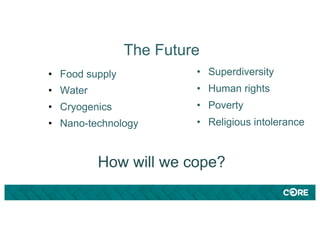
The Future
How will we cope?
• Food supply
• Water
• Cryogenics
• Nano-technology
• Superdiversity
• Human rights
• Poverty
• Religious intolerance
Take a few moments to
share any thoughts
about programmes you
offer in your school that
are designed to prepare
your students for this
future?
Future focused curriculum
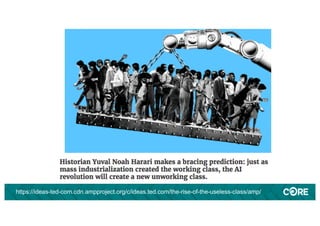
https://ideas-ted-com.cdn.ampproject.org/c/ideas.ted.com/the-rise-of-the-useless-class/amp/
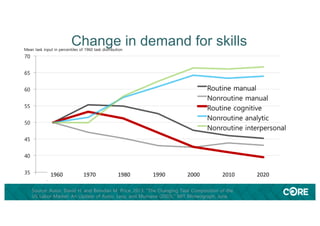
Change in demand for skills
35
40
45
50
55
60
65
70
1960 1970 1980 1990 2000 2006 2009
Routine manual
Nonroutine manual
Routine cognitive
Nonroutine analytic
Nonroutine interpersonal
Mean task input in percentiles of 1960 task distribution
1960 1970 1980 1990 2000 2010 2020
Source: Autor, David H. and Brendan M. Price. 2013. "The Changing Task Composition of the
US Labor Market: An Update of Autor, Levy, and Murnane (2003)." MIT Mimeograph, June.
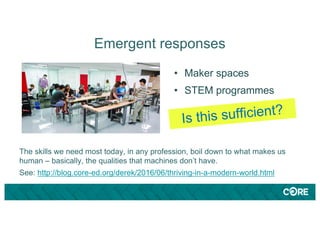
Emergent responses
• Maker spaces
• STEM programmes
The skills we need most today, in any profession, boil down to what makes us
human – basically, the qualities that machines don’t have.
See: http://blog.core-ed.org/derek/2016/06/thriving-in-a-modern-world.html
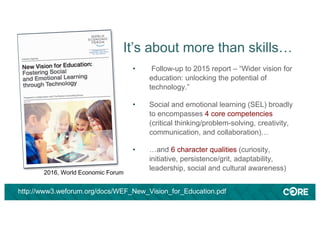
It’s about more than skills…
• Follow-up to 2015 report – “Wider vision for
education: unlocking the potential of
technology.”
• Social and emotional learning (SEL) broadly
to encompasses 4 core competencies
(critical thinking/problem-solving, creativity,
communication, and collaboration)…
• …and 6 character qualities (curiosity,
initiative, persistence/grit, adaptability,
leadership, social and cultural awareness)
http://www3.weforum.org/docs/WEF_New_Vision_for_Education.pdf
2016, World Economic Forum
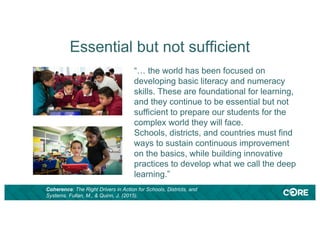
“… the world has been focused on
developing basic literacy and numeracy
skills. These are foundational for learning,
and they continue to be essential but not
sufficient to prepare our students for the
complex world they will face.
Schools, districts, and countries must find
ways to sustain continuous improvement
on the basics, while building innovative
practices to develop what we call the deep
learning.”
Coherence: The Right Drivers in Action for Schools, Districts, and
Systems. Fullan, M., & Quinn, J. (2015).
Essential but not sufficient
Share with each other
your thoughts in
response to this
question….
What is Deep learning?
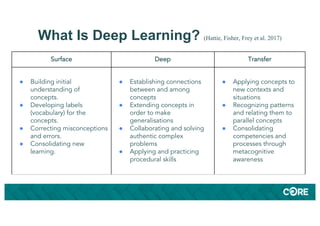
What Is Deep Learning? (Hattie, Fisher, Frey et al. 2017)
Surface Deep Transfer
● Building initial
understanding of
concepts.
● Developing labels
(vocabulary) for the
concepts.
● Correcting misconceptions
and errors.
● Consolidating new
learning.
● Establishing connections
between and among
concepts
● Extending concepts in
order to make
generalisations
● Collaborating and solving
authentic complex
problems
● Applying and practicing
procedural skills
● Applying concepts to
new contexts and
situations
● Recognizing patterns
and relating them to
parallel concepts
● Consolidating
competencies and
processes through
metacognitive
awareness
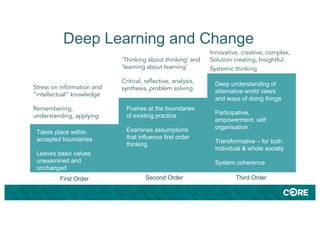
Deep Learning and Change
Takes place within
accepted boundaries
Leaves basic values
unexamined and
unchanged
First Order
Pushes at the boundaries
of existing practice
Examines assumptions
that influence first order
thinking
Second Order
Deep understanding of
alternative world views
and ways of doing things
Participative,
empowerment, self
organisation.
Transformative – for both
individual & whole society
System coherence
Third Order
Stress on information and
“intellectual” knowledge
Remembering,
understanding, applying
‘Thinking about thinking’ and
‘learning about learning’
Critical, reflective, analysis,
synthesis, problem solving.
Innovative, creative, complex,
Solution creating, Insightful.
Systemic thinking
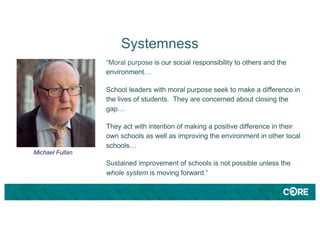
Systemness
“Moral purpose is our social responsibility to others and the
environment…
School leaders with moral purpose seek to make a difference in
the lives of students. They are concerned about closing the
gap…
They act with intention of making a positive difference in their
own schools as well as improving the environment in other local
schools…
Sustained improvement of schools is not possible unless the
whole system is moving forward.”
Michael Fullan
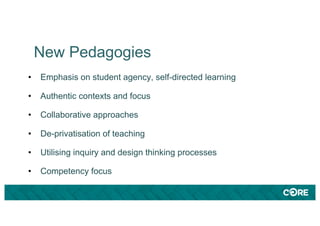
New Pedagogies
• Emphasis on student agency, self-directed learning
• Authentic contexts and focus
• Collaborative approaches
• De-privatisation of teaching
• Utilising inquiry and design thinking processes
• Competency focus
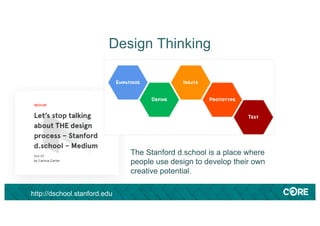
Design Thinking
http://dschool.stanford.edu
The Stanford d.school is a place where
people use design to develop their own
creative potential.
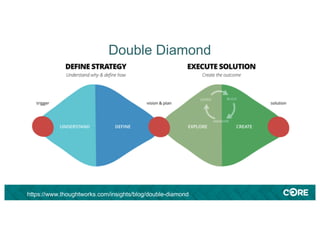
Double Diamond
https://www.thoughtworks.com/insights/blog/double-diamond
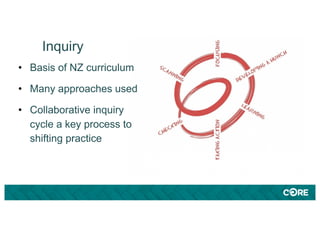
Inquiry
• Basis of NZ curriculum
• Many approaches used
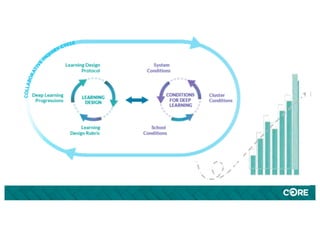
• Collaborative inquiry
cycle a key process to
shifting practice
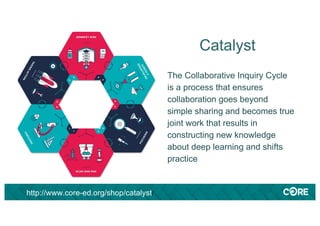
Catalyst
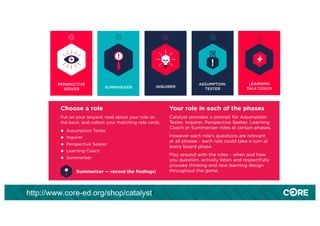
The Collaborative Inquiry Cycle
is a process that ensures
collaboration goes beyond
simple sharing and becomes true
joint work that results in
constructing new knowledge
about deep learning and shifts
practice
http://www.core-ed.org/shop/catalyst/
The teacher’s role
• Teacher as change agent
• Teacher as activator
• Figure out where individual student interests are
• Help students find their niche
• Leverage the learning
• Know whether learning is occurring
• Give defensible evidence
• Fundamental learning partnerships
• More of a collectivity – more complicated
• “That’s where the power is”
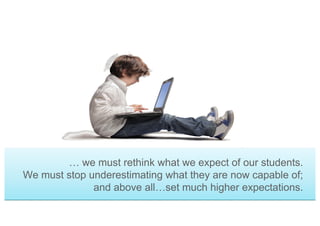
… we must rethink what we expect of our students.
We must stop underestimating what they are now capable of;
and above all…set much higher expectations.
derek.wenmoth@core-ed.org
@dwenmoth
http://www.wenmoth.net

Connect ed going deeper-share

  • 1.
    Going Deeper ConnectED conference Newcastle,May 2017 derek.wenmoth@core-ed.org @dwenmoth http://www.wenmoth.net
  • 2.
    Our changing world •Our world is changing and changing rapidly. • What must we do to prepare students for living and working in the 21st century? • How must our schools and teachers change to meet these opportunities and challenges?
  • 3.
    The Future How willwe cope? • Food supply • Water • Cryogenics • Nano-technology • Superdiversity • Human rights • Poverty • Religious intolerance
  • 4.
    Take a fewmoments to share any thoughts about programmes you offer in your school that are designed to prepare your students for this future? Future focused curriculum
  • 5.
  • 6.
    Change in demandfor skills 35 40 45 50 55 60 65 70 1960 1970 1980 1990 2000 2006 2009 Routine manual Nonroutine manual Routine cognitive Nonroutine analytic Nonroutine interpersonal Mean task input in percentiles of 1960 task distribution 1960 1970 1980 1990 2000 2010 2020 Source: Autor, David H. and Brendan M. Price. 2013. "The Changing Task Composition of the US Labor Market: An Update of Autor, Levy, and Murnane (2003)." MIT Mimeograph, June.
  • 7.
    Emergent responses • Makerspaces • STEM programmes The skills we need most today, in any profession, boil down to what makes us human – basically, the qualities that machines don’t have. See: http://blog.core-ed.org/derek/2016/06/thriving-in-a-modern-world.html
  • 8.
    It’s about morethan skills… • Follow-up to 2015 report – “Wider vision for education: unlocking the potential of technology.” • Social and emotional learning (SEL) broadly to encompasses 4 core competencies (critical thinking/problem-solving, creativity, communication, and collaboration)… • …and 6 character qualities (curiosity, initiative, persistence/grit, adaptability, leadership, social and cultural awareness) http://www3.weforum.org/docs/WEF_New_Vision_for_Education.pdf 2016, World Economic Forum
  • 9.
    “… the worldhas been focused on developing basic literacy and numeracy skills. These are foundational for learning, and they continue to be essential but not sufficient to prepare our students for the complex world they will face. Schools, districts, and countries must find ways to sustain continuous improvement on the basics, while building innovative practices to develop what we call the deep learning.” Coherence: The Right Drivers in Action for Schools, Districts, and Systems. Fullan, M., & Quinn, J. (2015). Essential but not sufficient
  • 10.
    Share with eachother your thoughts in response to this question…. What is Deep learning?
  • 11.
    What Is DeepLearning? (Hattie, Fisher, Frey et al. 2017) Surface Deep Transfer ● Building initial understanding of concepts. ● Developing labels (vocabulary) for the concepts. ● Correcting misconceptions and errors. ● Consolidating new learning. ● Establishing connections between and among concepts ● Extending concepts in order to make generalisations ● Collaborating and solving authentic complex problems ● Applying and practicing procedural skills ● Applying concepts to new contexts and situations ● Recognizing patterns and relating them to parallel concepts ● Consolidating competencies and processes through metacognitive awareness
  • 12.
    Deep Learning andChange Takes place within accepted boundaries Leaves basic values unexamined and unchanged First Order Pushes at the boundaries of existing practice Examines assumptions that influence first order thinking Second Order Deep understanding of alternative world views and ways of doing things Participative, empowerment, self organisation. Transformative – for both individual & whole society System coherence Third Order Stress on information and “intellectual” knowledge Remembering, understanding, applying ‘Thinking about thinking’ and ‘learning about learning’ Critical, reflective, analysis, synthesis, problem solving. Innovative, creative, complex, Solution creating, Insightful. Systemic thinking
  • 13.
    Systemness “Moral purpose isour social responsibility to others and the environment… School leaders with moral purpose seek to make a difference in the lives of students. They are concerned about closing the gap… They act with intention of making a positive difference in their own schools as well as improving the environment in other local schools… Sustained improvement of schools is not possible unless the whole system is moving forward.” Michael Fullan
  • 14.
    New Pedagogies • Emphasison student agency, self-directed learning • Authentic contexts and focus • Collaborative approaches • De-privatisation of teaching • Utilising inquiry and design thinking processes • Competency focus
  • 15.
    Design Thinking http://dschool.stanford.edu The Stanfordd.school is a place where people use design to develop their own creative potential.
  • 16.
  • 17.
    Inquiry • Basis ofNZ curriculum • Many approaches used • Collaborative inquiry cycle a key process to shifting practice
  • 18.
    Catalyst The Collaborative InquiryCycle is a process that ensures collaboration goes beyond simple sharing and becomes true joint work that results in constructing new knowledge about deep learning and shifts practice http://www.core-ed.org/shop/catalyst/
  • 19.
  • 21.
    The teacher’s role •Teacher as change agent • Teacher as activator • Figure out where individual student interests are • Help students find their niche • Leverage the learning • Know whether learning is occurring • Give defensible evidence • Fundamental learning partnerships • More of a collectivity – more complicated • “That’s where the power is”
  • 22.
    … we mustrethink what we expect of our students. We must stop underestimating what they are now capable of; and above all…set much higher expectations.
  • 23.