AMINOGLYCOSIDES
Dr. Mukundam Borah
Assistant Professor of Pharmacology
SMCH, Silchar
OBJECTIVES
At the end of the class, you should be able to ..
1.42.14 Explain aminoglycoside mechanisms of action and resistance.
1.42.15 Describe the advantages and disadvantages of multiple daily
dosing versus once daily extended-interval dosing regimens for
aminoglycosides.
1.42.16 Describe the rationale and the methods of plasma concentration
monitoring of aminoglycoside therapy.
1.42.17 Describe the causes and clinical signs of aminoglycoside
ototoxicity and nephrotoxicity and the best means of monitoring therapy to
avoid these serious toxicities.
1.42.18 Explain the unique clinical differences among the aminoglycosides.
COMMON FEATURES OF AMINOGLYCOSIDES
STRUCTURE
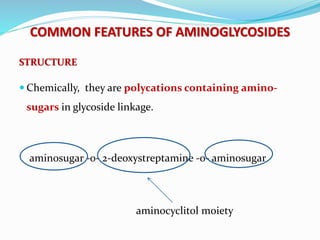
 Chemically, they are polycations containing amino-
sugars in glycoside linkage.
aminosugar -0- 2-deoxystreptamine -0- aminosugar
aminocyclitol moiety
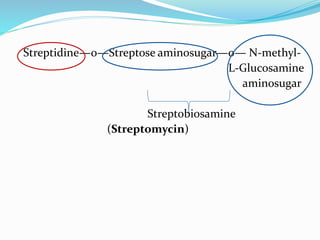
Streptidine—o—Streptose aminosugar—o— N-methyl-
L-Glucosamine
aminosugar
Streptobiosamine
(Streptomycin)
COMMON FEATURES OF AMINOGLYCOSIDES contd..
They are bactericidal and have maximum
activity in alkaline medium.
Simiar spectrum of activity and highly effective
aglinst Gram negative microorganisms.
Hiaghly polar and are not absorbed orally,
distributed extracellularly (mostly), and have
poor penetration into CSF and eyes.
 Excreted unchanged relatively rapidly by the kidneys by
glomerular filtration and dosage adjustment is a must in
renal impairment and elderly.
 Bacteria develop resistance fairly rapidly (with cross-
resistance).
 Exhibit synergism when combined with a beta-lactam
antibiotic.
 Cause nephrotoxicity and ototoxicity, along with curari
mimetic properties.
 Should be avoided in pregnancy.
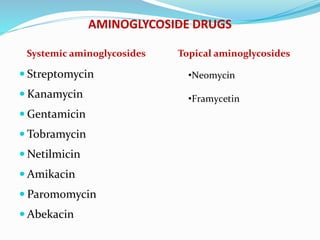
AMINOGLYCOSIDE DRUGS
Systemic aminoglycosides Topical aminoglycosides
 Streptomycin
 Kanamycin
 Gentamicin
 Tobramycin
 Netilmicin
 Amikacin
 Paromomycin
 Abekacin
•Neomycin
•Framycetin
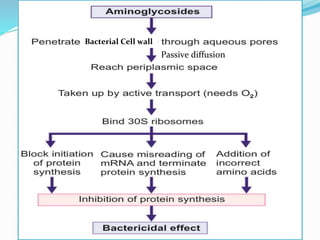
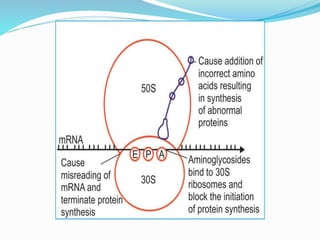
 1.42.14 Explain aminoglycoside mechanisms of
action
Passive diffusion
Bacterial Cell wall
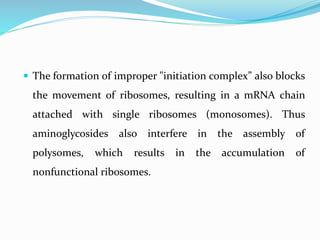
 The formation of improper "initiation complex” also blocks
the movement of ribosomes, resulting in a mRNA chain
attached with single ribosomes (monosomes). Thus
aminoglycosides also interfere in the assembly of
polysomes, which results in the accumulation of
nonfunctional ribosomes.
1.42.14 Explain aminoglycoside mechanisms of
resistance
ANTIBACTERIAL SPECTRUM
 Primarily directed against Gram-negative aerobic bacilli (E. coli,
Klebsiella, Shigella, Proteus, including Enterobacter and
Pseudomonas aeruginosa, except Salmonella).
 Most enterobacteriaçeae are sensitive to aminoglycosides. Only a
few Gram-positive cocci (aureus, Streptococcus viridans and
faecalis, not others) are inhibited by these drugs.
 Aminoglycosides are not effective against Gram-positive bacilli,
Gram negative cocci and anaerobes.
MECHANISMS OF RESISTANCE:
 Three principal mechanisms identified:
1. ‘R’ factor-mediated resistance: The conjugative
plasmids, that contain the r- gene transferred during
conjugation confers on the recipient cell the capacity to
synthesize specific enzymes which destroy the
aminoglycosides.
Synthesis of plasmid-mediated bacterial transferase
enzymes that can inactivate aminoglycosides by
acetylation, phosphorylation and adenylylation.
2. Due to decreased transport of aminoglycoside into the
bacterial cytosol.
3. By deletion or alteration of the receptor protein on 30S
ribosomal unit because of mutations to prevent
attachment of the drug with the 30S ribosomal
PHARMACOKINETICS
 Aminoglycosides are highly polar, basic and have very poor
oral bioavailability.
 Given parenterally (l.V. or l.M.) or applied locally (as
ointments or eye drops).
 These are poorly distributed insynovial, pleural and
peritoneal compartments and poorly protein bound.
 Aminoglycosides are not metabolized in the body, and are
excreted unchanged in urine by Glomerular filtration.
 Hence dose adjustment is needed to avoid toxicity in patients
with renal insufficiency.
 Dose in renal insufficiency = Regular therapeutic dose / Serum
creatinine value
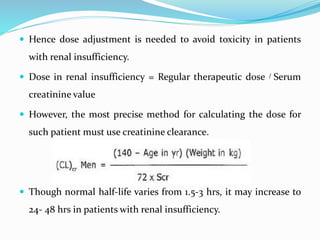
 However, the most precise method for calculating the dose for
such patient must use creatinine clearance.
 Though normal half-life varies from 1.5-3 hrs, it may increase to
24- 48 hrs in patients with renal insufficiency.
1.42.15 Describe the advantages and
disadvantages of multiple daily dosing versus
once daily extended-interval dosing regimens
for aminoglycosides
DOSING REGIMENS:
 For an average adult with normal renal function (CLcr > 70
ml/min), the usual doses are:
 Gentamicin/tobramycin/ 3- 5 mg/kg/day
sisomicin/netiImicin
 Streptomycin/ 7.5- 15 mg/kg/day
kanamycin/amikacin
 Considering the short t½ (2-4 hr) of aminoglycosides
the daily doses are conventionally divided into 3 equal
parts and injected i.m. (or i.v. slowly over 60 min)
every 8 hours.
 However, most authorities now recommend a single
total daily dose regimen for patients with normal
renal function.
Advantages of once daily extended-interval dosing regimens:
 They exhibit concentration dependent killing (CDK) and also
have a post antibiotic effect, depending on concentration.
 Increased concentration kills an increasing proportion of
bacteria at a rapid rate.(CDK)
 Post-antibiotic Effect (PAE): A persistent suppression of bacterial
growth after a brief exposure of an antimicrobial agent is known as
post-antibiotic effect (PAE).
 In PAE, the inhibition of bacterial growth is seen even when the
antibacterial agent is no longer present in the bacterial medium or
even when its concentration is well below MIC.
 Reduced incidence of ototoxicity and nephrotoxicity.
 Better patient compliance and Cost-effective .
Disdvantages of once daily extended-interval dosing
regimens:
 May require Therapeutic Drug Monitoring.
 Patients who are pregnant or have liver failure, severe renal
insufficiency, serious illness are not appropriate candidates
for once-daily dosing.
1.42.16 Describe the rationale and the methods of plasma
concentration
Monitoring of aminoglycoside therapy
For once daily injections, plasma trough concentrations are
measured which should be <1mcg/ml. Sample is collected after 2
hr and 12 hr following a dose.
Dose of aminoglycosides should be reduced in renal impairment.
Calculation:
Dose in renal insufficiency = Regular therapeutic dose / Serum
creatinine value
 PRECAUTIONS AND INTERACTIONS
 Avoid aminoglycosides during pregnancy due to risk of foetal
ototoxicity.
 Avoid concurrent use of other nephrotoxic drugs, e.g. NSAIDs,
amphotericin B, vancomycin, cyclosporine and cisplatin.
 Cautious use of other potentially ototoxic drugs like vancomycin,
minocycline and furosemide, though clinical evidence of
potentiated ototoxicity is meagre.
 Cautious use in patients >60 years age and in those with kidney
damage.
 Do not mix aminoglycoside with any drug in the same
syringe/infusion bottle.
ADVERSE DRUG REACTIONS
Neomycin, Kanamycin and Amikacin are the most ototoxic
(Cochlear toxicity) while Streptomycin and Gentamicin are the
most vestibulotoxic.
Neomycin, Tobramycin and Gentamicin are the most
nephrotoxic .
Neuromuscular Blockade
 The neuromuscular blockade is more with neomycin and
streptomycin as compared to amikacin, gentamicin,
tobramycin and netilmicin.
1.42.17 Describe the causes and clinical signs of aminoglycoside
ototoxicity and the best means of monitoring therapy to avoid
these serious toxicities
OTOTOXICITY CLINICAL SIGNS:
 Dependent on the drug, dose and duration of therapy
 Greater in infants, elderly and in renal impaired .
 High concentrations are found in the endolymph and perilymph
of the inner ear  cochlear or vestibular dysfunction or both
 Reversible or irreversible.
 Cochlear damage:
Hearing loss affects the high frequency sound first, then
progressively encompasses the lower frequencies.
Initially, the cochlear toxicity is asymptomatic and can be
detected only by audiometry.
Tinnitus then appears, followed by progressive hearing loss.
On stopping the drug, tinnitus disappears in 4--10 days, but
frequency loss persists.
 Vestibular damage:
 Headache is usually first to appear, followed by nausea,
vomiting, dizziness, nystagmus, vertigo and ataxia.
 When the drug is stopped at this stage, it passes into a
chronic phase lasting 6 to IO weeks in which the patient is
asymptomatic while in bed and has difficulty only during
walking.
 Compensation by visual and proprioceptive positioning
tends to allay symptoms and recovery (often incomplete)
occurs over 1-2 years.
1.42.17 Describe the causes and clinical signs of aminoglycoside
nephrotoxicity and the best means of monitoring therapy to avoid
these serious toxicities
Nephrotoxicity :
 Accumulate in the proximal tubular cells and cause damage to
them.
 Also reduce the sensitivity of the collecting ducts to vasopressin.
Nephrotoxicity Clinical signs:
 Mild albuminuria, cylindruria (renal casts), or acute tubular
necrosis (rarely azotemia)
Nephrotoxicity monitoring:
 Dosage adjustment in renal insufficiency.
 Withdrawal causes reversal.
INDIVIDUAL DRUGS AND CLNICAL USES
1. GENTAMICIN
 Currently, it is the most commonly used aminoglycoside for
acute infections and may be considered prototype of the class.
 Because of low therapeutic index, its use should be restricted to
serious gram-negative bacillary infections.
USES:
1. Gentamicin is very valuable for preventing and treating
respiratory infections in critically-ill patients,
postoperative pneumonias; patients with implants and in
intensive care units.
 It is mostly combined with a penicillin/cephalosporin or
another antibiotic in these situations.
 Aminoglycosides should not be used to treat community
acquired pneumonias (CAPs) which are mostly caused
by gram-positive cocci and anaerobes.
2. Pseudomonas, Proteus or Klebsiella infections:
 Burns, urinary tract infection, pneumonia, lung abscesses,
osteomyelitis, middle ear infection, septicaemia, etc.,
caused mostly by the above bacteria are an important area
of use of gentamicin. It may be combined with piperacillin
or a third generation cephalosporin for serious infections.
3. Meningitis caused by gram negative bacilli:
 Third generation cephalosporin with an aminoglycoside are
favoured for this purpose.
4. Subacute bacterial endocarditis (SABE):
Gentamicin (1 mg/kg 8 hourly i.m.) is generally combined
with penicillin/ampicillin/vancomycin.
STREPTOMYCIN
 Ribosomal resistance to streptomycin develops fast, which has
limited its usefulness as a single agent except for few indications .
 Uses:
I. Tuberculosis .
2. Subacute bacterial endocarditis (SABE)
3. Plague: Streptomycin is rapidly curative (in 7- 12 days).
Given alone or combined with a tetracycline. it is employed
only in confirmed cases.
4. Tularemia: Streptomycin is the drug of choice for this rare
disease; effects cure in 7-10 days. Tetracyclines arc the
alternative drugs, especially in milder cases.
Tobramycin
 It is 2-4 times more active than gentamicin against
Pseudomonas and Proteus.
 However, tobramycin is not useful for combining with
penicillin in the treatment of enterococcal endocarditis.
Kanamycin
 Similar to streptomycin in all respects but is more toxic.
 Kanamycin is occasionally used as a Second line drug in
resistant tuberculosis.
AMIKACIN
 It is a semisynthetic derivative of kanamycin to which it
resembles in pharmacokinetics, dose and toxicity.
 The outstanding feature of amikacin is its resistance to
bacterial aminoglycoside modifying enzymes. Thus, it has
the widest spectrum of activity.
 The range of conditions in which amikacin can be used is
the same as for gentamicin.
 It is recommended as a reserve drug for empirical
treatment of hospital acquired gram-negative bacillary
infections.
 Amikacin is also used for multidrug resistant TB.
NEOMYCIN
 Obtained from S. fradiae, it is a wide-spectrum aminoglycoside
active against most gram negative bacilli and some gram-positive
cocci.
 However, Pseudomonas and Strep. Pyogenes are not sensitive.
 Because of ototoxicity and nephrotoxicity, not used systemically.
 Absorption from the g.i.t. is minimal. Oral and topical
administration does not ordinarily cause systemic toxicity.
 Dose: 0.25- 1 g Q ID oral, 0.3--0.5% topical.
 Uses
I. Topically (often in combination with polymyxin, bacitracin
etc.) for infected wound, ulcers, burn, external ear infections,
conjunctivitis.
II. Used orally as preoperative intestinal antiseptic (1 g TDS or
QID) a day before surgery along with erythromycin (250 mg
QID) to reduce aerobic bowel flora.
III. Neomycin (1 g TDS or QID with reduced protein intake) is
useful in hepatic coma, as it suppresses ammonia-producing
coliform bacterial flora. Blood ammonia levels therefore get
decreased and encephalopathy is thus prevented.
 Adverse effects
 Oral neomycin for prolonged time has a damaging effect
on intestinal villi.
 Due to marked suppression of gut flora superinfection by
Candida can occur.
 Contraindicated if renal function is impaired.
Framycetin
 Ointment is used for skin infections, otitis externa,
furunculosis, burns and scalds. Eye drops are used for
ophthalmic infections.
ARBEKACIN
 It is a semisynthetic aminoglycoside of the kanamycin
family.
 It has a broad spectrum activity covering many gram +ive
and gram -ve bacteria including MRSA, E. coli,
P.aeruginosa. K. pneumoniae, etc. and is stable to many
commonly occurring aminoglycoside modifying enzymes,
confering activity against many bacteria resistant to
gentamicin and tobramycin.
 It synergises with B-lactam antibiotics, and the combination
may be useful in treating multidrug resistant Pseudomonas
and Acinetobacter infections.
 Dose: 1- 3 mg/kg/day i.m. or slow i.v. injection.
PAROMOMYCIN
 Paromomycin (1 g QID orally for 2 weeks) can be used to
treat Intestinal amoebiasis.
 It is also used orally to treat cryptosporidiosis in
immunocompromised patients.
1.42.18 Explain the unique clinical differences
among the aminoglycosides
 Streptomycin is bacteriostatic in low and bactericidal in
high concentrations.
 Kanamycin is used in MDR & XDR TB but is much more
toxic.
 Gentamycin acts synergistically with beta-lactam
antibiotics and metronidazole. Its urinary concentration is
50-100 times that in plasma.
 Tetracycline and chloramphenicol to be avoided with
gentamicin as they reduce its therapeutic efficacy.
 Tobramycin is highly active against Pseudomonas, relatively
less toxic.
 Amikacin has the broadest spectrum antibacterial activity;
is expensive and is usually reserved for hospital-acquired
Gram-negative infections and in MDR TB.
 Neomycin is administered orally for sterilization of bowels
prior to surgery (though is poorly absorbed orally); not used
systemically due to more severe ADRs.
THANK YOU

Aminoglycosides Dr Mukundam.pptx

  • 1.
    AMINOGLYCOSIDES Dr. Mukundam Borah AssistantProfessor of Pharmacology SMCH, Silchar
  • 2.
    OBJECTIVES At the endof the class, you should be able to .. 1.42.14 Explain aminoglycoside mechanisms of action and resistance. 1.42.15 Describe the advantages and disadvantages of multiple daily dosing versus once daily extended-interval dosing regimens for aminoglycosides. 1.42.16 Describe the rationale and the methods of plasma concentration monitoring of aminoglycoside therapy. 1.42.17 Describe the causes and clinical signs of aminoglycoside ototoxicity and nephrotoxicity and the best means of monitoring therapy to avoid these serious toxicities. 1.42.18 Explain the unique clinical differences among the aminoglycosides.
  • 3.
    COMMON FEATURES OFAMINOGLYCOSIDES STRUCTURE  Chemically, they are polycations containing amino- sugars in glycoside linkage. aminosugar -0- 2-deoxystreptamine -0- aminosugar aminocyclitol moiety
  • 4.
  • 5.
    COMMON FEATURES OFAMINOGLYCOSIDES contd.. They are bactericidal and have maximum activity in alkaline medium. Simiar spectrum of activity and highly effective aglinst Gram negative microorganisms. Hiaghly polar and are not absorbed orally, distributed extracellularly (mostly), and have poor penetration into CSF and eyes.
  • 6.
     Excreted unchangedrelatively rapidly by the kidneys by glomerular filtration and dosage adjustment is a must in renal impairment and elderly.  Bacteria develop resistance fairly rapidly (with cross- resistance).  Exhibit synergism when combined with a beta-lactam antibiotic.  Cause nephrotoxicity and ototoxicity, along with curari mimetic properties.  Should be avoided in pregnancy.
  • 7.
    AMINOGLYCOSIDE DRUGS Systemic aminoglycosidesTopical aminoglycosides  Streptomycin  Kanamycin  Gentamicin  Tobramycin  Netilmicin  Amikacin  Paromomycin  Abekacin •Neomycin •Framycetin
  • 8.
     1.42.14 Explainaminoglycoside mechanisms of action
  • 9.
  • 10.
     The formationof improper "initiation complex” also blocks the movement of ribosomes, resulting in a mRNA chain attached with single ribosomes (monosomes). Thus aminoglycosides also interfere in the assembly of polysomes, which results in the accumulation of nonfunctional ribosomes.
  • 12.
    1.42.14 Explain aminoglycosidemechanisms of resistance ANTIBACTERIAL SPECTRUM  Primarily directed against Gram-negative aerobic bacilli (E. coli, Klebsiella, Shigella, Proteus, including Enterobacter and Pseudomonas aeruginosa, except Salmonella).  Most enterobacteriaçeae are sensitive to aminoglycosides. Only a few Gram-positive cocci (aureus, Streptococcus viridans and faecalis, not others) are inhibited by these drugs.  Aminoglycosides are not effective against Gram-positive bacilli, Gram negative cocci and anaerobes.
  • 13.
    MECHANISMS OF RESISTANCE: Three principal mechanisms identified: 1. ‘R’ factor-mediated resistance: The conjugative plasmids, that contain the r- gene transferred during conjugation confers on the recipient cell the capacity to synthesize specific enzymes which destroy the aminoglycosides. Synthesis of plasmid-mediated bacterial transferase enzymes that can inactivate aminoglycosides by acetylation, phosphorylation and adenylylation.
  • 14.
    2. Due todecreased transport of aminoglycoside into the bacterial cytosol. 3. By deletion or alteration of the receptor protein on 30S ribosomal unit because of mutations to prevent attachment of the drug with the 30S ribosomal
  • 15.
    PHARMACOKINETICS  Aminoglycosides arehighly polar, basic and have very poor oral bioavailability.  Given parenterally (l.V. or l.M.) or applied locally (as ointments or eye drops).  These are poorly distributed insynovial, pleural and peritoneal compartments and poorly protein bound.  Aminoglycosides are not metabolized in the body, and are excreted unchanged in urine by Glomerular filtration.
  • 16.
     Hence doseadjustment is needed to avoid toxicity in patients with renal insufficiency.  Dose in renal insufficiency = Regular therapeutic dose / Serum creatinine value  However, the most precise method for calculating the dose for such patient must use creatinine clearance.  Though normal half-life varies from 1.5-3 hrs, it may increase to 24- 48 hrs in patients with renal insufficiency.
  • 17.
    1.42.15 Describe theadvantages and disadvantages of multiple daily dosing versus once daily extended-interval dosing regimens for aminoglycosides
  • 18.
    DOSING REGIMENS:  Foran average adult with normal renal function (CLcr > 70 ml/min), the usual doses are:  Gentamicin/tobramycin/ 3- 5 mg/kg/day sisomicin/netiImicin  Streptomycin/ 7.5- 15 mg/kg/day kanamycin/amikacin  Considering the short t½ (2-4 hr) of aminoglycosides the daily doses are conventionally divided into 3 equal parts and injected i.m. (or i.v. slowly over 60 min) every 8 hours.  However, most authorities now recommend a single total daily dose regimen for patients with normal renal function.
  • 19.
    Advantages of oncedaily extended-interval dosing regimens:  They exhibit concentration dependent killing (CDK) and also have a post antibiotic effect, depending on concentration.  Increased concentration kills an increasing proportion of bacteria at a rapid rate.(CDK)  Post-antibiotic Effect (PAE): A persistent suppression of bacterial growth after a brief exposure of an antimicrobial agent is known as post-antibiotic effect (PAE).  In PAE, the inhibition of bacterial growth is seen even when the antibacterial agent is no longer present in the bacterial medium or even when its concentration is well below MIC.
  • 20.
     Reduced incidenceof ototoxicity and nephrotoxicity.  Better patient compliance and Cost-effective . Disdvantages of once daily extended-interval dosing regimens:  May require Therapeutic Drug Monitoring.  Patients who are pregnant or have liver failure, severe renal insufficiency, serious illness are not appropriate candidates for once-daily dosing.
  • 21.
    1.42.16 Describe therationale and the methods of plasma concentration Monitoring of aminoglycoside therapy For once daily injections, plasma trough concentrations are measured which should be <1mcg/ml. Sample is collected after 2 hr and 12 hr following a dose. Dose of aminoglycosides should be reduced in renal impairment. Calculation: Dose in renal insufficiency = Regular therapeutic dose / Serum creatinine value
  • 22.
     PRECAUTIONS ANDINTERACTIONS  Avoid aminoglycosides during pregnancy due to risk of foetal ototoxicity.  Avoid concurrent use of other nephrotoxic drugs, e.g. NSAIDs, amphotericin B, vancomycin, cyclosporine and cisplatin.  Cautious use of other potentially ototoxic drugs like vancomycin, minocycline and furosemide, though clinical evidence of potentiated ototoxicity is meagre.  Cautious use in patients >60 years age and in those with kidney damage.  Do not mix aminoglycoside with any drug in the same syringe/infusion bottle.
  • 23.
    ADVERSE DRUG REACTIONS Neomycin,Kanamycin and Amikacin are the most ototoxic (Cochlear toxicity) while Streptomycin and Gentamicin are the most vestibulotoxic. Neomycin, Tobramycin and Gentamicin are the most nephrotoxic . Neuromuscular Blockade  The neuromuscular blockade is more with neomycin and streptomycin as compared to amikacin, gentamicin, tobramycin and netilmicin.
  • 24.
    1.42.17 Describe thecauses and clinical signs of aminoglycoside ototoxicity and the best means of monitoring therapy to avoid these serious toxicities OTOTOXICITY CLINICAL SIGNS:  Dependent on the drug, dose and duration of therapy  Greater in infants, elderly and in renal impaired .  High concentrations are found in the endolymph and perilymph of the inner ear  cochlear or vestibular dysfunction or both  Reversible or irreversible.
  • 25.
     Cochlear damage: Hearingloss affects the high frequency sound first, then progressively encompasses the lower frequencies. Initially, the cochlear toxicity is asymptomatic and can be detected only by audiometry. Tinnitus then appears, followed by progressive hearing loss. On stopping the drug, tinnitus disappears in 4--10 days, but frequency loss persists.
  • 26.
     Vestibular damage: Headache is usually first to appear, followed by nausea, vomiting, dizziness, nystagmus, vertigo and ataxia.  When the drug is stopped at this stage, it passes into a chronic phase lasting 6 to IO weeks in which the patient is asymptomatic while in bed and has difficulty only during walking.  Compensation by visual and proprioceptive positioning tends to allay symptoms and recovery (often incomplete) occurs over 1-2 years.
  • 27.
    1.42.17 Describe thecauses and clinical signs of aminoglycoside nephrotoxicity and the best means of monitoring therapy to avoid these serious toxicities Nephrotoxicity :  Accumulate in the proximal tubular cells and cause damage to them.  Also reduce the sensitivity of the collecting ducts to vasopressin. Nephrotoxicity Clinical signs:  Mild albuminuria, cylindruria (renal casts), or acute tubular necrosis (rarely azotemia) Nephrotoxicity monitoring:  Dosage adjustment in renal insufficiency.  Withdrawal causes reversal.
  • 28.
    INDIVIDUAL DRUGS ANDCLNICAL USES 1. GENTAMICIN  Currently, it is the most commonly used aminoglycoside for acute infections and may be considered prototype of the class.  Because of low therapeutic index, its use should be restricted to serious gram-negative bacillary infections.
  • 29.
    USES: 1. Gentamicin isvery valuable for preventing and treating respiratory infections in critically-ill patients, postoperative pneumonias; patients with implants and in intensive care units.  It is mostly combined with a penicillin/cephalosporin or another antibiotic in these situations.  Aminoglycosides should not be used to treat community acquired pneumonias (CAPs) which are mostly caused by gram-positive cocci and anaerobes.
  • 30.
    2. Pseudomonas, Proteusor Klebsiella infections:  Burns, urinary tract infection, pneumonia, lung abscesses, osteomyelitis, middle ear infection, septicaemia, etc., caused mostly by the above bacteria are an important area of use of gentamicin. It may be combined with piperacillin or a third generation cephalosporin for serious infections. 3. Meningitis caused by gram negative bacilli:  Third generation cephalosporin with an aminoglycoside are favoured for this purpose.
  • 31.
    4. Subacute bacterialendocarditis (SABE): Gentamicin (1 mg/kg 8 hourly i.m.) is generally combined with penicillin/ampicillin/vancomycin. STREPTOMYCIN  Ribosomal resistance to streptomycin develops fast, which has limited its usefulness as a single agent except for few indications .  Uses: I. Tuberculosis . 2. Subacute bacterial endocarditis (SABE)
  • 32.
    3. Plague: Streptomycinis rapidly curative (in 7- 12 days). Given alone or combined with a tetracycline. it is employed only in confirmed cases. 4. Tularemia: Streptomycin is the drug of choice for this rare disease; effects cure in 7-10 days. Tetracyclines arc the alternative drugs, especially in milder cases.
  • 33.
    Tobramycin  It is2-4 times more active than gentamicin against Pseudomonas and Proteus.  However, tobramycin is not useful for combining with penicillin in the treatment of enterococcal endocarditis. Kanamycin  Similar to streptomycin in all respects but is more toxic.  Kanamycin is occasionally used as a Second line drug in resistant tuberculosis.
  • 34.
    AMIKACIN  It isa semisynthetic derivative of kanamycin to which it resembles in pharmacokinetics, dose and toxicity.  The outstanding feature of amikacin is its resistance to bacterial aminoglycoside modifying enzymes. Thus, it has the widest spectrum of activity.  The range of conditions in which amikacin can be used is the same as for gentamicin.  It is recommended as a reserve drug for empirical treatment of hospital acquired gram-negative bacillary infections.  Amikacin is also used for multidrug resistant TB.
  • 35.
    NEOMYCIN  Obtained fromS. fradiae, it is a wide-spectrum aminoglycoside active against most gram negative bacilli and some gram-positive cocci.  However, Pseudomonas and Strep. Pyogenes are not sensitive.  Because of ototoxicity and nephrotoxicity, not used systemically.  Absorption from the g.i.t. is minimal. Oral and topical administration does not ordinarily cause systemic toxicity.  Dose: 0.25- 1 g Q ID oral, 0.3--0.5% topical.
  • 36.
     Uses I. Topically(often in combination with polymyxin, bacitracin etc.) for infected wound, ulcers, burn, external ear infections, conjunctivitis. II. Used orally as preoperative intestinal antiseptic (1 g TDS or QID) a day before surgery along with erythromycin (250 mg QID) to reduce aerobic bowel flora. III. Neomycin (1 g TDS or QID with reduced protein intake) is useful in hepatic coma, as it suppresses ammonia-producing coliform bacterial flora. Blood ammonia levels therefore get decreased and encephalopathy is thus prevented.
  • 37.
     Adverse effects Oral neomycin for prolonged time has a damaging effect on intestinal villi.  Due to marked suppression of gut flora superinfection by Candida can occur.  Contraindicated if renal function is impaired. Framycetin  Ointment is used for skin infections, otitis externa, furunculosis, burns and scalds. Eye drops are used for ophthalmic infections.
  • 38.
    ARBEKACIN  It isa semisynthetic aminoglycoside of the kanamycin family.  It has a broad spectrum activity covering many gram +ive and gram -ve bacteria including MRSA, E. coli, P.aeruginosa. K. pneumoniae, etc. and is stable to many commonly occurring aminoglycoside modifying enzymes, confering activity against many bacteria resistant to gentamicin and tobramycin.
  • 39.
     It synergiseswith B-lactam antibiotics, and the combination may be useful in treating multidrug resistant Pseudomonas and Acinetobacter infections.  Dose: 1- 3 mg/kg/day i.m. or slow i.v. injection. PAROMOMYCIN  Paromomycin (1 g QID orally for 2 weeks) can be used to treat Intestinal amoebiasis.  It is also used orally to treat cryptosporidiosis in immunocompromised patients.
  • 40.
    1.42.18 Explain theunique clinical differences among the aminoglycosides  Streptomycin is bacteriostatic in low and bactericidal in high concentrations.  Kanamycin is used in MDR & XDR TB but is much more toxic.  Gentamycin acts synergistically with beta-lactam antibiotics and metronidazole. Its urinary concentration is 50-100 times that in plasma.  Tetracycline and chloramphenicol to be avoided with gentamicin as they reduce its therapeutic efficacy.
  • 41.
     Tobramycin ishighly active against Pseudomonas, relatively less toxic.  Amikacin has the broadest spectrum antibacterial activity; is expensive and is usually reserved for hospital-acquired Gram-negative infections and in MDR TB.  Neomycin is administered orally for sterilization of bowels prior to surgery (though is poorly absorbed orally); not used systemically due to more severe ADRs.
  • 42.

Editor's Notes

  • #14 Plasmids are actually vectors serving as a carriers of DNA molecule. Extrachromosomal genetic elements, that can replicate independently and freely in cytoplasm. Plasmids which carry genes resistant to antibiotics (r-genes) are called R-plasmids. These r-genes can get readily transferred from one R-plasmid to another plasmid or to chromosome. Much of the drug resistance encountered in clinical practice is plasmid mediated. These enzymes are 6’-acetyltransferase, 2’-phosphotransferase, 3’- phosphotransferase and 4’-adenylyltransferase
  • #15 2. This may result from mutation or deletion of porin channel or proteins involved in transport or by making the oxygen + energy-dependent transport system nonfunctional
  • #17 because aminoglycoside clearance is directly proportion This formula is scaled down to 85% for females. (CL)cr Women al to his creatinine clearance value.
  • #20 PAE, therefore, reflects the time required for the bacteria to return to normal growth. The longer the time the bacteria needs for return to logarithmic growth (after an exposure to antimicrobial agent), the greater is the PAE of that antibiotic.
  • #21 Stankowicz MS, Ibrahim J, Brown DL. Once-daily aminoglycoside dosing: An update on current literature. Am J Health Syst Pharm. 2015 Aug 15;72(16):1357-64. doi: 10.2146/ajhp140564. PMID: 26246292.
  • #24  Aminoglycosides can cause neuromuscular junction blockade, by blocking postsynaptic NM receptor and by inhibiting Ca2+ mediated release of acetylcholine from cholinergic neurons. This is usually relevant in patients of myasthenia gravis only or in situations where some other skeletal muscle relaxant is to be coadministered (as the blockade may be aggravated). The neuromuscular blockade can be reversed by an administration of I.V. calcium gluconate or l.M. neostigmine.
  • #28 Promotes absorption of water and electrolytes from distal tubules
  • #33 A zoonotic diseasecaused by francisella tularensis. Direct ontact with infected rodents. Skin ulcer, lymphogranuloma, pneumonia
  • #38 Superinfection: This refers to the appearance of a new infection as a result of antimicrobial therapy. The normal flora contributes to host defence by elaborating substances cal led bacteriocins which inhibit pathogenic organisms. Further, ordinarily, the pathogen has to compete with the normal flora for nutrients, etc. to establish itself. Lack of competition may allow even a normally nonpathogenic component of the flora (e.g. Candida), which is not inhibited by the drug to predominate and invade. Old age, DM, Leukaemia, Aids