Mini Project – I
CONFORMAL MAPPING
Made by –
IT-B-46 ANKIT SINGH
IT-B-47 GAURAV SINGH
IT-B-48 PRASHANT SINGH
IT-B-49 PRATHMESH SINGH
IT-B-50 AMEY SONAWANE
Consider γ : [a , b] → ℂ as a smooth curve in a domain D. Let f (z) be a function
defined at all points z on γ . Let C denotes the image of γ under the transformation w = f (z). The
parametric equation of C is given by (t) = w(t) = f (γ(t)), t ∈ [a , b].
 Suppose that γ passes through z0 = (t0); (a < t0 < b) at which f is analytic and f'(z0) ≠ 0. Then
w' (t0) = f' (γ(t0))γ' (t0) = f' (z0)γ' (t0).
 That means
arg w' (t0) = arg f' (z0) + arg γ' (t0).
 Let C1 , C2 : [a , b] → ℂ be two smooth curves in a domain D passing through z0 . Then by
above we have
arg w1’ (t0 ) = arg f’ (z0 ) + arg C1’ (t0 ) and arg w2’ (t0 ) = arg f’ (z0 ) + arg C2’ (t0 ).
 That means
arg w2’ (t0 ) − arg w1’ (t0 ) = arg C2’ (t0 ) − arg C1’ (t0 ).
Definition
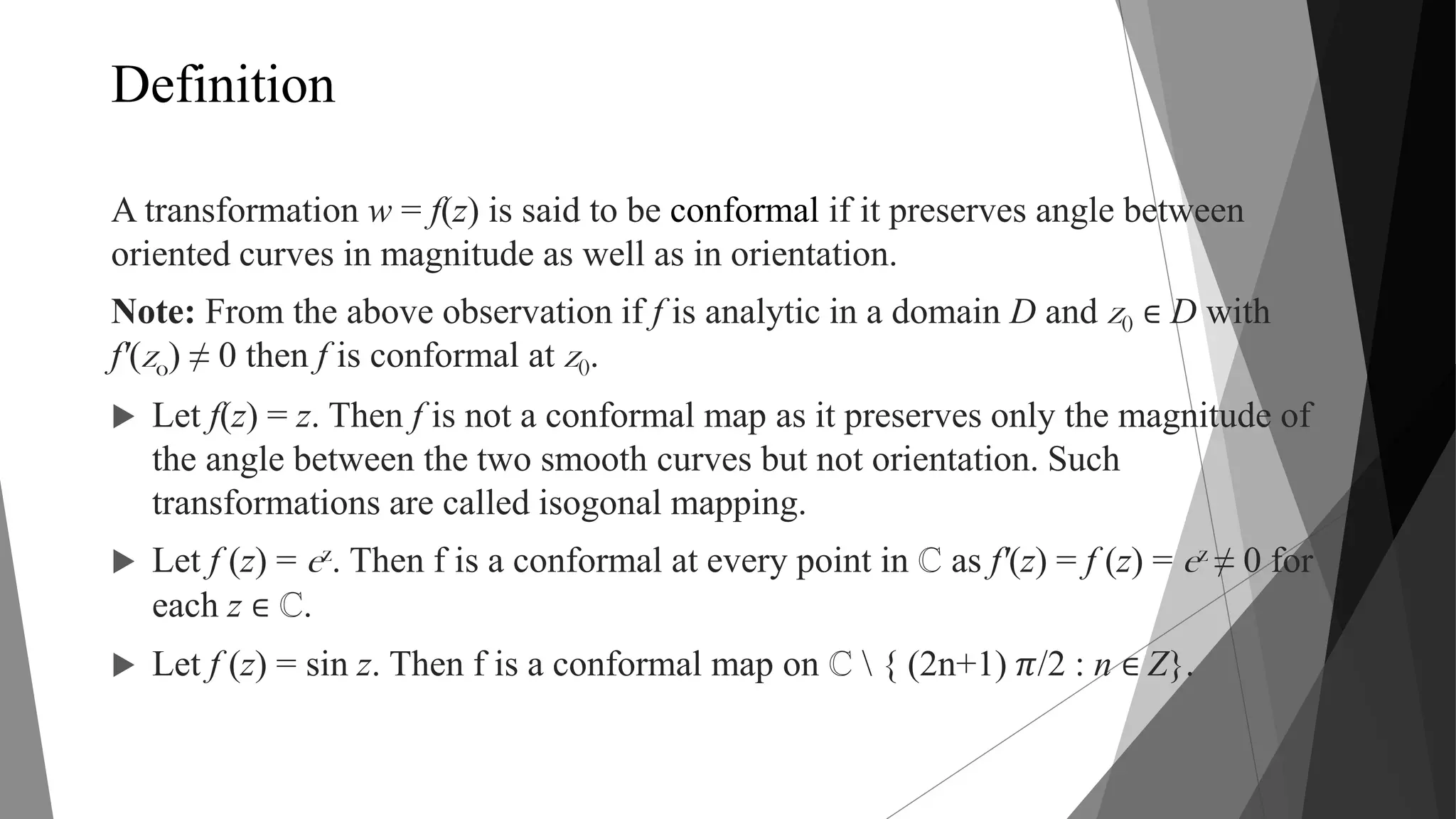
A transformation w = f(z) is said to be conformal if it preserves angle between
oriented curves in magnitude as well as in orientation.
Note: From the above observation if f is analytic in a domain D and z0 ∈ D with
f'(zo) ≠ 0 then f is conformal at z0.
 Let f(z) = z. Then f is not a conformal map as it preserves only the magnitude of
the angle between the two smooth curves but not orientation. Such
transformations are called isogonal mapping.
 Let f (z) = ez. Then f is a conformal at every point in ℂ as f'(z) = f (z) = ez ≠ 0 for
each z ∈ ℂ.
 Let f (z) = sin z. Then f is a conformal map on ℂ  { (2n+1) 𝜋/2 : n ∈ Z}.
Some Examples
Ex. 1: -
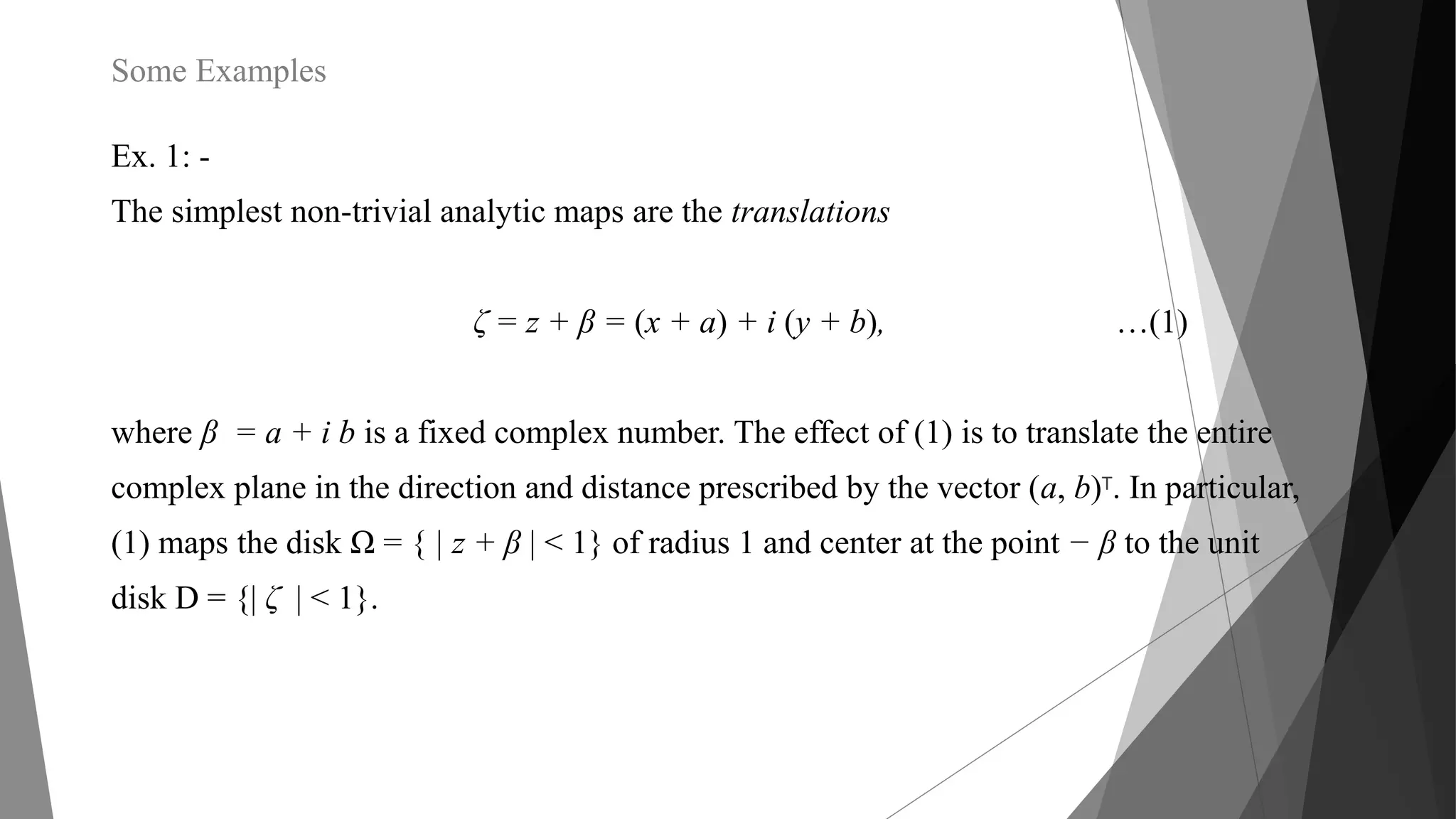
The simplest non-trivial analytic maps are the translations
ζ = z + β = (x + a) + i (y + b), …(1)
where β = a + i b is a fixed complex number. The effect of (1) is to translate the entire
complex plane in the direction and distance prescribed by the vector (a, b)T. In particular,
(1) maps the disk Ω = { | z + β | < 1} of radius 1 and center at the point − β to the unit
disk D = {| ζ | < 1}.
Ex. 2: -
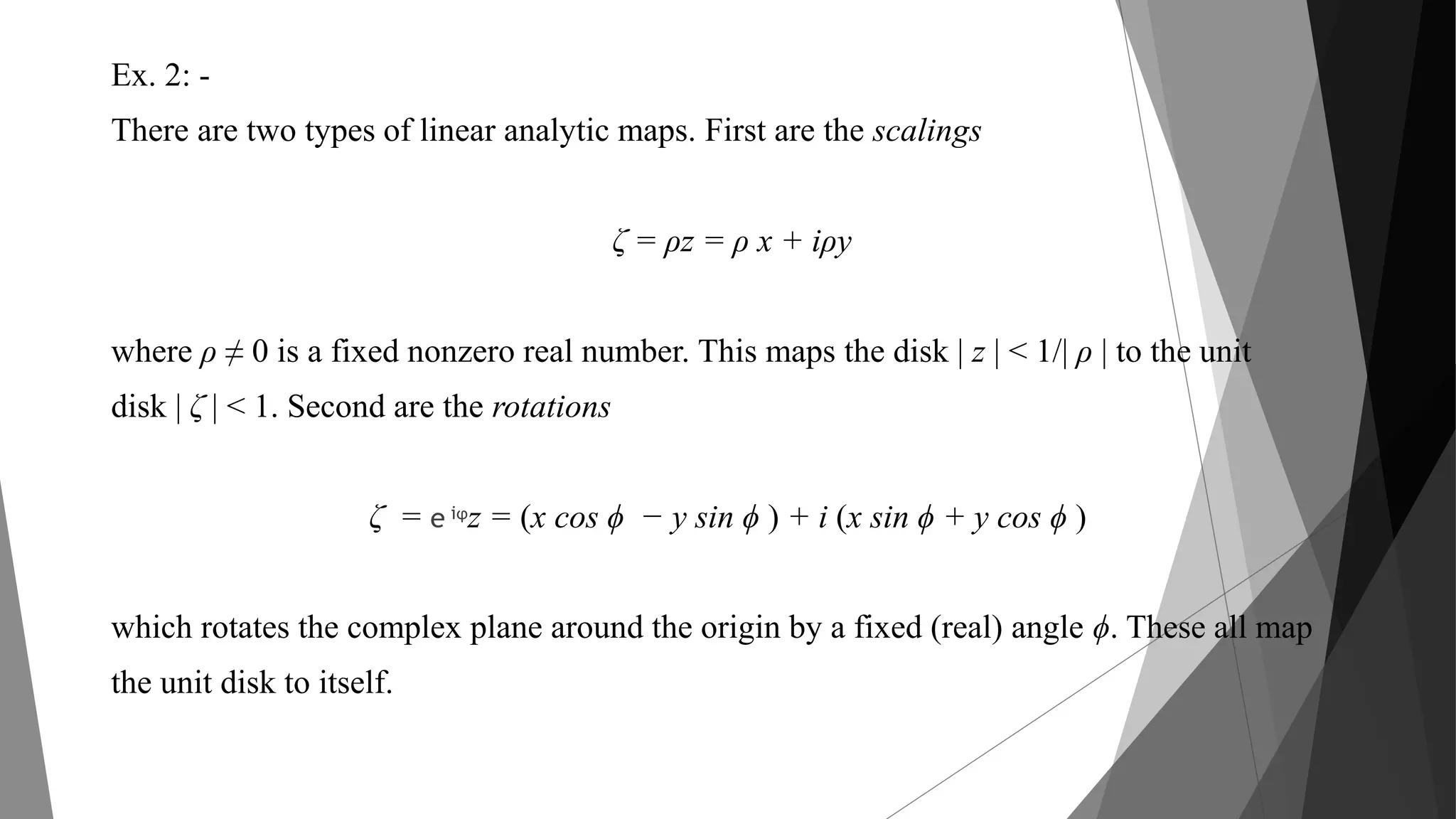
There are two types of linear analytic maps. First are the scalings
ζ = ρz = ρ x + iρy
where ρ ≠ 0 is a fixed nonzero real number. This maps the disk | z | < 1/| ρ | to the unit
disk | ζ | < 1. Second are the rotations
ζ = e iϕz = (x cos ϕ − y sin ϕ ) + i (x sin ϕ + y cos ϕ )
which rotates the complex plane around the origin by a fixed (real) angle ϕ. These all map
the unit disk to itself.
The End
THANK YOU

Conformal mapping

  • 1.
    Mini Project –I CONFORMAL MAPPING Made by – IT-B-46 ANKIT SINGH IT-B-47 GAURAV SINGH IT-B-48 PRASHANT SINGH IT-B-49 PRATHMESH SINGH IT-B-50 AMEY SONAWANE
  • 2.
    Consider γ :[a , b] → ℂ as a smooth curve in a domain D. Let f (z) be a function defined at all points z on γ . Let C denotes the image of γ under the transformation w = f (z). The parametric equation of C is given by (t) = w(t) = f (γ(t)), t ∈ [a , b].  Suppose that γ passes through z0 = (t0); (a < t0 < b) at which f is analytic and f'(z0) ≠ 0. Then w' (t0) = f' (γ(t0))γ' (t0) = f' (z0)γ' (t0).  That means arg w' (t0) = arg f' (z0) + arg γ' (t0).
  • 3.
     Let C1, C2 : [a , b] → ℂ be two smooth curves in a domain D passing through z0 . Then by above we have arg w1’ (t0 ) = arg f’ (z0 ) + arg C1’ (t0 ) and arg w2’ (t0 ) = arg f’ (z0 ) + arg C2’ (t0 ).  That means arg w2’ (t0 ) − arg w1’ (t0 ) = arg C2’ (t0 ) − arg C1’ (t0 ).
  • 4.
    Definition A transformation w= f(z) is said to be conformal if it preserves angle between oriented curves in magnitude as well as in orientation. Note: From the above observation if f is analytic in a domain D and z0 ∈ D with f'(zo) ≠ 0 then f is conformal at z0.  Let f(z) = z. Then f is not a conformal map as it preserves only the magnitude of the angle between the two smooth curves but not orientation. Such transformations are called isogonal mapping.  Let f (z) = ez. Then f is a conformal at every point in ℂ as f'(z) = f (z) = ez ≠ 0 for each z ∈ ℂ.  Let f (z) = sin z. Then f is a conformal map on ℂ { (2n+1) 𝜋/2 : n ∈ Z}.
  • 5.
    Some Examples Ex. 1:- The simplest non-trivial analytic maps are the translations ζ = z + β = (x + a) + i (y + b), …(1) where β = a + i b is a fixed complex number. The effect of (1) is to translate the entire complex plane in the direction and distance prescribed by the vector (a, b)T. In particular, (1) maps the disk Ω = { | z + β | < 1} of radius 1 and center at the point − β to the unit disk D = {| ζ | < 1}.
  • 6.
    Ex. 2: - Thereare two types of linear analytic maps. First are the scalings ζ = ρz = ρ x + iρy where ρ ≠ 0 is a fixed nonzero real number. This maps the disk | z | < 1/| ρ | to the unit disk | ζ | < 1. Second are the rotations ζ = e iϕz = (x cos ϕ − y sin ϕ ) + i (x sin ϕ + y cos ϕ ) which rotates the complex plane around the origin by a fixed (real) angle ϕ. These all map the unit disk to itself.
  • 7.