Show that
C
f(z)dz = 0, where f is the given function and C is the unit circle |z| = 1.
a) f(z) = z3
− 1 + 3i
b) f(z) = z2
+
1
z − 4
c) f(z) =
sin z
(z2 − 25) (z2 + 9)
Solution by Mikołaj Hajduk: The points a) and b) can be solved with use of parametrization z(t) = eit
where t ∈ [0, 2π] and dz = ieit
dt.
Ad. a)
C
f(z)dz =
C
(z3
− 1 + 3i)dz =
2π
0
((eit
)3
− 1 + 3i)ieit
dt =
=
2π
0
e3it
ieit
+ (−1 + 3i)ieit
dt =
2π
0
ie4it
dt +
2π
0
(−1 + 3i)ieit
dt =
= i
2π
0
e4it
dt + (−1 + 3i)i
2π
0
eit
dt = i
1
4i
e4it
2π
0
+ (−1 + 3i)i
1
i
eit
2π
0
=
=
1
4
e4it
2π
0
+ (−1 + 3i)eit
2π
0
=
1
4
(e4i∗2π
− e4i∗0
) + (−1 + 3i)(ei∗2π
− ei∗0
) =
c 2015/09/17 02:27:23, Mikołaj Hajduk 1 / 4 next
=
1
4
((e2iπ
)4
− e0
) + (−1 + 3i)(e2iπ
− e0
) =
1
4
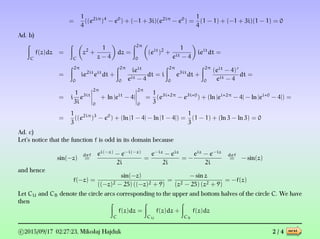
(1 − 1) + (−1 + 3i)(1 − 1) = 0
Ad. b)
C
f(z)dz =
C
z2
+
1
z − 4
dz =
2π
0
(eit
)2
+
1
eit − 4
ieit
dt =
=
2π
0
ie2it
eit
dt +
2π
0
ieit
eit − 4
dt = i
2π
0
e3it
dt +
2π
0
(eit
− 4)
eit − 4
dt =
= i
1
3i
e3it
2π
0
+ ln |eit
− 4|
2π
0
=
1
3
(e3i∗2π
− e3i∗0
) + (ln |ei∗2π
− 4| − ln |ei∗0
− 4|) =
=
1
3
((e2iπ
)3
− e0
) + (ln |1 − 4| − ln |1 − 4|) =
1
3
(1 − 1) + (ln 3 − ln 3) = 0
Ad. c)
Let’s notice that the function f is odd in its domain because
sin(−z)
def
=
ei(−z)
− e−i(−z)
2i
=
e−iz
− eiz
2i
= −
eiz
− e−iz
2i
def
= − sin(z)
and hence
f(−z) =
sin(−z)
((−z)2 − 25) ((−z)2 + 9)
=
− sin z
(z2 − 25) (z2 + 9)
= −f(z)
Let CU and CB denote the circle arcs corresponding to the upper and bottom halves of the circle C. We have
then
C
f(z)dz =
CU
f(z)dz +
CB
f(z)dz
c 2015/09/17 02:27:23, Mikołaj Hajduk 2 / 4 next
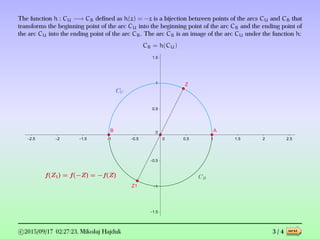
The function h : CU −→ CB defined as h(z) = −z is a bijection between points of the arcs CU and CB that
transforms the beginning point of the arc CU into the beginning point of the arc CB and the ending point of
the arc CU into the ending point of the arc CB. The arc CB is an image of the arc CU under the function h:
CB = h(CU)
c 2015/09/17 02:27:23, Mikołaj Hajduk 3 / 4 next
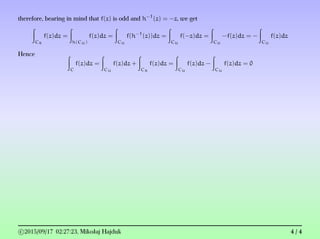
therefore, bearing in mind that f(z) is odd and h−1
(z) = −z, we get
CB
f(z)dz =
h(CU)
f(z)dz =
CU
f(h−1
(z))dz =
CU
f(−z)dz =
CU
−f(z)dz = −
CU
f(z)dz
Hence
C
f(z)dz =
CU
f(z)dz +
CB
f(z)dz =
CU
f(z)dz −
CU
f(z)dz = 0
c 2015/09/17 02:27:23, Mikołaj Hajduk 4 / 4

Complex Integral

  • 1.
    Show that C f(z)dz =0, where f is the given function and C is the unit circle |z| = 1. a) f(z) = z3 − 1 + 3i b) f(z) = z2 + 1 z − 4 c) f(z) = sin z (z2 − 25) (z2 + 9) Solution by Mikołaj Hajduk: The points a) and b) can be solved with use of parametrization z(t) = eit where t ∈ [0, 2π] and dz = ieit dt. Ad. a) C f(z)dz = C (z3 − 1 + 3i)dz = 2π 0 ((eit )3 − 1 + 3i)ieit dt = = 2π 0 e3it ieit + (−1 + 3i)ieit dt = 2π 0 ie4it dt + 2π 0 (−1 + 3i)ieit dt = = i 2π 0 e4it dt + (−1 + 3i)i 2π 0 eit dt = i 1 4i e4it 2π 0 + (−1 + 3i)i 1 i eit 2π 0 = = 1 4 e4it 2π 0 + (−1 + 3i)eit 2π 0 = 1 4 (e4i∗2π − e4i∗0 ) + (−1 + 3i)(ei∗2π − ei∗0 ) = c 2015/09/17 02:27:23, Mikołaj Hajduk 1 / 4 next
  • 2.
    = 1 4 ((e2iπ )4 − e0 ) +(−1 + 3i)(e2iπ − e0 ) = 1 4 (1 − 1) + (−1 + 3i)(1 − 1) = 0 Ad. b) C f(z)dz = C z2 + 1 z − 4 dz = 2π 0 (eit )2 + 1 eit − 4 ieit dt = = 2π 0 ie2it eit dt + 2π 0 ieit eit − 4 dt = i 2π 0 e3it dt + 2π 0 (eit − 4) eit − 4 dt = = i 1 3i e3it 2π 0 + ln |eit − 4| 2π 0 = 1 3 (e3i∗2π − e3i∗0 ) + (ln |ei∗2π − 4| − ln |ei∗0 − 4|) = = 1 3 ((e2iπ )3 − e0 ) + (ln |1 − 4| − ln |1 − 4|) = 1 3 (1 − 1) + (ln 3 − ln 3) = 0 Ad. c) Let’s notice that the function f is odd in its domain because sin(−z) def = ei(−z) − e−i(−z) 2i = e−iz − eiz 2i = − eiz − e−iz 2i def = − sin(z) and hence f(−z) = sin(−z) ((−z)2 − 25) ((−z)2 + 9) = − sin z (z2 − 25) (z2 + 9) = −f(z) Let CU and CB denote the circle arcs corresponding to the upper and bottom halves of the circle C. We have then C f(z)dz = CU f(z)dz + CB f(z)dz c 2015/09/17 02:27:23, Mikołaj Hajduk 2 / 4 next
  • 3.
    The function h: CU −→ CB defined as h(z) = −z is a bijection between points of the arcs CU and CB that transforms the beginning point of the arc CU into the beginning point of the arc CB and the ending point of the arc CU into the ending point of the arc CB. The arc CB is an image of the arc CU under the function h: CB = h(CU) c 2015/09/17 02:27:23, Mikołaj Hajduk 3 / 4 next
  • 4.
    therefore, bearing inmind that f(z) is odd and h−1 (z) = −z, we get CB f(z)dz = h(CU) f(z)dz = CU f(h−1 (z))dz = CU f(−z)dz = CU −f(z)dz = − CU f(z)dz Hence C f(z)dz = CU f(z)dz + CB f(z)dz = CU f(z)dz − CU f(z)dz = 0 c 2015/09/17 02:27:23, Mikołaj Hajduk 4 / 4