Resolving conflict – Reaching consensus

                 Rebecca Jones
           Dysart & Jones Associates
             www.dysartjones.com
           rebecca@dysartjones.com
Session Objectives
 Look at how to keep discussions as discussions
   Prepare & prevent discussions from escalading to damaging
    disagreements
 Know when a situation is a „conflict‟ and why that can be ok
 Consensus – what it is for you & how to gauge it
Basic Premise
 Conflict & communication are inextricably linked
  Basic “conflict” tools are communication tools, especially active
     listening & feedback
 Effectively managing & resolving conflict relies on a process, time &
  recognizing our own hot spots

 Conflict – it‟s not all bad
    We need differing opinions, viewpoints & perspectives
    We don‟t need destructive or negative conflict
    We can manage conflict to minimize stress & adverse impacts
Both in prevention & in process


      Clarity diffuses conflict.
 Conflict stems from differing opinions, beliefs, views &
  perspectives
   Beliefs drive behaviours
 Boards need to have differing opinions, beliefs, views &
  perspectives


  Reframe conflict as discourse &
 dialogue imperative to understand
  different lens & come up with the
             best solutions
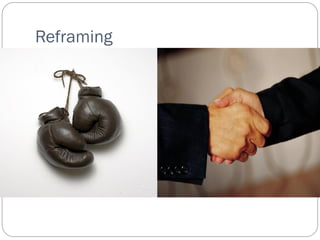
Reframing
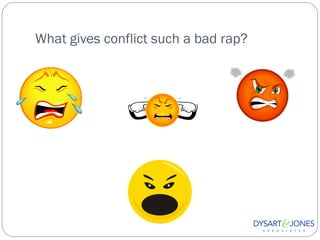
What gives conflict such a bad rap?
Conflicts
Disagreements don‟t need to become disruptive conflicts
 The negativity or destructiveness arrives when people introduce
  emotions, power plays, finger pointing, & blaming.

 Constructive is:
   Being open to other‟s ideas
   Staying objective
   Focusing on facts & the problem
 Destructive is:
   Blaming people
   Taking a right/wrong approach
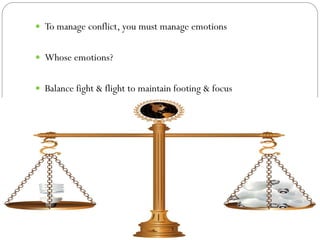
 To manage conflict, you must manage emotions


 Whose emotions?


 Balance fight & flight to maintain footing & focus
Managing “conflict” demands insight
 What do you mean you won’t approve the plan?


 We can’t work with xxxx any longer – we can’t move beyond this impasse -
  -- they are impossible.
Ensure we are looking
through the same window
Managing “conflict” demands insight
 What do you mean you won’t approve the plan?


 We can’t work with xxxx any longer – we can’t move
  beyond this impasse --- “they” are impossible.
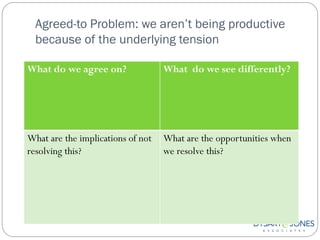
Agreed-to Problem: we aren’t being productive
  because of the underlying tension

What do we agree on?               What do we see differently?


What are the implications of not   What are the opportunities when
resolving this?                    we resolve this?
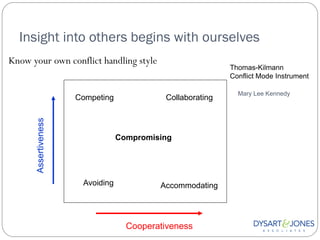
Insight into others begins with ourselves
Know your own conflict handling style
                                                             Thomas-Kilmann
                                                             Conflict Mode Instrument

                                                               Mary Lee Kennedy
                       Competing             Collaborating
       Assertiveness


                                   Compromising


                        Avoiding            Accommodating


                                     Cooperativeness                       14
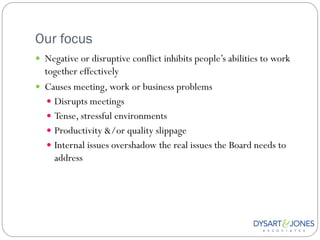
Our focus
 Negative or disruptive conflict inhibits people‟s abilities to work
  together effectively
 Causes meeting, work or business problems
    Disrupts meetings
    Tense, stressful environments
    Productivity &/or quality slippage
    Internal issues overshadow the real issues the Board needs to
     address
Negatively Impacting Work?


                       Yes?
          Then address it, constructively.

      Destructive conflict will not heal itself.
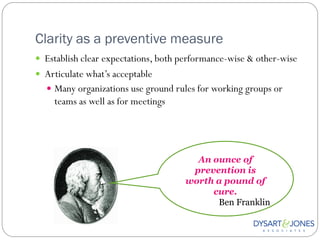
Clarity as a preventive measure
 Establish clear expectations, both performance-wise & other-wise
 Articulate what‟s acceptable
   Many organizations use ground rules for working groups or
    teams as well as for meetings


                                       An ounce of
                                      prevention is
                                     worth a pound of
                                          cure.
                                           Ben Franklin
Boards in a conflict
Sample preventative ground rules
 We focus on the library as a whole and the entire community for which it
    makes a positive difference
   We recognize that only the board has the authority to act on behalf of the
    library; individual board members have no authority to act on their own
   We ensure the decisions we make support the library’s mission & strategies
   We all share in the responsibility for the effective functioning of the board
   We respect each other’s opinions
   We have one conversation at a time
   We enjoy humour that is mutually funny
   We balance our hard-work with laughter
                                                               Consistently confirm
   Once decisions are taken, we support them                   these & the library‟s
                                                                    mission
Clarity: a by-product of communication

                 Clarity diffuses conflict.
                 Insights develop clarity.
         Listening and feedback produce insights.

We communicate to gain sight into each other’s perceptions,
                intentions & approaches.
There’s no resolving without talking

 Active listening is hard work, but the send-receive bridge
  isn‟t an obvious route for most people
 Most people prefer to stay on the SEND highway


 Use your own language
 Your intent is to find out what their perceptions are –
  what their view is
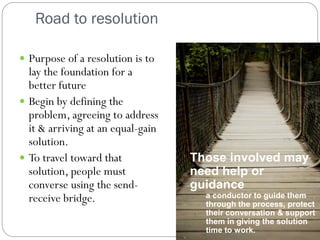
Road to resolution

 Purpose of a resolution is to
  lay the foundation for a
  better future
 Begin by defining the
  problem, agreeing to address
  it & arriving at an equal-gain
  solution.
 To travel toward that            Those involved may
  solution, people must            need help or
  converse using the send-         guidance
  receive bridge.                    a conductor to guide them
                                     through the process, protect
                                     their conversation & support
                                     them in giving the solution
                                     time to work.
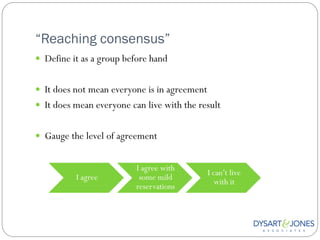
“Reaching consensus”
 Define it as a group before hand


 It does not mean everyone is in agreement
 It does mean everyone can live with the result


 Gauge the level of agreement


                          I agree with
                                              I can‟t live
          I agree          some mild
                                                 with it
                          reservations
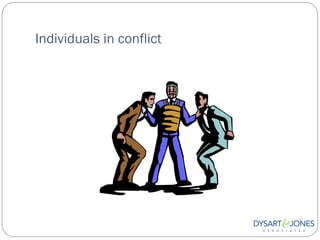
Individuals in conflict
Understanding your reactions
Individuals in a Conflict
 Sam & Tara – 2 Board members
 Bob & Marg – Chair & Vice Chair
 Sam & Tara are constantly sniping, disagreeing in meetings,
  blaming each other for issues, etc.
 Bob & Marg are concerned about the impact this has on meetings
  & Board effectiveness
 Bob feels he can‟t be objective & Marg offers to talk with Sam &
  Tara if Bob will help her work thru the process
The Process: Step 1
 Marg & Bob tell Sam & Tara their conflict is impacting performance –
  the Board‟s & theirs as Board members
 Marg & Bob are very clear that this is a Board problem that must be
  addressed & resolved for a go-forward situation

      THEY ARE PROVIDING INSIGHTS TO HELP PROVIDE
                  CLARITY to Sam & Tara

 Marg sets up a joint problem-solving meeting with them & asks them
  to think about a solution
The Process: Step 2
 Marg‟s preparation for the meeting:
   Meets individually with Sam & Tara, “Tell me how you see the
    problem”
   Keeps them focused on the Board impact, conveying
    understanding but neither agreement/disagreement
   Learns what is really at issue so that she can better manage the
    discussion & prevent unnecessary hurt feelings
   Reiterates need to have a more effective future
   Arranges for neutral room, with seating across from each other,
    for 90 minutes
   Develops meeting agenda, objectives, problem definition, &
    ground rules
The Process: Ground Rules
 Focus on the problem, not personalities
 Focus on a future effective working relationship, not past
  actions
 “Us” vs. the problem, not “You” vs. “Me”
 Seek/generate „both-gain‟ opportunities
 Identify balanced, equal-gain solution
 Engage fully in meaningful discussion, with no walk-aways &
  no power-plays
 Support decisions taken at the meeting
 Give the approach - & working relationship time & a chance
The Process: Ground Rules
     If at all possible, the one word that should never be used in this
      process is:


                            But…
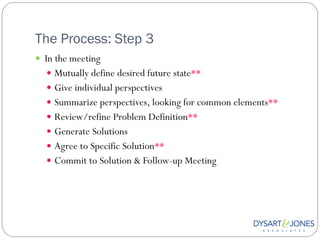
The Process: Step 3
 In the meeting
   Mutually define desired future state**
   Give individual perspectives
   Summarize perspectives, looking for common elements**
   Review/refine Problem Definition**
   Generate Solutions
   Agree to Specific Solution**
   Commit to Solution & Follow-up Meeting
The Process: Step 3
 Follow-up & commitment to see the situation improve


 How?
   Encouragement
   Informal & formal follow-up
   Consistent messages
   Reference common elements
Will it work?
 Depends on:
   Willingness & commitment of those involved
   Clarity of work-related problem
   Transparency of the process
   Preparation for working through the process
 Also depends on…..individual‟s knowledge of their
  hotspots!
   Fight or flight?
   Need to “be liked?”
   Need to be decisive or “solve problems”?
What derails most conflict management efforts?

                            US
 Our fear of emotional behavior…avoidance….dislike of one
  person…..our hot spots
Take time now to consider:
 What tendencies do you have that you must deal with to
  effectively resolve conflicts?


 How can you manage or deal with these tendencies?
Chair or Management role

Do:                                         Don‟t:
     facilitate                               wait
     listen                                   stay in same place or a place
     be calm                                   of “authority”
     know when to stop                        assume anything
     model the behavior                       look for trouble
     be sensitive to all
                                               take sides
     concentrate on getting the job done
     clarify “rules” & desired results
     ensure people know how to
      problem-solve
Individual’s role in resolving conflicts
 Honestly determine if it is a conflict or a personality
  issue
   How is it impacting your ability to perform effectively?
 Have a conversation with the other person, actively
  listening & crossing that send-receive bridge
 Engage in problem-solving
 Seek things to go in the common frame: what can you
  agree on?
 Ask for chair or management help
Critical success factors in resolving conflicts
 People involved:
 1. agree that their conflict is a productivity problem
 2. agree to work together to resolve
     - Using a problem-solving process
     - Focusing on situation & actions, NOT people
 3. jointly scope the problem: situation analysis
     - Each objectively present ideas & views
     - If possible, gather these as: What? When? Where? How? How often? Extent?
       Facts?
     - Figure out the REAL problem…
Critical success factors in resolving conflicts
People involved:
4. talk….that‟s they only way to get to the REAL problem
5. jointly re-define problem & agree that THAT problem must be
  solved
6. generate potential solutions
7. select preferred solution
8. commit to their individual & collective next steps
        - Document, in writing – right there!
9. schedule follow-up meeting
Can conflicts be managed & resolved?

Depends totally on people‟s willingness to try, to risk, to practice,
   and to recognizing that each of the skills involved are
                                ART:
                acknowledgement, respect & trust

Conflict management & reaching consensus for olba

  • 1.
    Resolving conflict –Reaching consensus Rebecca Jones Dysart & Jones Associates www.dysartjones.com rebecca@dysartjones.com
  • 2.
    Session Objectives  Lookat how to keep discussions as discussions  Prepare & prevent discussions from escalading to damaging disagreements  Know when a situation is a „conflict‟ and why that can be ok  Consensus – what it is for you & how to gauge it
  • 3.
    Basic Premise  Conflict& communication are inextricably linked Basic “conflict” tools are communication tools, especially active listening & feedback  Effectively managing & resolving conflict relies on a process, time & recognizing our own hot spots  Conflict – it‟s not all bad  We need differing opinions, viewpoints & perspectives  We don‟t need destructive or negative conflict  We can manage conflict to minimize stress & adverse impacts
  • 4.
    Both in prevention& in process Clarity diffuses conflict.
  • 5.
     Conflict stemsfrom differing opinions, beliefs, views & perspectives  Beliefs drive behaviours  Boards need to have differing opinions, beliefs, views & perspectives Reframe conflict as discourse & dialogue imperative to understand different lens & come up with the best solutions
  • 6.
  • 7.
    What gives conflictsuch a bad rap?
  • 8.
    Conflicts Disagreements don‟t needto become disruptive conflicts  The negativity or destructiveness arrives when people introduce emotions, power plays, finger pointing, & blaming.  Constructive is:  Being open to other‟s ideas  Staying objective  Focusing on facts & the problem  Destructive is:  Blaming people  Taking a right/wrong approach
  • 9.
     To manageconflict, you must manage emotions  Whose emotions?  Balance fight & flight to maintain footing & focus
  • 10.
    Managing “conflict” demandsinsight  What do you mean you won’t approve the plan?  We can’t work with xxxx any longer – we can’t move beyond this impasse - -- they are impossible.
  • 11.
    Ensure we arelooking through the same window
  • 12.
    Managing “conflict” demandsinsight  What do you mean you won’t approve the plan?  We can’t work with xxxx any longer – we can’t move beyond this impasse --- “they” are impossible.
  • 13.
    Agreed-to Problem: wearen’t being productive because of the underlying tension What do we agree on? What do we see differently? What are the implications of not What are the opportunities when resolving this? we resolve this?
  • 14.
    Insight into othersbegins with ourselves Know your own conflict handling style Thomas-Kilmann Conflict Mode Instrument Mary Lee Kennedy Competing Collaborating Assertiveness Compromising Avoiding Accommodating Cooperativeness 14
  • 15.
    Our focus  Negativeor disruptive conflict inhibits people‟s abilities to work together effectively  Causes meeting, work or business problems  Disrupts meetings  Tense, stressful environments  Productivity &/or quality slippage  Internal issues overshadow the real issues the Board needs to address
  • 16.
    Negatively Impacting Work? Yes? Then address it, constructively. Destructive conflict will not heal itself.
  • 17.
    Clarity as apreventive measure  Establish clear expectations, both performance-wise & other-wise  Articulate what‟s acceptable  Many organizations use ground rules for working groups or teams as well as for meetings An ounce of prevention is worth a pound of cure. Ben Franklin
  • 18.
    Boards in aconflict
  • 19.
    Sample preventative groundrules  We focus on the library as a whole and the entire community for which it makes a positive difference  We recognize that only the board has the authority to act on behalf of the library; individual board members have no authority to act on their own  We ensure the decisions we make support the library’s mission & strategies  We all share in the responsibility for the effective functioning of the board  We respect each other’s opinions  We have one conversation at a time  We enjoy humour that is mutually funny  We balance our hard-work with laughter Consistently confirm  Once decisions are taken, we support them these & the library‟s mission
  • 20.
    Clarity: a by-productof communication Clarity diffuses conflict. Insights develop clarity. Listening and feedback produce insights. We communicate to gain sight into each other’s perceptions, intentions & approaches.
  • 21.
    There’s no resolvingwithout talking  Active listening is hard work, but the send-receive bridge isn‟t an obvious route for most people  Most people prefer to stay on the SEND highway  Use your own language  Your intent is to find out what their perceptions are – what their view is
  • 22.
    Road to resolution Purpose of a resolution is to lay the foundation for a better future  Begin by defining the problem, agreeing to address it & arriving at an equal-gain solution.  To travel toward that Those involved may solution, people must need help or converse using the send- guidance receive bridge. a conductor to guide them through the process, protect their conversation & support them in giving the solution time to work.
  • 23.
    “Reaching consensus”  Defineit as a group before hand  It does not mean everyone is in agreement  It does mean everyone can live with the result  Gauge the level of agreement I agree with I can‟t live I agree some mild with it reservations
  • 24.
  • 25.
  • 26.
    Individuals in aConflict  Sam & Tara – 2 Board members  Bob & Marg – Chair & Vice Chair  Sam & Tara are constantly sniping, disagreeing in meetings, blaming each other for issues, etc.  Bob & Marg are concerned about the impact this has on meetings & Board effectiveness  Bob feels he can‟t be objective & Marg offers to talk with Sam & Tara if Bob will help her work thru the process
  • 27.
    The Process: Step1  Marg & Bob tell Sam & Tara their conflict is impacting performance – the Board‟s & theirs as Board members  Marg & Bob are very clear that this is a Board problem that must be addressed & resolved for a go-forward situation THEY ARE PROVIDING INSIGHTS TO HELP PROVIDE CLARITY to Sam & Tara  Marg sets up a joint problem-solving meeting with them & asks them to think about a solution
  • 28.
    The Process: Step2  Marg‟s preparation for the meeting:  Meets individually with Sam & Tara, “Tell me how you see the problem”  Keeps them focused on the Board impact, conveying understanding but neither agreement/disagreement  Learns what is really at issue so that she can better manage the discussion & prevent unnecessary hurt feelings  Reiterates need to have a more effective future  Arranges for neutral room, with seating across from each other, for 90 minutes  Develops meeting agenda, objectives, problem definition, & ground rules
  • 29.
    The Process: GroundRules  Focus on the problem, not personalities  Focus on a future effective working relationship, not past actions  “Us” vs. the problem, not “You” vs. “Me”  Seek/generate „both-gain‟ opportunities  Identify balanced, equal-gain solution  Engage fully in meaningful discussion, with no walk-aways & no power-plays  Support decisions taken at the meeting  Give the approach - & working relationship time & a chance
  • 30.
    The Process: GroundRules  If at all possible, the one word that should never be used in this process is: But…
  • 31.
    The Process: Step3  In the meeting  Mutually define desired future state**  Give individual perspectives  Summarize perspectives, looking for common elements**  Review/refine Problem Definition**  Generate Solutions  Agree to Specific Solution**  Commit to Solution & Follow-up Meeting
  • 32.
    The Process: Step3  Follow-up & commitment to see the situation improve  How?  Encouragement  Informal & formal follow-up  Consistent messages  Reference common elements
  • 33.
    Will it work? Depends on:  Willingness & commitment of those involved  Clarity of work-related problem  Transparency of the process  Preparation for working through the process  Also depends on…..individual‟s knowledge of their hotspots!  Fight or flight?  Need to “be liked?”  Need to be decisive or “solve problems”?
  • 34.
    What derails mostconflict management efforts? US  Our fear of emotional behavior…avoidance….dislike of one person…..our hot spots
  • 35.
    Take time nowto consider:  What tendencies do you have that you must deal with to effectively resolve conflicts?  How can you manage or deal with these tendencies?
  • 36.
    Chair or Managementrole Do: Don‟t:  facilitate  wait  listen  stay in same place or a place  be calm of “authority”  know when to stop  assume anything  model the behavior  look for trouble  be sensitive to all  take sides  concentrate on getting the job done  clarify “rules” & desired results  ensure people know how to problem-solve
  • 37.
    Individual’s role inresolving conflicts  Honestly determine if it is a conflict or a personality issue  How is it impacting your ability to perform effectively?  Have a conversation with the other person, actively listening & crossing that send-receive bridge  Engage in problem-solving  Seek things to go in the common frame: what can you agree on?  Ask for chair or management help
  • 38.
    Critical success factorsin resolving conflicts People involved: 1. agree that their conflict is a productivity problem 2. agree to work together to resolve - Using a problem-solving process - Focusing on situation & actions, NOT people 3. jointly scope the problem: situation analysis - Each objectively present ideas & views - If possible, gather these as: What? When? Where? How? How often? Extent? Facts? - Figure out the REAL problem…
  • 39.
    Critical success factorsin resolving conflicts People involved: 4. talk….that‟s they only way to get to the REAL problem 5. jointly re-define problem & agree that THAT problem must be solved 6. generate potential solutions 7. select preferred solution 8. commit to their individual & collective next steps - Document, in writing – right there! 9. schedule follow-up meeting
  • 40.
    Can conflicts bemanaged & resolved? Depends totally on people‟s willingness to try, to risk, to practice, and to recognizing that each of the skills involved are ART: acknowledgement, respect & trust