A presentation by  Nikki Al Ben S. Delfin Gaston Zaballa Ortigas Peace Institute/ Generation Peace Youth Network University for Peace Civil-Political Rights and Peoples’ Participation Peacebuilding and Related Concepts:  An Overview from a Practioner’s Perspective
Outline Disclaimer and Norms Basis of Peacebuilding and its Concepts: Fundamentals and the Rights-Based Approach to Peace Open Forum or 10-minute break Peoples’ Participation: Civil Society in Peacebuilding Peacebuilding in different contexts
Activity 1: Issues related to Peacebuilding Discuss the issues related to Peace[building] in your own context (i.e. region, community, or country)? Write the top 2 and paste them on the wall.
Activity 2. Wants and Needs  Divide yourselves in two groups. Group 1: What are your BASIC NEEDS in order to survive? Group 2: What are your needs BEYOND SURVIVAL?
Maslow’s Hierarchy of Needs
Quantity and Quality of Life
Human Dignity Preamble:  “… recognition of the inherent dignity and of the equal and inalienable rights of all members of the human family is the foundation of freedom, justice and peace in the world…” Article I of the UDHR: “ All human beings are born free and equal in dignity and rights.They are endowed with reason and conscience and should act towards one another in a spirit of brotherhood.”
Human Dignity The dignity of the human person is not only a fundamental right in itself but constitutes the real basis of fundamental rights.
What, then, is the problem?
How are the Peacebuilding Issues connected to Human Rights Issues? Simply put, violations and non-realization of human rights are situations of UNPEACE.
Just Peace Peace thrives along with social justice. Social justice can be realized through human rights A holistic  approach to peace is through a rights-based approach “ Jobs, justice, food, freedom” – Pepe Diokno
Just Peace SIX PATHS TO PEACE Pursuit of social, economic and political reforms to address the root causes of armed conflicts and social unrest Consensus-building and empowerment for peace Pursuit of peaceful, negotiated settlement with rebel groups Implementation of programs for reconciliation, rehabilitation and reintegration of ex-combatants and civilian victims of armed conflicts Addressing concerns arising from continuing armed conflict, and Building and nurturing a climate conducive to peace.
Debunking Human Rights Myths  (Delfin, 2009) Rights vs. Culture Not just a legalistic and technical framework: Beyond the international norm Beyond Western Notions Before WWII and the UN establishment
Debunking Human Rights Myths  (Delfin, 2009) Simple to complex needs, Simple to complex rights: Human, Social, Economic and Political Evolution
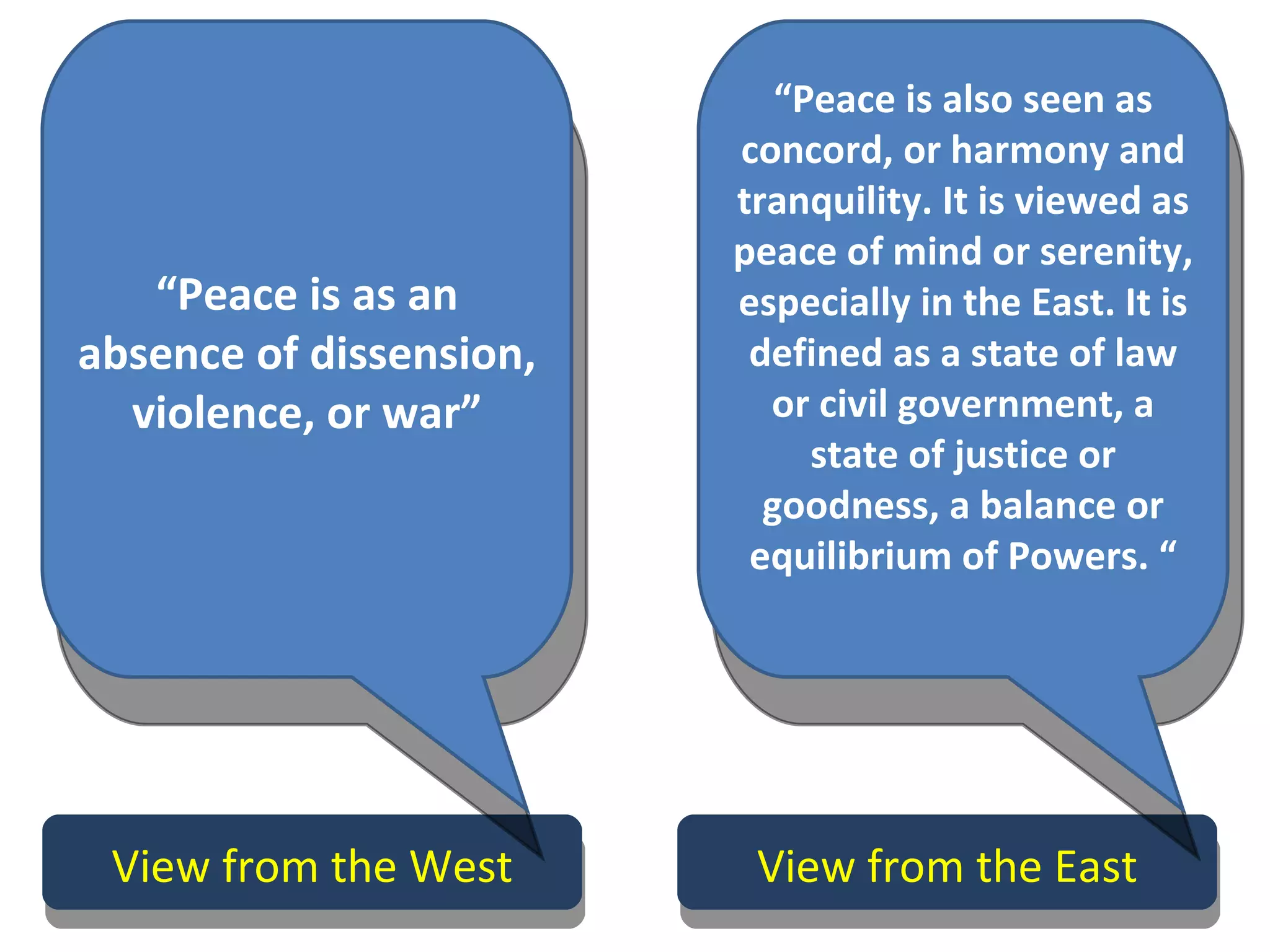
View from the West View from the East “ Peace is as an absence of dissension, violence, or war” “ Peace is also seen as concord, or harmony and tranquility. It is viewed as peace of mind or serenity, especially in the East. It is defined as a state of law or civil government, a state of justice or goodness, a balance or equilibrium of Powers. “
Core Ideas Human Dignity as the Basis of Human Rights Human Rights as the Basis of Peace and Social Justice Peace and Human Rights as the Basis of Peacebuilding
Assertour common humanity our humandignity our human rights !
273 out of 365, 113 are here.
Why are there armed conflicts?
Self Determination “ All peoples have the right of self-determination. By virtue of that right they freely determine their political status and freely pursue their economic, social and cultural development.” (Art. 1 of ICCPR/ICESCR)
Bangsamoro Struggle for Self Determination, some triggers: Historical Injustices - Sultanates - Colonial History: Moors and the Treaty of  Paris - US Occupation - ‘Foreign’ Settlers in Mindanao - Political, Economic and Cultural Alienation - Massacres and Killings 2. Control of Resources
Forms of Conflict
DEFINING PEACE  (CPE Diagram, n.d.) PEACE NEGATIVE PEACE Absence of direct/physical violence (both macro and micro) POSITIVE PEACE Presence of conditions of well-being and just relationships: social, economic, political, ecological Direct Violence e.g., war, torture, child and woman abuse Structural Violence e.g., poverty, hunger Socio-cultural Violence e.g., intolerance of the “other” Ecological Violence e.g., pollution, overconsumption VIOLENCE
Nuances in Peace Initiatives 1. Peacekeeping:  Conflict Management 2. Peacemaking: Conflict Resolution 3. Peacebuilding: Conflict Transformation
Peacekeeping  relating to the preservation of peace, especially the supervision by international forces of a truce between hostile nations.  is a military third-party intervention to assist the transition from violent conflict to stable peace. (American Heritage Dictionary, n.d.) A traditional peacekeeping operation is established when parties to a conflict, typically two states, agree to the interposition of UN troops to uphold a ceasefire. (SAIS, n.d.)
Peacekeeping Characteristics of Interposition: neutrality (remains impartial in the dispute and does not intervene in the fighting);  light military equipment;  use of force  only in self-defense;  consent  of the parties to the dispute;  prerequisite of a  ceasefire  agreement; and  contribution of  contingents  on a voluntary basis.
Peacemaking focuses primarily on the negotiation process, as it forms the basis for mediation, conciliation, and arbitration is a diplomatic effort A peace agreement is the desired end result To be sustainable, peace agreements have to include all key players of the conflict, end destructive violence, which is often established through a ceasefire agreement, and address the root causes of the conflict.
Peacebuilding Peacebuilding,  or post-conflict reconstruction , is a process that facilitates the establishment of durable peace,building and political as well as economic transformationand tries to prevent the recurrence of violence by addressing root causes and effects of conflict through reconciliation, institution .  Peacebuilding is complex and results materialize only in the medium and long-term.  A great number of agents engage in a wide variety of reconstruction efforts.  These efforts include addressing the functional and emotional dimensions of peacebuilding in specified target areas, such as civil society and legal institutions, among others. Evaluating the success and failure of peacebuilding efforts is therefore especially challenging.
Peacebuilding Responses/Interventions (Ferrer, 1997) Peace Constituency Building Conflict Reduction Efforts Conflict Settlement Efforts Peace Research and Training Programs Social Development Work
“ Strategic Peacebuilding”  Kapag ang mga likas yaman, aktor, at mga istratehiya ay alinsunod sa pagkamit ng mga mithiin at matugunan ang mga isyung pangmatagalan. Isang permanenteng proseso na sumasaklaw sa lahat ng mga gawaing masusi sa pagbuo at pagpapalawig ng kapayapaan at pagsugpo sa karahasan
“ Strategic Peacebuilding” A permanent process that encompasses all activities that are key in building and broadening peace and minimizing (or eradicating) violence Resources, actors, and strategies are in  synchronicity  and  synergy  toward addressing long-term issues
Peacebuilding Responses According to Roles: Service Provider Watchdog Advocate for Alternatives
Peacebuilding Responses according to Aims Direct Intervention Addressing the Consequences of the Conflict Working on the Social Fabric
Initiatives: Multi-Track Diplomacy Track 1 Track 2 Track 3
Track 1 TOP LEADERSHIP Government,  Negotiating Panels  official government diplomacy whereby communication and interaction is between governments Between the main opposing parties High-level discussions, ceasefire, peace talks
Track 2 NGOs, Practitioners, Academe, Media, etc. Unofficial interaction and intervention of non-state actors Professional Conflict Resolution Business NGOs Research Faith/Belief Systems Media Aid community Civil Society Initiatives  Local government Training  Education Conflict Resolution Workshops/Exercises, Peace Commissions, Advocacy work, Constituency building
Expanded Tracks (IMTD,n.d.) governments professional organisations the business community private citizens training, research and educational institutions activists church organisations funding media
Track 3 Communities Stakeholders directly affected by the armed conflicts Grassroot communities Grassroots training, Prejudice reduction, psychosocial trauma healing, community dialogues, etc.


Core Ideas Linkage of Human Dignity and Peoples’ Self Determination Linkage of Peoples to Power and Resources Linkage of Peacebuilding and Governance Democracy as delivery systems of human rights (Koenig, 2008)
1. Conflict is a natural and continuing reality of life 2. There can be no genuine peace without addressing the root causes of conflict.  3. There can be no real reconciliation and peace without repentance and justice 4..  Respect of all creation is the foundation of Peace 5. Peace and reconciliation should lead to equal and just relationships 6. Conflict is both an opportunity for transformation and development or destruction. Its outcome is dependent on how conflicting parties and stakeholders deal with it. 7. Only conflicting parties can truly reconcile their conflicts but a credible, neutral,  concerned and capable  facilitator expedite reconciliation
The work towards  a just  and sustainable peace  is PEACEBUILDING. “ Peace is not just the absence of war: Peace through justice, peace by means of peace.”
Thank you. References and Outline of Presentation can be found at: http://www.slideshare.net/ihateyourflashdisk

U peace presentation peacebuilding_slideshare

  • 1.
    A presentation by Nikki Al Ben S. Delfin Gaston Zaballa Ortigas Peace Institute/ Generation Peace Youth Network University for Peace Civil-Political Rights and Peoples’ Participation Peacebuilding and Related Concepts: An Overview from a Practioner’s Perspective
  • 2.
    Outline Disclaimer andNorms Basis of Peacebuilding and its Concepts: Fundamentals and the Rights-Based Approach to Peace Open Forum or 10-minute break Peoples’ Participation: Civil Society in Peacebuilding Peacebuilding in different contexts
  • 3.
    Activity 1: Issuesrelated to Peacebuilding Discuss the issues related to Peace[building] in your own context (i.e. region, community, or country)? Write the top 2 and paste them on the wall.
  • 4.
    Activity 2. Wantsand Needs Divide yourselves in two groups. Group 1: What are your BASIC NEEDS in order to survive? Group 2: What are your needs BEYOND SURVIVAL?
  • 5.
  • 6.
  • 7.
    Human Dignity Preamble: “… recognition of the inherent dignity and of the equal and inalienable rights of all members of the human family is the foundation of freedom, justice and peace in the world…” Article I of the UDHR: “ All human beings are born free and equal in dignity and rights.They are endowed with reason and conscience and should act towards one another in a spirit of brotherhood.”
  • 8.
    Human Dignity Thedignity of the human person is not only a fundamental right in itself but constitutes the real basis of fundamental rights.
  • 9.
    What, then, isthe problem?
  • 10.
    How are thePeacebuilding Issues connected to Human Rights Issues? Simply put, violations and non-realization of human rights are situations of UNPEACE.
  • 11.
    Just Peace Peacethrives along with social justice. Social justice can be realized through human rights A holistic approach to peace is through a rights-based approach “ Jobs, justice, food, freedom” – Pepe Diokno
  • 12.
    Just Peace SIXPATHS TO PEACE Pursuit of social, economic and political reforms to address the root causes of armed conflicts and social unrest Consensus-building and empowerment for peace Pursuit of peaceful, negotiated settlement with rebel groups Implementation of programs for reconciliation, rehabilitation and reintegration of ex-combatants and civilian victims of armed conflicts Addressing concerns arising from continuing armed conflict, and Building and nurturing a climate conducive to peace.
  • 13.
    Debunking Human RightsMyths (Delfin, 2009) Rights vs. Culture Not just a legalistic and technical framework: Beyond the international norm Beyond Western Notions Before WWII and the UN establishment
  • 14.
    Debunking Human RightsMyths (Delfin, 2009) Simple to complex needs, Simple to complex rights: Human, Social, Economic and Political Evolution
  • 15.
    View from theWest View from the East “ Peace is as an absence of dissension, violence, or war” “ Peace is also seen as concord, or harmony and tranquility. It is viewed as peace of mind or serenity, especially in the East. It is defined as a state of law or civil government, a state of justice or goodness, a balance or equilibrium of Powers. “
  • 16.
    Core Ideas HumanDignity as the Basis of Human Rights Human Rights as the Basis of Peace and Social Justice Peace and Human Rights as the Basis of Peacebuilding
  • 17.
    Assertour common humanityour humandignity our human rights !
  • 18.
    273 out of365, 113 are here.
  • 19.
    Why are therearmed conflicts?
  • 20.
    Self Determination “All peoples have the right of self-determination. By virtue of that right they freely determine their political status and freely pursue their economic, social and cultural development.” (Art. 1 of ICCPR/ICESCR)
  • 21.
    Bangsamoro Struggle forSelf Determination, some triggers: Historical Injustices - Sultanates - Colonial History: Moors and the Treaty of Paris - US Occupation - ‘Foreign’ Settlers in Mindanao - Political, Economic and Cultural Alienation - Massacres and Killings 2. Control of Resources
  • 22.
  • 23.
    DEFINING PEACE (CPE Diagram, n.d.) PEACE NEGATIVE PEACE Absence of direct/physical violence (both macro and micro) POSITIVE PEACE Presence of conditions of well-being and just relationships: social, economic, political, ecological Direct Violence e.g., war, torture, child and woman abuse Structural Violence e.g., poverty, hunger Socio-cultural Violence e.g., intolerance of the “other” Ecological Violence e.g., pollution, overconsumption VIOLENCE
  • 24.
    Nuances in PeaceInitiatives 1. Peacekeeping: Conflict Management 2. Peacemaking: Conflict Resolution 3. Peacebuilding: Conflict Transformation
  • 25.
    Peacekeeping relatingto the preservation of peace, especially the supervision by international forces of a truce between hostile nations. is a military third-party intervention to assist the transition from violent conflict to stable peace. (American Heritage Dictionary, n.d.) A traditional peacekeeping operation is established when parties to a conflict, typically two states, agree to the interposition of UN troops to uphold a ceasefire. (SAIS, n.d.)
  • 26.
    Peacekeeping Characteristics ofInterposition: neutrality (remains impartial in the dispute and does not intervene in the fighting); light military equipment; use of force only in self-defense; consent of the parties to the dispute; prerequisite of a ceasefire agreement; and contribution of contingents on a voluntary basis.
  • 27.
    Peacemaking focuses primarilyon the negotiation process, as it forms the basis for mediation, conciliation, and arbitration is a diplomatic effort A peace agreement is the desired end result To be sustainable, peace agreements have to include all key players of the conflict, end destructive violence, which is often established through a ceasefire agreement, and address the root causes of the conflict.
  • 28.
    Peacebuilding Peacebuilding, or post-conflict reconstruction , is a process that facilitates the establishment of durable peace,building and political as well as economic transformationand tries to prevent the recurrence of violence by addressing root causes and effects of conflict through reconciliation, institution . Peacebuilding is complex and results materialize only in the medium and long-term. A great number of agents engage in a wide variety of reconstruction efforts. These efforts include addressing the functional and emotional dimensions of peacebuilding in specified target areas, such as civil society and legal institutions, among others. Evaluating the success and failure of peacebuilding efforts is therefore especially challenging.
  • 29.
    Peacebuilding Responses/Interventions (Ferrer,1997) Peace Constituency Building Conflict Reduction Efforts Conflict Settlement Efforts Peace Research and Training Programs Social Development Work
  • 30.
    “ Strategic Peacebuilding” Kapag ang mga likas yaman, aktor, at mga istratehiya ay alinsunod sa pagkamit ng mga mithiin at matugunan ang mga isyung pangmatagalan. Isang permanenteng proseso na sumasaklaw sa lahat ng mga gawaing masusi sa pagbuo at pagpapalawig ng kapayapaan at pagsugpo sa karahasan
  • 31.
    “ Strategic Peacebuilding”A permanent process that encompasses all activities that are key in building and broadening peace and minimizing (or eradicating) violence Resources, actors, and strategies are in synchronicity and synergy toward addressing long-term issues
  • 32.
    Peacebuilding Responses Accordingto Roles: Service Provider Watchdog Advocate for Alternatives
  • 33.
    Peacebuilding Responses accordingto Aims Direct Intervention Addressing the Consequences of the Conflict Working on the Social Fabric
  • 34.
    Initiatives: Multi-Track DiplomacyTrack 1 Track 2 Track 3
  • 35.
    Track 1 TOPLEADERSHIP Government, Negotiating Panels official government diplomacy whereby communication and interaction is between governments Between the main opposing parties High-level discussions, ceasefire, peace talks
  • 36.
    Track 2 NGOs,Practitioners, Academe, Media, etc. Unofficial interaction and intervention of non-state actors Professional Conflict Resolution Business NGOs Research Faith/Belief Systems Media Aid community Civil Society Initiatives Local government Training Education Conflict Resolution Workshops/Exercises, Peace Commissions, Advocacy work, Constituency building
  • 37.
    Expanded Tracks (IMTD,n.d.)governments professional organisations the business community private citizens training, research and educational institutions activists church organisations funding media
  • 38.
    Track 3 CommunitiesStakeholders directly affected by the armed conflicts Grassroot communities Grassroots training, Prejudice reduction, psychosocial trauma healing, community dialogues, etc.
  • 39.
  • 40.
  • 41.
  • 42.
    Core Ideas Linkageof Human Dignity and Peoples’ Self Determination Linkage of Peoples to Power and Resources Linkage of Peacebuilding and Governance Democracy as delivery systems of human rights (Koenig, 2008)
  • 43.
    1. Conflict isa natural and continuing reality of life 2. There can be no genuine peace without addressing the root causes of conflict. 3. There can be no real reconciliation and peace without repentance and justice 4.. Respect of all creation is the foundation of Peace 5. Peace and reconciliation should lead to equal and just relationships 6. Conflict is both an opportunity for transformation and development or destruction. Its outcome is dependent on how conflicting parties and stakeholders deal with it. 7. Only conflicting parties can truly reconcile their conflicts but a credible, neutral, concerned and capable facilitator expedite reconciliation
  • 44.
    The work towards a just and sustainable peace is PEACEBUILDING. “ Peace is not just the absence of war: Peace through justice, peace by means of peace.”
  • 45.
    Thank you. Referencesand Outline of Presentation can be found at: http://www.slideshare.net/ihateyourflashdisk

Editor's Notes

  • #41 Referring to the wall, Which of these issues are personal issues? Which are Societal? Which are Institutional?
  • #42 Referring to the wall, Which of these issues are personal issues? Which are Societal? Which are Institutional?