Conflict in
Colombia
An on-going low-intensity
armed conflict in Colombia
between the Colombian
government and peasant
guerrillas.
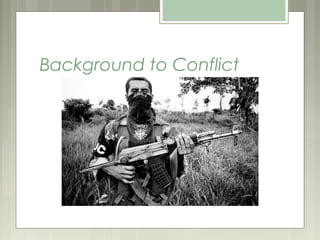
Background to Conflict
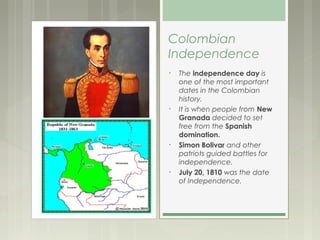
Colombian
Independence
•   The independence day is
    one of the most important
    dates in the Colombian
    history.
•   It is when people from New
    Granada decided to set
    free from the Spanish
    domination.
•   Simon Bolivar and other
    patriots guided battles for
    independence.
•   July 20, 1810 was the date
    of Independence.
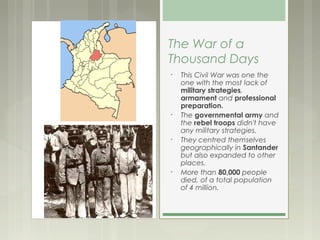
The War of a
Thousand Days
•   This Civil War was one the
    one with the most lack of
    military strategies,
    armament and professional
    preparation.
•   The governmental army and
    the rebel troops didn't have
    any military strategies.
•   They centred themselves
    geographically in Santander
    but also expanded to other
    places.
•   More than 80,000 people
    died, of a total population
    of 4 million.
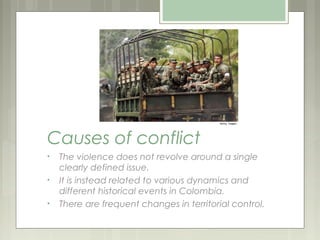
Causes of conflict
•   The violence does not revolve around a single
    clearly defined issue.
•   It is instead related to various dynamics and
    different historical events in Colombia.
•   There are frequent changes in territorial control.
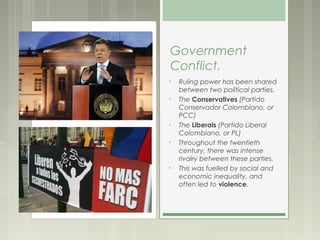
Government
Conflict.
•   Ruling power has been shared
    between two political parties.
•   The Conservatives (Partido
    Conservador Colombiano, or
    PCC)
•   The Liberals (Partido Liberal
    Colombiano, or PL)
•   Throughout the twentieth
    century, there was intense
    rivalry between these parties.
•   This was fuelled by social and
    economic inequality, and
    often led to violence.
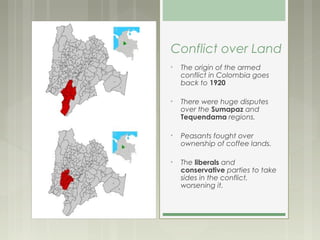
Conflict over Land
•   The origin of the armed
    conflict in Colombia goes
    back to 1920

•   There were huge disputes
    over the Sumapaz and
    Tequendama regions.

•   Peasants fought over
    ownership of coffee lands.

•   The liberals and
    conservative parties to take
    sides in the conflict,
    worsening it.
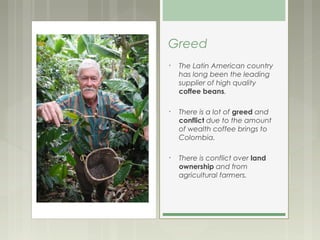
Greed
•   The Latin American country
    has long been the leading
    supplier of high quality
    coffee beans.

•   There is a lot of greed and
    conflict due to the amount
    of wealth coffee brings to
    Colombia.

•   There is conflict over land
    ownership and from
    agricultural farmers.
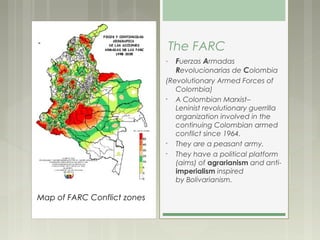
The FARC
                             -    Fuerzas Armadas
                                  Revolucionarias de Colombia
                             (Revolutionary Armed Forces of
                                Colombia)
                             •  A Colombian Marxist–
                                Leninist revolutionary guerrilla 
                                organization involved in the
                                continuing Colombian armed
                                conflict since 1964.
                             •  They are a peasant army.
                             •  They have a political platform
                                (aims) of agrarianism and anti-
                                imperialism inspired
                                by Bolivarianism.

Map of FARC Conflict zones
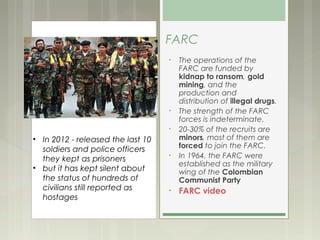
FARC
                                   •   The operations of the
                                       FARC are funded by
                                       kidnap to ransom, gold
                                       mining, and the
                                       production and
                                       distribution of illegal drugs.
                                   •   The strength of the FARC
                                       forces is indeterminate.
                                   •   20-30% of the recruits are
• In 2012 - released the last 10       minors, most of them are
  soldiers and police officers         forced to join the FARC.
  they kept as prisoners
                                   •   In 1964, the FARC were
                                       established as the military
• but it has kept silent about         wing of the Colombian
  the status of hundreds of            Communist Party
  civilians still reported as      •   FARC video
  hostages
Effects
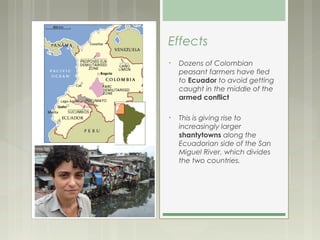
•   Dozens of Colombian
    peasant farmers have fled
    to Ecuador to avoid getting
    caught in the middle of the
    armed conflict

•   This is giving rise to
    increasingly larger
    shantytowns along the
    Ecuadorian side of the San
    Miguel River, which divides
    the two countries. 
Effects
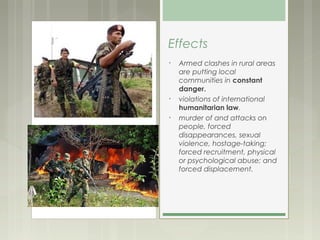
•   Armed clashes in rural areas
    are putting local
    communities in constant
    danger.
•   violations of international
    humanitarian law.
•   murder of and attacks on
    people, forced
    disappearances, sexual
    violence, hostage-taking;
    forced recruitment, physical
    or psychological abuse; and
    forced displacement.
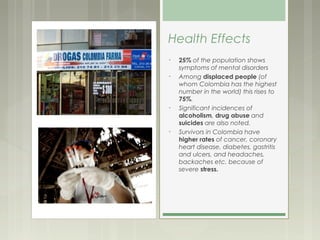
Health Effects
•   25% of the population shows
    symptoms of mental disorders
•   Among displaced people (of
    whom Colombia has the highest
    number in the world) this rises to
    75%.
•   Significant incidences of
    alcoholism, drug abuse and
    suicides are also noted.
•   Survivors in Colombia have
    higher rates of cancer, coronary
    heart disease, diabetes, gastritis
    and ulcers, and headaches,
    backaches etc. because of
    severe stress.

Conflict in Colombia

  • 1.
    Conflict in Colombia An on-goinglow-intensity armed conflict in Colombia between the Colombian government and peasant guerrillas.
  • 2.
  • 3.
    Colombian Independence • The independence day is one of the most important dates in the Colombian history. • It is when people from New Granada decided to set free from the Spanish domination. • Simon Bolivar and other patriots guided battles for independence. • July 20, 1810 was the date of Independence.
  • 4.
    The War ofa Thousand Days • This Civil War was one the one with the most lack of military strategies, armament and professional preparation. • The governmental army and the rebel troops didn't have any military strategies. • They centred themselves geographically in Santander but also expanded to other places. • More than 80,000 people died, of a total population of 4 million.
  • 5.
    Causes of conflict • The violence does not revolve around a single clearly defined issue. • It is instead related to various dynamics and different historical events in Colombia. • There are frequent changes in territorial control.
  • 6.
    Government Conflict. • Ruling power has been shared between two political parties. • The Conservatives (Partido Conservador Colombiano, or PCC) • The Liberals (Partido Liberal Colombiano, or PL) • Throughout the twentieth century, there was intense rivalry between these parties. • This was fuelled by social and economic inequality, and often led to violence.
  • 7.
    Conflict over Land • The origin of the armed conflict in Colombia goes back to 1920 • There were huge disputes over the Sumapaz and Tequendama regions. • Peasants fought over ownership of coffee lands. • The liberals and conservative parties to take sides in the conflict, worsening it.
  • 8.
    Greed • The Latin American country has long been the leading supplier of high quality coffee beans. • There is a lot of greed and conflict due to the amount of wealth coffee brings to Colombia. • There is conflict over land ownership and from agricultural farmers.
  • 9.
    The FARC - Fuerzas Armadas Revolucionarias de Colombia (Revolutionary Armed Forces of Colombia) • A Colombian Marxist– Leninist revolutionary guerrilla  organization involved in the continuing Colombian armed conflict since 1964. • They are a peasant army. • They have a political platform (aims) of agrarianism and anti- imperialism inspired by Bolivarianism. Map of FARC Conflict zones
  • 10.
    FARC • The operations of the FARC are funded by kidnap to ransom, gold mining, and the production and distribution of illegal drugs. • The strength of the FARC forces is indeterminate. • 20-30% of the recruits are • In 2012 - released the last 10 minors, most of them are soldiers and police officers forced to join the FARC. they kept as prisoners • In 1964, the FARC were established as the military • but it has kept silent about wing of the Colombian the status of hundreds of Communist Party civilians still reported as • FARC video hostages
  • 11.
    Effects • Dozens of Colombian peasant farmers have fled to Ecuador to avoid getting caught in the middle of the armed conflict • This is giving rise to increasingly larger shantytowns along the Ecuadorian side of the San Miguel River, which divides the two countries. 
  • 12.
    Effects • Armed clashes in rural areas are putting local communities in constant danger. • violations of international humanitarian law. • murder of and attacks on people, forced disappearances, sexual violence, hostage-taking; forced recruitment, physical or psychological abuse; and forced displacement.
  • 13.
    Health Effects • 25% of the population shows symptoms of mental disorders • Among displaced people (of whom Colombia has the highest number in the world) this rises to 75%. • Significant incidences of alcoholism, drug abuse and suicides are also noted. • Survivors in Colombia have higher rates of cancer, coronary heart disease, diabetes, gastritis and ulcers, and headaches, backaches etc. because of severe stress.