MEXICAN
REVOLUTION
Social Studies for 9th E.G.B.
Teacher: Mauricio Torres
BACKGROUND
 After the independence of many territories and
    colonies in Latin America, things stayed pretty
    much the same: the poor were still poor and the
    aristocracy were the only ones with privileges.
   In the early 1900s, the economy was booming
    because of exports: plentiful natural resources
    and cash crops were sold to industrialized
    countries.
   These resources were controlled by foreign
    investors.
   The tiny ruling classes kept economic benefits
    for themselves.
   These inequalities troubled many countries in
    Latin America (LA) and in Mexico, the situation
    led to an explosive revolution.
THE MEXICAN REVOLUTION
          By 1910, the dictator Porfírio Diaz had
           ruled Mexico for almost 35 years, winning
           reelection again and again.
          Mexico enjoyed apparent peace and
           economic growth:
             Foreign investors developed mines, built
               railroads and drilled for oil.
          These benefits only reached a small group
           of people. The rest of the country lived in
           poverty.
ROAD TO REVOLUTION
          Mexican society X-ray:
             Most of the peasants worked on haciendas,
              mines or factories, earning meager wages. They
              represented the oppressed.
             The middle class wanted democracy.
             The elite resented the power of foreign
              companies.
          In 1910, unrest boiled when Francisco
           Madero called for general elections, and
           Diaz resigned.
VIVA LA REVOLUCIÓN!
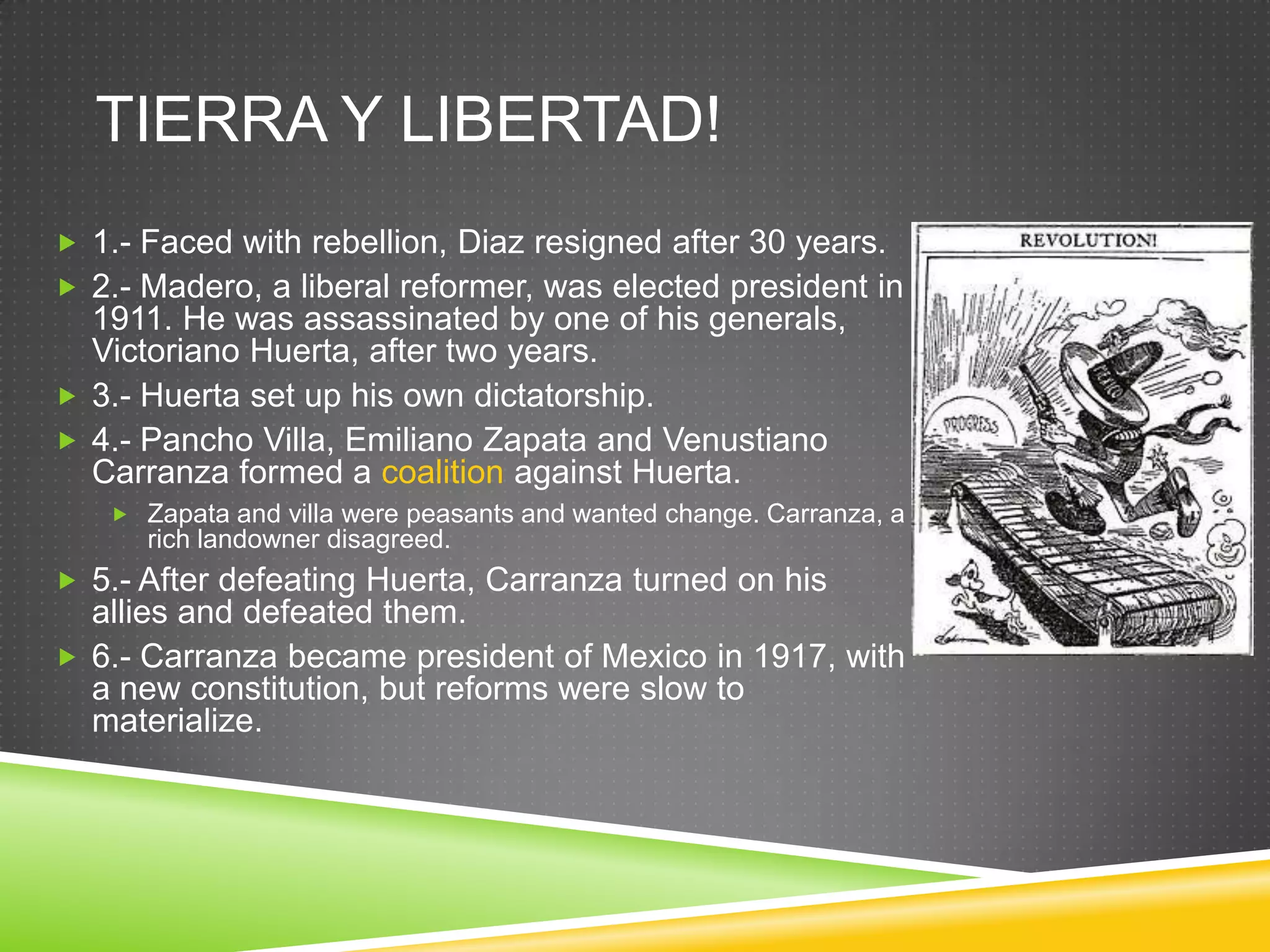
 Fighting raged across Mexico for over a decade. Peasants, small
   farmers, urban workers and ranchers were drawn into a violent
                            struggle.
TIERRA Y LIBERTAD!
 1.- Faced with rebellion, Diaz resigned after 30 years.
 2.- Madero, a liberal reformer, was elected president in
  1911. He was assassinated by one of his generals,
  Victoriano Huerta, after two years.
 3.- Huerta set up his own dictatorship.
 4.- Pancho Villa, Emiliano Zapata and Venustiano
  Carranza formed a coalition against Huerta.
    Zapata and villa were peasants and wanted change. Carranza, a
      rich landowner disagreed.
 5.- After defeating Huerta, Carranza turned on his
  allies and defeated them.
 6.- Carranza became president of Mexico in 1917, with
  a new constitution, but reforms were slow to
  materialize.
THE PRICE OF REFORM


                When it ended, the economy
                   was in shambles and more
                 than one million people were
                                        dead.
ASK YOURSELF
            Sequence:
                Describe the events of the Mexican
                 Revolution
            Explain:
                Explain the economic inequality that
                 existed in Latin American Countries.
            Discuss:
                Which were the groups that were unhappy
                 with Diaz’s regime and list each group’s
                 interest in the revolution.
BRIEF EXCERCISE
 Write down two paragraphs
  explaining what you understand
  from the slogan “Tierra y Libertad”.
  Try to put yourself in the average
  Mexican’s shoes to show your
  feelings.
 Do this in a separate sheet of paper,
  and hand it in at the end of the
  class.
BIBLIOGRAPHY
 Ellis, E. G., & Esler, A. (2009). World History. (P. Hall, Ed.) Upper
  Saddle River, New Jersey, US: Pearson Education INC.
 Images taken from www.google.com

Mexican Revolution

  • 1.
    MEXICAN REVOLUTION Social Studies for9th E.G.B. Teacher: Mauricio Torres
  • 2.
    BACKGROUND  After theindependence of many territories and colonies in Latin America, things stayed pretty much the same: the poor were still poor and the aristocracy were the only ones with privileges.  In the early 1900s, the economy was booming because of exports: plentiful natural resources and cash crops were sold to industrialized countries.  These resources were controlled by foreign investors.  The tiny ruling classes kept economic benefits for themselves.  These inequalities troubled many countries in Latin America (LA) and in Mexico, the situation led to an explosive revolution.
  • 3.
    THE MEXICAN REVOLUTION  By 1910, the dictator Porfírio Diaz had ruled Mexico for almost 35 years, winning reelection again and again.  Mexico enjoyed apparent peace and economic growth:  Foreign investors developed mines, built railroads and drilled for oil.  These benefits only reached a small group of people. The rest of the country lived in poverty.
  • 4.
    ROAD TO REVOLUTION  Mexican society X-ray:  Most of the peasants worked on haciendas, mines or factories, earning meager wages. They represented the oppressed.  The middle class wanted democracy.  The elite resented the power of foreign companies.  In 1910, unrest boiled when Francisco Madero called for general elections, and Diaz resigned.
  • 5.
    VIVA LA REVOLUCIÓN! Fighting raged across Mexico for over a decade. Peasants, small farmers, urban workers and ranchers were drawn into a violent struggle.
  • 6.
    TIERRA Y LIBERTAD! 1.- Faced with rebellion, Diaz resigned after 30 years.  2.- Madero, a liberal reformer, was elected president in 1911. He was assassinated by one of his generals, Victoriano Huerta, after two years.  3.- Huerta set up his own dictatorship.  4.- Pancho Villa, Emiliano Zapata and Venustiano Carranza formed a coalition against Huerta.  Zapata and villa were peasants and wanted change. Carranza, a rich landowner disagreed.  5.- After defeating Huerta, Carranza turned on his allies and defeated them.  6.- Carranza became president of Mexico in 1917, with a new constitution, but reforms were slow to materialize.
  • 7.
    THE PRICE OFREFORM  When it ended, the economy was in shambles and more than one million people were dead.
  • 8.
    ASK YOURSELF  Sequence:  Describe the events of the Mexican Revolution  Explain:  Explain the economic inequality that existed in Latin American Countries.  Discuss:  Which were the groups that were unhappy with Diaz’s regime and list each group’s interest in the revolution.
  • 9.
    BRIEF EXCERCISE  Writedown two paragraphs explaining what you understand from the slogan “Tierra y Libertad”. Try to put yourself in the average Mexican’s shoes to show your feelings.  Do this in a separate sheet of paper, and hand it in at the end of the class.
  • 10.
    BIBLIOGRAPHY  Ellis, E.G., & Esler, A. (2009). World History. (P. Hall, Ed.) Upper Saddle River, New Jersey, US: Pearson Education INC.  Images taken from www.google.com