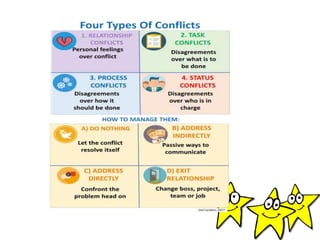
CONFLICT
MR.ANISH.V.A .M.Sc (N),M.Sc (C&P)
PRINCIPAL & HOD IN PSYCHIATRIC NURSING
MURLIDHAR COLLEGE OF NURSING, RAJKOT
Introduction
• One cause of stress.
• Painful state or condition of an individual
leads to emotional tension.
• Conflict occurs when one has to select
between equally desirable or equally
undesirable goals. These desires are
contradictory in nature and cannot satisfy
fully at same time.
Definition
• Conflict means a painful emotional state,
which results from a tension between
opposed and contradictory wishes.(Douglas
and Holland)
Types of conflict
• Approach-approach conflict
• A situation involving a choice between two equally desirable
but incompatible alternatives.
• Ex.- there are a two courses that you want to take, but they are
scheduled for the same time.
• Avoidance-avoidance conflict
• Conflict whereby one must choose between two more or less
equally undesirable or unattractive goals.
• decide between doing unwanted homework (avoidance) and
doing unwanted house chores (avoidance).
• Approach-avoidance conflict
• both positive and negative effects or characteristics that
make the goal appealing and unappealing simultaneously.
• For example, marriage is a momentous decision that has
both positive and negative aspects.
Multiple approach-avoidance conflict
• number of alternatives and each one is positive or negative.
An example of this is making a visit to a foreign city.
Internal conflicts
• Conflicts may be between one person and another or
between a person and his environment or may be within
the person himself.
• Conflict within a person is called internal conflicts,
conflicts between one’s motives, desires, sentiments and
attitudes.
• Internal conflicts may be conscious or unconscious.
• In conscious case we aware of the causes or resources of
our conflicts.
• In unconscious case, we are not aware of the real motives
causing conflicts.
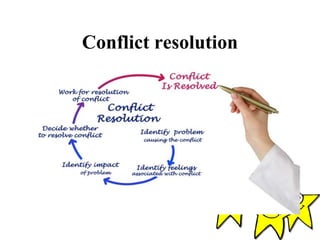
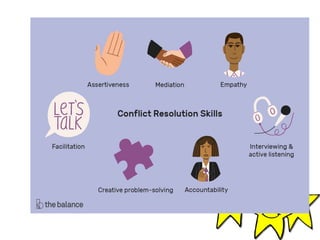
Conflict resolution
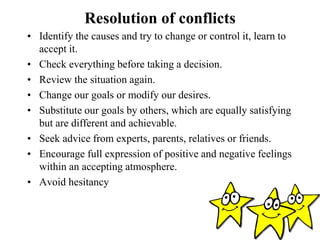
Resolution of conflicts
• Identify the causes and try to change or control it, learn to
accept it.
• Check everything before taking a decision.
• Review the situation again.
• Change our goals or modify our desires.
• Substitute our goals by others, which are equally satisfying
but are different and achievable.
• Seek advice from experts, parents, relatives or friends.
• Encourage full expression of positive and negative feelings
within an accepting atmosphere.
• Avoid hesitancy
Conflict

Conflict

  • 1.
    CONFLICT MR.ANISH.V.A .M.Sc (N),M.Sc(C&P) PRINCIPAL & HOD IN PSYCHIATRIC NURSING MURLIDHAR COLLEGE OF NURSING, RAJKOT
  • 3.
    Introduction • One causeof stress. • Painful state or condition of an individual leads to emotional tension. • Conflict occurs when one has to select between equally desirable or equally undesirable goals. These desires are contradictory in nature and cannot satisfy fully at same time.
  • 4.
    Definition • Conflict meansa painful emotional state, which results from a tension between opposed and contradictory wishes.(Douglas and Holland)
  • 7.
    Types of conflict •Approach-approach conflict • A situation involving a choice between two equally desirable but incompatible alternatives. • Ex.- there are a two courses that you want to take, but they are scheduled for the same time. • Avoidance-avoidance conflict • Conflict whereby one must choose between two more or less equally undesirable or unattractive goals. • decide between doing unwanted homework (avoidance) and doing unwanted house chores (avoidance).
  • 8.
    • Approach-avoidance conflict •both positive and negative effects or characteristics that make the goal appealing and unappealing simultaneously. • For example, marriage is a momentous decision that has both positive and negative aspects. Multiple approach-avoidance conflict • number of alternatives and each one is positive or negative. An example of this is making a visit to a foreign city.
  • 9.
    Internal conflicts • Conflictsmay be between one person and another or between a person and his environment or may be within the person himself. • Conflict within a person is called internal conflicts, conflicts between one’s motives, desires, sentiments and attitudes. • Internal conflicts may be conscious or unconscious. • In conscious case we aware of the causes or resources of our conflicts. • In unconscious case, we are not aware of the real motives causing conflicts.
  • 10.
  • 12.
    Resolution of conflicts •Identify the causes and try to change or control it, learn to accept it. • Check everything before taking a decision. • Review the situation again. • Change our goals or modify our desires. • Substitute our goals by others, which are equally satisfying but are different and achievable. • Seek advice from experts, parents, relatives or friends. • Encourage full expression of positive and negative feelings within an accepting atmosphere. • Avoid hesitancy