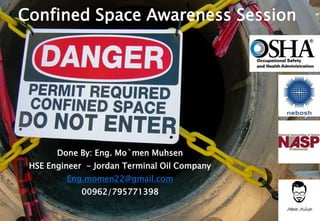

Confined Space Awareness Session
Done By: Eng. Mo`men Muhsen
HSE Engineer - Jordan Terminal Oil Company
Eng.momen22@gmail.com
00962/795771398
AGENDA
Overview of Confined Space Standard
Evaluate Your Spaces
Entry Options
PRCS Program
Q&A
Standards
Promulgated in 1993 – OSHA
The Statistics
2.1 million workers enter permit-required confined
spaces (PRCS) annually:
Routine maintenance, repairs, and inspections.
166 fatalities in 2018
144 in 2017 (15% increase)
Common themes include:
No written program.
Atmospheric hazards (H2S and CO).
Lack of, or improper, training for employees.
Agenda
Overview of Confined Space Standard
Evaluate Your Spaces
Entry Options
PRCS Program
Q&A
What is a Confined Space?
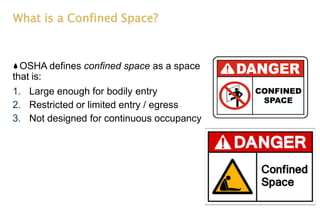
OSHA defines confined space as a space
that is:
1. Large enough for bodily entry
2. Restricted or limited entry / egress
3. Not designed for continuous occupancy
What is a Confined Space?
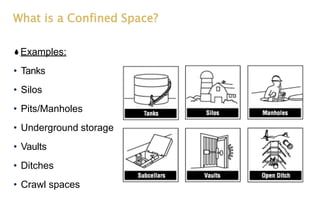
Examples:
• Tanks
• Silos
• Pits/Manholes
• Underground storage
• Vaults
• Ditches
• Crawl spaces
Types of Confined Spaces
Confined spaces can be classified into three main types:
1. Non-Permit Required
2. Temporary Permit-Required
3. Permit-Required
Employers are required to evaluate all spaces to determine if
they are permit-required confined spaces
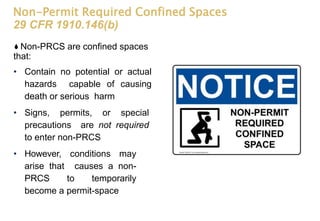
Non-Permit Required Confined Spaces
29 CFR 1910.146(b)
Non-PRCS are confined spaces
that:
• Contain no potential or actual
hazards capable of causing
death or serious harm
• Signs, permits, or special
precautions are not required
to enter non-PRCS
• However, conditions may
arise that causes a non-
PRCS to temporarily
become a permit-space
Temporary Re-Classification
• If conditions change within a non-PRCS, employers
must re-classify the space as permit-required as long
as the hazard(s) is present
• Example:
 A non-PRCS is entered by an employee
 Employee cleans inside with a alcohol
 Creates a hazardous atmosphere
 Temporarily becomes a PRCS
Permit-Required Confined Space (PRCS)
Confined spaces that have one or more of the following
characteristics:
• Actual or potential hazardous atmosphere
• Engulfment or entrapment
• Internal configuration that can trap or asphyxiate
• Other serious hazards (no specific definition)
 Electrical
 Mechanical
 Temperature
 Noise
 Falling objects
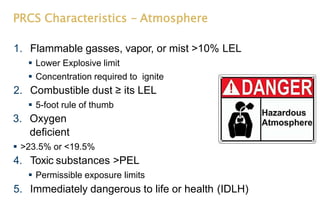
PRCS Characteristics - Atmosphere
1. Flammable gasses, vapor, or mist >10% LEL
 Lower Explosive limit
 Concentration required to ignite
2. Combustible dust ≥ its LEL
 5-foot rule of thumb
3. Oxygen
deficient
 >23.5% or <19.5%
4. Toxic substances >PEL
 Permissible exposure limits
5. Immediately dangerous to life or health (IDLH)
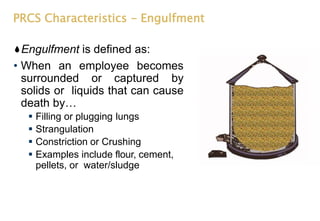
PRCS Characteristics - Engulfment
Engulfment is defined as:
• When an employee becomes
surrounded or captured by
solids or liquids that can cause
death by…
 Filling or plugging lungs
 Strangulation
 Constriction or Crushing
 Examples include flour, cement,
pellets, or water/sludge
PRCS Characteristics - Configuration
A confined space that
contains
“an internal configuration
such that an entrant can be
trapped or asphyxiated by
inwardly converging walls or
by a floor that slopes
downward and tapers to
smaller cross-section”
Examples
• Hoppers
• Cyclones
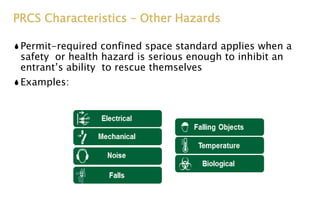
PRCS Characteristics – Other Hazards
Permit-required confined space standard applies when a
safety or health hazard is serious enough to inhibit an
entrant’s ability to rescue themselves
Examples:
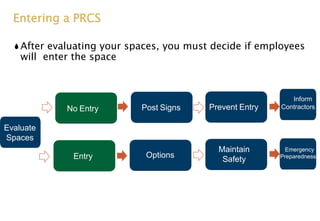
Entering a PRCS
After evaluating your spaces, you must decide if employees
will enter the space
No Entry Prevent EntryPost Signs
Inform
Contractors
Entry
Evaluate
Spaces
Options
Maintain
Safety
Emergency
Preparedness
Agenda
Overview of Confined Space Standard
Evaluate Your Spaces
Entry Options
PRCS Program
Q&A
No Entry Requirements
If you decide your employees are not going to enter PRCS
• Effectively communicate this policy through training
• Inform employees of their existence, location, and hazards
• Ensure they do not enter
If you decide contractors will enter PRCS
• Inform them of existence, location, and hazards of permit-
spaces
• Ensure entry is compliant with a permit-space program
• Debrief upon completion of work
Agenda
Overview of Confined Space Standard
Evaluate Your Spaces
Entry Options
PRCS Program
Q&A
Permit Required Confined Space Entry Program
If alternative entry and re-classification are not feasible,
employers must develop a written permit space program that
contains:
• Identification of hazards (TRA).
• Required procedures.
• Equipment required.
• Responsibilities.
• A permit system; and Training
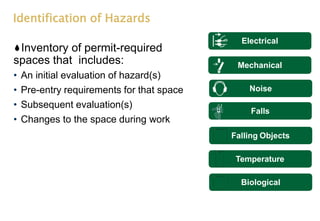
Identification of Hazards
Inventory of permit-required
spaces that includes:
• An initial evaluation of hazard(s)
• Pre-entry requirements for that space
• Subsequent evaluation(s)
• Changes to the space during work
Electrical
Mechanical
Noise
Falls
Falling Objects
Temperature
Biological
Procedures
Programs must include the means,
procedures, and practices necessary for
safe-entry, including but not limited to:
• Acceptable entry conditions
• Testing/monitoring data
• Isolation/LOTO procedures
• Control of hazardous atmosphere; and
• How hazards will remain
controlled throughout the duration
of entry
Equipment
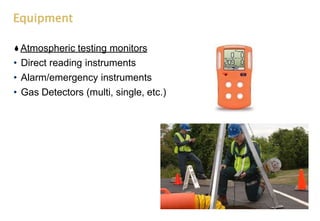
Atmospheric testing monitors
• Direct reading instruments
• Alarm/emergency instruments
• Gas Detectors (multi, single, etc.)
Equipment
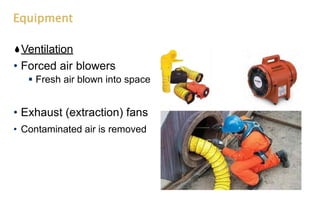
Ventilation
• Forced air blowers
 Fresh air blown into space
• Exhaust (extraction) fans
• Contaminated air is removed
Equipment
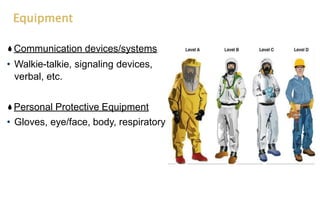
Communication devices/systems
• Walkie-talkie, signaling devices,
verbal, etc.
Personal Protective Equipment
• Gloves, eye/face, body, respiratory
Equipment
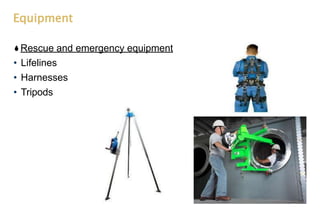
Rescue and emergency equipment
• Lifelines
• Harnesses
• Tripods
Responsibilities / Duties
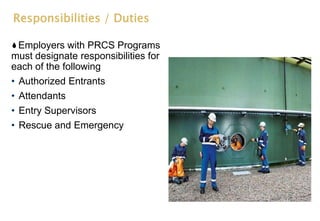
Employers with PRCS Programs
must designate responsibilities for
each of the following
• Authorized Entrants
• Attendants
• Entry Supervisors
• Rescue and Emergency
Responsibilities / Duties
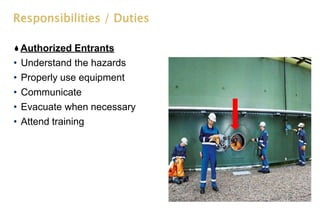
Authorized Entrants
• Understand the hazards
• Properly use equipment
• Communicate
• Evacuate when necessary
• Attend training
Responsibilities / Duties
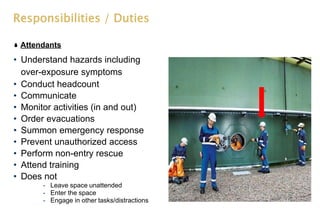
Attendants
• Understand hazards including
over-exposure symptoms
• Conduct headcount
• Communicate
• Monitor activities (in and out)
• Order evacuations
• Summon emergency response
• Prevent unauthorized access
• Perform non-entry rescue
• Attend training
• Does not
- Leave space unattended
- Enter the space
- Engage in other tasks/distractions
Responsibilities / Duties
Entry Supervisors
• Terminate/cancel permits
when work is finished
• Attend training
• May act as attendant or
entrant
 Cross-trained
 Capable of performing
functions
Responsibilities / Duties
Onsite Rescue/Emergency Team
• Equipped, trained and proficient in
use of rescue PPE and equipment
• Must be trained to entrant
responsibilities/duties
• Basic CPR and first aid
 1 member must be certified
• Annual mock rescues
• Evaluate your need for an outside
service - onsite rescue teams require
advanced training and equipment
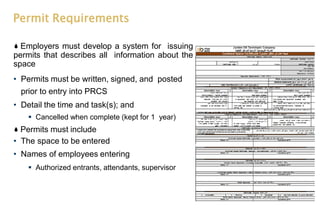
Permit Requirements
Employers must develop a system for issuing
permits that describes all information about the
space
• Permits must be written, signed, and posted
prior to entry into PRCS
• Detail the time and task(s); and
 Cancelled when complete (kept for 1 year)
Permits must include
• The space to be entered
• Names of employees entering
 Authorized entrants, attendants, supervisor
Permit Requirements
Permits must include
• Hazards (actual and potential)
• Isolation procedures
• Acceptable conditions to enter the
space
 Including monitoring data (initial and
continuous)
• Means for summoning emergency
rescue
• Means of communication (entrants
and attendants
Permit Requirements
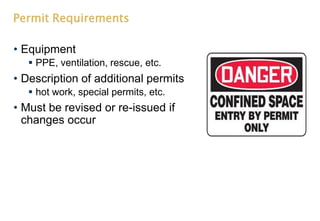
• Equipment
 PPE, ventilation, rescue, etc.
• Description of additional permits
 hot work, special permits, etc.
• Must be revised or re-issued if
changes occur
Agenda
Overview of Confined Space Standard
Evaluate Your Spaces
Entry Options
PRCS Program
Q&A
Questions ???

Confined space awareness session

  • 1.
    Confined Space AwarenessSession Done By: Eng. Mo`men Muhsen HSE Engineer - Jordan Terminal Oil Company Eng.momen22@gmail.com 00962/795771398
  • 2.
    AGENDA Overview of ConfinedSpace Standard Evaluate Your Spaces Entry Options PRCS Program Q&A
  • 3.
  • 4.
    The Statistics 2.1 millionworkers enter permit-required confined spaces (PRCS) annually: Routine maintenance, repairs, and inspections. 166 fatalities in 2018 144 in 2017 (15% increase) Common themes include: No written program. Atmospheric hazards (H2S and CO). Lack of, or improper, training for employees.
  • 5.
    Agenda Overview of ConfinedSpace Standard Evaluate Your Spaces Entry Options PRCS Program Q&A
  • 6.
    What is aConfined Space? OSHA defines confined space as a space that is: 1. Large enough for bodily entry 2. Restricted or limited entry / egress 3. Not designed for continuous occupancy
  • 7.
    What is aConfined Space? Examples: • Tanks • Silos • Pits/Manholes • Underground storage • Vaults • Ditches • Crawl spaces
  • 8.
    Types of ConfinedSpaces Confined spaces can be classified into three main types: 1. Non-Permit Required 2. Temporary Permit-Required 3. Permit-Required Employers are required to evaluate all spaces to determine if they are permit-required confined spaces
  • 9.
    Non-Permit Required ConfinedSpaces 29 CFR 1910.146(b) Non-PRCS are confined spaces that: • Contain no potential or actual hazards capable of causing death or serious harm • Signs, permits, or special precautions are not required to enter non-PRCS • However, conditions may arise that causes a non- PRCS to temporarily become a permit-space
  • 10.
    Temporary Re-Classification • Ifconditions change within a non-PRCS, employers must re-classify the space as permit-required as long as the hazard(s) is present • Example:  A non-PRCS is entered by an employee  Employee cleans inside with a alcohol  Creates a hazardous atmosphere  Temporarily becomes a PRCS
  • 11.
    Permit-Required Confined Space(PRCS) Confined spaces that have one or more of the following characteristics: • Actual or potential hazardous atmosphere • Engulfment or entrapment • Internal configuration that can trap or asphyxiate • Other serious hazards (no specific definition)  Electrical  Mechanical  Temperature  Noise  Falling objects
  • 12.
    PRCS Characteristics -Atmosphere 1. Flammable gasses, vapor, or mist >10% LEL  Lower Explosive limit  Concentration required to ignite 2. Combustible dust ≥ its LEL  5-foot rule of thumb 3. Oxygen deficient  >23.5% or <19.5% 4. Toxic substances >PEL  Permissible exposure limits 5. Immediately dangerous to life or health (IDLH)
  • 13.
    PRCS Characteristics -Engulfment Engulfment is defined as: • When an employee becomes surrounded or captured by solids or liquids that can cause death by…  Filling or plugging lungs  Strangulation  Constriction or Crushing  Examples include flour, cement, pellets, or water/sludge
  • 14.
    PRCS Characteristics -Configuration A confined space that contains “an internal configuration such that an entrant can be trapped or asphyxiated by inwardly converging walls or by a floor that slopes downward and tapers to smaller cross-section” Examples • Hoppers • Cyclones
  • 15.
    PRCS Characteristics –Other Hazards Permit-required confined space standard applies when a safety or health hazard is serious enough to inhibit an entrant’s ability to rescue themselves Examples:
  • 16.
    Entering a PRCS Afterevaluating your spaces, you must decide if employees will enter the space No Entry Prevent EntryPost Signs Inform Contractors Entry Evaluate Spaces Options Maintain Safety Emergency Preparedness
  • 17.
    Agenda Overview of ConfinedSpace Standard Evaluate Your Spaces Entry Options PRCS Program Q&A
  • 18.
    No Entry Requirements Ifyou decide your employees are not going to enter PRCS • Effectively communicate this policy through training • Inform employees of their existence, location, and hazards • Ensure they do not enter If you decide contractors will enter PRCS • Inform them of existence, location, and hazards of permit- spaces • Ensure entry is compliant with a permit-space program • Debrief upon completion of work
  • 19.
    Agenda Overview of ConfinedSpace Standard Evaluate Your Spaces Entry Options PRCS Program Q&A
  • 20.
    Permit Required ConfinedSpace Entry Program If alternative entry and re-classification are not feasible, employers must develop a written permit space program that contains: • Identification of hazards (TRA). • Required procedures. • Equipment required. • Responsibilities. • A permit system; and Training
  • 21.
    Identification of Hazards Inventoryof permit-required spaces that includes: • An initial evaluation of hazard(s) • Pre-entry requirements for that space • Subsequent evaluation(s) • Changes to the space during work Electrical Mechanical Noise Falls Falling Objects Temperature Biological
  • 22.
    Procedures Programs must includethe means, procedures, and practices necessary for safe-entry, including but not limited to: • Acceptable entry conditions • Testing/monitoring data • Isolation/LOTO procedures • Control of hazardous atmosphere; and • How hazards will remain controlled throughout the duration of entry
  • 23.
    Equipment Atmospheric testing monitors •Direct reading instruments • Alarm/emergency instruments • Gas Detectors (multi, single, etc.)
  • 24.
    Equipment Ventilation • Forced airblowers  Fresh air blown into space • Exhaust (extraction) fans • Contaminated air is removed
  • 25.
    Equipment Communication devices/systems • Walkie-talkie,signaling devices, verbal, etc. Personal Protective Equipment • Gloves, eye/face, body, respiratory
  • 26.
    Equipment Rescue and emergencyequipment • Lifelines • Harnesses • Tripods
  • 27.
    Responsibilities / Duties Employerswith PRCS Programs must designate responsibilities for each of the following • Authorized Entrants • Attendants • Entry Supervisors • Rescue and Emergency
  • 28.
    Responsibilities / Duties AuthorizedEntrants • Understand the hazards • Properly use equipment • Communicate • Evacuate when necessary • Attend training
  • 29.
    Responsibilities / Duties Attendants •Understand hazards including over-exposure symptoms • Conduct headcount • Communicate • Monitor activities (in and out) • Order evacuations • Summon emergency response • Prevent unauthorized access • Perform non-entry rescue • Attend training • Does not - Leave space unattended - Enter the space - Engage in other tasks/distractions
  • 30.
    Responsibilities / Duties EntrySupervisors • Terminate/cancel permits when work is finished • Attend training • May act as attendant or entrant  Cross-trained  Capable of performing functions
  • 31.
    Responsibilities / Duties OnsiteRescue/Emergency Team • Equipped, trained and proficient in use of rescue PPE and equipment • Must be trained to entrant responsibilities/duties • Basic CPR and first aid  1 member must be certified • Annual mock rescues • Evaluate your need for an outside service - onsite rescue teams require advanced training and equipment
  • 32.
    Permit Requirements Employers mustdevelop a system for issuing permits that describes all information about the space • Permits must be written, signed, and posted prior to entry into PRCS • Detail the time and task(s); and  Cancelled when complete (kept for 1 year) Permits must include • The space to be entered • Names of employees entering  Authorized entrants, attendants, supervisor
  • 33.
    Permit Requirements Permits mustinclude • Hazards (actual and potential) • Isolation procedures • Acceptable conditions to enter the space  Including monitoring data (initial and continuous) • Means for summoning emergency rescue • Means of communication (entrants and attendants
  • 34.
    Permit Requirements • Equipment PPE, ventilation, rescue, etc. • Description of additional permits  hot work, special permits, etc. • Must be revised or re-issued if changes occur
  • 35.
    Agenda Overview of ConfinedSpace Standard Evaluate Your Spaces Entry Options PRCS Program Q&A
  • 36.