The views expressed in this presentation are the views of the author/s and do not necessarily reflect the views or policies of the Asian
Development Bank, or its Board of Governors, or the governments they represent. ADB does not guarantee the accuracy of the data included
in this presentation and accepts no responsibility for any consequence of their use. The countries listed in this presentation do not imply any
view on ADB's part as to sovereignty or independent status or necessarily conform to ADB's terminology.
Learning in Conferences
Olivier Serrat
2015
The Purpose of Conferencing
Conferencing is an age-old technique for
reasoning and problem solving, usually to reach
agreement in formal or informal (yet planned)
settings. And so, a conference is a purposeful
gathering of people aiming to pool ideas on at
least one topic of joint interest, or needing to
achieve a common goal through interaction.
Conferences ordinarily occur face-to-face but
information and communications technology now
also enables virtual mediation—through
telephone and, increasingly, video.
The Forms of Conferencing
Conventions—Large meetings of delegates, industries,
members, professions, representatives, or societies seeking
concurrence on certain attitudes or routines, such as
processes, procedures, and practices.
Forums—Broad occasions for open discussion, as a rule
among experts but now and then involving audiences.
Seminars—Prolonged and sometimes repeated meets for
exchange of results and interaction among a limited
number of professionals or advanced students engaged in
intensive study or original research.
Workshops—Brief educational programs for small groups of
peers focusing on techniques and skills in a particular field.
The Forms of Conferencing
Retreats—Periods of group withdrawal from regular
activities for development of closer relationships,
instruction, or self-reflection.
Meetings*—Sundry instances of coming together for
business, civic, courtship, educational, government, health
and wellness, leisure, religious, social, sports, and other
functions.
* In the workplace, one-time, recurring, or series of meetings that
regularly draw on the services of a chairperson include briefings,
advisory meetings, committee meetings, council meetings, and
negotiations.
No Loose Change
Conventions, forums, seminars, workshops,
retreats, and meetings—to which the emerging
practice of "unconferencing" can hereafter be
added—are pervasive forms of interaction. The
resources allocated to their organization,
conduct, and attendance—of which the
opportunity cost incurred from taking part is no
loose change—must surely be astronomical.
Even so, we seldom assess the relative value of
such meets to either participants or event
planners. Run-of-the-mill, end-of-session
surveys requesting participants to jot down
what they enjoyed or disliked can no longer do.
The Poverty of Conference
Evaluations
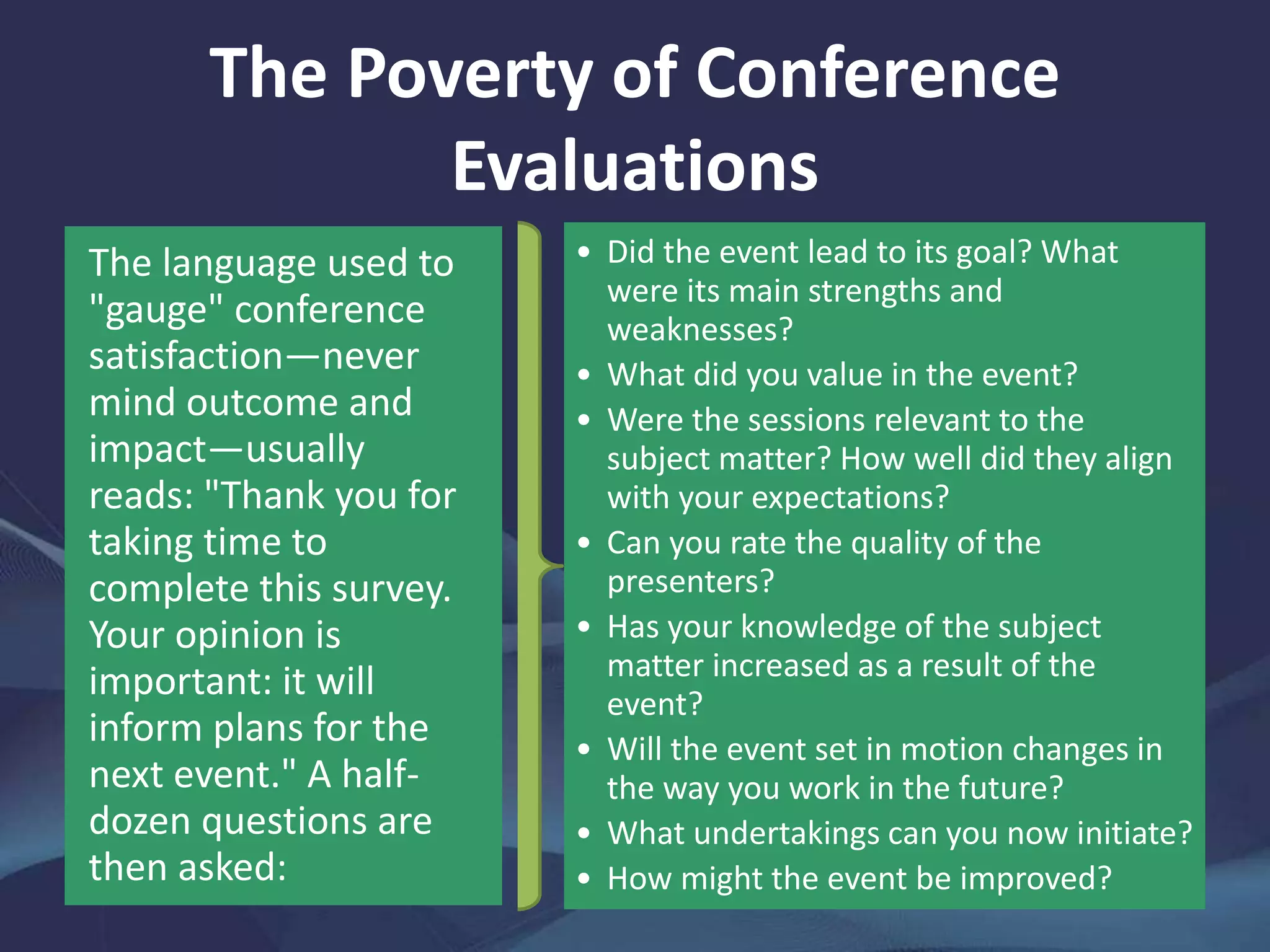
The language used to
"gauge" conference
satisfaction—never
mind outcome and
impact—usually
reads: "Thank you for
taking time to
complete this survey.
Your opinion is
important: it will
inform plans for the
next event." A half-
dozen questions are
then asked:
• Did the event lead to its goal? What
were its main strengths and
weaknesses?
• What did you value in the event?
• Were the sessions relevant to the
subject matter? How well did they align
with your expectations?
• Can you rate the quality of the
presenters?
• Has your knowledge of the subject
matter increased as a result of the
event?
• Will the event set in motion changes in
the way you work in the future?
• What undertakings can you now initiate?
• How might the event be improved?
The Poverty of Conference
Evaluations
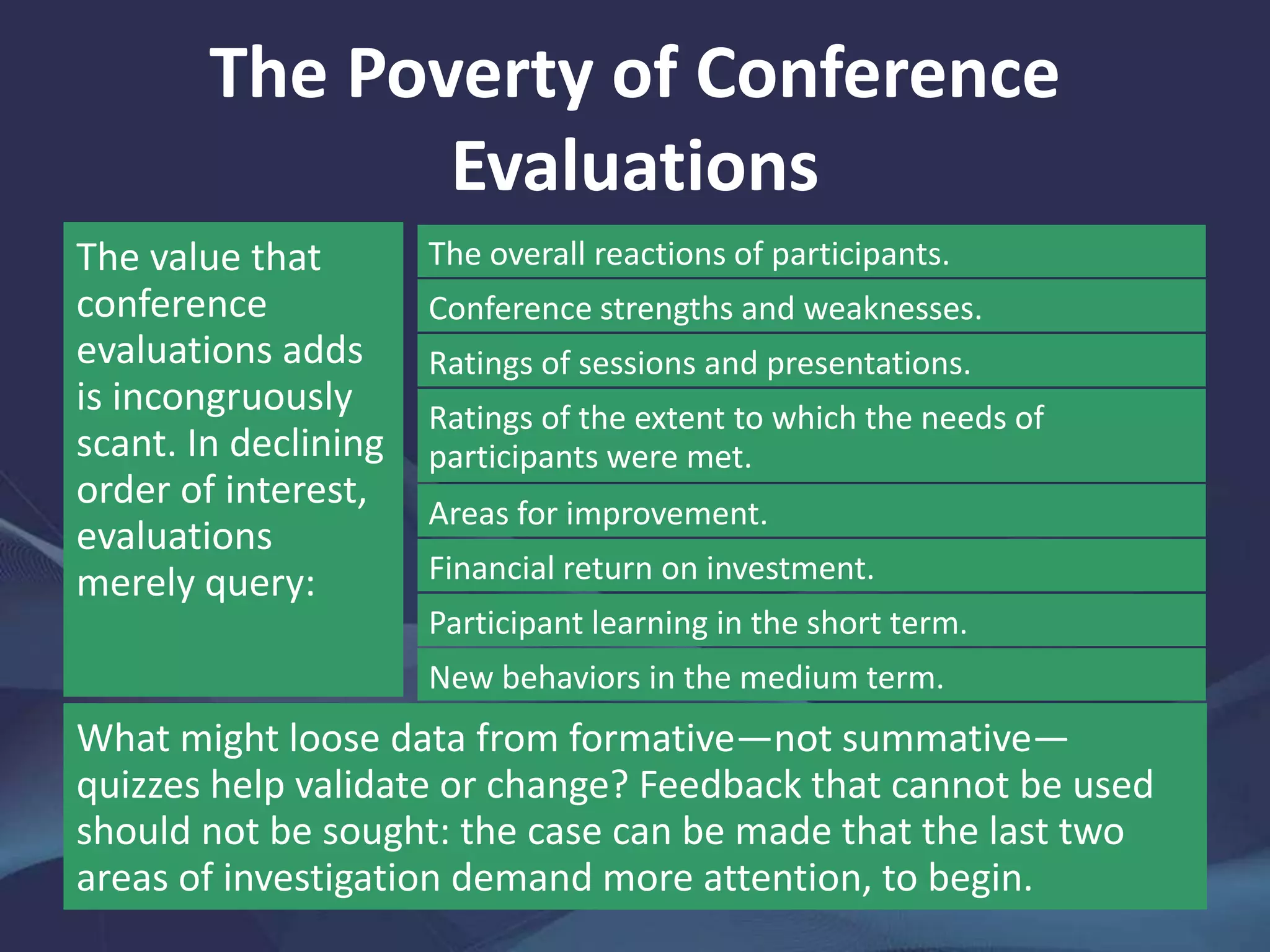
The value that
conference
evaluations adds
is incongruously
scant. In declining
order of interest,
evaluations
merely query:
The overall reactions of participants.
Conference strengths and weaknesses.
Ratings of sessions and presentations.
Ratings of the extent to which the needs of
participants were met.
Areas for improvement.
Financial return on investment.
Participant learning in the short term.
New behaviors in the medium term.
What might loose data from formative—not summative—
quizzes help validate or change? Feedback that cannot be used
should not be sought: the case can be made that the last two
areas of investigation demand more attention, to begin.
Four Levels of Learning Evaluation
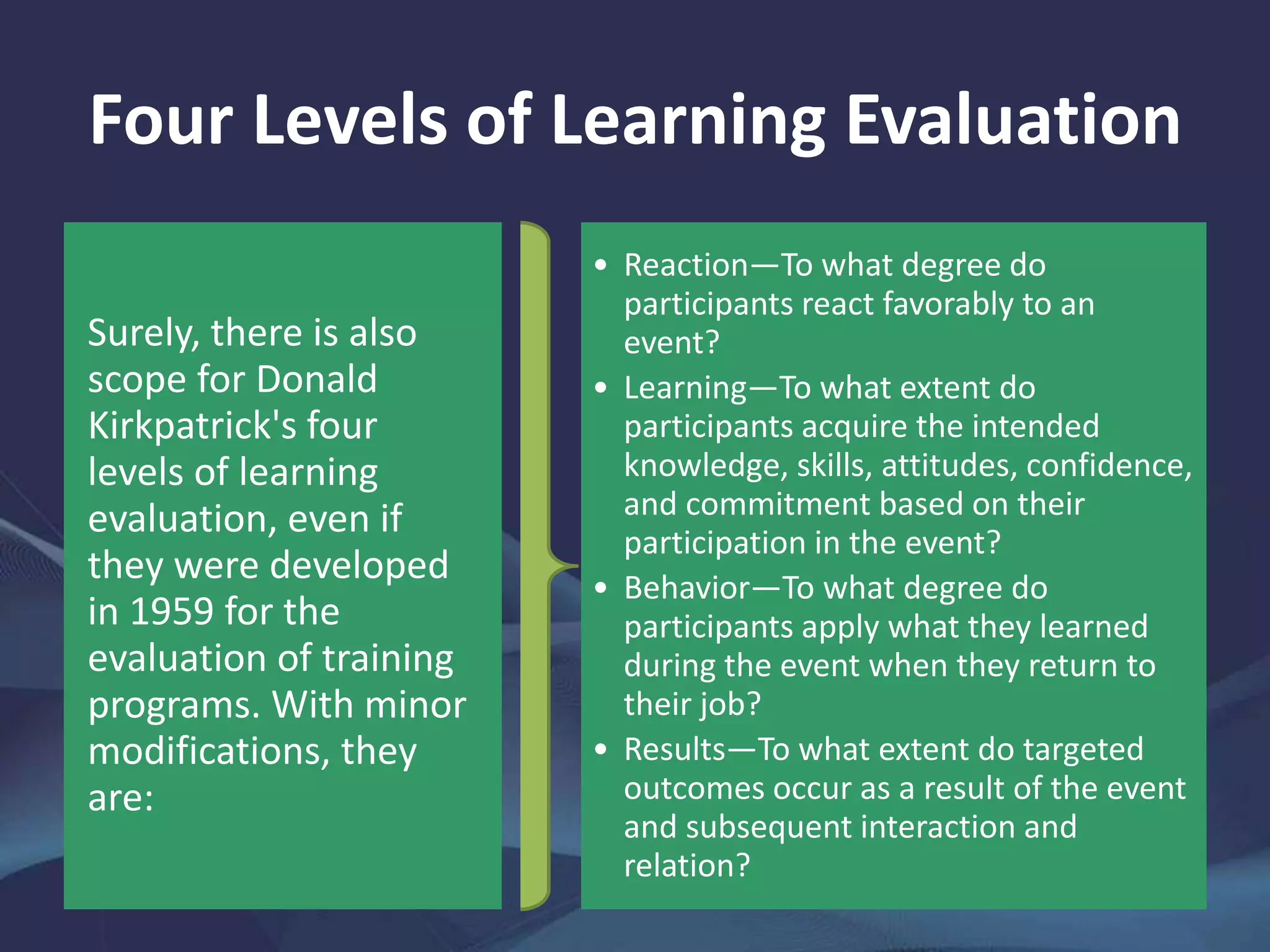
Surely, there is also
scope for Donald
Kirkpatrick's four
levels of learning
evaluation, even if
they were developed
in 1959 for the
evaluation of training
programs. With minor
modifications, they
are:
• Reaction—To what degree do
participants react favorably to an
event?
• Learning—To what extent do
participants acquire the intended
knowledge, skills, attitudes, confidence,
and commitment based on their
participation in the event?
• Behavior—To what degree do
participants apply what they learned
during the event when they return to
their job?
• Results—To what extent do targeted
outcomes occur as a result of the event
and subsequent interaction and
relation?
The Poverty of Learning in
Conferences
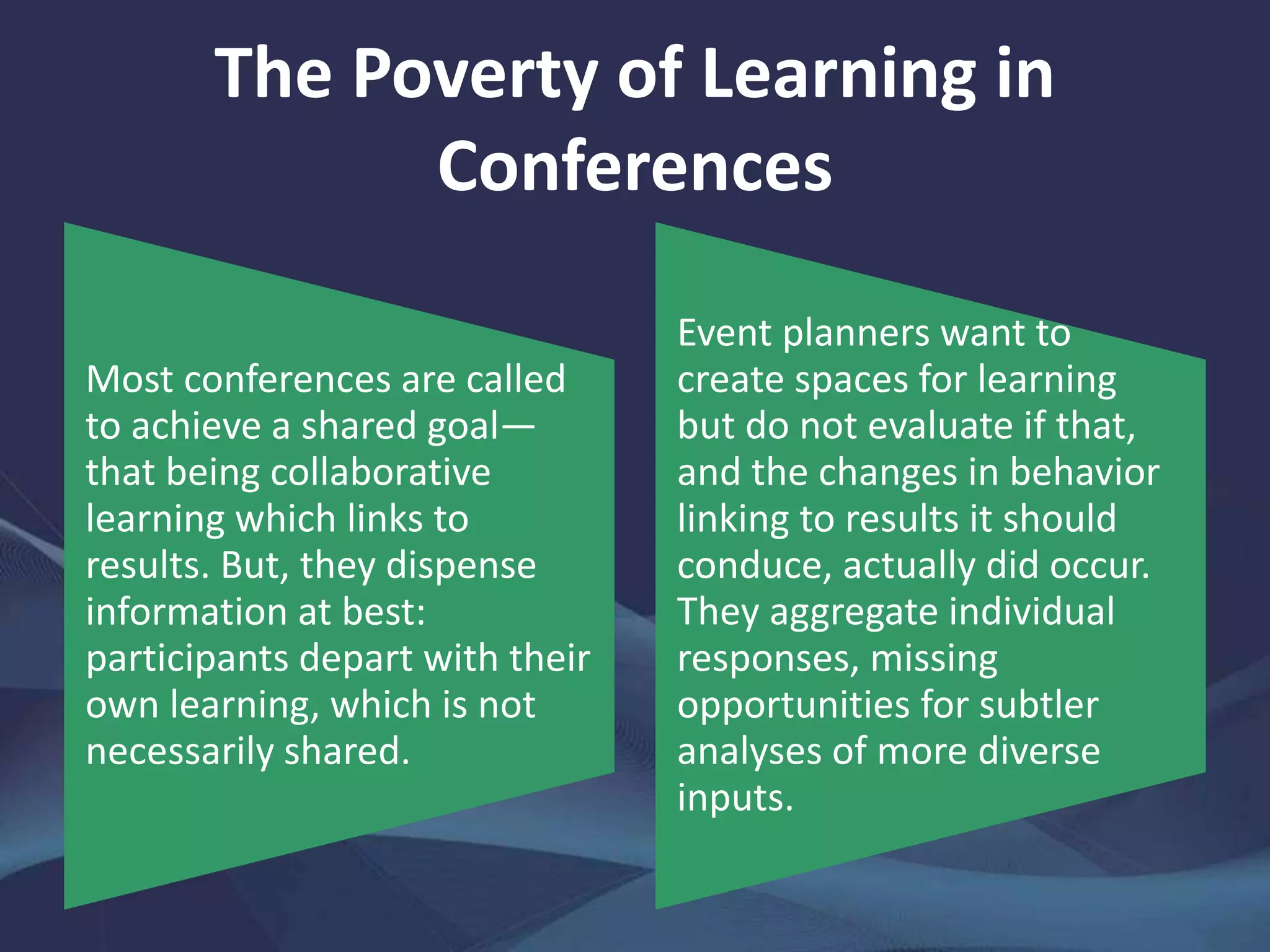
Most conferences are called
to achieve a shared goal—
that being collaborative
learning which links to
results. But, they dispense
information at best:
participants depart with their
own learning, which is not
necessarily shared.
Event planners want to
create spaces for learning
but do not evaluate if that,
and the changes in behavior
linking to results it should
conduce, actually did occur.
They aggregate individual
responses, missing
opportunities for subtler
analyses of more diverse
inputs.
Learning in Evaluation
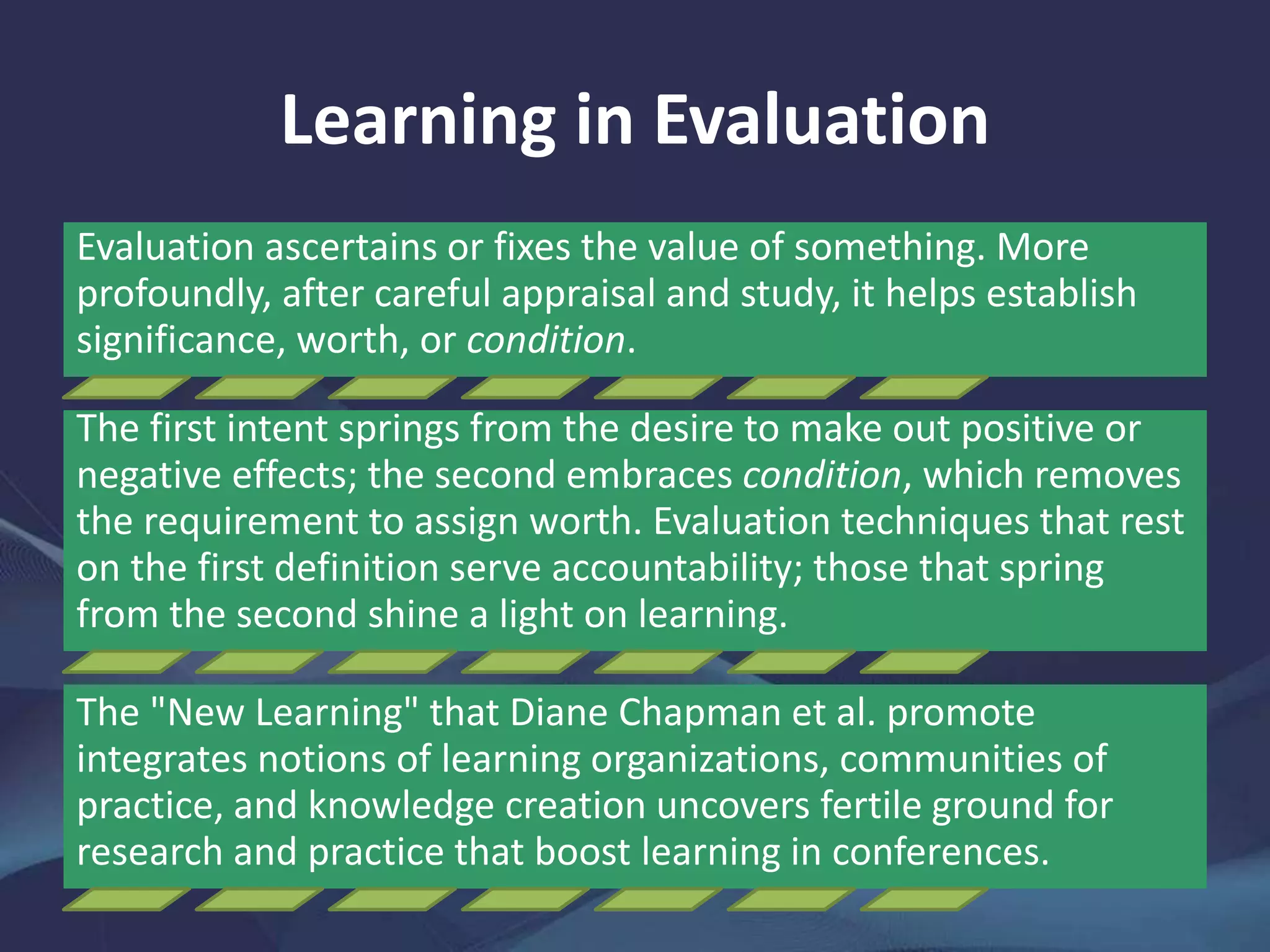
Evaluation ascertains or fixes the value of something. More
profoundly, after careful appraisal and study, it helps establish
significance, worth, or condition.
The first intent springs from the desire to make out positive or
negative effects; the second embraces condition, which removes
the requirement to assign worth. Evaluation techniques that rest
on the first definition serve accountability; those that spring
from the second shine a light on learning.
The "New Learning" that Diane Chapman et al. promote
integrates notions of learning organizations, communities of
practice, and knowledge creation uncovers fertile ground for
research and practice that boost learning in conferences.
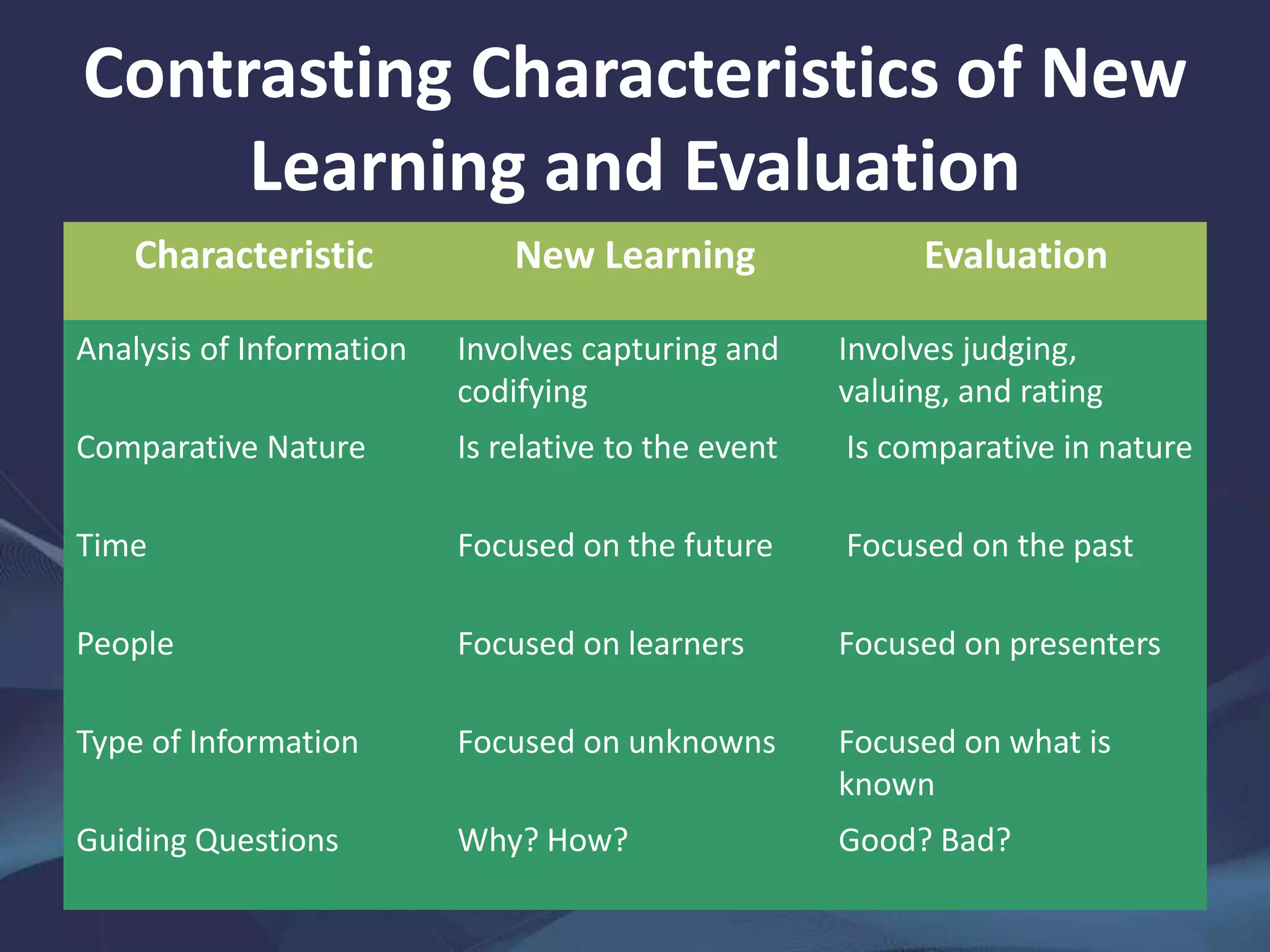
Contrasting Characteristics of New
Learning and Evaluation
Characteristic New Learning Evaluation
Analysis of Information Involves capturing and
codifying
Involves judging,
valuing, and rating
Comparative Nature Is relative to the event Is comparative in nature
Time Focused on the future Focused on the past
People Focused on learners Focused on presenters
Type of Information Focused on unknowns Focused on what is
known
Guiding Questions Why? How? Good? Bad?
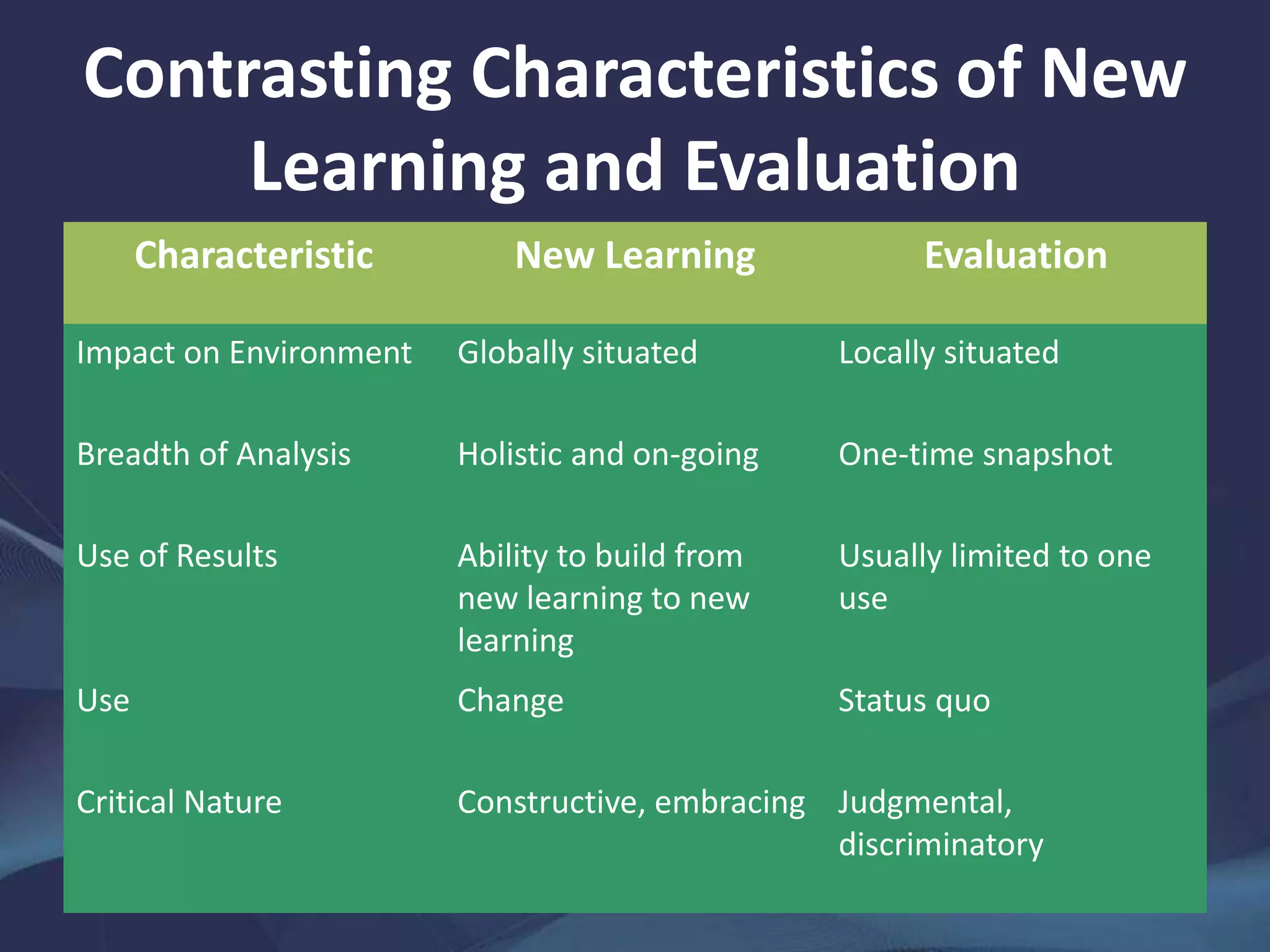
Contrasting Characteristics of New
Learning and Evaluation
Characteristic New Learning Evaluation
Impact on Environment Globally situated Locally situated
Breadth of Analysis Holistic and on-going One-time snapshot
Use of Results Ability to build from
new learning to new
learning
Usually limited to one
use
Use Change Status quo
Critical Nature Constructive, embracing Judgmental,
discriminatory
Contrasting Characteristics of New
Learning and Evaluation
Characteristic New Learning Evaluation
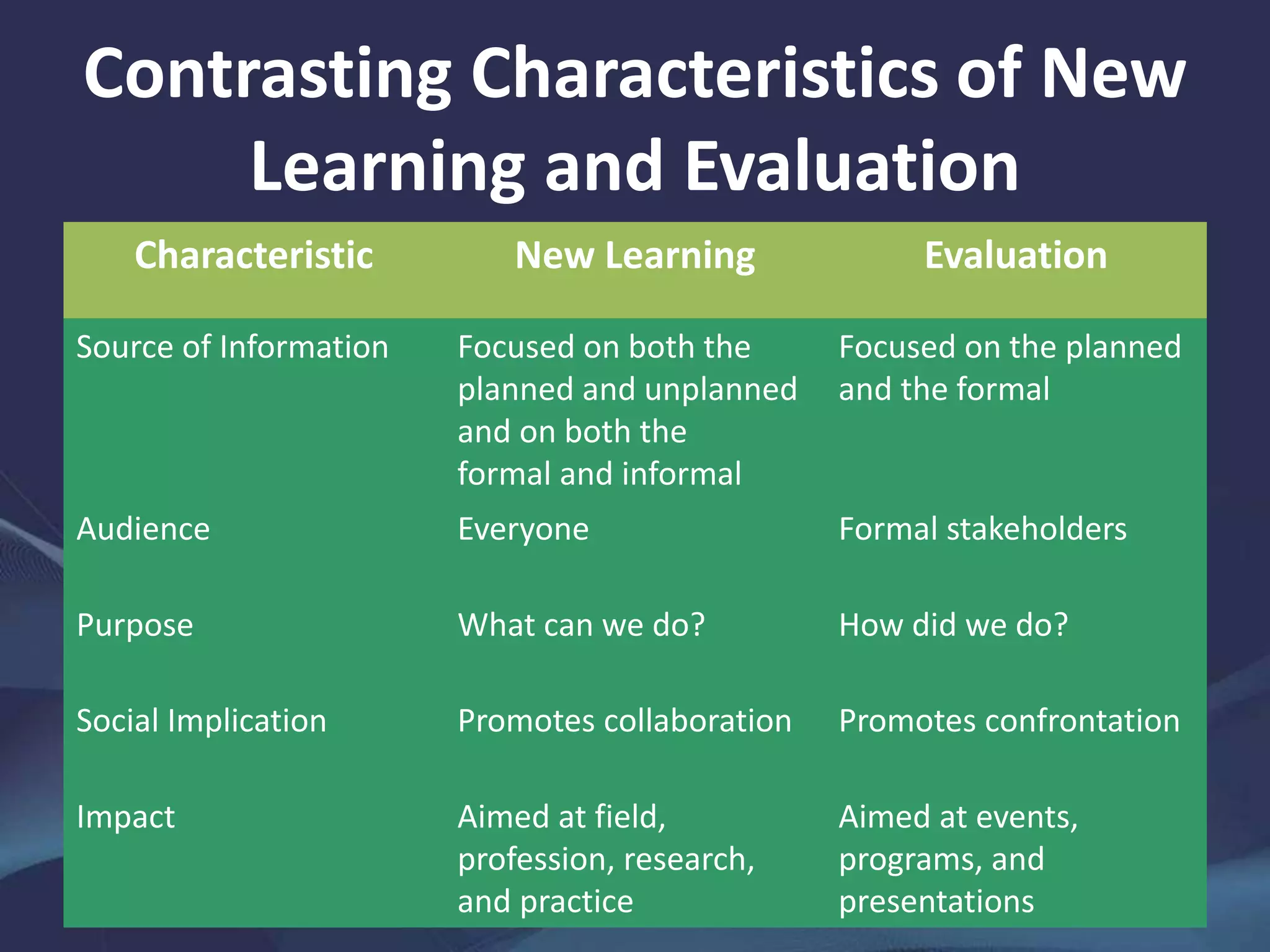
Source of Information Focused on both the
planned and unplanned
and on both the
formal and informal
Focused on the planned
and the formal
Audience Everyone Formal stakeholders
Purpose What can we do? How did we do?
Social Implication Promotes collaboration Promotes confrontation
Impact Aimed at field,
profession, research,
and practice
Aimed at events,
programs, and
presentations
Further Reading
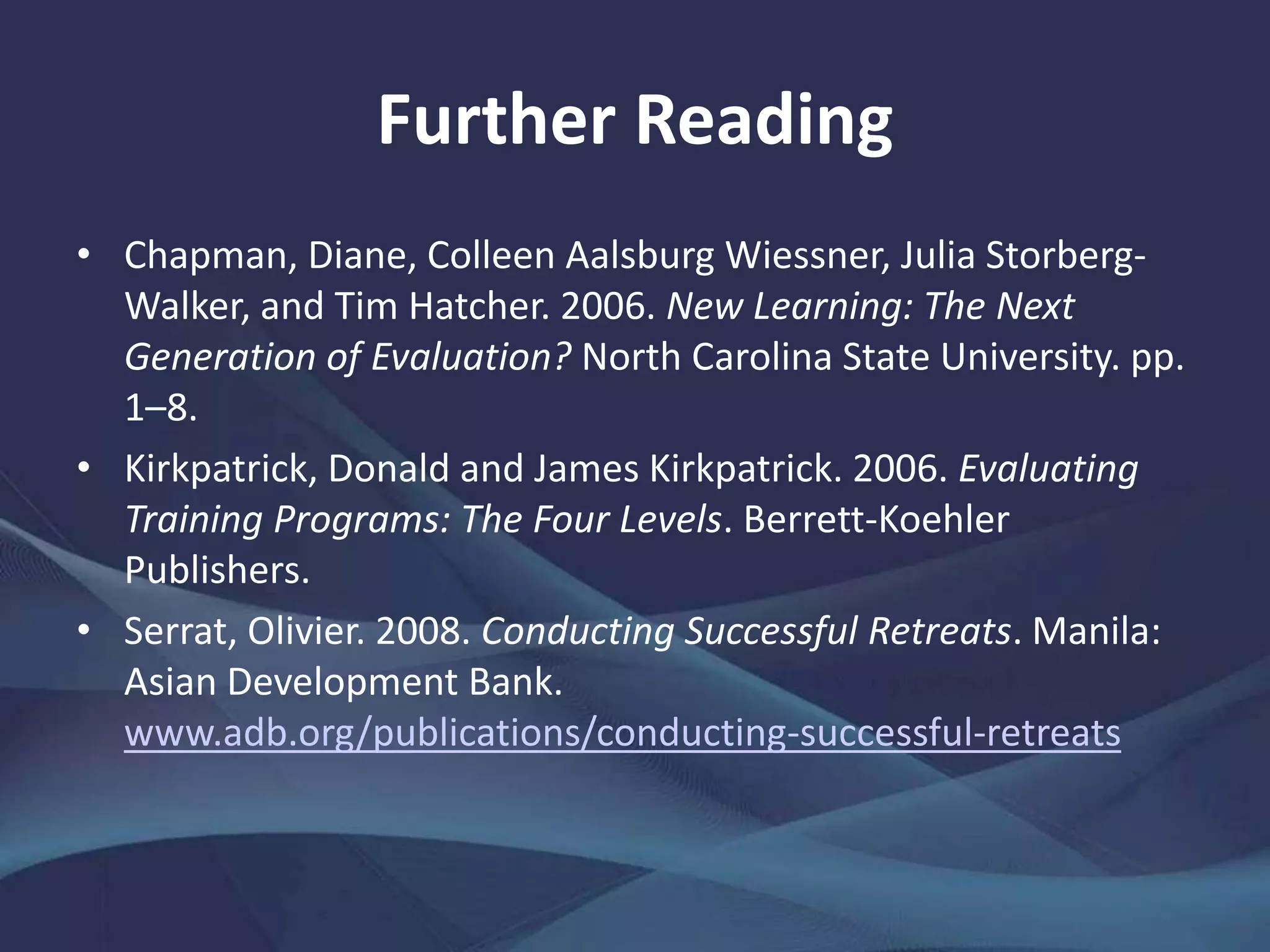
• Chapman, Diane, Colleen Aalsburg Wiessner, Julia Storberg-
Walker, and Tim Hatcher. 2006. New Learning: The Next
Generation of Evaluation? North Carolina State University. pp.
1–8.
• Kirkpatrick, Donald and James Kirkpatrick. 2006. Evaluating
Training Programs: The Four Levels. Berrett-Koehler
Publishers.
• Serrat, Olivier. 2008. Conducting Successful Retreats. Manila:
Asian Development Bank.
www.adb.org/publications/conducting-successful-retreats
Further Reading
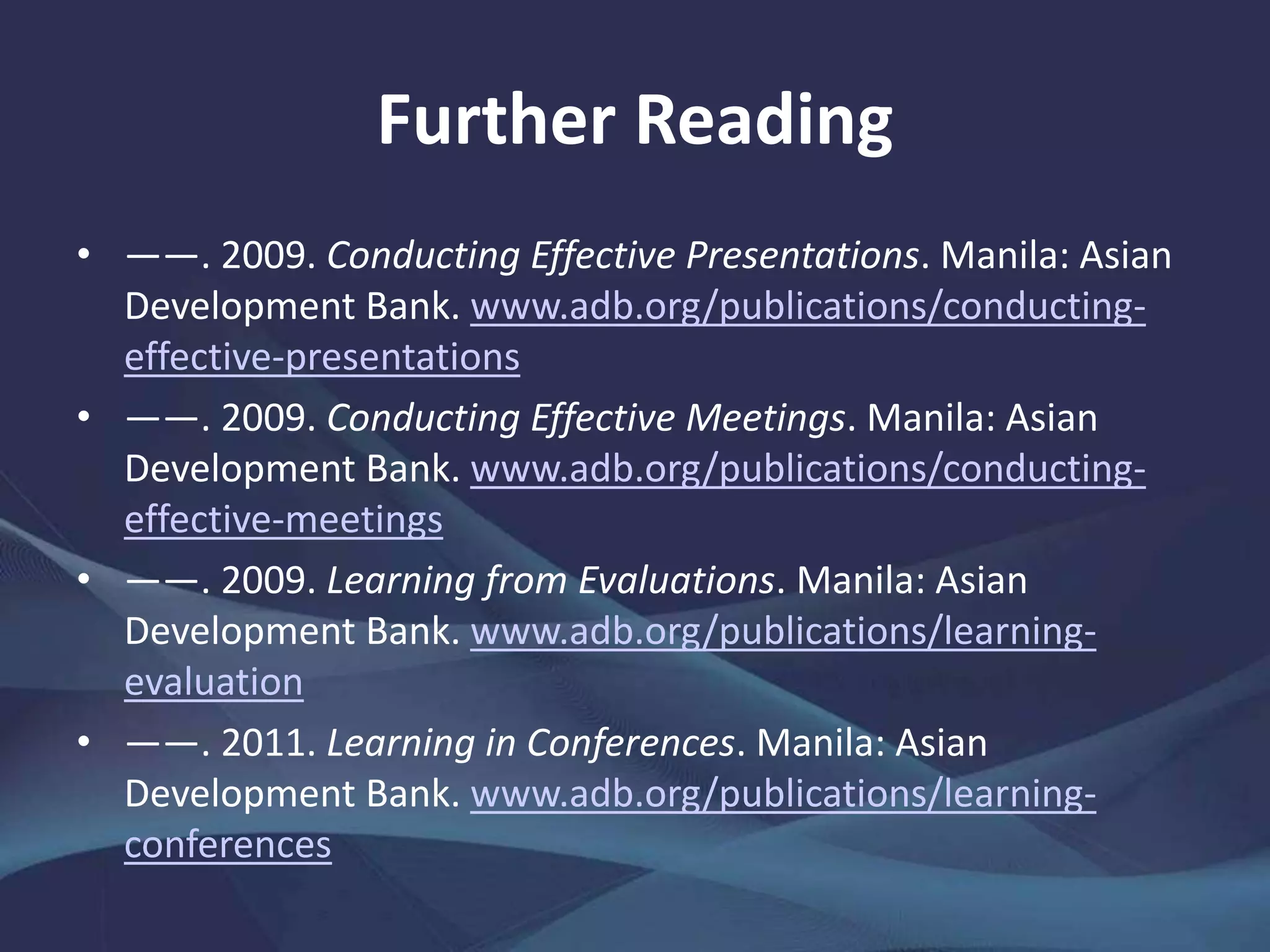
• ——. 2009. Conducting Effective Presentations. Manila: Asian
Development Bank. www.adb.org/publications/conducting-
effective-presentations
• ——. 2009. Conducting Effective Meetings. Manila: Asian
Development Bank. www.adb.org/publications/conducting-
effective-meetings
• ——. 2009. Learning from Evaluations. Manila: Asian
Development Bank. www.adb.org/publications/learning-
evaluation
• ——. 2011. Learning in Conferences. Manila: Asian
Development Bank. www.adb.org/publications/learning-
conferences
Quick Response Codes
@ADB
@ADB Sustainable
Development Timeline
@Academia.edu
@LinkedIn
@ResearchGate
@Scholar
@SlideShare
@Twitter

Learning in Conferences

  • 1.
    The views expressedin this presentation are the views of the author/s and do not necessarily reflect the views or policies of the Asian Development Bank, or its Board of Governors, or the governments they represent. ADB does not guarantee the accuracy of the data included in this presentation and accepts no responsibility for any consequence of their use. The countries listed in this presentation do not imply any view on ADB's part as to sovereignty or independent status or necessarily conform to ADB's terminology. Learning in Conferences Olivier Serrat 2015
  • 2.
    The Purpose ofConferencing Conferencing is an age-old technique for reasoning and problem solving, usually to reach agreement in formal or informal (yet planned) settings. And so, a conference is a purposeful gathering of people aiming to pool ideas on at least one topic of joint interest, or needing to achieve a common goal through interaction. Conferences ordinarily occur face-to-face but information and communications technology now also enables virtual mediation—through telephone and, increasingly, video.
  • 3.
    The Forms ofConferencing Conventions—Large meetings of delegates, industries, members, professions, representatives, or societies seeking concurrence on certain attitudes or routines, such as processes, procedures, and practices. Forums—Broad occasions for open discussion, as a rule among experts but now and then involving audiences. Seminars—Prolonged and sometimes repeated meets for exchange of results and interaction among a limited number of professionals or advanced students engaged in intensive study or original research. Workshops—Brief educational programs for small groups of peers focusing on techniques and skills in a particular field.
  • 4.
    The Forms ofConferencing Retreats—Periods of group withdrawal from regular activities for development of closer relationships, instruction, or self-reflection. Meetings*—Sundry instances of coming together for business, civic, courtship, educational, government, health and wellness, leisure, religious, social, sports, and other functions. * In the workplace, one-time, recurring, or series of meetings that regularly draw on the services of a chairperson include briefings, advisory meetings, committee meetings, council meetings, and negotiations.
  • 5.
    No Loose Change Conventions,forums, seminars, workshops, retreats, and meetings—to which the emerging practice of "unconferencing" can hereafter be added—are pervasive forms of interaction. The resources allocated to their organization, conduct, and attendance—of which the opportunity cost incurred from taking part is no loose change—must surely be astronomical. Even so, we seldom assess the relative value of such meets to either participants or event planners. Run-of-the-mill, end-of-session surveys requesting participants to jot down what they enjoyed or disliked can no longer do.
  • 6.
    The Poverty ofConference Evaluations The language used to "gauge" conference satisfaction—never mind outcome and impact—usually reads: "Thank you for taking time to complete this survey. Your opinion is important: it will inform plans for the next event." A half- dozen questions are then asked: • Did the event lead to its goal? What were its main strengths and weaknesses? • What did you value in the event? • Were the sessions relevant to the subject matter? How well did they align with your expectations? • Can you rate the quality of the presenters? • Has your knowledge of the subject matter increased as a result of the event? • Will the event set in motion changes in the way you work in the future? • What undertakings can you now initiate? • How might the event be improved?
  • 7.
    The Poverty ofConference Evaluations The value that conference evaluations adds is incongruously scant. In declining order of interest, evaluations merely query: The overall reactions of participants. Conference strengths and weaknesses. Ratings of sessions and presentations. Ratings of the extent to which the needs of participants were met. Areas for improvement. Financial return on investment. Participant learning in the short term. New behaviors in the medium term. What might loose data from formative—not summative— quizzes help validate or change? Feedback that cannot be used should not be sought: the case can be made that the last two areas of investigation demand more attention, to begin.
  • 8.
    Four Levels ofLearning Evaluation Surely, there is also scope for Donald Kirkpatrick's four levels of learning evaluation, even if they were developed in 1959 for the evaluation of training programs. With minor modifications, they are: • Reaction—To what degree do participants react favorably to an event? • Learning—To what extent do participants acquire the intended knowledge, skills, attitudes, confidence, and commitment based on their participation in the event? • Behavior—To what degree do participants apply what they learned during the event when they return to their job? • Results—To what extent do targeted outcomes occur as a result of the event and subsequent interaction and relation?
  • 9.
    The Poverty ofLearning in Conferences Most conferences are called to achieve a shared goal— that being collaborative learning which links to results. But, they dispense information at best: participants depart with their own learning, which is not necessarily shared. Event planners want to create spaces for learning but do not evaluate if that, and the changes in behavior linking to results it should conduce, actually did occur. They aggregate individual responses, missing opportunities for subtler analyses of more diverse inputs.
  • 10.
    Learning in Evaluation Evaluationascertains or fixes the value of something. More profoundly, after careful appraisal and study, it helps establish significance, worth, or condition. The first intent springs from the desire to make out positive or negative effects; the second embraces condition, which removes the requirement to assign worth. Evaluation techniques that rest on the first definition serve accountability; those that spring from the second shine a light on learning. The "New Learning" that Diane Chapman et al. promote integrates notions of learning organizations, communities of practice, and knowledge creation uncovers fertile ground for research and practice that boost learning in conferences.
  • 11.
    Contrasting Characteristics ofNew Learning and Evaluation Characteristic New Learning Evaluation Analysis of Information Involves capturing and codifying Involves judging, valuing, and rating Comparative Nature Is relative to the event Is comparative in nature Time Focused on the future Focused on the past People Focused on learners Focused on presenters Type of Information Focused on unknowns Focused on what is known Guiding Questions Why? How? Good? Bad?
  • 12.
    Contrasting Characteristics ofNew Learning and Evaluation Characteristic New Learning Evaluation Impact on Environment Globally situated Locally situated Breadth of Analysis Holistic and on-going One-time snapshot Use of Results Ability to build from new learning to new learning Usually limited to one use Use Change Status quo Critical Nature Constructive, embracing Judgmental, discriminatory
  • 13.
    Contrasting Characteristics ofNew Learning and Evaluation Characteristic New Learning Evaluation Source of Information Focused on both the planned and unplanned and on both the formal and informal Focused on the planned and the formal Audience Everyone Formal stakeholders Purpose What can we do? How did we do? Social Implication Promotes collaboration Promotes confrontation Impact Aimed at field, profession, research, and practice Aimed at events, programs, and presentations
  • 14.
    Further Reading • Chapman,Diane, Colleen Aalsburg Wiessner, Julia Storberg- Walker, and Tim Hatcher. 2006. New Learning: The Next Generation of Evaluation? North Carolina State University. pp. 1–8. • Kirkpatrick, Donald and James Kirkpatrick. 2006. Evaluating Training Programs: The Four Levels. Berrett-Koehler Publishers. • Serrat, Olivier. 2008. Conducting Successful Retreats. Manila: Asian Development Bank. www.adb.org/publications/conducting-successful-retreats
  • 15.
    Further Reading • ——.2009. Conducting Effective Presentations. Manila: Asian Development Bank. www.adb.org/publications/conducting- effective-presentations • ——. 2009. Conducting Effective Meetings. Manila: Asian Development Bank. www.adb.org/publications/conducting- effective-meetings • ——. 2009. Learning from Evaluations. Manila: Asian Development Bank. www.adb.org/publications/learning- evaluation • ——. 2011. Learning in Conferences. Manila: Asian Development Bank. www.adb.org/publications/learning- conferences
  • 16.
    Quick Response Codes @ADB @ADBSustainable Development Timeline @Academia.edu @LinkedIn @ResearchGate @Scholar @SlideShare @Twitter