Media Training“Interviewing 101”
Interviewing OverviewInterviewing 101
Interviewing 101An interview is not:A conversationAn opportunity to show how funny you areAn opportunity to show how much smarter you are than the reporterAn interview is:An opportunity to make a reporter understand and believe what you are talking aboutAn opportunity to convey the important points that are critical to your objectivesA chance to mitigate damage or change opinionsAn opportunity for your voice to be heardInterviewing 101
Newsmaker’s and Reporter’s Roles and ResponsibilitiesNewsmaker’sThe right to bring up relevant topics and points not specifically asked for in questioningThe right to correct misstatements and misinformation during an interview and before they appear in the newsReporter’sThe right to reasonable access to legitimate news sourcesThe right to ask any question that is important to their audience and the story you have agreed to be interviewed aboutInterviewing 101
 “Their” Interview GoalsTo clearly understand your point of viewBalance what your saying with what other experts or the industry is sayingChallenge points that are untested, unprovenProvide their audience with a balanced and objective look at you, your brand and your productsRemain unbiased and objectiveProvide their editors with a solid piece of reporting that looks at issues from all sidesMeet their deadlines and space requirementsInterviewing 101
“Your” Interview GoalsUnderstand the reporter’s level of knowledge about the subject and ensure that they can properly articulate your side of the storyDeliver the points you want to see Support those points so they (and you) will be credibleFrame the story the way you want to see it reportedMitigate what detractors have saidGet the reporter to see you as an authority who is helping them understand the subject matterInterviewing 101
“Your” Keys To Success	Mentally prepare a “game plan” before the interview about how you can get your message across.  Develop three or four key messages prior to an interviewStick to your area of expertiseBe enthusiastic about your subject matterIf you have an important point to share, tell the reporterKeep your responses short and on pointThe interview isn’t over until the reporter is goneNever say ANYTHING to a reporter that you wouldn’t want to see in printInterviewing 101
Preparing For InterviewsIn most cases, this will be the job of your PR Team:Determine the direction of the storyActual questions are preferredThemes and topics are more likelyDo homework on the reporter’s beat and reputation and the news outlet he/she representsFind out who else the reporter is interviewingSet a time limit and location for the interviewInterviewing 101
“Your” Interview PreparationPractice creates effective interviewsRehearse, don’t memorizeCraft key messages into “sound bites”Provide color and offer insightPrepare for the “other side of the story” so you can address criticismExpect the unexpected - Fear no question Interviewing 101
 “Their” Interview PreparationSearch past articles about:The subject matterThe companyThe productThe person being interviewedResearch recent and past litigationInterviews with “go to” “experts”Discussions with colleagues Interviewing 101
Types of InterviewsInterviewing 101
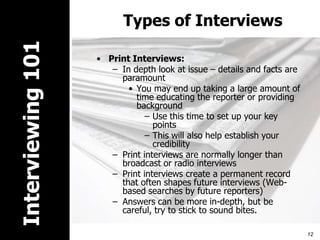
Types of InterviewsPrint Interviews:In depth look at issue – details and facts are paramountYou may end up taking a large amount of time educating the reporter or providing backgroundUse this time to set up your key pointsThis will also help establish your credibilityPrint interviews are normally longer than broadcast or radio interviewsPrint interviews create a permanent record that often shapes future interviews (Web-based searches by future reporters) Answers can be more in-depth, but be careful, try to stick to sound bites.Interviewing 101
Types of InterviewsTelevision InterviewsIncreased emphasis on look, tone and deliveryPersonality comes more into playHow you say it can be as important as what you sayDon’t wear shirts with drastic color changes from your skin colorDon’t wear crazy patternsDon’t sway, no darting eyesLook at the reporter, not into the cameraWatch “filler” wordsUnderstand in advance how long the piece is likely to be, that will shape your deliveryIf it is a 30 second story, need to stick to top line message pointsIf it is a five minute piece, more depth is possibleIn all cases, speak in sound bites.  If you don’t edit yourself, they willInterviewing 101
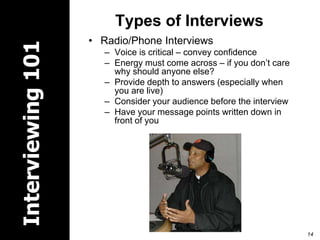
Types of InterviewsRadio/Phone InterviewsVoice is critical – convey confidenceEnergy must come across – if you don’t care why should anyone else?Provide depth to answers (especially when you are live)Consider your audience before the interviewHave your message points written down in front of youInterviewing 101
Interview TechniquesInterviewing 101
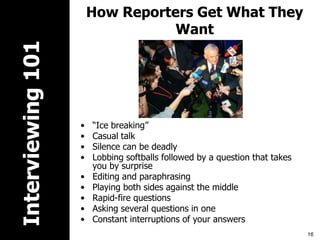
How Reporters Get What They WantInterviewing 101“Ice breaking”Casual talkSilence can be deadlyLobbing softballs followed by a question that takes you by surpriseEditing and paraphrasingPlaying both sides against the middleRapid-fire questionsAsking several questions in oneConstant interruptions of your answers
The Inverted PyramidTell your story with the headline first Follow with your key messagesAdd in supporting detailsInterviewing 101
More Ways to SucceedDon’t repeat negative words / issues or raise them yourselfBeware of getting bogged down in detailsAvoid slang that the audience will not understand (Speak in layman’s terms)Talk from your audience’s viewpointTell the truth.  Never lie Bring up points you want coveredInterviewing 101
Managing Difficult QuestionsInterviewing 101
Three Common TrapsGuessing, speculating, opiningNo commentsOff the recordThe microphone is always “hot” and the camera is always “on”.Don’t say it, if you don’t want to see it in print...Don’t do it, if you don’t want to see it on TV…Interviewing 101
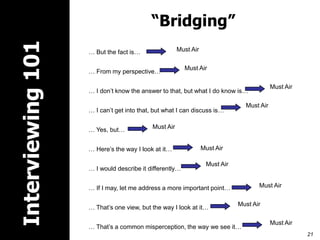
“Bridging”Must Air… But the fact is… … From my perspective… … I don’t know the answer to that, but what I do know is… … I can’t get into that, but what I can discuss is… … Yes, but… … Here’s the way I look at it… … I would describe it differently… … If I may, let me address a more important point… … That’s one view, but the way I look at it… … That’s a common misperception, the way we see it… Must AirMust AirMust AirInterviewing 101Must AirMust AirMust AirMust AirMust AirMust Air
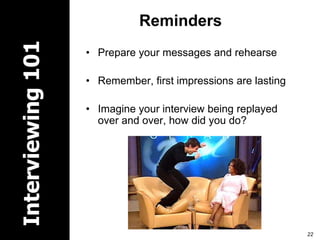
RemindersPrepare your messages and rehearseRemember, first impressions are lastingImagine your interview being replayed over and over, how did you do?Interviewing 101
Comfort, Confidence & Control = SUCCESSKnow your objectiveFocus on your audienceSelect key messagesState them wellBe credibleInterviewing 101
Key MessagesBrandMessage PointProductsMessage PointsCompetitorsMessage PointsThe IndustryMessage PointsInterviewing 101
Likely QuestionsInterviewing 101

Conducting Media Interviews

  • 1.
  • 2.
  • 3.
    Interviewing 101An interviewis not:A conversationAn opportunity to show how funny you areAn opportunity to show how much smarter you are than the reporterAn interview is:An opportunity to make a reporter understand and believe what you are talking aboutAn opportunity to convey the important points that are critical to your objectivesA chance to mitigate damage or change opinionsAn opportunity for your voice to be heardInterviewing 101
  • 4.
    Newsmaker’s and Reporter’sRoles and ResponsibilitiesNewsmaker’sThe right to bring up relevant topics and points not specifically asked for in questioningThe right to correct misstatements and misinformation during an interview and before they appear in the newsReporter’sThe right to reasonable access to legitimate news sourcesThe right to ask any question that is important to their audience and the story you have agreed to be interviewed aboutInterviewing 101
  • 5.
    “Their” InterviewGoalsTo clearly understand your point of viewBalance what your saying with what other experts or the industry is sayingChallenge points that are untested, unprovenProvide their audience with a balanced and objective look at you, your brand and your productsRemain unbiased and objectiveProvide their editors with a solid piece of reporting that looks at issues from all sidesMeet their deadlines and space requirementsInterviewing 101
  • 6.
    “Your” Interview GoalsUnderstandthe reporter’s level of knowledge about the subject and ensure that they can properly articulate your side of the storyDeliver the points you want to see Support those points so they (and you) will be credibleFrame the story the way you want to see it reportedMitigate what detractors have saidGet the reporter to see you as an authority who is helping them understand the subject matterInterviewing 101
  • 7.
    “Your” Keys ToSuccess Mentally prepare a “game plan” before the interview about how you can get your message across. Develop three or four key messages prior to an interviewStick to your area of expertiseBe enthusiastic about your subject matterIf you have an important point to share, tell the reporterKeep your responses short and on pointThe interview isn’t over until the reporter is goneNever say ANYTHING to a reporter that you wouldn’t want to see in printInterviewing 101
  • 8.
    Preparing For InterviewsInmost cases, this will be the job of your PR Team:Determine the direction of the storyActual questions are preferredThemes and topics are more likelyDo homework on the reporter’s beat and reputation and the news outlet he/she representsFind out who else the reporter is interviewingSet a time limit and location for the interviewInterviewing 101
  • 9.
    “Your” Interview PreparationPracticecreates effective interviewsRehearse, don’t memorizeCraft key messages into “sound bites”Provide color and offer insightPrepare for the “other side of the story” so you can address criticismExpect the unexpected - Fear no question Interviewing 101
  • 10.
    “Their” InterviewPreparationSearch past articles about:The subject matterThe companyThe productThe person being interviewedResearch recent and past litigationInterviews with “go to” “experts”Discussions with colleagues Interviewing 101
  • 11.
  • 12.
    Types of InterviewsPrintInterviews:In depth look at issue – details and facts are paramountYou may end up taking a large amount of time educating the reporter or providing backgroundUse this time to set up your key pointsThis will also help establish your credibilityPrint interviews are normally longer than broadcast or radio interviewsPrint interviews create a permanent record that often shapes future interviews (Web-based searches by future reporters) Answers can be more in-depth, but be careful, try to stick to sound bites.Interviewing 101
  • 13.
    Types of InterviewsTelevisionInterviewsIncreased emphasis on look, tone and deliveryPersonality comes more into playHow you say it can be as important as what you sayDon’t wear shirts with drastic color changes from your skin colorDon’t wear crazy patternsDon’t sway, no darting eyesLook at the reporter, not into the cameraWatch “filler” wordsUnderstand in advance how long the piece is likely to be, that will shape your deliveryIf it is a 30 second story, need to stick to top line message pointsIf it is a five minute piece, more depth is possibleIn all cases, speak in sound bites. If you don’t edit yourself, they willInterviewing 101
  • 14.
    Types of InterviewsRadio/PhoneInterviewsVoice is critical – convey confidenceEnergy must come across – if you don’t care why should anyone else?Provide depth to answers (especially when you are live)Consider your audience before the interviewHave your message points written down in front of youInterviewing 101
  • 15.
  • 16.
    How Reporters GetWhat They WantInterviewing 101“Ice breaking”Casual talkSilence can be deadlyLobbing softballs followed by a question that takes you by surpriseEditing and paraphrasingPlaying both sides against the middleRapid-fire questionsAsking several questions in oneConstant interruptions of your answers
  • 17.
    The Inverted PyramidTellyour story with the headline first Follow with your key messagesAdd in supporting detailsInterviewing 101
  • 18.
    More Ways toSucceedDon’t repeat negative words / issues or raise them yourselfBeware of getting bogged down in detailsAvoid slang that the audience will not understand (Speak in layman’s terms)Talk from your audience’s viewpointTell the truth. Never lie Bring up points you want coveredInterviewing 101
  • 19.
  • 20.
    Three Common TrapsGuessing,speculating, opiningNo commentsOff the recordThe microphone is always “hot” and the camera is always “on”.Don’t say it, if you don’t want to see it in print...Don’t do it, if you don’t want to see it on TV…Interviewing 101
  • 21.
    “Bridging”Must Air… Butthe fact is… … From my perspective… … I don’t know the answer to that, but what I do know is… … I can’t get into that, but what I can discuss is… … Yes, but… … Here’s the way I look at it… … I would describe it differently… … If I may, let me address a more important point… … That’s one view, but the way I look at it… … That’s a common misperception, the way we see it… Must AirMust AirMust AirInterviewing 101Must AirMust AirMust AirMust AirMust AirMust Air
  • 22.
    RemindersPrepare your messagesand rehearseRemember, first impressions are lastingImagine your interview being replayed over and over, how did you do?Interviewing 101
  • 23.
    Comfort, Confidence &Control = SUCCESSKnow your objectiveFocus on your audienceSelect key messagesState them wellBe credibleInterviewing 101
  • 24.
    Key MessagesBrandMessage PointProductsMessagePointsCompetitorsMessage PointsThe IndustryMessage PointsInterviewing 101
  • 25.