INTERVIEWING 101
COMM 106: MULTIMEDIA JOURNALISM
INTERVIEWING 101:
• Interviews are the heart of journalism, and each one is a
little different from any other. A reporter might interview a
candidate for governor one day and a 5-year-old the next.
Obviously, you’d approach those two conversations
differently, but there are some basic guidelines that apply
to all interviews.
• Remember that most adults associate the word interview
with something stressful, like a job application, so try to
avoid describing what you’re doing as an “interview”, even
when you’re calling ahead to set it up. Unless you are
contacting a public official or spokesman whose job
involves speaking with the news media, just tell people
you’d like to talk to them for a story. This may sound like a
distinction without a difference, but experienced
journalists say that using the right words can help people
be themselves and result in a better interview.
INTERVIEWING 101:
•ESTABLISHING CONTACT
•When you first reach out to someone
to do an interview, limit your first
contact to saying these three things:
•WHO YOU ARE (name/student)
•WHERE YOU’RE FROM (Westchester
Community College Journalism Class)
•WHAT YOU WANT (To talk to them about
***whatever***)
•Let everything else flow from the ensuing
communication
INTERVIEWING 101: questions
• An interview is a conversation with a purpose, and
the reporter is (or should be) in the driver’s seat.
You need to be open to unexpected detours, but
you also need a road map to remember where
you’re going. Know what questions you plan to ask
and why you’re asking them.
• MOST IMPORTANT: What is involved in the story
you want to tell? This focus is what forms the basis
for all your questions!
• Always be clear as to what you want/expect out
of your interview subject with your questions – if
you don’t know, how can they?
• The first question in an interview is important because it
sets the tone for what follows. A lot of journalists like to
begin with an “ice-breaker” question that lets the
source relax. It’s something they’re comfortable
answering. It may, in fact, have nothing to do with the
reason you are there. But often it helps to establish your
credentials with the source, and that can create a sense
of trust and openness. If you are interviewing a writer
about her latest novel, your opening question could be
about her previous book or her family to show you have
done your homework and are well prepared for the
conversation.
INTERVIEWING 101: questions
•Most of the time, the best questions are
open-ended questions that cannot be
answered with yes or no. “Did the fire wake
you up?” doesn’t get you much. “How did
you discover the house was on fire?” would
likely be more productive as it should spark a
story and not just an answer.
How a usual, boring interview might go:
• Interviewer: “How are you?” (not a great ice-breaker as it
doesn’t show any real interest in subject or evidence of
research/homework)
• Subject: “Good.”
• Interviewer: “So you were born in Boston, right?” (you’re letting
your research limit the subject’s answer)
• Subject: “Yes.”
• Interviewer: “And you lived there for five years?” (again, you’re
letting your research limit the subject’s answer)
• Subject: “Yes.”
The problem is that the interviewer only asked closed-ended or
trite questions, which didn’t allow for any interesting answers.
INTERVIEWING 101: questions
• Good interviewers know to use open-ended questions
instead, which tend to elicit much more interesting answers.
Staring questions with words such as “How” and “Why” and
phrases like “What do you think about…”, “What was it like
too…,” and “Can you tell me about...” are good open-ended
question starters. For instance -
• Interviewer: “Can you tell me about where you grew up?”
• Subject: “I grew up just outside of Boston in Newton
Center, Massachusetts. We lived in a two-family home – we
had the bottom floor, and the owners had the top floor. It
was a great place to grow up – we had a backyard to run
around in and a big, spooky basement where we played for
hours.”
INTERVIEWING 101: questions
• Interviewer: “What was it like to have your landlords living above
you?”
• Subject: “I didn’t think anything of it at the time. I guess my parents
knew they had to be on their best behavior – the Furmans were an
older couple and liked it when things were quiet.”
• Interviewer: “Why did your family leave Boston?”
• Interviewee: “My Dad got a promotion, so we moved to
Washington, DC when I was 11.”
• Interviewer: “What was that like for you, entering a new school
when you were at that age?”
Better, right? So think of an “interview” as a conversation with
someone where you begin questions words and phrases like “How,”
“Why,” “What do you think about,” “What was it like,” or “Tell me
about.”
INTERVIEWING 101: questions
• Good questions are also nonjudgmental, in that
they do not establish the reporter’s point of view.
It’s the difference between “What do you think
about that?” and “What could you have been
thinking?!”
• CNN’s Wolf Blitzer fell into this trap when he talked
to a woman in Oklahoma who had run out of her
house just before a tornado destroyed it.
INTERVIEWING 101: questions
• Another example of a biased/leading question is, "It's OK to
smoke around other people as long as they don't mind,
right?" or "Is your favorite color red?" A question that
favors a particular response is an example of a biased
question.
• A biased question could also be one that reveals how YOU
personally feel. For instance, “Why do you do the horrible
things you do?” or “You really hate women, don’t you?”
Typically, your job is NOT to judge – it’s to investigate and
inform accurately and fairly.
• If you can’t put your own feelings and opinions aside then
you probably shouldn’t be doing the story.
INTERVIEWING 101: questions
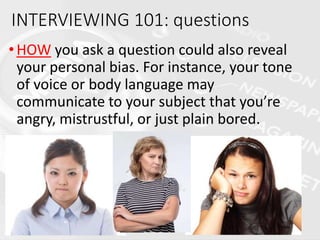
•HOW you ask a question could also reveal
your personal bias. For instance, your tone
of voice or body language may
communicate to your subject that you’re
angry, mistrustful, or just plain bored.
INTERVIEWING 101: questions
•Don’t be afraid to ask “dumb” questions:
• If you’re confused, don’t move along to the next
question. Ask for clarification, even if you’re
afraid you might sound “stupid”. You don’t want
to realize later that you don’t know what you’re
talking now about because you were confused
during the interview.
• You also don’t want to get the facts, intended
meaning, or context wrong because that would
be neither fair nor accurate to your subject or
your audience.
INTERVIEWING 101: questions
•Ask short questions:
•Don’t pack all your questions into one
super-mega question - split it up into two
parts.
•Typically, NO question should be over 10-15
words long. If it is – WRITE TWO
QUESTIONS!
INTERVIEWING 101: questions
•Don’t be afraid to say nothing:
• While it’s important to ask good questions, it’s also critically
important to be quiet and let the interviewee talk. Good
journalists are good listeners and often learn the most significant
information by being silent. People naturally want to fill silences.
Give them a chance to do so by responding with nonverbal cues
that say, “I’m interested,” such as leaning forward in your chair or
taking notes in your notebook. What you hear can lead to
additional questions that may not have occurred to you.
• But DON’T CROSS-TALK! You should always avoid verbal cues that
are used in normal conversation. Saying, “mmm-hmmm” or
“sure” or making other supportive noises is a good way to ruin a
great sound bite. You won’t be able to use it, either because the
background sound is so distracting or because you can’t risk
letting anyone think that you were agreeing with the person you
were interviewing.
INTERVIEWING 101: questions
•Don’t forget to prepare/plan
for/anticipate follow up questions:
• Follow-up questions can be key; they often lead
to an interview achieving a flow of
communication that delivers more information
and insight from your subject.
• If you do your research you can typically
anticipate what some answers might be and craft
follow-up questions ahead of time
• Also be prepared to think quickly – you have to
listen carefully so you can ask follow-up questions
as they present themselves during the interview
INTERVIEWING 101: questions
 Do plenty of research on your subject ahead of
time and write more questions than you think
you’ll need!
 You should always write at least 10
questions for your subject(s)
 It’s always better to be TOO prepared than
underprepared!
INTERVIEWING 101: questions
• Sometimes interview subjects ask to see a reporter’s
questions in advance or will only agree to an interview if
the reporter promises not to raise certain issues. Most
journalists won’t accept these kinds of conditions. Among
other things, providing specific questions in advance gives
a source the opportunity to prepare answers that are likely
to come across as stilted and rehearsed. And agreeing to
limit what can be discussed gives the source the upper
hand in a conversation that the journalist should control.
• That said, it’s always a good idea to tell sources the main
topics you plan to cover during the interview, while making
it clear that you reserve the right to ask about other things
as well.
INTERVIEWING 101: questions
• Whenever they conduct an interview, reporters usually
have some general questions they save for the end.
First, they may summarize the conversation to be sure
they’ve understood what was said. Then they will ask if
there is anything else the person being interviewed
wants to add. They also ask for the best way to get back
in touch with the person, especially after hours, and
they thank the person for their time.
• And many journalists have one last question they ask at
all interviews: “What else is going on?” It’s amazing
how many good stories you can find while you’re out
covering something else.
INTERVIEWING 101: questions
•END EVERY INTERVIEW
ASKING IF THERE’S
SOMETHING THE SUBJECT
WANTS TO ADD AND/OR
WHAT ELSE IS GOING ON
THAT THEY’D LIKE TO TELL
YOU ABOUT
•#1 Rule:
BE PROFESSIONAL,
POLITE, AND
INTERESTED
INTERVIEWING 101:
 BY NEXT CLASS: Complete the Blackboard Interview
Exercise/Quiz using the guidelines as discussed in
class
 BE SPECIFIC AND CLEAR AND DO NOT TAKE A
GENERAL APPROACH WITH THESE QUESTIONS - you
are interviewing them for a specific reason!
 Pick someone you already know something about –
use your existing knowledge and interests!
 NO LATE WORK ACCEPTED FOR FULL CREDIT
INTERVIEWING EXERCISE:
How to Interview “Almost” Anyone
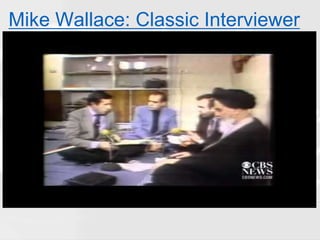
Mike Wallace: Classic Interviewer
Celeb Interviews That Went Terribly Wrong

WCC COMM 106 interviewing LUTHER

  • 1.
    INTERVIEWING 101 COMM 106:MULTIMEDIA JOURNALISM
  • 2.
    INTERVIEWING 101: • Interviewsare the heart of journalism, and each one is a little different from any other. A reporter might interview a candidate for governor one day and a 5-year-old the next. Obviously, you’d approach those two conversations differently, but there are some basic guidelines that apply to all interviews. • Remember that most adults associate the word interview with something stressful, like a job application, so try to avoid describing what you’re doing as an “interview”, even when you’re calling ahead to set it up. Unless you are contacting a public official or spokesman whose job involves speaking with the news media, just tell people you’d like to talk to them for a story. This may sound like a distinction without a difference, but experienced journalists say that using the right words can help people be themselves and result in a better interview.
  • 3.
    INTERVIEWING 101: •ESTABLISHING CONTACT •Whenyou first reach out to someone to do an interview, limit your first contact to saying these three things: •WHO YOU ARE (name/student) •WHERE YOU’RE FROM (Westchester Community College Journalism Class) •WHAT YOU WANT (To talk to them about ***whatever***) •Let everything else flow from the ensuing communication
  • 4.
    INTERVIEWING 101: questions •An interview is a conversation with a purpose, and the reporter is (or should be) in the driver’s seat. You need to be open to unexpected detours, but you also need a road map to remember where you’re going. Know what questions you plan to ask and why you’re asking them. • MOST IMPORTANT: What is involved in the story you want to tell? This focus is what forms the basis for all your questions! • Always be clear as to what you want/expect out of your interview subject with your questions – if you don’t know, how can they?
  • 5.
    • The firstquestion in an interview is important because it sets the tone for what follows. A lot of journalists like to begin with an “ice-breaker” question that lets the source relax. It’s something they’re comfortable answering. It may, in fact, have nothing to do with the reason you are there. But often it helps to establish your credentials with the source, and that can create a sense of trust and openness. If you are interviewing a writer about her latest novel, your opening question could be about her previous book or her family to show you have done your homework and are well prepared for the conversation. INTERVIEWING 101: questions
  • 6.
    INTERVIEWING 101: questions •Mostof the time, the best questions are open-ended questions that cannot be answered with yes or no. “Did the fire wake you up?” doesn’t get you much. “How did you discover the house was on fire?” would likely be more productive as it should spark a story and not just an answer.
  • 7.
    How a usual,boring interview might go: • Interviewer: “How are you?” (not a great ice-breaker as it doesn’t show any real interest in subject or evidence of research/homework) • Subject: “Good.” • Interviewer: “So you were born in Boston, right?” (you’re letting your research limit the subject’s answer) • Subject: “Yes.” • Interviewer: “And you lived there for five years?” (again, you’re letting your research limit the subject’s answer) • Subject: “Yes.” The problem is that the interviewer only asked closed-ended or trite questions, which didn’t allow for any interesting answers. INTERVIEWING 101: questions
  • 8.
    • Good interviewersknow to use open-ended questions instead, which tend to elicit much more interesting answers. Staring questions with words such as “How” and “Why” and phrases like “What do you think about…”, “What was it like too…,” and “Can you tell me about...” are good open-ended question starters. For instance - • Interviewer: “Can you tell me about where you grew up?” • Subject: “I grew up just outside of Boston in Newton Center, Massachusetts. We lived in a two-family home – we had the bottom floor, and the owners had the top floor. It was a great place to grow up – we had a backyard to run around in and a big, spooky basement where we played for hours.” INTERVIEWING 101: questions
  • 9.
    • Interviewer: “Whatwas it like to have your landlords living above you?” • Subject: “I didn’t think anything of it at the time. I guess my parents knew they had to be on their best behavior – the Furmans were an older couple and liked it when things were quiet.” • Interviewer: “Why did your family leave Boston?” • Interviewee: “My Dad got a promotion, so we moved to Washington, DC when I was 11.” • Interviewer: “What was that like for you, entering a new school when you were at that age?” Better, right? So think of an “interview” as a conversation with someone where you begin questions words and phrases like “How,” “Why,” “What do you think about,” “What was it like,” or “Tell me about.” INTERVIEWING 101: questions
  • 10.
    • Good questionsare also nonjudgmental, in that they do not establish the reporter’s point of view. It’s the difference between “What do you think about that?” and “What could you have been thinking?!” • CNN’s Wolf Blitzer fell into this trap when he talked to a woman in Oklahoma who had run out of her house just before a tornado destroyed it. INTERVIEWING 101: questions
  • 11.
    • Another exampleof a biased/leading question is, "It's OK to smoke around other people as long as they don't mind, right?" or "Is your favorite color red?" A question that favors a particular response is an example of a biased question. • A biased question could also be one that reveals how YOU personally feel. For instance, “Why do you do the horrible things you do?” or “You really hate women, don’t you?” Typically, your job is NOT to judge – it’s to investigate and inform accurately and fairly. • If you can’t put your own feelings and opinions aside then you probably shouldn’t be doing the story. INTERVIEWING 101: questions
  • 12.
    •HOW you aska question could also reveal your personal bias. For instance, your tone of voice or body language may communicate to your subject that you’re angry, mistrustful, or just plain bored. INTERVIEWING 101: questions
  • 13.
    •Don’t be afraidto ask “dumb” questions: • If you’re confused, don’t move along to the next question. Ask for clarification, even if you’re afraid you might sound “stupid”. You don’t want to realize later that you don’t know what you’re talking now about because you were confused during the interview. • You also don’t want to get the facts, intended meaning, or context wrong because that would be neither fair nor accurate to your subject or your audience. INTERVIEWING 101: questions
  • 14.
    •Ask short questions: •Don’tpack all your questions into one super-mega question - split it up into two parts. •Typically, NO question should be over 10-15 words long. If it is – WRITE TWO QUESTIONS! INTERVIEWING 101: questions
  • 15.
    •Don’t be afraidto say nothing: • While it’s important to ask good questions, it’s also critically important to be quiet and let the interviewee talk. Good journalists are good listeners and often learn the most significant information by being silent. People naturally want to fill silences. Give them a chance to do so by responding with nonverbal cues that say, “I’m interested,” such as leaning forward in your chair or taking notes in your notebook. What you hear can lead to additional questions that may not have occurred to you. • But DON’T CROSS-TALK! You should always avoid verbal cues that are used in normal conversation. Saying, “mmm-hmmm” or “sure” or making other supportive noises is a good way to ruin a great sound bite. You won’t be able to use it, either because the background sound is so distracting or because you can’t risk letting anyone think that you were agreeing with the person you were interviewing. INTERVIEWING 101: questions
  • 16.
    •Don’t forget toprepare/plan for/anticipate follow up questions: • Follow-up questions can be key; they often lead to an interview achieving a flow of communication that delivers more information and insight from your subject. • If you do your research you can typically anticipate what some answers might be and craft follow-up questions ahead of time • Also be prepared to think quickly – you have to listen carefully so you can ask follow-up questions as they present themselves during the interview INTERVIEWING 101: questions
  • 17.
     Do plentyof research on your subject ahead of time and write more questions than you think you’ll need!  You should always write at least 10 questions for your subject(s)  It’s always better to be TOO prepared than underprepared! INTERVIEWING 101: questions
  • 18.
    INTERVIEWING 101: questions •Sometimes interview subjects ask to see a reporter’s questions in advance or will only agree to an interview if the reporter promises not to raise certain issues. Most journalists won’t accept these kinds of conditions. Among other things, providing specific questions in advance gives a source the opportunity to prepare answers that are likely to come across as stilted and rehearsed. And agreeing to limit what can be discussed gives the source the upper hand in a conversation that the journalist should control. • That said, it’s always a good idea to tell sources the main topics you plan to cover during the interview, while making it clear that you reserve the right to ask about other things as well.
  • 19.
    INTERVIEWING 101: questions •Whenever they conduct an interview, reporters usually have some general questions they save for the end. First, they may summarize the conversation to be sure they’ve understood what was said. Then they will ask if there is anything else the person being interviewed wants to add. They also ask for the best way to get back in touch with the person, especially after hours, and they thank the person for their time. • And many journalists have one last question they ask at all interviews: “What else is going on?” It’s amazing how many good stories you can find while you’re out covering something else.
  • 20.
    INTERVIEWING 101: questions •ENDEVERY INTERVIEW ASKING IF THERE’S SOMETHING THE SUBJECT WANTS TO ADD AND/OR WHAT ELSE IS GOING ON THAT THEY’D LIKE TO TELL YOU ABOUT
  • 21.
    •#1 Rule: BE PROFESSIONAL, POLITE,AND INTERESTED INTERVIEWING 101:
  • 22.
     BY NEXTCLASS: Complete the Blackboard Interview Exercise/Quiz using the guidelines as discussed in class  BE SPECIFIC AND CLEAR AND DO NOT TAKE A GENERAL APPROACH WITH THESE QUESTIONS - you are interviewing them for a specific reason!  Pick someone you already know something about – use your existing knowledge and interests!  NO LATE WORK ACCEPTED FOR FULL CREDIT INTERVIEWING EXERCISE:
  • 23.
    How to Interview“Almost” Anyone
  • 24.
  • 25.
    Celeb Interviews ThatWent Terribly Wrong