Top of the Curve:
Asphalt Preservation
using Rejuvenators
APWA Florida Chapter
West Coast Branch
February 19, 2019
Chas Jordan, ENV SP, LEED GA, STP
cjordan@pavetechinc.com
2
What is Pavement Preservation?
A cost-effective set of practices that
extend pavement life and improve safety
and motorist satisfaction while saving
public tax dollars.
(NCPP, pavementpreservation.org)
3
Pavement Preservation
• Asset Management Principles:
• Life Cycle Cost Benefit
• Maintaining Early to keep in “Like New” Condition
• Pavement “Value”
• Preventive Maintenance
• Oil Changes?
• Change the Air Filter in your A/C Unit?
• Mow your lawn?
• All Examples of Preventive Maintenance
4
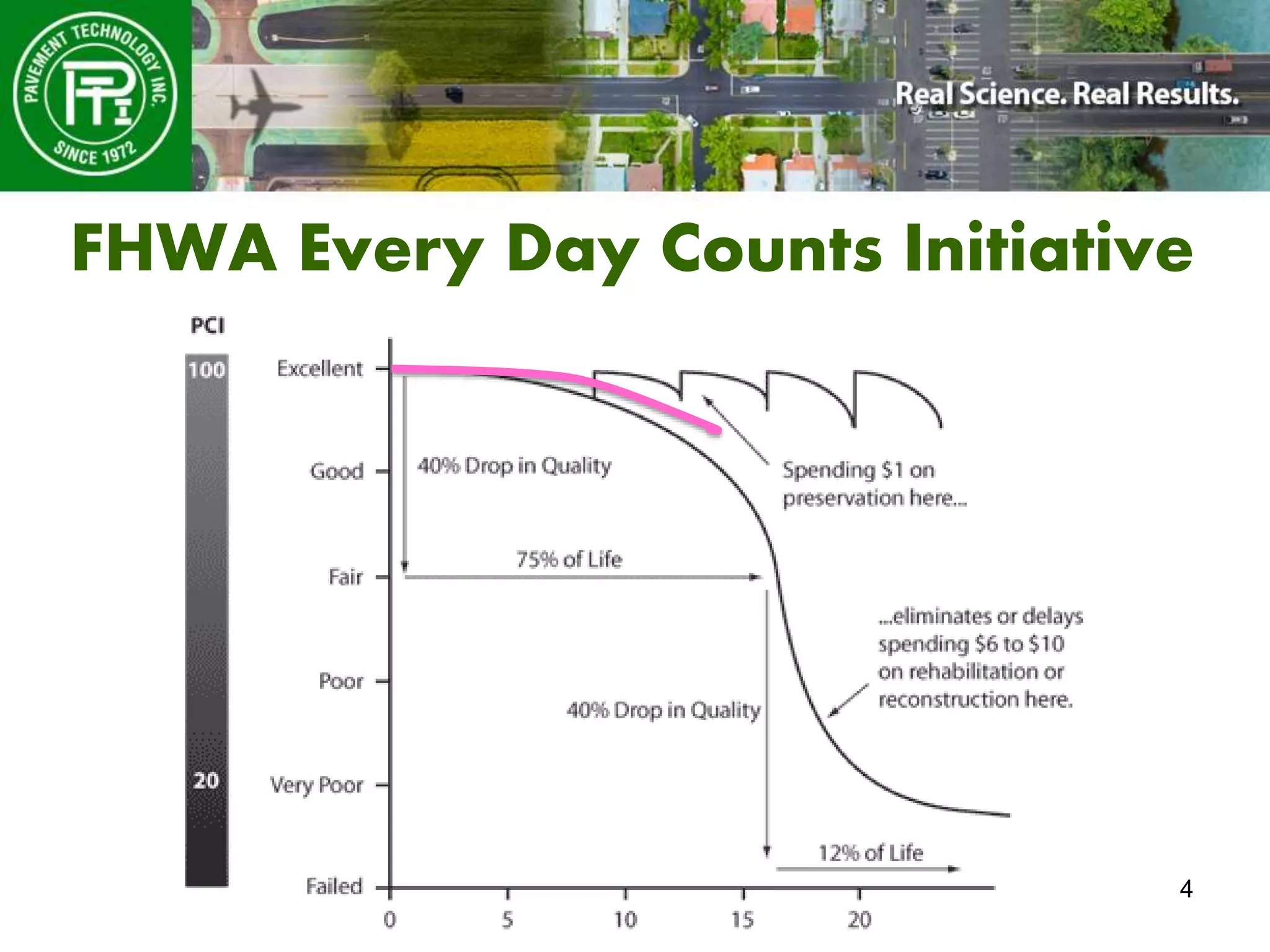
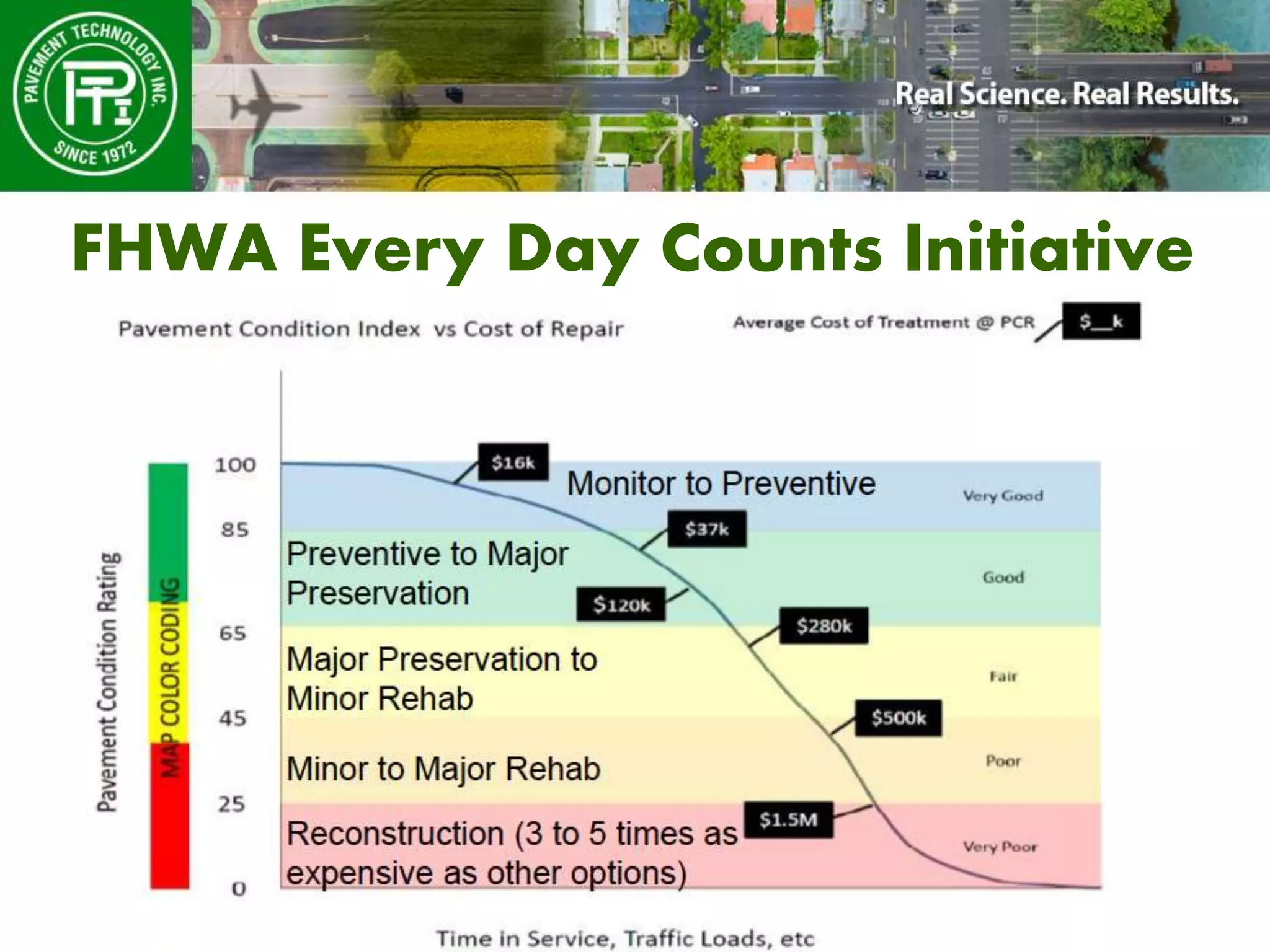
FHWA Every Day Counts Initiative
5
FHWA Every Day Counts Initiative
6
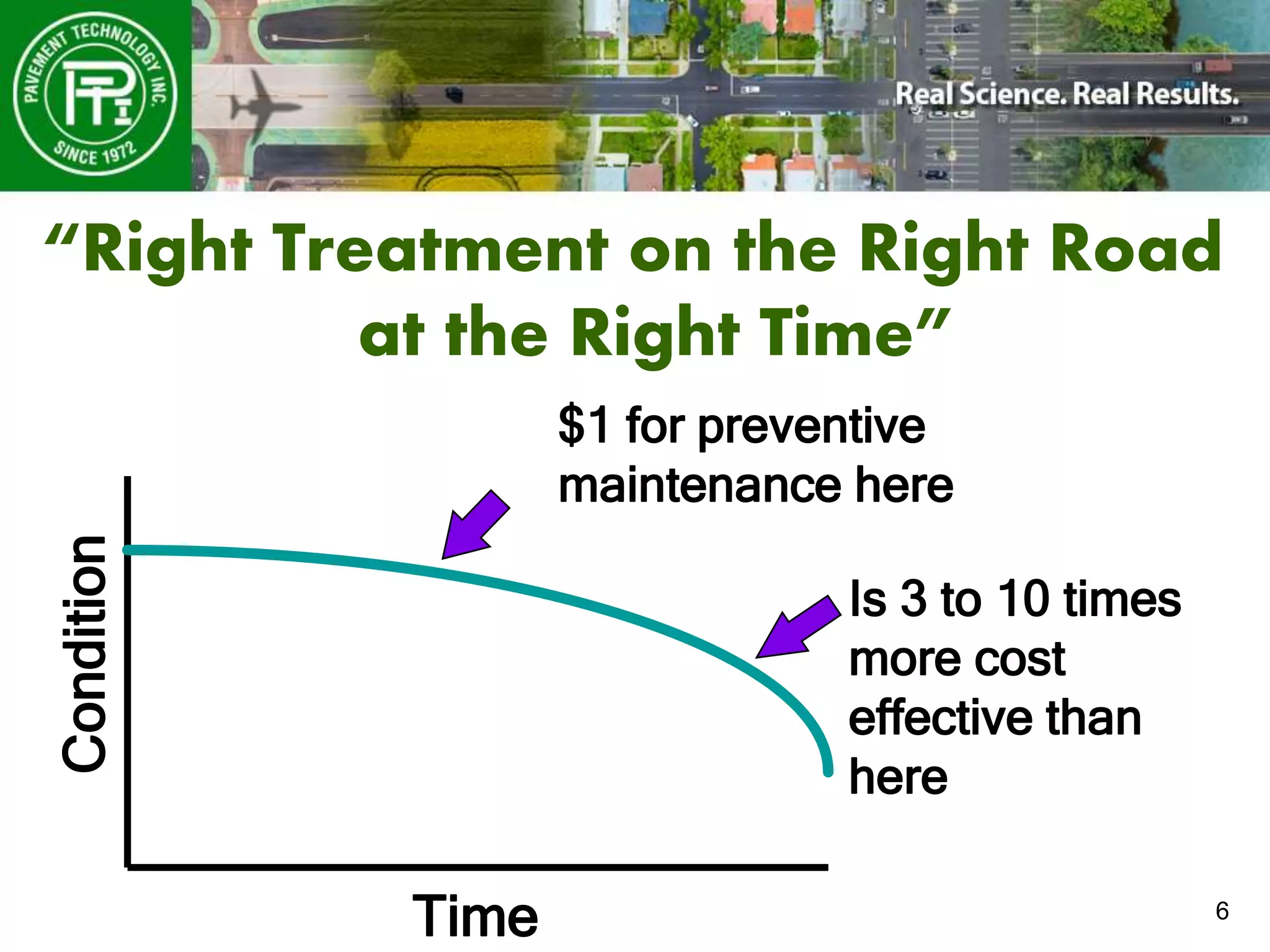
“Right Treatment on the Right Road
at the Right Time”
Condition
Time
$1 for preventive
maintenance here
Is 3 to 10 times
more cost
effective than
here
7
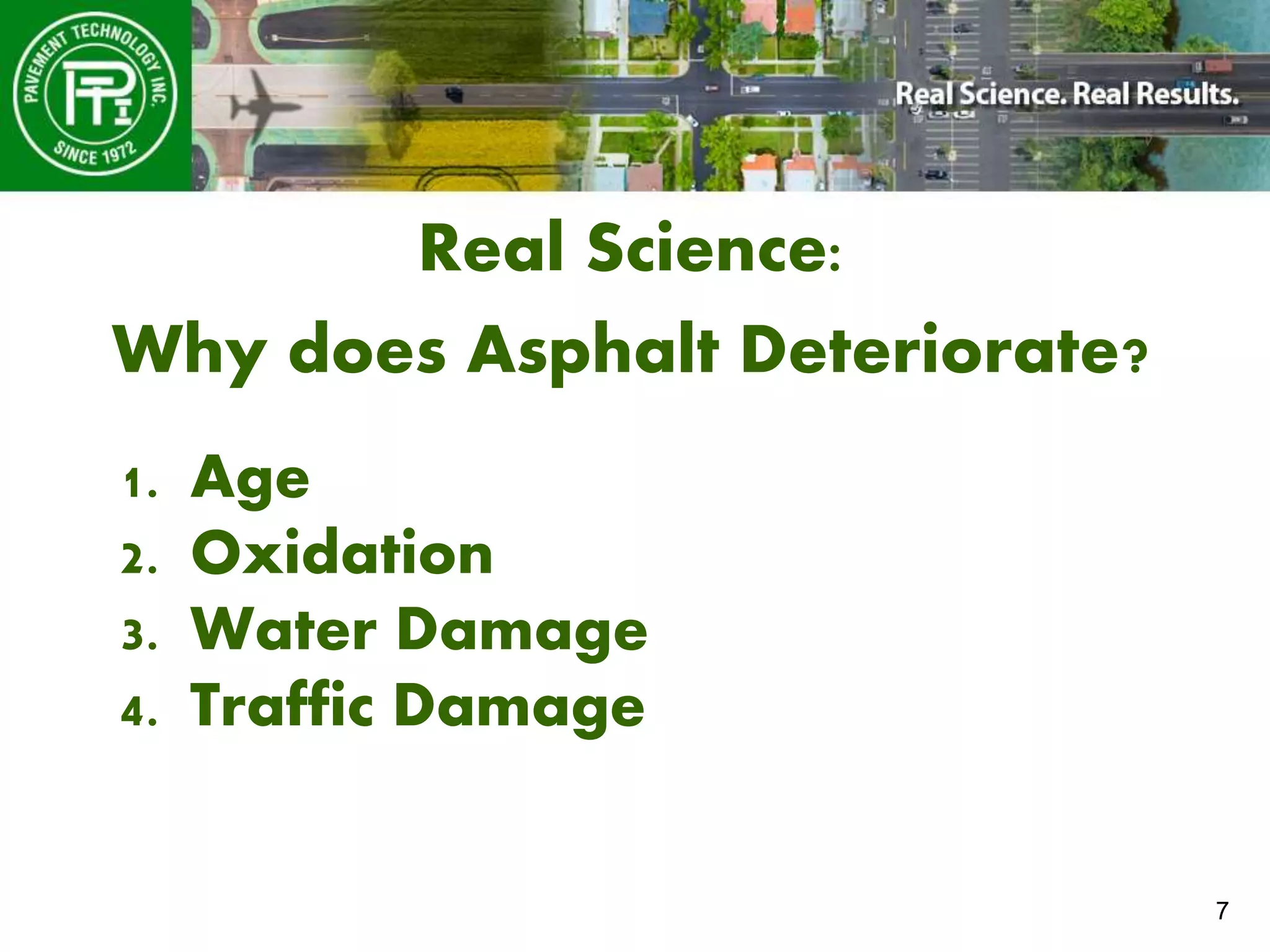
Real Science:
Why does Asphalt Deteriorate?
1. Age
2. Oxidation
3. Water Damage
4. Traffic Damage
8
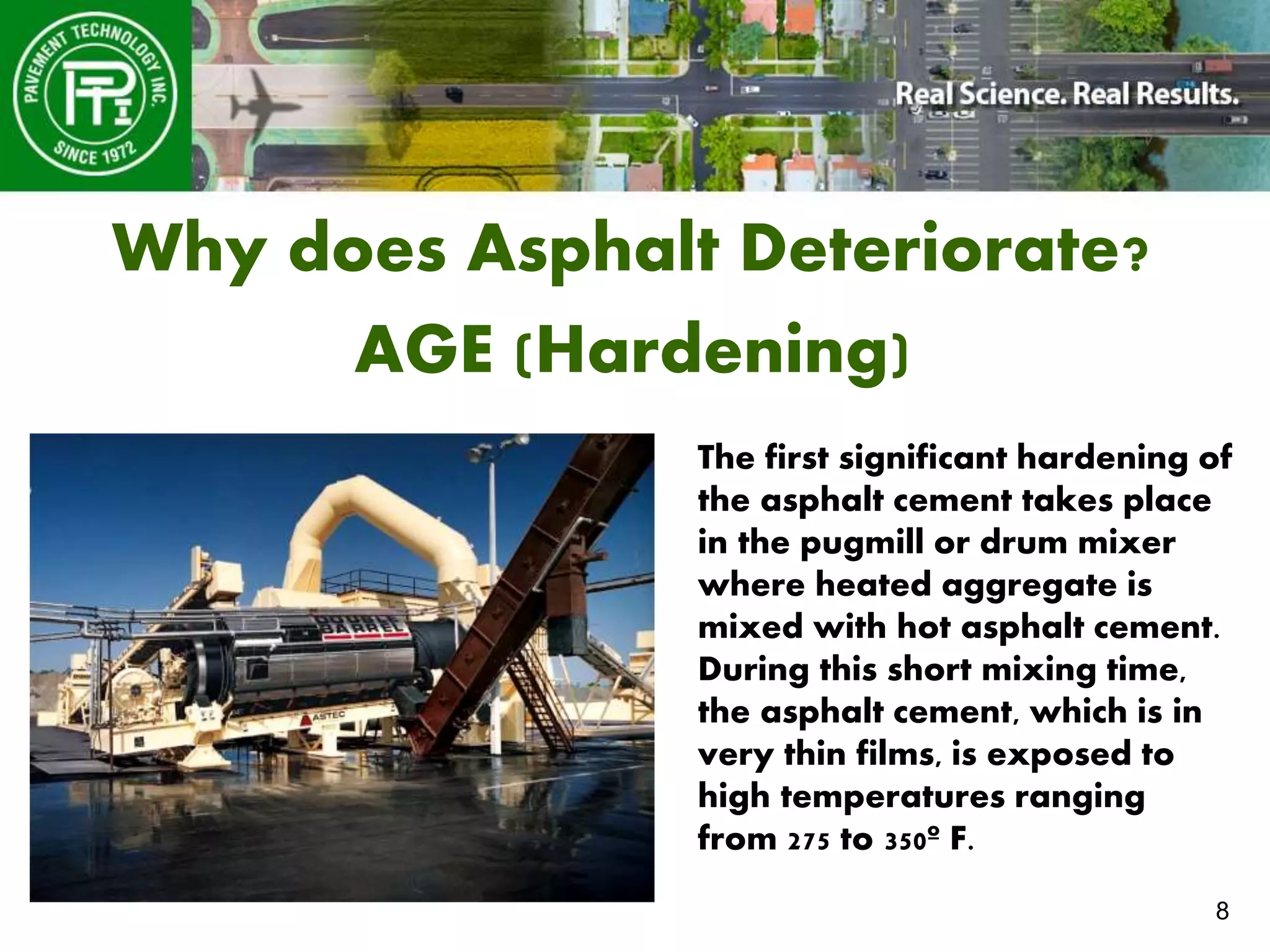
Why does Asphalt Deteriorate?
AGE (Hardening)
The first significant hardening of
the asphalt cement takes place
in the pugmill or drum mixer
where heated aggregate is
mixed with hot asphalt cement.
During this short mixing time,
the asphalt cement, which is in
very thin films, is exposed to
high temperatures ranging
from 275 to 350º F.
9
Why does Asphalt Deteriorate?
OXIDATION
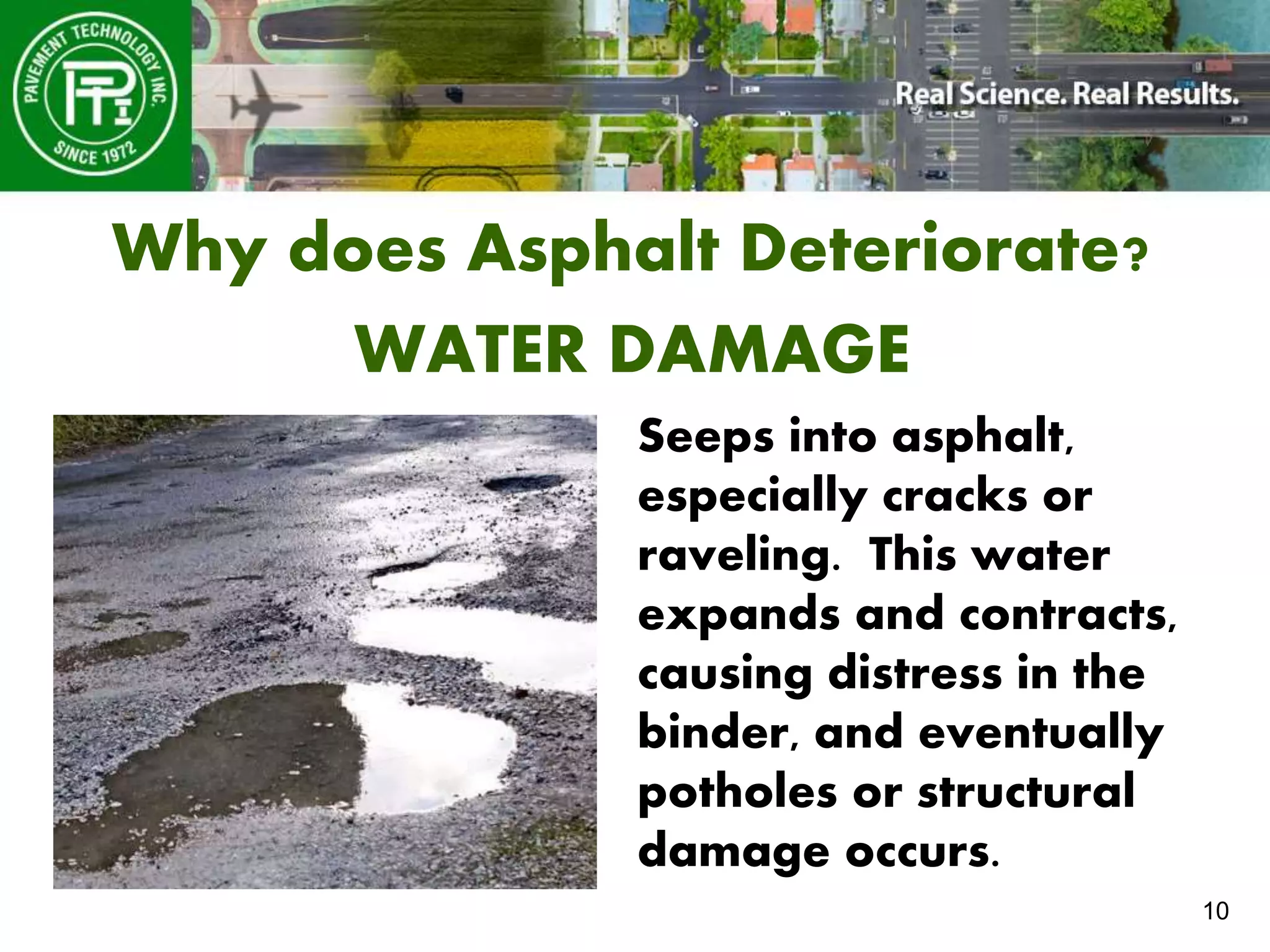
The roadway begins to
deteriorate the moment it’s
paved. The worst part is it’s
exponential. The viscosity of the
asphalt binder can go from 10-15K
poise when it’s only a few months
old to several hundred thousand
after only a few years. In Florida
this is how most roads fail.
10
Why does Asphalt Deteriorate?
WATER DAMAGE
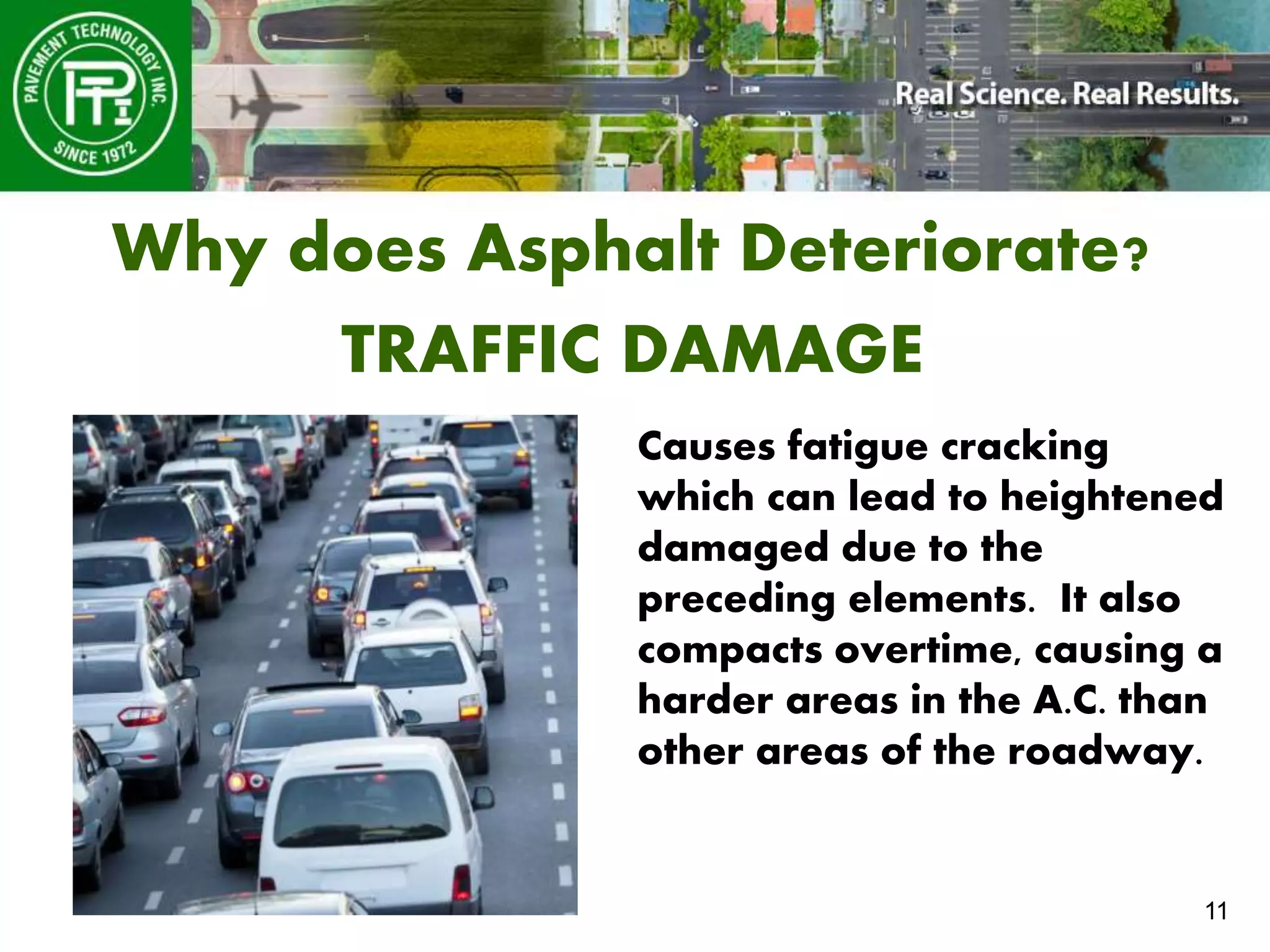
Seeps into asphalt,
especially cracks or
raveling. This water
expands and contracts,
causing distress in the
binder, and eventually
potholes or structural
damage occurs.
11
Why does Asphalt Deteriorate?
TRAFFIC DAMAGE
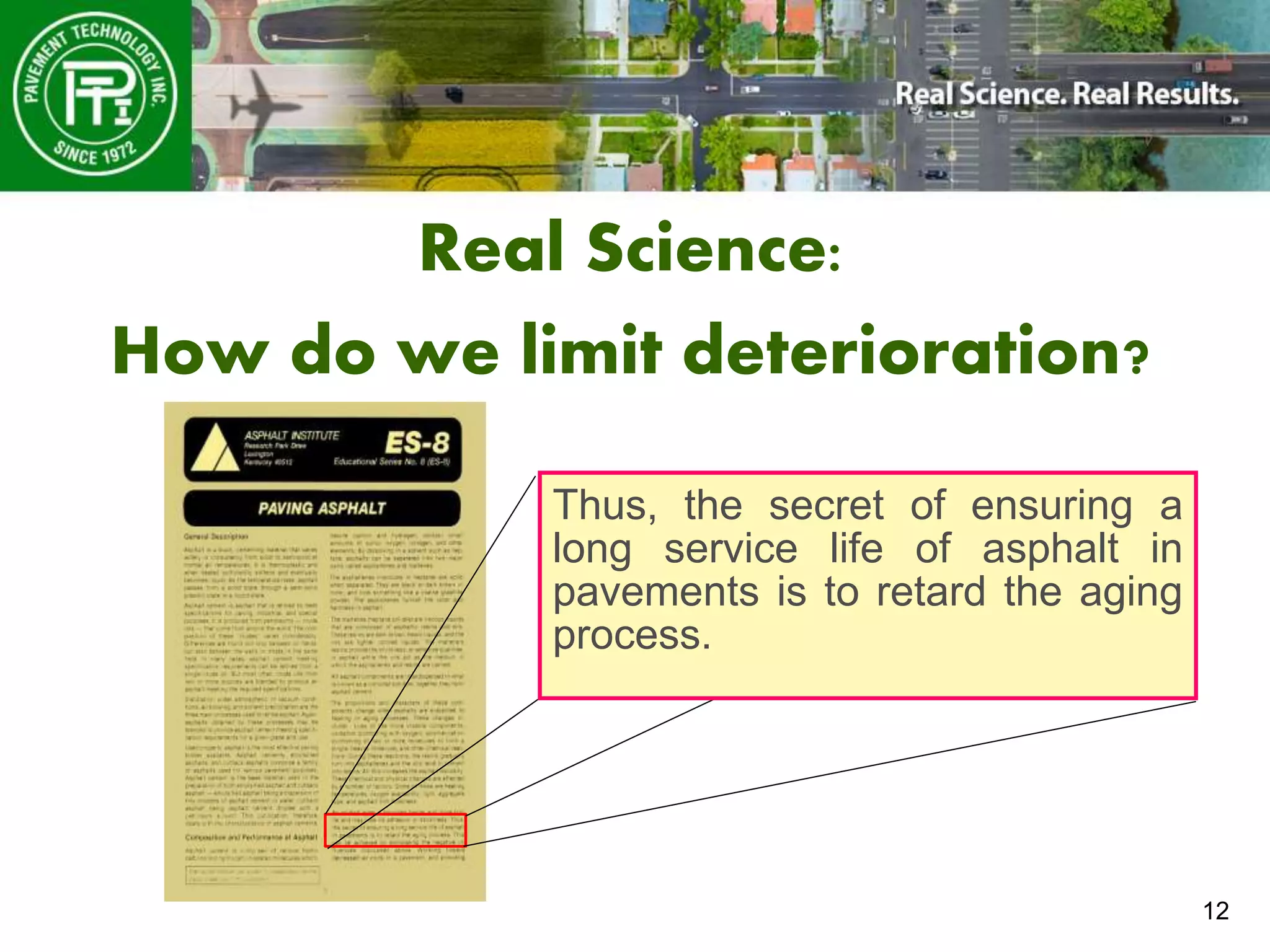
Causes fatigue cracking
which can lead to heightened
damaged due to the
preceding elements. It also
compacts overtime, causing a
harder areas in the A.C. than
other areas of the roadway.
12
Real Science:
How do we limit deterioration?
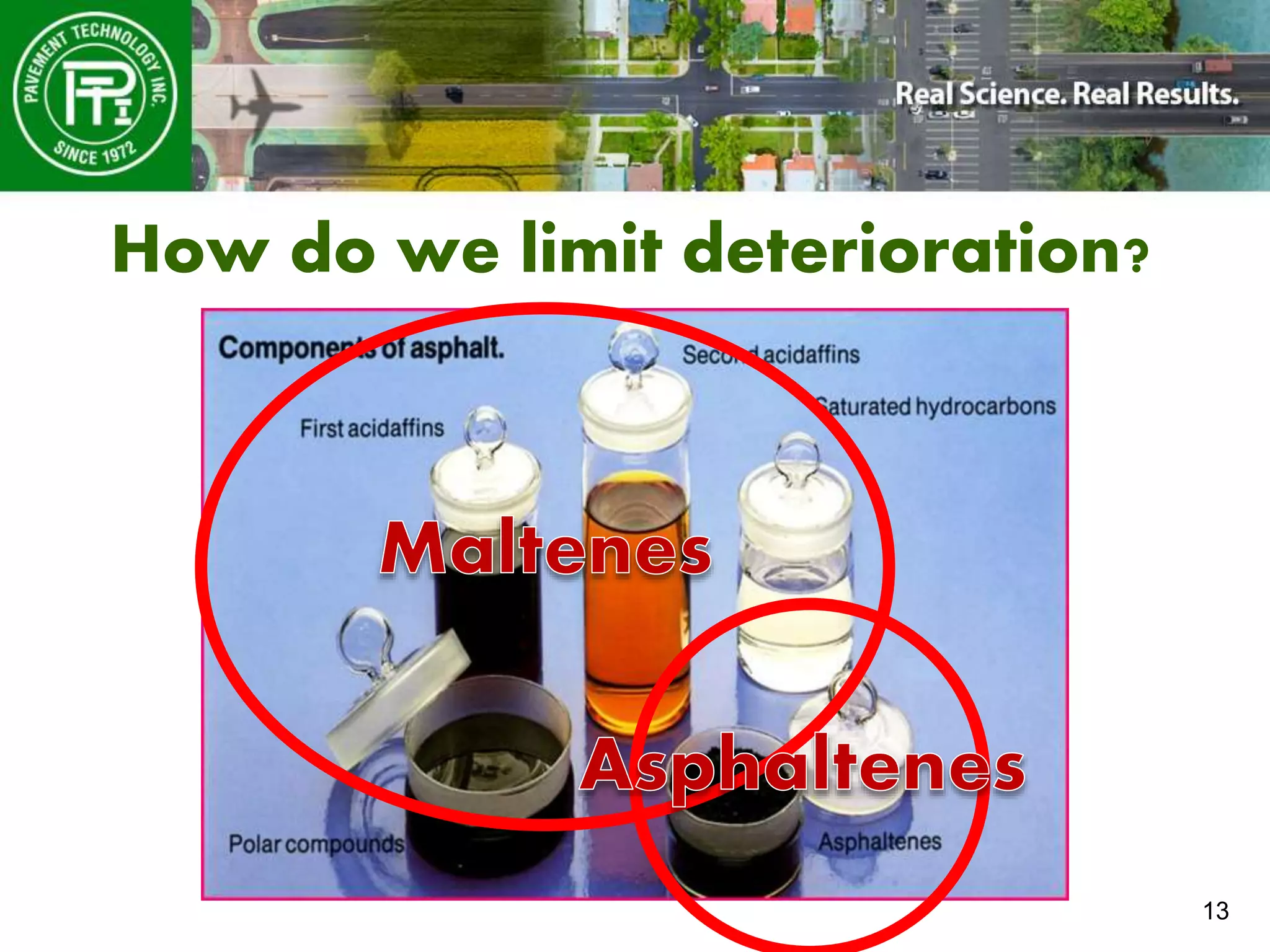
Thus, the secret of ensuring a
long service life of asphalt in
pavements is to retard the aging
process.
13
How do we limit deterioration?
14
Maltenes are the Key
• Maltenes are the unstable component
of asphalt binder and they are affected
by air, UV rays water, temperature, etc.
• It is the loss of the Maltenes from the
asphalt binder in the upper 3/8” to ½” of
asphalt pavements that start the
asphalt deterioration process.
15
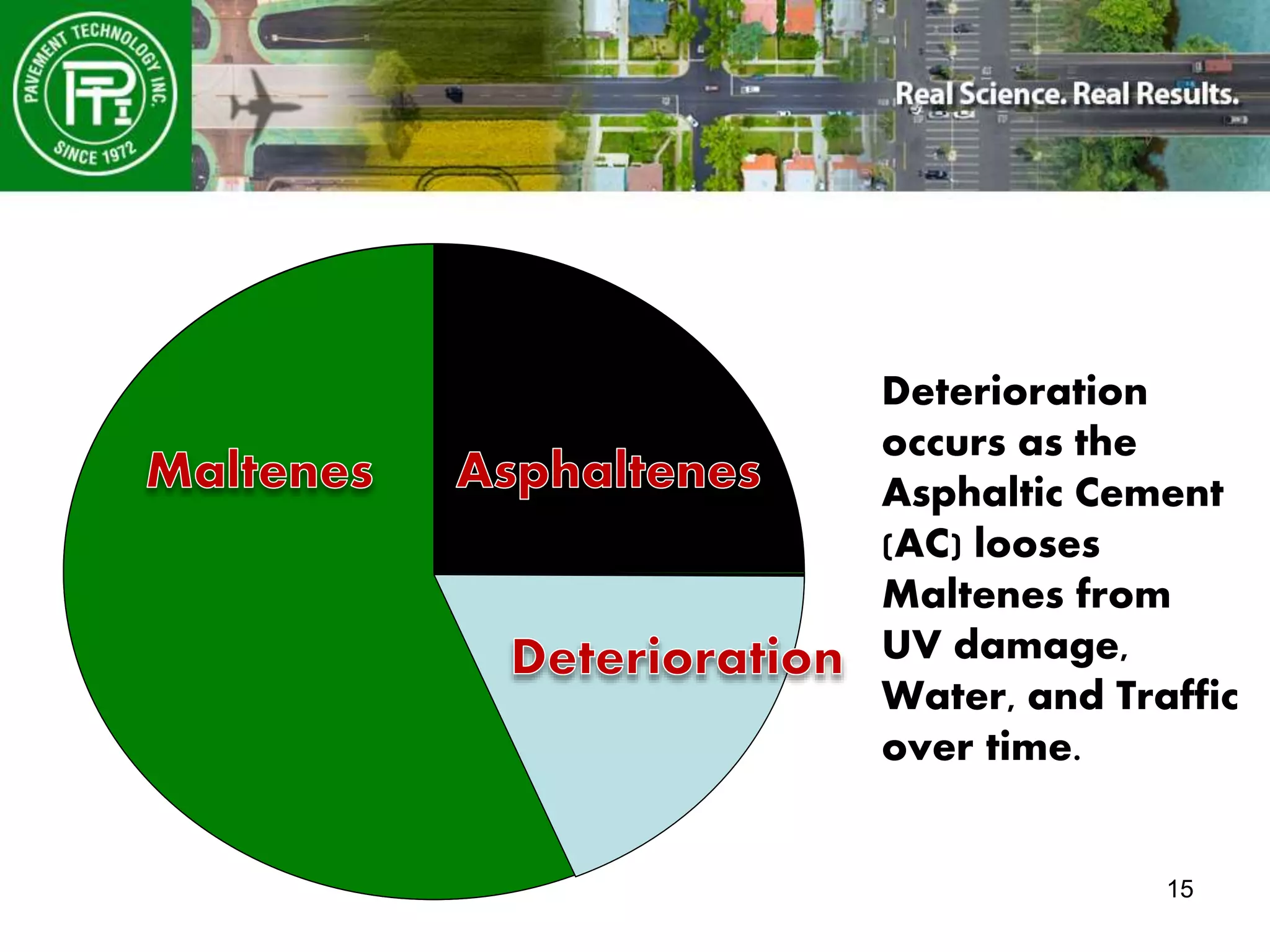
Deterioration
occurs as the
Asphaltic Cement
(AC) looses
Maltenes from
UV damage,
Water, and Traffic
over time.
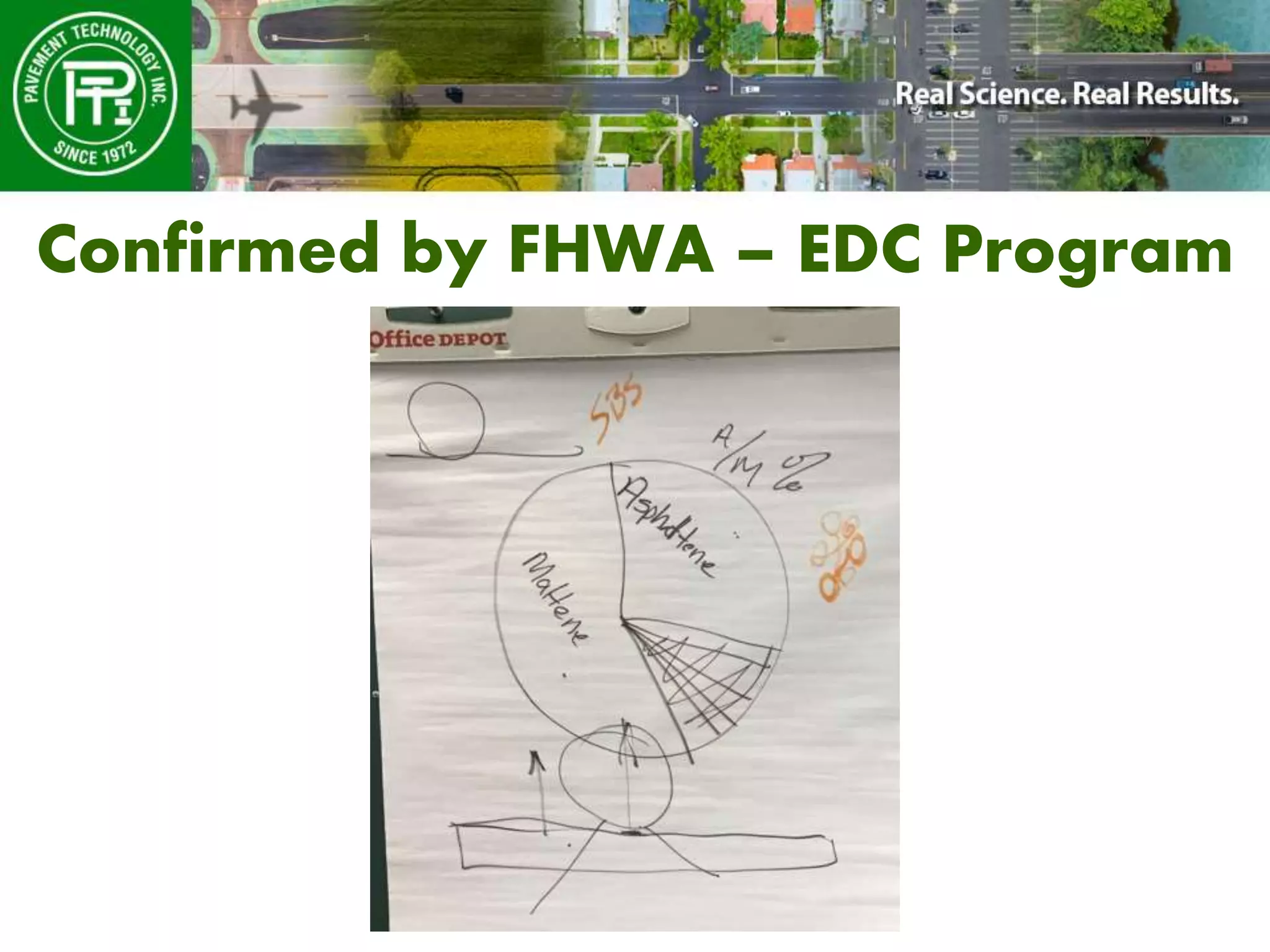
Confirmed by FHWA – EDC Program
17
Real Science:
So How do we Preserve?
• Depending on condition of the
pavement, it can be as simple as:
REPLACE THE MALTENES.
• Replacing the Maltenes can provide the
aged asphalt binder the materials
needed to remain fluid, viscous, and
healthy.
18
Replacing the Maltenes:
Rejuvenation
Maltene based rejuvenators work by
changing the chemistry of the asphalt
binder by replenishing the lost maltenes
back into the asphalt binder restoring its
asphaltene to maltene ratio back to
nearly new levels
19
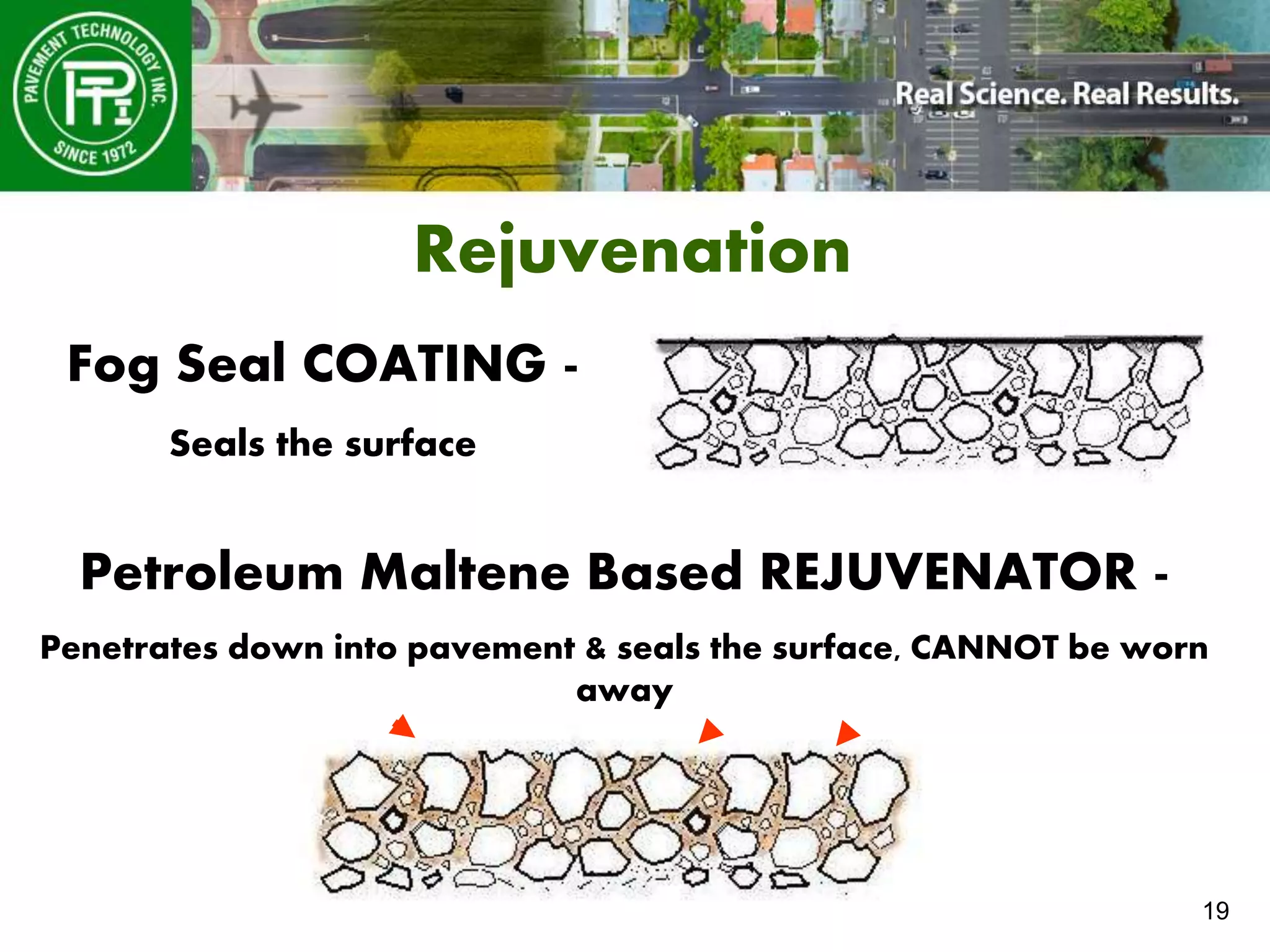
Rejuvenation
Fog Seal COATING -
Seals the surface
Petroleum Maltene Based REJUVENATOR -
Penetrates down into pavement & seals the surface, CANNOT be worn
away
20
Real Science:
How do we know this works?
• The “Rostler Method” - Determines the
rejuvenator efficacy and determines
the ratio of resinous to oily maltenes in
the pavement surface
• ASTM Test D-2006-70 – “Free Maltene
Distribution”
21
How do we know this works?
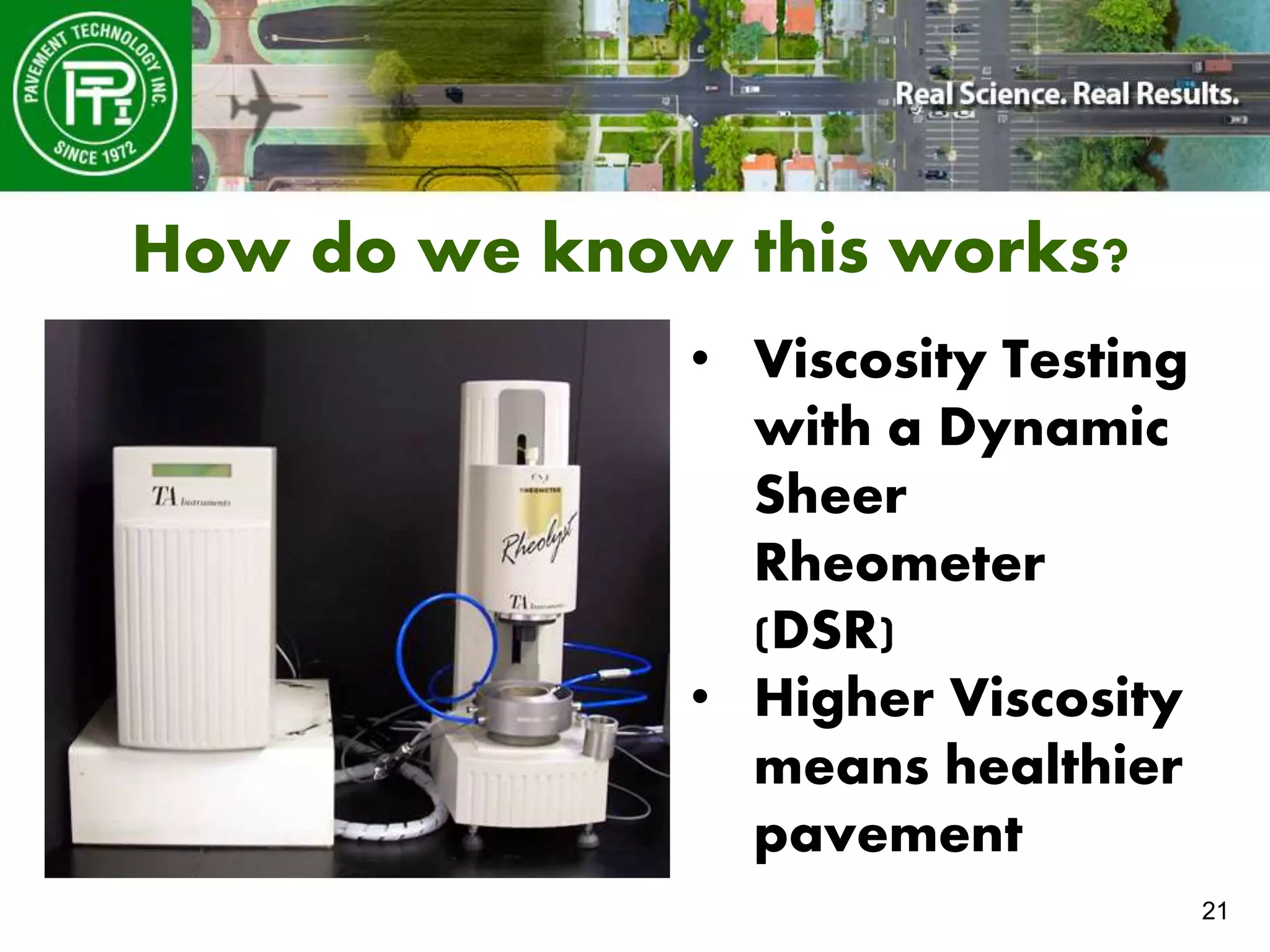
• Viscosity Testing
with a Dynamic
Sheer
Rheometer
(DSR)
• Higher Viscosity
means healthier
pavement
22
How do we know this works?
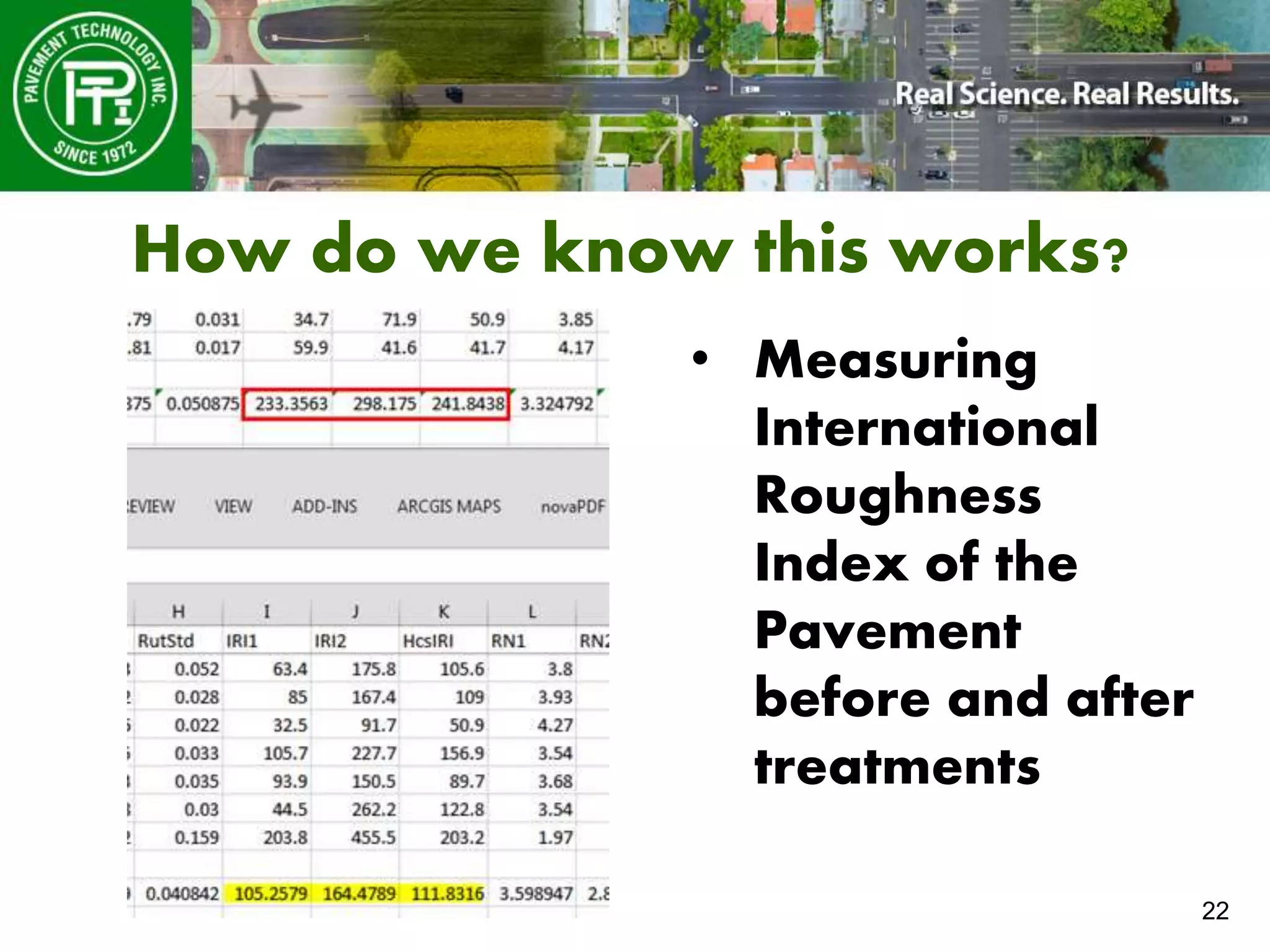
• Measuring
International
Roughness
Index of the
Pavement
before and after
treatments
23
How do we know this works?
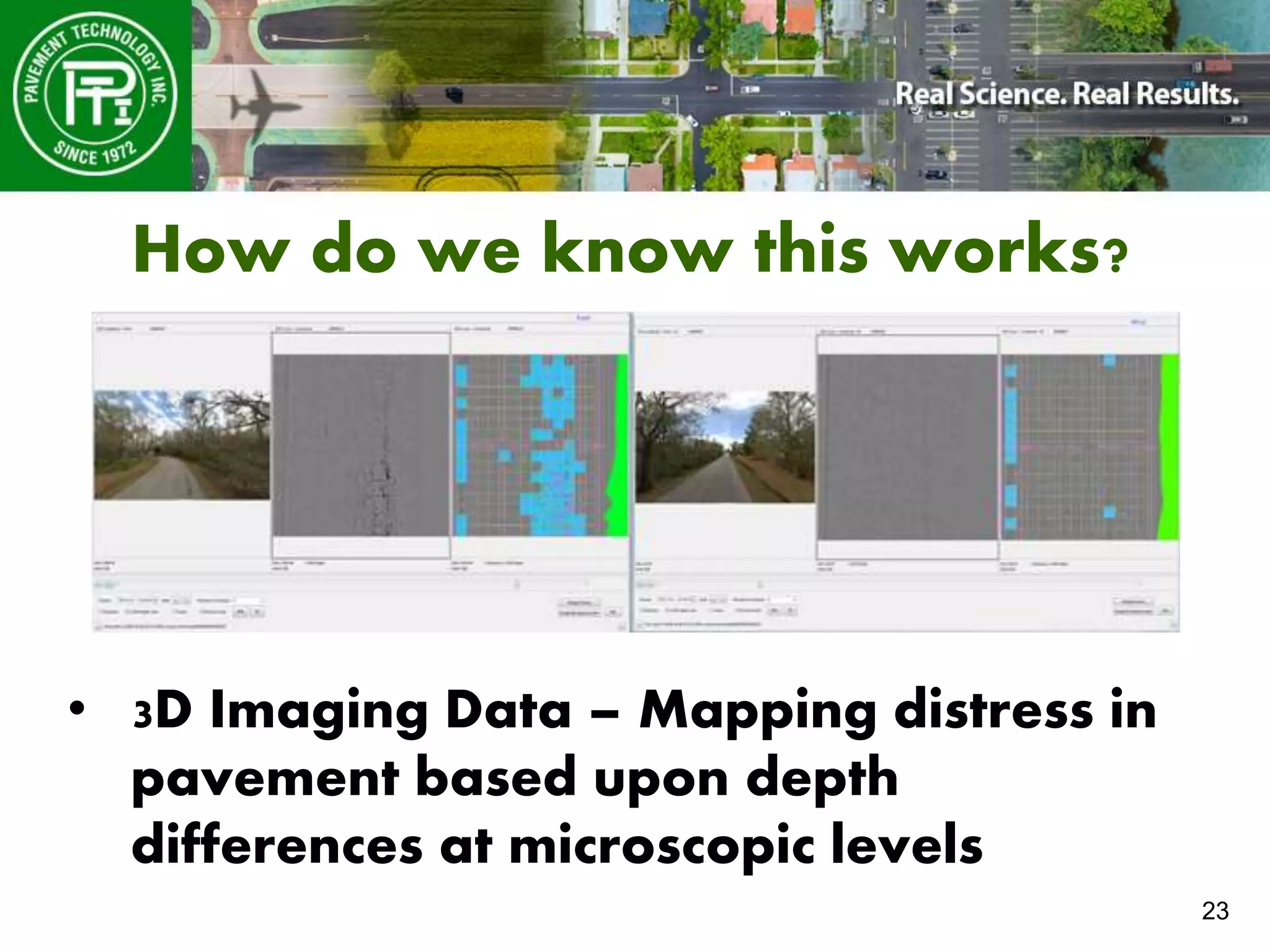
• 3D Imaging Data – Mapping distress in
pavement based upon depth
differences at microscopic levels
24
How do we know this works?
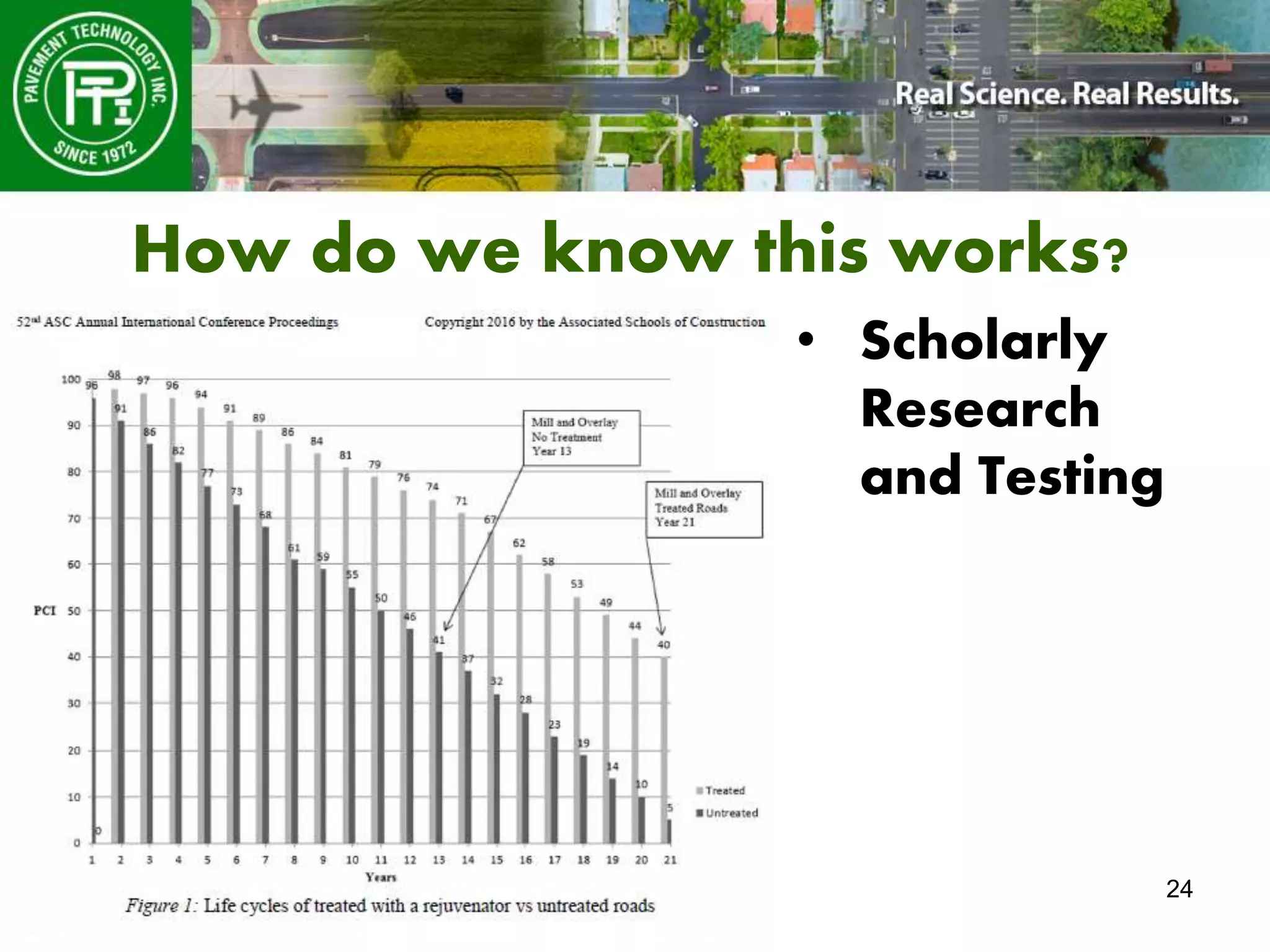
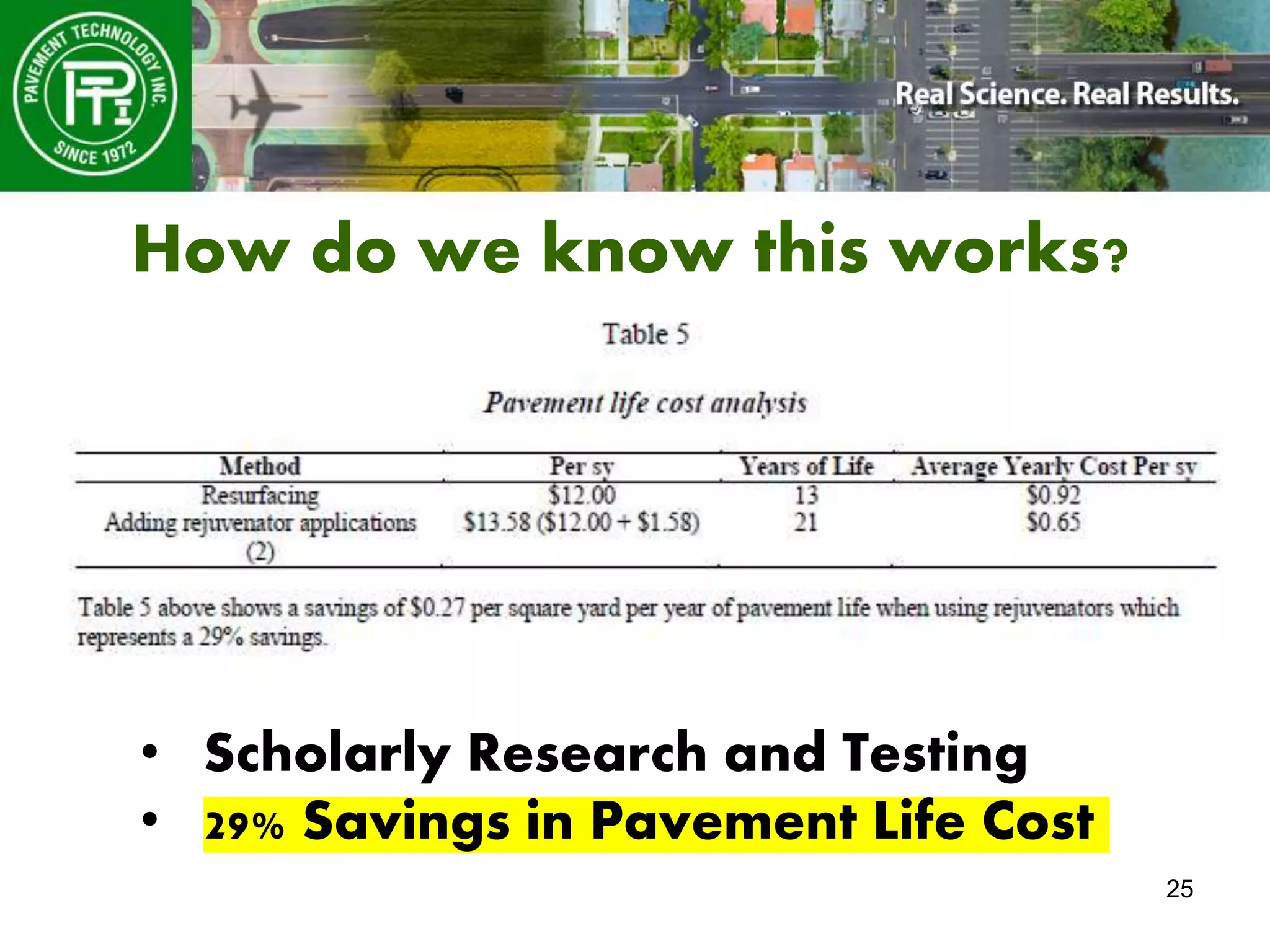
• Scholarly
Research
and Testing
25
How do we know this works?
• Scholarly Research and Testing
• 29% Savings in Pavement Life Cost
26
Real Science:
Is Rejuvenation what we need?
• Preservation can go beyond
rejuvenation, especially if pavement
shows signs of distress like:
• Cracking
• Severe Raveling
• Potholes
• Aggregate Loss
27
Cost Benefit – Basic ROI
Basic Cost Benefit Model –
• If a Road costs $150,000 to build (per lane mile) and it
has a 20 year life cycle in 100 years you will spend
$750,000 on that mile of road.
• If you preserve with a $1 per SY treatment early
and then every five years going forward, the asset
can now last 40 years.
• If we estimate ~$7,000 per Lane Mile to preserve
• $150,000 + ($7,000*4 treatments) = $178,000 for 40
Years
• In 100 years you will spend $445,000 (Barely more
than half your original investment)
28
How do I preserve?
• Through a mutual use of Maltene
replacement technology and:
• Crack Sealing
• Microsurfacing
• Seal Coating
• Chip Sealing
• Slurry Sealing
29
Why with other treatments?
• The Maltenes will benefit the existing
Asphaltic Cement, however due to the
distress in the existing road, a new
wearing surface is needed or at the
very least, crack sealing to limit water
intrusion below the top layer of
asphalt.
30
Real Science:
Has this been proven, and by who?
• National Center for Pavement
Preservation at Michigan State
University (pavementpreservation.org)
• Center for Multidisciplinary Research in
Transportation at Texas Tech University
• Time and Experience
31
What if....?
What if we could clean the air in our
communities by paving a material that
could clean the exhaust coming out of
our residents cars???
32
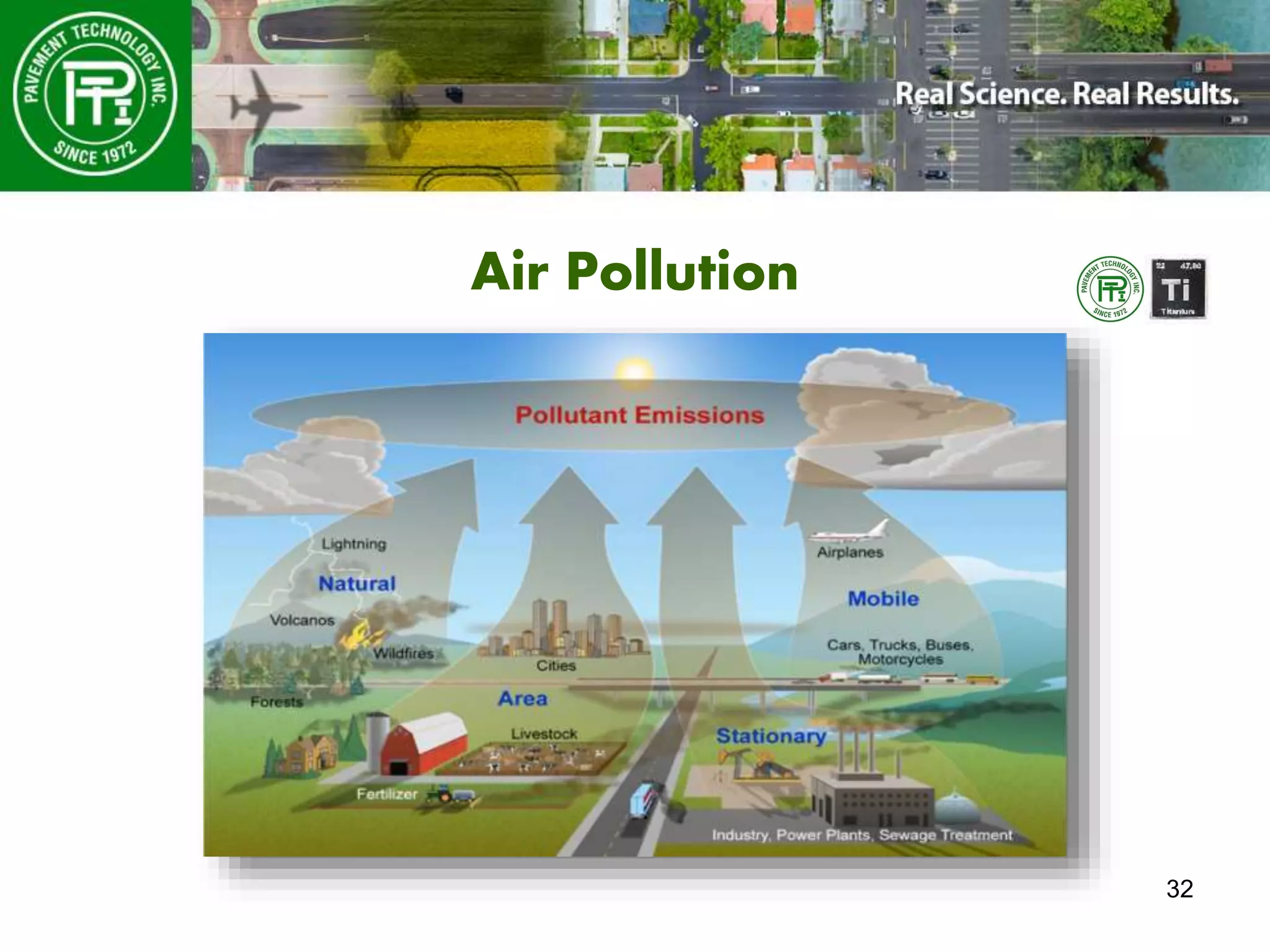
Air Pollution
33
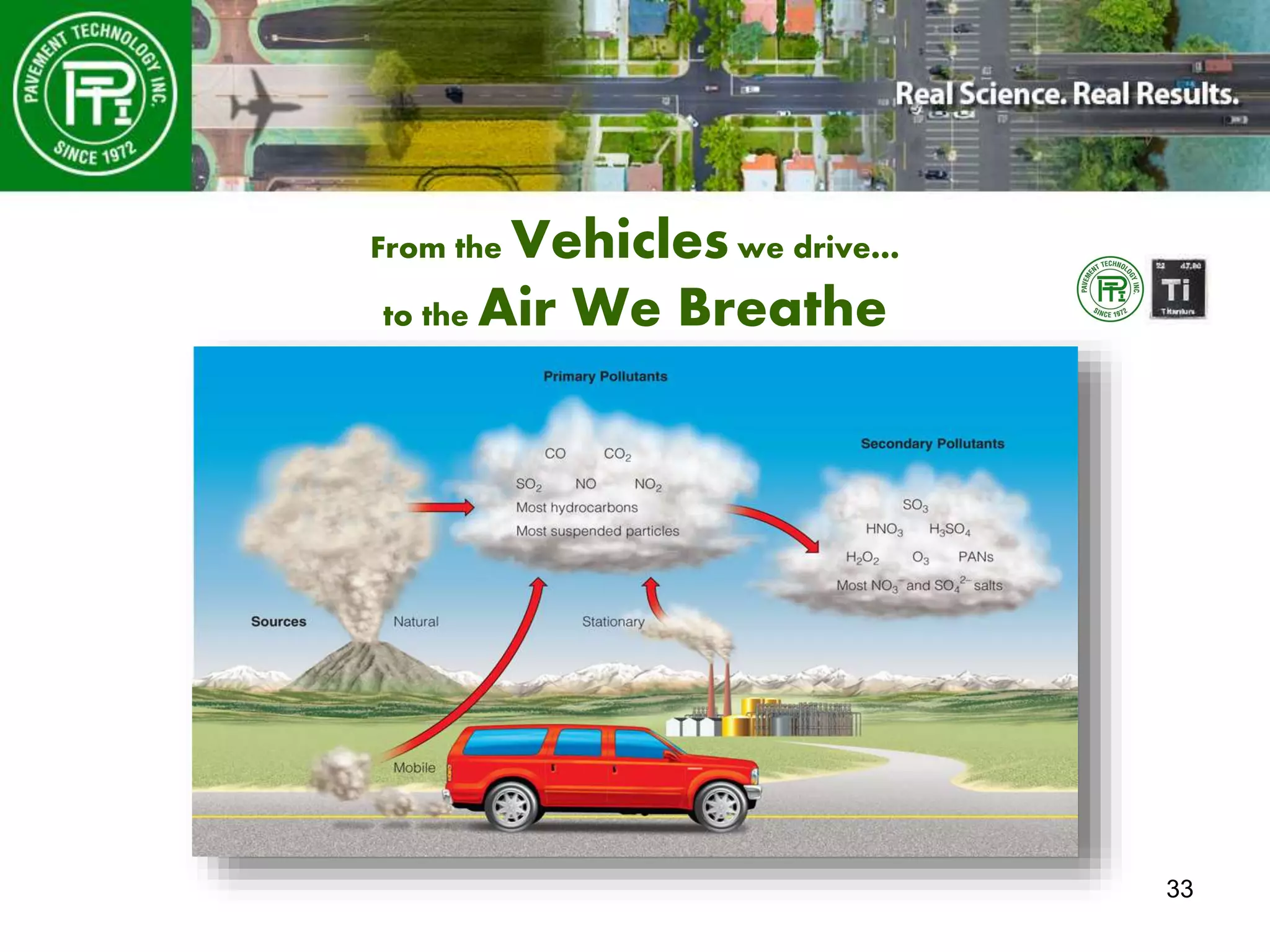
From the Vehicleswe drive…
to the Air We Breathe
34
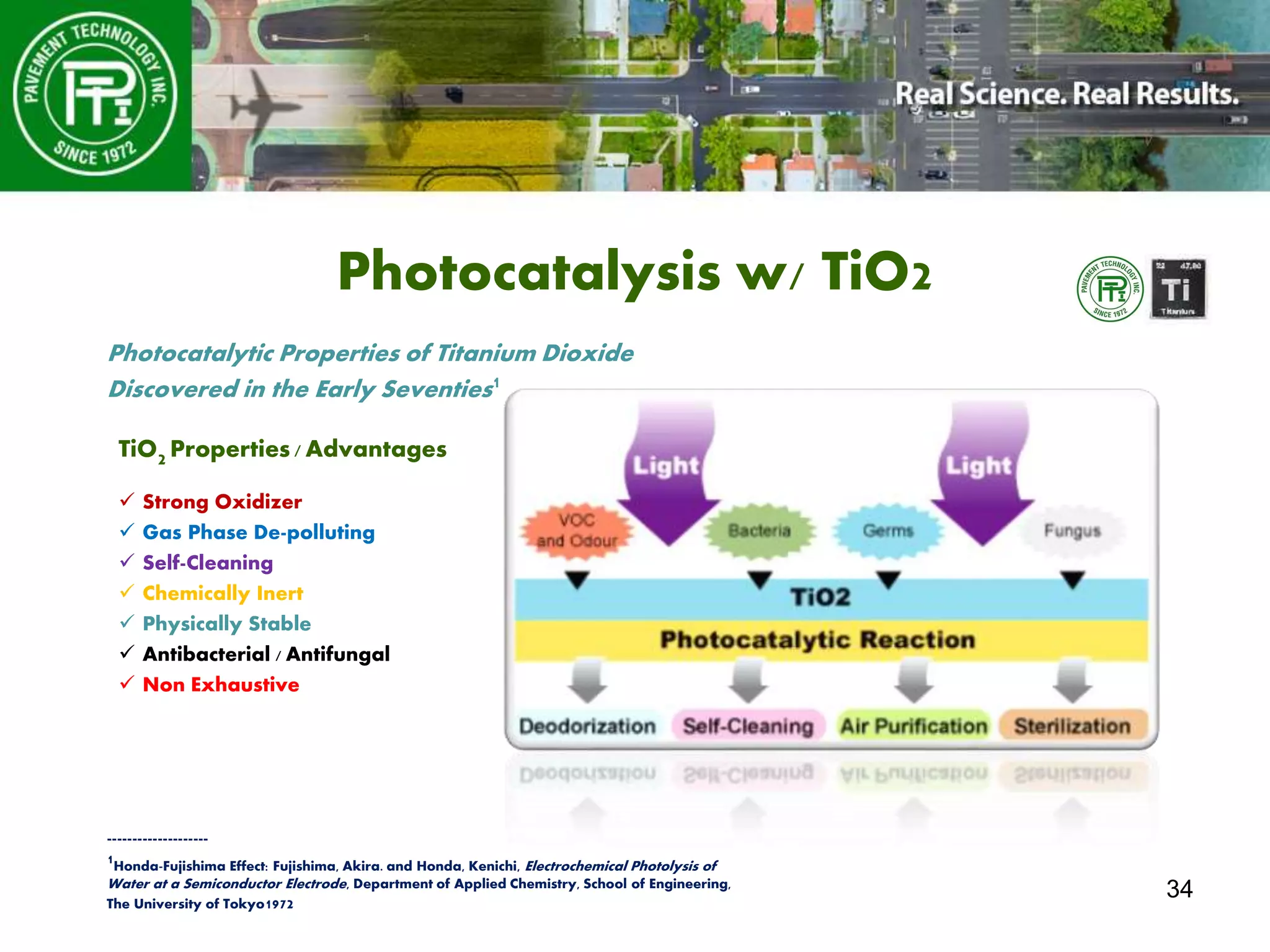
Photocatalysis w/ TiO2
TiO2 Properties/ Advantages
 Strong Oxidizer
 Gas Phase De-polluting
 Self-Cleaning
 Chemically Inert
 Physically Stable
 Antibacterial / Antifungal
 Non Exhaustive
--------------------
1Honda-Fujishima Effect: Fujishima, Akira. and Honda, Kenichi, Electrochemical Photolysis of
Water at a Semiconductor Electrode, Department of Applied Chemistry, School of Engineering,
The University of Tokyo1972
Photocatalytic Properties of Titanium Dioxide
Discovered in the Early Seventies1
35
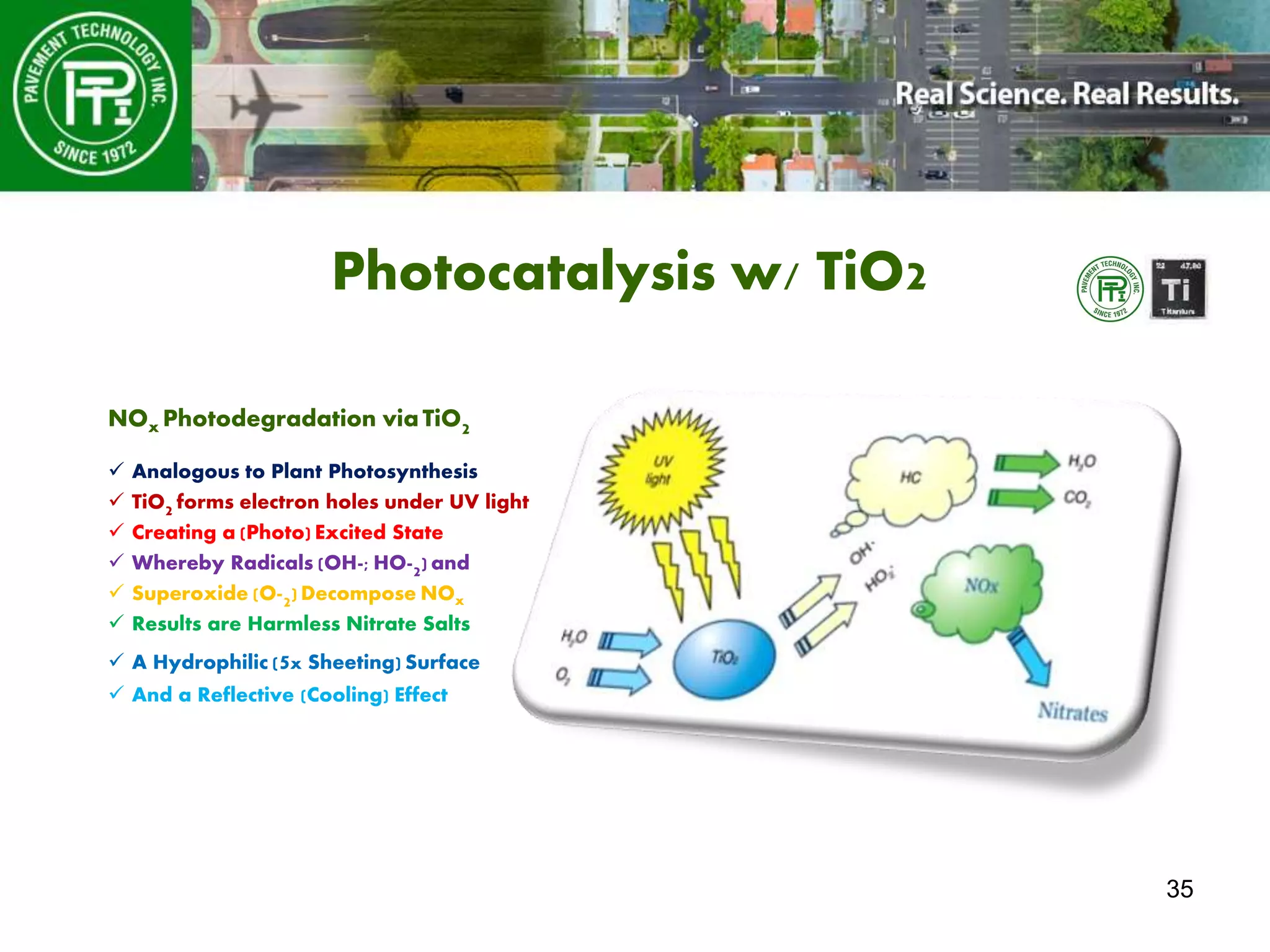
Photocatalysis w/ TiO2
NOx Photodegradation via TiO2
 Analogous to Plant Photosynthesis
 TiO2 forms electron holes under UV light
 Creating a (Photo) Excited State
 Whereby Radicals (OH-; HO-2) and
 Superoxide (O-2) Decompose NOx
 Results are Harmless Nitrate Salts
 A Hydrophilic (5x Sheeting) Surface
 And a Reflective (Cooling) Effect
y
36
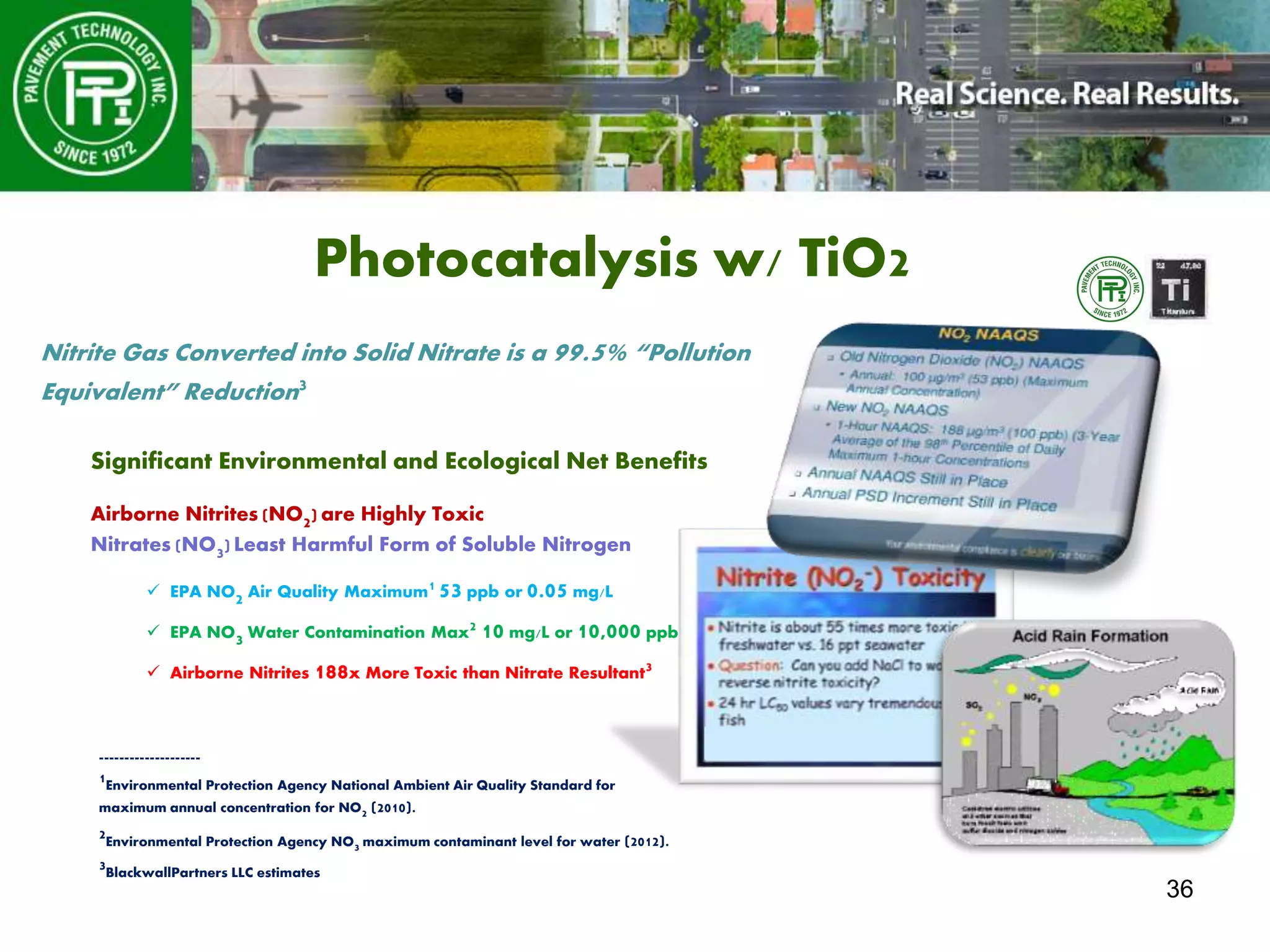
Photocatalysis w/ TiO2
Significant Environmental and Ecological Net Benefits
Airborne Nitrites (NO2) are Highly Toxic
Nitrates (NO3) Least Harmful Form of Soluble Nitrogen
 EPA NO2 Air Quality Maximum1 53 ppb or 0.05 mg/L
 EPA NO3 Water Contamination Max2 10 mg/L or 10,000 ppb
 Airborne Nitrites 188x More Toxic than Nitrate Resultant3
--------------------
1Environmental Protection Agency National Ambient Air Quality Standard for
maximum annual concentration for NO2 (2010).
2Environmental Protection Agency NO3 maximum contaminant level for water (2012).
3BlackwallPartners LLC estimates
Nitrite Gas Converted into Solid Nitrate is a 99.5% “Pollution
Equivalent” Reduction3
37
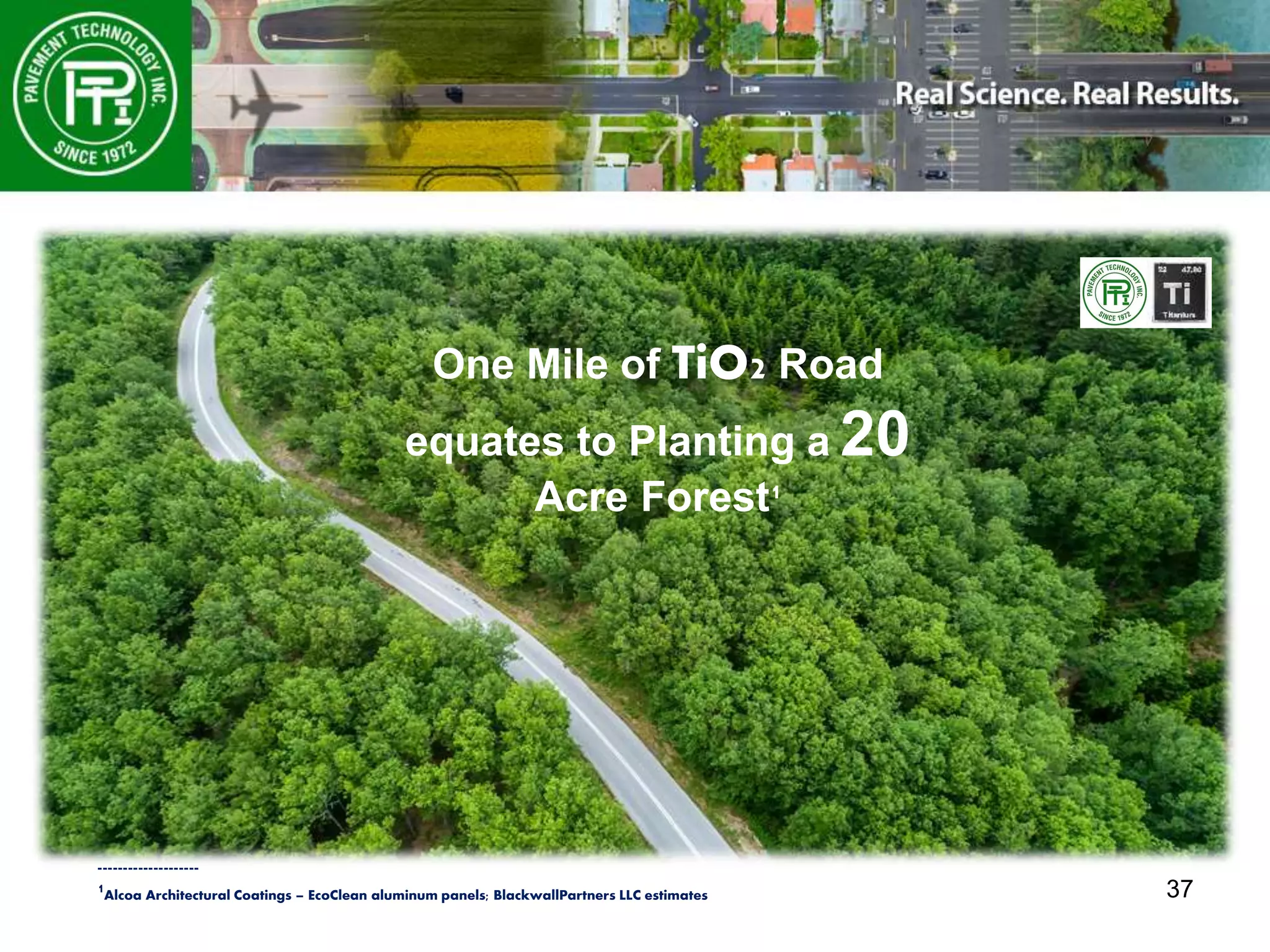
One Mile of TiO2 Road
equates to Planting a 20
Acre Forest1
--------------------
1Alcoa Architectural Coatings – EcoClean aluminum panels; BlackwallPartners LLC estimates
38
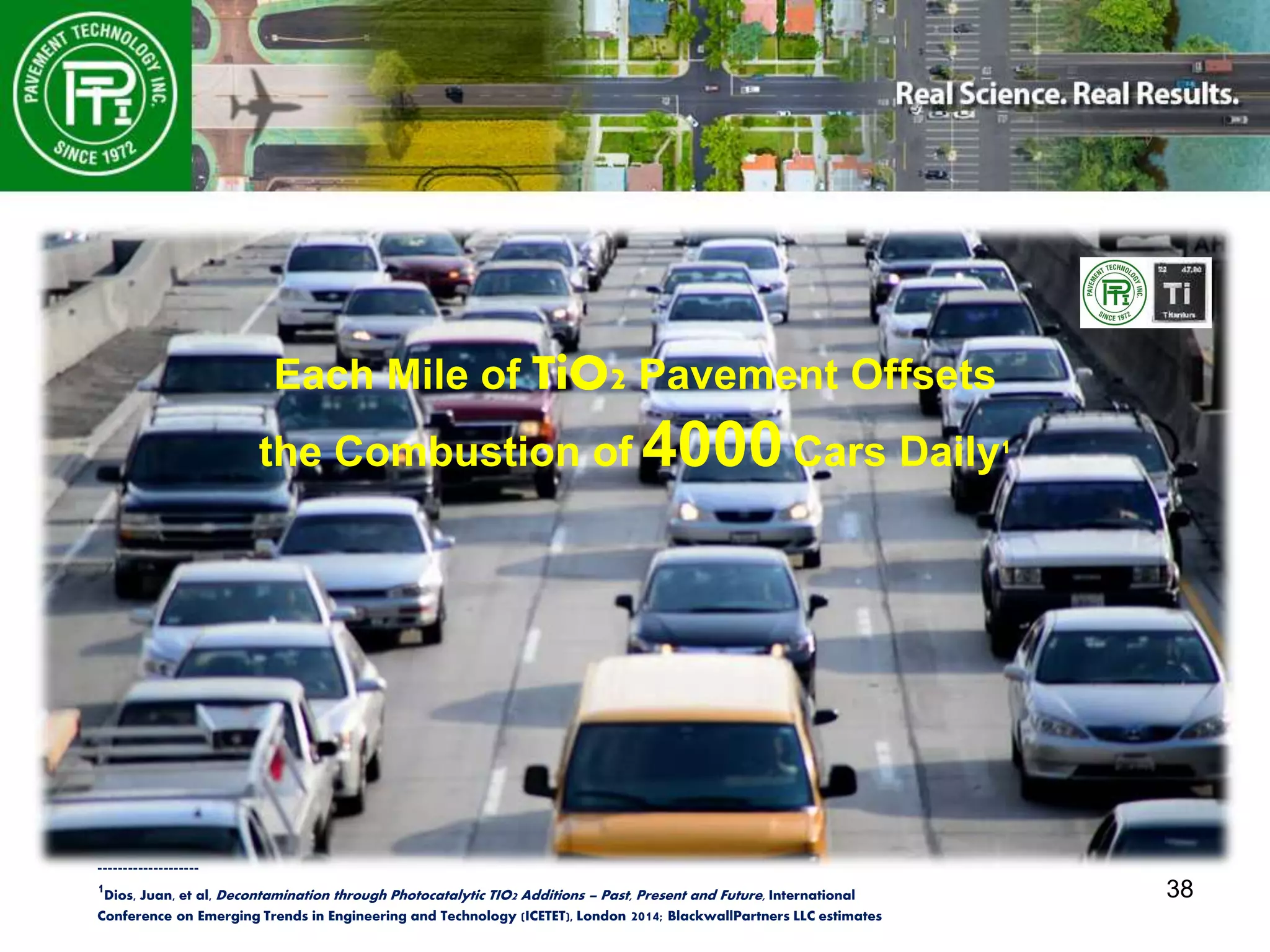
Each Mile of TiO2 Pavement Offsets
the Combustion of 4000Cars Daily1
--------------------
1Dios, Juan, et al, Decontamination through Photocatalytic TIO2 Additions – Past, Present and Future, International
Conference on Emerging Trends in Engineering and Technology (ICETET), London 2014; BlackwallPartners LLC estimates
39
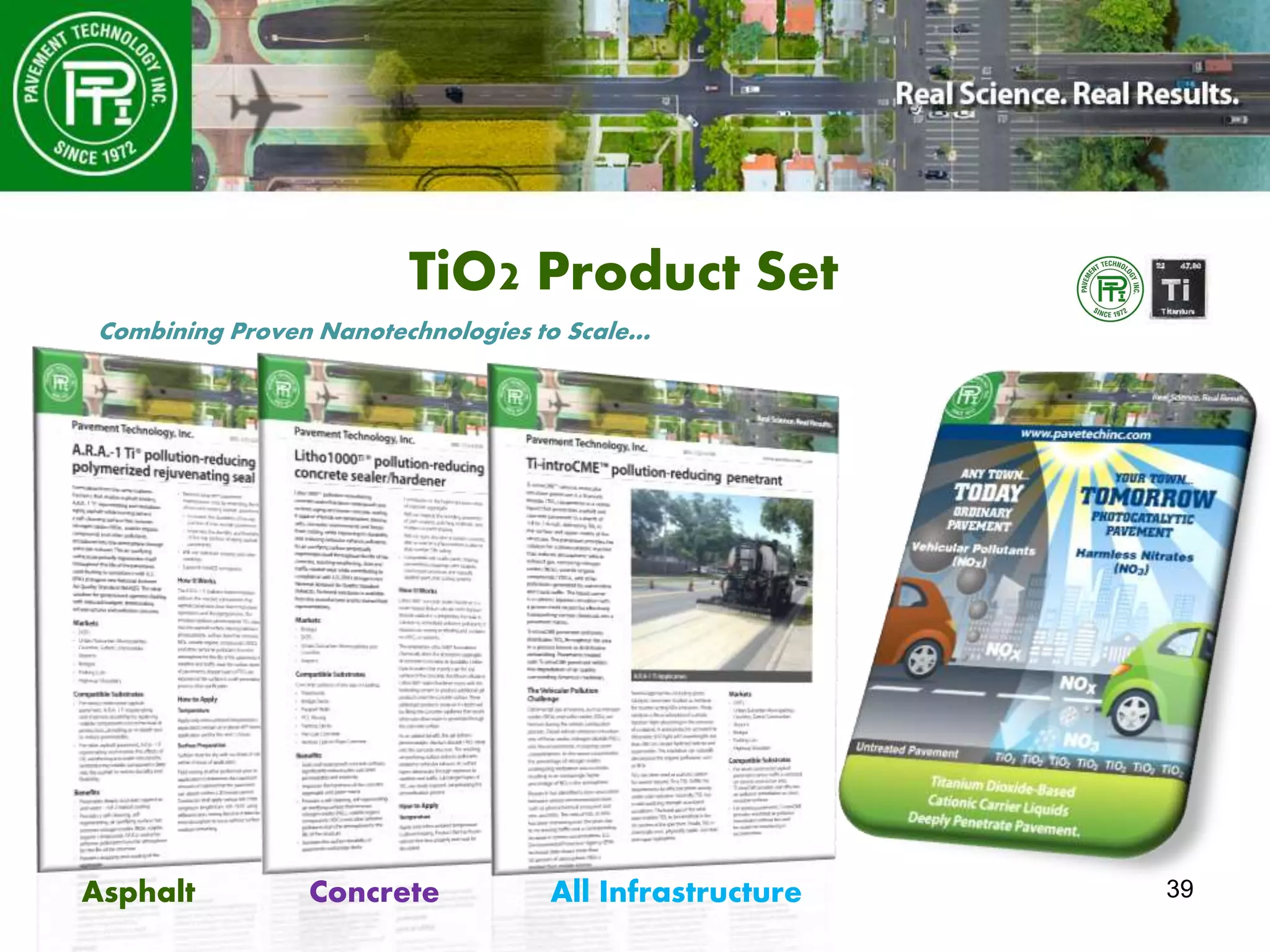
TiO2 Product Set
Asphalt Concrete All Infrastructure
Combining Proven Nanotechnologies to Scale…
40
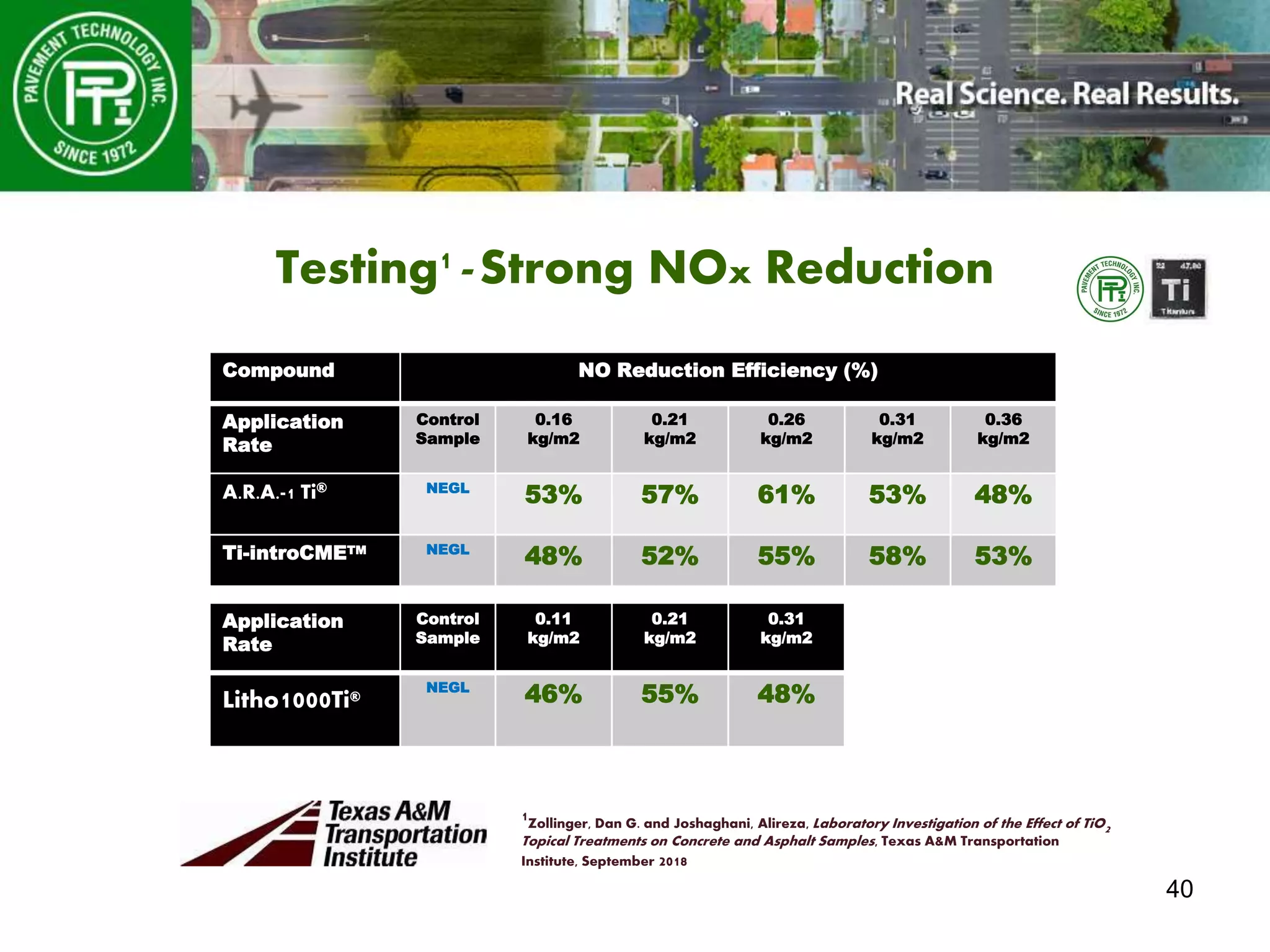
Testing1- Strong NOx Reduction
Compound NO Reduction Efficiency (%)
Application
Rate
Control
Sample
0.16
kg/m2
0.21
kg/m2
0.26
kg/m2
0.31
kg/m2
0.36
kg/m2
A.R.A.-1 Ti® NEGL
53% 57% 61% 53% 48%
Ti-introCMETM NEGL
48% 52% 55% 58% 53%
Application
Rate
Control
Sample
0.11
kg/m2
0.21
kg/m2
0.31
kg/m2
Litho1000Ti®
NEGL
46% 55% 48%
1Zollinger, Dan G. and Joshaghani, Alireza, Laboratory Investigation of the Effect of TiO2
Topical Treatments on Concrete and Asphalt Samples, Texas A&M Transportation
Institute, September 2018
41
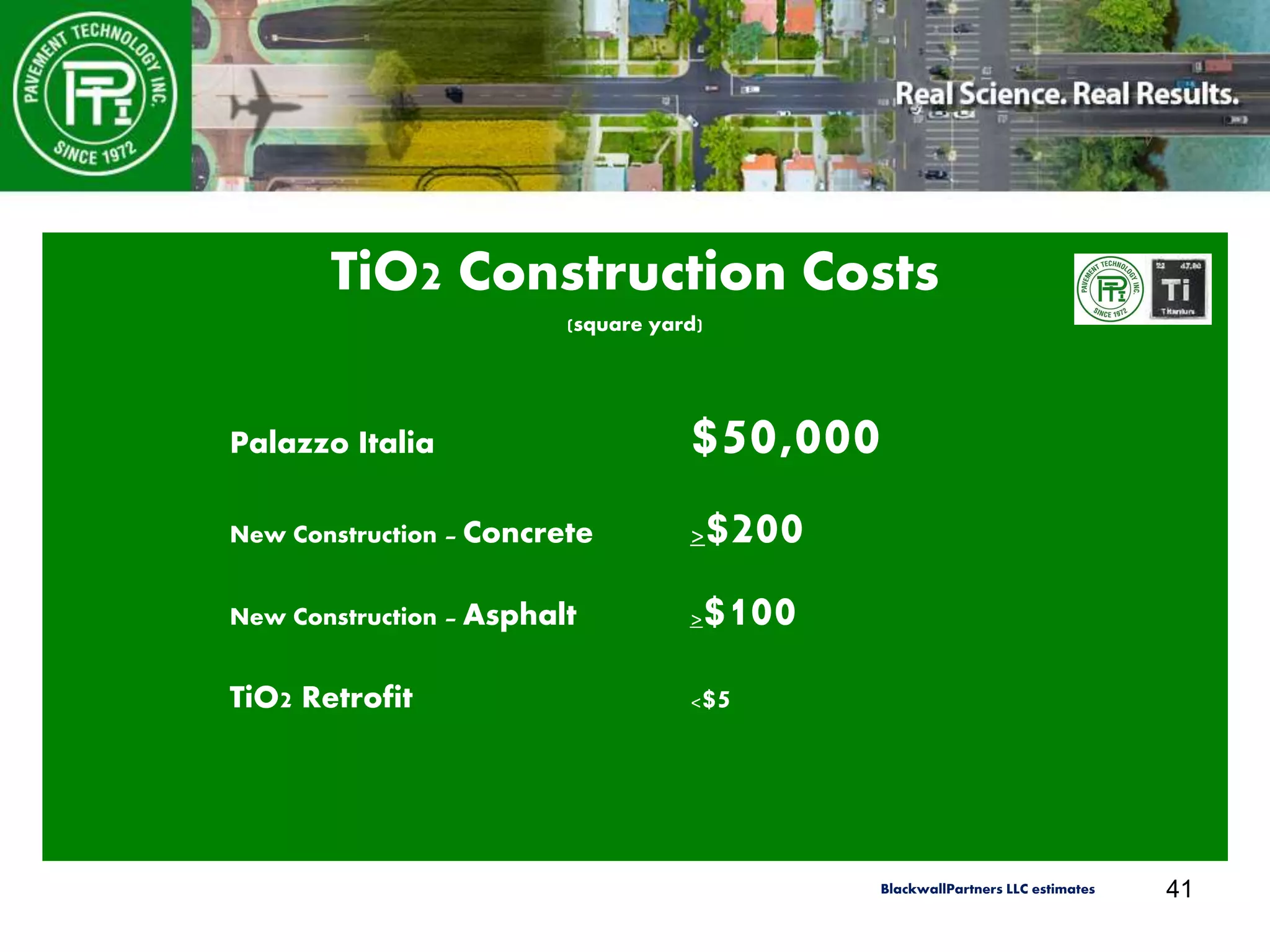
TiO2 Construction Costs
(square yard)
Palazzo Italia $50,000
New Construction – Concrete >$200
New Construction – Asphalt >$100
TiO2 Retrofit <$5
BlackwallPartners LLC estimates
42
Real Science. Real Results.
www.pavetechinc.com

Top of the Curve - Asphalt Preservation with Rejuvenators - APWA West Coast Branch

  • 1.
    Top of theCurve: Asphalt Preservation using Rejuvenators APWA Florida Chapter West Coast Branch February 19, 2019 Chas Jordan, ENV SP, LEED GA, STP cjordan@pavetechinc.com
  • 2.
    2 What is PavementPreservation? A cost-effective set of practices that extend pavement life and improve safety and motorist satisfaction while saving public tax dollars. (NCPP, pavementpreservation.org)
  • 3.
    3 Pavement Preservation • AssetManagement Principles: • Life Cycle Cost Benefit • Maintaining Early to keep in “Like New” Condition • Pavement “Value” • Preventive Maintenance • Oil Changes? • Change the Air Filter in your A/C Unit? • Mow your lawn? • All Examples of Preventive Maintenance
  • 4.
    4 FHWA Every DayCounts Initiative
  • 5.
    5 FHWA Every DayCounts Initiative
  • 6.
    6 “Right Treatment onthe Right Road at the Right Time” Condition Time $1 for preventive maintenance here Is 3 to 10 times more cost effective than here
  • 7.
    7 Real Science: Why doesAsphalt Deteriorate? 1. Age 2. Oxidation 3. Water Damage 4. Traffic Damage
  • 8.
    8 Why does AsphaltDeteriorate? AGE (Hardening) The first significant hardening of the asphalt cement takes place in the pugmill or drum mixer where heated aggregate is mixed with hot asphalt cement. During this short mixing time, the asphalt cement, which is in very thin films, is exposed to high temperatures ranging from 275 to 350º F.
  • 9.
    9 Why does AsphaltDeteriorate? OXIDATION The roadway begins to deteriorate the moment it’s paved. The worst part is it’s exponential. The viscosity of the asphalt binder can go from 10-15K poise when it’s only a few months old to several hundred thousand after only a few years. In Florida this is how most roads fail.
  • 10.
    10 Why does AsphaltDeteriorate? WATER DAMAGE Seeps into asphalt, especially cracks or raveling. This water expands and contracts, causing distress in the binder, and eventually potholes or structural damage occurs.
  • 11.
    11 Why does AsphaltDeteriorate? TRAFFIC DAMAGE Causes fatigue cracking which can lead to heightened damaged due to the preceding elements. It also compacts overtime, causing a harder areas in the A.C. than other areas of the roadway.
  • 12.
    12 Real Science: How dowe limit deterioration? Thus, the secret of ensuring a long service life of asphalt in pavements is to retard the aging process.
  • 13.
    13 How do welimit deterioration?
  • 14.
    14 Maltenes are theKey • Maltenes are the unstable component of asphalt binder and they are affected by air, UV rays water, temperature, etc. • It is the loss of the Maltenes from the asphalt binder in the upper 3/8” to ½” of asphalt pavements that start the asphalt deterioration process.
  • 15.
    15 Deterioration occurs as the AsphalticCement (AC) looses Maltenes from UV damage, Water, and Traffic over time.
  • 16.
    Confirmed by FHWA– EDC Program
  • 17.
    17 Real Science: So Howdo we Preserve? • Depending on condition of the pavement, it can be as simple as: REPLACE THE MALTENES. • Replacing the Maltenes can provide the aged asphalt binder the materials needed to remain fluid, viscous, and healthy.
  • 18.
    18 Replacing the Maltenes: Rejuvenation Maltenebased rejuvenators work by changing the chemistry of the asphalt binder by replenishing the lost maltenes back into the asphalt binder restoring its asphaltene to maltene ratio back to nearly new levels
  • 19.
    19 Rejuvenation Fog Seal COATING- Seals the surface Petroleum Maltene Based REJUVENATOR - Penetrates down into pavement & seals the surface, CANNOT be worn away
  • 20.
    20 Real Science: How dowe know this works? • The “Rostler Method” - Determines the rejuvenator efficacy and determines the ratio of resinous to oily maltenes in the pavement surface • ASTM Test D-2006-70 – “Free Maltene Distribution”
  • 21.
    21 How do weknow this works? • Viscosity Testing with a Dynamic Sheer Rheometer (DSR) • Higher Viscosity means healthier pavement
  • 22.
    22 How do weknow this works? • Measuring International Roughness Index of the Pavement before and after treatments
  • 23.
    23 How do weknow this works? • 3D Imaging Data – Mapping distress in pavement based upon depth differences at microscopic levels
  • 24.
    24 How do weknow this works? • Scholarly Research and Testing
  • 25.
    25 How do weknow this works? • Scholarly Research and Testing • 29% Savings in Pavement Life Cost
  • 26.
    26 Real Science: Is Rejuvenationwhat we need? • Preservation can go beyond rejuvenation, especially if pavement shows signs of distress like: • Cracking • Severe Raveling • Potholes • Aggregate Loss
  • 27.
    27 Cost Benefit –Basic ROI Basic Cost Benefit Model – • If a Road costs $150,000 to build (per lane mile) and it has a 20 year life cycle in 100 years you will spend $750,000 on that mile of road. • If you preserve with a $1 per SY treatment early and then every five years going forward, the asset can now last 40 years. • If we estimate ~$7,000 per Lane Mile to preserve • $150,000 + ($7,000*4 treatments) = $178,000 for 40 Years • In 100 years you will spend $445,000 (Barely more than half your original investment)
  • 28.
    28 How do Ipreserve? • Through a mutual use of Maltene replacement technology and: • Crack Sealing • Microsurfacing • Seal Coating • Chip Sealing • Slurry Sealing
  • 29.
    29 Why with othertreatments? • The Maltenes will benefit the existing Asphaltic Cement, however due to the distress in the existing road, a new wearing surface is needed or at the very least, crack sealing to limit water intrusion below the top layer of asphalt.
  • 30.
    30 Real Science: Has thisbeen proven, and by who? • National Center for Pavement Preservation at Michigan State University (pavementpreservation.org) • Center for Multidisciplinary Research in Transportation at Texas Tech University • Time and Experience
  • 31.
    31 What if....? What ifwe could clean the air in our communities by paving a material that could clean the exhaust coming out of our residents cars???
  • 32.
  • 33.
    33 From the Vehicleswedrive… to the Air We Breathe
  • 34.
    34 Photocatalysis w/ TiO2 TiO2Properties/ Advantages  Strong Oxidizer  Gas Phase De-polluting  Self-Cleaning  Chemically Inert  Physically Stable  Antibacterial / Antifungal  Non Exhaustive -------------------- 1Honda-Fujishima Effect: Fujishima, Akira. and Honda, Kenichi, Electrochemical Photolysis of Water at a Semiconductor Electrode, Department of Applied Chemistry, School of Engineering, The University of Tokyo1972 Photocatalytic Properties of Titanium Dioxide Discovered in the Early Seventies1
  • 35.
    35 Photocatalysis w/ TiO2 NOxPhotodegradation via TiO2  Analogous to Plant Photosynthesis  TiO2 forms electron holes under UV light  Creating a (Photo) Excited State  Whereby Radicals (OH-; HO-2) and  Superoxide (O-2) Decompose NOx  Results are Harmless Nitrate Salts  A Hydrophilic (5x Sheeting) Surface  And a Reflective (Cooling) Effect
  • 36.
    y 36 Photocatalysis w/ TiO2 SignificantEnvironmental and Ecological Net Benefits Airborne Nitrites (NO2) are Highly Toxic Nitrates (NO3) Least Harmful Form of Soluble Nitrogen  EPA NO2 Air Quality Maximum1 53 ppb or 0.05 mg/L  EPA NO3 Water Contamination Max2 10 mg/L or 10,000 ppb  Airborne Nitrites 188x More Toxic than Nitrate Resultant3 -------------------- 1Environmental Protection Agency National Ambient Air Quality Standard for maximum annual concentration for NO2 (2010). 2Environmental Protection Agency NO3 maximum contaminant level for water (2012). 3BlackwallPartners LLC estimates Nitrite Gas Converted into Solid Nitrate is a 99.5% “Pollution Equivalent” Reduction3
  • 37.
    37 One Mile ofTiO2 Road equates to Planting a 20 Acre Forest1 -------------------- 1Alcoa Architectural Coatings – EcoClean aluminum panels; BlackwallPartners LLC estimates
  • 38.
    38 Each Mile ofTiO2 Pavement Offsets the Combustion of 4000Cars Daily1 -------------------- 1Dios, Juan, et al, Decontamination through Photocatalytic TIO2 Additions – Past, Present and Future, International Conference on Emerging Trends in Engineering and Technology (ICETET), London 2014; BlackwallPartners LLC estimates
  • 39.
    39 TiO2 Product Set AsphaltConcrete All Infrastructure Combining Proven Nanotechnologies to Scale…
  • 40.
    40 Testing1- Strong NOxReduction Compound NO Reduction Efficiency (%) Application Rate Control Sample 0.16 kg/m2 0.21 kg/m2 0.26 kg/m2 0.31 kg/m2 0.36 kg/m2 A.R.A.-1 Ti® NEGL 53% 57% 61% 53% 48% Ti-introCMETM NEGL 48% 52% 55% 58% 53% Application Rate Control Sample 0.11 kg/m2 0.21 kg/m2 0.31 kg/m2 Litho1000Ti® NEGL 46% 55% 48% 1Zollinger, Dan G. and Joshaghani, Alireza, Laboratory Investigation of the Effect of TiO2 Topical Treatments on Concrete and Asphalt Samples, Texas A&M Transportation Institute, September 2018
  • 41.
    41 TiO2 Construction Costs (squareyard) Palazzo Italia $50,000 New Construction – Concrete >$200 New Construction – Asphalt >$100 TiO2 Retrofit <$5 BlackwallPartners LLC estimates
  • 42.
    42 Real Science. RealResults. www.pavetechinc.com