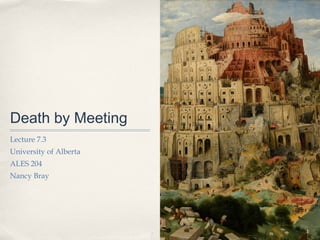
Death by Meeting
Lecture 7.3
University of Alberta
ALES 204
Nancy Bray


                        1
Housekeeping

Assignment #2 Questions

Labs next week: bring a copy of your fact sheet for peer review

Guest lecture on Monday - no PowerPoint!

Practice speeches - start week of March 11

Second half of ALES 204


                                                                  2
Lecture Outline

1. How to write a business letter

2. What are meetings?

3. How do meetings work?

4. How can you make meetings better


                                      3
1. How to write a business letter


                                    4
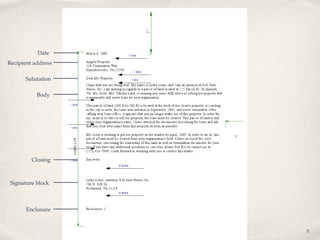
Date
Recipient address

       Salutation

           Body


         Closing


 Signature block


       Enclosure


                    5
2. What are meetings?


                        6
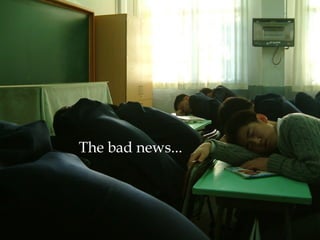
The bad news...


                  7
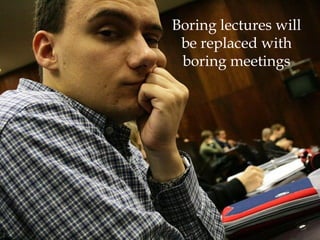
Boring lectures will
 be replaced with
 boring meetings


                       8
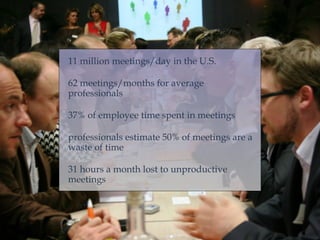
11 million meetings/day in the U.S.

62 meetings/months for average
professionals

37% of employee time spent in meetings

professionals estimate 50% of meetings are a
waste of time

31 hours a month lost to unproductive
meetings


                                               9
Professionals admit to...

 Daydreaming (91%)

 Missing meetings (96%)

 Missing parts of meetings (95%)

 Bringing other work to meetings (73%)

 Falling asleep (39%)


                                         10
Professionals complain that...

 They don’t know why they were invited

 The presenter reads from the PowerPoint slides.

 Meetings last too long

 The flow of the meeting is disturbed by technology

 No problems are ever solved

 Employees are told what is wrong, but no chance to input


                                                            11
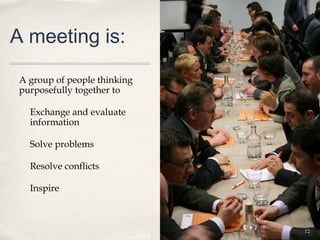
A meeting is:

 A group of people thinking
 purposefully together to

   Exchange and evaluate
   information

   Solve problems

   Resolve conflicts

   Inspire


                              12
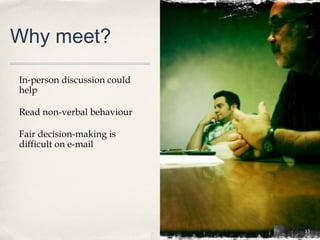
Why meet?

In-person discussion could
help

Read non-verbal behaviour

Fair decision-making is
difficult on e-mail


                             13
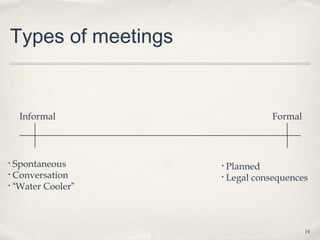
Types of meetings


    Informal                   Formal


• Spontaneous       • Planned
• Conversation
                    • Legal consequences
• “Water Cooler”


                                        14
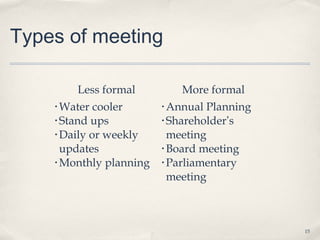
Types of meeting

        Less formal          More formal
    • Water cooler       • Annual Planning
    • Stand ups          • Shareholder’s

    • Daily or weekly      meeting
      updates            • Board meeting

    • Monthly planning   • Parliamentary

                           meeting


                                             15
Rules of order

       Increased use of formal meeting procedures (rules of order)


 Informal                                                   Formal


                 Robert’s Rules of Order

                 Parliamentary Rules of Order


                                                                     16
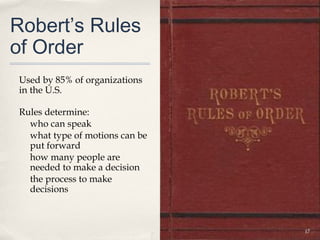
Robert’s Rules
of Order
Used by 85% of organizations
in the U.S.

Rules determine:
  who can speak
  what type of motions can be
  put forward
  how many people are
  needed to make a decision
  the process to make
  decisions


                                17
3. How do meetings work?


                           18
The main
characters
The Chair

The Administrator (secretary,
minute-taker)

Meeting participants


                                19
The Chair
should:
Communicate the purpose of
the meeting

Direct the conversation during
the meeting and make sure that
timing is respected

Give the group a sense of
security


                                 20
Chair must
decide
S- Situation (time/place)

P- Purpose (goals)

A- Audience (who)

M- Method (way to accomplish
goal)


                               21
The Agenda

The Chair is responsible for
setting the agenda (written
program)

Agenda set in advance

Chair gets agenda items from
meeting participants

Sends out agenda before
meeting


                               22
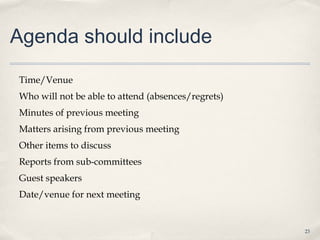
Agenda should include

Time/Venue
Who will not be able to attend (absences/regrets)
Minutes of previous meeting
Matters arising from previous meeting
Other items to discuss
Reports from sub-committees
Guest speakers
Date/venue for next meeting


                                                    23
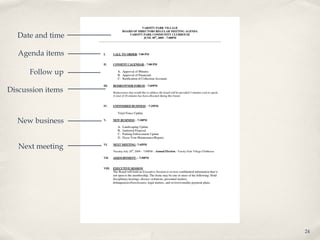
Date and time

   Agenda items

      Follow up

Discussion items


  New business


   Next meeting


                   24
Tips:

 Most difficult items should be placed in the middle third of the
 meeting

 No longer than 90 minutes

 Allocate time for each item


                                                                    25
Opening the meeting

Start on time

State purpose of the meeting

Make introductions

Announce procedures and timings

Discuss one item at a time

Finish on time


                                  26
Managing the meeting

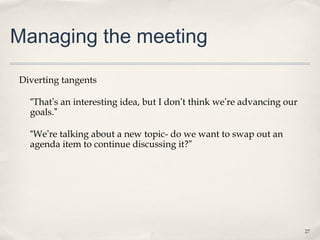
Diverting tangents

  “That’s an interesting idea, but I don’t think we’re advancing our
  goals.”

  “We’re talking about a new topic- do we want to swap out an
  agenda item to continue discussing it?”


                                                                       27
Managing the meeting

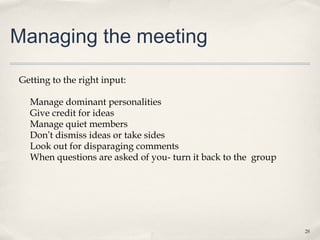
Getting to the right input:

  Manage dominant personalities
  Give credit for ideas
  Manage quiet members
  Don’t dismiss ideas or take sides
  Look out for disparaging comments
  When questions are asked of you- turn it back to the group


                                                               28
Managing the meeting

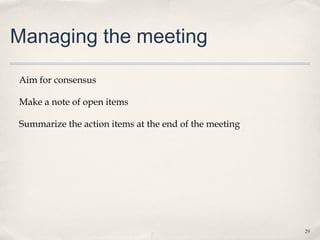
Aim for consensus

Make a note of open items

Summarize the action items at the end of the meeting


                                                       29
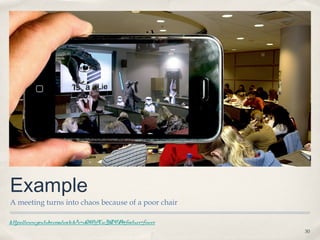
Example
A meeting turns into chaos because of a poor chair

https://www.youtube.com/watch?v=xQW1fEwYZVA&feature=fvwre
                                                            30
The
Administrator
 Assists the chair in planning
 the meeting

 Takes care of the logistics for a
 meeting (i.e., room, time, food)

 Takes minutes during the
 meeting


                                     31
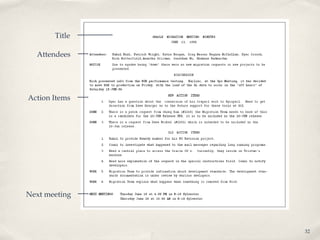
Title

  Attendees


Action Items


Next meeting


               32
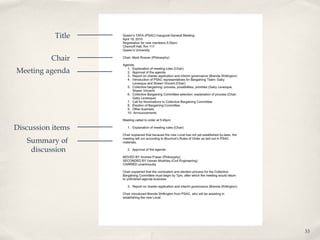
Title


          Chair
Meeting agenda


Discussion items
   Summary of
    discussion


                   33
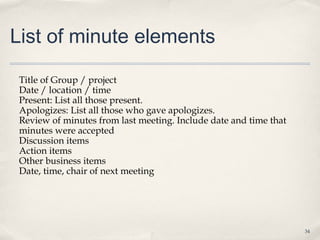
List of minute elements

 Title of Group / project
 Date / location / time
 Present: List all those present.
 Apologizes: List all those who gave apologizes.
 Review of minutes from last meeting. Include date and time that
 minutes were accepted
 Discussion items
 Action items
 Other business items
 Date, time, chair of next meeting


                                                                   34
How to take
minutes
Taking minutes

https://www.youtube.com/watch?v=brPtSs04r1Y&feature=relmfu


                                                             35
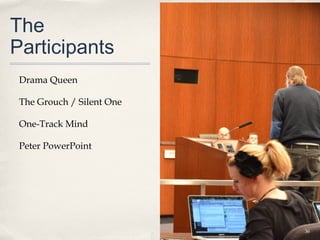
The
Participants
 Drama Queen

 The Grouch / Silent One

 One-Track Mind

 Peter PowerPoint


                           36
Drama Queen

Interrupts

Brings up the worst-case
scenario

Self-appointed spokesperson


                              37
How to handle the
drama queen

 Re-focus to the topic at hand

 Focus the attention on someone
 who does not speak as often


                                  38
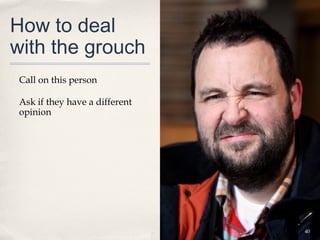
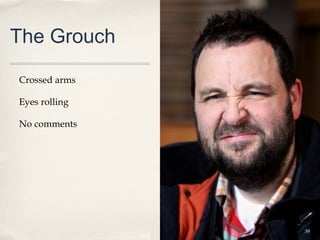
The Grouch

Crossed arms

Eyes rolling

No comments


               39
How to deal
with the grouch
 Call on this person

 Ask if they have a different
 opinion


                                40
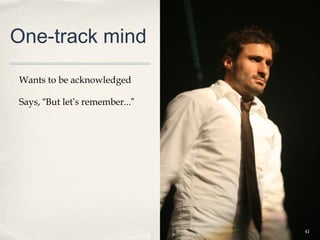
One-track mind

Wants to be acknowledged

Says, “But let’s remember...”


                                41
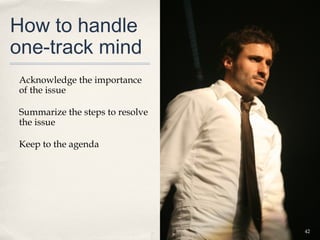
How to handle
one-track mind
Acknowledge the importance
of the issue

Summarize the steps to resolve
the issue

Keep to the agenda


                                 42
Peter PowerPoint
Reads from his long-winded PowerPoint slides word for word


                                                             43
How to handle Peter
PowerPoint

 Set limits on PowerPoint
 (number of words on slide)

 Don’t allow PowerPoint at all


                                 44
Can meetings get better?


                           45
Why meetings fail

The meeting is unnecessary

The meeting is held for the wrong reason

The objective of the meeting is unclear

Lack of preparation

The wrong people are there

Lack of proper control

Poor environment

Poor timing                                46
Remember

Every meeting is unique

A meeting’s success judged by the actions which result

Managing the meeting is everyone’s responsibility


                                                         47
Shake things up

If a meeting isn’t necessary, don’t have one.

Try different and “new” types of meetings

Look for and provoke sources of legitimate conflict

Take notes


                                                      48
Take away

Meetings are important form of
communication

Don’t waste participants’ time

Know your role

Take responsibility for the
productivity of the meeting no
matter which role you play


                                 49

7.3 death by meeting lecture slides complete notes

  • 1.
    Death by Meeting Lecture7.3 University of Alberta ALES 204 Nancy Bray 1
  • 2.
    Housekeeping Assignment #2 Questions Labsnext week: bring a copy of your fact sheet for peer review Guest lecture on Monday - no PowerPoint! Practice speeches - start week of March 11 Second half of ALES 204 2
  • 3.
    Lecture Outline 1. Howto write a business letter 2. What are meetings? 3. How do meetings work? 4. How can you make meetings better 3
  • 4.
    1. How towrite a business letter 4
  • 5.
    Date Recipient address Salutation Body Closing Signature block Enclosure 5
  • 6.
    2. What aremeetings? 6
  • 7.
  • 8.
    Boring lectures will be replaced with boring meetings 8
  • 9.
    11 million meetings/dayin the U.S. 62 meetings/months for average professionals 37% of employee time spent in meetings professionals estimate 50% of meetings are a waste of time 31 hours a month lost to unproductive meetings 9
  • 10.
    Professionals admit to... Daydreaming (91%) Missing meetings (96%) Missing parts of meetings (95%) Bringing other work to meetings (73%) Falling asleep (39%) 10
  • 11.
    Professionals complain that... They don’t know why they were invited The presenter reads from the PowerPoint slides. Meetings last too long The flow of the meeting is disturbed by technology No problems are ever solved Employees are told what is wrong, but no chance to input 11
  • 12.
    A meeting is: A group of people thinking purposefully together to Exchange and evaluate information Solve problems Resolve conflicts Inspire 12
  • 13.
    Why meet? In-person discussioncould help Read non-verbal behaviour Fair decision-making is difficult on e-mail 13
  • 14.
    Types of meetings Informal Formal • Spontaneous • Planned • Conversation • Legal consequences • “Water Cooler” 14
  • 15.
    Types of meeting Less formal More formal • Water cooler • Annual Planning • Stand ups • Shareholder’s • Daily or weekly meeting updates • Board meeting • Monthly planning • Parliamentary meeting 15
  • 16.
    Rules of order Increased use of formal meeting procedures (rules of order) Informal Formal Robert’s Rules of Order Parliamentary Rules of Order 16
  • 17.
    Robert’s Rules of Order Usedby 85% of organizations in the U.S. Rules determine: who can speak what type of motions can be put forward how many people are needed to make a decision the process to make decisions 17
  • 18.
    3. How domeetings work? 18
  • 19.
    The main characters The Chair TheAdministrator (secretary, minute-taker) Meeting participants 19
  • 20.
    The Chair should: Communicate thepurpose of the meeting Direct the conversation during the meeting and make sure that timing is respected Give the group a sense of security 20
  • 21.
    Chair must decide S- Situation(time/place) P- Purpose (goals) A- Audience (who) M- Method (way to accomplish goal) 21
  • 22.
    The Agenda The Chairis responsible for setting the agenda (written program) Agenda set in advance Chair gets agenda items from meeting participants Sends out agenda before meeting 22
  • 23.
    Agenda should include Time/Venue Whowill not be able to attend (absences/regrets) Minutes of previous meeting Matters arising from previous meeting Other items to discuss Reports from sub-committees Guest speakers Date/venue for next meeting 23
  • 24.
    Date and time Agenda items Follow up Discussion items New business Next meeting 24
  • 25.
    Tips: Most difficultitems should be placed in the middle third of the meeting No longer than 90 minutes Allocate time for each item 25
  • 26.
    Opening the meeting Starton time State purpose of the meeting Make introductions Announce procedures and timings Discuss one item at a time Finish on time 26
  • 27.
    Managing the meeting Divertingtangents “That’s an interesting idea, but I don’t think we’re advancing our goals.” “We’re talking about a new topic- do we want to swap out an agenda item to continue discussing it?” 27
  • 28.
    Managing the meeting Gettingto the right input: Manage dominant personalities Give credit for ideas Manage quiet members Don’t dismiss ideas or take sides Look out for disparaging comments When questions are asked of you- turn it back to the group 28
  • 29.
    Managing the meeting Aimfor consensus Make a note of open items Summarize the action items at the end of the meeting 29
  • 30.
    Example A meeting turnsinto chaos because of a poor chair https://www.youtube.com/watch?v=xQW1fEwYZVA&feature=fvwre 30
  • 31.
    The Administrator Assists thechair in planning the meeting Takes care of the logistics for a meeting (i.e., room, time, food) Takes minutes during the meeting 31
  • 32.
    Title Attendees ActionItems Next meeting 32
  • 33.
    Title Chair Meeting agenda Discussion items Summary of discussion 33
  • 34.
    List of minuteelements Title of Group / project Date / location / time Present: List all those present. Apologizes: List all those who gave apologizes. Review of minutes from last meeting. Include date and time that minutes were accepted Discussion items Action items Other business items Date, time, chair of next meeting 34
  • 35.
    How to take minutes Takingminutes https://www.youtube.com/watch?v=brPtSs04r1Y&feature=relmfu 35
  • 36.
    The Participants Drama Queen The Grouch / Silent One One-Track Mind Peter PowerPoint 36
  • 37.
    Drama Queen Interrupts Brings upthe worst-case scenario Self-appointed spokesperson 37
  • 38.
    How to handlethe drama queen Re-focus to the topic at hand Focus the attention on someone who does not speak as often 38
  • 39.
    The Grouch Crossed arms Eyesrolling No comments 39
  • 40.
    How to deal withthe grouch Call on this person Ask if they have a different opinion 40
  • 41.
    One-track mind Wants tobe acknowledged Says, “But let’s remember...” 41
  • 42.
    How to handle one-trackmind Acknowledge the importance of the issue Summarize the steps to resolve the issue Keep to the agenda 42
  • 43.
    Peter PowerPoint Reads fromhis long-winded PowerPoint slides word for word 43
  • 44.
    How to handlePeter PowerPoint Set limits on PowerPoint (number of words on slide) Don’t allow PowerPoint at all 44
  • 45.
    Can meetings getbetter? 45
  • 46.
    Why meetings fail Themeeting is unnecessary The meeting is held for the wrong reason The objective of the meeting is unclear Lack of preparation The wrong people are there Lack of proper control Poor environment Poor timing 46
  • 47.
    Remember Every meeting isunique A meeting’s success judged by the actions which result Managing the meeting is everyone’s responsibility 47
  • 48.
    Shake things up Ifa meeting isn’t necessary, don’t have one. Try different and “new” types of meetings Look for and provoke sources of legitimate conflict Take notes 48
  • 49.
    Take away Meetings areimportant form of communication Don’t waste participants’ time Know your role Take responsibility for the productivity of the meeting no matter which role you play 49