


TRAVEL
SERVICES NCII
(160 hours)
LESSON 3: Observe Workplace
Hygiene Procedures
OBJECTIVES:
LO 4. Identify and prevent hygiene risks
1.1 identify potential hygiene risks that deviate standard procedures
1.2 take necessary actions to minimize and remove risks within the scope of individual
responsibility
1.3 report hygiene risks beyond the control of individual staff members to the appropriate
authority for follow up
(TLE_HETS9- 12OWHP-IIa-3 ; TLE_HETS9- 12OWHP-IIb-4 )
II. Safe and Hygienic Handling,
Storage and Disposal of Food,
Beverages and Materials
PROPER FOOD HANDLING, FOOD SAFETY, AND
SANITATION PRACTICES
(EXCERPTED FROM THE MICHIGAN FOOD LAW OF 2000 AS AMENDED)
When to Wash?
Food employees must wash their hands and exposed portions of
the arms after touching bare human body parts, using the toilet
room, handling animals, coughing/sneezing, using a handkerchief,
using tobacco, eating/drinking, handling soiled equipment/utensils,
as often as necessary to prevent cross-contamination, when
switching between raw and ready-to-eat food, and after engaging
in other activities that contaminate the hands.
HYGIENE
Food employees shall maintain a high degree of personal
cleanliness and shall conform to good hygienic practices during
all working periods.
Food employees shall have clean outer garments and wear
effective hair restraints. Smoking, eating, and drinking are not
allowed by food employees in the food preparation and service
areas.
All non-working unauthorized persons must be restricted from
the food preparation and service areas.
NO BARE HAND CONTACT WITH READY-TO-
EAT FOOD
Food employees may not contact exposed ready-
to-eat food with their bare hands. Suitable utensils,
such as deli paper, spatulas, tongs, dispensing
equipment, or gloves shall be used.
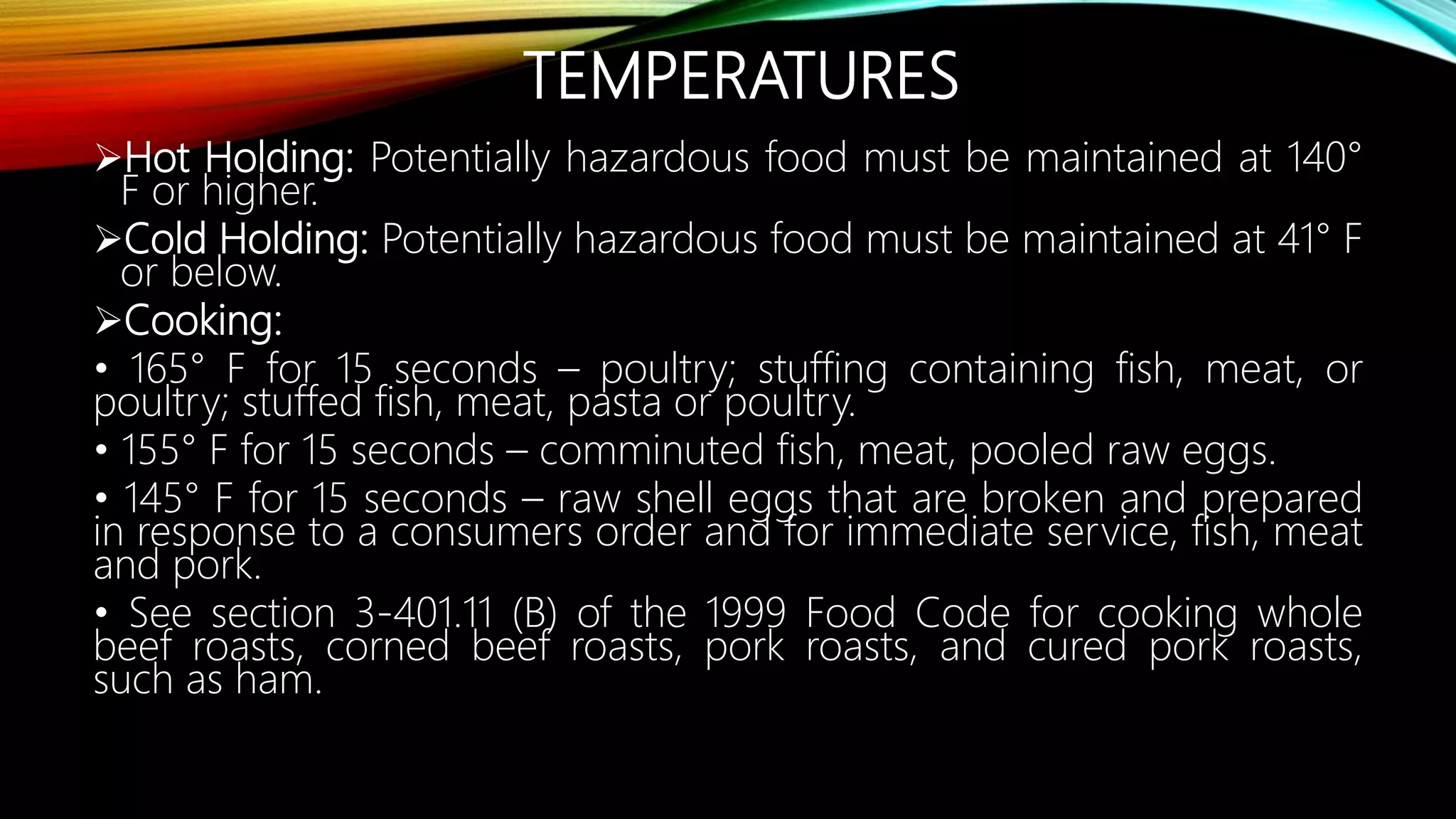
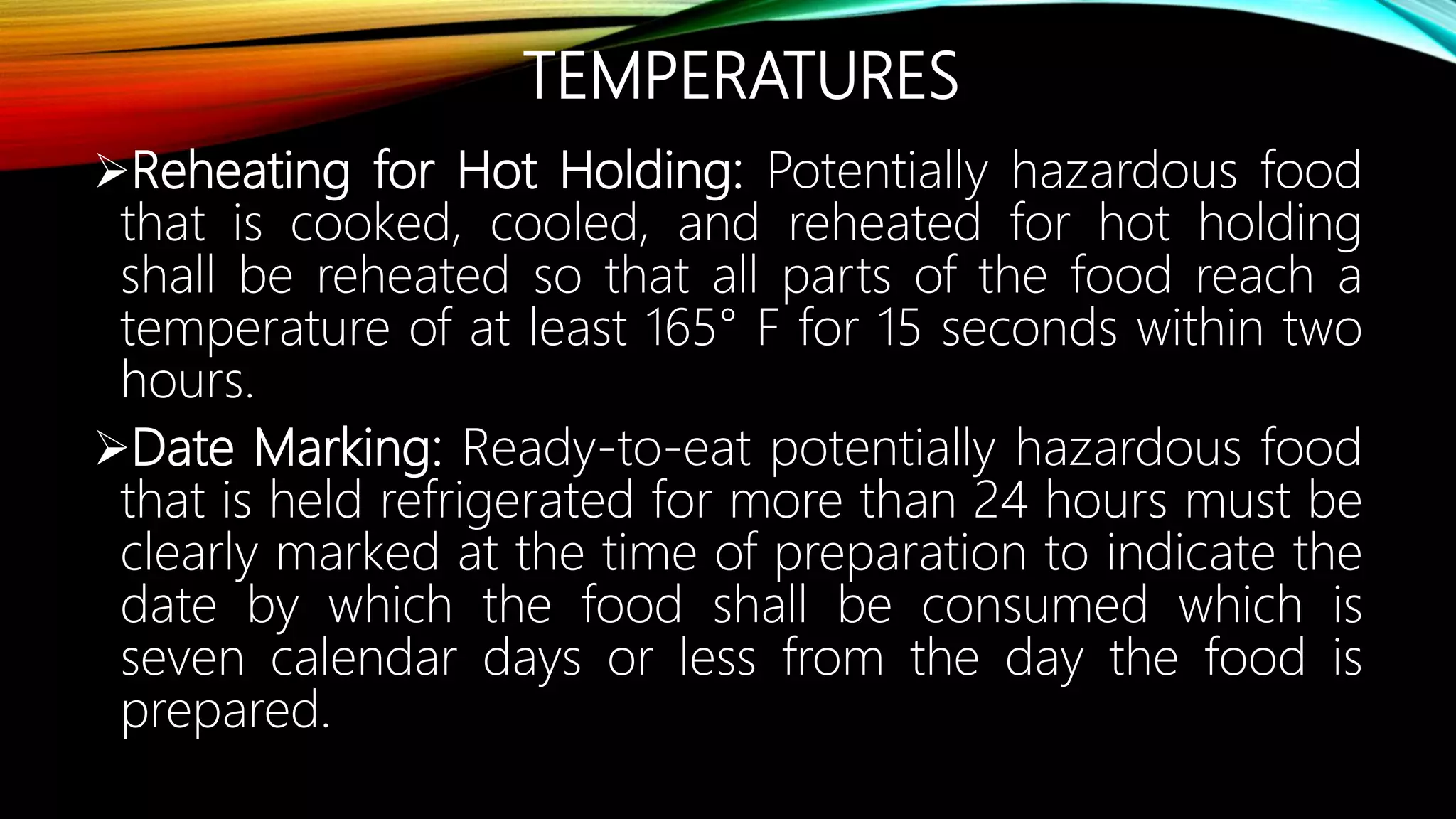
TEMPERATURES
Hot Holding: Potentially hazardous food must be maintained at 140°
F or higher.
Cold Holding: Potentially hazardous food must be maintained at 41° F
or below.
Cooking:
• 165° F for 15 seconds – poultry; stuffing containing fish, meat, or
poultry; stuffed fish, meat, pasta or poultry.
• 155° F for 15 seconds – comminuted fish, meat, pooled raw eggs.
• 145° F for 15 seconds – raw shell eggs that are broken and prepared
in response to a consumers order and for immediate service, fish, meat
and pork.
• See section 3-401.11 (B) of the 1999 Food Code for cooking whole
beef roasts, corned beef roasts, pork roasts, and cured pork roasts,
such as ham.
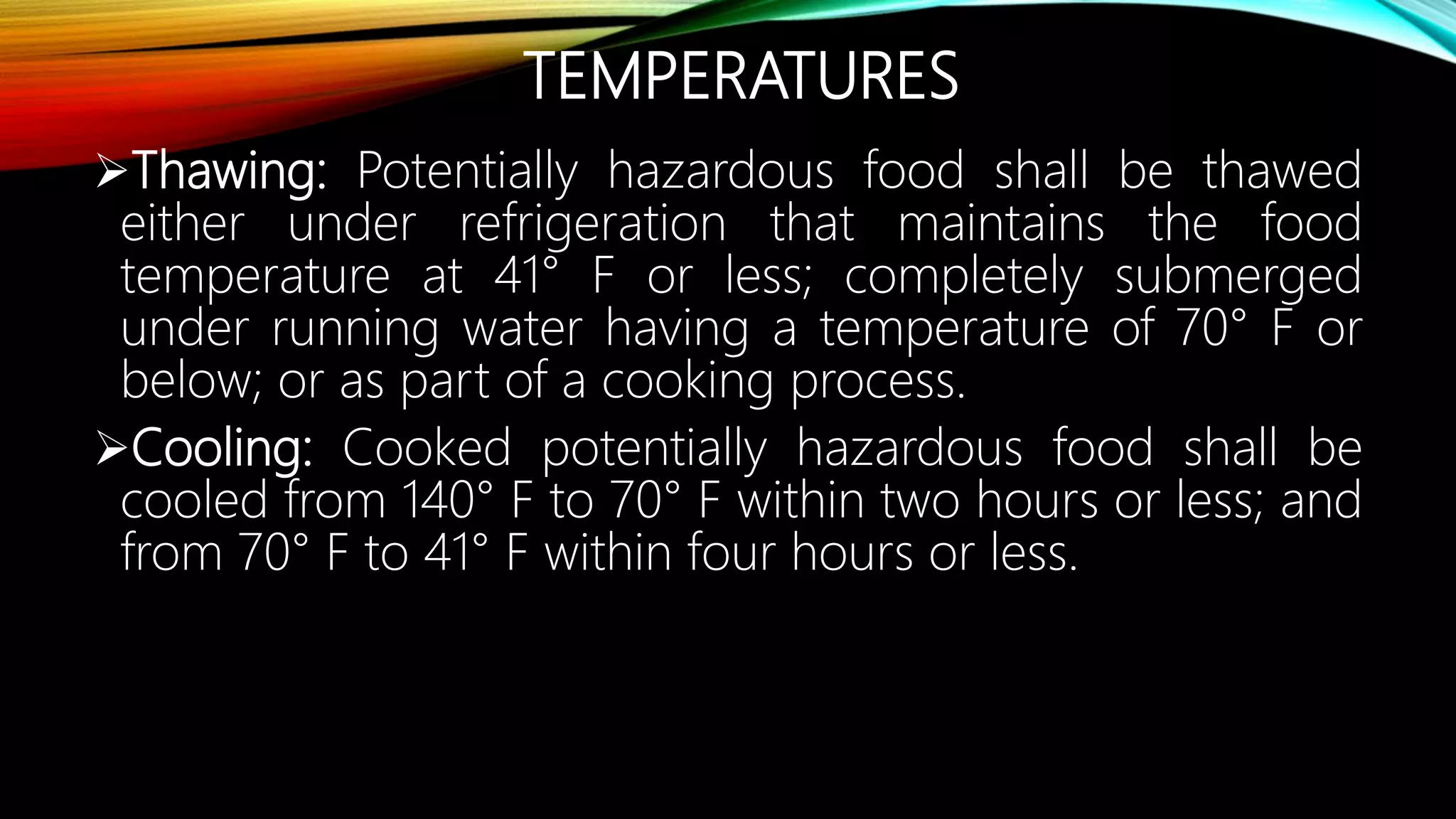
TEMPERATURES
Thawing: Potentially hazardous food shall be thawed
either under refrigeration that maintains the food
temperature at 41° F or less; completely submerged
under running water having a temperature of 70° F or
below; or as part of a cooking process.
Cooling: Cooked potentially hazardous food shall be
cooled from 140° F to 70° F within two hours or less; and
from 70° F to 41° F within four hours or less.
TEMPERATURES
Reheating for Hot Holding: Potentially hazardous food
that is cooked, cooled, and reheated for hot holding
shall be reheated so that all parts of the food reach a
temperature of at least 165° F for 15 seconds within two
hours.
Date Marking: Ready-to-eat potentially hazardous food
that is held refrigerated for more than 24 hours must be
clearly marked at the time of preparation to indicate the
date by which the food shall be consumed which is
seven calendar days or less from the day the food is
prepared.
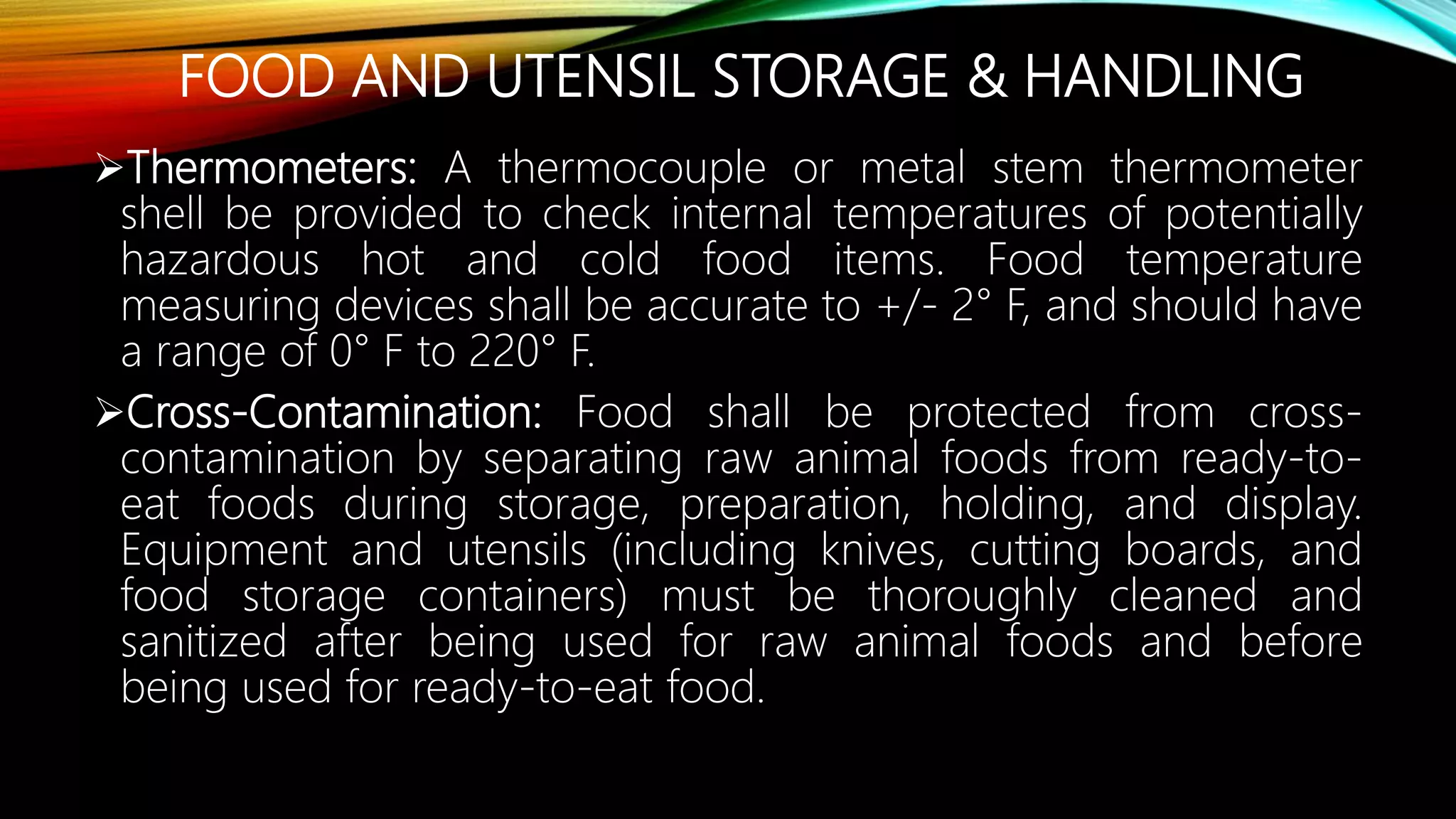
FOOD AND UTENSIL STORAGE & HANDLING
Thermometers: A thermocouple or metal stem thermometer
shell be provided to check internal temperatures of potentially
hazardous hot and cold food items. Food temperature
measuring devices shall be accurate to +/- 2° F, and should have
a range of 0° F to 220° F.
Cross-Contamination: Food shall be protected from cross-
contamination by separating raw animal foods from ready-to-
eat foods during storage, preparation, holding, and display.
Equipment and utensils (including knives, cutting boards, and
food storage containers) must be thoroughly cleaned and
sanitized after being used for raw animal foods and before
being used for ready-to-eat food.
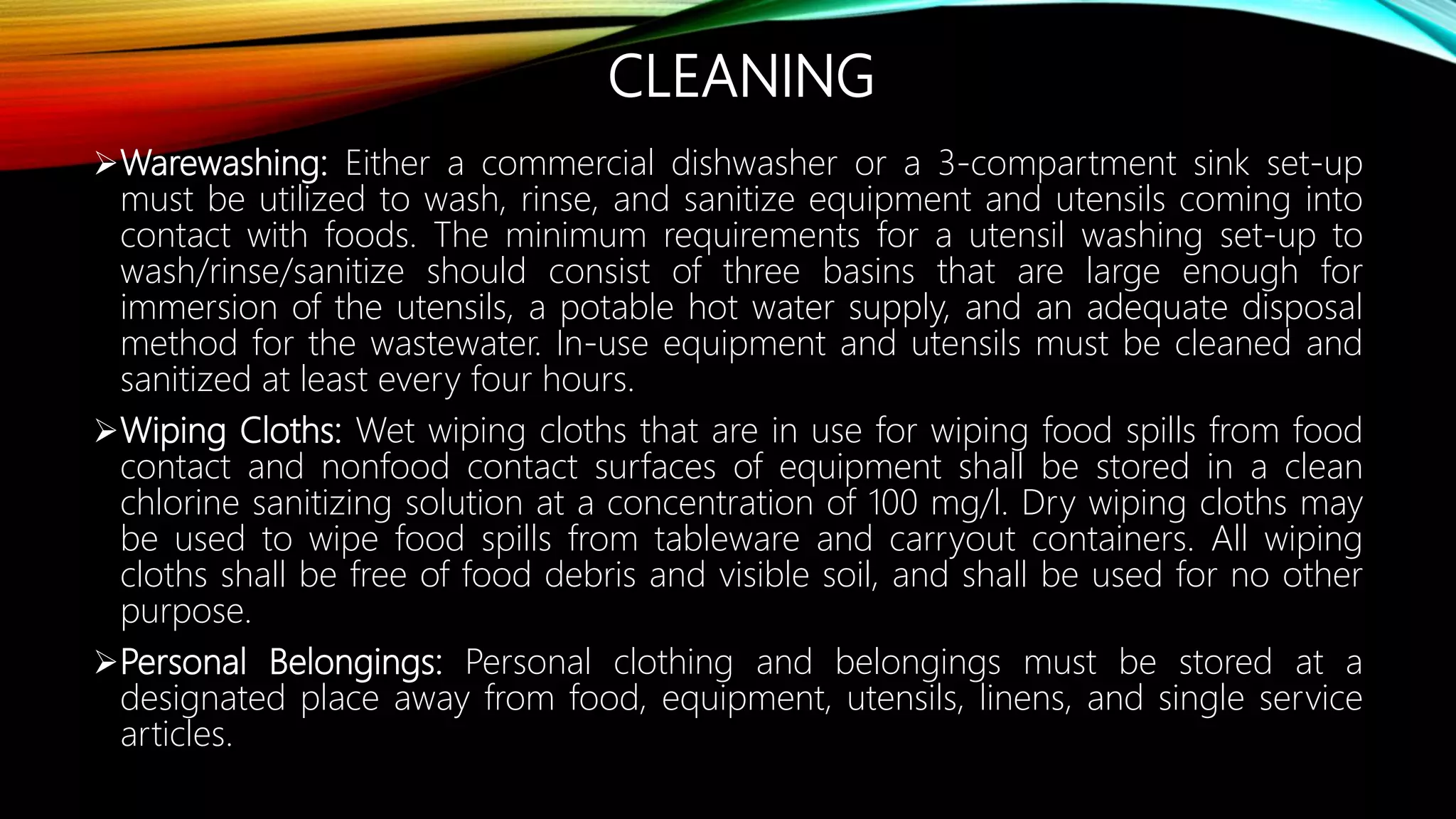
CLEANING
Warewashing: Either a commercial dishwasher or a 3-compartment sink set-up
must be utilized to wash, rinse, and sanitize equipment and utensils coming into
contact with foods. The minimum requirements for a utensil washing set-up to
wash/rinse/sanitize should consist of three basins that are large enough for
immersion of the utensils, a potable hot water supply, and an adequate disposal
method for the wastewater. In-use equipment and utensils must be cleaned and
sanitized at least every four hours.
Wiping Cloths: Wet wiping cloths that are in use for wiping food spills from food
contact and nonfood contact surfaces of equipment shall be stored in a clean
chlorine sanitizing solution at a concentration of 100 mg/l. Dry wiping cloths may
be used to wipe food spills from tableware and carryout containers. All wiping
cloths shall be free of food debris and visible soil, and shall be used for no other
purpose.
Personal Belongings: Personal clothing and belongings must be stored at a
designated place away from food, equipment, utensils, linens, and single service
articles.
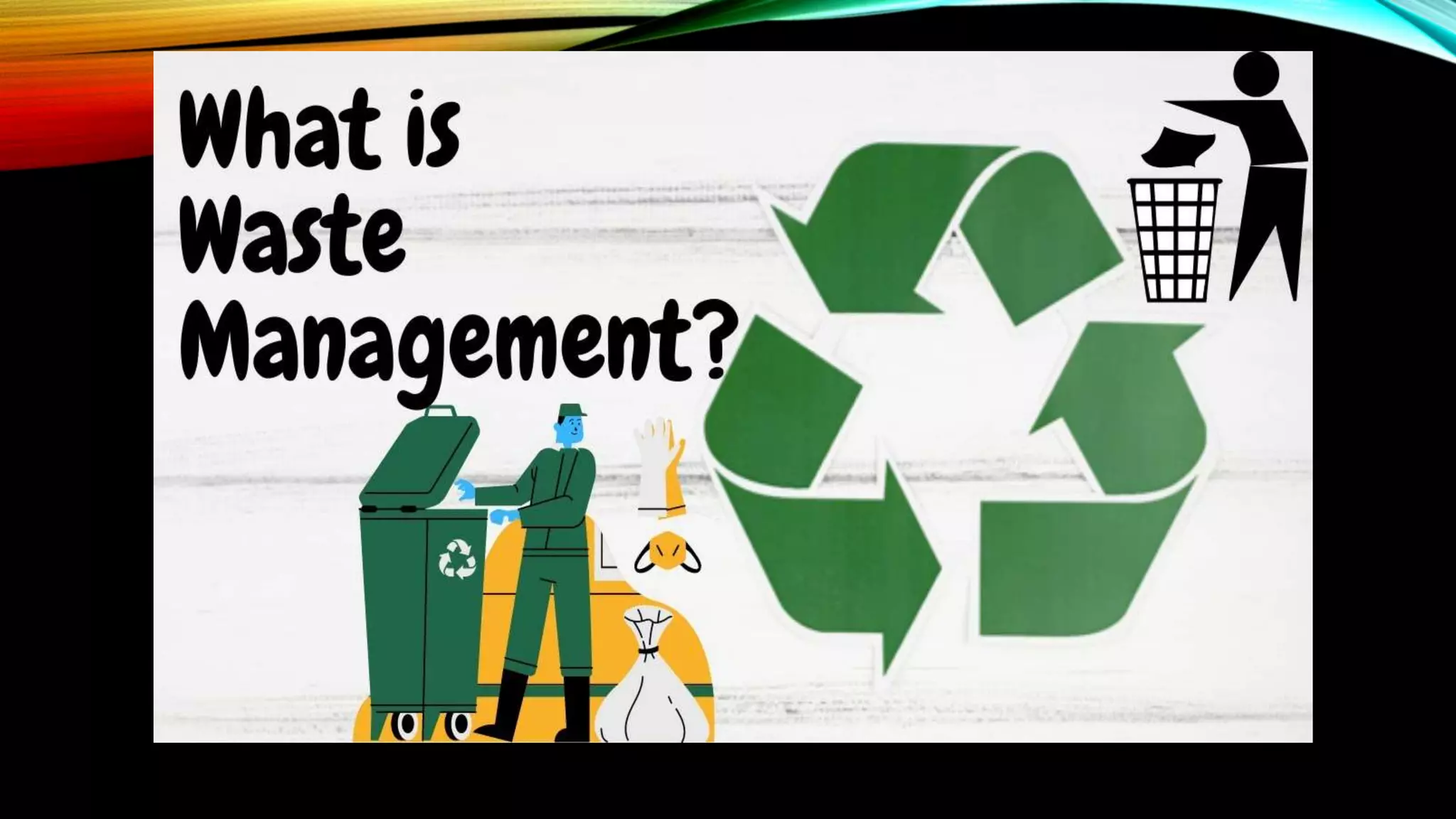
ECOLOGICAL WASTE
MANAGEMENT
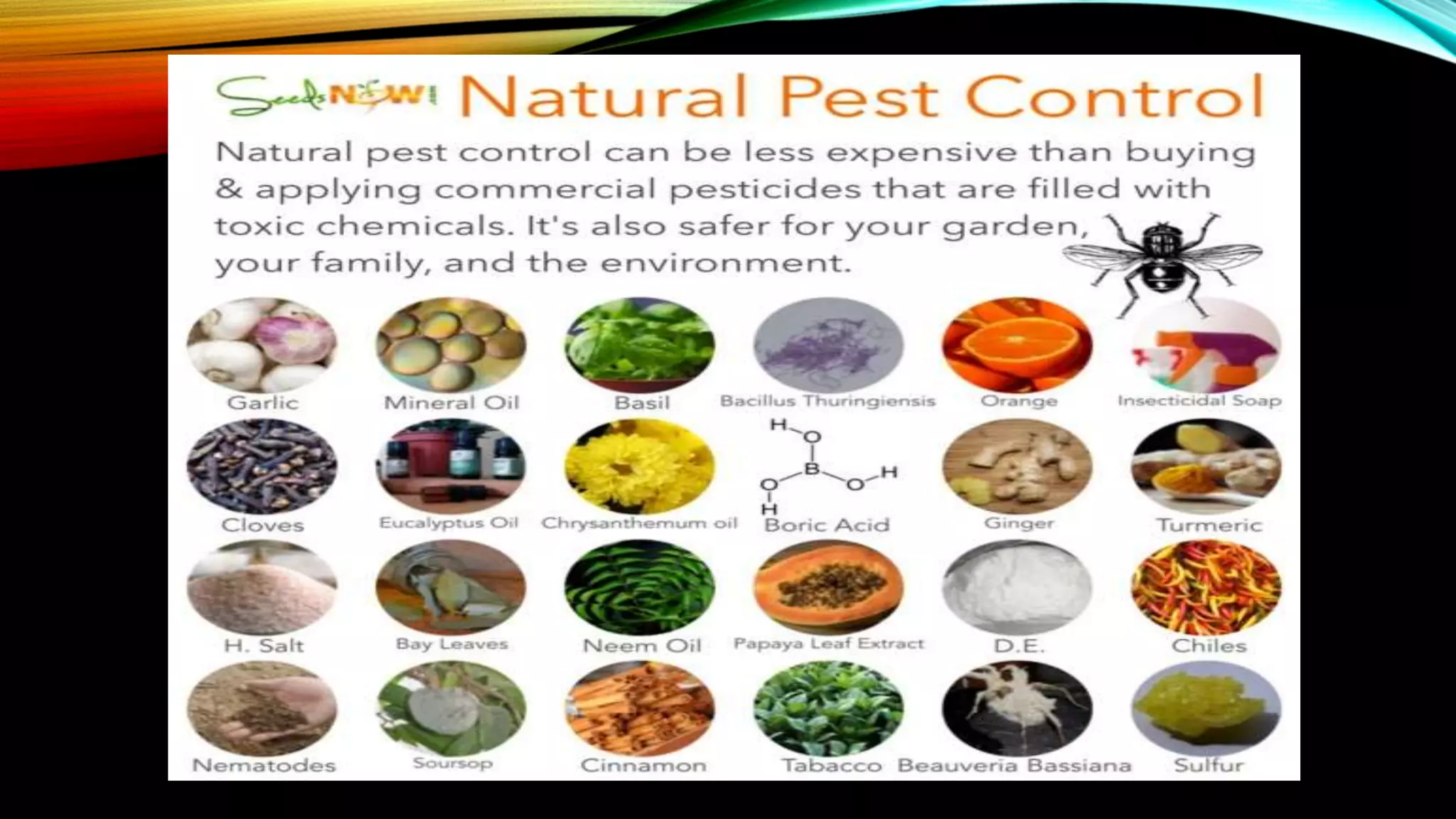
ORGANIC PEST CONTROL
III. MINIMIZING OR REMOVING RISK
•auditing staff skills and providing training
•ensuring strict compliance with policies
and procedures
•audits or incidents with follow up actions
REFERENCES:
Learner’s Module-Travel Services Grade 10, Department of Education
https://sk.sagepub.com/reference/the-sage-international-encyclopedia-of-
travel-and-tourism/i8186.xml
https://olfu.instructure.com/courses/54372/pages/week-2-chapter-2-the-
philippine-tourismindustry?module_item_id=3344818
http://tourism.gov.ph/files/DOTOrganizationalChartasof2017.pdf
http://www.tourism.gov.ph/structure.aspx
https://colorwhistle.com/computer-reservation-system/
THANK YOU FOR LISTENING!
Have a great day!
Prepared: Ms.Princess Joy L. Revilla
Secondary School Teacher – III, FGNMHS

Lesson 3 Observe Workplace Hygiene Procedures

  • 1.
  • 2.
    LESSON 3: ObserveWorkplace Hygiene Procedures
  • 3.
    OBJECTIVES: LO 4. Identifyand prevent hygiene risks 1.1 identify potential hygiene risks that deviate standard procedures 1.2 take necessary actions to minimize and remove risks within the scope of individual responsibility 1.3 report hygiene risks beyond the control of individual staff members to the appropriate authority for follow up (TLE_HETS9- 12OWHP-IIa-3 ; TLE_HETS9- 12OWHP-IIb-4 )
  • 4.
    II. Safe andHygienic Handling, Storage and Disposal of Food, Beverages and Materials
  • 5.
    PROPER FOOD HANDLING,FOOD SAFETY, AND SANITATION PRACTICES (EXCERPTED FROM THE MICHIGAN FOOD LAW OF 2000 AS AMENDED) When to Wash? Food employees must wash their hands and exposed portions of the arms after touching bare human body parts, using the toilet room, handling animals, coughing/sneezing, using a handkerchief, using tobacco, eating/drinking, handling soiled equipment/utensils, as often as necessary to prevent cross-contamination, when switching between raw and ready-to-eat food, and after engaging in other activities that contaminate the hands.
  • 6.
    HYGIENE Food employees shallmaintain a high degree of personal cleanliness and shall conform to good hygienic practices during all working periods. Food employees shall have clean outer garments and wear effective hair restraints. Smoking, eating, and drinking are not allowed by food employees in the food preparation and service areas. All non-working unauthorized persons must be restricted from the food preparation and service areas.
  • 7.
    NO BARE HANDCONTACT WITH READY-TO- EAT FOOD Food employees may not contact exposed ready- to-eat food with their bare hands. Suitable utensils, such as deli paper, spatulas, tongs, dispensing equipment, or gloves shall be used.
  • 8.
    TEMPERATURES Hot Holding: Potentiallyhazardous food must be maintained at 140° F or higher. Cold Holding: Potentially hazardous food must be maintained at 41° F or below. Cooking: • 165° F for 15 seconds – poultry; stuffing containing fish, meat, or poultry; stuffed fish, meat, pasta or poultry. • 155° F for 15 seconds – comminuted fish, meat, pooled raw eggs. • 145° F for 15 seconds – raw shell eggs that are broken and prepared in response to a consumers order and for immediate service, fish, meat and pork. • See section 3-401.11 (B) of the 1999 Food Code for cooking whole beef roasts, corned beef roasts, pork roasts, and cured pork roasts, such as ham.
  • 9.
    TEMPERATURES Thawing: Potentially hazardousfood shall be thawed either under refrigeration that maintains the food temperature at 41° F or less; completely submerged under running water having a temperature of 70° F or below; or as part of a cooking process. Cooling: Cooked potentially hazardous food shall be cooled from 140° F to 70° F within two hours or less; and from 70° F to 41° F within four hours or less.
  • 10.
    TEMPERATURES Reheating for HotHolding: Potentially hazardous food that is cooked, cooled, and reheated for hot holding shall be reheated so that all parts of the food reach a temperature of at least 165° F for 15 seconds within two hours. Date Marking: Ready-to-eat potentially hazardous food that is held refrigerated for more than 24 hours must be clearly marked at the time of preparation to indicate the date by which the food shall be consumed which is seven calendar days or less from the day the food is prepared.
  • 11.
    FOOD AND UTENSILSTORAGE & HANDLING Thermometers: A thermocouple or metal stem thermometer shell be provided to check internal temperatures of potentially hazardous hot and cold food items. Food temperature measuring devices shall be accurate to +/- 2° F, and should have a range of 0° F to 220° F. Cross-Contamination: Food shall be protected from cross- contamination by separating raw animal foods from ready-to- eat foods during storage, preparation, holding, and display. Equipment and utensils (including knives, cutting boards, and food storage containers) must be thoroughly cleaned and sanitized after being used for raw animal foods and before being used for ready-to-eat food.
  • 12.
    CLEANING Warewashing: Either acommercial dishwasher or a 3-compartment sink set-up must be utilized to wash, rinse, and sanitize equipment and utensils coming into contact with foods. The minimum requirements for a utensil washing set-up to wash/rinse/sanitize should consist of three basins that are large enough for immersion of the utensils, a potable hot water supply, and an adequate disposal method for the wastewater. In-use equipment and utensils must be cleaned and sanitized at least every four hours. Wiping Cloths: Wet wiping cloths that are in use for wiping food spills from food contact and nonfood contact surfaces of equipment shall be stored in a clean chlorine sanitizing solution at a concentration of 100 mg/l. Dry wiping cloths may be used to wipe food spills from tableware and carryout containers. All wiping cloths shall be free of food debris and visible soil, and shall be used for no other purpose. Personal Belongings: Personal clothing and belongings must be stored at a designated place away from food, equipment, utensils, linens, and single service articles.
  • 13.
  • 15.
  • 17.
    III. MINIMIZING ORREMOVING RISK •auditing staff skills and providing training •ensuring strict compliance with policies and procedures •audits or incidents with follow up actions
  • 18.
    REFERENCES: Learner’s Module-Travel ServicesGrade 10, Department of Education https://sk.sagepub.com/reference/the-sage-international-encyclopedia-of- travel-and-tourism/i8186.xml https://olfu.instructure.com/courses/54372/pages/week-2-chapter-2-the- philippine-tourismindustry?module_item_id=3344818 http://tourism.gov.ph/files/DOTOrganizationalChartasof2017.pdf http://www.tourism.gov.ph/structure.aspx https://colorwhistle.com/computer-reservation-system/
  • 19.
    THANK YOU FORLISTENING! Have a great day! Prepared: Ms.Princess Joy L. Revilla Secondary School Teacher – III, FGNMHS