The 3 Stooges
Chapter 9 Lesson 4
Section 3 page 158
COMPETITION &
MONOPOLIES
WHO
encourages competition in the economy?
The government
encourages competition in the economy.
Federal laws & regulatory agencies
MONOPOLIES have no competition.
Can they be forced to act more competitively?
Example: Federal Trade Commission
ANTITRUST LEGISLATION
Followed the rise of big businesses
After the CIVIL WAR
fueled industrial
expansion
OIL
Drove competition out of business
&
Pressured customers NOT to buy from RIVALS
NOTORIOUS
Owned by
JOHN D. ROCKEFELLER
What was his secret? Is he to be placed on a pedestal for
others as a "CAPTAIN OF INDUSTRY?" Or should he be
demonized as a "robber baron." A ROBBER BARON, by
definition, was an American capitalist at the turn of the
19th century who enriched himself upon the sweat of
others, exploited natural resources, or possessed unfair
government influence.
America's first billionaire.
http://www.ushistory.org/us/36b.asp
Got Standard Oil’s board members
onto boards of rivals
SOessentially the same people controlled both companies
= reduced temptation to compete with each other
INTERLOCKING
DIRECTORATE
= Majority of 1 board serves as board of rival company
Growing public pressure
Against his oil monopoly, or trust.
1890
Congress passes the Sherman Antitrust Act
Important ANTITRUST LEGISLATION
= Federal & state laws preventing new monopolies from
forming & breaking up those already existent
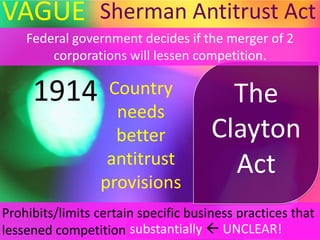
Sherman Antitrust ActVAGUE
1914 Country
needs
better
antitrust
provisions
Prohibits/limits certain specific business practices that
lessened competition substantially.
The
Clayton
Act
substantially  UNCLEAR!
Federal government decides if the merger of 2
corporations will lessen competition.
Table page 159 Antitrust
Legislation
Federal Laws
& Functions
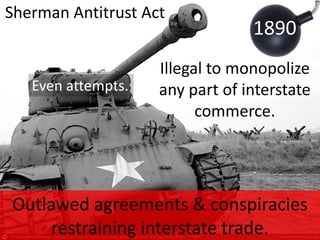
Sherman Antitrust Act
1890
Outlawed agreements & conspiracies
restraining interstate trade.
Illegal to monopolize
any part of interstate
commerce.
Even attempts.
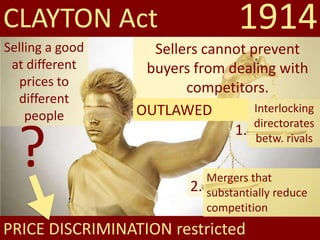
CLAYTON Act 1914
PRICE DISCRIMINATION restricted
?
Selling a good
at different
prices to
different
people
Sellers cannot prevent
buyers from dealing with
competitors.
OUTLAWED
1.
2.
Interlocking
directorates
betw. rivals
Mergers that
substantially reduce
competition
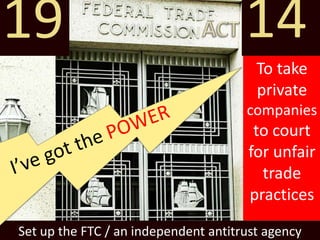
Set up the FTC / an independent antitrust agency
19 14
To take
private
companies
to court
for unfair
trade
practices
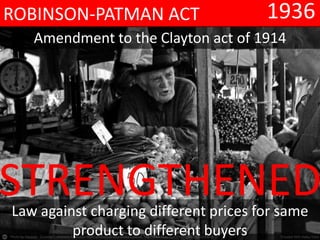
ROBINSON-PATMAN ACT 1936
Amendment to the Clayton act of 1914
STRENGTHENEDLaw against charging different prices for same
product to different buyers
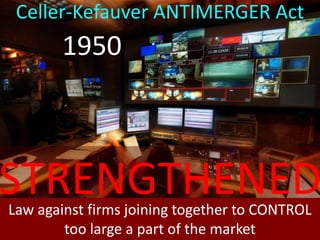
Celler-Kefauver ANTIMERGER Act
1950
STRENGTHENEDLaw against firms joining together to CONTROL
too large a part of the market
Hart-Scott-Rodino ANTITRUST IMPROVEMENTS Act
1976
1. Restricted mergers
that would reduce
competition
2. Required big corps.
planning to merge to
notify the FTC /Dept. of
Justice, who’d decide
whether to challenge
the merge under the
terms of the Clayton
act of 1914
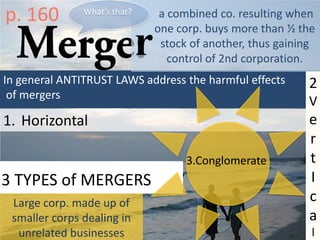
In general ANTITRUST LAWS address the harmful effects
of mergers
r
a combined co. resulting when
one corp. buys more than ½ the
stock of another, thus gaining
control of 2nd corporation.
3 TYPES of MERGERS
1. Horizontal
Large corp. made up of
smaller corps dealing in
unrelated businesses
p. 160
2
V
e
r
t
I
c
a
l
3.Conglomerate
What’s that?
HORIZONTAL
Two corps. in same business merge
1 brewery buys out another
EXAMPLE:
2 supermarkets, 2 food manufacturers
V
E
R
T
I
C
A
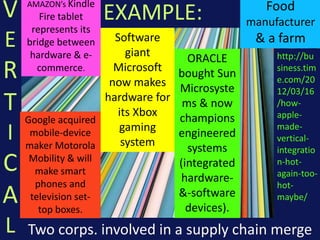
L Two corps. involved in a supply chain merge
EXAMPLE: Food
manufacturer
& a farm
Google acquired
mobile-device
maker Motorola
Mobility & will
make smart
phones and
television set-
top boxes.
AMAZON’s Kindle
Fire tablet
represents its
bridge between
hardware & e-
commerce.
ORACLE
bought Sun
Microsyste
ms & now
champions
engineered
systems
(integrated
hardware-
&-software
devices).
Software
giant
Microsoft
now makes
hardware for
its Xbox
gaming
system
http://bu
siness.tim
e.com/20
12/03/16
/how-
apple-
made-
vertical-
integratio
n-hot-
again-too-
hot-
maybe/
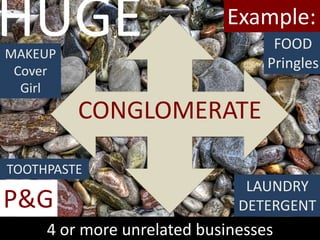
CONGLOMERATE
HUGE
4 or more unrelated businesses
Example:
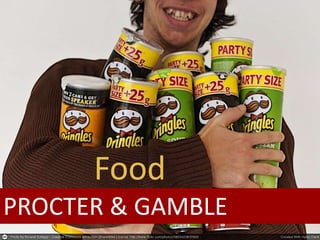
P&G
FOOD
Pringles
MAKEUP
Cover
Girl
LAUNDRY
DETERGENT
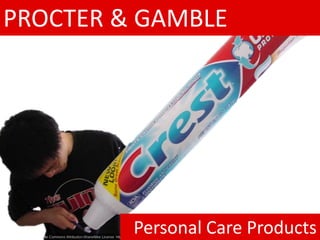
TOOTHPASTE
Mergers on
page 161
HORIZONTAL
V
E
R
T
I
C
A
L
CONGLOMERATE
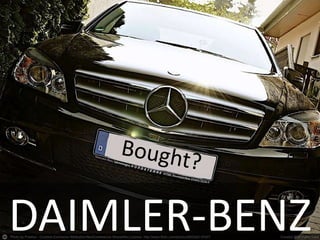
DAIMLER-BENZ
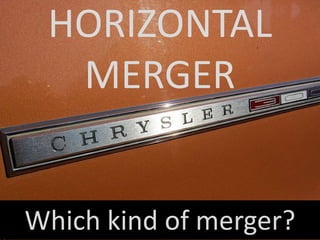
HORIZONTAL
MERGER
Which kind of merger?
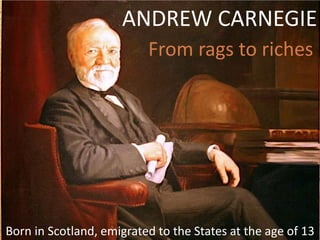
ANDREW CARNEGIE
From rags to riches
Born in Scotland, emigrated to the States at the age of 13
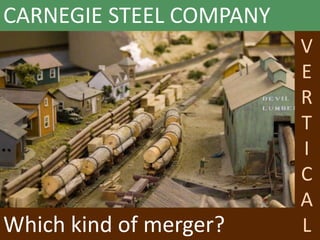
CARNEGIE STEEL COMPANY
bought
?
Mines
RAILROADS
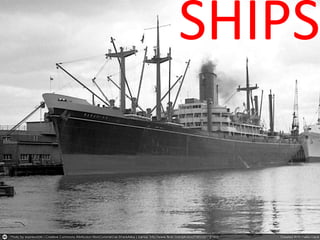
SHIPS
Which kind of merger?
V
E
R
T
I
C
A
L
CARNEGIE STEEL COMPANY
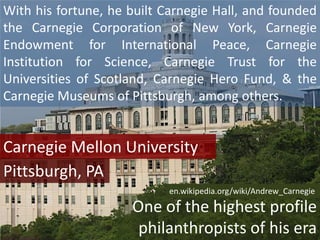
One of the highest profile
philanthropists of his era
With his fortune, he built Carnegie Hall, and founded
the Carnegie Corporation of New York, Carnegie
Endowment for International Peace, Carnegie
Institution for Science, Carnegie Trust for the
Universities of Scotland, Carnegie Hero Fund, & the
Carnegie Museums of Pittsburgh, among others.
Carnegie Mellon University
Pittsburgh, PA
en.wikipedia.org/wiki/Andrew_Carnegie
LAST, but not least
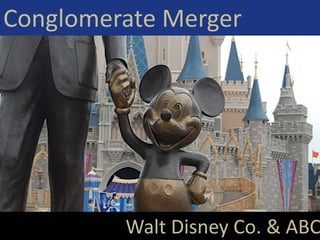
Conglomerate Merger
4 or more unrelated businesses
Example:
Famous examples from the 1960s include Ling-Temco-Vought, ITT
Corporation, Litton Industries, TextroTeledyne, Gulf+Wester, AT&T, and
Transamerica.
What’s
that?
Walt Disney Co. & ABC
Conglomerate Merger
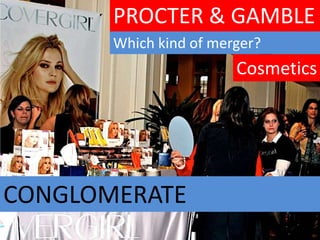
PROCTER & GAMBLE
Which kind of merger?
CONGLOMERATE
Cosmetics
PROCTER & GAMBLE
Food
PROCTER & GAMBLE
Personal Care Products
Household Care Products
Laundry Detergent
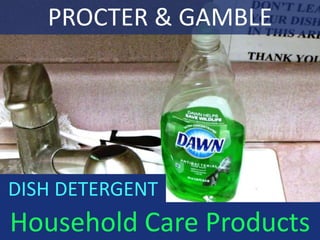
PROCTER & GAMBLE
Household Care Products
DISH DETERGENT
PROCTER & GAMBLE
Gov. uses antitrust laws to foster
competition
What else is used?
Direct
regulation of
business pricing
& product
quality.
Table 17 page 161
REGULATORY AGENCIES
Exist at LOCAL,
STATE &
FEDERAL levels
Oversee
many
industries
&services
FEDERAL TRADE COMMISION 1914
Regulates:
2.Unfair competition methods
in interstate commerce
3.Fraud in advertising
FTCstands for
FOOD & DRUG ADMIN. 1927
Regulates P_____ & S_____PURITY SAFETY
Deals with
1. F
2. D
3. C
FOOD
DRUGS
COSMETICS
stands for
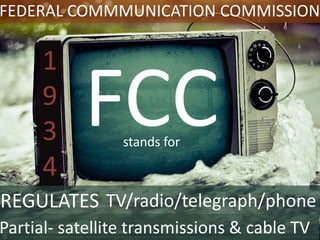
FEDERAL COMMMUNICATION COMMISSION
FCC
REGULATES TV/radio/telegraph/phone
Partial- satellite transmissions & cable TV
1
9
3
4
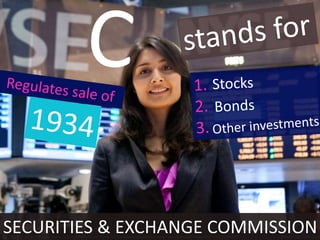
stands for
SECURITIES & EXCHANGE COMMISSION
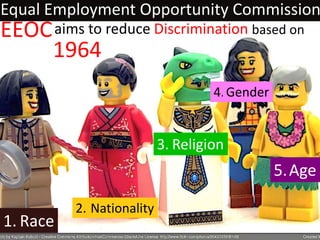
Equal Employment Opportunity Commission
1964
EEOCaims to reduce Discrimination based on
1.
2.
3.
4.
5.
Religion
Gender
Race
Nationality
Age
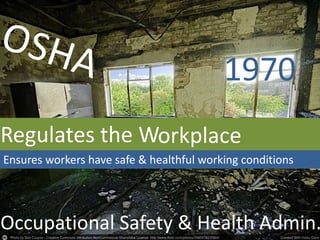
Occupational Safety & Health Admin.
1970
Regulates the Workplace
Ensures workers have safe & healthful working conditions
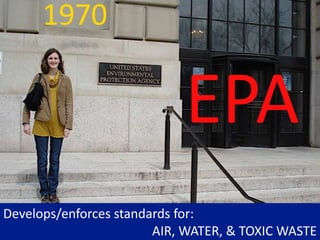
EPA
1970
Develops/enforces standards for:
AIR, WATER, & TOXIC WASTE
NRC
Nuclear Regulatory Commision
Regulates nuclear power industry
Licenses & Oversees the 1 / 2 / 3
1974
Design/Building/Operation of Plants
page 162
Government regulations aim to promote efficiency & competition
WASN’T HAPPENING IN THE 80’s/90’s
Government reduced regulations/control over business
WHY?
Regulations had actually DECREASED the competition
Which
Regulatory
Agency?
FCC
Federal Communications Commission
Example of deregulation
Competitive Pay-TV, Cable & Satellite systems
followed deregulation
What would happen to PRICES if
the government quit it’s role of
MERGER WATCHDOG
What would happen IF profits became + high?
More SELLERS would manage to enter the market
How would this impact CONSUMERS?
Eventual lower prices/+ competitive
supply of goods & services
$$$
Winding up
page 163
Discussion/Exercises
An ADVANTAGE of FREE ENTERPRISE SYSTEM
WAYS of ORGANIZING BUSINESSES
3 Basic
Types
1. Sole Proprietorships
2. Partnerships
3. Corporations
Can set up business in most profitable way
3.Corporations can get loans/otherwise might not exist
1.Sole Proprietor – own boss/ take risks / $$$
• Which type is greatest in number?
• Which has the greatest revenue?
#1
2.Partners share responsibility/risk/$$$
#3
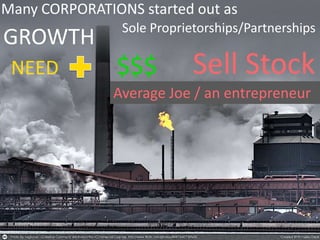
Many CORPORATIONS started out as
Sole Proprietorships/Partnerships
GROWTH
NEED $$$ Sell Stock
Average Joe / an entrepreneur
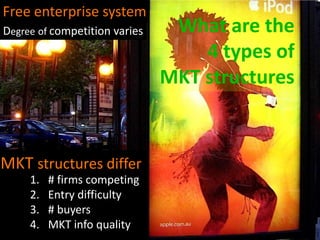
MKT structures differ
Free enterprise system
Degree of competition varies
1. # firms competing
2. Entry difficulty
3. # buyers
4. MKT info quality
What are the
4 types of
MKT structures
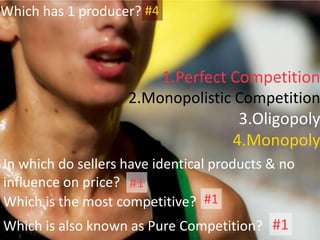
1.Perfect Competition
2.Monopolistic Competition
3.Oligopoly
4.Monopoly
Which is also known as Pure Competition? #1
#1
#1
In which do sellers have identical products & no
influence on price?
Which is the most competitive?
Which has 1 producer? #4
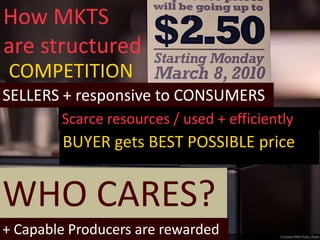
How MKTS
are structured
WHO CARES?
COMPETITION
SELLERS + responsive to CONSUMERS
+ Capable Producers are rewarded
Scarce resources / used + efficiently
BUYER gets BEST POSSIBLE price
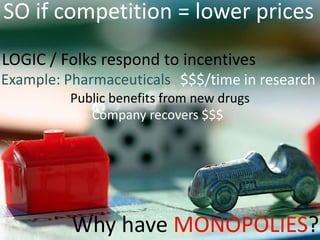
SO if competition = lower prices
Why have MONOPOLIES?
LOGIC / Folks respond to incentives
Example: Pharmaceuticals $$$/time in research
Public benefits from new drugs
Company recovers $$$
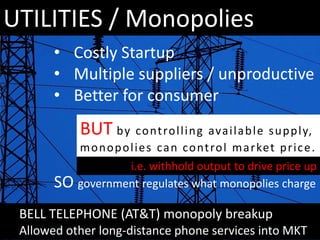
UTILITIES / Monopolies
• Costly Startup
• Multiple suppliers / unproductive
• Better for consumer
BUT by controlling available supply,
monopolies can control market price.
i.e. withhold output to drive price up
SO government regulates what monopolies charge
BELL TELEPHONE (AT&T) monopoly breakup
Allowed other long-distance phone services into MKT
Now shall we
go to page
165?

Economics Chap.9 Lesson 4 sec.3

  • 1.
    The 3 Stooges Chapter9 Lesson 4 Section 3 page 158 COMPETITION & MONOPOLIES
  • 2.
    WHO encourages competition inthe economy? The government encourages competition in the economy. Federal laws & regulatory agencies MONOPOLIES have no competition. Can they be forced to act more competitively? Example: Federal Trade Commission
  • 3.
    ANTITRUST LEGISLATION Followed therise of big businesses
  • 4.
    After the CIVILWAR fueled industrial expansion
  • 5.
    OIL Drove competition outof business & Pressured customers NOT to buy from RIVALS NOTORIOUS
  • 6.
    Owned by JOHN D.ROCKEFELLER What was his secret? Is he to be placed on a pedestal for others as a "CAPTAIN OF INDUSTRY?" Or should he be demonized as a "robber baron." A ROBBER BARON, by definition, was an American capitalist at the turn of the 19th century who enriched himself upon the sweat of others, exploited natural resources, or possessed unfair government influence. America's first billionaire. http://www.ushistory.org/us/36b.asp
  • 7.
    Got Standard Oil’sboard members onto boards of rivals SOessentially the same people controlled both companies = reduced temptation to compete with each other INTERLOCKING DIRECTORATE = Majority of 1 board serves as board of rival company
  • 8.
    Growing public pressure Againsthis oil monopoly, or trust. 1890 Congress passes the Sherman Antitrust Act Important ANTITRUST LEGISLATION = Federal & state laws preventing new monopolies from forming & breaking up those already existent
  • 9.
    Sherman Antitrust ActVAGUE 1914Country needs better antitrust provisions Prohibits/limits certain specific business practices that lessened competition substantially. The Clayton Act substantially  UNCLEAR! Federal government decides if the merger of 2 corporations will lessen competition.
  • 10.
    Table page 159Antitrust Legislation Federal Laws & Functions
  • 11.
    Sherman Antitrust Act 1890 Outlawedagreements & conspiracies restraining interstate trade. Illegal to monopolize any part of interstate commerce. Even attempts.
  • 12.
    CLAYTON Act 1914 PRICEDISCRIMINATION restricted ? Selling a good at different prices to different people Sellers cannot prevent buyers from dealing with competitors. OUTLAWED 1. 2. Interlocking directorates betw. rivals Mergers that substantially reduce competition
  • 13.
    Set up theFTC / an independent antitrust agency 19 14 To take private companies to court for unfair trade practices
  • 14.
    ROBINSON-PATMAN ACT 1936 Amendmentto the Clayton act of 1914 STRENGTHENEDLaw against charging different prices for same product to different buyers
  • 15.
    Celler-Kefauver ANTIMERGER Act 1950 STRENGTHENEDLawagainst firms joining together to CONTROL too large a part of the market
  • 16.
    Hart-Scott-Rodino ANTITRUST IMPROVEMENTSAct 1976 1. Restricted mergers that would reduce competition 2. Required big corps. planning to merge to notify the FTC /Dept. of Justice, who’d decide whether to challenge the merge under the terms of the Clayton act of 1914
  • 17.
    In general ANTITRUSTLAWS address the harmful effects of mergers r a combined co. resulting when one corp. buys more than ½ the stock of another, thus gaining control of 2nd corporation. 3 TYPES of MERGERS 1. Horizontal Large corp. made up of smaller corps dealing in unrelated businesses p. 160 2 V e r t I c a l 3.Conglomerate What’s that?
  • 18.
    HORIZONTAL Two corps. insame business merge 1 brewery buys out another EXAMPLE: 2 supermarkets, 2 food manufacturers
  • 19.
    V E R T I C A L Two corps.involved in a supply chain merge EXAMPLE: Food manufacturer & a farm Google acquired mobile-device maker Motorola Mobility & will make smart phones and television set- top boxes. AMAZON’s Kindle Fire tablet represents its bridge between hardware & e- commerce. ORACLE bought Sun Microsyste ms & now champions engineered systems (integrated hardware- &-software devices). Software giant Microsoft now makes hardware for its Xbox gaming system http://bu siness.tim e.com/20 12/03/16 /how- apple- made- vertical- integratio n-hot- again-too- hot- maybe/
  • 20.
    CONGLOMERATE HUGE 4 or moreunrelated businesses Example: P&G FOOD Pringles MAKEUP Cover Girl LAUNDRY DETERGENT TOOTHPASTE
  • 21.
  • 22.
  • 23.
  • 24.
    ANDREW CARNEGIE From ragsto riches Born in Scotland, emigrated to the States at the age of 13
  • 25.
  • 26.
  • 27.
  • 28.
  • 29.
    Which kind ofmerger? V E R T I C A L CARNEGIE STEEL COMPANY
  • 30.
    One of thehighest profile philanthropists of his era With his fortune, he built Carnegie Hall, and founded the Carnegie Corporation of New York, Carnegie Endowment for International Peace, Carnegie Institution for Science, Carnegie Trust for the Universities of Scotland, Carnegie Hero Fund, & the Carnegie Museums of Pittsburgh, among others. Carnegie Mellon University Pittsburgh, PA en.wikipedia.org/wiki/Andrew_Carnegie
  • 31.
    LAST, but notleast Conglomerate Merger 4 or more unrelated businesses Example: Famous examples from the 1960s include Ling-Temco-Vought, ITT Corporation, Litton Industries, TextroTeledyne, Gulf+Wester, AT&T, and Transamerica. What’s that? Walt Disney Co. & ABC
  • 32.
    Walt Disney Co.& ABC Conglomerate Merger
  • 33.
    PROCTER & GAMBLE Whichkind of merger? CONGLOMERATE Cosmetics
  • 34.
  • 35.
  • 36.
    Household Care Products LaundryDetergent PROCTER & GAMBLE
  • 37.
    Household Care Products DISHDETERGENT PROCTER & GAMBLE
  • 38.
    Gov. uses antitrustlaws to foster competition What else is used? Direct regulation of business pricing & product quality.
  • 39.
    Table 17 page161 REGULATORY AGENCIES Exist at LOCAL, STATE & FEDERAL levels Oversee many industries &services
  • 40.
    FEDERAL TRADE COMMISION1914 Regulates: 2.Unfair competition methods in interstate commerce 3.Fraud in advertising FTCstands for
  • 41.
    FOOD & DRUGADMIN. 1927 Regulates P_____ & S_____PURITY SAFETY Deals with 1. F 2. D 3. C FOOD DRUGS COSMETICS stands for
  • 42.
    FEDERAL COMMMUNICATION COMMISSION FCC REGULATESTV/radio/telegraph/phone Partial- satellite transmissions & cable TV 1 9 3 4 stands for
  • 43.
  • 44.
    Equal Employment OpportunityCommission 1964 EEOCaims to reduce Discrimination based on 1. 2. 3. 4. 5. Religion Gender Race Nationality Age
  • 45.
    Occupational Safety &Health Admin. 1970 Regulates the Workplace Ensures workers have safe & healthful working conditions
  • 46.
  • 47.
    NRC Nuclear Regulatory Commision Regulatesnuclear power industry Licenses & Oversees the 1 / 2 / 3 1974 Design/Building/Operation of Plants
  • 48.
    page 162 Government regulationsaim to promote efficiency & competition WASN’T HAPPENING IN THE 80’s/90’s Government reduced regulations/control over business WHY? Regulations had actually DECREASED the competition
  • 49.
    Which Regulatory Agency? FCC Federal Communications Commission Exampleof deregulation Competitive Pay-TV, Cable & Satellite systems followed deregulation
  • 50.
    What would happento PRICES if the government quit it’s role of MERGER WATCHDOG What would happen IF profits became + high? More SELLERS would manage to enter the market How would this impact CONSUMERS? Eventual lower prices/+ competitive supply of goods & services $$$
  • 51.
  • 52.
    An ADVANTAGE ofFREE ENTERPRISE SYSTEM WAYS of ORGANIZING BUSINESSES 3 Basic Types 1. Sole Proprietorships 2. Partnerships 3. Corporations Can set up business in most profitable way
  • 53.
    3.Corporations can getloans/otherwise might not exist 1.Sole Proprietor – own boss/ take risks / $$$ • Which type is greatest in number? • Which has the greatest revenue? #1 2.Partners share responsibility/risk/$$$ #3
  • 54.
    Many CORPORATIONS startedout as Sole Proprietorships/Partnerships GROWTH NEED $$$ Sell Stock Average Joe / an entrepreneur
  • 55.
    MKT structures differ Freeenterprise system Degree of competition varies 1. # firms competing 2. Entry difficulty 3. # buyers 4. MKT info quality What are the 4 types of MKT structures
  • 56.
    1.Perfect Competition 2.Monopolistic Competition 3.Oligopoly 4.Monopoly Whichis also known as Pure Competition? #1 #1 #1 In which do sellers have identical products & no influence on price? Which is the most competitive? Which has 1 producer? #4
  • 57.
    How MKTS are structured WHOCARES? COMPETITION SELLERS + responsive to CONSUMERS + Capable Producers are rewarded Scarce resources / used + efficiently BUYER gets BEST POSSIBLE price
  • 58.
    SO if competition= lower prices Why have MONOPOLIES? LOGIC / Folks respond to incentives Example: Pharmaceuticals $$$/time in research Public benefits from new drugs Company recovers $$$
  • 59.
    UTILITIES / Monopolies •Costly Startup • Multiple suppliers / unproductive • Better for consumer BUT by controlling available supply, monopolies can control market price. i.e. withhold output to drive price up SO government regulates what monopolies charge BELL TELEPHONE (AT&T) monopoly breakup Allowed other long-distance phone services into MKT
  • 60.
    Now shall we goto page 165?

Editor's Notes

  • #6 STAND. OIL DOC.: http://www.youtube.com/watch?v=xSHhUx9mg9A
  • #7 rockefeller documentary: http://www.youtube.com/watch?v=6MaJeW4XBxU (start to 1min50)
  • #14 http://www.youtube.com/watch?v=4rO1n8-SuNM (8-18 SEC.) JOCELYN BROWN