The Conditional Perfect Tense
Explained with Examples
By Dear Teacher
The English language is full of fascinating grammar structures that
allow us to convey complex ideas, and the conditional perfect tense
is one of them. This tense is used to express hypothetical scenarios in
the past—things that could have happened but didn’t. In this blog,
we’ll dive deep into the conditional perfect tense, exploring its
structure, uses, and variations, with plenty of examples to help you
master it.
What Is the Conditional Perfect Tense?
The conditional perfect tense allows us to talk about hypothetical
situations in the past that didn’t occur. It’s like looking back in time and
imagining "what could have been" under different circumstances.
For instance:
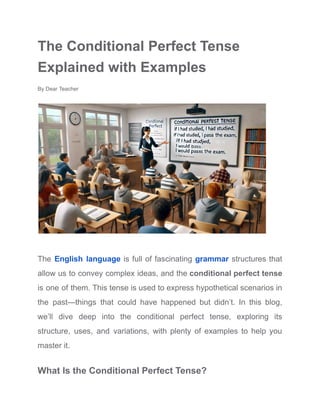
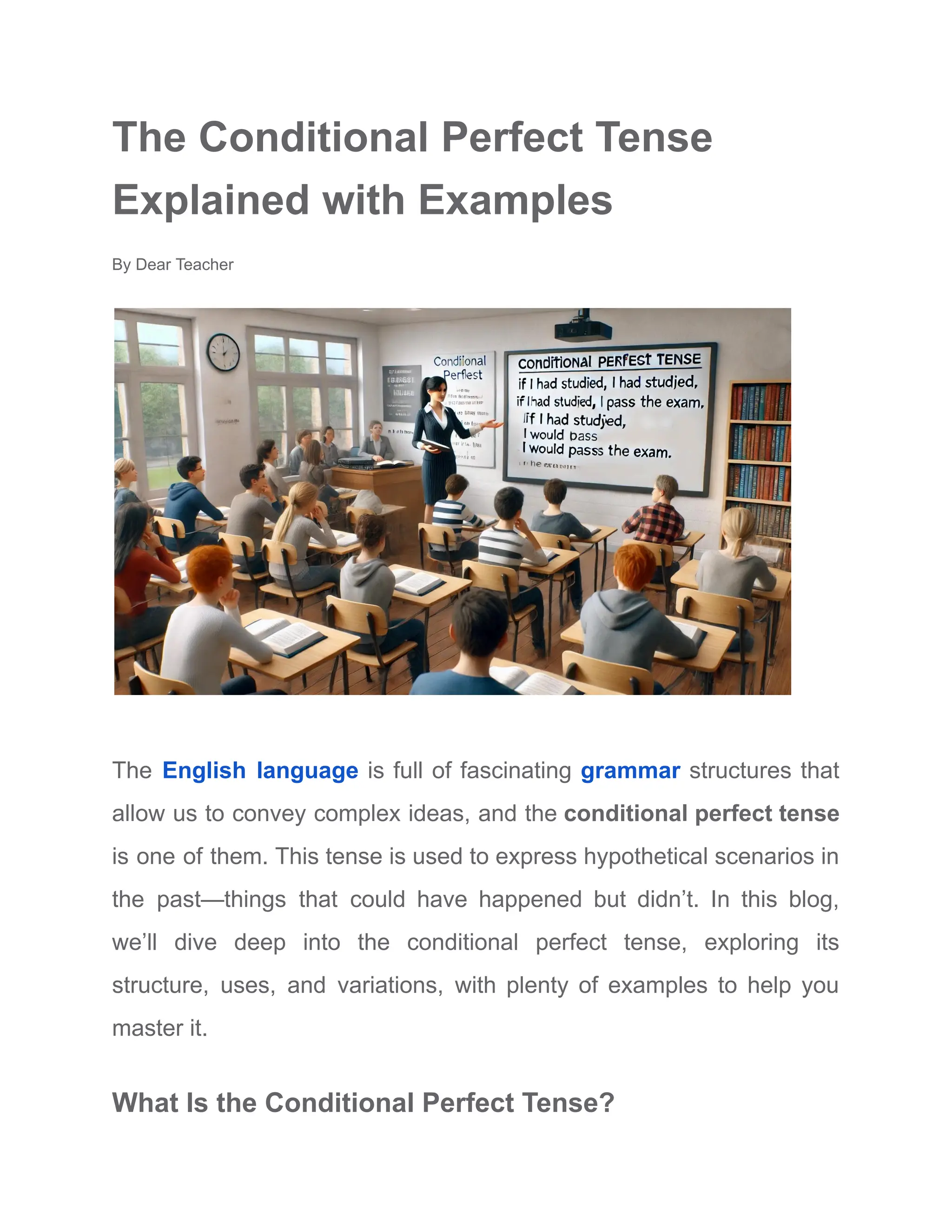
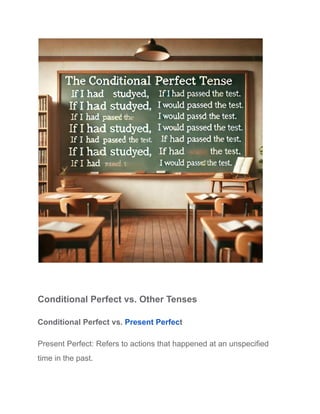
"If I had studied harder, I would have passed the exam."
This sentence reflects a past possibility that didn’t happen—the
speaker did not study hard enough and, as a result, didn’t pass.
When to Use the Conditional Perfect Tense
To discuss unrealized past scenarios: Situations where certain
actions or outcomes didn’t occur.
To express regret or criticism: Highlighting actions that should or
could have been taken.
To speculate about past events: Exploring alternative outcomes.
Structure of the Conditional Perfect Tense
The conditional perfect tense combines modal verbs (like would,
could, or should) with the perfect infinitive (have + past participle).
Formula:
[Subject] + [Modal Verb] + [Have] + [Past Participle]
Breakdown:
Subject: The person or thing performing the action (e.g., I, she, we).
Modal Verb: Adds meaning to the verb, like would (hypothetical),
could (possibility), or should (advisory).
Have: A helper verb that links the modal verb to the past participle.
Past Participle: The main action verb in its perfect form (e.g., eaten,
done, seen).
Example:
"She would have gone to the party if she had known about it."
Here, would introduces the hypothetical situation, connect it to the
past, and gone is the past participle.
How to Use the Conditional Perfect Tense
This tense comes alive when we use it to:
Express Missed Opportunities
"I would have traveled abroad if I had saved enough money."
(Regret about not saving enough to travel.)
Speculate About the Past
"They might have succeeded if they had tried harder."
(Imagining a different result with more effort.)
Show Regrets or Criticisms
"You should have apologized earlier."
(Pointing out something that wasn’t done but should have been.)
Examples of Conditional Perfect Tense in Action
Positive Sentences
"He would have helped you if he had known."
"They could have won the game if they had practiced more."
"We might have finished the project on time if we had started earlier."
Negative Sentences
"I wouldn’t have made the mistake if I had listened to your advice."
"She couldn’t have finished the marathon without proper training."
"He shouldn’t have spoken to her that way."
Questions
"Would they have succeeded if they had worked harder?"
"Could you have solved the problem without help?"
"Should I have mentioned the issue earlier?"
The Role of Modal Verbs in Conditional Perfect Tense
Common Modal Verbs
Would: Indicates likelihood or intention in the past.
"He would have joined us if he wasn’t busy."
Could: Suggests capability or possibility.
"She could have become a doctor if she had pursued it."
Should: Reflects obligation or advice.
"You should have called me when you arrived."
Nuances in Meaning
Each modal verb brings subtle variations in tone and intention. For
example, would is more definitive, while could is speculative.
Common Mistakes to Avoid
Mixing Up Tenses:
Incorrect: "He would have win the match if he tried harder."
Correct: "He would have won the match if he had tried harder."
Overcomplicating the Structure:
Incorrect: "She might would have gone to the party."
Correct: "She might have gone to the party."
Conditional Perfect vs. Other Tenses
Conditional Perfect vs. Present Perfect
Present Perfect: Refers to actions that happened at an unspecified
time in the past.
"I have visited Paris."
Conditional Perfect: Refers to hypothetical actions that didn’t occur.
"I would have visited Paris if I had the chance."
Conditional Perfect vs. Past Perfect
Past Perfect: Focuses on actions completed before another past
action.
"I had visited Paris before moving to London."
Conditional Perfect: Discusses unrealized past possibilities.
"I would have visited Paris if I had time."
Practical Uses in Everyday Conversations
You’ll often hear the conditional perfect in:
Regrets: "I should have attended the meeting."
Excuses: "I would have helped, but I was busy."
Hypothetical Stories: "They could have avoided the accident if they
had been careful."
Learning Tips for Mastering the Conditional Perfect
Tense
Practice with “If” Clauses: Pair your conditional perfect sentences
with “if” clauses to build fluency.
Memorize Key Structures: Focus on the formula to internalize the
mechanics.
Write and Reflect: Create sentences about your own experiences,
imagining “what could have been.”
FAQs About the Conditional Perfect Tense
1. What is the conditional perfect tense used for?
It is used to talk about hypothetical situations in the past—things that
could or should have happened but didn’t.
2. What is the structure of the conditional perfect tense?
The formula is [Subject] + [Modal Verb] + [Have] + [Past
Participle].
3. Can the conditional perfect tense be used without “if”
clauses?
Yes, but “if” clauses often make the meaning clearer. Example: "He
might have called earlier."
4. What’s the difference between “could have” and “would
have”?
Certainly! Let’s break down the difference between “could have” and
“would have” in detail.
Could have implied possibility.
Would have implied intention or certainty under certain conditions.
Could Have” Explained
“Could have” indicates a possibility or potential that existed in the
past but did not materialize. It suggests that something was possible,
but it does not guarantee that it would have happened. Think of it as
highlighting an opportunity or capability that was available, even if it
wasn't acted upon.
Example 1:
“I could have gone to the party, but I decided to stay home.”
(Attending the party was possible, but the speaker chose not to go.)
Example 2:
“They could have won the match if they had trained harder.”
(Winning the match was within their capabilities, but they didn’t train
enough.)
In summary, “could have” is used to emphasize missed opportunities
or unrealized possibilities.
Would Have” Explained
“Would have” expresses intention, certainty, or inevitability under
specific conditions. It suggests that if the situation had been different,
the outcome was almost guaranteed to happen. It’s less about
possibility and more about what was expected or planned to occur
under certain circumstances.
Example 1:
“I would have helped you if I had known you needed it.”
(Helping was the speaker’s definite intention, but the
condition—knowing help was needed—was not met.)
Example 2:
“She would have aced the test if she had studied.”
(Acing the test was certain if the condition of studying had been
fulfilled.)
In summary, “would have” reflects an outcome that was conditional
upon specific past events or actions.
Key Difference
“Could have” focuses on possibility or ability—something that
might have happened but didn’t.
Think of it as: “It was possible, but it didn’t happen.”
“Would have” focuses on intention or certainty under certain
conditions—something that almost definitely would have occurred if
the circumstances were right.
Think of it as: “It was planned or inevitable, but it didn’t happen
because the condition wasn’t met.”
Comparison in Context
Let’s compare the two in a similar scenario for clarity:
“I could have been a doctor, but I chose a different career path.”
(It was within my capability to become a doctor, but I opted not to
pursue it.)
“I would have been a doctor if I had attended medical school.”
(Becoming a doctor was certain if the condition of attending medical
school was fulfilled.)
5. How can I avoid mistakes with the conditional perfect tense?
Practice regularly, focus on the structure, and review common
examples to strengthen your understanding.

The Conditional Perfect Tense Explained with Examples

  • 1.
    The Conditional PerfectTense Explained with Examples By Dear Teacher The English language is full of fascinating grammar structures that allow us to convey complex ideas, and the conditional perfect tense is one of them. This tense is used to express hypothetical scenarios in the past—things that could have happened but didn’t. In this blog, we’ll dive deep into the conditional perfect tense, exploring its structure, uses, and variations, with plenty of examples to help you master it. What Is the Conditional Perfect Tense?
  • 2.
    The conditional perfecttense allows us to talk about hypothetical situations in the past that didn’t occur. It’s like looking back in time and imagining "what could have been" under different circumstances. For instance: "If I had studied harder, I would have passed the exam." This sentence reflects a past possibility that didn’t happen—the speaker did not study hard enough and, as a result, didn’t pass. When to Use the Conditional Perfect Tense To discuss unrealized past scenarios: Situations where certain actions or outcomes didn’t occur. To express regret or criticism: Highlighting actions that should or could have been taken. To speculate about past events: Exploring alternative outcomes. Structure of the Conditional Perfect Tense The conditional perfect tense combines modal verbs (like would, could, or should) with the perfect infinitive (have + past participle).
  • 3.
    Formula: [Subject] + [ModalVerb] + [Have] + [Past Participle] Breakdown: Subject: The person or thing performing the action (e.g., I, she, we). Modal Verb: Adds meaning to the verb, like would (hypothetical), could (possibility), or should (advisory). Have: A helper verb that links the modal verb to the past participle. Past Participle: The main action verb in its perfect form (e.g., eaten, done, seen). Example: "She would have gone to the party if she had known about it." Here, would introduces the hypothetical situation, connect it to the past, and gone is the past participle.
  • 4.
    How to Usethe Conditional Perfect Tense This tense comes alive when we use it to: Express Missed Opportunities "I would have traveled abroad if I had saved enough money."
  • 5.
    (Regret about notsaving enough to travel.) Speculate About the Past "They might have succeeded if they had tried harder." (Imagining a different result with more effort.) Show Regrets or Criticisms "You should have apologized earlier." (Pointing out something that wasn’t done but should have been.) Examples of Conditional Perfect Tense in Action Positive Sentences "He would have helped you if he had known." "They could have won the game if they had practiced more." "We might have finished the project on time if we had started earlier." Negative Sentences
  • 6.
    "I wouldn’t havemade the mistake if I had listened to your advice." "She couldn’t have finished the marathon without proper training." "He shouldn’t have spoken to her that way." Questions "Would they have succeeded if they had worked harder?" "Could you have solved the problem without help?" "Should I have mentioned the issue earlier?" The Role of Modal Verbs in Conditional Perfect Tense Common Modal Verbs Would: Indicates likelihood or intention in the past. "He would have joined us if he wasn’t busy." Could: Suggests capability or possibility. "She could have become a doctor if she had pursued it."
  • 7.
    Should: Reflects obligationor advice. "You should have called me when you arrived." Nuances in Meaning Each modal verb brings subtle variations in tone and intention. For example, would is more definitive, while could is speculative. Common Mistakes to Avoid Mixing Up Tenses: Incorrect: "He would have win the match if he tried harder." Correct: "He would have won the match if he had tried harder." Overcomplicating the Structure: Incorrect: "She might would have gone to the party." Correct: "She might have gone to the party."
  • 8.
    Conditional Perfect vs.Other Tenses Conditional Perfect vs. Present Perfect Present Perfect: Refers to actions that happened at an unspecified time in the past.
  • 9.
    "I have visitedParis." Conditional Perfect: Refers to hypothetical actions that didn’t occur. "I would have visited Paris if I had the chance." Conditional Perfect vs. Past Perfect Past Perfect: Focuses on actions completed before another past action. "I had visited Paris before moving to London." Conditional Perfect: Discusses unrealized past possibilities. "I would have visited Paris if I had time." Practical Uses in Everyday Conversations You’ll often hear the conditional perfect in: Regrets: "I should have attended the meeting." Excuses: "I would have helped, but I was busy."
  • 10.
    Hypothetical Stories: "Theycould have avoided the accident if they had been careful." Learning Tips for Mastering the Conditional Perfect Tense Practice with “If” Clauses: Pair your conditional perfect sentences with “if” clauses to build fluency. Memorize Key Structures: Focus on the formula to internalize the mechanics. Write and Reflect: Create sentences about your own experiences, imagining “what could have been.” FAQs About the Conditional Perfect Tense 1. What is the conditional perfect tense used for? It is used to talk about hypothetical situations in the past—things that could or should have happened but didn’t. 2. What is the structure of the conditional perfect tense?
  • 11.
    The formula is[Subject] + [Modal Verb] + [Have] + [Past Participle]. 3. Can the conditional perfect tense be used without “if” clauses? Yes, but “if” clauses often make the meaning clearer. Example: "He might have called earlier." 4. What’s the difference between “could have” and “would have”? Certainly! Let’s break down the difference between “could have” and “would have” in detail. Could have implied possibility. Would have implied intention or certainty under certain conditions. Could Have” Explained “Could have” indicates a possibility or potential that existed in the past but did not materialize. It suggests that something was possible, but it does not guarantee that it would have happened. Think of it as highlighting an opportunity or capability that was available, even if it wasn't acted upon.
  • 12.
    Example 1: “I couldhave gone to the party, but I decided to stay home.” (Attending the party was possible, but the speaker chose not to go.) Example 2: “They could have won the match if they had trained harder.” (Winning the match was within their capabilities, but they didn’t train enough.) In summary, “could have” is used to emphasize missed opportunities or unrealized possibilities. Would Have” Explained “Would have” expresses intention, certainty, or inevitability under specific conditions. It suggests that if the situation had been different, the outcome was almost guaranteed to happen. It’s less about possibility and more about what was expected or planned to occur under certain circumstances. Example 1:
  • 13.
    “I would havehelped you if I had known you needed it.” (Helping was the speaker’s definite intention, but the condition—knowing help was needed—was not met.) Example 2: “She would have aced the test if she had studied.” (Acing the test was certain if the condition of studying had been fulfilled.) In summary, “would have” reflects an outcome that was conditional upon specific past events or actions. Key Difference “Could have” focuses on possibility or ability—something that might have happened but didn’t. Think of it as: “It was possible, but it didn’t happen.” “Would have” focuses on intention or certainty under certain conditions—something that almost definitely would have occurred if the circumstances were right.
  • 14.
    Think of itas: “It was planned or inevitable, but it didn’t happen because the condition wasn’t met.” Comparison in Context Let’s compare the two in a similar scenario for clarity: “I could have been a doctor, but I chose a different career path.” (It was within my capability to become a doctor, but I opted not to pursue it.) “I would have been a doctor if I had attended medical school.” (Becoming a doctor was certain if the condition of attending medical school was fulfilled.) 5. How can I avoid mistakes with the conditional perfect tense? Practice regularly, focus on the structure, and review common examples to strengthen your understanding.