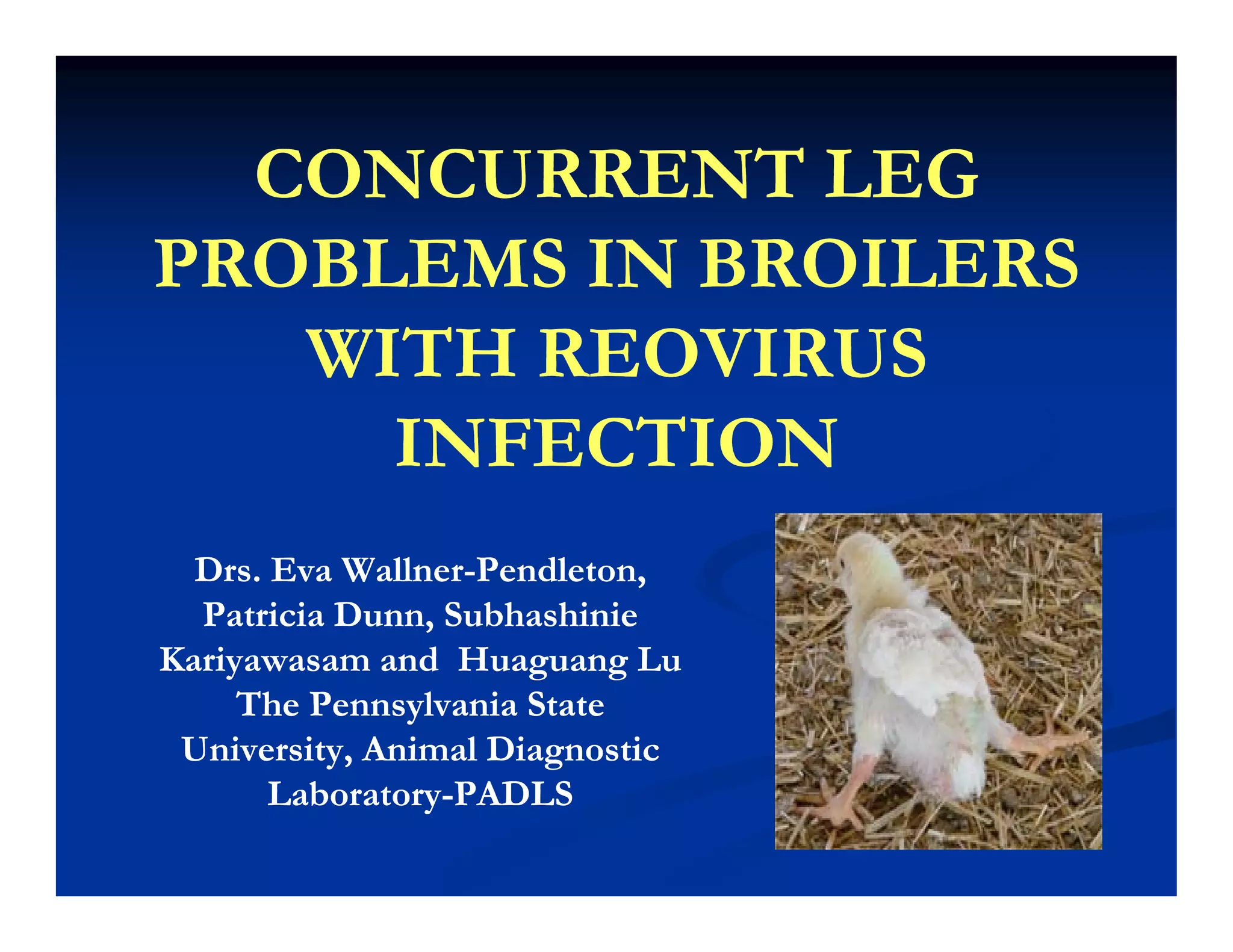
CONCURRENT LEGCONCURRENT LEGCONCURRENT LEGCONCURRENT LEG
PROBLEMS IN BROILERSPROBLEMS IN BROILERS
WITH REOVIRUSWITH REOVIRUS
INFECTIONINFECTION
Drs. Eva WallnerDrs. Eva Wallner--Pendleton,Pendleton,
PatriciaPatricia Dunn,Dunn, SubhashinieSubhashinie
Kari a asam andKari a asam and H ag ang LH ag ang LKariyawasam andKariyawasam and Huaguang LuHuaguang Lu
The Pennsylvania StateThe Pennsylvania State
University, Animal DiagnosticUniversity, Animal Diagnostic
LaboratoryLaboratory--PADLSPADLS
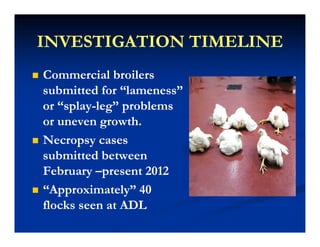
INVESTIGATION TIMELINEINVESTIGATION TIMELINEINVESTIGATION TIMELINEINVESTIGATION TIMELINE
Commercial broilersCommercial broilersCommercial broilersCommercial broilers
submitted for “lameness”submitted for “lameness”
or “splayor “splay--leg” problemsleg” problemsor splayor splay leg problemsleg problems
or uneven growth.or uneven growth.
Necropsy casesNecropsy casesNecropsy casesNecropsy cases
submitted betweensubmitted between
FebruaryFebruary present 2012present 2012FebruaryFebruary ––present 2012present 2012
“Approximately” 40“Approximately” 40
fl k ADLfl k ADLflocks seen at ADLflocks seen at ADL
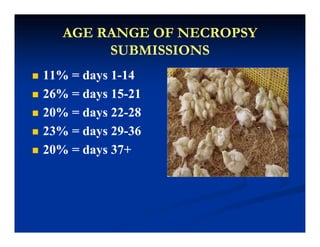
AGE RANGE OF NECROPSYAGE RANGE OF NECROPSY
SUBMISSIONSSUBMISSIONSSUBMISSIONSSUBMISSIONS
11% = days 111% = days 1--141411% days 111% days 1--1414
26% = days 1526% = days 15--2121
20% 2220% 22 282820% = days 2220% = days 22--2828
23% = days 2923% = days 29--3636
20% = days 37+20% = days 37+
Lameness Problems SeenLameness Problems Seen
According To AgeAccording To AgeAccording To AgeAccording To Age
Most groups had some coccidiosisMost groups had some coccidiosisg pg p
present (litter eating??), valguspresent (litter eating??), valgus
deformation and splaydeformation and splay--legslegsp yp y gg
11--14 days14 days
Bacterial yolk sac infection, polyserositis andBacterial yolk sac infection, polyserositis andacte a yo sac ect o , po yse os t s a dacte a yo sac ect o , po yse os t s a d
septic arthritisseptic arthritis
S. enteritidisS. enteritidis
Femoral head necrosisFemoral head necrosisFemoral head necrosisFemoral head necrosis
TD lesionsTD lesions
Aspergillosis in jointsAspergillosis in joints
Lameness Problems SeenLameness Problems Seen
A di T AA di T AAccording To AgeAccording To Age
1515--21 days21 days1515 21 days21 days
E. cecorumE. cecorum myositis and septicemiamyositis and septicemia
E. coliE. coli polyserositis and cellulitis and septicpolyserositis and cellulitis and septic
th itith itiarthritisarthritis
OsteomyelitisOsteomyelitis
Femoral head necrosisFemoral head necrosis
2222--28 days28 days
E. coliE. coli polyserositis and purulent arthritispolyserositis and purulent arthritis
Staphylococcus septic arthritisStaphylococcus septic arthritis
E. cecorumE. cecorum septicemiasepticemia
S. thompsonS. thompson infectioninfectionS. thompsonS. thompson infectioninfection
Femoral head necrosisFemoral head necrosis
Lameness Problems SeenLameness Problems Seen
A di T AA di T AAccording To AgeAccording To Age
2929--36 days36 days2929--36 days36 days
Osteomyelitis and condritisOsteomyelitis and condritis
E. cecorumE. cecorumE. cecorumE. cecorum
37 and up37 and up
F l h d iF l h d iFemoral head necrosisFemoral head necrosis
E. coliE. coli osteomyelitisosteomyelitis
Staphylococcus in jointsStaphylococcus in jointsStaphylococcus in jointsStaphylococcus in joints
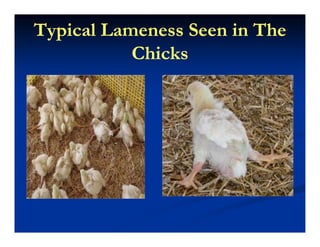
Typical Lameness Seen in TheTypical Lameness Seen in The
ChicksChicks
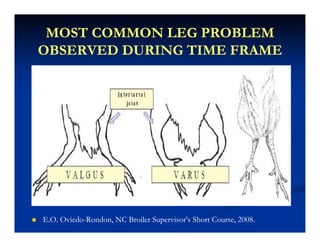
MOST COMMON LEG PROBLEMMOST COMMON LEG PROBLEM
OBSERVED DURING TIME FRAMEOBSERVED DURING TIME FRAMEOBSERVED DURING TIME FRAMEOBSERVED DURING TIME FRAME
E.O. OviedoE.O. Oviedo--Rondon, NC Broiler Supervisor’s Short Course, 2008.Rondon, NC Broiler Supervisor’s Short Course, 2008.
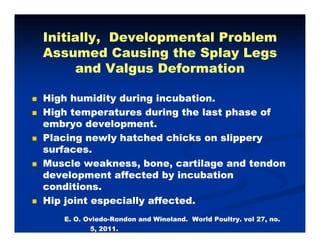
Initially, Developmental ProblemInitially, Developmental Problem
Assumed Causing the Splay LegsAssumed Causing the Splay Legs
and Valgus Deformationand Valgus Deformation
High humidity during incubation.High humidity during incubation.
High temperatures during the last phase ofHigh temperatures during the last phase of
embryo development.embryo development.
Placing newly hatched chicks on slipperyPlacing newly hatched chicks on slipperyPlacing newly hatched chicks on slipperyPlacing newly hatched chicks on slippery
surfaces.surfaces.
Muscle weakness, bone, cartilage and tendonMuscle weakness, bone, cartilage and tendon
development affected by incubationdevelopment affected by incubation
conditions.conditions.
Hip joint especially affectedHip joint especially affectedHip joint especially affected.Hip joint especially affected.
E. O. OviedoE. O. Oviedo--Rondon and Wineland. World Poultry. vol 27, no.Rondon and Wineland. World Poultry. vol 27, no.
5, 2011.5, 2011.
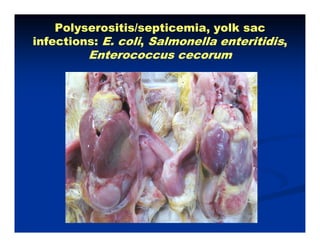
Polyserositis/septicemia, yolk sacPolyserositis/septicemia, yolk sac
infections:infections: E. coliE. coli,, Salmonella enteritidisSalmonella enteritidis,,,, ,,
Enterococcus cecorumEnterococcus cecorum
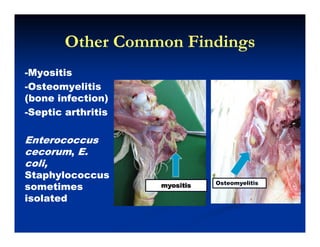
Other Common FindingsOther Common FindingsOther Common FindingsOther Common Findings
--MyositisMyositisyy
--OsteomyelitisOsteomyelitis
(bone infection)(bone infection)
--Septic arthritisSeptic arthritis
EnterococcusEnterococcusEnterococcusEnterococcus
cecorumcecorum,, E.E.
coli,coli,
StaphylococcusStaphylococcus
sometimessometimes
isolatedisolated
Osteomyelitis
isolatedisolated
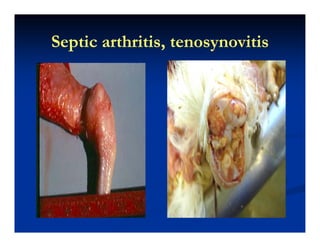
Septic arthritis, tenosynovitisSeptic arthritis, tenosynovitisSeptic arthritis, tenosynovitisSeptic arthritis, tenosynovitis
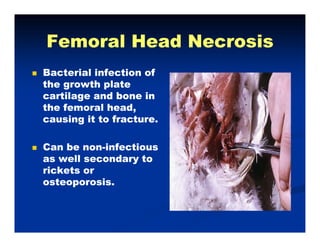
Femoral Head NecrosisFemoral Head NecrosisFemoral Head NecrosisFemoral Head Necrosis
Bacterial infection ofBacterial infection of
the growth platethe growth plate
cartilage and bone incartilage and bone in
the femoral headthe femoral headthe femoral head,the femoral head,
causing it to fracture.causing it to fracture.
Can be nonCan be non--infectiousinfectious
as well secondary toas well secondary to
rickets orrickets orrickets orrickets or
osteoporosis.osteoporosis.
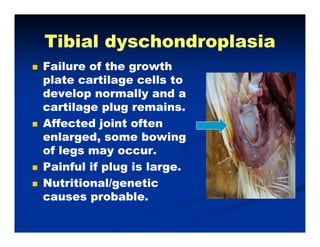
Tibial dyschondroplasiaTibial dyschondroplasiaTibial dyschondroplasiaTibial dyschondroplasia
Failure of the growthFailure of the growth
l t til ll tl t til ll tplate cartilage cells toplate cartilage cells to
develop normally and adevelop normally and a
cartilage plug remainscartilage plug remainscartilage plug remains.cartilage plug remains.
Affected joint oftenAffected joint often
enlarged, some bowingenlarged, some bowingenlarged, some bowingenlarged, some bowing
of legs may occur.of legs may occur.
Painful if plug is large.Painful if plug is large.Painful if plug is large.Painful if plug is large.
Nutritional/geneticNutritional/genetic
causes probable.causes probable.pp
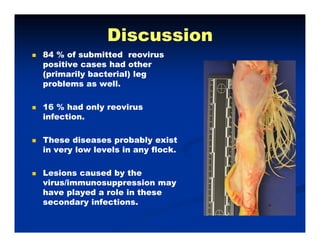
DiscussionDiscussion
84 % of submitted reovirus84 % of submitted reovirus
positive cases had otherpositive cases had other
(primarily bacterial) leg(primarily bacterial) leg(primarily bacterial) leg(primarily bacterial) leg
problems as well.problems as well.
16 % had only reovirus16 % had only reovirus16 % had only reovirus16 % had only reovirus
infection.infection.
These diseases probably existThese diseases probably existThese diseases probably existThese diseases probably exist
in very low levels in any flock.in very low levels in any flock.
L i d b thL i d b thLesions caused by theLesions caused by the
virus/immunosuppression mayvirus/immunosuppression may
have played a role in thesehave played a role in these
secondary infectionssecondary infectionssecondary infections.secondary infections.

Concurrent leg problems in broilers

  • 1.
    CONCURRENT LEGCONCURRENT LEGCONCURRENTLEGCONCURRENT LEG PROBLEMS IN BROILERSPROBLEMS IN BROILERS WITH REOVIRUSWITH REOVIRUS INFECTIONINFECTION Drs. Eva WallnerDrs. Eva Wallner--Pendleton,Pendleton, PatriciaPatricia Dunn,Dunn, SubhashinieSubhashinie Kari a asam andKari a asam and H ag ang LH ag ang LKariyawasam andKariyawasam and Huaguang LuHuaguang Lu The Pennsylvania StateThe Pennsylvania State University, Animal DiagnosticUniversity, Animal Diagnostic LaboratoryLaboratory--PADLSPADLS
  • 2.
    INVESTIGATION TIMELINEINVESTIGATION TIMELINEINVESTIGATIONTIMELINEINVESTIGATION TIMELINE Commercial broilersCommercial broilersCommercial broilersCommercial broilers submitted for “lameness”submitted for “lameness” or “splayor “splay--leg” problemsleg” problemsor splayor splay leg problemsleg problems or uneven growth.or uneven growth. Necropsy casesNecropsy casesNecropsy casesNecropsy cases submitted betweensubmitted between FebruaryFebruary present 2012present 2012FebruaryFebruary ––present 2012present 2012 “Approximately” 40“Approximately” 40 fl k ADLfl k ADLflocks seen at ADLflocks seen at ADL
  • 3.
    AGE RANGE OFNECROPSYAGE RANGE OF NECROPSY SUBMISSIONSSUBMISSIONSSUBMISSIONSSUBMISSIONS 11% = days 111% = days 1--141411% days 111% days 1--1414 26% = days 1526% = days 15--2121 20% 2220% 22 282820% = days 2220% = days 22--2828 23% = days 2923% = days 29--3636 20% = days 37+20% = days 37+
  • 4.
    Lameness Problems SeenLamenessProblems Seen According To AgeAccording To AgeAccording To AgeAccording To Age Most groups had some coccidiosisMost groups had some coccidiosisg pg p present (litter eating??), valguspresent (litter eating??), valgus deformation and splaydeformation and splay--legslegsp yp y gg 11--14 days14 days Bacterial yolk sac infection, polyserositis andBacterial yolk sac infection, polyserositis andacte a yo sac ect o , po yse os t s a dacte a yo sac ect o , po yse os t s a d septic arthritisseptic arthritis S. enteritidisS. enteritidis Femoral head necrosisFemoral head necrosisFemoral head necrosisFemoral head necrosis TD lesionsTD lesions Aspergillosis in jointsAspergillosis in joints
  • 5.
    Lameness Problems SeenLamenessProblems Seen A di T AA di T AAccording To AgeAccording To Age 1515--21 days21 days1515 21 days21 days E. cecorumE. cecorum myositis and septicemiamyositis and septicemia E. coliE. coli polyserositis and cellulitis and septicpolyserositis and cellulitis and septic th itith itiarthritisarthritis OsteomyelitisOsteomyelitis Femoral head necrosisFemoral head necrosis 2222--28 days28 days E. coliE. coli polyserositis and purulent arthritispolyserositis and purulent arthritis Staphylococcus septic arthritisStaphylococcus septic arthritis E. cecorumE. cecorum septicemiasepticemia S. thompsonS. thompson infectioninfectionS. thompsonS. thompson infectioninfection Femoral head necrosisFemoral head necrosis
  • 6.
    Lameness Problems SeenLamenessProblems Seen A di T AA di T AAccording To AgeAccording To Age 2929--36 days36 days2929--36 days36 days Osteomyelitis and condritisOsteomyelitis and condritis E. cecorumE. cecorumE. cecorumE. cecorum 37 and up37 and up F l h d iF l h d iFemoral head necrosisFemoral head necrosis E. coliE. coli osteomyelitisosteomyelitis Staphylococcus in jointsStaphylococcus in jointsStaphylococcus in jointsStaphylococcus in joints
  • 7.
    Typical Lameness Seenin TheTypical Lameness Seen in The ChicksChicks
  • 8.
    MOST COMMON LEGPROBLEMMOST COMMON LEG PROBLEM OBSERVED DURING TIME FRAMEOBSERVED DURING TIME FRAMEOBSERVED DURING TIME FRAMEOBSERVED DURING TIME FRAME E.O. OviedoE.O. Oviedo--Rondon, NC Broiler Supervisor’s Short Course, 2008.Rondon, NC Broiler Supervisor’s Short Course, 2008.
  • 9.
    Initially, Developmental ProblemInitially,Developmental Problem Assumed Causing the Splay LegsAssumed Causing the Splay Legs and Valgus Deformationand Valgus Deformation High humidity during incubation.High humidity during incubation. High temperatures during the last phase ofHigh temperatures during the last phase of embryo development.embryo development. Placing newly hatched chicks on slipperyPlacing newly hatched chicks on slipperyPlacing newly hatched chicks on slipperyPlacing newly hatched chicks on slippery surfaces.surfaces. Muscle weakness, bone, cartilage and tendonMuscle weakness, bone, cartilage and tendon development affected by incubationdevelopment affected by incubation conditions.conditions. Hip joint especially affectedHip joint especially affectedHip joint especially affected.Hip joint especially affected. E. O. OviedoE. O. Oviedo--Rondon and Wineland. World Poultry. vol 27, no.Rondon and Wineland. World Poultry. vol 27, no. 5, 2011.5, 2011.
  • 10.
    Polyserositis/septicemia, yolk sacPolyserositis/septicemia,yolk sac infections:infections: E. coliE. coli,, Salmonella enteritidisSalmonella enteritidis,,,, ,, Enterococcus cecorumEnterococcus cecorum
  • 11.
    Other Common FindingsOtherCommon FindingsOther Common FindingsOther Common Findings --MyositisMyositisyy --OsteomyelitisOsteomyelitis (bone infection)(bone infection) --Septic arthritisSeptic arthritis EnterococcusEnterococcusEnterococcusEnterococcus cecorumcecorum,, E.E. coli,coli, StaphylococcusStaphylococcus sometimessometimes isolatedisolated Osteomyelitis isolatedisolated
  • 12.
    Septic arthritis, tenosynovitisSepticarthritis, tenosynovitisSeptic arthritis, tenosynovitisSeptic arthritis, tenosynovitis
  • 13.
    Femoral Head NecrosisFemoralHead NecrosisFemoral Head NecrosisFemoral Head Necrosis Bacterial infection ofBacterial infection of the growth platethe growth plate cartilage and bone incartilage and bone in the femoral headthe femoral headthe femoral head,the femoral head, causing it to fracture.causing it to fracture. Can be nonCan be non--infectiousinfectious as well secondary toas well secondary to rickets orrickets orrickets orrickets or osteoporosis.osteoporosis.
  • 14.
    Tibial dyschondroplasiaTibial dyschondroplasiaTibialdyschondroplasiaTibial dyschondroplasia Failure of the growthFailure of the growth l t til ll tl t til ll tplate cartilage cells toplate cartilage cells to develop normally and adevelop normally and a cartilage plug remainscartilage plug remainscartilage plug remains.cartilage plug remains. Affected joint oftenAffected joint often enlarged, some bowingenlarged, some bowingenlarged, some bowingenlarged, some bowing of legs may occur.of legs may occur. Painful if plug is large.Painful if plug is large.Painful if plug is large.Painful if plug is large. Nutritional/geneticNutritional/genetic causes probable.causes probable.pp
  • 15.
    DiscussionDiscussion 84 % ofsubmitted reovirus84 % of submitted reovirus positive cases had otherpositive cases had other (primarily bacterial) leg(primarily bacterial) leg(primarily bacterial) leg(primarily bacterial) leg problems as well.problems as well. 16 % had only reovirus16 % had only reovirus16 % had only reovirus16 % had only reovirus infection.infection. These diseases probably existThese diseases probably existThese diseases probably existThese diseases probably exist in very low levels in any flock.in very low levels in any flock. L i d b thL i d b thLesions caused by theLesions caused by the virus/immunosuppression mayvirus/immunosuppression may have played a role in thesehave played a role in these secondary infectionssecondary infectionssecondary infections.secondary infections.