DNV GL ©
DRAFT
SAFER, SMARTER, GREENERDNV GL ©
DRAFT
Putting Our Expertise to the Test
DNV GL capability in Materials, Corrosion and Flow
Assurance Service
1
DNV GL ©
DRAFT
Putting Our Expertise to The Test – DNV GL Global Laboratory
2
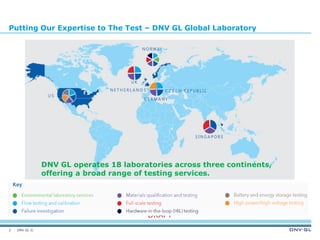
DNV GL operates 18 laboratories across three continents,
offering a broad range of testing services.
DNV GL ©
DRAFT
Global Insight, Local Expertise
3
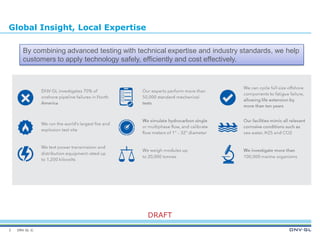
By combining advanced testing with technical expertise and industry standards, we help
customers to apply technology safely, efficiently and cost effectively.
DNV GL ©
DRAFT
DNV GL Laboratory Service - CAPEX, OPEX, DECOM
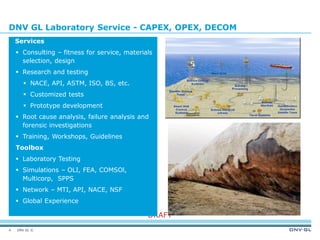
 Services
 Consulting – fitness for service, materials
selection, design
 Research and testing
 NACE, API, ASTM, ISO, BS, etc.
 Customized tests
 Prototype development
 Root cause analysis, failure analysis and
forensic investigations
 Training, Workshops, Guidelines
Toolbox
 Laboratory Testing
 Simulations – OLI, FEA, COMSOl,
Multicorp, SPPS
 Network – MTI, API, NACE, NSF
 Global Experience
4
DNV GL ©
DRAFT
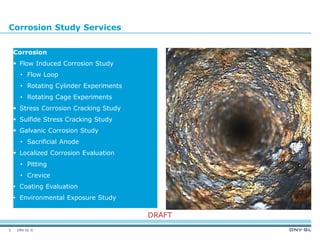
Corrosion Study Services
Corrosion
 Flow Induced Corrosion Study
• Flow Loop
• Rotating Cylinder Experiments
• Rotating Cage Experiments
 Stress Corrosion Cracking Study
 Sulfide Stress Cracking Study
 Galvanic Corrosion Study
• Sacrificial Anode
 Localized Corrosion Evaluation
• Pitting
• Crevice
• Coating Evaluation
• Environmental Exposure Study
5
DNV GL ©
DRAFT
Corrosion Testing – Tool Box
Our global facilities are equipped to study corrosion under user-specified/standard
conditions using a variety of methodologies:
 Electrochemical Testing Capability
• Linear Polarization Resistance (LPR)
• Electrochemical Impedance Spectroscopy (EIS)
• Electrochemical Noise (EN)
• Galvanic Currents (Weld Testing)
• Potentiodynamic Polarization Studies
 Autoclave Testing for HPHT applications
• General Exposure Studies under static and dynamic conditions.
• Real time corrosion monitoring using electrochemical methods in static conditions
 Flow Loop Studies
 Spool Test Studies
6
DNV GL ©
DRAFT
Flow-Induced Corrosion Study:
Large Scale Multiphase Flow Loop
 4-inch Diameter Pipe Systems
– Operating pressure: up to 14 bars
– Operating temperature: RT -130C
– Superficial gas velocity: 0 – 18 m/s
– Superficial liquid velocity: 0.01 – 2.2 m/s
– Liquid viscosity range: 0.5 – 300 cP
– Solids capability
 Multiphase Flow Technologies
– Multiphase flow characteristics (flow
pattern study)
– Flow monitoring
– Flow improved (e.g. drag reducing agent)
– Corrosion and solids management
– Evaluation of corrosion inhibitors
– Material Selection
– Development of in-line separator
7
DNV GL ©
DRAFT
Flow-Induced Corrosion:
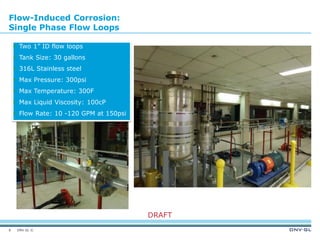
Single Phase Flow Loops
 Two 1” ID flow loops
 Tank Size: 30 gallons
 316L Stainless steel
 Max Pressure: 300psi
 Max Temperature: 300F
 Max Liquid Viscosity: 100cP
 Flow Rate: 10 -120 GPM at 150psi
8
DNV GL ©
DRAFT
Flow-Induced Corrosion:
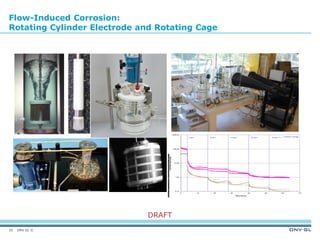
Rotating Cylinder Electrode and Rotating Cage
 Rotating Cylinder Electrode (RCE)
– Specimen Geometry: Cylindrical
– 1 to 4 specimens per test (coupon holder
design)
– P/T limits: 3500 psi @ 350C
– Advantages
– Relatively low cost testing approach
– Well characterized hydrodynamic
conditions
– CO2 and CO2/H2S conditions simulated
– Electrochemical measurements could be
implemented to monitor real corrosion
rate.
 Rotating Cage (RC)
– Specimen Geometry: Flat (approx
4”x3”x1/16”)
– 4 to 8 specimens per test (hydrodynamics
will depend on number of specimens)
– P/T limits: 3500 psi @ 350C
– Advantages
– Relatively low cost approach
– CO2 and CO2/H2S conditions can be
simulated
– Disadvantages
– Potential edge effects not beneficial for
coating applications
– ASTM round robin results indicate very
significant dispersion results at well
known corrosive conditions
– Results indicate average performance
over testing time
9
DNV GL ©
DRAFT
Flow-Induced Corrosion:
Rotating Cylinder Electrode and Rotating Cage
10
DNV GL ©
DRAFT
Flow-Induced Corrosion:
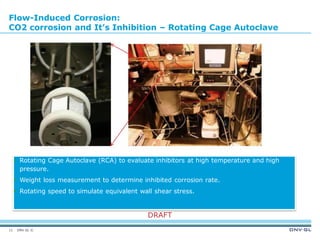
CO2 corrosion and It’s Inhibition – Rotating Cage Autoclave
 Rotating Cage Autoclave (RCA) to evaluate inhibitors at high temperature and high
pressure.
 Weight loss measurement to determine inhibited corrosion rate.
 Rotating speed to simulate equivalent wall shear stress.
11
DNV GL ©
DRAFT
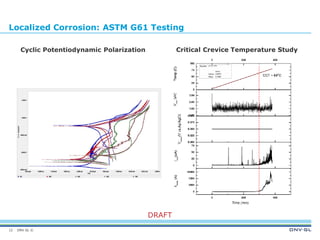
Localized Corrosion: ASTM G61 Testing
Cyclic Potentiodynamic Polarization Critical Crevice Temperature Study
12
DNV GL ©
DRAFT
Sour Service Studies
 Our labs are capable of running fracture toughness and fatigue studies in
a range of environments including HPHT Sour environment frequently
encountered in today’s O&G production. The studies include but are not
limited to
 SSC SCC Study – NACE MR0175/ISO 15156, NACE TM0169/ASTM G31, ASTM G111, NACE
TM00177, EFC 16, EFC 17, ASTM G38, ASTM G35, NACE TM0284, NACE TM0198
 Hydrogen Induced Cracking – NACE TM0248, OTI 95 635
 Fatigue Crack Growth Rate Study – ASTM E647, ASTM E1681
 S/N Fatigue Curve Determination – ASTM E399, ASTM E1380, BS7446, ASTM G148
 Slow Strain Rate Testing
 ECA & FFS – DNV OS-F101, DNV RP – F108
 Sour Electrochemistry – ASTM G3, ASTM G59
 Sour Inhibitor Evaluation – ASTM G170, ASTM G184, ASTM G185, ASTM G208
 Polymer & Lining Evaluation – NORSOK M-170, NACE TM0187, NACE TM0174, NACE
TM0185, NACE TM0183, NACE TM0192, NACE TM0296, NACE TM0297, NACE TM0298
13
DNV GL ©
DRAFT
Custom Testing – Autoclave Exposure Testing
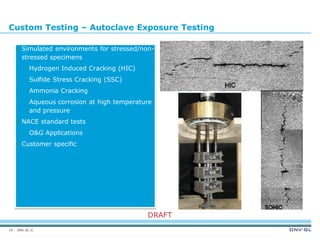
 Simulated environments for stressed/non-
stressed specimens
– Hydrogen Induced Cracking (HIC)
– Sulfide Stress Cracking (SSC)
– Ammonia Cracking
– Aqueous corrosion at high temperature
and pressure
 NACE standard tests
– O&G Applications
 Customer specific
14
DNV GL ©
DRAFT
Custom Testing – Autoclaves Capability in Columbus, USA
 Hastelloy Autoclaves (38 vessels)
– Up to 19L volume
– Up to 10,000 psig MAOP
– 1 x 10L @ 10,000 psig vessel
– 9 x 5L @ 5,000 psig vessels with stirring
 Atlas Cells (C-276) – 6 vessels
– Coated Panel testing at up to 2800 psig
 Other Autoclaves (18 vessels)
– Stainless steel modules up to 22L
– PTFE lined carbon steel vessel – 32L
– 4 x 4-5L @5,000 psig
 Liquid Loading of H2S
 High pressure syringe pump and multiple
air-operated booster pumps to achieve high
pressures at high temperatures
15
DNV GL ©
DRAFT
Custom Testing - Autoclave Capability in Singapore
16
Sizes Test Capacity
1 x 5L C276 Autoclave 350DegC/300 Bar
4 x 15L 32760 Autoclaves 200DegC/100 Bar
DNV GL ©
DRAFT
Computation Modelling Tools
17
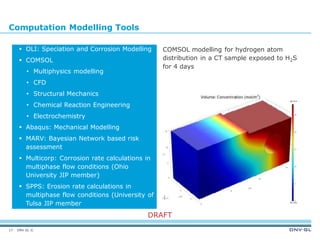
COMSOL modelling for hydrogen atom
distribution in a CT sample exposed to H2S
for 4 days
 OLI: Speciation and Corrosion Modelling
 COMSOL
• Multiphysics modelling
• CFD
• Structural Mechanics
• Chemical Reaction Engineering
• Electrochemistry
 Abaqus: Mechanical Modelling
 MARV: Bayesian Network based risk
assessment
 Multicorp: Corrosion rate calculations in
multiphase flow conditions (Ohio
University JIP member)
 SPPS: Erosion rate calculations in
multiphase flow conditions (University of
Tulsa JIP member
DNV GL ©
DRAFT
Flow Assurance Services and Tools
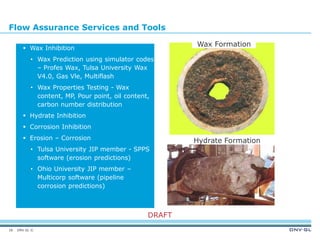
 Wax Inhibition
• Wax Prediction using simulator codes
– Profes Wax, Tulsa University Wax
V4.0, Gas Vle, Multiflash
• Wax Properties Testing - Wax
content, MP, Pour point, oil content,
carbon number distribution
 Hydrate Inhibition
 Corrosion Inhibition
 Erosion – Corrosion
• Tulsa University JIP member - SPPS
software (erosion predictions)
• Ohio University JIP member –
Multicorp software (pipeline
corrosion predictions)
18
Wax Formation
Hydrate Formation
DNV GL ©
DRAFT
Analytical Facilities
19
A comprehensive suite of analytical
facilities for detailed understanding of
materials and corrosion identification
studies and incident investigations
 Optical and electron microscopy
 SEM-EDX
 Infra-Red (IR) spectroscopy
 Raman Spectroscopy
 Fluorescence Spectroscopy
 Thermo-gravimetric analysis (TGA)
 Gas Chromatography
 GC- Mass Spectrometry
 Inductively coupled plasma mass
spectrometry (ICPMS)
 Diffusible Hydrogen Determinator
 Optical Emission Spectroscopy
DNV GL ©
DRAFT
SAFER, SMARTER, GREENER
www.dnvgl.com
Thank You
20

Materials, Corrosion and Flow Assurance Services

  • 1.
    DNV GL © DRAFT SAFER,SMARTER, GREENERDNV GL © DRAFT Putting Our Expertise to the Test DNV GL capability in Materials, Corrosion and Flow Assurance Service 1
  • 2.
    DNV GL © DRAFT PuttingOur Expertise to The Test – DNV GL Global Laboratory 2 DNV GL operates 18 laboratories across three continents, offering a broad range of testing services.
  • 3.
    DNV GL © DRAFT GlobalInsight, Local Expertise 3 By combining advanced testing with technical expertise and industry standards, we help customers to apply technology safely, efficiently and cost effectively.
  • 4.
    DNV GL © DRAFT DNVGL Laboratory Service - CAPEX, OPEX, DECOM  Services  Consulting – fitness for service, materials selection, design  Research and testing  NACE, API, ASTM, ISO, BS, etc.  Customized tests  Prototype development  Root cause analysis, failure analysis and forensic investigations  Training, Workshops, Guidelines Toolbox  Laboratory Testing  Simulations – OLI, FEA, COMSOl, Multicorp, SPPS  Network – MTI, API, NACE, NSF  Global Experience 4
  • 5.
    DNV GL © DRAFT CorrosionStudy Services Corrosion  Flow Induced Corrosion Study • Flow Loop • Rotating Cylinder Experiments • Rotating Cage Experiments  Stress Corrosion Cracking Study  Sulfide Stress Cracking Study  Galvanic Corrosion Study • Sacrificial Anode  Localized Corrosion Evaluation • Pitting • Crevice • Coating Evaluation • Environmental Exposure Study 5
  • 6.
    DNV GL © DRAFT CorrosionTesting – Tool Box Our global facilities are equipped to study corrosion under user-specified/standard conditions using a variety of methodologies:  Electrochemical Testing Capability • Linear Polarization Resistance (LPR) • Electrochemical Impedance Spectroscopy (EIS) • Electrochemical Noise (EN) • Galvanic Currents (Weld Testing) • Potentiodynamic Polarization Studies  Autoclave Testing for HPHT applications • General Exposure Studies under static and dynamic conditions. • Real time corrosion monitoring using electrochemical methods in static conditions  Flow Loop Studies  Spool Test Studies 6
  • 7.
    DNV GL © DRAFT Flow-InducedCorrosion Study: Large Scale Multiphase Flow Loop  4-inch Diameter Pipe Systems – Operating pressure: up to 14 bars – Operating temperature: RT -130C – Superficial gas velocity: 0 – 18 m/s – Superficial liquid velocity: 0.01 – 2.2 m/s – Liquid viscosity range: 0.5 – 300 cP – Solids capability  Multiphase Flow Technologies – Multiphase flow characteristics (flow pattern study) – Flow monitoring – Flow improved (e.g. drag reducing agent) – Corrosion and solids management – Evaluation of corrosion inhibitors – Material Selection – Development of in-line separator 7
  • 8.
    DNV GL © DRAFT Flow-InducedCorrosion: Single Phase Flow Loops  Two 1” ID flow loops  Tank Size: 30 gallons  316L Stainless steel  Max Pressure: 300psi  Max Temperature: 300F  Max Liquid Viscosity: 100cP  Flow Rate: 10 -120 GPM at 150psi 8
  • 9.
    DNV GL © DRAFT Flow-InducedCorrosion: Rotating Cylinder Electrode and Rotating Cage  Rotating Cylinder Electrode (RCE) – Specimen Geometry: Cylindrical – 1 to 4 specimens per test (coupon holder design) – P/T limits: 3500 psi @ 350C – Advantages – Relatively low cost testing approach – Well characterized hydrodynamic conditions – CO2 and CO2/H2S conditions simulated – Electrochemical measurements could be implemented to monitor real corrosion rate.  Rotating Cage (RC) – Specimen Geometry: Flat (approx 4”x3”x1/16”) – 4 to 8 specimens per test (hydrodynamics will depend on number of specimens) – P/T limits: 3500 psi @ 350C – Advantages – Relatively low cost approach – CO2 and CO2/H2S conditions can be simulated – Disadvantages – Potential edge effects not beneficial for coating applications – ASTM round robin results indicate very significant dispersion results at well known corrosive conditions – Results indicate average performance over testing time 9
  • 10.
    DNV GL © DRAFT Flow-InducedCorrosion: Rotating Cylinder Electrode and Rotating Cage 10
  • 11.
    DNV GL © DRAFT Flow-InducedCorrosion: CO2 corrosion and It’s Inhibition – Rotating Cage Autoclave  Rotating Cage Autoclave (RCA) to evaluate inhibitors at high temperature and high pressure.  Weight loss measurement to determine inhibited corrosion rate.  Rotating speed to simulate equivalent wall shear stress. 11
  • 12.
    DNV GL © DRAFT LocalizedCorrosion: ASTM G61 Testing Cyclic Potentiodynamic Polarization Critical Crevice Temperature Study 12
  • 13.
    DNV GL © DRAFT SourService Studies  Our labs are capable of running fracture toughness and fatigue studies in a range of environments including HPHT Sour environment frequently encountered in today’s O&G production. The studies include but are not limited to  SSC SCC Study – NACE MR0175/ISO 15156, NACE TM0169/ASTM G31, ASTM G111, NACE TM00177, EFC 16, EFC 17, ASTM G38, ASTM G35, NACE TM0284, NACE TM0198  Hydrogen Induced Cracking – NACE TM0248, OTI 95 635  Fatigue Crack Growth Rate Study – ASTM E647, ASTM E1681  S/N Fatigue Curve Determination – ASTM E399, ASTM E1380, BS7446, ASTM G148  Slow Strain Rate Testing  ECA & FFS – DNV OS-F101, DNV RP – F108  Sour Electrochemistry – ASTM G3, ASTM G59  Sour Inhibitor Evaluation – ASTM G170, ASTM G184, ASTM G185, ASTM G208  Polymer & Lining Evaluation – NORSOK M-170, NACE TM0187, NACE TM0174, NACE TM0185, NACE TM0183, NACE TM0192, NACE TM0296, NACE TM0297, NACE TM0298 13
  • 14.
    DNV GL © DRAFT CustomTesting – Autoclave Exposure Testing  Simulated environments for stressed/non- stressed specimens – Hydrogen Induced Cracking (HIC) – Sulfide Stress Cracking (SSC) – Ammonia Cracking – Aqueous corrosion at high temperature and pressure  NACE standard tests – O&G Applications  Customer specific 14
  • 15.
    DNV GL © DRAFT CustomTesting – Autoclaves Capability in Columbus, USA  Hastelloy Autoclaves (38 vessels) – Up to 19L volume – Up to 10,000 psig MAOP – 1 x 10L @ 10,000 psig vessel – 9 x 5L @ 5,000 psig vessels with stirring  Atlas Cells (C-276) – 6 vessels – Coated Panel testing at up to 2800 psig  Other Autoclaves (18 vessels) – Stainless steel modules up to 22L – PTFE lined carbon steel vessel – 32L – 4 x 4-5L @5,000 psig  Liquid Loading of H2S  High pressure syringe pump and multiple air-operated booster pumps to achieve high pressures at high temperatures 15
  • 16.
    DNV GL © DRAFT CustomTesting - Autoclave Capability in Singapore 16 Sizes Test Capacity 1 x 5L C276 Autoclave 350DegC/300 Bar 4 x 15L 32760 Autoclaves 200DegC/100 Bar
  • 17.
    DNV GL © DRAFT ComputationModelling Tools 17 COMSOL modelling for hydrogen atom distribution in a CT sample exposed to H2S for 4 days  OLI: Speciation and Corrosion Modelling  COMSOL • Multiphysics modelling • CFD • Structural Mechanics • Chemical Reaction Engineering • Electrochemistry  Abaqus: Mechanical Modelling  MARV: Bayesian Network based risk assessment  Multicorp: Corrosion rate calculations in multiphase flow conditions (Ohio University JIP member)  SPPS: Erosion rate calculations in multiphase flow conditions (University of Tulsa JIP member
  • 18.
    DNV GL © DRAFT FlowAssurance Services and Tools  Wax Inhibition • Wax Prediction using simulator codes – Profes Wax, Tulsa University Wax V4.0, Gas Vle, Multiflash • Wax Properties Testing - Wax content, MP, Pour point, oil content, carbon number distribution  Hydrate Inhibition  Corrosion Inhibition  Erosion – Corrosion • Tulsa University JIP member - SPPS software (erosion predictions) • Ohio University JIP member – Multicorp software (pipeline corrosion predictions) 18 Wax Formation Hydrate Formation
  • 19.
    DNV GL © DRAFT AnalyticalFacilities 19 A comprehensive suite of analytical facilities for detailed understanding of materials and corrosion identification studies and incident investigations  Optical and electron microscopy  SEM-EDX  Infra-Red (IR) spectroscopy  Raman Spectroscopy  Fluorescence Spectroscopy  Thermo-gravimetric analysis (TGA)  Gas Chromatography  GC- Mass Spectrometry  Inductively coupled plasma mass spectrometry (ICPMS)  Diffusible Hydrogen Determinator  Optical Emission Spectroscopy
  • 20.
    DNV GL © DRAFT SAFER,SMARTER, GREENER www.dnvgl.com Thank You 20