Climate Change: A Roadblock to Economic Growth
Five Decades of International
Attention
to Environment and Development
• Stockholm
• Montreal
• Rio
• Cairo
• Beijing
• Kyoto
• Istanbul
• New York
• Monterrey
• Johannesburg
• Copenhagen
• Brazil 2012?
• Paris,2015.December.
 According to the World Economic Forum’s Global Risks Report 2020, the top 5
risks over the coming decade,, are all Climate-related including human-made
environmental disasters, climate action failure, natural disasters, biodiversity
loss and extreme weather.
 The Nobel Prize for Economics in 2018 (William D. Nordhaus and Paul
Romer) was awarded for integrating climate change into long-term
macroeconomic analysis.
 While the world is dealing with the challenges posed by climate change, developing
economies like India are particularly vulnerable. Thus, climate risk as a material
aspect is going to play a critical role in charting out national-level policies, business
strategies and reorientation of finance in an emerging economy like India.
This agenda contains 17 goals and 169 targets. The agenda is built on the Millennium Development Goals (MDGs), which
were adopted in 2000 and were to be achieved by 2015.
SDGs provide a shared blueprint for peace and prosperity for people and the planet, now and into the future.
1) No actions, just words
2.An estimated $5,300
billion per year on various
(direct and indirect) fossil
fuel subsidies.
3) Corporate power
remains unchecked
express doubt about whether
climate change was even
occurring.
Prime Minister (PM) Narendra Modi’s announcement at the
26th United Nations Conference of Parties or UN COP-26 in
Glasgow on Monday, 1 November,2021.
India will achieve net-zero by 2070,
Germany, Sweden and Nepal will do it by 2045,
the US, UK, Japan and European Union aim by 2050, and
Russia, China and Saudi Arabia by 2060.
UK Prime Minister Boris Johnson greets Narendra Modi,
The highlights from Modi’s speech
were:
• 500 GW of installed non-fossil
energy capacity by 2030.
• 50% of energy to from renewables
by 2030.
• A reduction in carbon emissions by
1 billion tonnes by 2030.
• The emissions intensity of India’s
economy to fall by 45% by 2030.
• India will be net-zero by 2070.
• USD 1 trillion in climate finance for
developing countries is required.
• Climate finance needs to be tracked
like mitigation, pressure needs to be
placed on those not meeting finance
commitments.
India Progress towards Achieving the Climate Action Goals
•India achieved its pre-2020 voluntary goal despite having no binding obligation.
• India announced its voluntary goal to reduce the emissions intensity of its GDP by 20-25% by 2020 in
comparison to 2005 level.
• India achieved a 24% reduction in emission intensity of its GDP between 2005 and 2016.
•As per the Paris Agreement, India submitted its Nationally Determined Contributions (NDCs) to UNFCCC in
2015 outlining eight targets for the period 2021-2030, including
• Reducing the emissions intensity of its GDP by 33 to 35% by 2030 from the 2005 level.
• To achieve about 40% cumulative electric power installed capacity from non-fossil fuel-based energy
resources by 2030 with the help of the transfer of technology and low-cost international finance
including from the Green Climate Fund (GCF),
• To create an additional carbon sink of 2.5 to 3 billion tonnes of CO2 equivalent through additional
forest and tree cover by 2030.
• The other targets pertain to sustainable lifestyles; climate-friendly growth paths; climate change
adaptation; climate finance; and technology and capacity building.
• India's recent initiatives for combatting climate change (and thus achieving SDGs) - include its goal to
achieve net zero emissions by 2070, and initiatives for green energy transition.
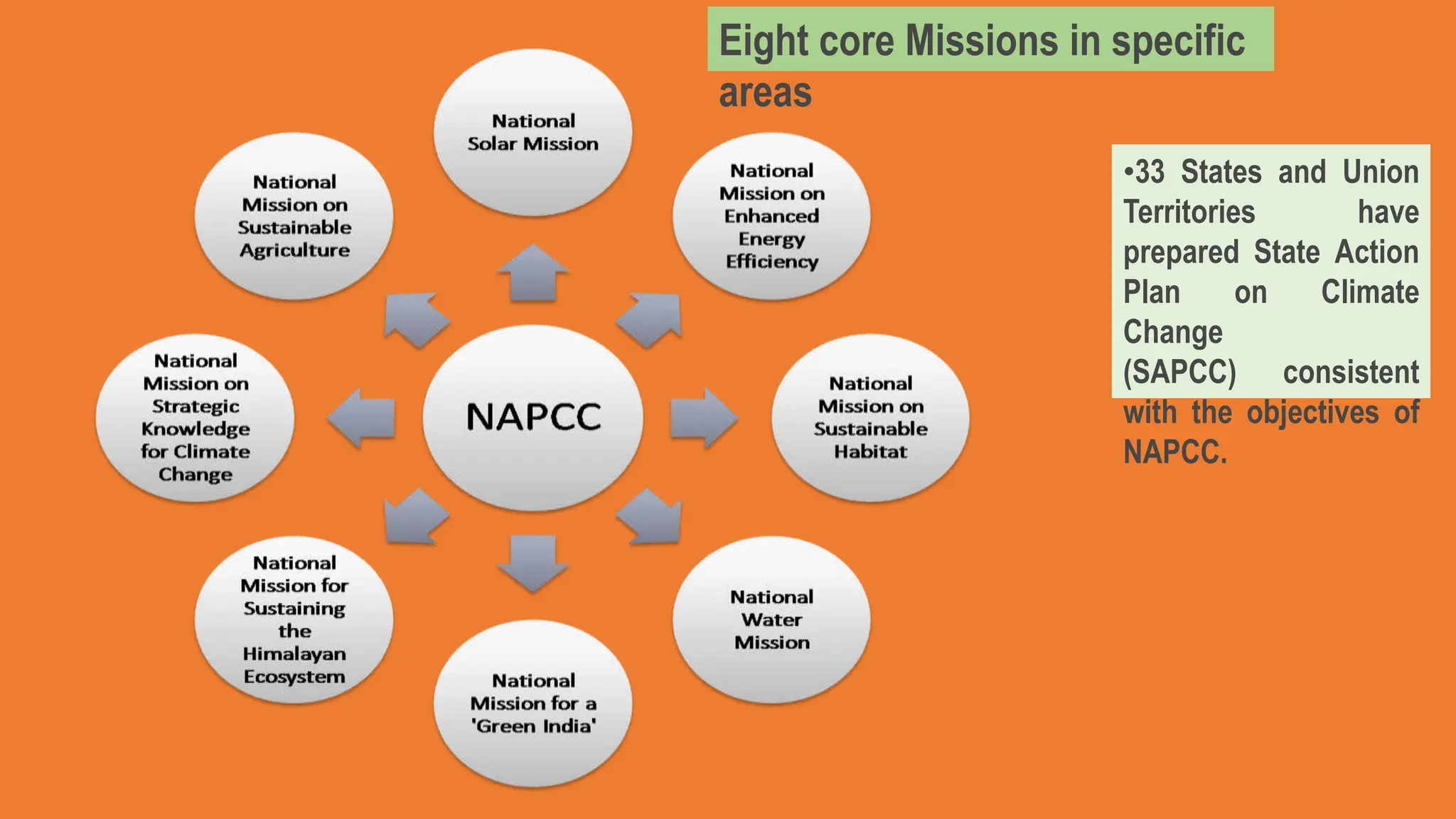
Eight core Missions in specific
areas
•33 States and Union
Territories have
prepared State Action
Plan on Climate
Change
(SAPCC) consistent
with the objectives of
NAPCC.
Targets, indicators and progress
SDG 13 has five targets
Total deaths from natural disasters
Number injured from natural disasters
Number left homeless from natural
disasters
Number affected by natural disasters
Additional charts:
CO2 emissions by country
CO2 emissions per capita
CO2 emissions intensity
Positive actions to the Governments to slow the rate of climate
change
1.Green transition: Investments must accelerate the decarbonization of all aspects of our
economy.
2.Green jobs and sustainable and inclusive growth
3.Green economy: making societies and people more resilient through a transition that is fair
to all and leaves no one behind. focus on economic sectors like forestry, farming,
mining or fishing.
4.Invest in sustainable solutions: fossil fuel subsidies must end and polluters must pay for
their pollution.
5.Oppose all climate risks
6.Cooperation – no country can succeed alone.
The most effective way to address this climate crisis is that long-term systematic shifts must
be made in order to produce a more climate-conscious, sustainable society.
India and Renewable Energy
Initiatives has India Taken to Facilitate RE Transition
 The Production Linked Incentive Scheme (PLI) scheme is another initiative of the Government of
India with respect to enhancing the manufacturing sector for the production of raw materials for
renewable energy.
The PM- KUSUM (Pradhan Mantri-Kisan Urja Suraksha evam Utthaan Mahabhiyan) aims to provide
financial and water security to farmers through harnessing solar energy capacities of 25,750 MW by
2022.
Solarisation of water pumps is a step in distributed power provided at the doorstep of the
consumer.
 The country has made reasonable progress by reaching nearly 110 GW of RE by the end of March
2022.It has also committed $35 billion of the $122 billion in energy-related funding to renewables,
almost twice the amount allotted to fossil fuels.
Challenges
 Impact on Environment: Raw material extraction and equipment manufacturing. Will have
detrimental impacts on biodiversity and ecology.
 Shortage of Skilled Personnel
 High initial cost of installation
 Storage systems of the generated energy are expensive and represent a real challenge in terms of
megawatt production.
Way Forward
Global Partnerships: Global partnerships ((R&D) for funding and supportive funding infrastructure).
Developing countries can also integrate cost-effective indigenous technologies into energy planning.
Distributed Renewable Energy (DRE): Can help achieve the renewable energy targets as well as
increase access to reliable and modern energy. DRE’s applications such as rooftop
solar can decarbonizes the developing world’s manufacturing supply chain; solar agri-
pumps could provide solar-based irrigation solutions, and the faster implementation of electric
vehicles into the urban freight. Increasing the scale of DRE would offer an opportunity to meet
renewable energy targets and provide returns to investors.
Green recovery packages. Incentives
RE as a Responsible Energy: RE shouldn’t stand merely for renewable energy but also for responsible
energy.
To avoid negative impacts, the RE industry must act on four principles:
Actively promoting universal labour, land, and human rights;
Climate Financing: Calling for climate finance of $1 trillion, the Prime Minister of India highlighted in
his COP26 address that developing nations cannot achieve ambitious targets of net-zero with older,
unfulfilled climate finance targets. Energy-poor countries need funding to accelerate their carbon-
cutting goals and invest in new technologies to decouple their growth trajectories from fossil fuels.
Our lifestyles have a profound
impact on our planet. Our
choices matter. Around two-
thirds of global greenhouse
gas emissions are linked to
private households. The
electricity we use, the food we
eat, the way we travel, and the
things we buy all contribute to
a person’s “carbon footprint,”
the amount of greenhouse gas
emissions associated with an
individual’s activities.
shield your home. ...
Switch to renewables. ...
Buy energy efficient. ...
Use less water. ...
Change your diet. ...
Turn off the lights. ...
Go digital
Cycle to work
Reduce, reuse, recycle
Eliminate single-use plastic
Raise awareness
Waste into Compost
Switch off computers
Use local food
Use public transport
Think green
Tips on reducing your carbon footprint.
•Buy Recycled Clothing. ...
•Switch off Electricity When You Don't Need
It. ...
•Take Shorter Showers. ...
•Use Alternate Modes Of Transport Instead
Of Your Car. ...
•Contribute To Carbon Offset Schemes
When You Travel By Air.
•Reduce Your Consumption Of Meat.
CHALLENGES
 A pledge, unfortunately, is not a plan
There’s also no single authority dictating how to do the math( No legal binding)
It’s also difficult to measure and verify progress.
Funding
 Geographical location (FOR SOLAR POWER)
 Supply Chain
 Individual Behaviours ( RECYCLING, TRANSPORTATION)
 Decarbonizing energy and industry (Transformation of technology)
 Nature-based solutions (actions to protect, sustainably manage, and restore natural or
modified ecosystems)
 Net-zero pledges can potentially worsen climate inequities. For example, wealthy countries,
which include some of the largest historical polluters, are able to fund offset projects outside
their borders while continuing to pollute at home. In turn, developing nations, which are some
of the most vulnerable to and least responsible for the climate crisis, are expected to take
much more costly climate actions like transitioning to renewables and electrifying transit.
Way Forward
•Achieving the SDGs in a country as diverse as India will
definitely be a heroic task, but not unachievable.
•We need to clearly identify priorities, have locally relevant
and people-centric development policies, and build strong
partnerships.
•The government also needs to have a focused plan for
tracking and evaluating impact and scaling up successful
interventions.
Presentation and creation
by
THANK YOU!

Climate change and economic growth.pptx

  • 1.
    Climate Change: ARoadblock to Economic Growth
  • 2.
    Five Decades ofInternational Attention to Environment and Development • Stockholm • Montreal • Rio • Cairo • Beijing • Kyoto • Istanbul • New York • Monterrey • Johannesburg • Copenhagen • Brazil 2012? • Paris,2015.December.
  • 3.
     According tothe World Economic Forum’s Global Risks Report 2020, the top 5 risks over the coming decade,, are all Climate-related including human-made environmental disasters, climate action failure, natural disasters, biodiversity loss and extreme weather.  The Nobel Prize for Economics in 2018 (William D. Nordhaus and Paul Romer) was awarded for integrating climate change into long-term macroeconomic analysis.  While the world is dealing with the challenges posed by climate change, developing economies like India are particularly vulnerable. Thus, climate risk as a material aspect is going to play a critical role in charting out national-level policies, business strategies and reorientation of finance in an emerging economy like India.
  • 4.
    This agenda contains17 goals and 169 targets. The agenda is built on the Millennium Development Goals (MDGs), which were adopted in 2000 and were to be achieved by 2015. SDGs provide a shared blueprint for peace and prosperity for people and the planet, now and into the future.
  • 6.
    1) No actions,just words 2.An estimated $5,300 billion per year on various (direct and indirect) fossil fuel subsidies. 3) Corporate power remains unchecked express doubt about whether climate change was even occurring.
  • 7.
    Prime Minister (PM)Narendra Modi’s announcement at the 26th United Nations Conference of Parties or UN COP-26 in Glasgow on Monday, 1 November,2021. India will achieve net-zero by 2070, Germany, Sweden and Nepal will do it by 2045, the US, UK, Japan and European Union aim by 2050, and Russia, China and Saudi Arabia by 2060. UK Prime Minister Boris Johnson greets Narendra Modi,
  • 9.
    The highlights fromModi’s speech were: • 500 GW of installed non-fossil energy capacity by 2030. • 50% of energy to from renewables by 2030. • A reduction in carbon emissions by 1 billion tonnes by 2030. • The emissions intensity of India’s economy to fall by 45% by 2030. • India will be net-zero by 2070. • USD 1 trillion in climate finance for developing countries is required. • Climate finance needs to be tracked like mitigation, pressure needs to be placed on those not meeting finance commitments.
  • 11.
    India Progress towardsAchieving the Climate Action Goals •India achieved its pre-2020 voluntary goal despite having no binding obligation. • India announced its voluntary goal to reduce the emissions intensity of its GDP by 20-25% by 2020 in comparison to 2005 level. • India achieved a 24% reduction in emission intensity of its GDP between 2005 and 2016. •As per the Paris Agreement, India submitted its Nationally Determined Contributions (NDCs) to UNFCCC in 2015 outlining eight targets for the period 2021-2030, including • Reducing the emissions intensity of its GDP by 33 to 35% by 2030 from the 2005 level. • To achieve about 40% cumulative electric power installed capacity from non-fossil fuel-based energy resources by 2030 with the help of the transfer of technology and low-cost international finance including from the Green Climate Fund (GCF), • To create an additional carbon sink of 2.5 to 3 billion tonnes of CO2 equivalent through additional forest and tree cover by 2030. • The other targets pertain to sustainable lifestyles; climate-friendly growth paths; climate change adaptation; climate finance; and technology and capacity building. • India's recent initiatives for combatting climate change (and thus achieving SDGs) - include its goal to achieve net zero emissions by 2070, and initiatives for green energy transition.
  • 14.
    Eight core Missionsin specific areas •33 States and Union Territories have prepared State Action Plan on Climate Change (SAPCC) consistent with the objectives of NAPCC.
  • 16.
    Targets, indicators andprogress SDG 13 has five targets Total deaths from natural disasters Number injured from natural disasters Number left homeless from natural disasters Number affected by natural disasters Additional charts: CO2 emissions by country CO2 emissions per capita CO2 emissions intensity
  • 17.
    Positive actions tothe Governments to slow the rate of climate change 1.Green transition: Investments must accelerate the decarbonization of all aspects of our economy. 2.Green jobs and sustainable and inclusive growth 3.Green economy: making societies and people more resilient through a transition that is fair to all and leaves no one behind. focus on economic sectors like forestry, farming, mining or fishing. 4.Invest in sustainable solutions: fossil fuel subsidies must end and polluters must pay for their pollution. 5.Oppose all climate risks 6.Cooperation – no country can succeed alone. The most effective way to address this climate crisis is that long-term systematic shifts must be made in order to produce a more climate-conscious, sustainable society.
  • 19.
    India and RenewableEnergy Initiatives has India Taken to Facilitate RE Transition  The Production Linked Incentive Scheme (PLI) scheme is another initiative of the Government of India with respect to enhancing the manufacturing sector for the production of raw materials for renewable energy. The PM- KUSUM (Pradhan Mantri-Kisan Urja Suraksha evam Utthaan Mahabhiyan) aims to provide financial and water security to farmers through harnessing solar energy capacities of 25,750 MW by 2022. Solarisation of water pumps is a step in distributed power provided at the doorstep of the consumer.  The country has made reasonable progress by reaching nearly 110 GW of RE by the end of March 2022.It has also committed $35 billion of the $122 billion in energy-related funding to renewables, almost twice the amount allotted to fossil fuels. Challenges  Impact on Environment: Raw material extraction and equipment manufacturing. Will have detrimental impacts on biodiversity and ecology.  Shortage of Skilled Personnel  High initial cost of installation  Storage systems of the generated energy are expensive and represent a real challenge in terms of megawatt production.
  • 20.
    Way Forward Global Partnerships:Global partnerships ((R&D) for funding and supportive funding infrastructure). Developing countries can also integrate cost-effective indigenous technologies into energy planning. Distributed Renewable Energy (DRE): Can help achieve the renewable energy targets as well as increase access to reliable and modern energy. DRE’s applications such as rooftop solar can decarbonizes the developing world’s manufacturing supply chain; solar agri- pumps could provide solar-based irrigation solutions, and the faster implementation of electric vehicles into the urban freight. Increasing the scale of DRE would offer an opportunity to meet renewable energy targets and provide returns to investors. Green recovery packages. Incentives RE as a Responsible Energy: RE shouldn’t stand merely for renewable energy but also for responsible energy. To avoid negative impacts, the RE industry must act on four principles: Actively promoting universal labour, land, and human rights; Climate Financing: Calling for climate finance of $1 trillion, the Prime Minister of India highlighted in his COP26 address that developing nations cannot achieve ambitious targets of net-zero with older, unfulfilled climate finance targets. Energy-poor countries need funding to accelerate their carbon- cutting goals and invest in new technologies to decouple their growth trajectories from fossil fuels.
  • 22.
    Our lifestyles havea profound impact on our planet. Our choices matter. Around two- thirds of global greenhouse gas emissions are linked to private households. The electricity we use, the food we eat, the way we travel, and the things we buy all contribute to a person’s “carbon footprint,” the amount of greenhouse gas emissions associated with an individual’s activities.
  • 23.
    shield your home.... Switch to renewables. ... Buy energy efficient. ... Use less water. ... Change your diet. ... Turn off the lights. ... Go digital Cycle to work Reduce, reuse, recycle Eliminate single-use plastic Raise awareness Waste into Compost Switch off computers Use local food Use public transport Think green Tips on reducing your carbon footprint. •Buy Recycled Clothing. ... •Switch off Electricity When You Don't Need It. ... •Take Shorter Showers. ... •Use Alternate Modes Of Transport Instead Of Your Car. ... •Contribute To Carbon Offset Schemes When You Travel By Air. •Reduce Your Consumption Of Meat.
  • 24.
    CHALLENGES  A pledge,unfortunately, is not a plan There’s also no single authority dictating how to do the math( No legal binding) It’s also difficult to measure and verify progress. Funding  Geographical location (FOR SOLAR POWER)  Supply Chain  Individual Behaviours ( RECYCLING, TRANSPORTATION)  Decarbonizing energy and industry (Transformation of technology)  Nature-based solutions (actions to protect, sustainably manage, and restore natural or modified ecosystems)  Net-zero pledges can potentially worsen climate inequities. For example, wealthy countries, which include some of the largest historical polluters, are able to fund offset projects outside their borders while continuing to pollute at home. In turn, developing nations, which are some of the most vulnerable to and least responsible for the climate crisis, are expected to take much more costly climate actions like transitioning to renewables and electrifying transit.
  • 25.
    Way Forward •Achieving theSDGs in a country as diverse as India will definitely be a heroic task, but not unachievable. •We need to clearly identify priorities, have locally relevant and people-centric development policies, and build strong partnerships. •The government also needs to have a focused plan for tracking and evaluating impact and scaling up successful interventions.
  • 26.