ClinicalToxicology
Phar 3132
Chapter 1
Origin & Scope ofToxicology
Outline
•Introduction to Toxicology
•History of Toxicology
•Different Areas of Toxicology
Toxicology: Derived from Greek word, toxikon and logos •
 the study of the adverse effects of chemical, physical, or
biological agents on living organisms and the ecosystem,
including the prevention and amelioration of such adverse
effects."
The science of poisons that studies toxic substances with respect to
their:
Sources , Properties , Mechanism of toxicity
Toxic effects, Detection , Clinical manifestations
Not everyone will respond to substances in exactly the same
way. 3
I. Introduction to Toxicology
Introduction to Toxicology…..
 Chemical Sources: like drug, corrosives
 Plant sources: hashish, cocaine
 Animal sources: animal venoms( scorpion, spider, Snake
 A toxicologist is trained to examine & communicate the
nature of those effects on human, animal, & environmental
health
 Toxicological research examines the cellular, biochemical,
& molecular MOT as well as functional effects such as:
• Neurobehavioral & immunological, & assesses the
probability of their occurrence
4
Cont……
 Toxicologists they are involved in the recognition, identification,
and quantification of hazards resulting from occupational exposure
to chemicals and the public health aspects of chemicals in air,
water, other parts of the environment, foods, and drugs.
 Molecular toxicologist
 Clinical toxicologist
 Environmental toxicologist
5
Toxicological terms and definitions
 Toxin- a poison of natural (biological) origin 
 Poisons :any substance that produces disease conditions, tissue
injury or interrupts natural life processes when in contact with or
absorbed into the body.
 Toxic agent-Anything that can produce an adverse biological effect.
 It may be chemical, physical, or biological in form.
E.g chemical (such as cyanide), physical (such as radiation) and
biological (such as snake venom).
6
7
Toxicosis describes the disease state that results from
exposure to poison or poisoning and intoxication.
Cont……
 Toxicity-any toxic (adverse) effect that a chemical or
physical agent might produce within a living organism 
 Toxicant : A poison that is made by humans or that is put
into the environment by human activities.
• chemical that can injure or kill humans, animals, or
plants; (poison)
 Systemic toxin: Affects the entire body/many
organs.Not site specific
 Organ toxin: Affects only specific tissues or organ
 Hazard - is the likelihood that injury will occur in a given
situation or setting: the conditions of use and exposure are
primary considerations
8
Cont…….
 Risk - is defined as the expected frequency of the occurrence of an
undesirable effect arising from exposure to a chemical or physical
agent
RISK= HAZARD + EXPOSURE
 The toxicity depends on a variety of factors: dose, duration and route
of exposure, shape and structure of the chemical itself, and individual
human factors.
 toxicity is a relative term applied in comparing one chemical with
another.
 A highly toxic substance causes damage to an organism if administered in a very
small amount. But a substance of low toxicity will not produce an effect unless the
amount is very large.
9
II. History of Toxicology
A. Antiquity
 Toxicology dates back to the earliest humans, who used
animal venom & plant extracts for hunting, warfare, &
assassination
 The Ebers papyrus (circa 1500 B.C.) describes many
recognized poisons- hemlock, aconite, opium, lead,
copper, antimony, digitalis, belladonna alkaloids
 Theophrastus (370–286 B.C.), a student of Aristotle, wrote
De Historia Plantarum
 Socrates (470-399 B.C.) received poison as part of state
execution
10
Antiquity…
 Demosthenes (385– 322 B.C.) and Cleopatra’s
(69–30 B.C.)
 Voluntary took poison
 King Mithridates (134-63 B.C.) of Pontus
 Poisoned many criminals in his experiments to
identify antidotes
 Epidemic Poisonings in Rome lasted from 4th
-1st
century B.C
 Dioscorides (Greek physician) 60 A.D.
 Described many poisons, devised categorization system
(plant, animal, mineral)
11
B. Middle Ages
 Moses Ben Maimon (Maimonides 1135–1204 A.D.)
 Wrote poisoning and their Antidotes
 Renaissance Italians brought poisoning to a zenith
 Catherine de Medici
 Catherine Deshayes ( “La Voisine” )
12
C. Age of Enlightenment
 Paracelsus (1493-1541)
 Led the change from the science of Hippocrates and
Galen to that of the 17th
century giants
 Main Contributions by Paracelsus:
• Described the concept that “the dose makes the
poison”
• Toxicity is related to chemical structure
• Described the main clinical manifestations of two
common poisoning: arsenic & mercury
13
D. Modern Toxicology
 Exponential growth parallels the World War II
with greatly increased production of drugs,
pesticides, organic chemicals
 During this period, the use of “patent” medicines
was prevalent, and there were several incidents
of poisonings from these medicaments
14
Categories of Toxic effects
 Toxic effects may be grouped into:
 Local and systemic effect
Reversible and irreversible effect
Immediate and delayed effect
Morphological effect
Functional effect , Biochemical effect
15
Principal aspect of Toxicology
The principal aspects of Toxicology:
1.Toxicometrics: It is the study of measurement of poisons.
2.Toxicodynamics: It deals with the biochemical and physiological
effects of xenobiotics and mechanisms of their action.
3.Toxicokinetics: It deals with the absorption, distribution,
biotransformation and excretion of xenobiotics.
16
 Toxicology is broadly divided into different classes
Depending on: 
A. Research methodology 
B. Socio-medical 
C. Organ/specific effects
I. Based on research methodology
 The professional activities of toxicologists fall into 3 main
categories:
Descriptive, mechanistic, & regulatory
17
III.Different Areas of Toxicology
I. Based on research methodology
 Descriptive, mechanistic, & regulatory
 Although each has distinctive characteristics, each contributes to
the other, & all are vitally important to chemical risk assessment
A.Mechanistic Toxicology:
 Concerned with identifying & understanding the cellular, biochemical, &
molecular MZMs by which chemicals exert toxic effects on living
organisms
 In risk assessment, mechanistic data may be very useful:
i. In demonstrating that an adverse outcome observed in lab animals
is directly relevant to humans
ii. This is important for rational treatment – Facilitation of search for
safer drugs (e.g. organophosphates - malathione
18
Different Areas of Toxicology …
 Mechanistic Toxicology…
 E.g., the relative toxic potential of organophosphate
insecticides in mammalians & insects can be accurately
predicted on the basis of an understanding of:
• Common mechanisms (inhibition of AchE )&
• Differences in biotransformation for these insecticides
among the different species
 Malathione has low mammalian toxicity B/c mammals have
carboxylesterases, that readily hydrolyze the carboxyester link, detoxifying
the compound. While Insects, by contrast, do not readily hydrolyze this
ester, and the result is its selective insecticidal action
19
Different Areas of Toxicology …
 Mechanistic Toxicology…
ii. In identifying adverse responses in experimental
animals that may not be relevant to humans
• E.g. , the propensity of the widely used artificial
sweetener saccharin to cause bladder cancer in
rats may not be relevant to humans at normal
dietary intake rates
• B/c bladder cancer is induced only under conditions
where saccharin is at such a high conc in the urine
that it forms a crystalline precipitate
20
Different Areas of Toxicology …
 Mechanistic Toxicology…
iii. In the design & production of safer alternative
chemicals & in rational therapy for chemical
poisoning & Tx of disease
21
Different Areas of Toxicology …
B. Descriptive Toxicology:
 Concerned directly with toxicity testing, which
provides information for safety evaluation &
regulatory requirements
 The appropriate toxicity tests in cell culture
systems or experimental animals are designed
to yield info to evaluate risks posed to humans
& the environment from exposure to specific
chemicals
22
Different Areas of Toxicology …
C. Regulatory Toxicology:
 Decide, on the basis of data provided by descriptive &
mechanistic toxicologists, whether a drug or other chemical
poses a sufficiently low risk to be marketed for a stated
purpose or subsequent human or environmental exposure
resulting from its use.
 Predictive toxicology : studies about the potential and actual
risks of chemicals /drugs 
 This is important for licensing a new drug/chemical for use
23
II. Based on specific socio-medical issues
 Occupational toxicology – It deals with chemical found
in the workplace
E.g. – Industrial workers may be exposed to these agents during
the synthesis, manufacturing or packaging of substances
 Agricultural workers may be exposed to harmful amounts of
pesticides during the application in the field
24
Different Areas of Toxicology …
 In addition to the above categories, there are
other specialized areas of toxicology such as:
 Forensic toxicology
 Clinical toxicology
 Environmental toxicology
25
Different Areas of Toxicology …
a) Forensic toxicology:
 A hybrid of analytic chemistry & fundamental
toxicological principles
 Concerned primarily with the medico-legal
aspects of the harmful effects of chemicals on
humans & animals
 Primarily to aid in establishing the cause of
death & determining its circumstances in a
postmortem investigation
26
Different Areas of Toxicology …
b) Environmental Toxicology
 Focuses on the impacts of chemical
pollutants in the environment on biological
organisms
 Although toxicologists concerned with the
effects of environmental pollutants on human
health fit into this definition, it is most
commonly associated with studies on the
impacts of chemicals on nonhuman
organisms such as fish, birds, terrestrial
animals, and plants
27
Different Areas of Toxicology …
 Clinical toxicology:
 Designates an area of professional emphasis in the realm of
medical science that is concerned with disease caused by or
uniquely associated with toxic substances
 Efforts are directed at treating pts poisoned with drugs or
other chemicals & at the development of new techniques to
treat those intoxications
28
III. Based on the organ/system effect
 Cardiovascular toxicology
 Renal toxicology
 Central nervous system toxicology –
 Gastrointestinal toxicology
 Respiratory toxicology
29
Fig. Graphical representation of the interconnections b/n different
areas of toxicology
30
31
Scope and Importance of Toxicology
 Toxicology deals with the toxicity studies of chemicals used:
1. In medicine for diagnostic, preventive and therapeutic purposes.
2. In food industry as direct and indirect additives.
3. In agriculture as pesticides, growth regulators, artificial pollinators,
and animal food additives.
4. In chemical industry as solvent, components, and intermediates of
plastics and many other types of chemicals.
5. Toxicology is concerned with the health, effects of metals (as in
mines and smelters), petroleum products, paper and pulp, toxic
plants and animal toxins.
32
 Toxicology may be helpful in the development of:
i. Suitable and safer food additives,
ii. Suitable and safer pesticides,
iii.Suitable drugs against any specific disease.
2. The data on acute toxicity tests Provides an idea
of toxic, sub-lethal & lethal dose of a specific
toxicant for specific animal
33
Cont……
3. helpful in the antidotal therapy.
4. helpful in the monitoring of environmental pollution.
5. helpful in monitoring of risk assessment.
6. An understanding of the mechanism of toxic action also
contributes to the basic knowledge of pharmacology, physiology,
biochemistry and cytology.
7. Analytical toxicology provides suitable procedures to evaluate
the presence or absence of different types of substances and their
levels in the environment. the permissible limit of any toxicant in
any segment of the environment.
34
Principles of toxicology
Learning objectives
 By the end of this chapter you should be able to:
 Classify toxic agents in a varity of ways
 Describe the spectrum of undesired effects
 Differentiate b/n quantal & graded dose
response relationships
 Explain about variations in toxic responses
36
Chapter Outline
 Spectrum of toxic dose
 Classification of toxic agents
 Characteristics of exposure
 Spectrum of undesired effects
 Dose-response relationships
 Variation in toxic responses
37
I. Spectrum of toxic dose
 Paracelsus (1493–1541), phrased this well when
he noted:
 “What is there that is not poison? All things are
poison & nothing [is] without poison. solely the
dose determines that a thing is not a poison”
 E.g. in mouth LD50 of water = 44ml/kg, saline
=68ml/kg
 Even very toxic substances may not be toxic at
low conc
• E.g Botlinium toxin used as a cosmetic
38
Spectrum of toxic dose…
 Among chemicals there is a wide spectrum of doses
needed to produce deleterious effects, serious injury,
or death
 Some chemicals produce death in µg doses & are
commonly thought of as being extremely
poisonous
 Other chemicals may be relatively harmless after
doses in excess of several grams
39
Spectrum of toxic dose…
 It should be noted, however, that measures of acute
lethality such as LD50 may not accurately reflect the
full spectrum of toxicity, or hazard, associated
with exposure to a chemical
 LD50: the dosage of chemical needed to produce
death in 50 % of treated animals, was not a
constant
• E.g., some chemicals with low acute toxicity
may have carcinogenic or teratogenic effects
at doses that produce no evidence of acute
toxicity
40
41
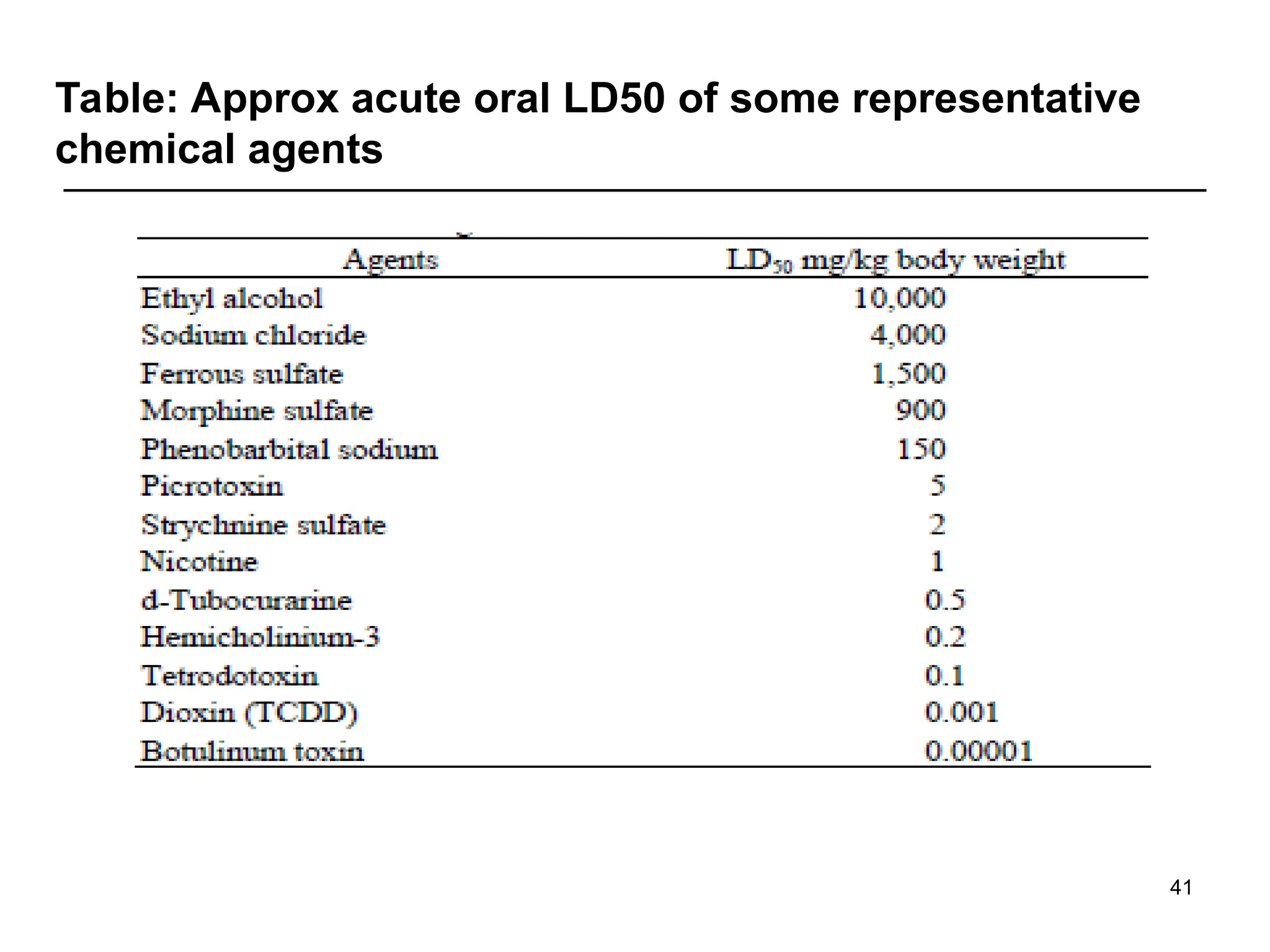
Table: Approx acute oral LD50 of some representative
chemical agents
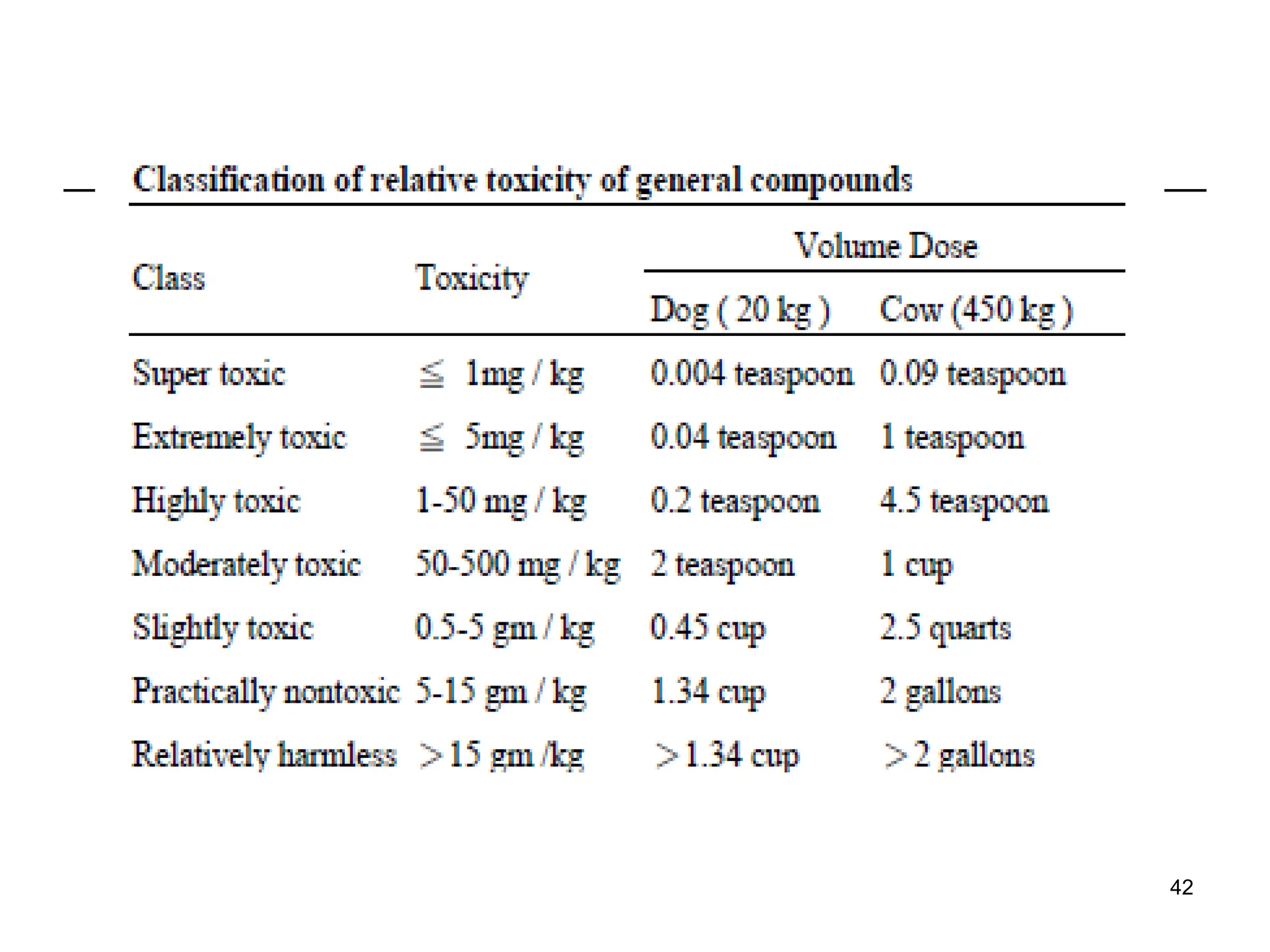
42
II. Classification of toxic agents
 Toxic agents are classified in a variety of ways,
depending on the interests & needs of the
classifier
 Eg, toxic agents are discussed in terms of their:
 Target organs: liver, kidney, hematopoietic
system, etc
 Use: pesticide, solvent, food additive, etc
 Effects: cancer, mutation, liver injury, etc
 Source: Toxin and Toxicant
43
Classification of toxic agents…
 Toxin: refers to toxic substances that are
produced by biological systems such as plants,
animals, fungi or bacteria
 E.g. Zeralanone, produced by a mold
 Toxicant: used in speaking of toxic substances
that are produced by or are a by-product of
anthropogenic (human-made) activities
 E.g. Dioxin [2,3,7,8-tetrachlorodibenzop- dioxin
(TCDD)], produced during the combustion of
certain chlorinated organic chemicals
44
Classification of toxic agents…
 Some toxicants can be produced by both
 E.g. polyaromatic HCs are produced by the
combustion of organic matter
• Natural processes, e.g., forest fires &
• Anthropogenic activities, e.g., combustion of
coal for energy production; cigarette smoking
 Generally, such toxic substances are referred to as
toxicants, rather than toxins
 B/c, although they are naturally produced, they
are not produce by biological systems
45
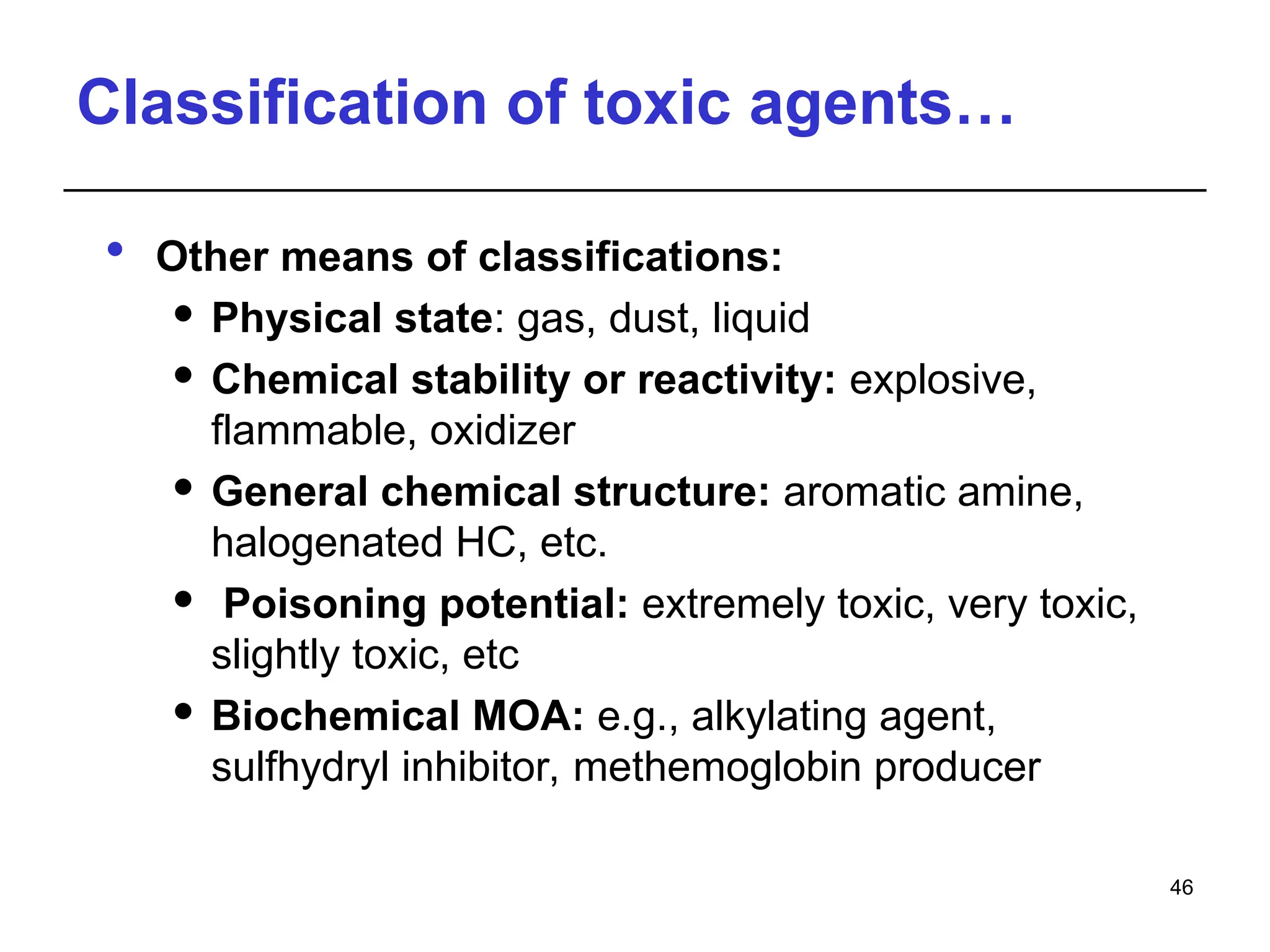
Classification of toxic agents…
 Other means of classifications:
 Physical state: gas, dust, liquid
 Chemical stability or reactivity: explosive,
flammable, oxidizer
 General chemical structure: aromatic amine,
halogenated HC, etc.
 Poisoning potential: extremely toxic, very toxic,
slightly toxic, etc
 Biochemical MOA: e.g., alkylating agent,
sulfhydryl inhibitor, methemoglobin producer
46
III. Spectrum of undesired effects
 Spectrum of undesired effects of chemicals is broad
 Some effects are deleterious & others are not
 E.g. In therapeutics each drug produces a number
of effects, but usually only one effect is associated
with the primary objective of the therapy
 All the other effects are referred to as
undesirable or side effects of that drug for that
therapeutic indication
47
Spectrum of undesired effects
 However, some of these side effects may be
desired for another therapeutic indication
 E.g. the “1st
-gen” antihistamine diphenhydramine
• It is effective in reducing histamine responses
associated with allergies, but it readily enters
the brain & causes mild CNS sedation
• However, it is widely used as an ‘OTC”
sleep remedy, taking advantage of the
CNS-depressant effects
48
Spectrum of undesired effects…
 Some side effects of drugs are never desirable &
are always deleterious to the well-being of
humans
 These are referred to as the adverse,
deleterious, or toxic effects of the drug
49
Spectrum of undesired effects…
a) Allergic reactions:
 Chemical allergy: an immunologically mediated
adverse rxn to a chemical resulting from
previous sensitization to that chemical or to a
structurally similar one
 Once sensitization has occurred, allergic rxns
may result from exposure to relatively very low
doses of chemicals
50
Table: Classification of immunologic reactions
SJS/TEN: Stevens-Johnsonsyndrome/ Toxic epidermal necrolysis
AGEP: Acutegeneralized exanthematous pustulosis
DRESS syndrome: Drug Rxn (orRash) with Eosinophiliaand SystemicSymptoms
Spectrum of undesired effects…
b) Idiosyncratic rxn:
 Refers to a genetically determined abnormal
reactivity to a chemical
c) Immediate vs delayed toxicity:
 Immediate toxic effects
• Can be defined as those that occur/ develop
rapidly after a single administration of a
substance
 Delayed toxic effects:
• Those that occur after the lapse of some time
51
Spectrum of undesired effects…
d) Reversible vs irreversible toxic effects:
 If a chemical produces pathological injury to a
tissue, the ability of that tissue to regenerate
largely determines whether the effect is reversible
or irreversible
• For a tissue such as liver, which has a high ability
to regenerate, most injuries are reversible
• Whereas injury to the CNS is largely irreversible
 Carcinogenic & teratogenic effects of chemicals,
once they occur, are usually considered
irreversible toxic effects
52
Spectrum of undesired effects…
e) Local Vs systemic toxicity:
 Local effects:
• Those that occur at the site of first contact b/n
the biological system & the toxic agent
• Produced by the ingestion of caustic substances
or the inhalation of irritant materials
• E.g. chlorine gas reacts with lung tissue at the
site of contact, causing damage & swelling of
the tissue, with possibly fatal consequences,
even though very little of the chemical is
absorbed into the bloodstream
53
Spectrum of undesired effects…
 Local Vs systemic toxicity…
 Systemic effects:
• Require absorption & distribution of a toxicant
from its entry point to a distant site, at which
deleterious effects are produced
 Most substances except highly reactive agents
produce systemic effects
 For some agents, both effects can be demonstrated
• E.g. Tetraethyl Pb produces effects on skin at the site of
absorption & then is transported systemically to produce
its typical effects on the CNS & other organs
54
Spectrum of undesired effects…
 Local Vs systemic toxicity…
 Most chemicals that produce systemic toxicity do
not cause a similar degree of toxicity in all organs;
instead, they usually elicit their major toxicity in
only one or two organs
• Target organs of toxicity of a particular chemical
 The target organ of toxicity is often not the site of
the highest conc of the chemical
• E.g., Pb is concentrated in bone, but its toxicity is due to
its effects in soft tissues
• DDT is concentrated in adipose tissue but produces no
known toxic effects in that tissue
55
Spectrum of undesired effects…
f) Interaction of chemicals:
 Chemical interactions are known to occur by a
number of MZMs, such as:
• Alterations in absorption, protein binding, & the
biotransformation & excretion of one or both of
the interacting toxicants
 In addition to these modes of interaction, the
response of the organism to combinations of
toxicants may be ↑ed or ↓ed b/c of toxicologic
responses at the site of action
56
Spectrum of undesired effects…
 Interaction of chemicals…
a) Additive effect:
• Occurs when the combined effect of 2 chemicals
is equal to the sum of the effects of each agent
given alone (E.g. 2 + 3 = 5)
• The effect most commonly observed when 2
chemicals are given together is an additive effect
• E.g. when 2 organophosphate insecticides are
given together, the cholinesterase inhibition is
usually additive
57
Spectrum of undesired effects…
 Interaction of chemicals…
b) Synergistic effect:
• Occurs the combined effects of 2 chemicals
are much greater to the sum of the effects of
each agent given alone (e.g. 2 + 2 = 20)
• E.g. CCl4 & Ethanol induced hepatoxicity
58
Spectrum of undesired effects…
 Interaction of chemicals…
c) Potentiation effect:
• Occurs one chemical dose not have a toxic
effect on a certain organ but when added
another chemical makes that chemical much
more toxic (e.g. 0 + 2 = 10)
• E.g. Isopropanol is not hepatoxic, but enhance
CCl4 induced hepatoxicity
59
Spectrum of undesired effects…
 Interaction of chemicals…
d) Antagonistic effect:
• Occurs when 2 chemicals administered
together interfere with each other’s actions or
one interferes with the action of the other (e.g.
4 + 6 = 8; 4 + (-4) = 0; 4 + 0 = 1)
• Antagonistic effects of chemicals are often
very desirable in toxicology & are the basis of
many antidotes
• There are 4 major types of antagonism:
functional, chemical, dispositional, & receptor
60
Spectrum of undesired effects…
g. Tolerance:
 It is a state of ↓ed responsiveness to a toxic
effect of a chemical resulting from prior
exposure to that chemical or to a structurally
related chemical
 2 major MZMs are responsible for tolerance:
• Due to a ↓ed amount of toxicant reaching
the site where the toxic effect is produced →
dispositional tolerance
• Due to a reduced responsiveness of a
tissue to the chemical
61
IV. Characteristics of exposure
 Toxic effects in a biological system are not produced by a
chemical agent unless that agent or its metabolic breakdown
products reach appropriate sites in the body at a conc & for
a length of time sufficient to produce a toxic manifestation
 Many chemicals are of relatively low toxicity in the
“native” form but, when acted on by enzymes in the body,
are converted to intermediate forms that interfere with
normal cellular biochemistry & physiology
62
Characteristics of exposure…
 Thus, whether a toxic response occurs is dependent on:
 Chemical & physical properties of the agent
 Exposure situation
 How the agent is metabolized by the system
 Conc of the active form at the particular target site(s)
 The overall susceptibility of the biological system or
subject
63
Characteristics of exposure…
 The major factors that influence toxicity as it relates to
the exposure situation for a specific chemical:
 Route of administration &
 Duration & frequency of exposure
64
A. Route & Site of Exposure
 The major routes (pathways) by which toxic agents gain
access to the body:
 GIT: ingestion
 Lungs: inhalation
 Skin: topical, percutaneous, or dermal
 Parenteral: other than intestinal canal routes
65
Route and Site of Exposure…
 Toxic agents generally produce the greatest effect & the
most rapid response when given directly into the
bloodstream (IV route)
 An approx. descending order of effectiveness for the
other routes would be:
• Inhalation > IP > SC > IM > intradermal > oral >
dermal
66
Route of exposure
a) Oral route:
 Accounts for 80 % of acute toxic episodes
resulting from accidental & intentional ingestion
of poisons
 Absorption occurs in all areas of the GIT
 Key factors are lipophilicity & % of substance in
the non-ionized form
 Dissolution rate: many Txs recommend dilution,
but this can aid dissolution & absorption in some
instances
1
Route of exposure
a) Oral route:
 Accounts for 80 % of acute toxic episodes
resulting from accidental & intentional ingestion
of poisons
 Absorption occurs in all areas of the GIT
 Key factors are lipophilicity & % of substance in
the non-ionized form
 Dissolution rate: many Txs recommend dilution,
but this can aid dissolution & absorption in some
instances
67
Route of exposure…
• Oral route…
 Large amts of solids can form concretions in the
stomach
 Food rich in fat delay absorption
 Some chemicals can slow own absorption by
gastric irritation, closing pyloric sphincter
 Oral absorption can allow detoxification of toxins by
1st
pass metabolism, or produce toxins from non-
toxic parent compounds
68
Route of exposure…
b) Inhalational route:
 Toxins absorbed by lung categorized as:
• Vapor gases: CO, hydrogen sulfide, sulfur
oxides, nitrogen oxides
• Vapor fumes of volatile liquids: chloform,
benzene, carbon tetrachloride, mercury
• Aerosols: lipid-soluble diffusion, water
soluble filtration
69
Route of exposure…
c) Dermal route:
 Skin is the most accessible organ to toxins & a very efficient
barrier
 Poison undergoing percutanous absorption goes through
several layers of skin to circulation
 Absorptions is determined by compound (corrosive ?), length
of exposure, condition of skin (abrasions ?)
70
Route & Site of Exposure…
 The “vehicle” & other formulation factors can markedly
alter absorption after ingestion, inhalation, or topical exposure
 In addition, the route of administration can influence the
toxicity of agents
 E.g. an agent that is detoxified in the liver would be
expected to be less toxic when given via the portal
circulation (oral) than when given via the systemic
circulation (inhalation) ????
71
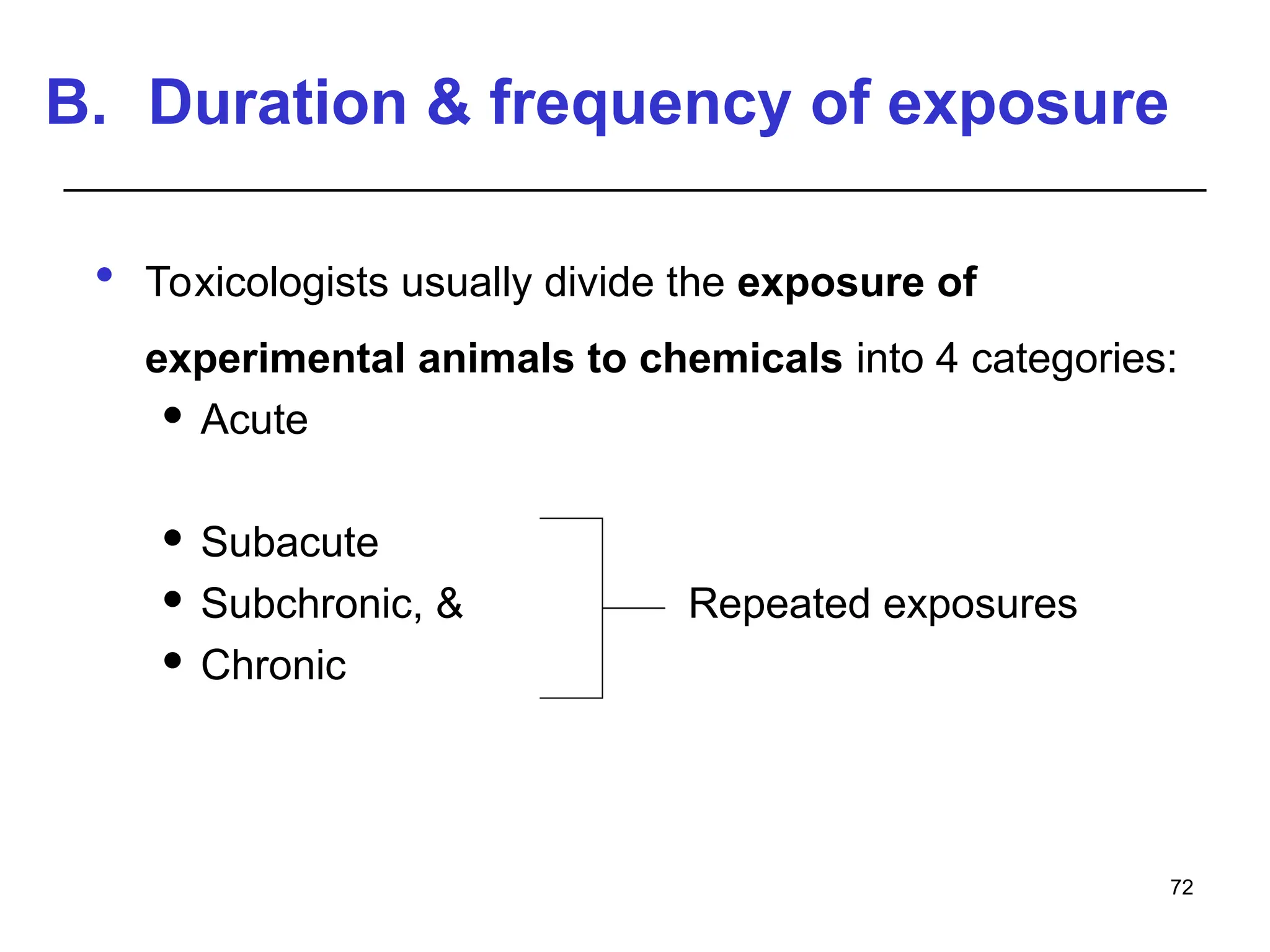
B. Duration & frequency of exposure
 Toxicologists usually divide the exposure of
experimental animals to chemicals into 4 categories:
 Acute
 Subacute
 Subchronic, & Repeated exposures
 Chronic
72
Duration & frequency of exposure…
a) Acute exposure:
 Exposure to a chemical for < 24 h
 It usually refers to a single administration
 Examples of exposure routes are, IV, & Sc inj; oral
intubation; & dermal application
 NB: Acute exposure by inhalation refers to continuous
exposure for < 24 h, most frequently for 4 h
73
Duration & frequency of exposure…
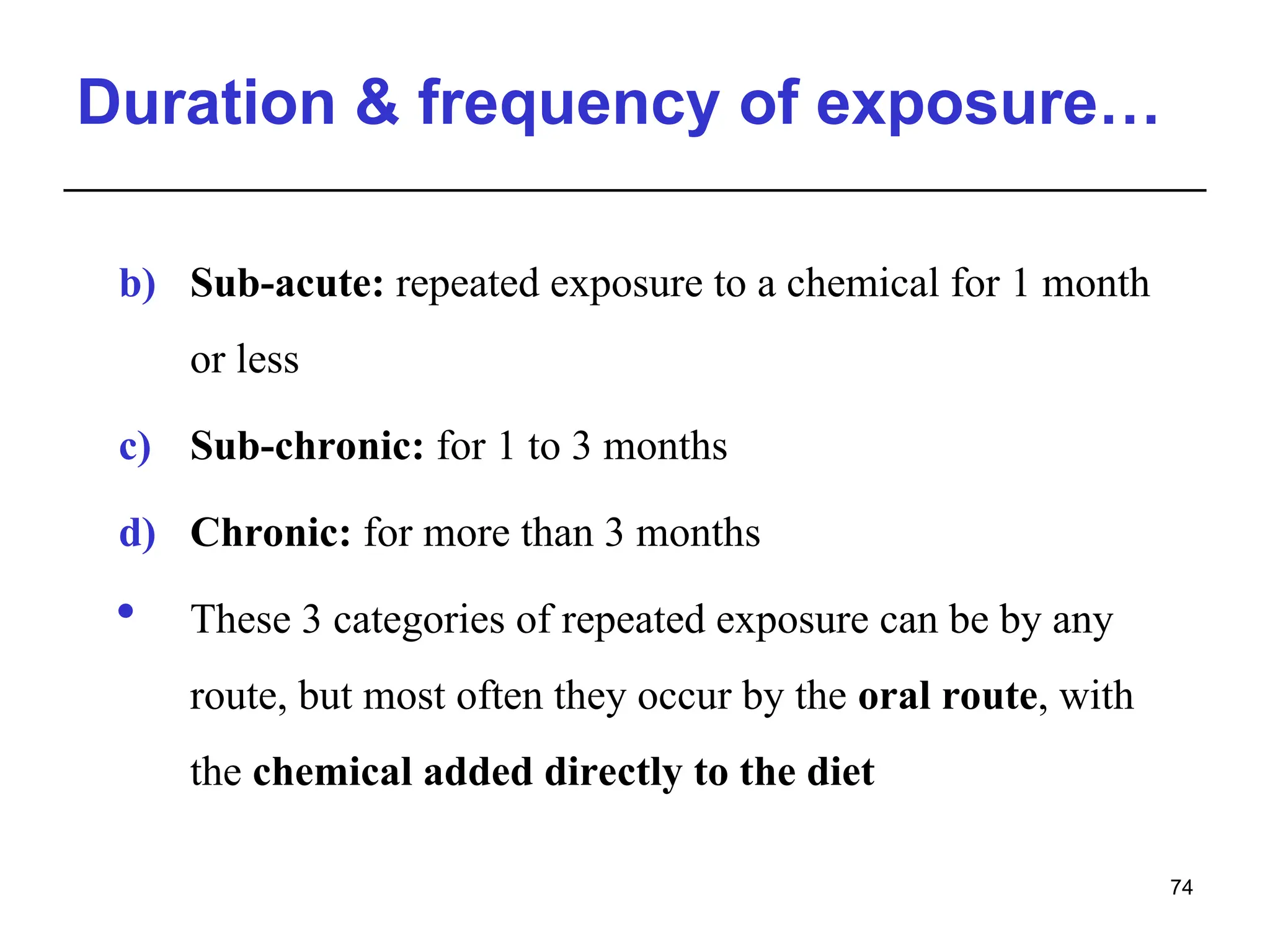
b) Sub-acute: repeated exposure to a chemical for 1 month
or less
c) Sub-chronic: for 1 to 3 months
d) Chronic: for more than 3 months
 These 3 categories of repeated exposure can be by any
route, but most often they occur by the oral route, with
the chemical added directly to the diet
74
Duration & frequency of exposure…
 In human exposure situations, the frequency & duration of exposure
are usually not as clearly defined as in controlled animal studies
 But many of the same terms are used
 Workplace/environmental exposures may be:
 Acute: occurring from a single incident or episode
 Sub-chronic: occurring repeatedly over several wks or months
 Chronic: occurring repeatedly for many months or yrs
75
Duration & frequency of exposure…
 For many agents, the toxic effects that follow a single
exposure are quite different from those produced by
repeated exposure
 E.g. Benzene
• The primary acute toxic manifestation is CNS depression
• But repeated exposures can result in bone marrow
toxicity & an ↑ed risk for leukemia
76
Duration & frequency of exposure…
 Acute exposure to agents that are rapidly absorbed is
likely to produce immediate toxic effects
 But also can produce delayed toxicity that may or
may not be similar to the toxic effects of chronic
exposure
77
Duration & Frequency of Exposure…
 Conversely, chronic exposure to a toxic agent may produce
some immediate effects after each administration in addition to
the long-term, low-level, or chronic effects of the toxic
substance
 In characterizing the toxicity of a specific chemical, it is
evident that information is needed not only for the single-dose
& long-term effects but also for exposures of intermediate
duration
78
Duration & frequency of exposure…
 The other time-related factor that is important in
the temporal characterization of repeated
exposures is the frequency of exposure
 A chemical that produces severe effects with a
single dose may have no effect if the same
total dose is given in several intervals
79
Duration & frequency of exposure…
 It is evident that with any type of repeated exposure,
the production of a toxic effect is influenced not only
by the frequency of exposure
 But may, in fact, be totally dependent on the
frequency rather than the duration of exposure
80
Duration & frequency of exposure…
 Chronic toxic effects may occur, therefore, if the chemical:
 Accumulates in the biological system
• Rate of absorption exceeds the rate of
biotransformation &/or excretion
 Produces irreversible toxic effects
 There is insufficient time for the system to recover from
the toxic damage within the exposure frequency interval
81
V. Dose-response ( D-R)relationships
 The characteristics of exposure & the spectrum of
effects come together in a correlative r/ship customarily
referred to as the D-R r/ship
 From a practical perspective, there are 2 types of D– R
r/ships:
 Graded D-R r/ship
 Quantal D-R r/ship
82
D-R r/ships…
a) Graded D-R r/ship:
 The individual D–R r/ship, which describes the
response of an individual organism to varying doses
of a chemical
• B/c the measured effect is continuous over a
range of doses
83
D-R r/ships…
 Quantal D–R r/ship:
 Characterizes the distribution of individual
responses to different doses in a population of
individual organisms
 It can be constructed for lethality, cancer, liver
injury, & other toxic responses
84
VI. Variation in toxic responses
a) Selective Toxicity
 It means that a chemical produces injury to one
kind of living matter without harming another
form of life even though the 2 may exist in
intimate contact
 They may be related to each other as parasite
& host or may be 2 tissues in one organism
85
Variation in toxic responses…
 Selective Toxicity…
 Drugs & other chemicals used for selective toxic purposes are
selective for one of 2 reasons
• The chemical is equally toxic to both economic & uneconomic
cells but is accumulated mainly by uneconomic cells
• The chemical reacts fairly specifically with a cytological or a
biochemical feature that is absent from or does not play an
important role in the economic form
86
Variation in toxic responses…
 Selective Toxicity…
 Selectivity resulting from differences in distribution
usually is caused by differences in:
 The absorption
 Biotransformation, or
 Excretion of the toxicant
87
Variation in toxic responses…
 Selective Toxicity…
 Example1:
• Selective toxicity of an insecticide spray may be
partly due to:
• A larger SA per unit wt that causes the insect to
absorb a proportionally larger dose than does the
mammal being sprayed
• Effectiveness of radioactive iodine in the Tx of
hyperthyroidism is due to:
• Selective ability of the thyroid gland to
accumulate iodine
88
Variation in toxic responses…
 Selective Toxicity…
 Example 2:
• Selective toxicity caused by differences in
comparative cytology is exemplified by a comparison
of plant & animal cells
• Plants differ from animals in many ways, e.g
• Absence of a nervous system, an efficient
circulatory system, &
• Presence of a photosynthetic MZM & cell walls
89
Variation in toxic responses…
 Selective Toxicity…
 Example 3:
• The fact that bacteria contain cell walls &
humans do not has been utilized in developing
selective toxic antibiotics, such as penicillin &
cephalosporins, that kill bacteria but are
relatively nontoxic to mammalian cells
90
Variation in toxic responses…
 Selective Toxicity…
 Example 4:
• Selective toxicity can also be a result of a difference in
biochemistry in the 2 types of cells
• E.g. bacteria do not absorb folic acid but synthesize
it from p-aminobenzoic acid, glutamic acid, &
pteridine, whereas mammals cannot synthesize
folic acid but have to absorb it from the diet
91
Variation in toxic responses…
 Selective Toxicity…
 Thus, sulfonamide drugs are selectively toxic to bacteria
b/c the sulfonamides, which resemble p-aminobenzoic
acid antagonize the incorporation of p-aminobenzoic acid
into the folic acid molecule—a rxn that humans do not
carry out
92
Variation in toxic responses…
b) Species differences toxicity:
 E.g. Aflatoxin induced liver tumor
• 15 ppb in rats, but 10,000 ppb in mice
 Mice express this enzyme constitutively, whereas
rats normally express a closely related form with
much less detoxifying activity toward aflatoxin
epoxide
93
Variation in toxic responses…
c) Individual difference in response:
 Even within a species, large inter-individual
differences in response to a chemical can occur b/c of
subtle genetic differences
 Hereditary differences in a single gene that occur in
more than 1% of the population are referred to as
genetic polymorphism & may be responsible for
idiosyncratic rxns to chemicals
94
Principles & methods of testing
for toxicity
Learning Objectives
 Discuss the studies on general toxicity
 Describe developmental & reproductive toxicity
studies
 Explain the different methods of mutagenicity
studies
 Describe the tests used to study carcinogenic
effect of chemicals
96
Chapter Outline
 Studies on general toxicity:
 Acute, sub-acute, sub-chronic & chronic toxicity
studies
 Studies on various types of specific adverse
effects:
 Developmental & reproductive toxicity
 Mutagenicity
 Tests for carcinogens
 Immunotoxicity assessment
 Irritation & sensitization - local tolerance studies
97
I. Studies on General Toxicity
 Toxicity testing: encompasses a variety of methods
aimed at assessing the potential harmful effects of
substances on biological systems.
Importance of Toxicity Testing
 Understanding the impact of chemicals on health and the
environment ,for public safety.
 helps to prevent harmful exposures and informs regulatory
decisions to safeguard human and ecological health.
Cont….
Scope of Toxicity Testing
encompasses a wide array of substances, including pharmaceuticals,
industrial chemicals, and environmental pollutants, necessitating an
interdisciplinary approach that toxicology, chemistry
Fundamental Principles of Toxicity Testing
Reproducibility, Validity, and Ethical Considerations
Reproducibility : ensures that toxicity tests yield consistent results across
different laboratories and studies,
serving as a cornerstone for reliable data interpretation and regulatory
Cont…..
 Validity refers to the accuracy of a test in measuring what it
purports to measure, ensuring that the results reflect actual
biological responses rather than artifacts of the procedure.
 Ethical Considerations :The ethical implications of toxicity
testing necessitate a commitment to minimizing animal testing,
promoting alternatives such as in vitro methods and ensuring
humane treatment for any involved.
I. Studies on General Toxicity
 Toxicological testing is best performed with pure
substances since examination with chemical
mixtures is practically impossible & may give rise to
erroneous conclusions due to possible chemical
interactions
 If it is necessary to determine the toxicity of a cpd
mixture, investigation should start by establishing
the composition of the mixture & determining which
components of the mixture are bioactive
101
Principles of descriptive animal toxicity
tests
 Two main principles underlie all descriptive animal
toxicity testing
A. The effects produced by a compound in lab
animals , when properly qu
alified, are
applicable to humans
• O
n the basis of dose per unit of body surface,
toxic effects in humans are usually in the same
range as those in experimental animals
• O
n a body weight basis, humans are generally
more vulnerable than are experimental anim als
1
Studies on General Toxicity…
 Each substance then must be classified &
characterized with respect to its physicochemical
properties
 The stability of a given substance determines how it
should be administered for testing, particularly if it is
inactivated in the GIT
 In general, the starting point for toxicological testing
of new substances is testing in lab animals
 A chemical may be administrated to animals by oral,
dermal, IV, IM or IP routes
102
Studies on General Toxicity…
 The ideal experimental animal is one that
metabolizes & secretes a substance in the same
manner as humans do
 Thus, rodents, hamsters, rabbits, cats & dogs are
the most frequent human surrogates used for
toxicological testing
 Mainly b/c they are economical, amenable to
frequent handling & lacking in the vomiting reflex
 Other animals, such as monkeys, are also used
103
Studies on General Toxicity…
 Metabolic differences b/n humans & surrogate test
animals can result in erroneous conclusions about the
activity of a substance in humans
 Use of younger animals provides the advantage of
obtaining faster results due to their higher rate of
metabolism, as well as their being cheaper to
purchase & house
 Age & gender of animals can influence the outcome
of the investigation
104
Studies on General Toxicity…
 The purity of the substance is very important, since
impurities may significantly influence toxicological findings
 Before animal testing is started, a literature search must
be done to collect available results of any previous testing
 If the test substance is administrated to experimental
animal by mixing it with food or water, it may be affected by
oxidation (i.e., through contact with air), or by temperature
variations or by the feeding habits of the experimental
animals
105
Studies on General Toxicity…
 Gastric intubation (gavage), an artificial means of
substance introduction, has advantages with respect
to dosing exactness & reduced variation
 The gavage is performed after the animals have
fasted in order to avoid mixing chemical test
substances with stomach contents
 In general, the chemical dose should not exceed
5% of the test animal’s diet
106
Studies on General Toxicity…
A number of different types of data are used in order to establish the
safety of chemical substances for use. These include:
Consideration of the chemical structure and any intended biological
activity
In vitro models, such as cell cultures or tissue slices
Laboratory animals
Human volunteers
107
Studies on General Toxicity…
 Alternative test methods:
 The use of lab-cultured single-cell organisms
 Isolated organs or mammalian cell lines
 NB: The advantage of animal testing:
 The possibility to examine the results of different
routes of exposure under controlled conditions
108
Studies on General Toxicity…
 However, differences in genetic pool, lifespan,
susceptibility, metabolic pathways & other
parameters of organic life, present serious
limitations when extrapolating the results of
animal testing to human populations
 Animal experiments are usually classified
according to their duration as:
 Acute, sub-acute, chronic or sub-chronic testing
 Chronic & acute toxic effects for a specific toxicant
can differ both qualitatively & quantitatively
109
110
Fig. Typical tiered testing scheme for the toxicological evaluation of new
chemicals
TOXICITY STUDIES
 Acute toxicity (14 Days)
 Sub-acute (repeated doses) toxicity (28 Days) •
 Sub-chronic toxicity (3 Months)
 Chronic toxicity (6 Months to 2Years)
 Special toxicity (Carcinogenicity)
Acute toxicity studies are conducted to determine the short-
term adverse effects of drug/chemical when administered in
a single dose, or in multiple doses during a period of 24 h in
two mammalian species (one non-rodent).
111
A. Acute toxicity studies
 Objectives:
 To determine Maximum Tolerated Dose (MTD) & No
Observable Effect Level (NOEL)
 To determine the Median Lethal Dose (LD50) after a
single dose administered through one or more routes, one
of which is the intended route of administration in humans
 To identify potential target organs for toxicity, determine
reversibility of toxicity, & identify parameters for clinical
monitoring
 To help select doses for repeated-dose toxicity tests
112
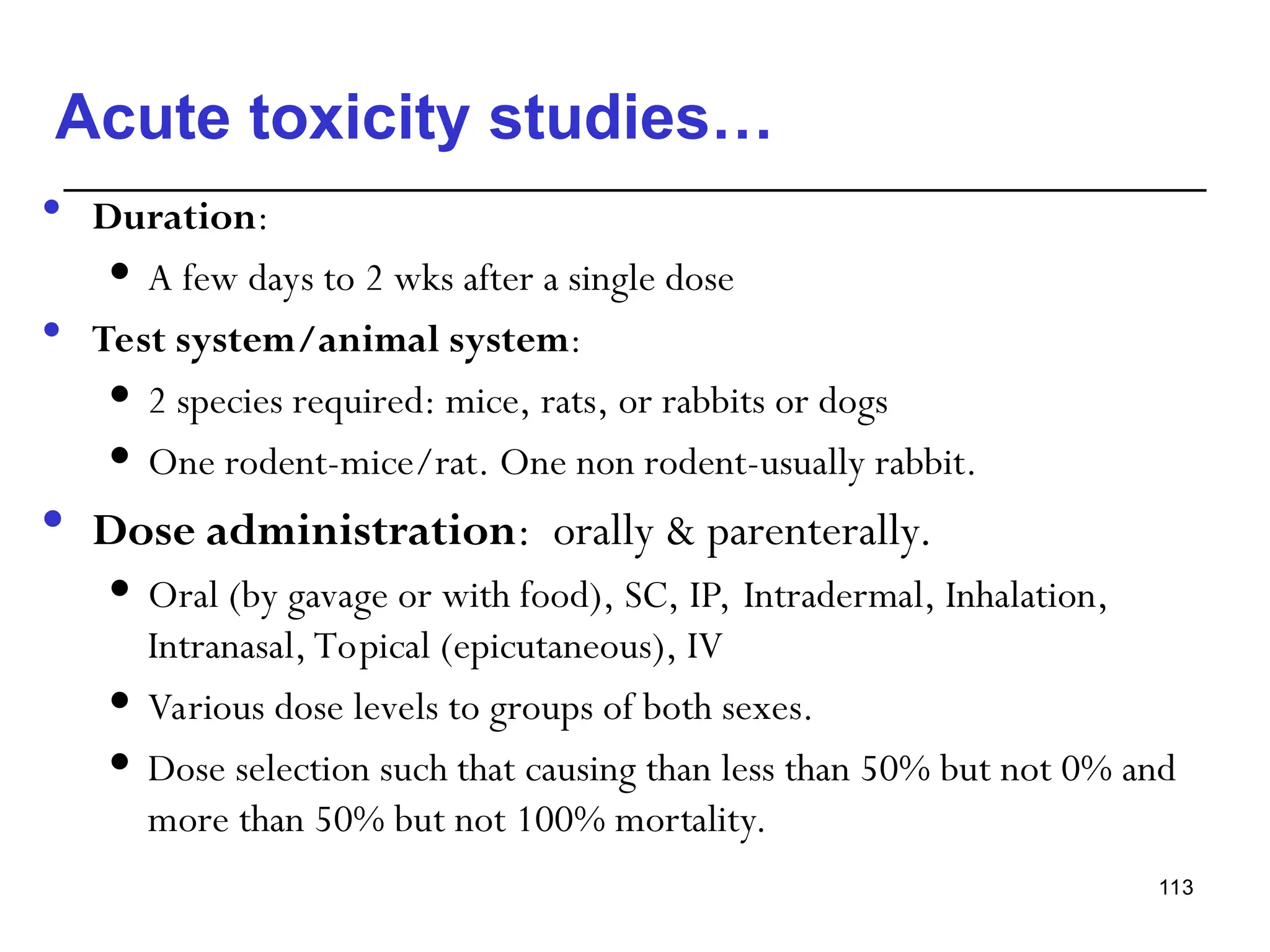
Acute toxicity studies…
 Duration:
 A few days to 2 wks after a single dose
 Test system/animal system:
 2 species required: mice, rats, or rabbits or dogs
 One rodent-mice/rat. One non rodent-usually rabbit.
 Dose administration: orally & parenterally.
 Oral (by gavage or with food), SC, IP, Intradermal, Inhalation,
Intranasal, Topical (epicutaneous), IV
 Various dose levels to groups of both sexes.
 Dose selection such that causing than less than 50% but not 0% and
more than 50% but not 100% mortality.
113
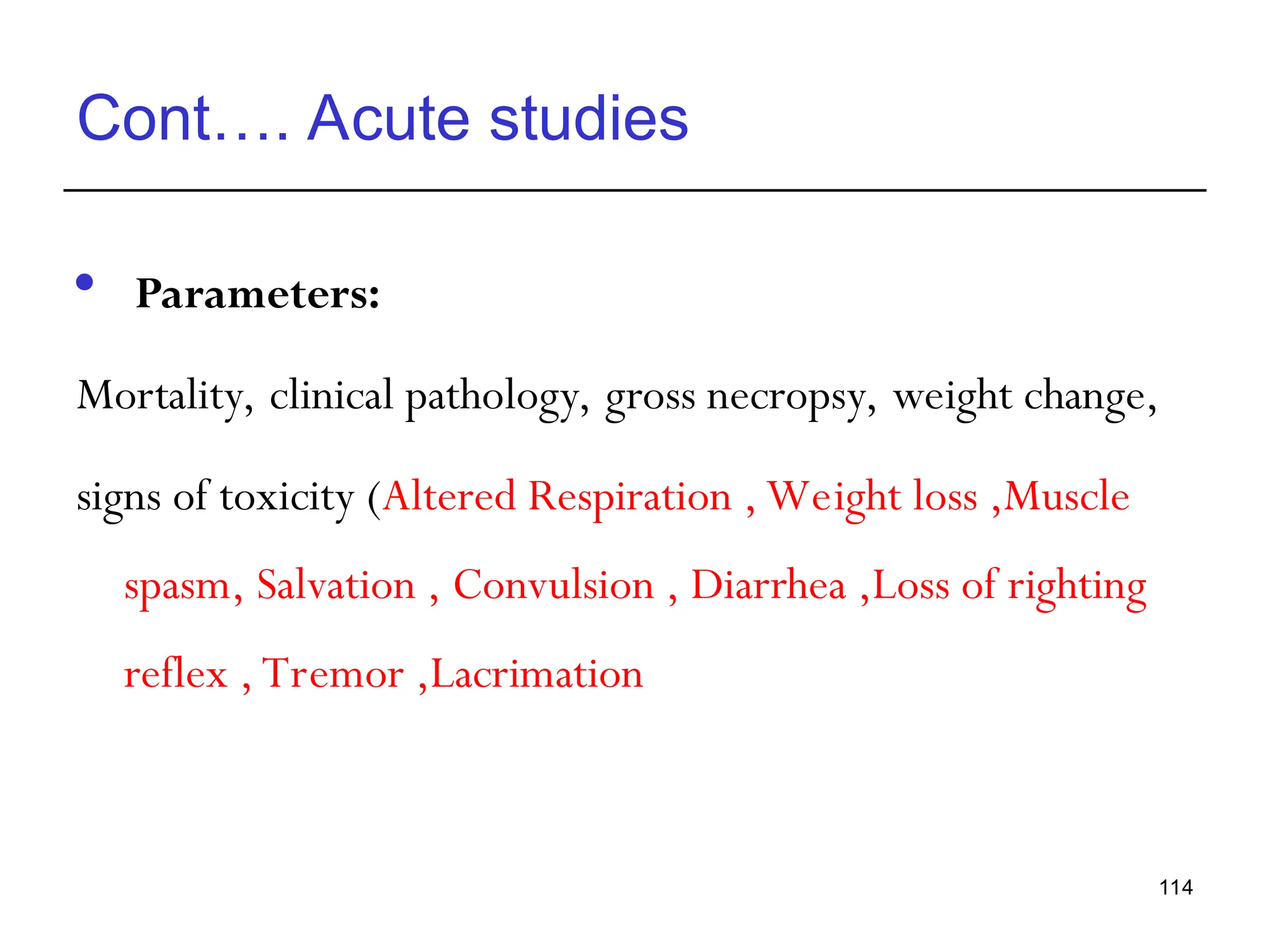
Cont…. Acute studies
 Parameters:
Mortality, clinical pathology, gross necropsy, weight change,
signs of toxicity (Altered Respiration , Weight loss ,Muscle
spasm, Salvation , Convulsion , Diarrhea ,Loss of righting
reflex , Tremor ,Lacrimation
114
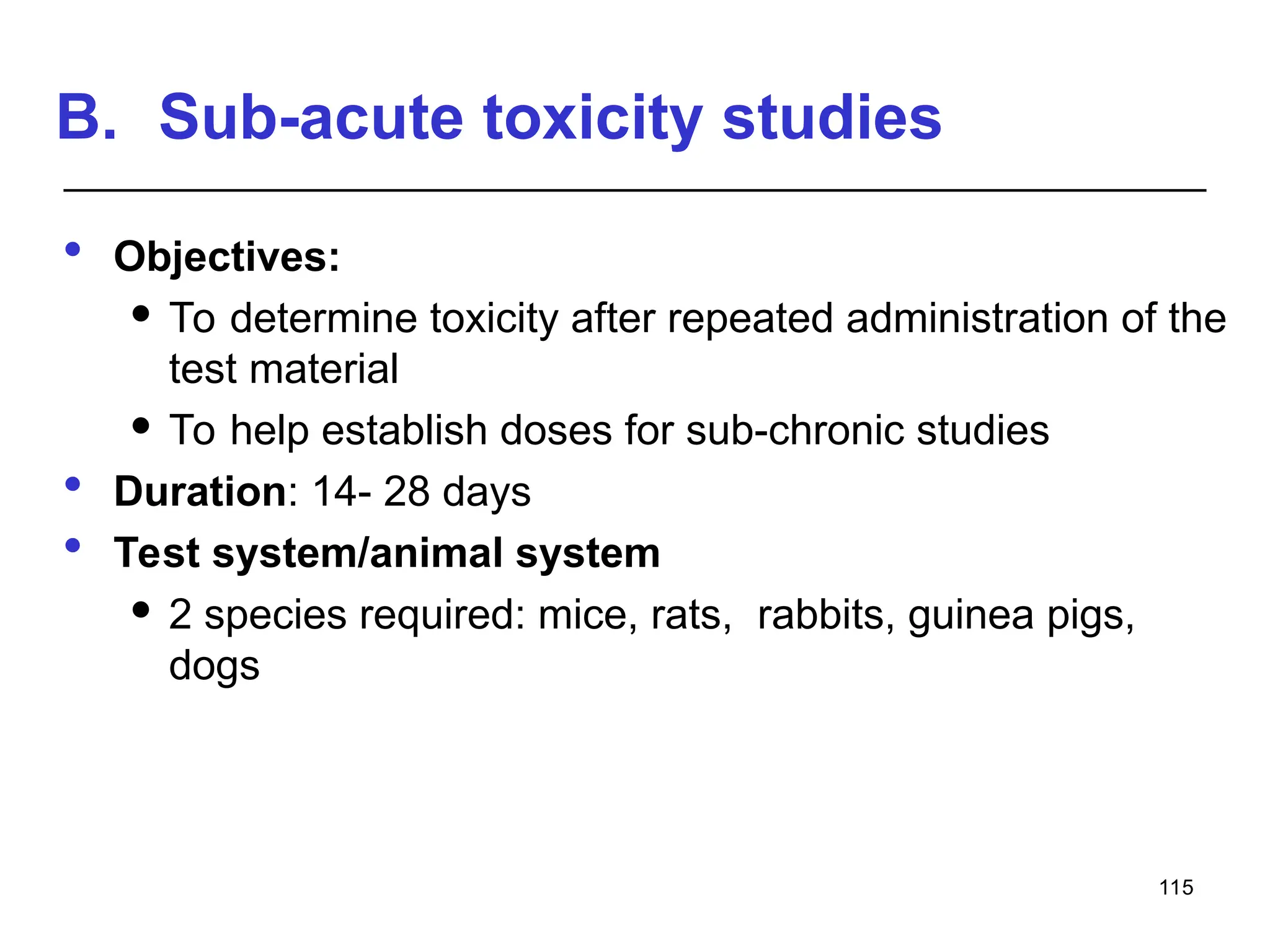
B. Sub-acute toxicity studies
 Objectives:
 To determine toxicity after repeated administration of the
test material
 To help establish doses for sub-chronic studies
 Duration: 14- 28 days
 Test system/animal system
 2 species required: mice, rats, rabbits, guinea pigs,
dogs
115
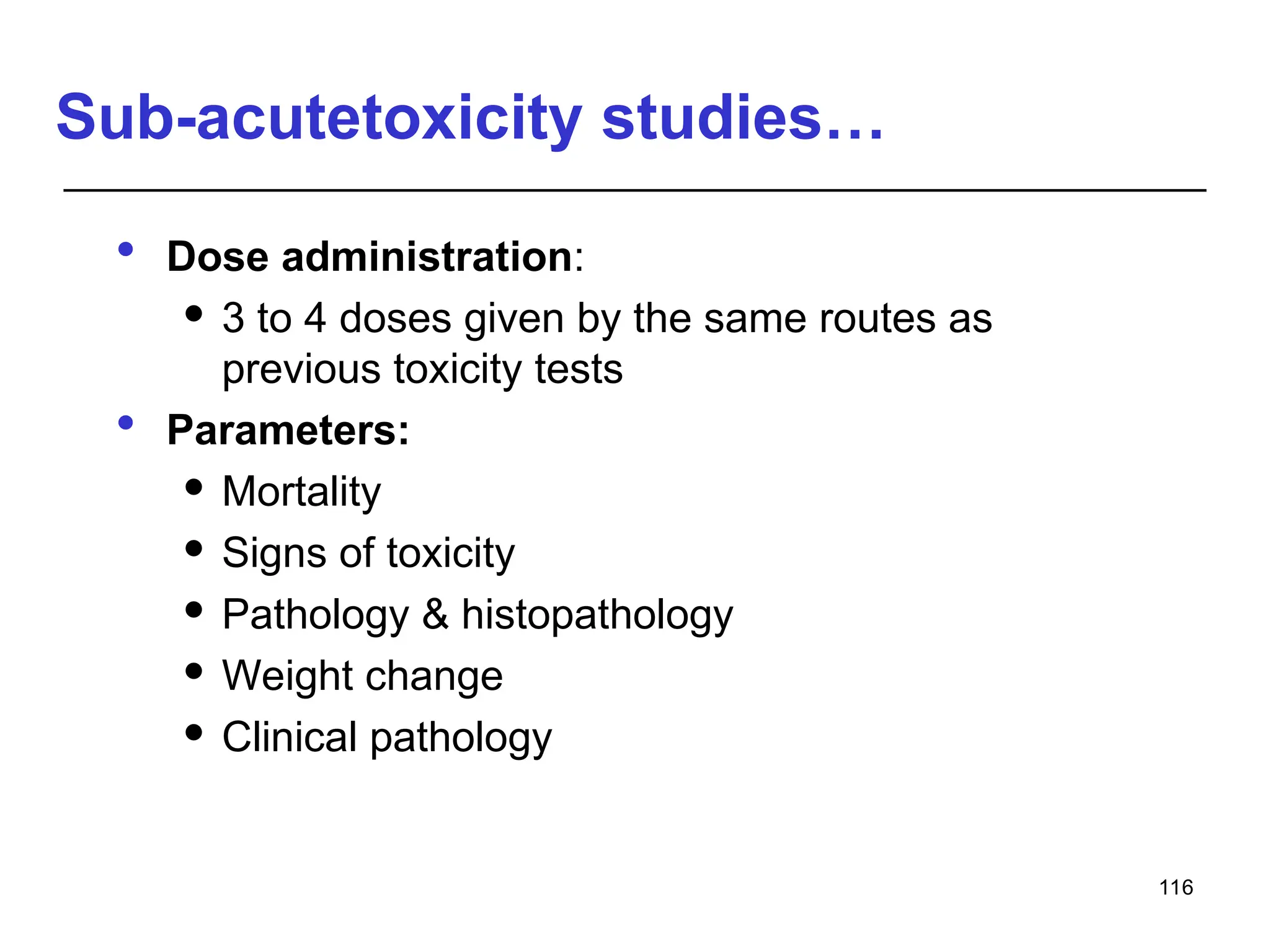
Sub-acutetoxicity studies…
 Dose administration:
 3 to 4 doses given by the same routes as
previous toxicity tests
 Parameters:
 Mortality
 Signs of toxicity
 Pathology & histopathology
 Weight change
 Clinical pathology
116
C. Sub-chronic toxicity testing
 Objectives:
 To establish a “no observable effect level"
(NOEL)
 To characterize D-R r/ships following repeated
doses
 To further identify & characterize specific organs
affected after repeated administration
 To predict a reasonable & appropriate dose for
chronic exposure studies (MTD)
117
Sub-chronic toxicity testing…
 Duration:
 Commonly 90 days, but varies from 2 wks to 6
months or up to 10% of species’ lifespan
 Test system/animal system:
 2 species required: rodents, dogs
 Dose administration:
 At least 3 doses given by the same routes as
previous toxicity tests; the lowest producing no
apparent toxicity & the highest producing toxicity
but less than or equal to 10% mortality
118
Sub-chronic toxicity testing…
 Parameters
 Mortality
 Weight change
 Signs of toxicity
 Clinical pathology
 Pathology and histopathology
119
D. Chronic toxicity testing
 Objectives:
 To evaluate the cumulative toxicity of chemicals
 To assess carcinogenic potential
 Duration:
 Rodents - 6 to 24 months; non-rodents - 12
months or longer or up to 10% of species’
lifespan
 Length depends on intended period of human
exposure
120
Chronic toxicity testing…
 Test system/animal system:
 2 species required: Rodents, dogs
 Dose administration:
 As in sub-acute/ subchronic toxicity studies
 Parameters:
 Mortality
 Pathology & histopathology
 Weight change
 Clinical pathology of all animals (mortalities &
survivors)
121
II. Studies on various types of
specific adverse effects
 Studies on various types of specific adverse
effects
 Developmental & reproductive toxicity
 Mutagenicity
 Tests for carcinogens
 Immuno-toxicity assessment
 Irritation & sensitization - local tolerance
studies
122
A. Developmental & reproductive
toxicity
 Developmental toxicology:
 The study of adverse effects on the developing
organism occurring anytime during the life
span of the organism that may result from
exposure to chemical or physical agents
• Before conception (either parent)
• During prenatal development, or
• Postnatally until the time of puberty
123
Developmental & reproductive
toxicity…
 Teratology:
 The study of defects induced during
development b/n conception & birth
 Reproductive toxicology:
 The study of the occurrence of adverse effects
on the male or female reproductive system
that may result from exposure to chemical or
physical agents
124
Developmental & reproductive
toxicity…
a) General fertility & reproductive performance (segment
I) studies:
 They are usually performed in rats with 2 or 3 doses (20
rats per sex per dose) of the test chemical (neither
produces maternal toxicity)
 Males are given the chemical 60 days & females 14 days
before mating
 The animals are given the chemical throughout
gestation & lactation
125
Developmental & reproductive
toxicity…
 Segment I studies…
 Typical observations made include:
• The % of females that become pregnant
• The number of stillborn & live offspring,
• The wt, growth, survival, & general condition of
the offspring during the first 3 wks of life
126
Developmental & reproductive
toxicity…
b) Teratogenic effects (segment II) studies:
 Teratogens are most effective when administered
during the 1st
trimester, the period of organogenesis
 Thus, the animals (usually 12 rabbits & 24 rats or
mice per group) are usually exposed to one of three
dosages during organogenesis (day 7 to 17 in
rodents & days 7 to 19 in rabbits), & the fetuses are
removed by cesarean section a day before the
estimated time of delivery (gestational days 29 for
rabbit, 20 for rat, & 18 for mouse)
127
Developmental & reproductive
toxicity…
 Segment II studies..
 The uterus is excised & weighed & then examined
for the number of live, dead, & resorbed fetuses
 Live fetuses are weighed
 Half of each litter is examined for skeletal
abnormalities & the remaining half for soft tissue
anomalies
128
Developmental & reproductive
toxicity…
c) Perinatal & postnatal toxicities of chemicals
(segment III) studies:
 This test is performed by administering the
test compound to rats from the 15th day of
gestation throughout delivery & lactation
 Then determining its effect on the birth-
weight, survival, & growth of the offspring
during the first 3 wks of life
129
B. Mutagenicity
 Mutagenesis is the ability of chemicals to cause
changes in the genetic material in the nucleus of cells in
ways that allow the changes to be transmitted during
cell division
 Mutations can occur in either of 2 cell types, with
substantially different consequences
 Germinal mutations
 Somatic mutations
130
Mutagenicity…
 Germinal mutations:
 Damage DNA in sperm & ova, which can undergo meiotic
division & therefore have the potential for transmission of
the mutations to future generations
 A gene change in a body's reproductive cell (egg or sperm)
that becomes incorporated into the DNA of every cell in the
body of the offspring.
 Germline mutations are passed on from parents to offspring
 If mutations are present at the time of fertilization in either
the egg or the sperm, the resulting combination of genetic
material may not be viable, & the death may occur in the early
stages of embryonic cell division
131
Mutagenicity…
 Germinal mutations…
 Alternatively, the mutation in the genetic
material may not affect early embryogenesis
but may result in the death of the fetus at a later
developmental period, resulting in abortion
 Congenital abnormalities may also result from
mutations
132
Mutagenicity…
 Somatic mutations:
 Mutations in all other cell types & are not heritable but may
result in cell death or transmission of a genetic defect to other
cells in the same tissue through mitotic division.
 An alteration in DNA that occurs after conception. Somatic
mutations can occur in any of the cells of the body except the
germ cells (sperm and egg) and therefore are not passed on to
children.
133
Mutagenicity…
 B/c the initiating event of chemical carcinogenesis is
thought to be a mutagenic one, mutagenic tests are often
used to screen for potential carcinogens
 Numerous in vivo & in vitro procedures have been
devised to test chemicals for their ability to cause
mutations
134
Mutagenicity…
 Some genetic alterations are visible with the light
microscope
 In this case, cytogenetic analysis of bone
marrow smears is used after the animals have
been exposed to the test agent
 B/c some mutations are incompatible with normal
development, the mutagenic potential of a
chemical can also be evaluated by the dominant
lethal test
 This test is usually performed in rodents
135
Mutagenicity…
 The dominant lethal test…
 The male is exposed to a single dose of the
test compound & then is mated with two
untreated females weekly for 8 wks
 The females are killed before term, & the
number of live embryos & the number of
corpora lutea are determined
136
Mutagenicity…
 Salmonella/microsome/Ames test:
 The test for mutagens that has received the
widest attention that is developed by Ames &
colleagues
 This test uses several mutant strains of S.
typhimurium that lack the enzyme
phosphoribosyl ATP synthetase, which is
required for histidine synthesis
 These strains are unable to grow in a histidine-
deficient medium unless a reverse or back-
mutation to the wild type has occurred
137
Mutagenicity…
 Ames test…
 Other mutations in these bacteria have been
introduced to enhance the sensitivity of the
strains to mutagenesis
 The 2 most significant additional mutations
enhance penetration of substances into the
bacteria & decrease the ability of the bacteria
to repair DNA damage
138
Mutagenicity…
 Ames test…
 B/c many chemicals are not mutagenic or
carcinogenic unless they are biotransformed to
a toxic product by enzymes in the ER, rat liver
microsomes are usually added to the medium
containing the mutant strain & the test chemical
 The number of reverse mutations is then
quantified by the number of bacterial colonies
that grow in a histidine-deficient medium
139
C. Tests for carcinogens
a) The Standard Test:
 The currently accepted design for
carcinogenicity testing is to expose rats & mice
to the agent for about 2 years
 For each species, 50 male & 50 female animals
per group are dosed with a vehicle or the test
agent in that vehicle
 Daily observations are made & if any animals
become moribund during the experiment, they
are killed so that tissues are not lost due to
autolysis
140
Tests for carcinogens…
 The Standard Test..
 All animals, including those that survive to the
scheduled end of the experiment, are
subjected to autopsy & almost 40 different
tissues are taken from each animal for
histological examination
 All observations are recorded, summarized &
analyzed
141
D. Immunotoxicity Assessment
 Objective:
 To determine the potential of a test material to
induce immune suppression or immune
enhancement
 Duration:
 Subacute (14 days) or sub-chronic (90 days)
exposure
 Test system/animal system: Rodents
 Dose administration:
 Repeated doses administered as in
sub-acute/sub-chronic toxicity studies
142
Immunotoxicity Assessment…
 Parameters:
 Level 1:
• Hematology
• Histopathology or lymphoid organs
• Quantity of T- & B-cells (cellularity of lymphoid
organs)
• Blastogenesis (mitogen responsiveness; mixed
lymphocyte reaction)
• Quantitation and funciton of natural killer cells
• Macrophage function
• Cytokine production
143
Immunotoxicity Assessment…
 Parameters…
 Level 2:
• Kinetics of antibody production to T-
dependent antigens
• Quantity of IgM/IgG-producing (plaque-
forming) cells
• Delayed hypersensitivity responses to known
sensitizers
• Immune response to infectious agents (e.g.,
Listeria, Streptococcus)
• Immune response to transplantable tumors
144
E. Irritation & sensitization - local
tolerance studies
 Objectives:
 To determine the potential of a test material to
provoke ocular irritation, dermal irritation, or
sensitization
 Duration:
 Irritation - 1 hr to 3 wks after a single topical or
corneal administration
 Sensitization - intradermal or topical induction
doses followed by topical challenges with a non-
irritating dose (6 - 8 wks total)
 Test system/animal system: Rodents, rabbits
145
Irritation & sensitization - local
tolerance studies…
 Test system/animal system: Rodents, rabbits
 Dose administration
 Single patch administration
 Multiple doses over 2—4 weeks
 Topical (epicutaneous), intradermal, or corneal
146
Irritation & sensitization - local
tolerance studies…
 Parameters:
 Degree of pruritis, erythema, edema, papules,
and vesicles
 Corneal irritation, swelling, or injury
 Microscopic integrity of corneal endothelium
 Other features of the eye (conjuctive, cornea,
iris, lens, anterior portion of vitreous humor)
147

Chapter 1 (2).ppt........................

  • 1.
  • 2.
    Chapter 1 Origin &Scope ofToxicology Outline •Introduction to Toxicology •History of Toxicology •Different Areas of Toxicology
  • 3.
    Toxicology: Derived fromGreek word, toxikon and logos •  the study of the adverse effects of chemical, physical, or biological agents on living organisms and the ecosystem, including the prevention and amelioration of such adverse effects." The science of poisons that studies toxic substances with respect to their: Sources , Properties , Mechanism of toxicity Toxic effects, Detection , Clinical manifestations Not everyone will respond to substances in exactly the same way. 3 I. Introduction to Toxicology
  • 4.
    Introduction to Toxicology….. Chemical Sources: like drug, corrosives  Plant sources: hashish, cocaine  Animal sources: animal venoms( scorpion, spider, Snake  A toxicologist is trained to examine & communicate the nature of those effects on human, animal, & environmental health  Toxicological research examines the cellular, biochemical, & molecular MOT as well as functional effects such as: • Neurobehavioral & immunological, & assesses the probability of their occurrence 4
  • 5.
    Cont……  Toxicologists theyare involved in the recognition, identification, and quantification of hazards resulting from occupational exposure to chemicals and the public health aspects of chemicals in air, water, other parts of the environment, foods, and drugs.  Molecular toxicologist  Clinical toxicologist  Environmental toxicologist 5
  • 6.
    Toxicological terms anddefinitions  Toxin- a poison of natural (biological) origin   Poisons :any substance that produces disease conditions, tissue injury or interrupts natural life processes when in contact with or absorbed into the body.  Toxic agent-Anything that can produce an adverse biological effect.  It may be chemical, physical, or biological in form. E.g chemical (such as cyanide), physical (such as radiation) and biological (such as snake venom). 6
  • 7.
    7 Toxicosis describes thedisease state that results from exposure to poison or poisoning and intoxication.
  • 8.
    Cont……  Toxicity-any toxic(adverse) effect that a chemical or physical agent might produce within a living organism   Toxicant : A poison that is made by humans or that is put into the environment by human activities. • chemical that can injure or kill humans, animals, or plants; (poison)  Systemic toxin: Affects the entire body/many organs.Not site specific  Organ toxin: Affects only specific tissues or organ  Hazard - is the likelihood that injury will occur in a given situation or setting: the conditions of use and exposure are primary considerations 8
  • 9.
    Cont…….  Risk -is defined as the expected frequency of the occurrence of an undesirable effect arising from exposure to a chemical or physical agent RISK= HAZARD + EXPOSURE  The toxicity depends on a variety of factors: dose, duration and route of exposure, shape and structure of the chemical itself, and individual human factors.  toxicity is a relative term applied in comparing one chemical with another.  A highly toxic substance causes damage to an organism if administered in a very small amount. But a substance of low toxicity will not produce an effect unless the amount is very large. 9
  • 10.
    II. History ofToxicology A. Antiquity  Toxicology dates back to the earliest humans, who used animal venom & plant extracts for hunting, warfare, & assassination  The Ebers papyrus (circa 1500 B.C.) describes many recognized poisons- hemlock, aconite, opium, lead, copper, antimony, digitalis, belladonna alkaloids  Theophrastus (370–286 B.C.), a student of Aristotle, wrote De Historia Plantarum  Socrates (470-399 B.C.) received poison as part of state execution 10
  • 11.
    Antiquity…  Demosthenes (385–322 B.C.) and Cleopatra’s (69–30 B.C.)  Voluntary took poison  King Mithridates (134-63 B.C.) of Pontus  Poisoned many criminals in his experiments to identify antidotes  Epidemic Poisonings in Rome lasted from 4th -1st century B.C  Dioscorides (Greek physician) 60 A.D.  Described many poisons, devised categorization system (plant, animal, mineral) 11
  • 12.
    B. Middle Ages Moses Ben Maimon (Maimonides 1135–1204 A.D.)  Wrote poisoning and their Antidotes  Renaissance Italians brought poisoning to a zenith  Catherine de Medici  Catherine Deshayes ( “La Voisine” ) 12
  • 13.
    C. Age ofEnlightenment  Paracelsus (1493-1541)  Led the change from the science of Hippocrates and Galen to that of the 17th century giants  Main Contributions by Paracelsus: • Described the concept that “the dose makes the poison” • Toxicity is related to chemical structure • Described the main clinical manifestations of two common poisoning: arsenic & mercury 13
  • 14.
    D. Modern Toxicology Exponential growth parallels the World War II with greatly increased production of drugs, pesticides, organic chemicals  During this period, the use of “patent” medicines was prevalent, and there were several incidents of poisonings from these medicaments 14
  • 15.
    Categories of Toxiceffects  Toxic effects may be grouped into:  Local and systemic effect Reversible and irreversible effect Immediate and delayed effect Morphological effect Functional effect , Biochemical effect 15
  • 16.
    Principal aspect ofToxicology The principal aspects of Toxicology: 1.Toxicometrics: It is the study of measurement of poisons. 2.Toxicodynamics: It deals with the biochemical and physiological effects of xenobiotics and mechanisms of their action. 3.Toxicokinetics: It deals with the absorption, distribution, biotransformation and excretion of xenobiotics. 16
  • 17.
     Toxicology isbroadly divided into different classes Depending on:  A. Research methodology  B. Socio-medical  C. Organ/specific effects I. Based on research methodology  The professional activities of toxicologists fall into 3 main categories: Descriptive, mechanistic, & regulatory 17 III.Different Areas of Toxicology
  • 18.
    I. Based onresearch methodology  Descriptive, mechanistic, & regulatory  Although each has distinctive characteristics, each contributes to the other, & all are vitally important to chemical risk assessment A.Mechanistic Toxicology:  Concerned with identifying & understanding the cellular, biochemical, & molecular MZMs by which chemicals exert toxic effects on living organisms  In risk assessment, mechanistic data may be very useful: i. In demonstrating that an adverse outcome observed in lab animals is directly relevant to humans ii. This is important for rational treatment – Facilitation of search for safer drugs (e.g. organophosphates - malathione 18
  • 19.
    Different Areas ofToxicology …  Mechanistic Toxicology…  E.g., the relative toxic potential of organophosphate insecticides in mammalians & insects can be accurately predicted on the basis of an understanding of: • Common mechanisms (inhibition of AchE )& • Differences in biotransformation for these insecticides among the different species  Malathione has low mammalian toxicity B/c mammals have carboxylesterases, that readily hydrolyze the carboxyester link, detoxifying the compound. While Insects, by contrast, do not readily hydrolyze this ester, and the result is its selective insecticidal action 19
  • 20.
    Different Areas ofToxicology …  Mechanistic Toxicology… ii. In identifying adverse responses in experimental animals that may not be relevant to humans • E.g. , the propensity of the widely used artificial sweetener saccharin to cause bladder cancer in rats may not be relevant to humans at normal dietary intake rates • B/c bladder cancer is induced only under conditions where saccharin is at such a high conc in the urine that it forms a crystalline precipitate 20
  • 21.
    Different Areas ofToxicology …  Mechanistic Toxicology… iii. In the design & production of safer alternative chemicals & in rational therapy for chemical poisoning & Tx of disease 21
  • 22.
    Different Areas ofToxicology … B. Descriptive Toxicology:  Concerned directly with toxicity testing, which provides information for safety evaluation & regulatory requirements  The appropriate toxicity tests in cell culture systems or experimental animals are designed to yield info to evaluate risks posed to humans & the environment from exposure to specific chemicals 22
  • 23.
    Different Areas ofToxicology … C. Regulatory Toxicology:  Decide, on the basis of data provided by descriptive & mechanistic toxicologists, whether a drug or other chemical poses a sufficiently low risk to be marketed for a stated purpose or subsequent human or environmental exposure resulting from its use.  Predictive toxicology : studies about the potential and actual risks of chemicals /drugs   This is important for licensing a new drug/chemical for use 23
  • 24.
    II. Based onspecific socio-medical issues  Occupational toxicology – It deals with chemical found in the workplace E.g. – Industrial workers may be exposed to these agents during the synthesis, manufacturing or packaging of substances  Agricultural workers may be exposed to harmful amounts of pesticides during the application in the field 24
  • 25.
    Different Areas ofToxicology …  In addition to the above categories, there are other specialized areas of toxicology such as:  Forensic toxicology  Clinical toxicology  Environmental toxicology 25
  • 26.
    Different Areas ofToxicology … a) Forensic toxicology:  A hybrid of analytic chemistry & fundamental toxicological principles  Concerned primarily with the medico-legal aspects of the harmful effects of chemicals on humans & animals  Primarily to aid in establishing the cause of death & determining its circumstances in a postmortem investigation 26
  • 27.
    Different Areas ofToxicology … b) Environmental Toxicology  Focuses on the impacts of chemical pollutants in the environment on biological organisms  Although toxicologists concerned with the effects of environmental pollutants on human health fit into this definition, it is most commonly associated with studies on the impacts of chemicals on nonhuman organisms such as fish, birds, terrestrial animals, and plants 27
  • 28.
    Different Areas ofToxicology …  Clinical toxicology:  Designates an area of professional emphasis in the realm of medical science that is concerned with disease caused by or uniquely associated with toxic substances  Efforts are directed at treating pts poisoned with drugs or other chemicals & at the development of new techniques to treat those intoxications 28
  • 29.
    III. Based onthe organ/system effect  Cardiovascular toxicology  Renal toxicology  Central nervous system toxicology –  Gastrointestinal toxicology  Respiratory toxicology 29
  • 30.
    Fig. Graphical representationof the interconnections b/n different areas of toxicology 30
  • 31.
  • 32.
    Scope and Importanceof Toxicology  Toxicology deals with the toxicity studies of chemicals used: 1. In medicine for diagnostic, preventive and therapeutic purposes. 2. In food industry as direct and indirect additives. 3. In agriculture as pesticides, growth regulators, artificial pollinators, and animal food additives. 4. In chemical industry as solvent, components, and intermediates of plastics and many other types of chemicals. 5. Toxicology is concerned with the health, effects of metals (as in mines and smelters), petroleum products, paper and pulp, toxic plants and animal toxins. 32
  • 33.
     Toxicology maybe helpful in the development of: i. Suitable and safer food additives, ii. Suitable and safer pesticides, iii.Suitable drugs against any specific disease. 2. The data on acute toxicity tests Provides an idea of toxic, sub-lethal & lethal dose of a specific toxicant for specific animal 33
  • 34.
    Cont…… 3. helpful inthe antidotal therapy. 4. helpful in the monitoring of environmental pollution. 5. helpful in monitoring of risk assessment. 6. An understanding of the mechanism of toxic action also contributes to the basic knowledge of pharmacology, physiology, biochemistry and cytology. 7. Analytical toxicology provides suitable procedures to evaluate the presence or absence of different types of substances and their levels in the environment. the permissible limit of any toxicant in any segment of the environment. 34
  • 35.
  • 36.
    Learning objectives  Bythe end of this chapter you should be able to:  Classify toxic agents in a varity of ways  Describe the spectrum of undesired effects  Differentiate b/n quantal & graded dose response relationships  Explain about variations in toxic responses 36
  • 37.
    Chapter Outline  Spectrumof toxic dose  Classification of toxic agents  Characteristics of exposure  Spectrum of undesired effects  Dose-response relationships  Variation in toxic responses 37
  • 38.
    I. Spectrum oftoxic dose  Paracelsus (1493–1541), phrased this well when he noted:  “What is there that is not poison? All things are poison & nothing [is] without poison. solely the dose determines that a thing is not a poison”  E.g. in mouth LD50 of water = 44ml/kg, saline =68ml/kg  Even very toxic substances may not be toxic at low conc • E.g Botlinium toxin used as a cosmetic 38
  • 39.
    Spectrum of toxicdose…  Among chemicals there is a wide spectrum of doses needed to produce deleterious effects, serious injury, or death  Some chemicals produce death in µg doses & are commonly thought of as being extremely poisonous  Other chemicals may be relatively harmless after doses in excess of several grams 39
  • 40.
    Spectrum of toxicdose…  It should be noted, however, that measures of acute lethality such as LD50 may not accurately reflect the full spectrum of toxicity, or hazard, associated with exposure to a chemical  LD50: the dosage of chemical needed to produce death in 50 % of treated animals, was not a constant • E.g., some chemicals with low acute toxicity may have carcinogenic or teratogenic effects at doses that produce no evidence of acute toxicity 40
  • 41.
    41 Table: Approx acuteoral LD50 of some representative chemical agents
  • 42.
  • 43.
    II. Classification oftoxic agents  Toxic agents are classified in a variety of ways, depending on the interests & needs of the classifier  Eg, toxic agents are discussed in terms of their:  Target organs: liver, kidney, hematopoietic system, etc  Use: pesticide, solvent, food additive, etc  Effects: cancer, mutation, liver injury, etc  Source: Toxin and Toxicant 43
  • 44.
    Classification of toxicagents…  Toxin: refers to toxic substances that are produced by biological systems such as plants, animals, fungi or bacteria  E.g. Zeralanone, produced by a mold  Toxicant: used in speaking of toxic substances that are produced by or are a by-product of anthropogenic (human-made) activities  E.g. Dioxin [2,3,7,8-tetrachlorodibenzop- dioxin (TCDD)], produced during the combustion of certain chlorinated organic chemicals 44
  • 45.
    Classification of toxicagents…  Some toxicants can be produced by both  E.g. polyaromatic HCs are produced by the combustion of organic matter • Natural processes, e.g., forest fires & • Anthropogenic activities, e.g., combustion of coal for energy production; cigarette smoking  Generally, such toxic substances are referred to as toxicants, rather than toxins  B/c, although they are naturally produced, they are not produce by biological systems 45
  • 46.
    Classification of toxicagents…  Other means of classifications:  Physical state: gas, dust, liquid  Chemical stability or reactivity: explosive, flammable, oxidizer  General chemical structure: aromatic amine, halogenated HC, etc.  Poisoning potential: extremely toxic, very toxic, slightly toxic, etc  Biochemical MOA: e.g., alkylating agent, sulfhydryl inhibitor, methemoglobin producer 46
  • 47.
    III. Spectrum ofundesired effects  Spectrum of undesired effects of chemicals is broad  Some effects are deleterious & others are not  E.g. In therapeutics each drug produces a number of effects, but usually only one effect is associated with the primary objective of the therapy  All the other effects are referred to as undesirable or side effects of that drug for that therapeutic indication 47
  • 48.
    Spectrum of undesiredeffects  However, some of these side effects may be desired for another therapeutic indication  E.g. the “1st -gen” antihistamine diphenhydramine • It is effective in reducing histamine responses associated with allergies, but it readily enters the brain & causes mild CNS sedation • However, it is widely used as an ‘OTC” sleep remedy, taking advantage of the CNS-depressant effects 48
  • 49.
    Spectrum of undesiredeffects…  Some side effects of drugs are never desirable & are always deleterious to the well-being of humans  These are referred to as the adverse, deleterious, or toxic effects of the drug 49
  • 50.
    Spectrum of undesiredeffects… a) Allergic reactions:  Chemical allergy: an immunologically mediated adverse rxn to a chemical resulting from previous sensitization to that chemical or to a structurally similar one  Once sensitization has occurred, allergic rxns may result from exposure to relatively very low doses of chemicals 50 Table: Classification of immunologic reactions SJS/TEN: Stevens-Johnsonsyndrome/ Toxic epidermal necrolysis AGEP: Acutegeneralized exanthematous pustulosis DRESS syndrome: Drug Rxn (orRash) with Eosinophiliaand SystemicSymptoms
  • 51.
    Spectrum of undesiredeffects… b) Idiosyncratic rxn:  Refers to a genetically determined abnormal reactivity to a chemical c) Immediate vs delayed toxicity:  Immediate toxic effects • Can be defined as those that occur/ develop rapidly after a single administration of a substance  Delayed toxic effects: • Those that occur after the lapse of some time 51
  • 52.
    Spectrum of undesiredeffects… d) Reversible vs irreversible toxic effects:  If a chemical produces pathological injury to a tissue, the ability of that tissue to regenerate largely determines whether the effect is reversible or irreversible • For a tissue such as liver, which has a high ability to regenerate, most injuries are reversible • Whereas injury to the CNS is largely irreversible  Carcinogenic & teratogenic effects of chemicals, once they occur, are usually considered irreversible toxic effects 52
  • 53.
    Spectrum of undesiredeffects… e) Local Vs systemic toxicity:  Local effects: • Those that occur at the site of first contact b/n the biological system & the toxic agent • Produced by the ingestion of caustic substances or the inhalation of irritant materials • E.g. chlorine gas reacts with lung tissue at the site of contact, causing damage & swelling of the tissue, with possibly fatal consequences, even though very little of the chemical is absorbed into the bloodstream 53
  • 54.
    Spectrum of undesiredeffects…  Local Vs systemic toxicity…  Systemic effects: • Require absorption & distribution of a toxicant from its entry point to a distant site, at which deleterious effects are produced  Most substances except highly reactive agents produce systemic effects  For some agents, both effects can be demonstrated • E.g. Tetraethyl Pb produces effects on skin at the site of absorption & then is transported systemically to produce its typical effects on the CNS & other organs 54
  • 55.
    Spectrum of undesiredeffects…  Local Vs systemic toxicity…  Most chemicals that produce systemic toxicity do not cause a similar degree of toxicity in all organs; instead, they usually elicit their major toxicity in only one or two organs • Target organs of toxicity of a particular chemical  The target organ of toxicity is often not the site of the highest conc of the chemical • E.g., Pb is concentrated in bone, but its toxicity is due to its effects in soft tissues • DDT is concentrated in adipose tissue but produces no known toxic effects in that tissue 55
  • 56.
    Spectrum of undesiredeffects… f) Interaction of chemicals:  Chemical interactions are known to occur by a number of MZMs, such as: • Alterations in absorption, protein binding, & the biotransformation & excretion of one or both of the interacting toxicants  In addition to these modes of interaction, the response of the organism to combinations of toxicants may be ↑ed or ↓ed b/c of toxicologic responses at the site of action 56
  • 57.
    Spectrum of undesiredeffects…  Interaction of chemicals… a) Additive effect: • Occurs when the combined effect of 2 chemicals is equal to the sum of the effects of each agent given alone (E.g. 2 + 3 = 5) • The effect most commonly observed when 2 chemicals are given together is an additive effect • E.g. when 2 organophosphate insecticides are given together, the cholinesterase inhibition is usually additive 57
  • 58.
    Spectrum of undesiredeffects…  Interaction of chemicals… b) Synergistic effect: • Occurs the combined effects of 2 chemicals are much greater to the sum of the effects of each agent given alone (e.g. 2 + 2 = 20) • E.g. CCl4 & Ethanol induced hepatoxicity 58
  • 59.
    Spectrum of undesiredeffects…  Interaction of chemicals… c) Potentiation effect: • Occurs one chemical dose not have a toxic effect on a certain organ but when added another chemical makes that chemical much more toxic (e.g. 0 + 2 = 10) • E.g. Isopropanol is not hepatoxic, but enhance CCl4 induced hepatoxicity 59
  • 60.
    Spectrum of undesiredeffects…  Interaction of chemicals… d) Antagonistic effect: • Occurs when 2 chemicals administered together interfere with each other’s actions or one interferes with the action of the other (e.g. 4 + 6 = 8; 4 + (-4) = 0; 4 + 0 = 1) • Antagonistic effects of chemicals are often very desirable in toxicology & are the basis of many antidotes • There are 4 major types of antagonism: functional, chemical, dispositional, & receptor 60
  • 61.
    Spectrum of undesiredeffects… g. Tolerance:  It is a state of ↓ed responsiveness to a toxic effect of a chemical resulting from prior exposure to that chemical or to a structurally related chemical  2 major MZMs are responsible for tolerance: • Due to a ↓ed amount of toxicant reaching the site where the toxic effect is produced → dispositional tolerance • Due to a reduced responsiveness of a tissue to the chemical 61
  • 62.
    IV. Characteristics ofexposure  Toxic effects in a biological system are not produced by a chemical agent unless that agent or its metabolic breakdown products reach appropriate sites in the body at a conc & for a length of time sufficient to produce a toxic manifestation  Many chemicals are of relatively low toxicity in the “native” form but, when acted on by enzymes in the body, are converted to intermediate forms that interfere with normal cellular biochemistry & physiology 62
  • 63.
    Characteristics of exposure… Thus, whether a toxic response occurs is dependent on:  Chemical & physical properties of the agent  Exposure situation  How the agent is metabolized by the system  Conc of the active form at the particular target site(s)  The overall susceptibility of the biological system or subject 63
  • 64.
    Characteristics of exposure… The major factors that influence toxicity as it relates to the exposure situation for a specific chemical:  Route of administration &  Duration & frequency of exposure 64
  • 65.
    A. Route &Site of Exposure  The major routes (pathways) by which toxic agents gain access to the body:  GIT: ingestion  Lungs: inhalation  Skin: topical, percutaneous, or dermal  Parenteral: other than intestinal canal routes 65
  • 66.
    Route and Siteof Exposure…  Toxic agents generally produce the greatest effect & the most rapid response when given directly into the bloodstream (IV route)  An approx. descending order of effectiveness for the other routes would be: • Inhalation > IP > SC > IM > intradermal > oral > dermal 66 Route of exposure a) Oral route:  Accounts for 80 % of acute toxic episodes resulting from accidental & intentional ingestion of poisons  Absorption occurs in all areas of the GIT  Key factors are lipophilicity & % of substance in the non-ionized form  Dissolution rate: many Txs recommend dilution, but this can aid dissolution & absorption in some instances 1
  • 67.
    Route of exposure a)Oral route:  Accounts for 80 % of acute toxic episodes resulting from accidental & intentional ingestion of poisons  Absorption occurs in all areas of the GIT  Key factors are lipophilicity & % of substance in the non-ionized form  Dissolution rate: many Txs recommend dilution, but this can aid dissolution & absorption in some instances 67
  • 68.
    Route of exposure… •Oral route…  Large amts of solids can form concretions in the stomach  Food rich in fat delay absorption  Some chemicals can slow own absorption by gastric irritation, closing pyloric sphincter  Oral absorption can allow detoxification of toxins by 1st pass metabolism, or produce toxins from non- toxic parent compounds 68
  • 69.
    Route of exposure… b)Inhalational route:  Toxins absorbed by lung categorized as: • Vapor gases: CO, hydrogen sulfide, sulfur oxides, nitrogen oxides • Vapor fumes of volatile liquids: chloform, benzene, carbon tetrachloride, mercury • Aerosols: lipid-soluble diffusion, water soluble filtration 69
  • 70.
    Route of exposure… c)Dermal route:  Skin is the most accessible organ to toxins & a very efficient barrier  Poison undergoing percutanous absorption goes through several layers of skin to circulation  Absorptions is determined by compound (corrosive ?), length of exposure, condition of skin (abrasions ?) 70
  • 71.
    Route & Siteof Exposure…  The “vehicle” & other formulation factors can markedly alter absorption after ingestion, inhalation, or topical exposure  In addition, the route of administration can influence the toxicity of agents  E.g. an agent that is detoxified in the liver would be expected to be less toxic when given via the portal circulation (oral) than when given via the systemic circulation (inhalation) ???? 71
  • 72.
    B. Duration &frequency of exposure  Toxicologists usually divide the exposure of experimental animals to chemicals into 4 categories:  Acute  Subacute  Subchronic, & Repeated exposures  Chronic 72
  • 73.
    Duration & frequencyof exposure… a) Acute exposure:  Exposure to a chemical for < 24 h  It usually refers to a single administration  Examples of exposure routes are, IV, & Sc inj; oral intubation; & dermal application  NB: Acute exposure by inhalation refers to continuous exposure for < 24 h, most frequently for 4 h 73
  • 74.
    Duration & frequencyof exposure… b) Sub-acute: repeated exposure to a chemical for 1 month or less c) Sub-chronic: for 1 to 3 months d) Chronic: for more than 3 months  These 3 categories of repeated exposure can be by any route, but most often they occur by the oral route, with the chemical added directly to the diet 74
  • 75.
    Duration & frequencyof exposure…  In human exposure situations, the frequency & duration of exposure are usually not as clearly defined as in controlled animal studies  But many of the same terms are used  Workplace/environmental exposures may be:  Acute: occurring from a single incident or episode  Sub-chronic: occurring repeatedly over several wks or months  Chronic: occurring repeatedly for many months or yrs 75
  • 76.
    Duration & frequencyof exposure…  For many agents, the toxic effects that follow a single exposure are quite different from those produced by repeated exposure  E.g. Benzene • The primary acute toxic manifestation is CNS depression • But repeated exposures can result in bone marrow toxicity & an ↑ed risk for leukemia 76
  • 77.
    Duration & frequencyof exposure…  Acute exposure to agents that are rapidly absorbed is likely to produce immediate toxic effects  But also can produce delayed toxicity that may or may not be similar to the toxic effects of chronic exposure 77
  • 78.
    Duration & Frequencyof Exposure…  Conversely, chronic exposure to a toxic agent may produce some immediate effects after each administration in addition to the long-term, low-level, or chronic effects of the toxic substance  In characterizing the toxicity of a specific chemical, it is evident that information is needed not only for the single-dose & long-term effects but also for exposures of intermediate duration 78
  • 79.
    Duration & frequencyof exposure…  The other time-related factor that is important in the temporal characterization of repeated exposures is the frequency of exposure  A chemical that produces severe effects with a single dose may have no effect if the same total dose is given in several intervals 79
  • 80.
    Duration & frequencyof exposure…  It is evident that with any type of repeated exposure, the production of a toxic effect is influenced not only by the frequency of exposure  But may, in fact, be totally dependent on the frequency rather than the duration of exposure 80
  • 81.
    Duration & frequencyof exposure…  Chronic toxic effects may occur, therefore, if the chemical:  Accumulates in the biological system • Rate of absorption exceeds the rate of biotransformation &/or excretion  Produces irreversible toxic effects  There is insufficient time for the system to recover from the toxic damage within the exposure frequency interval 81
  • 82.
    V. Dose-response (D-R)relationships  The characteristics of exposure & the spectrum of effects come together in a correlative r/ship customarily referred to as the D-R r/ship  From a practical perspective, there are 2 types of D– R r/ships:  Graded D-R r/ship  Quantal D-R r/ship 82
  • 83.
    D-R r/ships… a) GradedD-R r/ship:  The individual D–R r/ship, which describes the response of an individual organism to varying doses of a chemical • B/c the measured effect is continuous over a range of doses 83
  • 84.
    D-R r/ships…  QuantalD–R r/ship:  Characterizes the distribution of individual responses to different doses in a population of individual organisms  It can be constructed for lethality, cancer, liver injury, & other toxic responses 84
  • 85.
    VI. Variation intoxic responses a) Selective Toxicity  It means that a chemical produces injury to one kind of living matter without harming another form of life even though the 2 may exist in intimate contact  They may be related to each other as parasite & host or may be 2 tissues in one organism 85
  • 86.
    Variation in toxicresponses…  Selective Toxicity…  Drugs & other chemicals used for selective toxic purposes are selective for one of 2 reasons • The chemical is equally toxic to both economic & uneconomic cells but is accumulated mainly by uneconomic cells • The chemical reacts fairly specifically with a cytological or a biochemical feature that is absent from or does not play an important role in the economic form 86
  • 87.
    Variation in toxicresponses…  Selective Toxicity…  Selectivity resulting from differences in distribution usually is caused by differences in:  The absorption  Biotransformation, or  Excretion of the toxicant 87
  • 88.
    Variation in toxicresponses…  Selective Toxicity…  Example1: • Selective toxicity of an insecticide spray may be partly due to: • A larger SA per unit wt that causes the insect to absorb a proportionally larger dose than does the mammal being sprayed • Effectiveness of radioactive iodine in the Tx of hyperthyroidism is due to: • Selective ability of the thyroid gland to accumulate iodine 88
  • 89.
    Variation in toxicresponses…  Selective Toxicity…  Example 2: • Selective toxicity caused by differences in comparative cytology is exemplified by a comparison of plant & animal cells • Plants differ from animals in many ways, e.g • Absence of a nervous system, an efficient circulatory system, & • Presence of a photosynthetic MZM & cell walls 89
  • 90.
    Variation in toxicresponses…  Selective Toxicity…  Example 3: • The fact that bacteria contain cell walls & humans do not has been utilized in developing selective toxic antibiotics, such as penicillin & cephalosporins, that kill bacteria but are relatively nontoxic to mammalian cells 90
  • 91.
    Variation in toxicresponses…  Selective Toxicity…  Example 4: • Selective toxicity can also be a result of a difference in biochemistry in the 2 types of cells • E.g. bacteria do not absorb folic acid but synthesize it from p-aminobenzoic acid, glutamic acid, & pteridine, whereas mammals cannot synthesize folic acid but have to absorb it from the diet 91
  • 92.
    Variation in toxicresponses…  Selective Toxicity…  Thus, sulfonamide drugs are selectively toxic to bacteria b/c the sulfonamides, which resemble p-aminobenzoic acid antagonize the incorporation of p-aminobenzoic acid into the folic acid molecule—a rxn that humans do not carry out 92
  • 93.
    Variation in toxicresponses… b) Species differences toxicity:  E.g. Aflatoxin induced liver tumor • 15 ppb in rats, but 10,000 ppb in mice  Mice express this enzyme constitutively, whereas rats normally express a closely related form with much less detoxifying activity toward aflatoxin epoxide 93
  • 94.
    Variation in toxicresponses… c) Individual difference in response:  Even within a species, large inter-individual differences in response to a chemical can occur b/c of subtle genetic differences  Hereditary differences in a single gene that occur in more than 1% of the population are referred to as genetic polymorphism & may be responsible for idiosyncratic rxns to chemicals 94
  • 95.
    Principles & methodsof testing for toxicity
  • 96.
    Learning Objectives  Discussthe studies on general toxicity  Describe developmental & reproductive toxicity studies  Explain the different methods of mutagenicity studies  Describe the tests used to study carcinogenic effect of chemicals 96
  • 97.
    Chapter Outline  Studieson general toxicity:  Acute, sub-acute, sub-chronic & chronic toxicity studies  Studies on various types of specific adverse effects:  Developmental & reproductive toxicity  Mutagenicity  Tests for carcinogens  Immunotoxicity assessment  Irritation & sensitization - local tolerance studies 97
  • 98.
    I. Studies onGeneral Toxicity  Toxicity testing: encompasses a variety of methods aimed at assessing the potential harmful effects of substances on biological systems. Importance of Toxicity Testing  Understanding the impact of chemicals on health and the environment ,for public safety.  helps to prevent harmful exposures and informs regulatory decisions to safeguard human and ecological health.
  • 99.
    Cont…. Scope of ToxicityTesting encompasses a wide array of substances, including pharmaceuticals, industrial chemicals, and environmental pollutants, necessitating an interdisciplinary approach that toxicology, chemistry Fundamental Principles of Toxicity Testing Reproducibility, Validity, and Ethical Considerations Reproducibility : ensures that toxicity tests yield consistent results across different laboratories and studies, serving as a cornerstone for reliable data interpretation and regulatory
  • 100.
    Cont…..  Validity refersto the accuracy of a test in measuring what it purports to measure, ensuring that the results reflect actual biological responses rather than artifacts of the procedure.  Ethical Considerations :The ethical implications of toxicity testing necessitate a commitment to minimizing animal testing, promoting alternatives such as in vitro methods and ensuring humane treatment for any involved.
  • 101.
    I. Studies onGeneral Toxicity  Toxicological testing is best performed with pure substances since examination with chemical mixtures is practically impossible & may give rise to erroneous conclusions due to possible chemical interactions  If it is necessary to determine the toxicity of a cpd mixture, investigation should start by establishing the composition of the mixture & determining which components of the mixture are bioactive 101 Principles of descriptive animal toxicity tests  Two main principles underlie all descriptive animal toxicity testing A. The effects produced by a compound in lab animals , when properly qu alified, are applicable to humans • O n the basis of dose per unit of body surface, toxic effects in humans are usually in the same range as those in experimental animals • O n a body weight basis, humans are generally more vulnerable than are experimental anim als 1
  • 102.
    Studies on GeneralToxicity…  Each substance then must be classified & characterized with respect to its physicochemical properties  The stability of a given substance determines how it should be administered for testing, particularly if it is inactivated in the GIT  In general, the starting point for toxicological testing of new substances is testing in lab animals  A chemical may be administrated to animals by oral, dermal, IV, IM or IP routes 102
  • 103.
    Studies on GeneralToxicity…  The ideal experimental animal is one that metabolizes & secretes a substance in the same manner as humans do  Thus, rodents, hamsters, rabbits, cats & dogs are the most frequent human surrogates used for toxicological testing  Mainly b/c they are economical, amenable to frequent handling & lacking in the vomiting reflex  Other animals, such as monkeys, are also used 103
  • 104.
    Studies on GeneralToxicity…  Metabolic differences b/n humans & surrogate test animals can result in erroneous conclusions about the activity of a substance in humans  Use of younger animals provides the advantage of obtaining faster results due to their higher rate of metabolism, as well as their being cheaper to purchase & house  Age & gender of animals can influence the outcome of the investigation 104
  • 105.
    Studies on GeneralToxicity…  The purity of the substance is very important, since impurities may significantly influence toxicological findings  Before animal testing is started, a literature search must be done to collect available results of any previous testing  If the test substance is administrated to experimental animal by mixing it with food or water, it may be affected by oxidation (i.e., through contact with air), or by temperature variations or by the feeding habits of the experimental animals 105
  • 106.
    Studies on GeneralToxicity…  Gastric intubation (gavage), an artificial means of substance introduction, has advantages with respect to dosing exactness & reduced variation  The gavage is performed after the animals have fasted in order to avoid mixing chemical test substances with stomach contents  In general, the chemical dose should not exceed 5% of the test animal’s diet 106
  • 107.
    Studies on GeneralToxicity… A number of different types of data are used in order to establish the safety of chemical substances for use. These include: Consideration of the chemical structure and any intended biological activity In vitro models, such as cell cultures or tissue slices Laboratory animals Human volunteers 107
  • 108.
    Studies on GeneralToxicity…  Alternative test methods:  The use of lab-cultured single-cell organisms  Isolated organs or mammalian cell lines  NB: The advantage of animal testing:  The possibility to examine the results of different routes of exposure under controlled conditions 108
  • 109.
    Studies on GeneralToxicity…  However, differences in genetic pool, lifespan, susceptibility, metabolic pathways & other parameters of organic life, present serious limitations when extrapolating the results of animal testing to human populations  Animal experiments are usually classified according to their duration as:  Acute, sub-acute, chronic or sub-chronic testing  Chronic & acute toxic effects for a specific toxicant can differ both qualitatively & quantitatively 109
  • 110.
    110 Fig. Typical tieredtesting scheme for the toxicological evaluation of new chemicals
  • 111.
    TOXICITY STUDIES  Acutetoxicity (14 Days)  Sub-acute (repeated doses) toxicity (28 Days) •  Sub-chronic toxicity (3 Months)  Chronic toxicity (6 Months to 2Years)  Special toxicity (Carcinogenicity) Acute toxicity studies are conducted to determine the short- term adverse effects of drug/chemical when administered in a single dose, or in multiple doses during a period of 24 h in two mammalian species (one non-rodent). 111
  • 112.
    A. Acute toxicitystudies  Objectives:  To determine Maximum Tolerated Dose (MTD) & No Observable Effect Level (NOEL)  To determine the Median Lethal Dose (LD50) after a single dose administered through one or more routes, one of which is the intended route of administration in humans  To identify potential target organs for toxicity, determine reversibility of toxicity, & identify parameters for clinical monitoring  To help select doses for repeated-dose toxicity tests 112
  • 113.
    Acute toxicity studies… Duration:  A few days to 2 wks after a single dose  Test system/animal system:  2 species required: mice, rats, or rabbits or dogs  One rodent-mice/rat. One non rodent-usually rabbit.  Dose administration: orally & parenterally.  Oral (by gavage or with food), SC, IP, Intradermal, Inhalation, Intranasal, Topical (epicutaneous), IV  Various dose levels to groups of both sexes.  Dose selection such that causing than less than 50% but not 0% and more than 50% but not 100% mortality. 113
  • 114.
    Cont…. Acute studies Parameters: Mortality, clinical pathology, gross necropsy, weight change, signs of toxicity (Altered Respiration , Weight loss ,Muscle spasm, Salvation , Convulsion , Diarrhea ,Loss of righting reflex , Tremor ,Lacrimation 114
  • 115.
    B. Sub-acute toxicitystudies  Objectives:  To determine toxicity after repeated administration of the test material  To help establish doses for sub-chronic studies  Duration: 14- 28 days  Test system/animal system  2 species required: mice, rats, rabbits, guinea pigs, dogs 115
  • 116.
    Sub-acutetoxicity studies…  Doseadministration:  3 to 4 doses given by the same routes as previous toxicity tests  Parameters:  Mortality  Signs of toxicity  Pathology & histopathology  Weight change  Clinical pathology 116
  • 117.
    C. Sub-chronic toxicitytesting  Objectives:  To establish a “no observable effect level" (NOEL)  To characterize D-R r/ships following repeated doses  To further identify & characterize specific organs affected after repeated administration  To predict a reasonable & appropriate dose for chronic exposure studies (MTD) 117
  • 118.
    Sub-chronic toxicity testing… Duration:  Commonly 90 days, but varies from 2 wks to 6 months or up to 10% of species’ lifespan  Test system/animal system:  2 species required: rodents, dogs  Dose administration:  At least 3 doses given by the same routes as previous toxicity tests; the lowest producing no apparent toxicity & the highest producing toxicity but less than or equal to 10% mortality 118
  • 119.
    Sub-chronic toxicity testing… Parameters  Mortality  Weight change  Signs of toxicity  Clinical pathology  Pathology and histopathology 119
  • 120.
    D. Chronic toxicitytesting  Objectives:  To evaluate the cumulative toxicity of chemicals  To assess carcinogenic potential  Duration:  Rodents - 6 to 24 months; non-rodents - 12 months or longer or up to 10% of species’ lifespan  Length depends on intended period of human exposure 120
  • 121.
    Chronic toxicity testing… Test system/animal system:  2 species required: Rodents, dogs  Dose administration:  As in sub-acute/ subchronic toxicity studies  Parameters:  Mortality  Pathology & histopathology  Weight change  Clinical pathology of all animals (mortalities & survivors) 121
  • 122.
    II. Studies onvarious types of specific adverse effects  Studies on various types of specific adverse effects  Developmental & reproductive toxicity  Mutagenicity  Tests for carcinogens  Immuno-toxicity assessment  Irritation & sensitization - local tolerance studies 122
  • 123.
    A. Developmental &reproductive toxicity  Developmental toxicology:  The study of adverse effects on the developing organism occurring anytime during the life span of the organism that may result from exposure to chemical or physical agents • Before conception (either parent) • During prenatal development, or • Postnatally until the time of puberty 123
  • 124.
    Developmental & reproductive toxicity… Teratology:  The study of defects induced during development b/n conception & birth  Reproductive toxicology:  The study of the occurrence of adverse effects on the male or female reproductive system that may result from exposure to chemical or physical agents 124
  • 125.
    Developmental & reproductive toxicity… a)General fertility & reproductive performance (segment I) studies:  They are usually performed in rats with 2 or 3 doses (20 rats per sex per dose) of the test chemical (neither produces maternal toxicity)  Males are given the chemical 60 days & females 14 days before mating  The animals are given the chemical throughout gestation & lactation 125
  • 126.
    Developmental & reproductive toxicity… Segment I studies…  Typical observations made include: • The % of females that become pregnant • The number of stillborn & live offspring, • The wt, growth, survival, & general condition of the offspring during the first 3 wks of life 126
  • 127.
    Developmental & reproductive toxicity… b)Teratogenic effects (segment II) studies:  Teratogens are most effective when administered during the 1st trimester, the period of organogenesis  Thus, the animals (usually 12 rabbits & 24 rats or mice per group) are usually exposed to one of three dosages during organogenesis (day 7 to 17 in rodents & days 7 to 19 in rabbits), & the fetuses are removed by cesarean section a day before the estimated time of delivery (gestational days 29 for rabbit, 20 for rat, & 18 for mouse) 127
  • 128.
    Developmental & reproductive toxicity… Segment II studies..  The uterus is excised & weighed & then examined for the number of live, dead, & resorbed fetuses  Live fetuses are weighed  Half of each litter is examined for skeletal abnormalities & the remaining half for soft tissue anomalies 128
  • 129.
    Developmental & reproductive toxicity… c)Perinatal & postnatal toxicities of chemicals (segment III) studies:  This test is performed by administering the test compound to rats from the 15th day of gestation throughout delivery & lactation  Then determining its effect on the birth- weight, survival, & growth of the offspring during the first 3 wks of life 129
  • 130.
    B. Mutagenicity  Mutagenesisis the ability of chemicals to cause changes in the genetic material in the nucleus of cells in ways that allow the changes to be transmitted during cell division  Mutations can occur in either of 2 cell types, with substantially different consequences  Germinal mutations  Somatic mutations 130
  • 131.
    Mutagenicity…  Germinal mutations: Damage DNA in sperm & ova, which can undergo meiotic division & therefore have the potential for transmission of the mutations to future generations  A gene change in a body's reproductive cell (egg or sperm) that becomes incorporated into the DNA of every cell in the body of the offspring.  Germline mutations are passed on from parents to offspring  If mutations are present at the time of fertilization in either the egg or the sperm, the resulting combination of genetic material may not be viable, & the death may occur in the early stages of embryonic cell division 131
  • 132.
    Mutagenicity…  Germinal mutations… Alternatively, the mutation in the genetic material may not affect early embryogenesis but may result in the death of the fetus at a later developmental period, resulting in abortion  Congenital abnormalities may also result from mutations 132
  • 133.
    Mutagenicity…  Somatic mutations: Mutations in all other cell types & are not heritable but may result in cell death or transmission of a genetic defect to other cells in the same tissue through mitotic division.  An alteration in DNA that occurs after conception. Somatic mutations can occur in any of the cells of the body except the germ cells (sperm and egg) and therefore are not passed on to children. 133
  • 134.
    Mutagenicity…  B/c theinitiating event of chemical carcinogenesis is thought to be a mutagenic one, mutagenic tests are often used to screen for potential carcinogens  Numerous in vivo & in vitro procedures have been devised to test chemicals for their ability to cause mutations 134
  • 135.
    Mutagenicity…  Some geneticalterations are visible with the light microscope  In this case, cytogenetic analysis of bone marrow smears is used after the animals have been exposed to the test agent  B/c some mutations are incompatible with normal development, the mutagenic potential of a chemical can also be evaluated by the dominant lethal test  This test is usually performed in rodents 135
  • 136.
    Mutagenicity…  The dominantlethal test…  The male is exposed to a single dose of the test compound & then is mated with two untreated females weekly for 8 wks  The females are killed before term, & the number of live embryos & the number of corpora lutea are determined 136
  • 137.
    Mutagenicity…  Salmonella/microsome/Ames test: The test for mutagens that has received the widest attention that is developed by Ames & colleagues  This test uses several mutant strains of S. typhimurium that lack the enzyme phosphoribosyl ATP synthetase, which is required for histidine synthesis  These strains are unable to grow in a histidine- deficient medium unless a reverse or back- mutation to the wild type has occurred 137
  • 138.
    Mutagenicity…  Ames test… Other mutations in these bacteria have been introduced to enhance the sensitivity of the strains to mutagenesis  The 2 most significant additional mutations enhance penetration of substances into the bacteria & decrease the ability of the bacteria to repair DNA damage 138
  • 139.
    Mutagenicity…  Ames test… B/c many chemicals are not mutagenic or carcinogenic unless they are biotransformed to a toxic product by enzymes in the ER, rat liver microsomes are usually added to the medium containing the mutant strain & the test chemical  The number of reverse mutations is then quantified by the number of bacterial colonies that grow in a histidine-deficient medium 139
  • 140.
    C. Tests forcarcinogens a) The Standard Test:  The currently accepted design for carcinogenicity testing is to expose rats & mice to the agent for about 2 years  For each species, 50 male & 50 female animals per group are dosed with a vehicle or the test agent in that vehicle  Daily observations are made & if any animals become moribund during the experiment, they are killed so that tissues are not lost due to autolysis 140
  • 141.
    Tests for carcinogens… The Standard Test..  All animals, including those that survive to the scheduled end of the experiment, are subjected to autopsy & almost 40 different tissues are taken from each animal for histological examination  All observations are recorded, summarized & analyzed 141
  • 142.
    D. Immunotoxicity Assessment Objective:  To determine the potential of a test material to induce immune suppression or immune enhancement  Duration:  Subacute (14 days) or sub-chronic (90 days) exposure  Test system/animal system: Rodents  Dose administration:  Repeated doses administered as in sub-acute/sub-chronic toxicity studies 142
  • 143.
    Immunotoxicity Assessment…  Parameters: Level 1: • Hematology • Histopathology or lymphoid organs • Quantity of T- & B-cells (cellularity of lymphoid organs) • Blastogenesis (mitogen responsiveness; mixed lymphocyte reaction) • Quantitation and funciton of natural killer cells • Macrophage function • Cytokine production 143
  • 144.
    Immunotoxicity Assessment…  Parameters… Level 2: • Kinetics of antibody production to T- dependent antigens • Quantity of IgM/IgG-producing (plaque- forming) cells • Delayed hypersensitivity responses to known sensitizers • Immune response to infectious agents (e.g., Listeria, Streptococcus) • Immune response to transplantable tumors 144
  • 145.
    E. Irritation &sensitization - local tolerance studies  Objectives:  To determine the potential of a test material to provoke ocular irritation, dermal irritation, or sensitization  Duration:  Irritation - 1 hr to 3 wks after a single topical or corneal administration  Sensitization - intradermal or topical induction doses followed by topical challenges with a non- irritating dose (6 - 8 wks total)  Test system/animal system: Rodents, rabbits 145
  • 146.
    Irritation & sensitization- local tolerance studies…  Test system/animal system: Rodents, rabbits  Dose administration  Single patch administration  Multiple doses over 2—4 weeks  Topical (epicutaneous), intradermal, or corneal 146
  • 147.
    Irritation & sensitization- local tolerance studies…  Parameters:  Degree of pruritis, erythema, edema, papules, and vesicles  Corneal irritation, swelling, or injury  Microscopic integrity of corneal endothelium  Other features of the eye (conjuctive, cornea, iris, lens, anterior portion of vitreous humor) 147

Editor's Notes

  • #19 Malathion [diethyl (dimethoxythiophosphorylthio)succinate], in particular, has low mammalian toxicity because mammals possess certain enzymes, the carboxylesterases, that readily hydrolyze the carboxyester link, detoxifying the compound. Insects, by contrast, do not readily hydrolyze this ester, and the result is its selective insecticidal action
  • #20 Dose–response studies suggest that such high concentrations would not be achieved in the human bladder even after extensive dietary consumption.
  • #21 Dose–response studies suggest that such high concentrations would not be achieved in the human bladder even after extensive dietary consumption.
  • #44 Zearalenone is the primary toxin, causing infertility, abortion or other breeding problems, especially in swine. Zearalenone is heat-stable and is found worldwide in a number of cereal crops, such as maize, barley, oats, wheat, rice, and sorghum and also in bread
  • #48 With the advent of newer histamine (H1) receptor antagonists that do not cross the blood-brain barrier and thus do not have this CNS-depressant side effect, the drug is used less commonly today as an antihistamine.
  • #53 Another distinction b/n types of effects is made on the basis of the general site of action
  • #56 Because of the large number of different chemicals an individual may come in contact with at any given time (workplace, drugs, diet, hobbies, etc.), it is necessary, in assessing the spectrum of responses, to consider how different chemicals may interact with each other.
  • #60 Another distinction b/n types of effects is made on the basis of the general site of action
  • #69 Suspended particulates <1micromole
  • #70 Do all poisoning involve a “pure” substance?
  • #93 Large differences in carcinogenic response between experimental animal species are not unusual. For example, mice are highly resistant to the hepatocarcinogenic effects of the fungal toxin aflatoxin B1. Dietary doses as high as 10,000 parts per billion (ppb) failed to produce liver cancer in mice, whereas in rats dietary doses as low as 15 ppb produced a significant increase in liver tumors. The mechanistic basis for this dramatic difference in response appears to be entirely related to species differences in the expression of a particular form of glutathione S transferase (mGSTA3-3) that has unusually high catalytic activity toward the carcinogenic epoxide of aflatoxin. Mice express this enzyme constitutively, whereas rats normally express a closely related form with much less detoxifying activity toward aflatoxin epoxide. Interestingly, rats do possess the gene for a form of glutathione S-transferase with high catalytic activity toward aflatoxin epoxide (rGSTA5-5) that is inducible by certain dietary antioxidants and drugs. Thus, dietary treatment can dramatically change the sensitivity of a species to a carcinogen.