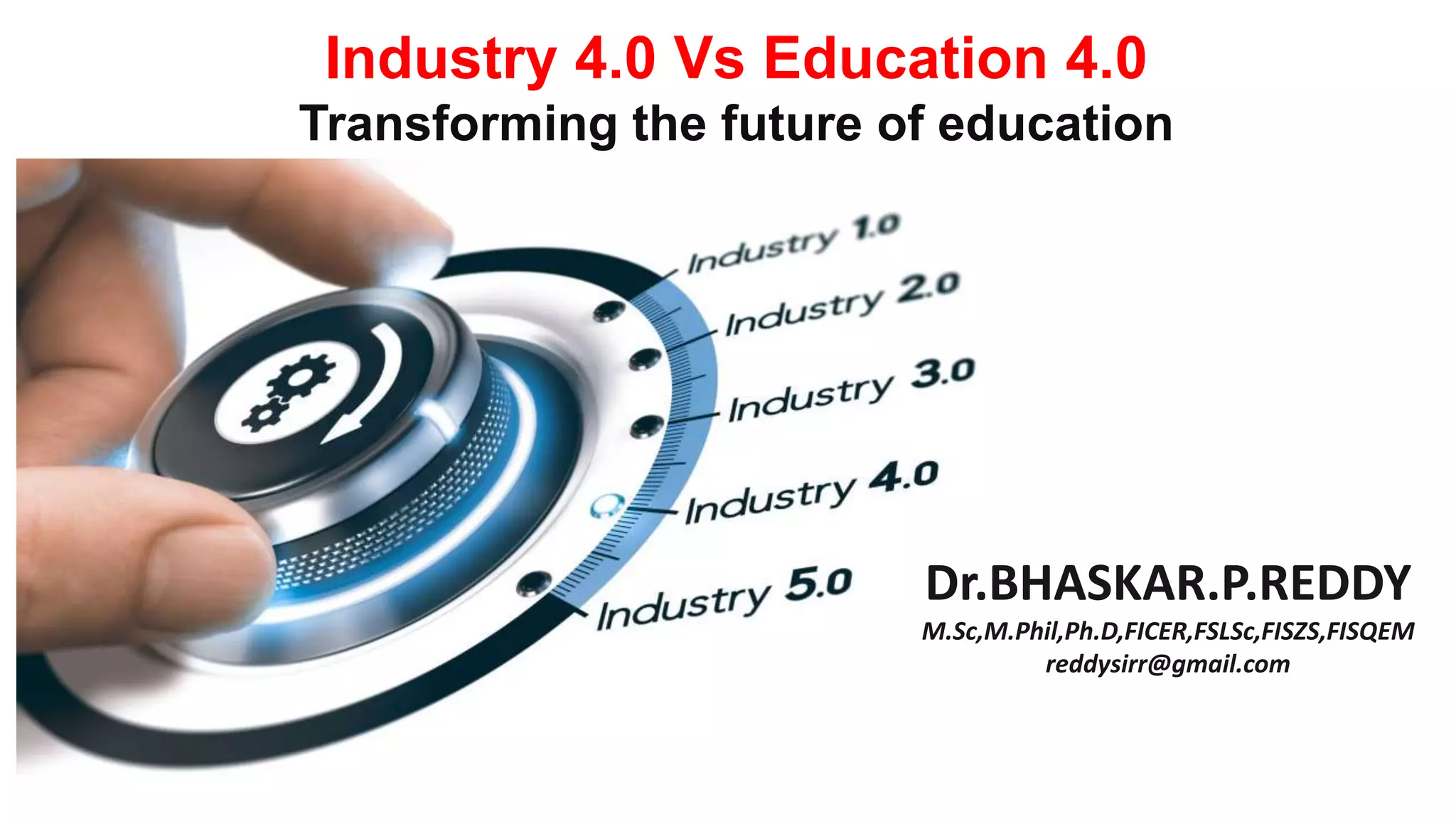
Industry 4.0 Vs Education 4.0
Transforming the future of education
Dr.BHASKAR.P.REDDY
M.Sc,M.Phil,Ph.D,FICER,FSLSc,FISZS,FISQEM
reddysirr@gmail.com
Education = is concerned with methods of teaching and
learning or it is the process of teaching and learning.
Purpose= is to provide the opportunity for acquiring
knowledge and skills that will enable people to develop their
full potential, and become successful members of society. It
also makes man the smartest creature on earth. It empowers
humans and gets them ready to face challenges of life
efficiently.
Education certainly determines the quality of an individual's
life. Education improves one's knowledge, skills and develops
the personality and attitude. Most noteworthy, Education
affects the chances of employment for people.
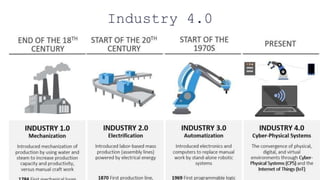
Industry 4.0
What is Industry 4.0?
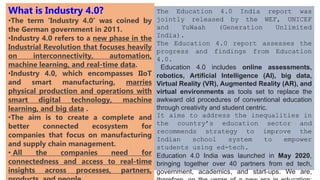
•The term ‘Industry 4.0’ was coined by
the German government in 2011.
•Industry 4.0 refers to a new phase in the
Industrial Revolution that focuses heavily
on interconnectivity, automation,
machine learning, and real-time data.
•Industry 4.0, which encompasses IIoT
and smart manufacturing, marries
physical production and operations with
smart digital technology, machine
learning, and big data .
•The aim is to create a complete and
better connected ecosystem for
companies that focus on manufacturing
and supply chain management.
• All the companies need for
connectedness and access to real-time
insights across processes, partners,
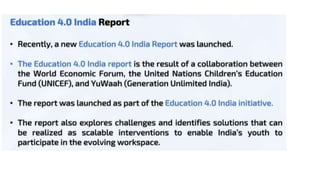
The Education 4.0 India report was
jointly released by the WEF, UNICEF
and YuWaah (Generation Unlimited
India).
The Education 4.0 report assesses the
progress and findings from Education
4.0.
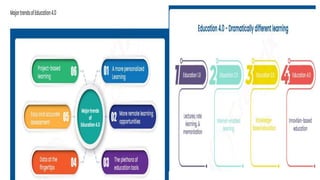
Education 4.0 includes online assessments,
robotics, Artificial Intelligence (AI), big data,
Virtual Reality (VR), Augmented Reality (AR), and
virtual environments as tools set to replace the
awkward old procedures of conventional education
through creativity and student centric.
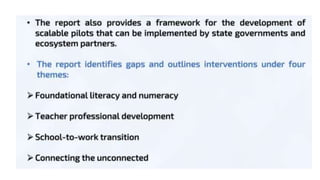
It aims to address the inequalities in
the country’s education sector and
recommends strategy to improve the
Indian school system to empower
students using ed-tech.
Education 4.0 India was launched in May 2020,
bringing together over 40 partners from ed tech,
government, academics, and start-ups. We are,
Industry 4.0 is revolutionizing the way companies manufacture,
improve and distribute their products. Manufacturers are integrating
new technologies, including Internet of Things (IoT), cloud
computing and analytics, and AI and machine learning into their
production facilities and throughout their operations.
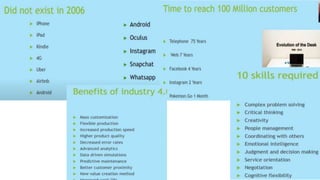
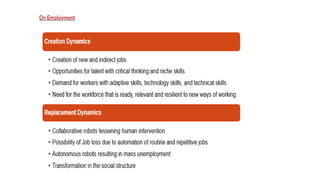
Industry 4.0 is radically transforming the employment landscape as
well as the future skills requirements for jobs. This demand for new
skills will prove challenging to education 4.0 as it will prepare the
youth of tomorrow to develop those much-needed skills.
Industry 4.0 is going to change the way we work, the way
we live, the way we think and the way we relate things with
other. One of the major components of industry 4.0 is
Artificial Intelligence (AI). It enables machines to think,
learn and in decision making also.
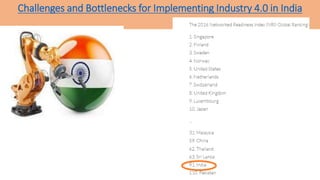
Challenges and Bottlenecks for Implementing Industry 4.0 in India
 Falling Behind
Based on the rankings above, India so behind in Industry 4.0 implementation India risks remaining at the same low rank even
a few years from now. Prime minister Narendra Modi’s “Make in India” initiative places India in direct competition with China.
However, unless we implement Industry 4.0 concepts, India will never reach the level that China has set. Industrial companies
must take different approaches to leveraging the power of IIoT in these challenging times, and reforming the operating model
with IIoT solutions will prove to be very helpful.
Challenges Facing India’s Adoption
1.High cost of scaling
2.Lack of resources/knowledge to scale
3.Lack of data analytics skills in-house
4.Jugaad attitude from the plant-floor to management level
5.Lack of courage among investors or management.
6.Lack of trust and a fear of failure
7.Lack of interest in innovation
8.Lack of coordination from management
9.Less support from shop-floor employees
10.Risks to data security
11.Unclear budget value presented by the project head
12.Lack of leadership support and attention
13.Too many stakeholders
14.India’s political situation and policies
Sagar presentation.pptx

Sagar presentation.pptx

  • 1.
    Industry 4.0 VsEducation 4.0 Transforming the future of education Dr.BHASKAR.P.REDDY M.Sc,M.Phil,Ph.D,FICER,FSLSc,FISZS,FISQEM reddysirr@gmail.com
  • 3.
    Education = isconcerned with methods of teaching and learning or it is the process of teaching and learning. Purpose= is to provide the opportunity for acquiring knowledge and skills that will enable people to develop their full potential, and become successful members of society. It also makes man the smartest creature on earth. It empowers humans and gets them ready to face challenges of life efficiently. Education certainly determines the quality of an individual's life. Education improves one's knowledge, skills and develops the personality and attitude. Most noteworthy, Education affects the chances of employment for people.
  • 4.
  • 7.
    What is Industry4.0? •The term ‘Industry 4.0’ was coined by the German government in 2011. •Industry 4.0 refers to a new phase in the Industrial Revolution that focuses heavily on interconnectivity, automation, machine learning, and real-time data. •Industry 4.0, which encompasses IIoT and smart manufacturing, marries physical production and operations with smart digital technology, machine learning, and big data . •The aim is to create a complete and better connected ecosystem for companies that focus on manufacturing and supply chain management. • All the companies need for connectedness and access to real-time insights across processes, partners, The Education 4.0 India report was jointly released by the WEF, UNICEF and YuWaah (Generation Unlimited India). The Education 4.0 report assesses the progress and findings from Education 4.0. Education 4.0 includes online assessments, robotics, Artificial Intelligence (AI), big data, Virtual Reality (VR), Augmented Reality (AR), and virtual environments as tools set to replace the awkward old procedures of conventional education through creativity and student centric. It aims to address the inequalities in the country’s education sector and recommends strategy to improve the Indian school system to empower students using ed-tech. Education 4.0 India was launched in May 2020, bringing together over 40 partners from ed tech, government, academics, and start-ups. We are,
  • 8.
    Industry 4.0 isrevolutionizing the way companies manufacture, improve and distribute their products. Manufacturers are integrating new technologies, including Internet of Things (IoT), cloud computing and analytics, and AI and machine learning into their production facilities and throughout their operations. Industry 4.0 is radically transforming the employment landscape as well as the future skills requirements for jobs. This demand for new skills will prove challenging to education 4.0 as it will prepare the youth of tomorrow to develop those much-needed skills. Industry 4.0 is going to change the way we work, the way we live, the way we think and the way we relate things with other. One of the major components of industry 4.0 is Artificial Intelligence (AI). It enables machines to think, learn and in decision making also.
  • 15.
    Challenges and Bottlenecksfor Implementing Industry 4.0 in India
  • 16.
     Falling Behind Basedon the rankings above, India so behind in Industry 4.0 implementation India risks remaining at the same low rank even a few years from now. Prime minister Narendra Modi’s “Make in India” initiative places India in direct competition with China. However, unless we implement Industry 4.0 concepts, India will never reach the level that China has set. Industrial companies must take different approaches to leveraging the power of IIoT in these challenging times, and reforming the operating model with IIoT solutions will prove to be very helpful. Challenges Facing India’s Adoption 1.High cost of scaling 2.Lack of resources/knowledge to scale 3.Lack of data analytics skills in-house 4.Jugaad attitude from the plant-floor to management level 5.Lack of courage among investors or management. 6.Lack of trust and a fear of failure 7.Lack of interest in innovation 8.Lack of coordination from management 9.Less support from shop-floor employees 10.Risks to data security 11.Unclear budget value presented by the project head 12.Lack of leadership support and attention 13.Too many stakeholders 14.India’s political situation and policies