A Framework for
Flood Risk Management
An Introduction
Dr John Porter
A good place to start if we want to prepare a
strategic framework for managing flood risk is
to define flood risk.
What is flood risk?
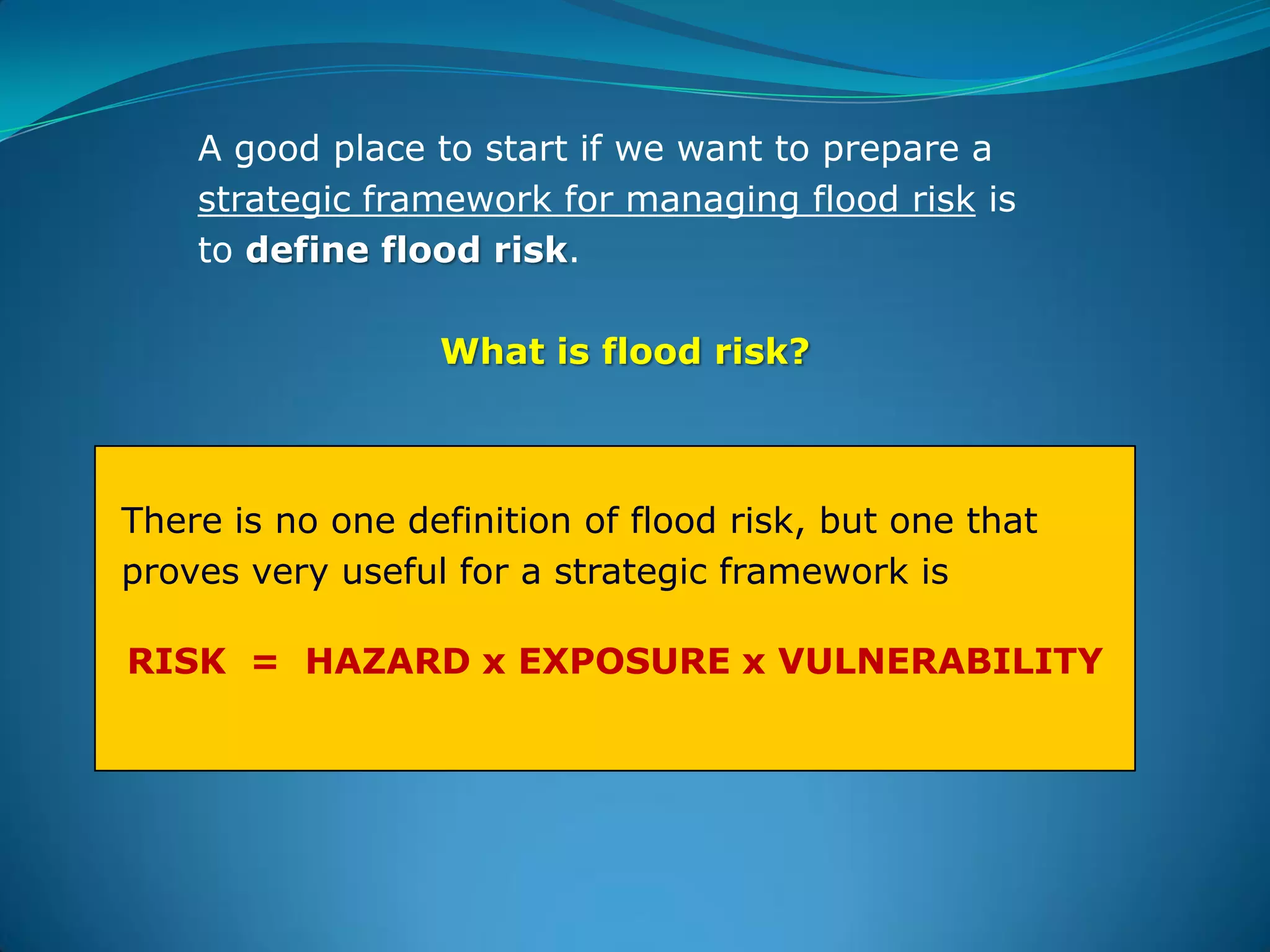
There is no one definition of flood risk, but one that
proves very useful for a strategic framework is
RISK = HAZARD x EXPOSURE x VULNERABILITY
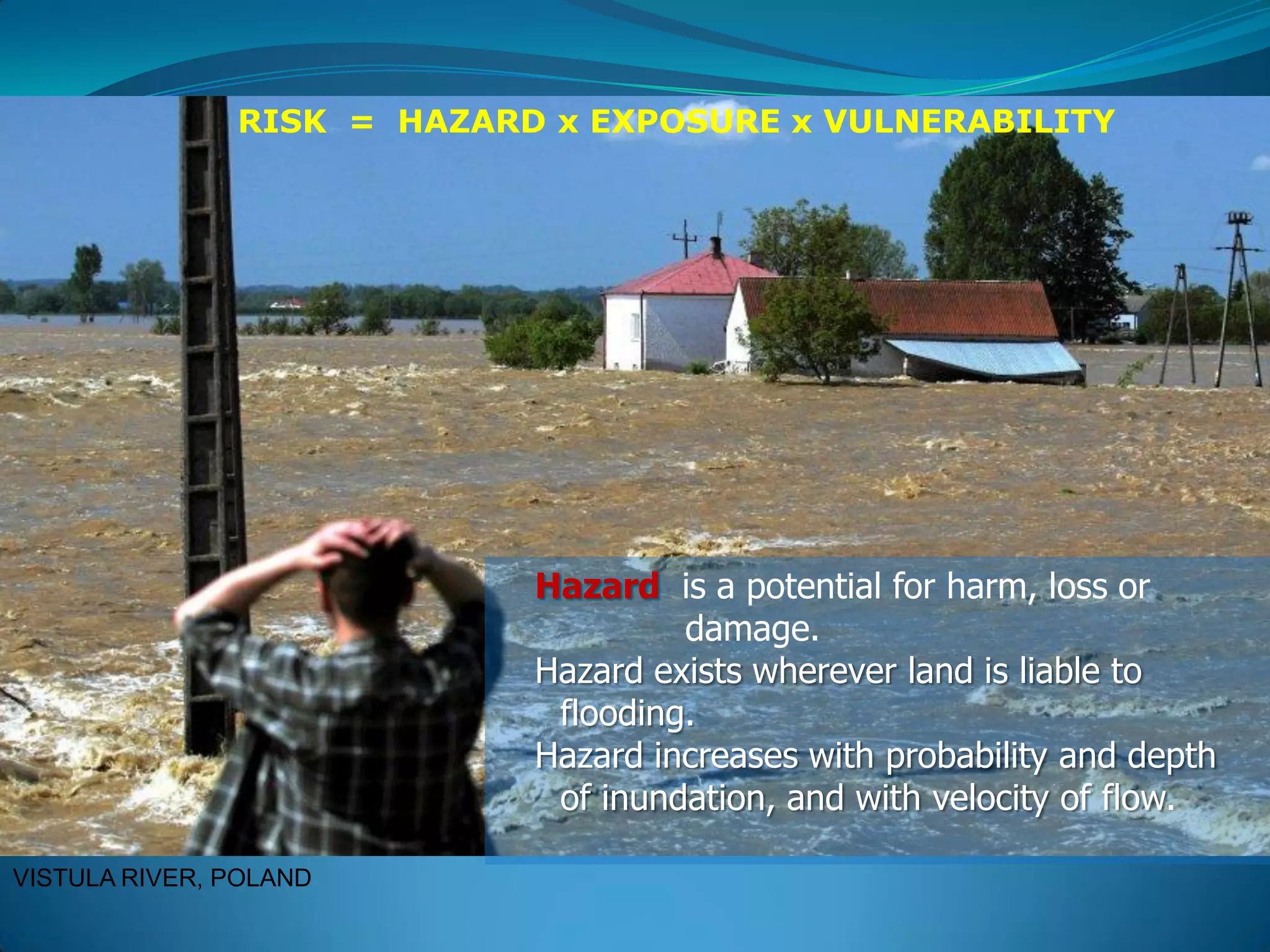
Hazard is a potential for harm, loss or damage.
Hazard exists wherever land is liable to flooding.
Hazard increases with probability and depth of inundation, and
with velocity of flow.
RISK = HAZARD x EXPOSURE x VULNERABILITY
Hazard is a potential for harm, loss or
damage.
Hazard exists wherever land is liable to
flooding.
Hazard increases with probability and depth
of inundation, and with velocity of flow.
VISTULA RIVER, POLAND
RISK = HAZARD x EXPOSURE x VULNERABILITY
Exposure
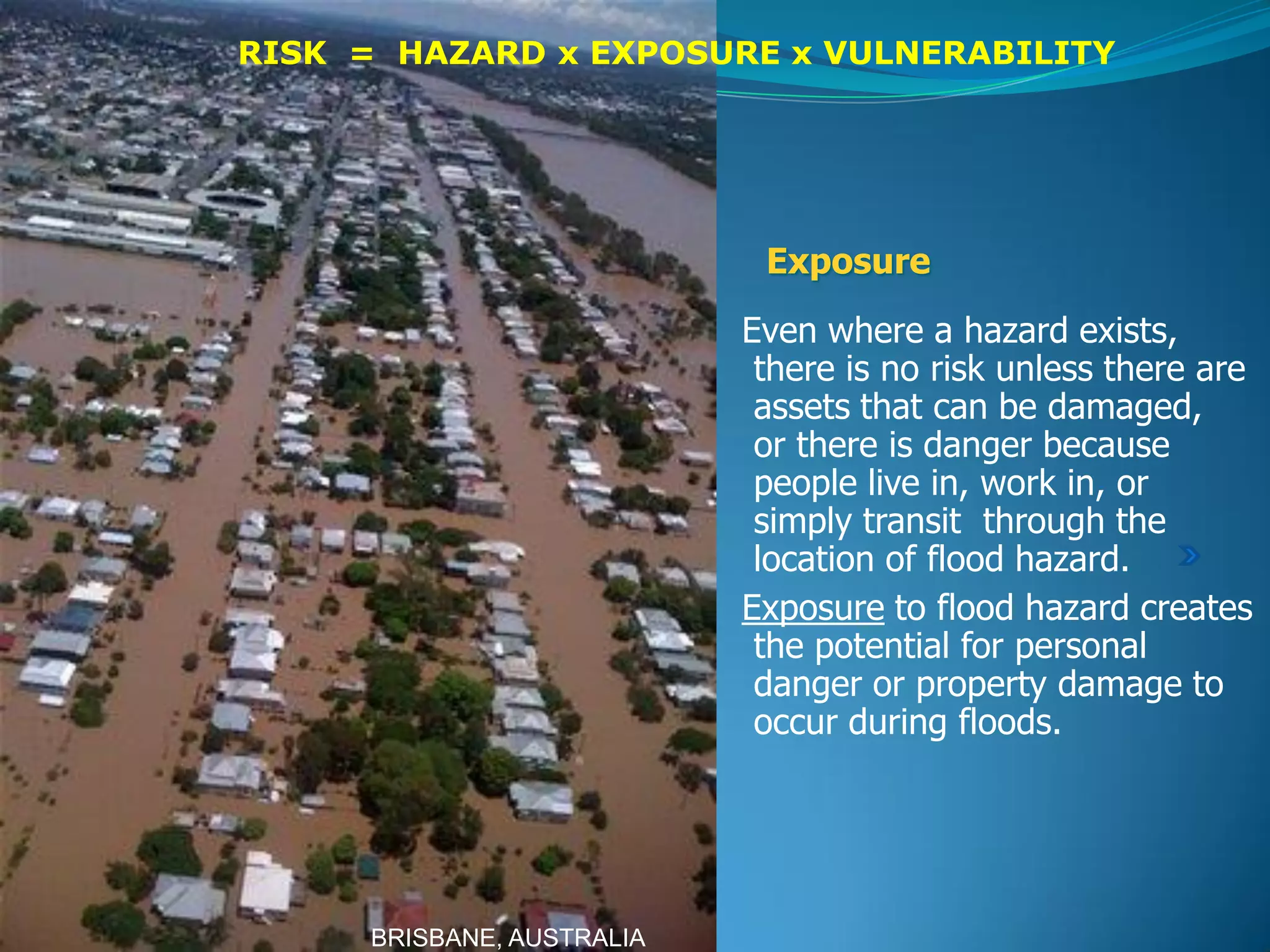
Even where a hazard exists,
there is no risk unless there are
assets that can be damaged,
or there is danger because
people live in, work in, or
simply transit through the
location of flood hazard.
Exposure to flood hazard creates
the potential for personal
danger or property damage to
occur during floods.
BRISBANE, AUSTRALIA
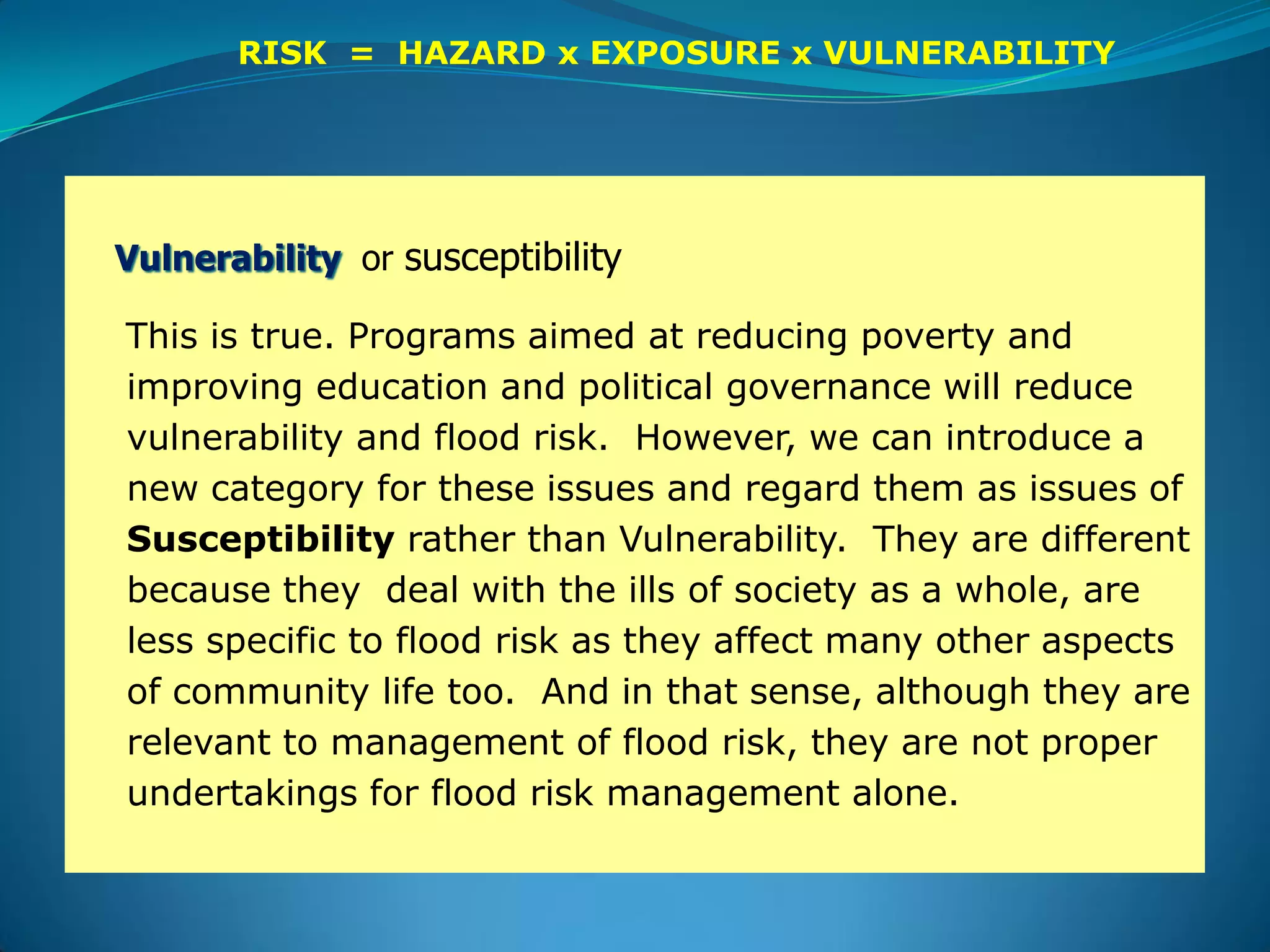
RISK = HAZARD x EXPOSURE x VULNERABILITY
The consequences of flooding – and therefore the risk – also
depends on how vulnerable people and their assets are to danger
and damage.
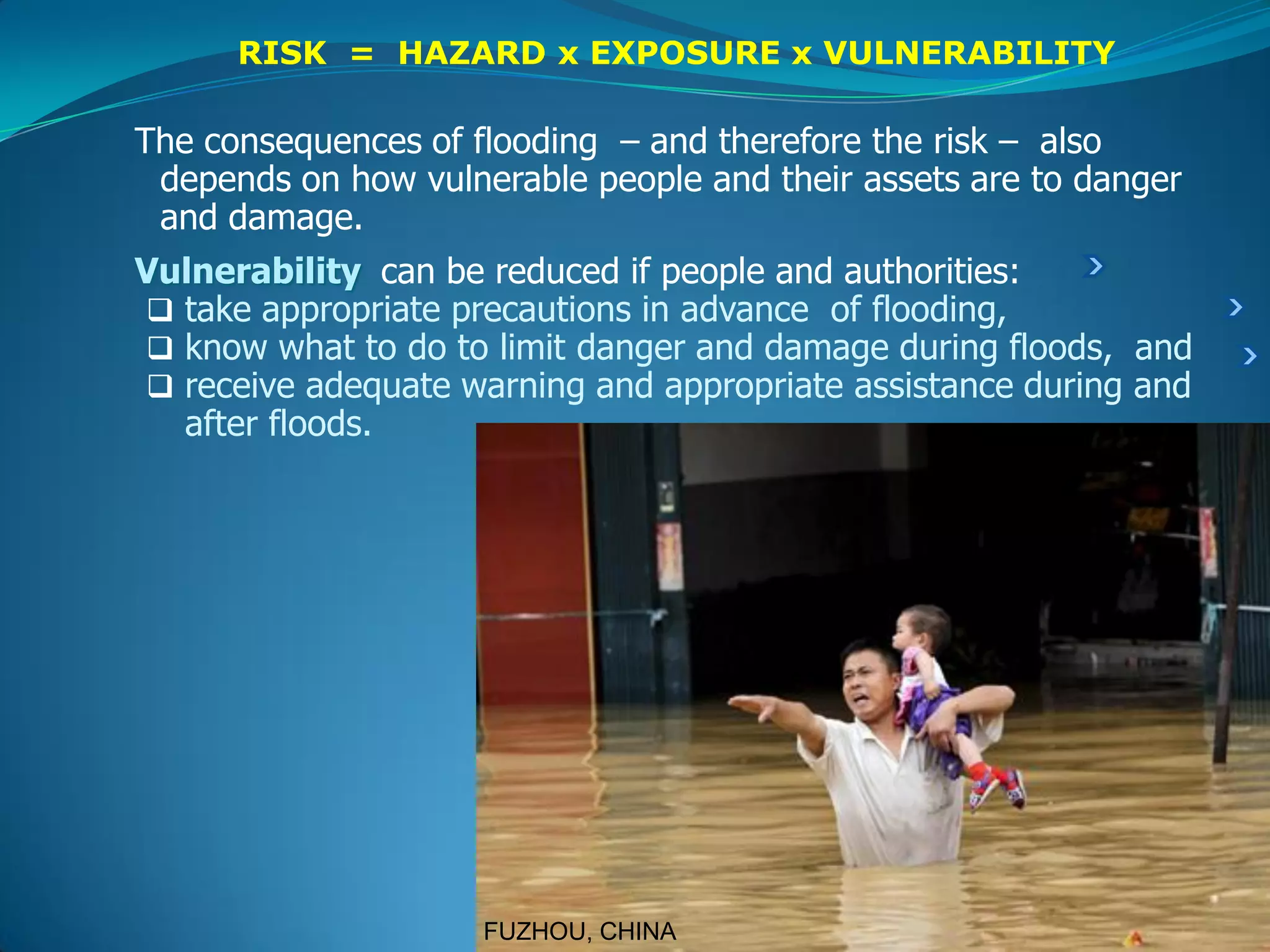
Vulnerability can be reduced if people and authorities:
 take appropriate precautions in advance of flooding,
 know what to do to limit danger and damage during floods, and
 receive adequate warning and appropriate assistance during and
after floods.
FUZHOU, CHINA
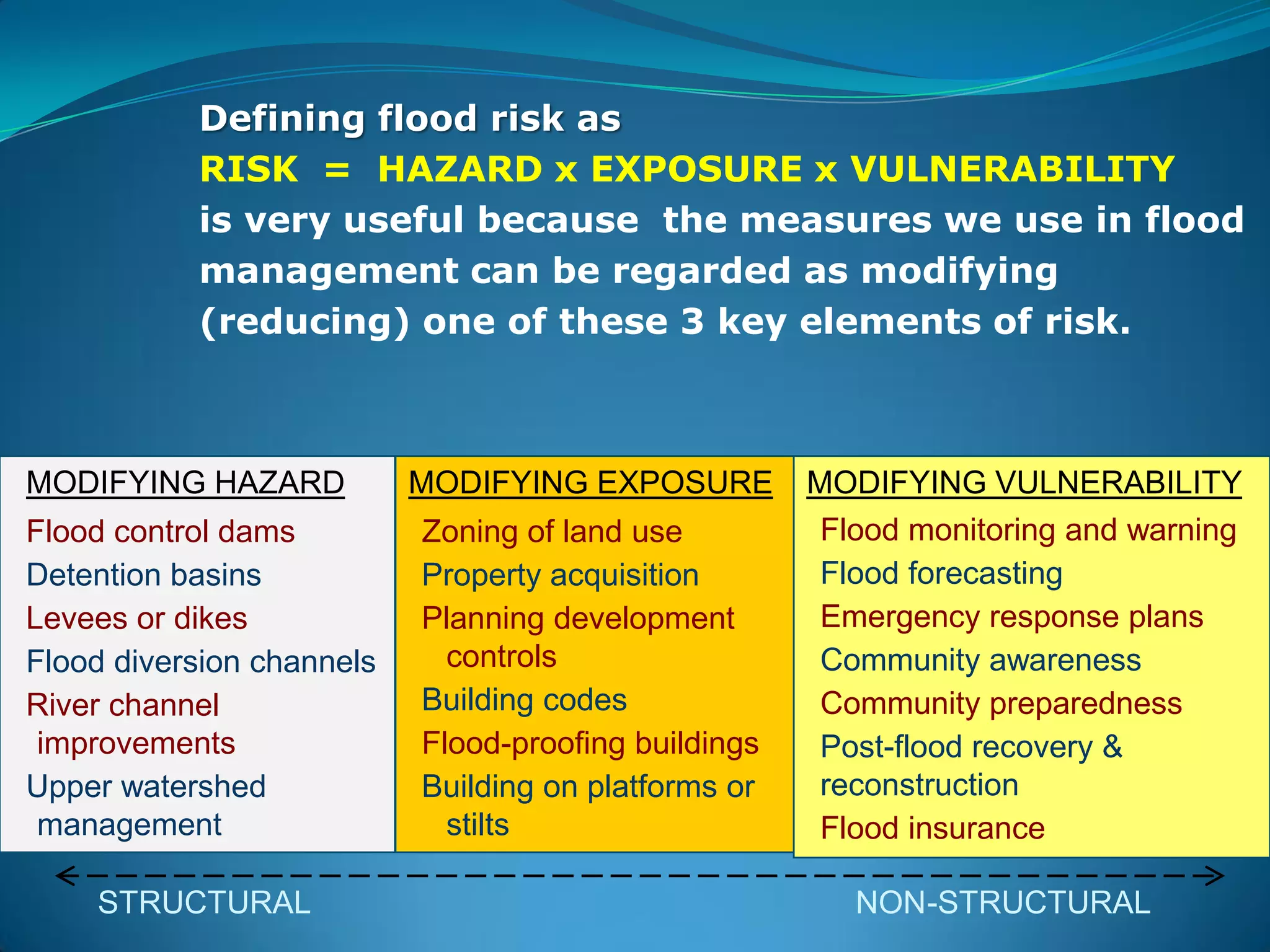
Defining flood risk as
RISK = HAZARD x EXPOSURE x VULNERABILITY
is very useful because the measures we use in flood
management can be regarded as modifying
(reducing) one of these 3 key elements of risk.
MODIFYING HAZARD
Flood control dams
Detention basins
Levees or dikes
Flood diversion channels
River channel
improvements
Upper watershed
management
MODIFYING EXPOSURE
Zoning of land use
Property acquisition
Planning development
controls
Building codes
Flood-proofing buildings
Building on platforms or
stilts
MODIFYING VULNERABILITY
Flood monitoring and warning
Flood forecasting
Emergency response plans
Community awareness
Community preparedness
Post-flood recovery &
reconstruction
Flood insurance
STRUCTURAL NON-STRUCTURAL
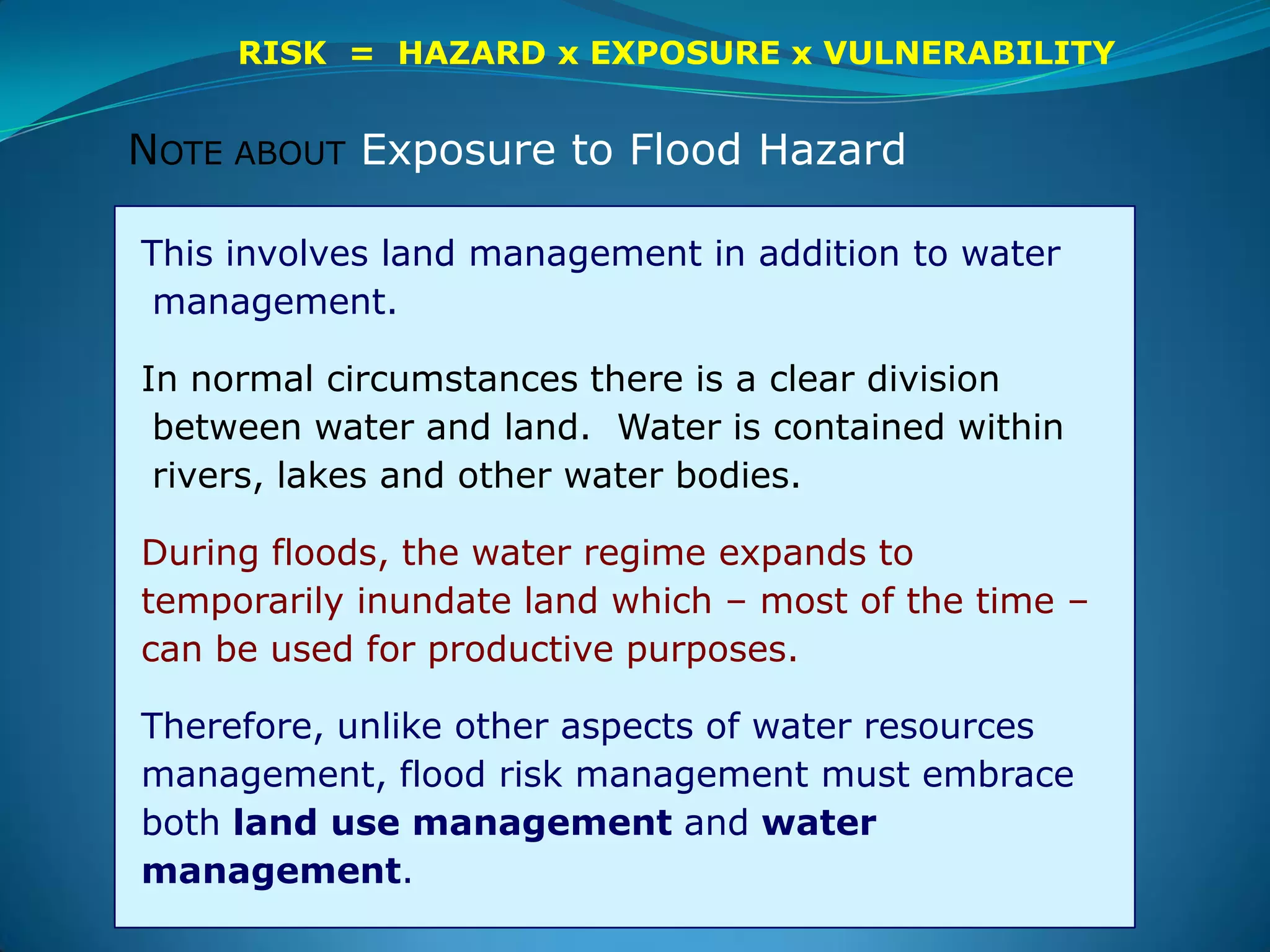
This involves land management in addition to water
management.
In normal circumstances there is a clear division
between water and land. Water is contained within
rivers, lakes and other water bodies.
During floods, the water regime expands to
temporarily inundate land which – most of the time –
can be used for productive purposes.
Therefore, unlike other aspects of water resources
management, flood risk management must embrace
both land use management and water
management.
RISK = HAZARD x EXPOSURE x VULNERABILITY
NOTE ABOUT Exposure to Flood Hazard
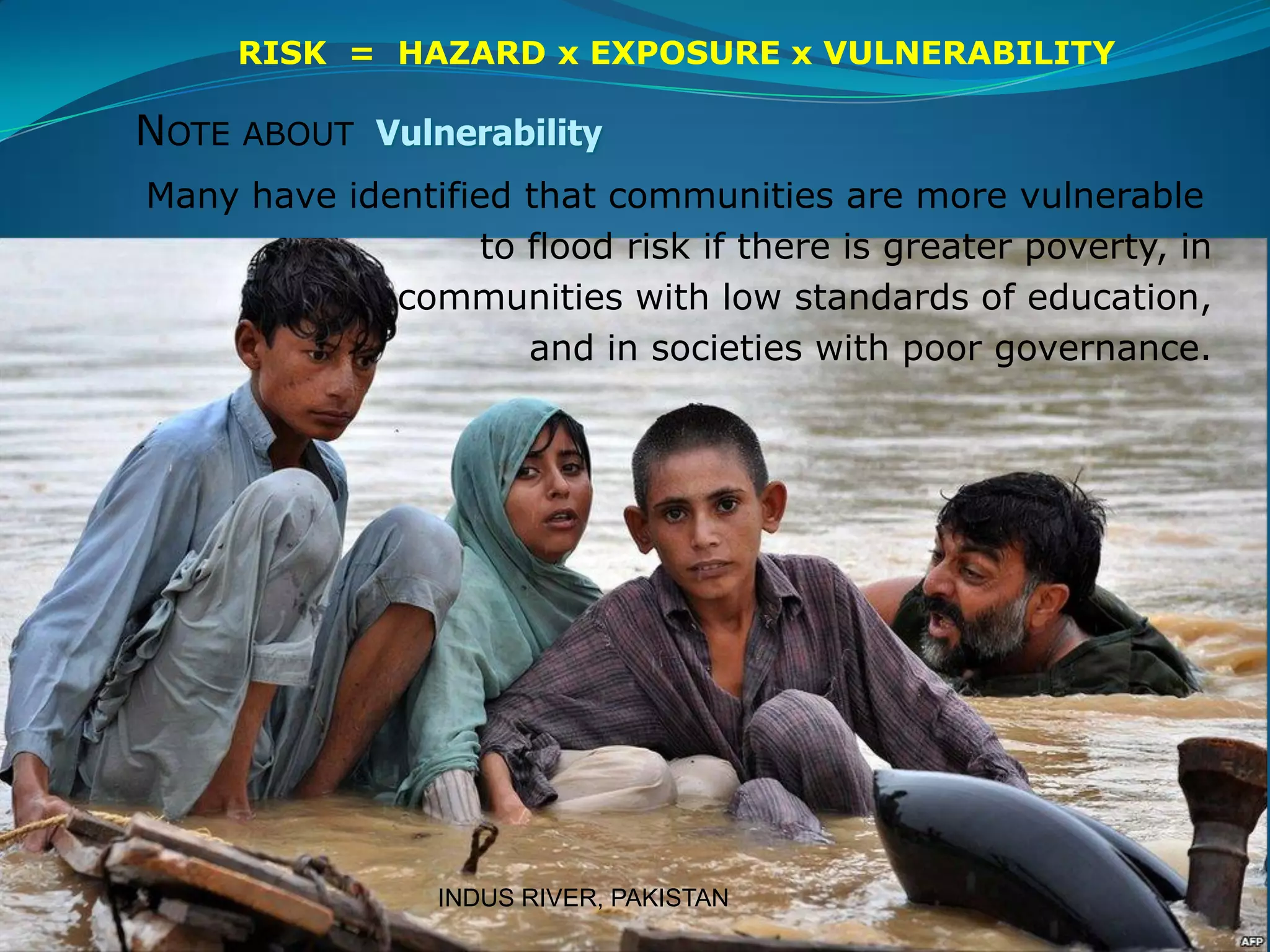
NOTE ABOUT Vulnerability
Many have identified that communities are more vulnerable
to flood risk if there is greater poverty, in
communities with low standards of education,
and in societies with poor governance.
RISK = HAZARD x EXPOSURE x VULNERABILITY
INDUS RIVER, PAKISTAN
Vulnerability or susceptibility
This is true. Programs aimed at reducing poverty and
improving education and political governance will reduce
vulnerability and flood risk. However, we can introduce a
new category for these issues and regard them as issues of
Susceptibility rather than Vulnerability. They are different
because they deal with the ills of society as a whole, are
less specific to flood risk as they affect many other aspects
of community life too. And in that sense, although they are
relevant to management of flood risk, they are not proper
undertakings for flood risk management alone.
RISK = HAZARD x EXPOSURE x VULNERABILITY
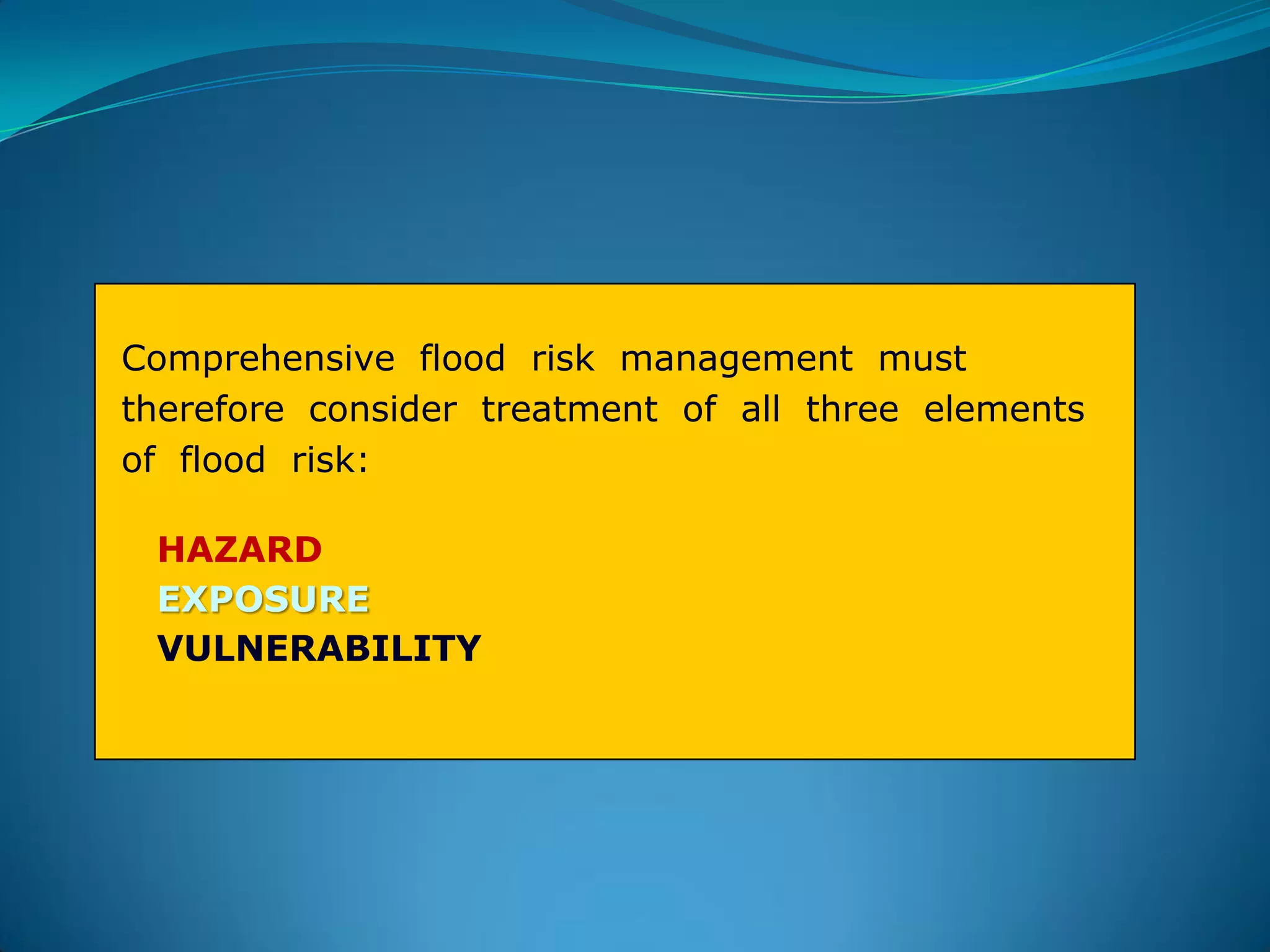
Comprehensive flood risk management must
therefore consider treatment of all three elements
of flood risk:
HAZARD
EXPOSURE
VULNERABILITY
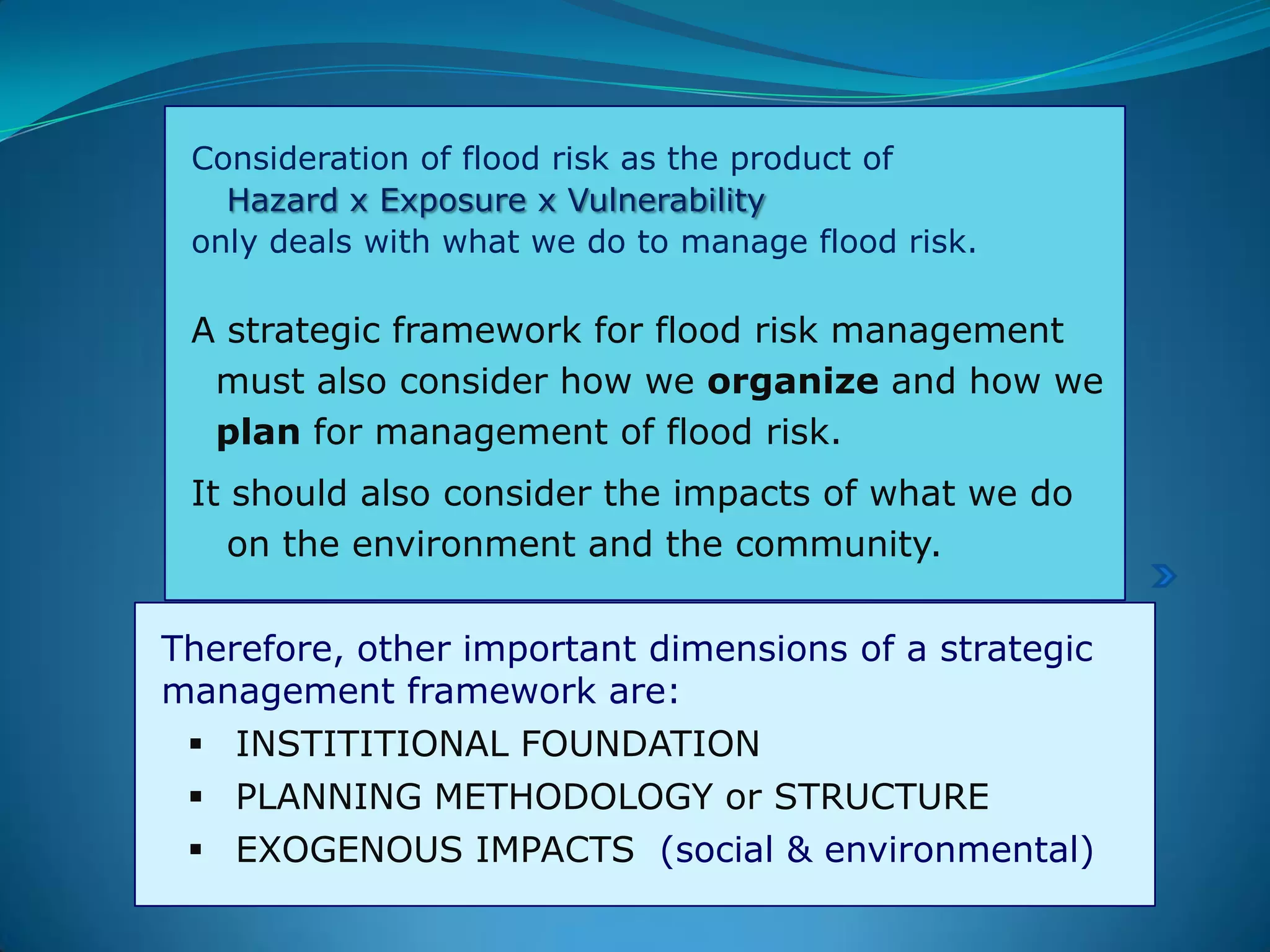
Consideration of flood risk as the product of
Hazard x Exposure x Vulnerability
only deals with what we do to manage flood risk.
A strategic framework for flood risk management
must also consider how we organize and how we
plan for management of flood risk.
It should also consider the impacts of what we do
on the environment and the community.
Therefore, other important dimensions of a strategic
management framework are:
 INSTITITIONAL FOUNDATION
 PLANNING METHODOLOGY or STRUCTURE
 EXOGENOUS IMPACTS (social & environmental)
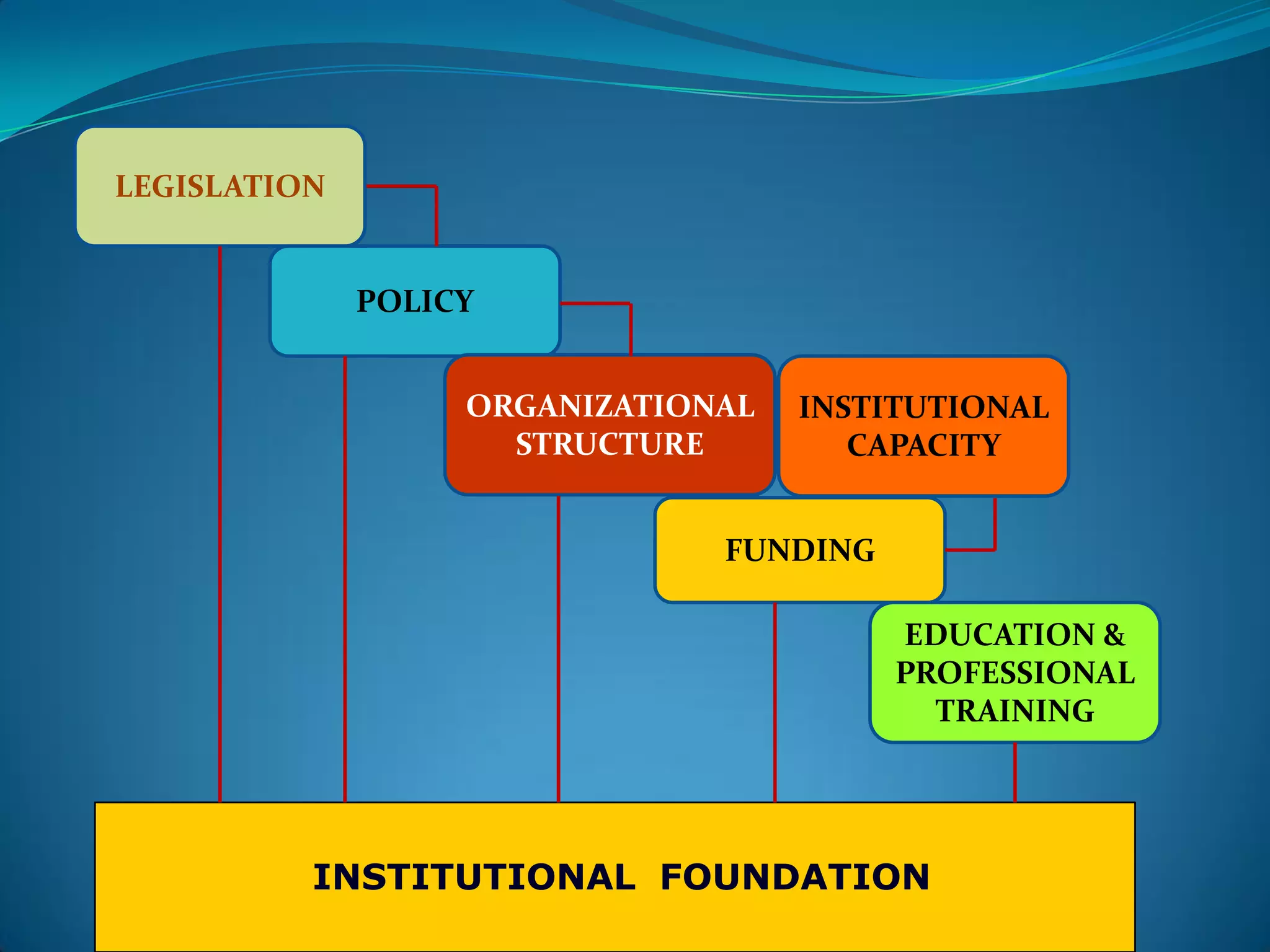
INSTITUTIONAL FOUNDATION
LEGISLATION
POLICY
ORGANIZATIONAL
STRUCTURE
INSTITUTIONAL
CAPACITY
FUNDING
EDUCATION &
PROFESSIONAL
TRAINING
INSTITUTIONAL FOUNDATION
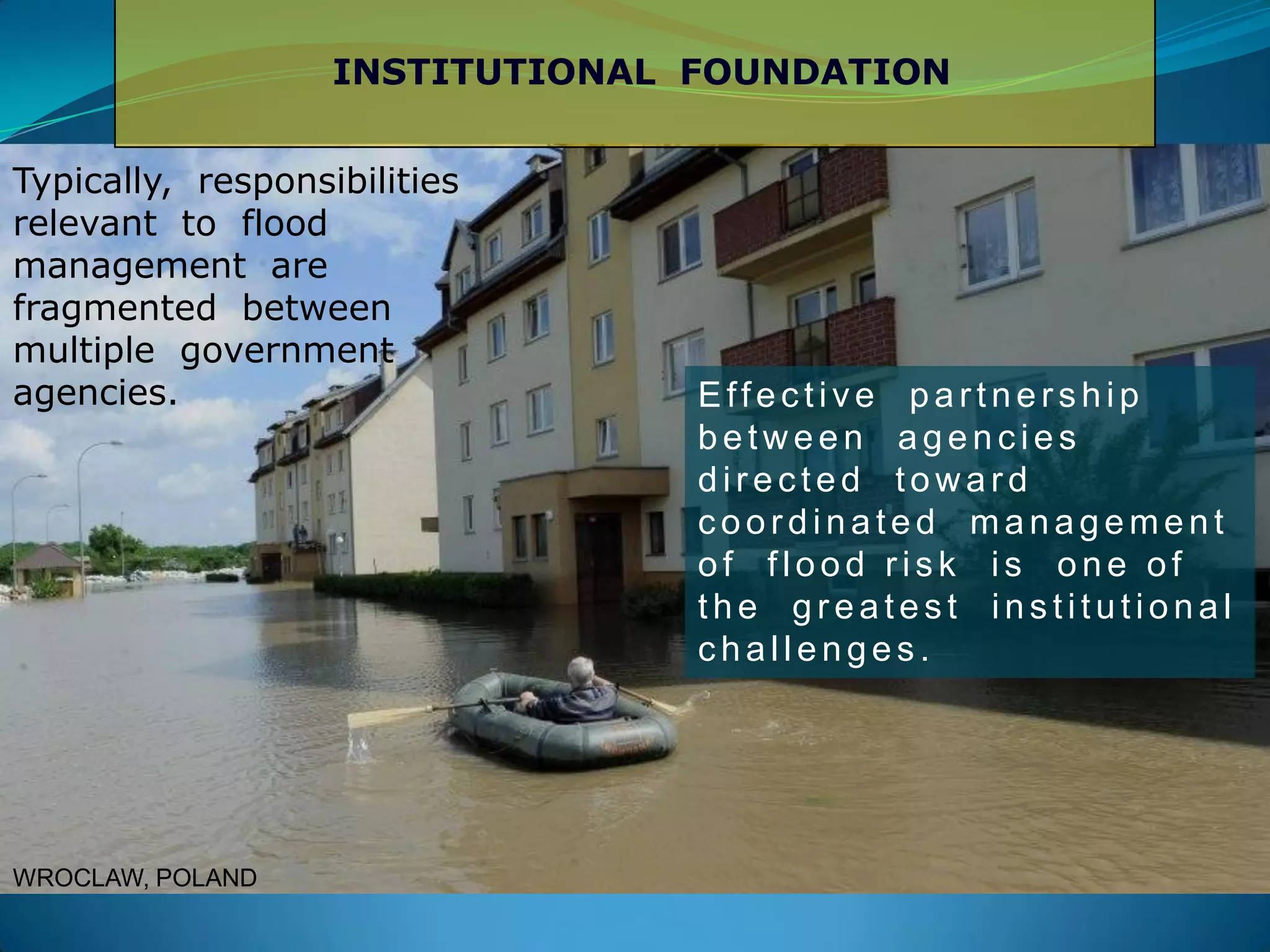
Typically, responsibilities
relevant to flood
management are
fragmented between
multiple government
agencies. Effec tive partners hip
betw een agenc ies
dir ec ted tow ar d
c oor dinated management
of flood ris k is one of
the gr eates t ins titutional
c hallenges .
WROCLAW, POLAND
PLANNING METHODOLOGY
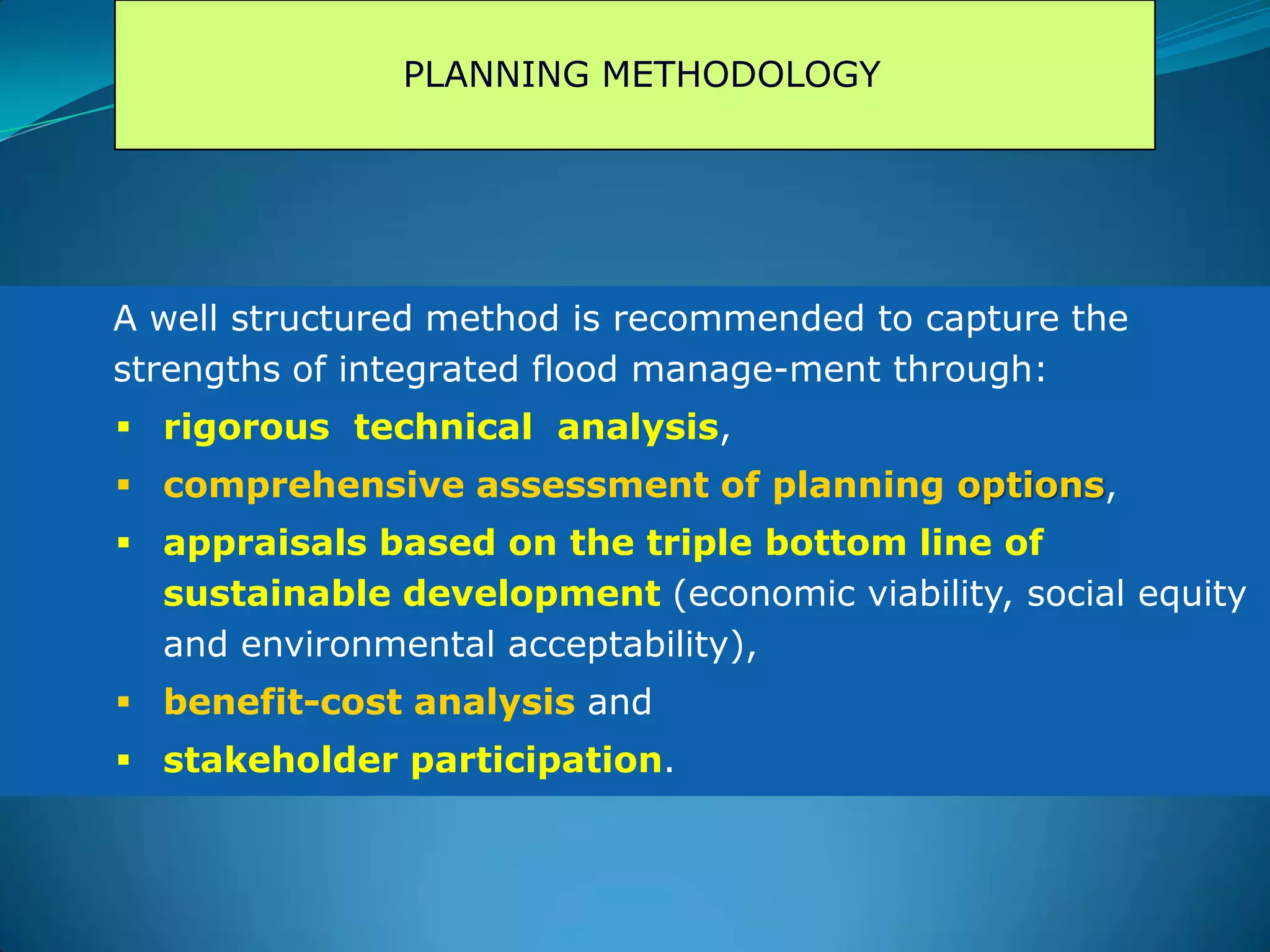
A well structured method is recommended to capture the
strengths of integrated flood manage-ment through:
 rigorous technical analysis,
 comprehensive assessment of planning options,
 appraisals based on the triple bottom line of
sustainable development (economic viability, social equity
and environmental acceptability),
 benefit-cost analysis and
 stakeholder participation.
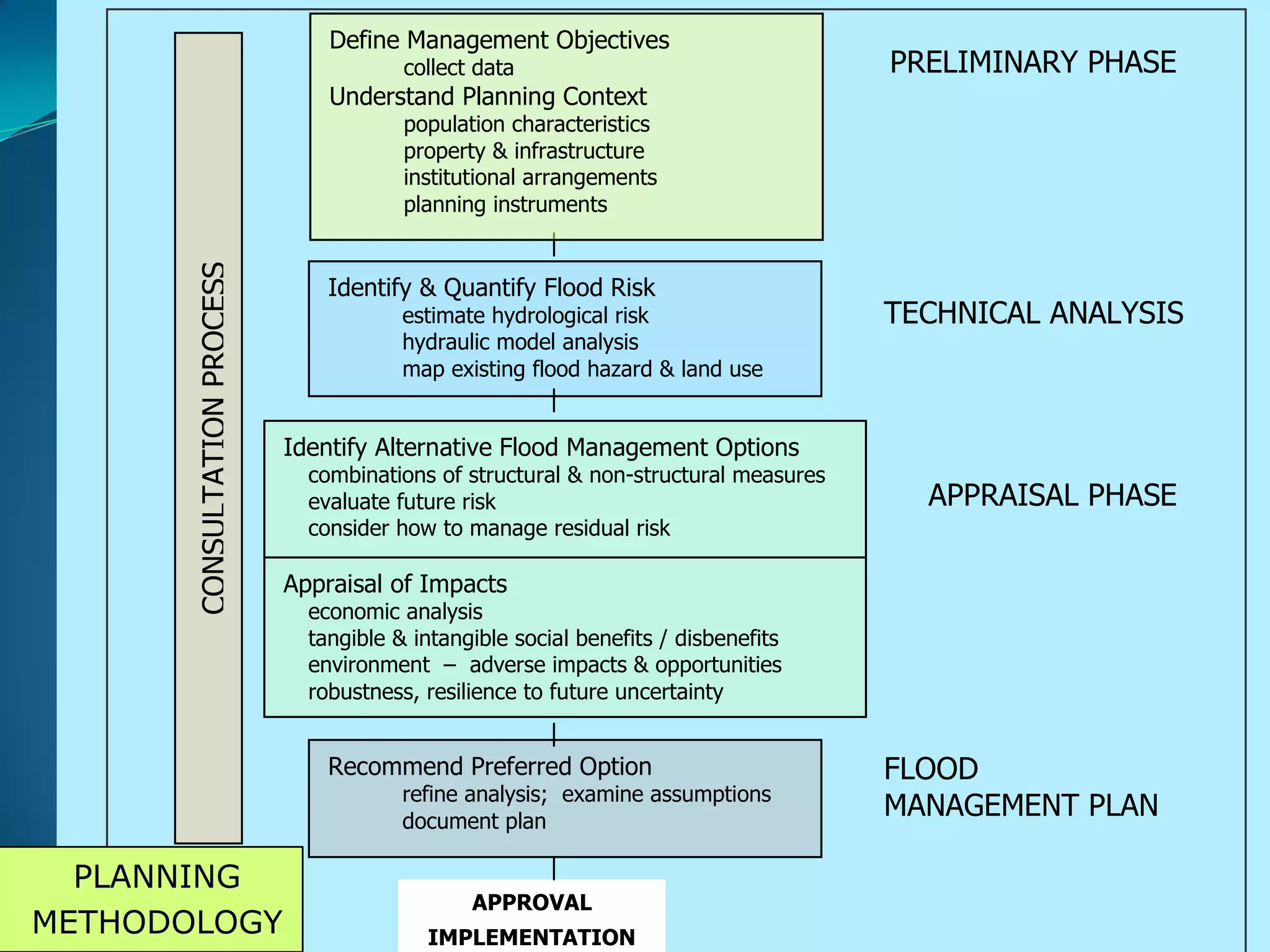
CONSULTATIONPROCESS
PRELIMINARY PHASE
Identify & Quantify Flood Risk
estimate hydrological risk
hydraulic model analysis
map existing flood hazard & land use
TECHNICAL ANALYSIS
Identify Alternative Flood Management Options
combinations of structural & non-structural measures
evaluate future risk
consider how to manage residual risk
Appraisal of Impacts
economic analysis
tangible & intangible social benefits / disbenefits
environment – adverse impacts & opportunities
robustness, resilience to future uncertainty
APPRAISAL PHASE
Recommend Preferred Option
refine analysis; examine assumptions
document plan
FLOOD
MANAGEMENT PLAN
APPROVAL
IMPLEMENTATION
Define Management Objectives
collect data
Understand Planning Context
population characteristics
property & infrastructure
institutional arrangements
planning instruments
PLANNING
METHODOLOGY
PLANNING
METHODOLOGY
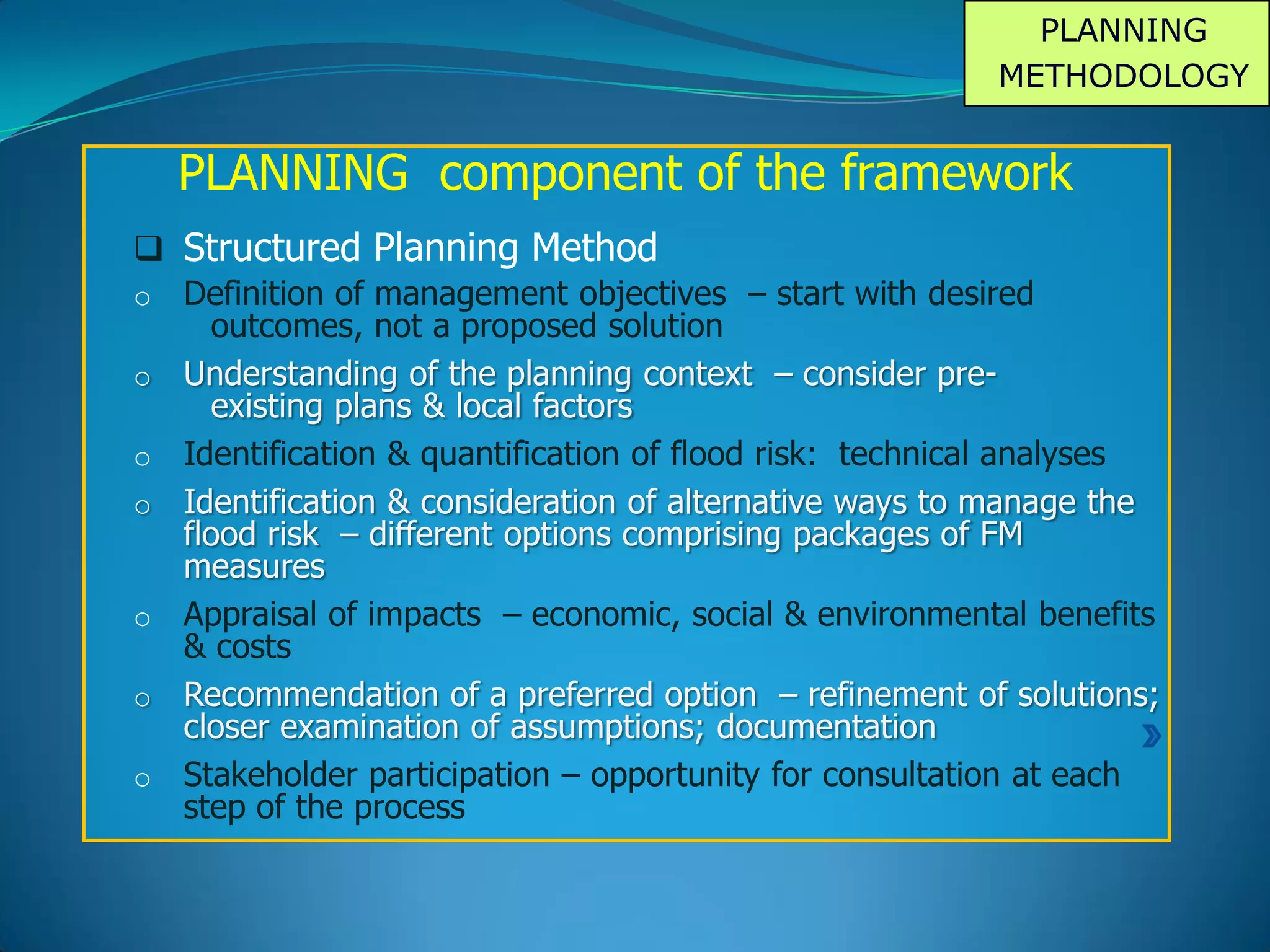
PLANNING component of the framework
 Structured Planning Method
o Definition of management objectives – start with desired
outcomes, not a proposed solution
o Understanding of the planning context – consider pre-
existing plans & local factors
o Identification & quantification of flood risk: technical analyses
o Identification & consideration of alternative ways to manage the
flood risk – different options comprising packages of FM
measures
o Appraisal of impacts – economic, social & environmental benefits
& costs
o Recommendation of a preferred option – refinement of solutions;
closer examination of assumptions; documentation
o Stakeholder participation – opportunity for consultation at each
step of the process
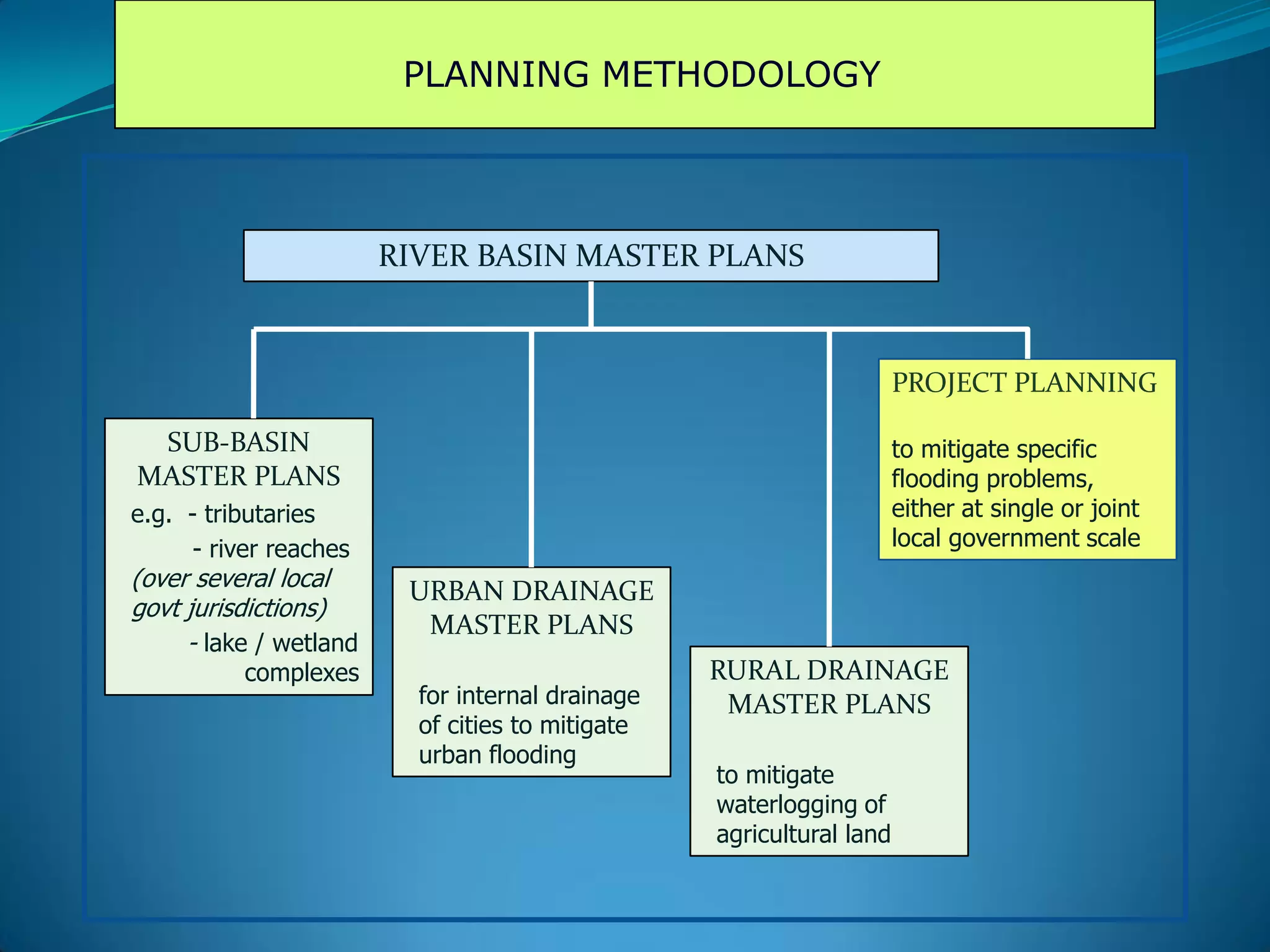
PLANNING METHODOLOGY
RIVER BASIN MASTER PLANS
SUB-BASIN
MASTER PLANS
e.g. - tributaries
- river reaches
(over several local
govt jurisdictions)
- lake / wetland
complexes
URBAN DRAINAGE
MASTER PLANS
for internal drainage
of cities to mitigate
urban flooding
RURAL DRAINAGE
MASTER PLANS
to mitigate
waterlogging of
agricultural land
PROJECT PLANNING
to mitigate specific
flooding problems,
either at single or joint
local government scale
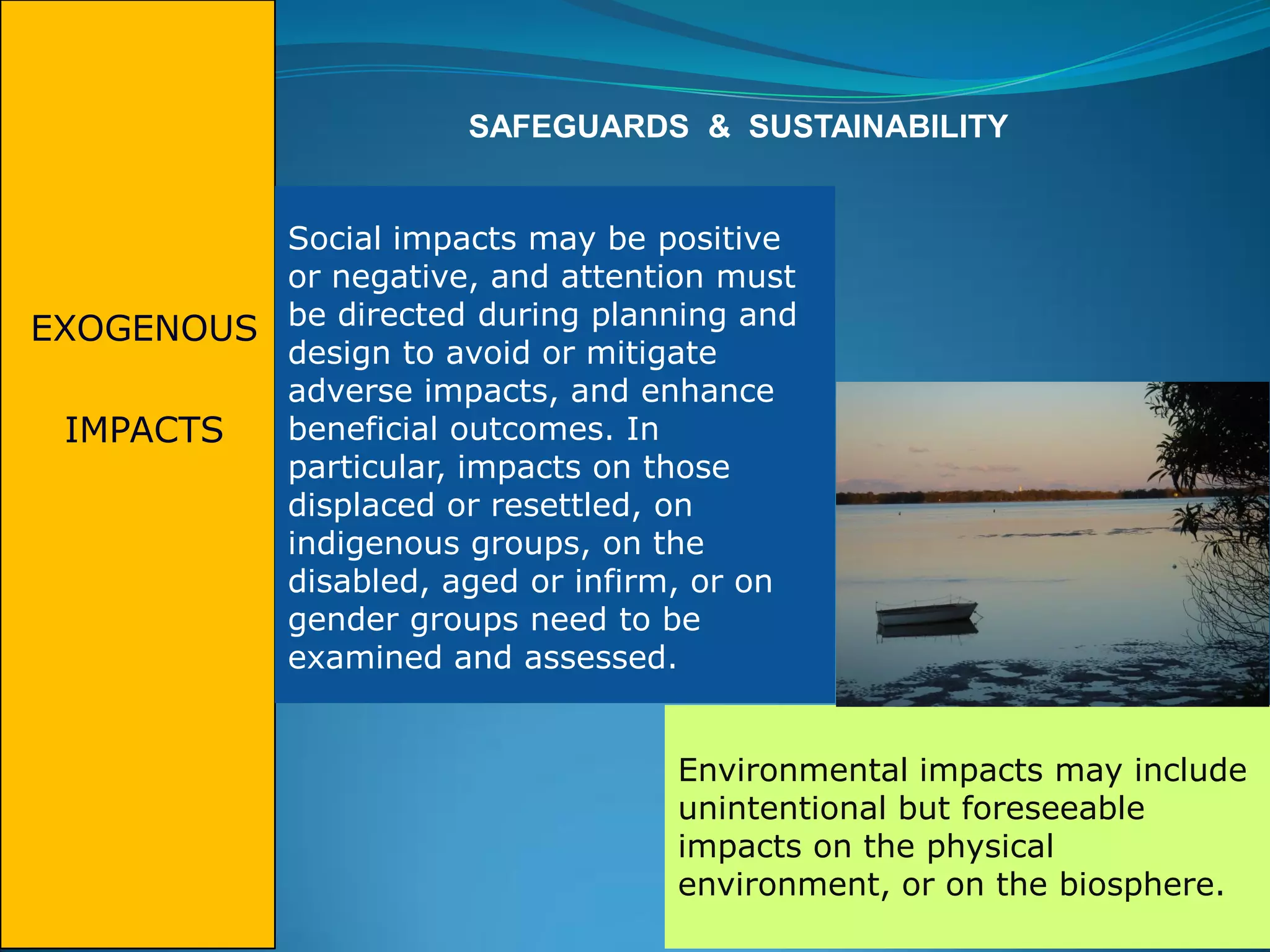
EXOGENOUS
IMPACTS
SAFEGUARDS & SUSTAINABILITY
Social impacts may be positive
or negative, and attention must
be directed during planning and
design to avoid or mitigate
adverse impacts, and enhance
beneficial outcomes. In
particular, impacts on those
displaced or resettled, on
indigenous groups, on the
disabled, aged or infirm, or on
gender groups need to be
examined and assessed.
Environmental impacts may include
unintentional but foreseeable
impacts on the physical
environment, or on the biosphere.
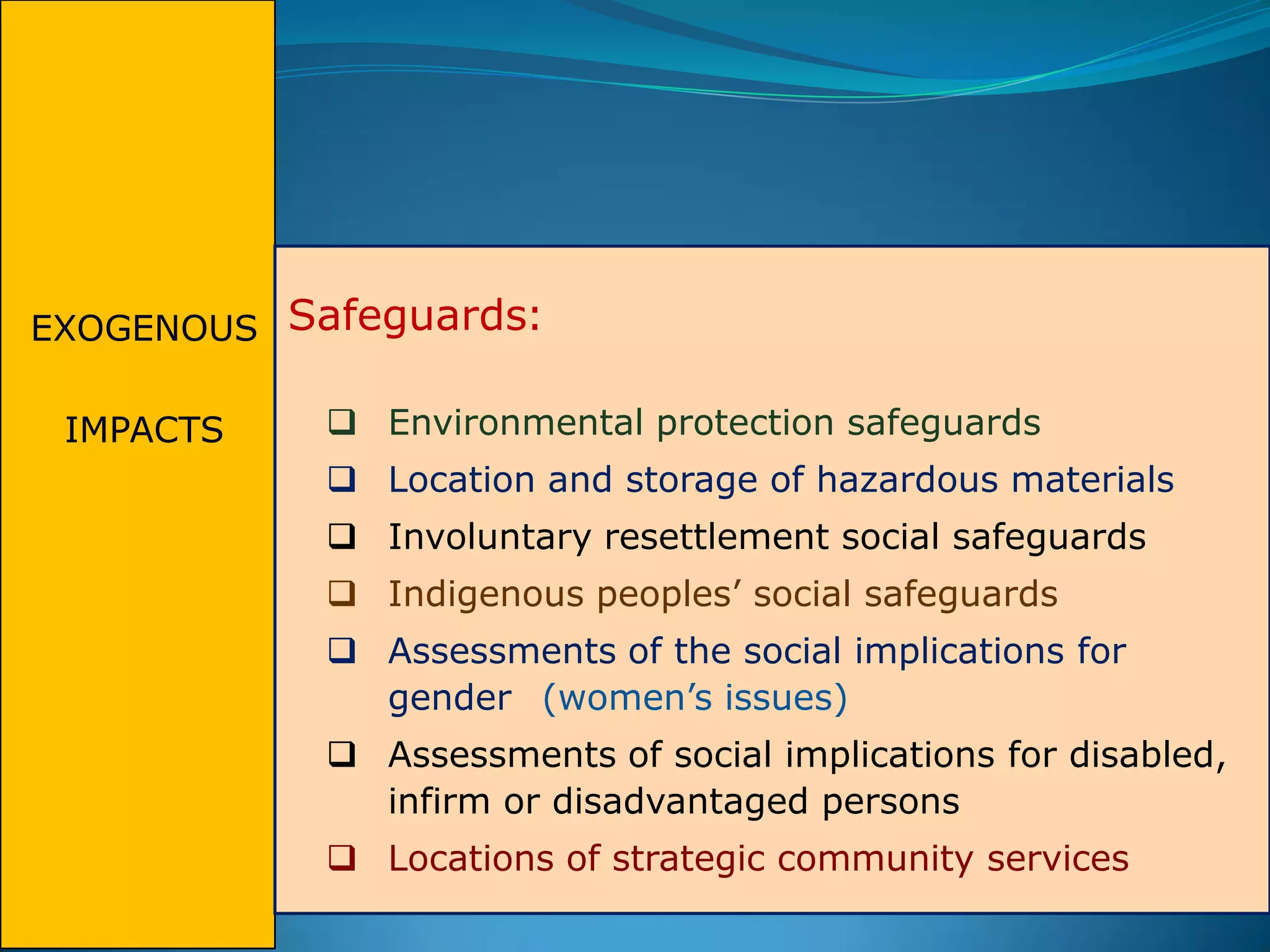
EXOGENOUS
IMPACTS
Safeguards:
 Environmental protection safeguards
 Location and storage of hazardous materials
 Involuntary resettlement social safeguards
 Indigenous peoples’ social safeguards
 Assessments of the social implications for
gender (women’s issues)
 Assessments of social implications for disabled,
infirm or disadvantaged persons
 Locations of strategic community services
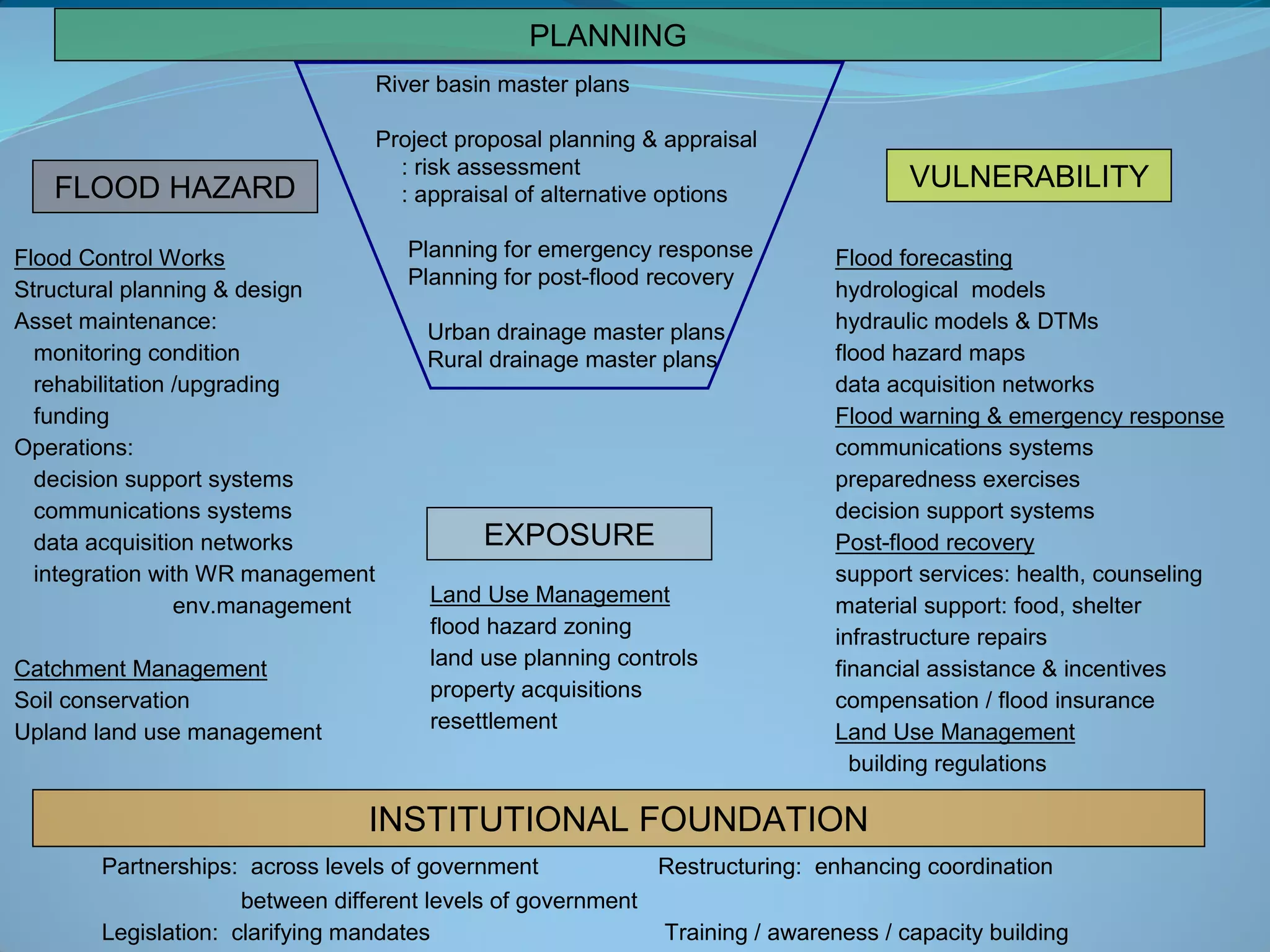
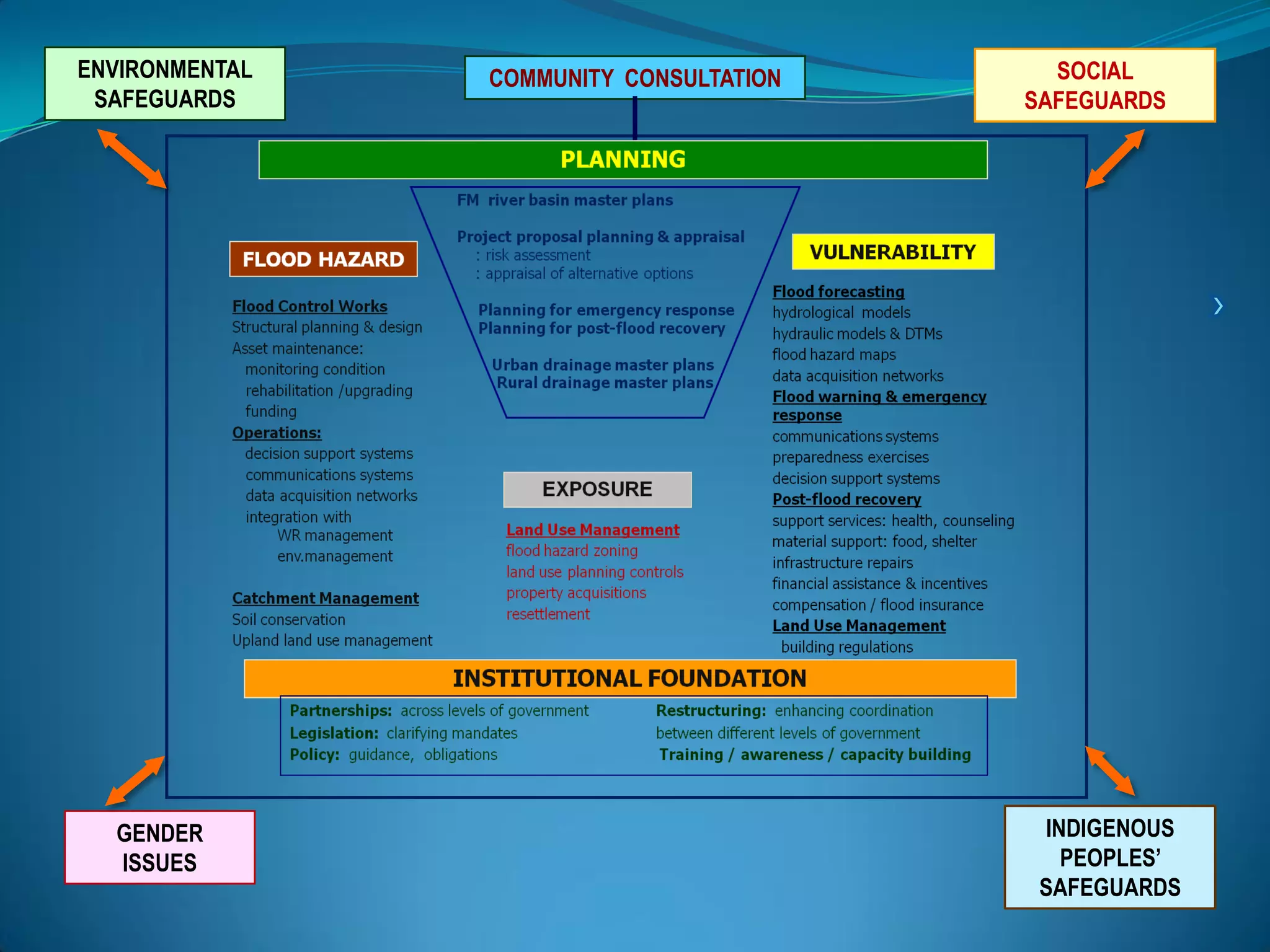
INSTITUTIONAL FOUNDATION
PLANNING
FLOOD HAZARD
EXPOSURE
VULNERABILITY
Flood Control Works
Structural planning & design
Asset maintenance:
monitoring condition
rehabilitation /upgrading
funding
Operations:
decision support systems
communications systems
data acquisition networks
integration with WR management
env.management
Catchment Management
Soil conservation
Upland land use management
Land Use Management
flood hazard zoning
land use planning controls
property acquisitions
resettlement
Flood forecasting
hydrological models
hydraulic models & DTMs
flood hazard maps
data acquisition networks
Flood warning & emergency response
communications systems
preparedness exercises
decision support systems
Post-flood recovery
support services: health, counseling
material support: food, shelter
infrastructure repairs
financial assistance & incentives
compensation / flood insurance
Land Use Management
building regulations
River basin master plans
Project proposal planning & appraisal
: risk assessment
: appraisal of alternative options
Planning for emergency response
Planning for post-flood recovery
Urban drainage master plans
Rural drainage master plans
Partnerships: across levels of government Restructuring: enhancing coordination
between different levels of government
Legislation: clarifying mandates Training / awareness / capacity building
ENVIRONMENTAL
SAFEGUARDS
SOCIAL
SAFEGUARDS
GENDER
ISSUES
INDIGENOUS
PEOPLES’
SAFEGUARDS
COMMUNITY CONSULTATION
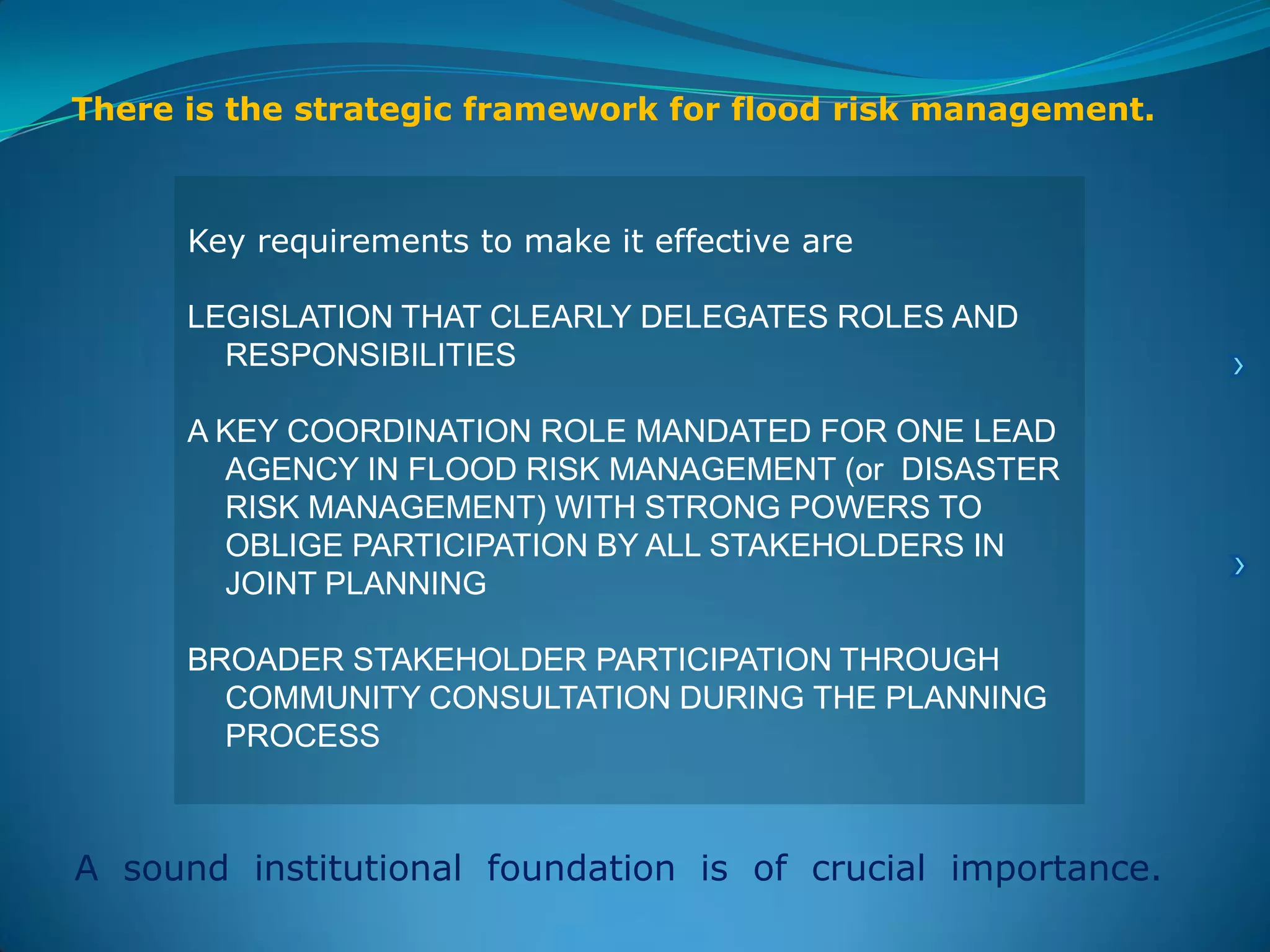
Key requirements to make it effective are
LEGISLATION THAT CLEARLY DELEGATES ROLES AND
RESPONSIBILITIES
A KEY COORDINATION ROLE MANDATED FOR ONE LEAD
AGENCY IN FLOOD RISK MANAGEMENT (or DISASTER
RISK MANAGEMENT) WITH STRONG POWERS TO
OBLIGE PARTICIPATION BY ALL STAKEHOLDERS IN
JOINT PLANNING
BROADER STAKEHOLDER PARTICIPATION THROUGH
COMMUNITY CONSULTATION DURING THE PLANNING
PROCESS
There is the strategic framework for flood risk management.
A sound institutional foundation is of crucial importance.
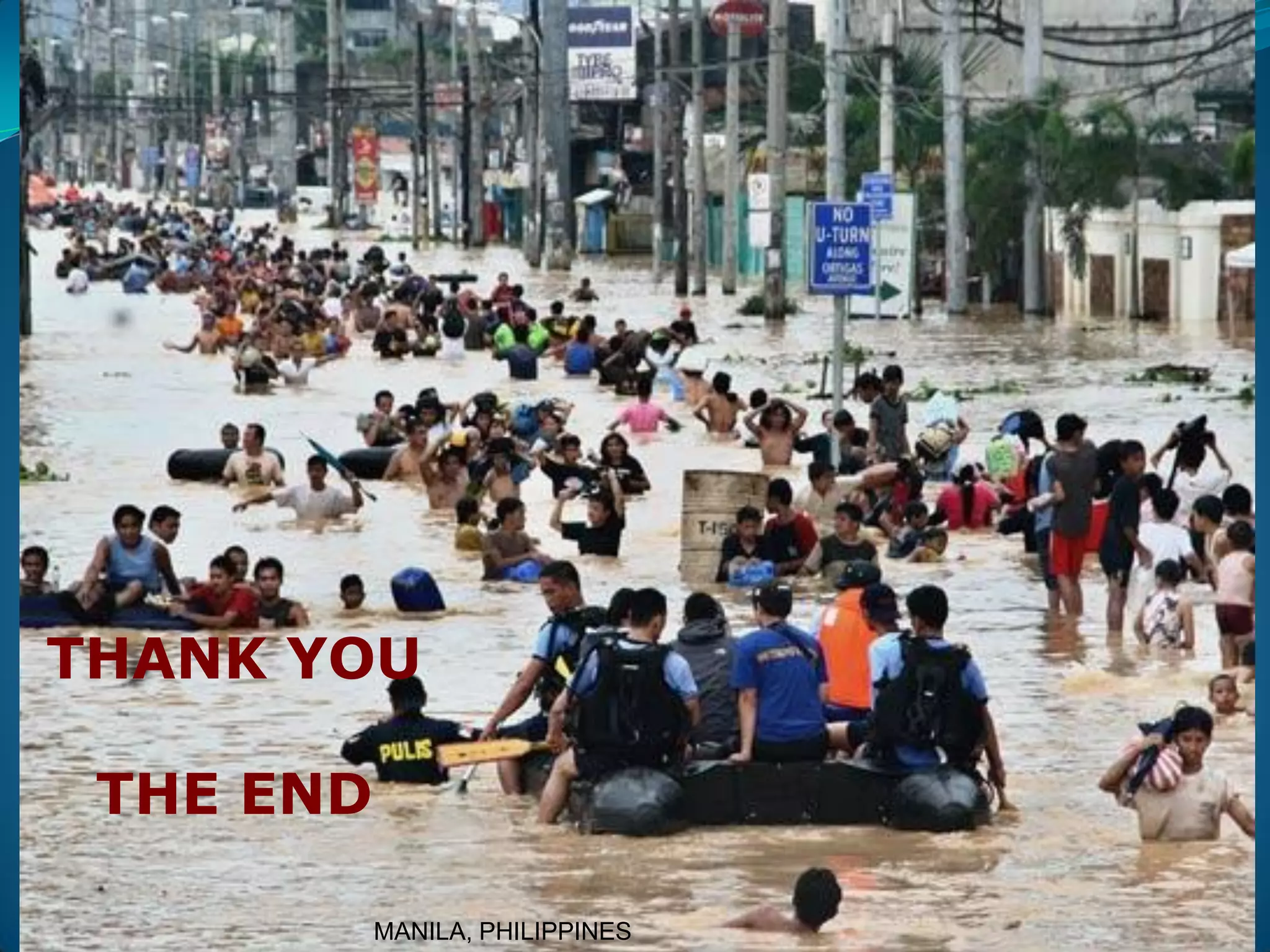
THANK YOU
THE END
MANILA, PHILIPPINES

Concept of flood risk (1)

  • 1.
    A Framework for FloodRisk Management An Introduction Dr John Porter
  • 2.
    A good placeto start if we want to prepare a strategic framework for managing flood risk is to define flood risk. What is flood risk? There is no one definition of flood risk, but one that proves very useful for a strategic framework is RISK = HAZARD x EXPOSURE x VULNERABILITY
  • 3.
    RISK = HAZARDx EXPOSURE x VULNERABILITY Hazard is a potential for harm, loss or damage. Hazard exists wherever land is liable to flooding. Hazard increases with probability and depth of inundation, and with velocity of flow. RISK = HAZARD x EXPOSURE x VULNERABILITY Hazard is a potential for harm, loss or damage. Hazard exists wherever land is liable to flooding. Hazard increases with probability and depth of inundation, and with velocity of flow. VISTULA RIVER, POLAND
  • 4.
    RISK = HAZARDx EXPOSURE x VULNERABILITY Exposure Even where a hazard exists, there is no risk unless there are assets that can be damaged, or there is danger because people live in, work in, or simply transit through the location of flood hazard. Exposure to flood hazard creates the potential for personal danger or property damage to occur during floods. BRISBANE, AUSTRALIA
  • 5.
    RISK = HAZARDx EXPOSURE x VULNERABILITY The consequences of flooding – and therefore the risk – also depends on how vulnerable people and their assets are to danger and damage. Vulnerability can be reduced if people and authorities:  take appropriate precautions in advance of flooding,  know what to do to limit danger and damage during floods, and  receive adequate warning and appropriate assistance during and after floods. FUZHOU, CHINA
  • 6.
    Defining flood riskas RISK = HAZARD x EXPOSURE x VULNERABILITY is very useful because the measures we use in flood management can be regarded as modifying (reducing) one of these 3 key elements of risk. MODIFYING HAZARD Flood control dams Detention basins Levees or dikes Flood diversion channels River channel improvements Upper watershed management MODIFYING EXPOSURE Zoning of land use Property acquisition Planning development controls Building codes Flood-proofing buildings Building on platforms or stilts MODIFYING VULNERABILITY Flood monitoring and warning Flood forecasting Emergency response plans Community awareness Community preparedness Post-flood recovery & reconstruction Flood insurance STRUCTURAL NON-STRUCTURAL
  • 7.
    This involves landmanagement in addition to water management. In normal circumstances there is a clear division between water and land. Water is contained within rivers, lakes and other water bodies. During floods, the water regime expands to temporarily inundate land which – most of the time – can be used for productive purposes. Therefore, unlike other aspects of water resources management, flood risk management must embrace both land use management and water management. RISK = HAZARD x EXPOSURE x VULNERABILITY NOTE ABOUT Exposure to Flood Hazard
  • 8.
    NOTE ABOUT Vulnerability Manyhave identified that communities are more vulnerable to flood risk if there is greater poverty, in communities with low standards of education, and in societies with poor governance. RISK = HAZARD x EXPOSURE x VULNERABILITY INDUS RIVER, PAKISTAN
  • 9.
    Vulnerability or susceptibility Thisis true. Programs aimed at reducing poverty and improving education and political governance will reduce vulnerability and flood risk. However, we can introduce a new category for these issues and regard them as issues of Susceptibility rather than Vulnerability. They are different because they deal with the ills of society as a whole, are less specific to flood risk as they affect many other aspects of community life too. And in that sense, although they are relevant to management of flood risk, they are not proper undertakings for flood risk management alone. RISK = HAZARD x EXPOSURE x VULNERABILITY
  • 10.
    Comprehensive flood riskmanagement must therefore consider treatment of all three elements of flood risk: HAZARD EXPOSURE VULNERABILITY
  • 11.
    Consideration of floodrisk as the product of Hazard x Exposure x Vulnerability only deals with what we do to manage flood risk. A strategic framework for flood risk management must also consider how we organize and how we plan for management of flood risk. It should also consider the impacts of what we do on the environment and the community. Therefore, other important dimensions of a strategic management framework are:  INSTITITIONAL FOUNDATION  PLANNING METHODOLOGY or STRUCTURE  EXOGENOUS IMPACTS (social & environmental)
  • 12.
  • 13.
    INSTITUTIONAL FOUNDATION Typically, responsibilities relevantto flood management are fragmented between multiple government agencies. Effec tive partners hip betw een agenc ies dir ec ted tow ar d c oor dinated management of flood ris k is one of the gr eates t ins titutional c hallenges . WROCLAW, POLAND
  • 14.
    PLANNING METHODOLOGY A wellstructured method is recommended to capture the strengths of integrated flood manage-ment through:  rigorous technical analysis,  comprehensive assessment of planning options,  appraisals based on the triple bottom line of sustainable development (economic viability, social equity and environmental acceptability),  benefit-cost analysis and  stakeholder participation.
  • 15.
    CONSULTATIONPROCESS PRELIMINARY PHASE Identify &Quantify Flood Risk estimate hydrological risk hydraulic model analysis map existing flood hazard & land use TECHNICAL ANALYSIS Identify Alternative Flood Management Options combinations of structural & non-structural measures evaluate future risk consider how to manage residual risk Appraisal of Impacts economic analysis tangible & intangible social benefits / disbenefits environment – adverse impacts & opportunities robustness, resilience to future uncertainty APPRAISAL PHASE Recommend Preferred Option refine analysis; examine assumptions document plan FLOOD MANAGEMENT PLAN APPROVAL IMPLEMENTATION Define Management Objectives collect data Understand Planning Context population characteristics property & infrastructure institutional arrangements planning instruments PLANNING METHODOLOGY
  • 16.
    PLANNING METHODOLOGY PLANNING component ofthe framework  Structured Planning Method o Definition of management objectives – start with desired outcomes, not a proposed solution o Understanding of the planning context – consider pre- existing plans & local factors o Identification & quantification of flood risk: technical analyses o Identification & consideration of alternative ways to manage the flood risk – different options comprising packages of FM measures o Appraisal of impacts – economic, social & environmental benefits & costs o Recommendation of a preferred option – refinement of solutions; closer examination of assumptions; documentation o Stakeholder participation – opportunity for consultation at each step of the process
  • 17.
    PLANNING METHODOLOGY RIVER BASINMASTER PLANS SUB-BASIN MASTER PLANS e.g. - tributaries - river reaches (over several local govt jurisdictions) - lake / wetland complexes URBAN DRAINAGE MASTER PLANS for internal drainage of cities to mitigate urban flooding RURAL DRAINAGE MASTER PLANS to mitigate waterlogging of agricultural land PROJECT PLANNING to mitigate specific flooding problems, either at single or joint local government scale
  • 18.
    EXOGENOUS IMPACTS SAFEGUARDS & SUSTAINABILITY Socialimpacts may be positive or negative, and attention must be directed during planning and design to avoid or mitigate adverse impacts, and enhance beneficial outcomes. In particular, impacts on those displaced or resettled, on indigenous groups, on the disabled, aged or infirm, or on gender groups need to be examined and assessed. Environmental impacts may include unintentional but foreseeable impacts on the physical environment, or on the biosphere.
  • 19.
    EXOGENOUS IMPACTS Safeguards:  Environmental protectionsafeguards  Location and storage of hazardous materials  Involuntary resettlement social safeguards  Indigenous peoples’ social safeguards  Assessments of the social implications for gender (women’s issues)  Assessments of social implications for disabled, infirm or disadvantaged persons  Locations of strategic community services
  • 20.
    INSTITUTIONAL FOUNDATION PLANNING FLOOD HAZARD EXPOSURE VULNERABILITY FloodControl Works Structural planning & design Asset maintenance: monitoring condition rehabilitation /upgrading funding Operations: decision support systems communications systems data acquisition networks integration with WR management env.management Catchment Management Soil conservation Upland land use management Land Use Management flood hazard zoning land use planning controls property acquisitions resettlement Flood forecasting hydrological models hydraulic models & DTMs flood hazard maps data acquisition networks Flood warning & emergency response communications systems preparedness exercises decision support systems Post-flood recovery support services: health, counseling material support: food, shelter infrastructure repairs financial assistance & incentives compensation / flood insurance Land Use Management building regulations River basin master plans Project proposal planning & appraisal : risk assessment : appraisal of alternative options Planning for emergency response Planning for post-flood recovery Urban drainage master plans Rural drainage master plans Partnerships: across levels of government Restructuring: enhancing coordination between different levels of government Legislation: clarifying mandates Training / awareness / capacity building
  • 21.
  • 22.
    Key requirements tomake it effective are LEGISLATION THAT CLEARLY DELEGATES ROLES AND RESPONSIBILITIES A KEY COORDINATION ROLE MANDATED FOR ONE LEAD AGENCY IN FLOOD RISK MANAGEMENT (or DISASTER RISK MANAGEMENT) WITH STRONG POWERS TO OBLIGE PARTICIPATION BY ALL STAKEHOLDERS IN JOINT PLANNING BROADER STAKEHOLDER PARTICIPATION THROUGH COMMUNITY CONSULTATION DURING THE PLANNING PROCESS There is the strategic framework for flood risk management. A sound institutional foundation is of crucial importance.
  • 23.