BABOK® v3 Demystified
Webinar Series
Chapter: Chennai IIBA® Chapter
Date & Time: 25-Oct-16 | 7:30 to 8:30 PM IST
Topic: Concept Modelling
Presenter: Mohan Kumar Subramani, CBAP®
2
Insert Footer
Concept Modelling
• A concept model is used to organize the business vocabulary
needed to consistently and thoroughly communicate the
knowledge of a domain
• Concept models put a premium on high-quality, design-
independent definitions that are free of data or implementation
biases
• A concept model identifies the correct choice of terms to use in
communications, including all business analysis information
3
Insert Footer
Concept Modelling
Concept models can be effective where:
• The enterprise seeks to organize, retain, build-on, manage, and
communicate core knowledge
• The initiative needs to capture large numbers of business rules
• There is resistance from stakeholders about the perceived
technical nature of data models, class diagrams, or data element
nomenclature and definition
4
Insert Footer
Concept Modelling
Concept models can be effective where:
• Innovative solutions are sought when re-engineering business
processes or other aspects of business capability
• The enterprise faces regulatory or compliance challenges
5
Insert Footer
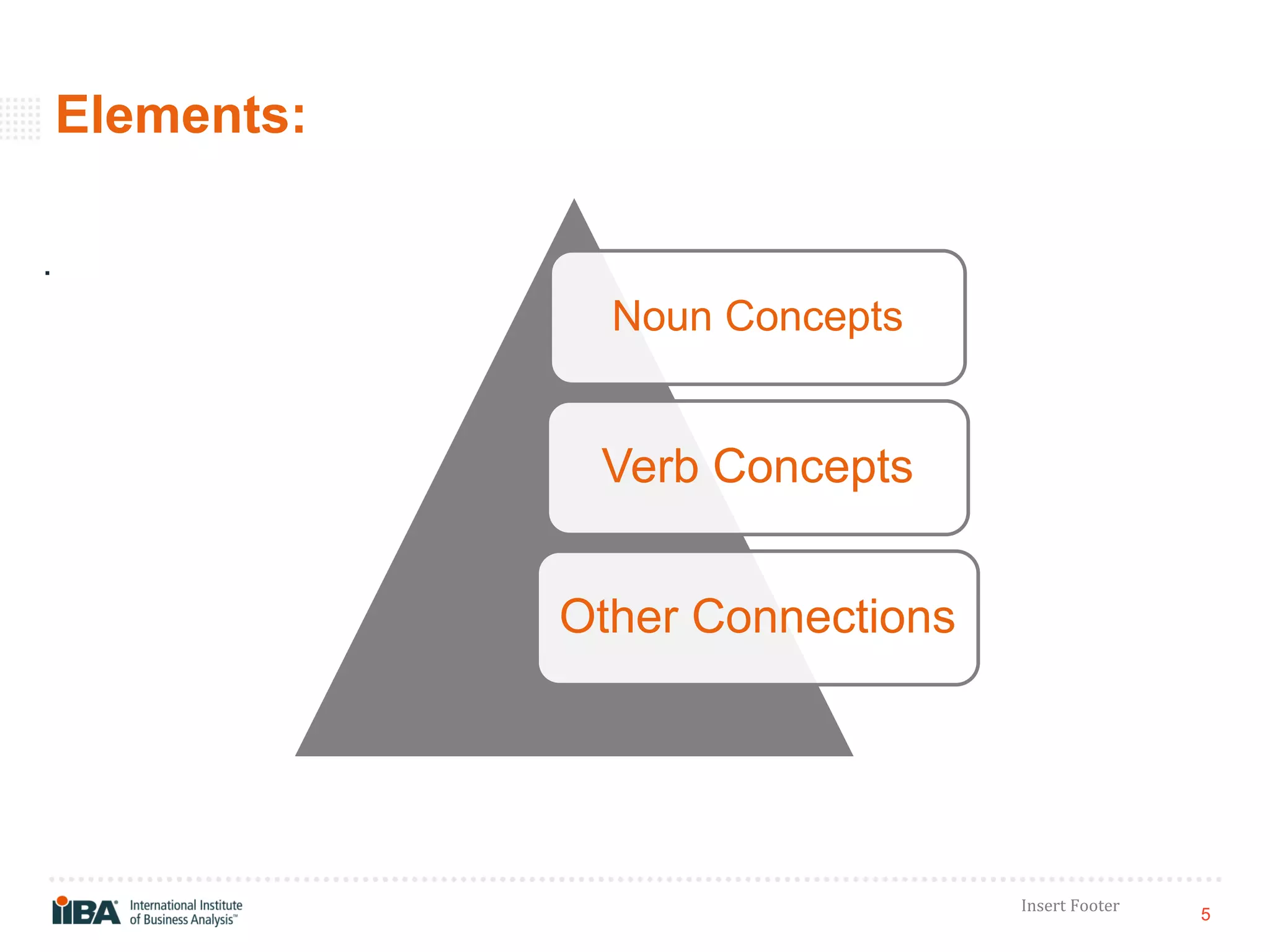
Elements:
.
Noun Concepts
Verb Concepts
Other Connections
6
Insert Footer
Elements: Noun Concepts
• The most basic concepts in a concept model are the noun concepts of the
domain, which are simply ‘givens’ for the space
7
Insert Footer
Elements: Verb Concepts
• Verb concepts provide basic structural connections between noun
concepts
• These verb concepts are given standard wordings, so they can be
referenced unambiguously
• Sometimes verb concepts are derived, inferred, or computed by
definitional rules
• This is how new knowledge or information is built up from more basic
facts.
8
Insert Footer
Elements: Other Connections
• Concept models must support rich meaning (semantics), other types of
standard connections are used besides verb concepts.
These include but are not limited to:
• Categorizations
• Classifications
• Partitive (whole-part) connections
• Roles
9
Insert Footer
Strengths
• Provide a business-friendly way to communicate with
stakeholders about precise meanings and subtle distinctions
• Is independent of data design biases and the often limited
business vocabulary
• Proves highly useful for white-collar, knowledge-rich, decision-
laden business processes
• Helps ensure that large numbers of business rules and complex
decision tables are free of ambiguity and fit together cohesively
10
Insert Footer
Limitations
• May set expectations too high about how much integration based
on business semantics can be achieved on relatively short notice
• Requires a specialized skill set based on the ability to think
abstractly and non-procedurally about know-how and knowledge
• The knowledge-and-rule focus may be foreign to stakeholders
• Requires tooling to actively support real-time use of standard
business terminology in writing business rules, requirements, and
other forms of business communication
11
Insert Footer
About Fhyzics
Fhyzics, a leader in Business Analysis Services and Training, is an
Endorsed Education Provider [EEPTM] of International Institute of
Business Analysis [IIBA®], Canada.
www.fhyzics.com
For more details about our course, please speak to Bharathi at
+91-900-305-9000
12
Insert Footer
Next Webinar: Data Mining
24-November-2016 [Thursday]
13
Insert Footer
14
Insert Footer
Thank You
Webinar Platform
Compliments from
Fhyzics Business Consultants Private Limited
Presented By
Mr. Mohan Kumar Subramani, CBAP®
Business Analysis Faculty

Concept modelling

  • 1.
    BABOK® v3 Demystified WebinarSeries Chapter: Chennai IIBA® Chapter Date & Time: 25-Oct-16 | 7:30 to 8:30 PM IST Topic: Concept Modelling Presenter: Mohan Kumar Subramani, CBAP®
  • 2.
    2 Insert Footer Concept Modelling •A concept model is used to organize the business vocabulary needed to consistently and thoroughly communicate the knowledge of a domain • Concept models put a premium on high-quality, design- independent definitions that are free of data or implementation biases • A concept model identifies the correct choice of terms to use in communications, including all business analysis information
  • 3.
    3 Insert Footer Concept Modelling Conceptmodels can be effective where: • The enterprise seeks to organize, retain, build-on, manage, and communicate core knowledge • The initiative needs to capture large numbers of business rules • There is resistance from stakeholders about the perceived technical nature of data models, class diagrams, or data element nomenclature and definition
  • 4.
    4 Insert Footer Concept Modelling Conceptmodels can be effective where: • Innovative solutions are sought when re-engineering business processes or other aspects of business capability • The enterprise faces regulatory or compliance challenges
  • 5.
  • 6.
    6 Insert Footer Elements: NounConcepts • The most basic concepts in a concept model are the noun concepts of the domain, which are simply ‘givens’ for the space
  • 7.
    7 Insert Footer Elements: VerbConcepts • Verb concepts provide basic structural connections between noun concepts • These verb concepts are given standard wordings, so they can be referenced unambiguously • Sometimes verb concepts are derived, inferred, or computed by definitional rules • This is how new knowledge or information is built up from more basic facts.
  • 8.
    8 Insert Footer Elements: OtherConnections • Concept models must support rich meaning (semantics), other types of standard connections are used besides verb concepts. These include but are not limited to: • Categorizations • Classifications • Partitive (whole-part) connections • Roles
  • 9.
    9 Insert Footer Strengths • Providea business-friendly way to communicate with stakeholders about precise meanings and subtle distinctions • Is independent of data design biases and the often limited business vocabulary • Proves highly useful for white-collar, knowledge-rich, decision- laden business processes • Helps ensure that large numbers of business rules and complex decision tables are free of ambiguity and fit together cohesively
  • 10.
    10 Insert Footer Limitations • Mayset expectations too high about how much integration based on business semantics can be achieved on relatively short notice • Requires a specialized skill set based on the ability to think abstractly and non-procedurally about know-how and knowledge • The knowledge-and-rule focus may be foreign to stakeholders • Requires tooling to actively support real-time use of standard business terminology in writing business rules, requirements, and other forms of business communication
  • 11.
    11 Insert Footer About Fhyzics Fhyzics,a leader in Business Analysis Services and Training, is an Endorsed Education Provider [EEPTM] of International Institute of Business Analysis [IIBA®], Canada. www.fhyzics.com For more details about our course, please speak to Bharathi at +91-900-305-9000
  • 12.
    12 Insert Footer Next Webinar:Data Mining 24-November-2016 [Thursday]
  • 13.
  • 14.
    14 Insert Footer Thank You WebinarPlatform Compliments from Fhyzics Business Consultants Private Limited Presented By Mr. Mohan Kumar Subramani, CBAP® Business Analysis Faculty